HOA President Secretly Charged Her Tesla From My Private Solar Grid for Weeks—Then I Locked Her Out and the System Logs Exposed Everything She’d Done.
PART3:
When rates increased, my bill remained low.
And when neighbors needed help, I helped.
That distinction matters.
One August evening, a transformer fault killed power to eleven houses for nearly six hours.
The outside temperature had been 113 degrees that afternoon.
My neighbors, George and Helen Miller, were both in their seventies.
Helen used refrigerated medication.
I ran an extension line from one of my protected emergency circuits.
Another neighbor, Mrs. Alvarez, had two grandchildren staying with her.
I powered two fans and her refrigerator.
Nobody paid me.
Nobody signed paperwork.
Nobody declared my solar panels a neighborhood utility.
People needed help.
I had capacity.
I helped.
Simple.
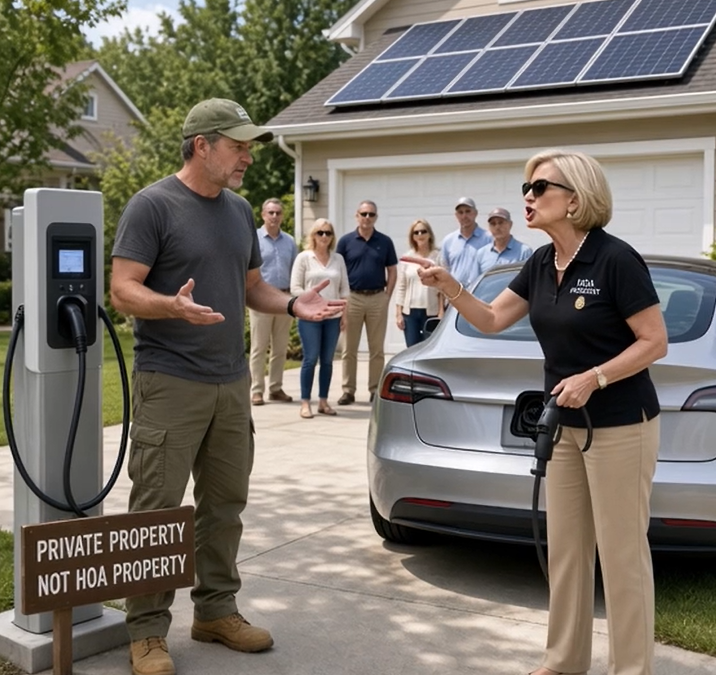
Beside my driveway, I had installed a Level 2 electric-vehicle charging station.
I did not own a Tesla.
My pickup had a small auxiliary battery system for tools and field equipment, but the EV charger was mostly for visitors.
My brother owned an electric car.
A colleague drove a Nissan Leaf.
A friend from Tucson had a Rivian.
The charger was convenient.
Most importantly, it was connected entirely behind my private system.
No HOA wiring.
No community circuit.
No shared meter.
No public pedestal.
Electricity went:
sunlight,
panels,
inverter,
battery bus,
charger.
Mine.
For six months, nobody cared.
Then Diane Mercer noticed it.
Diane was HOA president.
Forty-six.
Real-estate broker.
White Tesla Model Y.
Perfect blond bob.
Perfect nails.
Perfect ability to turn any inconvenience into an agenda item.
She had been president for two years when I moved in.
At first, I thought she was merely enthusiastic.
She organized landscaping.
Negotiated pool maintenance.
Ran neighborhood meetings with printed agendas and little nameplates.
She knew everybody’s house number.
She remembered whose trash cans were visible after collection day.
People joked about it.
“Diane sees everything.”
They laughed.
They should not have.
Her first interaction with me concerned solar panels.
Not because they were prohibited.
Arizona developments had learned years earlier that outright solar bans were a difficult fight.
Instead, Diane questioned aesthetics.
“Daniel, the southern array is visible from the east walking path.”
“Yes.”
“Have you considered a parapet?”
“No.”
“It might improve visual consistency.”
“It would shade the panels.”
“We are trying to maintain architectural cohesion.”
“I am trying to generate electricity.”
She did not smile.
“The two are not mutually exclusive.”
“In this case, they may be.”
She sent an architectural-review letter.
I responded with city permit, HOA solar guidelines, and the engineer’s shadow analysis.
The committee approved.
Diane never mentioned it again.
Not then.
The first unauthorized charging session happened on a Wednesday.
I discovered it because I am an engineer and engineers tend to look at data that normal people sensibly ignore.
At 6:15 every morning, while coffee brewed, I checked the system dashboard.
Not because necessary.
Because I enjoyed it.
That Wednesday the overnight load curve looked wrong.
House baseline should have been around 0.8 to 1.2 kilowatts.
Refrigerator.
Network.
Air handler cycling.
Battery management.
Instead, beginning at 12:43 a.m., demand jumped to 9.6 kilowatts.
Held.
Then tapered.
Ended at 2:17.
Approximately thirteen kilowatt-hours drawn.
I assumed software issue.
Checked inverter logs.
No.
Actual output.
Checked garage circuits.
Nothing.
Then EVSE log.
Session started 12:43:12.
Vehicle connected.
Charging complete 2:16:49.
Energy delivered:
13.2 kWh.
I stared.
I had not had a guest.
Maybe my brother stopped by?
No.
At 12:43?
No chance.
I checked driveway camera.
There it was.
White Tesla.
Diane.
She pulled into my driveway at 12:41.
Lights off before stopping.
That detail caught me.
She got out.
Walked directly to charger.
Removed connector.
Plugged into her Tesla.
Then sat inside car.
At 2:17, she unplugged.
Returned cable neatly.
Drove away.
I watched twice.
Not because unclear.
Because audacity occasionally requires replay.
I could have called her immediately.
Instead I sent a text at 7:10.
Diane, did you charge your Tesla at my house last night?
Three dots appeared.
Stopped.
Appeared again.
Then:
Yes. I hope that’s okay. My home charger was having issues and I only needed a little.
I replied:
Please ask next time. That charger is private.
She responded with a thumbs-up.
I thought done.
The next night:
nothing.
Friday:
nothing.
Saturday at 1:06 a.m.:
Tesla.
This time 18.7 kWh.
I watched footage in the morning.
She looked toward my house before plugging in.
Not accidental.
I texted:
Diane, I asked you not to use the charger without permission.
She replied:
I thought you said to ask next time, not that access was prohibited.
I stared.
Then:
You did not ask.
Her:
It was late. I didn’t want to wake you.
Me:
Then do not use it.
No response.
I added an access lock in software.
The charger already supported authentication.
I had never enabled because my driveway was private and people generally did not steal electricity.
I generated RFID tags for approved users.
My brother.
Two friends.
Me.
Unauthorized connection would not energize.
Problem solved.
For forty-eight hours.
Then Monday at 5:37 p.m., Diane knocked.
I opened.
She wore workout clothes and sunglasses perched on her head.
“Did you change the charger?”
“Yes.”
“My car won’t connect.”
“That is what the change does.”
She stared.
“Why?”
“Because you kept using it without permission.”
“I used it twice.”
“Correct.”
“Daniel, we live in a community.”
“Yes.”
“People share resources.”
“When they offer.”
“I assumed you installed it partly as an emergency amenity.”
“You assumed incorrectly.”
She folded arms.
“You supplied electricity during the outage.”
“To two specific neighbors.”
“So you have precedent.”
There was that word.
“Precedent.”
“Yes.”
“You think helping Helen keep medication cold gives you a legal right to charge your Tesla?”
“I didn’t say legal right.”
“You’re standing at my door because I disabled access.”
“I’m asking for neighborly cooperation.”
“No.”
She blinked.
Not because word complicated.
Because she disliked hearing it.
“Why not?”
“Because it’s my electricity.”
“You aren’t paying utility rates for it.”
That sentence told me a lot.
“What difference does that make?”
“You generate surplus.”
“Sometimes.”
“So the marginal cost is negligible.”
I laughed.
That offended her.
“Diane.”
“Yes?”
“My panels cost money.”
“My batteries cost money.”
“The charger cost money.”
“Battery cycles have value.”
“Equipment has finite life.”
“And even if every electron were completely free, ownership would still be mine.”
“You are being unnecessarily rigid.”
“I’m being specific.”
“I thought engineers appreciated efficiency.”
“We do.”
“Then letting unused solar capacity charge a neighborhood vehicle is efficient.”
“I don’t want to.”
Her mouth tightened.
“That isn’t very community-minded.”
“No.”
“It is very property-minded.”
She left.
I should have realized she would interpret refusal as challenge.
Three days later, I received an HOA notice.
SUBJECT: COMMUNITY ENERGY ACCESS POLICY — IMMEDIATE EFFECT.
I read it twice.
Then laughed.
Then stopped laughing.
The board had adopted what Diane called the Emergency Sustainability and Shared Resource Resolution.
Section 4 stated:
Privately owned renewable-energy infrastructure with accessible exterior connection points may be designated a community resilience resource during periods of elevated utility demand, emergency conditions, charging disruption, or grid instability.
Section 5:
Reasonable access shall not be unreasonably withheld from residents when excess capacity is available.
Section 6:
Physical or electronic obstruction of a designated resilience resource may constitute interference with HOA emergency-preparedness objectives.
At the bottom:
My address.
DESIGNATED RESOURCE: EV CHARGING POINT.
I called HOA office.
Receptionist, Marla, answered.
“Did board vote on this?”
“Yes.”
“When?”
“Yesterday.”
“Notice?”
“It was an emergency session.”
“Minutes?”
“Pending.”
“Who declared an emergency?”
“President Mercer.”
“What emergency?”
“Regional grid stress.”
The public grid was functioning normally.
I called Diane.
“You created a rule for my charger.”
“It applies to all qualifying renewable resources.”
“How many qualifying exterior EV chargers exist?”
Pause.
“Currently yours.”
“So you created a rule for my charger.”
“It is technology-neutral.”
“Do you believe the HOA owns my electricity?”
“No.”
“Then how can you require access?”
“The association regulates exterior uses affecting community resilience.”
“That sentence means nothing.”
“It means you cannot monopolize excess capacity during a recognized energy event.”
“What recognized event?”
“Peak-demand conditions.”
“Who recognizes?”
“The board.”
“You.”
“The board.”
“Was anybody besides you present?”
Silence.
I smiled.
“Send minutes.”
“You’ll receive through normal process.”
Then:
“If you continue locking residents out, fines may accrue.”
“How much?”
“Two hundred fifty dollars per incident.”
“Per incident of somebody trying to take electricity?”
“Per unreasonable access denial.”
“Good luck.”
She hung up.
That afternoon I called my attorney.
Maria Lopez.
Property and municipal law.
She read resolution.
“Cute.”
“That’s your legal analysis?”
“I have longer version.”
“I prefer cute.”
She continued:
“First, association may regulate common property and valid covenant matters.”
“Yes.”
“Second, it cannot convert private utility infrastructure into shared property simply by passing resolution.”
“Good.”
“Third, we need your declarations.”
I sent.
No clause regarding community access to private electrical systems.
No energy easement.
No emergency-use rights.
Nothing.
Maria sent cease-and-desist.
She also advised:
“Do not disable somebody’s car.”
“I can disable charger.”
“Yes.”
“Not car.”
“Obviously.”
“Daniel.”
“I know.”
“Engineers sometimes get creative.”
“I’m not booby-trapping anything.”
“Good.”
That point mattered.
I did not design anything to damage Diane’s Tesla.
I did not lock the connector into the vehicle permanently.
I did not alter voltage.
I did not interfere with her electronics.
I simply configured my charger the way millions of private chargers can be configured:
authorized users only.
If an unauthorized vehicle connected, the charger remained off and logged the attempt.
That was all.
Then Diane started using a trick.
The charger had a manual emergency override behind a locked utility panel.
Not for customers.
For service.
Somehow she learned about it.
One night at 12:22, camera recorded her entering my driveway.
She plugged in.
Denied.
She walked around unit.
Opened side cover.
How?
The service latch had been forced.
No significant damage.
She found manual restart.
The charger energized in service mode.
I woke at 1:10 because my phone alert showed unexpected load.
I opened dashboard.
Vehicle charging.
I opened camera.
Diane.
I walked outside.
Garage lights came on automatically.
She jumped.
I stood ten feet away.
“Unplug.”
She looked at me.
“Daniel.”
“Unplug.”
“This is becoming ridiculous.”
“You opened a locked service panel.”
“It was not locked.”
“It was.”
“No damage.”
“That is not answer.”
She unplugged.
Then:
“The HOA has designated this infrastructure for shared access.”
“My lawyer told your board that designation has no authority.”
“Our counsel disagrees.”
“Then have counsel send opinion.”
“You cannot retaliate against residents.”
“Get off my property.”
She stood.
For a second I wondered if she would refuse.
Then she walked to Tesla.
Before entering:
“You are creating a very expensive problem for yourself.”
I said:
“No.”
“You are.”
She drove away.
At 7:00 the next morning I photographed the panel.
Tool marks.
Broken latch.
Camera footage.
Charger logs.
Energy delivered:
6.4 kWh.
I filed non-emergency police report for unauthorized property access and tampering.
Not because six kilowatt-hours would bankrupt me.
Because pattern had changed.
She was now defeating physical access control.
Officer Nolan arrived.
Reviewed video.
“That’s HOA president?”
“Yes.”
“She lives four houses over?”
“Yes.”
“This is about electricity?”
“Yes.”
He looked at charger.
Then me.
“People are weird.”
“Correct.”
He took report.
I sent Diane one final written notice by certified mail and email.
You do not have permission to enter my property or use, open, manipulate, connect to, or access any portion of my solar, battery, or EV charging system. Any future access will be treated as knowing trespass and unauthorized use.
Maria approved wording.
Diane signed certified delivery.
Then fined me $1,000.
Four “access denial” incidents.
I appealed.
Board hearing scheduled.
Before hearing, I started reviewing system history.
Not because necessary to prove three known sessions.
Because I had a feeling.
I exported six months of EVSE logs.
Each session had:
Start time.
End time.
Energy.
Authorization mode.
Device identifier.
Vehicle handshake ID.
Faults.
Location status.
Then I filtered unknown device ID.
My coffee got cold.
There were twenty-one sessions.
Not three.
Twenty-one.
The earliest began three weeks before the first night I noticed.
Diane had been using my charger almost nightly on certain days.
Some sessions tiny.
5 kWh.
Others 20.
One 31.4.
Total:
286.7 kWh.
Again, money was not huge.
At retail residential rates, maybe tens of dollars.
But batteries.
Equipment.
Trespass.
And most importantly:
She had lied.
She told me she used it twice.
Data showed twenty-one sessions.
I pulled camera archive.
Older footage automatically retained thirty days.
Enough.
White Tesla.
Repeated.
Usually between midnight and 3:00.
Lights off approaching several times.
Sometimes she parked on street first and walked over with car later? Actually vehicle must be near charger. Better: she rolled in quietly.
One night she wore a hoodie.
I wish I were exaggerating.
She lived four houses away and put on hoodie to steal solar electricity worth maybe four dollars.
This was not economic need.
Her house had functioning charger.
I verified indirectly later.
It was entitlement.
Or thrill.
Or refusal to pay.
Maybe all.
Then I found something stranger.
My system logged a second device identifier.
Not Tesla.
Another EV.
Four sessions.
Security footage:
HOA treasurer, Mark Ellison.
Blue Ford Mustang Mach-E.
He charged at 11:50 p.m. twice.
Once 4:30 a.m.
Once 1:12 a.m.
I knew Mark slightly.
Quiet man.
Accountant.
I emailed:
Mark, did Diane give you permission to use my charger?
He called within five minutes.
“She said HOA had an arrangement with you.”
“No.”
Silence.
“She told me it was a community charger.”
“It never was.”
“Oh.”
“How many times?”
“Three.”
Logs showed four.
He corrected after checking.
“Four.”
“Did she charge too?”
Pause.
“Sometimes.”
“How long has she been telling people this?”
“I don’t know.”
“Who else?”
“I only know me.”
He sounded genuinely shaken.
“I’ll pay you.”
“This isn’t about money.”
“I know.”
“Do you?”
“Yes.”
He exhaled.
“Daniel, I’m sorry.”
“Send me an email explaining exactly what Diane told you.”
Silence.
Then:
“I need to think.”
“Fine.”
An hour later it arrived.
Diane had told him the charger was part of an “informal neighborhood resilience pilot.”
She said I had agreed to provide excess solar overnight and that HOA would formalize later.
That was before the emergency resolution.
Meaning she invented permission first.
Then created rule after I objected.
Sequence mattered.
I sent everything to Maria.
She called.
“This is getting better.”
“For whom?”
“For evidence.”
“Bad for my faith in neighbors.”
“That I don’t bill.”
Then she asked:
“Any HOA account payments to you?”
“No.”
“Energy reimbursements?”
“No.”
“Written agreement?”
“No.”
“Board approval before use?”
“Apparently not.”
“Good.”
At appeal hearing, community room held maybe thirty residents.
Diane sat at center table.
Mark Ellison sat two seats away.
Would not look at her.
Two other board members.
Secretary Rachel Kim—not related to any prior fictional characters, just common surname; perhaps use Rachel Benson to avoid confusion. Let’s call her Rachel Benson.
Rachel Benson.
Vice President Gerald Price.
Diane opened.
“This hearing concerns repeated refusal to comply with community energy-access standards.”
I sat with Maria.
Diane continued:
“Mr. Reed has benefited from neighborhood infrastructure and community protections while refusing reasonable reciprocal access to renewable resources.”
Maria whispered:
“She loves nouns.”
I nearly laughed.
Diane displayed resolution.
Then photographs of my panels.
Then a slide:
COMMUNITY RESILIENCE REQUIRES SHARED RESPONSIBILITY.
I was impressed by branding.
She claimed Phoenix-area grid stress justified neighborhood-level energy sharing.
Nobody had requested emergency support.
No outage.
No emergency.
Just Diane’s Tesla.
Maria spoke.
“Please identify recorded covenant provision authorizing HOA appropriation or compulsory use of privately owned electrical energy.”
Diane said:
“The board has broad health and safety authority.”
“Please identify provision.”
“Our counsel can address.”
“Is counsel here?”
“No.”
“Did counsel issue written opinion?”
“The board received guidance.”
“Produce it.”
“We are not here to litigate.”
Maria smiled.
“Then rescind fines.”
Diane refused.
Then I presented logs.
Not yet video.
Just data.
Twenty-one sessions.
286.7 kWh.
Device ID.
Dates.
I asked:
“Diane, how many times did you charge before I first contacted you?”
She stared at screen.
“I don’t recall.”
“You told me once.”
“I said I had used it.”
“You said you used it twice after second incident.”
“I may have been approximating.”
“Twenty-one is not an approximation of two.”
Murmur.
Diane said:
“Regardless, those sessions occurred when excess generation existed.”
That admission mattered.
Maria looked at me.
Then Diane.
“So you acknowledge the sessions?”
“I am not disputing vehicle access.”
“Did Daniel authorize them?”
“The charger was externally accessible.”
That was her answer.
Accessible.
A bicycle on a porch is accessible.
A hose beside a house is accessible.
An unlocked chair on patio is accessible.
Accessibility is not permission.
Maria asked:
“Did you ask?”
Diane paused.
“Not initially.”
“Did you know it was privately owned?”
“Yes.”
“Did you know it was connected to his solar and batteries?”
“Yes.”
“Did you pay?”
“No.”
“Did you inform him?”
“No.”
“Then after he told you to stop, did you continue?”
“I relied on board authority.”
“Before board passed resolution?”
Silence.
Maria projected timeline.
Unauthorized sessions began.
Daniel notices.
Daniel objects.
Diane continues.
Access locked.
Diane proposes emergency rule.
Board passes.
That order destroyed her narrative.
Then Mark raised hand.
Not normal board protocol.
Diane looked.
“Mark?”
He cleared throat.
“I need to correct record.”
Room quiet.
Diane’s face changed.
He read his email aloud.
“President Mercer told me Mr. Reed had agreed to make excess charging available as part of an informal resilience pilot.”
“That was before the board resolution.”
He looked at me.
“I used it four times based on that representation.”
Diane interrupted:
“Mark, we discussed concept—”
“No.”
He looked at her.
“You told me he agreed.”
“I believed—”
“You said he agreed.”
The room changed.
Not because electricity.
Because trust.
Diane started:
“There was an understanding—”
I said:
“Show it.”
No document.
No text.
No email.
No handshake.
Nothing.
Then I played video.
Diane arriving 12:43.
Again.
Another night.
Again.
Then service panel footage.
She opened side cover.
Used tool.
Maria paused image.
“Mrs. Mercer, after receiving direct notice that access was revoked, why did you open the charger service compartment?”
Diane said:
“The HOA resolution designated the charging point as shared infrastructure.”
“It is not HOA infrastructure.”
“It serves community function.”
“Who owns it?”
“Mr. Reed.”
“Who paid?”
“Mr. Reed.”
“Who insured?”
“Mr. Reed.”
“Who maintained?”
“Mr. Reed.”
“Whose property?”
“Mr. Reed.”
“Then what makes it shared infrastructure?”
“The board resolution.”
Maria leaned back.
“That is the issue.”
Gerald Price, vice president, spoke for first time.
“Diane.”
She looked.
“When did board vote to designate Daniel’s charger?”
“The emergency session.”
“Before that?”
“No.”
“Then what did you tell Mark?”
She stared.
Gerald looked sick.
“I voted because you said Daniel had previously offered charger as community backup.”
“He did during outage.”
I said:
“No.”
“I offered extension cords to two elderly neighbors.”
Gerald turned.
“That is what you meant?”
Diane:
“It demonstrated willingness.”
Gerald removed glasses.
“That is not what you said.”
Another crack.
Rachel Benson pulled minutes.
She read.
“President Mercer reports homeowner has established private renewable system and previously allowed neighborhood use, creating reasonable basis for shared emergency designation.”
I looked at Diane.
She had converted two emergency extension cords into legal foundation.
The fines were suspended pending counsel review.
Not rescinded yet.
Diane ended meeting abruptly.
Residents lingered.
Questions.
Mark apologized publicly.
Gerald asked Maria for copies.
Rachel requested logs.
I gave only through attorney.
Not because secrecy.
Because chain of evidence.
That night, Diane charged again.
Yes.
After hearing.
At 1:08 a.m.
She entered driveway.
Plugged in.
Authentication denied.
She opened service panel.
But I had upgraded.
No manual charging without local authorized PIN.
The display said:
ACCESS DENIED.
She tried twice.
Then something happened that later became exaggerated online.
Her Tesla “shut down in my driveway.”
People said I remotely disabled it.
False.
I had no ability to control her Tesla.
What actually happened was simpler.
She had arrived with very low battery.
Apparently expecting a full charge.
The Tesla showed insufficient range to comfortably return? She lived four houses away, so even 1% could return. Better: she deliberately parked and left it, then vehicle entered low-power state? “shut down” should be because battery nearly empty but within driveway. Yet a Tesla won’t brick from failing charge immediately. Need plausible. Maybe she had 0% and rolled in because she had been driving, then once charger refused, vehicle could not re-engage due low-voltage protection. Could happen but risky factual plausibility. Since fictional, but should grounded. We can instead say display refused to start and car showed 0 miles, requiring tow/service—not because I shut it down. Let’s phrase carefully.
Her battery estimate showed 0%.
She tried to drive.
The car refused to shift out of Park because the traction battery had reached protective reserve shutdown.
Not my doing.
Her planning.
She stood in driveway staring.
Then kicked my charging pedestal.
That set off tamper alarm.
Garage lights came on.
Cameras switched to event mode.
My phone woke me.
I watched live.
Diane pulled at service door.
Tried connector again.
Then walked toward garage side door.
She tested handle.
Locked.
Motion camera recorded.
At 1:16, I spoke through exterior speaker.
“Diane.”
She froze.
“Step away from the equipment.”
She looked toward camera.
“You locked me out.”
“Yes.”
“My car is dead.”
“That is not my fault.”
“I need power.”
“Call roadside assistance.”
“You are doing this intentionally.”
“I denied unauthorized use.”
“You knew I would come.”
“Yes.”
“You knew my car needed charging.”
“No.”
“You saw the state of charge.”
“I cannot see your vehicle battery until it negotiates charging, and it did not.”
“You could turn it on.”
“I will not.”
“This is an emergency.”
“No.”
“My vehicle is stranded.”
“Four houses from your home.”
She looked furious.
“I will call police.”
“Please.”
She did.
Officer Nolan returned.
Same officer from tampering report.
He pulled up.
Saw Tesla.
Saw Diane.
Saw me in slippers.
“Again?”
“Yes.”
Diane immediately:
“He disabled my vehicle.”
I corrected.
“I disabled access to my charger.”
Officer:
“Can you disable her car?”
“No.”
“Did you?”
“No.”
Diane:
“He knew it would shut down.”
“I knew unauthorized charging would fail.”
Nolan looked at Tesla screen through window.
Then charger.
“Ma’am, why did you enter his property after written trespass notice?”
“I have HOA authority.”
“HOA authority does not override trespass notice on his private driveway absent some legal right.”
“This charger is designated community infrastructure.”
Nolan looked at me.
“Is it?”
“No.”
“HOA pay for it?”
“No.”
“City?”
“No.”
“Utility?”
“No.”
He looked back.
“Then that’s civil argument.”
“And tonight?”
I asked.
Nolan’s face shifted.
“Tonight we have documented notice and prior report.”
He asked Diane:
“Did you know Mr. Reed told you not to enter?”
She refused answer initially.
Then:
“I dispute validity.”
“Did you know?”
“Yes.”
“Did you enter anyway?”
“Yes.”
“Did you manipulate his charging equipment?”
“I attempted to access community-designated charging.”
“That isn’t what I asked.”
Silence.
She received citation for trespass and tampering investigation referral.
Her Tesla was towed.
Not because I hacked.
Because roadside service moved a dead vehicle.
At 1:58 a.m., driveway empty.
I went back inside.
The next morning every screen in my garage had preserved event logs automatically.
Charger denied authorization.
Service-panel tamper sensor.
Camera motion.
Door-handle attempt.
Audio.
Network.
Timestamp.
Power state.
No energy delivered.
Exactly what a good monitoring system should do.
I called Maria.
She said:
“Don’t post anything.”
“I wasn’t.”
“Good.”
“People are going to ask.”
“Say matter documented.”
“That sounds like lawyer.”
“I am.”
Then:
“Also, Daniel?”
“Yes?”
“Very good job not ‘teaching her a lesson’ with electronics.”
“I know electricity.”
“Which is precisely why I worry.”
Fair.
By 9:00, Briarwood Facebook group already had Diane’s version.
HOA PRESIDENT STRANDED AFTER HOMEOWNER SABOTAGES COMMUNITY CHARGER.
She claimed:
I had intentionally configured system to “immobilize” her Tesla.
I refused emergency electricity.
I endangered her.
I interfered with board operations.
She called emergency HOA meeting for that evening.
That was when I stopped treating this as charger dispute.
I began asking what else Diane had done with HOA power.
Because people who invent one authority often invent others.
I downloaded public board minutes.
Requested financials.
Violation records not all accessible due privacy, but residents began contacting me.
Word spread.
Not because I encouraged.
Mark did.
He resigned as treasurer that morning.
His resignation email said:
I participated in charging at Daniel Reed’s property because President Mercer represented that owner consent existed. That representation was false. I cannot continue serving while the board defends a policy created after unauthorized use had already occurred.
That email went everywhere.
Residents started comparing stories.
Mrs. Alvarez:
Diane had ordered her to remove a portable battery backup from front-facing garage because it was “unregistered energy infrastructure.”
George Miller:
Diane tried adding $75 annual “solar equity assessment” to homes with rooftop panels.
It never passed.
A family with a Ford Lightning had been told they could not use vehicle-to-home backup during outage because “private energy export could destabilize neighborhood emergency planning.”
Nonsense.
Then Gerald Price sent me something.
Draft board resolution.
Authored by Diane six months earlier.
COMMUNITY RENEWABLE RESOURCE FRAMEWORK.
It proposed mandatory registration of private batteries, generators, EV chargers, and solar systems.
In declared emergencies, HOA would coordinate access.
Board rejected it 3–1.
Diane had tried before.
Lost.
Then after using my charger and being locked out, she introduced a narrower “emergency” version during a hastily called meeting with only three directors present.
Gerald said:
“I thought it applied only true emergencies.”
“Did you read?”
“Yes.”
“Did you know she was already charging?”
“No.”
“Did she disclose?”
“No.”
“Would you have voted yes?”
“No.”
Then Gerald sent another email.
Diane to board before emergency session:
Daniel Reed has historically shared power with residents and has now arbitrarily revoked access. Immediate board action is necessary to preserve established community resilience expectations.
Historically shared power.
Two extension cords.
That phrase became central.
Then financial records.
Diane had submitted HOA reimbursement requests for “community EV emergency transport.”
Three months.
Charging expenses at public stations.
$482.
Why if she was charging free at my house?
Mark, as treasurer, had approved because Diane said Tesla was used for HOA business during outages and neighborhood inspections.
There had been no outages those dates.
Mileage logs showed trips to:
HOA attorney.
Landscaper.
Pool supply.
And one Scottsdale restaurant.
Not criminal fortune.
But pattern.
Using HOA as extension of personal convenience.
Then something larger.
Diane had authorized installation of two “community resilience outlets” at clubhouse.
Cost:
$11,800.
Vendor:
Mercer Energy Solutions.
Owner:
her brother-in-law.
No competitive bids.
No conflict disclosure in minutes.
Gerald did not know relationship.
Rachel did not.
Mark said Diane called vendor “independent specialist.”
Now charger dispute looked like window into governance.
Maria warned:
“Do not accuse publicly until audit.”
I listened.
At emergency meeting, clubhouse was full.
Maybe eighty people.
More standing outside.
Diane sat front.
No Tesla.
Rental car.
She opened with accusation.
“Last night, homeowner Daniel Reed deliberately disabled emergency charging access in a manner that stranded a vehicle and endangered a resident.”
I raised hand.
She ignored.
Officer Nolan stood in back.
Off duty? Better he attended only if subpoena? Let’s not use police presence unless official. Instead residents had copy of incident number.
Diane continued:
“This illustrates why community oversight of private energy infrastructure is necessary.”
Then she proposed:
$5,000 fine.
Suspension of community privileges.
Legal action requiring charger access.
Emergency lien if unpaid.
I stood.
“You are proposing a lien on my house because I would not give you electricity after midnight.”
She banged gavel.
“You will wait for comment.”
Mark stood too.
“I resign.”
Murmur.
Diane:
“Mark, this is not—”
He walked front.
Placed printed statement.
“You told me Daniel agreed to community charging.”
Diane:
“There was established use.”
“You told me he agreed.”
“Mark—”
“I used his charger because of you.”
Then:
“You never disclosed your own use to board.”
Room erupted.
Gerald called:
“Point of order.”
Diane banged gavel.
Gerald continued:
“I move to table all enforcement against Daniel Reed pending independent legal review of association authority and investigation of representations made by president.”
Rachel seconded.
Diane said:
“You cannot make motion during president’s report.”
Gerald:
“Then end report.”
Applause.
She glared.
Eventually vote.
Gerald yes.
Rachel yes.
Replacement treasurer? Seat vacant.
Diane no.
Motion passed 2–1 under quorum? Three board members present after Mark resignation maybe quorum depending 5 seats and one vacancy. Let’s establish 4 active after Mark? Better: board had five: Diane, Gerald, Rachel, Mark, Evelyn Stone absent. Mark resigns effective after meeting? Then still votes? Could complicate. Let Mark remain through vote.
Mark said:
“My resignation effective after adjournment.”
Vote:
Gerald yes.
Rachel yes.
Mark yes.
Diane no.
Evelyn absent.
3–1.
All enforcement paused.
Diane’s face went white.
Then resident comments.
Mrs. Alvarez.
George Miller.
Others.
Questions about failed renewable framework.
Clubhouse vendor.
Brother-in-law.
Diane tried to control.
Couldn’t.
People had documents.
One resident, Kevin Moss, asked:
“Did you tell board Daniel gave you permission to charge?”
Diane:
“There was informal access.”
“Yes or no?”
“I understood access was available.”
“Did he say yes?”
Silence.
“Did you charge before asking?”
“Yes.”
“Twenty-one times?”
She stared.
I had not publicly given total.
Mark had.
Room exploded.
Diane snapped:
“Energy was surplus.”
Kevin:
“That’s not your electricity!”
That became the line.
Not price.
Not emergency.
Not HOA.
Ownership.
Diane tried to adjourn.
Gerald challenged.
Board voted to continue.
For first time in years, she did not control room.
I presented logs.
Not all.
Summary.
Dates.
Energy.
Video stills.
Final trespass notice.
No dramatics.
Then I said:
“I did not shut down Diane’s Tesla.”
“My equipment has no ability to do that.”
“I disabled unauthorized access to my charger.”
“She arrived with almost no charge remaining.”
“The vehicle entered its own protective shutdown.”
“Roadside assistance towed it.”
“That is documented.”
“I did not alter voltage.”
“I did not damage her car.”
“I did not trap connector.”
“I did not lock her vehicle.”
“The only thing I locked was my own charger.”
Quiet.
I continued.
“If Briarwood wants a shared charging station, build one.”
“Budget it.”
“Vote.”
“Pay.”
“Insure.”
“Maintain.”
“But you do not create one by deciding mine is convenient.”
Applause.
Diane stared straight ahead.
The independent attorney retained two days later gave board written opinion.
The HOA lacked authority to compel routine access to private electrical equipment.
Emergency police/fire entry was separate.
No covenant supported energy-sharing mandate.
Emergency resolution exceeded board authority as applied to my charger.
Fines void.
The attorney also flagged conflict-of-interest concerns regarding Mercer Energy Solutions.
An independent audit followed.
Not because I demanded.
Residents did.
What they found did not resemble movie embezzlement.
Diane had not stolen hundreds of thousands.
The reality was smaller and more believable.
And because smaller, it had survived longer.
Over three years:
$11,800 clubhouse resilience outlets awarded to brother-in-law without disclosure.
$7,400 landscape lighting contract to company co-owned by cousin.
$3,200 “emergency mobility reimbursement” including Tesla charging, tires, and detailing partially reimbursed as HOA operating expense.
$5,600 consultant fees paid to Diane’s real-estate office for “property-value impact analysis.”
No board vote documented.
Several violation fines selectively waived for clients who used her brokerage.
Others aggressively enforced against residents who challenged her.
Total questionable transactions:
a little over $31,000.
Not mansion money.
Enough.
But money was not what destroyed her.
Emails did.
Diane wrote constantly.
Confident people love documentation when they believe documentation proves competence.
One email to Mark:
If Daniel resists, we can formalize the access expectation through emergency authority. Once policy exists, his refusal becomes noncompliance rather than a private dispute.
That line appeared in audit packet.
Another:
Residents respond better when rules are presented as established rather than debated as optional.
Another:
We should avoid overloading board members with technical details regarding authority. Counsel can clean up language later.
That was catastrophic.
Gerald read it twice.
Then said at recall meeting:
“She believed our job was to approve her decisions after she made them.”
Yes.
Recall petition gained signatures rapidly.
Diane fought.
Of course.
She sent twelve-page letter.
Claimed audit politically motivated.
Claimed charger logs invaded privacy.
Claimed residents benefited from decisive leadership.
Some had.
Pool maintenance improved.
Property values had risen.
Landscaping looked good.
People can do useful things and abuse authority.
Both.
The recall meeting took place six weeks after the night her Tesla died.
Clubhouse could not fit crowd.
They rented a middle-school auditorium.
I almost did not go.
Maria said:
“You don’t need.”
George Miller said:
“You should see ending.”
I went.
Diane sat stage.
Board.
Independent counsel.
Auditor.
One hundred eighty residents.
The auditor summarized.
Conflicts.
No disclosures.
Unauthorized reimbursements.
Improper fines.
Renewable resolution.
My charger.
Nobody shouted initially.
Then questions.
A woman asked:
“Did you actually think Daniel’s power belonged to us?”
Diane replied:
“No.”
“Then why fine him for blocking it?”
“I believed community emergency authority created temporary access obligations.”
“There was no emergency.”
“We were in elevated summer demand.”
“So my refrigerator is community property if grid demand high?”
Laughter.
Diane:
“That is reductive.”
The woman:
“So was your rule.”
Applause.
Another resident:
“Did you reimburse yourself for Tesla detailing?”
Diane:
“The vehicle was frequently used for association activity.”
“Did board approve?”
“I submitted expenses.”
“That wasn’t question.”
Again.
Documents beat rhetoric.
Then Mark spoke.
“I enabled this.”
Room quiet.
“I approved reimbursements without enough support.”
“I trusted president.”
“I used Daniel’s charger because I was told permission existed.”
“I should have verified.”
“I did not.”
He looked at me.
“I’m sorry.”
I nodded.
Then:
“If recall passes, I will not seek board position again.”
That mattered.
Accountability without self-defense.
Gerald spoke.
“I voted for emergency energy rule.”
“I did not know Diane had been repeatedly using charger.”
“I did not know Daniel objected before meeting.”
“I did not know she described two emergency extension cords as established community use.”
“I should have asked.”
Rachel same.
People were angry but less at them.
Why?
They admitted.
Diane did not.
Recall vote:
132 remove.
21 retain.
9 abstain.
She was removed.
No police dragged her away.
No sirens.
No dramatic handcuffs.
She stood.
Gathered folder.
Walked.
But at aisle, she stopped beside me.
For one second I expected accusation.
Instead:
“You could have just let me charge.”
I stared.
After everything.
That was what remained.
“You still don’t understand.”
Her eyes hardened.
“What exactly don’t I understand?”
“It was never electricity.”
“Of course it was.”
“No.”
“It was you deciding that because you wanted access, my no became a problem you had authority to solve.”
She said nothing.
I continued.
“If you had knocked on my door the first night and said your charger broke, I probably would have said yes.”
That landed.
Because true.
She looked away.
Then walked out.
The new interim president was Gerald.
His first official act was rescinding Emergency Sustainability and Shared Resource Resolution.
Second:
refund my fines.
Third:
commission governance audit.
Fourth:
publish contracts.
Fifth:
install actual HOA-owned EV charger at clubhouse.
That last part made me laugh.
Residents voted.
Budget:
$8,900 after rebate.
Two ports.
Usage billed at cost.
Access through resident app.
Insured.
Permitted.
Everyone knew terms.
Diane had been right about one thing:
A shared charger could be useful.
She was wrong about how shared things become shared.
You build them together.
You do not rename somebody else’s.
The clubhouse charger opened four months later.
I attended ribbon cutting because George insisted.
Gerald handed me oversized ceremonial scissors.
“No.”
“Come on.”
“No.”
“You started this.”
“I absolutely did not.”
They laughed.
Mark, no longer board, paid first charging session.
Someone photographed.
Fine.
Briarwood moved on.
The audit resulted in civil claims.
HOA’s insurer covered some.
Diane repaid reimbursements not properly authorized.
Her brokerage severed certain HOA referral arrangements.
The board reported conflict issues to state real-estate licensing authorities because some HOA enforcement had intersected with her brokerage clients.
No prison.
No empire exploding in Hollywood sense.
But her presidency ended.
Financial control ended.
Neighborhood reputation changed.
She eventually sold the Tesla.
People assumed because humiliation.
Maybe.
She bought a Lexus hybrid.
I knew because I still saw her at grocery store.
She remained in neighborhood another year.
Awkward.
We did not speak.
Then her house listed.
Sold.
She moved.
Before leaving, she mailed me an envelope.
Inside:
cashier’s check.
$96.14.
Memo:
ESTIMATED ELECTRICITY AND EQUIPMENT USE.
I laughed.
The number was absurdly precise.
Engineer in me appreciated.
There was a note.
Daniel,
I disagree with several conclusions reached by the board and audit, but I acknowledge that I used your charging equipment without explicit permission and continued after you withdrew access.
I should not have treated prior emergency assistance to neighbors as consent to broader use.
I also should have disclosed the personal nature of the dispute before asking the board to adopt the energy resolution.
The enclosed amount is intended to reimburse use.
Diane
Not a perfect apology.
Still an apology.
I deposited check.
Why?
Because repayment is repayment.
I did not need symbolic rejection.
Maria asked:
“You keeping note?”
“Yes.”
“Why?”
“Records.”
She laughed.
“Engineer.”
Correct.
My solar system kept running.
No grand changes.
I replaced the charger’s service latch.
Updated access.
Added better camera angle.
Not fortress.
Just reasonable.
Friends still charge.
My brother.
Colleague.
Once Mrs. Alvarez’s nephew.
They ask.
I authorize.
Easy.
During another transformer failure, I again powered neighbors.
This time Gerald came over before doing anything.
“We have two medical households asking backup.”
“I have capacity.”
“Can HOA reimburse?”
“No need.”
“Do you want written?”
I smiled.
“Yes.”
He laughed.
We wrote one-page temporary emergency-use acknowledgment.
Not because distrust.
Because clarity.
Power to Helen’s refrigerator.
Mrs. Alvarez’s fans.
George’s CPAP.
Everything worked.
Nobody declared my batteries communal afterward.
Growth.
The actual HOA charger became popular.
Usage fee covered electricity.
A second unit added later.
A small battery backup installed at clubhouse for cooling center.
This time board hired independent engineer.
Published design.
Took bids.
Conflict disclosures.
Permits.
Nothing exciting happened.
That is the sign of good infrastructure.
Nothing exciting.
I was asked to join energy committee.
I declined initially.
Then accepted as non-voting technical adviser.
Why?
Because systems improve when people who complain also help build better.
I told them that sounded annoyingly mature.
George said:
“You’re forty-something.”
“Act it.”
Fair.
We created emergency plan.
Not private appropriation.
Volunteer registry.
Who had generators.
Who was willing to share.
Who had battery.
Who needed medical power.
Consent boxes.
Owners could withdraw.
No assumption.
No “precedent.”
That word made me twitch.
Residents joked.
At first meeting Gerald said:
“Daniel has generously agreed—”
I raised finger.
He corrected.
“Daniel has voluntarily agreed for this specific program under written limits.”
Everyone laughed.
Exactly.
Words matter.
Years later, people told story wrong.
“HOA lady hacked his charger.”
No.
She forced service access.
“Engineer hacked her Tesla.”
No.
I could not and did not.
“He bricked her car remotely.”
No.
Her battery was exhausted and the car protected itself.
“He trapped her.”
No.
She entered after notice.
“He set cameras for her.”
No.
Cameras existed.
Reality had enough irony.
No need embellish.
A woman repeatedly stole private electricity.
When owner locked charger, she used HOA authority to redefine property.
When denied again, she trespassed.
Her own choices generated evidence.
That is satisfying enough.
The amount of electricity never mattered much financially.
People get stuck there.
“Only ninety bucks?”
Yes.
Maybe.
Depending valuation.
Theft does not become permission because cheap.
And the larger cost involved battery wear, charger wear, property access, trust.
But even those were secondary.
The principle was simple:
She knew it wasn’t hers.
She took it.
Then when asked to stop, she tried changing rules instead of changing behavior.
That is what brought her down.
Had Diane apologized after first text, story ends.
Probably I let her charge occasionally.
She lived close.
Her home charger eventually turned out not to be broken.
That was another small detail.
The installer who later serviced HOA charger knew her setup.
It worked.
She had been using mine because my electricity was free.
Maybe she liked avoiding utility costs.
Maybe she thought solar surplus was wasted otherwise.
Maybe she enjoyed convenience.
I never asked.
Motive after first warning matters less.
She knew.
Continued.
Then institutionalized.
The moment she weaponized board was point of no return.
Organizations become dangerous when leaders use them to settle private irritation.
HOA had legitimate functions.
Pool.
Landscaping.
Insurance.
Common walls.
Streetlights.
It did not exist to make Diane’s Tesla cheaper.
Yet because she controlled agenda, a personal convenience became “community resilience.”
That transformation is classic abuse.
Change nouns.
Personal benefit becomes public interest.
Private refusal becomes noncompliance.
Taking becomes access.
Entitlement becomes emergency planning.
Language can hide power.
Documents expose.
The most damaging email in audit was not about money.
It was:
Once policy exists, his refusal becomes noncompliance rather than a private dispute.
That sentence told everything.
She knew sequence.
Create rule.
Then redefine target as offender.
A healthy rule begins with legitimate community problem and applies generally.
Her rule began with one homeowner saying no to her personally.
Then applied outward to justify what she already wanted.
Backward governance.
Gerald later used that concept in board orientation.
“If rule starts with named person, stop.”
Not always.
But good warning.
The board added policy:
No emergency rule may designate privately owned equipment for HOA use without written owner agreement or lawful public authority.
Again:
obvious after abuse.
I became obnoxiously interested in governance.
My divorce had taught me not all systems fail visibly.
Some degrade through assumptions.
In marriage, you stop asking.
In boards, you stop checking.
In engineering, you stop testing.
Same principle.
Feedback.
Diane hated feedback.
Every challenge felt opposition.
That is common among competent leaders.
She was competent.
Important.
If she were ridiculous from start, residents would never elect.
She got pool resurfaced under budget.
Negotiated landscaping down 12%.
Organized heat-safety checks for seniors.
Handled storm cleanup well.
People trusted because she had earned some.
Then trust expanded beyond oversight.
Nobody wanted read contracts because Diane handled.
Nobody questioned reimbursement because Diane worked hard.
Nobody checked vendor relationships.
Efficiency became opacity.
Again.
Her fall was not because she was incapable.
Because capability made scrutiny feel unnecessary.
That is more dangerous than obvious incompetence.
I stayed energy committee two years.
Then stepped away.
Systems should not depend on one person either.
Gerald rotated.
Rachel became president later.
Meetings remained boring.
Perfect.
One evening, my brother Jason plugged into charger.
RFID accepted.
He came inside.
“Still tracking every watt?”
“Yes.”
“Psychopath.”
“Engineer.”
“How much mine?”
“11.8 so far.”
“Invoice?”
“No.”
“Community precedent?”
I stared.
He laughed for five minutes.
Family is cruel.
I eventually upgraded battery system.
Old cabinets still healthy, but new chemistry better.
I sold two modules.
Kept one for workshop.
The charger replaced with model supporting solar-surplus mode.
Friends could automatically use excess without draining battery below reserve.
Better.
I configured.
Users still authorized.
Technology can make sharing easy without erasing consent.
That is point people miss.
Privacy, ownership, community cooperation not opposites.
Clear permission makes sharing safer.
I helped neighbors design rooftop systems.
No charge.
Even people who had initially sided Diane.
One man named Greg apologized.
“At first I thought you were petty.”
“Why?”
“She said you had so much power you were wasting.”
“I don’t have ‘so much.’”
“I know now.”
“Would it matter?”
He smiled.
“No.”
Exactly.
Scarcity does not create ownership.
Abundance does not either.
One resident had citrus trees.
Fruit everywhere.
She left basket outside:
FREE.
That was shared because she offered.
If I walked yard at midnight and picked whatever I wanted because “she has extra,” that would be stealing.
Simple.
Solar feels abstract because electrons invisible.
Ownership isn’t.
I used orange analogy often.
Engineers reluctantly becoming philosophers.
At a local solar association panel, they invited me to speak about “community microgrids.”
I told Diane story anonymized.
Question:
“Would you ever join actual community microgrid?”
“Yes.”
People surprised.
“After that?”
“Especially after.”
“How?”
“Contracts.”
“Metering.”
“Compensation.”
“Opt-in.”
“Priority loads.”
“Exit rights.”
“Governance.”
“Technical isolation.”
I love systems.
Community energy can be excellent.
But real sharing is engineered and agreed.
Not seized by HOA resolution.
One attendee asked:
“Doesn’t emergency justify access?”
“Sometimes public authorities may have emergency powers.”
“Private HOA is not fire department.”
“And even real emergency plans should be established before crisis.”
“Would you have refused if someone’s life depended?”
“No.”
That is difference between moral choice and compelled standing rule.
In actual life-threatening emergency, I would help.
I already had.
Diane exploited that kindness as “historical access.”
That risk sometimes makes people stop helping.
I refused to let it.
After affair, some friends said:
“Never loan power again.”
Wrong lesson.
Then entitlement wins twice.
First takes.
Then makes generous person afraid to share.
Better:
share clearly.
Temporary.
Specific.
Document if needed.
Do not let misuse convert generosity into regret.
That principle came up when Rachel’s father needed oxygen during outage.
I powered.
Rachel asked:
“You want form?”
I said:
“No.”
Then laughed.
“Actually text me ‘thank you for temporary emergency power.’”
She did.
We both laughed.
Not fear.
Clarity.
The security footage eventually became training evidence for HOA insurer.
Apparently they used case in governance seminar.
I only learned because Gerald attended regional conference.
Slide:
AVOIDING SELF-HELP APPROPRIATION OF OWNER-OWNED RESOURCES.
Awful title.
He sent photo.
My charger blurred.
Diane name removed.
I replied:
I HAVE ACHIEVED IMMORTALITY.
He wrote:
YOUR CHARGER HAS.
Fair.
Diane herself disappeared from neighborhood discussion over time.
Good.
People should not be permanent villains.
She made serious mistakes.
Paid.
Lost office.
Moved.
Maybe changed.
Not my responsibility.
I do not wake thinking about her.
The solar system remains.
That is what matters.
Sun rises.
Panels generate.
Batteries charge.
House runs.
Sometimes grid fails.
My lights stay.
The same thing I wanted before HOA drama.
Control over one project that was mine.
In retrospect, irony is almost funny.
I built system because tired of managing machinery belonging to other people.
Then Diane decided machinery I finally owned belonged to everyone else.
That hit something deeper than eighty dollars.
It was the reason I reacted firmly.
My house was the first project in years where I answered to nobody but code, physics, and my own decisions.
Then a clipboard arrived.
No.
Some boundaries are about money.
Some about identity.
But law does not need know emotional reason.
Mine.
That was enough.
The night Diane’s Tesla stopped in my driveway remains the version people love.
A black screen.
Garage monitors glowing.
Cameras recording.
President caught.
But real climax happened earlier.
Text:
Please ask next time.
Her response:
Thumbs-up.
Everything after unnecessary.
She had a graceful exit.
Then again after second session:
Do not use it.
Another exit.
Then software lock.
Exit.
Then lawyer letter.
Exit.
Then certified trespass notice.
Exit.
Then board hearing.
Exit.
Every stage she could stop.
Instead she escalated.
That is why consequences felt earned.
Not because I outsmarted her technologically.
I barely needed.
I set access control.
Ordinary.
The system simply recorded.
Truth became unavoidable because data had no patience for rhetoric.
Twenty-one sessions.
Start times.
Energy.
Device identifiers.
Emails.
Video.
Data does not know HOA president.
It does not know engineer.
It does not care who sounds confident.
It records.
That is why I love instrumentation.
People remember stories.
Meters remember events.
At first board hearing Diane said:
“I don’t recall.”
The logs recalled.
Perfect.
I once told Gerald:
“Every HOA should have event logs.”
“For what?”
“Decisions.”
He laughed.
“We call those minutes.”
“Then make them accurate.”
Point taken.
Rachel improved minutes.
Who proposed.
Who voted.
Documents referenced.
Conflicts disclosed.
No vague:
Board discussed and approved.
Specific.
Good governance is event logging for humans.
Maybe engineers should run government.
No.
Terrible idea.
We’d make everything unreadable.
One summer, Briarwood experienced actual utility emergency.
Major transmission issue.
Regional request reduce load.
HOA opened clubhouse cooling center using battery.
Residents received message:
Private generator and solar owners are invited, but not required, to register voluntary support.
I smiled.
Not required.
Gerald had learned.
I volunteered 5 kWh from portable battery bank for medical-device station if needed.
Never used.
That is fine.
Readiness not entitlement.
Diane would have called unused capacity waste.
I call reserve.
Engineers understand reserve exists because future uncertainty.
Humans need too.
Not everything unused is available to whoever asks last.
The phrase “surplus electricity” caused half dispute.
Surplus relative to what?
At 1 a.m., battery energy may be unused currently.
But I reserve for morning load.
Outage.
Battery health.
Future weather.
Forecast.
I designed strategy.
Diane saw numerical excess and decided waste.
That is common mistake when looking at someone else’s resources.
You see unused.
Owner sees reserved.
Spare bedroom.
Savings account.
Empty acreage.
Idle equipment.
Stored fuel.
Battery capacity.
Outside observer calls surplus.
Owner may call resilience.
Ownership includes right to reserve.
That could be another lesson.
I told solar panel audience:
“The most dangerous word in shared-resource debate is unused.”
People nodded.
Good.
Years passed.
Briarwood matured.
Trees taller.
Children drove.
George Miller died.
Helen moved near daughter.
Mrs. Alvarez still grows basil that somehow survives Phoenix.
Gerald moved too.
Rachel remains.
I remain.
At end of cul-de-sac.
Panels.
Workshop.
New truck.
Same habit.
6:15 coffee.
Dashboard.
These days I check less.
Trust system.
One morning I saw overnight EV charge.
14.3 kWh.
For half second old feeling.
Then remembered Jason staying guest room.
His car.
Authorized.
I laughed alone.
Trauma is too strong word.
Conditioning.
Maybe.
I texted:
YOU OWE ME 14.3 KWH.
He replied:
COMMUNITY RESOURCE.
I blocked him for six minutes.
Family.
The cashier’s check from Diane?
I used it to buy additional security module for charger.
Not intentionally symbolic.
Okay, partly.
The remaining twenty dollars went coffee.
Maria said:
“Petty.”
“Yes.”
Harmless petty.
No revenge.
If Diane saw, she never knew.
The HOA eventually removed her old “Community Enhancement Award” plaque from clubhouse.
Not because scandal.
They replaced whole wall with rotating volunteer recognition.
Better.
No cult of president.
Leadership should rotate.
Another lesson.
One young homeowner asked me:
“Why did everyone let her do so much?”
I said:
“Because most things she did worked.”
He frowned.
“That sounds bad.”
“It’s human.”
“If leader gets good results, people stop watching process.”
“So process matters more?”
“Both.”
“Results without process can hide risk.”
“Process without results wastes time.”
He laughed.
“You sound like engineer.”
“I am.”
He asked:
“Was she evil?”
“No.”
“Then why?”
I thought.
“She believed being responsible for community meant she could decide what community needed.”
“And?”
“She forgot other people remain owners of their own things.”
That was answer.
Leadership does not absorb everyone else’s agency.
Diane viewed every resource through optimization.
If solar exists and vehicle needs charge, connect.
If resident helped before, formalize.
If board hesitates, frame emergency.
If vendor related but cheaper, use.
If rules slow, interpret broadly.
Efficient.
Until trust collapses.
You can optimize system past consent.
Then it stops being system and becomes control.
Perhaps her corporate procurement background trained certain instincts.
Mine engineering trained opposite:
interlocks exist for reason.
Permissions.
Authorization.
Isolation.
You do not energize circuit because “probably fine.”
You verify.
Diane bypassed human interlocks.
The charger did not.
ACCESS DENIED.
That display may be cleanest metaphor.
Not punitive.
Not destructive.
Denied because credentials absent.
A good system does not argue.
It checks authorization.
No authorization.
No energy.
Humans could learn.
On final day before she moved, I came home and saw moving truck near her house.
She stood driveway.
Our eyes met.
She walked over.
I braced.
She stopped at property line.
That detail mattered.
Did not step onto driveway.
“Daniel.”
“Diane.”
She looked toward charger.
“I understand now why you were angry.”
“That’s something.”
“I still think communities need resilience planning.”
“So do I.”
She seemed surprised.
“I saw clubhouse charger.”
“Good project.”
“I proposed shared charging first.”
“No.”
She frowned.
“I did.”
“You proposed sharing mine.”
Silence.
Then she laughed.
First genuine laugh I had ever heard from her.
“You really are impossible.”
“Probably.”
She extended hand from sidewalk.
I stepped to edge.
Shook.
“Good luck.”
“You too.”
Then she left.
No forgiveness ceremony.
No confession.
Enough.
She respected line.
Literally.
Maybe that was growth.
The driveway looked empty afterward.
The first time she crossed after midnight, she acted as though line did not exist because nothing physical blocked.
By last conversation, she stopped at edge.
You can make symbolism if you want.
I noticed.
Today, if somebody asks me for charger access, I usually say yes.
Not always.
The display shows:
AUTHORIZED USERS ONLY.
Below, smaller plaque Gerald gave as joke:
ASK FIRST.
I actually mounted it.
Because that is whole story.
Not solar.
Not Tesla.
Not HOA.
Ask first.
If answer no, accept.
If stakes real emergency, explain.
If community needs resource, build.
If rules need change, follow authority.
Do not take.
Then legislate backward.
Three weeks of midnight charging did not destroy Diane.
Her reaction to being told no did.
The Tesla did not betray her.
The solar grid did not trap her.
I did not hack anything.
She simply kept entering a place she had been told not to enter and connecting to equipment she had been told not to use.
My system did what I designed it to do.
It measured.
Protected.
Logged.
When the final unauthorized attempt came, the charger refused power.
Her own battery ran out.
The cameras kept recording.
And every screen in my garage quietly preserved the evidence.
Not because they knew justice.
Machines know nothing about justice.
They only know state.
Voltage present.
Voltage absent.
Authorized.
Unauthorized.
Session started.
Session denied.
Door opened.
Tamper detected.
Timestamp.
That was enough.
Diane had spent months turning words into authority.
My system answered with data.
In the end, data won.
The HOA built its own charger.
Residents got refunds.
Board rules changed.
My solar system remained private.
And the sunlight falling on my roof still powers my house every morning.
Whenever somebody jokes that I should put up a sign saying:
HOA PRESIDENTS CHARGE DOUBLE,
I tell them no.
The sign I have is better.
ASK FIRST.
Because if Diane Mercer had done that once, there would never have been a story.








