HOA President Rammed His 42-Foot Yacht Through My Private Lake Bridge and Laughed—Then I Opened My Dam and Drained His $1.9 Million Resort.
PART2:
The lake exists because men with steam shovels, dynamite, concrete, and bad lungs built a dam across the lower river valley in the late 1920s.
Before that, the land was farms.
Wet meadows.
A twisting river.
A few stone walls that still disappear beneath the water every autumn.
My great-grandfather, Silas Hastings, owned a large piece of the southern valley.
Family stories describe him as six-foot-four, permanently suspicious, and unwilling to sign anything without reading every word twice.
He had little formal schooling.
He could also calculate timber loads in his head and remember a property boundary by the shape of a rock forty years after first seeing it.
When the county decided to build the reservoir, they needed his land.
Silas did not oppose the dam itself.
He understood water supply.
Flood control.
Economic development.
What he opposed was being told that once government wanted something, landowners became paperwork.
The negotiations lasted almost two years.
County lawyers offered cash.
He said no.
They offered more.
He said no.
They threatened condemnation.
Silas hired an attorney from Albany who apparently had the temperament of an angry badger.
Eventually everybody got tired enough to become reasonable.
The county received the right to flood the lowlands.
My family retained the peninsula, the upland farm, and a small island north of it.
And buried in a deed recorded in 1928 was the provision that became the most expensive sentence Richard Covington never read.
It granted the Hastings estate continuing access to and protective use of the emergency drawdown works whenever the reservoir level posed a material threat to Hastings structures, access, drainage, or retained property.
It did not give my family ownership of the main dam.
It did not allow us to manipulate the lake recreationally.
It did not let us open gates whenever fishing was bad.
It was a protective easement.
Emergency only.
The county still operated the reservoir.
The state inspected the dam.
But because the auxiliary drawdown structure had been built partly through a stone channel on Hastings land, the agreement required the county to preserve access and gave the landowner the right to compel a safety review and, under certain documented conditions, request a controlled reduction in lake level.
For ninety years, the provision was irrelevant.
My grandfather knew about it.
My father knew about it.
I knew about it because I was an engineer and old infrastructure interested me.
Nobody else cared.
Then came the Reserve at Oak Haven.
The development began five years before the bridge incident.
A corporation bought hundreds of acres along the north and east shoreline and turned them into what their brochures called “a generational waterfront community.”
The phrase made me laugh.
My family had been there four generations.
Apparently generational meant something different if you put stone columns around the entrance.
The Reserve had fifty-two homesites.
Private marina.
Clubhouse.
Infinity pool.
Tennis courts.
Fitness center.
Event lawn.
Wine room.
And, because apparently normal docks were beneath them, a “resort harbor” designed for boats large enough to make you wonder whether anyone actually liked the lake or merely enjoyed occupying it.
The cheapest house sold for roughly $1.9 million.
Some exceeded four.
I had no problem with that.
What people pay for a house is their business.
My problem began with the HOA.
The Reserve at Oak Haven Property Owners Association formed before the first family moved in.
That meant the developer wrote the covenants.
Hundreds of pages.
Architectural standards.
Boat limits.
Fence colors.
Tree-removal rules.
Holiday-light restrictions.
Parking procedures.
Approved mailbox designs.
There were regulations for the precise height of ornamental grasses.
I learned this because the HOA eventually started mailing me copies.
I was not a member.
My land was never part of the subdivision.
That did not stop them.
The first letter arrived during construction.
Dear Mr. Hastings,
As a neighboring property owner benefiting from the enhanced values created by the Reserve at Oak Haven, we encourage voluntary compliance with our shoreline appearance standards.
I wrote back:
Dear Reserve,
No.
They sent another.
I ignored it.
Then a property manager called about my boathouse.
It was cedar-sided, green roof, built in 1958.
He explained that the Reserve required shoreline structures to use approved neutral palettes.
I explained that my boathouse had been green before he was born.
He asked if I would consider charcoal.
I asked whether he would consider not calling again.
We did not become friends.
Richard Covington moved in the following year.
I first saw him at the marina opening.
Tall.
Maybe fifty-five.
Silver hair that always looked freshly cut.
Expensive sunglasses.
The kind of tan acquired by golf rather than labor.
He had built the largest house in the Reserve.
Four stories from lake side.
Glass.
Stone.
A patio descending toward a private dock.
I later learned he had sold a medical-device company.
Money was not a concern.
Control seemed to be.
Within a year he became HOA president.
That suited him.
Richard believed every problem was the result of someone not following his preferred arrangement.
The Reserve expanded its marina.
Richard pushed for larger slips.
Then residents began complaining about my bridge.
The bridge crossed a narrow channel between my peninsula and a smaller wooded island the Hastings family also owned.
It was not a highway bridge.
Not public.
Not even technically a road bridge.
It carried a gravel farm lane and utilities.
About twelve feet wide.
Timber deck over steel stringers.
Low profile.
Small boats passed beneath the center span.
Larger boats could not.
That was intentional.
The channel behind my island was shallow and narrow.
Historically it had been used by canoes, skiffs, and farm boats.
The navigable route for full-size vessels went around the west side.
That added less than half a mile.
Reserve residents did not like that.
Their marina sat northeast of me.
Some wanted a shortcut to the southern cove.
The shortcut required passing my bridge.
Which they could not.
Richard’s first letter was almost polite.
Arthur,
As you know, boating activity at Oak Haven has changed significantly. The Hastings crossing now represents a functional impediment to navigation and creates unnecessary congestion around the western point.
I believe we can find a mutually beneficial solution.
I called him.
“What solution?”
“Raise the bridge.”
“No.”
He laughed.
“I haven’t made an offer.”
“No.”
“Arthur, hear me out.”
“No.”
“You’re being emotional.”
That sentence irritated me enough to continue.
“How high?”
“Minimum sixteen feet clearance.”
“What span?”
“Twenty-four feet.”
He had clearly paid someone to sketch.
“That would require new abutments.”
“Yes.”
“Utility relocation.”
“Yes.”
“Permitting.”
“Obviously.”
“Environmental review.”
“Probably.”
“Who pays?”
“The HOA is prepared to contribute.”
“Contribute?”
“We’d structure it.”
“It’s my bridge.”
“Exactly.”
“Then I’ll structure it. It stays.”
Silence.
Richard’s tone changed.
“You realize you’re obstructing recreational access.”
“I am not obstructing legal access.”
“The channel is water.”
“The bottom is mine.”
That quieted him.
The old deed gave my family title to parts of submerged land not condemned during reservoir creation.
Another relic.
I continued:
“Your members can travel around the island.”
“That adds time.”
“About four minutes at no-wake speed.”
“Not the point.”
“It is exactly the point.”
He hung up.
After that, things became less polite.
The HOA sent a navigation consultant.
Then an attorney.
Then a petition claiming my bridge created a safety hazard.
The county reviewed.
Rejected.
State environmental office confirmed the primary marked boating route was elsewhere.
The bridge was grandfathered.
Legal.
Structurally sound.
Privately owned.
That should have ended it.
Richard did not like endings he had not written.
He began using his yacht.
The boat was called Dominion.
Of course it was.
Forty-two feet.
Twin engines.
White hull.
Three levels if you counted the flybridge.
Too large for much of Oak Haven, in my opinion, but legal.
The first time he approached my bridge, he stopped perhaps twenty yards away.
I was repairing fence.
He sounded horn.
Once.
Twice.
Three times.
I walked down.
“What?”
He pointed upward from his helm.
“Can’t get through.”
“I know.”
“Open it.”
“It does not open.”
“What kind of bridge doesn’t open?”
“The kind you drove toward without checking.”
He stared.
I stared.
Then Dominion reversed.
Neighbors on his deck laughed.
The next weekend, same.
Horn.
No response.
He backed away.
Then photos of my bridge began appearing in HOA newsletters under terms like obsolete infrastructure and private obstruction.
I saved every one.
Engineers save documents.
We are boring that way.
My wife, Claire, used to tease me for keeping permits from jobs completed thirty years earlier.
After she died, I found boxes in the basement labeled in her handwriting:
ARTHUR’S IMPORTANT PAPERS THAT NO NORMAL HUMAN WOULD KEEP.
I kept the boxes.
Claire would have enjoyed Richard.
Not liked him.
Enjoyed him.
She had an ability to puncture people without raising her voice.
Richard once came to my door while she was still alive, complaining about my dock lights.
Claire listened.
Then asked:
“Do you own the moon too, or only everything below it?”
He never complained about the lights again until after she died.
That was two years before the bridge.
By then my patience was thinner.
The collision happened July 18.
Saturday.
2:14 p.m.
Clear.
Warm.
Light wind from southwest.
I remember because I had been staining the rail.
My neighbor, Tom Bishop, was fishing from his pontoon near the cove.
Two kayakers were just west of the island.
Dominion appeared from north.
Too fast.
Not dangerously fast in open water.
Too fast for the channel.
Richard stood at flybridge controls.
Three people with him.
I recognized two HOA board members.
I put brush down.
The yacht continued.
Horn sounded.
I expected reverse.
Nothing.
Then engine note rose.
Tom shouted from his pontoon.
“What the hell?”
Dominion lined up directly with bridge.
Not under.
Through.
For one second I genuinely thought Richard had lost steering.
I moved toward shore.
Then I saw him.
Standing.
Looking straight at bridge.
No panic.
He had decided.
The bow rail struck first.
Metal screamed.
Then upper structure hit timber deck.
The bridge lifted almost a foot.
One steel stringer twisted.
Deck planks exploded.
Handrail snapped.
The starboard side of yacht scraped beneath broken beam.
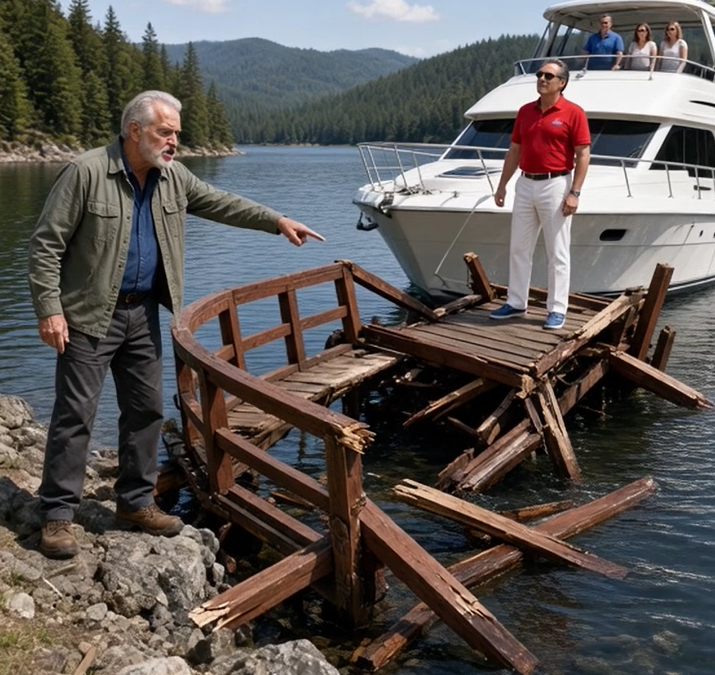
One section of bridge collapsed into channel.
Dominion kept pushing.
The engines churned muddy water.
Then it broke through.
My bridge did not simply fail.
It was torn apart.
The yacht emerged south side trailing lumber.
I stood stunned.
Tom was already calling 911.
Richard idled fifty yards away.
One board member leaned over side checking scratches.
Then Richard looked back.
He laughed.
“Guess you’ll finally have to widen it.”
I walked to water’s edge.
“You just destroyed private property.”
He lifted tumbler.
“You should’ve moved the obstruction.”
Tom shouted:
“I saw the whole thing, asshole!”
Richard ignored him.
Dominion continued toward cove.
That was the moment I stopped seeing him as merely arrogant.
Arrogance believes rules should bend.
Richard believed consequences belonged to other people.
Sheriff’s deputy arrived forty minutes later.
Young.
Polite.
Out of depth.
He photographed damage.
Took statements.
Richard had already called his attorney.
By the time deputy spoke to him, story had changed.
Mechanical malfunction.
Unexpected current.
Bridge allegedly noncompliant.
Navigation hazard.
Emergency maneuver.
Potential liability by bridge owner.
The deputy returned.
“This may be civil.”
I stared.
“He deliberately drove through it.”
“He says steering response was impaired.”
“Tom saw.”
“I’m documenting.”
“The boat kept throttle up.”
“He disputes.”
“Can you test him for alcohol?”
“He says drink was iced tea.”
Of course.
“Can you cite him?”
“For what specifically?”
I named statutes.
The deputy sighed.
“Mr. Hastings, I understand you’re upset.”
There are few phrases more effective at making a calm person less calm.
“I am not asking you to understand my emotional state.”
I pointed.
“I am asking you to document an intentional vessel collision with a fixed private structure.”
He nodded.
“I am.”
“Then document it.”
He did.
No arrest.
No citation that day.
Richard’s yacht damage was substantial but cosmetic relative to mine.
Bent rail.
Fiberglass gouging.
Damaged radar arch.
One cracked windshield.
My bridge was unusable.
Worse, it carried the buried conduit feeding power and data to the island pump station and small monitoring shed I used for drainage and property maintenance.
The conduit survived but was exposed.
That mattered.
I called an emergency contractor.
He came Sunday.
Estimate:
$186,000 for full bridge replacement to current standards.
More if foundations damaged.
Insurance adjuster scheduled Monday.
I thought process had begun.
Then Monday morning I was served.
Richard Covington and Oak Haven Holdings had filed for temporary restraining order.
They claimed:
The Hastings bridge constituted an unlawful navigational hazard.
Its collapse endangered boating traffic.
Any reconstruction before a full jurisdictional review would create irreparable harm.
They also claimed the bridge had damaged Dominion.
And, because law has a sense of humor, they sought recovery for Richard’s yacht.
The emergency judge granted temporary order preventing reconstruction pending hearing.
Not final ruling.
Temporary.
But enough.
Forty-eight hours after Richard destroyed bridge, I was legally barred from rebuilding it.
He called that afternoon.
I almost did not answer.
“Arthur.”
“What?”
“I heard about the order.”
“You filed it.”
“Yes.”
“Then why are you telling me?”
“I’m trying to resolve this.”
I laughed.
That irritated him.
“Here’s what I propose.”
“No.”
“You haven’t heard.”
“No.”
“The HOA will withdraw opposition if replacement design provides sixteen-foot clearance.”
“Goodbye.”
“We’ll contribute fifty thousand.”
“Goodbye.”
“And waive claim for the yacht damage.”
I paused.
“Waive?”
“Yes.”
“You destroyed my bridge.”
“Your bridge damaged my vessel.”
“You drove into it.”
“That is disputed.”
“Tom recorded part of it.”
Silence.
He had not known.
I smiled for first time in two days.
Richard recovered.
“Videos can be misleading.”
“So can lawsuits.”
“Arthur.”
His voice hardened.
“You can spend two years fighting this.”
“You’re almost seventy.”
“You really want that?”
There it was.
He believed time was leverage.
Old man.
Widower.
One property.
Make cost of resistance higher than surrender.
I looked through kitchen window toward broken bridge.
Claire’s pencil marks in pantry behind me.
My father’s hands on those original stringers.
My grandfather crossing with tractor.
Great-grandfather’s deed in county archives.
Richard had mistaken age for fatigue.
That was his second mistake.
“I’ll see you in court.”
I hung up.
Then I went downstairs.
Claire’s boxes.
Not because I expected magic.
Because litigation requires records.
I pulled old surveys.
Bridge permits.
County correspondence.
Structural reports.
Then found a metal document box my father had given me when he moved into nursing care.
HASTINGS WATER RIGHTS.
I had not opened it in maybe twelve years.
Inside:
copies of 1928 deed.
1974 reaffirmation.
1989 county dam modernization agreement.
Inspection maps.
Easement exhibits.
And one memorandum from 1992 prepared when state upgraded spillway.
I sat at workbench.
Read.
Then again.
My professional life had trained me to notice phrases other people skim.
MATERIAL THREAT.
RETAINED ACCESS.
STRUCTURAL IMPAIRMENT.
EMERGENCY DRAWDOWN.
REASONABLE REQUEST OF EASEMENT HOLDER.
COORDINATED OPERATION.
My bridge was not merely access.
The eastern abutment tied into retaining wall protecting a drainage bench along peninsula.
Its failure had exposed saturated bank.
Heavy July thunderstorms were forecast.
If another storm raised local runoff while bridge debris partially obstructed channel, it could increase erosion against Hastings shoreline.
Was that catastrophic?
No.
Could it qualify as a documented structural and access threat under easement?
Possibly.
I did not touch any control.
That is important.
People later said I “opened the dam.”
That was the headline.
Reality was more interesting.
And legal.
I called my attorney, Ellen Marks.
Sixty-three.
Property law.
No patience for theatrics.
She read documents.
Then said:
“Oh.”
That is not a word you want your lawyer to say casually.
“Good oh?”
“Maybe.”
I explained engineering issue.
She said:
“Do not touch anything.”
“I wasn’t going to.”
“I mean it.”
“I know.”
“You are client who knows enough to be dangerous.”
“Thank you.”
“Not compliment.”
She contacted county water resources.
I prepared engineering memorandum.
Photographs.
Survey.
Weather forecast.
Bridge debris.
Bank condition.
Exposed utility conduit.
Potential scour.
I requested emergency site review under 1928 agreement.
County engineer arrived next morning.
His name was Neil Sharma.
Forty-one.
Competent.
He looked at bridge.
Then deed.
Then me.
“You’ve been sitting on this easement ninety-eight years?”
“Family has.”
“You ever used it?”
“No.”
“Why now?”
I pointed at collapsed span.
“That changed.”
He inspected.
Took measurements.
Called dam office.
State representative joined by afternoon.
Nobody rushed.
Nobody laughed.
Infrastructure people become humorless around old legal obligations.
At 4:20, Neil said:
“I agree temporary drawdown may reduce risk during debris removal and abutment inspection.”
“How much?”
“We decide.”
Correct answer.
“Do you need easement-holder concurrence?”
“Yes.”
“You have it.”
State wanted modest reduction.
County wanted more because forecast.
Final plan:
controlled drawdown sufficient to lower water away from damaged abutment, expose channel bed, allow safe debris removal, inspect retaining wall, and protect peninsula during reconstruction dispute.
Not dry lake.
Not empty reservoir.
But Oak Haven is shallow along north/east shore.
A reduction of several feet would pull water hundreds of feet away from some developed shoreline.
Especially the Reserve marina.
I knew that.
So did Neil.
“Have they been notified?”
“County will notify shoreline stakeholders.”
“When?”
“Tomorrow morning.”
I went home.
Slept well for first time since collision.
The Reserve received notice at 8:03 a.m.
Richard called at 8:17.
“What did you do?”
I was making eggs.
“Good morning.”
“Do not play games.”
“What exactly?”
“They’re lowering the lake.”
“Yes.”
“Because of your bridge.”
“Because your yacht destroyed my bridge.”
“This is retaliation.”
“No.”
“You requested it.”
“I invoked a recorded safety easement and supplied engineering documentation.”
“You’re draining the lake.”
“Controlled drawdown.”
“Stop it.”
“I don’t operate dam.”
“Withdraw request.”
“No.”
“Arthur.”
His voice was almost shaking.
“You understand what that does to our marina?”
“Yes.”
“Boats will ground.”
“Move them.”
“We have sixty-eight slips.”
“Then you should start.”
“Our resort weekend is Friday.”
I buttered toast.
“Unfortunate.”
“You son of a bitch.”
“I would move Dominion first.”
He hung up.
By noon, marina staff worked frantically.
Large yachts moved to deeper public marina.
Smaller boats trailered.
Jet skis hauled.
Floating docks descended awkwardly against pilings until staff had to reconfigure.
Reserve residents gathered shoreline watching water creep back.
The drawdown was gradual.
Legal.
Monitored.
Safe.
And absolutely devastating to the appearance of their “curated waterfront experience.”
Mud flats emerged.
Then old tree stumps.
Then sections of stone wall from farms flooded a century earlier.
The infinity pool still reflected sky beautifully.
Beyond it was now several hundred feet of brown exposed lakebed.
I received forty-three calls in two days.
HOA members.
Property manager.
Developers.
One woman demanded to know when I would “turn lake back on.”
I told her that was not how lakes worked.
Another said her realtor had a showing.
I said I was sorry.
She called me liar.
Richard’s lawyers filed emergency motion alleging malicious interference with water rights.
The county opposed.
State submitted affidavit.
My attorney attached 1928 deed.
Judge denied motion.
In written order, one sentence made me laugh.
“Petitioners have presented no evidence that respondent Hastings personally operates the dam or controls county implementation of an engineering drawdown.”
Exactly.
I had not touched a gate.
I had used paperwork.
Gravity handled rest.
By Friday, Reserve’s $1.9 million “Resort Weekend” was a disaster.
They had invited prospective buyers.
Wine tasting.
Chef dinner.
Boat demonstrations.
Live music.
Promotional drone footage.
I saw drone.
Poor operator circled desperately trying to frame houses without exposing mud.
Impossible.
A local paper ran photograph:
LUXURY LAKE COMMUNITY FACES UNEXPECTED DRAWDOWN.
Then discovered bridge dispute.
Then Richard’s role.
Then Tom’s video surfaced.
He had filmed from pontoon after hearing horn.
The video began seconds before impact.
Dominion approaching.
No visible steering emergency.
Engines audibly accelerating.
Someone on yacht laughing.
Then collision.
Then Richard’s voice after:
“Guess you’ll finally have to widen it.”
That video changed everything.
Sheriff’s office reopened vessel incident.
Insurance companies became interested.
So did Coast Guard auxiliary investigators? On inland NY lake probably state boating enforcement. Let’s say state marine unit.
State marine enforcement reviewed.
Richard’s carrier reserved rights.
My carrier pursued subrogation.
HOA members began asking board questions.
Why was association named in lawsuit?
Did board authorize?
Who approved attorney fees?
Why was HOA insurance involved in an incident using Richard’s private yacht?
Minutes became important.
Board minutes showed Richard had discussed “resolving the Hastings obstruction” at three meetings.
One entry:
President Covington advised that alternative measures may become necessary if voluntary bridge modification cannot be achieved.
Ellen nearly smiled reading.
“That is not ideal for him.”
Meanwhile drawdown continued until target level.
Then held.
Bridge channel exposed.
What water had hidden, mud revealed.
One abutment had shifted.
Retaining stone displaced.
Utility conduit damaged more than visible.
Neil’s engineering report concluded the collision created a genuine risk of additional structural loss if lake remained high during storms.
That validated entire emergency request.
No retaliation.
No game.
Safety.
Richard hated safety because it made revenge legally irrelevant.
Then something unexpected happened.
The lake drawdown exposed problems at Reserve marina.
Pilings had been installed shorter than design depth in one segment.
Riprap erosion behind retaining wall.
Two stormwater outfalls had been partially buried.
One decorative shoreline wall had undermining.
These were not my accusations.
County inspectors saw them because water was gone.
A marina that looked flawless when submerged suddenly displayed shortcuts.
The development company blamed contractor.
Contractor blamed design revisions.
HOA blamed developer.
Richard blamed me.
Naturally.
At one board meeting he said:
“None of this would be visible if Hastings had not manipulated the lake.”
A homeowner named Susan Bell responded:
“Richard, it would still exist.”
That quote made its way around lake within hour.
The $1.9 million figure in later headlines referred to the Reserve’s resort clubhouse and marina amenity package, not whole development.
Repairs to exposed defects, canceled events, boat relocation, insurance, legal costs, and shoreline remediation climbed rapidly.
Nobody lost a house.
Nobody flooded.
Nobody was injured.
The development remained wealthy.
But its image of absolute control cracked.
For Richard, image was currency.
Then my bridge case returned to court.
Temporary restraining order hearing became evidence hearing.
Ellen presented:
original permits.
survey.
navigation map.
county determination.
state letters.
Tom’s video.
structural report.
1928 deed.
Richard’s counsel argued the bridge obstructed modern recreational use.
Judge asked:
“Was the bridge lawful before plaintiff’s vessel struck it?”
“Yes, Your Honor, but—”
“Was there an order requiring defendant to modify it?”
“No.”
“Did plaintiff possess any easement through bridge opening?”
“No.”
“Then why was plaintiff there?”
Silence.
Attorney tried:
“The channel has historically been used for navigation.”
Ellen stood.
“By vessels capable of passing.”
Judge looked over glasses.
I liked her immediately.
Richard took stand later.
He claimed he believed bridge had sufficient clearance.
Ellen asked:
“You had approached it previously?”
“Yes.”
“And reversed?”
“Yes.”
“Because you could not pass?”
“Conditions varied.”
“The height of bridge varied?”
Richard’s attorney objected.
Overruled.
Richard frowned.
“No.”
“Your yacht’s height varied?”
“No.”
“So what condition changed?”
Silence.
Then:
“Water level.”
Ellen produced gauge records.
Water level on collision day lower than first documented approach.
His yacht had even less clearance.
He began sweating.
Then video.
He said audio misleading.
Ellen replayed.
“Guess you’ll finally have to widen it.”
He claimed joke.
Judge did not laugh.
Temporary order dissolved.
I was permitted to rebuild.
Richard’s claim for yacht damage dismissed.
My counterclaim continued.
The sheriff’s office did not charge him with some dramatic felony as social media later invented.
The state issued boating citations related to reckless operation and damage.
Civil liability mattered more.
His insurer initially denied intentional-act coverage.
That frightened him.
If carrier considered collision deliberate, Richard personally exposed.
He settled before trial.
Terms confidential except property records and public filings later revealed substantial payment.
Enough to replace bridge.
Legal fees.
Engineering costs.
Temporary access.
Lost use.
Shoreline restoration.
And more.
I rebuilt.
Not sixteen feet high.
That was satisfying.
I rebuilt to current standards with same lawful low-clearance concept, slightly wider farm deck, stronger steel, reinforced abutments.
County approved.
State approved.
Channel remained unsuitable for large boats.
Richard had destroyed bridge to force change.
He got newer version of same bridge.
There are few pleasures cleaner than code-compliant spite.
The drawdown ended once safety work and inspections were complete.
Water returned gradually.
Reserve marina floated again.
Mud disappeared.
Drone footage improved.
But things did not return to previous arrangement.
HOA election arrived in September.
Richard ran.
Lost.
Thirty-eight to eleven.
Susan Bell became president.
Her first official letter to me said:
Mr. Hastings,
On behalf of the new board, I would like to apologize for the association’s role in the bridge dispute.
I showed Ellen.
She said:
“Frame it.”
I did.
Susan came to property later.
No lawyers.
No board.
Brought coffee.
She stood at rebuilt bridge.
“It’s smaller than Richard made it sound.”
“It’s a bridge.”
“He talked like you’d built Berlin Wall across lake.”
I laughed.
She looked toward Reserve.
“I voted for him twice.”
“Why?”
“He got things done.”
That phrase.
Dangerous admiration.
Susan continued:
“Until we realized what ‘things’ meant.”
We talked.
She asked about water rights.
I explained history.
She said:
“So you can drain lake whenever you want?”
“No.”
This misconception had spread.
“I cannot.”
I explained easement.
Safety.
County operation.
State oversight.
Documentation.
“Then why does everyone say you drained resort?”
“Because headlines prefer verbs.”
She smiled.
“Did you enjoy it?”
I considered lying.
“Yes.”
She laughed.
Fair.
Then she asked:
“Would you have done drawdown if Richard apologized and paid immediately?”
That was harder.
“Yes.”
She looked surprised.
“Why?”
“Because abutment was damaged.”
“Storm risk real.”
“The correct engineering response would still have been lower level for inspection.”
I paused.
“I might have enjoyed it less.”
She understood.
That distinction matters to me.
Revenge stories are satisfying because they simplify.
Someone hurts you.
You pull lever.
Their world collapses.
But real power is most defensible when the thing you do is the thing you would have done anyway if anger were absent.
The lake level needed temporary reduction.
I had legal right to compel review.
County agreed.
Richard’s resort suffered because it had built its identity on shoreline conditions that were never guaranteed to remain static.
That was consequence.
Not sabotage.
The bridge reopened in November.
First person across was me.
Second was Claire’s old dog? We haven’t mentioned pet. Don’t invent late.
I walked.
Slow.
Halfway, stopped.
New steel beneath.
Cold lake.
Island trees bare.
I thought of my father.
He had rebuilt old bridge with me after flood damage when I was twenty-six.
We spent entire summer.
No contractor.
Just him, me, a welder named Earl, and more bad decisions than safety inspectors would allow today.
He died before Reserve existed.
I could hear what he would have said about Richard.
Not printable.
I touched new handrail.
“Still here.”
That was all.
Richard remained in his house.
For a while.
He stopped attending HOA events.
Dominion disappeared from lake.
I heard he sold it.
Then his property listed.
$4.6 million.
Sat seven months.
Price reduced.
Eventually sold.
New owners were pleasant.
The first thing they did was kayak under my bridge.
Correct vessel.
Good start.
Richard moved south.
Florida, somebody said.
That felt appropriate.
The Reserve itself survived.
Of course.
One arrogant president does not destroy fifty houses.
But board changed.
Rules softened.
They stopped sending me architectural notices.
No one mentioned my boathouse color again.
More interestingly, lake community became less divided.
Older families and Reserve residents had rarely mixed.
Bridge fight forced everyone to learn history.
They discovered peninsula was not unregulated leftover.
It was original.
They discovered lake was infrastructure.
Not backdrop.
Dam had rules.
Water had management.
Shoreline shifted.
Ownership mattered.
Easements mattered.
I was invited to give talk at historical society.
Title:
LAKE OAK HAVEN: THE VALLEY UNDER THE WATER.
Standing room only.
I brought 1928 map.
Showed farms.
Road.
River.
Silas Hastings parcel.
A Reserve resident raised hand.
“Is my house over old orchard?”
I checked.
“No.”
“You’re over Harold Pierce’s cow pasture.”
Room laughed.
Another:
“What’s under marina?”
I pointed.
“Part of county road.”
Susan said:
“Explains traffic.”
That kind of humor would have been impossible two years earlier.
History reduces arrogance when presented kindly.
Sometimes.
One spring, lake was lowered routinely for maintenance.
Not my request.
County schedule.
Reserve residents handled calmly.
Moved boats.
Adjusted docks.
No panic.
Someone posted in community group:
ARTHUR DID IT AGAIN.
Susan replied:
NO, THE COUNTY DID. PLEASE LEARN SOMETHING.
I laughed for five minutes.
My granddaughter Emily visited that summer.
She was twenty-three.
Civil engineering graduate student.
Claire would have adored that.
Emily walked rebuilt bridge.
Asked:
“Grandpa, did you really drain the whole lake because a guy hit your bridge?”
“No.”
“That’s what Dad says.”
“Your father likes drama.”
“So what happened?”
I told her.
Full.
She listened.
Then:
“That is somehow more petty.”
“How?”
“You didn’t do anything illegal.”
“Correct.”
“You just knew exactly which boring old document mattered.”
“Correct.”
“And then made professionals do their jobs.”
“Yes.”
She grinned.
“That’s engineer revenge.”
I accepted.
She asked to see controls.
I took her down to easement corridor.
Not inside operating enclosure without authorization.
Just old stone channel, access road, concrete history.
Vegetation around.
Water noise.
I repeated my father’s line:
“Your great-great-great-grandfather trusted gravity more than politicians.”
Emily laughed.
“Do you?”
“I trust calculations.”
“Worse.”
Fair.
We discussed why emergency infrastructure matters.
Why easements persist.
Why old agreements create obligations generations later.
Why property law can outlive people who negotiated it.
No revenge.
Just engineering.
That is what I wanted passed on.
Not grudge.
Knowledge.
The settlement paid enough that bridge did not cost me retirement.
I donated a portion to local volunteer fire department water-rescue unit.
Why?
Because if Richard had collided when anyone stood on bridge, story would be very different.
Nobody was hurt.
That was luck.
I did not want forget.
Tom Bishop refused repayment for his time helping document.
I bought him new trolling motor.
He complained.
Kept it.
Lenny? no.
Susan’s HOA later contributed to lakewide navigation markers.
Properly.
One sign near channel:
PRIVATE LOW-CLEARANCE BRIDGE
NO LARGE VESSELS
USE WESTERN ROUTE
Richard had argued signage inadequate.
He was partly right.
I added better signs.
Being wronged does not mean you are right about everything.
That was another lesson.
The bridge was legal, but visibility could improve.
So improve.
No surrender.
Just sense.
A year after reconstruction, a delivery contractor driving small workboat approached channel too fast.
Saw sign.
Stopped.
Reversed.
Went around.
I watched from shore.
No drama.
Perfect.
That is infrastructure success.
Nothing happens.
People often ask whether I regret drawdown.
No.
Would I have done it differently?
Maybe.
I would have contacted more shoreline residents directly before county notice.
Some elderly owners scrambled to move boats because they got generic letter late.
That was not their fault.
Richard created dispute.
They bore inconvenience.
I later apologized to two.
They appreciated.
One said:
“Still worth watching his marina in mud.”
Not everyone is noble.
Neither am I.
I did enjoy some of it.
Particularly promotional drone.
I am not ashamed.
But pleasure and justification are separate.
If court had found drawdown unsafe, I would not have pushed.
If engineer disagreed, I would have accepted.
If easement did not apply, I would have fought bridge case instead.
The point was never “I own dam.”
I do not.
The point was:
Richard assumed nobody before him had rights that mattered.
He assumed wealth meant first claim on landscape.
He assumed new paperwork outranked old deed.
He assumed a private bridge became public inconvenience because his yacht was tall.
He assumed police hesitation meant innocence.
Temporary court order meant victory.
Lawyer letter meant fact.
Age meant weakness.
He assumed wrong.
The strangest thing about wealthy arrogance is how often it depends on ignorance.
Not ignorance of money.
They usually understand money well.
Ignorance of systems that existed before they arrived.
Drainage.
Roads.
Water rights.
Utility easements.
Agricultural access.
Floodplain rules.
Old deeds.
People who know where records are.
Richard had excellent lawyers.
But lawyers only know what client asks them to examine.
He asked how to force bridge modification.
He did not ask what century-old rights surrounded lake.
That omission cost him.
After incident, Reserve hired title firm to review entire shoreline history.
I found that amusing.
They discovered several old easements.
A cemetery access.
Utility corridor.
Farm road.
Public fishing right on one narrow strip.
Nothing catastrophic.
Just reminders.
Land remembers.
Paper remembers.
Water remembers too, in different way.
During drawdown, old fence line emerged near north shore.
Posts blackened from decades underwater.
Residents walked out to look.
One found horseshoe.
Another old glass bottle.
Children collected stones.
For one week luxury resort looked less like brochure and more like valley it had replaced.
I liked that.
Not because mud humbled rich.
Because landscape briefly told truth.
There had been lives before infinity pools.
Cows.
Roads.
Orchards.
Silas arguing with county.
My grandfather skating on early ice.
Father teaching me to row.
Claire sitting on dock.
History does not oppose development.
It merely refuses erasure.
Richard tried erasing bridge because inconvenient.
The lake answered by revealing what else was buried.
That is almost poetic.
Claire would have accused me of getting sentimental.
She would be right.
On anniversary of collision, I took chair to shoreline.
2:14 p.m.
Not intentional at first.
Then noticed time.
New bridge cast shadow.
A small bass boat passed underneath.
Two teenagers waved.
I waved.
No horn.
No demand.
Just boat fitting place.
I poured coffee from thermos.
Not whiskey.
Everyone online insists old men drink whiskey during revenge.
Mostly we drink coffee and worry about blood pressure.
I thought about Richard’s laugh.
For months it had bothered me.
Then less.
Eventually not at all.
Because last laugh is overrated.
You do not win by making other person feel small.
You win when they stop having power over your thoughts.
Richard moved.
Bridge stood.
Lake returned.
My kitchen still had pencil marks.
That was enough.
Emily later asked:
“Would you have forgiven him?”
“If he apologized?”
“Yes.”
She looked skeptical.
“Really?”
“I didn’t say trust.”
“Different.”
“What if he offered to pay before lawsuits?”
“I would have accepted.”
“And drawdown?”
“Still safety inspection.”
“Right.”
She smiled.
“Engineer.”
“Exactly.”
Forgiveness is not removal of consequence.
If you ram bridge, you pay bridge.
If you damage abutment, lake may need lowering.
If you abuse HOA authority, board may remove you.
If you lie under oath, credibility suffers.
None require hatred.
That became easier once Claire gone.
Grief changes priorities.
I had spent two years learning how little anger accomplishes against death.
Richard did not deserve more of my remaining time than necessary.
So I used enough.
No more.
The rebuilt bridge plaque is discreet.
Emily had it made.
On underside of handrail where boaters cannot see unless standing:
HASTINGS CROSSING
REBUILT 2024
DESIGNED TO LAST LONGER THAN BAD NEIGHBORS
I objected.
Then left it.
Good engineering needs humor.
Susan discovered.
Sent photo.
Message:
BOARD APPROVES.
I replied:
NOT SUBJECT TO BOARD APPROVAL.
She sent laughing emoji.
Progress.
Reserve clubhouse eventually repaired shoreline.
Marina defects corrected.
Development values recovered.
A new family bought one of empty lots.
They came to introduce themselves before construction.
Imagine.
Knocked.
Brought cookies.
Asked about lake.
I showed map.
Their eight-year-old son stared.
“So your grandpa made lake?”
“No.”
“Great-grandpa?”
“He helped negotiate land.”
“Did he own dinosaurs?”
I said probably not.
His mother apologized.
I said keep asking questions.
That is how you avoid becoming Richard.
Learn before declaring.
One afternoon years later, county engineer Neil visited.
New truck.
More gray.
“We’re updating emergency-action plans.”
“Good.”
“We’re cleaning language around your easement.”
“That sounds dangerous.”
He laughed.
“Not removing.”
“Clarifying procedure.”
Lawyers after conflict.
Always.
We sat porch.
He said:
“You know people still call it Hastings Drawdown.”
“County drawdown.”
“I know.”
“You signed.”
“I concurred.”
“You supplied trigger.”
“I documented trigger.”
He smiled.
“Fine.”
Then:
“You did know marina would be mud.”
“Yes.”
“Just checking.”
“Did you?”
“Yes.”
We both drank coffee.
Engineers rarely lie to each other about secondary benefits.
He continued:
“Best part?”
“What?”
“When Covington called asking me to ‘turn water back on.’”
I laughed.
“So he called you too?”
“Fourteen times.”
“Sorry.”
“No, no.”
Neil smiled.
“I work government. That was entertainment.”
People imagine bureaucracy faceless.
It is mostly tired people with inboxes.
Richard attacked wrong ecosystem.
When HOA later proposed adding pedestrian footbridge on north shore, they asked county, state, adjacent owners.
Proper process.
Permit granted.
Nobody rammed anything.
Civilization advanced.
My own health declined normally.
Knees.
Hearing.
Nothing dramatic.
I stopped maintaining island myself.
Emily helped lease to conservation group for seasonal research.
Bridge remained access.
One day she asked whether family should preserve easement forever.
“Yes.”
“Even if lake management modernizes?”
“Review.”
“Not blindly.”
“Rights can be useful.”
“Obligations too.”
“Do not become Richard in opposite direction.”
She understood.
Old rights should not become weapon without purpose.
The 1928 clause protected land.
Use it for protection.
Not dominance.
That distinction is where power stays legitimate.
If I had opened controls secretly to embarrass him, I would have been no better, and perhaps criminal.
Instead I filed.
Engineers inspected.
County approved.
State monitored.
Court reviewed.
Boring.
Lawful.
Devastating.
Best kind.
The internet simplified:
OLD MAN DRAINS HOA RESORT AFTER YACHT ATTACK.
Some versions claimed I owned dam.
False.
Some claimed resort lost $1.9 million.
False.
$1.9 million was amenity valuation cited in development materials; total financial consequences disputed.
Some claimed Richard went bankrupt.
No.
He remained wealthy.
He just lost a legal fight, board position, insurance certainty, yacht, and perhaps some pride.
Enough.
Reality does not require cartoon punishment.
The bridge standing is punishment.
He wanted it gone.
It remains.
Sometimes the thing an arrogant person cannot tolerate is proof world did not rearrange itself around him.
The last time I saw Richard was at deposition settlement conference.
He wore navy suit.
No sunglasses.
Looked tired.
We stood alone by coffee urn while lawyers argued elsewhere.
He said:
“You could have just taken the money.”
I knew what he meant.
Original fifty-thousand contribution.
Raised bridge.
“Could have.”
“All this.”
He gestured.
“Waste.”
“Was it?”
“You got new bridge.”
“Yes.”
“HOA spent a fortune.”
“Yes.”
“You drained lake.”
“County lowered lake.”
He exhaled.
“Still doing that?”
“Yes.”
He looked at me.
“Why?”
“Because words matter.”
He almost smiled.
Then:
“You know I didn’t mean to destroy whole thing.”
I waited.
“I thought bridge would give.”
“It did.”
“I mean…”
He struggled.
This was closest to apology.
“I thought we’d push through section.”
“You intentionally hit it.”
He looked away.
“I thought damage would be less.”
“That does not help.”
“No.”
Silence.
Then:
“I was angry.”
“Yes.”
“You embarrassed me at board meetings.”
“I disagreed with you.”
“Same thing sometimes.”
“No.”
That was perhaps core.
Richard experienced disagreement as humiliation.
Therefore forcing compliance felt restoration.
Dangerous trait.
He nodded slowly.
“I guess.”
Then:
“I’m sorry.”
I had imagined apology many times.
In imagination it felt satisfying.
In reality, just sad.
I said:
“Thank you.”
Not:
It’s okay.
Because not.
But apology accepted as fact.
We returned to lawyers.
That was last.
I heard Florida.
Maybe not.
I hope he learned.
Not my job.
The Reserve’s new HOA later removed phrase “legacy community” from marketing.
I doubt because me.
Still amused.
Lake Oak Haven remained.
Children swam.
Boats.
Geese.
Winter ice.
Spring runoff.
Every few years water level changed.
People complained.
Then adapted.
Infrastructure is permanent only compared to human impatience.
The dam will someday need major replacement.
Bridge too.
Houses eventually roofs.
Marinas rot.
Deeds survive surprisingly long.
Stories longer.
My family now tells collision story every Thanksgiving.
Everyone exaggerates.
My son says yacht was sixty feet.
Emily says Richard wore captain’s hat.
He did not.
Somebody always says I “opened dam.”
I always correct.
“No.”
Then nobody listens.
Family mythology.
Claire’s chair stays empty.
Still.
That is one loss no easement fixes.
Sometimes I wonder what she would say seeing mud flats around Reserve.
Probably:
“Arthur, don’t look so pleased.”
I would say:
“I’m not.”
She would raise eyebrow.
Then I would admit.
Fine.
A little.
At seventy, you are allowed some petty joy if nobody gets hurt.
But if there is a message beyond entertainment, it is simple.
Do not mistake wealth for ownership of everything around wealth.
Do not assume new development erases old rights.
Do not confuse a temporary legal advantage with truth.
Do not treat quiet people as powerless because they have not yet decided to respond.
And for heaven’s sake, if you are driving a forty-two-foot yacht toward a twelve-foot bridge, do not assume the bridge is the thing that needs to move.
Richard had money.
Lawyers.
HOA.
A deputy who called it civil.
A temporary order.
A yacht named Dominion.
For forty-eight hours he had everything that looked like leverage.
I had a broken bridge.
A widower’s house.
Old document box.
A 1928 deed nobody had cared about in decades.
And professional habit of reading footnotes.
That was enough.
The lake dropped.
Not because I was more powerful.
Because systems remember obligations.
The mud appeared.
Defects surfaced.
Video surfaced.
Truth surfaced.
Richard’s control receded with water.
Then water returned.
That part matters.
I did not keep lake down.
I did not want Reserve ruined.
I wanted bridge safe, land protected, rights respected.
Once that was done, gates closed according to county plan.
Lake refilled.
Marina floated.
Summer returned.
Balance.
My bridge remained.
That may be most satisfying ending.
Not empty resort.
Not bankrupt enemy.
A functional bridge where lawful bridge belonged.
One morning after reconstruction, I stood halfway across and heard engine.
A boat approached.
Small cabin cruiser.
New Reserve owner.
He slowed well before channel.
Looked at clearance.
Then waved.
“Can I make it?”
I looked.
“No.”
He nodded.
“Thanks.”
Reversed.
Went around island.
Four extra minutes.
No horn.
No lawsuit.
No collision.
I watched until wake faded.
Then continued walking.
That is what Richard never understood.
Most conflict is not caused by obstacles.
It is caused by people who decide an obstacle is insult.
A bridge says:
You cannot go this way.
A reasonable person chooses another route.
An entitled person says:
Who are you to stop me?
Then one afternoon a yacht struck steel and timber.
And an old legal agreement from 1928 woke up.
By autumn, Richard’s yacht was gone.
By winter, my bridge was back.
By spring, the Reserve had a new board.
And underneath the handrail, where only people walking across can read it, Emily’s little plaque still says:
DESIGNED TO LAST LONGER THAN BAD NEIGHBORS.
Every time I cross, I touch it.
Not because I hate Richard.
Because Claire would have laughed.
And because sometimes the best revenge is not destruction.
It is making sure the thing someone tried to erase is rebuilt stronger, entirely legal, exactly where it was before.








