HOA President Ordered Her Son to Tow My ATV From My Garage—Then the Police Cuffed Him in Front of Her
PART2:
“This might be the most beautiful sentence in the paperwork.”
She looked over.
“What?”
I pointed.
“Not subject to Briar Ridge Homeowners Association.”
Rachel laughed.
“You really hate HOAs that much?”
“No.”
I signed the page.
“I hate people who think a clipboard is a badge.”
I had no idea how prophetic that sentence was going to be.
We moved in on a Saturday.
By the following Friday, I met Patricia Whitmore.
That was six days.
Not even a full week.
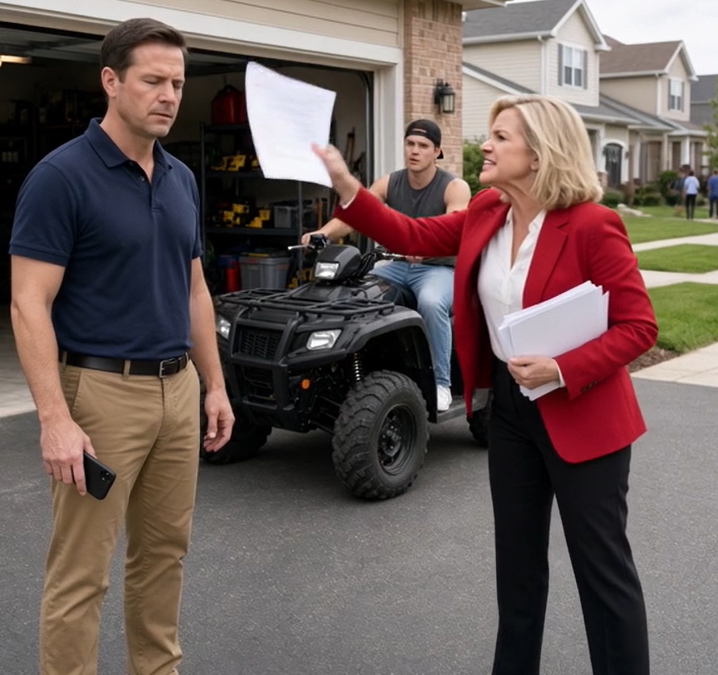
I was in the driveway unloading tools from my utility trailer when I saw a woman walking directly across our front lawn.
Not the sidewalk.
Not the driveway.
The lawn.
Straight line from the Briar Ridge side.
Mid-fifties.
Blonde bob.
White sneakers.
Tan shorts.
Navy polo embroidered with BRIAR RIDGE HOA BOARD.
She moved with the confidence of somebody who had spent a long time expecting people to rearrange themselves when she arrived.
No hello.
No introduction.
She stopped maybe six feet from me, looked over my shoulder toward the garage, and said:
“You can’t leave that visible.”
I thought she meant the boxes.
“Leave what visible?”
She pointed.
My ATV was inside the garage.
A normal four-wheeler.
Nothing oversized.
No ridiculous lift kit.
No neon lights.
I used it on a friend’s hunting property and occasionally around my own lot when hauling brush or firewood.
“That.”
I looked at it.
Then at her.
“My ATV?”
“Yes.”
“Why?”
“Recreational vehicles cannot be visible from the street.”
There are conversations so absurd your brain spends the first few seconds trying to determine whether you missed the setup.
I set down a socket set.
“This house isn’t in your HOA.”
She gave me a tight smile.
“This property is part of the community.”
“It borders the community.”
“It is visually part of the community.”
That was new legal terminology.
“Visually?”
“Yes.”
“What does that mean?”
“It means standards still matter.”
“I’m sure they do.”
I pointed toward the survey stake near the hedge.
“But your standards end over there.”
Her expression changed.
Not much.
Just enough.
People like Patricia often do not get angry immediately when told no.
First, they become confused.
As if the word itself has malfunctioned.
She said:
“I’m Patricia Whitmore.”
I waited.
“I’m the HOA president.”
“Okay.”
Again she paused.
The title was supposed to do something.
It did not.
She looked at my ATV.
“That needs to be stored out of view.”
“No.”
“You may want to review the covenants.”
“I reviewed my deed.”
“The HOA documents are separate.”
“Not for me.”
“You’re mistaken.”
“I’m not.”
She crossed her arms.
“I’ve been on this board for nine years.”
“Congratulations.”
“I know which homes are subject to our standards.”
“Apparently not.”
That was our first interaction.
It established the pattern perfectly.
Patricia would make a statement.
I would explain that she had no authority over my property.
She would interpret my refusal not as an answer but as an obstacle to continued negotiation.
The second visit concerned lawn height.
She appeared while I was trimming a tree.
“Your grass is above three and a half inches.”
I looked down.
“Good eye.”
“Our community standard is three.”
“Then I hope your grass is three.”
She stared.
“You really intend to keep doing this?”
“Doing what?”
“Acting like you’re exempt from maintaining the neighborhood.”
“My property isn’t in the neighborhood.”
She left a printed sheet in my mailbox.
I returned it to her porch.
The next one involved my porch light.
Then garbage cans.
Then the color of the shed behind my workshop.
Patricia seemed particularly offended by the shed.
It was dark green.
Nothing spectacular.
One afternoon she informed me that Briar Ridge’s approved palette consisted of six neutral tones.
I asked:
“Is green one?”
“No.”
“Then I guess it’s good I’m not in Briar Ridge.”
Rachel found the whole thing funny at first.
She would come home and ask:
“What did the mayor complain about today?”
“Bird feeder.”
“No.”
“Yes.”
“What’s wrong with it?”
“Too visible.”
“From where?”
“Apparently orbit.”
We laughed.
That was before Patricia began showing up when I wasn’t home.
One afternoon I had worked a night shift and was sleeping upstairs.
Rachel answered the front door.
Patricia stood there with a clipboard.
She informed my wife that an “inspection walk” would occur that weekend and that our ATV issue needed to be corrected beforehand.
Rachel is calmer than I am.
That does not mean she is easier to push around.
She listened.
Then said:
“Our property is not in your HOA.”
Patricia replied:
“That hasn’t been properly established.”
Rachel blinked.
“It’s in our deed.”
“I’d like a copy.”
“No.”
Patricia’s mouth tightened.
“As president, I need verification.”
Rachel smiled.
“No, you don’t.”
Then closed the door.
When I came downstairs, she told me.
I said:
“You shut the door?”
“Yes.”
“Without giving her the deed?”
“Yes.”
“I knew I married well.”
We laughed again.
But by then, the situation had begun feeling different.
A normal person might misunderstand a boundary once.
Maybe twice.
Patricia had been shown.
Told.
Corrected.
Repeatedly.
What she was doing was no longer confusion.
It was refusal.
She believed authority could be manufactured through persistence.
If she repeated that my property belonged under her standards enough times, maybe reality would get tired and agree.
I kept my job out of it.
A few neighbors knew I worked patrol.
I never hid it.
My cruiser occasionally sat in the driveway when fleet maintenance arrangements changed, and I wore the uniform to and from work.
But I never told Patricia:
I’m a cop.
Because that was irrelevant.
I was not right because I carried a badge.
I was right because the deed said what it said.
A plumber would have had the same property rights.
A teacher.
A mechanic.
A retired accountant.
Nobody should need law-enforcement employment to tell a stranger to stay off their property.
Patricia’s favorite target remained my ATV.
It became almost obsessive.
The machine spent probably ninety percent of its life inside the garage.
But whenever I rolled it near the door for cleaning, loading gear, checking the oil, or doing maintenance, Patricia somehow appeared.
I joked to Rachel that the HOA must have installed an ATV early-warning radar.
One Saturday I was pressure-washing the driveway.
The ATV sat near the garage.
Patricia’s son wandered over.
That was my first real interaction with Tyler Whitmore.
He was twenty-six.
Old enough to know better.
Young enough to still believe charm could substitute for judgment.
Lowered black pickup.
Gym tank top.
Baseball cap backward.
Expensive sunglasses.
The kind of guy who called everybody “bro” while arguing because he believed casual language made consequences less serious.
He walked up as if we already knew each other.
“That yours?”
He nodded toward ATV.
“Yeah.”
“Nice.”
I waited.
“My mom hates that thing.”
“I know.”
He laughed.
“She says it makes your place look trashy.”
I shut off the pressure washer.
“Then she should stop staring into my garage.”
Tyler smirked.
“I’m just saying, if you parked it out back, there wouldn’t be all this drama.”
“If your mother minded her own property, there wouldn’t be drama either.”
His smile faded slightly.
“Dude, she runs the neighborhood.”
“Good for her.”
I pointed toward his side of the property line.
“She runs that neighborhood.”
Then toward my garage.
“She doesn’t run this.”
Tyler gave one of those exaggerated shrugs people use when they want to appear relaxed while getting irritated.
“Whatever.”
He walked back.
Three days later, I found a bright yellow notice taped to my garage door.
Not mailed.
Not placed in the box.
Taped directly to my house.
BRIAR RIDGE HOA
NOTICE OF NONCOMPLIANCE
VIOLATION: VISIBLE RECREATIONAL VEHICLE
CORRECTIVE ACTION REQUIRED WITHIN 72 HOURS.
FAILURE TO COMPLY MAY RESULT IN REMOVAL/TOWING AT OWNER EXPENSE.
I stood there reading it twice.
Rachel came up behind me.
“That looks official.”
“It isn’t.”
“Can they tow?”
“No.”
“Would they try?”
That was the question.
I pulled the notice off carefully.
Did not tear it.
Put it inside clear folder.
Then walked across to Patricia’s house.
She was outside with two women from the HOA doing the suburban power walk where everyone is wearing athletic gear but moving slowly enough to exchange property gossip.
I held up notice.
“Did you put this on my garage?”
Patricia did not deny.
“It was posted as a courtesy.”
“Threatening to tow my ATV is a courtesy?”
“It’s the next enforcement step.”
“There is no enforcement.”
“You have been repeatedly notified.”
“About rules that do not apply.”
She exhaled dramatically.
The two women looked away.
I kept my voice calm.
Years in patrol taught me that when another person wants escalation, calm becomes its own leverage.
“Listen carefully.”
Patricia folded arms.
“My house is not in your HOA.”
No response.
“You have no authority over my driveway.”
Nothing.
“My garage.”
Nothing.
“My ATV.”
Her jaw tightened.
“If you, your son, a towing company, or anyone acting for you comes onto my property and removes that ATV without my permission, I will report it stolen.”
Tyler stood inside their open garage.
Close enough to hear every word.
He called out:
“Over a tow?”
I turned.
“If you touch it without permission, yes.”
He laughed.
“Bro, relax.”
“I’m completely relaxed.”
Then I repeated it.
“If you touch my ATV, I will call law enforcement.”
There was no ambiguity.
No fine print.
No misunderstanding.
Tyler shook his head like I was being dramatic.
Patricia said:
“You can’t steal something being removed through community enforcement.”
“There is no community enforcement on my property.”
“We disagree.”
“No.”
I held the fake notice up.
“You disagree with a deed.”
Then I walked home.
That was the warning.
After that, small things began happening.
The side gate would be open when I knew I had latched it.
The cover over my ATV moved.
Once, a gas can had shifted from the back wall to beside the garage door.
Nothing individually dramatic.
But police work teaches patterns.
One oddity is nothing.
Three similar oddities following a direct conflict is information.
I installed cameras.
Doorbell.
Driveway.
Garage.
Side gate.
Rear workshop.
Nothing hidden.
No spy gadgets.
Normal residential security cameras with motion notifications and cloud backup.
Rachel watched me mount the garage camera.
“You really think she’ll try it?”
“Patricia personally?”
I tightened bracket.
“Maybe not.”
“Tyler?”
“Yes.”
“You think he’s that stupid?”
“I think he believes warnings only matter when he respects the person giving them.”
That turned out to be almost exactly right.
Three weeks passed.
Patricia went quiet.
I thought maybe the cameras were visible enough to discourage her.
Or perhaps somebody on the board had finally looked up parcel records and explained reality.
Then came the Tuesday.
I had the day off.
Rachel had gone to help her sister shop for a new refrigerator.
I rolled ATV toward front of garage to change oil, inspect a CV boot, and install a small storage box.
Tools everywhere.
Garage door halfway down to keep afternoon sun out.
At 11:20, my lieutenant called.
One deputy had gone home sick.
Could I cover four hours?
I nearly said no.
Then looked at the unfinished ATV.
Figured I could finish later.
I pushed tools against wall, left machine near front, lowered door most of the way but did not latch it because I planned to return.
I put on uniform.
Left.
At 2:46 my phone buzzed.
Driveway motion.
I checked.
Tyler.
He walked up the driveway alone.
At first I assumed another fake notice.
Then he stopped.
Looked toward street.
Pulled out phone.
Typed something.
Bent down.
And ducked beneath my partially lowered garage door.
I remember my entire body becoming very still.
Not angry.
Still.
I opened live view.
Tyler stood beside ATV.
He looked around garage.
Then walked directly to it.
A pickup backed into driveway.
Another man got out.
I recognized him vaguely from Briar Ridge.
Bryce Dalton.
Probably mid-twenties.
Tyler waved him inside.
Both grabbed the ATV.
They started rolling it backward.
I watched maybe ten seconds longer.
Enough to make absolutely sure there was no innocent interpretation.
There wasn’t.
Then I called dispatch.
Not my supervisor.
Not a buddy.
Dispatch.
The same way any homeowner should.
“County dispatch, what’s the address of your emergency?”
I gave my address.
“My name is Ethan Cole. I’m a county deputy, currently on duty but away from residence.”
The dispatcher knew me.
Her tone changed.
“What’s happening?”
“Two males are inside my detached garage removing my ATV without permission.”
“Do you know them?”
“One is Tyler Whitmore, lives across from me.”
I described Bryce.
“They’re on camera now.”
“Any weapons?”
“Unknown.”
“Anyone home?”
“No.”
“Are you responding?”
“I’m returning but I’ll stage until marked units have scene.”
That mattered.
I had no desire to create a confrontation.
No off-duty hero routine.
No badge flashing.
No rushing home and turning property crime into armed dispute.
Responding patrol units were two minutes away.
Let them work.
I called Rachel.
“Don’t come home yet.”
“What happened?”
“Something stupid.”
“Patricia?”
“Her son.”
“What did he do?”
“He’s taking ATV.”
Silence.
Then:
“You’re kidding.”
“I wish.”
“I’m coming.”
“No.”
“Ethan—”
“Please.”
That tone worked.
She knew.
“I’ll call you when scene is safe.”
I headed home.
At a red light I checked camera.
They had gotten ATV into driveway.
Tyler climbed on.
Couldn’t immediately start it.
He tried again.
The engine fired.
Bryce returned to pickup.
They had apparently planned for Tyler to drive the ATV somewhere while Bryce followed.
Where?
Patricia’s house?
A tow lot?
HOA storage?
I never learned.
It no longer mattered.
Tyler rolled toward street.
Then red and blue lights appeared at far end.
Deputy Mason’s cruiser turned onto block.
Second unit behind.
Tyler froze.
The ATV lurched.
Stalled.
Bryce’s pickup stopped abruptly.
Mason exited.
“Hands where I can see them!”
Tyler raised both.
And for one perfect second, the expression on his face was not fear.
It was confusion.
He genuinely did not understand why police had shown up.
That remains one of the strangest parts.
He had entered another man’s garage after being directly warned not to touch the ATV.
Removed it.
Started it.
Began driving away.
Yet consequences still surprised him.
I parked about six houses down.
Waited until Mason radioed scene secure.
Then walked up.
Tyler saw me.
Relief crossed his face.
Actually relief.
Like the homeowner had arrived to explain everything.
“Tell them it’s yours.”
Mason looked at him.
“It is his.”
Tyler nodded rapidly.
“Yeah. Exactly. He knows me. I’m just moving it.”
I said:
“Without permission.”
Tyler’s face tightened.
“Come on.”
“From inside my garage.”
“Your garage was open.”
“Partially.”
“That means—”
“No.”
Mason cut in.
“It does not mean what you think it means.”
Then Patricia arrived.
She came hurrying from across the street wearing sunglasses and sandals.
“This is a misunderstanding.”
Mason raised palm.
“Ma’am, stay there.”
“We’ve been trying to resolve this for months.”
“Stay there.”
“That vehicle is in violation.”
Mason stared.
“Whose violation?”
“Ours.”
“Who owns this property?”
Patricia gestured toward me.
“He does, but—”
“Is he in your HOA?”
“It’s complicated.”
“No.”
I said.
“It isn’t.”
Patricia glared.
Tyler looked toward her.
“This is what you said I could do.”
She snapped:
“Not now.”
Interesting.
Mason heard.
“So somebody told you to remove it?”
Tyler hesitated.
Patricia stepped forward.
“He was helping resolve an ongoing property issue.”
Mason:
“By entering someone’s garage?”
“It was open.”
I almost laughed.
Mason did not.
He asked Tyler:
“Did Mr. Cole give you permission to go inside?”
“No, but—”
“Permission to move ATV?”
“My mom—”
“I’m not asking what your mother told you.”
“No.”
Mason nodded.
“Turn around.”
Tyler stared.
“What?”
“Turn around.”
“You’re arresting me?”
“Turn around.”
“Seriously?”
Mason took his wrist.
Tyler finally turned.
Hands behind back.
Cuffs clicked.
Patricia lost control.
“No.”
She came forward.
Second deputy stepped between.
“Ma’am, stay back.”
“This is ridiculous.”
“Stay back.”
“He is not a criminal.”
“He entered private property and removed a motor vehicle without permission.”
“It’s an HOA matter.”
“No, ma’am.”
“This is civil.”
“No, ma’am.”
“It’s community enforcement.”
The deputy asked:
“Is this your property?”
She stopped.
“No.”
“Is the owner a member of your association?”
She tried again.
“That has been disputed.”
I pulled out my phone.
“No.”
I opened property plat first.
Then camera clips.
Mason watched Tyler duck under door.
Look around.
Wave Bryce in.
Both roll ATV out.
Then the earlier footage.
Patricia herself at side of my garage.
Moving cover.
Photographing machine.
The fake tow notice.
Text from neighbor warning Patricia had discussed “getting rid of that ATV.”
Mason looked up.
Patricia’s face had changed.
Not much.
But certainty was leaking.
“This proves harassment.”
I said.
“She was told in writing and verbally the property isn’t HOA.”
Patricia snapped:
“He has been hostile since the day he moved here.”
“That doesn’t make your son’s entry legal.”
I answered.
She pointed at me.
“You set this up.”
That genuinely surprised me.
“By owning cameras?”
“You knew we were trying to resolve it.”
“There was nothing to resolve.”
“You left the garage open.”
There it was.
I stared.
“You think I intentionally left my own garage partially open so your adult son would enter and steal my ATV?”
“You knew there was tension.”
Mason rubbed his forehead.
“Ma’am.”
She ignored him.
“You’ve been antagonistic.”
I said:
“I told you no.”
“Repeatedly.”
“Those are different things.”
A few neighbors had come outside.
Of course.
Police lights are stronger than church bells when it comes to neighborhood attendance.
People stood on porches.
Two walked closer.
Patricia noticed.
Her volume went up.
“This man has been a problem since he moved here.”
One neighbor, Carol Benson, muttered:
“He’s not in the HOA, Pat.”
Patricia turned.
“That is not the point.”
Carol:
“Kind of is.”
Another neighbor coughed into fist to hide laugh.
Tyler, meanwhile, had begun realizing that his mother’s authority was not translating.
He said:
“Can we not do all this?”
Mason looked.
“All what?”
“I’ll put it back.”
“You already removed it.”
“Nothing happened.”
I stared.
“You went into my garage.”
“Dude.”
“I told you what would happen.”
His face changed.
He remembered.
That conversation by Patricia’s driveway.
If you touch it, I will report it stolen.
He looked at his mother.
Then me.
“I thought she worked it out.”
“You heard me tell both of you there was nothing to work out.”
Patricia interrupted:
“He did not understand legal status of property.”
Mason:
“Did you?”
She crossed arms.
“I believe the property should comply.”
“That was not my question.”
Silence.
Then Bryce—who had been standing by pickup with second deputy—said:
“I thought we were just towing it.”
Everyone looked.
He immediately regretted talking.
The deputy asked:
“Towing it where?”
Bryce’s mouth opened.
Closed.
“I don’t know.”
“Who told you to come?”
“Tyler.”
“Did Tyler tell you owner gave permission?”
Bryce looked at him.
“No.”
Tyler’s face went pale.
Patricia said:
“This is getting blown completely out of proportion.”
Mason asked:
“Did you tell your son to move the ATV?”
She froze.
Maybe if she had remained silent, her lawyer could have shaped things differently.
Patricia had never been good at silence.
“I told him to address it before things got worse.”
There was a little pause.
The kind when everybody hears a sentence land.
Mason’s voice became very careful.
“You told him to go onto Mr. Cole’s property and remove the ATV?”
“Not in those words.”
“What words?”
“As part of the enforcement process.”
“What enforcement process?”
“Our HOA procedure.”
“He is not a member.”
She threw her hands slightly outward.
“That’s not how this neighborhood works.”
That sentence may have done more damage to her reputation than anything else.
Not because it was illegal by itself.
Because it revealed the belief underneath everything.
Property lines did not matter.
Deeds did not matter.
Consent did not matter.
Her neighborhood “worked” according to her expectations.
Mason said:
“This neighborhood works under state law.”
Nothing to add.
Tyler was escorted to cruiser.
He looked more stunned than angry.
“What am I supposed to do?”
Nobody answered.
That question said too much.
At twenty-six, with cuffs behind him, he was still looking for another adult to resolve the consequence.
Bryce was not immediately cuffed.
He cooperated.
He looked terrified.
Kept saying he thought he was helping move something authorized by Tyler’s mother.
That did not make participation smart, but his role was different and eventually his outcome was better.
Patricia stayed.
She kept talking until her husband, Martin, came outside.
I had only spoken to him twice.
Quiet man.
Accountant.
Looked perpetually tired.
He took in scene.
Son in cruiser.
Wife arguing with deputy.
ATV in road.
Me holding phone.
He closed eyes.
Just for second.
Then walked to Patricia.
“Stop.”
She turned.
“Martin, he’s having Tyler arrested.”
“He?”
Martin looked toward Mason.
“Or police?”
Patricia’s face hardened.
“You know what I mean.”
Martin said:
“Stop talking.”
It was first intelligent legal advice anyone in family had given.
She did not take it.
The officers photographed garage.
ATV.
Notice.
Copied camera footage.
Took statements.
Rachel arrived only after I texted safe.
She parked.
Walked up.
Looked at ATV.
Then Patricia.
Then police cruiser.
“Seriously?”
I nodded.
Rachel stood beside me.
Patricia glared.
“This didn’t need to happen.”
Rachel answered:
“You’re right.”
For one second Patricia seemed encouraged.
Then Rachel continued:
“You could have left our property alone six months ago.”
Patricia turned away.
Eventually units left.
Street became quiet.
Not normal quiet.
The charged emptiness after an event everybody knows will be discussed privately before dinner.
Neighbors drifted back.
Carol Benson stayed.
She was sixty-eight and had lived in Briar Ridge from first phase.
She looked at me.
“You okay?”
“I’m fine.”
She looked across at Whitmore house.
“About time.”
“What does that mean?”
Carol hesitated.
Then laughed bitterly.
“You think you’re the first?”
That was the moment this became larger than an ATV.
Carol told me Patricia had spent years stretching HOA authority.
Not necessarily illegal theft.
More subtle.
Selective enforcement.
Threat letters.
Fines inconsistent with covenants.
Pressure against older homeowners who did not know process.
Demanding access to yards.
Approving projects for friends while rejecting near-identical applications from people she disliked.
“It’s easier to pay.”
Carol said.
“What?”
“The fine.”
“Or move garbage can.”
“Or repaint trim.”
“Even when she’s wrong.”
“Because fighting her becomes second job.”
I understood immediately.
That was why Patricia had confidence.
It had worked.
Persistence became authority because enough people found compliance cheaper than resistance.
Until she crossed a property line literally and figuratively.
Next three days were predictable.
First came rumor.
Patricia told neighbors I had “used my badge” to have her son arrested.
False.
I had intentionally stayed away until responding officers controlled scene.
Reports documented that.
Body cameras did too.
Then she claimed I had entrapped Tyler.
By leaving garage door partially open.
That theory traveled less successfully.
A garage door not fully shut is not invitation to remove vehicles.
Then she said Tyler believed he had HOA authorization.
Which was possibly true.
But authorization from someone without authority is not permission from owner.
The camera video was devastatingly simple.
No yelling.
No editing needed.
Tyler looks around.
Ducks beneath door.
Signals friend.
Rolls ATV out.
Starts it.
Police arrive.
There was no way to turn that into a paperwork misunderstanding.
Four days later Patricia and Martin came to my door.
Evening.
I saw them on camera first.
Rachel said:
“Want me to answer?”
“No.”
I opened inner door but kept screen locked.
Martin began.
“Ethan, we’d like to discuss what happened.”
“Okay.”
“Our son made a serious mistake.”
Patricia corrected instantly:
“Based on incomplete information.”
Martin’s eyes closed.
I almost felt sorry for him.
Almost.
I said:
“He had complete information.”
Patricia shook head.
“No. He understood that the ATV was subject to HOA action.”
“Because you told him that.”
“I told him our position.”
“Your position was false.”
“That’s your interpretation.”
“No.”
I reached toward table inside and picked copy of county parcel map.
“This is not interpretive.”
Martin said quietly:
“Patricia.”
She ignored.
“We’d like to resolve this privately.”
I stared.
“The police report already exists.”
“That can be handled.”
“How?”
Her voice softened.
The fake reasonable voice.
“If you’re willing not to pursue this aggressively, I can make sure the board takes no further action regarding your property.”
For a second I genuinely did not understand.
Then I did.
In exchange for helping reduce consequences for her son, she would stop doing something she had never been entitled to do.
I laughed.
Patricia’s face hardened.
“What?”
“That’s your offer?”
“It’s neighborly.”
“You’re offering to stop harassing me if I help your son after he went into my garage.”
“Harassing is an unfair characterization.”
“Leave.”
Martin nodded immediately.
“Come on.”
Patricia started:
“Ethan—”
“Leave.”
Martin touched her elbow.
“Patricia.”
She finally went.
Rachel had heard from hallway.
When door closed:
“She really thought that was generous.”
“Yes.”
“That’s terrifying.”
“Yes.”
The criminal case was less dramatic than neighborhood gossip made it.
Tyler was charged.
The exact mix changed after prosecutor review because ATV had not left property far, damage was limited, and circumstances were documented.
Trespass.
Unauthorized taking.
Related counts.
I am deliberately not turning myself into prosecutor in this story.
I was the victim.
I gave evidence.
Then I stepped back.
That distinction mattered professionally.
Bryce cooperated early.
His attorney apparently convinced prosecutor that he had been a remarkably gullible helper rather than primary actor.
He still faced consequences.
Smaller.
Tyler’s biggest problem was not value of ATV.
It was planning.
Prior warning.
Entry into garage.
Video.
And mother’s admission.
Patricia had her own exposure because she had instructed him.
Again, I will not pretend there was some movie scene where entire family received decades in prison.
There wasn’t.
Real legal consequences are usually less theatrical.
Charges.
Lawyers.
Fees.
Probation exposure.
Fines.
Restitution.
Court dates.
Embarrassment.
That was enough.
The ATV suffered scratches to rack, bent plastic, and a damaged brake lever from being dropped awkwardly after police arrived.
Nothing catastrophic.
Insurance covered after deductible while restitution was sorted.
I repaired most myself.
What changed more dramatically was Briar Ridge.
Carol and several residents started comparing documents.
That was Patricia’s real downfall.
Once one person stops obeying assumed authority, everyone else begins asking:
Wait.
Was she allowed to do that to me?
Residents requested board minutes.
Fine schedules.
Architectural approvals.
Budget statements.
Violation logs.
Several discovered Patricia had been interpreting provisions far more broadly than written.
One resident had paid hundreds after being threatened over a garden structure that technically complied.
Another removed a small trailer based on a rule that did not exist in current covenants.
A third had been told she could not install accessibility rail because it violated façade standard.
That one angered people.
The board had other members.
They were not innocent of passivity.
Some had allowed Patricia to become Briar Ridge rather than merely president of it.
At emergency meeting, residents packed clubhouse.
I did not attend.
Not my HOA.
That mattered to me.
I did not need revenge inside organization I did not belong to.
Carol told me afterward.
Patricia opened by calling recent events “a targeted campaign by an adversarial neighboring homeowner.”
Someone shouted:
“He isn’t even in HOA!”
Apparently meeting went downhill from there.
Martin sat back.
Tyler absent.
A resident named Paul Greene asked:
“Did you direct your son to remove property from a home outside association?”
Patricia replied:
“I directed corrective action.”
Paul:
“That’s a yes.”
Another resident:
“Why did you think you could?”
Patricia:
“For years that property has benefited from Briar Ridge standards without contributing.”
That was revealing.
My house being near nice homes, in her mind, created a debt.
Another resident said:
“You don’t get to annex him because you don’t like his ATV.”
People laughed.
Patricia did not.
The board voted to remove her as president pending broader review.
Then membership election.
She lost board seat entirely.
That sentence from source story is almost perfect:
She tried to use authority she didn’t have.
In the end, she lost the authority she actually did have.
And it happened without me filing one HOA complaint.
Because once people saw the limit of her power, the performance collapsed.
For months after, Patricia barely looked toward our house.
Tyler moved out not long after.
Whether because embarrassment, legal conditions, or ordinary adult life, I never asked.
Martin remained.
He waved occasionally.
I waved back.
No need to punish him socially for his wife’s behavior.
One evening he approached while I was taking trash down.
I braced for something.
He said:
“I’m sorry.”
Not long speech.
I waited.
“He should not have gone into your garage.”
“No.”
“She should not have told him to.”
“No.”
“I should’ve stopped this months earlier.”
That surprised me.
“What do you mean?”
Martin looked toward their house.
“I knew she was obsessed with your property.”
“Then why didn’t you say something?”
“I did.”
Pause.
“Not strongly enough.”
He looked tired.
“You get used to avoiding the argument.”
There it was again.
Compliance because resistance is exhausting.
I understood.
Did not excuse.
But understood.
He continued:
“Tyler grew up watching her get her way if she pushed long enough.”
“That wasn’t good for him.”
“No.”
Martin nodded.
“He’s learning.”
“That’s expensive way.”
“Maybe only way he would.”
He offered hand.
I shook.
That was enough.
Months passed.
The replacement HOA president, Carol Benson, came over one Saturday.
She stood at property edge instead of walking across lawn.
I noticed.
“Morning.”
“Morning.”
“I wanted to give you something.”
She held envelope.
Inside was formal letter.
BRIAR RIDGE HOA ACKNOWLEDGES THAT 417 MEADOW LANE IS NOT AND HAS NEVER BEEN SUBJECT TO THE DECLARATION, COVENANTS, RULES, FEES, OR ENFORCEMENT AUTHORITY OF BRIAR RIDGE HOMEOWNERS ASSOCIATION.
I read.
Then looked at Carol.
“I already knew.”
She smiled.
“I know.”
“So why?”
“For us.”
“What?”
“Patricia spent years pretending boundary was fuzzy.”
“It wasn’t.”
“We want our records to make that impossible again.”
I liked that.
Institutions improve when lessons become documentation rather than stories only.
I framed the letter.
Not because needed.
Because Rachel thought it was funny.
She hung it over workbench beside fake violation notice.
Underneath she taped handwritten label:
BEFORE.
AFTER.
The ATV stayed.
In same garage.
Visible sometimes.
No one complained.
I did eventually build a better storage nook in workshop because it freed garage space.
Patricia might have considered that a victory.
It wasn’t.
I moved it because I wanted to.
Consent makes identical action entirely different.
That point was central to whole mess.
If she had walked over first week and said:
“Hey, I know you’re outside HOA, but some neighbors find ATV visibility distracting. Would you mind keeping it farther in garage when possible?”
I probably would have said:
“Sure, most of time.”
Instead:
You cannot leave that visible.
Authority she did not possess.
People underestimate how much conflict begins not over result but over disrespect.
I was never emotionally attached to seeing ATV from street.
I was attached to deciding what happened on my property.
That is ownership.
Not doing whatever you want without law.
My property still had zoning.
County codes.
Noise rules.
State law.
I followed them.
But a voluntary association I never joined could not manufacture jurisdiction because its president disliked my garage.
Some neighbors later asked why I didn’t simply show Patricia full deed on day one.
I did not owe her my deed.
But beyond that, I had told her where to verify.
County parcel system.
Public record.
She did not want proof.
She wanted compliance.
That distinction mattered.
People genuinely seeking truth ask:
Where can I check?
People seeking authority say:
Prove to me you don’t have to obey.
Patricia’s demand was always reversed burden.
She assumed control until I proved exemption to her satisfaction.
That is not how property rights work.
My law-enforcement background helped me see that early.
But again, the story is not:
HOA messed with cop and got arrested.
I dislike that version.
It suggests ordinary citizen might have been powerless.
He should not be.
The reason Tyler was arrested was not that I was deputy.
It was because evidence existed.
Camera footage.
Property records.
Direct warning.
Unlawful entry.
Unauthorized removal.
Any homeowner can document.
Call dispatch.
Avoid confrontation.
Preserve evidence.
Let process work.
In fact, being a deputy made me more cautious.
I knew exactly how badly things can go when off-duty officers personally intervene in property disputes.
Had I raced home armed, confronted Tyler myself, and tried to physically stop him, story could have become dangerous.
Instead, cameras gave me distance.
Marked units handled.
That saved everyone from worse decisions.
Even Tyler.
He was stupid.
Not violent.
Police arrested safely.
No weapons.
No fight.
No injuries.
Best possible outcome once he chose badly.
My lieutenant reviewed report because I was involved as victim.
Standard.
He called next day.
“You okay?”
“Yes.”
“Anything we need to know?”
“No.”
“Did you identify yourself as deputy to Whitmores before?”
“Not as threat.”
“Good.”
“Cameras?”
“Full.”
“Good.”
Then:
“HOA president?”
“Yes.”
He sighed.
“Why is it always parking, trash cans, or lawn furniture?”
“ATV.”
“Ah. Variety.”
Work continued.
That was refreshing.
At home, Rachel remained more irritated than me for longer.
She saw Patricia at grocery store.
Patricia turned cart down another aisle.
Rachel came home delighted.
“She fled produce.”
“Leave her alone.”
“I didn’t say anything.”
“You looked?”
“I smiled.”
“Rachel.”
“Very neighborly.”
I laughed.
Marriage.
A year later Tyler’s case resolved.
I received restitution for damage.
He completed conditions.
No jail movie ending.
I was fine with that.
He did something criminal.
He faced consequences.
Purpose of justice is not always maximum suffering.
Especially when no one was physically harmed.
Would I trust him?
No.
Did I need his life ruined forever?
Also no.
One afternoon, unexpectedly, he came by.
Two years after incident.
No truck.
Walking.
He stopped at edge of driveway.
Did not cross.
That alone told me something.
“Mr. Cole?”
I was changing oil in mower.
“Yeah?”
“Can I talk?”
“From there.”
He nodded.
Fair.
He looked older.
Not much.
But something in posture.
Less performance.
No backward hat.
No sunglasses.
“I wanted to apologize.”
I said nothing.
“I was an idiot.”
“True.”
He almost smiled.
“My mom told me it was authorized.”
“I know.”
“But you told me it wasn’t.”
“Yes.”
“And I decided what she said mattered more because…”
He looked away.
“I don’t know.”
“You wanted it to.”
“Yeah.”
Good answer.
“I thought worst thing that would happen was argument.”
“That’s because consequences had usually become arguments for you.”
He nodded.
“Probably.”
“I shouldn’t have gone in your garage.”
“No.”
“I shouldn’t have touched ATV.”
“No.”
“Bryce still hates me.”
“That’s between you two.”
He inhaled.
“I’m sorry.”
I believed he meant it.
So I said:
“I accept your apology.”
His shoulders dropped.
Then:
“That doesn’t mean we’re friends.”
He laughed once.
“Understood.”
He left.
I respected him more after that five-minute conversation than in entire year before.
Accountability is not complicated grammatically.
I did it.
I was wrong.
I’m sorry.
No “if.”
No “but.”
No “because my mother.”
Simple.
Hard.
Patricia never apologized.
That was her choice.
Maybe she still believes I destroyed her reputation.
I didn’t.
A reputation is often just repeated behavior becoming visible.
The cameras did not create Tyler’s actions.
Police did not create her admission.
Neighbors did not create her overreach.
They recorded it.
Exposed it.
That is different.
Briar Ridge eventually became a normal HOA.
Not perfect.
Still arguments about fences.
Pool access.
Landscaping.
Apparently one resident fought for four months over purple front door.
Humans need hobbies.
But no more annexing neighboring houses by attitude.
Carol served two terms.
Then resigned willingly.
Imagine that.
New board actually printed map showing exact HOA boundaries.
Our parcel appeared outside in gray.
Someone mailed me copy as joke.
Rachel framed that too.
Our workshop began looking like museum of bureaucratic failure.
The yellow fake violation notice remained my favorite artifact.
VISIBLE RECREATIONAL VEHICLE.
I considered mounting it on ATV.
Rachel vetoed.
“Don’t poke bear.”
“The bear lost election.”
“She still has windows.”
Fair.
We lived quietly.
That was what I wanted from beginning.
Not victory.
Quiet.
A place where I could come home after dealing with everyone else’s emergencies and not negotiate my own garage.
Years later, a new family moved into Briar Ridge near us.
Young couple.
They came over with cookies.
Actual introduction.
“Hi, we’re Daniel and Priya. We’re next door.”
Amazing concept.
Priya asked:
“Are you outside HOA?”
“Yes.”
“We were told very specifically not to send you notices.”
Rachel and I looked at each other.
Then laughed.
Daniel looked confused.
“Did I miss something?”
“Long story.”
That is how the best neighborhood stories age.
Scandal becomes orientation folklore.
Apparently new HOA packets included paragraph:
Association authority applies exclusively to lots legally subject to declaration. Adjacent non-member parcels are not subject to enforcement.
I like to think Patricia wrote that through unintended contribution.
Policy often grows from someone doing something absurd enough that future people need explicit sentence.
One morning my new neighbor asked if he could borrow ATV.
I said yes.
He walked it out.
Patricia happened to be getting mail across street.
She saw.
I saw her see.
Nobody said anything.
That was closure.
Not courtroom.
Not handcuffs.
Not board vote.
An ATV moved legally because owner said yes.
Same machine.
Same driveway.
Different element:
Permission.
Entire story reduced to one word.
No.
Patricia heard no and treated it as beginning of negotiation.
Tyler heard no and treated it as bluff.
They learned no could be final.
That lesson cost them.
It also taught neighborhood.
Sometimes boundaries are not invitations to persuade.
I tell younger deputies version of story during training when we discuss off-duty incidents.
Not because funny.
Because important.
“You see property crime on your own camera?”
“Call like citizen.”
“Don’t race home trying to become arresting officer in your own case.”
“Identify your status.”
“Stage.”
“Let responding units handle.”
“Document.”
“Separate ego from safety.”
A recruit once asked:
“Didn’t it feel weird letting someone steal your ATV while you watched?”
“Yes.”
“Why not intervene?”
“Because ATV can be recovered.”
I looked at him.
“Bad confrontation can’t always be.”
That is another lesson.
Stuff is stuff.
Boundaries matter.
But life matters more.
If Tyler had gotten ATV down road before units arrived, still cameras.
Still report.
Still evidence.
No need to turn theft into fight.
Years in policing make you less eager for action if you are paying attention.
You know how quickly normal argument becomes obituary.
Patricia’s mistake was confusing restraint with weakness.
Because I did not yell.
Because I did not threaten badge.
Because I repeatedly said simply:
This house is not in your HOA.
She believed there was no consequence behind it.
But boundaries do not require volume.
The strongest ones often sound boring.
No.
Leave.
Do not touch that.
You don’t have permission.
Then, if ignored, process.
That is what happened.
People online later loved the moment police cuffed Tyler.
I understand.
There is satisfying symmetry.
He laughed when I warned him.
Then cuffs.
But I do not think the cuffs were most important moment.
The most important moment came seconds before.
Mason asked Patricia:
“Is this your property?”
She said:
“No.”
“Is he a member of your HOA?”
She tried:
“That is complicated.”
And Mason said:
“No. It’s not.”
That sentence punctured months of invented ambiguity.
No.
It is not complicated.
People who overreach often survive by making simple boundaries sound complex.
Maybe.
Technically.
Community standards.
Shared values.
Neighborhood expectations.
Visual impact.
None changed the deed.
Sometimes clarity is radical.
No.
It is not yours.
Years later, when Rachel and I discussed moving closer to her sister, we met realtor.
She asked what mattered.
Rachel said:
“Garage.”
“Workshop.”
“Not HOA.”
I laughed.
Realtor smiled.
“Bad experience?”
“Educational.”
We did not move.
Still there.
Workshop expanded.
Garage repainted.
ATV newer now.
Original eventually sold to college kid.
Before handing keys, I told him story.
He stared.
“Somebody tried stealing this?”
“Yep.”
“HOA?”
“Yep.”
“Because they could see it?”
“Yep.”
“That’s insane.”
“Pretty much.”
He bought anyway.
I almost included fake violation notice as bonus.
Rachel stopped me.
We kept history.
Patricia still lived across for several more years before she and Martin downsized.
Moving truck came Saturday.
I did not watch intentionally.
Saw from garage.
At one point Patricia crossed street.
Stopped at property line.
Did not step over.
That detail did not escape me.
“Ethan.”
“Patricia.”
“We’re leaving.”
“I see.”
Pause.
She looked toward garage.
No ATV now.
Just lawn equipment.
Then:
“I hope things are quieter for you.”
Interesting sentence.
Not apology.
Not accusation.
Somewhere between.
“They are.”
She nodded.
“Good.”
She turned.
I almost let it end.
Then:
“Patricia.”
She looked back.
“Good luck.”
Her face softened.
“Thank you.”
That was last conversation.
I have no interest carrying enemies forever.
Boundaries protect peace.
They should not become identity.
She moved.
New family arrived.
Life continued.
Martin waved once from passenger seat during final drive.
I waved.
Tyler never returned.
Probably for best.
There is temptation in stories like this to divide everyone cleanly.
Cop good.
HOA evil.
Son criminal.
Reality is messier.
Patricia was wrong.
Repeatedly.
Her behavior crossed from annoying to coercive and contributed directly to an unlawful act.
Tyler chose to enter.
He was an adult.
His mother’s instruction did not erase responsibility.
Bryce chose to help without verifying.
I also benefited from being calm, documented, and knowledgeable about process.
But none of them were comic-book villains.
They were people who let entitlement outrun judgment.
That is common enough to be dangerous.
Patricia had been rewarded for overreach often enough that she stopped feeling it as overreach.
Tyler grew up watching persistence convert no into yes.
Then one day it didn’t.
Sometimes consequences are the first honest teacher.
The neighborhood got better afterward because people began reading rules instead of accepting interpretations.
That is important.
HOAs are not inherently absurd.
Shared communities need common maintenance.
Pools.
Roads.
Landscaping.
Stormwater.
Common roofs sometimes.
Covenants can be useful if transparent and limited.
The danger comes when officers of association confuse administration with ownership of residents.
Or, in my case, ownership of people who were not even residents.
Authority has edges.
Good leaders know them.
Bad ones treat edge as challenge.
Carol once told me after she became president:
“The weirdest thing is how little power this role actually gives.”
I laughed.
“Exactly.”
She continued:
“Most of it is organizing.”
“Budgets.”
“Vendors.”
“Meetings.”
“Patricia made it feel like government.”
“Some people want titles because of work.”
“Some want titles because of title.”
Carol nodded.
“I hate meetings.”
“That’s why you’re probably safer.”
She served well.
When we eventually replaced our mailbox, I intentionally chose plain black one.
Nothing provocative.
Rachel laughed.
“You know Patricia would’ve approved.”
“I don’t care.”
“That’s growth.”
She was right.
If I had chosen neon orange mailbox just to irritate former HOA president, Patricia would still be controlling me indirectly.
Doing opposite out of spite is still reacting.
Freedom means choosing without her in equation.
That is where story really ended.
Not when Tyler was cuffed.
Not when Patricia lost presidency.
When I stopped thinking about what she would think.
ATV in garage because convenient.
Grass whatever height I prefer within county code.
Shed green because I like green.
Mailbox black because Rachel picked it.
No audience.
No defiance.
Just home.
People ask what I would have done differently.
Cameras sooner.
That is one.
Maybe send certified letter after second visit:
Property not within HOA jurisdiction. Any further entry onto property without permission prohibited.
Clear documentation earlier.
Maybe board itself would have intervened before Patricia escalated.
But I would not have surrendered simply to avoid conflict.
Peace purchased by rewarding illegitimate control is usually temporary.
The next demand comes.
Then another.
Patricia’s pattern proved it.
ATV.
Lawn.
Lights.
Shed.
Inspection.
Tow.
There is always next.
Boundary must eventually be defended.
Preferably early.
Calmly.
Legally.
With records.
No threats beyond accurate consequence.
I told Tyler:
If you touch it, I will report it stolen.
He laughed.
Then I did exactly that.
Nothing extra.
No revenge charge.
No special treatment.
No screaming.
Just follow-through.
That was why his face changed when cuffs clicked.
The warning had not been bluff.
People accustomed to bluff-based conflict become stunned by consistency.
I meant what I said.
That is all.
The fake notice still hangs over my workbench.
Rachel changed handwritten labels eventually.
BEFORE.
AFTER.
Under “AFTER,” instead of HOA letter, she hung a photograph from our driveway camera.
Not Tyler being cuffed.
I would not make trophy of that.
It is photo of empty driveway the next morning.
Sunlight.
Garage door open.
ATV sitting exactly where it belonged.
Nothing happening.
At bottom she wrote:
THIS IS WHAT WE WANTED.
She was right.
No drama.
No police.
No HOA president.
No strangers in garage.
Just our property.
Our rules within actual law.
Quiet.
Sometimes the best ending to a conflict is not watching opponent lose.
It is returning to a life where they are irrelevant.
Patricia tried for months to convince me she controlled my house.
She failed.
Then she tried to convince her son.
He believed her.
That belief put him in handcuffs.
Then neighbors stopped believing too.
And once they did, the title on Patricia’s polo shirt lost the only power it had ever really possessed.
I still think back to that first morning.
She stood in my driveway.
Pointed at ATV.
“You cannot leave that visible.”
I said:
“This house is not in your HOA.”
Everything after that came from her refusal to accept one boring fact.
The deed did not change.
The property line did not move.
My answer never changed.
She did.
First president.
Then complainant.
Then mother arguing beside police cruiser.
Then former board member.
Then former neighbor.
All because she could not understand that authority ends somewhere.
Mine does too.
That is what actual law teaches.
A badge has limits.
A warrant has limits.
A property line has limits.
An HOA has limits.
A person who respects authority understands where it stops.
A person addicted to authority sees every limit as insult.
Patricia chose the second.
And her son learned the hard way that somebody else’s confidence is not legal permission.
The last time I saw the original ATV, the college kid who bought it loaded it onto trailer.
He tightened straps.
Then asked:
“You sure you don’t want to keep it?”
“No.”
“Lot of history.”
I smiled.
“It’s a machine.”
He nodded.
Before getting into truck, he looked at house across street where Patricia used to live.
“That the HOA lady’s place?”
“Used to be.”
He laughed.
“Wild.”
Then drove away.
I watched trailer turn corner.
No sadness.
The machine was never point.
Ownership was.
Consent was.
Boundaries were.
And that is why, after months of fake notices and threats, the image that stays with me is not Patricia shouting.
It is Tyler standing beside my ATV under flashing police lights, finally looking confused as he realized the sentence he had laughed at weeks earlier was not a threat at all.
It had been information.
“If you touch it, you’re going to get arrested.”
He touched it.
I called.
The police arrived.
And for the first time since I moved into that house, Patricia Whitmore finally discovered there was one neighborhood rule she could not rewrite:
No means no.








