HOA President Chained My Farm Gate on Harvest Morning as a Storm Closed In—Then Her Emails Revealed She Was Pressuring Me to Sell for a Developer’s Job.
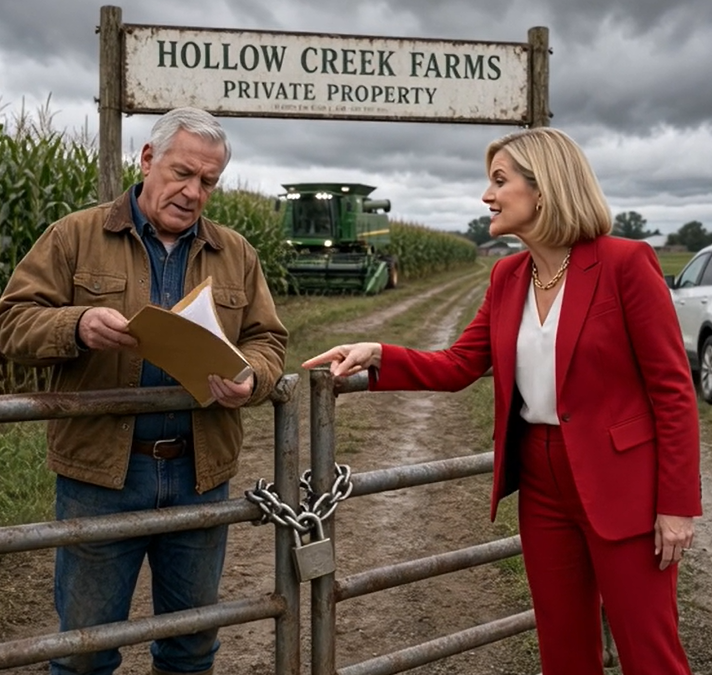
PART2:
The kind of weather that can turn standing corn into a field of snapped stalks and mud before lunch.
We had one window.
Maybe eight hours.
Maybe less.
Linda knew that.
That was why she had chosen that morning.
I shut down the combine.
The engine wound lower.
When it stopped completely, the woods seemed unnaturally quiet.
Far to the southwest, thunder rolled.
I climbed down.
At sixty-eight years old, I had learned that anger moves faster than judgment.
Linda wanted me angry.
I could see it in the way she held the phone.
She wanted me shouting.
She wanted me cutting that chain.
She wanted footage of an old farmer storming toward an HOA president with bolt cutters while she calmly announced that she was “protecting the community.”
The bolt cutters were in the toolbox behind my seat.
I left them there.
“That gate is on my property,” I said.
Linda lowered the phone maybe an inch.
“The road beyond it belongs to Cedar Ridge.”
“I have a recorded agricultural easement.”
“You had one before the development was built.”
“I’ve had it since 1976.”
Her mouth tightened into a little smile.
“Things change, Walter.”
Behind me, a truck door slammed.
My grandson Caleb came around the grain truck.
Sixteen.
Tall already.
Brown hair sticking from under a seed-company cap that had once belonged to my wife.
He had spent half the night helping me get ready.
Checking tire pressure.
Cleaning windows.
Loading tools.
Packing sandwiches because we expected to work until well after dark.
He looked at the chain.
Then at Linda.
Then at the western sky.
“Grandpa.”
His voice was tight.
“They upgraded the warning.”
“I heard.”
“They’re saying hail by one.”
Linda swung the phone toward him.
“Stay out of this.”
Caleb stared.
“This is my family’s farm.”
“Control your grandson, Walter.”
Caleb took one step forward.
“I’m standing right here.”
“And you’re trespassing.”
He looked down at his boots.
The gravel beneath them was ours.
I knew the survey pin.
So did Linda.
“This is our land.”
She smiled.
“That attitude is exactly why people don’t want your operation here anymore.”
My operation.
She said it as if I had opened a steel mill beside her swimming pool the previous Tuesday.
The Briggs farm had been there since 1948.
My grandfather bought the first 160 acres after the war.
The land was poor then.
Rocky.
Overgrown.
Half of it hadn’t been worked in years.
He cleared stones with a pry bar and a borrowed truck.
Built the original equipment barn from salvaged oak.
Planted corn with a little two-row planter behind a tractor that barely made it over the ridge.
My father expanded the place after returning from Korea.
I grew up there.
So did my daughter.
I added dairy cattle in my twenties.
Sold the herd when milk prices stopped making sense.
Shifted to grain.
Bought neighboring acreage whenever families decided farming was no longer for them.
By the time Cedar Ridge Estates appeared, our fields surrounded that subdivision on three sides.
The developer advertised it as country living.
Their brochures showed red barns.
Golden corn.
Split-rail fences.
Children smiling at horses.
Sunsets behind silos.
What they did not show were manure spreaders.
Diesel engines at five in the morning.
Combines operating until midnight.
Harvest dust.
Mud.
Flies.
Grain dryers.
Chemical tanks.
Trucks.
The countryside, apparently, was beautiful as long as nobody actually farmed in it.
The first Cedar Ridge families understood.
Most were reasonable.
Some had grown up on farms themselves.
Their children came to our roadside stand for sweet corn.
They waved when tractors passed.
One family brought their toddler every spring to see newborn calves back when we still had cattle.
Then Linda Caldwell moved in.
Largest house in the development.
Glossy black front door.
Three-car garage.
Stone driveway columns.
She became HOA president within six months.
Her first complaint concerned my tractor lights.
I had been planting after sunset.
The light from my tractor, she said, affected the community’s nighttime atmosphere.
I told her corn did not care about atmosphere.
Her second complaint involved mud.
A grain truck left two thin tire tracks across twenty feet of pavement after rain.
Her third was about the smell from my manure pile.
I had not owned dairy cattle in eleven years.
The smell was coming from a farm two miles west.
When I explained this, she informed me that agricultural property owners had a responsibility to “coordinate odors.”
I thought she was joking.
Linda rarely joked.
Over the next two years, she mailed me twenty-seven letters.
Machinery noise.
Dust.
Barn color.
Lighting.
Farm traffic.
Equipment visibility.
One letter actually described the faded red on my barn as “visually aggressive.”
Every envelope went back unopened with the same sentence across the front:
THE BRIGGS FARM IS NOT PART OF CEDAR RIDGE HOA.
That should have been enough.
It made her worse.
The farm lane behind the gate became her favorite argument.
It ran along the development for about half a mile before turning through our lower property.
My family had used it long before Cedar Ridge existed.
When the subdivision was approved, the county required the developer to preserve agricultural access.
The language could not have been clearer.
The road had to remain open twenty-four hours a day for farm use.
The HOA could not erect gates.
Barriers.
Landscaping.
Parked vehicles.
Decorations.
Or anything else that interfered with agricultural traffic.
I had sent the agreement to Linda’s lawyer twice.
She knew.
And now, on the one morning when delaying me could cost more than all twenty-seven of her letters combined, she had chained my gate.
“You need to remove that.”
“No.”
“Move your SUV.”
“No.”
“You’re intentionally blocking an agricultural easement.”
“I’m protecting residents from dangerous commercial traffic.”
“That combine has been using this road longer than your house has existed.”
That came from Caleb.
Linda aimed her phone at him again.
“Young man, your grandfather has been repeatedly warned about intimidation.”
Caleb laughed once.
“You’re standing on his farm blocking his combine.”
“Caleb.”
I touched his shoulder.
His hands had curled into fists.
He had his grandmother’s temper.
Ruth used to say he inherited my stubbornness and none of my patience.
She had been gone three years.
Cancer.
Some mornings I still turned toward the kitchen expecting her to be there with coffee.
She had a gift for seeing where an argument was headed before I did.
That morning, I could almost hear her.
Don’t give that woman what she came for.
I squeezed Caleb’s shoulder.
“Call Sheriff Dalton.”
Linda laughed.
“Go ahead.”
“And call Daniel Harris at county planning.”
Her smile faded slightly.
“The sheriff already knows Cedar Ridge owns this road.”
“The county knows I have an easement.”
“Then perhaps the county can harvest your corn.”
She lifted the phone.
“Now move that machine away from our entrance.”
I did not move it.
I climbed back inside long enough to shut the weather radio off.
Then waited.
Every minute felt expensive.
At 5:31 the first large raindrops hit the windshield.
Not steady rain.
Just warning drops.
Heavy.
Cold.
The kind that leave dark circles in dust.
Caleb checked radar.
“Storm line’s moving faster.”
“I know.”
“How much can we get if we start at six?”
“Depends.”
“If Peterson and Markham help?”
“I didn’t ask.”
“Call them.”
“Not until we know we can get through.”
Caleb looked at Linda.
“She knows exactly what she’s doing.”
“Yes.”
That answer surprised him.
I had spent months telling him not to assume bad intent when stupidity could explain something.
Not this morning.
Linda knew the forecast.
She knew the easement.
She knew harvest was ready.
She had chosen a steel chain before sunrise.
This was not accidental.
At 5:34 porch lights began coming on inside Cedar Ridge.
The combine was loud enough that people noticed.
Curtains shifted.
Front doors opened.
A few residents stepped outside with coffee.
Linda seemed energized by the audience.
“You bought houses next to a working farm,” I told her.
“The farm did not move here after you did.”
“That doesn’t give you permission to destroy everyone else’s quality of life.”
“I’m harvesting corn.”
“At five in the morning.”
“Because a major storm is coming.”
“Your poor planning isn’t our emergency.”
Caleb muttered something that would have earned him a lecture from Ruth.
I pretended not to hear.
At 5:47, Deputy Eric Miller arrived.
Young man.
Professional.
He parked near the gate.
Before he was fully out of the cruiser, Linda hurried toward him.
“Officer, thank goodness.”
Her voice changed completely.
Calm.
Measured.
Concerned citizen.
“This man is attempting to force commercial machinery through our private community after being formally prohibited.”
Miller looked at the combine.
Then at me.
“Mr. Briggs?”
“No.”
Linda held up her laminated sign.
“The HOA suspended his access.”
“The HOA has no authority over my farm.”
Miller looked at the chain.
“Who installed this?”
“I authorized it.”
Linda said.
“For public safety.”
“Is the gate HOA property?”
“The road is.”
“The gate is mine.”
Miller sighed.
“Do you have documentation?”
“I keep a copy in my truck.”
I handed him a folder.
Deed.
Survey.
Subdivision approval.
Agricultural easement.
Letters from Cedar Ridge’s own attorney acknowledging access.
Miller read silently.
Linda did not let him finish.
“These documents are decades old.”
He kept reading.
“They do not address modern development conditions.”
Still reading.
“Property values have changed.”
Miller turned a page.
“Noise expectations are different.”
He looked up.
“Ma’am.”
“Yes?”
“This says the easement is permanent.”
“It appears permanent to you.”
Miller stared at her.
“I can read.”
A man watching from the Cedar Ridge sidewalk snorted into his coffee.
Linda heard.
Her cheeks tightened.
I wanted to enjoy it.
I could not.
The clock was now past six.
“Deputy.”
I pointed toward field.
“I need access opened now.”
“The storm reaches here this afternoon.”
Miller looked at chain.
Then Linda.
“This may still be a civil matter.”
I understood why.
Easements can become legal swamps.
Police do not generally stand roadside interpreting decades-old property law.
But time was disappearing.
“It stops being merely civil when somebody knowingly obstructs recorded agricultural access.”
Linda crossed her arms.
“Are you threatening to arrest me because Walter failed to plan around bad weather?”
“No one threatened you.”
Miller said.
“Then make him move his equipment.”
A gray county pickup turned onto the road.
I recognized it immediately.
Daniel Harris.
County planning office.
Twenty-six years there.
He had reviewed the Cedar Ridge subdivision before half the residents owned houses.
He climbed out wearing work boots, rain jacket, and the expression of a man whose breakfast had been interrupted by paperwork he thought was settled years earlier.
He did not greet Linda.
He walked to the gate.
“Who put the chain here?”
“I authorized it.”
Linda said.
“And before you begin, our attorney has already reviewed our authority.”
Daniel looked at her.
“Which attorney?”
“David Mercer.”
Daniel reached into his jacket.
Pulled out folded paper.
“That’s interesting.”
Linda’s expression shifted.
“Mr. Mercer contacted my office last week asking whether Cedar Ridge could restrict harvest traffic on this lane.”
She said nothing.
“We answered him.”
“I wasn’t copied.”
Daniel unfolded the page.
“You were.”
“The HOA receives hundreds of messages.”
“It went to your personal association address.”
“I don’t remember it.”
“It was marked urgent.”
Now the residents were moving closer.
Steven Park, who lived near entrance, had started recording.
Not secretly.
Phone held chest high.
Another resident, Ellen Hayes, came out in a bathrobe under yellow raincoat.
A father named Marcus Reed—not the doctor from our other stories, just local father—stood near playground entrance.
Linda saw the growing audience.
She raised her voice.
“This road passes directly through our community.”
Daniel nodded.
“Yes.”
“We have children.”
“Yes.”
“Pets.”
“Yes.”
“Elderly residents.”
“Yes.”
“I am not apologizing for protecting them.”
Daniel pointed at the county sign beside gate.
“Your development approval requires this road remain open for agricultural traffic twenty-four hours a day.”
“That language is outdated.”
“It remains binding.”
“I am the elected president of this association.”
“You were not elected by the county.”
Several residents looked at one another.
Daniel crouched.
A small metal tag hung from the new padlock.
He read.
“HOA purchased this?”
“Yes.”
“With association funds?”
“That’s internal business.”
“It becomes county business when association equipment is attached to a private gate and used to block a county-protected easement.”
Linda looked toward Miller.
“Are you going to allow a county employee to interrogate me on private property?”
Miller checked survey.
Then looked up.
“According to this map, you’re standing on Mr. Briggs’s property.”
That changed the crowd.
You could almost feel it.
Until then, some neighbors had viewed this as another one of Linda’s disputes.
Annoying farmer versus strict HOA president.
Now the facts were sharpening.
Private gate.
Recorded easement.
County restriction.
Written warning.
Linda standing on my land.
Marcus asked:
“Did the board vote on this?”
Linda ignored.
“Linda.”
He repeated.
“Did we vote to chain this gate?”
“I took emergency action.”
“What emergency?”
She pointed.
“That machine.”
Marcus stared at my combine.
“It’s been going through here every harvest since before I moved in.”
“And residents have complained.”
“Who?”
“That’s confidential.”
Steven’s phone stayed on her.
The rain came a little harder.
Caleb looked west.
“Grandpa.”
I knew.
The lower field represented almost half our annual income.
Operating costs already spent.
Loan due in December.
One major crop failure would not mean skipping vacation.
We did not take vacations.
It could mean selling acreage.
Maybe equipment.
Maybe worse.
Linda looked at my face.
Something in her expression brightened.
Then she said the sentence that changed everything.
“Perhaps this will finally encourage you to reconsider the developer’s offer.”
The roadside became quiet.
Even the rain seemed louder.
I stared at her.
“What offer?”
Her eyes widened.
Only a fraction.
She knew immediately.
“The standing purchase offer.”
“That expired fourteen months ago.”
“The developer remains interested.”
“How do you know?”
“I’m aware of matters affecting our community.”
Daniel slowly straightened.
Deputy Miller looked from her to me.
I stepped closer.
Not threatening.
Just enough that I did not need to raise my voice.
“Did you block my harvest because you’re trying to force me to sell?”
“That’s ridiculous.”
“Then why mention the offer?”
“Because your operation is no longer compatible with Cedar Ridge.”
“My farm predates Cedar Ridge.”
“There you go again.”
Her control cracked.
“Acting like age gives you ownership over the future.”
“No.”
I said.
“The deed gives me ownership.”
Someone laughed.
A real laugh.
Linda turned red.
She pointed toward the barn.
The combine.
The field.
“Look at this property.”
“Old machinery.”
“Dust.”
“Chemicals.”
“Noise.”
“You are holding an entire community hostage because you are emotionally attached to land that could finally be used properly.”
Caleb moved before I could stop him.
“My grandmother died in that house.”
“Caleb.”
“My great-grandfather built that barn.”
He pointed toward lane.
“My mom learned to drive on this road.”
Linda brought her phone inches from his face.
“This aggression is exactly what residents have complained about.”
Caleb looked at phone.
Then looked at me.
He was furious.
Sixteen.
Everything in him wanted to say something ugly.
Maybe knock phone away.
Maybe give Linda the video she had been trying to manufacture since dawn.
Instead, slowly, Caleb stepped backward.
I had never been prouder of him.
Miller shut the document folder.
“Mrs. Caldwell.”
“Remove the chain.”
“No.”
“That is a lawful instruction based on the county’s determination.”
“You called this civil ten minutes ago.”
“I said it might be.”
He pointed toward Daniel.
“The agency responsible for this easement is now confirming it.”
“My lawyer will dispute your interpretation.”
“You are free to do that.”
“After you remove the obstruction.”
Linda extended both wrists dramatically.
“Then arrest me.”
That was pure theater.
She believed no one would.
People like Linda often confuse social position with immunity.
Deputy Miller did not take the bait.
He looked at Daniel.
Daniel made a call.
Ten minutes later, a county maintenance truck arrived.
Portable hydraulic cutter.
Linda moved in front of gate.
“You will not destroy HOA property.”
Miller stepped between her and chain.
“You can move voluntarily.”
“Or?”
“I’ll move you.”
Linda looked toward residents.
I could see what she expected.
Support.
Someone to say she was protecting children.
Someone to blame farm.
No one moved.
Steven kept recording.
Marcus crossed arms.
Ellen Hayes shook her head.
Linda stepped aside.
The maintenance worker placed cutter on chain.
Metal tightened.
Then snapped.
The links dropped to gravel.
Small sound.
After nearly an hour and a half of argument, it sounded like a church bell.
Caleb took off toward combine.
“Wait.”
He stopped.
Everyone looked at me.
I pointed behind Linda.
Her SUV still blocked lane.
“You’re still in the way.”
She stared at vehicle as though it had betrayed her.
“I’m not moving it.”
Miller sighed.
“Mrs. Caldwell.”
“You cannot tow my car from HOA property.”
Daniel looked at map.
“The shoulder is inside the agricultural easement.”
Miller reached for radio.
“I’ll call a tow.”
That finally moved her.
Linda rushed to SUV.
Started engine.
Backed so hard the tires scattered gravel.
She lowered window.
“This isn’t over, Walter.”
I picked up half the severed chain.
“For the corn, it is.”
At 6:41, I drove through.
Something happened I had not expected.
Cedar Ridge residents cleared the way.
Marcus dragged one decorative planter out of the turning radius.
Steven moved an HOA sign.
Ellen stood under umbrella and waved.
Another resident lifted low ornamental chain somebody had installed near shoulder years earlier.
The same neighborhood Linda claimed I was threatening now helped my combine pass.
Rain began steadily at seven.
Caleb called three neighboring farmers.
I had not wanted to ask.
Pride.
They came anyway.
Peterson brought combine.
Markham brought grain cart.
Sam Ellis brought truck.
By eight, four machines were working lower fields.
At nine, two Cedar Ridge women arrived with coffee and egg sandwiches.
At ten, Marcus came with teenage sons.
“What can we do?”
“You ever work grain?”
“No.”
“Good.”
He laughed.
“Why good?”
“You won’t have bad habits.”
I put them near grain carts.
By noon they were covered in dust.
The boys were grinning.
One said:
“This is actually kind of awesome.”
Marcus shook his head.
“Don’t tell your mother.”
At 1:17, storm sirens started.
Wind pushed through standing corn in long waves.
Sky turned green-gray.
Lightning flashed southwest.
We kept cutting.
One pass.
Unload.
Turn.
Another.
Caleb drove grain truck harder than I liked.
I yelled on radio.
“Slow down.”
“We’re out of time.”
“Slow down anyway.”
Ruth would have said same.
At 1:42, final truck came out.
Ten minutes later, hail hit.
It hammered the barn roof so hard conversation stopped.
Rain turned field entrances into soup.
Wind flattened last rows near creek.
We lost fourteen acres.
Painful.
But most crop was safe.
Without Linda’s chain, I estimate we might have lost six.
If access had remained blocked another hour?
More than one hundred.
That evening, after storm passed, I found Caleb sitting on combine steps.
Mud to knees.
Hair wet.
Hands shaking from adrenaline and exhaustion.
The severed chain lay across his lap.
“You keeping that?”
“Yes.”
“Why?”
“So I remember.”
“What?”
He looked toward Cedar Ridge.
Residents were clearing branches from the road.
Marcus and sons among them.
“That one person can make a whole place look bad.”
I sat beside him.
“And?”
Caleb looked at chain.
“The rest get to decide whether she actually speaks for them.”
Ruth would have kissed him.
Maybe corrected his grammar first.
The HOA held an emergency meeting the next evening.
More residents attended than there were chairs.
I did not go initially.
Caleb wanted to.
I said no.
“It’s their association.”
Then Daniel Harris called.
“Walter.”
“Yes?”
“You should probably be here.”
“Why?”
“There’s something you need to see.”
So we went.
Not as HOA members.
As affected landowners.
Linda arrived with attorney.
Prepared statement.
She called her actions a “temporary emergency traffic-control measure.”
Said unnamed residents had expressed safety concerns.
Said she never intended financial harm.
Then Steven Park connected his phone to clubhouse TV.
Played video.
There was Linda at dawn.
Your poor planning is not our emergency.
There she was refusing Miller.
There she was mentioning developer offer.
There she was saying my farm no longer belonged.
Then Daniel distributed county email.
Dated previous week.
To HOA counsel.
Board address.
Linda’s address.
Subject:
AGRICULTURAL ACCESS — BRIGGS EASEMENT — URGENT.
Clear response:
HOA MAY NOT RESTRICT, SUSPEND, OBSTRUCT, OR CONDITION AGRICULTURAL TRAFFIC.
Linda claimed she did not see.
Then one board member, Rachel Kim, stood.
“I have something else.”
Linda looked.
Rachel opened laptop.
Three months earlier, Linda had emailed developer representative.
She had written:
If renewed acquisition proposal is made, I believe community pressure can be facilitated to make continued agricultural use increasingly impractical.
The room became silent.
Another line:
With cooperation from the development group, I would be interested in discussing a formal consulting role after acquisition and rezoning.
No payment yet.
No signed contract.
But intention clear.
She was not merely offended by tractors.
She wanted my farm gone.
And she wanted a job when it disappeared.
Linda stood.
“That email is being mischaracterized.”
Rachel:
“It’s on the screen.”
“I was discussing long-term planning.”
“You offered to pressure him.”
“I said community pressure.”
“What’s difference?”
Linda’s attorney touched her arm.
She shook him off.
“I was trying to protect property values.”
Marcus stood.
“My sons spent yesterday helping Walter save corn because you locked him out of his own field.”
“That was your choice.”
“Yes.”
He said.
“This is ours too.”
Board removed Linda as president that night.
Six to one.
The opposing vote?
Linda.
For some reason that detail always makes Caleb laugh hardest.
Cedar Ridge reimbursed the gate damage.
Paid for fourteen acres lost during delay.
Their insurer later pursued Linda personally over intentional acts outside board authority.
Developer backed away from my farm.
Not because suddenly developed conscience.
Because everything was radioactive.
Emails.
Residents.
County.
News.
No company wants promotional rendering next to headline about trying to squeeze old farmer out before a storm.
Linda sold her house following spring.
But my favorite part came weeks later.
Cedar Ridge held autumn festival.
Someone invited Caleb and me to bring my restored 1952 Farmall tractor.
I almost declined.
Caleb said:
“They helped.”
He was right.
So we drove the same lane.
No chain.
Kids climbed tractor.
Parents took photos.
Ellen Hayes brought apple pie.
Marcus asked me to explain how corn became food, feed, ethanol, starch, sweetener, industrial products.
His sons acted like experienced farmhands after one day.
Caleb mocked them.
Near entrance stood new wooden sign.
CEDAR RIDGE BORDERS A WORKING FARM.
FARMING INVOLVES EARLY HOURS, LARGE EQUIPMENT, DUST, NOISE, ODORS, AND SEASONAL TRAFFIC.
THE FARM WAS HERE FIRST.
PLEASE DRIVE CAREFULLY AND RESPECT ITS WORK.
Caleb read.
“Grandma would’ve liked that.”
“She would’ve corrected punctuation.”
He laughed.
I looked across fields.
Corn stubble.
Old barn.
House where four generations ate breakfast before sunrise.
Linda had believed chain meant power.
It did not.
It meant somebody mistook inconvenience for injustice.
Authority for ownership.
Silence for consent.
I mounted the broken chain over equipment-shed workbench.
Right above bolt cutters I refused to use.
Years later it still hangs there.
Caleb asks why.
Though he knows.
I tell him anyway.
A farmer’s hardest job is not always planting.
Harvesting.
Repairing fences.
Watching weather.
Sometimes the hardest thing is standing perfectly still while someone works as hard as possible to make you angry enough to lose the very thing you’re trying to protect.
Linda wanted video of an unstable old farmer.
Instead she recorded herself.
That irony mattered.
But not as much as what happened afterward.
Cedar Ridge changed.
Not because every resident became pro-farm overnight.
There were still complaints.
Dust.
Noise.
Traffic.
One family complained about grain dryer.
Fair enough.
We adjusted operating hours when possible.
Another asked that heavy trucks slow near bus stop.
Reasonable.
We added sign.
Respect works both directions.
What disappeared was assumption that new houses had greater claim to land than old farm.
The new board created agricultural liaison.
Fancy phrase meaning:
Call Walter before writing stupid letter.
Caleb loved it.
One resident phoned during harvest:
“Are you going to be working late?”
“Yes.”
“How late?”
“Maybe midnight.”
“My baby’s room faces road.”
I thought.
“I can route trucks out north lane after nine.”
“Would that hurt you?”
“No.”
“Thank you.”
No lawsuit.
No chain.
Conversation.
That was all Linda never understood.
I was not unwilling to compromise.
I was unwilling to be ordered off rights I already possessed.
There is a difference.
The development had legitimate concerns.
Kids.
Noise.
Safety.
But a permanent agricultural easement is not optional because tractors got inconvenient after people bought houses.
The farm did not appear after subdivision.
Buyers were shown views of it.
Some paid premiums for those views.
Then complained about work producing them.
That contradiction always amused me.
Rural aesthetic is not same as rural economy.
A barn is not decoration.
A cornfield is not lawn.
A combine is not parade float.
Cedar Ridge learned.
Slowly.
One spring, new resident named Olivia knocked at farmhouse.
Not HOA official.
Just neighbor.
“My son is obsessed with tractors.”
“Dangerous condition.”
She laughed.
“Can he see combine?”
I took them to shed.
Boy was six.
Stared at machine like spaceship.
I let him sit cab with engine off.
His mother said:
“We moved here for countryside.”
I smiled.
“Then you get full package.”
She laughed.
“Fair.”
That became phrase around neighborhood.
Full package.
Dust.
Sunsets.
Mud.
Fireflies.
Tractors.
Geese.
Farm smells.
Pie.
Storms.
One doesn’t get brochure version only.
Caleb graduated high school.
Went to Penn State agricultural engineering.
That surprised no one.
He returned summers.
Taller.
Quieter.
Still stubborn.
One day he pointed at chain.
“You really could have cut it.”
“Yes.”
“Would’ve been faster.”
“Yes.”
“Why didn’t you?”
“Because Linda was filming.”
“So?”
“Because people see what they want.”
He frowned.
“If I had cut chain while yelling, she could show ten seconds without showing two years before.”
“But paperwork proves—”
“Eventually.”
I looked at him.
“In conflict, never hand somebody unnecessary evidence against you.”
He nodded.
Then:
“Still would’ve been satisfying.”
“Very.”
We both looked at bolt cutters.
Farm humor.
Years passed.
I retired from most heavy work.
Caleb and his mother gradually took more management.
He bought newer combine.
Too many screens.
I hated it.
“It practically drives itself.”
I complained.
“That’s point.”
“What if computer fails?”
“You call technician.”
“Exactly.”
He rolled eyes.
I kept old tractor.
Farmall.
Simple.
Starts if battery and fuel cooperate.
One year Cedar Ridge invited us again.
Caleb drove modern tractor.
I took Farmall.
Kids preferred mine.
Justice.
Linda’s old house went to family named Patels.
First week Dr. Patel? We should avoid recurring occupation details unnecessarily. They were nice.
They walked over before doing anything near property line.
“We’re thinking about adding trees.”
“Your side?”
“Yes.”
“Plant what you like.”
“They won’t affect farm equipment?”
“No.”
“Okay.”
That simple courtesy felt almost luxurious.
They later asked what happened with former owner because neighbors hinted.
I said:
“Long story.”
Caleb said:
“She chained Grandpa out during harvest and tried to sell farm for commission.”
I glared.
“What?”
“Accurate.”
Mrs. Patel stared.
“Seriously?”
“Mostly.”
Caleb liked efficient version.
I preferred context.
Stories shrink.
That is dangerous sometimes.
People make Linda cartoon.
She was not.
She was intelligent.
Organized.
Effective in certain ways.
That made overreach more dangerous.
If she had simply been ridiculous, people would have ignored.
She knew how to frame.
Safety.
Property values.
Community.
Modern standards.
Reasonable words.
Used toward unreasonable control.
That is worth remembering.
Bad actions rarely introduce themselves as bad.
They arrive labeled protection.
Order.
Efficiency.
Standards.
Sometimes genuine.
Sometimes cover.
Ask:
Who has legal authority?
What evidence?
What process?
Who benefits?
The county email answered first questions.
Developer email answered last.
By blocking harvest, Linda was not merely enforcing preference.
She was increasing pressure on a landowner while positioning herself for future consulting benefit.
That transformed neighborhood irritation into conflict of interest.
Residents understood.
That was why she fell so fast.
Not because they all loved me.
They hated being used.
Nobody likes discovering their property association became leverage in somebody else’s job negotiation.
The insurance dispute lasted longer.
Lawyers always do.
Eventually settled.
I cared less.
Crop survived.
Farm stayed.
That mattered.
Fourteen acres lost became muddy scar.
Next spring we replanted.
Corn grew.
Fields do not hold grudges.
Good lesson.
One evening Caleb and I stood at edge of lower field.
New corn knee high.
He said:
“Hard to believe that was all flattened.”
“Land recovers.”
“People?”
“Sometimes.”
“Linda?”
I shrugged.
“Not our business.”
He thought.
“You forgive her?”
“Not question.”
“What is?”
“Whether I still let her run anything in my head.”
He looked.
“Do you?”
“No.”
That was mostly true.
Forgiveness is often confused with pretending no harm.
I did not.
Linda’s actions could have cost farm.
I remembered.
But I did not need to wake every day angry.
She moved.
Farm remained.
Spend energy where useful.
Another lesson Ruth taught.
After she died, anger felt embarrassingly small beside grief.
You learn finite nature of attention.
Do not hand too much to people who do not deserve.
The chain became symbol in family, but not trophy against Linda.
Caleb eventually added little brass plate beneath it.
5:12 A.M.
I asked:
“Why?”
“So nobody forgets.”
“Forget what?”
“Timing.”
He was right.
If Linda had chained gate on sunny Tuesday in June, annoying.
On harvest morning before storm, weapon.
Context defines action.
She selected maximum leverage.
That is why developer email believable.
Intent shows through timing.
Caleb, now studying engineering, said:
“Systems fail at interfaces.”
“What?”
“Engineering thing.”
“Explain.”
“Farm and development share road.”
“Different interests.”
“Easement is interface rule.”
“Linda broke interface.”
I stared.
“College charging you money to explain fences?”
He laughed.
But idea stuck.
Community and farm did not need identical goals.
They needed respected boundaries and agreed interface.
Road.
Traffic.
Communication.
Rules.
Linda tried replacing rule with personality.
Systems centered on personalities fail.
After she left, process improved.
That is institutional lesson.
Good governance should survive leader.
Bad governance becomes leader.
Cedar Ridge had become Linda.
Then residents took it back.
A few years later, county considered widening road.
Public meeting.
Old version of me might assume development behind it.
Instead I went.
Listened.
School bus safety.
Drainage.
Legitimate.
We negotiated turning radius protecting farm lane.
No drama.
Caleb whispered:
“Disappointing.”
“What?”
“No villain.”
“Best meetings have none.”
He nodded.
Boring is success.
I thought about morning Deputy Miller first said civil dispute.
Some readers get angry at him.
I did not.
He arrived with two parties claiming road rights.
One had chain.
One had old papers.
He paused.
Then read.
Then adjusted when county official confirmed.
That is what you want.
Not instant certainty.
Evidence.
Miller later stopped by farm.
“Sorry it took.”
“You did fine.”
“I should’ve ordered chain sooner.”
“Maybe.”
He looked at mounted chain.
“You really kept it.”
“Caleb.”
“Of course.”
Then he asked corn price and stayed for coffee.
People can do jobs without becoming characters forever.
Daniel Harris retired.
At party county office presented him framed copy of Cedar Ridge easement.
He called me.
“This is your fault.”
“You came voluntarily.”
“Your grandson called me at 5:20 in morning.”
“Same thing.”
He laughed.
Daniel had understood significance before most.
Not because heroic.
Because he read development approvals for living.
Expertise is often unglamorous until moment it matters.
He knew exact clause.
Knew email.
Knew county authority.
That prevented Linda converting confidence into fact.
Another reason to respect boring professionals.
Surveyors.
Clerks.
Engineers.
Planners.
People who know where line actually is.
The developer that once pursued farm eventually built elsewhere.
Fine.
Development is not evil.
Land changes.
Farms sell.
Families choose.
But choice matters.
I may sell someday.
Caleb may not want all acreage.
Maybe conservation easement.
Maybe partial development.
That will be Briggs decision.
Not somebody starving us into signature.
That is difference.
At seventy-four, I updated estate plan.
Caleb sat lawyer office.
I preserved agricultural access rights carefully.
Lawyer asked:
“You worried Cedar Ridge?”
“No.”
“Then why?”
“Because paper outlives memory.”
That came from experience.
People change.
Boards change.
Good neighbors leave.
Bad ones arrive.
Recorded rights remain if maintained.
Linda taught value unintentionally.
The gate itself was replaced.
Old one bent after county cutter and years wear.
New galvanized.
No chain except our lock when field not in season—and lock placed to still allow easement operations as applicable.
Near it, county installed permanent sign:
AGRICULTURAL ACCESS EASEMENT
DO NOT BLOCK
Caleb took picture.
Sent:
LINDA MEMORIAL.
I replied:
BE NICE.
He sent laughing emoji.
Ruth would have loved texting.
Maybe hated emojis.
Impossible know.
Her absence runs through story more than people see.
If she had been alive, Linda may never get as far.
Ruth could make a person feel foolish with one sentence.
When developer first offered buy, she said:
“Tell them if they want country view, they should enjoy looking at country.”
I repeated.
Developer representative did not laugh.
After Ruth died, farm became more important to me.
Not because soil sacred.
Because memory.
Her garden.
Height marks in mudroom.
Apron hook.
Chair.
I know emotional attachment can cloud economics.
Linda was not entirely wrong that attachment influenced me.
Where she went wrong was assuming attachment invalidated ownership.
People are allowed to value place for reasons beyond highest financial use.
Land is not obligated to maximize somebody else’s profit.
That sentence would have annoyed her.
I like it.
Caleb once asked if I would have sold if developer doubled offer.
“Maybe.”
He looked shocked.
“Really?”
“Everything has price?”
“No.”
“Then?”
“Circumstances.”
“If you wanted farm.”
“I won’t sell.”
“If you didn’t?”
“We talk.”
He smiled.
So future not frozen.
Protecting farm does not mean forcing descendants to keep it.
It means giving them choice.
Linda tried removing mine.
I fought.
One day Caleb may choose differently.
That is his life.
Storm morning became local story.
Paper wrote:
HOA BARRIER DELAYS FARM HARVEST BEFORE STORM.
More restrained than internet titles.
Good.
Internet would say:
KAREN TRIES TO STEAL 400-ACRE FARM—GETS DESTROYED.
Reality subtler.
She did not own developer.
No signed conspiracy purchase.
She offered pressure for potential future consulting.
Still wrong.
But accuracy matters.
If you exaggerate villains, lesson weakens.
Linda was dangerous because behavior plausible.
One HOA president.
One chain.
One SUV.
One hour.
That almost cost more than dramatic crime might.
Everyday abuse of authority accumulates.
People comply because resistance inconvenient.
Then boundary moves.
That is how overreach grows.
Caleb saw residents initially silent.
Then clear road.
Then help harvest.
His quote remains best:
“One person can make whole place look bad.”
“And the rest decide whether she speaks for them.”
Cedar Ridge decided.
That is community.
Not president.
Not sign.
Collective choices.
Autumn festival proved.
A neighborhood that morning seemed enemy by evening had sent coffee, machinery contacts, labor.
Most residents were not Linda.
It would have been easy for me to treat them as such.
Resent everyone.
Block festival.
Refuse cooperation.
That would let one woman define relationship.
Caleb stopped me.
At festival, a little girl climbed Farmall.
Her father Marcus stood beside.
He said:
“Never understood harvest before this.”
I smiled.
“You shouldn’t have to work twelve hours in hail to learn.”
“Brochures did leave some things out.”
“Yes.”
“Do farmers really run all night?”
“When crop says.”
He nodded.
“Linda used to tell us you did it intentionally to annoy neighborhood.”
I laughed.
“You think I enjoy being awake at three?”
He laughed too.
Misunderstanding dies through proximity.
That is why subdivisions built near farms need education.
Right-to-farm notices.
Disclosure.
Signs.
Not just legal protection.
Expectations.
Cedar Ridge added disclosure to resale packets.
Nearby working farm may generate noise, odors, dust, lighting, and machinery at irregular hours.
Good.
Future buyers know.
One small policy prevents future Linda.
Maybe.
Human ingenuity for complaint limitless.
Still.
Years after, at family Thanksgiving, Caleb brought girlfriend.
She saw chain in shed.
“What’s that?”
He told story.
Poorly.
“HOA lady tried to lock Grandpa out so storm would destroy farm because she wanted developer job.”
I interrupted.
“That skips forty-five minutes.”
“Essential facts.”
“Context.”
“Grandpa loves context.”
His girlfriend smiled.
“I noticed.”
Then asked:
“Why didn’t you just cut chain?”
Caleb and I answered simultaneously:
“Camera.”
We laughed.
That became family line.
Always assume camera.
Not from paranoia.
From discipline.
Act in way you can defend if smallest clip circulates without context.
Good rule.
Linda was filming me.
Steven filmed her.
Technology cuts both ways.
She came seeking evidence.
Created her own.
The broken chain weighs maybe seven pounds.
Ordinary steel.
Could buy another for forty dollars.
Yet when I see it, I remember smell of rain.
Diesel.
Caleb’s face.
Thunder.
County cutter.
Residents moving planters.
Hail on barn.
Ruth’s imagined voice.
All attached.
Objects become containers.
Farm full of them.
My father’s wrench.
Ruth’s mug.
Grandfather’s stone hammer.
Chain.
Not valuable at auction.
Priceless to memory.
I do not romanticize battle.
Would rather chain never exist.
We lost fourteen acres.
Spent weeks on paperwork.
Lawyers.
Insurance.
County meetings.
Caleb missed school day.
Stress.
Conflict.
No one wins cleanly.
But sometimes defense necessary.
When it is, best defense often boring.
Documents.
Phone calls.
Witnesses.
Restraint.
No shouting.
No bolt cutters.
I did not defeat Linda with clever trick.
Her own actions defeated her.
I simply refused to help her create another narrative.
That is perhaps deepest point.
She wanted spectacle.
An angry farmer.
Dangerous machinery.
Aggressive grandson.
She had script.
We did not perform.
Caleb stepped back.
I called county.
Miller read.
Daniel brought email.
Residents watched.
Facts stayed facts long enough for people to see.
Manipulators depend on reaction.
Do not always give.
Storm supplied urgency.
Truth supplied rest.
The following summer, Cedar Ridge kids came for farm day.
I showed grain dryer.
Combine.
Planter.
Soil sample.
Explained why compaction matters.
Why equipment needs road width.
Why harvest timing changes.
One boy asked:
“Did bad lady really chain gate?”
His mother turned crimson.
I said:
“She made bad decision.”
“Did police arrest her?”
“No.”
“Why?”
“Not every bad decision means handcuffs.”
He looked disappointed.
Children prefer simple justice.
Adults should teach process.
“She lost job?”
“HOA position.”
“Because chain?”
“Because neighbors decided she shouldn’t represent them.”
He thought.
“That’s like voting someone off island.”
His mother apologized.
I laughed.
“Close enough.”
At seventy-six, I reduced acres under corn.
More soybeans.
Some conservation strips along creek.
Cedar Ridge residents liked wildflowers.
So did pollinators.
Linda would have called coordinated aesthetics.
I called erosion control.
Sometimes interests align.
One thing never changed.
Harvest before storm.
Machines move when crop and weather say.
The permanent sign keeps lane open.
No one parks.
If party planned, board emails.
We coordinate.
That is what functional community looks like.
Not one side winning.
Boundaries plus communication.
Caleb eventually married.
Had daughter.
He brought her to shed.
At three, she pointed chain.
“What?”
He said:
“Grandpa’s reminder.”
I corrected:
“Your daddy’s reminder.”
“What reminder?”
Caleb looked at me.
Then said:
“Don’t get so mad you forget what you’re protecting.”
I had to look away.
Ruth would have liked that one too.
Maybe no grammar correction.
When people ask whether farm “won,” I say farm is not sports team.
We harvested.
Stayed solvent.
Rights respected.
Neighbors improved.
That is enough.
Linda lost presidency.
Moved.
Maybe found another community.
I hope she learned.
I genuinely do.
Not for her sake alone.
For people around her.
Power without humility damages.
Sometimes person must lose title before recognizing title never created ownership of everyone else.
The last letter Linda ever sent arrived after house sold.
No HOA letterhead.
Personal.
Short.
Walter,
I still believe your operation and Cedar Ridge were fundamentally incompatible, but I regret how the matter was handled.
No apology exactly.
I read.
Caleb wanted burn.
I kept.
Why?
Because incomplete apologies are still records of changed certainty.
She once said farm did not belong.
Now she said matter mishandled.
Small shift.
I did not reply.
No need.
Peace sometimes means letting last word sit unanswered.
Mounted chain remains above bolt cutters.
Her letter in farm file.
Not shrine.
Archive.
I am old enough to know stories change depending who tells.
My version centers farm.
Linda’s likely centers safety and humiliation.
Residents center governance.
Caleb centers family.
Daniel centers easement.
Miller centers strange morning before breakfast.
Truth lives in documents and overlap.
Recorded easement existed.
Chain existed.
County warning existed.
Developer email existed.
Storm arrived.
Corn harvested.
Those are anchors.
Everything else is interpretation.
And if there is one image I trust most, it is not Linda’s downfall.
It is 6:41.
Combine rolling.
Chain cut.
Residents stepping aside.
Ellen Hayes waving beneath yellow umbrella.
Marcus dragging planter.
Caleb climbing truck.
Sky darkening.
A community that one hour earlier seemed like barrier choosing not to become one.
Then later those same people brought coffee.
Helped grain.
Returned next day to clear branches.
That is better ending than revenge.
Linda wanted farm gone because she believed it did not fit community.
By autumn, community installed sign saying farm belonged.
Not because old automatically right.
Because facts did.
The farm was there first.
The easement valid.
Work legitimate.
Respect earned both ways.
I stood beside Caleb reading sign.
He said:
“Grandma would’ve liked it.”
I said:
“She would have corrected the grammar.”
He laughed.
Across road the stubble shone gold.
Barn roof still dented from hail.
House windows reflected afternoon sun.
We had survived another season.
No dramatic victory music.
Just land.
Work.
Neighbors.
A gate that opened.
Sometimes that is all a person is fighting for.
Not dominance.
Not revenge.
The right to continue.
At 5:12 that storm morning, Linda Caldwell believed a chain could stop nearly eighty years of family history long enough to force future she wanted.
She was wrong.
Not because I was stronger.
Not because I shouted louder.
Because she had confused power with authority.
The HOA had a president.
The county had a recorded easement.
The land had a deed.
The storm had no interest in anybody’s title.
And I had enough sense to leave my bolt cutters in the toolbox.
The chain came down anyway.
Her SUV moved.
The combine crossed.
The corn came in.
And by the next evening, the people Linda claimed to speak for were listening to her own recorded words and deciding she would never speak for them again.
The broken chain still hangs in my equipment shed.
Above the bolt cutters.
Whenever my granddaughter asks why, Caleb gives his version.
Whenever Caleb asks why I kept it, I give mine.
But the truth is simpler than both.
I keep it because there will always be somebody who mistakes your patience for permission.
Somebody who assumes that because you have not shouted, you will surrender.
Somebody who believes the title on their door matters more than the line on your deed.
When that happens, remember what I learned at 5:12 on a Thursday morning while thunder rolled behind nearly four hundred acres of corn:
Do not give them the fight they came to film.
Give them the facts they cannot survive.








