HOA President Called 911 Because I Refused to Give Her Free Fuel—Then She Learned the “Problem Neighbor” She’d Been Harassing Was the City’s Police Chief.
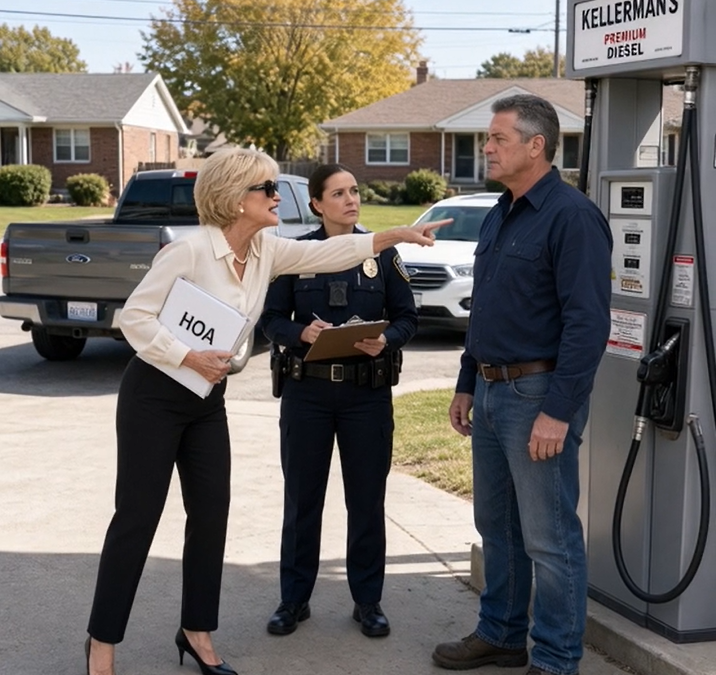
PART3:
“Yes, you have.”
“Marcus.”
“No.”
Her eyes narrowed.
“Would you at least allow me to finish?”
“No.”
She inhaled slowly.
“As HOA president, I am responsible for community emergency preparedness.”
“Congratulations.”
“Your fuel source has already been used for community benefit.”
“By me.”
“So there needs to be equitable access.”
I actually laughed.
Brenda’s face changed.
Not much.
Enough.
“Equitable access.”
I repeated.
“Yes.”
“To my diesel.”
“You chose to establish a community precedent.”
“No.”
“I chose not to let an old man lose oxygen during a blackout.”
She shifted the clipboard.
“The distinction is not as significant as you seem to think.”
“It is from this side of the property line.”
I put nozzle back into holster.
Locked it.
Brenda watched.
“That is extraordinarily uncooperative.”
“That is extraordinarily mine.”
“Marcus.”
I turned toward garage.
Her voice sharpened.
“I need approximately twenty gallons.”
I looked back.
“For what?”
“Community travel obligations.”
“Use a gas station.”
She looked genuinely offended.
“Why should I pay nearly four dollars a gallon when you have stored fuel available to residents?”
I stared at her Range Rover.
Then back.
“For the third time, your car doesn’t even use diesel.”
“That can be addressed.”
“How?”
She hesitated.
“I was speaking more broadly.”
“No, you weren’t.”
She opened mouth.
I held up a hand.
“Brenda, this is private fuel on private property.”
“It is not HOA-owned.”
“It is not community property.”
“It is not free.”
“You are not getting any.”
She became very still.
“What did you say?”
That was her mistake.
Not the question.
The expectation behind it.
Like perhaps I had spoken too casually the first time.
Like if she made me repeat no, the word would realize who was listening and retreat.
“I said no.”
Brenda pulled out her phone.
I expected a photograph.
Maybe another violation report.
Instead she dialed.
I heard:
“911, what is the address of your emergency?”
Brenda’s whole voice changed.
Softer.
Shaky.
Professional victim.
“I need police assistance.”
I stared.
“Ma’am, what’s happening?”
“I’m at a residence inside Willowbrook Estates.”
“There is a man behaving aggressively.”
I laughed in disbelief.
She turned slightly away.
“He has a large fuel-storage installation.”
“He is hostile.”
“He has been threatening me and refusing to comply with community safety requirements.”
I leaned against the truck.
The smell of diesel hung in the cold air.
My hand was still on the fuel cap.
“Ma’am, has he displayed a weapon?”
“No.”
“Has he physically threatened you?”
“He is very intimidating.”
That answer told me everything.
Brenda glanced over.
I smiled.
Not because funny.
Because she had just stepped onto ground I understood very well.
“Ma’am, officers are being dispatched.”
“Thank you.”
She hung up.
Then looked at me.
“You brought this on yourself.”
I said:
“Did I?”
Her shoulders lifted.
“You could have cooperated.”
“With free fuel.”
“This is about your hostile attitude.”
“No.”
“It’s about you hearing a word you don’t like.”
She walked toward her Range Rover.
“I suggest you stay here.”
I almost told her officers knew where to find me.
Instead:
“Sure.”
Twelve minutes later, two patrol cars turned onto Willowbrook Lane.
I recognized both.
Officer Ben Carter in first.
Officer Elise Navarro second.
Ben parked.
Got out.
Saw me.
Stopped.
Just for half a beat.
Then professionalism clicked in.
“Morning, Chief.”
Brenda had been walking toward him.
She stopped.
Her head turned.
“Chief?”
Ben’s eyes flicked toward her.
Then back to me.
I said:
“Morning, Ben.”
Brenda looked from him to me.
“What does he mean?”
I did not answer.
Ben did.
“Ma’am, you called about Chief Kellerman?”
She stared.
The world did not dramatically stop.
No thunder.
No dropped clipboard.
Just one woman trying to recalculate six months of assumptions in real time.
“Chief?”
Elise walked over.
“Police chief.”
She supplied.
Brenda blinked.
I almost felt sorry.
Almost.
Then she recovered.
Very quickly.
“That’s irrelevant.”
Good.
Actually good.
Because she was correct.
If I had threatened her, my title should not protect me.
Ben glanced at me.
I said:
“She is right.”
Then:
“I am personally involved.”
“Treat it as any call.”
Ben nodded.
“We will.”
That mattered.
Brenda began.
“I approached Mr. Kellerman regarding an ongoing HOA safety matter.”
“She ordered me to give her free fuel.”
“I did not order.”
“You said, ‘Fill mine when you’re finished.’”
“That was conversational.”
“It was a demand.”
Brenda ignored.
“He became aggressive.”
Ben asked:
“What did he do?”
“He repeatedly refused to cooperate.”
“That isn’t a threat.”
Elise said.
Brenda turned.
“His demeanor was threatening.”
“What words?”
Pause.
“He said no.”
I looked away because laughing would not help.
Ben kept face neutral.
“Did he approach you?”
“No.”
“Touch you?”
“No.”
“Threaten physical harm?”
“No.”
“Display weapon?”
“No.”
“Prevent you from leaving?”
“No.”
“Did he tell you to leave?”
Brenda hesitated.
“Not directly.”
Ben glanced at my security camera above garage.
“Chief?”
“Everything recorded.”
Brenda looked up.
For the first time.
Camera.
Tiny red light.
I unlocked my phone.
Pulled feed.
Audio.
She listened to herself.
Fill mine when you’re finished.
Equitable access.
No.
When clip ended, nobody spoke.
Elise asked:
“Ms. Ashworth, are you saying any part of that recording is incomplete?”
“No.”
“Then there is no criminal threat here.”
Brenda’s jaw tightened.
“I still believe his behavior creates a community safety concern.”
“That would be civil or HOA matter.”
Ben said.
“Not a police emergency.”
He paused.
“And knowingly making false emergency claims can itself become an issue.”
“I did not make a false claim.”
“You said he threatened you.”
“I felt threatened.”
“That is not the same as a threat.”
Brenda looked at me.
The hatred came then.
Not because I was police chief.
Because the uniformed people she had summoned did not automatically convert her preference into authority.
She turned toward her car.
“I will address this through proper channels.”
I said:
“Please do.”
She drove away.
Ben waited.
Then looked at me.
“You okay?”
“Yes.”
He nodded toward pump.
“Did she really ask for fuel?”
“Yes.”
“For Range Rover?”
“Yes.”
“That’s gas.”
“I told her.”
Ben shook head.
“I’m not putting that part in report.”
“You’re putting all relevant statements.”
“Chief.”
“All relevant.”
He sighed.
“Yes, sir.”
That was the beginning.
To explain Brenda, I need to explain Willowbrook.
I had moved there eighteen months earlier after my wife Sarah died.
Cancer.
The word is small for what it does.
Sarah and I were married twenty-seven years.
She was a high-school counselor.
The sort of person teenagers found excuses to visit long after they stopped needing schedule changes.
She remembered everybody’s birthday.
She could make friends in grocery checkout.
I was the opposite.
Military logistics for twenty years.
Then law enforcement.
Systems.
Schedules.
Inventory.
Evidence.
Procedure.
I liked clear things.
Sarah made unclear things tolerable.
Cancer took two years.
At first appointments.
Then surgery.
Then chemotherapy.
Then the kind of medical vocabulary you learn unwillingly.
Margins.
Markers.
Progression.
Palliative.
We did all the right things.
It did not matter.
The spring she died, our house became unbearable.
Not because empty.
Because not empty enough.
Her coat still hung beside mine.
Her coffee cup stayed on second shelf.
The bathroom drawer had hair ties she would never use.
I could stand in kitchen and know exactly where she would have been at 6:45.
That is a specific kind of grief.
The person is gone.
Their geography remains.
After four months, I sold.
Everyone thought too soon.
Maybe.
But staying was killing me differently.
Willowbrook Estates was one of those middle-class Ohio subdivisions built in phases.
About two hundred homes.
Tree-lined streets.
Community center.
Pool.
Playground.
Most houses similar enough to feel planned without becoming identical.
My property was unusual.
At the edge.
Older than most development.
Large detached workshop.
Deep lot.
A leftover parcel that had once belonged to a small farm before subdivision grew around it.
That garage sold me.
Sarah used to say I needed something to fix whenever life became unfixable.
Vintage trucks became that.
A 1973 Chevrolet C20.
1956 Ford F-100 project.
Old International pickup that had been mostly rust when I bought it.
Machines were honest.
If compression was low, gauge told you.
If fuel line leaked, floor showed it.
If electrical circuit failed, meter narrowed problem.
Machines did not say they were fine when they were dying.
The prior owner had been a farmer named Edwin Walsh.
He installed the diesel tank years earlier.
When I bought, I could have removed it.
Instead I upgraded.
Fifteen thousand dollars.
New double-wall containment.
Environmental inspection.
Fire marshal.
County planning.
Insurance rider.
Everything legal.
I used diesel for my truck, tractor, generator, and some restoration equipment.
The first HOA president I knew was Mrs. Henderson.
Retired third-grade teacher.
Seventy.
Tiny.
Terrifying when annoyed.
She knocked my door first week.
“Welcome.”
Handed me bylaws.
Then:
“Mow before twelve inches.”
“Don’t paint the house fluorescent.”
“Pay dues.”
“Don’t be an ass.”
I liked her immediately.
She retired from board due health.
Brenda moved in six months later.
Real-estate agent.
Maybe forty-eight.
Range Rover.
Luxury wardrobe.
A talent for speaking about ordinary preferences as if they were principles of civilization.
She campaigned for HOA president on “elevated standards.”
At first, residents liked energy.
Brenda organized landscaping bids.
Improved clubhouse furniture.
Got pool resurfaced.
People applauded.
Power rarely begins with obvious abuse.
It begins with usefulness.
Then enforcement tightened.
The Rodriguezes got repeated notices because two cars sat in driveway.
Their garage held disabled daughter’s equipment.
Mr. Orion’s vegetable garden became “nonconforming horticultural use.”
A young Black couple, Devin and Rochelle Turner, got three letters about basketball hoop.
Two houses down, white family had same kind.
No letter.
When Devin asked, Brenda said:
“Enforcement timing varies.”
Convenient.
A veteran named Carl Westbrook received warning because his service-dog ramp allegedly altered facade.
Brenda eventually backed down after attorney called.
Nobody connected incidents at first.
Everyone assumed bureaucracy.
I began paying attention.
Then she found pump.
During ice outage I helped people.
Not because HOA asked.
Because need was obvious.
Harold Martinez’s oxygen system had battery backup but not enough for multi-day outage.
I gave Dorothy fuel for their generator.
The Carson family’s basement pump.
Mr. Orion’s freezer and heat.
One other veteran’s CPAP and medical refrigeration.
People talked.
Brenda heard.
She came with clipboard three days after power restored.
Questions.
Permits.
Insurance.
Environmental containment.
Commercial zoning.
I had answers.
That seemed to irritate her.
Within a week:
$500 HOA violation.
Unauthorized commercial activity.
I read covenants.
My parcel was within association.
But private preexisting improvements were grandfathered subject to code.
No commercial operation.
No sales.
No customer traffic.
No violation.
I responded with nineteen pages.
Permits.
Photos.
County records.
Inspection.
Insurance.
I thought facts ended disagreement.
That was naïve.
Brenda did not want resolution.
She wanted submission.
Three days later:
emergency board meeting.
Thirty residents.
Folding chairs.
Stale coffee.
PowerPoint.
I still remember slide.
Photo of my tank.
Red arrows.
EXPLOSION RISK.
ENVIRONMENTAL HAZARD.
She had found images of fuel-depot fires online.
Not my equipment.
Industrial disasters.
She flashed them between photos of children playing.
Classic persuasion.
“Imagine this near your family.”
A woman gasped.
People shifted.
Fear works fastest when technical issue is unfamiliar.
I let Brenda finish.
Then stood.
Fire marshal Jim Henderson had come because I asked.
He had inspected system month earlier.
I placed report.
“Passed.”
Permit.
“Current.”
Insurance.
“Covered.”
Environmental containment.
“Exceeds minimum.”
Then:
“Jim?”
He stood.
“Marcus’s system is one of the cleaner private installations I see.”
Room changed.
Brenda tried aesthetics.
Property values.
Traffic.
Dorothy Martinez stood.
“Marcus kept my husband’s oxygen machine running during ice storm.”
Then Carson family.
Then Mr. Orion.
Then Carl Westbrook.
Stories beat slides.
Meeting adjourned.
Vote postponed.
Brenda stood at podium typing.
I knew we were not done.
Two weeks later, City Planning.
Anonymous complaint:
unlicensed fuel station.
Tax evasion.
Environmental hazard.
Inspector Dave Morrison came.
I opened everything.
One hour.
No violation.
Brenda appeared during inspection like she had GPS tag on city employees.
Dave told her plainly.
No issue.
Then warning:
Repeated knowingly false complaints can result in penalties.
Brenda waited until he left.
“This isn’t over, Marcus.”
That sentence is common in bad movies.
Real people sometimes say it too.
She did.
I replied:
“That’s your choice.”
That evening Jake Owens, contractor down street, texted.
Check Nextdoor.
Screenshots.
Concerned Willowbrook Resident.
Hazardous diesel compound.
Declining property values.
Police chief? At this point neighbors did not know my job because I rarely wore uniform home and city was adjacent jurisdiction? Let me clarify.
Willowbrook sat inside Pine Grove municipality, where I served police chief, but many newer residents simply knew me as Marcus because I kept work separate.
Brenda somehow had never searched.
The fake accounts did not mention.
Three profiles.
Created within days.
Stock-looking photographs.
Same punctuation habits.
Same phrases Brenda used in letters.
“Community safety.”
“Hostile resident.”
“Unfair advantage.”
I documented.
Never replied.
Then private investigators came.
Unmarked sedan.
Two people photographing driveway.
Claimed insurance assessment.
No ID.
Told me return inside.
I told them leave.
Two hours later:
Rick Santos.
Apex Investigations.
He sounded embarrassed.
“Mr. Kellerman, we need to talk about Brenda Ashworth.”
“She hired us.”
“For what?”
“Background.”
“Specifically anything illegal, compromising, or actionable.”
“Actionable how?”
“She offered five-thousand-dollar success bonus if we found material that could lead to arrest, code action, or removal from community.”
I sat at kitchen table.
Sarah’s old coffee mug was in cabinet at my previous house, but grief still had ways.
The moment felt like something she would have hated.
Small corruption.
Mean.
Petty.
“What changed your mind?”
Rick hesitated.
“We ran your background.”
“Good job.”
“Sir…”
He exhaled.
“She hired a PI to dig up criminal dirt on the police chief.”
That was when I knew Brenda genuinely did not know.
“Did you tell her?”
“Yes.”
“And?”
“She said you were probably abusing position and ordered us to continue.”
I laughed once.
“Of course.”
Rick offered contract copy.
I told him preserve originals.
Speak to counsel if needed.
Then I called my own department legal advisor.
Because chief or not, personal conflict required boundaries.
The next day Brenda filed harassment complaint with my department.
Stalking.
Intimidation.
Abuse of authority.
I recused immediately.
Lieutenant Maria Martinez handled.
She came to my kitchen.
Recorder.
Forms.
Same professionalism she would use for anybody.
“Chief, I need to ask whether you have followed Ms. Ashworth, contacted her unnecessarily, threatened enforcement, or used departmental resources related to this dispute.”
“No.”
“Any calls?”
“Only documented neighborhood matters.”
“Messages?”
I turned over.
Security video showed Brenda entering my property more often than I had ever been near hers.
Meeting records.
911 incident.
Inspection.
Emails.
Maria reviewed.
“Unfounded.”
Then looked at me.
“But this is becoming pattern.”
“Yes.”
“You thinking restraining order?”
“Not yet.”
“Why?”
“Evidence.”
“You have enough.”
“Maybe.”
She raised eyebrow.
“Sarah would tell you not to be stubborn.”
That hurt.
Maria had known Sarah.
I looked away.
“Probably.”
She softened.
“Chief.”
“I’m okay.”
“You always say that.”
“She used to hate it too.”
“I know.”
Maria left.
That weekend I stopped looking only at what Brenda was doing to me.
I started looking at HOA.
Twenty years logistics teaches one habit:
When a single thing repeatedly behaves wrong, widen system boundary.
The visible failure may not be the real failure.
I downloaded eight months of HOA financial statements.
Most residents never did.
Nothing secret.
Budgets.
Minutes.
Invoices.
Contracts.
At first normal.
Pool chemicals.
Insurance.
Snow removal.
Landscaping.
Then names.
Ashworth & Associates Legal Services.
$15,000.
Brenda’s maiden name Ashworth.
Relative owned firm.
Premier Grounds Management.
$8,200.
Owner Derek Ashworth.
Her nephew.
Residential Safety Solutions.
$6,500.
Owner Michael Ashworth.
Cousin.
Quality Construction Solutions.
$12,400.
Another relative.
Emergency clubhouse roof repair.
I drove over.
Roof looked new.
It had been replaced three years earlier.
I called former president Mrs. Henderson.
“Did clubhouse roof need emergency repair?”
“No.”
“Who repaired three years ago?”
“Burke Roofing.”
“Warranty?”
“Ten years.”
I sat.
Invoices said flashing, membrane, structural leak mitigation.
No permit.
No warranty claim.
I pulled corporate registrations.
Addresses.
Family connections.
Then competitive prices.
Inflated.
Around $47,000 questionable in eight months.
Not necessarily criminal.
Yet.
Family businesses can legally contract if disclosed, competitively priced, board approved.
But minutes showed none of relationships.
Proposals described vendors as independent.
Conflict-of-interest policy required disclosure.
Brenda had signed annually.
There was real problem.
I could not investigate personally.
So Monday morning:
District Attorney White Collar Unit.
Detective Jim Reynolds.
Former CPA.
Patient.
Boring in best way.
He read.
“Could be fiduciary breach.”
“Could be fraud.”
“Need intent.”
“I understand.”
“Any personal benefit to you?”
“No.”
“HOA office?”
“No.”
“Vote?”
“No.”
“Civil suit?”
“Active dispute.”
He looked.
“That cuts both ways.”
“I know.”
“If we take, we independently verify.”
“Good.”
“This won’t be dramatic tomorrow.”
“Good.”
He almost smiled.
“Most people want dramatic tomorrow.”
“I want case that survives.”
“Then six to eight weeks minimum.”
“Take twelve.”
He nodded.
I left.
That evening six neighbors at Mel’s Diner.
Dorothy.
Bob Orion.
Jake.
Rochelle Turner.
Carl Westbrook.
Janet Williams.
Coffee.
Bacon.
Receipts spread across table.
They got angry.
I stopped.
“No pitchforks.”
Jake said:
“Figuratively?”
“Especially figuratively.”
I explained:
DA investigating.
Homeowners can demand audit.
Special meeting under bylaws with ten signatures.
Dorothy already had bylaws marked.
“Article Seven.”
She smiled.
Brenda had underestimated retired teachers and widows with highlighters.
Then Bob asked:
“What happens when she comes after us?”
Everyone quiet.
That was when I said:
“Something you should know.”
I had avoided telling neighbors because job did not define me and I didn’t want every parking complaint landing on porch.
“I’m chief of police.”
Dorothy stared.
Then laughed until coffee spilled.
“No.”
“Yes.”
“This woman called police on police chief because he wouldn’t give her free gas?”
“Diesel.”
“That makes it dumber.”
Jake whistled.
Rochelle stared.
“Why didn’t you tell her?”
“Why should I need title for her to respect no?”
That quieted them.
I continued.
“That’s point.”
“She should not have been allowed to do this if I were retired mechanic.”
“Or teacher.”
“Or single mother.”
“Or nineteen-year-old kid.”
“Knowing my job might stop her.”
“But then lesson becomes wrong.”
Dorothy nodded.
“Accountability shouldn’t depend on who target is.”
Exactly.
We collected signatures.
Neighbors shared experiences.
Selective enforcement.
Harassment.
One elderly woman had paid $750 in landscaping fines after Brenda’s nephew’s company offered “compliance correction” for $1,900.
That was interesting.
Devin Turner received repeated basketball-hoop fines after refusing Brenda’s recommended security company.
Another connection.
A pattern was forming.
Brenda responded within forty-eight hours.
Emergency safety resolution.
My fuel tank again.
This time:
$10,000 “community safety deposit.”
Removal within forty-eight hours.
Supposed federal concerns.
Terrorism.
That word almost impressed me.
Community center packed.
Brenda presented “federal safety findings.”
Industrial explosion photos.
Consultant report from Residential Safety Solutions.
Her cousin’s firm.
She said local fire marshal not qualified for “federal terrorism protocols.”
Jim Henderson looked personally offended.
I stood.
“Which federal agency issued findings?”
Brenda:
“Sensitive.”
“Name?”
“Security-related.”
I took phone.
Before meeting, I had contacted regional federal environmental safety office because Brenda’s notices referenced federal code.
Agent Morrison agreed to clarify publicly available rules.
Speaker.
“Does your agency require removal of properly permitted private residential fuel tanks as terrorism threats?”
“No.”
Room shifted.
Brenda looked like somebody had pulled plug behind her.
Agent continued:
“Ordinary private fuel storage is governed primarily by applicable fire, environmental, zoning and safety requirements.”
“And presenting non-federal consultant material as federal findings may be misleading depending circumstances.”
Brenda ended discussion.
Dorothy stood.
“I move no extraordinary assessments until independent audit.”
Unanimous.
Even Brenda allies.
The next morning, shredding.
Boxes.
Family cars.
Reynolds texted:
Charges likely Monday. Stay out.
Then Brenda escalated hard.
Flyers.
Anonymous posts.
Terrorism accusations.
Hazardous chemicals.
Calls to city.
Weapons complaint.
Child protective services.
That one made me furious in different way.
There were no children living with me.
But neighborhood children sometimes came garage with parents.
Anonymous report claimed exposed to dangerous fuel.
Caseworker arrived.
Professional.
Embarrassed.
I opened files.
Twenty minutes.
No safety issue.
She said:
“Malicious reporting can have consequences.”
I added report.
Friday Reynolds called.
“We found money movement.”
“How bad?”
“Attempt to move $63,000 from HOA reserve.”
“Where?”
“Account labeled emergency legal and safety expenses.”
“To whom?”
“Shell consulting entity with connection to her family network.”
Bank flagged due unusual amount.
Frozen.
Then digital.
Three fake neighborhood accounts linked to devices from Brenda’s home.
Not proof she personally typed every post.
But source.
Monday arrest likely.
Friday afternoon Brenda’s house looked like evacuation.
Shredding.
Boxes.
Backyard burning.
Fire department came.
Jim Henderson personally.
I stayed home.
Saturday silent.
Sunday normal.
Children bikes.
Dogs.
Lawnmowers.
I sat porch with beer.
For first time in months, Willowbrook sounded like place Sarah might have liked.
Monday morning:
Brenda scheduled one last emergency HOA meeting.
9:00 a.m.
Agenda:
Removal of Marcus Kellerman’s HOA privileges.
Declaration of continuing safety threat.
Immediate enforcement.
Reynolds had told me:
Attend if you normally would.
Do not warn.
I arrived 8:45.
Community center packed.
Brenda wore cream suit.
Projector showed my fuel tank.
Petitions.
Some signatures looked repeated.
She opened.
“Today we finally resolve the danger threatening Willowbrook.”
She pointed toward me.
“This individual has refused safety requirements, manipulated city officials, abused law-enforcement influence, and created hostile conditions for families.”
I sat.
She was building narrative exactly as always.
Then:
“I move that Marcus Kellerman be expelled from all association rights and privileges and enforcement action begin immediately.”
Back doors opened.
Detective Jim Reynolds.
Two investigators.
State prosecutor.
A room can change temperature without thermostat.
Brenda stopped.
Reynolds walked aisle.
“Brenda Ashworth?”
Her face emptied.
“Yes?”
“Mrs. Ashworth, you are under arrest in connection with alleged embezzlement, financial fraud, false reporting, misuse of association funds, and related conspiracy offenses.”
Gasps.
Phones rose.
Brenda said:
“This is outrageous.”
“You have right to remain silent.”
“You are doing this here?”
“Yes, ma’am.”
“In front of residents?”
“Yes.”
She looked at me.
I did nothing.
No smile.
No victory pose.
Reynolds continued rights.
Then addressed room only after permitted:
“Residents should understand investigation concerns HOA funds allegedly routed through undisclosed family-connected vendors, attempted transfer of reserve funds, and related false-reporting activity.”
Chaos.
Board members started talking.
“I didn’t know.”
“No disclosure.”
“She told us…”
Dorothy stood.
“Quiet!”
Teacher voice.
It worked.
Reynolds placed cuffs.
Brenda looked toward me.
And that was when I finally stood.
Not to gloat.
To correct one thing.
“Brenda.”
She stopped.
“You spent months calling police.”
“You filed reports.”
“You hired investigators.”
“You accused me of crimes because I wouldn’t give you free fuel.”
Her eyes burned.
“You should have learned something before deciding I was easy.”
I let silence.
“My name is Chief Marcus Kellerman.”
“Pine Grove Police Department.”
“You filed false complaints with the department I run.”
For two seconds nobody spoke.
Brenda whispered:
“You’re what?”
Then room erupted.
Dorothy slapped table laughing.
Jake said something I cannot print.
Rochelle covered mouth.
Bob Orion stood and clapped once before realizing maybe arrest not sporting event.
Handcuffs clicked.
The sound was quieter than PowerPoint projector fan.
Reynolds led Brenda out.
Local news cameras waited.
Someone had tipped them.
Not me.
Dorothy immediately called emergency motion.
Suspend every Brenda-initiated enforcement action.
Independent audit.
Emergency election.
Unanimous.
Then she grinned at me.
“I nominate Marcus interim president.”
I lifted coffee.
“Absolutely not.”
People laughed.
“I run a police department.”
“One government at a time.”
That was first laughter Willowbrook had shared in months.
But arrest was not ending.
Real accountability is paperwork after spectacle.
Six months of subpoenas.
Bank records.
Emails.
Vendor interviews.
Invoices.
Messages.
Contracts.
The final documented loss exceeded original $47,000.
About $67,000.
Inflated family contracts.
Misrepresented services.
Attempted reserve transfer.
Brenda eventually entered plea.
Federal custody eighteen months.
Probation.
Restitution.
Real-estate license revoked.
Associated businesses investigated separately.
Some money recovered.
Not all.
Her husband filed divorce months later.
I did not celebrate.
I had seen enough collapse.
Crime harms wider than offender.
The judge’s remarks mattered.
He noted financial misconduct existed inside broader pattern of abusing entrusted authority to retaliate, intimidate and conceal.
That was accurate.
Brenda’s real problem was never fuel pump.
Pump was simply first object that told her no.
After emergency elections, Dorothy Martinez became HOA president.
She protested.
Everyone ignored.
Her first reforms were almost revolutionary in their boredom.
Published minutes.
Competitive bids.
Conflict disclosures.
Open budgets.
Two signatures for reserve transfers.
No relatives hired without full disclosure and vote.
Appeal process for violations.
Selective-enforcement review.
Anonymous complaints required factual verification before penalties.
Basketball hoop letters vanished.
Mr. Orion’s garden officially recognized as pollinator/vegetable plot.
The Rodriguezes got apology.
Carl Westbrook’s ramp approved permanently.
My fuel pump remained.
Exactly where it was.
Next February another ice storm hit.
Power out eighteen hours.
This time there was plan.
Neighbors Helping Neighbors.
Not HOA seizure.
Voluntary network.
Generators registered.
Fuel needs estimated.
Medical households prioritized.
Fire-safety workshop.
Proper containers.
Documentation.
No chaos.
Eight families received emergency diesel from me.
Free.
My choice.
Harold’s equipment stayed powered.
Brenda had tried to turn generosity into entitlement.
I refused to let her ruin generosity.
That mattered.
People asked why.
“After everything HOA did?”
No.
Brenda did.
Not neighborhood.
Do not confuse institution with worst person holding title.
I helped start emergency-preparedness workshops.
Backup power.
Home safety.
Proper fuel storage.
How to read HOA covenants.
Financial-literacy sessions.
Attorney volunteers explained records requests.
Conflict-of-interest rules.
First-time homeowners learned to read documents before signing.
The most useful lesson was simple:
Knowledge makes intimidation expensive.
My fuel system became fire department example.
Jim took photos.
Proper containment.
Spacing.
Shutoff.
Grounding.
Labels.
I joked:
“Use Brenda slide too?”
“No.”
“Coward.”
He laughed.
The internet eventually found arrest video.
Of course.
Headline:
HOA PRESIDENT TARGETS WRONG NEIGHBOR — HE’S THE POLICE CHIEF.
Millions.
I hated framing.
Not because false.
Because it implied Brenda’s behavior was outrageous only because she picked powerful target.
I agreed to three interviews.
In every one:
“She should have been held accountable if I were nobody.”
One host asked:
“Did being chief save you?”
I said:
“It helped me understand process.”
“But permits saved tank.”
“Documents disproved complaints.”
“Residents exposed financial conduct.”
“DA handled investigation.”
“Evidence did work.”
“That is how it should be.”
State lawmakers discussed HOA transparency.
Some reforms.
Not all.
Fine.
Real change incremental.
My personal life changed slower.
For months after Sarah died, garage had been therapy.
After Brenda mess, neighborhood became unavoidable.
People knocked.
Coffee.
Meetings.
Workshops.
One person came more often.
Sarah Martinez.
Dorothy’s granddaughter.
Yes, her name was Sarah.
That made me uncomfortable initially.
Thirty-nine.
Paralegal.
Recently divorced.
Two kids.
She volunteered legal clinics.
We argued.
A lot.
First argument over emergency-plan liability waiver.
She said mine overbroad.
I said hers useless.
Dorothy watched like tennis.
Eventually compromise.
Then coffee.
Then dinner.
I almost stopped when relationship started because her name.
Felt disloyal.
My therapist—a sentence I once never expected to say—asked:
“Do you think your wife wanted her name retired?”
I laughed.
“No.”
“Then?”
I went to dinner.
Sarah Martinez never competed with Sarah Kellerman.
Different person.
Different love.
That was important.
She knew.
Never asked me remove photographs.
Her kids invaded garage.
One learned oil changes.
Other hated mechanical things and reorganized my sockets by color, which remains unforgivable.
House became loud again.
I remarried three years later.
Dorothy claimed HOA corruption was matchmaking service.
I told her stop.
She did not.
Brenda’s old house sold.
New family moved.
I met them once.
They apologized for property as if house had done something.
I said:
“Your house is innocent.”
They laughed.
Good.
I rarely thought about Brenda by then.
Until one letter arrived.
No attorney letterhead.
Handwritten.
Marcus,
I have had considerable time to examine how I used the authority given to me by people who trusted me.
There is no justification for what I did with association money or for the retaliatory complaints against you and other residents.
I told myself I was protecting standards and community values when, in reality, I had begun treating disagreement as disobedience.
The fuel incident should have ended the moment you said no.
Instead, I treated your refusal as a challenge to my position.
I am sorry.
I do not expect a reply.
Brenda.
I read twice.
Put in drawer.
Sarah asked:
“You going to answer?”
“No.”
“Forgive her?”
“I don’t know.”
“Need to decide?”
“No.”
She smiled.
“Good.”
Not every apology needs response.
Not every story needs reconciliation.
Sometimes accountability and remorse exist separately.
I hope Brenda changed.
Not my responsibility.
Willowbrook changed.
That I could see.
Annual budget meeting became surprisingly popular.
People read.
Ask.
Bids compared.
When somebody said:
“Board knows best.”
Dorothy snapped:
“No, board serves.”
That difference became cultural.
Authority as service.
Not ownership.
The pump still sits outside my garage.
New hose now.
Same tank.
Still inspected every year.
PRIVATE PROPERTY sign faded once.
I replaced.
Not because Brenda.
Because boundaries should be clear before crisis.
During outages, I still help.
But we document amounts.
Safe containers.
No one assumes.
No one demands.
Every time pump clicks on, I sometimes remember her heels on gravel.
Fill mine when you’re finished.
Not please.
Not can I buy.
Not do we have emergency plan.
Fill mine.
That sentence told whole story.
Brenda did not understand distinction between access and entitlement.
She saw that I had resource.
She held title.
Therefore resource should become hers.
Everything after followed.
Fines.
Complaints.
PowerPoints.
Investigators.
Financial corruption.
Reserve transfer.
False reports.
Same belief:
If I have authority, I can convert preference into obligation.
Military taught me opposite.
Law enforcement reinforced.
Authority is burden.
Not privilege.
You carry public money carefully because not yours.
You apply rules consistently because not yours.
You use force only within law because power not yours.
You document because memory and ego lie.
You recuse when personally involved because position not yours to weaponize.
Brenda failed each.
The irony of her calling police chief was funny.
But not central.
The central failure was she thought police call itself was a weapon.
She believed saying “I feel threatened” would make state force compel me to obey her.
When it didn’t, she sought another agency.
Then another.
Planning.
CPS.
Private investigators.
Federal language.
Anonymous posts.
Financial pressure.
She kept shopping for authority until she found something that would make no become yes.
That is abuse of process.
And paperwork caught her.
I still have original manila folder.
Sandra? No, my late wife Sarah had died before. My second wife Sarah Martinez sometimes teases me about keeping it. Let’s distinguish by calling her Sarah M. internally, but maybe confusing. Better she later went by Sarah Kellerman. Still okay.
Folder labeled:
FUEL PUMP.
Inside:
permits.
Inspections.
Insurance.
Complaint.
Board letters.
Fake-post screenshots.
PI contract.
Audit records.
Maria’s report.
CPS closure.
Federal clarification.
Arrest records.
A whole corruption investigation born from one woman refusing to accept:
No.
At community workshops, first-time homeowners sometimes ask:
“What if HOA sends scary legal-looking letter?”
I say:
“Read it.”
“What if they threaten fines?”
“Read covenant.”
“What if they say they can lien?”
“Talk lawyer if stakes high.”
“What if they’re wrong?”
“Respond in writing.”
“What if they ignore?”
“Keep records.”
“Can I yell?”
“You can.”
“Should I?”
“Usually not.”
Laughter.
Then:
“Never confuse official tone with actual authority.”
That may be best thing Brenda taught us.
Official tone is cheap.
Anyone can write:
NOTICE.
VIOLATION.
FINAL WARNING.
IMMEDIATE ACTION REQUIRED.
Authority comes from law, contract, evidence, process.
Check those.
Brenda was excellent at tone.
Terrible at limits.
Years later, Dorothy stepped down.
New board elections.
Someone nominated me.
Again.
I declined.
Again.
“Why?”
“Because I like neighbors.”
They laughed.
I meant it.
HOA board work is necessary and often thankless.
Good people do it.
Bad people seek it for different reasons sometimes.
The answer is not abolish every association.
It is controls.
Transparency.
Participation.
People reading documents.
One Friday evening I sat garage with Jake and Bob.
Old Chevrolet finally running.
Sarah’s kids inside house.
Dorothy approaching ninety and still issuing opinions from across street.
Jake said:
“You know what’s crazy?”
“What?”
“If Brenda had just paid for gas—”
“Diesel.”
“You know what I mean.”
“She’d never know about audit.”
Bob laughed.
“Her greed exposed bigger greed.”
I thought.
“No.”
“What?”
“Not greed first.”
“Control.”
Jake nodded.
“She could afford fuel.”
Exactly.
Brenda’s Range Rover.
Real-estate income.
Big house.
She did not need twenty gallons.
It was about hierarchy.
She believed president should be accommodated.
The moment I said no, she experienced boundary as insult.
That is dangerous in small organizations.
People imagine corruption begins with bags of cash.
Sometimes it begins with parking space.
Free meal.
Favor.
Exception.
Then retaliation when someone refuses.
The money comes later.
I looked at diesel pump through open garage.
“Maybe she did us favor.”
Bob raised beer.
“Don’t get sentimental.”
“Fair.”
We toasted anyway.
My first wife Sarah once told me:
“You trust systems more than people because systems don’t surprise you.”
I argued.
She was right.
Brenda taught me systems can fail too if people stop participating.
HOA bylaws had safeguards.
Residents didn’t use them.
Financial statements existed.
Nobody read.
Conflict policy existed.
Board trusted.
Audit rights existed.
No one requested.
Brenda did not create vacuum.
She filled one.
That realization prevented us from simply replacing villain.
New culture required participation.
Residents rotated committees.
Budget Q&A.
Contract review.
Nobody loved.
But authority stayed distributed.
Good.
A few years after, a different dispute came.
Teen built basketball ramp too close road.
HOA sent notice.
Family upset.
People expected new board to retreat from all enforcement after Brenda.
They did not.
They followed covenant.
Meeting.
Safety concern.
Compromise relocation.
No selective fine.
No humiliation.
Rules survived Brenda.
As they should.
Accountability is not opposite governance.
It is governance.
One winter morning, Harold Martinez died.
Natural causes.
Dorothy called me.
I came.
She held my hand.
“Those extra years.”
She said.
“What?”
“That storm.”
“Your generator fuel.”
“Maybe didn’t add years.”
“It added those three days.”
She squeezed.
“Three days matter.”
I thought about Brenda demanding equity.
There is real question beneath absurdity.
Community resilience.
Private resources.
Who gets help.
We eventually created fair emergency plan.
Not because HOA seized my tank.
Because neighbors coordinated voluntarily.
Medical priority.
Elderly households.
Cost-sharing for larger events.
Fire department oversight.
Consent.
That is how community should work.
Not entitlement.
Agreement.
Sarah—my second wife—once asked:
“If another Brenda asked nicely?”
“For fuel?”
“Yes.”
“In emergency?”
“Yes.”
“Probably.”
“Not emergency?”
“No.”
She laughed.
“Still stubborn.”
“Boundaries are not stubborn.”
“Sometimes.”
Fair.
At seventy? I was in my late fifties later. Let’s keep timeline realistic.
By the time I turned sixty, I retired from police department.
Real retirement this time.
No chief.
Just Marcus.
That changed how people heard story.
New residents did not know.
One day a young HOA volunteer came to garage.
New emergency-preparedness committee.
“Mr. Kellerman?”
“Yes?”
“We’re updating resources.”
“Okay.”
“Someone said you have private diesel storage.”
“Yes.”
“Would you like to register as voluntary emergency resource?”
He held form.
Clear.
Opt-in.
Limits.
Owner retains control.
No guaranteed availability.
Cost terms.
Safety protocol.
I smiled.
“What?”
“Nothing.”
“Did I say something wrong?”
“No.”
I signed.
That was full circle.
Same resource.
Different approach.
Ask.
Consent.
Document.
Respect.
I gave him copy.
He said:
“Thanks.”
Walked away.
No police.
Amazing.
Sometimes culture change looks like boring form.
I loved it.
The old Range Rover incident eventually became neighborhood legend exaggerated beyond recognition.
Versions:
Brenda demanded 100 gallons.
She threatened gun.
I arrested her myself.
SWAT raided HOA meeting.
FBI helicopter landed.
All false.
I correct.
Truth is better.
She asked free fuel.
Called 911.
Did not know who I was.
Then pursued months-long retaliation.
I recused.
Records exposed separate corruption.
Investigators arrested her during meeting.
No helicopter.
People disappointed.
Good.
Accuracy matters even when less entertaining.
Especially then.
My favorite part of the whole story is not cuffs.
Not reveal.
Not internet.
It is Ben Carter that first morning.
He saw chief.
Could have instantly dismissed Brenda.
Instead:
“Treat it as any call.”
He did.
Asked questions.
Reviewed evidence.
No favoritism.
That was authority used correctly.
Contrast explains everything.
Brenda wanted title to create truth.
Ben used procedure to discover truth.
That is whole story in miniature.
One title demanded.
One title restrained.
When I trained young officers, I used incident without naming her.
“Citizen accuses chief.”
“What do you do?”
One recruit:
“Call supervisor.”
“Good.”
Another:
“Bodycam.”
“Good.”
“Separate parties.”
“Good.”
“Document.”
“Good.”
“Believe chief?”
Silence.
“No.”
“Believe complainant automatically?”
“No.”
“Evidence.”
Exactly.
Evidence.
The boring word that saves people from personalities.
Brenda had charisma.
Confidence.
Legal vocabulary.
Presentation skills.
I had permits.
Guess which lasted.
Every now and then I stand in driveway early morning.
Cold air.
Diesel.
Birds.
Sarah’s coffee through kitchen window.
Life normal.
I remember another morning.
White Range Rover.
Heels.
Clipboard.
“Fill mine.”
I wonder what would have happened if I said yes.
Probably nothing that day.
Twenty gallons.
Maybe she leaves.
Then next request.
Someone else.
A board power.
Emergency deposit.
Family contracts continue.
Reserve drains.
Nobody investigates until storm needs $63,000 and money gone.
Maybe Brenda’s demand was gift in ugly wrapping.
Not because abuse good.
Because boundary exposed character early enough.
Saying no is diagnostic sometimes.
Watch what person does.
Healthy person negotiates.
Asks.
Accepts.
Unhealthy power retaliates.
Brenda retaliated all way into indictment.
I think about people who apologized after.
Board members.
Neighbors who believed slides.
Residents who shared posts.
I did not hold grudges.
Fear is persuasive.
Most people are busy.
They see official-looking presentation, trust.
Lesson is not shame them.
Teach verification.
Dorothy said:
“I voted for her.”
“So?”
“I should’ve known.”
“No.”
“You should’ve watched after.”
She did.
That is enough.
One resident, Margaret Lee, came garage with pie.
“I complained about your tank.”
“I know.”
“You know?”
“Public meeting.”
“I thought it would explode.”
“Reasonable if all info you had was her slideshow.”
“I feel stupid.”
“Don’t.”
“Why?”
“Because you changed your mind when evidence changed.”
She looked.
“That’s all?”
“That is harder than people think.”
She left pie.
Excellent pie.
Human beings need routes back from wrong beliefs.
If admitting error costs humiliation, they cling.
Willowbrook got better partly because we let people revise.
Except Brenda?
Even her, eventually maybe.
I did not publicly mock her letter.
Did not post.
Private.
She was accountable.
Also human.
Both.
The fuel pump itself developed leak alarm years later.
Sensor false positive.
I shut system.
Called service.
For three hours, neighborhood group jokes:
EXPLOSION RISK!
TERRORISM!
I replied:
VERY SERIOUS COMMUNITY EMERGENCY. SEND POWERPOINT.
Even I can laugh eventually.
The pump passed.
At one workshop, I told young couple:
“Never own anything requiring this much paperwork.”
Then corrected:
“Actually paperwork is why it survives.”
They bought backup generator instead.
Smart.
When I eventually sell property, tank may go.
That is okay.
Objects are tools.
Principles matter.
Private property can serve community voluntarily.
HOA can govern shared interests without becoming personal kingdom.
Police chief can be complainant without police becoming weapon.
Neighbors can organize without mob.
Evidence can expose corruption without vengeance.
No is complete answer when request exceeds authority.
That last one took Brenda longest.
The morning she demanded fuel, I was not trying to teach lesson.
I wanted drive truck.
Maybe that is why memory remains vivid.
Big consequences often begin stupidly.
Not grand corruption meeting.
Not secret offshore account.
A driveway.
A nozzle.
A woman with clipboard.
A man saying no.
She called police because I would not give her something she had no right to take.
Months later, she stood in front of same neighbors she had tried to frighten and moved to strip me of community rights.
She believed her title was shield.
Back doors opened.
Investigators entered.
Her authority vanished not because I outranked her.
Not because I was tougher.
Not because I knew secret law.
Because records existed.
The records showed my tank legal.
The records showed her complaints false.
The records showed investigators hired.
The records showed family contracts.
The records showed undisclosed relationships.
The records showed fake accounts.
The records showed attempted reserve transfer.
The records showed money.
Paper did what shouting never could.
That may be most satisfying part.
Brenda spent months trying to turn my fuel pump into evidence against me.
In the end, the pump remained exactly where it was.
The paperwork was what brought her down.
And the next time someone in Willowbrook needed emergency fuel during a winter outage, nobody marched onto my driveway demanding anything.
They knocked.
They asked.
And because they asked, I opened the gate.








