HOA Karen Turned My Family Lake Into Her Luxury Floating Restaurant—Then I Locked the Only Boat Ramp and Let Her Own Cameras Record What Happened Next.
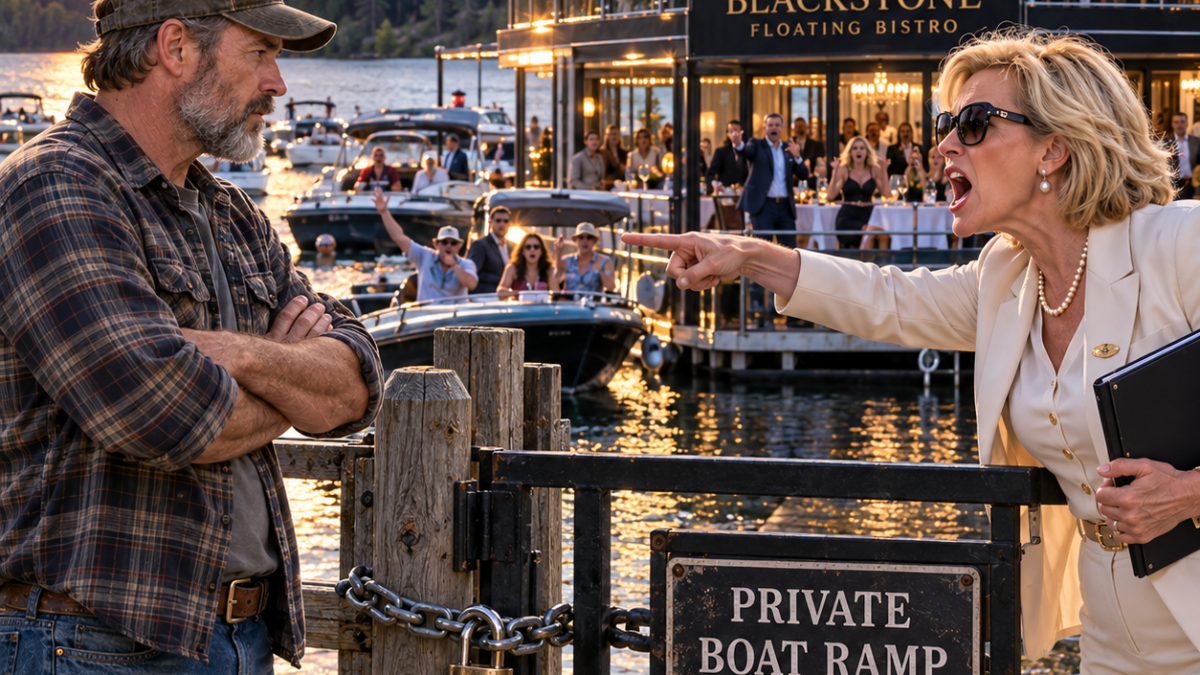
PART3:
Beautiful, if you enjoy eating seafood while pretending gravity and zoning laws do not apply.
“Our waterfront is underutilized,” Vivian announced.
Chuck Morrison, who had run the coffee shop since before I had gray hair, leaned over and whispered:
“So is my patience.”
Vivian clicked to the next slide.
“Blackstone Floating Bistro will bring sophistication, tourism, economic vitality, and increased property values to our community.”
The room reacted with the careful silence people use when someone rich says something dumb and might still be able to raise dues.
She continued.
“We will create an exclusive dining destination accessible by boat, with premium launch services, valet docking, and a curated hospitality experience.”
I raised my hand.
Vivian looked at me as if I had just attempted to interrupt the national anthem with a leaf blower.
“Yes, Garrett?”
“The only boat ramp is on my property.”
A few people nodded.
Everybody knew that.
Everybody except Vivian, apparently, or maybe she knew and had placed that fact in the same mental drawer where she kept humility, restraint, and receipts.
She smiled.
Not a real smile.
A boardroom smile.
The kind that says, I have practiced appearing human.
“Garrett,” she said, “sometimes progress requires difficult transitions.”
“Concrete on my land is not a transition,” I said. “It’s a boundary.”
Someone laughed.
Vivian did not.
“The lake-access easement serves the entire community.”
“The easement serves public recreational access.”
“Exactly.”
“No.”
She tilted her head.
I continued.
“Public recreational access isn’t the same thing as commercial restaurant access.”
Her smile thinned.
“Our counsel is reviewing that.”
“Good.”
I stood.
“Have him read the deed.”
Then I sat.
That should have been the end of it.
It was only the beginning.
The next morning, Vivian sent a community-wide email.
Subject:
THE FUTURE OF HOLLOWAY LAKE.
My family’s name was in the county plat.
The actual lake had another historical name, but everyone called it Holloway Lake because we’d owned most of the western shoreline for generations.
Vivian wrote:
For too long, outdated interpretations of waterfront access have prevented our community from realizing the full economic and recreational potential of this shared asset.
Shared asset.
I read those two words four times.
Then:
The HOA is currently reviewing all recorded access rights and intends to ensure that no single private landowner can obstruct reasonable community use.
Sarah would have said:
She hasn’t even built the restaurant yet and she’s already writing the lawsuit brochure.
I missed her most at moments like that.
Not the big anniversaries.
Not cemetery visits.
The stupid moments.
When something ridiculous happened and I instinctively turned toward the person who would have understood exactly why it was funny.
I forwarded Vivian’s email to my attorney.
Her name was Rebecca Sloan.
She had handled Sarah’s estate.
Land issues.
Business filings.
The kind of lawyer who had no dramatic courtroom voice because she had never needed one.
Her normal voice was enough.
She called twenty minutes later.
“Do you have the original lake-access instrument?”
“In Dad’s files.”
“Find it.”
I did.
Metal filing cabinet in the workshop.
Grandfather’s papers were in a folder labeled:
LAKE.
Of course.
No color coding.
No index.
Just LAKE.
Inside:
1952 deed.
1964 shoreline survey.
County correspondence.
Ramp maintenance receipts.
Old photographs.
And the document Vivian should have read before designing a restaurant.
It was recorded in 1958.
Grandfather had granted the county a twelve-foot-wide public recreational access easement beginning at the county road, crossing a strip of our property, and terminating at the boat ramp.
The purpose was specific:
FREE NONCOMMERCIAL PUBLIC ACCESS FOR FISHING, SMALL-CRAFT LAUNCHING, AND LAWFUL RECREATIONAL USE OF THE LAKE.
Then came the restrictions.
No commercial loading.
No toll.
No reservation fee.
No private exclusion.
No concession activity without written landowner approval.
No transfer of management to a private association.
The land underneath the easement remained Holloway property.
So did the ramp.
The public possessed a right to use a defined corridor for defined noncommercial purposes.
That was all.
Grandfather had been more thoughtful than I realized.
Rebecca read it and whistled.
“Vivian’s restaurant doesn’t fit.”
“No.”
“Not even close.”
“What can she do?”
“She can run a restaurant elsewhere.”
I smiled.
“What about the floating part?”
“That involves separate questions.”
State lakebed authorization.
Health.
Fire.
Wastewater.
Docking.
Navigation.
“But she cannot turn your ramp into valet infrastructure simply because the public has a fishing easement.”
I looked at the document.
One sentence mattered most:
No fee, direct or indirect, shall be imposed as a condition of access through the servient property.
“Rebecca.”
“Yes?”
“They’re planning premium launch services.”
“I heard you.”
“Valet.”
“Yes.”
“That’s a fee.”
“Probably several fees wearing a blazer.”
I liked Rebecca.
We sent Vivian a letter.
Not hostile.
Clear.
Holloway family supports continued free noncommercial public access consistent with the 1958 instrument.
No consent is granted for:
Commercial launch activity.
Restaurant deliveries.
Valet services.
Paid parking.
Restaurant employee access through the easement.
Utility installation.
Signage.
Ticketing.
Exclusive reservation systems.
Construction staging.
Fuel transfer.
The HOA responded through counsel.
Their attorney, Malcolm Pierce, argued that the easement’s purpose had “evolved through historic community practice.”
Rebecca called me after reading that.
“Property rights don’t evolve because someone wants table service.”
“What about historic practice?”
“Has anyone operated a restaurant there?”
“No.”
“Charged ramp fees?”
“No.”
“Run catering trucks?”
“No.”
“Valet trailers?”
“No.”
“Then historic practice appears to involve fishing.”
Fair.
The next board meeting was standing-room only.
Vivian had learned something I had not:
Luxury restaurants excite people.
Especially when they are hypothetical.
People imagined:
Sunset dinners.
Anniversary tables.
Cocktails.
Property appreciation.
Tourists.
Some residents opposed her.
Others loved it.
One man stood and said:
“Garrett, this could add ten percent to our home values.”
I asked:
“Who told you that?”
“Vivian.”
“Of course.”
Another woman said:
“Why should one family control the lake forever?”
I answered:
“We don’t.”
“You control the ramp.”
“We own the ramp.”
“Same thing.”
“No.”
I pointed toward Vivian.
“The public can launch there right now.”
“For free.”
“As my grandfather intended.”
“You want to change that?”
“No.”
“She does.”
Vivian stood.
“This is fearmongering.”
I looked at her.
“You’re charging people.”
“We are creating a managed hospitality model.”
“Which costs money.”
“Premium services cost money.”
“Through a no-fee easement.”
“Your interpretation.”
“The document literally says no fee.”
She smiled.
“Indirect fees may be structured lawfully.”
That sentence told me she had already built the business model.
The restaurant had a name by then.
THE LANTERN.
Naturally.
Apparently rich people cannot eat near water unless the restaurant sounds like a candle.
Vivian created Blackstone Lake Hospitality LLC.
Registered two months after she became HOA president.
Owner:
Vivian Blackstone, 70 percent.
Her sister, Chloe March, 30 percent.
That would matter later.
The HOA then voted on what Vivian called a “waterfront partnership agreement.”
It authorized HOA spending of $96,000 on:
Shoreline beautification.
Traffic improvements.
Safety lighting.
Digital access control.
And “community waterfront amenity integration.”
Rebecca read the vote and said:
“They’re using HOA money to improve infrastructure beside a private business owned by the HOA president?”
“Yes.”
“Did Vivian recuse?”
“She abstained.”
“That helps a little.”
“She presented the proposal.”
“That helps less.”
The improvements started the next week.
Without my permission.
I woke to a contractor unloading decorative boulders beside my ramp.
I walked down.
“Stop.”
Foreman showed work order.
Millbrook—no, ours was called Lake Hollow HOA.
Work zone marked partly on my parcel.
“Who authorized?”
“HOA.”
“This is Holloway property.”
He looked at paperwork.
Then at me.
“I’m calling my office.”
“Good.”
Contractor left within an hour.
The next day, someone installed two black metal posts beside the public-access lane.
Digital gate arms.
I removed nothing.
I photographed.
Called Rebecca.
Called county.
The posts were outside the easement footprint but inside my property.
The HOA contractor had drilled six concrete anchors.
I sent written trespass notice.
Vivian sent back:
These are temporary access-management improvements required for safety.
Rebecca replied:
Remove them by Friday.
They removed them Thursday night.
Then they installed similar posts twenty feet farther east on HOA common property.
Fine.
That was their land.
But they started routing trailers from the HOA parking lot through the public easement.
Still problem if commercial.
Vivian was clever enough not to commit every violation in one day.
She built layer by layer.
First signs.
Then reservations.
Then “suggested” valet fees.
Then commercial deliveries early in the morning.
Then restaurant staff using the ramp.
Then the floating structure arrived.
I remember that day.
A massive rectangular platform came down the highway in sections.
Steel floats.
Kitchen module.
Glass dining enclosure.
Generators.
Decking.
Workers launched pieces from my ramp at 5:40 a.m.
My security camera caught everything.
I was asleep.
At 6:02, I heard diesel engines.
By the time I got outside, the third section was halfway down the concrete.
I stood in front of the next truck.
Driver stopped.
Vivian came out of an SUV.
“You need to move.”
“No.”
“We have a launch permit.”
“Show me landowner authorization.”
“We have county marine approval.”
“That is not what I asked.”
She pulled out a folder.
Of course she had a folder.
Inside was a county special-event and marine-construction permit.
Applicant:
Blackstone Lake Hospitality.
Site access:
Lake Hollow HOA managed launch facility.
Managed launch facility.
My grandfather’s ramp.
I felt something cold move through my chest.
“You told the county the HOA manages my ramp.”
“It manages community access.”
“No.”
“Garrett.”
“No.”
She lowered her voice.
“Do not make a scene.”
I looked around.
Forklift.
Contractors.
Heavy truck.
Restaurant module sitting half on my ramp.
“You brought a kitchen onto my property before sunrise.”
“Because you refuse to cooperate.”
“That’s usually when consent matters most.”
She motioned to contractor.
“Continue.”
I called sheriff.
Not 911.
Deputy came.
Looked at recorded easement.
Permit.
My deed.
Vivian’s paperwork.
Then did what deputies often do in complicated property disputes.
Refused to become judge.
He told contractors:
“If the record owner is expressly revoking commercial permission outside the easement, I suggest you stop until attorneys sort this out.”
The contractor stopped.
Vivian exploded.
Not screaming.
Worse.
Cold.
“This project has financing.”
“Then your lender should have checked access.”
“We have reservations.”
“Refund them.”
“We have forty employees.”
“You haven’t opened.”
“This is harassment.”
“No.”
“This is ownership.”
That afternoon her lawyer filed for temporary injunction.
She wanted a court order preventing me from “interfering with historic community lake access.”
We responded.
Judge reviewed the 1958 easement.
She did not decide full merits immediately.
But she refused to order me to permit unrestricted commercial use.
Instead:
Existing free noncommercial public recreational access must remain unobstructed.
No ruling granting Blackstone Hospitality commercial rights.
That should have ended Vivian’s restaurant.
Instead she treated the first sentence as victory and ignored the second.
She announced:
COURT PROTECTS COMMUNITY LAKE ACCESS.
True in the narrowest way.
Misleading in every useful one.
The floating restaurant was completed using a different launch site twenty miles away and towed across a connected navigable section with permits.
Expensive.
But possible.
It anchored roughly four hundred yards offshore.
State approvals allowed the floating structure subject to several conditions.
Health inspection.
Fire suppression.
Wastewater containment.
Navigation lighting.
No problem there initially.
The problem was access.
The nearest practical boat launch was ours.
There was another primitive county ramp on the far eastern arm.
Too shallow for larger valet vessels.
No parking.
Narrow road.
Vivian’s entire business plan assumed Holloway ramp.
So she reinvented the fee.
The public launch remained “free.”
Technically.
But restaurant customers paid:
$35 parking reservation.
$20 valet handling.
$18 dock service.
Or $65 “Lantern Access Package.”
The HOA installed a kiosk on its adjacent parking lot.
Customers paid there.
Then their boat trailers crossed the public easement.
Vivian claimed:
“We do not charge for the ramp.”
Rebecca said:
“That is adorable.”
Restaurant employees used it.
Food deliveries used it.
Propane used it.
Laundry service.
Waste pickup.
Maintenance crews.
All commercial.
My cameras recorded every vehicle.
Date.
Time.
Plate.
Trailer.
Some days seventy crossings.
The old concrete ramp began deteriorating under traffic Grandpa never imagined.
I sent notices.
Vivian ignored them.
Then came the thing that made the locals angry.
On Saturday mornings, restaurant customers filled the parking area.
The HOA began reserving spaces.
Families who had used the lake for generations arrived to launch fishing boats and found signs:
PREMIUM RESERVATION PARKING
LANTERN GUESTS ONLY
An older man named Eddie Ross called me.
He had fished the lake since 1971.
“Garrett?”
“Yeah.”
“They’re charging sixty-five bucks.”
“For restaurant customers.”
“They told me parking is full.”
“Public lane?”
“Open.”
“Then launch.”
“No place to leave truck.”
The easement guaranteed access.
Not infinite parking on HOA property.
Vivian had found another pressure point.
Local families could technically launch.
Practically, she had made it difficult.
That violated the spirit of what Granddad intended even if the exact legal issue was messier.
Then Vivian announced the Memorial Bass Derby would need a reservation.
Sarah’s derby.
On my dock.
She wrote:
Due to enhanced waterfront demand and safety concerns, all organized lake events must coordinate through the HOA hospitality calendar.
I read that sentence once.
Then drove straight to her house.
Bad idea.
Rebecca later agreed.
Vivian opened door.
“Garrett.”
“You do not schedule Sarah’s derby.”
She folded her arms.
“Organized events affect traffic.”
“Not your dock.”
“The community access corridor—”
“Not your derby.”
“You can’t monopolize peak weekends.”
“My wife ran that event twenty years before you moved here.”
“And traditions change.”
I stared.
She realized perhaps half a second too late what she had said.
“Garrett, I meant—”
“Do not say my wife’s name.”
“I wasn’t—”
“Do not touch the derby.”
I left.
That was the angriest I became through the entire dispute.
Not restaurant.
Not fees.
Sarah.
Three days later I calmed down and did what she would have told me to do.
Use paper.
Not temper.
Rebecca filed a motion clarifying the injunction.
County received our evidence of commercial traffic.
The state agency overseeing the floating structure received notice that its approved access representation was disputed.
Health department received updated operations records.
HOA insurer received notice of potential commercial-use liability crossing private property.
And I upgraded cameras.
Not hidden.
Six of them.
High-definition.
Date stamp.
Ramp.
Gate.
Dock.
Road.
Shoreline.
Old marina building.
Vivian called them intimidation devices.
I called them cameras.
Then we found the best evidence.
Grandfather had not only created the public access easement.
He had signed a separate 1961 agreement with the county when they helped resurface the ramp.
One paragraph said:
The servient owner shall retain the right to temporarily secure or suspend vehicular access when the ramp is being subjected to unauthorized commercial use, hazardous loading, physical damage, or use beyond the recreational purpose stated in the recorded easement, provided reasonable emergency access remains available and county authorities receive notice.
Rebecca read it twice.
Then:
“Oh.”
“What?”
“This is very useful.”
“How useful?”
“Garrett, your grandfather planned for somebody like Vivian before Vivian was born.”
The right was not unlimited.
I couldn’t lock families out because I was annoyed.
I could not terminate the public easement.
I could temporarily secure vehicular access when it was being used commercially outside its purpose or being damaged, as long as I notified the county and preserved emergency access.
That changed strategy.
We commissioned a civil engineer to inspect the ramp.
Not because it was collapsing.
Because seventy years of age plus commercial traffic had produced edge cracking and surface deterioration.
The engineer recommended restricting heavy repetitive commercial vehicles until repairs.
More useful evidence.
We sent Vivian formal notice.
Commercial access must cease Friday at 6:00 p.m.
Free noncommercial public recreational access would resume after safety work under a controlled opening schedule.
Emergency and law-enforcement access would remain available.
County sheriff received key.
Fire-rescue received key.
County public works received notice.
Marine patrol knew.
Blackstone Hospitality received notice.
HOA received notice.
Insurer.
Restaurant lender.
Everyone.
Vivian replied:
Your unilateral closure is illegal and dangerous. We will continue operations.
Rebecca responded:
Then operations will be recorded.
Friday arrived.
The Lantern was booked.
Of course.
Vivian made it a spectacle.
Fifty diners.
Champagne launch.
Two restaurant shuttle boats.
Private vessels.
Influencers.
One local reporter she had invited to cover the “battle for public lake access.”
That decision remains one of my favorite examples of arrogance.
She invited the press to document herself violating written notice.
At 4:30 p.m., I sat on porch.
Coffee.
Sarah’s old blue mug.
Camera feeds open on tablet.
Vehicle after vehicle entered.
Restaurant delivery van.
Two valet crews.
Propane service.
Guests.
Vivian herself.
White dress.
Wide hat.
Sunglasses.
She stopped under camera.
Looked directly into it.
Waved.
Then drove through.
I saved clip.
At 5:18, restaurant shuttle one launched.
5:31, shuttle two.
5:42, three customer boats.
5:55, valet truck.
At 6:00, I drove my old Ford to the gate.
Two sheriff’s deputies were present because Rebecca had asked for civil standby.
County marine patrol waited on water.
Important.
Nobody was going to be abandoned in danger.
I walked to the ramp entrance.
The public-access sign remained.
Under it I installed another sign:
TEMPORARY VEHICULAR CLOSURE
UNAUTHORIZED COMMERCIAL USE / RAMP SAFETY
EMERGENCY ACCESS AVAILABLE
NONCOMMERCIAL REOPENING SCHEDULE POSTED
I closed the steel vehicle gate.
Locked it.
Handed deputy a copy of key even though sheriff already had one.
Then stepped back.
No cheering.
No speech.
Nothing.
For eleven minutes, nothing happened.
At 6:11, a restaurant valet van arrived from the shoreline service lane.
Could not exit through gate.
Driver called someone.
6:16, first private customer boat approached ramp.
A valet employee waved from water.
Saw gate.
Stopped.
Horn.
Another boat.
Horn.
By 6:25, six boats floated in the staging cove.
No emergency.
Just confusion.
Marine patrol directed them away from shallow congestion.
The restaurant shuttle tried docking.
Could not unload through closed commercial vehicle access because Vivian had planned no legal alternative that did not depend on my property.
Technically guests could remain on the floating restaurant.
They had food.
Water.
Life jackets.
The structure was safe.
Marine patrol also had capacity to ferry anyone with medical need to a county dock.
Nobody was trapped in mortal danger.
They were commercially stranded.
Very different.
Vivian called me.
I answered.
“Open the gate.”
“No.”
“You have customers on the water.”
“Yes.”
“You are endangering fifty people.”
“Marine patrol is there.”
“You’re holding them hostage.”
“No.”
“You were notified eleven days ago that commercial access ended at six.”
“This is a public ramp.”
“For noncommercial recreational use.”
“These people are recreational users.”
“Your employees are charging them.”
Silence.
Then:
“You are insane.”
“Maybe.”
“Open it.”
“No.”
“I am calling the sheriff.”
“He’s standing ten feet from me.”
I handed phone toward Deputy Shaw.
He shook his head.
Smart man.
Vivian hung up.
At 6:37, the local reporter arrived.
Not the one Vivian had invited.
A second station had seen social media posts.
Then another.
Cameras.
Microphones.
People love a boat-ramp standoff.
Vivian finally came ashore in a marine patrol boat.
Not because she needed rescue.
Because her shuttle couldn’t use the ramp.
She stepped onto county emergency landing twenty yards from my gate, walked toward me, and shouted:
“This man locked the public out of their lake!”
Cameras turned.
I said nothing.
Vivian pointed.
“He is retaliating against this community because he failed to stop a legal business.”
Reporter asked me:
“Mr. Holloway, did you lock the only boat ramp while diners were on the lake?”
“Yes.”
Vivian looked triumphant.
Reporter:
“Why?”
I held up document.
“Because the public easement is noncommercial.”
Then second.
“The county agreement allows temporary closure for unauthorized commercial use and physical damage.”
Third.
“Eleven days’ written notice.”
Fourth.
“Emergency services have access.”
Then I pointed toward marine patrol.
“No one is being denied rescue.”
The reporter looked at Vivian.
“Did you receive written notice?”
She said:
“We dispute its legality.”
Not no.
Good.
Another reporter asked:
“Are customers charged to use the ramp?”
Vivian:
“No.”
“Do they pay a launch package?”
“Our hospitality fees cover parking, valet, and docking.”
Reporter:
“So they pay money before crossing the ramp?”
Vivian’s attorney arrived at exactly the wrong time.
He stepped between cameras.
“No further comment.”
That was when the honking started again.
Not from danger.
Angry boat owners.
One yelled from water:
“I paid sixty-five dollars for this!”
Microphones picked it up.
Another:
“Vivian said this was HOA property!”
There it was.
Not mine.
His.
Camera turned.
“HOA property?”
The man shouted:
“That’s what they told us!”
Vivian looked physically ill.
I stood beside gate with coffee.
It had gone cold.
Still satisfying.
The restaurant eventually evacuated guests safely through two alternatives.
Marine patrol ferried elderly passengers to county landing.
Private boats remained overnight at designated moorings or were redirected to the shallower east ramp if compatible.
The restaurant shuttle tied up at The Lantern until morning.
Nobody injured.
Nobody stranded without help.
Nobody held hostage.
The business simply could not continue its normal valet operation.
That was enough.
Saturday dinner canceled.
Sunday canceled.
Blackstone Hospitality posted:
TEMPORARILY CLOSED DUE TO HOSTILE PRIVATE ACTION.
People had opinions.
Some supported Vivian.
Some supported me.
Social media did what it always does.
Invented facts.
One person claimed I carried a rifle.
False.
Another claimed Vivian owned the whole lake.
False.
Someone said Sarah had secretly opposed public access.
That one made me close the laptop.
I stayed off social media.
The cameras did not.
Saturday at 9:14 a.m., Vivian’s operations manager came to gate with bolt cutters.
Two employees.
Camera recorded.
Deputy patrol car arrived before they cut anything because the county had increased checks.
Manager left.
At 11:32, an HOA maintenance truck placed a sign outside my gate:
ILLEGAL CLOSURE
PUBLIC ACCESS GUARANTEED
Still on HOA land.
Fine.
At 1:07, Vivian walked to the pedestrian side of the easement.
That remained open during daylight for noncommercial lake users under our temporary safety plan.
She marched down holding phone.
Then filmed herself.
“Look.”
She pointed toward fishermen launching small kayaks by hand.
“He claims commercial traffic is dangerous but allows his friends.”
Unfortunately for her, the men she filmed were strangers to me.
And not paying anyone.
That video proved my exact distinction.
Rebecca called.
“Tell Vivian thank you.”
“I will not.”
“Fine.”
Monday brought the county hearing.
Not trial.
Administrative review of ramp access and permit representations.
We presented:
1958 easement.
1961 county agreement.
Engineering report.
Notice.
Camera logs.
Fee schedules.
Launch packages.
Commercial crossing counts.
Restaurant marketing.
Vivian presented:
Historic community use.
Economic benefit.
Court’s prior public-access language.
Attorney argued my closure was pretext to sabotage competitor.
Competitor?
That surprised me.
“How am I competing?”
Then they revealed Sarah’s Bait and Tackle plan.
Vivian claimed I wanted restaurant gone to protect my future business.
I laughed.
Could not help it.
“Worms and coffee?”
The hearing officer did not laugh.
Professional.
But someone in back did.
Rebecca answered:
Sarah’s Bait and Tackle had not opened.
Would not operate as a restaurant.
Would serve public recreational users.
And even if I stood to benefit economically, recorded property restrictions did not disappear because motive was imperfect.
That matters legally.
People often believe if they prove you are angry, the deed becomes negotiable.
It does not.
Then came county permit file.
This was Vivian’s biggest problem.
Her application identified:
LAUNCH FACILITY OPERATOR: LAKE HOLLOW HOA.
OWNERSHIP/AUTHORITY: COMMUNITY-MANAGED ACCESS.
Not technically saying HOA owned the land.
But omitting Holloway ownership.
County staff testified they believed HOA had lawful authority to authorize commercial access.
Would they have issued the same permit if told:
Private landowner expressly refuses commercial use?
“No.”
That answer changed everything.
Then state floating-structure representative spoke.
Their approval assumed legally available shore service.
Without commercial access, restaurant needed an alternative service plan.
The Lantern itself was not immediately illegal.
But its operations plan was incomplete.
Health department needed waste-removal access.
Fire needed emergency servicing.
Food suppliers needed lawful route.
Vivian had built an offshore restaurant whose entire logistics chain crossed property she did not control.
Bad business planning wearing expensive shoes.
County ruled:
Public noncommercial easement remains valid.
Holloway family may not terminate lawful recreational access.
Commercial restaurant use is outside easement scope absent owner agreement.
Temporary vehicular restrictions supported by documented safety concerns may continue subject to repair and published public access schedule.
HOA has no authority to charge launch-related access fees through Holloway property.
That afternoon I reopened the ramp.
For free recreational use.
Fishing boats.
Kayaks.
Families.
No restaurant vans.
No valet.
No Blackstone shuttle service.
Eddie Ross was first through.
He drove an ancient Ford towing a sixteen-foot aluminum boat.
Stopped beside me.
“What do I owe you?”
“Nothing.”
“That’s what I thought.”
He smiled.
Sarah would have liked that.
Vivian did not stop.
She appealed.
Then HOA began fining me.
Yes.
For:
Obstruction of community amenity.
Commercial interference.
Unauthorized signage.
Failure to maintain aesthetic gate standards.
The last one was $250.
Rebecca read it.
“Is your parcel subject to HOA covenants?”
“No.”
“Then this is decorative paper.”
We sent one letter.
Fines withdrawn.
Then the HOA insurance carrier entered.
Why?
Conflict of interest.
Vivian was HOA president.
Blackstone Hospitality was her company.
HOA funds had been spent on infrastructure whose primary commercial beneficiary was Blackstone Hospitality.
Residents started requesting records.
Payments showed:
$96,000 waterfront project.
$27,000 parking lot resurfacing near ramp.
$18,400 decorative lighting.
$11,800 access-control system.
$8,600 marketing campaign described as “community economic development.”
Restaurant brochures appeared in campaign materials.
Then a revenue-sharing memorandum.
Blackstone Hospitality would pay HOA five percent of certain “waterfront access revenues” after the first $250,000 annual gross.
In exchange, HOA agreed to support access, parking, and hospitality infrastructure.
That had not been clearly disclosed to homeowners before vote.
Worse:
Vivian signed for Blackstone Hospitality.
And signed HOA paperwork in her capacity as president.
On opposite sides of related transactions.
She had formally abstained from one board vote.
But emails showed she negotiated terms before and after.
That triggered independent board counsel.
Then the residents got angry.
Not because of me.
Money.
Always follow money if you want bored homeowners to become constitutional scholars.
At a special meeting, Chuck Morrison stood.
Coffee-shop Chuck.
Seventy-one.
Never raised his voice.
He held one sheet of paper.
“Vivian.”
She looked tired by then.
“Yes?”
“You spent HOA money to improve parking for your restaurant.”
“For community waterfront access.”
“Your restaurant uses the parking.”
“So do residents.”
“You charge guests.”
“We provide services.”
“Did you tell us your company would receive the money when you asked us to fund improvements?”
“We disclosed the partnership.”
“No.”
Chuck lifted the meeting packet from six months earlier.
“This says ‘future waterfront operator.’”
He looked at her.
“You were already the operator.”
Room shifted.
Vivian said:
“The entity structure was still being finalized.”
Chuck nodded.
“So you didn’t know you owned it?”
Laughter.
She lost the room.
Then a woman named Patricia Nguyen spoke.
She had supported Vivian from the beginning.
“I bought opening-night reservations.”
Vivian smiled hopefully.
Patricia continued.
“I paid $240 for dinner.”
“Another $65 launch package.”
“Then I spent three hours on the lake while my husband tried to figure out how to get our boat back.”
Vivian’s smile vanished.
“Nobody told us access was disputed.”
“We believed the HOA owned the ramp.”
That was the central lie.
Not legal jargon.
Expectation.
People had handed over money because Vivian made the ramp sound hers.
Board vice president asked:
“Did legal counsel ever state the HOA owned Holloway ramp?”
Malcolm Pierce was present.
He looked miserable.
“No.”
Vivian turned.
“Malcolm.”
He continued.
“Our position concerned easement rights.”
“Not fee ownership.”
“Not an unrestricted commercial easement.”
That sentence ended Vivian’s presidency.
Not immediately.
But emotionally.
The board voted that night to suspend her authority over all waterfront matters.
Four to one.
She voted no.
Then independent audit.
Then recall petition.
Eighty-two percent signed.
Vivian resigned before the vote.
Her resignation letter blamed:
A coordinated campaign of misinformation, resistance to modernization, personal hostility, and fear of economic progress.
Sarah would have framed it.
Not because it was true.
Because it was funny.
Blackstone Floating Bistro lasted another six weeks.
Without Holloway ramp, operating costs exploded.
Suppliers had to use the eastern public landing.
Shallow draft.
Smaller loads.
Longer transport.
Guest shuttle logistics changed.
No premium valet launches.
The restaurant remained beautiful.
But beauty does not fix bad access economics.
Reservations fell.
Then health department cited waste-service inconsistencies after access plan changed.
Correctable.
Then fire authority required revised evacuation plan.
Also correctable.
Then lender learned primary access assumptions were disputed.
Less correctable.
Blackstone Hospitality missed a payment.
Investors demanded new capital.
Vivian tried selling memberships.
THE LANTERN FOUNDERS CLUB.
Ten thousand dollars.
Priority reservations.
Private dock access.
Wine storage.
Some people bought.
Not enough.
Then something else happened.
The cameras.
Remember the cameras?
They caught commercial activity before closure.
They also caught what happened late at night during the restaurant’s decline.
One camera covered the shoreline beside old marina.
At 2:13 one morning, a Blackstone maintenance boat arrived.
Two employees unloaded sealed gray containers.
Placed them in pickup.
Probably normal waste.
Except one employee rolled a greasy drum toward my service area.
Left it beside my dumpster.
Commercial waste dumped on my property.
Another night:
Restaurant linens.
Another:
Food waste.
Another:
Used cooking oil containers staged near my shed.
They had quietly turned my marina area into overflow service space after losing formal access.
I installed no traps.
Made no confrontation.
Saved clips.
Sent them to Rebecca.
She sent notices.
Then county health.
That led to inspection.
Not catastrophe.
But another violation.
Vivian called me.
“You are spying on my employees.”
“They’re on my property.”
“You have cameras pointed at the lake.”
“I have cameras pointed at my ramp.”
“You’re obsessed.”
“Stop sending people onto my land at two in the morning.”
“They were using established service access.”
“No.”
“We’ve been over this.”
“Yes.”
She hung up.
The Lantern closed for “seasonal restructuring” in October.
Never reopened under Vivian.
The floating building was sold at auction the next spring to a resort three counties away.
A tug came.
Hooked up.
Pulled it across the water.
I stood on dock watching.
Chuck brought coffee.
“Feel victorious?”
“No.”
“Liar.”
“Maybe a little.”
He handed me cup.
“What are you putting there instead?”
“Nothing.”
“Good.”
The lake looked better empty.
Not because restaurants are evil.
Because not every beautiful view needs monetization.
That was something Vivian never understood.
Silence has value even when nobody invoices for it.
The HOA settlement took longer.
The association’s independent counsel determined some spending had been properly authorized for shared improvements, while other expenditures created conflict-of-interest concerns.
Not every dollar was stolen.
That matters.
Vivian was not sneaking cash into a purse.
She had created a system where her private business and public HOA role overlapped until nobody could tell whose interest came first.
Civil claims followed.
HOA recovered part of expenditures through settlement with Blackstone Hospitality and insurers.
Vivian reimbursed some amounts.
Waived other claims.
No dramatic prison sentence.
No handcuffs.
No federal raid.
People online were disappointed.
I wasn’t.
Property back.
Ramp free.
Restaurant gone.
Records corrected.
Good enough.
The county revised permit procedure.
Future applicants claiming access through privately owned land had to supply:
Owner authorization or recorded commercial right.
Not merely association certification.
Again:
Boring reform.
Best kind.
Then I finally opened Sarah’s Bait and Tackle.
One year later.
June.
5:00 a.m.
No grand opening balloons.
No influencer.
No reservation app.
Just:
SARAH’S BAIT & TACKLE
WORMS
LURES
COFFEE
BAD ADVICE FREE
Chuck made the sign.
First customer was Eddie Ross.
Bought worms.
Coffee.
Asked:
“How much to use ramp?”
“Nothing.”
“Parking?”
“Nothing.”
“Valet?”
“Get out.”
He laughed.
Kids came.
Retirees.
Tourists.
People from the HOA.
Yes.
Them too.
I never banned residents because of Vivian.
That would have made the ramp a weapon.
Grandfather did not preserve access so I could punish a subdivision decades later.
Public means public.
Noncommercial means noncommercial.
Free means free.
Those words mattered.
The first Memorial Bass Derby after the restaurant closed was the biggest we ever held.
Eighty-three kids.
Rachel from local grocery donated hot dogs.
Chuck handled coffee.
Rebecca came wearing shoes completely wrong for mud.
The new HOA president, Daniel Brooks, volunteered at weigh-in.
No banners.
No political speeches.
We hung Sarah’s photograph near dock.
Her laughing.
Sunglasses on head.
Lemonade pitcher in hand.
I almost canceled the event that morning.
Grief hit unexpectedly.
Three years had become four.
Everyone told me time helps.
It does.
But time is not a straight line.
Sometimes one photo puts you back in hospital room.
I stood behind bait shop trying to breathe.
A little girl named Macy found me.
Seven maybe.
Holding tiny bass in bucket.
“Mr. Garrett?”
“Yeah?”
“My fish is too small.”
I looked.
Very small.
“That’s impressive.”
“No, it’s not.”
“It is if you’re the fish.”
She frowned.
“I don’t think I can win.”
“Probably not.”
Children deserve honesty.
She looked disappointed.
Then I remembered Sarah.
I crouched.
“You know what my wife used to say?”
“What?”
“The biggest fish wins a trophy.”
“But the smallest fish gets the best story.”
Macy thought.
“Why?”
“Because it has to explain how it got caught.”
She laughed.
Went back.
I cried after she left.
Then returned to derby.
Macy won Smallest Fish.
Sarah had invented that category years earlier because children hated losing.
We brought it back.
Vivian’s old premium parking kiosk became storage.
I bought it from HOA for one dollar after settlement.
Why?
Spite.
Useful spite.
We keep life jackets inside.
The screen that once charged people $65 now has a handwritten sign taped over it:
FREE LOANER LIFE JACKETS
RETURN WHEN DONE
That might be my favorite part.
The luxury valet parking lot reverted to ordinary gravel.
The HOA stopped reserving waterfront spaces for businesses.
A portion remained accessible parking.
Good.
The rest first come.
The public ramp needed major repairs eventually.
The commercial traffic had accelerated damage.
County offered funding because of the old agreement.
I paid part.
HOA offered contribution.
I hesitated.
Then accepted.
New president asked:
“Does that give us rights?”
I laughed.
“No.”
He laughed too.
We wrote contribution agreement anyway.
Rebecca insisted.
No new easement rights.
No management rights.
No commercial authority.
Improvement contribution only.
Clarity preserves friendship.
The new concrete matched old slope.
We kept one original section near top where grandfather’s initials were scratched:
H.H.
1952.
Technically the easement was recorded later, but ramp itself came first.
I stood there after repairs.
Ran my hand over letters.
Thought about him mixing concrete in wheelbarrows.
He could not have imagined digital valet fees.
Floating restaurants.
HOA emails.
Tesla-driving presidents.
Maybe he could.
Human entitlement is not new technology.
He wrote the deed carefully for a reason.
One evening, two years after Vivian left, a black SUV pulled into bait shop parking.
She got out.
No Tesla.
No sunglasses.
Simpler clothes.
I recognized her immediately.
She looked older.
So did I.
She walked inside.
Chuck happened to be there.
He stared like a man watching a coyote enter church.
Vivian said:
“Hello, Garrett.”
“Vivian.”
“I won’t stay.”
“Okay.”
She looked around.
Sarah’s photos.
Kids with fish.
Coffee urn.
Worm refrigerator.
Free-life-jacket kiosk visible outside.
“You opened it.”
“Yes.”
“Business good?”
“Good enough.”
She nodded.
Then:
“I came to get something.”
My body tightened.
“What?”
“My mother’s fishing photograph.”
I remembered.
During HOA cleanup, old waterfront display materials had been boxed.
Some belonged to residents.
One photograph showed a teenage Vivian with an older woman holding trout.
I had not known who it was.
“It’s in back.”
I found box.
Handed photo.
Vivian looked at it.
Her face changed.
“My mother brought me here when I was nine.”
That surprised me.
“What?”
“She lived outside town.”
“Before Seattle.”
“Yes.”
“She used this ramp.”
I stared.
“Then why the hell did you try charging people?”
She laughed once.
Not amused.
“I’ve asked myself that.”
Good answer.
She ran thumb across photo.
“My mother never had much.”
“She’d bring sandwiches.”
“Coffee in thermos.”
“We rented a little boat from a man named—”
“Carl Jensen?”
Her eyes lifted.
“Yes.”
Carl had operated old marina before Dad bought his shed.
Vivian looked around.
“I wanted to make this place into the kind of lake I thought meant success.”
There was no defense in her voice.
Just fact.
“Exclusive.”
“Premium.”
She smiled sadly.
“That word.”
I said nothing.
“I hated being poor here.”
That was something I had never considered.
For me, old ramp meant family.
For her, maybe it meant childhood embarrassment.
She continued.
“When I came back with money, I wanted the lake to look different.”
“Why?”
“So I would feel different.”
That sentence did more than every legal filing.
Not excuse.
Understanding.
Dangerous people are still human.
Human motives do not erase consequences.
But knowing motive sometimes lets anger loosen.
“You almost killed public access trying to upgrade it.”
“I know.”
“You used HOA money.”
“I know.”
“You told people you controlled my ramp.”
“I know.”
“You scheduled Sarah’s derby.”
She closed eyes.
“That was cruel.”
“Yes.”
“I’m sorry.”
I looked at her.
Not boardroom smile.
Nothing polished.
Just tired.
“Thank you.”
She nodded.
Not forgiveness ceremony.
No hug.
She took photo.
At door, she stopped beside life-jacket kiosk.
“Was that ours?”
“Yes.”
“You turned it into free equipment.”
“Yes.”
“That feels pointed.”
“It is.”
She laughed.
Actually laughed.
Then left.
I never saw her again.
Years passed.
The bait shop became more successful than I intended.
Which sounds like complaining because it is.
I retired to avoid schedules.
Now fishermen arrive at 4:45 asking for coffee.
Sarah would enjoy the irony.
I hired Macy when she turned sixteen.
Yes.
Smallest Fish Macy.
She works summers.
Still terrible at being on time.
Good with children.
The Memorial Bass Derby now has a scholarship fund.
Nothing huge.
Five hundred dollars to one graduating local student involved in lake conservation or outdoor education.
Named for Sarah.
That was Rebecca’s idea.
Mine would have been more tackle.
Grandchildren—my daughter Emily eventually had two—come each summer.
They call the public access lane “Great-Grandpa’s road.”
Close enough.
One afternoon my grandson asked:
“Grandpa, is this your lake?”
I paused.
Children ask questions adults ruin with paragraphs.
“The land around this part is ours.”
“The ramp is ours.”
“Can people use it?”
“Yes.”
“Then it’s theirs too?”
I thought.
“Using something doesn’t always mean owning it.”
He frowned.
Like Vivian.
“But if it’s yours, why let them?”
There it was.
Grandfather’s whole philosophy.
“Because we can.”
He accepted that.
Then asked for ice cream.
Wisdom has limits at eight.
The floating restaurant became a funny local memory.
People call the incident Ramp Night.
Someone made a bumper sticker:
READ THE EASEMENT.
Rebecca owns three.
I own zero.
Reporters still occasionally contact me when some viral post resurfaces.
“Did you really trap fifty rich people on a floating restaurant?”
No.
I closed unauthorized commercial vehicle access after notice while marine patrol maintained emergency safety.
Not viral.
Accurate.
“Did boats really honk?”
Yes.
A lot.
“Did Vivian call you unstable?”
Yes.
That part was funny.
“Did you sit on your porch drinking coffee?”
Yes.
But after the first fifteen minutes I walked down and helped Deputy Shaw manage confused boaters.
Again, less cinematic.
Real life usually is.
The dangerous version of the story would be:
Angry landowner traps people to prove point.
I reject that version.
People’s safety was never leverage.
The property right was.
That distinction matters.
I wanted Vivian’s operation to stop.
I did not want diners endangered.
So sheriff knew.
Marine patrol knew.
Fire-rescue had key.
Medical transport remained possible.
That is what adults do when conflict becomes physical.
You do not create a second wrong because first one made you angry.
Sarah taught me that more than anyone.
She could be furious without becoming careless.
I am still learning.
The old 1958 easement now hangs framed in bait shop.
Not original.
Copy.
Original stays safe.
Beside it is a photograph of Grandpa pouring ramp concrete.
Underneath:
FREE NONCOMMERCIAL ACCESS
1952–FOREVER
Technically access began later.
Nobody complains.
The county attorney probably would.
On opposite wall hangs Sarah with the lemonade pitcher.
That is the real governing document.
Not legally.
Morally.
What was the ramp for?
People.
Not exclusivity.
Not status.
Not tolls.
Not premium atmosphere.
People.
Vivian’s biggest mistake was not misunderstanding land law.
Her lawyer could have corrected that.
Her biggest mistake was believing improvement and monetization were the same thing.
She saw gravel and thought unfinished.
Old docks and thought inconsistent.
Kids fishing and thought liability.
Coffee drinkers and thought low-value use.
Free ramp and thought missed revenue.
She did not understand that a thing can be valuable precisely because nobody has optimized it yet.
A father teaching his daughter to back a trailer badly.
No transaction.
An old man launching a dented aluminum boat.
No reservation.
A widow scattering ashes.
No valet.
A child catching a fish too small to keep.
No premium package.
Those uses looked economically empty on her spreadsheet.
They were the whole point.
I used to hate the phrase premium atmosphere.
Now it makes me laugh.
One morning Chuck and I sat outside bait shop.
Fog.
Flat water.
Two teenagers trying to start an outboard.
One finally yelled:
“It helps if the kill switch is attached!”
Chuck sipped coffee.
“Premium atmosphere.”
I laughed so hard I spilled mine.
Sarah would have too.
That is how I know the lake is mine again.
Not legally.
It was always ours legally.
Emotionally.
For a while Vivian made every boat feel like evidence.
Every car a violation.
Every meeting a battle.
Every sunrise part of litigation.
That is how property disputes steal more than land.
They occupy your attention.
After she left, ordinary returned slowly.
The first morning I did not check cameras before coffee.
The first weekend I forgot to mention her.
The first derby where nobody asked about restaurant.
Then one day I realized the floating building had been gone longer than it existed.
Good.
Scars shrink relative to life if you keep living.
I still have cameras.
Of course.
Retired Boeing.
We document.
But now most footage is useless.
Deer.
Raccoons.
Teenagers taking too long to reverse trailers.
Once a bear opened a cooler.
Much better crime.
The cameras mattered because Vivian believed confidence could substitute for consent.
They showed:
Commercial vans.
Fee-paying customers.
Employee traffic.
Restaurant shuttles.
Late-night waste.
Her wave before crossing after written notice.
Her operations manager approaching with bolt cutters.
Evidence did not argue.
It accumulated.
That is a lesson worth keeping.
If someone with more confidence than authority begins rewriting reality around your property, do not always try to outshout them.
Save the email.
Photograph the sign.
Pull the deed.
Read the easement.
Record the notice.
Keep the receipt.
Install the camera lawfully.
Let dates do what anger cannot.
Vivian called me bitter.
Maybe I was.
She called me selfish.
Sometimes.
Unstable.
Ask my daughter.
She might agree before coffee.
None of those labels changed the instrument number at the courthouse.
Character attacks are often what people use when documents stop cooperating.
The ramp is still there.
New concrete mixed with old.
Grandfather’s initials at top.
Every dawn, somebody launches.
Sometimes wealthy.
Sometimes not.
A hundred-thousand-dollar bass boat gets the same slope as a twelve-foot aluminum jon boat.
No priority.
No velvet rope.
No valet.
No clipboard asking whether you enhance premium atmosphere.
Just:
Back down slowly.
Don’t block the lane.
Pick up your trash.
Be decent.
If you buy worms, thank you.
If not, still good luck.
That was Sarah.
That was Grandpa.
That is enough for me.
The night Vivian’s restaurant stalled on the water, people said I destroyed her business by locking a gate.
That is not quite right.
I locked a gate because she built a business that depended on pretending she owned the key.
The difference is everything.