HOA Karen Sued Me for the Only Road Across My 1,800 Acres—Then the Judge Erased the Access She Was Trying to Protect
HOA Karen Sued Me for the Only Road Across My 1,800 Acres—Then the Judge Erased the Access She Was Trying to Protect.
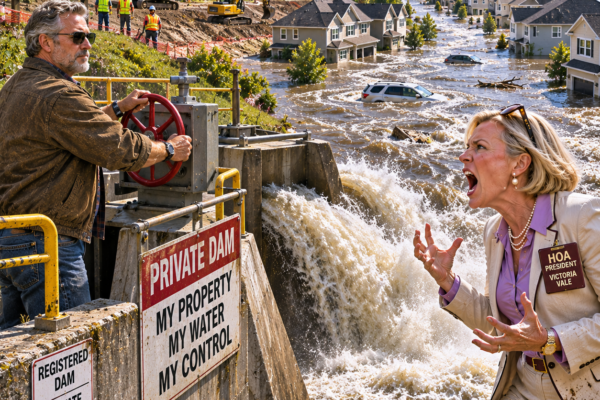
“YOU CANNOT CLOSE THIS ROAD, DANIEL! TWO HUNDRED THIRTY FAMILIES DEPEND ON IT, AND SILVER CREEK WILL TAKE YOU TO COURT BEFORE WE LET ONE NEW LANDOWNER HOLD THIS COMMUNITY HOSTAGE!” HOA president Patricia Whitmore shouted after I asked her for the only thing that should have settled the argument—a recorded easement proving her neighborhood had permanent rights across my 1,800-acre ranch.
I never closed Canyon Road, never threatened the residents, and even offered Silver Creek a permanent residential easement that protected school buses, ambulances, guests, deliveries, and every family already living there—but Patricia rejected it, sued me for broader “future transportation rights,” and quietly backed a four-lane expansion that would also serve a development controlled by her husband.
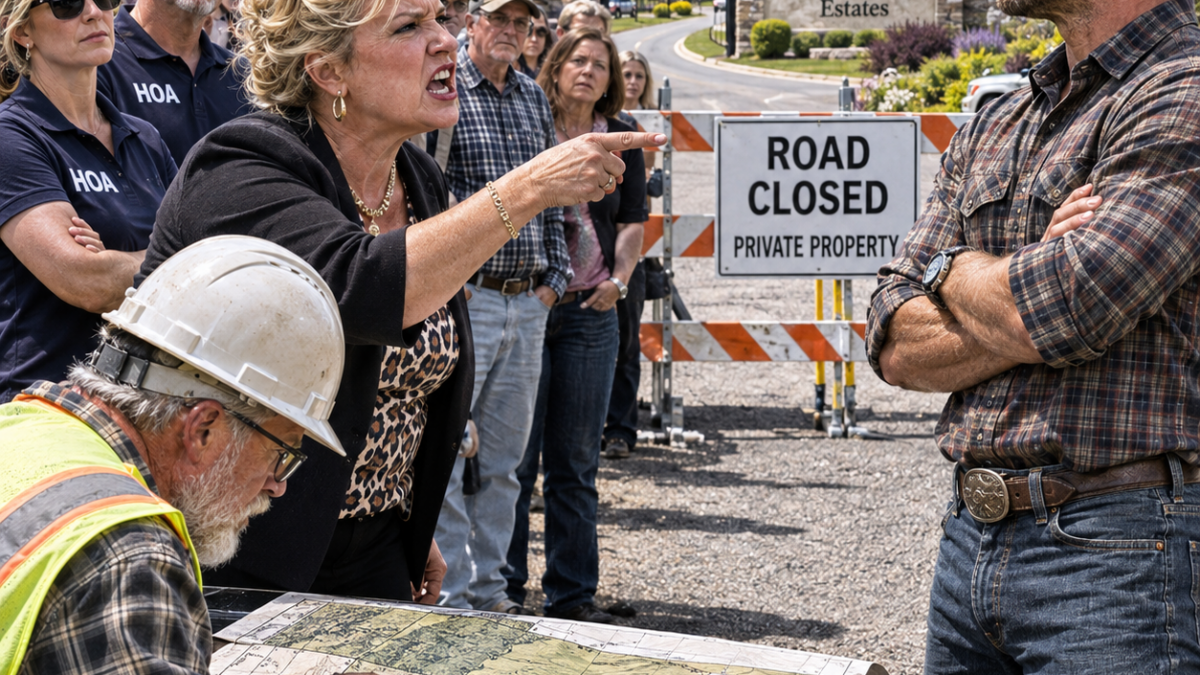
Then the judge ruled that the HOA had never proven a permanent easement at all, Patricia refused the replacement agreement I offered anyway, and less than twenty-four hours later more than 200 residents were standing behind county barricades staring at the only road into their neighborhood—while a surveyor unfolded an old map on the hood of my truck and said, “Daniel, before you reopen anything, you need to see where this road was really supposed to go.”
My name is Daniel Brooks.
Three months before Silver Creek Estates temporarily lost the only entrance it had relied on for twenty-seven years, I made the largest purchase of my life.
One thousand eight hundred acres in western Colorado.
Open grassland.
Pine-covered hills.
Two creeks.
Cattle pasture.
Old barns.
Private roads.
And a narrow canyon running east toward a county highway.
My family thought I had lost my mind.
I was not born rich.
My father repaired farm equipment for thirty-five years.
My mother worked at an elementary school.
After college, I started an excavation company with one used skid steer and a pickup that leaked oil everywhere it parked.
We repaired ranch roads.
Cleared storm debris.
Built drainage.
Prepared home sites.
Fixed erosion problems.
Over eighteen years, the business grew.
I saved more than I spent.
Bought a few rentals.
Then some smaller pieces of land.
That was how I already knew Dawson Ranch.
My company had repaired several erosion problems there years earlier.
When the owner, William Dawson, decided to sell, I paid attention.
William was eighty-one.
His daughter lived in Oregon.
He wanted to simplify his life.
The ranch was beautiful.
It was also complicated.
Silver Creek Estates sat almost inside it.
PART2:
The neighborhood had been carved from a piece of the old Dawson holdings twenty-seven years earlier.
Around 230 homes.
Clubhouse.
Tennis courts.
Mountain views.
Landscaped entrance.
Silver Creek owned roughly 190 acres.
I was buying the 1,800 acres surrounding it on three sides.
My land was completely outside the HOA.
No covenants.
No dues.
No architectural committee.
No HOA authority over my barns, fences, cattle, roads, or land.
That part was clear.
The complication was Canyon Road.
William showed it to me before closing.
A narrow paved road left the county highway, crossed almost three miles of Dawson Ranch, then entered Silver Creek through its western gate.
“That’s their normal entrance,” he said.
“Do they have an easement?”
William shrugged.
“They’ve used it since the houses went up.”
“That wasn’t my question.”
He smiled.
“That’s why you have a lawyer.”
He was right.
Rebecca Hayes handled my purchase.
She ordered the title search.
Utility easements.
Old cattle access.
Power lines.
Temporary construction rights.
Everything appeared.
Except a permanent road easement for Silver Creek.
The title company searched again.
Nothing.
Rebecca warned me not to get excited.
“Twenty-seven years of use matters.”
“So they may still have rights?”
“Possibly. There may be old agreements, county records, implied rights, something we haven’t found.”
I nodded.
“I’m not locking two hundred families behind a ranch gate while we research paperwork.”
“Good.”
That was my position before I ever met Patricia Whitmore.
Existing residents could keep using Canyon Road.
I would investigate.
Then we would formalize whatever needed formalizing.
Simple.
Then Patricia called.
No hello.
No welcome.
Her first sentence:
“I understand you purchased our access road.”
I looked at my phone.
“I purchased Dawson Ranch.”
“Canyon Road crosses it.”
“I know.”
“It has been Silver Creek’s entrance for twenty-seven years.”
“I know that too.”
“So nothing changes.”
That tone bothered me.
Not because she wanted access.
Of course she wanted access.
Because she spoke like my participation in the conversation was optional.
“I didn’t say anything was changing.”
Pause.
“Good. I wanted to make sure we understood each other.”
“I understand you use the road. My attorney is reviewing the access records.”
“There’s nothing to review.”
“There is always something to review when you buy eighteen hundred acres.”
“The HOA has permanent access.”
“Great. Send Rebecca the easement.”
Silence.
“We have documents.”
“Send them.”
Two days later, a packet arrived.
First document:
1998 construction access agreement.
William Dawson had allowed the original Silver Creek developer to move workers, equipment, materials, and machinery across Canyon Road while homes were being built.
Expiration:
December 31, 2001.
Not permanent.
Second:
Maintenance agreement.
Silver Creek contributed to grading, snow removal, and repairs because residents were using the road.
One sentence jumped off the page.
Maintenance participation does not create ownership or permanent easement rights.
I called Rebecca.
“That seems clear.”
“It is.”
“Then why are they still using the road?”
“Because William let them.”
That possibility fit everything we knew.
William had always been easygoing.
Residents paid some maintenance.
The arrangement worked.
Nobody forced a legal fight.
Then William became older.
Years passed.
People moved into Silver Creek and assumed the entrance came with their homes.
Permission became routine.
Routine became something nobody questioned.
Rebecca found letters from the early 2000s.
William repeatedly referred to Silver Creek’s use as neighbor access.
One letter reminded the HOA:
Access continued at the Dawson family’s permission.
Silver Creek never objected.
That was important.
Still, I did not close anything.
I wrote Patricia.
Normal residential use could continue while we negotiated.
Then I offered something stronger.
Permanent residential easement.
Residents.
Guests.
Deliveries.
School buses.
Ambulances.
Emergency vehicles.
Normal utility service.
Silver Creek would share road-maintenance and snow-removal costs.
Carry insurance.
No road widening.
No future commercial or outside development traffic without my written permission.
I thought the HOA would be relieved.
Patricia refused.
Not negotiated.
Refused.
Her email said:
Silver Creek will not pay rent for a road that already belongs to the community.
I stared at that line.
The road did not belong to Silver Creek.
My deed included the land beneath it.
We had found no permanent HOA easement.
Still, I stayed calm.
We invited the board to my ranch office.
Patricia came.
Treasurer Frank Wilson.
Board member Jennifer Collins.
HOA attorney Charles Benton.
Rebecca sat beside me.
For the first twenty minutes, the meeting was almost pleasant.
Frank admitted he could not find a recorded easement.
Jennifer said residents simply believed Canyon Road had always been part of Silver Creek.
Charles said decades of use could create legal arguments.
Rebecca agreed.
That was honest.
Then Patricia placed a folder on my desk.
“This should end the discussion.”
Inside:
PERMANENT COMMUNITY ACCESS AGREEMENT.
Dated May 2002.
Supposedly signed by William Dawson.
It granted Silver Creek unlimited access across Canyon Road.
But it went much further.
Road widening.
Utility installation.
Drainage.
Gate construction.
And one phrase Rebecca immediately circled:
future community transportation needs.
She looked at Patricia.
“Where was this recorded?”
“It wasn’t.”
“Why?”
“The developer kept it privately.”
Charles Benton shifted in his chair.
He said he had only seen the document that morning.
That mattered.
Patricia had apparently found the perfect missing agreement and had not even shown her attorney until just before our meeting.
Rebecca asked where it came from.
“HOA archives.”
“When did you find it?”
“Recently.”
“How recently?”
“Why does that matter?”
“Because every lawyer and title company involved has spent weeks searching for this exact document.”
We took a copy.
No accusation.
No shouting.
I drove to see William.
He still had not moved to Oregon.
I handed him the agreement.
He read the first page.
Then the second.
His eyebrows rose.
“I never signed this.”
“You’re sure?”
“Daniel, I spent twenty years refusing to give those people permanent control of that road.”
I pointed to his signature.
“It looks real.”
“It is.”
That answer surprised me.
William disappeared into another room.
Came back with an old file box.
Pulled out a 2002 cattle lease.
His signature sat at the bottom.
Rebecca later compared them.
Exact image.
Copied.
We did not yet know by whom.
The next morning I called Patricia.
I did not say forgery.
I simply told her William denied signing the agreement.
She laughed.
“He’s eighty-one.”
That made me angry.
William was old.
He was not confused.
“We’re having the document examined.”
Then Patricia said the sentence that ended whatever cooperation remained between us.
“If you interfere with Silver Creek’s access, the HOA will sue you.”
“I haven’t interfered with anything.”
“Good. Keep it that way.”
She hung up.
For another month, Canyon Road stayed open.
I worked the ranch.
Repaired fencing.
Cleared dead trees.
Restored an old barn.
Moved cattle.
Most Silver Creek residents waved when they drove through.
Some stopped to introduce themselves.
Robert Hayes, a retired firefighter, apologized for the conflict.
“Most of us don’t care who owns the road.”
“I know.”
“We just need to get home.”
“I know that too.”
That mattered.
I did not want 230 families turned into weapons in somebody else’s property fight.
Then survey crews appeared along Canyon Road.
Not mine.
Silver Creek’s.
I stopped the supervisor politely.
“What are you mapping?”
“Future road improvement corridor.”
He showed me.
Canyon Road widened from two lanes to four near Silver Creek.
Turning lane.
Bike path.
Streetlights.
Utility trenches.
Then the new four-lane section continued beyond Silver Creek’s gate, north through my ranch.
That made no sense.
I called Frank.
He sounded confused.
“I thought this was a safety survey.”
“For four lanes?”
“What?”
I sent him the plan.
Twenty minutes later:
“I’ve never seen this.”
Neither had Jennifer.
Patricia called it a preliminary concept.
Rebecca called it unauthorized planning across somebody else’s property.
Then the county supplied the public application.
SILVER CREEK NORTH ACCESS STUDY.
North access to what?
We found out.
Mesa Ridge Development Partners was studying roughly nine hundred acres north of Silver Creek.
Hundreds of potential homes.
Small commercial area.
Preferred entrance:
Canyon Road.
Across my ranch.
Silver Creek sat between the highway and Mesa Ridge.
The road through my property was the missing connection.
Then Rebecca searched the company.
One manager:
Steven Whitmore.
Patricia’s husband.
There it was.
Patricia was HOA president.
Her husband was connected to a major development that became dramatically more valuable if Silver Creek secured permanent broad access across my ranch.
That did not by itself prove wrongdoing.
But it was a conflict that demanded sunlight.
Rebecca sent a preservation letter.
No road work.
No document destruction.
No hidden construction.
Preserve communications.
Then we asked Silver Creek’s board to confirm it had not approved Mesa Ridge traffic.
Frank supported us.
Jennifer supported us.
Patricia responded differently.
Silver Creek sued me.
The lawsuit asked the court to declare Canyon Road a permanent HOA access route.
No gates.
No rerouting.
No fees.
No interference.
It also asked the court to validate the supposed 2002 agreement.
The fake-looking one William denied signing.
I sat in Rebecca’s office reading the complaint.
“They’re actually suing me.”
“Yes.”
“Even though I haven’t closed anything.”
“Yes.”
“Why?”
Rebecca pointed at the requested language.
Current and future community transportation purposes.
Future.
Again.
“They aren’t only asking for their 230 homes,” she said.
“They’re trying to establish something broad enough to become useful later.”
“To Mesa Ridge.”
“Possibly.”
Then the document examiner called.
The 2002 agreement had been created recently.
Font version wrong for the claimed date.
PDF metadata newer.
William’s signature copied.
Witness signature belonged to a man who died before the supposed signing date.
Rebecca sat very still.
“That is a serious problem.”
“For the HOA?”
“For whoever made it.”
We sent the findings to Charles Benton.
He immediately asked for time.
Patricia did not withdraw the lawsuit.
Instead, she emailed residents saying I was trying to erase Silver Creek’s historic rights and shut the only entrance.
My phone exploded.
Parents.
Older homeowners.
Business owners.
Some angry.
Some terrified.
One woman asked:
“Are you really locking us in?”
“No.”
“Patricia says you are.”
“I’ve never said that.”
“Then why fight access?”
“Because the lawsuit asks for rights much broader than getting you home.”
“What rights?”
Exactly.
Residents did not know.
So I mailed every homeowner my proposed easement.
No insults.
No accusations.
Just terms.
Permanent residential access.
Emergency access.
School buses.
Deliveries.
Guests.
Normal utilities.
Fair maintenance contribution.
No outside development or commercial traffic without separate agreement.
Frank called.
“You started a war over here.”
“Why?”
“Because residents want to know why we rejected this.”
“Good question.”
Patricia called the easement a trick.
She said signing it would surrender rights Silver Creek already had.
Now residents wanted proof those rights existed.
The only document Patricia had produced was collapsing under forensic review.
The main court hearing was scheduled.
I kept Canyon Road open.
Rebecca encouraged that.
No reason to create panic while the judge was deciding.
Then at 1:20 one morning, my ranch hand Thomas Walker called.
“Daniel, there are construction trucks on Canyon Road.”
“What kind?”
“Dump trucks. Grader. Bulldozer.”
I drove out.
Four dump trucks.
Two pickups.
Grading machine.
Bulldozer.
Not heading toward Silver Creek.
Heading north.
Deep into my ranch.
I blocked the dirt track with my truck and stayed inside.
Thomas called Sheriff Owen Parker.
The supervisor approached.
“We’re starting the north connector.”
“On whose land?”
“Silver Creek access corridor.”
He showed me the work order.
Client:
Mesa Ridge Development Partners.
Authorization:
Silver Creek Estates.
Authority:
The disputed 2002 agreement.
The same document already under court review.
I called Rebecca.
Her voice changed.
“Do not let them begin.”
“Sheriff’s coming.”
“Good.”
Then Thomas shouted.
Another excavator had entered through a different ranch track.
Its bucket hit the old fence at the Mesa Ridge boundary.
Once.
Twice.
Fence collapsed.
Headlights appeared on the far side.
Dozens.
Construction vehicles waiting.
Before the court had even ruled, someone had already decided my ranch was going to become Mesa Ridge’s entrance.
The bulldozer rolled through.
I recorded.
No threats.
No standing in front of machinery.
Truck numbers.
Crew names.
Time.
Location.
The supervisor finally realized this was not a routine project.
He stopped the machines.
Sheriff Parker arrived minutes later.
The crew handed over its paperwork.
Nobody arrested.
They were contractors relying on documents their client supplied.
The fence damage was documented.
That part made me angrier than the lawsuit.
Paperwork disputes can be reversed.
A broken livestock fence can put cattle on a highway.
Rebecca arrived wearing a coat over pajamas.
She read the work order under truck headlights.
“Previously established transportation corridor.”
She looked up.
“That wording is deliberate.”
The supervisor frowned.
“We were told title was settled.”
“It isn’t.”
The sheriff ordered work stopped pending court review.
Crews backed out.
Temporary panels closed the fence.
By sunrise, Rebecca had an emergency order.
No construction.
No widening.
No utilities.
No new traffic beyond existing Silver Creek residential use until the court ruled.
Patricia called it an attack.
Frank called it:
“A pause.”
That difference showed how badly the board had split.
Residents wanted records.
Not speeches.
Frank later told me they were still terrified I would shut Canyon Road if Silver Creek lost.
So I went to the clubhouse.
No attorneys.
No sheriff.
Just me.
About eighty residents stood in the parking lot.
“I’m not trying to trap anyone.”
A woman asked:
“Then why not give us permanent access?”
“I did.”
“Patricia says you can cancel it.”
“No. My proposed easement is permanent for existing residential use if Silver Creek follows the agreement.”
“What does that include?”
“Residents.”
“Families?”
“Yes.”
“Deliveries?”
“Yes.”
“Ambulances?”
“Yes.”
“School buses?”
“Yes.”
“Guests?”
“Yes.”
A man in a baseball cap looked confused.
“So what are we suing over?”
I did not answer for Patricia.
“Read the complaint.”
Some already had.
The fight was not about normal residential access anymore.
It was about:
Road widening.
Utilities.
Future transportation.
Development traffic.
Mesa Ridge.
Then Rebecca found the Access Preservation Reserve.
Silver Creek residents had contributed to it for years.
Nearly $460,000 had been spent.
Engineering.
Legal research.
Traffic studies.
Surveying.
Consulting.
A large amount went to Steven Whitmore’s companies.
One invoice:
FUTURE CORRIDOR RIGHTS DEVELOPMENT.
$88,000.
That was not preserving the current road.
Patricia had approved it under emergency contracting authority after wildfire concerns.
Wildfire risk was real.
Silver Creek genuinely needed better evacuation planning.
But county emergency officials had recommended studying a secondary route to the south.
Not turning Canyon Road into a four-lane development corridor heading north.
A real safety problem had been attached to a private development plan.
Then William remembered something.
Patricia and Steven had visited him six years earlier.
They wanted permanent road rights.
He refused.
Steven offered $200,000.
Then $350,000.
William still refused because the proposed language included future neighborhoods.
His attorney at the time, Charles Reynolds, had documented it.
Rebecca obtained the file.
One letter to Patricia:
Mr. Dawson permits Silver Creek residents to use Canyon Road as a neighbor courtesy. No permanent easement exists. Any future development use will require a separate negotiated agreement.
Patricia signed for delivery.
She knew.
Then came the rejected draft Steven had sent William six years earlier.
Its wording was almost identical to the supposed 2002 agreement.
Same phrases.
Same paragraph structure.
Same “future community transportation needs.”
A document supposedly written in 2002 contained language from a draft written decades later.
Silver Creek’s own attorney asked the judge to withdraw the 2002 agreement from evidence.
Patricia objected.
Her own lawyer no longer trusted her key document.
Then the hearing began.
Patricia testified.
Silver Creek residents had used Canyon Road for decades.
True.
William had allowed repairs.
True.
Residents depended on it.
True.
Rebecca never disputed those facts.
Then:
“Can you identify a recorded permanent easement from Mr. Dawson?”
“No.”
Rebecca showed the maintenance agreement.
Maintenance participation does not create ownership or permanent easement rights.
Patricia said she had never focused on that sentence.
Then the six-year-old letter.
No permanent easement exists.
“You received this?”
“Yes.”
“So you knew William Dawson disputed permanent rights.”
“He disputed development rights.”
“The letter says no permanent easement exists.”
Silence.
Then Rebecca placed Steven’s rejected draft beside the fake 2002 agreement.
Same unusual punctuation.
Same paragraph order.
Same typo.
“Transportion.”
Missing the A.
The document examiner explained the wording had been copied.
The judge asked Charles Benton:
“Does Silver Creek still rely on the 2002 agreement?”
The HOA attorney stood.
“No, Your Honor.”
Patricia stared at him like he had betrayed her.
He had not.
He was refusing to defend evidence he no longer believed.
Then came long-term use.
That was more complicated.
Silver Creek had used Canyon Road for twenty-seven years.
Openly.
Regularly.
But William’s letters repeatedly described the use as permission.
The HOA paid maintenance because he asked them to share cost.
They never purchased the road.
Never recorded an easement.
Never protested William’s ownership.
Never claimed road-widening rights until development interests appeared.
Then the judge asked me:
“If I find Silver Creek has no permanent easement, what will you do the next morning?”
I looked at Rebecca.
She nodded.
“I will offer them the same permanent residential easement I offered before they sued me.”
The judge leaned back.
“You’re willing to continue access?”
“Yes.”
“No future development traffic?”
“Not without a separate agreement.”
“Will you charge rent?”
“No profit rent. They share actual maintenance and insurance.”
“Why?”
“Because two hundred families should not lose practical access to their homes because their leadership overreached.”
The room changed.
Even Patricia looked down.
The judge took the case under advisement.
A few days later Rebecca called.
“Silver Creek lost.”
Not every argument.
But the important ones.
No permanent easement proven.
No broad transportation right.
No road-widening right.
No Mesa Ridge development right.
No utility corridor for future land.
The disputed 2002 agreement carried no legal weight.
Most important:
Silver Creek’s twenty-seven-year use had been permissive.
Permission.
Not ownership.
Not permanent control.
Patricia had sued to turn William’s courtesy into a legal right.
Instead, the lawsuit produced a ruling confirming that the right had never been permanent.
I immediately told Rebecca to send Silver Creek my easement.
Same offer.
Permanent residential access.
But the court ruling created one temporary legal problem.
The informal permission under which Silver Creek had historically used the road was no longer enough.
I had granted temporary use during the lawsuit.
That temporary permission would expire with the case unless extended.
Rebecca prepared an extension.
Patricia refused it.
Her email:
Silver Creek would appeal and would not legitimize Daniel Brooks’s false ownership claims.
My ownership was not false.
My deed was clear.
The court had just confirmed the HOA had no permanent right.
Frank called furious.
“The board didn’t authorize that.”
Jennifer said the same.
Rebecca warned Patricia:
Temporary access expires at 8:00 tomorrow morning unless the HOA accepts the extension.
7:45.
Frank called.
“Emergency vote. We have enough.”
“Send it.”
7:52.
Patricia removed Frank’s administrative access from the HOA system.
7:56.
She sent residents a message saying I was illegally closing their only road.
7:58.
Rebecca received:
NO AGREEMENT.
8:00.
Permission expired.
I called the county road department to document that Canyon Road was private.
Not to trap anyone.
People already inside Silver Creek could leave.
Emergency vehicles remained allowed.
But new general entry stopped until somebody with authority signed.
County workers installed temporary barricades.
Residents gathered.
Patricia arrived beside herself.
Phones came out.
Frank pushed through the crowd holding a printed board resolution.
Five of seven directors had voted yes.
Rebecca checked the bylaws.
“The board has authority.”
I exhaled.
“Then reopen it.”
That should have ended everything.
Then county surveyor Thomas Reed called from uphill.
“Daniel, don’t open the gate yet.”
Patricia exploded.
“You have the agreement!”
Thomas ignored her.
He spread an old subdivision map across my truck.
Silver Creek’s entrance gate did not sit where everyone thought.
The subdivision boundary started almost four hundred feet farther east.
Guard booth.
Landscape monument.
First section of road.
Part of the gate complex.
All on my ranch.
William had allowed that too.
Frank stared.
“That cannot be right.”
Thomas showed the original plat.
Modern survey.
Iron monument buried under landscaping.
Same answer.
Rebecca nodded slowly.
“We need to rewrite the easement description.”
Then Thomas pointed north.
Another line.
Old service route.
Patricia’s face changed.
The route left Canyon Road before Silver Creek’s gate, crossed my ranch, passed behind the neighborhood, continued north, then reached an old county emergency reservoir.
The reservoir sat on my land.
Recently graded around.
Huge flat pad.
Fresh gravel.
Utility trenches.
I had no idea any work was happening there.
My ranch hand Thomas Walker called.
“Daniel, there are crews at the reservoir.”
“What crews?”
“Concrete trucks.”
“How many?”
“Six or seven.”
“What are they building?”
Pause.
“They’ve already poured a foundation the size of a football field.”
Rebecca grabbed her keys.
We reached the reservoir.
Concrete trucks.
Steel frames.
Pump boom.
Security.
Fresh construction road across my land.
The site supervisor, Robert Jenkins, showed us the authorization.
Project:
NORTH VALLEY WATER CENTER.
Owner:
Mesa Ridge Development Partners.
Their map said the parcel belonged to Mesa Ridge.
My deed said it belonged to me.
Rebecca told the crew to stop the pour until ownership was verified.
Sheriff Parker arrived.
Thomas Reed located the old county monument.
Coordinates matched my deed.
The parcel had been sold by Franklin County to William Dawson years earlier.
Then transferred to me with the ranch.
Mesa Ridge had no recorded ownership.
Robert looked sick.
“We were told this closed last month.”
“With who?”
He opened the title packet.
Seller:
Dawson Ranch Holdings.
Buyer:
Mesa Ridge Development Partners.
Price:
$1.2 million.
I had never heard of Dawson Ranch Holdings.
William had never used that company.
Rebecca searched the state database.
Formed eight months earlier.
Two weeks after William listed the ranch.
Manager:
Steven Whitmore.
Now things were much worse.
The deed claimed William sold the reservoir parcel to Steven’s company eighteen months earlier.
William denied it.
Signature wrong.
Another false transfer.
Fresh pipes had already been installed.
Electrical cabinets.
Pump station.
The North Valley Water Center would provide storage, pressure, and treatment for future Mesa Ridge homes.
They were building the center of a private water system on my property.
Still, I refused to blame Patricia for something we had not yet proven she knew about.
Steven was directly tied to the company.
Patricia was directly tied to the road campaign.
Whether she knew about the false reservoir deed required evidence.
Silver Creek’s board signed the corrected residential easement.
Five votes.
Patricia refused.
Did not matter.
Board authority controlled.
Existing residents received permanent access.
Residents.
Guests.
Deliveries.
School buses.
Emergency vehicles.
Normal utility maintenance.
No Mesa Ridge traffic.
No commercial development.
No road widening beyond ordinary safety work without written permission.
For the first time in twenty-seven years, Silver Creek had a real recorded right to use Canyon Road.
A better right than before the lawsuit.
That was exactly what I wanted.
The judge dismissed Silver Creek’s broad transportation claim.
Residential access stayed.
Mesa Ridge did not.
Then Mesa Ridge’s lenders discovered that the reservoir parcel had been used as collateral for nearly $6 million in financing.
A fake deed had turned part of my ranch into loan security.
The bank immediately froze additional funding.
Steven called.
He wanted to buy the reservoir and a northern road corridor.
$2.4 million.
“No.”
$3 million.
“No.”
$3.8 million.
Still no.
Rebecca asked if I wanted to counter.
“No.”
“Why?”
“I didn’t buy eighteen hundred acres so I could immediately build someone else’s highway through it.”
Money was no longer the question.
I wanted the ranch.
Quiet.
Space.
Cattle.
Water.
Trees.
Steven’s route would destroy the reason I bought it.
Silver Creek residents began realizing something too.
Many did not want hundreds of Mesa Ridge homes using their entrance.
Patricia had presented road widening as protection for Silver Creek.
In reality, it could turn their neighborhood into the access corridor for another development.
The board removed her as president.
Six to one.
Frank became acting president.
Hated the job.
Which probably made him ideal.
Independent counsel reviewed Silver Creek’s connection to Mesa Ridge.
More than $600,000 in HOA spending over eight years had gone toward access planning, surveying, utility studies, road concepts, and consulting.
Some legitimate safety work.
Some connected directly to Steven’s companies.
Broad budget categories hid the purpose.
Emergency access.
Road safety.
Utility resilience.
Then one private cooperation letter.
Patricia had agreed Silver Creek would support Mesa Ridge road and utility coordination in exchange for projected connection fees from future homes.
Potential HOA revenue:
Almost $1.5 million over ten years.
That complicated her motive.
She was not necessarily thinking only about enriching her husband.
She may genuinely have believed Mesa Ridge could benefit Silver Creek financially.
But the method still mattered.
You do not improve a community by quietly building plans across somebody else’s ranch.
Then investigators found Patricia’s email.
Steven:
NORTH WATER SITE NEEDS DAWSON PARCEL BEFORE FINANCING.
Patricia:
WILLIAM WILL NEVER SELL DEVELOPMENT ACCESS.
Steven:
RESERVOIR IS SEPARATE ENOUGH.
Patricia:
ONLY IF TITLE CAN BE CLEANED.
Steven:
I CAN HANDLE TITLE.
Patricia:
KEEP HOA OUT OF THAT PIECE.
There it was.
She knew Steven was trying to obtain the reservoir outside ordinary negotiations.
She did not necessarily forge anything.
But she knew enough to know something was wrong.
Sheriff Parker obtained a warrant for Steven’s development office.
Investigators found the file used to create the fake reservoir deed.
William’s signature copied from an old conservation agreement.
Retired notary stamp.
Metadata from Steven’s company computer.
No $1.2 million purchase ever paid to William.
Mesa Ridge books treated the deal as an internal paper transfer.
Then Thomas Reed found something underneath the unfinished foundation.
Old steel line.
County emergency-water main.
The title company had missed an old public easement.
That was legitimate.
County had sold the reservoir parcel decades earlier but retained emergency water rights.
I had no problem with that.
Firefighters might need the system someday.
Real easements did not threaten me.
They had purpose.
Boundaries.
Records.
The problem was Mesa Ridge had connected its new private pump system to that county emergency main.
No permit.
No agreement.
No approval.
Their engineers intended to use the county line as backup firewater for future development.
Again:
Building tomorrow’s rights before receiving today’s permission.
County ordered the connection cut.
Then Silver Creek residents voted.
Eighty-four percent supported removing every HOA policy tied to Mesa Ridge access.
No North Connector.
No outside development traffic.
No development utility coordination.
No future commercial road use without a full resident vote and legitimate property rights.
That was when I knew the community had separated itself from Patricia’s plan.
Life became quiet for nearly two weeks.
Then William Dawson visited.
We drove the ranch.
At the reservoir, he looked at the giant unfinished foundation.
“I should’ve warned you more about Patricia.”
“You couldn’t have known all this.”
He pointed north.
“My father used to own land beyond that ridge.”
Another thousand acres.
Old coal and gravel exploration had once used a mineral access route across what became Dawson Ranch.
Temporary license.
Extended once.
Expired in 1979.
The old map nearly matched Mesa Ridge’s North Connector grading.
Rebecca did not like that coincidence.
Maybe Steven had discovered it in county archives.
Could he try to revive another expired route after losing Canyon Road?
We sent the agreement to the title company and county.
Everybody agreed:
Expired.
No current right.
Problem solved.
Three nights later, Thomas Walker called.
“The north gate is open.”
“I locked it.”
“I know.”
“Chain?”
“Cut.”
“Anyone inside?”
Pause.
“Too many.”
Headlights covered the old mineral route.
Survey trucks.
Utility trucks.
Pickups.
Twenty workers.
They were marking the expired path.
One man handed me a county emergency utility-access declaration signed by Thomas Harris.
The same county engineer who had been helping us.
I called him at home.
“I never signed that.”
Of course.
Sheriff Parker stopped the crews.
Again, contractors.
Again, official-looking paper.
Then one truck farther up the trail kept moving.
We followed it to the reservoir.
Two workers stood beside the county emergency valve.
One held a cutting tool.
Outer lock already removed.
Sheriff Parker ordered them back.
They complied.
They said they had been told to isolate the county line for:
PRIVATE SYSTEM CONVERSION.
Rebecca found another document in their packet.
A deed.
Not the reservoir.
The entire ranch.
Seller:
Daniel Brooks.
Buyer:
North Valley Land Trust.
Date:
Two days earlier.
My signature sat at the bottom.
I stared at it.
Too real.
Then I recognized it.
Copied directly from my closing documents.
North Valley had then granted Mesa Ridge:
Old mineral-road access.
Reservoir water rights.
Utility corridors.
All across 1,800 acres.
Somebody had not only forged a road right.
They had tried to erase me as owner.
Then a deputy returned from the county recorder.
“The deed was filed this afternoon.”
That one made my stomach drop.
Rebecca did not panic.
“Recording a document does not make a forgery valid.”
She filed an emergency title action before sunrise.
Notice went into county records warning banks, developers, and contractors that North Valley’s claimed ownership was disputed for suspected fraud.
Western Record Solutions had electronically filed the deed through a real processing service.
North Valley had created a client account nine days earlier.
Business registration.
Tax number.
Authorization letter.
All looked normal.
My signature appeared on the authorization too.
State records:
North Valley Land Trust formed three weeks earlier.
Manager:
Steven Whitmore.
He called me directly.
Rebecca put him on speaker.
“Daniel, we can fix this.”
“What are we fixing?”
“The title issue.”
“You mean the deed saying I gave away my entire ranch?”
“The structure can be corrected.”
“Why would I transfer eighteen hundred acres to you?”
“You were supposed to receive equity in Mesa Ridge.”
“I never agreed to that.”
“You had conversations.”
“You made offers. I said no.”
Then Steven said something investigators later cared about.
“You could have signed afterward.”
Rebecca looked up immediately.
I asked:
“After what?”
He realized the mistake.
“This can still be settled.”
“How?”
“Withdraw the title challenge. We recognize your ownership interest. You grant the access corridor.”
“My ownership interest?”
Silence.
“I own the ranch.”
He hung up.
The emergency hearing was that afternoon.
Rebecca produced my real deed.
Bank transfer.
Title insurance.
Taxes.
Insurance.
William’s records.
Possession.
Then the new deed.
No payment.
No negotiation.
No closing.
No title policy.
No legitimate notary meeting.
No correspondence from me agreeing to sell.
Only a document appearing two days earlier.
Signature comparison was devastating.
The fake deed signature was digitally identical to the signature from my purchase closing.
Not similar.
Identical.
Same tiny interruption.
Same pressure shape.
Same everything.
Handwritten signatures do not reproduce pixel-for-pixel.
Copied images do.
Judge froze the deed.
North Valley could not sell.
Mortgage.
Lease.
Build.
Grant easements.
Or rely on the fake document.
The recorder received the court notice immediately.
My ranch stayed mine.
Investigators recovered Steven’s laptop.
Folder:
LAND CONSOLIDATION.
Inside:
Fake Dawson reservoir deed.
Fake North Valley ranch deed.
Old mineral-route activation papers.
Utility agreements.
Road easements.
Development schedule.
The strategy was obvious.
First:
Use Silver Creek’s twenty-seven years of road history to get broad access through court.
If that worked:
Mesa Ridge gets its route.
If not:
Revive the mineral road.
If that failed:
Create ownership documents.
If those fake documents survived long enough, construction and financing could move forward before the real owner stopped them.
Momentum.
That had been the strategy all along.
Move enough dirt.
Spend enough money.
Install enough utilities.
Borrow enough capital.
Then make the legitimate owner feel like stopping it would cost more than surrendering.
One old email from Patricia years earlier even said:
Once road investment passes certain point, Dawson will negotiate rather than litigate.
William had refused.
Then I bought the ranch.
The target changed.
Investigators found a Mesa Ridge projection.
With permanent Canyon Road development access:
Projected value roughly $74 million.
Without it:
Less than half.
Now the desperation made sense.
My ranch was not just land between Mesa Ridge and the highway.
It was the missing road.
Water.
Emergency infrastructure.
Utility corridor.
Everything.
Patricia did not create the fake ranch deed.
Digital evidence pointed to Steven’s office.
But her role became clear too.
She had spent years using the HOA to prepare the corridor.
Approved access spending.
Signed consultant contracts.
Promoted “future community rights.”
Knew Steven stood to profit.
The fake 2002 agreement had been created on a computer tied to one of Steven’s older companies.
Patricia had received a draft before claiming it was discovered in HOA storage.
Her explanation collapsed.
Frank called after the board reviewed the findings.
“She used the HOA as leverage.”
“Yes.”
“Residents paid for part of it.”
“Yes.”
Then:
“Do you regret giving us the permanent easement?”
“No.”
He sounded surprised.
“Why not?”
“Because Silver Creek needed access before Patricia. You’ll need access after her.”
That distinction mattered more than anything.
The residents were not the scheme.
Families bought homes believing Canyon Road was their entrance.
I was not going to punish them because Patricia and Steven stretched that access into something else.
The permanent residential easement stayed.
But it meant exactly what it said.
Silver Creek residents:
Yes.
Mesa Ridge:
No.
Commercial traffic:
No.
Four-lane widening:
No.
Future subdivision utilities:
No.
The irony was almost perfect.
Patricia sued me to make Silver Creek’s access stronger.
The court examined the history and found the HOA never had a permanent right.
For those few hours after judgment, before Frank’s board accepted my new easement, Silver Creek truly lost the only road it had relied on for twenty-seven years.
Not because I wanted that.
Because Patricia refused the agreement even after the judge rejected her legal theory.
She sued herself out of the story she had been telling.
The board put the road back.
This time legally.
North Valley eventually stopped defending the fake transfer.
Judge declared the deed void from the beginning.
Every Mesa Ridge right created through it disappeared.
County recorder corrected the chain of title.
Brooks Ranch Properties remained owner of all 1,800 acres.
Subject only to legitimate old easements and the new Silver Creek residential easement.
I framed the order.
Rebecca said that was weird.
I framed it anyway.
The fake reservoir transfer was voided too.
The county’s real emergency-water easement remained.
I supported it.
If firefighters need water during a wildfire, they should have it.
Real easements never bothered me.
Permission.
Purpose.
Limits.
Records.
That is how they are supposed to work.
Mesa Ridge had to redesign.
New highway access from the north.
Longer.
More expensive.
Completely outside my ranch.
Some investors stayed.
Some left.
The project shrank.
Then paused.
Maybe somebody builds homes there someday.
I do not care.
Build legally.
That was all I had asked from the beginning.
Steven eventually faced charges tied to forged property records, fraudulent filings, false government paperwork, lender representations, and other conduct investigators connected directly to his companies.
Patricia faced different criminal and civil issues involving HOA documents, financial conflicts, records, and misuse of authority.
The cases took time.
No instant screaming judge.
No magical punishment by sunset.
Evidence.
Lawyers.
Hearings.
Restitution.
Negotiations.
Consequences.
Silver Creek pursued civil recovery from several Steven-connected companies.
Some money returned.
Not all.
Enough to restore part of the access reserve and reduce the hit to homeowners.
Patricia permanently lost her HOA position.
Steven lost control of much of the development plan he had built around my land.
Their own documents did most of the work.
Frank eventually became permanent president.
He hated it.
Residents trusted him partly because he hated it.
One of his first projects was finding Silver Creek a real second emergency route.
Not through my northern pasture.
Not through Mesa Ridge.
A narrow southern emergency road could be built using Silver Creek land and a small legitimate county easement.
Fire department reviewed it.
County engineers designed it.
Residents voted.
And before anybody moved dirt, Frank called every affected landowner.
Imagine that.
Ask first.
The road was finished the next year.
Normally gated.
Only for evacuation, wildfire, or major Canyon Road blockage.
Silver Creek no longer depended entirely on one route.
That made everybody safer.
Including me.
The unfinished North Valley Water Center foundation remained on my reservoir parcel.
Mesa Ridge offered to remove it.
Thomas Reed suggested something better.
The county wanted more emergency firewater storage.
The foundation could support modern tanks.
So we negotiated.
Mesa Ridge contributed toward conversion rather than paying full demolition costs.
County installed legal emergency tanks under its existing easement.
I kept the land.
No private development water.
No Mesa Ridge control.
Only public emergency storage.
Something bad became useful.
William Dawson came back for the first system test.
We stood beside the new tanks.
“You improved my old useless reservoir.”
“Our reservoir?”
He smiled.
“You paid me. It’s yours.”
Fair.
Silver Creek’s entrance still sits partly on my ranch.
Now the easement describes it correctly.
HOA pays its share of Canyon Road maintenance.
I handle drainage on the ranch sections.
Snow removal gets coordinated.
Nobody pretends.
Simple systems work when everybody knows what they own.
Almost two years after I bought the ranch, I stopped at the Silver Creek clubhouse with maintenance records.
Susan Grant was leaving with her grandson.
She recognized me.
“You’re the man who almost locked us out.”
I smiled.
“Almost.”
She laughed.
“That’s how Patricia told it.”
“What do you tell it now?”
Susan thought for a moment.
“Our HOA sued the man who was letting us use his road, then discovered we didn’t legally own the access we were suing over.”
“That’s closer.”
“And then you gave it back.”
“I gave you a real one.”
She nodded.
“Exactly.”
That was the whole story.
I bought 1,800 acres outside Silver Creek.
I never joined the HOA.
They never acquired authority over my ranch because residents drove across it.
I did not become subject to their rules.
They did not gain development rights because Patricia needed them.
The HOA sued anyway.
They wanted a judge to transform decades of permission into permanent control.
Instead, the judge finally measured the arrangement.
Permission.
Not ownership.
Not an unlimited easement.
For a few tense hours, Silver Creek lost the only access it had depended on for almost three decades.
Then the people who actually lived there chose cooperation instead of control.
They accepted the same permanent residential easement I had offered from the beginning.
And because it was written properly, their access became stronger than it had ever been.
Families got what they actually needed.
Mesa Ridge did not.
That was the fairest ending I could imagine.
Today, the northern ranch is still open country.
Grass has grown through the abandoned mineral route.
Thomas Walker rebuilt the fence where the midnight bulldozers broke through.
I installed a simple steel gate.
Small sign.
BROOKS RANCH
PRIVATE PROPERTY
AUTHORIZED ACCESS ONLY
No angry slogan.
No joke about HOAs.
The boundary itself says enough.
Frank sometimes visits.
He still enters through Canyon Road like every Silver Creek resident.
First time he saw the framed judgment in my office, he stared.
“You actually framed this?”
“Yes.”
“That’s terrible.”
“I know.”
He raised his coffee toward it.
“Eighteen hundred acres?”
“Still mine.”
“Silver Creek access?”
“Still yours.”
“Mesa Ridge?”
“Not through here.”
He nodded.
“That sounds fair.”
It was.
That is what I kept from the whole mess.
You can own land without treating neighbors badly.
You can say yes to families and no to developers.
You can cooperate with an HOA without joining it.
You can protect public safety without surrendering private property.
And sometimes the strongest boundary is the one that still leaves room for kindness.
William Dawson allowed Silver Creek to use Canyon Road because he wanted to be a good neighbor.
Patricia mistook that kindness for weakness.
Then she tried to convert permission into control.
She sued me expecting the court to make the HOA’s claim bigger.
Instead, the court measured it.
And once everything was measured, the truth became simple.
Silver Creek owned Silver Creek.
I owned Brooks Ranch.
The county owned its legitimate easements.
Mesa Ridge owned whatever land it had actually purchased.
Nobody needed to steal anything from anyone else.
Almost every disaster in this story came from people refusing to accept that.
When I stand on the northern ridge now, I can see Silver Creek below.
Hundreds of roofs between the trees.
Families going about normal lives.
Canyon Road winds across my land toward the county highway.
Cars use it every day.
Legally.
Clearly.
No fear.
No hidden development rights attached.
Farther north sits Mesa Ridge’s land.
Whatever happens there will need another road.
Their road.
And that is exactly how it should be.
I bought 1,800 acres outside the HOA.
They sued me over the only way into their neighborhood.
They lost the lawsuit—and for a moment, lost the road too.
Then the residents accepted the honest agreement I had offered from the beginning.
The developers who tried using that HOA lawsuit to turn my ranch into their private entrance learned something far more expensive.
A road can cross your property for twenty-seven years.
People can maintain it.
Map it.
Insure it.
Build plans around it.
Call it theirs.
But confidence does not become ownership because enough years pass.
Eventually, somebody checks the deed.