HOA Karen Sank My $15 Million Yacht for Being “Too Big”—Then She Learned I Owned the Entire Marina She Thought She Controlled.
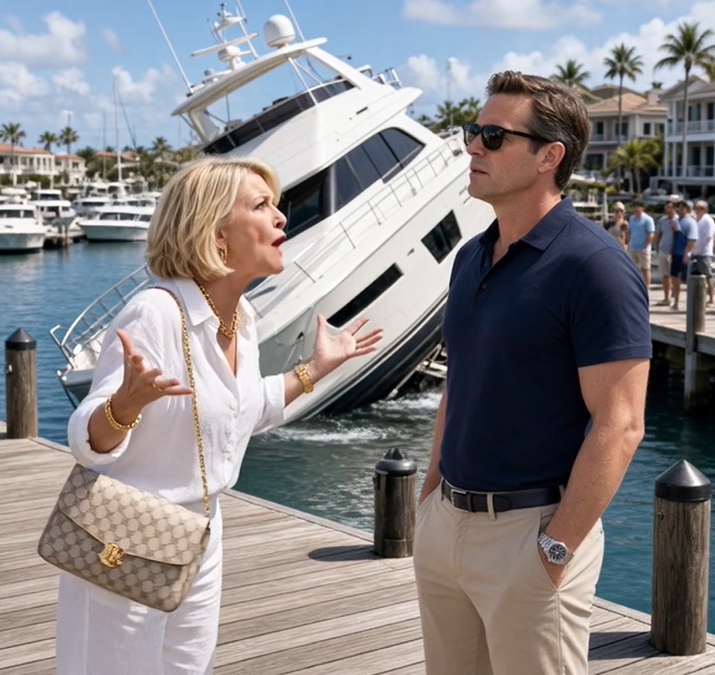
PART3:
I stared.
Behind me another pump kicked on.
“Violation of what?”
“The Baycrest vessel-size standard.”
“You touched my yacht?”
“I authorized marina enforcement.”
I remember looking at her for a long time.
Not because I had nothing to say.
Because I had too many things to say and most would not have helped.
Odyssey shifted behind me.
Luis cursed.
I turned back.
“Can we save her?”
“We’re trying.”
“What failed?”
“Port-side damage below the waterline.”
“How?”
His face changed.
“The contractor lost control during relocation.”
Relocation.
That word almost made me laugh.
“You were here?”
“No.”
“I was getting parts.”
“Mate called me.”
“Who ordered movement?”
He did not answer.
He did not need to.
Karen stepped closer.
“I did.”
I turned.
She actually looked proud.
“The marina rules allow removal of noncompliant vessels.”
“No.”
“Yes.”
“No.”
“You’ve been warned three times.”
“You sent three HOA letters.”
“Correct.”
“I’m not in your HOA.”
“The marina serves the HOA.”
“That is not the same thing.”
Her smile tightened.
“Mr. Hayes, we have had this discussion.”
“No.”
“You’ve talked.”
“I’ve told you that your rules don’t govern this berth.”
She looked toward Odyssey.
“Apparently they do.”
That was when I realized Karen did not yet understand.
Not even slightly.
She thought Baycrest owned the marina.
That assumption had probably been repeated so often no one bothered checking.
Residents called it “our marina.”
The HOA newsletter called it “Baycrest Community Marina.”
Its logo was on the gate.
The HOA managed the waiting list for residential slips.
It collected certain common-area assessments tied to marina access.
The annual July party took place there.
Karen held board meetings in the marina lounge.
From her perspective, ownership must have seemed obvious.
But Baycrest Homeowners Association did not own one square foot of dock.
It never had.
My name is Michael Hayes.
I spent twenty-two years as a naval engineer and maritime systems consultant.
I worked shipyards from Norfolk to San Diego.
Government contracts.
Commercial retrofits.
Stability calculations.
Propulsion upgrades.
Damage-control systems.
I had spent enough nights inside machinery spaces listening to pumps and alarms to know how quickly water wins when people get arrogant.
By fifty-six, I was tired.
Not physically.
Although there was some of that.
Mostly tired of urgency.
Every project was critical.
Every deadline impossible.
Every executive wanted certainty from systems built around weather, saltwater, steel fatigue, human error, and money.
My first marriage did not survive it.
That deserves honesty.
I was away too much.
Present badly when home.
Always solving something.
Always checking email.
Always thinking the next inspection mattered more than dinner.
By the time I finally stepped away from consulting, I had money.
Plenty.
And very little idea what to do with a life that no longer had a schedule attached.
Odyssey became part of the answer.
People hear fifteen-million-dollar yacht and assume vanity.
Maybe some vanity existed.
Anyone claiming complete purity around a seventy-eight-foot yacht is lying.
But Odyssey was not purchased to impress anyone.
I designed much of her.
Not from scratch.
The hull began as a high-quality semi-custom platform.
Then I spent three years changing almost everything that mattered to me.
Reinforced structural sections.
Redundant bilge systems.
Modified electrical architecture.
Custom navigation.
Quieter generators.
Long-range fuel configuration.
Teak decks.
Simple interiors.
No nightclub lighting.
No ridiculous gold fixtures.
No marble bathtub weighing half a ton.
I wanted a vessel that could sit quietly at anchor for days.
That could run safely offshore.
That felt calm.
The first morning I slept aboard after final refit, I woke before sunrise.
Made coffee.
Sat aft.
No phone.
No contract.
No one asking for a presentation.
Just water.
That was the first time in years I noticed how exhausted I had been.
Baycrest came later.
I found the marina while cruising Florida’s west coast.
The inlet was protected.
Good depth.
Strong docks.
Reasonable hurricane plan.
Fuel access.
Competent harbormaster.
The surrounding community was upscale without being entirely sterile.
At least then.
I rented a transient berth for one month.
Then two.
Eventually six.
During that time I became friends with the marina owner, Gordon Bell.
Seventy-four.
Former commercial fisherman turned marina operator.
He had built Baycrest Harbor from an old boatyard decades earlier.
Gordon hated computers.
Loved diesel engines.
Had no patience for HOA politics.
The Baycrest subdivision had been developed beside his property.
The HOA never owned the marina.
Instead, the original developer negotiated a long-term license and access agreement.
Baycrest residents received priority access to a block of slips.
The HOA maintained the boardwalk landscaping and contributed to certain capital expenses.
But Gordon’s company owned:
the basin lease,
the docks,
the marina office,
the fuel pier,
the service yard,
the parking strip,
the boat ramp,
and sixty-two slips.
Including the one where Odyssey sat.
The HOA’s relationship with the marina was contractual.
Not proprietary.
Important difference.
Three years before Karen sank my yacht, Gordon called me.
“Want to buy a headache?”
I was sitting on Odyssey drinking coffee.
“What kind?”
“Marina.”
“No.”
“Good.”
He hung up.
Called the next week.
“Still no?”
“Yes.”
“Come look at books.”
I did.
Baycrest Harbor was profitable.
Not wildly.
But stable.
Gordon wanted out.
His children had no interest.
A regional marina group had offered to buy and replace half the old staff.
He hated that.
“What does this have to do with me?”
“You know boats.”
“I don’t know hospitality.”
“You know when people are lying.”
“Sometimes.”
“You like this place.”
“I like my slip.”
“Then buy all sixty-two.”
I laughed.
He did not.
Three months later, Harbor Crest Holdings LLC purchased Baycrest Harbor Marina.
Harbor Crest Holdings was mine.
Not publicly branded.
Not connected to my personal name in marketing.
That was intentional.
I had spent enough of my life being identified by what I owned.
Gordon stayed on for a year during transition.
Luis became harbormaster.
Most residents never noticed.
The sign remained Baycrest Harbor Marina.
The HOA access agreement remained.
Bills changed account numbers.
That was all.
Karen moved into Baycrest fourteen months later.
She became HOA president within six.
The first time she saw Odyssey, I was coiling a stern line.
She walked down Pier C as though inspecting troops.
Pearl earrings.
Pastel blazer.
Clipboard.
She stopped.
“That is enormous.”
I looked up.
“She does have presence.”
Karen lowered sunglasses.
“This is a residential marina, Mr…?”
“Hayes.”
“Michael Hayes.”
She repeated it slowly.
“Mr. Hayes, Baycrest values proportion.”
“I value stability.”
She did not smile.
“Your yacht overwhelms the sightline.”
“The slip is rated for her.”
“That may be technically true.”
“It is specifically true.”
“Baycrest rules cap recreational vessels at fifty-five feet.”
“Baycrest HOA rules?”
“Yes.”
“I’m not a member.”
Her expression barely shifted.
“You berth in our marina.”
“No.”
She stared.
“You don’t?”
“I berth in Baycrest Harbor Marina.”
“That’s what I said.”
“No.”
I went back to line.
She waited.
People accustomed to deference often interpret silence as disrespect.
“Are you deliberately being difficult?”
“No.”
“Then help me understand.”
I looked at her.
“You’re HOA president.”
“Yes.”
“You control HOA property.”
“Yes.”
“This slip isn’t HOA property.”
She laughed.
Not loudly.
The kind of laugh people use when correcting a child.
“I assure you, Mr. Hayes, the marina is a Baycrest amenity.”
“It is an amenity your HOA has contractual access to.”
Her smile disappeared.
“That sounds like semantics.”
“It isn’t.”
“Who owns it?”
I considered telling her.
Then decided I did not owe a stranger my corporate structure.
“The marina operating company.”
“And you lease from them?”
“In a manner of speaking.”
That answer would come back to haunt her.
She interpreted it as yes.
From then on, in Karen’s mind, I was a wealthy renter refusing community rules.
The first violation notice arrived two days later.
BAYCREST HOMEOWNERS ASSOCIATION
MARINA COMPLIANCE NOTICE
VESSEL LENGTH EXCEEDS COMMUNITY LIMIT.
I forwarded it to Luis.
His reply:
LOL.
Then:
Want me to answer?
I said no.
I wrote:
Ms. Whitmore,
Odyssey is berthed under a private commercial marina agreement and is not subject to Baycrest HOA vessel-length restrictions.
Please direct future marina operational questions to the harbormaster.
Michael Hayes.
She responded within eleven minutes.
Mr. Hayes,
Baycrest residents expect consistent standards. Exceptions for wealthy outsiders create resentment and diminish community character.
Interesting.
Wealthy outsider.
She lived in a house valued somewhere near four million dollars.
I replied:
Your concerns regarding community standards should be directed to your board’s legal counsel, who can review the marina access agreement.
I thought that would end it.
It did not.
Karen visited Luis.
She demanded my slip agreement.
He refused.
“Private customer contract.”
“I’m HOA president.”
“Congratulations.”
Luis has a gift.
She demanded marina ownership records.
He told her property records were public.
She complained that Odyssey blocked sunset views from the community promenade.
It did not.
Pier C sat twenty degrees south of main promenade.
She complained about generator noise.
Odyssey used shore power.
She complained about crew parking.
I had one crew member and allocated spaces.
She complained about “commercial appearance.”
It was a yacht.
Eventually she invented safety.
That always happens.
People struggling to enforce preference often discover the word safety.
A large vessel, she wrote, could create evacuation hazards during hurricanes.
Luis responded with our hurricane plan, which included Odyssey moving before named storm conditions required clearing.
Then wake concerns.
Odyssey sat tied.
Then fire load.
Coast Guard documentation current.
Then emergency access.
Pier rated.
Every accusation answered.
She became angrier.
I became bored.
That was mistake.
Not because I should have surrendered.
Because I underestimated how dangerous boredom can be around a person who treats resistance as personal insult.
Karen began photographing Odyssey.
At dawn.
At night.
From the fuel dock.
From adjacent boats.
One crew member found her aboard the finger pier measuring beam clearance.
Luis issued written notice that HOA officers had no authority to access restricted service zones without permission.
Karen called him insolent.
He framed the email.
Then she held a board meeting.
I learned afterward from a Baycrest homeowner named Grace Porter.
Grace was sixty-nine, retired judge, lived two houses from marina, and had the rare ability to dislike nonsense regardless of who produced it.
She stopped me near bait shop.
“Karen is trying to rewrite marina rules.”
“She can try.”
“She thinks the HOA can vote itself ownership.”
“That would be efficient.”
Grace smiled.
“I told her to read the license.”
“Did she?”
“She said the document is outdated.”
Of course.
The access agreement was twenty-seven years old.
Still valid.
Automatically renewed every five years unless terminated according to specific clauses.
One clause mattered more than others.
The HOA could not interfere with marina operations, marina customers, vessel management, commercial contracts, or property belonging to non-HOA berth holders.
A material intentional breach, after notice, allowed the marina owner to suspend certain preferential privileges pending cure.
Not residences.
Not access to homes.
Marina privileges.
Slip priority.
Clubhouse dock use.
Guest launch rights.
Karen had not read that far.
Or she had and assumed nobody would enforce.
I asked Grace:
“What did board do?”
“Tabled it.”
“Good.”
“Karen did not seem to understand tabled means no.”
I should have paid more attention to that sentence.
A week later, a second notice appeared physically taped to Odyssey’s boarding gate.
FINAL MARINA ENFORCEMENT NOTICE.
REMOVE OR RELOCATE VESSEL WITHIN 72 HOURS.
I called Luis.
“Did you authorize this?”
“No.”
“Any marina staff?”
“No.”
I took photos.
Removed paper.
Sent Karen certified letter.
Not email.
Formal.
Ms. Whitmore:
Neither Baycrest HOA nor its officers possess authority to relocate, board, tow, modify, secure, detach, or otherwise interfere with Odyssey.
Any unauthorized physical interference with the vessel or its mooring arrangements will be treated as trespass and property damage and referred to appropriate authorities.
Please direct legal questions to Harbor Crest Holdings.
That name appeared for first time.
She could have searched it.
She did not.
Instead she responded through HOA attorney.
The attorney’s letter was surprisingly careful.
It did not claim ownership.
It said the HOA “reserved all rights.”
Lawyer language for:
My client wants something I am not prepared to promise she can legally do.
I sent it to my counsel, Andrea Sloan.
Maritime and commercial-property attorney in Tampa.
She read access agreement.
“Karen doesn’t have a leg.”
“I know.”
“Then why are you calling?”
“Because people without legs still kick sometimes.”
Andrea laughed.
“Document.”
“I am.”
“Tell Luis nobody moves vessel without written authorization from you or captain.”
“Already policy.”
“Good.”
Then life distracted me.
I had planned a five-day trip aboard Odyssey.
Cancelled due to a hydraulic issue.
A technician needed parts.
Luis and I met in marina office on Tuesday afternoon.
At 4:18, Captain Mendoza left for service supplier.
At 4:31, Karen arrived with a marine towing contractor.
We learned later from camera footage.
Two men.
Small commercial workboat.
A subcontractor Karen had used before to move HOA residents’ boats during dock maintenance.
She showed them paperwork.
What paperwork?
An HOA “emergency relocation authorization” bearing her signature.
Why emergency?
Odyssey allegedly exceeded berth dimensions and presented “navigation obstruction.”
The contractor should have verified with marina office.
He did not.
That became his problem.
Karen apparently told him marina management had refused to cooperate and board had superior authority under community covenants.
He believed her.
Or wanted job.
Cameras showed Luis’s assistant, nineteen-year-old dockhand named Javier, approach.
He told them not to touch Odyssey.
Karen overruled him.
On video she said:
“You work for us.”
He replied:
“No, ma’am. I work for marina.”
She said:
“Same thing.”
Those two words eventually cost the HOA a great deal.
Same thing.
They were not.
Javier called Luis.
No answer because Luis was with me in office storage room with terrible reception.
Then he called security.
Before security reached Pier C, contractor began moving Odyssey.
I will not describe technical sequence in operational detail because what matters is simple:
A seventy-eight-foot vessel requires qualified planning, proper crew, and controlled handling.
They had none.
They disconnected lines and attempted an unauthorized repositioning without Odyssey’s captain aboard.
Wind was light.
Current moderate.
Still enough.
Something went wrong near adjacent service structure.
Odyssey struck hard.
Damage opened below waterline on port side.
By the time they got vessel back against dock, flooding exceeded onboard automatic pump capacity.
Javier hit high-water alarms and called emergency response.
Karen apparently still believed problem was cosmetic.
Camera audio picked her saying:
“Once she’s moved, this will all calm down.”
Fourteen minutes later the engine-room flooding alarm sounded continuously.
That was about when I walked outside.
Now Karen stood in front of me while Odyssey settled.
I said:
“Who authorized you to touch her?”
“The HOA.”
“Name.”
“I am president.”
“That isn’t an answer.”
She lifted chin.
“The board delegated marina compliance to my office.”
“Show me vote.”
“This is not the time.”
“No.”
I pointed at sinking yacht.
“This is exactly the time.”
Luis shouted from stern:
“Michael!”
I left her.
For next ninety minutes, nothing mattered except keeping Odyssey afloat and preventing pollution.
Fire-rescue marine unit arrived.
Commercial salvage pumps.
Containment boom.
Tow assistance.
We stabilized her enough to prevent complete sinking, but not enough to avoid extensive flooding.
Engine spaces.
Electrical compartments.
Lower guest cabins.
Water entered.
Saltwater.
The enemy of everything expensive.
By darkness, Odyssey sat partially submerged against pier with heavy list.
Fifteen million dollars was original project value.
Repair figure would come later.
For that night, she looked dead.
Karen finally stopped smiling.
Police came.
Florida Fish and Wildlife officers.
Local marine patrol.
Statements.
Cameras.
The towing contractor’s supervisor arrived.
He took one look at Odyssey.
Then at his two employees.
Then at Karen.
“You told them marina authorized.”
Karen’s eyes flashed.
“The HOA did authorize.”
“That’s not what I asked.”
“We control this marina.”
Luis laughed.
Not humor.
A single exhausted sound.
“No, ma’am.”
Karen turned.
“I am getting tired of your attitude.”
Luis looked at me.
Then back.
“Would you like to tell her?”
I had been delaying it.
Partly because emergency.
Partly because I wanted official statements finished before Karen adjusted story.
But everyone had heard enough.
I said:
“Karen.”
She turned.
“Baycrest HOA does not own this marina.”
“We’ve established you dispute—”
“No.”
I pointed at dock beneath us.
“I own it.”
Silence.
Real silence.
Even the contractor stopped talking.
Karen blinked.
“What?”
“I own Baycrest Harbor.”
“You rent a slip.”
“No.”
“Harbor Crest Holdings owns marina.”
“Yes.”
“And I own Harbor Crest Holdings.”
Her mouth opened.
Nothing.
I continued:
“The dock you are standing on is mine.”
“The slip agreement for Odyssey is with my company.”
“The marina employees you’ve been ordering around work for my company.”
“The fuel pier is mine.”
“The service yard is mine.”
“Every commercial berth is mine.”
“The HOA has a license.”
“Nothing more.”
Karen looked at Luis.
He nodded.
“All true.”
She recovered faster than most people would.
That is one thing I will give her.
“This is a conflict of interest.”
I almost admired audacity.
“For whom?”
“You’ve hidden ownership while using marina against residents.”
“I haven’t used anything against residents.”
“You allowed yourself an oversized yacht.”
“In a commercial berth designated for vessels up to eighty-five feet.”
“Baycrest limit is fifty-five.”
“For HOA-priority residential slips.”
She stopped.
Grace Porter had arrived behind police line.
She spoke:
“I told you.”
Karen turned.
Grace crossed arms.
“I told you to read the agreement.”
“You stay out of this.”
Grace smiled.
“I live here.”
That evening, Andrea Sloan arrived from Tampa.
She came carrying a legal pad and the expression of someone who had just been handed both a nightmare and an excellent case.
“Michael.”
“Andrea.”
She looked at Odyssey.
“Oh.”
“Yes.”
Then Karen.
“You’re Ms. Whitmore?”
“I am.”
“I represent Harbor Crest Holdings and Mr. Hayes personally.”
Karen began:
“The HOA acted under—”
Andrea raised one finger.
“I strongly suggest you stop talking until your attorney arrives.”
Rare good advice.
Karen did not take it.
She almost never did.
“I have authority under Baycrest covenants.”
Andrea said:
“You have authority over HOA members subject to covenants.”
“Mr. Hayes is not one.”
“He uses our marina.”
“No.”
Andrea’s tone sharpened.
“He uses his marina.”
Karen looked around as though reality might change if enough people witnessed her disbelief.
Then she said:
“The marina exists for Baycrest.”
Luis muttered:
“The sun exists for Baycrest too, apparently.”
I gave him look.
He stopped.
The HOA attorney arrived twenty minutes later.
David Rosen.
Forties.
Professional.
He saw Karen.
Saw Andrea.
Saw Odyssey.
Then asked:
“What happened?”
Karen answered:
“I enforced vessel compliance.”
Rosen closed his eyes.
Just briefly.
Then:
“Karen, did the board vote to authorize physical removal?”
“We delegated enforcement.”
“That is not what I asked.”
“I had emergency authority.”
“Under what section?”
She named general nuisance clause.
He looked toward water.
Then at me.
“Mr. Hayes.”
I nodded.
“Could I see marina access agreement?”
Andrea handed him copy.
He read first page.
Ownership.
His face changed.
Then interference clause.
Then termination provisions.
He looked at Karen.
“Did you read this?”
“I have reviewed marina agreement.”
“All of it?”
She bristled.
“David.”
“Did you?”
“No one told me Hayes owned Harbor Crest.”
“That’s not relevant to your authority.”
Important sentence.
Rosen understood.
Even if I were anonymous renter, she still lacked permission.
Ownership reveal made irony larger.
It did not create the violation.
Karen had overreached either way.
Rosen asked contractor:
“Who hired you?”
The supervisor pointed at Karen.
“In writing?”
“Yes.”
“Do you have it?”
“Yes.”
He handed tablet.
There it was.
Baycrest HOA letterhead.
Signed:
Karen Whitmore
President
AUTHORIZE IMMEDIATE RELOCATION OF NONCOMPLIANT VESSEL “ODYSSEY.”
Responsibility accepted by association for enforcement action performed in good faith.
Andrea read.
Then looked at me.
Very slightly.
That look meant:
Do not smile.
I did not.
The HOA’s insurer was notified before midnight.
So was my marine insurer.
So were environmental authorities due fuel contamination.
Odyssey remained afloat only because salvage crew worked through night.
By 3:00 a.m., temporary patch reduced ingress.
By dawn, pumps had lowered interior water enough for controlled stabilization.
The vessel would survive.
But surviving and being economically undamaged are different things.
Saltwater had reached systems that cost more than houses.
Electrical.
Navigation.
Generators.
Climate systems.
Interior joinery.
Machinery.
Custom components.
The preliminary loss estimate crossed seven figures almost immediately.
Then eight.
Karen left marina around one in morning.
Not arrested.
That disappoints people when I tell story.
Property disputes are not movies.
Police documented.
Marine authorities investigated.
The contractor’s role required review.
Insurance.
Civil liability.
Potential criminal questions around unauthorized entry and damage.
But nobody slapped handcuffs on Karen beside sinking yacht.
Consequences came slower.
And more thoroughly.
At 7:10 the next morning, Baycrest HOA board convened emergency session in clubhouse.
Grace called me.
“You coming?”
“No.”
“You own clubhouse dock.”
“Still no.”
“I think you should hear this.”
“Andrea says no.”
“Your lawyer is smart.”
“Yes.”
“Annoying.”
Also yes.
I did not attend.
Andrea did.
As marina owner’s counsel.
Karen opened meeting apparently declaring accident “unfortunate but necessary result of long-standing noncompliance.”
That lasted until Rosen placed agreement on projector.
Ownership:
Baycrest Harbor Marina owned by Harbor Crest Holdings LLC.
HOA rights:
Priority licensing of specified slips.
Resident access.
Use of designated boardwalk and community dock.
No ownership interest.
No operational authority.
No authority over non-HOA commercial slips.
No right to interfere with nonmember vessels.
Then clause 14.
Material interference.
Intentional unauthorized action by HOA officers affecting marina operations or customer property constituted material breach.
Harbor Crest could suspend preferential marina privileges after notice and opportunity to cure.
Karen said:
“They can’t do that.”
Rosen replied:
“They absolutely can.”
“What does suspend mean?”
Grace later told me room went quiet.
Rosen read.
Preferred slip allocations could be withdrawn.
Discounted resident rates suspended.
Guest-dock privileges restricted.
HOA event use suspended.
Certain parking rights renegotiated.
The marina itself would remain open commercially.
Residents would not be trapped or denied lawful access.
But the perks they had assumed were permanent could disappear.
Karen had risked benefits used by almost every waterfront homeowner.
One board member asked:
“For one yacht?”
Rosen said:
“For unauthorized physical interference resulting in catastrophic damage to property.”
Different framing.
Then another board member:
“Who authorized her?”
Silence.
Karen said:
“I did what this board elected me to do.”
Grace:
“We elected you to administer covenants.”
“Not commandeer vessels.”
That phrase made local news.
By 9:30 board voted six to one to suspend Karen’s authority pending investigation.
The one vote against?
Karen.
There is something almost admirable about consistency.
At 10:00 Andrea sent formal notice of breach to HOA.
Not termination.
I did not want to punish fifty-nine families for one woman’s decision.
The notice required cure:
Remove Karen from marina-related authority.
Acknowledge HOA jurisdiction limits.
Pay or insure against damages attributable to its action.
Cover emergency response costs.
Issue written notice to residents clarifying marina ownership and rules.
Review governance.
No retaliation.
No drama.
Contract.
Grace called.
“You’re not kicking us out?”
“No.”
“Karen told people you’d evict every boat.”
“I have no interest.”
“She says this proves you planned takeover.”
“I already own it.”
Grace laughed so hard she had to hang up.
That afternoon Karen held an impromptu press conference.
Not official.
Two local reporters.
She stood outside Baycrest sign and described herself as “a volunteer community leader being targeted by a billionaire marina owner.”
I am not a billionaire.
Not even close.
Details.
She said Odyssey violated community standards.
She said I concealed ownership to entrap HOA.
That allegation became popular among residents who disliked me.
Until documents surfaced.
The marina acquisition had been recorded publicly three years earlier.
HOA received formal ownership-change notice.
Its management company acknowledged.
The board minutes referenced Harbor Crest six times.
Karen had inherited all records when she became president.
She had simply not read them.
That became pattern.
Not conspiracy.
Negligence with confidence.
The contractor’s insurer began fighting HOA insurer.
HOA insurer argued Karen acted outside scope.
Karen argued broad authority.
Contractor argued negligent misrepresentation.
My insurer paid salvage and began subrogation.
Andrea described it:
“Everybody is pointing at everyone else, which is excellent for billable hours and terrible for civilization.”
Meanwhile I focused on Odyssey.
We hauled her.
Seeing her out of water hurt more than watching sinking.
A boat in water belongs.
A damaged yacht on travel lift looks exposed.
The port-side breach was ugly.
Hull damage repairable.
Systems worse.
Saltwater corrosion begins before emotions settle.
Every compartment opened.
Wiring tagged.
Components removed.
Cabinetry stripped.
Teak sections lifted.
Odyssey looked gutted.
Luis stood beside me.
“I’m sorry.”
“For what?”
“I wasn’t here.”
“You were doing your job.”
“I should’ve answered Javier.”
“You were in concrete office with no signal.”
“I should’ve—”
“No.”
I understood guilt.
Engineering teaches root cause.
People prefer one.
Real failures usually chains.
Karen overreach.
Contractor failure to verify authority.
Poor communications.
Javier lacked escalation contact.
Security response delay.
My assumption no one would be reckless enough.
Several links.
We fixed ours.
Marina introduced strict vessel-movement authorization protocol.
No external contractor touches customer boat without marina verification.
After-hours escalation.
Digital approval.
Staff training.
Karen created expensive lesson.
We made sure not to waste it.
Two weeks later, marine investigation report concluded contractor movement caused collision and hull damage.
It did not assign final legal liability.
Courts and insurers handle that.
But facts mattered.
Karen could no longer call sinking spontaneous mechanical failure.
Camera footage.
Contractor records.
Her signed authorization.
All existed.
Then came another problem.
Odyssey was technically fifteen-million-dollar asset.
Local news loved number.
“$15 MILLION YACHT SINKS IN HOA DISPUTE.”
The story went national online.
Every version worse.
Some claimed Karen drilled holes.
False.
Some said she cut mooring lines intentionally to sink it.
False.
Some said I bought whole neighborhood the next morning.
False.
One video claimed I “evicted Karen into the ocean.”
I almost admired creativity.
I told Andrea:
“Can we stop internet?”
“No.”
“Thought lawyers could do anything.”
“We mostly send PDFs.”
Fair.
I issued one statement:
Odyssey was damaged during an unauthorized relocation initiated by an HOA officer who lacked authority over the vessel. The marina remains open. We are cooperating with investigators and insurers. No Baycrest resident is being displaced from a slip as retaliation.
Boring.
Correct.
Then I stopped talking.
Karen did not.
She went on local radio.
Said marina ownership gave me “unfair monopoly power.”
A host asked:
“Did you know Hayes owned marina before ordering yacht moved?”
“No.”
“Would it have changed your decision?”
Karen hesitated.
Then:
“No.”
That sentence was played approximately one million times.
Because it destroyed her best defense.
If she had said:
Yes, I misunderstood ownership.
Then maybe negligence.
Instead she admitted ownership would not have mattered.
She believed HOA authority superseded actual owner.
That was core.
Baycrest residents turned.
Not all at once.
People rarely do.
But insurance assessment rumors started.
If HOA insurer denied coverage, residents feared special assessment.
Now Karen’s abstract crusade had dollar amount attached to their mailboxes.
Moral clarity often arrives alongside invoices.
At emergency membership meeting, more than two hundred people packed clubhouse.
Karen defended herself for forty minutes.
Grace waited.
Then stood.
She had practiced law thirty-four years.
Did not need microphone.
“Karen.”
Room quieted.
“You have repeatedly said Michael Hayes hid ownership.”
“Yes.”
“Assume he did.”
Karen blinked.
“What?”
“Assume Mr. Hayes never told you anything.”
“Assume Harbor Crest ownership required ten minutes of public-record research.”
“Assume every marina employee was rude.”
“Assume the yacht offended you.”
Grace paused.
“Which of those facts gave you permission to board or move property belonging to someone else?”
No answer.
“That is the whole case.”
Karen looked around.
“Community standards—”
“Do not answer a property question with aesthetics.”
Applause.
Grace continued:
“You did not sink a yacht because it was too large.”
“You caused an unauthorized vessel relocation because you believed your title made permission unnecessary.”
“That is not governance.”
“That is entitlement.”
Karen’s face went red.
“I was protecting Baycrest.”
A man in back yelled:
“From sunsets?”
Laughter.
Meeting was over emotionally before vote.
Membership recalled Karen as president.
Eighty-seven percent.
She retained her home.
Of course.
HOA cannot erase property ownership because neighbors dislike president.
She became resident.
Nothing more.
Her replacement was Grace.
Grace protested.
Naturally that is why people wanted her.
First act:
She came to marina office.
No clipboard.
No blazer.
Coffee.
“I hate you.”
“Why?”
“You made me president.”
“I didn’t vote.”
“Your yacht did.”
She handed formal apology.
On behalf of HOA.
No admission beyond counsel-approved language.
Still meaningful.
Then:
“What do we do about agreement?”
“We cure breach.”
“Residents keep slips?”
“If cure.”
“Discount rates?”
“Yes.”
“Guest dock?”
“Yes.”
“Community event?”
“We’ll discuss.”
She stared.
“You’re being reasonable.”
“Sorry.”
“That ruins story.”
“I know.”
We amended agreement.
Clearer signs.
Clearer ownership.
Clearer authority.
The sign at marina entrance changed subtly.
BAYCREST HARBOR MARINA
A HARBOR CREST PROPERTY
Resident access available pursuant to Baycrest HOA agreement.
Nobody could say they didn’t know.
The financial case took almost two years.
Odyssey repairs took eleven months.
Replacement cost for damaged systems substantial.
Some custom components no longer manufactured.
We upgraded.
Not because I wanted.
Because restoration sometimes means building differently.
The yacht came back.
Not identical.
Close.
New port-side section.
Updated electrical distribution.
Modernized navigation.
Rebuilt interiors.
One cabin changed entirely because original millwork could not be matched.
That bothered me more than expected.
Objects accumulate memory.
Even boats.
The first night aboard after return, I sat aft with coffee.
Same inlet.
Same gulls.
Same sunset.
No champagne.
Never liked it much.
Luis joined.
“She feels good.”
“Yes.”
“Better?”
I thought.
“No.”
He looked.
“Different.”
He nodded.
Correct.
Repair is not rewind.
People understand that with grief.
Less with objects.
Odyssey had survived but carried new steel.
New wiring.
New story.
I did too.
Karen’s personal liability settled eventually.
HOA insurer covered part under reservation.
Contractor insurer another.
Karen herself contributed under confidential settlement.
I will not invent amount.
It was enough to matter.
Nobody went bankrupt publicly.
No mansion seized.
No dramatic prison sentence.
Reality did not need that.
Karen lost position.
Legal costs.
Reputation.
And the certainty that her interpretation of authority was reality.
That was substantial.
The contractor changed procedures.
Good.
HOA changed governance.
Good.
Marina became clearer.
Good.
The outcome I wanted was not Karen destroyed.
It was no one ever ordering another customer’s vessel moved because a clipboard made them feel powerful.
That changed.
For a while, Karen avoided marina.
Then one morning, maybe eighteen months later, I saw her on boardwalk.
No pearls.
Running clothes.
She stopped.
I expected nothing.
“Michael.”
“Karen.”
Long pause.
She looked toward Odyssey.
“I’m glad she was repaired.”
I said:
“So am I.”
Another pause.
“I should not have authorized the move.”
There it was.
Not full apology.
But fact.
“No.”
“I believed…”
She stopped.
Then tried again.
“I believed the board had more authority than it did.”
“Yes.”
“You could have told me you owned marina.”
I almost laughed.
Instead:
“You did not need to know.”
She frowned.
“What?”
“You didn’t need to know I owned it to know you couldn’t touch my boat.”
Silence.
“That was the mistake.”
Not ownership.
Consent.
Her expression changed.
Very slightly.
“You’re right.”
I did not expect that.
Then she walked away.
No reconciliation.
No friendship.
Enough.
Grace later heard.
“How?”
“Marina gossip.”
“Of course.”
“She admitted?”
“Mostly.”
Grace nodded.
“Growth.”
“Maybe.”
“Don’t ruin it.”
Life settled.
Baycrest continued.
Marina parties.
Fishing tournaments.
Storm preparations.
Boats came and went.
Odyssey traveled.
Keys.
Bahamas.
Charleston.
One long trip through Chesapeake.
I sold her? Not yet.
Not then.
For several years she remained the place where I could disappear without being lonely.
That distinction matters.
Eventually my daughter Elena asked:
“Dad, why did you never tell the HOA you owned marina?”
“I told their lawyer to review agreement.”
“No, why not just say, ‘I own the place’?”
I thought.
Because title should not be argument.
Because rights should apply regardless of status.
Because wealthy people already use ownership as shortcut too often.
Finally:
“Because I didn’t want obedience based on who I was.”
She looked.
“I wanted them to respect boundary.”
“That’s annoyingly principled.”
“Thank you.”
“I meant annoying.”
“I know.”
She asked:
“Did you enjoy reveal?”
“Yes.”
We both laughed.
I am not a saint.
The moment Karen’s face changed when I said “I own it” was satisfying.
Very.
But satisfaction is not same as reason.
If I had been renter, her actions still wrong.
That became my favorite correction whenever people told story.
“She sank owner’s yacht and discovered he owned marina!”
“Yes.”
“But don’t miss point.”
“What?”
“She shouldn’t have moved anyone’s yacht.”
That is lesson.
Do not wait for hidden billionaire.
Do not treat janitor differently from CEO.
Do not respect property only after learning owner has more power than you.
Rights are boring that way.
They should apply before reveal.
Baycrest began annual governance training after Karen.
Grace insisted.
Board members hated.
Good.
Topics:
Covenant authority.
Property boundaries.
Marina agreement.
Emergency powers.
Records.
Conflict of interest.
Due process.
What HOA can do.
More importantly:
What it cannot.
I taught one marina section.
A board member joked:
“Are we allowed to move boats?”
“No.”
Everyone laughed.
I didn’t.
Then explained actual emergency exceptions through marina staff.
Fire.
Storm.
Immediate hazard.
Qualified authority.
Documented.
Not “I dislike sightline.”
They listened.
One slide simply said:
AESTHETIC DISAGREEMENT IS NOT AN EMERGENCY.
Grace framed it.
The marina also changed visually.
I replaced some aging docks.
Improved pump-out system.
Added shade.
Better storm cleats.
Karen had once accused Odyssey of overwhelming sightline.
Now Pier C had mixed vessel sizes.
Thirty feet.
Forty.
Sixty.
Eighty.
Commercial rules based on engineering capacity.
Not visual proportion.
Some residents hated larger yachts.
They were allowed.
Dislike is not jurisdiction.
Others loved them.
Children came watch.
One boy asked how a boat floats.
I spent twenty minutes explaining displacement with an orange and bucket.
His mother apologized.
I said never apologize for engineering question.
Maybe that became most useful thing to come from whole mess.
Harbor Crest started youth marine systems scholarship.
Not Karen-related.
At least I told myself.
We funded vocational training.
Marine mechanics.
Electrical.
Fiberglass.
Welding.
The people who repair fifteen-million-dollar yachts often learned skills at community colleges, not yacht clubs.
That deserved investment.
Javier, the dockhand who tried to stop unauthorized move, became assistant harbormaster.
Then harbormaster when Luis retired.
I promoted him partly because he spoke up while someone with authority costume told him he was wrong.
That quality matters.
At retirement dinner Luis said:
“Karen did one thing right.”
Everyone went quiet.
“She proved Javier had a spine.”
Laughter.
Javier turned red.
Grace raised glass.
“To unauthorized personnel.”
We laughed.
That is what communities do with old pain when healthy.
Not forget.
Integrate.
The dock section where Odyssey sank was replaced.
A little plaque appeared one morning.
I did not authorize.
ODYSSEY PIER
MAXIMUM HOA AUTHORITY: 0 FEET
I removed it.
Grace put it back.
I removed.
It returned.
Eventually I gave up.
Marina traditions are stronger than ownership.
People ask why I did not terminate HOA license immediately.
Because retaliation against innocent residents would have repeated Karen’s mistake.
Power existed.
Use still needed justification.
The contract allowed suspension.
That did not mean maximum suspension wise.
I wanted cure.
Got cure.
That was enough.
This mattered to me because throughout career I watched people confuse capability with necessity.
Can we build it?
Should we?
Can we enforce it?
Should we?
Can I cancel sixty slip priorities?
Yes.
Should I because one officer acted recklessly?
No.
Authority should be proportional.
That is the exact principle Karen violated.
Do not become opponent in opposite jersey.
Grace appreciated.
She still called me stubborn capitalist pirate.
I called her retired tyrant.
Healthy friendship.
Years later, a hurricane threatened coast.
Serious one.
Baycrest prepared.
Every vessel moved according plan.
Odyssey left early.
Karen—still resident—helped elderly neighbor secure shutters.
People can be more than worst event.
Storm turned south.
Baycrest spared.
Afterward Karen emailed marina:
Thank you for clear procedures.
I stared.
Forwarded to Grace.
Subject:
MIRACLE.
Grace replied:
DO NOT SCARE HER OFF.
Maybe people learn.
Maybe not permanently.
But sometimes.
Odyssey eventually became too much yacht for my life.
Not financially.
Emotionally.
I wanted smaller crew.
Simpler.
More anchoring in shallow bays.
I sold her eight years after incident.
Buyer was family from Boston.
First question:
“Is this the yacht an HOA sank?”
I sighed.
“Yes.”
“That story is why my wife wanted to see it.”
Of course.
I walked them through repairs.
Documentation.
Surveys.
Every replaced system.
No hiding.
The husband asked:
“Any structural concern?”
“No.”
We had years of inspections.
He nodded.
“Then she has history.”
“Yes.”
That is what old vessels become.
Layers.
I sold below? Not necessary.
The day Odyssey left Baycrest under new ownership, I stood on Pier C.
She backed cleanly.
Turned.
Engines low.
Sun on stainless.
No list.
No pumps.
No broken teak.
Healthy.
I expected sadness.
Felt gratitude.
Then relief.
Objects can finish jobs too.
She had given me peace when I needed.
Then conflict I did not ask for.
Then perspective.
I bought a forty-six-foot trawler later.
Grace saw.
“HOA approved.”
“Get off my dock.”
She laughed.
I named it Quietly.
Elena hated.
“Dad, that’s terrible.”
“Perfect.”
“People will think you’re making point.”
“I am always making point.”
True.
Karen walked by the week Quietly arrived.
Stopped.
“Much more proportional.”
I stared.
She smiled.
Actually smiled.
I laughed.
That was closure.
Baycrest changed hands eventually? I still owned marina longer. Maybe sold later to employee group.
When I turned seventy, I sold majority stake in Harbor Crest to employee-led partnership.
Javier.
Two investors.
Local family.
I retained small interest for transition.
Why not corporate chain?
Because Gordon trusted me not to erase place.
I wanted same.
Sale agreement preserved HOA access.
Clear authority.
Staff.
Environmental commitments.
No secret reveal possible next time.
Ownership sign obvious.
Good.
The story remained.
Every new employee heard exaggerated version.
“Karen blew up yacht.”
No.
“She sank it with crane.”
No.
“Michael bought marina the next day for revenge.”
Absolutely no.
I corrected.
They ignored.
Humans prefer mythology.
I told training classes true sequence.
Existing marina owner.
HOA president.
Unauthorized relocation.
Collision.
Flooding.
Insurance.
Governance failure.
That version more useful.
Because it can happen.
Not yacht specifically.
But pattern.
Somebody in role assumes adjacent authority.
Nobody challenges.
Vendor trusts title.
Damage.
Organizations need verification at boundaries.
That is systems lesson.
The bigger and more expensive the property, the more obvious.
But same applies to someone’s bicycle.
Car.
Parking spot.
Backyard.
A title on committee does not create ownership.
Karen’s biggest mistake was not disliking my yacht.
She was allowed.
Plenty did.
It was huge.
Her mistake was deciding dislike plus title equaled control.
That equation causes endless human conflict.
HOAs get attention because they make it visible.
But corporations do it.
Governments can.
Families.
Managers.
Anyone.
Authority has scope.
Healthy systems label scope.
After Karen, Baycrest did.
The original fifty-five-foot rule remained.
For HOA priority slips.
Where contract allowed.
People kept asking:
“Why not abolish it?”
Because it served purpose.
Those slips were smaller.
Turning basin limitations.
Safety.
Engineering.
Karen had taken legitimate rule and extended it outside boundary.
That does not make rule bad.
Important nuance.
Overreach does not invalidate all governance.
It makes boundary enforcement essential.
I kept original notice:
FINAL MARINA ENFORCEMENT NOTICE.
Taped to office wall for years.
Javier wrote beneath:
CHECK WHO OWNS MARINA FIRST.
I later crossed out.
Wrote:
CHECK WHETHER YOU HAVE AUTHORITY FIRST.
That is better.
Ownership reveal is entertaining.
Authority analysis is truth.
One afternoon a young board member asked:
“What if Karen had discovered you owned marina before?”
“Maybe she would’ve backed off.”
“So reveal could’ve prevented damage.”
“Yes.”
“Do you regret not telling?”
Fair question.
I thought long.
“A little.”
He looked surprised.
“I didn’t owe her.”
“But avoiding catastrophe matters more than proving principle.”
Could I have prevented?
Maybe.
If I had said at first:
Karen, I own marina.
Would her ego have changed direction?
Probably.
Would she have respected other nonmember renter?
Maybe not.
But Odyssey might not sink.
Being legally right does not mean every communication choice optimal.
That humility took years.
I added:
“Still, responsibility for touching boat without permission is hers.”
“Both can be true.”
That sentence became common in my older age.
Two things can be true.
Karen overreached.
I could have disclosed sooner.
Contractor failed verification.
Marina could have had stronger vendor-control systems.
HOA governance weak.
Insurance structures confusing.
No single cause.
System failure.
Naval engineering again.
Accidents happen through chains.
Break one link.
Prevent.
We changed links.
Good.
The fifteen-million-dollar number faded over time.
People asked:
“Was it really worth fifteen?”
“Yes.”
“Did you recover full?”
Confidential.
“Did you profit?”
No.
Insurance does not reimburse disruption, time, identity.
And I did not want profit.
I wanted boat restored.
That happened.
The emotional value impossible.
You cannot insure peace.
When Odyssey went down, I felt not simply property loss.
I felt someone had invaded retirement I built after difficult career.
That anger burned hotter than money.
Karen was trying to impose another system of demands on place I had chosen specifically to escape them.
That is why I nearly lost temper.
But engineering saves me sometimes.
When water enters hull, emotion waits.
Shut systems.
Find ingress.
Control flooding.
Stabilize.
Then argue.
Life could use more damage-control training.
Stop leak first.
Blame later.
At seventy-two, I gave a talk at maritime college.
Title:
AUTHORITY, ASSUMPTIONS, AND A VERY EXPENSIVE HOLE IN A BOAT.
Students loved yacht story.
I made them map failure chain.
Karen signs.
Contractor accepts.
Verification missing.
Marina contact failure.
Security delay.
Collision.
Ingress.
Pump capacity exceeded.
Then asked:
“Where would you intervene?”
They gave answers.
Better vendor protocol.
Physical lockouts.
Clear signage.
Authority database.
Emergency contacts.
I nodded.
“That is engineering.”
Not revenge.
Find point where system could have prevented.
One student asked:
“Would you sue Karen personally?”
“I did pursue lawful claims.”
“Was it satisfying?”
“Less than you think.”
“Why?”
“Litigation is mostly emails.”
Room laughed.
True.
Justice often administrative.
Depositions.
Invoices.
Mediation.
Not dramatic.
The best part was Odyssey floating again.
Not settlement.
Baycrest still looks beautiful at sunset.
Palm trees.
Pelicans.
Lights.
Families walking.
The brochure once said coastal harmony.
Maybe marketing people accidentally predicted future.
Harmony is not absence of rules.
It is different parts knowing their range.
A dock.
A home.
An HOA.
A marina.
A yacht.
An owner.
A board.
Each with space.
Karen tried conducting whole orchestra because she held clipboard.
She learned not every instrument belonged to her.
Years after, Grace retired as HOA president.
They held dinner.
Karen attended.
I did too.
That surprised some.
Grace gave speech:
“Baycrest survived because eventually we learned the difference between managing shared property and trying to manage everyone.”
She looked at me.
“And because Michael only threatened to revoke our marina privileges once.”
“I did not threaten.”
“Lawyer did.”
Andrea yelled from table:
“I notified.”
Laughter.
Karen laughed too.
That moment mattered.
Not because everyone became friends.
Because old conflict no longer commanded room.
After dinner, Karen approached.
“You know what I hated most?”
“What?”
“That stupid yacht.”
I laughed.
“I know.”
“It blocked my sunset.”
“It blocked maybe seven degrees.”
“Seven important degrees.”
“Tragic.”
She smiled.
Then serious.
“I really thought marina was ours.”
“I know.”
“That seems insane now.”
“Yes.”
She looked toward water.
“I had been president six months and everyone kept saying ‘our marina.’”
“No one corrected.”
“Grace did.”
“She often does.”
Karen nodded.
“I heard what I wanted.”
There it was.
The entire story.
People often do not lack information.
They filter it.
Titles amplify filter.
When everyone around you stops challenging, confidence hardens into reality.
That is why boards need dissent.
Procedures.
Records.
Annoying lawyers.
Even people like Grace.
Especially Grace.
Karen said:
“I am sorry.”
Full sentence.
Years late.
Still.
“Thank you.”
I accepted.
No hug.
No absolution speech.
Enough.
We stood looking at water.
Quietly—not boat—was tied at smaller slip.
Karen pointed.
“I like that one.”
“Because you can see around it?”
“Exactly.”
Fair.
The plaque prank at Odyssey Pier eventually disappeared during dock replacement.
Good.
Stories do not need permanent jokes.
Ownership sign remained.
Clear.
Boring.
Useful.
If I have learned anything, it is that boring clarity prevents expensive drama.
People online still tell version:
HOA Karen sinks fifteen-million yacht and finds out victim owns entire marina.
I do not correct every time.
Headline works.
But if someone asks me what actually mattered, I tell them:
She did not need to know who I was.
She needed to know what she was allowed to do.
That is whole thing.
The marina belonged to me.
The yacht belonged to me.
But even if neither were expensive, even if I had rented one small slip and owned a twenty-year-old fishing boat, consent would matter exactly the same.
Wealth makes consequences bigger.
It should not make rights stronger.
Karen learned through most expensive possible example.
I learned disclosure can sometimes prevent stupidity even when not required.
The HOA learned a board title has boundaries.
The contractor learned verify authorization.
The marina learned tighten controls.
Odyssey got rebuilt.
Baycrest kept its marina access.
No families expelled.
No marina destroyed.
No revenge eviction.
That outcome does not sound as viral.
It is better.
Because after all the lawyers and pumps and meetings, sunset returned.
Water went back to reflecting orange sky instead of broken teak.
People stopped filming.
Luis eventually retired.
Javier ran marina.
Grace stopped complaining about meetings because she no longer attended them.
Karen became just another neighbor.
And I sat aboard a smaller boat drinking coffee.
No clipboard.
No crisis.
No one telling me my vessel overwhelmed a sightline.
Exactly what I had wanted in the first place.
Peace.
The kind you appreciate more after someone sinks fifteen million dollars of it.
And whenever someone at Baycrest tells the story, there is one line they always get right.
Karen stood on the dock smiling because she believed she had just enforced an HOA rule.
Then I told her:
“You don’t own this marina.”
She answered:
“We do.”
And I said:
“No, Karen.
You use it.
I own it.”
The smile disappeared.
Behind us, Odyssey was still taking on water.
That was not the satisfying part.
The satisfying part came years later.
The yacht was floating again.
The residents still had their slips.
The rules had been rewritten clearly.
And every new board member received the same first-page warning in the governance manual:
THE ASSOCIATION’S AUTHORITY ENDS WHERE ITS LEGAL AUTHORITY ENDS.
No amount of confidence extends it.
No clipboard changes it.
And no sunset view is worth learning that lesson with a fifteen-million-dollar yacht.








