HOA Karen Hired Six Thugs to Break Me Into Signing Away My Private Road—Then Their Leader Saw My Face, Lowered His Head, and Whispered, “Boss.”
HOA Karen Hired Six Thugs to Break Me Into Signing Away My Private Road—Then Their Leader Saw My Face, Lowered His Head, and Whispered, “Boss.”
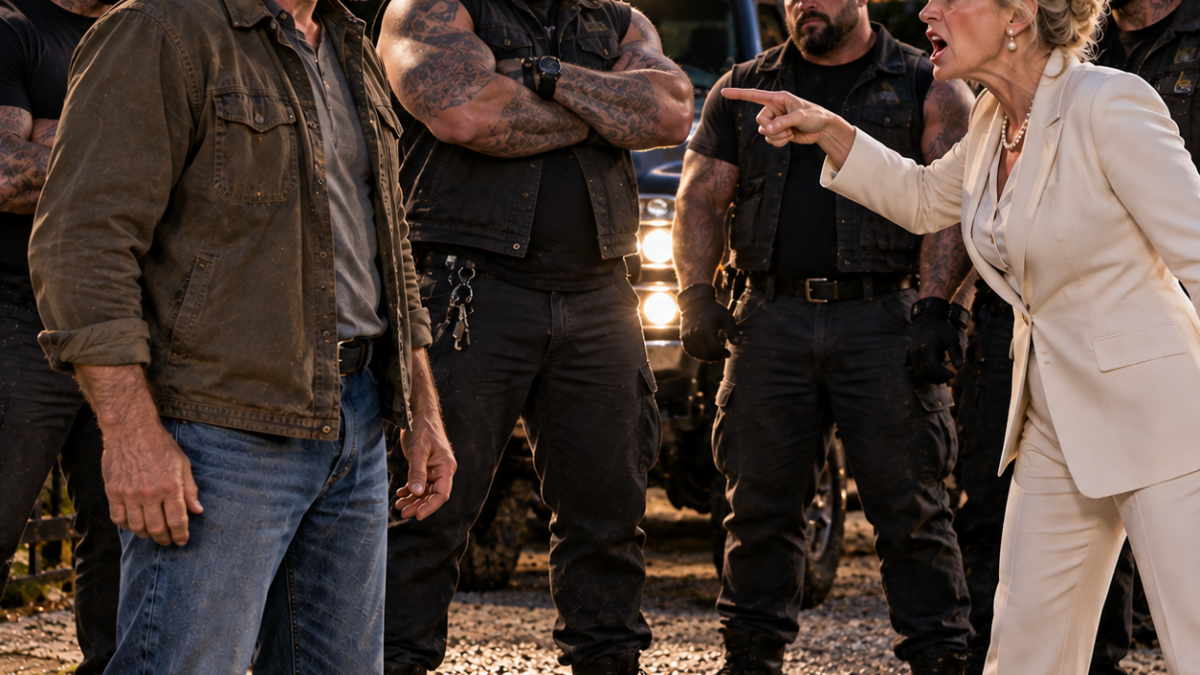
Celeste Ror sent six men onto my private road after midnight, told them to block my vehicles, rattle my fence posts, shine flashlights through my windows, and keep me awake until I signed away the only access route her secret development deal needed.
She stood behind them smiling in designer heels, called me an unemployed handyman clinging to a decaying house, and told me I had forty-eight hours to understand my place before things became uncomfortable.
Then the man leading her crew turned toward the porch light, saw my face, lowered his head like the past itself had stepped out of the dark, and said one word that made every hired hand in my yard put down his tools.
My name is Elias Mercer, and for most of that year, nobody in Brier Glenn knew the first true thing about me.
That was not an accident.
I had spent enough of my life being known by title, by responsibility, by signature authority, by the weight of decisions made in rooms where people looked at you because somebody had to be calm and nobody else wanted the job.
When I came back to my grandfather’s place, I did not want another room full of people waiting for me to decide what happened next.
I wanted a roof to fix.
A gate to hang.
A floor to sand flat.
A morning quiet enough that the first thing I heard was wind in old oak leaves instead of radios, generators, sirens, or someone saying my name with bad news attached to it.
The house sat just outside the iron gates of Brier Glenn, close enough that I could hear their sprinklers hiss on every evening at exactly six, far enough that none of their rules had ever been mine.
My grandfather bought that land when the whole stretch was pasture and pine, decades before a single stone pillar, decorative fountain, or gated monument went up down the road.
He built the house himself in a decade when men still did that, or at least still believed they could, and every room carried some mark of his stubborn hands.
The porch boards creaked under my boots every morning.
The east steps dipped slightly because he had never trusted the soil on that side.
The kitchen window stuck in damp weather.
The hallway door had not closed square in twenty years.
The workshop behind the house smelled like old sawdust, linseed oil, and the kind of metal that remembers every tool ever hung on the wall.
I loved all of it.
Not because it was perfect.
Because it was honest.
For the better part of a year, I brought the place back from the slow collapse that comes when a house sits empty too long.
I replaced rotted joists.
Rehung shutters.
Sanded doors.
Rebuilt the front gate.
Cleared vines from fence wire and patched the gravel drive where spring rain had cut ruts deep enough to make a small car reconsider its life choices.
Most days I wore a flannel shirt with sawdust ground into the seams, jeans with one knee nearly gone, and boots that had surrendered any dream of looking new.
To the residents of Brier Glenn, that was all the information they needed.
They assumed I was hired help.
A caretaker, maybe.
An unemployed handyman doing odd jobs around a house that belonged to someone more important.
The kind of man who mows lawns for people who sit on architectural committees.
I let them believe it.
There are advantages to being underestimated.
People speak more freely around someone they have already placed beneath them.
They leave doors open.
They skip explanations.
They reveal what they think authority looks like by aiming it at the wrong target.
PART2:
I had learned that in disaster zones, in fraud investigations, in towns where storm damage turned ordinary people desperate and opportunists hungry.
For twenty years, I built and ran Sentinel Ridge Response, a disaster-recovery and site-security company that worked across a dozen states.
We protected evacuation zones after hurricanes, secured collapsed commercial sites after tornadoes, coordinated temporary shelters, stabilized damaged buildings, and kept predators away from homeowners too exhausted to recognize one more danger walking toward them with a clipboard.
Sentinel started with four borrowed trucks and twelve people.
At its largest, it had more than eight hundred employees.
I sold the controlling interest before it became the kind of company where I spent more time discussing quarterly reports than people.
After that, I moved into federal investigative work involving disaster-recovery fraud, contractor corruption, property crimes tied to federally funded programs, and the ugly little ecosystems that appear whenever large amounts of emergency money arrive in damaged places.
By the time Brier Glenn decided I was a helpless man in an old house, I carried credentials I did not discuss and a badge I did not show unless the law required it.
Nobody at the gate ever asked.
Nobody in the neighborhood ever looked past the flannel.
Celeste Ror certainly did not.
She came up my driveway on a Tuesday morning while I was replacing a hinge on the front gate.
I remember the exact sound before I remember her voice: the crunch of expensive tires over gravel that did not belong to her.
Her SUV stopped at an angle, half on the drive, half on the grass, like even the way she parked needed to claim territory.
Celeste stepped out wearing cream slacks, a pale blue blouse, and heels completely unsuited to gravel.
She was in her fifties, polished and sharp, with hair that looked professionally arranged to survive weather, argument, and moral evidence.
She did not ask my name.
She did not introduce herself.
She looked at my pickup, then at the gate hinge in my hand, then at me.
“You need to move that truck off homeowners association property.”
I turned the hinge over once in my palm.
“This road is private.”
“That road is maintained as part of the Brier Glenn access corridor.”
“No, ma’am. It belongs to this parcel. It belonged to my grandfather before Brier Glenn had a street sign.”
She laughed.
Not loudly.
Worse.
Softly, in the way people laugh when they are not amused but want you to understand they have ranked you.
“Men like you often confuse stubbornness with authority.”
I set the hinge on the gatepost.
“Who are you?”
That offended her.
“Celeste Ror. President of Brier Glenn Homeowners Association.”
“All right.”
“Now move the truck.”
“No.”
She stared.
Not because of the word.
Because I said it without apology.
“The western service lane is under association management.”
“No.”
“It connects to association property.”
“Yes.”
“That makes it part of our controlled corridor.”
“No.”
Her lips tightened.
“Do you own this property?”
“Yes.”
She looked at the house.
Then at me.
Something in her expression said she did not believe me.
“You’re Elias Mercer?”
“I am.”
“I was told the Mercer estate had been vacant.”
“It was.”
“And now?”
“Now it isn’t.”
She opened the leather folder she carried.
There were maps.
Of course there were maps.
Whenever somebody wants land they don’t own, they eventually bring a map showing what it would look like if they did.
She unfolded one across the hood of her SUV.
Brier Glenn.
The existing gates.
Its clubhouse.
The private streets.
Then a new section west of the current subdivision.
Forty-six luxury homes.
A small wellness center.
A second decorative lake.
And running through the center of it all was my gravel road.
They had colored it gold.
WESTERN HERITAGE ACCESS DRIVE.
I read the label twice.
“That your handwriting?”
“It’s a planning concept.”
“On my road.”
“Which is why I’m speaking with you.”
“So the truck isn’t the problem.”
“It is one problem.”
“What do you want?”
“A permanent nonexclusive access easement.”
“No.”
She looked almost entertained.
“You haven’t heard the offer.”
“Still no.”
“Fifty thousand dollars.”
“No.”
“Annual maintenance contribution.”
“No.”
“Paving at no cost to you.”
“Absolutely no.”
That surprised her.
“You would prefer gravel?”
“I prefer ownership.”
“You would retain title.”
“I would lose control.”
“That’s overly dramatic.”
“No. That’s what an easement does.”
She looked at me more carefully.
Maybe wondering whether the handyman had read a deed.
She folded the map.
“We can discuss later.”
“We just did.”
The first letter arrived three days later.
NOTICE OF UNSAFE VEHICLE OBSTRUCTION — BRIER GLENN WESTERN ACCESS CORRIDOR
They fined me $250.
For my pickup.
On my private road.
I put the letter on my kitchen table and drank coffee.
Then I pulled my deed.
Survey.
County plat.
Title policy.
The western edge of Brier Glenn ended thirty-eight feet before my road.
Between the two sat a narrow strip of land owned by Brier Glenn’s developer.
There was no HOA easement.
No shared road.
No cross-access agreement.
Nothing.
The development’s original approval actually showed its traffic entering from the opposite side.
My road was not a community corridor.
It was a shortcut somebody had recently decided would make a future project cheaper.
I wrote one letter.
Not on federal letterhead.
Not from an attorney.
Just me.
The Mercer Road is private property outside the Brier Glenn HOA. I am not an HOA member. No easement or access right exists in favor of Brier Glenn. Please cancel the violation and stop representing the road as association property.
Celeste replied personally.
Your interpretation is inconsistent with the community’s long-term development framework.
That phrase made me smile.
Not legal documents.
Framework.
She canceled nothing.
The next violation concerned my fence.
Then wood stacked beside workshop.
Then construction debris.
Those were actually old cedar boards I intended to reuse.
Then a trailer parked behind barn.
Every letter referred to Brier Glenn standards.
Every letter demanded payment.
I paid nothing.
After the fourth, I hired local property attorney named Naomi Ellis.
Naomi had been practicing land law in the county for twenty-three years and had the useful habit of becoming quieter as everyone else became louder.
She reviewed everything.
Then:
“You’re not in the HOA.”
“I know.”
“There is no easement.”
“I know.”
“Then why are they doing this?”
“They want road.”
She looked at map Celeste had left.
“Ah.”
Naomi traced proposed extension.
“This is not just forty-six houses.”
“What?”
“Look here.”
A dashed line continued north beyond Brier Glenn.
I had assumed it was a trail.
Naomi didn’t.
“Utility corridor.”
We pulled planning filings.
That was when the real project appeared.
Not just Brier Glenn expansion.
A development entity called Crestline Residential Partners had an option on 310 acres beyond the western ridge.
Luxury housing.
Small resort lodge.
Event space.
Maybe 180 units over several phases.
The project had one major problem.
Access.
Their preferred public-road connection from the north required a new bridge over Mill Creek and major grading through unstable slope.
Estimated cost:
$7.8 million before utilities.
My road connected directly to county road on high, stable ground.
With a permanent easement and modest widening, they could save millions.
Crestline’s internal concept map showed:
Mercer Access — Preferred
No agreement.
Preferred.
I understood Celeste better after that.
She had not become obsessed with a gravel lane because of my pickup.
Somebody had promised something.
Naomi sent formal cease-and-desist.
Brier Glenn’s counsel responded quickly.
More reasonably.
The HOA acknowledged I was not subject to its declaration.
The violation letters were “administrative error.”
All fines canceled.
The association denied claiming ownership.
Good.
Then one sentence:
The Association continues to believe that historic and practical access rights may exist over the Mercer Road and reserves all rights.
Naomi circled.
“They don’t have a legal theory yet.”
“Yet?”
“They’re buying time.”
The harassment changed form.
Residents began walking up my road.
Not many.
Two at first.
Then four.
They said Celeste told them it was a shared walking connector.
I turned them around politely.
A Brier Glenn landscaping truck used the lane one afternoon.
Driver showed work order.
WEST ACCESS — MERCER CORRIDOR.
I photographed.
Called vendor.
They apologized.
Celeste said misunderstanding.
Then a security vehicle.
Then a survey crew.
That one I stopped at gate.
The crew chief was embarrassed.
“We were told owner authorized.”
“He didn’t.”
“Understood.”
They left.
I started using cameras.
Not hidden.
Three on house.
Two covering gate.
Another overlooking road.
Celeste saw one and smiled.
“Paranoid?”
“No.”
“People who have nothing to hide usually don’t need six cameras.”
“That works both directions.”
She stopped smiling.
A month later I found orange survey stakes along my western boundary.
Not on the road.
Beside it.
Crestline logo.
I did not pull them.
I photographed.
Naomi contacted developer.
Their lawyer claimed stakes were entirely on developer-controlled strip.
Survey later proved two were eleven feet inside my parcel.
Minor trespass.
Still useful pattern.
Then Crestline’s acquisition director visited.
His name was Pierce Langford.
He was fifty, smooth, expensive, and far more careful than Celeste.
He did introduce himself.
He asked permission to come onto porch.
I appreciated that.
“Mr. Mercer, I think we’ve gotten off on wrong foot.”
“No.”
He smiled.
“Fair.”
He offered $300,000 for permanent easement.
“No.”
“Five hundred.”
“No.”
“Seven-fifty.”
“No.”
He paused.
“This is a road.”
“Yes.”
“You keep ownership.”
“You keep pretending that’s same as control.”
“Easement terms can be narrow.”
“How many homes eventually?”
“We don’t know.”
“You do.”
He sighed.
“One hundred eighty to two hundred.”
“Construction traffic?”
“Temporary.”
“Utilities?”
“Likely.”
“Guests?”
“Residents and authorized users.”
“Emergency services?”
“Yes.”
“Delivery vehicles?”
“Likely.”
“So my private gravel road becomes primary entrance for two hundred houses and a resort.”
“Not primary.”
“Preferred.”
He glanced at me.
I had read his plans.
Good.
“We can build elsewhere.”
“Then do.”
“It costs more.”
“That’s your problem.”
He sat back.
“You know what $750,000 means for a man living in this house?”
There it was.
Class judgment.
Not cruelly stated.
Still.
“I know exactly what it means.”
“You could rebuild everything.”
“I am rebuilding everything.”
“You could leave.”
“I don’t want to.”
“Then a million.”
“No.”
Pierce eventually stood.
“Celeste told me you’re difficult.”
“Celeste doesn’t know me.”
He looked around.
“Maybe nobody does.”
Closer than he realized.
The next month, Brier Glenn recorded a Notice of Potential Access Interest against the strip near my road.
Not against my whole parcel.
Still enough to create title noise.
Naomi filed suit for declaratory relief and slander of title.
Brier Glenn’s original attorney withdrew the notice within ten days, saying it had been recorded “prematurely.”
Celeste was furious.
I knew because she came to my gate and told me.
“You’ve escalated this into litigation.”
“You recorded a claim against my property.”
“The board was preserving rights.”
“You don’t have rights.”
“That is your opinion.”
“Your own lawyer withdrew it.”
She stepped close enough that I could smell expensive perfume.
“You should understand something, Elias.”
“All right.”
“Communities like Brier Glenn don’t simply stop growing because one man refuses to cooperate.”
“Maybe not.”
“You can take money now or spend money later.”
That sounded like threat.
I asked:
“Is that an official HOA position?”
Her eyes flicked toward camera.
Then she smiled.
“You’re very dramatic.”
And left.
I sent the footage to Naomi.
She said:
“Keep everything.”
I did.
Crestline’s planning hearing was delayed because access remained unresolved.
Their lender had conditions tied to confirmed ingress.
Pierce increased offer to $1.25 million.
No.
Then Celeste started telling residents I was blocking an emergency exit.
I called fire department.
Same story I had seen before.
They did not require my road.
The proposed expansion needed second access before final occupancy, but that could be satisfied through Crestline’s northern bridge route.
Expensive.
Not impossible.
Celeste turned expensive into impossible.
At a Brier Glenn meeting, according to resident who later became witness, she said:
“Mr. Mercer is endangering future emergency access for every family on western side.”
A resident asked:
“Does county require his road?”
Celeste answered:
“The practical requirement is obvious.”
Not yes.
Not no.
Enough people heard requirement anyway.
Pressure rose.
I received anonymous letters.
Sell.
Stop hurting families.
One had a picture of my house.
Not threatening exactly.
Unpleasant.
I reported.
No action.
Then nails appeared near gate.
Could be anything.
Then fence wire cut.
Could be animals? Wire doesn’t usually unscrew.
Then floodlight shattered.
I upgraded cameras.
Naomi said:
“You need consider injunction.”
“We have enough?”
“For trespass? Maybe. For anonymous harassment, harder.”
I contacted my federal supervisor.
Not to open case.
To disclose.
“I have private property dispute with adjacent development and escalating harassment.”
He listened.
“Any relation to your caseload?”
“No.”
“Any federal funds?”
“Not that I know.”
“Any reason your position is known?”
“No.”
“Then local matter. Do not use credentials unless safety or law requires.”
“Agreed.”
“And if it becomes criminal, you are victim, not investigator.”
“I know.”
That mattered.
I had spent years telling others conflict contaminates cases.
I wasn’t going to become hypocrite because my fence got cut.
Then Celeste made the call that changed everything.
Later records showed she contacted a company called Grayline Field Services.
The name sounded legitimate.
It was.
Mostly.
Grayline did site security, vacant-property protection, construction-zone patrol, repossession support, strike logistics, and high-risk commercial escorts.
Some employees were former military.
Some former disaster contractors.
Not criminals.
But Celeste did not hire them for normal security.
She hired them for what she described as:
Nonviolent access stabilization and occupant-compliance presence.
That phrase appeared on invoice.
$18,500 for three nights.
Paid from a Brier Glenn “special legal and security reserve.”
The HOA board had approved no such thing.
Celeste used president’s emergency spending authority meant for storms, gate failures, and security incidents.
She told Grayline that Mercer property was a “contested caretaker-occupied parcel” involved in association access dispute.
She represented me as a holdover caretaker refusing owner-approved access.
She said Crestline had lawful site-control rights.
She attached a map.
Not my deed.
Not court order.
No permission.
Grayline owner assigned a six-man crew.
Crew leader was Marcus Holloway.
Mack.
I had not seen him in nine years.
Mack had joined Sentinel Ridge in its early days.
Former Army mechanic.
Big shoulders.
Voice like gravel.
He wasn’t one of the polished managers.
He was the man I sent when a recovery site needed to function by sunrise.
After Hurricane Delia ripped through coastal counties, Mack ran a thirty-person team protecting a temporary fuel depot and emergency shelter.
When looters hit a pharmacy distribution site after another storm, Mack held perimeter without one civilian injury.
He was steady.
Not gentle.
Steady.
When his wife got sick, Sentinel kept his insurance and paid him while he stayed home.
That wasn’t charity.
He had earned it ten times.
Years later, after I sold company, Mack left too.
Started contracting.
Grayline sometimes hired him for complicated jobs.
Celeste didn’t know any of that.
To her, he looked exactly like the man she wanted.
Large.
Weathered.
Quiet.
Capable of making somebody uncomfortable without technically threatening them.
The contract instructions she gave him included:
Park service vehicles to restrict unapproved vehicle movement.
Maintain visible overnight presence.
Test fence stability along disputed corridor.
Use handheld illumination to document occupancy.
Prevent unauthorized removal of boundary markers.
Communicate forty-eight-hour deadline for access compliance.
No physical contact.
No weapons displayed.
No forced entry into residence.
Read carefully and it still sounds bad.
At midnight on private land, it sounded worse.
The first truck came at 12:18 a.m.
I was awake.
Not because intuition.
Because camera alert.
Headlights turned through my gate.
Then a second truck.
Then a dark SUV.
I opened camera feed.
Six men.
Work lights.
Tool bags.
Reflective vests.
One carried post driver.
Another pry bar.
A truck stopped sideways across my drive.
Then Celeste’s SUV arrived.
At 12:27.
Designer heels.
No joke.
Cream coat.
Hair perfect.
She stood near road like opening ceremony.
I called sheriff before going outside.
“Multiple trespassers on private property, ongoing land dispute, vehicles blocking my exit.”
“Any weapons?”
“None visible.”
“Stay inside if safe.”
“I will until units closer.”
Then fence rattled.
Hard.
One man was testing posts.
Another shone flashlight toward house.
Not into bedroom intentionally, perhaps, but beam swept windows.
Another photographed truck.
Celeste called from yard.
“Elias!”
I stayed porch-dark.
“Elias, we need to talk.”
I turned porch light on.
Stepped outside but stayed behind railing.
Camera above me recording.
“Get off my property.”
She smiled.
“You were notified.”
“No.”
“Grayline is securing the western access corridor.”
“There is no access corridor.”
“This is now a compliance matter.”
“Leave.”
One of the men walked toward gate hinge.
I said:
“Do not touch that.”
He stopped.
Celeste:
“They have authorization.”
“From who?”
“The association and development partner.”
“Neither owns this road.”
“You have forty-eight hours to sign.”
That was first explicit deadline.
“For what?”
“The easement agreement Pierce already offered.”
“And if I don’t?”
Her smile thinned.
“This level of oversight will continue until we have clarity.”
“Meaning you’ll keep men outside my house at midnight.”
“They’re security professionals.”
“You’re using them to intimidate me.”
“I’m giving you opportunity to resolve.”
Then she made mistake of looking me up and down.
Flannel.
Old jeans.
Barely laced boots.
“You have spent a year playing owner while fixing somebody else’s decaying house.”
I almost laughed.
She continued:
“No job anyone can identify.”
“No family here.”
“No visible income.”
“You’re clinging to a property you cannot possibly maintain at this level forever.”
There are moments when arrogance becomes so pure it stops being insulting and becomes information.
I said:
“You’ve done research.”
“I understand exactly who I’m dealing with.”
“No.”
She smiled.
“An unemployed handyman with a deed and too much pride.”
Behind her, one of the crew leaders turned.
Mack had been speaking with two men near first truck.
Maybe my voice registered.
Maybe porch light.
Maybe name.
He walked closer.
Fifteen yards.
Ten.
He looked up.
Stopped.
I watched recognition move through him.
Not dramatic at first.
Eyes narrowing.
Head tilting.
Then he took off cap.
“Boss?”
Celeste looked back.
“What?”
Mack stepped another pace.
“Boss.”
Every man on crew heard tone.
One put post driver down immediately.
Another lowered flashlight.
A third looked from Mack to me.
Celeste snapped:
“What are you doing?”
Mack ignored her.
“Elias Mercer?”
“Yes.”
He looked around property.
Then at Celeste.
Then at me again.
“Jesus Christ.”
Celeste:
“Do you know him?”
Mack’s face changed in way I remembered from storm sites when somebody gave him bad briefing.
“Yes.”
“How?”
“He built Sentinel Ridge.”
Silence.
Celeste stared.
I could almost see recalculation fail.
Mack looked at his men.
“Tools down. Nobody touches anything.”
Celeste stepped toward him.
“You are under contract.”
Mack turned.
“Contract says disputed caretaker parcel.”
“It is.”
“No.”
She pointed at me.
“He is occupying estate pending—”
“He owns this place.”
“You don’t know that.”
Mack looked at me.
“Do you?”
“Yes.”
He nodded once.
“Then we’re done.”
Celeste’s face flushed.
“You do not get to decide that.”
“I decide what my crew does.”
“I hired Grayline.”
“And Grayline did not hire us to commit trespass.”
“This is authorized.”
“Show me owner authorization.”
She opened folder.
Mack read.
HOA map.
Crestline letter.
A “site control memorandum.”
No signature from me.
He looked up.
“This isn’t owner consent.”
“You’re not lawyer.”
“No.”
He handed back.
“But I’ve secured enough disaster property to know difference between owner’s signature and lady saying she runs neighborhood.”
That line would later make him very popular with deputy.
Celeste lowered voice.
“You will fulfill contract.”
Mack:
“No.”
“You’ll lose payment.”
“Then lose payment.”
She looked at his men.
“Anyone here interested in keeping job?”
Nobody moved.
Mack’s people were contract crew. He had brought them.
One said quietly:
“We’re with Mack.”
Celeste looked at me again.
Different now.
“Who are you?”
I rested hands on porch rail.
“Your neighbor.”
“Don’t be cute.”
“You never asked anything beyond what you wanted.”
She stepped toward porch.
Mack moved between—not aggressively, but enough.
“Ma’am, don’t.”
She snapped:
“Get out of my way.”
Mack:
“Sheriff coming?”
I nodded.
“Called.”
“Good.”
He turned to crew.
“Vehicles to shoulder. Clear drive. Nobody leaves until deputies ask unless told otherwise.”
That was voluntary cooperation.
Not detention.
One man moved truck blocking my exit.
Another collected tools into pile.
Celeste grabbed phone.
“I’m calling Pierce.”
Mack said:
“You should call lawyer.”
For first time that night, I smiled.
Sheriff units arrived at 12:43.
Three deputies.
Sergeant first.
Mack identified himself immediately.
Presented work order.
Showed texts.
Said:
“We came under representation property was controlled by HOA/developer and occupant had been given notice. Owner says no. We stopped.”
Good.
Celeste tried to control narrative.
“I am HOA president. This is a civil access dispute. Grayline has authority to secure contested corridor.”
Sergeant asked:
“Do you have court order?”
“No.”
“Deed?”
“The association has development rights.”
“Do you have easement?”
“Pending.”
“So no?”
“This man is obstructing—”
Sergeant held hand.
“Ma’am.”
He turned to me.
“Mr. Mercer, do you want these people off property?”
“Yes.”
“To prosecute trespass?”
“For the people who leave now and cooperate, I want facts documented first. I reserve complaint.”
Mack looked at me.
That was intentional.
His crew had been misled, but they still crossed my gate after midnight.
Let investigators sort.
I wasn’t going to promise immunity I didn’t control.
Sergeant appreciated answer.
Deputies photographed.
Statements.
Grayline contract.
Texts.
Celeste’s map.
Vehicle positions.
Fence posts.
No damage beyond scuffed gravel and one loosened post.
Then deputy asked me occupation.
I told him quietly.
“I’m a federal investigator. This is private matter. I have notified my agency and I am not acting in official capacity.”
He nodded.
“Any overlap?”
“None known.”
That was enough.
Celeste overheard “federal investigator.”
Her face changed again.
Not pale movie-style.
Just still.
“You’re federal law enforcement?”
“I work federal investigations.”
“You never said.”
“You never asked.”
“You let me believe—”
“That I was poor?”
She stopped.
“That I was unemployed?”
Silence.
“That you could send six men into my yard because you thought nobody important lived here?”
Her attorney later claimed that wording was prejudicial.
Maybe.
It was true.
I did not show badge.
Didn’t threaten.
Didn’t call federal agents.
The sheriff handled everything.
At 1:36, Grayline crew left after providing contacts.
Mack stayed another twenty minutes.
Celeste left under deputy direction after being formally trespass-warned.
No arrest that night.
People always want arrest at climax.
Real investigations need evidence.
Mack stood by his truck.
He looked older.
So did I.
“You all right, Boss?”
“Don’t call me that.”
He smiled.
“Can’t help it.”
“What happened to you?”
“Life.”
“Useful answer.”
He looked toward house.
“I swear I didn’t know.”
“I believe you.”
“I should’ve checked deeper.”
“Yes.”
That hurt.
He nodded.
“I saw the paperwork and figured corporate property dispute.”
“You’re too old to trust somebody else’s summary.”
“Yeah.”
Then:
“She wanted us to make you tired.”
“I know.”
“Three nights. Block drive. lights. noise. post checks. No touching you.”
“That supposed to make me feel better?”
“No.”
He looked ashamed.
“I’ve done site pressure before. Usually repossession, abandoned commercial property, strike line. Legal has paper.”
“This didn’t.”
“No.”
“What did she tell you?”
“That caretaker was refusing owner-approved easement because wanted payout.”
I laughed once.
“She called me caretaker.”
“She called you a lot worse when you weren’t there.”
“I’m sure.”
Mack reached into truck and handed me copy of contract.
“Give this to lawyer.”
“Deputies photographed.”
“Keep anyway.”
Then he looked at porch.
“You still got that old habit.”
“What?”
“Standing under light so everybody else stays dark.”
That took me back.
Storm sites.
Fuel depots.
I shrugged.
“Old habits.”
He put cap on.
“Sorry, Elias.”
Not boss.
Better.
“Drive safe, Mack.”
By breakfast, Naomi had contract.
By noon, Brier Glenn counsel had email.
By evening, HOA board had emergency meeting.
Celeste did not attend.
She claimed medical issue.
The board’s treasurer, Martin Webb, called Naomi.
“We did not authorize this.”
“Who did?”
“Celeste used emergency security authority.”
“For land dispute?”
“We’re investigating.”
“How much?”
“Eighteen-five.”
“From HOA funds?”
“Yes.”
“Did board know Crestline relationship?”
Pause.
“What relationship?”
There it was.
The secret.
Discovery over next month produced consulting agreement.
Celeste Ror owned a company called Ror Community Strategies LLC.
Crestline Residential Partners paid it $12,000 per month.
Plus a $275,000 “success fee” if the Mercer corridor was secured through purchase, easement, judicial recognition, or “other legally enforceable means.”
She had not disclosed that contract to homeowners.
She had told board she was volunteering as “community liaison” to Crestline.
Not being paid.
That alone transformed everything.
Her HOA pressure wasn’t merely mistaken governance.
She had personal financial incentive.
Emails got worse.
Celeste to Pierce:
He thinks silence makes him strong. Pressure needs to become personal inconvenience.
Pierce:
No illegal conduct. I mean that. Our financing cannot absorb scandal.
Celeste:
Nothing illegal. Security presence. Access stabilization. He will fold.
Another:
He looks broke. House is half construction site. No visible employment. If we keep him from sleeping and make property impossible to use, $1.25M will look different.
Mack’s contract matched.
Another email three days before midnight:
Forty-eight hours is enough. After that we escalate visual occupation and vendor staging.
Pierce replied:
Do not say occupation.
He knew optics.
Did he know actual plan?
That became disputed.
Crestline claimed Celeste exceeded instructions.
Some evidence supported.
Pierce had repeatedly written “lawful pressure only.”
Other evidence showed he knew she was using HOA resources to push.
Civilly, enough trouble.
Criminally, prosecutors were more careful.
The county district attorney reviewed trespass, criminal coercion, harassment, conspiracy.
Because Celeste had used men, nighttime presence, vehicle blocking, and explicit pressure tied to property transfer, investigators took it seriously.
Mack and five crew members cooperated.
Grayline owner refunded HOA money and terminated Celeste contract.
He also changed internal review policy.
Crew did not face serious charges after evidence showed they were materially misled and stopped immediately when ownership challenged, though two received civil trespass notices and Grayline resolved property-damage claim for fence post and gravel.
Celeste was different.
She had prior notices.
Attorney letters.
Deed.
Survey.
Pending litigation.
She knew.
Her own HOA counsel had written:
The association possesses no present right to enter or obstruct Mercer Road. Any access must be negotiated or established judicially. Do not engage contractors for physical presence on Mercer property.
Two weeks before Grayline.
Celeste replied:
Understood.
That one word did a lot of work.
The board removed her as president.
Fast.
Five to one.
She voted no.
To remove her from board required member vote.
She resigned before it happened.
Then residents saw consulting contract.
That made them furious in a different way.
Brier Glenn had more than two hundred homes.
Most owners were not my enemies.
Many had never even seen my road.
Their dues had been used to fund a midnight intimidation operation benefiting their president personally.
At clubhouse meeting, Martin Webb read consultant payments.
Someone shouted:
“She got paid how much?”
Another:
“From developer?”
Another:
“And used our money to hire those men?”
Martin:
“That appears to be what occurred.”
Celeste’s friend Diane stood.
“This is being distorted.”
A resident named Anne Navarro asked:
“Which part?”
Silence.
“Did she disclose $12,000 a month?”
“No.”
“Did we approve Grayline?”
“No.”
“Did we have access rights?”
“No.”
“Then what is distorted?”
Good questions.
Brier Glenn hired independent counsel.
Insurance carrier issued reservation-of-rights notice over intentional acts outside board authorization.
The HOA dropped its access claim immediately.
Recorded release.
No easement.
No historic corridor.
Nothing.
Their new attorney sent me apology.
Actual apology.
The Association acknowledges that Mercer Road is privately owned and that Brier Glenn has no right of access absent future written agreement.
I framed?
No.
Naomi did.
She called it “rare collectible.”
The developer tried to salvage project.
Pierce visited once more.
This time at Naomi’s office.
Not my house.
He looked tired.
“No Celeste.”
“No.”
“Good.”
He slid new offer.
$2.2 million for easement.
I looked.
“No.”
He exhaled.
“Elias, you know northern bridge adds almost eight million.”
“Yes.”
“You know financing may collapse.”
“Yes.”
“You don’t care?”
“It’s your project.”
“We’ve invested years.”
“I’ve owned road longer.”
He leaned forward.
“Is this revenge now?”
“No.”
“Then why?”
“Same reason before.”
“Control?”
“Yes.”
“You could name conditions.”
“Conditions become arguments for my children later.”
“You have children?”
I smiled.
He knew less than Celeste.
“Not your business.”
He sat back.
“I underestimated you.”
“That’s not central problem.”
“What is?”
“You treated no as temporary obstacle.”
He looked toward Naomi.
Then me.
“Everything in development is negotiable.”
“No.”
That conversation ended project western route.
Crestline eventually pursued northern bridge.
Cost more.
Phase delayed eighteen months.
Some units removed to make numbers work.
Project still happened.
That’s important.
No one needed my road.
They preferred it.
Convenience had been dressed as necessity.
Same pattern.
Celeste’s criminal case resolved almost a year later.
No dramatic federal prosecution.
No SWAT.
State case.
She ultimately pleaded to charges involving coercive solicitation and unlawful trespass conspiracy under negotiated agreement, with some counts dismissed.
Probation.
Substantial fine.
Restitution.
No-contact order.
Community service.
No prison beyond booking and brief pretrial processing.
People online complained.
But nobody was beaten.
No weapons.
No prior record.
The men stopped before serious damage.
Sentencing reflects conduct, history, evidence.
I didn’t need cell door to feel whole.
Civil consequences were heavier.
Brier Glenn sued her over unauthorized use of association funds and undisclosed conflict.
Crestline terminated consulting contract and refused success fee.
Her insurer declined portions of personal defense.
She sold house.
Lost position.
Paid settlement.
Reputation she had built around being “community leader” evaporated.
Those were real consequences.
Mack?
He called a month after plea.
“Coffee?”
We met at diner.
He looked uncomfortable in booth.
Big men often do.
“How’s Grayline?”
“Fine.”
“Still contracting?”
“Less.”
He stirred coffee.
“I keep thinking about night.”
“Stop.”
“Can’t.”
“You stopped your men.”
“I brought them.”
“Both true.”
He nodded.
“That was always your thing.”
“What?”
“You never let one good decision erase earlier bad one.”
“Useful in disasters.”
“Annoying in performance reviews.”
I smiled.
He looked at me.
“Why didn’t you tell her who you were?”
“Which part?”
“Sentinel. Federal.”
“Why would I?”
“She thought she could break you.”
“That would still be wrong if I were what she thought.”
He nodded slowly.
“Yeah.”
“That is part people miss.”
Mack looked down.
“If you’d been some broke caretaker…”
“What?”
He didn’t finish.
Would he have kept going?
Maybe longer.
That question bothered him.
Good.
Not because I wanted him tortured.
Because moral growth begins where flattering story ends.
He said:
“I’d like to think once you said owner we’d stop.”
“You did.”
“But before porch light?”
“You were rattling fence.”
“Yeah.”
We sat.
Then he said:
“I’ve started requiring owner verification personally on contested-property jobs.”
“Good.”
“Grayline too.”
“Better.”
He smiled.
“Still bossing me.”
“No.”
“You can’t help it.”
Maybe.
I did not return to Sentinel.
No desire.
The federal badge stayed mostly out of Brier Glenn.
That was also important.
Some residents learned and suddenly became more respectful.
I disliked that.
One stopped me at grocery store.
“Agent Mercer, I just want you to know we never supported Celeste.”
“Elias.”
“Sir?”
“Elias.”
“Of course.”
I asked:
“Would you have supported her if I wasn’t federal?”
He looked embarrassed.
That’s question.
Rights should not depend on credentials.
I did not win because I had badge.
I won because deed said what it said, cameras recorded what happened, Mack told truth, emails existed, HOA counsel had warned her, and Celeste put personal financial incentive above limits.
The badge added nothing except conflict obligations.
In fact, it constrained me.
I could not investigate.
Could not pull records.
Could not interview suspects in official capacity.
Could not use federal systems.
I was a victim.
Witness.
Property owner.
That’s all.
My supervisor made that clear.
“Do not touch case.”
“I won’t.”
“Do not run plate.”
“I won’t.”
“Do not ask coworkers favors.”
“I won’t.”
“Do not show up in federal jacket to local hearing.”
“I own flannel.”
He sighed.
“Of course you do.”
So local detectives investigated.
Local prosecutor charged.
Private attorney handled land.
Correct.
Power isn’t useful if using it poisons result.
Celeste never understood that kind of limit.
She thought authority meant capacity to push.
That was difference between us.
The old house came together slowly.
By the second year, roof done.
Floors refinished.
Kitchen window still stuck when humid.
I left it.
Some imperfections deserve tenure.
The front gate Mack’s crew rattled remained.
I replaced one post.
Kept hinge.
Not as trophy.
It still worked.
One evening, Anne Navarro from Brier Glenn came walking near road.
Stopped outside gate.
“Elias?”
“Yes?”
“Can I come up?”
“Sure.”
She opened.
Permission.
Small thing.
She brought pie.
“My husband says this is bribery.”
“For?”
“Apology.”
“You didn’t do anything.”
“We let Celeste become Celeste.”
I set pie on porch table.
“What does that mean?”
“She’d been president six years.”
“Okay.”
“She started small. Vendor contracts. Rules. Committee appointments. People complained and we shrugged because things looked nice.”
“That’s common.”
“She made everything efficient.”
“Also common.”
“Then she stopped asking.”
I understood.
Anne looked toward Brier Glenn stone gate.
“By the time anybody noticed, disagreement with Celeste felt like disagreement with whole neighborhood.”
“That’s dangerous.”
“Yeah.”
She smiled.
“New board is boring.”
“Congratulations.”
“We’re thrilled.”
Good governance is often boring.
No midnight crews.
No secret consulting.
No maps across neighbor’s land.
They changed bylaws.
Emergency spending over $5,000 required second officer approval.
Conflict disclosures annual.
Developer relationships disclosed.
No claim to off-site property without recorded basis and counsel sign-off.
No security contractor may enter non-HOA property.
Obvious.
Written because obvious failed.
Crestline finished its bridge two years later.
I drove by once.
Big structure.
Expensive.
Beautiful, actually.
Pierce sent no invitation.
Fair.
The new western homes sold.
People moved.
Brier Glenn property values did not collapse.
Fire trucks got access.
Landscapers managed.
World survived my no.
That was useful.
Celeste had made road sound like key to civilization.
It wasn’t.
It was cheaper route.
People exaggerate needs when trying to cross boundary.
Mack visited property once after.
Daytime.
He brought two younger Grayline supervisors.
“Training.”
I raised eyebrow.
“On my yard?”
“Not exactly.”
He asked permission.
Good start.
He wanted them to hear story from property owner.
I said yes.
We stood by gate.
Mack pointed.
“What did we do wrong?”
One young supervisor said:
“Failed owner verification.”
“More.”
“Relied on client characterization of legal status.”
“More.”
“Entered after hours for pressure activity.”
“More.”
“Blocked egress without court order.”
“Good.”
He looked at me.
I added:
“You confused contract with authority.”
They looked.
“A client can pay you to do something they don’t have right to authorize.”
One took notes.
I almost laughed.
Sentinel days again.
Then Mack said:
“And if old guy on porch turns out to be your former boss?”
I glared.
They laughed.
Fine.
Afterward Mack stayed.
“House looks good.”
“Getting there.”
“You gonna sell?”
“No.”
“Of course.”
We sat porch.
He looked over oak trees.
“I remember you saying you wanted this.”
“What?”
“Back when company was crazy. You’d say someday you wanted one place where nobody needed you.”
I had forgotten.
He hadn’t.
“Turns out people still needed me.”
“No.”
He shook head.
“They needed your road.”
Different.
He was right.
I had come home thinking obscurity would produce peace.
It mostly did.
But hiding title cannot protect boundaries if someone wants land.
Paper does.
Neighbors do.
Cameras.
Courts.
Sometimes a man from your past recognizing you under porch light.
The word “Boss” became the part everyone remembered.
Not me.
I remember what happened two seconds before.
Mack was still doing job.
My fence was still being rattled.
The crew was still on my property because somebody with money and confidence told them story.
Recognition changed outcome.
That is uncomfortable.
Would they have stopped for a stranger who calmly said:
I own this land?
I hope.
Mack hoped.
But hope isn’t system.
So Grayline changed verification.
Brier Glenn changed spending.
I changed gate.
I installed keypad and camera.
Not fortress.
Just less assumption.
I also recorded a no-trespass notice with development’s counsel.
Clear.
Future contractors would see.
Boundaries shouldn’t depend on face recognition.
That may be most important lesson.
One afternoon a utility crew arrived to inspect pole near rear property.
They stopped at gate.
Called number.
“Mr. Mercer, we have easement.”
“Come through.”
They had paperwork.
Easy.
Authority shown.
Gate opened.
No drama.
That is what functioning rights look like.
Celeste once told me men like me confuse stubbornness with authority.
I thought about that often.
She was right in abstract.
Stubbornness is not authority.
Neither is presidency.
Neither is money.
Neither is badge.
Neither is being called boss.
Authority has source.
Deed.
Contract.
Law.
Consent.
Court order.
Defined role.
Everything else is posture.
Celeste had posture.
I had deed.
Mack had work order.
But work order failed because person who hired him lacked underlying right.
The sheriff had actual law-enforcement authority.
My federal credentials didn’t give me local property-enforcement power.
Limits.
That is how systems stay sane.
Years later, my federal service ended.
Retired fully.
No badge now.
It’s in locked box.
I still wear flannel.
Still fix house.
Brier Glenn has new president named Jonah Mills.
Retired accountant.
He came by first week.
Stopped at gate.
Called.
“Mr. Mercer?”
“Elias.”
“I’m Jonah, HOA president.”
“My condolences.”
He laughed.
“I wanted introduce.”
“Come up.”
He walked.
No folder.
Excellent.
He said:
“We have no request for road.”
“Best opening.”
“I do have question.”
“Of course.”
“Stormwater ditch near boundary. County says part is ours, part yours.”
“Okay.”
“Can we survey jointly?”
“Yes.”
“You’re surprisingly reasonable.”
“Don’t tell internet.”
We hired surveyor.
Found drainage culvert partly clogged on my side and partly collapsed on theirs.
Split work by responsibility.
No lawsuit.
No thugs.
No secret deal.
No “Boss.”
Just neighbors.
That is better ending than revenge.
But sometimes people want to know what happened to Celeste.
Last I heard she moved two counties away.
No HOA board.
Maybe learned.
Maybe not.
I received one letter.
About eighteen months after settlement.
Handwritten.
No lawyer.
Elias, I misjudged you.
I almost stopped reading.
That was not apology yet.
She wrote:
I believed your refusal was irrational because I believed anyone in your position would accept the money if enough pressure were applied. I convinced myself your resistance justified stronger tactics. I also convinced myself that because I was acting for the community, my own financial interest did not matter. Both beliefs were wrong.
Better.
Then:
Seeing Marcus call you Boss was the first moment I realized how little I knew about the person I had decided to control. I wish I could say that was when I understood I had crossed the line. The truth is, I understood before that and crossed it anyway.
That mattered.
No excuse.
She ended:
I am sorry for what I did.
I did not respond for months.
Then:
I received your letter. I appreciate that you took responsibility. I hope you carry that lesson somewhere useful.
That was all.
No friendship.
No forgiveness ceremony.
Life isn’t required to tie ribbon.
The old gravel road still runs from county pavement to my house.
Crestline bridge visible far north if leaves off.
Sometimes Brier Glenn walkers wave from their side of fence.
I wave.
My grandfather’s workshop restored.
I left one wall untouched.
Old pegboard.
Tool outlines.
His handwriting in pencil:
3/4 wrench missing again.
Probably me.
I was twelve.
The front gate squeaks despite new hinge.
I could fix.
Haven’t.
Sound tells me someone arriving.
One night, years after Celeste, headlights came up drive at 11:40.
For one second my body remembered.
Camera.
Trucks.
Lights.
Then phone rang.
Jonah.
“Sorry late. Tree down across Brier Glenn exit. Fire department asking whether emergency vehicle can stage on your lower turnout temporarily.”
I looked out.
Storm.
Branches.
“County requesting?”
“Yes. Captain’s here.”
“Open gate.”
They used turnout four hours.
No easement created.
No money.
No problem.
Actual emergency.
Ask.
Permission.
Difference.
In morning Jonah left note:
Thank you. No permanent access assumed.
I laughed.
He had learned history.
Maybe too well.
I pinned note workshop.
Not because legal.
Because trust.
At retirement I sometimes think about Sentinel Ridge.
People.
Storms.
Mack.
We built systems where chaos existed.
The irony is I came home to avoid commanding anyone and ended up teaching an HOA the same lesson disaster work taught:
When structures fail, people reveal themselves.
Some exploit confusion.
Some freeze.
Some help.
Some claim authority.
The best ones verify before acting.
Mack failed first step.
Then recovered.
Celeste knew and pushed anyway.
That is difference accountability cares about.
If the story gets told as:
HOA Karen hired thugs, but surprise, victim was their boss.
It’s satisfying.
It’s also incomplete.
The useful part comes after surprise.
The men did not kneel.
I did not command private army.
I did not flash badge and arrest anyone.
Mack said one word because he recognized someone he respected.
Then he did what he should have done for any owner.
He stopped.
He checked.
He handed over paperwork.
He told truth.
That is what changed night.
Not my résumé.
And if there is one part I wish people understood, it’s that Celeste did not pick the wrong man.
She picked the wrong method.
If I had really been an unemployed handyman clinging to a decaying inherited house, six men outside my windows at midnight would still have been wrong.
Blocking my truck would still be wrong.
Rattling my fence would still be wrong.
Pressuring me to transfer property under threat of continued harassment would still be wrong.
The deed would still matter.
My no would still matter.
A person’s rights should not become stronger because somebody whispers boss.
That word merely exposed how differently people behave once status appears.
I have spent enough life around titles to distrust that.
Boss.
Agent.
President.
Developer.
Officer.
Owner.
Every title can tell you something.
None tells you everything.
Celeste had president.
Mack had crew leader.
Pierce had developer.
I had several titles I chose not to use.
In the end, the only title that mattered on Mercer Road was one printed in county records.
Owner.
And even that did not give me right to do whatever I wanted.
Utilities had easements.
County had emergency powers.
Neighbors had rights on their land.
Law still applied.
Ownership is boundary, not throne.
I think my grandfather understood.
He hated locked gates.
Rarely used them.
But if someone wanted cross, they asked.
He said yes often.
That was why people respected his no.
Generosity and boundaries aren’t enemies.
They need each other.
I finally finished house.
Mostly.
The hallway door still crooked.
I could plane it.
I won’t.
Grandfather installed wrong.
It has survived sixty years.
Earned.
Porch creaks.
Oak leaves.
Morning quiet.
No radios.
No sirens.
Usually.
I drink coffee on step where Celeste once stood in expensive shoes telling me I didn’t understand authority.
Sometimes I can still see Mack in yard.
Cap in hand.
Recognition.
“Boss.”
Then tools hitting gravel.
One by one.
Not loudly.
Just enough.
A pry bar.
Post driver.
Flashlight.
The sound of a bad job ending before it became something worse.
That is the moment people remember.
I remember what came next.
Deputies asking questions.
Contracts unfolding.
Emails being preserved.
A board discovering its president had sold their trust for a private success fee.
A developer paying millions more to build the road it should have built from beginning.
A security company changing its rules because one familiar face revealed a process failure.
A neighborhood learning that “community need” does not erase somebody else’s deed.
And me learning that peace is not the absence of people testing your boundaries.
It is knowing where those boundaries are, documenting them, and refusing to become the thing you are fighting when someone crosses.
Celeste thought pressure would make me sign.
Mack thought he was securing a disputed corporate site.
Brier Glenn thought its president was protecting future access.
Pierce thought every no had number.
All of them were working from assumptions.
Only one thing survived all assumptions.
The road was mine.
And when the last truck backed out that night, Mack stopped at the gate and looked toward porch one final time.
He lifted two fingers from steering wheel.
Not salute.
Not employee to boss.
Just one man acknowledging another.
I lifted hand.
Then the road went quiet.
No engines.
No flashlights.
No designer heels on gravel.
Just oak leaves moving over an old house everybody had mistaken for weakness.
I stood there a long time.
Then I closed the gate.
Not because I was afraid.
Because it was mine to close.