HOA Karen Handcuffed Me on My Own 136 Acres and Sent an Excavator Toward My Gate—Then a State Police Captain Arrived and Asked Who Had Put Her Husband in Cuffs.
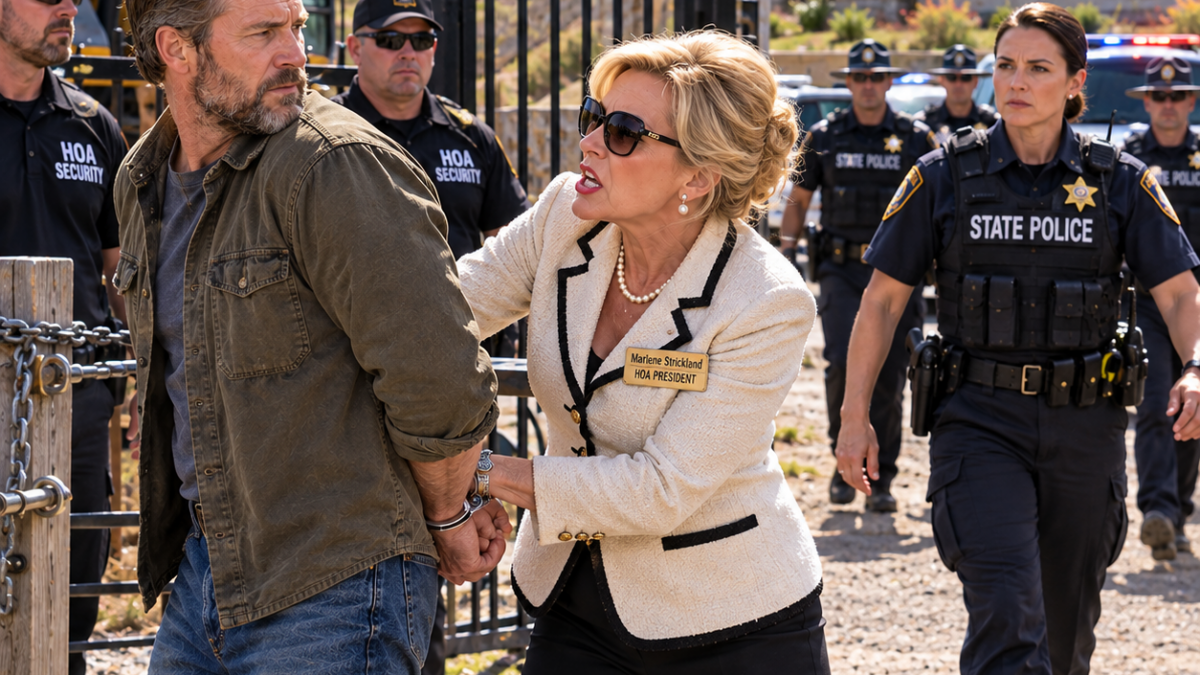
PART2:
Say “community interest” enough times and suddenly private land begins to sound negotiable.
Say “safety corridor” enough times and a road through someone else’s acreage starts to feel like destiny.
Say “emergency access” enough times and people stop asking why the emergency had been scheduled during a loan deadline.
I first met Marlene at my gate on a Thursday afternoon.
She arrived in a white SUV with STONEHAVEN RIDGE COMMUNITY ASSOCIATION printed discreetly on the doors.
She wore navy slacks, a cream blouse, sunglasses, and a little gold badge on a leather holder clipped to her belt.
Not a government badge.
An HOA badge.
I would later learn she had ordered twenty of them online.
At the time, I simply stared.
She held out her hand.
“Travis Whitaker?”
“Yes.”
“Marlene Strickland, association president.”
I looked at her hand.
Then shook it.
“What can I do for you?”
“We’re reviewing regional access needs.”
“Good for you.”
Her smile paused.
PART3:
“Stonehaven has expanded considerably.”
“I’ve noticed.”
“We now have nearly four hundred homes.”
“Congratulations.”
“And only one primary eastern emergency outlet.”
I knew what she meant.
Stonehaven’s main entrance was west.
A narrow secondary fire lane existed north, connecting to a county service road.
They wanted another route east.
Across my land.
Marlene opened a leather folder.
“We’re proposing a controlled emergency corridor from Ridgecrest Drive to County Road 9.”
She showed me a glossy site plan.
Red dashed line.
It began inside Stonehaven.
Crossed their eastern common area.
Then entered my western pasture.
Passed within sixty feet of my workshop.
Continued down my private south road.
Ended at my gate.
I looked at her.
“No.”
She smiled again.
“You haven’t heard the terms.”
“I saw the line.”
“We would pave and maintain it.”
“No.”
“Emergency use only.”
“No.”
“The county strongly favors redundant access.”
“Then the county can call me.”
“We’re trying to resolve this neighbor-to-neighbor.”
“No.”
She closed the folder.
“Why?”
“Because trucks, fire apparatus, residents, contractors, and whatever else eventually gets called emergency access would be running through my working yard.”
“We can fence it.”
“No.”
“You would be compensated.”
“No.”
“Twenty-five thousand.”
“No.”
“Annual maintenance.”
“No.”
She stared.
“Are you unwilling to negotiate?”
“Yes.”
That answer upset her more than if I had insulted her.
People like Marlene understand disagreement.
They do not understand refusal to enter the process.
She tucked the folder under her arm.
“This may become a public safety issue.”
“Then public safety agencies can contact me.”
“They already support the concept.”
“Who?”
She hesitated.
“County planning has discussed it.”
“Name.”
“We’re not at that stage.”
“Then nobody supports it yet.”
Her jaw tightened.
“I can see this is going to be difficult.”
“No.”
I pointed toward her SUV.
“It’s actually very simple.”
She left.
That was the beginning.
My wife Rebecca came home at nine that night.
Rebecca Whitaker had been with the state police twenty-two years.
When we married, she was a sergeant.
By the time Marlene discovered us, Rebecca commanded the regional field operations unit.
Captain.
I did not advertise that fact.
Neither did she.
Our marriage worked partly because we kept our jobs separate.
At home, she was the woman who left coffee mugs in the garage despite complaining when I left sockets on the kitchen counter.
I was the man who refused to throw away extension cords until they were physically dangerous.
Her state-police rank mattered at work.
Not at dinner.
I told her about Marlene.
Rebecca took off her boots.
“Did she show you anything from the county?”
“No.”
“Fire marshal?”
“No.”
“Planning?”
“No.”
“Then she has a drawing.”
“Yes.”
Rebecca opened the refrigerator.
“What are you making?”
“Sandwich.”
“At nine?”
“You married law enforcement.”
“Fair.”
I did not ask Rebecca to check anything.
That mattered later.
She did not use her position to interfere in the land dispute.
I called a land-use attorney instead.
His name was Owen Price.
Owen had represented my father years earlier when a utility company upgraded transmission lines near the north parcel.
He was sixty-three now, spoke slowly, and treated urgency as something other people suffered from.
I sent him Marlene’s plan.
He called the next morning.
“There is no recorded eastern access easement across your tract.”
“I know.”
“You checked?”
“I pulled title when Dad died.”
“Good.”
“Anything old?”
“There is a 1947 farm access note near the northwest corner.”
“That goes north.”
“Correct.”
“Not Stonehaven.”
“Correct.”
“So?”
“So tell her no.”
“I did.”
“Then we are done.”
I liked Owen.
Unfortunately, Marlene was not done.
Two weeks later I received a certified letter.
STONEHAVEN RIDGE COMMUNITY SAFETY NOTICE.
It claimed my locked gate “materially obstructed a historically established emergency access corridor.”
Historically established.
There had never been a road from Stonehaven through my property.
There had once been a cattle track.
My grandfather used it.
That was about as historically established as a deer trail.
The letter demanded I remove the gate within ten days.
Owen replied:
No recorded easement exists.
No license exists.
No agreement exists.
Do not enter.
Do not disturb fences.
Do not place equipment.
Do not represent Stonehaven as having access rights.
Marlene wrote back herself.
The association disagrees.
No legal basis.
Just:
The association disagrees.
Then survey crews appeared.
Three men in orange vests.
They entered from the Stonehaven side and walked seventy yards onto my land.
My camera caught them.
I drove over.
“Gentlemen.”
They stopped.
One held GPS equipment.
“Can I help you?”
“Survey.”
“For who?”
“Stonehaven Ridge.”
“Did they tell you this is private property?”
They looked at one another.
Crew chief pulled work order.
“Our map shows proposed easement.”
“Proposed.”
He looked again.
Then understood.
“We were told access was authorized.”
“It isn’t.”
He packed up.
Professional.
No argument.
I called Marlene.
“You sent surveyors onto my land.”
“They were documenting the corridor.”
“Do it from yours.”
“We have a right to confirm boundaries.”
“Not by trespassing.”
“We disagree about the right.”
“Then get a court order.”
She hung up.
The next move was stranger.
Stonehaven issued me a violation notice.
I was not in the HOA.
Still:
UNSAFE GATE OBSTRUCTION — $500.
I took a photograph.
Sent it to Owen.
He replied:
Frame it.
I nearly did.
Then another.
UNAPPROVED COMMERCIAL VEHICLE NOISE.
Then:
VISIBLE INDUSTRIAL STORAGE.
Then:
NONCONFORMING FENCE MATERIAL.
I called Stonehaven’s management company.
The woman on the phone sounded embarrassed.
“Mr. Whitaker, your parcel does not appear in our assessment database.”
“Correct.”
“Then I’m not sure why enforcement—”
“Ask Marlene.”
“I will.”
The fines stopped.
Marlene did not.
Three months after our first conversation, Stonehaven announced an expansion.
Eighty-two additional luxury homes on land southeast of the existing subdivision.
That explained everything.
The expansion parcel belonged to a development partnership partly controlled by Stonehaven’s original developer.
To build phase four, they needed financing.
To get favorable financing, they needed secondary emergency access.
The northern service lane apparently failed to satisfy the lender’s updated risk requirements because of grade and winter conditions.
The easiest route?
Through my property.
Suddenly Marlene’s emergency had a dollar amount.
Owen found the planning packet.
New eastern corridor listed as:
Proposed Emergency and Construction Access — Whitaker Alignment.
Construction too.
Not merely emergency.
The road would shorten heavy-equipment access by almost four miles.
It would also turn my south gate into the preferred route for the entire expansion.
I called Marlene.
“This is for construction.”
“It has multiple functions.”
“You told me emergency only.”
“At the preliminary stage.”
“You lied.”
“I presented the primary community benefit.”
“Construction trucks are a benefit?”
“To economic development.”
There it was.
“What does the HOA get?”
Silence.
“Marlene?”
“The expansion strengthens the tax base and association reserve.”
“Does Stonehaven receive money?”
She changed tone.
“That is confidential.”
I hung up.
Owen later obtained the proposed development agreement.
Stonehaven Ridge HOA would receive $1.6 million in infrastructure contributions if phase four closed financing.
New clubhouse upgrades.
Pool renovation.
Landscaping endowment.
Road repairs.
And a $200,000 “community transition payment.”
Conditional on access milestones.
One milestone:
Recorded eastern emergency corridor.
Another:
Construction access availability by June 30.
Marlene’s emergency had a deadline.
June 30.
That mattered.
It explained the escalation.
April:
Survey crews.
May:
Notices.
Then a private security company appeared.
Stonehaven signed a contract with RidgeShield Protective Services.
Uniforms.
Marked SUVs.
Body cameras.
Not police.
Security.
Their first supervisor, a man named Curtis Lane, came to my gate.
Polite.
“Mr. Whitaker?”
“Yes.”
“We’ve been asked to monitor boundary disputes.”
“From that side.”
He nodded.
“I understand.”
“Do you?”
He looked at my NO TRESPASSING sign.
“Yes.”
Good man.
For two weeks, RidgeShield stayed inside Stonehaven.
Then Curtis disappeared.
Replaced by Troy Maddox.
Troy was younger.
Former bouncer energy.
He wore a tactical vest despite working suburban HOA security.
He started parking near my gate.
Taking photographs.
One afternoon he used a drone.
I called Stonehaven.
No response.
Owen sent a cease-and-desist on low-altitude surveillance over private work areas.
Then things calmed.
For nine days.
On the tenth, Marlene sent me a document.
PDF.
COUNTY EMERGENCY ACCESS EASEMENT DETERMINATION.
It appeared official.
County header.
Seal.
Parcel numbers.
Language granting Stonehaven “temporary and emergency vehicular access through the Whitaker tract for purposes of public safety, infrastructure protection, and continuity of community ingress/egress.”
Signed:
Robert E. Halpern
Deputy Director, Milfield County Land Services.
I had never heard of him.
Owen had.
Because Robert Halpern did not exist.
He called me.
“That seal is wrong.”
“How wrong?”
“County seal has three stars.”
“This has four.”
I zoomed.
Four.
“And the department is called Land Development Services, not Land Services.”
I stared.
“Someone made this?”
“Looks that way.”
“Can we prove?”
“I’m calling county counsel.”
Thirty minutes later:
Fake.
No such determination.
No such employee.
No easement recorded.
County counsel wanted copy immediately.
Owen sent it.
I called Rebecca.
Not Captain Whitaker.
My wife.
“Someone sent me a fake county easement.”
Silence.
Then:
“Do not touch metadata.”
“I already opened it.”
“Fine.”
“Do not forward except attorney or county.”
“Owen already sent county counsel.”
“Good.”
“Should I send you?”
“No.”
That answer mattered.
“Why?”
“If it becomes criminal, I want distance.”
“You think it will?”
“I think somebody created a fake government record to influence a property dispute.”
Fair.
She continued:
“Let county handle it.”
I did.
The county sent Stonehaven a letter stating the document was not authentic and demanding the association cease using it.
Marlene replied:
The association received the document through a third-party land consultant and is investigating provenance.
Reasonable answer.
For exactly two days.
Then she used it again.
At a Stonehaven resident meeting.
Camera footage later showed her holding the same fake easement.
“Our legal access has been confirmed.”
A resident asked:
“By the county?”
“Yes.”
Lie.
Another:
“Then why is Whitaker fighting?”
“He does not accept modern community needs.”
She told them I was blocking emergency services.
No emergency service had asked for access.
In fact, county fire chief provided written statement:
Current Stonehaven access meets minimum emergency-response requirements pending expansion. Proposed eastern corridor relates primarily to future development contingency planning.
That sentence destroyed her “children will die” argument.
So she stopped quoting fire officials.
The fake easement became her authority.
Owen recommended filing for an injunction.
We did.
Hearing set three weeks out.
June 24.
Six days before financing deadline.
Marlene’s attorney filed opposition.
Here is where it got strange.
The HOA’s actual attorney, Susan Keller, did not attach the fake easement.
Instead she argued possible implied or necessity-based rights.
Weak.
But legitimate litigation.
Owen called her.
“Did you see the county determination Marlene is circulating?”
Susan paused.
“What determination?”
That told us everything.
Marlene had bypassed her own counsel.
Susan requested a copy.
Twenty-four hours later Stonehaven’s law firm withdrew from the easement dispute citing a conflict regarding representations made outside counsel.
That was a very polite way of setting down a burning bag and stepping away.
June 18, the excavator arrived.
It parked on Stonehaven property behind my western fence.
Yellow Komatsu.
Bucket.
Dozer blade.
Beside it:
Skid steer.
Flatbed.
Rolls of temporary construction fencing.
RidgeShield trucks.
I walked to fence.
Troy Maddox stood across.
“What’s the equipment for?”
“Emergency corridor preparation.”
“No.”
He glanced toward excavator.
“We have documentation.”
“You have a fake easement.”
“Not my department.”
“Stay on your side.”
“Talk to Ms. Strickland.”
“I’m talking to the man standing beside the machine.”
He smiled.
“We’ll follow orders.”
That sentence bothered me.
I called sheriff.
Deputy came.
Looked at property line.
Talked to Troy.
Told him:
Without court order or verified easement, do not cross.
Good.
Sheriff wrote incident report.
Marlene called me that night.
“You’re embarrassing this community.”
“Your excavator is parked against my fence.”
“We have a deadline.”
“Not my problem.”
“It becomes your problem when emergency-access rights are confirmed.”
“They weren’t.”
“You are relying on technicalities.”
“The technicality is ownership.”
“You’re risking eighty-two families losing homes.”
“No homes exist.”
“Buyers have contracts.”
“With a developer.”
“Families.”
“Then your developer should have secured access before selling.”
She went quiet.
Then:
“You don’t understand what happens if this loan fails.”
There it was.
Not safety.
Loan.
“How much?”
“What?”
“The loan.”
Silence.
“How much, Marlene?”
“None of your business.”
“Then neither is my road.”
She hung up.
The next morning, someone cut one of my cameras.
Not cable.
Physically turned it toward the ground.
Another was covered with a black bag.
A trail camera disappeared.
I called sheriff again.
Deputies photographed.
No clear suspect.
Then Rebecca did something she rarely did.
She got angry at home.
Not captain angry.
Rebecca angry.
She held my broken camera bracket.
“This is escalation.”
“I know.”
“You sleeping?”
“Some.”
“That’s not an answer.”
“Enough.”
She stared.
“You need to stay away from the gate alone.”
“Becca.”
“I mean it.”
“This is my land.”
“That does not make you bulletproof.”
“They’re HOA security, not cartel.”
“People become unpredictable when money and pride collapse at same time.”
She was right.
I hated that.
I installed two more cameras high.
One inside workshop window.
One on a utility pole fully inside my parcel.
Then I called three employees and told them not to confront anyone.
If equipment crossed line:
Call 911.
Record from safe position.
Do not block with bodies.
I wrote it down.
Safety plan.
June 21.
Marlene posted an HOA newsletter:
EASTERN ACCESS ACTIVATION EXPECTED THIS WEEK.
Activation.
She wrote:
Following extensive legal review, Stonehaven Ridge will exercise emergency corridor rights necessary to protect residents and preserve approved community expansion.
No court order.
No recorded easement.
County had already disowned her document.
Still she wrote it.
Then something happened I did not know until later.
A Stonehaven board member named Charles Avery emailed her.
Marlene, county says that easement paper isn’t theirs. We cannot send machinery across Whitaker’s land.
Marlene replied:
County staff are protecting themselves politically. Our consultant has confirmed the underlying right.
Charles:
Who is consultant?
Marlene:
Ridge Development Strategies.
That company existed.
Owned by her brother, Paul Strickland.
Not disclosed to residents.
Later investigators found the fake easement PDF had been created on a computer registered to Ridge Development Strategies.
Not proof Marlene personally typed it.
But close enough to make everyone suddenly interested in file metadata.
June 23.
Sunday.
Quiet.
I worked in shop.
Rebecca left before dawn for a multi-county training exercise.
She would be gone most day.
At 11:00, I checked gate.
Excavator still on Stonehaven side.
I took photo.
At 2:00, still there.
At 6:00, RidgeShield moved two SUVs near boundary.
At 8:30, lights.
I called sheriff non-emergency.
“Equipment staged. No crossing yet.”
Logged.
At 10:00, I locked gate.
Heavy chain.
Not theatrical.
Normal.
Slept badly.
June 24.
Hearing day.
We were scheduled in court at 2:00 p.m.
I woke at 5:41 because diesel engines were running.
Outside.
I dressed.
Checked camera.
Three RidgeShield trucks.
Flatbed.
Excavator.
Marlene’s white SUV.
And two county sheriff cruisers.
I called Owen.
“It’s happening.”
“What?”
“They’re at the gate.”
“Do not physically interfere with machinery.”
“I know.”
“I’m calling county counsel.”
I walked outside.
Phone recording.
Marlene stood beside gate with a document folder.
Troy Maddox.
Four security guards.
Excavator operator remained in cab.
Two deputies stood near public road.
One I recognized:
Deputy Sam Keller.
No relation to Stonehaven attorney.
The other was young.
Marlene raised her hand.
“Mr. Whitaker.”
I laughed once.
“Marlene.”
“We are activating the corridor.”
“No.”
“I have county documentation.”
“You have forged paperwork.”
Deputy Keller stepped forward.
“Ma’am, we already discussed this.”
Marlene held up the fake easement.
“This is legal access.”
Keller shook his head.
“Our dispatch has a county notice that document is disputed and reportedly not authentic.”
Her face changed.
“Reportedly.”
“Yes.”
“We have a hearing today.”
“Then wait for it.”
“We cannot.”
“Why?”
“Public safety.”
Keller looked toward excavator.
“What emergency exists right now?”
Marlene did not answer directly.
“The corridor must be cleared.”
“That’s not an emergency.”
Troy stepped closer.
“Deputy, this is a civil matter.”
Keller looked at him.
“Then why are you trying to use us to help enter?”
Good question.
Marlene turned to deputies.
“We no longer require sheriff assistance.”
Keller stared.
“What?”
“You can leave.”
“We were called here.”
“Yes.”
“By your security company.”
“The situation is under control.”
Keller looked at me.
“Mr. Whitaker, do you want us to remain while they’re here?”
“Yes.”
Marlene’s smile disappeared.
“This driveway is private property.”
I almost laughed.
Keller said:
“Whose?”
She stopped.
“My point is the sheriff has no role in this civil access activation.”
Keller looked at gate.
“At this moment nobody crosses until ownership and access are clarified.”
Marlene snapped:
“You do not have authority to suspend an easement.”
“And you do not have authority to make us enforce one.”
Silence.
Then his radio called him.
Apparently supervisor instructed deputies to reposition at public road because no court order existed and sheriff wanted to avoid participating in a civil dispute unless crime occurred.
Keller told me:
“We’re staying right there.”
He pointed fifty yards back.
“If anyone damages property or puts hands on you, call 911.”
Marlene heard.
She smiled.
That smile should have warned me.
Deputies walked to cruisers.
Not leaving scene.
Just public road.
I stood inside my gate.
Marlene opened folder.
“Final notice.”
I kept recording.
“Stonehaven Ridge is taking temporary emergency possession of the corridor under association emergency authority.”
“What authority?”
“Recorded access rights.”
“Not recorded.”
“County-recognized rights.”
“County called your document fake.”
“You are obstructing public safety.”
“Then wait three hours and tell the judge.”
Her face went flat.
“We cannot wait.”
“Loan deadline?”
Tiny reaction.
Enough.
I continued.
“This has nothing to do with emergency access.”
She pointed toward Troy.
“Mr. Whitaker is interfering with authorized operations.”
Troy stepped forward.
I held up one hand.
“Do not touch me.”
He stopped.
Good.
Marlene did not.
She walked through pedestrian gap beside gate before I could close it.
Onto my property.
“Marlene.”
“You have been served.”
She held paper toward me.
I did not take it.
“You are trespassing.”
“No.”
“Yes.”
“We have possession authority.”
“No.”
Then she pulled something from her belt.
Handcuffs.
Actual steel handcuffs.
I thought for one second it was another fake badge performance.
Then she grabbed my left wrist.
I jerked back.
“What the hell are you doing?”
“Stop resisting.”
The absurdity of hearing an HOA president say those words almost froze me.
I pulled my arm away.
Troy moved.
Two guards stepped closer.
I looked toward sheriff cruisers.
Keller was already turning.
Marlene caught my wrist again.
One cuff clicked.
Metal.
Real.
I said loudly:
“Do not restrain me.”
She grabbed my other wrist.
Behind my back.
Second cuff closed.
Too tight.
Pain shot through my thumb.
My phone dropped onto gravel but kept recording.
I stared at her.
“What do you think you’re doing?”
“Citizen detention.”
“For what crime?”
“Interference with emergency access.”
“That is not a crime.”
“You refused lawful order.”
“You are not law enforcement.”
“You are being detained for security.”
Troy looked uncomfortable now.
Good.
Maybe some part of him understood line had moved.
Marlene turned toward guards.
“Move him to the truck.”
I planted my feet.
“No.”
She pointed toward flatbed.
“He is your problem until the corridor is open.”
That sentence was captured on three cameras, my phone, and Deputy Keller’s bodycam from down the road.
Keller started running toward us.
“HEY!”
Marlene looked.
“You were told to remain on public road.”
Keller shouted:
“Take those cuffs off him now!”
She raised the fake easement.
“This is private enforcement.”
Keller was perhaps twenty yards away when the state police command vehicle turned onto the road.
Dark blue.
Lights.
Behind it:
Three marked units.
Then another.
I did not know Rebecca was coming.
That matters.
I had not called her.
Deputy Keller had requested state assistance after county dispatch flagged the fake government document issue and the staged heavy equipment.
Separately, county counsel had contacted state police earlier that morning because they suspected forged county records were being used to justify imminent property entry.
Rebecca’s regional command was closest unit with investigative and field resources.
She was redirected from training.
The command vehicle stopped behind sheriff cruisers.
Door opened.
Rebecca stepped out.
State police uniform.
Captain bars.
Hair pulled back.
Six troopers behind.
For one second, she did not see me.
She saw:
Excavator.
Security guards.
Marlene.
Deputy Keller.
Then me.
Hands cuffed behind my back.
Everything in her face changed.
Not dramatically.
That was scarier.
Rebecca never shouted first.
She walked forward.
“Who put cuffs on him?”
Nobody answered.
Marlene raised her chin.
“This man is being detained under community security authority.”
Rebecca looked at me.
“Travis.”
Marlene turned.
Then back to Rebecca.
“You know him?”
Rebecca’s eyes stayed on cuffs.
“Yes.”
“How?”
She finally looked at Marlene.
“He’s my husband.”
Silence.
Not movie silence.
Real silence.
Engines idling.
Gravel under boots.
A bird somewhere in fence line.
Marlene’s face emptied.
Troy muttered something I could not hear.
Rebecca said:
“Who has the key?”
Marlene hesitated.
“Ma’am, this is—”
“Who has the key?”
Troy pointed.
“She does.”
Rebecca held out her hand.
Marlene tried one last piece of authority.
“Captain, before you interfere, you need to understand Stonehaven Ridge has exercised lawful emergency possession—”
Rebecca interrupted.
“Key.”
Marlene gave it.
Rebecca did not unlock me.
She handed key to Trooper Elena Brooks.
“Remove restraints. Photograph wrists first.”
That was Rebecca the captain.
Not Rebecca the wife.
Evidence before comfort.
Brooks photographed cuffs.
Position.
My wrists.
Locking mechanism.
Then removed them.
Blood returned painfully to my hands.
Rebecca did not touch me.
She asked:
“Any injury?”
“Numb thumb.”
“Medical?”
“Later.”
She nodded.
Then turned.
“Deputy Keller.”
“Yes, Captain.”
“Did you witness the restraint?”
“Yes.”
“Bodycam?”
“On.”
“Did Mr. Whitaker threaten anyone?”
“No.”
“Commit a crime in your presence?”
“No.”
“Was there a court order authorizing entry?”
“No.”
“Verified easement?”
“No.”
Rebecca looked at Marlene.
“Where is your document?”
Marlene held folder tighter.
“Our attorney—”
“I’m asking where the document is.”
She handed it over.
Rebecca did not read extensively.
Looked at seal.
Then gave it to an investigator.
“Bag it.”
Marlene stepped forward.
“That is association property.”
Rebecca said:
“It may be evidence.”
“Of what?”
“That’s what we are going to determine.”
Then she looked toward excavator.
“Operator.”
The man leaned out.
“Yes?”
“Engine off.”
He shut it down.
“Troy Maddox?”
Troy raised hand slightly.
“Right here.”
“You and all RidgeShield personnel stay where you are.”
“Are we detained?”
Rebecca replied:
“You are temporarily being held at the scene while we determine what occurred.”
Clear language.
Real authority.
No gold HOA badge.
No performance.
Just procedure.
Marlene finally seemed to understand difference.
She pointed at me.
“He physically obstructed a lawful access activation.”
Rebecca looked toward Deputy Keller.
“Did he?”
Keller said:
“He stood on his property behind a locked gate.”
Rebecca nodded.
Marlene continued:
“He refused an emergency order.”
“Whose?”
“Stonehaven’s.”
“Stonehaven is a homeowners association.”
“It has emergency powers.”
“Over its own common property perhaps.”
Rebecca’s tone stayed flat.
“Show me the statute, court order, recorded instrument, or governmental delegation that gave you authority to place a nonmember landowner in handcuffs.”
Marlene said nothing.
Rebecca waited.
Long enough.
Nothing.
Then:
“Okay.”
She turned to the investigative sergeant.
“Separate everybody.”
That was how the criminal investigation began.
Not with dramatic arrest.
With separation.
Statements.
Photographs.
Bodycams.
Camera footage.
Documents.
Equipment serials.
Phone preservation.
The excavator operator cooperated immediately.
He worked for Eastern Grade LLC.
Their work order said:
Emergency access clearing, authorized by Stonehaven Ridge HOA under recorded county easement.
He had received a copy of the fake document.
He had no idea it was fake.
His boss later testified Marlene repeatedly assured them county approval existed.
The flatbed company had same paperwork.
RidgeShield had a “security activation directive” signed by Marlene.
It instructed guards to:
Remove unauthorized obstructions.
Secure access corridor.
Prevent interference by private parties.
Detain trespassers or disruptive persons when necessary pending law-enforcement transfer.
Private parties.
On my land.
Troy looked worse when investigators read that.
“Did you draft this?”
“No.”
“Did your company legal department approve?”
“I assumed.”
Never good answer.
Curtis Lane—the previous supervisor—later told investigators he had refused to participate in property entry without a court order.
He was reassigned at Stonehaven’s request.
Another piece.
My cameras gave them more.
Survey crews.
Security staging.
Camera tampering.
Marlene entering.
Cuffs.
Her statement:
He is your problem until the corridor is open.
Then deputies’ bodycam.
County warning that document was disputed.
Marlene saying sheriff could leave.
Then cuffing me once deputies stepped away.
Sequence matters.
It showed she did not mistakenly believe deputies had authorized detention.
She waited until they withdrew.
That was hard to explain.
Then Rebecca did something I will always respect.
She removed herself.
Once immediate scene was secure, she called division commander and requested conflict reassignment.
Her husband was victim.
She could not supervise investigation.
A major from another region took over.
Rebecca stayed long enough to ensure scene safety, then left operational command.
At home that night, after twelve hours of statements, photographs, urgent-care wrist exam, and legal calls, she finally became my wife again.
She closed kitchen door.
Looked at bruises around my wrists.
Then cried.
Rebecca almost never cried.
I sat.
She touched my hand carefully.
“I wanted to hit her.”
I laughed once.
“Very professional.”
“I didn’t.”
“No.”
“Do you know how hard?”
“Probably.”
She stared at me.
“You joke when you’re scared.”
“I learned from Marines.”
“You weren’t a Marine.”
“I watched movies.”
That made her laugh through tears.
Good.
Then:
“Why didn’t you call me this morning?”
“I called sheriff.”
“That’s not what I asked.”
“Because you’re my wife, not my private police department.”
She nodded.
“Correct.”
“But?”
“But I hated seeing you like that.”
“I know.”
She leaned forehead against mine.
“Don’t make me see that again.”
“I’ll put it on calendar.”
She punched my shoulder.
Gently.
Two days later our injunction hearing happened.
Different world now.
Stonehaven’s new attorney asked for postponement because Marlene had been suspended by board.
Yes.
Suspended.
Not yet removed.
The board had held an emergency meeting within hours of incident.
Charles Avery—the same member who warned her—made motion.
Strip Marlene of authority.
Preserve records.
Prohibit any property-entry operations.
Cooperate with investigators.
Vote:
6–0.
Marlene was not present.
The board also formally stated:
Stonehaven Ridge claims no present recorded easement across Whitaker property unless established by a court.
That sentence should have existed months earlier.
Judge issued temporary injunction anyway.
No Stonehaven agent, contractor, security employee, or equipment could enter my property without my written consent or separate lawful authority.
No reliance on disputed county document.
No destruction or modification of gates, fences, cameras.
No corridor work.
Financing deadline passed.
Phase four loan did not close.
Developer blamed HOA.
HOA blamed developer.
Marlene blamed me.
For a while.
Then discovery began.
Civil first.
Criminal parallel.
The expansion agreement showed why June 30 mattered.
$48 million development financing.
Not all tied to road.
But eastern access was a condition precedent for final funding.
Stonehaven’s $1.6 million contribution package also depended on closing.
Marlene had campaigned on:
No dues increase.
New pool complex.
Road resurfacing.
Expanded clubhouse.
How?
Expansion money.
If loan failed, her entire financial plan collapsed.
She had made promises using money that did not yet exist.
That creates pressure.
Pressure creates rationalizations.
Emails told story.
April 3.
Marlene to developer representative:
Whitaker remains resistant. We may need to activate historic access rights rather than continue voluntary negotiation.
Developer:
Our title consultant has found no recorded right.
Marlene:
There are older county corridor references.
Developer:
Send documentation before we rely on that.
No document sent.
April 19.
Marlene to Paul Strickland, her brother:
Need something county-based that demonstrates corridor recognition. Lender keeps asking.
Paul:
I’ll see what can be assembled from old maps.
Assembled.
May 2.
PDF metadata for fake easement showed creation on Paul’s office computer.
File author field:
PStrickland.
Creation software:
Adobe Acrobat Pro.
County seal image appeared to have been downloaded from an outdated tourism brochure.
That explained crooked seal.
Investigators found draft versions.
One titled:
EAST_ACCESS_FINAL2.pdf.
Another:
EAST_ACCESS_FINAL_USE_THIS.pdf.
People imagine sophisticated fraud looks sophisticated.
Often it looks like file names.
Paul claimed he created a “conceptual exhibit,” not a fraudulent legal instrument.
Problem:
Draft became document with signature block and county language.
Then Marlene distributed it as legal proof.
Who added fake Halpern signature?
Forensics could not conclusively prove which person typed it.
But communication narrowed possibilities.
Marlene texted Paul:
Need version that looks recorded, not planning sketch.
Paul replied:
Understood.
Not good.
Then:
Marlene:
Seal is blurry.
Paul:
That’s what I could find.
Very not good.
Then June 20:
Marlene to Troy:
We may need to physically establish use before Monday hearing. Once corridor is opened, status quo changes.
That line became central.
Physically establish use.
Before court hearing.
She intended to create facts on ground.
Troy replied:
Sheriff may intervene.
Marlene:
It is civil. Once they step back, security handles private property control.
There it was.
My handcuffs were not spontaneous.
Maybe she had not specifically planned to cuff me.
But she planned to exploit the sheriff’s reluctance to enter civil dispute.
Then another text:
Marlene to security coordinator:
Bring restraints in case Whitaker obstructs machinery.
I had to stop reading for a while.
At home, Rebecca found me sitting in workshop with printouts.
“You okay?”
“No.”
“Good answer.”
She sat beside me.
“I thought she panicked.”
“So did I.”
“She planned cuffs.”
“Looks like.”
Rebecca was silent.
Then:
“That bothers me more.”
“Me too.”
Because anger can explain a bad second.
Planning explains a decision.
The criminal investigation expanded.
Potential offenses varied by evidence and state law.
Forgery.
Use of forged governmental instrument.
Criminal trespass.
Property damage.
Unlawful restraint.
Conspiracy.
Attempted theft or coercion theories were discussed but not all charged.
I learned quickly that real prosecution is narrower than outrage.
Investigators do not charge a mood.
They charge elements.
Paul was interviewed.
Troy retained attorney.
Marlene retained two.
RidgeShield corporate counsel arrived and distanced company from Troy’s field decisions.
Their internal policy prohibited employees from acting as law enforcement except narrow citizen-arrest circumstances involving observed criminal conduct.
Blocking your own gate is not one.
RidgeShield fired Troy.
Then offered settlement to me before I filed anything.
Owen advised patience.
“We need investigation first.”
I agreed.
The HOA wanted settlement too.
Different issue.
New interim president Charles Avery came to my workshop.
Alone.
No badge.
No clipboard.
“Hank—”
“Travis.”
“Sorry.”
Bad start.
He sighed.
“I’ve had a rough week.”
“So have I.”
“Fair.”
He looked at machinery.
“I never knew what you actually did here.”
“You never asked.”
“No.”
He held out a folder.
I almost laughed.
He caught it.
“Right.”
He put it down.
“Stonehaven wants to formally withdraw all access claims.”
“Good.”
“Record a disclaimer.”
“Good.”
“Pay for camera damage.”
“Good.”
“Legal fees.”
“Talk to Owen.”
He nodded.
Then:
“We also want to apologize.”
“That doesn’t require lawyer.”
“No.”
He looked toward gate.
“I voted for some of Marlene’s expansion plans.”
“Okay.”
“I believed we needed eastern access.”
“You probably do for expansion.”
“Maybe.”
“I believed you were being unreasonable.”
“That’s allowed.”
“I didn’t know about fake document.”
“I believe you.”
“I didn’t know she planned entry.”
“I believe you.”
He seemed surprised.
“Why?”
“Your email told her to stop.”
He looked down.
“Investigators showed you?”
“Discovery.”
“I should have done more.”
Maybe.
But I had become suspicious of people demanding everyone become hero in retrospect.
“You objected.”
“I still stayed on board.”
“Yes.”
“I kept thinking she’d calm down.”
“That was your mistake.”
He nodded.
Then:
“What happens to Stonehaven now?”
“Not my community.”
“That simple?”
“Yes.”
He almost smiled.
“Must be nice.”
“It is.”
Phase four did not die.
Just changed.
Developer negotiated another access route through a southern parcel.
More expensive.
Required retaining wall.
Road extension.
Six-month delay.
Imagine that.
Private property remained private and capitalism survived.
The $1.6 million HOA contribution was reduced to $900,000 due redesign costs.
Stonehaven still got road repairs.
Smaller clubhouse update.
No giant pool expansion.
Residents survived that too.
Marlene’s criminal case took fourteen months.
No dramatic courthouse ambush.
She surrendered through attorney after charges were approved.
News cameras came anyway because:
HOA PRESIDENT HANDCUFFS STATE POLICE CAPTAIN’S HUSBAND
is apparently catnip for local television.
I hated headline.
Not because false.
Because it made Rebecca sound like reason crime mattered.
It should have mattered if I were married to a plumber.
Or nobody.
Rebecca said same thing when asked for comment.
She gave one statement through department:
My relationship to Mr. Whitaker is irrelevant to whether private citizens may lawfully restrain someone or use fraudulent documents. I recused from the investigation immediately.
Perfect.
Marlene’s defense focused partly on good-faith belief.
She believed access right existed.
She relied on consultant.
She believed citizen detention lawful when I obstructed an emergency corridor.
Prosecutors answered with county warning.
Lawyer withdrawal.
Texts.
Fake-document drafting.
Security instructions.
Timing before hearing.
Good-faith belief becomes harder when people repeatedly tell you document is fake.
Paul Strickland reached plea agreement first.
He admitted involvement in creating a document that falsely represented county authority.
His attorney emphasized he believed it was for negotiation and planning at first.
Maybe true.
He cooperated.
Troy reached agreement involving unlawful restraint-related conduct and lost security licensing for a period.
Marlene fought longer.
Eventually she pleaded to a combination of forgery/use-of-false-document and unlawful restraint-related offenses, while other counts were dismissed under agreement.
She received a custodial sentence shorter than some residents wanted, followed by supervision, restitution, and restrictions related to fiduciary positions.
I did not attend sentencing initially.
Rebecca asked:
“Do you want to?”
“No.”
Then I changed my mind.
Not for revenge.
Closure is overused word.
Maybe witness.
Marlene spoke.
Of course.
She described pressure.
Expansion.
Community promises.
Lender.
She said:
“I believed Mr. Whitaker was exploiting technical ownership to block something hundreds of residents needed.”
I nearly laughed.
Technical ownership.
Then:
“I believed access had existed historically.”
Judge asked:
“Did you know county had disavowed the easement document?”
Long pause.
“Yes.”
“Before the incident?”
“Yes.”
“Did you know the civil hearing was scheduled that afternoon?”
“Yes.”
“Why not wait?”
That was the entire case.
Why not wait?
Marlene said:
“Because financing expired.”
There it was.
Not fire.
Not ambulance.
Not trapped residents.
Financing.
The judge looked at her.
“So the emergency was financial.”
Marlene began explaining.
Judge stopped her.
I do not remember exact legal language afterward.
I remember that sentence.
The emergency was financial.
Yes.
My victim statement was short.
I did not mention Rebecca until necessary.
“Marlene did not restrain me because I was dangerous.”
“She restrained me because I was standing between her equipment and land she wanted.”
I looked at her.
“Had I been married to nobody, this would still be wrong.”
“Had Captain Whitaker not arrived, it would still be wrong.”
“The part that frightens me is not that she made a mistake about a deed.”
“People make mistakes.”
“It is that when public deputies would not give her the authority she wanted, she created her own.”
I sat.
That was enough.
After criminal case, civil cases settled.
Stonehaven paid a portion through insurance and reserves.
RidgeShield paid separate amount.
Marlene’s coverage disputed intentional acts.
I will not give numbers.
Not because astronomical.
Confidentiality.
We recovered legal fees, property damage, lost business time, medical expenses, and agreed damages.
What I cared about most was recorded disclaimer.
Stonehaven filed:
NOTICE OF NO EASEMENT OR ACCESS CLAIM.
It identified my parcels and stated HOA claimed no right of vehicular, emergency, recreational, construction, or utility access across them absent future written agreement.
That document remains in county records.
Beautiful.
Boring.
Exactly as land should be.
I replaced gate.
Not fancy.
Heavy steel.
New posts.
Cameras.
NO TRESPASSING.
PRIVATE INDUSTRIAL PROPERTY.
I considered adding:
HOA PRESIDENTS INCLUDED.
Rebecca said no.
She was probably right.
Our marriage changed after incident.
Not badly.
But truthfully.
For weeks I woke when vehicles slowed near gate.
My hands went numb when thinking about cuffs.
The urgent-care doctor said nerve irritation would recover.
It did.
Mind took longer.
I had always considered myself calm.
Capable.
That morning taught me how helpless restraint feels.
One second standing.
Next metal closes.
Other people decide movement.
That stays in body.
Rebecca understood more than I wanted her to.
She had handcuffed people professionally.
Lawfully.
Now she watched husband flinch when bracelets appeared on television.
One evening she set duty belt on counter.
Cuffs visible.
I looked.
Then looked away.
She noticed.
Next day, cuffs stayed in garage until work.
I said:
“You don’t need to hide them.”
“I know.”
“Then why?”
“Because love sometimes means not making someone prove they’re fine.”
That sentence broke something open.
We talked.
Therapy.
Yes.
Industrial mechanic and state police captain.
Two people who believed competence was adequate replacement for vulnerability.
Therapist had fun.
I stopped waking every night.
Rebecca stopped blaming herself for not arriving sooner.
That was her version.
“If command vehicle had been ten minutes later…”
“Stop.”
“You were cuffed.”
“Stop.”
“I should have—”
“You weren’t there.”
She understood professionally.
Not emotionally.
I told her same thing counselor told me:
“You are assigning yourself power you did not have.”
She glared.
“That sounds like therapy.”
“It is.”
“I hate therapy.”
“You outrank therapist?”
“No.”
“Then listen.”
She threw pillow.
Marriage recovered.
Stonehaven changed too.
Without Marlene, board became more cautious.
Maybe too cautious initially.
Every decision went to lawyer.
Mailbox repainting?
Counsel.
Pool chair purchase?
Probably counsel.
Charles eventually relaxed.
They rewrote emergency powers.
Explicit:
HOA emergency authority extends only to association property, common elements, contractual rights, and actions otherwise allowed by law.
It does not authorize detention, seizure, entry upon nonmember property, alteration of private gates, or creation of access rights.
I never thought a suburban HOA needed to write:
Do not handcuff landowners.
Apparently civilization is iterative.
They also banned board-purchased badges.
That made me laugh.
All RidgeShield contracts ended.
Stonehaven hired ordinary gate staff.
Polo shirts.
Radios.
No tactical vests.
Better.
The expansion was built three years later.
Different eastern access.
I watched construction trucks turn south every morning.
They could have crossed my land in three minutes.
Instead twelve.
Some residents grumbled.
One stopped at my workshop once.
Older man.
“Do you know how much that alternate road cost us?”
“No.”
“Four million.”
“Not me.”
“You could’ve just allowed an easement.”
“Yes.”
He stared.
“That’s it?”
“Yes.”
“You don’t feel bad?”
“No.”
He drove away.
Property rights are strange because saying no feels aggressive to people who benefit from yes.
I did not owe efficient access to somebody else’s development.
Could I have sold an easement for a lot of money?
Probably.
After everything, developer offered $800,000.
I refused.
Rebecca asked:
“Not tempted?”
“Very.”
“Why no?”
I looked toward shop.
“Because then trucks run past us forever.”
She nodded.
“Fair.”
A million dollars is valuable.
So is not hating where you live.
People forget that in development math.
Five years after incident, county replaced culvert near my south gate.
Real county crew.
Real permit.
Real seal.
Supervisor brought paperwork.
I studied it longer than necessary.
He laughed.
“Bad history?”
“Yes.”
“Want to call office?”
“Yes.”
He handed phone number.
I verified.
Then let them work.
Trust but verify.
Very on-brand.
One morning Charles Avery came with a bottle of bourbon.
I do not drink much.
Accepted anyway.
He was stepping down as Stonehaven president.
“Congratulations.”
“For quitting?”
“Yes.”
He laughed.
We sat outside workshop.
He said:
“You know what still bothers me?”
“What?”
“I saw the fake easement at a board meeting.”
“When?”
“Before county letter.”
“And?”
“I thought seal looked wrong.”
I waited.
“But Marlene sounded certain.”
There it was.
“She said counsel had reviewed.”
“But counsel hadn’t.”
“No.”
“You didn’t ask.”
“No.”
He drank coffee.
Not bourbon.
Too early.
“I’ve thought about that for five years.”
“What?”
“How much authority comes from nobody wanting to be the awkward person who asks for proof.”
Good question.
A lot.
Marlene’s power did not come only from title president.
It came from everyone around her assuming somebody else had verified.
Security assumed HOA counsel checked.
Contractor assumed county checked.
Residents assumed board checked.
Board assumed consultant checked.
Consultant was her brother.
No one pulled record.
Except Owen.
The entire tower rested on embarrassment about asking:
Is this real?
That lesson went beyond Stonehaven.
I began telling employees:
If paperwork grants someone unusual authority, verify source.
Not because everyone fraudulent.
Because mistakes propagate.
A wrong work order can destroy equipment just as easily as dishonest one.
Machines taught same lesson.
Input matters.
Rebecca retired from state police at fifty-six.
Her ceremony was small.
She refused big speech.
Commander gave her framed badge.
At reception somebody told story about command vehicle at my gate.
Crowd laughed at Marlene recognizing I was captain’s husband.
Rebecca did not.
Later she said:
“I hate that people think that’s funny.”
“Why?”
“Because it makes the story sound like she cuffed wrong guy.”
I looked at her.
“She did.”
“No.”
Rebecca shook her head.
“She cuffed a person she had no right to cuff.”
“Who you were should not matter.”
Exactly.
We stopped telling version where reveal is:
Surprise, captain’s husband.
That was dramatic.
But not lesson.
The state police captain did not create my rights.
The deed did.
The absence of easement did.
County records did.
Basic limits on private authority did.
Rebecca’s arrival created accountability faster.
Not legality.
That distinction matters to both of us.
Marlene completed her sentence.
Moved after release.
Somebody said Florida.
Somebody else Tennessee.
I did not verify.
She wrote me once.
Handwritten.
No lawyer.
Travis,
I have replayed that morning more times than I can count. For years I told myself the project justified urgency and that you had forced confrontation by refusing reasonable access. I understand now that I had begun treating disagreement as obstruction and position as authority.
I should have waited for the court.
I should never have touched you.
I am sorry.
Marlene
I read it.
Put it in file.
Did not reply for three months.
Then wrote one sentence.
I accept that you understand it now.
Not:
I forgive you.
Not:
All good.
Just acknowledgment.
People want forgiveness scenes.
Sometimes understanding is enough.
The letter changed nothing legally.
It changed something in me.
Anger stopped needing daily maintenance.
Good.
I had equipment to maintain.
My business grew smaller as I approached sixty.
I stopped midnight calls except long-term clients.
Sold two service trucks.
Kept shop.
A young mechanic named Luis began buying company from me in stages.
Smart.
Patient.
Asked questions.
First week he noticed recorded disclaimer in office.
“What’s that?”
“Insurance against history.”
He read.
“An HOA tried taking your land?”
“Parts.”
“They handcuffed you?”
“Long story.”
He stared toward gate.
“Captain Whitaker your wife?”
“Yes.”
Luis smiled.
“Man, they picked wrong guy.”
I shook my head.
“No.”
He looked confused.
“They picked the wrong action.”
That became my answer.
Not wrong family.
Not wrong husband.
Wrong action.
Against anybody.
I still understand why title works for stories.
People love reversal.
Arrogant HOA president cuffs ordinary man.
State police captain arrives.
Husband reveal.
Very satisfying.
Life’s real reversal was quieter.
Marlene believed authority came from appearance.
Badge.
Security team.
Official-looking paper.
Equipment.
Community title.
Deadline.
Then people who actually handle authority arrived.
Deputies.
State investigators.
County records.
Judge.
And every one asked same boring questions:
Who owns the land?
Where is recorded easement?
Who created this document?
What law authorized detention?
What emergency existed?
Who gave contractor permission?
What did you know and when?
Authority hates ambiguity less than performance does.
Real authority documents.
Checks.
Limits itself.
Recuses when conflicted.
Rebecca taught me that most clearly when she stepped away from investigation.
She could have tried controlling it.
Emotionally she wanted to.
Professionally she didn’t.
Marlene did opposite.
She had limited authority.
Expanded it emotionally.
Then physically.
That is the difference.
One of my favorite memories came eight years later.
Stonehaven had community open house.
New president invited neighboring property owners.
Rebecca and I went.
Yes.
Voluntarily.
Clubhouse renovated.
Smaller than Marlene planned.
Nice.
Pool looked good.
Kids.
Food trucks.
Normal suburban life.
At entrance, sign:
STONEHAVEN RIDGE
GOOD NEIGHBORS, CLEAR BOUNDARIES.
I stopped.
Rebecca read.
Then looked at me.
“Subtle.”
“Very.”
Charles had apparently suggested wording before he left.
Inside, nobody treated us as enemies.
Most new residents barely knew history.
Good.
One woman asked:
“You’re the people with machine shop?”
“Yes.”
“My garage lift is stuck.”
I laughed.
“Of course.”
I fixed it next week.
Neighbors again.
Not because boundaries disappeared.
Because boundaries were respected.
That is something Marlene never understood.
She thought cooperation required control.
It doesn’t.
I have loaned Stonehaven generators during outages.
Plowed part of their service road after ice storm.
Let fire crews stage on my gravel once during brush fire.
For free.
Why?
Because they asked.
That word matters.
Asked.
Permission has dignity on both sides.
One person keeps ownership.
Other receives help.
Nobody pretends generosity is an easement.
During brush fire, new president called:
“Travis, fire chief wants to stage two engines in your south yard.”
“Yes.”
“You sure?”
“Yes.”
“Want it in writing?”
“Text is fine for emergency temporary permission.”
He laughed.
“You’ve softened.”
“No.”
“Fire is real emergency.”
Marlene’s loan wasn’t.
Silence.
Then:
“Fair.”
Engines came.
Fire contained.
They left.
No one filed a fake deed afterward.
Progress.
I am sixty-four now.
Rebecca gardens.
Badly.
Do not tell her.
She plants tomatoes too close.
I fix pumps three days a week.
Luis owns majority business.
My land is still one hundred thirty-six acres.
Stonehaven still east.
Phase four homes visible through trees.
Alternate access road curves south.
Every time I see it, I think:
Four million dollars.
Then:
Not my four million.
Gate remains.
New chain.
No cuffs.
County records remain boring.
That is success.
On the wall above my desk hangs my grandfather’s original survey map.
Beside it, framed copy of Stonehaven disclaimer.
And below that, crooked fake county easement.
Yes.
I framed it.
Owen told me not to keep original.
Evidence disposed per process later.
I have certified copy.
Four-star seal.
Fake Halpern signature.
Ridiculous.
Luis asks why display fraud.
I say:
“Because confidence is cheap.”
He says:
“That sounds like an old-man saying.”
“I am old.”
“Fair.”
The fake document reminds me of morning everything almost went wrong.
But the real object I kept is cuff key.
Not Marlene’s original key—that remained evidence.
Rebecca bought same model later and gave me key on anniversary as dark joke.
Engraved:
WAIT FOR THE JUDGE.
I laughed for ten minutes.
Then put it on key ring.
Marriage after trauma becomes weird.
Good weird.
If you ask what scared me most that morning, not excavator.
Not guards.
Not cuffs.
It was how normal everybody looked.
No masked criminals.
No chaos.
Clean SUVs.
Printed documents.
Safety vests.
Radios.
Clipboards.
A woman using official language.
A machine operator waiting for go-ahead.
That is how bad decisions become systems.
Everybody has one narrow job.
Operator digs when authorized.
Security secures when instructed.
Board president signs.
Contractor assumes legal review.
Residents assume board knows.
Then suddenly bucket crosses property line and everybody says:
I thought somebody checked.
That phrase should terrify people.
I thought somebody checked.
Check.
If stakes are high, check.
If authority unusual, check.
If paper grants someone power over another person’s land, movement, money, or liberty, check twice.
My father taught me similar lesson with machinery.
Never trust a pressure gauge you didn’t verify after maintenance.
Why?
Because a wrong gauge can make dangerous system look normal.
Marlene’s fake easement was a wrong gauge.
Everyone saw official format and relaxed.
Until county said:
No.
Not ours.
From there, she had choice.
Stop.
Wait for court.
Negotiate.
Find alternate access.
She chose to turn pressure higher.
That is why consequences belonged to her.
People still title story:
HOA Karen Handcuffed the Wrong Man.
I understand.
But I prefer:
HOA President Forgot a Boundary Is Still a Boundary When Money Is on the Other Side.
Less viral.
More accurate.
Rebecca says nobody would click.
Probably right.
She was always better at public communication.
The day she retired, she stood at our gate.
Same place.
Looked down road.
“Do you ever think about moving?”
“No.”
“That fast?”
“Yes.”
“Why?”
I looked at shop.
Fields.
Fence.
Road.
“One bad morning doesn’t get to own twenty good years.”
She smiled.
“That sounds like therapy.”
“It probably is.”
“Still hate therapy?”
“Less.”
We walked back toward house.
No command vehicle.
No deputies.
No excavator.
Just gravel under boots.
The way land should sound.
The most expensive road Stonehaven never built runs only on old planning maps now.
Red dashed line.
Through my pasture.
Past shop.
Down south road.
It never existed.
That makes me happier than any courtroom judgment.
Sometimes the strongest property right is the road that remains imaginary.
Marlene tried to make it real through repetition.
Then paperwork.
Then machinery.
Then handcuffs.
What stopped her was not that she chose a man with a powerful wife.
It was that eventually every layer of real authority asked her to prove what she kept claiming.
She could not.
The deed stayed boring.
The fence stayed mine.
The gate stayed shut.
And the excavator never moved another inch.