HOA Karen Dug Three Trenches Across My Private Road to Trap Me—Then One Strip of Red Warning Tape Turned Her Scheme Into a $2.6 Million Utility Claim.
PART3:
Hours.
Vehicle limits.
Insurance.
No permanent easement.
I still said no.
Howard seemed to understand.
Mallerie did not.
“Why?”
That was the first time she asked as though refusal itself required justification.
“Because I don’t want Stonebridge traffic on my road.”
“Traffic is an exaggeration.”
“You said landscapers, pool contractor, security vendor, snow contractor, and emergency maintenance.”
“Occasional access.”
“Today.”
She frowned.
“What does that mean?”
“Today it’s landscaping. Next year it becomes delivery. Then residents. Then somebody says everybody has used it so long it ought to be permanent.”
“That is not how easements work.”
I looked at her.
“I’m aware.”
Apparently not the answer she expected.
My father had spent thirty years telling me the same thing.
Never let casual use become assumed use.
Not because neighbors are evil.
Because memory changes.
One owner says:
Sure, drive through.
Five years later somebody else says:
We’ve always had access.
Ten years later it becomes:
That’s our road too.
Paper prevents arguments.
My road had no reciprocal agreement with Stonebridge Ridge.
The development’s plat showed its western boundary stopping forty-six feet east of my gravel surface.
There was a landscaped buffer in between.
No shared drive.
No access easement.
No gate.
No ambiguity.
Mallerie still tried.
She sent letter calling the road a “legacy community connector.”
That phrase was impressive considering the community was two years old and the road was fifty-six.
I wrote back:
The Barlow Road is private property. Stonebridge Ridge has no recorded right of access. Please stop referring to it as a community connector.
She responded:
The board disagrees with your characterization.
I laughed.
A board cannot vote my deed into another category.
Then Stonebridge installed a pedestrian gate in its western fence.
Facing my road.
No agreement.
No access right.
Just a black metal gate opening onto a strip of grass that led directly toward my gravel.
I noticed while checking fence.
Called Keith Nolan.
“Why is there a gate?”
“Landscape emergency access.”
“Emergency access to what?”
“Your road.”
“No.”
“It doesn’t touch your property.”
“Correct. Keep it that way.”
He sounded embarrassed.
“Mallerie wanted future flexibility.”
Future flexibility.
Another phrase.
Within a month, landscapers were using it anyway.
Two men in a utility cart crossed the buffer, reached my road, turned north, and drove almost half a mile toward my equipment shed before I stopped them.
They were apologetic.
Their work order showed:
WEST SERVICE ACCESS VIA BARLOW CONNECTOR.
I photographed it.
Called Mallerie.
She said:
“That was misunderstanding.”
“Your name approved work order.”
Silence.
“They weren’t supposed to go that far.”
“They weren’t supposed to come at all.”
“Travis, we’re trying to be practical.”
“So am I. Stop.”
They stopped for maybe six weeks.
Then a Stonebridge security SUV used the road.
Then an irrigation contractor.
Then a tree service.
Every time:
Misunderstanding.
Every time:
Mallerie.
I hired an attorney.
Her name was Rebecca Sloan.
Forty-five.
Real-estate litigator.
Calm enough to make angry people feel loud.
She sent formal notice:
No entry.
No easement.
No license.
Any further use considered trespass.
Stonebridge counsel replied acknowledging no recorded access right and stating the HOA would instruct vendors accordingly.
Good.
I thought done.
Mallerie apparently took that as opening for a different strategy.
First came an “emergency-access proposal.”
Stonebridge’s western section had only one vehicular connection to the main internal road.
The county fire marshal had approved development with emergency-turnaround standards.
No requirement for a second external route.
Still, Mallerie began telling residents that my road could become an emergency escape if wildfire or storm blocked Stonebridge’s front gate.
That argument was harder emotionally.
Nobody wants be man saying no to emergency vehicles.
So I checked.
I called county fire marshal myself.
“Do you need my road?”
“No.”
“Has Stonebridge asked?”
“They’ve discussed redundancy.”
“Is my land required?”
“No.”
“If real emergency?”
“Fire, rescue, sheriff may use whatever lawful emergency authority exists based on conditions. That is different from permanent HOA easement.”
Exactly.
I offered one thing in writing:
If county requested temporary emergency access during an actual declared incident, I would cooperate where safe and lawful.
Mallerie wanted permanent access deed.
No.
Then she sent petition signed by fifty-three homeowners.
REQUEST FOR COMMUNITY SAFETY ACCESS
I read names.
Some were people I had never met.
A resident named Sarah Kim called me.
“I want you to know I signed because Mallerie told us fire department required it.”
“They don’t.”
Long pause.
“Really?”
“Call them.”
She did.
Two days later she apologized.
That was first sign residents weren’t being told full story.
Mallerie shifted again.
Property values.
Then maintenance efficiency.
Then county planning.
Then “historic right.”
That one interested Rebecca.
“Historic right based on what?”
Apparently the Barlow road had once been used by the farmer who owned the land that became Stonebridge.
True.
In 1974, my grandfather allowed Warren Miller to drive a tractor across part of road during harvest.
Handshake.
Seasonal.
Miller died in 1991.
The tract changed owners twice.
No recorded easement.
Mallerie found old aerial photos showing a worn track between properties.
She decided that proved access.
Rebecca said:
“It proves dirt existed.”
Stonebridge’s attorney apparently told her same thing.
I know because months later emails came out.
The historical agricultural use does not create a present HOA vehicular easement based on materials provided. Do not represent otherwise.
Mallerie replied:
Then we need another path.
That sentence mattered later.
The first truly ugly move was a notice recorded against my property.
Not a lien.
A Notice of Access Claim.
It stated Stonebridge Ridge asserted “potential prescriptive and necessity-based rights” over Barlow Road.
Anyone searching title would see dispute.
Rebecca called it pressure.
We filed action to quiet title and remove cloud.
Stonebridge counsel looked annoyed because board had recorded notice against his advice.
At preliminary hearing, judge ordered no expansion of use while case pending.
Neither side was granted final victory yet.
But HOA was explicitly warned:
No new access.
No interference.
No alteration of road.
That should have been end.
Instead, Mallerie began talking about “self-help preservation.”
Her emails later showed she believed because road had become subject of litigation, she needed physical leverage before final hearing.
She wrote to Howard Bell:
If Travis can continue full use while we are locked out, he has no reason to negotiate.
Howard replied:
We should let counsel handle.
She answered:
Counsel is moving too slowly.
Three days before trenches, Stonebridge board met.
Minutes listed:
WEST ACCESS DISCUSSION — EXECUTIVE SESSION
Howard later testified Mallerie proposed placing temporary barriers on my road to “protect disputed access corridor.”
He objected.
Treasurer objected.
Board did not approve excavation.
That distinction mattered enormously.
Mallerie left meeting and called Stonebridge’s landscape contractor.
Not the regular crew.
A small excavation company named Vance Site Services.
Vance.
Her cousin’s company.
Owner: Robert Vance.
She told him the HOA needed “drainage cuts and vehicle-control trenches” along disputed western corridor.
He asked for utility locate.
She told him the area was “private HOA-controlled open land with no active utilities except old abandoned line.”
That statement would cost millions.
I didn’t know any of this at 5:12 the next morning.
I was driving out for an early equipment auction.
Coffee in cup holder.
Dark.
Headlights on gravel.
About four hundred yards from house, beams hit dirt pile.
I braked.
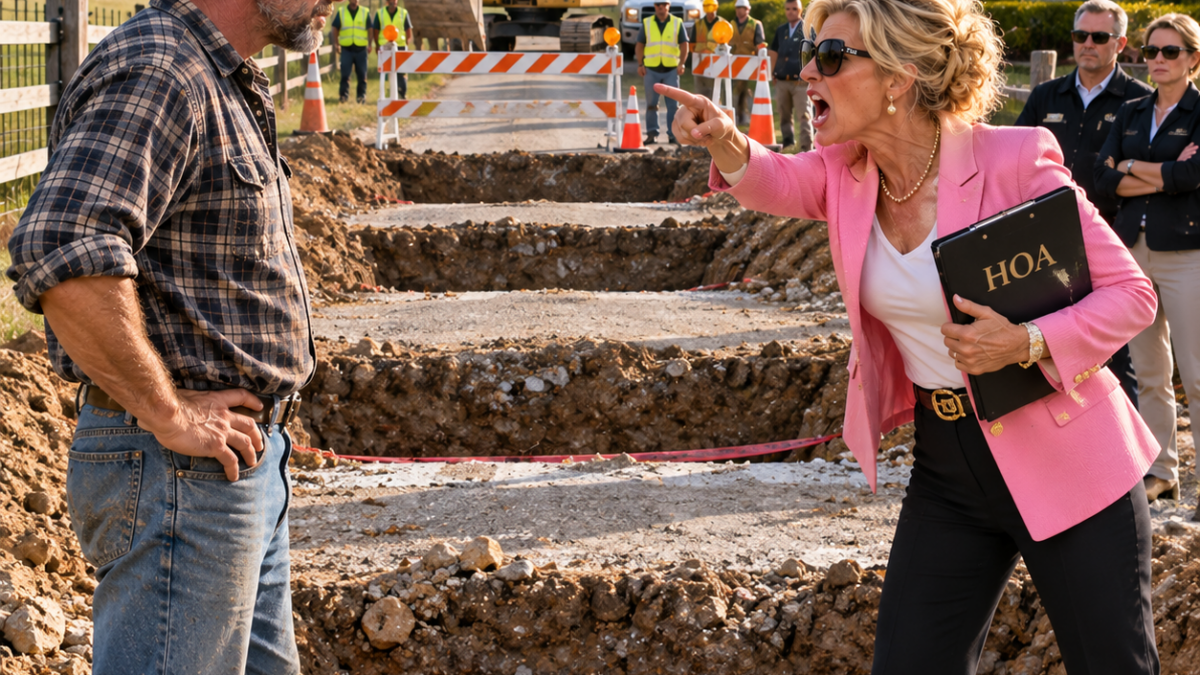
A trench stretched across road.
Maybe four feet wide.
Deep enough I couldn’t cross safely.
Fresh spoil on both sides.
Orange barricade.
ROAD CLOSED — HOA ACCESS PROJECT
I sat there thinking somebody had lost mind.
I put truck in reverse.
My road is narrow there.
No turnaround until field gate sixty yards back.
I backed.
Then stopped.
Second trench.
It had been dug behind me after I drove past that point? No. Impossible. I realized I had entered road from house and second trench was behind because it was farther toward house, but I had somehow crossed? Let’s make geometry clear: first trench at main outlet stops forward. He reverses toward side turnout, finds second trench cut across turnout/secondary spur, not behind the exact path. Need three trenches trap him. Maybe first blocks forward, second blocks nearest turnaround spur, third blocks alternative field bypass. He can still reverse home, but can’t exit property. Title “trap me” means trap on property. Let’s structure.
The first trench blocked the county-road end.
I reversed toward equipment turnout where I could swing around and take old southern farm lane.
That one had second trench.
Then I tried field lane.
Third trench.
Not physically trapped in truck between cuts, but trapped on property.
Let’s continue accordingly.
I backed three hundred feet to equipment turnout.
Another dirt pile.
Second trench across the turnout and southern spur.
That’s where red warning tape hung from exposed soil.
I got out.
Flashlight.
Fresh excavation.
At bottom, a strip of red plastic warning tape hung loose from the trench wall.
Not something I had installed.
Printed black letters partially visible.
I did not climb down.
Construction background enough to know buried-utility warning tape is not decoration.
I photographed from edge.
Then I drove back toward house and tried the old pasture lane connecting to south fence.
Third trench had been cut across that too.
That was moment anger changed.
One trench could be stupid.
Two could be overreach.
Three paths blocked before dawn meant intent.
They wanted me landlocked.
I called sheriff.
Then Rebecca.
Then utility emergency number printed on old easement marker near road.
Why utility?
Because my grandfather granted an underground easement in 1982 to Piedmont Electric & Communications Cooperative.
Back then it was for a distribution control cable and service corridor.
Over decades, easement upgraded.
The cooperative had buried fiber and electrical-control infrastructure under portions of road shoulder.
I did not know exact depth.
I did not need to.
The deed said:
No excavation in easement without notice and utility clearance.
The red tape told me somebody had reached that zone.
At 5:39, utility dispatcher said:
“Do not approach excavation. We’re sending crew.”
At 5:47, Mallerie arrived.
Of course.
White Range Rover.
Stonebridge magnetic door badge.
She stopped at first trench near county-road end.
Two HOA volunteers arrived behind.
Orange vest.
Barricades.
By 6:02, she was directing placement like road superintendent.
I walked up from inside property.
“You did this?”
She folded arms.
“The association installed temporary access controls.”
“You dug three trenches across my road.”
“Across disputed corridor.”
“My deed is not disputed by your shovel.”
“Travis, we’ve tried negotiating for months.”
“So you trapped me?”
“You still have access to your residence.”
“Not to public road.”
“That will be restored once we settle.”
There it was.
Not safety.
Not drainage.
Leverage.
I turned phone recording openly.
“Say that again.”
She smiled.
“You know what terms are on table.”
“No. Explain.”
“Permanent nonexclusive access easement. HOA covers maintenance contribution. You retain ownership.”
“And if I don’t sign?”
“The protective excavations remain until court clarifies.”
I stared.
“You think you can block my only legal road until I give you easement.”
“Our counsel believes disputed access requires preservation.”
That was lie.
Counsel believed opposite.
I said:
“Did board approve digging?”
Her expression shifted.
“The president has emergency authority.”
“For what emergency?”
“Access protection.”
“That isn’t emergency.”
She looked at watch.
“You have paperwork waiting. Sign and we can fill cuts today.”
Coercion rarely announces itself that plainly.
I said:
“No.”
She stepped closer.
“You’re making this unnecessarily difficult.”
“No.”
“Your own land will become less useful if this continues.”
That sentence I remembered word for word.
Then utility trucks arrived.
Two white Piedmont Cooperative vehicles.
One larger service truck.
A supervisor named Aaron Beckett.
He got out.
Hard hat.
Tablet.
Looked at trench.
Then immediately raised hand.
“Everybody stop.”
No equipment was running.
He walked perimeter.
Saw red tape.
His face changed.
“Who excavated?”
Mallerie stepped forward.
“Stonebridge Ridge HOA.”
“Did you request locate?”
“Our contractor handled.”
“Ticket number?”
Silence.
“We were told there were no active lines.”
Aaron looked at her.
“By who?”
“Our site contractor.”
A pickup came around county road.
Vance Site Services.
Robert Vance.
Apparently returning to finish backfill? Or inspect.
He got out and immediately looked uneasy when he saw utility trucks.
Aaron:
“Are you contractor?”
“Yes.”
“Locate ticket?”
Robert:
“Client represented clear.”
Aaron:
“That isn’t answer.”
Robert rubbed neck.
“No ticket.”
Everyone went quiet.
Aaron walked to second trench.
Did not enter.
He asked his crew to set perimeter.
Then checked system.
His radio crackled.
Another technician called.
They had alarms at nearby switching cabinet overnight.
Communications latency.
One control circuit offline.
Fiber degradation.
Not total outage.
Aaron looked down trench.
“Something’s damaged.”
Mallerie said:
“There’s no power outage.”
Aaron turned slowly.
“You don’t have to lose house power to damage utility infrastructure.”
Important sentence.
Utility crew found one conduit crushed and another partially severed along edge of trench.
A buried fiber bundle carrying cooperative telemetry, communications, and leased commercial circuits had been struck.
An adjacent electrical-control conduit was damaged enough that system protection transferred to backup.
Nobody electrocuted.
No neighborhood blacked out.
That was luck.
The red warning tape had been installed above easement during an earlier upgrade.
The excavator had reached it, torn through, kept digging.
At least according to later evidence.
Aaron’s crew shut area down.
County deputy arrived.
Then another.
Mallerie kept telling them civil dispute.
Deputy looked at trenches.
Then at court order copy on my phone.
No alteration of road.
He called supervisor.
By 7:15, the scene looked less like HOA protest and more like utility incident.
Piedmont contacted county emergency management because fiber damage affected monitoring and several public-service leased circuits.
Again, not catastrophic.
Backup systems worked.
But repairs were complicated.
The conduit ran under compacted road.
Splice work.
Testing.
Temporary routing.
Equipment.
Contractors.
Restoration.
And because the damaged cable included leased capacity serving business and public-safety customers, every hour generated documentation.
Mallerie did not seem worried yet.
She kept saying:
“The contractor is insured.”
Robert Vance looked at her.
“That isn’t how this works.”
He had realized client representation might not save him.
By noon, first trench had been temporarily bridged with steel plates under utility supervision so I could exit.
Not by HOA.
Piedmont and county coordinated safe access.
The second trench remained utility work zone.
The third was filled temporarily because no utility issue there.
Mallerie left before lunch.
Not arrested.
Not dragged away.
Real consequences start with letters.
Three days later Stonebridge received preservation notice from Piedmont’s claims counsel.
Then contractor’s insurer.
Then my attorney amended our civil complaint.
Then Stonebridge’s own insurance carrier issued reservation-of-rights letter because intentional excavation outside board authority might not be fully covered.
That got residents’ attention.
Howard Bell called me.
“Travis.”
“Howard.”
“I didn’t approve this.”
“I know.”
“How bad?”
“I don’t know yet.”
“Mallerie says utility damage minor.”
“Ask Piedmont.”
He sighed.
“She told us trenches were temporary erosion controls.”
I almost laughed.
“Across three exits?”
“I know.”
“You need your own lawyer.”
“We have HOA counsel.”
“Not Mallerie’s cousin.”
“What?”
“You didn’t know contractor?”
Silence.
“No.”
There were layers.
Stonebridge board learned Vance Site Services was owned by Mallerie’s cousin.
The $18,600 excavation contract had been approved by Mallerie under “emergency president authority.”
No competitive bid.
No board vote.
No counsel review.
No utility locate request.
No owner permission.
No county excavation permit because contractor claimed private drainage work.
Then emails surfaced.
Robert to Mallerie:
You sure we’re clear to cut? There are markers along road.
Mallerie:
Old line. Owner uses them to scare people. Stay inside 3 locations on map.
Robert:
Need locate if active.
Mallerie:
No time. We need road blocked before Barlow’s title hearing.
That sentence became Exhibit 14.
Another:
Make cuts deep enough trucks can’t bridge with gravel. He needs to understand access works both ways.
I remember Rebecca reading.
Then taking off glasses.
“Travis.”
“Yes?”
“She just wrote intent for us.”
“Apparently.”
“Do not send this to anyone.”
“Why would I?”
“Because angry clients love Facebook.”
“I don’t have Facebook.”
She stared.
“I’ve never been prouder.”
The court hearing on our title case happened eleven days after trenches.
Judge Malcolm Pierce.
Seventy maybe.
He had patience until someone lied.
Stonebridge’s new counsel—because original firm withdrew from representing Mallerie personally—opened by conceding there was no recorded HOA easement over my road.
That was new.
Judge:
“So the association no longer asserts prescriptive access?”
Counsel:
“Not on current record.”
“Necessity?”
“No, Your Honor.”
“Then why was a notice recorded?”
“Prior board position.”
Judge looked at Stonebridge representatives.
Mallerie was present with separate attorney.
Rebecca presented deed.
Surveys.
Prior court order.
Trench photos.
Video.
Emails.
Utility incident report preliminary.
Judge asked:
“Ms. Vance authorized excavation after this court ordered no alteration of disputed road?”
Her attorney:
“She disputes characterization—”
Judge:
“I asked whether she authorized excavation.”
“Yes.”
“Was road owned by HOA?”
“No.”
“Was there an easement?”
“No recorded easement.”
“Was owner consent obtained?”
“No.”
“Was utility locate obtained?”
“No.”
Judge removed glasses.
Room quiet.
“I struggle to understand what legal theory justified a shovel.”
That line made local paper.
He ordered Stonebridge notice-of-access claim canceled.
Permanent injunction against HOA entering, obstructing, altering, or asserting access absent written agreement or future court order.
My road.
Mine.
That should have ended property dispute.
But $2.6 million had not arrived yet.
That came seven weeks later.
Piedmont Cooperative completed damage assessment.
I did not see first until Howard forwarded through counsel.
TOTAL CLAIM: $2,614,883.47
Not simply cost of cable.
People online later imagined one fiber line worth millions.
The claim included:
Emergency response crews.
Specialized fiber replacement.
Control-system testing.
Temporary communications routing.
Third-party contractor mobilization.
Road excavation and restoration.
Replacement conduit.
Equipment rental.
Engineering.
Customer-service credits under leased-circuit agreements.
Damage to monitoring infrastructure.
Inspection costs.
Traffic control.
Legal and claims administration.
Lost-use claims still subject negotiation.
And restoration of the utility easement area.
The single largest category was not even the physical fiber.
It was emergency redundancy and contracted outage exposure.
Stonebridge residents panicked.
Reasonably.
Annual HOA budget was nowhere near $2.6 million.
Insurance coverage became battlefield.
HOA’s general liability carrier argued intentional acts by unauthorized officer might fall outside coverage.
Contractor insurer argued Stonebridge misrepresented site conditions.
Stonebridge argued Vance Site Services had independent duty to request utility locate.
Vance argued HOA gave written assurance.
Piedmont didn’t care about their internal blame.
It sent claim to everyone potentially responsible.
Stonebridge.
Vance Site Services.
Mallerie individually.
Robert individually under certain theories.
Their insurers.
Everyone.
Nobody wrote check next day.
Claims that size become negotiation and litigation.
But $2.6 million number hit.
And Mallerie had spent months telling homeowners access would save them maintenance money.
Now residents faced possibility of special assessment.
Emergency board meeting overflowed clubhouse.
I didn’t attend.
Sarah Kim did and later told me everything.
Howard, now acting president because board suspended Mallerie pending investigation, stood front.
He explained claim.
Someone shouted:
“Two point six million for three holes?”
Howard:
“For utility damage and associated losses.”
Another:
“Why were we digging on his road?”
Good question.
Howard:
“The board did not authorize excavation as represented.”
Mallerie, sitting audience with attorney, stood.
“I acted under emergency powers to protect association rights.”
Residents erupted.
A man named Paul Enright shouted:
“What rights? Judge said we had none!”
Mallerie:
“That ruling came later.”
Howard:
“The prior order already prohibited alteration.”
That was important.
Another resident:
“Why your cousin?”
Silence.
Another:
“Why no utility locate?”
Mallerie:
“The contractor was responsible.”
From back:
“Your emails told him not to!”
That ended whatever control she had left.
Board voted to remove her as president.
The bylaws allowed board to replace officer though member recall needed remove director seat.
Residents scheduled recall.
She resigned board before vote.
Her letter blamed “hostile legal campaign led by an adjacent landowner.”
Me.
I didn’t respond.
The utility claim became a legal war for almost eighteen months.
Not storybook.
Depositions.
Mediation.
Coverage counsel.
Engineers.
Invoices.
Experts.
Who knew what.
Who had duty.
Who paid what.
Final allocation ended far below worst-case direct HOA burden because multiple insurers contributed, contractor accepted significant share, and some claimed consequential damages were negotiated downward.
But the total settlement and repair package remained enormous.
Piedmont ultimately recovered roughly the full direct and negotiated loss across multiple defendants and carriers.
Stonebridge’s portion—through insurer plus association funds—was hundreds of thousands.
Enough to hurt.
Residents paid a special assessment, though nowhere near $2.6 million each or collectively out of pocket.
Their insurer renewed at much higher premium.
Reserve fund took hit.
Landscape expansion canceled.
Clubhouse renovation postponed.
Irony:
The maintenance shortcut that Mallerie wanted across my road would have saved maybe twenty thousand a year.
Her attempt to force it cost the community many times that.
That’s how bad leverage works.
You focus on small gain and stop pricing downside.
My claim against Stonebridge was separate.
Blocked access.
Trespass.
Road damage.
Legal fees.
Slander of title from recorded access notice.
Interference with property use.
I did not sue every homeowner.
I sued association and responsible parties.
Important.
The residents had not dug trenches.
Most didn’t know.
I wasn’t interested in revenge assessment.
We settled.
Stonebridge paid my legal fees and road restoration through insurance/settlement.
Access notice permanently released.
A recorded covenant was added along Stonebridge western boundary acknowledging no vehicular or pedestrian right over Barlow Road without owner agreement.
The pedestrian gate facing road was removed.
Good.
Mallerie?
Civilly, she had bigger problems.
Stonebridge pursued indemnity for actions outside authority.
Vance Site Services sued her after its insurer paid.
Piedmont maintained personal claims tied to intentional misrepresentation, though ultimate resolution confidential.
She sold house about a year later.
Before leaving, she came to my property once.
She stayed outside gate.
Smart.
I was fixing mailbox.
“Travis.”
I looked.
“Mallerie.”
She had no folder.
First time.
“I wanted to say something before we move.”
I waited.
She looked down road.
Fresh gravel where trench scars had been repaired.
“I thought you were being selfish.”
“Okay.”
“I thought you enjoyed having the one thing we needed.”
“You didn’t need it.”
“We needed efficiency.”
“Different.”
She nodded.
“I know.”
That surprised me.
She continued:
“I kept thinking if we could force a temporary inconvenience, you’d finally negotiate.”
“Three trenches.”
“Yes.”
“You damaged a utility.”
“I didn’t know it was active.”
“The warning markers?”
She looked away.
“I believed Robert would handle.”
“He asked.”
“I know.”
Silence.
Then:
“Do you hate me?”
People ask dramatic questions when leaving.
“No.”
She looked surprised.
“I don’t trust you.”
That hurt her more perhaps.
“Hate takes energy.”
She nodded.
“I ruined things for people who had nothing to do with it.”
“Yes.”
That was truth.
She said:
“I thought I was protecting them.”
Maybe.
I believe people often do harmful things while narrating themselves as protector.
That’s what makes power dangerous.
Mallerie did not wake wanting $2.6 million utility claim.
She wanted shortcut.
Control.
A victory.
Then each refusal became personal.
Each legal obstacle became unfair.
Each warning became negotiable.
Eventually she looked at an excavation contractor asking whether utilities were active and answered based on what she needed to be true.
That is how disasters are made.
Not usually one giant evil choice.
A staircase of smaller ones.
She said:
“I’m sorry.”
No qualifiers.
Good.
I nodded.
“I appreciate that.”
She left.
I never saw her again.
Robert Vance lost much of business.
Not because cousin alone.
Utility contractors stopped hiring his company after locate violation became public.
He kept license? State regulators fined and required remedial training. He downsized.
I felt some sympathy.
Some.
He knew better.
Excavators know red warning tape.
“Client told me” is not substitute for safe-dig procedures.
But Mallerie’s emails showed pressure.
He made his choice.
Accountability isn’t all-or-nothing.
The road returned to normal.
That’s the part people forget.
After lawyers, claims, reporters, HOA meetings, there is gravel.
Rain.
Potholes.
Delivery truck.
My dog sleeping middle until I honk.
I repaired with contractor Piedmont approved.
Second trench became strongest section because utility restoration rebuilt base.
Funny.
Third trench I filled myself? No, insurer-paid contractor did. But I later graded.
For months I could see color difference in stone.
Three scars.
Eventually dust matched.
One day Sarah Kim from Stonebridge stopped at gate.
Not crossing.
“Can I ask something?”
“Sure.”
“We’re forming emergency-preparedness group.”
“Okay.”
“We want to know if in actual wildfire emergency county could use your road.”
“County can contact me.”
“Would you allow?”
“If safe, yes.”
She smiled.
“That’s all Mallerie needed.”
“Maybe.”
“Would you have said yes before?”
“Yes.”
“For free?”
“For emergency?”
“Yes.”
She shook head.
“So all this—”
“Wasn’t about emergency.”
“Right.”
She looked embarrassed.
“We believed her.”
“You believed your president.”
“Same?”
“Sometimes.”
She laughed.
Then:
“Thank you for not punishing everyone.”
“I don’t have authority to punish everyone.”
“Still.”
We became decent neighbors.
Stonebridge changed leadership.
Howard served interim.
Then Sarah got elected.
First email she sent me:
We have no request for access. This email is simply to introduce myself.
I replied:
Best HOA email I’ve ever received.
She laughed.
Under her board, no one tried road.
They built a new internal maintenance lane entirely on their property.
Cost $86,000.
Less than one small portion of utility claim.
Sometimes the expensive alternative only looks expensive until compared with stealing shortcut.
They also added turnaround inside western edge.
Landscapers no longer drove three miles? They still did, but route managed.
Nobody died.
Property values survived.
Pool stayed open.
World continued without my road.
That mattered.
Mallerie had framed access as necessity.
It wasn’t.
It was convenience dressed as necessity.
I have become suspicious of that.
When somebody says:
“We have no choice,”
I ask:
“No choice, or no cheap choice?”
Different.
Stonebridge always had choices.
Longer route.
Build lane.
Change vendor schedule.
Pay extra.
They wanted my property because easier.
No shame asking.
Problem began when no wasn’t accepted.
My grandfather would have understood.
He was generous with neighbors.
But clear.
He once let rancher cross during flood.
Then next year rancher assumed.
Granddad blocked gate and said:
“Permission is not inheritance.”
I was nine.
Remembered.
Maybe that’s why Mallerie’s five-thousand offer never tempted.
It wasn’t money.
It was future.
Once HOA holds recorded permanent access, I no longer decide who enters.
The land changes.
Road changes.
Liability changes.
If I sell, easement remains.
My children inherit burden.
All for somebody else’s lawn crew saving mileage.
No.
That’s not stubbornness.
That’s valuation.
Stonebridge’s first attorney later met Rebecca at bar conference and apologized for client? Not necessary, but can add nuanced note.
Rebecca told me one afternoon:
“The weird thing is their original counsel did almost everything right.”
“How?”
“He told them no easement. Told them not to excavate. Told them preserve court order. Told them use legal process.”
“So lawyer wasn’t problem.”
“No.”
“Don’t tell people. Ruins story.”
She laughed.
Real life is inconvenient that way.
Not every lawyer villain.
Not every HOA board.
Not every resident.
One president convinced herself limits didn’t apply.
The system around her failed to stop quickly.
That is more useful lesson.
Stonebridge later changed bylaws.
Emergency contracts above $5,000 require two officers unless true life-safety event.
Related-party vendors disclosed.
No excavation without utility locate ticket and board authorization.
No property-interest claims recorded without counsel approval.
No officer may unilaterally obstruct access to another parcel.
Again:
Rules born from absurdity.
I joked with Sarah:
“Could’ve called it Don’t Dig Travis Road rule.”
She said:
“We considered.”
Good she didn’t.
I do not need name in HOA bylaws.
Piedmont Cooperative improved markings.
They installed permanent above-ground easement posts at intervals.
Red and white.
My road looks slightly uglier.
Fine.
Utility also upgraded section during repair, increasing redundancy.
The $2.6 million claim was not all wasted? Careful—damage waste, repairs improvements secondary. They restored and modernized affected conduit because old design. But don’t imply damage beneficial.
Aaron Beckett visited a year later.
Utility supervisor.
He stood near second trench site.
“You know what saved them from worse?”
“What?”
“Damage didn’t hit the power circuit the way it could have.”
I nodded.
“I don’t want details.”
“Smart.”
“Could somebody have been hurt?”
“Yes.”
That stayed.
Everyone focused on money.
$2.6 million.
Headline.
But people could have been hurt.
That’s more important.
Underground utilities aren’t abstract.
They carry energy and communications.
You don’t dig because angry.
You call.
Locate.
Plan.
Respect easement.
We were lucky cost was financial.
I don’t joke about that part.
The title online became:
HOA Dug Trenches to Trap Farmer—Hit $2.6M Utility Line.
Close enough.
But some versions added explosions.
No.
No explosion.
No flames.
No houses dark for days.
Backup systems worked.
A few circuits degraded.
Repairs controlled.
Reality already irresponsible enough.
Another version says I secretly owned utility.
No.
I didn’t.
Another says I was utility engineer waiting to trap them.
No.
I install fences, repair equipment, manage my property.
My only advantage was reading my deed and remembering easement existed.
There should not need secret identity for private property rights to matter.
I hate stories where lesson is:
They picked wrong man.
Mallerie picked wrong action.
Would have been wrong if I were twenty-five-year-old first-time owner.
Wrong if elderly widow.
Wrong if bank.
Wrong if nobody knew utility existed.
Trespass doesn’t become legal because victim ordinary.
I once told local reporter that.
He didn’t use quote.
Not dramatic enough.
Years passed.
I’m fifty-six now.
Still nineteen acres.
Still road.
My daughter brings grandchildren.
They ride bikes on gravel.
I tell stay away utility markers.
They ask why.
“Because Grandpa likes not getting sued for millions.”
They laugh.
Children think money imaginary.
Probably healthy.
The first trench site lies near big sycamore.
Second near turnout.
Third by lower field.
I know exactly.
Every time grader passes, I remember.
Not anger.
Memory.
One morning after heavy rain, a delivery driver asked:
“Is this Stonebridge access?”
“No.”
“GPS says maybe.”
“GPS is wrong.”
He backed.
Modern version of same problem.
Maps imply.
Land says no.
I contacted mapping services to correct.
Some did.
One still labels “Stonebridge Service Rd.”
Annoys me.
But label doesn’t create easement.
Important.
A surveyor named Felicia Grant came during title cleanup.
Set new monuments along boundary.
I asked:
“Can we put sign every ten feet?”
She laughed.
“Trying start war?”
“Ending.”
We installed three modest signs:
PRIVATE ROAD — BARLOW PROPERTY — NO THRU ACCESS
No threats.
No “violators prosecuted.”
Clear.
Sarah’s HOA paid for landscaping buffer so residents didn’t wander.
Good.
One day Stonebridge child kicked soccer ball through fence.
His father called from other side.
“Mr. Barlow?”
“Yeah?”
“Can I come get ball?”
“Sure.”
He came.
Permission.
Ten seconds.
That is all Mallerie refused to understand.
Permission is not humiliation.
Asking doesn’t make you weak.
No does not make owner hostile.
Boundaries let neighbors coexist.
The whole $2.6 million disaster grew because she treated asking as first step toward inevitable yes.
When yes didn’t arrive, she escalated.
Offer.
Petition.
Historic claim.
Recorded notice.
Court.
Trenches.
At every step there was exit.
She could stop.
That’s what I think about most.
People talk like big mistakes sudden.
Usually not.
Usually many exits passed.
Robert could request locate.
Mallerie could listen counsel.
Board could suspend earlier.
Contractor could refuse.
I could have confronted physically and made worse.
Deputies could have treated merely civil and ignored blockage longer.
Utility could have had weaker backup.
We were lucky multiple people later chose correctly.
Rebecca told me:
“The most important thing you did was call instead of filling trenches yourself.”
I wanted.
I owned tractor.
Could have pushed dirt.
Bad idea.
Potentially damaged utility further.
Destroyed evidence.
Violated investigation perimeter.
Risked injury.
Anger tells you act.
Expertise tells you sometimes don’t.
That was hardest lesson.
At 5:20 that morning, I wanted drive tractor down and shove every barricade into Stonebridge pond.
Satisfying image.
Stupid.
Instead photos.
Calls.
Wait.
Boring saved case.
Boring often wins.
Document.
Preserve.
Ask.
Let people with authority do jobs.
That does not mean passive.
It means targeted.
One evening years later, Howard visited.
He wasn’t board anymore.
Brought beer.
We sat porch.
He said:
“I should’ve stopped her.”
“You voted no.”
“Not enough.”
“What else?”
“Called counsel after meeting. Maybe alerted you.”
“Maybe.”
“She said she was only placing signs.”
“You didn’t know trenches.”
“No.”
He looked toward Stonebridge lights.
“I didn’t want fight.”
“Most people don’t.”
“That’s how she got room.”
That was honest.
Small authority grows in quiet spaces because everyone calculates annoyance.
Not worth argument.
Then one person decides lack of opposition equals approval.
I’ve seen family businesses like that too.
Not unique to HOA.
Good governance requires somebody willing to say:
Show me vote.
Show me authority.
Show me contract.
Show me locate ticket.
Mallerie hated those questions.
Sarah welcomes now.
That is difference.
Piedmont’s final claim file eventually closed.
I asked Aaron how exact $2,614,883.47 became settlement.
He said:
“You do not want enter utility claims accounting.”
“Correct.”
“Smartest thing you’ve said.”
I know initial claim became distributed negotiated amount.
That’s all.
People ask:
“Did HOA really pay 2.6 million?”
Not entirely directly.
Claim was 2.6.
Multiple parties/insurers resolved.
Important distinction.
If your story needs entire HOA writing one check, it’s less accurate.
Residents paid enough.
More than deserved.
Mallerie paid consequences.
Contractor paid.
Insurers paid.
Everyone learned.
My road remains without HOA easement.
Stonebridge never got access.
Did I ever reconsider selling easement?
No.
Maybe emergency license someday if county asks permanent evacuation route? I would evaluate.
Not because grudge.
Facts change.
If public safety genuinely needs, compensate, engineer, record proper terms.
I am not ideologically opposed to easements.
I have one for Piedmont under my own road.
Grandfather granted because utility served region.
It had purpose.
Defined corridor.
Rights.
Responsibilities.
That easement is exactly what exposed Mallerie’s mistake.
Irony.
A legitimate easement protected by law existed underneath road she tried to take through nonexistent one.
She ignored real property right while inventing another.
That may be entire story in one sentence.
The old utility deed is in my safe now.
I copied.
My father had kept folded envelope.
On back in his handwriting:
DON’T DIG NEAR LOWER TURNOUT WITHOUT CALLING CO-OP.
I found after incident.
I laughed until almost cried.
If only Mallerie had read Dad’s filing system.
Though she was never entitled.
My granddaughter asked what note means.
I said:
“It means your great-grandpa knew things.”
“Did Mrs. Mallerie know?”
“No.”
“Why didn’t you tell her?”
“I did tell everyone not to dig.”
“Not same.”
She’s eight and already cross-examining.
I said:
“She wasn’t supposed to be digging at all.”
Satisfied.
Children understand.
At county property-rights seminar, Rebecca asked me to speak.
I declined first.
Then agreed.
People expected dramatic.
I said:
“First, know what you own.”
“Second, know what easements exist.”
“Third, don’t assume a recorded claim is valid just because it was recorded.”
“Fourth, if somebody blocks your access, call counsel and law enforcement before machinery.”
“Fifth, never excavate without utility clearance.”
Everybody laughed at fifth.
I didn’t.
Then they stopped.
Because $2.6 million.
After talk one HOA president approached.
“I hate that these stories make all HOAs look crazy.”
“I agree.”
She seemed surprised.
“You do?”
“Yes.”
“Stonebridge needed governance. Mallerie abused it.”
She nodded.
“I spend most of my time asking people to stop parking boats in fire lane.”
“Useful.”
“Exactly.”
We shook.
Institutions aren’t villains.
Behavior is.
If I taught anything, I hope that.
The road looked ordinary before.
Looks ordinary now.
A mile of gravel.
No dramatic gate.
No checkpoint.
No guard.
Private doesn’t mean fortified.
It means permission.
I still leave gate open sometimes when expecting feed truck.
That does not mean HOA can enter.
Open gate isn’t invitation to everyone.
Same as unlocked porch isn’t community property.
Some boundaries physical.
Some legal.
Both matter.
The morning after final settlement, I drove road at 6:00.
Sunrise.
No barricades.
No trenches.
Reached county pavement.
Stopped.
Looked back.
For months every trip out had reminded me.
That morning it didn’t.
I almost missed significance.
Then realized.
Normal again.
Like other stories, normal was win.
Not Mallerie moving.
Not court order.
Not utility claim.
Being able to drive to hardware store without thinking about HOA.
Freedom often looks boring from outside.
I went for bolts.
Coffee.
Came home.
Stonebridge landscaping crew passed on county road.
They waved.
I waved.
They took long way.
As they should.
Sarah once joked:
“Three extra miles.”
“Yep.”
“All this because of three miles.”
“No.”
“Because she wouldn’t accept no?”
“Exactly.”
Efficiency wasn’t worth ownership.
Convenience wasn’t necessity.
And three miles became millions because somebody tried to erase distinction.
The red warning tape from trench?
Piedmont took most during repair.
Aaron saved small section as evidence, later returned? Utilities likely retain/destroy. Let’s say I received photograph, not tape.
I keep photograph.
Red strip hanging from brown dirt.
At time, I didn’t know what it meant.
Now I do.
It was line between stupid property dispute and infrastructure claim.
But more than that, warning tape was literal version of every warning Mallerie had ignored.
Private-road sign.
Attorney letter.
Recorded deed.
Court order.
Counsel email.
Contractor question.
Buried utility marker.
Red tape.
Warning after warning.
At some point consequences stop being surprise.
That’s how I think about her now.
Not evil.
Not victim.
A person who kept stepping past warnings because she believed objective justified one more step.
Eventually ground itself said stop.
And the ground is less negotiable than an HOA board.
One last thing happened about four years later.
Stonebridge wanted install walking trail near western boundary.
Sarah called.
“Just so you hear from us first.”
“Okay.”
“Entirely inside Stonebridge.”
“Good.”
“No connection to road.”
“Better.”
“We need temporary crane access during bridge installation over drainage swale. Contractor asked if Barlow Road possible.”
I waited.
She continued quickly:
“I told them no unless you independently agree.”
I smiled.
“Where’s crane need to go?”
She explained.
There was actually a practical benefit to me too because they planned repair shared drainage culvert near boundary.
We negotiated a one-day temporary license.
Written.
Insured.
Specific vehicle.
Specific date.
No permanent right.
$1 consideration plus they repaired fence section their construction would affect.
The crane used my road.
One day.
No problem.
Sarah sent thank-you.
Someone might say:
“After all that, you let HOA use road?”
Yes.
Because permission.
Because terms.
Because no means no and yes means yes.
Property rights are not refusing forever.
They are being person who gets to decide.
Mallerie wanted outcome without consent.
Sarah asked.
That is difference between neighbors and adversaries.
When crane left, temporary license expired automatically.
No one pretended historic access.
No one recorded claim.
No trenches.
No utility damage.
Imagine.
All that conflict distilled into basic courtesy.
My father would’ve laughed.
“Could’ve told you that.”
He could.
Probably did.
We just spend money rediscovering old lessons.
Today, if I stand at lower turnout, I can still see slightly different gravel where second trench was repaired.
The utility marker is brighter.
Stonebridge roofs visible through trees.
Kids sometimes ride bikes behind fence.
No hostility.
The road goes west to my house and east nowhere because it never belonged to subdivision.
That’s enough.
If somebody asks why I never took Mallerie’s original $5,000 annual offer, I tell them truth.
It wasn’t about price.
There was no number that made sense for permanent convenience easement I didn’t want.
Maybe $100,000?
Still no.
A million?
Then I’d think, because I’m not saint.
But ownership has value beyond appraisal.
Control.
Future.
Silence.
The ability to decide tomorrow.
People underestimate that until contract removes it.
Mallerie didn’t understand my no because she thought every boundary was negotiation.
Then when negotiation failed, she tried creating leverage physically.
Three trenches.
One at exit.
One at turnaround.
One at alternate lane.
She wanted me sitting inside my own land feeling cost of refusal.
Instead those trenches exposed a utility easement older than her subdivision, violated a court order, documented coercive intent, and put her association into a $2.6 million claims fight.
The irony is almost too clean.
But the lesson isn’t:
Don’t mess with Travis Barlow.
It is:
Don’t confuse somebody else’s inconvenience with your entitlement.
Don’t record rights you don’t own.
Don’t dig where you don’t have permission.
Don’t ignore utility warnings.
And never mistake a person’s refusal to fight you physically for weakness.
That morning, I could have driven tractor into barricades.
Could have screamed.
Could have shoved dirt.
Could have given Mallerie exactly the confrontation she expected.
Instead I took photographs.
Called sheriff.
Called lawyer.
Called utility.
Then waited.
By noon, her barricades were evidence.
By month, her access claim was gone.
By year, Stonebridge was writing checks it never imagined.
And my road?
It stayed exactly what it had been since my grandfather shaped the first version with borrowed equipment in 1968.
Private.
Recorded.
Useful.
Mine.
The only thing different now is a small sign near lower turnout beside the new utility marker.
Sarah asked permission before HOA paid to install it.
I said yes.
It reads:
UNDERGROUND UTILITY CORRIDOR — DO NOT EXCAVATE WITHOUT AUTHORIZATION AND REQUIRED LOCATES.
Below that is my own smaller sign.
Nothing threatening.
Nothing clever.
Just five words.
PRIVATE ROAD. ASK BEFORE ENTERING.
That’s all Mallerie ever had to do.