HOA Karen Cut My Locked Farm Gate to Use My Field as a Shortcut—Then Her Luxury SUV Sank Into the Posted Drainage Trench She’d Been Warned About.
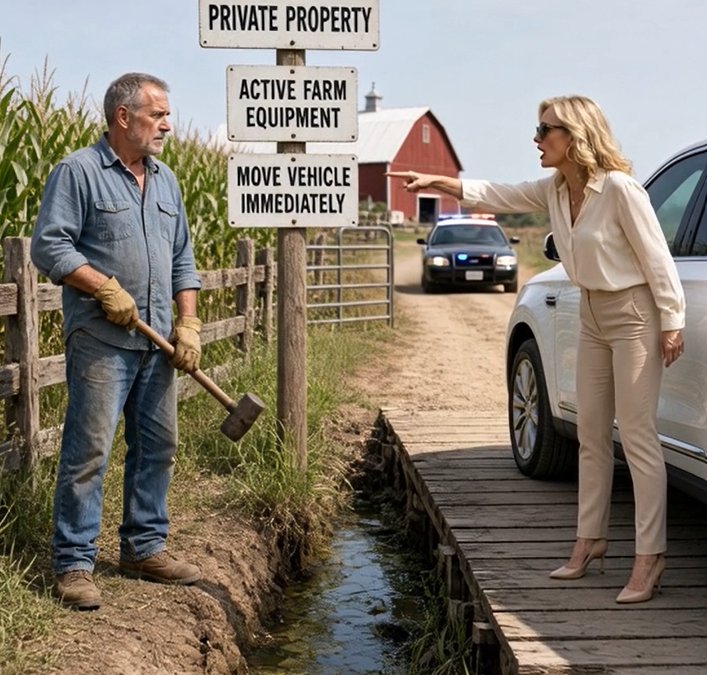
PART2
“He created that trench because he knew I would drive through here.”
Morrison glanced toward the county permit sign attached to my fence.
“It’s a drainage swale.”
“It’s a trap.”
“It’s permitted.”
“He knew I use this route!”
I nodded.
“That may be the first accurate thing she has said this morning.”
Karen spun.
“You think this is funny?”
“No.”
I looked beyond her SUV.
At the recovering corn rows.
At the repaired irrigation line.
At Daisy grazing farther east with the herd.
“I think it took you six months to discover that private property eventually stops being convenient.”
She jabbed one muddy finger toward me.
“You’re going to prison.”
Morrison raised an eyebrow.
“For what?”
“He destroyed my vehicle.”
The sheriff looked again.
Then down at his boots.
“Ground is not usually charged with vandalism.”
Karen opened her mouth.
Nothing came out.
For six months she had treated my farm as though it were the unfinished southern annex of Green Meadows Estates.
That morning, the land finally disagreed.
My name is Marcus Chen.
Before moving to Nebraska, I spent nineteen years working in corporate logistics.
Warehouses.
Transportation networks.
Distribution routes.
Mechanical loading systems.
Freight schedules.
Procurement.
Inventory.
Emergency planning.
I was good at it.
Very good.
That was part of the problem.
Companies reward competence by giving competent people increasingly ridiculous amounts of work.
By my final year, I had become the human equivalent of a junction box.
Everything went through me.
My calendar contained meetings about meetings that had not yet been scheduled.
Lunch happened at a desk.
Vacation meant answering emails from a different state.
I owned a condominium with a beautiful kitchen I rarely used and windows overlooking downtown that I usually saw after dark.
The moment I quit was not dramatic.
No shouting.
No heart attack.
No inspirational speech.
I was sitting alone in a break room at 11:31 one night.
A vending-machine packet of crackers in front of me.
Coffee burning on the warmer.
One fluorescent tube flickering overhead.
My phone buzzed.
URGENT.
A shipment delay.
Something that felt catastrophic to six executives that night and would be forgotten within a month.
I stared at the screen.
Then at a window that did not open.
And I thought:
I do not want to die inside a building where the windows do not open.
That was it.
Within eleven months, I resigned.
Sold the condo.
Moved sixty miles outside Omaha to seventy acres near a small town called Silver Ridge.
The farm had pasture.
Corn ground.
Soybean acreage.
A creek.
An exhausted farmhouse.
And a barn that leaned slightly east as though it had spent sixty years listening to the wind.
I loved it immediately.
It was also completely outside Green Meadows Estates.
I checked.
Repeatedly.
Deed.
Survey.
Title.
County GIS.
No easement.
No shared roadway.
No access lane.
No HOA jurisdiction.
Nothing.
That mattered because Green Meadows bordered my northern property line.
It was one of those newer planned subdivisions built for people who wanted rural views without most rural realities.
Curving streets.
Large homes.
Decorative trees.
Stone entrance columns.
Walking paths.
Small clubhouse.
Lawns manicured so evenly they looked computer-generated.
Most people there were perfectly normal.
Teachers.
Accountants.
Nurses.
Military families.
Business owners.
People with kids, mortgages, dogs, and weekend plans.
For three years, we had no problems.
I rebuilt the farmhouse.
Straightened most of the barn.
Started a small cattle herd.
Planted corn.
Learned soybean farming badly, then less badly.
Corporate logistics taught systems.
Farming taught humility.
You could build the perfect schedule and lose three days to rain.
You could calculate feed to the pound and have one heifer decide the water trough looked suspicious.
You could spend four hours repairing something a cow would bend again by sunset.
It was harder work than my corporate career.
It was also honest.
At the end of each day, something existed that had not existed that morning.
A repaired fence.
A cleared ditch.
A stacked load of hay.
Straight rows.
Healthy cattle.
I slept better.
Then Karen Petton drove into my cornfield.
The first time, I assumed she was lost.
It was late May.
The corn had emerged only weeks earlier.
Small green shoots stood in neat rows.
I was fixing a barn hinge when I heard an unfamiliar engine.
A white SUV came down my private gravel lane.
That itself was unusual but not alarming.
Delivery drivers got turned around.
People followed bad GPS directions.
The SUV reached the barn.
Did not stop.
Turned directly into the field.
The tires crushed the first two rows.
I stepped out.
Raised a hand.
“Ma’am!”
The driver continued another thirty yards.
Stopped.
A woman climbed out.
White blouse.
Large sunglasses.
High heels.
She locked the SUV.
Then started walking toward Green Meadows.
“Excuse me!”
She glanced over.
“This is private property.”
“Oh.”
Not apology.
Not surprise.
Just recognition of information she had not requested.
“You can’t park there.”
“I’ll only be an hour.”
“That is corn under your vehicle.”
She looked down.
Actually looked.
Then laughed.
“This area has always been used for overflow parking.”
“By whom?”
“The HOA.”
“No.”
She lowered her sunglasses.
“No?”
“The HOA doesn’t own this field.”
“You must be new.”
“I’ve lived here three years.”
She waved one hand.
“Then perhaps nobody explained how things work.”
“My deed explained it.”
That stopped her.
“I’m Karen Petton.”
“Okay.”
“I sit on the Green Meadows board.”
“I’m Marcus Chen.”
I pointed.
“You’re standing in my corn.”
Her mouth tightened.
“Green Meadows has community-access rights through the western buffer.”
“No, it doesn’t.”
“We have maps.”
“I have a recorded deed.”
She turned.
“I’ll move after the luncheon.”
“You’ll move now.”
Karen continued walking.
That was my introduction to her.
The first encounter tells you something about a person.
The second tells you whether the first was a mistake.
Two days later she came back.
Same SUV.
Same field.
This time farther in.
She crushed another section of seedlings.
When I confronted her, she did not claim confusion.
“The cul-de-sac is crowded.”
“That is not my problem.”
“It affects community access.”
“There is no community access.”
“You’re being hostile.”
“You’re trespassing.”
Karen smiled.
“You farmers are very territorial.”
I looked at flattened corn beneath her SUV.
“That is another word for owning something.”
She left the vehicle for nearly two hours.
I photographed.
Documented.
Estimated crop damage.
Did not tow.
Did not block.
Did not touch.
Third time, she drove through at speed.
Music through open windows.
Mud sprayed.
She honked twice while passing.
Laughing.
That was when I understood.
Karen was not looking for parking.
She was establishing precedent.
Each time she crossed my land without immediate consequence, the next crossing felt more legitimate to her.
Human beings do this constantly.
Push boundary.
Nothing happens.
Push again.
Soon the absence of resistance gets rewritten as permission.
Then other Green Meadows residents started using the field too.
A minivan parked near my irrigation equipment.
Two SUVs crossed during neighborhood birthday party.
A sedan avoided my gravel-drive gate by driving over grass.
One man waved like I worked event parking.
I stopped him.
“Where are you going?”
“Green Meadows.”
“Use Green Meadows entrance.”
“Karen said we could cut through.”
“Karen doesn’t own this.”
He looked genuinely confused.
He apologized.
Backed out.
That mattered.
Most people were not malicious.
They had been told something repeatedly.
“Historic access.”
“Community buffer.”
“Overflow parking.”
If the person saying it carried a clipboard and HOA title, people assumed she knew.
That is how false authority grows.
Not because everyone is stupid.
Because most adults do not pull deeds before attending a baby shower.
I began documenting.
Every vehicle.
Every time.
Date.
Photographs.
Tracks.
Damage.
My logistics habits returned.
If something repeats, track it.
Then Karen brought her dog.
Tiny white animal in pink harness.
Maybe twelve pounds.
I was checking fence near cattle pasture.
Karen parked.
Opened rear door.
Dog jumped out.
No leash.
It ran immediately toward cattle.
Barking.
My herd scattered.
Cattle are large.
People think that means fearless.
It does not.
Prey animals can panic over surprisingly small things.
The dog rushed fence line.
Barked.
Ran.
Karen laughed.
“He thinks he’s a ranch dog.”
“Call him.”
“He’s playing.”
“Call your dog.”
One of my pregnant heifers, Daisy, turned too fast on wet ground.
Her back legs slipped.
She slammed sideways into a fence post.
I ran.
“CALL YOUR DOG!”
Karen’s smile vanished.
“You don’t need to yell.”
“Your dog is frightening livestock.”
“Then train them not to be so dramatic.”
Daisy tried to rise.
Her rear leg trembled.
Something in me went cold.
“Get the dog.”
“Excuse me?”
“Get your dog and leave.”
“You cannot speak to me that way.”
“Leave.”
Maybe she heard something different in my voice.
She collected dog.
Muttered:
“Aggressive behavior.”
Then drove off.
The veterinarian arrived an hour later.
Daisy had no broken bones.
But severe bruising.
Stress.
Pregnancy.
The calf’s heartbeat was weak.
We watched.
Two days later Daisy lost it.
I found her beside the tiny body early morning.
She kept nudging.
Once.
Wait.
Again.
Farm animals do not grieve like people.
But they recognize absence.
Daisy remained beside the calf until I removed it.
That changed me.
Until then, Karen had been annoying.
Expensive.
Entitled.
Now her behavior had harmed something living that had no part in our dispute.
And she had laughed.
I started with signs.
Large.
Reflective.
PRIVATE PROPERTY.
NO VEHICLE ACCESS.
ACTIVE FARM.
TRESPASSERS WILL BE REPORTED.
Karen drove past.
I added reflective posts.
Someone splashed them with mud.
Cones.
Moved into ditch.
Then attorney.
James Sutton had practiced property law long enough to be unimpressed by confident nonsense.
He studied my deed.
Survey.
Title.
Photos.
Then Karen’s email attachment.
Pink dotted line across my field.
HISTORICAL COMMUNITY ACCESS ZONE.
HOA logo.
No legal description.
No surveyor seal.
No county recording.
No scale.
No date.
Jim stared.
“Did she create this in PowerPoint?”
“Possibly crayons.”
He almost laughed.
Then:
“This is more serious than it looks.”
“How?”
“She is turning repeated trespass into an asserted legal right.”
“She can’t.”
“She can try.”
“Months aren’t historic use.”
“Correct.”
“But we need record that use was contested.”
He drafted cease-and-desist.
Certified mail.
Property description.
No easement.
Prior damage.
No permission.
Future entries would be knowing trespass.
Karen signed delivery.
The next morning, the letter was shredded in my field.
Fresh tracks over pieces.
At 3:12 that afternoon, email.
Green Meadows rejects your unilateral interpretation of the community buffer. The association has exercised access rights for decades. We expect cooperation.
I replied:
There is no recorded easement. Your map has no legal validity. Do not enter my property.
Her response:
We’ll see, Marcus.
That was when I installed trail cameras.
Not hidden traps.
Ordinary cameras.
Gate.
Field.
Pasture.
Good enough resolution for plates.
Cloud backup.
Time stamps.
Karen called sheriff before I did.
Tuesday afternoon she arrived with Sheriff Dale Morrison.
I came around barn.
She pointed.
“That’s him!”
Morrison had twenty-two years county law enforcement.
Tall.
Lean.
Permanent expression of a man who had heard many dramatic versions of ordinary events.
“Afternoon, Marcus.”
“Sheriff.”
Karen pressed a hand to chest.
“He threatened me.”
Morrison looked.
“How?”
“He blocked my vehicle.”
“Where?”
“The HOA access lane.”
“There is no HOA access lane.”
Karen stared.
Morrison said:
“Start at beginning.”
She explained.
I had supposedly run from barn screaming.
Said I would “deal with her personally.”
Blocked escape.
She feared for life.
Morrison asked:
“What time?”
“Twenty minutes ago.”
I opened phone.
Trail camera.
First clip:
Karen entering past PRIVATE PROPERTY.
Second:
Karen leaving SUV.
Me standing more than one hundred yards away beside barn.
Third:
Karen returning alone.
Middle finger at camera.
Driving through corn.
Continuous time stamp.
No confrontation.
Morrison watched twice.
Karen:
“That footage has been manipulated.”
“It appears continuous.”
“He edits things.”
Morrison looked at me.
“Do you?”
“Not those.”
Then he said something Karen did not expect.
“I checked county records before coming.”
She stiffened.
“There is no public easement.”
“Your records are incomplete.”
“I checked title.”
“HOA has documentation.”
“Give it to your attorney.”
“These signs are illegal.”
“Why?”
“They interfere with historic community use.”
Morrison sighed.
“Historic use doesn’t mean you can drive through planted corn.”
Karen folded arms.
“You should arrest him.”
“For what?”
“Harassment.”
“He was beside his barn.”
She stared at me.
Morrison continued:
“I’m documenting both complaint and property dispute.”
Then directly:
“Mrs. Petton, you now have explicit notice from owner and law enforcement that you are not permitted to enter this property.”
“You cannot issue that order.”
“The owner just did.”
He looked at me.
“I witnessed.”
Karen started again.
He raised hand.
“If you return without permission, confusion is no longer argument.”
“It becomes knowing trespass.”
She slammed SUV door.
Accelerated.
Mud sprayed over my jeans.
Morrison watched.
“She’ll be back.”
“Yes.”
“Keep documenting.”
“I will.”
Two days after Daisy lost her calf, I woke to find three Green Meadows vehicles parked in lower pasture.
Baby shower.
One SUV had blue and yellow balloons on mirror.
A woman carrying a gift bag waved.
“Thanks for letting us use field!”
“I didn’t.”
Her face changed.
“What?”
“Private property.”
“Karen said HOA overflow.”
“She lied.”
I showed deed and signs.
Drivers apologized.
Moved.
One woman returned later with a card.
Not necessary.
But decent.
That was when I stopped thinking of Green Meadows as enemy.
Karen was using them too.
I contacted board president directly.
Harold Vance.
Retired banker.
He replied quickly.
“We’ve never voted to claim access across your property.”
“What?”
“Karen says preexisting easement.”
“She sent map?”
“Yes.”
“No deed?”
“She says records pending.”
I emailed my deed.
Jim Sutton’s letter.
Sheriff notice.
Trail photos.
Harold replied next day:
We are retaining independent counsel.
HOA attorney reached same conclusion.
No easement.
No prescriptive access.
No common ownership.
No recorded community buffer.
The board formally instructed Karen not to represent otherwise.
She ignored them.
Meanwhile, I had an actual property problem.
Western edge drainage.
Years of erosion.
Standing water after irrigation.
Soil unstable.
I had postponed fixing because farming offers infinite ways to postpone expensive work.
Now I applied with county conservation office.
Engineer inspected.
Recommended shallow drainage swale.
Native grass.
Reinforced fencing.
Raised agricultural crossing farther south.
He pointed at old route Karen used.
“That section won’t support passenger vehicles when wet.”
“I know.”
“Post signs.”
“Yes.”
“Fence.”
“Yes.”
“And Marcus?”
“What?”
“Do not create any structure intended to damage vehicles.”
I laughed.
“I want vehicles out, not damaged.”
“Good.”
Everything permitted.
Survey flags.
County inspection.
Fence.
Locked gate.
Bright warning signs.
I sent photos and written notice to:
Karen.
HOA attorney.
Harold.
Sheriff Morrison.
County.
Certified mail.
Karen signed.
For three weeks:
peace.
Corn recovered.
Cattle settled.
Daisy returned to normal feeding.
No vehicles.
I started believing problem had ended.
Then Karen cut the chain.
Trail camera caught all.
7:42 a.m.
White SUV approaches.
Stops.
She exits.
Walks to gate.
Reads signs.
Looks around.
Returns vehicle.
Retrieves bolt cutters.
Cuts chain.
Not pushes gate.
Not misunderstanding.
Cuts.
Pushes open.
Drives onto soft route.
She did exactly what warning predicted.
Front tires sank.
Instead of reversing immediately, she accelerated.
Anyone who has farmed clay knows that is often worst thing.
Mud sprayed.
Wheels dug.
She turned left to go around.
Driver front tire entered drainage swale.
SUV dropped.
Done.
Camera captured the whole thing.
By time I arrived, she was outside covered in mud.
One shoe missing.
“You did this!”
“You cut my lock.”
“You knew the ground was unstable.”
“That is why gate exists.”
“You left no access.”
“There is not supposed to be access.”
“I had a board meeting.”
“Use public road.”
“It takes seven extra minutes.”
Seven.
Minutes.
Six months of damage.
Killed seedlings.
Broken irrigation.
Vet bill.
Dead calf.
Legal letters.
Sheriff warning.
Cut gate.
Because public route added seven minutes.
That was when I finally understood the scale.
This had never been need.
It was refusal to be inconvenienced by someone else’s ownership.
Karen pulled folder from SUV.
“This is a certified cease-and-desist.”
I looked.
Letter from Karen personally.
Not attorney.
It ordered me to remove gate and restore HOA access within twenty-four hours.
“You wrote this.”
“On behalf of Green Meadows.”
“Board approve?”
She did not answer.
“You cannot do this.”
She shouted.
“It’s my land.”
“Are you going to help me?”
“You’re standing in my field.”
“I could have been killed!”
“You drove onto posted soft soil.”
“You don’t know how fast.”
“The camera does.”
Her face changed.
Then sirens.
Sheriff Morrison arrived.
Karen ran toward cruiser.
“He built a trap.”
Morrison looked at signs.
Cut chain.
Bolt cutters.
SUV.
Then me.
“Permit?”
I handed.
“Inspection?”
Handed.
“Notice?”
Certified receipt.
Karen’s signature.
He looked at date.
“Twelve days ago.”
Karen said:
“That doesn’t make conditions safe.”
Morrison:
“It told you conditions were unsafe.”
“He is taking my access away.”
“There is no access right.”
“He knew I would drive through.”
Morrison looked at her for a long moment.
Then:
“Mrs. Petton, did you cut this chain?”
“I removed an illegal obstruction.”
“Did Mr. Chen give permission?”
“The HOA has rights.”
“No.”
“I am board member.”
“Not here.”
He took citation book.
Karen stared.
“What are you doing?”
“Criminal trespass.”
Her face changed.
“And property damage to lock and gate.”
“You cannot cite me.”
“I warned you personally.”
“This is retaliation.”
“No, ma’am.”
He pointed toward SUV.
“Retaliation would be Mr. Chen damaging your property after you damaged his.”
Then at mud.
“This is mud.”
Karen called husband.
Speaker.
“Richard, get out here. Marcus trapped my SUV.”
Long silence.
Then tired male voice:
“Karen, why are you on his land again?”
Her face changed.
“He blocked the HOA route.”
“There is no HOA route.”
“You’re taking his side?”
“I’m taking the attorney’s side.”
“You knew?”
“I told you last week.”
Karen lowered phone.
“You never support me.”
“I am trying to stop you from getting arrested.”
Morrison cleared throat.
“That opportunity may have passed.”
Silence.
Karen ended call.
Called Harold.
“Send HOA counsel.”
“Where are you?”
“Chen’s farm.”
“Why?”
“My vehicle is stuck.”
“Did you enter through locked gate?”
Silence.
Harold exhaled.
“Karen.”
“I need counsel.”
“The board voted yesterday.”
“On what?”
“We removed you from access committee.”
“You can’t.”
“We did.”
Her expression emptied.
Harold continued, speaker loud enough all heard:
“Green Meadows does not claim any access right across Chen property.”
“You are abandoning me.”
“No.”
“We are refusing to repeat a claim our attorney determined is false.”
Call ended.
Karen stood still.
That may have been real turning point.
Not SUV.
Not citation.
The title she had wielded for months stopped working.
Her authority had not been stolen.
People simply stopped pretending she possessed authority she never had.
Tow truck arrived.
Walt Brennan.
Big man.
Gray beard.
Overalls.
He walked around SUV.
Whistled.
“That’ll be expensive.”
Karen stood near road in one muddy shoe.
“How expensive?”
“Extraction maybe seven hundred.”
She inhaled.
“And repairs?”
“Can’t tell.”
He pointed.
“Possible sensors.”
“Underbody.”
“Wheel alignment.”
“Water intrusion.”
“This is his fault.”
Walt looked at signs.
Cut chain.
Then her.
“Did he drive it?”
“No.”
“Then I’d argue with whoever did.”
He connected straps.
SUV emerged slowly.
A long sucking sound.
Rear-window HOA sticker finally peeled off and dropped into mud.
Nobody retrieved.
Karen called insurer.
Explained.
I could hear pieces.
Private land.
Disputed access.
Cut gate?
Long silence.
“What do you mean intentional conduct?”
Another.
“I did not intentionally damage vehicle.”
She looked at me.
“He caused conditions.”
Representative apparently disagreed.
Call ended.
The anger had drained.
Shock remained.
Consequences had always belonged to other people.
Crop damage belonged to farmer.
Fines belonged to homeowners.
Seven extra minutes belonged to drivers.
Cattle stress belonged to livestock.
Legal bills belonged to Marcus.
Now invoice had her name.
Sheriff handed citation.
“There will also be documentation for gate and crop damage.”
Karen looked at me.
“You planned this.”
“I planned drainage.”
“You knew I’d ignore signs.”
“I hoped you wouldn’t.”
“You wanted it.”
“No.”
I looked toward Daisy.
Karen followed.
“I wanted you to stop before something worse happened.”
“What does that mean?”
“Your dog caused Daisy to fall.”
“That wasn’t proven.”
“She lost calf two days later.”
“I never touched animal.”
“No.”
I looked at SUV.
“You rarely touch things you damage.”
She had no answer.
Green Meadows suspended her that evening.
Within a week, she resigned.
Formal HOA letter arrived.
It acknowledged:
No easement.
No access right.
Karen’s representations unauthorized.
Corrected maps distributed to every household.
Most people apologized.
Baby-shower woman brought feed-store gift cards.
I refused reimbursement.
Accepted apology.
A retired teacher named Carol organized volunteers to repair fence.
Harold met me at property line.
“We should have challenged her sooner.”
“Yes.”
He looked surprised.
Most people expect false comfort.
I continued.
“Not entirely your fault.”
“But you let her speak for organization after you stopped verifying.”
He nodded.
“She was useful.”
“That is usually how it begins.”
“She handled complaints.”
“Contractors.”
“Meetings.”
“People liked that she got things done.”
“And stopped asking how.”
“Yes.”
He looked toward subdivision.
“We’re rewriting procedures.”
“Publish maps.”
“We will.”
“No property-right claim without recorded documentation.”
“Agreed.”
“No board member inventing maps.”
Harold laughed despite himself.
“That one is now explicit.”
The HOA did not dissolve.
Good.
HOAs are not inherently evil.
Shared pools.
Common landscaping.
Snow removal.
Road issues.
Budgets.
Those require organization.
Green Meadows became smaller in behavior.
Quieter.
Transparent.
And most importantly, its authority stopped exactly at its boundary.
That was all I had wanted.
Karen’s case did not lead to prison.
Real life is usually less theatrical.
She pleaded no contest.
Fines.
Restitution for gate and crop damage.
Community service.
Part of SUV repair not covered because insurer argued she knowingly drove into restricted conditions after cutting gate.
Her husband Richard moved out months later.
I never learned whether farm dispute caused marriage collapse.
Probably not alone.
Problems that large usually predate public event.
Karen sold SUV.
Later saw her in modest gray sedan.
Public road.
She did not look toward farm.
I did not wave.
Daisy recovered.
Next spring she delivered healthy calf.
Bull calf.
Strong.
Sheriff Morrison stopped by around then.
I told him:
“I named him Morrison.”
He stared.
“Why?”
“Because he arrived after trespass incident.”
“That’s terrible.”
“Too late.”
“Please don’t tell anyone.”
I told everyone.
The drainage restoration worked.
Standing water reduced.
Native grass established.
Raised crossing handled farm equipment.
No passenger vehicles entered.
I kept cameras.
Documentation is not revenge.
It is memory that cannot be argued with.
One year later Morrison stopped while I repaired a gate.
“You know people tell story wrong.”
“How?”
“They say you built some machine that swallowed Karen’s SUV.”
“I did not.”
“Others say remote-controlled gate forced her into ditch.”
“No.”
“One version has retractable bridge.”
I looked at him.
“That sounds expensive.”
“You pressed a button.”
“I was holding coffee.”
“That’s boring.”
“Truth often is.”
He leaned on cruiser.
“So what happened?”
“She cut lock.”
“Drove past six signs.”
“Entered posted soft ground.”
“Accelerated when she sank.”
“Got stuck.”
Morrison nodded.
“That will never go viral.”
“Good.”
He looked over drainage area.
“Do you regret not doing something more dramatic?”
I looked across corn.
Daisy and calf.
Creek moving.
Barn upright-ish.
“No.”
Karen wanted confrontation big enough to transform herself into victim.
I never gave her one.
I gave:
Certified letters.
Recorded deed.
Survey.
Camera.
County permit.
Locked gate.
Signs.
Sheriff notice.
Opportunities to turn around.
She defeated herself one deliberate decision at a time.
That was more satisfying than trap.
People ask:
Did she deserve SUV damage?
Wrong question.
Lesson is not deserving mud.
Lesson is boundaries.
For six months Karen believed a rule stopped mattering when inconvenient.
She believed repeated false statement could become property right.
She believed confidence was evidence.
She believed HOA title traveled across fence.
Mud did not prove she was bad person.
It proved physical world remained solid even when she rejected limits.
My farm had survived drought.
Hail.
Equipment failures.
Commodity prices capable of ruining a season.
It could survive Karen Petton.
But peace does not protect itself.
Sometimes peace needs signs.
Lawyers.
Cameras.
Sheriff willing to read deed before accepting loudest story.
And sometimes it needs locked gate strong enough that crossing requires a person to make decision obvious.
That is why chain mattered.
Before, Karen could claim confusion.
After she cut lock, confusion ended.
Intent began.
Jim Sutton said:
“Never underestimate usefulness of making bad behavior choose itself.”
I liked that.
Months later, county civil proceeding over damage.
Karen’s attorney tried argue drainage project foreseeable hazard.
County engineer testified.
Authorized.
Proper slope.
Proper signs.
Fenced.
No road.
Designed environmental restoration.
Not vehicular trap.
Then footage.
Karen with bolt cutters.
That ended most argument.
Her lawyer approached settlement.
Gate.
Crop loss.
I included veterinary costs related Daisy.
Causation challenged.
We compromised.
I did not need every dollar.
I needed record.
Karen wrote check.
Jim handed.
“You happy?”
“No.”
“Why?”
“Dead calf stays dead.”
He nodded.
Legal remedies are translation.
They turn harm into dollars because court cannot undo time.
Useful.
Incomplete.
A few Green Meadows residents continued defending Karen.
They said:
“She believed access existed.”
At beginning perhaps.
Not after deed.
Not after attorney.
Not after board.
Not after sheriff.
Belief can be mistaken.
Persistence after evidence becomes choice.
One man named Eric came to farm.
Polite.
“You really never allowed road?”
“No.”
“Previous owner?”
“I asked.”
“Occasional neighbor use decades ago.”
“No deeded right.”
“But if people used historically…”
“Permission or tolerated use isn’t ownership.”
He nodded.
“I thought Karen said HOA maintained it.”
“Did they?”
“No.”
“Plowed?”
“No.”
“Graveled?”
“No.”
“Insured?”
“No.”
“Then?”
He laughed.
“Fair.”
That mattered too.
I did not want Green Meadows humiliated.
Most people had simply trusted board member.
We put proper fence-line markers.
HOA paid surveyor independently.
Maps distributed.
Children could still visit farm days by invitation.
I hosted elementary agriculture tour eventually.
Karen had nearly made me shut everyone out.
I refused.
Entitlement and generosity are not opposites.
You can enforce boundaries and still open gate willingly.
That distinction became important.
A family asked permission to photograph graduation pictures by barn.
Yes.
Green Meadows gardening club asked whether they could tour native-grass drainage project.
Yes.
A father asked if kids could walk through field as shortcut without vehicles.
No.
Not during growing season.
Maybe after harvest if arranged.
He accepted.
Normal humans can hear no.
That is how you tell difference.
Karen’s insistence made ordinary cooperation seem revolutionary.
Three years after, I attended Green Meadows meeting by invitation.
Harold retiring.
New bylaws.
Residents voted.
No invented easements.
Conflict-resolution process.
Board members prohibited from unilateral property representations.
Maps attached.
Property disputes required counsel.
Complaints logged.
Karen’s name never mentioned.
Good.
Systems should learn without turning one person into eternal ritual.
After meeting, Harold handed beer.
“You think we went too far?”
“With paperwork?”
“Yes.”
“No.”
“You’re former logistics.”
“Exactly.”
He laughed.
“Of course.”
Then:
“Would you ever join board?”
“No.”
“You don’t even live in HOA.”
“That too.”
“Thought I’d ask.”
No.
Still powerful.
Years later, when asked why I left corporate life, I told truth.
I wanted windows that opened.
Farming gave more than that.
It taught property is not abstraction.
Fence line affects animals.
Drainage affects soil.
One careless tire damages weeks of growth.
One loose dog can panic herd.
One false map repeated often enough can alter behavior of dozens.
Boundaries are not about hostility.
They coordinate responsibility.
If cow gets out, mine.
If your SUV drives in, yours.
If HOA pool leaks, theirs.
Clear lines reduce conflict.
People like Karen experience line as personal rejection because they confuse access with status.
Seven extra minutes.
That still amazes.
All this over seven minutes.
Public road into Green Meadows required loop around northern entrance.
Karen’s illegal shortcut saved roughly seven.
She damaged crops.
Lost board seat.
Paid fines.
Damaged luxury SUV.
Strained marriage.
All to save seven minutes.
I once calculated because logistics habits die hard.
Suppose she used shortcut twice weekly for year.
Seven minutes each direction maybe fourteen.
728 minutes.
About twelve hours.
She risked everything over twelve annual hours.
That is not efficiency.
That is entitlement disguised as optimization.
Corporate life taught me to quantify.
Farm taught me some costs cannot.
Daisy’s calf.
No number.
Stress.
Peace.
Feeling of seeing unfamiliar car enter field.
Watching cattle react.
Money covered gate.
Not those.
Time restored.
By third year without trespass, I stopped checking cameras daily.
That felt like healing.
Not dramatic.
Just forgetting to be suspicious.
One morning I walked gravel with coffee.
Cattle breathing.
Creek.
Barn door moving.
No engines.
No horns.
No music.
Peace returned slowly.
Not because Karen became kinder.
Because boundary became harder to cross than respect.
That is how many systems work.
Rules depending entirely on goodwill fail when one person has none.
Physical barrier made cost immediate.
But gate alone not enough.
Legal clarity.
Public correction.
Board action.
Sheriff.
Documentation.
All.
People sometimes fetishize fences.
Build bigger.
Lock harder.
Real solution not fortress.
It is combined:
clear ownership,
clear communication,
fair enforcement,
evidence,
proportionate consequences.
I never wanted feud.
Wanted farming.
The feud ended when Karen stopped being able to convert inconvenience into authority.
Years after, she sent no apology.
Fine.
Not every antagonist needs redemption letter.
I hope she changed.
Mostly I hope she stopped carrying bolt cutters.
One afternoon Sheriff Morrison and I watched calf Morrison chase butterflies.
He said:
“Still hate name.”
“Too late.”
“If he charges me someday…”
“He’ll recognize family.”
“That makes me less comfortable.”
I laughed.
Farm humor.
Daisy eventually died old.
Peacefully.
Morrison grew into irritatingly curious steer.
Life moved.
Corn rows regrew.
The exact place Karen SUV sank became grass.
You would never know.
Land has useful indifference.
It does not preserve humiliation unless people tell stories.
Green Meadows kids invented theirs.
“The SUV Hole.”
I hated name.
They loved.
Harold put sign on HOA side:
NO TRESPASSING ON ADJACENT AGRICULTURAL PROPERTY.
Someone added in marker:
YES, THIS MEANS YOU.
HOA removed addition.
Fair.
I kept damaged chain.
Not trophy.
Evidence first.
Then forgot in barn drawer.
Found years later.
Rusty.
I held.
Thought about throwing out.
Did.
That surprised me.
No need.
Boundaries had become normal.
Proof no longer emotionally necessary.
Trail-camera video still archived.
Jim says never delete.
Lawyer brain.
Fine.
If someone asks story accurately, I show maybe still.
Karen cutting lock.
Not SUV buried.
Why?
Because mud is entertaining.
Cut lock is meaning.
The moment she chose.
Before that:
dispute.
After:
intentional trespass.
Stories often focus consequence because visual.
But cause is more important.
Everyone remembers luxury SUV buried.
I remember bolt cutters.
That is why my version begins:
I did not touch car.
I did not push.
I did not tow.
I did not place.
Karen drove past warnings.
Moved cones in prior weeks.
Ignored sheriff.
Ignored HOA attorney.
Cut locked gate.
Then ground gave way.
Simple.
Almost boring.
Good.
Truth does not need engineering tricks.
One reporter from regional station came months later after social-media story circulated.
She wanted recreate.
Asked:
“Where exactly did you build trench?”
“I didn’t build trench for Karen.”
“Drainage swale?”
“County-approved drainage restoration.”
“Did you anticipate SUV might become stuck?”
“I anticipated that’s why sign said no vehicles.”
Reporter smiled.
“Did you know she would ignore?”
“I knew history.”
“Did you hope?”
“No.”
“Be honest.”
“I am.”
“What did you feel seeing car?”
“Annoyed.”
“Not satisfied?”
“Maybe later.”
“Sheriff quote about mud?”
“He said ground isn’t usually charged with vandalism.”
Reporter loved.
That became clip.
Headline:
HOA KAREN IGNORES SIX SIGNS—MUD WINS.
Millions views.
Comments wanted me to dig deeper trench next time.
No.
Do not engineer harm.
Important.
The reason I won legally and morally was I did not build trap.
I improved property legitimately.
Warned.
Fenced.
Documented.
If I had created hazard specifically to injure Karen, story changes.
Restraint protects you.
Same in corporate.
Same farming.
Same law.
Jim told me repeatedly:
“Do not become creative.”
Meaning no spikes.
No hidden ditch.
No cable.
No revenge.
I listened.
Boring wins.
That became a phrase.
Boring wins.
Certified mail.
Permit.
Camera.
Survey.
Fence.
Sheriff.
Not viral.
Effective.
A young farmer named Caleb bought land nearby later.
Had neighbors cutting across.
He asked:
“How’d you deal?”
I said:
“Survey first.”
“Signs?”
“After.”
“Cameras?”
“Yes.”
“Can I dig—”
“No.”
“I haven’t said.”
“No.”
He laughed.
“Lawyer?”
“If persists.”
“Sheriff?”
“Document.”
“Could just block road with manure.”
“That would be funny.”
“So?”
“Don’t.”
He sighed.
“Boring.”
“Boring wins.”
Six months later his issue resolved with letter.
No mud.
Better outcome.
We celebrated coffee.
That is what I wish people took.
Not revenge fantasy.
Process.
Karen’s downfall satisfying because self-inflicted after every off-ramp.
She had:
First request.
No.
Second.
No.
Deed.
No easement.
Attorney.
No easement.
Board counsel.
No easement.
Sheriff.
No easement.
Signs.
No access.
Locked gate.
Stop.
She had more opportunities to turn around than most people ever receive.
She chose bolt cutters.
Then complained road did not obey.
There is lesson beyond HOA.
People sometimes interpret patience as weakness.
Marcus hasn’t towed.
He must accept.
Marcus hasn’t sued.
He must know we’re right.
Marcus hasn’t yelled.
He can be pushed.
No.
Sometimes quiet people are building file.
That is another logistics lesson.
Do not confuse delayed response with absence.
I was collecting.
Not plotting.
Evidence.
When line needed enforcement, everything was already ready.
Karen claimed trap.
Permit says drainage.
County engineer says legitimate.
Certified mail says warned.
Camera says cut lock.
Sheriff says notice.
HOA counsel says no right.
No argument left.
She had narrative.
I had sequence.
Sequence usually wins.
At farm, I have old office whiteboard in workshop.
Originally brought from condo.
Now lists feed.
Repairs.
Weather.
One corner I wrote years ago:
FACTS FIRST. FEELINGS AFTER.
Not perfect life philosophy.
Feelings matter.
Daisy taught that.
But conflict?
Facts first protects feelings from making you stupid.
If I confronted Karen violently after calf, she would have gotten victim story.
If I damaged SUV, she would have case.
If I blocked tow, same.
Instead I let reality accumulate.
By end, even her husband said:
There is no HOA route.
That line probably hurt her most.
Not because spouse betrayed.
Because claim had lost social support.
Authority is partly collective agreement.
HOA title gave authority inside HOA where bylaws granted.
Outside, nothing.
She tried carrying title like passport.
Farm did not stamp it.
Sheriff did not.
Court did not.
Her own board stopped.
Done.
When Green Meadows later put signs on its land reminding residents not to enter neighboring farms, I appreciated.
Not because needed.
Because organization took responsibility for correcting misinformation.
Harold came over once.
“I still feel bad.”
“Stop.”
He looked surprised.
“You told me yes before.”
“That was first year.”
“And now?”
“You fixed.”
He nodded.
“So absolved?”
“I’m not priest.”
He laughed.
“Good.”
He helped repair barn roof.
Community became neighbor.
That was goal.
Karen had made boundary war.
After her, boundary became ordinary.
Healthy boundaries are boring.
Nobody notices.
That is success.
On my sixty-fifth birthday—years later—Green Meadows invited me to summer picnic.
I went.
Public entrance.
Added seven minutes.
Harold joked.
“Worth drive?”
“Barely.”
People laughed.
A white SUV was parked near clubhouse.
Different owner.
For a second memory.
Then nothing.
I ate burger.
Kids played.
Someone asked if they could visit calf.
Yes.
No tension.
That is ending I like more than Karen citation.
Normalcy.
The land and subdivision could coexist.
Always could.
One person made conflict.
Then systems corrected.
No need forever enemies.
The farm still outside HOA.
No easement.
No parking.
No shortcuts.
No problem.
Sometimes people ask whether I ever considered selling that western strip to Green Meadows.
“No.”
Why?
Not revenge.
Agricultural access.
Drainage.
Cattle.
Also precedent.
Could negotiate if needed someday.
But no.
Ownership allows choices.
Maybe future Marcus—or whoever owns—will decide different.
Fine.
The principle is choice must be voluntary.
No one acquires your land by behaving as though already theirs.
Karen tried.
Mud did not punish.
It simply refused to become a road because Karen called it one.
That image stays.
A map can say HISTORICAL COMMUNITY ACCESS.
A person can repeat.
Residents can believe.
SUV can still sink.
Physical reality does not care labels.
Neither does recorder’s office.
Law ideally same.
Recorded deed.
Survey.
Boundary.
That is why the morning felt inevitable in retrospect.
Karen had been operating in narrative.
I had been operating in land.
Eventually those collided.
The land won.
If I ever write sign for barn, maybe:
CONFIDENCE IS NOT AN EASEMENT.
Jim says trademark.
I won’t.
Too cute.
The current sign remains simple:
PRIVATE PROPERTY
NO VEHICLE ACCESS
Nothing else needed.
My favorite morning now comes in October.
Corn harvested.
Air sharp.
Cattle visible through thin mist.
I carry coffee.
Walk western line.
Grass over swale.
Gate.
Chain.
No tire tracks.
Creek.
Sometimes deer.
That is why I came Nebraska.
Not revenge.
Not HOA war.
Quiet.
Work.
Space.
Karen threatened that more than she understood.
I defended not ego.
Life I built after leaving fluorescent building.
Farm was opposite of corporate exhaustion.
There, every square foot belonged to spreadsheet, meeting, somebody’s priority.
Here, I could hear weather.
Karen tried bringing artificial urgency:
HOA access.
Board meeting.
Luncheon.
Seven minutes.
None mattered to soil.
Corn grows on schedule sun decides.
Cattle do not care board title.
Mud definitely does not.
There is humility in land.
I think Karen needed it.
Not mud as punishment.
Limits as reality.
Maybe she learned.
Maybe not.
Not my job now.
Years after, Sheriff Morrison retired.
At party, I brought photo of calf Morrison.
He groaned.
“You promised never tell.”
“I never promised.”
He framed anyway.
His retirement speech briefly mentioned “certain residents who believe county road extends through other people’s corn.”
Everybody laughed.
Karen not present.
Good.
No need keep her center.
Before leaving, Morrison said:
“You did one thing right more people should.”
“What?”
“You let us do jobs.”
“What does that mean?”
“You didn’t chase her off with tractor.”
“You didn’t put nails down.”
“You didn’t tow yourself.”
“You documented and called.”
“People make law harder when they want instant satisfaction.”
I nodded.
“Boring wins.”
“There it is.”
He shook hand.
That phrase again.
If you take one practical lesson:
Don’t manufacture showdown when evidence can do work.
Karen manufactured hers because she wanted control.
I avoided mine because I wanted peace.
Irony is avoidance won.
Her loudest day ended with one shoe missing and sheriff citation.
My quiet days returned.
No victory banner.
Corn.
Calf.
Coffee.
Exactly what I wanted.
When online commenters say:
“You should’ve charged her $10,000 rescue fee!”
No.
Tow company charged.
When they say:
“Should’ve left SUV overnight.”
No.
Environmental risk.
Obstruction.
When they say:
“Should’ve fenced it in.”
No.
That becomes problem.
When they say:
“Should’ve filled trench with concrete.”
No.
Then drainage fails.
Revenge is often bad property management.
Farm still needs work after internet loses interest.
I made decisions for farm, not applause.
That is why years later I can walk it without dealing with aftermath of clever vengeance.
The drainage grass works.
Fence works.
Relationship with Green Meadows works.
Karen is gone from story except when someone asks.
Even her ruined tracks disappeared.
The earth smoothed.
Crops returned.
Daisy had another calf.
Nothing remained except records.
That’s healthy.
Damage remembered without becoming landscape.
The last time someone asked:
“Is this where HOA lady got stuck?”
It was a teenager from Green Meadows.
I pointed.
“Roughly.”
He looked disappointed.
“Doesn’t look deep.”
“It wasn’t.”
“How did car get so buried?”
“She kept accelerating.”
He nodded.
“Why?”
Excellent question.
“I don’t know.”
Maybe because stopping would mean admitting warning right.
Maybe because forward motion feels like control.
Maybe because entitled people interpret resistance as challenge.
Maybe because expensive SUVs advertise confidence they cannot supply.
Or maybe panic.
Humans make poor choices when embarrassed.
I answered simply:
“She should’ve backed out when she first felt tires sink.”
Teenager said:
“My dad says that about life.”
“Your dad sounds annoying.”
“He is.”
We laughed.
But true.
There are moments when ground says stop.
Healthy response:
Stop.
Reassess.
Back out.
Karen pushed accelerator.
Again and again.
Not just SUV.
Entire six months.
First “private property.”
Accelerate.
Deed.
Accelerate.
Attorney.
Accelerate.
Sheriff.
Accelerate.
Board counsel.
Accelerate.
Locked gate.
Bolt cutters.
Accelerate.
Eventually no traction.
That metaphor is almost too neat.
Reality provided.
So when someone tells story as farmer traps HOA Karen, I correct.
I did not trap her.
A trap removes informed choice.
Karen had more information than anyone.
She knew.
She chose.
There is difference.
She knew field private.
She knew no easement.
She knew sheriff warning.
She knew board attorney ruling.
She knew gate locked.
She knew signs.
She knew soil unstable.
She cut chain.
Drove anyway.
That is not trap.
That is consequence.
And consequence does not always arrive wearing judge’s robe.
Sometimes it looks like brown Nebraska clay climbing over chrome wheels while your HOA sticker slowly peels off rear window.
The morning Karen’s SUV sank, she looked at me and said:
“You planned this.”
She needed that to be true.
Because alternative was unbearable.
That she had created entire disaster herself.
One trespass at a time.
One ignored warning at a time.
One invented map.
One false police complaint.
One cut lock.
One push of accelerator.
I did plan something.
A drainage restoration.
A fence.
A legal boundary.
A quieter farm.
All of it worked.
Karen just refused to use the road.
And in the end, after six months of treating seventy acres of somebody else’s land like an extension of her subdivision, Karen Petton finally learned the one rule my farm had been trying to teach her from the beginning:
Private property does not become public just because the shortcut is convenient.
I did not touch her SUV.
I did not build a weapon.
I did not set a trap.
Karen ignored every warning and drove onto ground that could not carry her.
The land did the rest.








