HOA Karen Built an $8M Hotel on My “Abandoned” Land—Then Toxic Gas Shut It Down in 48 Hours
PART2:
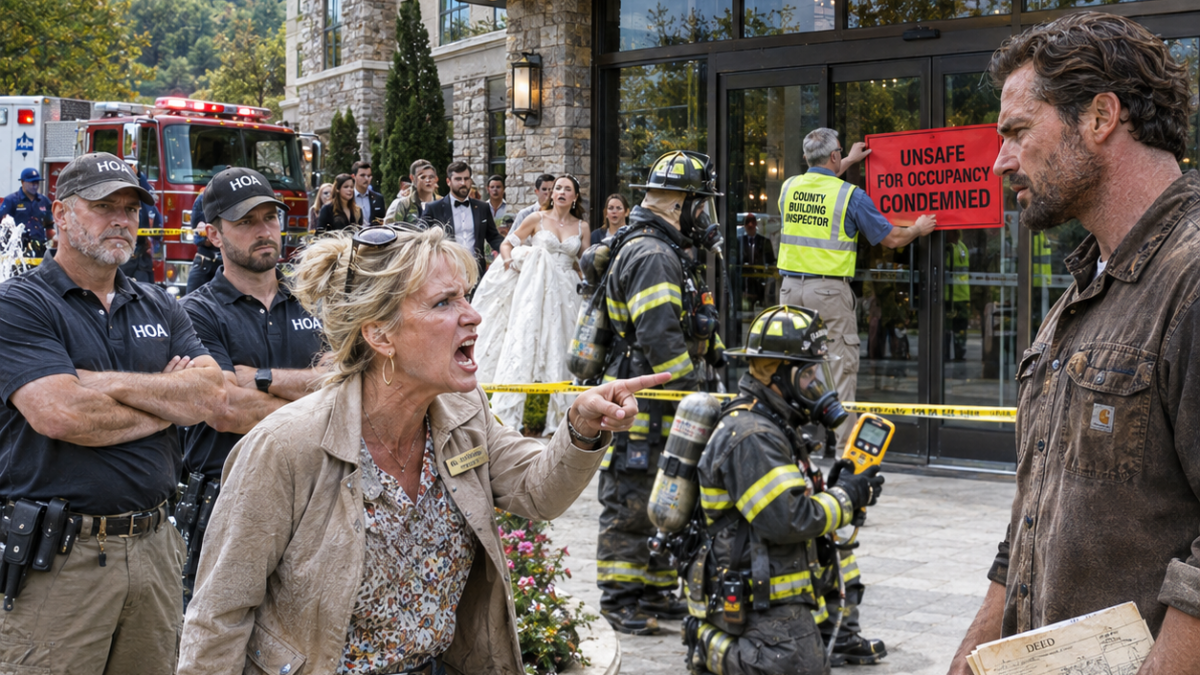
County environmental officer Rachel Bennett walked toward us holding a portable monitor sealed inside a clear evidence bag.
She ignored Linda’s shouting.
“Hydrogen sulfide was detected inside the lower western utility area.”
Linda’s attorney stepped forward.
“At what concentration?”
“Enough that nobody is going back inside until we determine the source.”
Then Rachel added:
“We found an old underground structure directly beneath part of the western foundation.”
Linda stopped talking.
Rachel continued.
“That structure does not appear on the final approved construction plans.”
Linda looked at Ridgeview’s project manager.
Then whispered:
“I told you that chamber was supposed to be filled.”
Rebecca Collins, my attorney, stood beside me.
She turned slowly toward Linda.
I did the same.
Because until that moment, I had thought the gas might be the one thing nobody saw coming.
That sentence told me somebody had seen something.
My name is Andrew Lawson.
Before Ridgeview Grand Hotel existed, Lawson Ridge was forty-six acres of woods, meadow, old concrete, and stubborn family history outside a small town in western North Carolina.
My grandfather bought it in 1969 after a furniture company shut down a small industrial storage operation there.
The land passed to my father.
Then to me.
Nobody lived there full-time.
That was apparently enough for Linda Whitmore to start using the word abandoned.
But unused and abandoned are not the same thing.
Dad paid the taxes.
I paid them after he died.
Dad cut the grass twice a year.
I kept doing it.
We checked the fence.
Cleared fallen trees.
Maintained the gravel lane.
Kept the old equipment barn standing.
My younger brother Tyler and I camped there occasionally.
The western boundary touched Maple Grove Estates.
Nearly two hundred homes.
Clubhouse.
Pool.
Tennis courts.
Walking trails.
A very active homeowners association.
For years, our relationship with Maple Grove was simple.
Their property ended at their fence.
Mine began on the other side.
Sometimes a soccer ball came over.
Sometimes residents asked to walk near the creek.
My father usually said yes.
I did too.
A retired carpenter named George Miller became one of the best neighbors we had.
He called whenever a tree from Lawson Ridge leaned toward the Maple Grove fence.
His wife Susan kept an eye on the barn.
Their granddaughter Lily loved wildflowers, so every spring George asked whether he could take her into the meadow.
He always asked.
That was the difference.
Permission makes almost everything easy.
The trouble began when Linda Whitmore became HOA president.
Linda was confident, organized, and obsessed with improving Maple Grove’s property values.
The first time she contacted me, she said Maple Grove wanted to discuss “activating underutilized land” between the neighborhood and the state highway.
I met her because listening costs nothing.
She brought a real-estate consultant named Daniel Harris.
They wanted ten acres.
Landscaped entrance road.
Commercial access.
Improved connection to the highway.
Their first offer:
$180,000.
“No.”
Daniel increased it to $250,000 during the same meeting.
Still no.
Linda leaned across the table.
“What number changes your mind?”
“There isn’t one.”
“Everything has a price.”
“Only if the owner wants to sell it.”
She smiled.
Not warmly.
The kind of smile somebody gives when they think you are negotiating badly.
For six months, nothing happened.
Then I found a Maple Grove development sign attached to my fence.
I called Linda.
She said a contractor placed it on the wrong property.
Possible.
Two weeks later, orange survey flags appeared nearly three hundred feet inside Lawson Ridge.
Linda blamed the survey crew.
Possible again.
Then more appeared.
That stopped feeling possible.
I hired William Cooper, a licensed surveyor, to re-mark the entire boundary.
His conclusion was clean.
Forty-six acres.
Lawson property.
No Maple Grove easement.
No HOA control.
No commercial development option.
No shared road.
No transfer.
I sent Linda the updated map.
Her reply was one of the strangest emails I had ever received.
Maple Grove, she said, had evidence that part of Lawson Ridge could be considered “functionally abandoned” because no residence or operating business occupied the land.
I forwarded it to Rebecca.
She called me ten minutes later.
“Do not worry about the word abandoned.”
“I’m not.”
“Good. Because ordinary words don’t become legal magic because an HOA president types them in bold.”
She sent Maple Grove a formal notice.
Private property.
Valid deed.
Taxes current.
No permission to enter.
No permission to survey.
No permission to develop.
For a while, peace returned.
Then Dad’s old barn was broken into.
The lock had been cut.
Nothing valuable disappeared.
But boxes of property records had been moved.
Historical maps were spread across the floor.
One folder containing old surveys was missing.
I reported it.
Installed trail cameras.
Changed the lock.
I did not accuse Linda.
I had no proof.
Three weeks later, Maple Grove sent residents a glossy newsletter announcing RIDGEVIEW COMMONS.
Hotel.
Restaurant.
Event lawn.
Meeting center.
Walking area.
George brought me the brochure.
I opened it.
The hotel was not near Lawson Ridge.
It was on Lawson Ridge.
The artist had even put a fountain where my gravel lane crossed the meadow.
I called Linda.
“This project is on my property.”
“It’s conceptual.”
“Remove it.”
“Our lawyers are still reviewing historic ownership issues.”
“There are no ownership issues.”
“Our attorneys disagree.”
Rebecca demanded documents.
Two weeks later, Maple Grove produced what it called an abandoned parcel development agreement.
According to it, my father had agreed years earlier that if Lawson Ridge remained unused for more than ten consecutive years, Maple Grove or its development partner could “maintain and improve” part of the land.
Dad’s signature appeared at the bottom.
It looked real.
That bothered me.
Rebecca asked for the original.
Maple Grove said an archive company had it.
Maple Grove Community Development Services.
Owner:
Robert Whitmore.
Linda’s husband.
Rebecca warned me not to jump from suspicious to fraudulent.
“Connections are not proof.”
Then construction fencing appeared twelve acres inside Lawson Ridge.
Not on the boundary.
Inside.
I arrived one Wednesday morning and found temporary steel fencing surrounding part of the meadow.
A sign read:
RIDGEVIEW HOTEL & EVENT CENTER — COMING SOON.
I called the sheriff.
Deputy James Wilson checked my deed.
The construction supervisor produced a development packet.
Old land agreement.
New development lease.
My signature appeared on the lease.
That one was easy.
“I never signed this.”
Rebecca obtained an emergency order stopping construction while the paperwork was reviewed.
For a few weeks, the site froze.
Then Ridgeview Holdings changed its argument.
Now the hotel supposedly sat on a separate parcel Ridgeview had purchased years earlier.
Only a “minor boundary overlap,” they said.
William Cooper surveyed it.
More than sixty percent of the hotel footprint was inside Lawson Ridge.
Much of the parking lot too.
Then a corrected deed appeared in county records.
Twenty-one acres supposedly transferred from Dad to Ridgeview Holdings nine years earlier.
Dad’s signature again.
Rebecca looked at it.
“How many documents can they keep finding?”
“As many as somebody created.”
That sentence stayed with me.
Tyler and I searched Dad’s old files.
Three nights.
Boxes.
Tax records.
Receipts.
Bank statements.
Old Maple Grove correspondence.
Then we found a temporary license Dad had signed nine years earlier.
It allowed Maple Grove contractors to store landscaping equipment on five acres.
Sixty days.
Nothing more.
The signature looked exactly like the supposed twenty-one-acre transfer.
Rebecca sent both to a document examiner.
The preliminary opinion came back.
Not merely similar handwriting.
Identical image.
Same long starting stroke.
Same tiny break.
Same ink artifact below the surname.
Someone appeared to have copied Dad’s real signature from the temporary license.
Construction should have stopped there.
Instead, the legal fight became a game of whack-a-mole.
We blocked one filing.
Another appeared.
One judge restricted work.
Ridgeview produced a revised parcel map and restarted on supposedly undisputed land.
Bulldozers crossed the line anyway.
We went back to court.
Stop.
Start.
Stop.
Start.
Every delay cost me money.
Every delay cost Ridgeview money too.
That may have been the strategy.
Make the dispute so expensive that I would surrender.
Robert Whitmore called me directly.
“Six hundred thousand.”
“No.”
“Nine hundred.”
“No.”
“One point two million.”
That made me pause.
Not because I suddenly wanted to sell.
Because it was more money than anyone had ever offered me for the land.
Rebecca asked me to think about it.
I did.
One night.
Then one question kept bothering me.
If Ridgeview was so certain it already owned the property, why would Robert pay me $1.2 million to stop saying it was mine?
I refused.
A month later, the hotel started rising.
Five stories.
112 rooms.
Restaurant.
Conference hall.
Pool.
Event terrace.
Nearly $8 million in stated project value.
I drove past steel columns standing where my meadow had been.
It made me sick.
Lawyers were still arguing.
Meanwhile, concrete hardened.
Walls went up.
Windows arrived.
Reality was being built faster than ownership could be litigated.
Then George called.
“Workers are complaining about a smell.”
“What smell?”
“Rotten eggs.”
That got my attention.
Dad used to tell Tyler and me not to dig deeply around one of the old concrete pads on the western side.
We assumed it was old piping.
Maybe broken industrial equipment.
I searched his records again.
This time I found a faded county letter dated 1981.
Industrial waste recovery chamber.
Western Lawson Ridge.
Capped.
Do not disturb without environmental review.
I took it straight to Rebecca.
She called Rachel Bennett at the county environmental office.
Rachel pulled old industrial records.
The furniture operation had used underground collection chambers for wastewater and organic industrial material.
Most surface structures had been removed decades earlier.
At least one underground chamber remained.
Exact modern location uncertain.
Rachel asked whether Ridgeview’s environmental survey had identified it.
Their report said:
No significant underground industrial structure detected within planned hotel footprint.
That did not match the 1981 letter.
Rebecca requested the original environmental files.
Meanwhile, stories continued.
Workers dizzy in one lower room.
Headaches.
Smell near a service corridor.
One contractor refused to work near an underground area.
None of that proved toxic gas.
Construction sites smell strange.
People get headaches for ordinary reasons.
I refused to start rumors.
Rachel told me not to enter the site.
The county would handle testing.
Ridgeview denied there was any environmental problem.
Robert accused me of trying to sabotage the hotel.
Linda sent residents a newsletter claiming “outside opponents” were spreading environmental misinformation after failing to stop the project legally.
Then Ridgeview Grand Hotel opened.
Opening weekend was huge.
Discounted rooms for Maple Grove homeowners.
Wedding reception.
Business conference.
Restaurant launch.
Linda posed beside the fountain beneath a banner:
WELCOME TO THE FUTURE OF MAPLE GROVE.
Less than forty-eight hours later, George called me.
“Andrew, something’s wrong.”
Several guests were sick.
Headaches.
Nausea.
Dizziness.
A housekeeper nearly fainted in a lower hallway.
Fire department had been called.
By the time I reached Lawson Ridge, firefighters were moving guests outside.
Linda argued with the hotel manager.
Robert paced with his phone.
Then a firefighter entered the lower level carrying a gas detector.
The alarm sounded.
Everything changed.
Protective equipment went on.
Guests moved farther away.
Ambulances arrived.
Rachel found me near the yellow tape.
“Hydrogen sulfide.”
I knew enough to understand that was serious.
“How much?”
“Enough that nobody stays inside.”
Then another monitor alarmed near a utility room.
The fire chief ordered full evacuation.
That led to the red condemnation notice.
And Linda’s whispered sentence.
I told you that chamber was supposed to be filled.
The following day, county vehicles filled the parking lot.
Fire department.
Environmental team.
Insurance representatives.
Engineers.
Rachel explained the problem.
Hydrogen sulfide can come from decaying organic material and some industrial waste systems.
At high enough concentrations, it can cause nausea, dizziness, confusion, collapse, and worse.
The strongest readings were in the western lower utility area.
Exactly over the chamber from Dad’s old letter.
Then came the first serious document problem.
Ridgeview’s official environmental report said no underground chamber existed in the hotel footprint.
But an earlier construction survey showed one.
Not vaguely.
Clearly.
Then firefighters found a dusty metal box beside the cracked structure.
Inside were old maps.
Inspection notes.
And a modern folder labeled:
RIDGEVIEW ENVIRONMENTAL EXCEPTION — INTERNAL.
The first page showed the chamber.
The second showed gas readings taken months before opening.
Beside the highest reading:
DO NOT REPORT UNTIL OWNERSHIP ISSUE RESOLVED.
At the bottom was handwritten approval.
Linda Whitmore.
Linda immediately denied the handwriting was hers.
Fair enough.
Handwriting needed verification.
But the folder proved something more important.
The underground structure was not a surprise.
Somebody knew.
An excavation contractor named Frank Wilson contacted the county after the evacuation made the news.
His crew had hit an old concrete wall early in foundation work.
He stopped excavation.
Reported it.
Project manager Stephen Parker arrived with Robert Whitmore.
Frank asked whether environmental review was needed.
He was told the structure was an abandoned water vault.
It would be filled.
Two days later, another contractor partly covered it.
Work resumed.
No county inspection.
No report of an unexpected underground structure.
Stephen was interviewed.
At first he said Robert told him everything had already been cleared.
Then investigators showed him the internal folder.
His story shifted.
He had seen gas readings.
Robert called them temporary soil conditions.
Then Rachel asked about:
DO NOT REPORT UNTIL OWNERSHIP ISSUE RESOLVED.
Stephen went quiet.
Eventually he described a meeting where Linda argued that reporting an environmental problem before the property litigation ended could strengthen my case.
That made my stomach turn.
I was being publicly blamed for “discovering” contamination to stop the hotel.
If Stephen was telling the truth, Linda knew about the issue while the building was still under construction.
Emails followed.
Not one dramatic confession.
Something worse.
A chain of warnings nobody wanted to own.
Environmental consultant:
Western chamber requires additional review before structural loading.
Project management:
Schedule cannot absorb another environmental delay.
Robert:
Proceed with mitigation assumption. Ownership litigation may change final footprint anyway.
Linda:
Do not create a public issue until title position is secure.
Why keep moving?
Money.
Ridgeview’s construction lender required work to begin by a specific deadline.
Delay threatened more than $1 million in financing benefits.
Steel had been ordered.
Contracts signed.
Public announcements made.
Maple Grove had tied its reputation to the project.
Stopping would cost money.
Admitting a problem would cost pride.
So somebody kept moving.
Then Tyler remembered Dad saying not to camp near the western ditch.
We searched another metal filing box stored in his garage.
Inside:
A hand-drawn site map.
Storage pad.
Drain line.
Concrete sump.
Old chamber.
Then farther west:
CHAMBER B — SEALED.
There were at least two.
Rachel’s team used ground scanning.
Second underground void.
About seventy feet west of the hotel.
Under part of the event lawn and parking area.
Still sealed.
Good.
But a hotel utility trench ran beside it.
More testing.
Then old insurance drawings showed two waste recovery chambers connected by underground industrial drainage.
Closure records incomplete.
The county widened the investigation.
While environmental crews worked, the property case finally started collapsing.
The document examiner confirmed Dad’s signature on the supposed twenty-one-acre transfer was copied from the temporary landscaping license.
Then the notary record was checked.
The notary listed on the transfer had died almost a year before the document’s stated date.
Impossible.
Then another problem.
The document claimed Dad transferred twenty-one acres to Ridgeview Holdings nine years earlier.
State business records showed Ridgeview Holdings had been formed only five years ago.
The company did not exist when it supposedly bought the land.
Rebecca looked at me.
“Their transfer is falling apart.”
Ridgeview’s attorneys argued that millions had already been invested in good faith.
Rebecca’s answer:
“You cannot improve your way into owning someone else’s land.”
The judge did not yet issue final title.
But Ridgeview was barred from selling, refinancing, demolishing, or constructing further without court permission while fraud issues were reviewed.
Then their lender entered.
More than $5 million already tied to the project.
They demanded title records.
Environmental records.
Internal risk reports.
One document said:
LAWSON RIDGE OWNERSHIP DISPUTED.
Another:
PROCEED BASED ON ANTICIPATED SETTLEMENT WITH LAWSON OWNER.
Anticipated settlement.
They had built an $8 million hotel while expecting I would eventually take the money.
Then we found the development schedule.
Phase One: Secure construction site.
Phase Two: Advance hotel build before title hearing.
Phase Three: Settle with Lawson after substantial completion.
Rebecca stared.
“They wanted the building to become leverage.”
Exactly.
Build first.
Make removal seem impossible.
Then tell me:
Look at the jobs.
Look at the weddings.
Look at the investment.
Look at the millions already spent.
Surely you will sell now.
They had created the burden and planned to hand me the guilt.
The gas reversed everything.
A beautiful hotel had been leverage.
A condemned hotel was liability.
Robert’s attorney offered $2 million.
Then $2.5 million.
For the first time, I seriously considered taking it.
Not because they were right.
Because I was exhausted.
Lawyers.
Surveyors.
Court hearings.
Environmental testing.
A condemned five-story building in my meadow.
I went to Lawson Ridge alone.
Stood beside Dad’s old barn.
Looked at dark hotel windows.
I asked myself what Dad would want.
I did not know.
Then I remembered something he taught us.
Owning something is not the same as refusing every offer forever.
Ownership means the decision is yours.
If I sold because I wanted to, fine.
If I sold because someone built a multimillion-dollar problem on my land and expected the problem to force me, that was different.
I refused.
Then Rachel called.
Another underground space.
Smaller.
Directly beneath the conference hall.
No county records.
No approved plan.
Worse:
The foundation had been built around it.
Not unknowingly over it.
Around it.
A former concrete worker confirmed the crew had encountered an underground room.
They were told not to enter.
They were ordered to build a sealed wall around it.
Stephen Parker was interviewed again.
This time with counsel.
He admitted the third chamber existed.
Robert told him it contained old industrial materials and should remain sealed until the ownership lawsuit was resolved.
Had it been tested?
Yes.
Readings were high enough that one consultant recommended stopping work.
Why continue?
Stephen finally said:
“Linda said if Andrew learned there was contamination beneath the hotel site, he could get the project stopped.”
Then he added something else.
Before the chamber was sealed, Robert and Linda personally entered it with two contractors.
They removed several boxes.
One heavy metal cabinet remained.
County teams opened the chamber under controlled conditions.
Gas monitors were already inside.
Installed during construction.
Never reported.
Their memory logs showed elevated readings months before opening.
The heavy cabinet held old environmental records.
And a newer binder.
RIDGEVIEW HOTEL ENVIRONMENTAL RISK CONTROL.
Every gas reading.
Every consultant warning.
Every recommendation to delay opening.
Final page:
PROCEED WITH OPENING.
PUBLIC DISCLOSURE DEFERRED PENDING OWNERSHIP RESOLUTION.
Robert Whitmore.
Linda Whitmore.
And beneath them:
Thomas Avery.
Former county building safety director.
Rachel stared.
“That man has been dead three years.”
A dead official had supposedly approved opening a hotel that did not yet exist.
The signature looked convincing.
Until examiners compared it to old public records.
Exact match to an archived inspection form.
Copied.
Dad’s signature copied.
Dead official’s signature copied.
My name placed on a lease I never signed.
Dead notary.
Pattern.
Then Alan Foster appeared.
Environmental engineer.
He had inspected the property early.
Found gas.
Buried pipes.
Likely additional structures.
He wrote a twelve-page report recommending full environmental stop.
Sent it to Robert.
Linda called him the next morning.
Could the gas be described as temporary construction odor?
Alan said no.
Had his report been filed with the county?
Not yet.
A few days later, Robert told him another consultant cleared the site.
Alan was removed.
His invoice went unpaid.
He kept a copy of his original report.
Rachel compared it with the version filed by Ridgeview.
Same cover page.
Same project number.
Same date.
After page one, almost everything changed.
Alan’s report:
Dangerous readings.
Stop construction.
Filed report:
No significant underground hazard.
Eleven pages replaced.
His signature on the filed version?
Copied from an older engineering letter.
By then even Rebecca looked stunned.
Every time the project needed permission, another piece of paper magically appeared.
Then the money trail surfaced.
Ridgeview paid $180,000 to Pinegrove Consulting for environmental coordination.
Owner:
Jennifer Dawson.
Linda’s sister.
No employees.
No real environmental track record.
One invoice:
ENVIRONMENTAL REPORT RECONCILIATION — $42,000.
Investigators wanted to know what reconciliation meant.
Maple Grove residents wanted to know something else.
Why had nearly $600,000 of HOA reserves gone toward infrastructure connected to a privately controlled hotel?
Emergency meeting.
More than one hundred homeowners.
Independent attorney.
Linda no longer allowed to chair.
Residents learned HOA money paid for roads, drainage, utilities, landscaping, and “shared amenities” connected to Ridgeview.
Then they learned about a revenue-sharing agreement.
Maple Grove would receive annual payments if the hotel became profitable.
Signed by Linda.
And by Ridgeview Holdings.
Signed by her husband Robert.
The room exploded.
One woman shouted that the pool roof had been leaking for two years.
Another asked about the playground repairs.
George stood.
“Why are our dues funding a hotel on land Andrew Lawson never sold?”
Linda said the ownership situation was complicated.
George answered:
“It became complicated after fake paperwork showed up.”
The board voted.
Linda Whitmore was removed as HOA president.
I thought I would feel victorious.
I did not.
I felt tired.
Removing Linda did not remove the hotel.
Did not clean the gas.
Did not restore the meadow.
But it stopped her from speaking as though every Maple Grove homeowner stood behind her.
That mattered.
Then the court invalidated Ridgeview’s supposed twenty-one-acre transfer for purposes of the title claim.
The company did not exist on the stated transfer date.
Dad’s signature was copied.
The notary timeline was impossible.
The hotel lender approached Rebecca.
This time respectfully.
They proposed buying the hotel footprint directly from me.
$3.2 million.
Remove Linda and Robert.
Fund full environmental remediation.
Possibly reopen under new operators if engineers ever declared the structure safe.
For once, I did not immediately reject it.
The lender had also been misled.
A clean transaction might compensate me.
Protect workers.
Clean the site.
Maybe preserve the hotel.
I walked the untouched meadow.
Thought about Dad.
He never told me Lawson Ridge had to stay frozen forever.
He taught me nobody else got to decide.
So I told Rebecca:
“We can talk.”
Conditions:
Full cleanup.
No HOA control.
No Whitmore involvement.
Environmental monitoring.
Legal costs.
Property damage.
Restoration of remaining acreage.
For the first time, negotiation felt like choice.
Then Rachel called again.
“We found a pipe.”
I almost laughed.
“This entire nightmare is pipes.”
“This one is new.”
Installed during hotel construction.
It was designed to move gas away from the western chamber.
That sounded responsible.
Except the pipe ended in a sealed utility chase beneath the main lobby.
It was supposed to vent outside.
The exterior outlet had been capped.
Why?
Change order:
EXTERIOR VENT VISUALLY CONFLICTS WITH LUXURY FACADE.
Someone chose appearance over ventilation.
Attached safety note:
DO NOT CAP THIS VENT. GAS ACCUMULATION RISK.
Below:
OVERRIDE APPROVED.
Robert Whitmore.
Negotiations stopped.
Investigators searched Ridgeview offices.
Inside a locked storage room they found original documents.
Dad’s real temporary license.
Alan Foster’s real environmental report.
Old county maps.
Construction photos.
And a folder labeled:
LAWSON — FINAL RESOLUTION.
Four stages.
Stage One:
Establish development control.
Stage Two:
Build before final title ruling.
Stage Three:
Use hotel investment to force settlement.
Stage Four:
Acquire remaining Lawson Ridge after contamination disclosure reduces land value.
I read that final line twice.
They had not only planned to take the hotel section.
They planned to use the contamination to make the rest of my property cheaper.
A map showed nearly all forty-six acres redeveloped.
Hotel expansion.
Retail.
Parking structure.
Luxury townhomes.
My barn gone.
Meadow gone.
Creek rerouted.
Projected development value:
$38 million.
Then investigators opened an envelope.
Purchase agreement.
All remaining Lawson Ridge.
Buyer:
Ridgeview affiliate.
Seller:
Andrew Lawson.
Price:
$420,000.
My signature.
I had never seen it.
This fake document came with something new.
Video certification.
The sheriff played it.
A man sat at a desk.
Gray jacket.
Dark baseball cap.
His face looked like mine.
His voice sounded like mine.
He looked into a camera and said he understood he was selling Lawson Ridge.
Then signed.
For half a second, even I felt disoriented.
Rebecca looked at me.
“Is that you?”
“No.”
I knew exactly where I had been on the alleged signing date.
Tyler’s birthday.
We spent the morning replacing electrical panels at a grocery distribution facility two hours away.
Work logs.
Security footage.
Coworkers.
Receipts.
Family dinner photographs.
I had an alibi better than most criminals.
Digital investigators examined the video.
It had been created six days before police found it.
Not three months earlier.
The date overlay was fake.
The audio track had cuts.
One sentence came from an old voicemail I left Maple Grove about a fallen tree.
Another phrase came from a recorded meeting.
Real words.
Fake sentence.
Then they examined the face.
Parts matched old video-call footage from my meetings with Robert and Linda.
The man at the desk was somebody else.
My face had been placed over his.
Deputy Wilson said:
“They stopped creating documents.”
Rebecca looked at him.
“What?”
“They created an event.”
The fake notary stamp came from a real mortgage filing.
The two witnesses worked for Linda’s sister.
One denied ever seeing me sign.
Then office security footage identified the real man in the gray jacket.
Temporary worker.
Robert paid him $200 to sign sample papers for what he called a training video.
The worker had no idea my face would later be placed over his.
Rebecca filed everything.
Emergency hearing.
This time Ridgeview’s lawyers looked different.
The lender had abandoned Robert and Linda.
Maple Grove had removed Linda.
County condemned the hotel.
State environmental investigators were involved.
Rebecca put the evidence in order.
Grandfather’s purchase.
Dad’s deed.
Nine years of tax bills.
Temporary license.
Copied signature.
Impossible deed to a company that did not yet exist.
Dead notary.
False lease.
Altered environmental report.
Dead county official.
Fake purchase contract.
Manufactured video.
Then she said:
“Every time Mr. Lawson refused to surrender his property, another document appeared saying he already had.”
The judge issued final title two weeks later.
Lawson Ridge belonged to me.
All forty-six acres.
The twenty-one-acre transfer was void.
The later purchase agreement was void.
Ridgeview Holdings owned none of Lawson Ridge.
The hotel did not change that.
Millions spent did not change that.
Construction did not create title.
I sat beside Rebecca.
My hands shook.
Not fear.
Exhaustion.
I had spent years proving something that should never have been questioned.
Dad owned it.
Then I owned it.
The court had finally forced everyone else to accept the same reality.
Then came the harder question.
What do you do with an $8 million condemned hotel built on land that does not belong to the developer?
Engineers evaluated it.
Option one:
Major excavation beneath the hotel.
Extremely expensive.
High structural risk.
Option two:
Remove and rebuild a large western section.
Also extremely expensive.
Option three:
Demolition.
Nobody liked option three.
The lender wanted value recovered.
Engineers wanted safety.
The state wanted environmental cleanup.
I wanted my property back.
Eventually independent engineers concluded repairing the building safely could cost nearly as much as replacement.
Western chamber damaged.
Third chamber beneath foundation.
Improper gas vent.
Unknown buried industrial structures.
Major systems requiring reinspection.
The lender returned.
This time their attorney said the words I had wanted from the beginning.
“We recognize Mr. Lawson owns the land. We’re asking what solution he would accept.”
Ask.
That was all.
Not threaten.
Not fabricate.
Not build first.
Ask.
I told them I did not want to run a hotel.
I did not want to own one.
And after everything that happened, I did not want Ridgeview Grand Hotel remaining on Lawson Ridge.
But I did not want ordinary workers punished either.
So we negotiated.
Lender funds demolition.
Lender funds environmental remediation.
Chambers cleaned or sealed under state supervision.
Contaminated soil treated.
Creek protected.
Construction debris removed.
Meadow restored.
My legal fees and property damages covered.
Employee assistance provided through settlement and insurance funds.
Lawson Ridge returned completely free of Ridgeview claims.
It took weeks.
Eventually, they agreed.
Demolition began.
No dramatic implosion.
Environmental conditions made that impossible.
Floor by floor.
Section by section.
Western side first.
Conference hall.
Guest wings.
Lobby.
Finally, the fountain.
I watched the excavator lift its base.
That fountain had appeared on the earliest brochure before Ridgeview legally owned one inch of my property.
Linda stood beside it on opening weekend beneath:
WELCOME TO THE FUTURE OF MAPLE GROVE.
Now it hung from an excavator bucket.
Then disappeared.
I did not cheer.
Too many people had worked on that building honestly.
Electricians.
Carpenters.
Plumbers.
Painters.
Housekeepers.
Restaurant workers.
Wedding staff.
Most of them never knew the land paperwork was false.
The building was not evil.
It was the physical result of people believing money and momentum could replace consent.
The chambers took longer.
State environmental crews opened them under controlled conditions.
The western chamber contained decaying industrial material capable of producing hydrogen sulfide after disturbance.
The third chamber contained smaller amounts.
The second remained relatively stable.
Monitoring wells were installed.
Affected soil remediated.
Drainage protected.
Rachel explained every step.
Slowly.
Carefully.
I appreciated slow for once.
The final environmental report made an important distinction.
Lawson Ridge was not some giant poisonous wasteland I had secretly known about.
Most of the forty-six acres was unaffected.
The hazard came from buried industrial structures that had remained stable until modern construction disturbed them without adequate investigation and ventilation.
That mattered.
I had never developed over them.
Never invited guests into a building above them.
Ridgeview had.
After receiving warnings.
The investigations continued.
Robert faced serious problems tied to documents, environmental decisions, project accounts, and false approvals.
Linda faced her own consequences involving HOA money, property claims, environmental warnings, and related actions.
Jennifer’s consulting company was investigated too.
Not every contractor was treated like a criminal.
Frank Wilson had stopped digging when he found the chamber.
Alan Foster warned them.
Workers followed plans they were given.
Responsibility mattered.
I stopped following every court date.
At some point, continuing to build my life around Linda and Robert would have given them another piece of Lawson Ridge.
Not the land.
My time.
I was done giving them that.
Maple Grove had to recover too.
Nearly $600,000 of reserves had been tied up in Ridgeview infrastructure.
The new board pursued insurance and legal recovery.
They rewrote rules.
No major family-connected contract without full disclosure.
No investment of reserve money in outside development without member approval.
No project could touch land beyond Maple Grove’s recorded boundary without verified permission.
No officer could call private land “abandoned” merely because nobody lived on it.
George laughed when he heard that last rule.
“That one cost a lot of money to write.”
He was right.
Common sense is free until somebody ignores it.
The pool roof finally got repaired.
So did the playground.
That pleased me more than Linda losing office.
HOA money was supposed to pay for ordinary neighborhood needs.
Not an $8 million hotel on somebody else’s land.
Nearly a year after demolition started, Tyler and I stood where the lobby had been.
No hotel.
Fresh soil.
Restoration fencing.
Native grass beginning to return.
Dad’s old barn still in the distance.
Tyler looked around.
“Dad would never believe this.”
“He’d believe the paperwork part.”
That made us laugh.
Dad saved everything.
The temporary license.
Industrial letter.
Old maps.
Tax receipts.
Those boring papers protected Lawson Ridge after he was gone.
I became exactly like him afterward.
Fireproof cabinet.
Title judgment.
Environmental report.
Survey.
Cleanup certificate.
Court orders.
Every page.
Nobody was ever going to call this land abandoned again because the paperwork was inconvenient to find.
Then George brought Lily over.
She was older.
Still loved wildflowers.
Purple blooms had started returning to the restored meadow.
She stopped at the edge.
“Can I go in?”
I smiled.
“Of course.”
George looked at me.
“You still let people use it after everything?”
“People who ask.”
“Yes.”
“Absolutely.”
That was something Linda never understood.
I never hated sharing.
The problem was not Maple Grove families walking near the creek.
The problem was someone deciding permission meant weakness.
Kindness does not transfer ownership.
I eventually created a small walking path.
Family.
Invited neighbors.
Occasional local school groups.
At the entrance, George helped install a wooden sign.
LAWSON RIDGE
PRIVATE LAND
ACCESS BY PERMISSION
PLEASE RESPECT THE PROPERTY
He stepped back.
“No hotel?”
“No hotel.”
“No luxury townhomes?”
“No.”
“No fountain?”
“Definitely no fountain.”
Monitoring continued.
Rachel visited twice the following year.
Normal readings.
Stable remediation.
Old industrial features now properly mapped.
Future owners would know exactly what existed.
That mattered.
History becomes dangerous when people hide it.
The old chamber had existed for decades.
It did not suddenly become dangerous because I found Dad’s letter.
It became dangerous when people found warning signs during construction and kept moving.
They wanted the deadline.
The financing.
The opening weekend.
The photographs.
An $8 million success story.
So they ignored the thing beneath their feet.
Then the gas moved.
People still tell the story differently.
“Andrew Lawson got an $8 million hotel condemned.”
Technically true.
But it makes me sound like I walked in with a wrench and released toxic gas.
I did not.
I found a record.
I gave it to the county.
Inspectors tested the building.
Gas monitors sounded.
Firefighters found the chamber.
Investigators found the hidden reports.
The building inspector condemned the hotel because people were getting sick inside an unsafe structure.
Evidence condemned it.
Not revenge.
People also ask whether I regret refusing the early offers.
$600,000.
$900,000.
$1.2 million.
Then $2 million.
Then $2.5 million.
Maybe taking the money would have been easier.
But those were not clean choices.
By then they had already created pressure.
Built structures.
Filed documents.
Tried to make their investment my responsibility.
They wanted the existence of the hotel to force consent after the fact.
That is not the same as a free sale.
Later, when the lender approached me respectfully, admitted my ownership, and asked what I wanted, I was willing to negotiate.
That difference is everything.
A choice only means something when you are allowed to say no.
Today, Lawson Ridge looks nothing like Linda’s brochure.
No hotel.
No restaurant.
No wedding terrace.
No parking garage.
No fountain.
The creek still runs along the edge.
The meadow is back.
The barn still leans slightly no matter how many times Tyler says we should rebuild it.
Where Ridgeview’s lobby once stood, I placed a wooden bench between two young oak trees.
The bench is for Dad.
I carved one sentence into the back.
THIS LAND WAS NEVER ABANDONED.
Sometimes I sit there and remember the opening weekend.
Wedding guests.
Ambulances.
Gas alarms.
Firefighters.
Linda shouting that I had caused everything.
Then I remember what investigators found afterward.
Copied signatures.
A dead notary.
A dead county official’s signature.
Altered environmental reports.
Hidden gas readings.
A foundation built around a chamber nobody reported.
A vent capped because it looked ugly against the luxury facade.
A fake purchase agreement.
A manufactured video of me supposedly signing away land I never sold.
One bad decision had required another bad decision to protect it.
Then another.
Then another.
Until an $8 million hotel stood on property the developer did not own over a danger people inside the project already knew existed.
That is the part I remember.
Big projects create psychological momentum.
A hotel looks too expensive to stop.
A development looks too important to challenge.
An HOA president looks too confident to question.
Millions of dollars make ordinary people believe somebody must have checked the basics.
Who owns the land?
Is the deed real?
Did the person sign?
What is buried underneath?
Did the environmental engineer actually approve this?
Does the building vent dangerous gas outside—or into the lobby?
Simple questions.
Expensive answers.
Linda thought size would eventually defeat ownership.
Build enough.
Spend enough.
Create enough jobs.
Generate enough paperwork.
Eventually the owner would surrender because saying no had become too complicated.
She was wrong.
Money does not create title.
Construction does not create permission.
A copied signature does not create consent.
And a beautiful building does not become safe because everybody wants opening day.
The county condemned Ridgeview Grand Hotel because it was unsafe.
The court returned Lawson Ridge because it was mine.
But neither of those was the real ending for me.
The real ending happened later.
Standing in the restored meadow.
Watching Lily walk through wildflowers.
Seeing Maple Grove families use the trail because they had asked first.
Looking at a piece of land people once described as abandoned and realizing nobody else was deciding what happened there anymore.
My land.
My choice.
My boundary.
That was all I had wanted from the beginning.
And this time, everybody finally knew exactly where it was.