HOA Fined Me $8,500 for Mooring My Boat at My Own Dock—Then State Agents Found 25 Illegal Leases
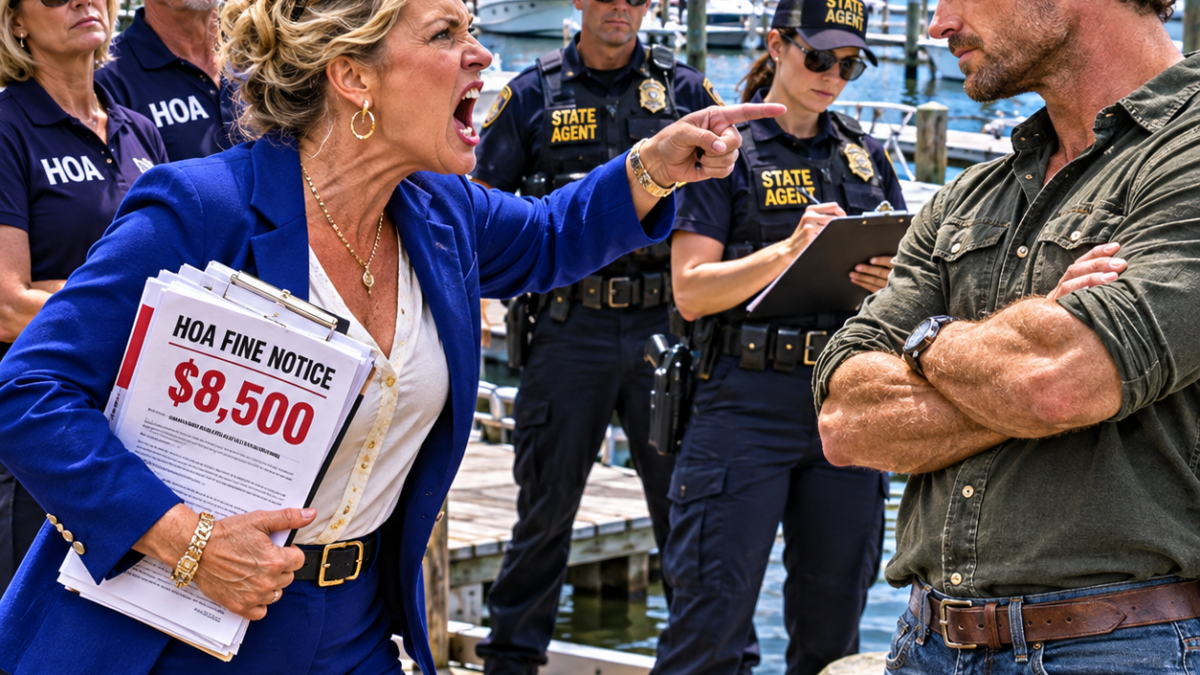
HOA Fined Me $8,500 for Mooring My Boat at My Own Dock—Then State Agents Found 25 Illegal Leases
**“MOVE THAT BOAT TODAY, JASON, OR I’LL KEEP ADDING FINES UNTIL YOU CAN’T AFFORD TO KEEP THIS PROPERTY!” HOA president Linda Crawford snapped while standing on my private shoreline with an $8,500 enforcement notice in her hand.**
I pointed to the state permit bolted to the dock post and reminded her for the fourth time that my property had never belonged to Willow Bend HOA, my dock had existed before the subdivision, and the boat tied beside us was exactly the one recreational vessel my permit allowed.
Then three Wisconsin state investigators arrived, counted only sixteen legal HOA slips, asked Linda to explain twenty-five private dock leases carrying her signature—and before anyone had finished answering, one of the agents walked around the wooded point and discovered a hidden marina nobody on the HOA board seemed to know existed.
Linda Crawford’s face changed the moment the first investigator placed the leases on the picnic table.
Two hours earlier, she had been standing beside my boat like she had won.
Now she looked like someone trying to remember which version of a story she had told to which person.
Thomas Walker, the lead investigator, spread the agreements out carefully.
Twenty-five.
Every one numbered.
Every one signed.
Every one charging somebody money to keep a boat somewhere around Lake Benton.
Some renters paid $275 a month.
Some $325.
Others as much as $400.
Thomas tapped the first stack.
“Who authorized these?”
Linda folded her arms.
“Willow Bend has managed the waterfront for years.”
“That wasn’t my question.”
She looked toward Frank Miller, the HOA treasurer.
“The fees pay for maintenance.”
Thomas nodded.
“Good. Show me the maintenance account.”
Frank lowered his eyes.
“There isn’t one.”
Nobody said anything.
Linda turned toward him so quickly the $8,500 fine notice nearly slipped from her hand.
Thomas opened another folder.
“The state permit on file authorizes sixteen association slips.”
Linda said nothing.
He counted the leases again.
“Twenty-five additional renters.”
Still nothing.
Then he pointed toward the northern cove.
“So before we talk about Mr. Hale’s boat, I need to know who built the other slips.”
That was when I realized my ridiculous fine had never really been about my boat.
My name is Jason Hale.
Six months earlier, I had bought a small house on Lake Benton in northern Wisconsin.
Nothing fancy.
Two bedrooms.
Workshop.
Enough yard for my dog.
And the main reason I bought it—
direct lake access.
I had spent twenty years running a heating and plumbing company.
By forty-six, I was tired of traffic.
Tired of hearing trucks outside my bedroom at five in the morning.
Tired of neighbors sharing walls.
PART2:
Lake Benton looked like exactly the kind of place where a man could work during the week, fish on Saturdays, and occasionally waste an entire Sunday doing absolutely nothing.
My house sat beside Willow Bend Estates.
Around 140 homes.
Nice place.
Good landscaping.
Clubhouse.
Walking trail.
Private roads.
And an HOA.
At first glance, my property looked like part of Willow Bend.
Same road.
Same lake.
Their walking trail even passed near my eastern fence.
But the parcel was older than the subdivision.
Much older.
Harold Jenkins built the house in 1979.
Willow Bend came decades later.
Harold never joined.
The deed was clear.
My closing attorney confirmed it.
Title company confirmed it.
My land was outside the HOA.
That included a narrow strip of shoreline between two Willow Bend-owned parcels.
Only about eighty feet wide.
But eighty feet was enough.
At the end sat a simple wooden dock.
Short walkway.
Two posts.
One slip.
Nothing impressive.
The day Harold handed me the keys, he walked me around the property.
“Septic cleanout’s by that maple.”
“Got it.”
“Well pump behind the shed.”
“Got it.”
“Dock gets slippery after rain.”
“I’ll remember.”
Then he tapped a small metal plate attached to one post.
“Keep that.”
“What is it?”
“State permit.”
Lake Benton was state managed.
Private shoreline owners could maintain approved docks, but the lake bed and water beyond ordinary shoreline limits remained under state regulation.
I did not pretend to understand every technical rule.
I did not need to.
My attorney checked the permit.
Valid.
Transferred with the property subject to normal renewal requirements.
One private recreational vessel allowed.
Simple.
Then Linda Crawford knocked on my door.
Late fifties.
Neatly dressed.
Folder in hand.
The kind of person who spoke like a meeting had already started before you entered the room.
“Welcome to Willow Bend.”
“Thanks.”
“You received the community handbook?”
“No.”
Her smile weakened.
I explained why.
“My property isn’t in the HOA.”
She blinked.
Then smiled again.
“Functionally, you’re still part of the community.”
That was the first strange sentence she ever said to me.
“Neighbor, yes.”
I paused.
“Member, no.”
“Of course.”
The rest of the conversation stayed polite.
She told me about summer events.
Lake cleanups.
Fishing days.
Neighborhood safety.
I told her I would help with anything reasonable.
And I meant it.
I liked most people there.
Frank Miller helped me move a workbench into my garage.
Susan Parker brought pie.
David Collins showed me the best part of the lake for bass.
For the first month, everything was easy.
Then I bought the boat.
Twenty-two feet.
Used.
Small cabin.
Fishing setup.
Nothing remotely close to a yacht.
I launched at the public ramp and tied it to my dock.
The next morning, an orange sticker was stuck to the windshield.
UNAUTHORIZED VESSEL MOORED IN HOA-CONTROLLED SHORE ZONE.
FINE: $250.
DAILY PENALTY AFTER 48 HOURS: $100.
I honestly thought someone was messing with me.
I called Linda.
“There’s an HOA violation sticker on my boat.”
“Yes.”
“My boat is at my dock.”
“The dock is located within Willow Bend’s managed shoreline zone.”
“No, it isn’t.”
She sighed.
“Jason, shoreline management is complicated.”
“My deed isn’t.”
“The HOA manages dock activity throughout the Willow Bend waterfront.”
“My dock existed before Willow Bend.”
“That doesn’t automatically exempt it.”
“Exempt it from what?”
“Our mooring standards.”
I laughed.
She didn’t.
She listed boat length limits.
Overnight rules.
Guest vessel rules.
Dock-decoration restrictions.
Fuel storage.
Fine.
Reasonable rules for members.
I was not a member.
She changed arguments.
“Water regulations affect everyone.”
That sounded more plausible.
So I did not keep arguing.
I called Rebecca Hayes.
Rebecca had handled property matters for my business for years.
She reviewed everything.
Deed.
Closing papers.
State dock permit.
Willow Bend covenants.
Subdivision plat.
Then she called.
“You’re not in the HOA.”
“I know.”
“Dock is not on HOA land.”
“I know.”
“Permit allows one recreational vessel.”
“Exactly.”
“Then keep fishing.”
She sent Linda a polite letter.
No threats.
Just facts.
My property stood outside Willow Bend.
My dock was privately permitted.
The HOA had no power to fine me.
Two weeks passed.
Then another notice arrived.
Balance:
$950.
Original $250.
Seven days at $100.
Plus a $50 processing charge.
I called Frank.
“I thought the board was reviewing this.”
“So did I.”
“Then why is Linda still fining me?”
“I don’t know.”
That interested me.
Frank explained the board had discussed Rebecca’s letter.
At least two directors wanted enforcement paused until legal authority was clear.
Linda apparently disagreed.
I asked Frank whether Willow Bend actually had any recorded authority over my dock.
He hesitated.
“Linda says we manage every dock inside the shoreline plan.”
“What shoreline plan?”
“Old development map.”
“Send it.”
He did.
The map was more than twenty years old.
Sixteen association slips were marked.
My house appeared as a separate rectangle.
JENKINS TRACT.
Not part of Willow Bend.
My dock was not on the HOA plan.
Rebecca answered after seeing it:
“This helps you.”
Linda invented another explanation.
The HOA’s “aquatic management boundary” supposedly extended farther than ordinary property boundaries.
Rebecca asked for the document creating that authority.
Linda sent an HOA lake-use policy adopted twelve years earlier.
It applied to Willow Bend members and association water facilities.
Still not me.
Then things got weird.
One Saturday morning, I walked down to my dock and found a metal plate screwed to the side.
SLIP 17.
I stared at it.
I had not installed it.
The screws were new.
I called Frank.
“Why does my dock say Slip 17?”
Silence.
“You sure?”
“I’m touching the number.”
Another pause.
“That’s strange.”
“Why?”
“Willow Bend only has sixteen slips.”
Now I was interested.
I photographed everything.
That evening, a man walked down my shoreline carrying fishing gear.
“Can I help you?”
He smiled.
“I’m renting seventeen.”
“What?”
“Slip seventeen.”
He showed me an email.
WILLOW BEND LAKESIDE DOCK PROGRAM.
ASSIGNED SLIP 17.
MONTHLY FEE: $325.
He had paid three months upfront.
His name was Robert Jenkins.
No relation to Harold.
He lived about ten miles away and owned no property in Willow Bend.
Linda had told him the HOA rented unused seasonal slips to local boat owners.
I felt bad for him immediately.
“This is my private dock.”
His face dropped.
“I paid almost a thousand dollars.”
“I believe you.”
“Are you sure this belongs to you?”
I showed him the property line.
Then the state permit.
Robert apologized.
“For what?”
“I didn’t know.”
“Then you didn’t do anything to me.”
I asked how he paid.
He showed me.
Checks payable to:
WILLOW BEND LAKESIDE SERVICES.
That was not the HOA’s name.
I called Frank again.
“Does Willow Bend have a company called Lakeside Services?”
“No.”
“You sure?”
“Very.”
“Someone rented my dock through it.”
Long silence.
“Send me everything.”
The next morning, Linda called before eight.
“You embarrassed one of our renters.”
“I told him the truth.”
“You had no authority to interfere with an HOA lease.”
“On my dock?”
“Slip seventeen is part of our seasonal program.”
“It became seventeen yesterday.”
“It’s been listed for years.”
“No, it hasn’t.”
Then she said:
“You need to understand the dock system is bigger than your property line.”
I remembered that sentence.
Bigger.
Every time Linda could not prove a right, the right somehow became bigger.
I asked:
“Show me the lease that gives Willow Bend control over my dock.”
“Internal document.”
“You leased my dock to a stranger.”
“We leased water access.”
“From shoreline I own.”
She ended the call.
Rebecca had told me to start documenting phone conversations legally.
That call became useful.
She also told me not to remove the Slip 17 plate yet.
“Why?”
“Evidence.”
I hated that word.
Evidence meant the problem was going to last.
Two days later, my balance jumped to $2,350.
Linda added a “boat obstruction assessment” because Robert could not use the slip he had paid for.
I almost admired the logic.
She rented my dock.
Then fined me because my boat prevented her customer from using it.
Rebecca sent a stronger letter.
Stop all fines.
Stop leasing my dock.
Produce every document supporting the HOA’s authority.
Refund money collected from renters using my property.
Nothing.
Instead, a towing boat arrived.
I was drinking coffee when I saw two men in reflective jackets approach from the water.
They tied alongside my boat.
I walked down.
“Morning.”
One held a work order.
“We’re removing an unauthorized vessel.”
“From where?”
He checked.
“Willow Bend Slip 17.”
“This is private property.”
He frowned.
Then I showed him my state permit.
He stopped immediately.
Again, contractors were not the problem.
They called dispatch.
Dispatch called Willow Bend.
Five minutes later, Linda arrived in a golf cart.
“You cannot interfere with contracted enforcement.”
“I can when your contractor is touching my boat.”
She opened her folder.
“Your current balance is $3,100.”
One towing employee tried not to smile.
I asked Linda:
“If this is an HOA slip, show me the permit.”
“We have a master permit.”
“Show me.”
“It’s on file.”
“With who?”
“The state.”
Good.
That gave Rebecca an easier route.
Instead of debating Linda’s interpretation of HOA policy, we requested the actual dock permits from the Wisconsin Department of Natural Resources.
Public records.
Simple.
Two weeks later, we had the answer.
Willow Bend had permits for sixteen slips.
Not seventeen.
Not twenty-five.
Not forty-one.
Sixteen.
All located along association-owned shoreline.
My dock had its own separate permit tied to my parcel.
Exactly what Harold told me.
Rebecca sent Linda the state records.
No response.
Then Slip 17 disappeared.
Someone unscrewed the metal number in the middle of the night.
My camera recorded a hooded figure arriving in a Willow Bend maintenance golf cart at 2:14 a.m.
Face hidden.
Plate removed.
Gone.
Rebecca sent the video to Willow Bend’s attorney.
Charles Benton.
His response interested me.
He said he had not known my dock was included in any rental program.
Linda had apparently been acting without fully informing even her own lawyer.
For ten days, the fines stopped.
Then certified mail arrived.
FINAL HOA MARINE ENFORCEMENT ASSESSMENT.
Balance:
$8,500.
I read the number twice.
Charges included:
Unauthorized long-term mooring.
Interference with marina operations.
Lost rental income.
Legal review.
Towing cancellation.
Repeated violation penalty.
And something called:
SHORELINE RESTORATION RESERVE.
I laughed.
Rebecca didn’t.
“This isn’t about making you move the boat anymore.”
“Then what is it about?”
“Pressure.”
“For what?”
That was the question.
Frank called that evening.
“I need to talk in person.”
He arrived without an HOA shirt.
Without a folder.
Just Frank.
“I found something.”
“What?”
“Dock income.”
“I know the HOA collects slip fees.”
“No.”
He shook his head.
“You know about the sixteen legal slips.”
“Okay.”
“There’s another account.”
Now I paid attention.
Willow Bend’s normal budget showed sixteen association spaces.
Members with dock privileges paid annual maintenance.
Simple.
But Frank had found another stream of money.
LAKESIDE SERVICES.
Average deposits during boating season:
Nearly $9,000 a month.
“How long?”
“Five years.”
“From what?”
“I don’t know.”
“Who controls it?”
He looked embarrassed.
“Linda.”
Not the treasurer.
Not the full board.
Linda.
The account had apparently been created under an old committee authorization.
Frank thought it handled dock maintenance.
Then he showed me the recurring names.
Twenty-five.
Robert Jenkins.
Slip 17.
Slip 18.
19.
20.
All the way to 41.
I looked at Frank.
“You told me there are sixteen legal slips.”
“There are.”
“Then where are these?”
“I don’t know.”
That was the moment we stopped treating this like an HOA argument.
Rebecca contacted the state.
We sent:
My permit.
Willow Bend permit records.
Robert’s lease.
Photographs of Slip 17.
Towing paperwork.
Frank’s transaction list.
We did not accuse Linda of a crime.
We asked one question.
Was Willow Bend authorized to operate forty-one slips?
The answer came quickly.
No.
That brought state investigators to Lake Benton.
Thomas Walker led the inspection.
Two other investigators.
One waterways engineer.
They started at my dock.
Permit valid.
Private parcel.
One recreational boat.
Legal.
Thomas held my $8,500 fine notice.
“This is from Willow Bend?”
“Yes.”
“For this boat?”
“Yes.”
“At this dock?”
“Yes.”
He looked at Linda, who had arrived after seeing state vehicles.
“Why?”
Linda launched into the community shoreline argument.
Thomas listened.
Then asked her to show him the sixteen permitted HOA locations.
She did.
They walked each one.
Legal.
Then Thomas asked:
“Slip seventeen?”
“Clerical error.”
“Lease to Robert Jenkins?”
“Administrative mistake.”
“Slip eighteen?”
Silence.
One of the investigators started walking around the northern wooded point.
I followed.
I had seen docks there before.
Assumed they belonged to houses farther around the lake.
Then the agent checked one post.
No permit number.
Another.
No number.
Another.
Nothing.
We kept walking.
The trees opened.
And there it was.
A hidden marina.
Not enormous.
But real.
Floating dock sections.
Numbered signs.
Storage boxes.
Power pedestals.
Boat lifts.
Boats tied in rows.
Slip 18.
19.
20.
21.
22.
23.
Numbers continued around the cove.
Frank stared.
“You didn’t know?”
“No.”
Most Willow Bend residents could not see it.
Trees screened the shoreline.
Road access came through a maintenance lane almost nobody used.
The investigators counted.
Twenty-five leased spaces beyond the legal sixteen.
Exactly twenty-five recurring renters on Frank’s report.
Linda stopped smiling.
Thomas asked:
“Where are the leases?”
“HOA office.”
Frank shook his head.
“No.”
Everyone looked at him.
He pointed toward a small wooden building beside the hidden docks.
“Linda keeps dock records there.”
Locked office.
Linda immediately argued state agents could not enter because it held private HOA records.
Thomas surprised her.
He agreed.
He did not force the door.
He asked her to produce the records voluntarily.
She refused.
So they documented everything else.
Slip numbers.
Dock dimensions.
Electrical connections.
Boats.
Shoreline.
Then the waterways engineer opened the state parcel map.
His expression changed.
“What?”
He pointed around the cove.
“These structures aren’t all on Willow Bend shoreline.”
The cove crossed three ownership areas.
Part Willow Bend.
Part privately owned by Robert and Susan Hill.
And part state conservation shoreline.
Nine of the illegal spaces relied at least partly on protected public land.
That was much worse.
A sign near the farthest dock read:
PRIVATE MARINA
WILLOW BEND MEMBERS AND LESSEES ONLY.
Thomas stared at it.
“Private marina?”
Linda said nothing.
Frank whispered:
“We don’t have a marina.”
Thomas looked from the twenty-five slips to the leases, then at my $8,500 fine.
“You fined him for one legal boat at one permitted private dock.”
Linda folded her arms.
“This is an HOA matter.”
Thomas looked around the cove.
“No.”
He pointed toward the unpermitted structures.
“This is a state waterways matter.”
Then two pickup trucks arrived pulling boat trailers.
One driver stepped out.
“Linda?”
Thomas asked:
“Are you renting a slip here?”
“Yes.”
“Which?”
“Twenty-nine.”
“How much?”
“Four hundred a month.”
“Who gets paid?”
He pointed at Linda.
“Willow Bend?”
“No. Linda.”
He pulled up payment history.
Recipient:
LWC WATERFRONT MANAGEMENT.
Frank went pale.
“That isn’t an HOA company.”
Rebecca looked at Linda.
“Who owns it?”
Nobody answered.
Then the second driver said:
“I thought Linda owned the docks.”
Linda started toward her golf cart.
Thomas stopped her verbally.
Not detained.
But formally warned to preserve every lease and payment record.
Frank’s phone buzzed.
Bank alert.
Someone was attempting to transfer money from Lakeside Services.
$184,600.
Destination:
LWC Waterfront Management.
Rebecca looked at Linda.
Linda was holding her phone.
Another notification.
TRANSFER APPROVED.
Frank whispered:
“She’s moving the dock money.”
The state obtained an emergency order later that evening.
The locked office opened.
The first major thing investigators found was not a lease.
It was a map.
Existing twenty-five illegal slips marked blue.
Another thirty marked red.
Beside the red section:
PHASE TWO.
And beneath it:
BEGIN AFTER HALE DOCK REMOVAL.
My $8,500 fine suddenly made perfect sense.
My dock was not random.
It sat at the southern edge of the shoreline Linda wanted to connect.
If she could force me to remove my boat—
then abandon the dock—
then somehow absorb or license the shoreline—
the hidden marina could expand.
Investigators photographed the map.
Then the office.
Lease forms.
Payment records.
Handwritten ledgers.
Dock diagrams.
Contractor invoices.
Folders by slip number.
The state immediately stopped new use of every illegal slip.
That created a difficult problem.
Twenty-five renters had paid money.
They believed the spaces were legitimate.
Thomas did not treat them like criminals.
No new boats.
No new leases.
Existing renters got seventy-two hours to relocate safely unless a specific hazard required faster removal.
Robert Jenkins came over.
“I should’ve known.”
“No.”
“I never saw a state permit.”
“Most people renting a boat slip don’t ask to inspect government records.”
He looked toward the marina.
“Think I’ll get my money back?”
“Keep every receipt.”
Rebecca overheard.
“That sounds like a lawyer.”
“It is.”
That evening, Frank called a full homeowner meeting.
More than a hundred people showed up.
Linda did not.
Her attorney said she was stepping away temporarily.
Frank started with one sentence I respected.
“We are not here to guess.”
Then he listed what was confirmed.
Sixteen permitted HOA slips.
Twenty-five additional leased slips.
Private accounts.
State investigation.
My dock improperly labeled Slip 17.
Future expansion map.
Questions exploded.
Did the HOA receive the money?
How much?
Did Linda keep it?
Did board members know?
Frank answered only what he could prove.
Then the board voted to freeze dock spending.
Remove Linda’s banking access.
Remove contract authority.
Disable her access to HOA electronic systems.
Then they canceled my $8,500 fine.
Not paused.
Not reduced.
Canceled.
Frank looked at me.
“You never should’ve received it.”
“Thank you.”
I could have given a speech.
I didn’t.
I said:
“I hope the people who paid for fake slips get their money back too.”
That shifted the room.
This was no longer Jason Hale versus Willow Bend.
The entire neighborhood had a problem.
The state mapped every shoreline structure.
Several legal docks had small modifications beyond original permits.
Extra lifts.
Minor extensions.
Fixable.
The hidden marina was different.
It had grown in stages.
Some sections nearly seven years old.
Others less than six months.
Linda had not built twenty-five slips overnight.
She had expanded slowly.
That was why nobody noticed one dramatic moment.
The map showed how.
Phase one.
Then phase two.
The waterways engineer explained why my eighty feet mattered.
My shoreline divided Willow Bend’s legal dock area from another cove capable of holding more floating slips.
Without my property, the system stayed disconnected.
With my shoreline, the marina could become continuous.
Rebecca reminded me of something I had almost forgotten.
One month after I moved in, Linda had casually asked whether I might sell “unused shoreline privileges.”
I had said no.
The email still existed.
IF YOU EVER DECIDE BOAT OWNERSHIP IS INCONVENIENT, WILLOW BEND WOULD BE INTERESTED IN ACQUIRING SHORELINE ACCESS ASSOCIATED WITH YOUR DOCK.
Not land.
Access.
At the time, harmless.
Now—
not harmless.
Frank found an older board memo.
NORTH COVE RECREATIONAL CAPACITY.
Four years earlier Linda proposed expanding boating access.
Board members asked whether the state would approve more docks.
She said shoreline constraints made it difficult.
True.
The board approved only:
Four temporary kayak racks.
Two small guest tie-up areas.
Linda had taken limited seasonal permission and turned it into twenty-five commercial leases.
Frank stared at the minutes.
“We gave her an inch.”
Rebecca said:
“She built a marina.”
The accountant found the money.
Around $472,000 moved through Lakeside Services over five years.
Some paid legitimate expenses.
Power.
Repairs.
Dock contractors.
Insurance.
But the account had never been clearly reported in normal HOA financial statements.
Income was offset against shoreline expenses, making the operation appear smaller.
Then:
More than $210,000 transferred to LWC Waterfront Management.
Owner:
Linda W. Crawford.
LWC.
Her initials.
Frank sat down.
“She never disclosed that company.”
The bylaws required it.
Invoices from LWC listed:
Dock administration.
Seasonal lessee coordination.
Shoreline supervision.
Marina operations.
Marina.
The thing the HOA supposedly did not have.
Then investigators reviewed Linda’s standard lease.
Every renter signed language claiming Willow Bend controlled all docks within the:
COMMUNITY LAKE ZONE.
No legal map created such a zone.
No deed.
No permit.
No state order.
Just words.
Rebecca called it paper geography.
Draw an imaginary boundary.
Repeat it.
Charge money inside it.
Hope nobody checks ownership.
For years, it worked.
Then my boat refused to move.
Robert and Susan Hill learned several illegal docks relied on their shoreline.
They were devastated.
Not because boaters existed.
Because nobody asked.
The Hills spent only part of the year at the lake.
Wooded frontage.
Quiet.
Linda had told renters the land belonged to Willow Bend.
Susan asked Rebecca:
“Are these boat owners trespassing?”
“Probably without knowing it.”
That mattered.
The Hills did not want to punish renters.
They wanted their boundary respected.
Then protected public shoreline became another problem.
Nine slips depended partly on conservation land.
Trees had been cut.
Gravel paths added.
Electrical conduit buried.
Storage boxes installed.
All supporting a private business.
Contractor:
Crawford Shoreline Services.
Owner:
Richard Crawford.
Linda’s brother.
The HOA paid some invoices.
LWC paid others.
Family business built on land they did not own.
Then the real reason Linda was expanding became clear.
Blue Harbor Properties had purchased thirty acres west of Willow Bend.
Plan:
Twenty-eight luxury townhomes.
Problem:
Limited usable shoreline.
Boat access made those townhomes much more valuable.
Blue Harbor had been negotiating with Linda.
Not Willow Bend’s full board.
Linda.
Future marina rights.
The phase-two expansion lined up with Blue Harbor’s planned pedestrian connection.
And my property sat between them.
Rebecca overlaid the maps.
“My dock blocks the route.”
“Yes.”
The $8,500 fine was not punishment.
It was leverage.
Get my boat out.
Pressure me.
Make the dock appear unused.
Then create whatever paperwork came next.
The accountant found Blue Harbor emails.
NEED CONFIRMATION HALE FRONTAGE RESOLVED BEFORE FINAL MARINA AGREEMENT.
Linda replied:
WORKING ON COMPLIANCE.
I stared at that word.
Compliance.
That was what my property rights had become.
A compliance problem.
Then Blue Harbor produced a draft management agreement.
Operator:
LWC Waterfront Management.
Future capacity:
55 slips.
Twenty-five existing illegal spaces.
Thirty red spaces on phase two.
Exact match.
The map was not a dream.
It was a business plan.
Blue Harbor money made it valuable.
Then investigators searched Linda’s office again.
They found:
Keys.
Numbered dock tags.
Cash receipts.
Ledgers.
And photographs.
My house.
My shoreline.
My boat.
Me leaving for work.
My dock empty during repairs.
Rebecca stared.
“She was monitoring when you used it.”
That bothered me more than the fine.
Then came an envelope.
Draft:
HALE SHORELINE LICENSE.
Ten-year right for Willow Bend to manage my dock.
My name typed at the bottom.
Signature line blank.
Yellow sticky note:
NEED SIGNATURE SOURCE.
My stomach went cold.
Someone was looking for a real signature they could copy.
State investigators referred that to law enforcement.
Then Frank discovered the hidden marina was listed vaguely on Willow Bend’s insurance as a:
SEASONAL WATERFRONT ACTIVITY AREA.
No twenty-five renters disclosed.
No commercial leases.
No protected shoreline issue.
If somebody had been badly injured there, coverage could have been challenged.
Now residents understood.
This was not only about dock money.
It was liability for the entire HOA.
The board removed Linda permanently as president.
She still owned her home.
She still had homeowner rights.
But no authority.
Frank became acting president.
He looked miserable.
I told him that was probably healthy.
Then the $184,600 transfer became important.
The bank froze the receiving account before the money moved farther.
The accountant determined most of the money came from lease payments.
Some should have gone back to renters.
Some was mixed HOA money.
Linda’s lawyer said the transfer represented management fees owed to LWC.
Frank found the contract.
Linda had signed for Willow Bend.
Then signed for LWC.
Both sides.
No attached board approval.
No competitive bidding.
No owner disclosure.
The contract gave LWC authority to:
SECURE, EXPAND, AND ADMINISTER ADDITIONAL SHORELINE ACCESS NECESSARY TO MAXIMIZE MARINA CAPACITY.
There it was.
Linda had privately granted her own company authority to expand a marina using the HOA’s name.
Without owning the necessary shoreline.
Frank asked:
“How did nobody see this?”
Rebecca answered:
“Because people trusted her.”
Trust had become permission.
For the next week, the lake grew quieter.
Boats left illegal slips.
The Hills hired an attorney.
Blue Harbor paused marina work.
Accountants rebuilt the records.
I went fishing.
My boat sat exactly where it had always belonged.
No orange sticker.
No Slip 17.
No tow boat.
I caught one small bass.
Best fishing day in months.
Then Robert Jenkins came by.
He had received a partial refund.
“This is the slip that started everything.”
“I would’ve preferred something less exciting.”
He laughed.
Then asked whether I was suing Willow Bend.
I could have.
Wrongful fines.
Trespass.
Attempted towing.
Unauthorized numbering.
Monitoring.
Legal expenses.
I had plenty of possible claims.
But Willow Bend residents had already lost money because of Linda.
I did not want innocent homeowners funding my revenge.
Rebecca negotiated instead.
The HOA formally recognized:
My property lies outside Willow Bend.
My dock is private.
No Willow Bend rule applies to my shoreline absent my voluntary written agreement.
My legal costs connected directly to the dock dispute were reimbursed.
Fine permanently voided.
Written apology for attempted towing and false enforcement.
Minor shoreline damage repaired.
Enough.
Linda’s private company remained separately responsible for its own conduct.
That distinction mattered.
Then Thomas called.
“We found something under Slip 39.”
I drove to North Cove.
The illegal dock had been removed.
Beneath it:
Old steel posts underwater.
Rectangular pattern.
Divers inspected.
Submerged concrete platform.
Old pipes.
One toward Willow Bend.
One toward Blue Harbor.
David Collins recognized it.
“Old pump station.”
Decades earlier, the original developer planned a private lake-water irrigation system.
The larger system had been rejected by regulators.
A smaller temporary system operated during construction.
Permit expired.
It should have ended.
But someone had reused it.
The newer pipe toward Blue Harbor was modern.
So was the electric pump.
The control timer:
1:00 a.m. to 4:00 a.m.
Nightly.
Meter logs showed millions of gallons withdrawn over two years.
State regulated water.
No permit.
Possibly used for dust control.
Landscaping.
Future ponds.
Then the pump started while investigators stood there.
Nobody had activated it.
Pressure jumped.
A large downstream draw opened.
Smoke rose over Blue Harbor’s construction site.
Fire.
For one second, that made the hidden pump sound useful.
Then Thomas realized it was feeding Blue Harbor’s fire-suppression system.
Still illegal.
Still unpermitted.
And the old platform was not designed for the pressure.
Water around the intake started swirling.
Mud rose.
One steel support snapped.
The platform tilted.
High-pressure line broke loose.
Water shot into the air.
Floating docks lifted.
Another support failed.
Then a thick electrical cable snapped.
Blue flash.
Everyone jumped backward.
Thomas shouted:
“Nobody touch the water!”
Power company remotely disconnected the circuit.
Fire department closed the cove.
Nobody was shocked.
No boats broke free.
That was the good news.
Blue Harbor’s lumber shed burned.
Tankers controlled it.
No occupied homes.
No injuries.
Again:
Good.
But investigators now knew Linda’s operation had also created an illegal utility system.
Invoices tied it together.
LWC bought the modern pump six years earlier.
Three years later:
HIGH-FLOW PRESSURE UPGRADE.
Paid partly by Willow Bend Lakeside Services.
Partly by Blue Harbor.
Frank stared.
“We paid for their pump?”
Partly.
Why?
Board minutes answered.
Linda had proposed a:
NORTH COVE FIRE RESILIENCE PROJECT.
Emergency water source if hydrant pressure failed.
Good idea.
Board approved $68,000 for feasibility.
Final system cost:
Over $240,000.
Extra money came largely from the illegal lease account.
Linda had used revenue from illegal dock leases to finance an illegal lake-water system.
Then rented access to Blue Harbor.
Rebecca summarized:
“She didn’t build one hidden business.”
“Dock rentals.”
“Marina management.”
“Water access.”
“Shoreline services.”
“Future Blue Harbor leasing.”
All hidden behind phrases that sounded responsible.
Emergency resilience.
Community lake zone.
Seasonal overflow.
Waterfront management.
Blue Harbor cooperated when investigators asked for records.
Project superintendent said:
“We thought she had authority.”
I had heard that sentence too many times.
Blue Harbor paid LWC around $18,000 per month.
Waterfront coordination.
Construction water.
Future marina rights.
Priority access to phase-two slips.
More than half a million dollars over the relationship.
That explained why Linda needed my shoreline so badly.
The twenty-five renters were useful.
Blue Harbor was the real prize.
Then investigators found LWC had a silent partner.
North Shore Recreation Holdings.
Owner:
Richard Crawford.
Linda’s brother.
He received twenty percent of profits.
His crews built the illegal marina.
Linda handled the HOA.
Permits.
Contracts.
Money.
Richard handled construction.
The bylaws required competitive bidding for major work.
Linda repeatedly called projects “emergencies.”
Storm preparation.
Dock stabilization.
Fire resilience.
Shoreline safety.
Emergency access.
Emergency became the word that made normal oversight disappear.
Then the state found the pump could reverse flow.
Water from Blue Harbor temporary tanks could potentially push backward toward Lake Benton.
Cross-connection risk.
Samples were taken.
Most normal.
One near the pump platform showed sediment and traces of construction chemicals.
Not dangerous levels.
Still enough to demand investigation.
Blue Harbor voluntarily shut every connection.
That mattered.
Not everybody doubled down when confronted.
Some people corrected course.
The state finished its shoreline map.
Twenty-five illegal leased slips.
Nine tied partly to protected public shoreline.
Seven partly associated with Hill property.
Nine on Willow Bend shoreline but outside permits.
Thirty more proposed.
Illegal pump platform.
Two unpermitted utility lines.
Electrical branches.
Shoreline clearing.
And one private dock—
mine—
exactly where it was legally supposed to be.
Thomas looked at the map.
“Your dock is the only thing here that doesn’t need fixing.”
I laughed.
“Can I get that in writing?”
“You already did.”
Then the accountant uncovered the meaning of the $184,600 transfer.
It matched a land purchase price.
Whose land?
Robert and Susan Hill’s shoreline.
They had never agreed to sell.
Draft purchase agreement:
Buyer—
North Shore Recreation Holdings.
Seller—
Robert and Susan Hill.
Price—
$184,600.
Exact amount Linda tried to transfer.
One version unsigned.
Another version contained signatures.
Notarized.
The Hills denied signing.
Susan Hill began crying.
Not because of the money.
Because Linda had been their friend.
She brought groceries when Robert had surgery.
Checked the house when they traveled.
Helped arrange snow removal.
Then someone apparently used their names on a fake land transaction.
Robert stared at the signature.
“She knew I would say no.”
He had rejected two offers.
$70,000.
Then $120,000.
Why?
“My wife likes the woods.”
Simple.
They liked their land.
Linda apparently saw no as a temporary administrative problem.
Investigators found marina financing papers.
The Hill shoreline was future collateral.
Existing marina income.
Blue Harbor contracts.
Future slip leases.
Linda needed the Hills to the north.
Me to the south.
Two private property owners.
Both said no.
Both became “compliance problems.”
Richard Crawford was arrested first.
His computers contained construction records and copies of the Hill purchase paperwork.
His attorney said he thought Linda had handled permissions.
Investigators would sort that out.
Linda remained home.
No HOA access.
No accounts.
No dock office.
Then she sent me a letter.
She said the marina began because residents needed more dock access.
Demand grew.
People were happy.
Money came in.
The system expanded.
Then Blue Harbor appeared.
Rules became obstacles.
One line stayed with me:
I TOLD MYSELF THE PERMITS COULD BE FIXED LATER.
That sentence described almost everything.
Build first.
Collect money.
Create dependence.
Legalize later.
She admitted my dock mattered to phase two.
Admitted she believed HOA pressure would eventually make me surrender the shoreline.
She denied creating the Hill deed.
Blamed Richard.
Maybe true.
Maybe not.
Then:
I SHOULD HAVE ASKED.
Four words.
Too late.
Still true.
The state began planning removal of the illegal marina.
Not everything had to be destroyed.
Some structures sitting entirely on Willow Bend shoreline were potentially permit-able.
Destroying useful property for revenge made no sense.
Thomas proposed a smaller legal marina.
Eight additional slips.
Proper state review.
No protected shoreline.
No Hill land.
No Hale shoreline.
No private Linda company.
The HOA supported it.
So did I.
The Hills did something generous too.
They granted a narrow walking easement through part of their wooded shoreline.
No dock rights.
No commercial use.
No buildings.
Susan Hill said:
“I don’t want Linda’s choices to make us hate our neighbors.”
That was kindness with boundaries.
Blue Harbor canceled its LWC agreement.
The developer planned legal access on its own shoreline instead.
More expensive.
Less convenient.
Lawful.
For about a week, the story seemed almost finished.
Then Thomas called.
“We found another contract.”
“What now?”
“Water.”
LWC had signed a fifteen-year agreement with Benton County Water Services.
Private water hauler.
Construction sites.
Landscaping.
Fire reservoirs.
Linda’s company had agreed to sell large volumes of Lake Benton water.
No valid withdrawal permit.
Guaranteed minimum volume.
Penalties if supply failed.
Now the pump upgrades made sense.
Night pumping.
High flow.
Blue Harbor connection.
Linda had turned the lake itself into inventory.
State checked water records.
No allocation.
No withdrawal permit.
Nothing.
Meter logs still showed repeated draws.
Benton County Water Services cooperated immediately.
Every invoice.
Every delivery.
Commercial nursery.
Road construction.
Private fire reservoir.
Then one invoice made Frank stare.
Destination:
Willow Bend Estates.
Emergency fire reserve delivery.
The HOA had paid a hauler to deliver water removed from the lake beside the neighborhood.
Frank said:
“She sold us our own water.”
Simplest version.
Payment:
$42,000.
Part to the hauler.
Part flowed back toward Linda’s company.
Any remaining support for Linda inside Willow Bend disappeared.
The board authorized civil recovery.
Then a major storm hit Lake Benton.
Wind.
Rain.
Lightning.
Several illegal marina sections remained temporarily anchored while the state arranged safe removal.
The pump platform was electrically disconnected.
We thought that made it harmless.
Wind pushed hard into North Cove.
One floating dock broke free.
Then another.
The largest section began moving across the water.
Three empty boat lifts attached.
Heavy.
Dangerous.
Thomas shouted that if it hit my dock, it could destroy the whole structure.
Then something beneath the water tightened.
The old pump line.
Still physically connected.
The drifting marina pulled.
The submerged platform shifted.
Again.
Then the surface around it collapsed inward.
A whirlpool opened.
Large.
Mud spun upward.
The old platform dropped.
Water around North Cove began falling into something underground.
Fast.
Then the Hill shoreline cracked.
Fifteen feet dropped toward the lake.
Trees tilted.
Remaining dock structures moved.
Thomas stared at an old map.
“If that tunnel goes where I think it does, North Cove could drain into it.”
“Where does it go?”
He pointed inland.
Toward Willow Bend.
Seconds later, the maintenance road cracked.
Water exploded through the asphalt from below.
Now Lake Benton was rushing underground toward the neighborhood.
Residents were ordered away from the north side.
Thomas found old campground records.
Before Willow Bend existed, a private campground had used a large lake-intake tunnel for irrigation and emergency water.
Most infrastructure had been abandoned.
Main tunnel never removed.
Linda did not build it.
That distinction mattered.
But LWC reused the old intake without fully understanding its condition.
Added pump weight.
Pipes.
Electrical equipment.
Dock structures.
The storm and drifting marina finally broke the old chamber.
The tunnel ran beneath the maintenance road.
Then under woods.
Then toward the soccer field beside the clubhouse.
Frank called management.
“Clear the field.”
Minutes later, grass near one goal started bubbling.
Turf lifted.
Split.
Water burst through.
A sinkhole opened.
Thomas actually looked relieved.
“Better there than under a house.”
He was right.
County crews redirected flow toward Willow Bend’s approved stormwater pond.
Placed an underwater temporary plug near the failed intake.
North Cove dropped several inches.
Then stabilized.
No houses collapsed.
Nobody hurt.
Road damaged.
Soccer field damaged.
Hill shoreline partly lost.
Several illegal docks destroyed.
But people were safe.
Morning after the storm, Lake Benton looked calm.
North Cove did not.
Broken posts.
Twisted floating docks.
Missing trees.
Fenced maintenance road.
Large hole in the soccer field.
Engineers said the tunnel could be permanently sealed.
Shoreline repaired.
Road rebuilt.
Field restored.
Cost:
Several hundred thousand dollars.
Insurance arguments followed.
LWC coverage.
Willow Bend coverage.
Contractor coverage.
Environmental restoration.
More paperwork.
Frank called another homeowner meeting.
By now residents had learned something.
Do not panic before the facts exist.
He explained what was known.
One resident asked:
“Are we getting a giant special assessment?”
Frank said:
“We don’t know.”
Another:
“Is Linda paying?”
“The courts and insurers decide that.”
Not satisfying.
But honest.
Then Robert Hill stood.
His shoreline had been badly damaged.
“I want my property fixed.”
Nobody objected.
“I want the fake deed handled.”
Of course.
“I want every illegal dock off our land.”
Fair.
Then he continued.
“But I don’t want to financially destroy 140 families because one person built a private business through their HOA.”
Susan stood beside him.
I respected them enormously.
I stood too.
“My position is the same.”
People looked over.
“My fine is gone. My dock is mine. I’m not trying to make every Willow Bend homeowner pay because Linda tried to take it.”
People applauded.
I hated that.
This was not a hero moment.
It was common sense.
The accountant finished the full review two weeks later.
Illegal dock leases:
Nearly half a million dollars over five years.
LWC received more than $200,000 from that stream.
Richard’s companies received major construction payments.
Blue Harbor paid Linda’s private company hundreds of thousands for marina and water access.
HOA funds mixed into private projects.
Illegal lake-water sales created another revenue stream.
The exact destination of every dollar took time.
But the main fact was clear.
Linda had used HOA authority, private companies, public water, state shoreline and private property to build a waterfront business around things she did not own.
The state issued major violations.
Illegal structures.
Protected shoreline disturbance.
Unpermitted withdrawal.
Electrical infrastructure.
Pump violations.
Waterways damage.
But Thomas emphasized:
“The goal isn’t only punishment.”
The state wanted the lake repaired.
Unsafe structures removed.
Legal access preserved.
Environmental damage restored.
Willow Bend cooperated.
That helped.
Blue Harbor cooperated.
That helped too.
Then prosecutors moved against Linda.
She was arrested after review of:
The forged Hill documents.
Secret transfers.
Private-company contracts.
Undisclosed financial benefits.
Use of HOA authority for personal business.
Richard faced separate charges based on construction and company records.
Their cases were not identical.
The legal process took months.
Longer for some issues.
Linda eventually entered a negotiated plea involving undisclosed operation of LWC, illegal dock leasing, improper account transfers and abuse of HOA authority.
Richard’s role in the forged Hill transaction turned out larger than Linda originally claimed.
Their consequences reflected different conduct.
No one-day movie ending.
Real cases take time.
Civil recovery took longer.
The Hills recovered money for shoreline damage and the fake transaction.
Renters received refunds from frozen accounts, insurance and settlements.
Some first got partial refunds.
Eventually most recovered substantial amounts.
Robert Jenkins called me when his refund cleared.
“I got my Slip 17 money.”
“Congratulations on renting my dock for exactly zero days.”
“Best marina experience of my life.”
We remained friends.
The state removed most of the illegal North Cove marina.
But several sections on real Willow Bend shoreline were structurally sound.
The state allowed a new permit application.
Not fifty-five slips.
Not forty-one.
Not twenty-five.
Eight.
That was what the shoreline could reasonably support.
Willow Bend homeowners voted yes.
This time—
plans posted publicly.
Permit numbers visible.
Costs disclosed.
No private management company.
No separate bank account.
No protected public land.
No Hill shoreline.
No Hale dock.
The legal marina opened the next summer.
Eight slips.
Lottery system.
Simple.
The Hills kept their woods.
Willow Bend replanted damaged shoreline.
Their walking easement stayed.
People could walk.
No docks.
No commercial use.
Nobody pretended an easement meant ownership.
The collapsed intake tunnel took longer.
Engineers sealed it.
Removed unstable abandoned sections.
Documented the entire system for future owners.
Pump platform dismantled.
Electrical cable removed.
Lake bed restored.
Maintenance road rebuilt.
Soccer-field sinkhole filled with properly compacted material.
Children eventually played there again.
Frank told me everyone applauded when the first soccer game started.
“It’s grass.”
“I know.”
“Why did people clap?”
“Because people clap for things they almost lost.”
That sounded right.
My own dispute ended quietly.
I could have sued Willow Bend for years.
Instead, we settled.
Formal recognition that my property was outside the HOA.
Private dock rights clearly recorded.
No future HOA shoreline authority without my written agreement.
Legal fees reimbursed.
$8,500 assessment permanently voided.
Written apology for false enforcement and attempted towing.
Minor shoreline damage repaired.
Linda’s private company settled separately from ordinary HOA dues where possible.
That mattered.
I wanted boundaries.
Not revenge.
Willow Bend rewrote its governance.
All outside business contracts disclosed.
Board members with financial interests removed from related votes.
Dock income placed in one visible account.
Every shoreline structure linked to a real permit number.
No side banking.
No single-person transfer authority above a small amount.
Frank complained about how many rules he had to create.
“Look what Linda did to me.”
“You’re becoming an HOA person.”
“Never say that again.”
He became good at the job for one reason.
He stopped pretending confidence was information.
If a permit was delayed, he said it was delayed.
If insurance increased, he showed the cost.
If repairs were expensive, he showed invoices.
Boring transparency worked better than impressive certainty.
Blue Harbor completed its townhouse project too.
Smaller dock area.
On its own shoreline.
State approved.
No Willow Bend connection.
No hidden pump.
No illegal water sales.
No need for my property.
The project still succeeded.
That was almost funny.
Linda created years of risk to give Blue Harbor shortcuts the developer never truly needed.
My dock stayed where Harold Jenkins left it.
Same basic structure.
Same one boat.
I replaced two boards.
Added a light.
That was all.
No Slip 17.
Never again.
The old metal number sits in my workshop drawer.
Frank wanted me to hang it on the dock.
Absolutely not.
Susan Parker still jokes.
“Fine balance?”
“Zero.”
“Shame. Eighty-five hundred had a nice sound.”
“Leave.”
Normal returned.
Boat motors.
Fishing.
Children at the clubhouse.
Neighbors teasing one another.
No investigators carrying boxes.
No agents counting dock posts.
No banking alerts.
Then Robert and Susan Hill invited Frank and me to dinner.
We sat on their porch overlooking North Cove.
The new legal marina was visible in the distance.
Eight slips.
Small.
Neat.
Nothing attached to Hill property.
Robert raised his glass.
“To saying no.”
Susan corrected him.
“To people finally listening when we say no.”
Better.
That was the center of everything.
Linda asked the Hills to sell.
They said no.
She asked for my shoreline access.
I said no.
The problem was not that Linda wanted something.
People want things.
That is normal.
The problem was that she treated refusal like an obstacle instead of an answer.
So she created another reality around it.
Community lake zone.
Management boundary.
Private marina.
Illegal leases.
Water contracts.
Future licenses.
Forged purchase agreement.
Paperwork designed to make no look temporary.
Years later, a new resident would never know most of this happened.
North Cove is green again.
Maintenance road smooth.
Soccer field flat.
Legal marina has a state permit sign.
The Hills’ trees are growing.
Blue Harbor has its own dock farther west.
And my boat still sits at the same private dock.
Willow Bend added a rule that says plainly:
HOA AUTHORITY DOES NOT EXTEND TO PRIVATELY PERMITTED DOCKS OUTSIDE ASSOCIATION PROPERTY.
Frank points new residents toward my house.
“That guy.”
I wave.
They laugh.
The state also installed clearer markers along conservation shoreline.
Every permitted Willow Bend dock now displays identification.
Everybody knows where the legal structures are.
That seems obvious.
Before this, apparently it wasn’t.
The $8,500 fine notice hangs in my workshop.
Rebecca told me to throw it away.
I kept it.
Not because I am angry.
Because it reminds me how small the beginning looked.
One boat.
One dock.
One absurd HOA fine.
If I had paid it and moved my boat, Linda might have gotten exactly what she wanted.
My shoreline could have become phase two.
Thirty more slips.
More Blue Harbor money.
More protected shoreline damage.
More lake-water sales.
Maybe eventually a fake shoreline license carrying my copied signature.
Instead, I asked one question.
“What gives you the right?”
That question led Rebecca to the state permit.
The permit led to sixteen legal HOA slips.
Sixteen led to twenty-five illegal leases.
The leases led to the hidden marina.
The marina led to Linda’s private company.
The company led to hundreds of thousands of dollars.
The money led to Blue Harbor.
Blue Harbor led to the pump.
The pump led to illegal water sales.
The office led to the forged Hill paperwork.
And the old pump platform eventually exposed the forgotten tunnel beneath North Cove.
The $8,500 fine was only a loose thread.
Once somebody pulled it, everything Linda had built around other people’s property started coming apart.
People sometimes ask whether I felt satisfied when she lost the presidency and faced criminal consequences.
Not really.
Relieved is the better word.
Relieved my dock stayed mine.
Relieved renters got refunds.
Relieved the Hills kept their shoreline.
Relieved Willow Bend did not collapse financially.
Relieved nobody died when North Cove failed.
Relieved Lake Benton survived the bad decisions made around it.
Satisfaction would have been easier if everyone hurt had also been guilty.
They weren’t.
Most were homeowners.
Boat renters.
Contractors.
Neighbors.
People who trusted papers that looked official.
That is why kindness mattered.
You can hold the right people accountable without turning everyone around them into an enemy.
Frank stayed president three years.
Then retired happily from the job.
Jennifer Collins replaced him.
Before leaving, Frank offered the new board one piece of advice.
“If a project needs a secret account, a midnight transfer, a hidden map, and somebody else’s shoreline, maybe don’t approve it.”
People laughed.
Excellent policy.
My boat is older now.
So am I.
I still fish Lake Benton.
Sometimes Robert Jenkins comes with me.
Whenever we pass Willow Bend’s legal marina, he counts aloud.
“One.”
“Stop.”
“Two.”
“Robert.”
“Three.”
Always eight.
Then when we return, he points toward my dock.
“Seventeen.”
I tell him to shut up.
He never does.
Then I tie the boat exactly where the whole thing started.
My dock.
My shoreline.
My permit.
No HOA fine.
No hidden lease.
No invented management boundary.
No private company claiming rights it does not have.
Just one boat tied to one legal dock exactly where it belongs.
Linda Crawford once fined me $8,500 for keeping that boat there.
She needed me gone because my lawful shoreline stood in the way of a marina she was secretly expanding.
Instead, state investigators followed the paperwork and found twenty-five illegal dock leases.
Then they found everything behind them.
And in the end, the strangest part was not that Linda tried to control one boat she had no authority over.
It was that she built an entire waterfront business on the assumption nobody would ever ask to see the permit.