He Stopped to Give a Woman a Ride Through a Freezing Night—Then He Heard Her Praying Behind a Thin Wall for the Horses Her Father Was About to Lose
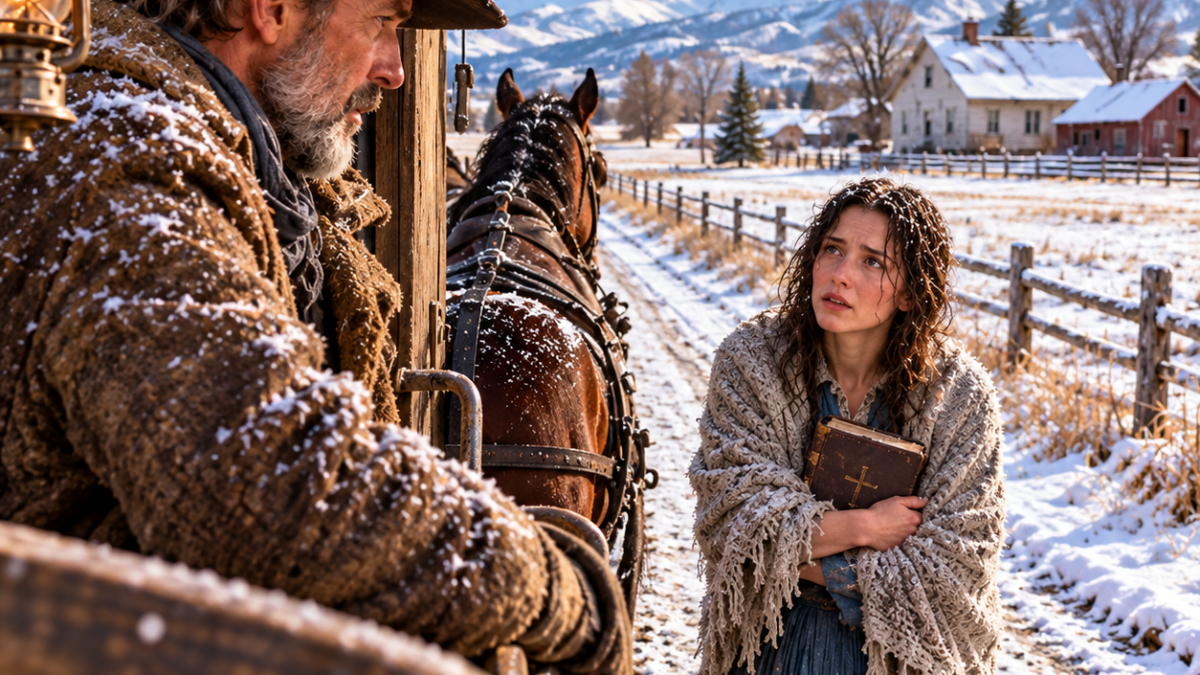
He Stopped to Give a Woman a Ride Through a Freezing Night—Then He Heard Her Praying Behind a Thin Wall for the Horses Her Father Was About to Lose.
I almost drove past the woman on the frozen road, the same way I had driven past a hundred other sorrows that were none of my business.
By midnight, she was sleeping behind a bolted door in my spare room, and through the thin pine wall I heard her whisper a prayer that would ruin every rule I had spent thirty-six years building around my heart.
By morning, I learned I was the man hired to lead her father’s horses away, and before the week was over, I had to choose between keeping my word to a powerful trader or becoming the answer to a prayer no one knew I had heard.
My name is Cole Vance, and in the late November of 1878, along the freezing timber trails of northern Arkansas, God stopped my wagon.
I did not know it was God at first.
Men like me seldom name mercy when it first arrives. We call it inconvenience. Bad timing. Weather. A fool decision. A quarter mile of guilty conscience we would rather not examine.
That night, the sleet came sideways off the ridge, thin and hard as thrown glass. It struck the brim of my hat, clicked against the wagon lantern, and glazed the mules’ backs with a silver crust. The road was no more than two muddy ruts cut through black timber, and the wheels complained every time they dropped into another frozen hole.
I had four mules in harness, one saddle horse tied behind, and an empty freight wagon rattling over ground that wanted to break an axle just to prove it could. I had hauled everything folks in northern Arkansas could buy, sell, inherit, lose, gamble, or surrender to debt. Plows. Bureaus. Crates of hens. Coffins. Stoves. Church pews. One piano that never forgave me for the road between Searcy and Batesville.
That week, I had been sent by Dwight Grayson, a horse trader out of Batesville, to attend a farm sale near Cedar Bluff and purchase a matched gray team he had his eye on.
My instruction was simple.
Buy the team if they stayed under four hundred and fifty dollars. Lead them straight back to Grayson’s yard. No delays. No sentiment. No side trips.
That was the kind of order I understood.
Load it. Tie it. Drive.
A hauler who does anything else eventually loses money, sleep, or something worse.
By fifty-two, I had made a life out of not looking too closely at the things I moved from one place to another. A freight man sees more grief than preachers and doctors if he works long enough. He hauls bedsteads out of houses after wives die. He hauls tools away from shops after men go bankrupt. He hauls the good china to married daughters and the broken chairs to auction. He hauls farm equipment off land a family has worked for three generations while the children stand in the yard pretending not to cry.
You learn where to place your eyes.
Ropes.
Knots.
Wheels.
Hooves.
You do not look at the woman on the porch.
You do not look at the boy clenching his jaw beside the barn.
You do not look back at the house when you drive away.
I had been good at that for a long time.
Then I saw her.
She appeared in my lantern light for maybe three seconds.
A woman walking alone down the middle of the wagon ruts, head bowed, hands tucked inside a worn wool shawl. Her dress was cotton, dark with sleet at the hem. Her hair had come loose under the weather and lay pasted against her cheeks. She was moving steadily, but not strongly. There is a difference.
Strong people walk like they expect the road to answer them.
Desperate people walk because stopping has become more dangerous than going on.
I passed her.
The mules blew steam into the dark. Harness chains jingled. The wagon wheels rolled on. The lantern swung beside me, throwing her shadow behind us until even that was gone.
I told myself she was nearly to town.
I told myself she might not want a strange man stopping on a lonely road.
I told myself everybody walking at night had a reason, and most of those reasons were not improved by a freight hauler asking questions.
I drove another quarter mile.
Then I pulled up the team so hard the wheel brake shrieked.
The mules stopped and turned their ears back at me, offended.
PART2:
I sat there in the sleet with both hands on the lines, staring into the dark ahead.
“Fool,” I muttered.
The lead mule, Esther, shook her head like she agreed.
I turned the wagon around in a place too narrow for turning, cursed twice, apologized to nobody, and drove back.
She was still walking.
When the lantern found her again, she stopped but did not step toward the ditch or away from me. She stood in the road and watched me come on, shoulders square despite the cold. Pride had kept her upright after strength had already made other arrangements.
I drew alongside and leaned down from the seat.
“I’m not asking for a ride,” she said before I could speak.
Her voice was low, steady, and shaking all at once.
“I want that on the record.”
“So noted,” I said. “The record also says it is eleven at night and you are walking through slush in a cotton dress.”
“My buggy is in the ditch on the old mill road. Broken wheel. I waited with it an hour, but the lantern oil gave out.”
“Then climb up before the lines freeze to my gloves.”
She did not move at once.
She looked first at the mules, then at the long empty wagon behind me, then at my face. I could see her deciding whether I was a greater danger than the weather.
Pressed to her chest, she held an old leather Bible. The cover was dark and cracked with age, and the gold cross had been worn nearly off from use or worry or both.
“What do you haul?” she asked.
“Whatever folks buy at farm sales.”
Something flickered across her face.
I nearly missed it.
PART3:
Nearly.
“A horse trader sent me for a team up north of here,” I added. “I lead them home behind the wagon.”
The Bible tightened against her chest.
Then her face closed.
She climbed up.
I pulled my buffalo coat off the peg behind the seat and handed it to her.
“Smells like mule,” I said. “No extra charge.”
She took it anyway. It swallowed her shoulders and fell nearly to her ankles. She pulled it around herself with both hands and shook so hard her teeth clicked.
“Does your outfit let you carry strangers?” she asked.
“I am the outfit.”
“That so?”
“Nobody can fire me but me, and I’ve tried.”
That got half a smile.
Half a smile from a freezing woman on a dark road is worth more than a laugh from a warm man in a saloon.
“My name is Clara,” she said after a while.
No last name.
I did not ask.
In my line of work, you learn not to. A person gives what they can afford to give. Names, like money, are not always available in full.
“Cole Vance,” I said.
“Mr. Vance.”
“Cole is cheaper.”
“Clara is all you get tonight.”
“Fair enough.”
We rode in silence for a stretch. The sleet had begun turning the road to a slick ribbon. The mules lowered their heads and worked carefully. The wagon creaked behind us.
“Why didn’t you stay with the buggy?” I asked.
“I did. An hour.”
“Most people sit and wait.”
“Most people aren’t wheelwrights.”
That made me look at her.
She was staring ahead, chin tucked in the collar of my coat.
“You fix wheels?”
“I fix wagons at a blacksmith and wagon works in Fort Smith. Freight wagons. Army wagons. Stagecoaches. They are older than yours and have worse attitudes.”
“My wagon has a fine attitude.”
“Your near hind wheel squeaks every third turn.”
“It sings.”
“It complains.”
“You hear that in this weather?”
“I hear everything wrong with a wagon. It is a curse and a trade.”
I almost smiled.
“Where am I taking you, Clara?”
“The boarding house in Cedar Bluff.”
The quickest route was the old mill road, straight past a dozen farms and into town.
She turned toward me before I pulled the team that way.
“Could we take the ridge road?”
“It’s longer.”
“I know.”
“It is colder.”
“I know.”
“Why?”
She took a breath and released it slowly.
“Please don’t take me past the farms on the old mill road.”
“Any farm in particular?”
She pulled the buffalo coat tighter.
“Politely,” she said, “that is all I have for tonight.”
I had made my life around not asking twice.
So I took the ridge road.
Every mile or so, my lantern caught a handbill nailed to a fence post.
Farm Sale by Order of the County Court.
Saturday.
Horses and Implements.
I had passed a thousand such notices in my life.
Clara watched every one of them go by like it had called her by name.
Cedar Bluff was dark except for the hotel, the boarding house, and the saloon. The sleet had closed the ferry and filled the town with stranded teamsters, horse buyers, traders, cousins with claims to auction proceeds, and men who smelled profit before breakfast.
The boarding house had a card in the window.
NO ROOMS.
WELCOME SALE BUYERS.
Clara stood in the hallway wearing my buffalo coat and did arithmetic with her eyes.
The next inn was twenty-five miles west.
She did not have twenty-five more miles in her.
“You know anybody in town?” I asked.
“I know everybody in town,” she said.
Her voice had gone flat.
“That is the problem.”
I should have wished her luck.
I should have gone to the livery, stabled the mules, slept in the hay, bought my team Saturday, and kept my business clean.
Instead, I heard myself say, “I have a spare room.”
She looked at me.
“There is a bolt on the inside of the door,” I added.
She studied my face so long the clerk behind the boarding house desk stopped pretending not to listen.
“I’ll need terms,” she said.
“Terms?”
“I cook breakfast. I don’t take charity. And you don’t ask me why I am here.”
“Breakfast is the rent.”
“Done.”
“You didn’t bargain,” she said.
“I haven’t had a decent breakfast in two years. It is not a position worth defending.”
The laugh slipped out of her quick and surprised, like it had escaped without her permission.
That laugh was the first warm thing in the whole night.
My place sat outside Cedar Bluff, a small white house with a big barn behind it, which tells you which one I cared about more. The house had two rooms downstairs, two upstairs, and walls thin enough to hear a mouse consider sinning. The barn had six stalls, a loft, a workbench, space for freight, and the only order I kept without effort.
I showed Clara the upstairs room.
“There’s the bolt.”
She stepped inside and tested it.
Twice.
I pretended not to notice.
She pretended not to notice me pretending.
Then she stopped with one hand on the door.
“You passed me.”
I looked up.
“A quarter mile later, you stopped. Why?”
“I don’t know.”
“That is not an answer.”
“It’s the one I have tonight.”
She nodded slowly.
“Fair,” she said. “It is the one I gave you.”
Then the bolt slid home.
I went downstairs, banked the stove, pulled off my boots, and sat at the kitchen table longer than necessary. The house made its usual winter sounds. Wind against pine siding. Stove iron ticking. Mules shifting in the barn. The faint drip from a place in the roof I had been meaning to fix since September.
Then I heard her.
At first, I thought she was crying.
Then I realized it was lower than crying.
A woman on her knees.
Through the thin pine wall, her voice trembled into the dark.
“Lord, you know I haven’t asked you for much in thirteen years. I’m asking now. Save my father’s horses. I don’t ask it for me. I ask it for him. Don’t let him lose the last thing he has. And if You can’t spare them, then spare his heart.”
I sat very still.
The stove popped.
Wind struck the house.
Then she read softly, like someone who already knew the words by the shape of them.
“And we know that all things work together for good to them that love God, to them who are the called according to His purpose.”
Romans.
My mother had read that verse once in our kitchen a lifetime ago, the morning after my father lost the farm.
I had not thought of it in years.
Or I had made a practice of not thinking of it.
Upstairs, Clara fell silent.
I sat in the dark kitchen and did not know what any of it meant.
But I knew, with the quiet certainty that enters a man and sits down before he can argue it out, that I had not stopped my wagon by accident.
At five, the house smelled of bacon, coffee, and biscuits.
I came downstairs expecting the awkwardness that follows a night when a stranger has wept through your walls. Clara gave me none. She stood at the stove in my coat, sleeves rolled back, hair braided tight, working like she had always known where my skillet lived.
“Coffee,” she said.
It was not a question.
I poured.
She took an unreasonable amount of sugar.
I watched her bow her head over eggs and bacon longer than most preachers do at Thanksgiving. Her lips moved but no sound came.
I looked away because some things are not for a man’s eyes just because they happen in his house.
After breakfast, I went to hitch the mules to fetch her buggy. When I turned, she was in the barn doorway, head tilted like someone listening through a wall.
“Hear that squeak?” she asked.
“What squeak?”
“The near hind wheel. Hub is running dry and the iron tire is working loose. By the first thaw, it will come apart on you going downhill with a full load.”
I looked at my wagon.
Then at her.
“What exactly do you do in Fort Smith?”
“I told you. I fix wagons.”
“Women do not generally fix freight wagons.”
“Freight wagons do not generally object when the work is good.”
That seemed hard to argue with.
“Eggs are getting cold,” she said. “That is part of the rent.”
By seven, the sun came up hard and white over the stubble fields. We took my light wagon out the old mill road to recover her buggy. She sat beside me now with less trembling and more watchfulness.
We passed a big white farmhouse with a red barn.
Wagons already lined the road.
A banner hung along the fence.
ROGERS FARM SALE. SATURDAY 9:00.
Clara did not turn her head.
I noticed that she did not.
I did not know what to do with the noticing.
At the ditch, she assessed the broken wheel with the brisk contempt of a surgeon finding poor stitching.
“Axle’s sound,” she said. “Wheel’s cracked. I can splint it enough to get to town.”
From the back of my wagon, she took rawhide, a length of hickory, a mallet, and tools I had not told her I carried. Her hands moved quick and sure. No wasted motion. No fluttering. No asking permission. She lashed the splint in place, tested the weight, then climbed up to steer without being asked.
The buggy came out on the second pull.
When it was done, she started to take off my coat.
“Keep it till the day warms,” I said.
She gave me a look I could not sort out.
Then she thanked me and drove toward town.
Halfway home, I realized I had not asked where she was going.
That was habit.
Or cowardice.
Most habits are.
The sale was loud by eight the next morning.
Three hundred people in wool coats crowded the Rogers place, stamping cold from their boots and pretending not to stare too hard at what grief had priced. Church ladies sold ham biscuits and hot cider from a plank table. Boys ran between wagons. Men stood in clusters discussing soil, weather, debt, and other men’s failures with equal confidence.
Auctioneer Wally Boyd stood on a hay wagon, talking fast enough to shame a telegraph line.
“Cole Vance,” he called when he saw me. “Grayson’s man. You’re here for the grays?”
“I am.”
“They’ll go high.”
“Not higher than my number.”
“You ever known grief not to bid against money?”
I looked at him.
He grinned without warmth and turned away.
The grays stood in front of the barn.
Matched Percherons.
Dapple gray. Big-bodied. Clean-legged. Manes brushed. Hooves blacked. Harness freshly oiled until the leather shone. They looked too fine for a forced sale. Too dignified.
A brass plate hung on each bridle.
Moses.
Aaron.
I had seen strong teams before. These two had something else. They stood as if they had been taught not simply to obey but to understand. Their ears moved toward the same sounds. Their weight shifted together. A team like that is not made quickly. A team like that is raised inside a life.
My order from Dwight Grayson was plain.
Buy up to four hundred and fifty dollars.
Lead them straight to Batesville.
That was when I saw my coat.
Forty feet from the horses stood Clara inside it.
She was not watching the crowd.
She was watching Moses and Aaron the way a person watches someone in a sickbed.
I should have understood then.
But a man can miss the truth even when it is wearing his coat in front of him.
Wally opened at two hundred.
The bids climbed fast.
Two-twenty.
Two-fifty.
Two-eighty.
Three hundred.
At three-twenty-five, two farmers dropped out. At three-fifty, a trader from Conway shook his head and stepped back. At three-seventy-five, only one man stood against me, a red-faced buyer with new gloves and old greed.
I kept waiting for Clara to raise her hand.
She did not move.
“Three-eighty-five,” I called.
Wally pointed.
“Three-eighty-five to Grayson’s man. Do I hear four?”
The red-faced man looked at the horses, then at me, then at the crowd watching.
He spat.
Wally waited half a breath.
“Sold. Three hundred eighty-five dollars to Grayson of Batesville. Cole, they’re yours to lead.”
The word yours landed wrong.
They were not mine.
They were not Grayson’s either, not in any way that mattered beyond paper.
Clara turned and looked straight at me.
Not at the horses.
At me.
A man came up beside her then. Big, brown work coat, same dark hair, same set to the jaw, only tired in a way Clara was not. His shoulders looked built by years of lifting and bent by one year too many.
“Clara,” he said. “Pa wants you to come by. Sister at the mission says he keeps asking who bought them.”
There it was.
The thing I should have guessed.
The Rogers farm.
The prayer.
The horses.
The ridge road.
I had been hired to lead her father’s horses away, and she had slept in my spare room without one word about it.
The team came to my lead rope on the first touch.
Somebody had trained them right, years ago.
Moses lowered his head when I checked the bridle. Aaron shifted closer, watching my hands. They did not spook at the crowd. Did not toss. Did not protest. Good horses with no say in the matter.
I had led a few hundred animals away in front of the families that owned them.
I had a way of doing it.
Look at ropes.
Knots.
Hooves.
Buckles.
Do not look at people.
That morning, it took everything I had to keep looking at the ropes.
The big man came over.
“Bobby Rogers,” he said. “That’s my father’s team you’re tying.”
“I’m sorry about your father.”
“He fell in August. Broke his hip. He’s in the mission home on Main Street and not coming back out here.”
“I’m sorry,” I said again, because men like me say sorry when no word fits and silence seems ruder.
Bobby looked at Moses and Aaron.
“I farmed this ground with him twenty-two years. Couldn’t make it pay after the drought. Neither could the bank.”
His eyes moved toward Clara.
“She stayed at your place.”
“The boarding house was full.”
“Sure it was.”
There was no accusation in his voice exactly.
That made it worse.
“Thirteen years,” he said. “She never came home for one harvest, but she found time for the sale.”
“That’s not my business.”
“No.” He looked at my hands on the rope. “You just haul it.”
He was not mean about it.
He sounded like a man who had been tired for four years and had no strength left to aim his anger properly.
Still, the words landed.
You just haul it.
When I was sixteen, I stood in my own yard one county over and watched a hauler lead my father’s team away after the bank took our farm. The hauler never once looked at us. Not at my father standing with both hands open at his sides like he had dropped something he could not find. Not at my mother in the doorway. Not at me, trying to hold my face like a man’s though I was still a boy.
I remember hating that hauler.
Then I remember thinking he had the right idea.
If you do not look, maybe you do not have to keep what you see.
Clara came over.
Her eyes were dry.
Her voice was not.
“You didn’t tell me,” I said.
“You didn’t ask.”
“That was the deal.”
“Yes.”
“Which way are you going out?” she asked.
“Main Street to the east road.”
“The mission home is on Main. Pa’s window faces the street. He hasn’t seen them since August.”
She stopped there.
She did not ask me for anything.
That was worse.
Grayson had been clear.
Straight to Batesville.
A wealthy breeder from Missouri was coming Sunday to inspect the team. Grayson wanted them in his yard by then. Clean, rested, and unmarked by delay or sentiment.
The clouds in the west were already stacking gray.
I had one rule on sale days.
Load it. Tie it. Drive.
Do not stop in front of anybody’s window.
“Which window?” I asked.
Clara blinked.
“The fourth one.”
At a quarter to eleven, I eased the wagon up in front of Cedar Bluff Mission Home.
A minute later, the curtain moved in the fourth window.
Then a sister in gray wheeled an old man out onto the porch in a wicker chair, a quilt over his knees and a Bible on his lap older than Clara’s.
Ernest Rogers was small and bald, with the biggest hands I ever saw on a man that size. Farm hands. Horse hands. Hands that knew rope, weather, plow lines, and children’s heads.
They brought him down the ramp.
He reached up and laid one hand flat on Moses’s neck the way you would settle a child.
Moses lowered his head.
Aaron stepped closer.
The old man closed his eyes.
For a moment, nobody on Main Street moved.
Then Ernest asked, “Did they take the bit first try?”
“First try,” I said.
Clara stood by the steps.
“She gentled them winter they turned three,” Ernest said. “She was eighteen. Wouldn’t let me near the halter.”
“You kept coming near it,” Clara said.
“I was supervising.”
“You were interfering.”
The old man laughed, and the sound took ten years off his face until the sister fussed and made him tuck his hand back under the quilt.
He looked my wagon over from end to end.
“You lead many teams off many farms?”
“Most weekends, fall and spring.”
“You ever look back at the house when you drive off?”
“No, sir.”
“Hm.”
He did not sound like he was judging me.
He sounded like he was filing it away.
Then Clara did something no one expected.
She took hold of Moses’s mane, placed one foot against the wagon wheel, and swung herself onto his broad bare back right there on Main Street in her blue cotton dress and my buffalo coat.
The crowd along the boardwalk stopped pretending not to stare.
Clara sat her father’s horse like she was eighteen again.
Moses did not move.
He simply stood taller.
Ernest laughed until the sister threatened to take him back inside.
Then the old man bowed his head.
“Lord,” he prayed aloud, voice shaking but clear, “I’ve sat at that window every morning since August asking You to look after my children and whoever You send down this road. Well, here’s who You sent.”
I looked down at my boots.
“Bless these horses wherever they go. Bless my girl who trained them. Bless my boy who tried to hold what no man can hold alone. And bless the man leading them.” His voice paused. “He doesn’t look back. Teach him to.”
No one on that street moved until he said, “Amen.”
Before I left, Clara walked me to the wagon.
“Bobby’s wife made up the settee for me,” she said. “Denise is kind, but I would be sleeping in a house where everybody is sorry I’m there.”
I knew the kind of house she meant.
“Is that room still for rent?” she asked.
“Breakfast rate.”
“Breakfast rate,” she repeated.
By the time I pulled out, the sleet had returned.
Nine miles east, the road down Gilliam’s Hill had glazed over completely. I found a freight wagon on its side at the bottom, two mules tangled in harness and screaming. I spent an hour helping the driver cut them loose and calm them down.
Then I stood at the top of the hill with Moses and Aaron behind me, the road shining like a knife blade below.
You do not lead another man’s three-hundred-eighty-five-dollar team down icy hills just to prove you are on time.
Not unless pride has made a fool of you.
I turned around.
At the telegraph office, I wired Grayson.
ROAD UNSAFE. TEAM SOUND. WILL LEAVE MONDAY FIRST LIGHT.
C. VANCE.
His answer came an hour later.
MISSOURI BUYER STANDS IN EMPTY CORRAL SUNDAY. YOUR DELAY COSTS ME.
No signature.
None needed.
When I got home, Clara was in my kitchen with groceries nobody had asked her to buy. Beef stew simmered in a pot I did not remember owning. Cornbread sat in a skillet, golden and accusing.
“Thank you for the window,” she said.
“He’ll talk about it for a year.”
“It was on the way.”
She pointed the spoon at me.
“It was not on the way. You turned a freight wagon around on Main Street.”
“Main Street leads east.”
“Cole.”
“What?”
“Did it cost you with your trader?”
I lifted my bowl.
“Grayson’s fine.”
She looked at me for a second longer than comfort allowed.
Then she nodded and went back to the stew.
That was the first lie I told her.
A small one, I told myself.
The kind that smooths a sharp place.
The kind that prevents a woman who already carries too much from picking up one more thing.
That night, through the wall, I heard her pray again.
This time, I heard my name in it.
Sunday morning, Clara walked with me to the little white church at the crossroads and sang every hymn without the book. Her voice was not large, but it was steady. It had weather in it. Not the storm itself. The place left clean after.
I had not stood in church beside a woman since my mother left Arkansas.
That is not a thing I meant to think during “Nearer, My God, to Thee,” but a mind will choose its own hymns.
Sunday afternoon, I found Clara under my freight wagon.
“It is the Lord’s Day,” I said.
“The Lord made allowance for an ox in a ditch,” she called from underneath. “A wheel that will kill you on a hill is close enough. Hand me the big wrench.”
I handed it down.
A second later, she held it back up.
“This has been used as a hammer.”
“It has not.”
“There are hammer marks on your wrench, Cole.”
“I don’t know how you can see that from under a wagon.”
“The marks are ashamed of themselves. They stand out.”
By three, I had been demoted to holding the lantern.
“You’ve been promoted to lighting,” she said. “It is a very important position.”
She worked the way good wheelwrights work. No hurry. No wasted motion. She talked to bolts under her breath, not sweetly. Threats mostly.
When she pulled the hub, she held up the iron box that lined it.
A crack ran clean through where the weight sat.
She did not say, I told you so.
She simply set it on my workbench where I would see it every morning for the next year.
That evening, she went to visit her father and asked if I wanted to come.
“I have ledgers.”
She looked at me.
“Do you?”
“I have the idea of ledgers.”
She went without me.
An hour later, she came back and found me not doing ledgers at all.
“He asked why you didn’t come in.”
“I’m the hauler.”
“He said that is a job, not a reason.”
I had nothing for that.
Late that night, I found her in the barn, sitting in the straw of Moses’s stall in the dark.
I leaned on the stall door.
She did not startle.
“I knew you’d come out eventually,” she said.
“Moses complaining?”
“No. I was.”
“About what?”
“Thirteen years.”
That did not ask for a reply, so I gave none.
She ran her thumb through Moses’s mane.
“The winter I was eighteen, Pa brought these two home half-wild. Bobby said they were too much horse for us. Pa said good, that meant they had sense enough to object.”
Moses shifted closer to her.
“I worked with them every morning before chores and every evening after. Pa kept trying to help. He thought help meant standing too close and saying things I already knew. By Easter, they were plowing straight lines with nothing but my voice.”
“You were proud of that.”
“I was terrible about it.”
“That is not the same thing.”
She smiled faintly.
“No. But close.”
Then her face changed.
“The year after, I asked whether any of the farm would ever be mine.”
I stayed quiet.
“Pa said farms go to the one who stays.”
The barn seemed to grow still around us.
“So I told him I would go,” she said. “At nineteen, anything seems fair if it hurts enough.”
“Why didn’t you bid on them?”
She kept her eyes on Moses.
“You don’t get to leave for thirteen years and come back and buy the parts you loved.”
It was a good answer.
It sounded practiced.
“Your turn,” she said.
“My turn for what?”
“Where did you learn not to look?”
“I don’t know what you mean.”
“I watched you tie those horses. You looked at every knot in Arkansas. You never once looked at me.”
“It is a safety thing. You watch your load.”
“You do that when somebody asks you something real.”
I looked away.
She waited.
The woman was unnervingly good at waiting.
I said nothing.
After a while, she brushed straw from her dress and stood.
“You answer a different question,” she said gently. “Good night, Cole.”
She did not push.
That made it worse.
Monday morning, she was on the wagon seat before I was.
“I want to see where they go.”
I should have refused.
Grayson had already been crossed once. A woman who had prayed over those horses, slept under my roof, repaired my wagon, kissed no part of my life except the edges, and seen too much besides did not need a long ride beside me to a trader’s yard.
But when she looked at me, I only said, “Bring the coat.”
The road to Batesville ran dry and gold under a hard sky. Stubble fields rolled by on both sides. Moses and Aaron walked behind us, steady as church deacons. Clara had opinions about my driving.
“You’re babying the near mule.”
“I’ve driven these mules eleven years.”
“Then you’ve been babying him eleven years.”
“That mule has a sensitive mouth.”
“That mule has trained you beautifully.”
At noon, we stopped at a roadhouse. She ate half my cornbread and told me it was rent.
“Rent is breakfast.”
“Times have been hard since ’73, Mr. Vance. Rent goes up.”
She asked about my father.
I said he had passed six years before.
“Did he farm?”
“A long time ago.”
“What happened?”
I clucked to the mules and began whistling.
She let the whistling run out.
Then she looked away across the fields and did not ask again.
I had done the thing again.
Answered a different question.
Dwight Grayson was a large bald man who had traded horses thirty years and never once been in a hurry to smile. His yard outside Batesville was all straight fences, clean troughs, and men who moved quickly because slow men did not last there.
He inspected Moses and Aaron himself.
Walked around them twice.
Checked their teeth.
Ran hands over legs and shoulders.
Watched them move.
Then he spoke one quiet word and both horses squared up like soldiers.
Grayson looked at Clara.
“Who trained these?”
“I did. When I was eighteen. Pa was under orders not to touch them.”
“Thirteen years and they still answer to the same hand.”
She said nothing.
He turned to me.
“You were due yesterday.”
“Road iced over.”
“My Missouri buyer left this morning.”
“I wired.”
“You cost me a sale.”
“Yes.”
Clara’s head turned toward me.
I did not look at her.
Grayson studied me.
Then Clara said, “They would have broken a leg on Gilliam’s Hill.”
Grayson’s eyes moved to her.
“Would they?”
“Yes.”
“You know roads now too?”
“I know wheels. I know ice. I know when a man turned around because he had more sense than greed.”
Grayson’s mouth did something dangerously close to smiling.
“You ever need work,” he said to her, “you come to me.”
“I fix wagons.”
“Wagons are just horses that complain less.”
That was the closest thing to a joke I had heard from him in eleven years.
When he walked me to his office door, his voice dropped.
“We’ll talk about spring.”
That was all.
I knew what it meant.
Maybe I had not lost him entirely.
Or maybe I had lost enough to matter.
On the way home, Clara fell asleep against my shoulder with my buffalo coat for a pillow. I kept my eyes on the road and my hands loose on the lines, aware of every mile, every breath, every place where her weight touched my sleeve.
When I set the brake in my yard, the wagon was silent.
No squeak.
She woke and caught me listening for it.
“You’re welcome,” she said.
“I didn’t say thank you.”
“You were thinking it loudly.”
She sat up, hair loose from sleep, face softer than I had yet seen it.
“Cole, I’m going to kiss you,” she said. “Then I’m going inside, and you are going to let me go inside.”
I looked at her.
“Are those terms?”
“Those are terms.”
So she kissed me.
It was not long.
It was not the sort of kiss men brag about because bragging would cheapen what it was.
It was a door opening just enough to show light under it.
Then she went into the house, and I sat on the wagon seat ten minutes in the dark listening to nothing squeak.
Tuesday, I hauled a broken mowing machine for Floyd Brewer.
Two blacksmiths had looked at it and declared it cursed. Clara found a packrat nest in the gear case where the rat had chewed the drive strap through. She had the thing running before I got the tailgate down.
Floyd stared at her.
“Where did you come from?”
“Cedar Bluff originally.”
“Well, we sure could use you back. Nearest wheelwright’s forty miles, and he charges like it’s a hundred.”
She laughed it off.
But riding home, she looked at every empty storefront on Main Street like she was measuring.
That evening, she said her father wanted to meet me properly.
“I’ll come sometime this week,” I said.
Wednesday morning, she asked again.
“Sometime,” I said.
Wednesday noon, I took her to the cafe on Main, thinking eggs and coffee in public might make me less cowardly.
It did not.
Halfway through our meal, Wally Boyd slid into the booth as if invited by the devil himself.
“Heard Grayson gave your spring hauling to that outfit from Searcy over the Rogers team delay,” he said.
I set my fork down.
“Just asking, Cole.”
He looked at Clara.
Then at me.
Then he left with the satisfied air of a man who had dropped a match and did not plan to stay for the fire.
Clara did not speak until we were in the wagon.
“You lost Grayson.”
“Some of Grayson.”
“Because you stopped on Main Street for my father.”
“That was my choice.”
“You don’t get to pay for my family behind my back, Cole.”
“Why not?”
She opened her mouth.
Nothing came out.
We rode home in silence.
I thought I had done a noble thing.
That is always when pride is most dangerous.
Thursday, Bobby Rogers rode into my yard.
He stayed mounted longer than necessary, which told me he did not want to come in.
“The land goes before the judge tomorrow at ten,” he said. “Her share’s paid at the bank by noon. I expect she’ll be on the one o’clock stage to Fort Smith.”
Something in me closed before I knew it had opened.
“You know that?”
“I know my sister.”
I looked toward the house.
Bobby looked at his boots.
“Somebody should have told me the first time she left. I came in from the field and her room was empty. Pa sat at the table not talking. Thirteen years of Christmas letters after that.”
He rubbed his jaw.
“You seem like a decent man. She already cost you Grayson.”
“She didn’t cost me anything.”
He looked at me then.
“Careful. That is the kind of thing a man says right before he starts keeping score.”
I stood in the barn doorway a long time after he rode out.
I had heard those words before in a different kitchen about a different woman.
My mother.
After our farm was sold, she took her half of what little remained and went to St. Louis. Sent birthday letters for a few years. Then they thinned. Then stopped.
I had been sixteen.
Old enough to understand leaving.
Young enough to believe it defined everyone who did it.
In the house, Clara’s door was open a crack.
She sat at the small desk, writing a letter and reading it under her breath.
“As soon as the papers are signed and the money is paid, I am finished here. I will wire you from the road.”
I stepped back before she saw me.
That night, she made pot roast.
Halfway through, she set down her fork.
“The land goes before the judge tomorrow.”
“Bobby told me.”
“If I catch the one o’clock stage, I’ll make Fort Smith before the weather turns.”
“That’s what you think this is?” she asked.
“It is what people do.”
“Which people, Cole?”
I did not answer.
That was the answer.
Her face changed.
Not dramatically.
Worse.
Quietly.
“Ask me where I’m going,” she said.
“That’s not my business.”
The words left my mouth before I could stop them.
The exact words I had said to her brother on sale day.
She nodded slowly.
“All right.”
Then she washed her plate, went down the hall, and I heard the bolt slide.
First time all week.
That night, through the wall, I heard no prayer.
Just quiet.
At five, I gave up on sleep and went to the barn. The cracked hub box still sat on my workbench where she had placed it.
When I came back at eight, her buggy was gone.
A plate of eggs and bacon sat on the stove with another plate turned over it to keep warm.
My buffalo coat hung on the peg by the door.
She had paid her rent.
By four that afternoon, I was still telling myself I had no right to be angry at a woman for doing exactly what I had expected her to do.
Then a boy from the mission ran up my lane carrying a note in a large, shaky hand.
Mr. Vance,
You parked my horses under my window and never once came in to say hello. Where I come from, that is poor manners.
Come now.
E. Rogers.
Room four at the mission home smelled of coffee, liniment, old wood, and winter wool drying near a stove.
Ernest Rogers sat by the window, Bible open on his knees.
“Where is my daughter?” he asked.
“Fort Smith, I expect.”
“You expect.”
“I don’t know.”
“Did you ask?”
“No.”
“Then you don’t know, do you, son?”
I sat on the edge of the chair near the bed.
He studied me with eyes that had not lost much despite the body failing under them.
“You know why she didn’t bid on those horses?”
“She said you don’t get to leave and come back and buy the parts you loved.”
Ernest made a sound like a tire coming off a wheel.
“That is the version she tells so nobody feels sorry for her.”
I leaned forward.
“She didn’t bid because she was broke,” he said.
I stared at him.
“Four years ago, drought burned us to dust. Grasshoppers took what the sun left. The bank was going to call our note before spring planting. Clara found out. I still don’t know how.”
He laid one large hand on the Bible.
“She paid for seed and feed. Every dollar she had saved. Made me swear on this book not to tell Bobby. Bobby thought I paid it. I let him.”
His mouth twisted.
“A man’s pride is an expensive animal.”
I could not speak.
“And today,” Ernest continued, “the buyer took all the land but the house and barn. Bobby could keep those only if he found the money.”
The old man looked out the window.
“At ten this morning, in front of the judge, Clara signed her whole third over to him. Walked out of that courthouse with nothing but the pen. She kept the pen.”
I thought of Clara in my wagon telling me I did not get to pay for her family behind her back.
She had been doing it for years.
“Does Bobby know?” I asked.
“Bobby sat in his wagon outside the courthouse half the morning. He knows enough to be ashamed and grateful, which is a heavy pair to carry.”
“And Clara?”
“She came here after. Kissed my head. Told me not to worry. That is when I knew she was about to do something foolish.”
“Go back to Fort Smith?”
“Maybe.”
“You don’t know?”
He lifted his Bible.
“Tuesday, she asked me something. Whether a man who stops his wagon in the sleet is the kind who keeps on stopping. I told her I’d need to meet him first.”
He looked at me a long time.
“Well. I’ve met him.”
I swallowed.
“What did you decide?”
“That he is stubborn. Frightened. More honorable than he wants to admit. Less honest with himself than with others. A man who thinks not looking keeps him safe.”
I almost smiled despite myself.
“You got all that from one missed visit?”
“I farmed forty years and raised two sons and a daughter. You learn to read weather.”
He turned the Bible toward me.
“And we know that all things work together for good to them that love God.”
“I heard her read that the first night.”
“I expect you were meant to.”
“I don’t know where she went.”
“Did you ask her?”
“No.”
“Then you don’t know, do you, son?”
He had already said that.
It did not improve by repetition.
“What I have to say won’t fit on a telegraph blank,” I said.
“No,” Ernest agreed. “Truth seldom does at ten cents a word.”
“I know where she works.”
“Then why are you still sitting here?”
I stood.
At the door, Ernest called after me.
“Cole.”
I turned.
“I prayed thirteen years for my girl to come home. Never once told the Lord how to do it. Turns out He sent a freight wagon.”
His eyes sharpened.
“Don’t make Him send it twice.”
The stage took three days to reach Fort Smith with stops.
I saddled my horse and rode it in two.
I did not enjoy a mile.
Cold rain found me before dawn the second day. Mud sucked at the horse’s hooves. My back ached. My knees complained. I slept four hours under a shed roof and woke with my coat stiff from frost. By the time I reached Fort Smith, my hands were cracked, my face windburned, and my horse liked me less than when we started.
Kellerman’s Blacksmith and Wagon Works stood on Garrison Avenue, long and low, with forge light spilling red through the wide doors.
It was past nine at night, but the forges were lit.
A night foreman with arms like fence posts looked me over.
“You Vance?”
“Yes.”
“She said you might come.”
My heart did something foolish.
“When?”
“Before she left Cedar Bluff.”
He pointed toward the back.
“Bay three.”
Clara stood beneath a leaking roof, dragging a big red tool chest toward the door.
She saw me and stopped.
Her face gave nothing away at first.
Then too much.
“You rode two days about that?” she asked.
Her voice was steady.
Her hands were not.
“On whose account?” she added.
“Mine.”
She waited.
She was good at waiting.
I stepped inside the forge bay. Rain dripped through a hole in the roof and hissed when it struck hot iron near the forge.
“You asked where I learned not to look,” I said.
She folded her arms.
“You said you were sixteen.”
“We had a farm one county over. Pa lost it the same way yours did. Slow, then all at once. I stood in the yard and watched a hauler lead our team away. He never looked at us. I hated him for that.”
I took a breath.
“Then my mother took her share of what was left and moved to St. Louis. Sent me birthday letters a few years. Then stopped. So I decided that hauler had figured something out. Load it. Tie it. Don’t look at anybody. Nobody can take a thing from you if you never get close enough to hand it over.”
The words took less time to say than I expected.
Maybe because I had spent thirty-six years not saying them.
Clara’s face had softened, but she did not rescue me from the silence.
“When Bobby said the money would be paid Friday,” I said, “I heard my mother. I thought you were leaving for good before you had even told me where you were going. I am not proud of it.”
“I am not your mother.”
“I know.”
“Then say the rest.”
I took another breath.
“I was wrong about you. About why you didn’t bid. About what you were doing at the courthouse. About why you came back. About all of it.”
“You heard me Thursday,” she said. “The letter.”
“Yes.”
Her eyes flashed.
“That letter was to Mr. Kellerman. Twelve years in this bay. You don’t quit a man like that by post. I came to do it in person once Bobby’s side was settled and I was finished with the farm.”
I had nothing smart to say.
So, for once, I did not try.
“Pa has a few good years left,” she said. “I want to be twenty minutes from him, not three days. And Floyd Brewer is right about needing a wheelwright.”
“Floyd is usually wrong.”
“Not this time.”
She stepped closer.
“Also, I wired Dwight Grayson Friday from the courthouse steps.”
My head came up.
“You what?”
“He sold Moses and Aaron back to me for exactly what he paid. Twelve payments on a handshake over the telegraph.”
“Grayson does not do that.”
“Grayson does it when you tell him the whole story.”
“You told him?”
“I told him stopping on Main Street was my idea.”
“It wasn’t.”
“It was my father’s window.”
“Clara—”
“You told me not to pay for your family behind your back.”
“Yes.”
“I did not pay,” she said. “I traded different.”
I laughed louder than I meant to.
The night foreman looked over.
Clara’s mouth twitched.
“So here it is,” she said. “I need a place to keep a team and a place to fix wagons. You have an empty stall. That is the part I am asking.”
She looked straight at me.
“The rest, you ask.”
So I asked.
Not well.
Not finely.
But plainly.
I asked her to come home with me.
Not to the stall.
To me.
I told her I wanted her on the wagon seat when she wanted to ride and across the table when she did not. I told her I wanted her prayers on the other side of my thin pine walls and her wrench marks on my tools, even if she insulted every one of them. I told her I had heard her that first night asking God to save her father’s horses, and I had spent every day since wondering if I was part of the answer.
“I would like,” I said, my voice rougher than I intended, “to spend whatever years God gives me finding out.”
She looked down.
“I was already coming back.”
“I know.”
“I wanted to see if you would come for me before anybody told you.”
“Nobody told me that part.”
“I know.”
Her eyes were wet, and she was annoyed about it.
“Yes,” she said.
Then lifted one finger.
“With terms.”
I smiled before I could stop it.
“Of course.”
“When something costs you, you tell me. Before, not after.”
“Done. Same for you.”
She thought about that longer than I liked.
“Done.”
Then, right there in bay three under that leaking roof, she took my hand and bowed her head.
For the first time in thirty-six years, I prayed aloud with another human being.
It was not a fine prayer.
Mostly thank You.
I believe it was enough.
When I opened my eyes, Clara wiped her face with the back of her wrist and shoved the big red tool chest toward me.
“You can make yourself useful.”
So I did.
The next week, my ledger had a new work order in Clara’s handwriting.
Pickup: Clara Rogers, Grayson’s Yard, Batesville.
Cargo: One team Percheron, Moses and Aaron.
Delivery: Vance Freight, Cedar Bluff, stall two.
Grayson helped me tie them.
“See you in spring, Cole,” he said. Then glanced toward Clara. “Bring your wheelwright. She frightens me.”
“She frightens everybody with bad maintenance,” I said.
“Good. Men need holy fear.”
On the way home, I turned up Main Street.
This time I did not have to think about it.
The curtain was already back in the fourth window.
Ernest raised one big hand.
Bobby stood beside his chair.
For a second, his arm remained at his side.
Then Bobby raised his hand too.
Clara was waiting at the barn in my coat.
She led Moses and Aaron into their stalls like she had been doing it her whole life, which I suppose she had.
Then she took the work order from my ledger and signed the bottom, in the little box marked “Remarks” that nobody ever fills in.
Five words.
The driver stopped. Keep him.
I stood there staring at it.
“You have terrible handwriting,” I said.
“You have terrible manners.”
“You already knew that.”
“I’m keeping you anyway.”
I have led a lot of teams off a lot of farms.
Moses and Aaron were the only two I ever brought home.
Clara opened a wagon repair shop in the empty storefront on Main Street by spring. The sign read Rogers Wheel and Wagon Works in letters Bobby painted after pretending for three days he was only measuring the board. Men came first because they were curious and then because she was better than the fellow forty miles off who charged like he was a surgeon.
She hired two boys by summer and terrified both into competence.
Floyd Brewer brought every machine he owned whether broken or not because he liked saying he knew her first.
Ernest sat by the mission window most mornings until Clara moved him into the small room downstairs at my house after the thaw. He complained that I brewed coffee like I was punishing the beans. Clara agreed. Bobby came every Thursday evening and pretended he was visiting Moses and Aaron, though he spent most of the time talking to his father about the north pasture, the one piece he had kept.
The Rogers farmhouse was gone to another man by then.
Loss is not undone simply because one prayer is answered.
That is a thing worth saying.
We did not get back the whole farm.
We did not get back thirteen years.
Clara did not become nineteen again, and Ernest did not rise from his chair and walk out to hitch a plow. Bobby did not stop carrying guilt overnight. I did not suddenly become a man who knew how to look at grief without wanting to reach for the reins and drive away.
But something worked together.
The sleet.
The broken buggy.
The full boarding house.
The thin pine wall.
The window on Main Street.
The icy hill.
Even the lie I told over stew and the fear that sent her away.
God took all of it, every crooked piece, and made a road back.
I think often about that quarter mile between passing Clara and stopping my wagon.
In memory, it has become longer than any road I ever drove.
It holds the whole of my life before and after.
Before that quarter mile, I was a man who believed safety meant distance.
After it, I began to learn that honor is not what we say about ourselves. It is what we do in the cold when no one is watching and it would be easier to keep driving.
Some of the most important things God will ever do in a life begin in a moment a man almost drives past.
I almost drove past Clara.
Almost drove past the prayer.
Almost drove past Moses and Aaron.
Almost drove past Ernest’s window.
Almost drove past the woman who would sit beside me in the wagon for twenty-three years, correcting my driving, insulting my tools, repairing my wheels, and teaching me that looking back at the house when you leave it does not make a man weak.
It makes him human.
Years later, after Ernest had gone to the Lord and Bobby’s oldest boy was old enough to brush Moses’s last foal, Clara and I would sit on the porch in the evening and watch the road turn gold under sunset.
Sometimes she would reach for my hand and say, “Would you have stopped if you knew what it would cost?”
I always gave her the same answer.
“No.”
She would laugh because she knew I was telling the truth.
Then I would say, “But God knew better than to tell me first.”
That is mercy too.
The Lord does not always show a man the whole road.
Sometimes He gives him only the woman in the lantern light.
Only the broken wheel.
Only the prayer through the wall.
Only the next right thing.
And if the man is foolish, stubborn, frightened, and blessed enough, he stops.
He turns the wagon around.
He makes room on the seat.
And one day, years later, he understands that no stranger on the road is a stranger to God.
No ride is an accident.
No prayer disappears just because the one praying cannot see who has been sent down the road.
I did not know I was the answer to Clara’s prayer.
I did not know Ernest Rogers had been asking God every morning to send somebody past his window.
I did not know Moses and Aaron would come home.
I did not know the woman in my buffalo coat would teach my house to sound alive again.
But God knew.
He saw the road from end to end.
And somewhere between the ridge road and Cedar Bluff, between the sale barn and the mission porch, between the empty stall and bay three in Fort Smith, He did what He has always done with broken things handed over honestly.
He made them work together for good.
Not smooth.
Not easy.
Not without cost.
Good.
That is enough.
It was enough for Ernest at his window.
Enough for Clara in my spare room.
Enough for Moses and Aaron in stall two.
And, by God’s patience, enough for me—the man who once never looked back—to spend the rest of my days learning how.








