He Stopped for Coffee and Heard a Voice He Hadn’t Heard in 12 Years—Then He Saw the Old Bible in Her Hands and Realized Their Story Wasn’t Over
PART3:
But he knew it the way a man knows his own name spoken in the dark. He knew the gentle strength beneath it, the way certain words were held a heartbeat longer, the softness that never made her sound weak.
Slowly, he turned his head.
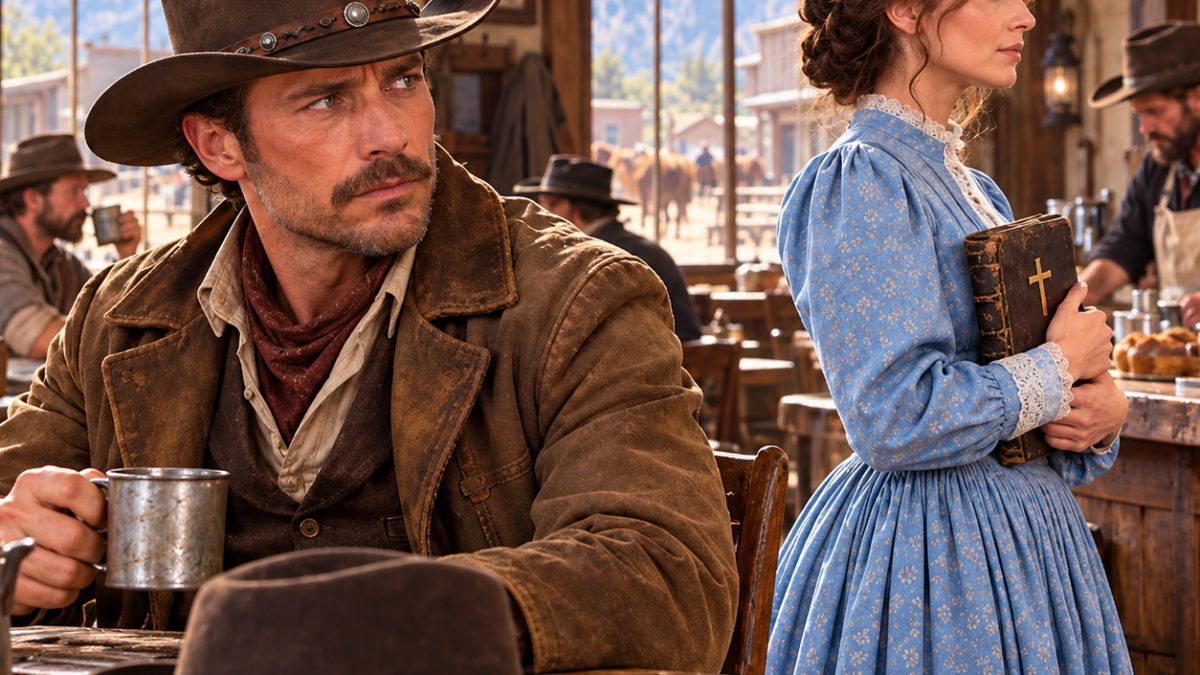
The woman sat beside an elderly widow in a black traveling dress. The widow’s eyes were red from crying, and one gloved hand trembled against the tabletop. The younger woman held that hand with one of her own. In the other rested an old leather Bible, worn soft at the edges, with a small brass cross pressed into the cover.
Jonas knew that Bible too.
It had belonged to his mother.
He had given it to Lydia Monroe twelve years ago, the week before he rode north with Harlan’s cattle outfit, before a letter went missing, before silence grew teeth, before pride and hurt built a wall neither of them had ever climbed.
Lydia.
The name did not pass his lips.
It struck him through the chest instead.
She wore a sky-blue dress, clean but plainly mended at the cuff. Her brown hair was pinned up, though a few loose strands had escaped at her neck. Time had changed her, yes. There were faint lines near her eyes now, not from age so much as worry and weather and nights spent staying strong because no one else was there to do it for her.
But it was Lydia.
His Lydia.
No.
Not his.
Not anymore.
Maybe never.
He sat frozen as she leaned closer to the widow.
“My daughter’s letter said Tuesday,” the older woman whispered. “It is Thursday now. What if she has forgotten me?”
Lydia squeezed her hand.
“Then we will wait together one more day. If she does not come, I will help you write to her. Nobody should have to wait alone.”
Jonas stared at the tabletop.
Nobody should have to wait alone.
He had waited twelve years, though he had called it other things.
Work.
Duty.
Ambition.
Building.
Surviving.
He had waited in Montana with three returned letters in his trunk. Waited through his first winter in a line shack, telling himself if she loved him, she would have come. Waited while buying his first ten cattle. Waited while the herd grew. Waited while he built a ranch house too large for one man because some foolish part of him still believed the rooms might one day fill with the life he had imagined with her.
Then the waiting hardened.
He stopped calling it waiting.
He called it accepting.
A man could make almost any wound sound respectable if he gave it a strong enough name.
Across the room, Lydia rose and poured the widow fresh coffee. When the proprietor brought Lydia a plate of bread and beans, she cut the portion in half and slid one part toward the older woman without a word.
Then the little boy on the barrel sighed loudly over his newspaper.
Lydia noticed.
She stood, walked to him, and bent slightly so her face was level with his.
“That word is cattle,” she said.
The boy frowned. “Looks like cat-tell.”
“It does, doesn’t it? But see the two t’s?” She pointed. “They stand together like fence posts. Cattle.”
“Cattle,” the boy repeated.
“Good.”
He grinned.
She smiled back.
Jonas felt the years buckle inside him.
When the old man at the counter fumbled in his pocket and came up short for his meal, Lydia quietly set a nickel beside his cup before returning to her seat. She did it so quickly he almost missed it. Almost. The old man did not see. The proprietor did, but said nothing.
Jonas saw everything.
He saw the kindness.
He saw the tiredness.
He saw the folded newspaper near her Bible, opened to notices for work.
Twice, she glanced at it and pressed her lips together.
She was worried.
She was tired.
She was still kind.
That was what undid him.
Not her beauty, though she was still beautiful in the plain, steady way that had once made him think of clean water and Sunday morning light.
It was that twelve years had passed and whatever life had done to Lydia Monroe, it had not made her hard.
Then she looked up.
Their eyes met across the room.
The boarding house did not vanish. Not exactly. Jonas still heard the scrape of a chair, the soft cough of the old man, the creak of boards as someone crossed the porch outside. But those sounds moved far away, as if he were hearing them from the bottom of a well.
Lydia’s face went still.
The widow kept speaking, but Lydia did not hear her anymore.
Slowly, Lydia set the Bible on the table.
Jonas rose.
His legs felt like a young man’s and an old man’s at the same time.
He crossed the room with his hat in one hand and twelve years pressing down on his shoulders.
He stopped a few feet from her table.
“Lydia.”
Her hand rested on the Bible as though it were holding her upright.
For a long moment, she said nothing.
Then, softly, carefully, she answered, “Jonas.”
That was all.
Two names.
A whole life buried between them.
The widow looked from one to the other and, with the wisdom of the very old and very wounded, excused herself to speak with the proprietor.
Jonas sat because he did not know what else to do. Lydia remained still, her fingers lightly touching the brass cross on the Bible.
“You look well,” she said at last.
Her voice was composed now.
Too composed.
He knew that voice too. It was the sound of a woman locking doors inside herself one at a time.
“I heard you did well for yourself,” she continued. “The Whittaker ranch. Everyone in the valley knows the name.”
There was no bitterness in the words.
But there was something bruised beneath them.
“I heard you were teaching,” he said.
“I was. In Silver Fork.” She folded her hands. “The school closed in the spring. Not enough families left.”
“And you came here?”
“Looking for work.”
His eyes moved to the newspaper.
She noticed and straightened it.
“I can teach,” she said. “I can keep books. I can write a proper letter. I can cook badly enough not to poison anyone and sew well enough to repair what better hands have already made. There are not many openings for women who are no longer young enough to be called promising and not old enough to be called respectable.”
“You are not old.”
She looked at him then, and for half a second he saw pain flare.
“No,” she said quietly. “Only older.”
He deserved that.
Maybe not for the reasons she believed.
But he deserved it all the same.
He looked at the Bible.
“You kept it.”
Her composure slipped.
Only a little.
“It was your mother’s.”
“I gave it to you.”
“Yes.” She looked down at it. “I could not throw away something that belonged to her.”
“Even after?”
The words hung between them.
Even after I left.
Even after you never answered.
Even after I believed you had refused me.
Even after you believed I had abandoned you.
Lydia closed the Bible slowly.
“Even after.”
Twelve years earlier, Jonas Whittaker had been poor enough that pride was almost all he owned.
He had one horse, a secondhand saddle, two shirts, a pair of boots with one sole beginning to loosen, and a hunger to become the kind of man no one could look down on. Lydia Monroe had loved him anyway.
That was the miracle of it.
She had seen him when he was still becoming, not after he had built something worth admiring. They used to sit on the steps of her aunt’s boarding house in Red Bluff after supper, watching the last light fade behind the blacksmith shop, talking about a small house with a stove that drew properly and a porch wide enough for two chairs.
Children, maybe.
Honest work.
A garden if the soil allowed.
Sunday mornings in a little church where no one cared whether Jonas owned cattle or only drove them for someone else.
He had believed he could build it for her.
Then Harlan Maddox came through town with a cattle outfit bound for Montana and offered Jonas a place. Not just wages. A share of the herd if the drive succeeded. A chance.
The kind of chance a poor man might get once.
But the outfit left at dawn.
Lydia was three days’ ride south nursing her sick aunt.
Jonas sat up half the night writing the most important letter of his life.
He wrote that he loved her. That he would send for her. That he would marry her the day she arrived if she still wanted him. That he was not leaving to escape her but to build something worthy of her faith in him.
At dawn, he left the letter at the stage station with coins to carry it urgent.
Then he rode north.
And waited.
No answer came.
When he reached Montana, he wrote again.
And again.
Two letters came back months later, marked undelivered. The third disappeared entirely.
By then the winter had come down hard, and pride had begun whispering cruel comforts.
She had changed her mind.
She had chosen safety.
She had looked at the poor cowboy who went north and decided not to follow.
Jonas believed it because believing she had simply refused him hurt less than riding back to ask and hearing it from her own mouth.
A proud man can survive heartbreak if he makes it sound like dignity.
That was his sin.
Not leaving.
Not working.
Not building.
His sin was assuming sorrow had told him the truth.
Sitting across from Lydia now, he saw the shape of those years on her face too.
“What kind of work are you hoping for?” he asked.
Her mouth tightened.
“Anything honest.”
He nodded.
“My ledgers need saving.”
Her eyes lifted.
“Your ledgers?”
“Old Walter Price has kept them for nine years, but his eyes gave out this summer. He can barely read his own numbers anymore. I have letters from buyers in Boise I have not answered in six weeks.”
“Jonas—”
“There are eleven children on my ranch,” he continued. “Families of my hands. The nearest school is fifteen miles, and in winter that might as well be fifty.”
She looked at him sharply.
“I am not asking for charity.”
“I know.”
“I mean it.”
“So do I.” He leaned forward. “I am not offering charity. I am offering work I need done at the same wages I would pay a man, though likely you will do it better.”
Her eyes searched his face.
The old Lydia might have softened quickly.
This woman did not.
“I do not know if that is wise.”
“Neither do I.”
“I do not want to mistake gratitude for something else.”
“I would not ask you to.”
“And I do not want either of us to mistake old feelings for present ones.”
That struck deeper than he expected.
Because he had been doing just that in the five minutes since hearing her voice. Mourning, rejoicing, regretting, remembering. Dragging the past into the room like an old trunk and wanting to open it all at once.
Jonas turned his hat slowly in his hands.
“I am not asking you to be the girl you were twelve years ago,” he said. “I would not know how to be that boy again either.”
Her expression changed slightly.
“I am only asking whether two people who turned out to be who we are might still do some good together.”
Lydia looked down at the old Bible.
Then out the window toward the distant mountains.
“Only the work,” she said.
“Only the work,” Jonas agreed.
The Whittaker ranch stood on a rise above a wide valley where grass rolled green toward the foothills and the mountains rose blue beyond them. The house was larger than Lydia expected. Two stories of timber and stone, a long porch facing west, glass windows that caught the evening light, a kitchen big enough for a family, and a dining table made for twelve.
It was the finest house Lydia had ever set foot in.
And the quietest.
That was what struck her most the first evening.
Not the size.
The silence.
The parlor held a fine rug, polished chairs, and shelves with too few books. The dining table had one place set at the far end. The hallway clock ticked so loudly it seemed almost rude, as if there should have been laughter or footsteps or someone calling from another room to soften it.
Jonas showed her the small room off the kitchen where she could work.
“There is good morning light,” he said.
“There is.”
“And a stove close enough in winter.”
“That matters.”
He stood awkwardly near the door, hat in hand, like a boy showing a girl a church pew.
“If it does not suit—”
“It suits.”
He nodded.
“The schoolchildren can use the old bunkhouse once we clear it. It has benches and a stove.”
“I would like to see it tomorrow.”
“You will.”
Still, he did not leave.
Lydia looked at him.
“What is it?”
He looked around the little room, then at her trunk, then at the Bible in her hands.
“I don’t know.”
That honest answer surprised her.
Jonas smiled faintly, but there was sadness in it.
“I spent twelve years making room for a life that never came. Now someone is standing in one of the rooms and I do not know how to behave.”
Lydia’s chest tightened.
She looked down before he could see too much.
“Good night, Jonas.”
He understood the mercy in the dismissal.
“Good night, Lydia.”
After he left, Lydia opened her trunk and set the old Bible on the windowsill.
The brass cross caught the lamplight.
For twelve years, she had carried it through boarding rooms, schoolhouses, sickrooms, and lonely winters. Not because she could not let Jonas go, she told herself, but because his mother had been kind to her once. Because good things should not be discarded simply because sorrow came after them.
Now, standing in the room of the man she had spent twelve years forgiving, Lydia was no longer sure which story she had been telling herself was true.
Work saved her from thinking too much.
Within one week, Walter Price’s tangled ledgers began to obey her. The old bookkeeper hovered anxiously at first, embarrassed by his failing eyes and prickly about handing numbers to a woman. By the third day, he was calling her Miss Lydia and confessing where he had hidden receipts he was afraid to admit he had misplaced.
By the second week, the buyers in Boise had answers written in a firm, elegant hand.
By the third, eleven children sat on benches in the old bunkhouse, learning letters from a woman in a sky-blue dress who made them laugh while they worked.
Lydia loved them almost immediately.
Tommy Castillo was seven and suspicious of vowels. Sarah Bell had a mind for sums sharp enough to cut thread. The Harmon twins pretended they could not read but listened harder than anyone. Little Ruth O’Malley cried the first morning because she had never held a pencil before and thought she would break it.
Lydia put her own hand over Ruth’s and guided the first shaky line.
“See?” she said. “A pencil is not as fragile as you think.”
Ruth looked at the mark as though she had made fire.
After that, she would not put the pencil down.
Jonas came by the bunkhouse most afternoons near the end of lessons. He never interrupted. He stood in the doorway with dust on his boots, smelling of horses and hay, and watched as if the sight confused and pleased him in equal measure.
Sometimes Lydia caught him there.
“Numbers balance?” he would ask.
“They do now.”
“Children behaving?”
“No.”
“Learning?”
“Yes.”
“Then I’ll call that good.”
He would leave before she could smile too much.
It was the ledgers that first unsettled her.
Line after line showed money leaving the ranch for things that had nothing to do with cattle.
Payment to Widow Harmon for fence repair, though Lydia knew from the children that the Harmons owned no fence. Flour and seed delivered to the Castillo family the winter Mr. Castillo broke his leg. A doctor’s bill in Boise paid in full for a child named Annie Bell. School slates purchased anonymously from a supplier in Eagle. Church roof repair under the notation “equipment.” Two months’ wages advanced to a ranch hand whose wife had lost a baby.
Lydia asked Walter Price about it.
The old man chuckled.
“The boss don’t like anybody knowing.”
“Why not?”
“Says a man’s left hand oughtn’t know what his right hand’s doing.” Walter scratched his cheek. “Reckon he got that from somewhere.”
Lydia returned to the ledger and sat with it open before her for a long time.
She had spent twelve years imagining Jonas Whittaker as a man who chose fortune over love and grew cold behind it. She had forgiven that man the way a person forgives a locked door. Not because the door opens, but because living your whole life knocking will ruin your hands.
But this was not the man she had imagined.
This man fixed roofs in secret.
Fed children quietly.
Paid debts without signatures.
Built a school before anyone asked him to.
That discovery was almost harder than believing him selfish.
Because anger can survive a villain.
It struggles with a good man who hurt you without meaning to.
Jonas was discovering things too.
He discovered Lydia still sang while she worked.
Softly.
Almost under her breath.
Old hymns mostly.
Come Thou Fount.
Abide with Me.
There Is a Fountain.
He would stop outside her office in the morning, hearing her voice through the cracked door while she sorted receipts, and something in his chest would loosen and ache at the same time.
He discovered she had grown sharper than the girl he remembered. When a buyer tried to shave twenty dollars off a contract, Lydia caught it by comparing figures in three different letters. The response she wrote was polite enough to read in church and firm enough to make the man send payment by return post.
He discovered she laughed less often than she used to, but when she did, it came from deeper.
He discovered she had sat beside deathbeds and taught children through winters with too little coal. She had buried her aunt alone. She had moved from town to town as schools closed and families left. She had learned to survive without becoming brittle.
He was not falling in love with a memory.
That frightened him.
It would have been easier if she were only the past returned, only the girl on the boarding house steps with starlight in her hair and faith enough for both of them.
But Lydia Monroe was not a girl anymore.
She was a woman who could look at his accounts and see both profit and mercy. A woman who could quiet a crying child without softening the lesson. A woman who could sit across from him at supper and make the whole room feel less like a house and more like a possibility.
Most evenings, they ended up on the porch.
It was never planned.
Jonas would sit with coffee, watching the sun drop behind the ridge. Lydia would come out with a mending basket or a book or nothing at all. They sat a few feet apart and talked about small things.
A new foal.
Whether the hay would hold through winter.
Sarah Bell’s sums.
Walter’s stubbornness.
The way Tommy Castillo spelled horse correctly but somehow turned wagon into “waggin,” which Lydia admitted was not entirely unreasonable.
One evening, Tommy came running across the yard waving a slate.
“Miss Lydia! Miss Lydia! Look!”
She took it.
On the slate, in large determined letters, he had written his full name.
Tommy Castillo.
No mistakes.
Lydia’s face lit.
“Tommy, that is excellent.”
He puffed with pride.
“Show Mr. Whittaker.”
Jonas leaned forward gravely.
“Well now,” he said. “A man who can write his name can sign for wages.”
Tommy’s eyes widened.
“I can?”
“When you earn them.”
Tommy sprinted away to tell every child within shouting distance.
Jonas laughed.
The sound surprised them both.
Lydia turned to him slowly.
“I have not heard that in twelve years.”
The smile faded from his face, but not painfully.
“No,” he said. “I suppose not.”
“This house does not hear much of it.”
He looked out over the valley.
“No. It does not.”
The porch boards creaked softly as Lydia shifted.
“You built a fine place.”
“I built a large place.”
“There is a difference?”
“All the difference in the world.”
He turned his cup in his hands.
“I spent twelve years building a house big enough for a family. I just never learned how to make it a home.”
Lydia did not answer.
She did not need to.
But she did not look away either.
A few nights later, Jonas asked her to supper in the big dining room.
Just the two of them.
The cook had made roast beef, potatoes, and biscuits. Lamps glowed warm against the polished wood. Outside, wind moved along the eaves.
When they sat, Lydia folded her hands.
Then paused.
“Would you say grace, Jonas?”
He went still.
The clock ticked in the hall.
“I don’t know how anymore,” he said.
She looked at him gently.
“I find that hard to believe.”
“I don’t mean I’ve forgotten the words. I mean I have forgotten how to speak them honestly.” He looked down at the table. “I never hated God. I just stopped talking to Him. After enough years, silence begins to feel like the arrangement.”
Lydia’s voice softened.
“Then tell Him the truth.”
Jonas almost laughed.
“What if the truth is not fit for supper?”
“I expect the Lord has heard worse.”
He bowed his head.
For a long moment, nothing happened.
The silence was not empty.
It was crowded with twelve years.
Then, in a voice low and rough, Jonas said, “Thank You, Lord.”
His voice nearly broke on the last word.
That was all.
Three words.
The first prayer Jonas Whittaker had spoken aloud in more than ten years.
Lydia whispered, “Amen.”
They ate quietly after that.
Neither of them needed many words.
Later, on the porch, Jonas asked the question he had been carrying since Willow Creek.
“That verse you read to the widow,” he said. “All things work together for good. Do you believe that? Truly?”
Lydia looked out toward the dark ridge.
“I believe it.”
“After everything?”
“Yes.” She was quiet for a moment. “But I think people misread it.”
“How so?”
“Paul did not say everything that happens is good.” She turned the Bible in her lap. “Some things are simply broken, Jonas. Some losses God never sent. Some years are hard, and pretending they were not does not honor anyone.”
He listened.
“He said God can work in them. Even in the broken parts.” Her eyes met his. “That is different. Better, I think.”
Jonas did not answer then.
But long after she went inside, he remained on the porch, listening to the night and thinking of three small words.
Thank You, Lord.
At first, the letters arrived as an inconvenience.
That was how the truth often came, Jonas would later think. Not with trumpets, but in a dusty sack someone almost threw away.
Earlier that summer, he had purchased a strip of land along the old North Road where the Cedar Fork Stage Station had stood abandoned for more than a decade. The place was rotted nearly through. He planned to tear it down, salvage what timber could be saved, and build a storage shed for winter feed.
In the first week of October, two ranch hands brought a canvas mail sack to the house.
“Found it behind a collapsed wall in the storeroom,” one said. “Figured Miss Monroe handles letters.”
The sack was gray with dust, stiff at the seams, and tied with a cord so old it crumbled when Lydia touched it.
Walter Price remembered the station.
“Old Amos Reed kept it,” he said. “Fell sick one winter and died before spring. Stage line changed routes that same year. Place was boarded up. Guess nobody checked the storeroom.”
Lydia sat at her desk and sorted the letters carefully.
Most were addressed to names she did not know. Some were brittle. Some were stained. All belonged to lives that had moved on, ended, or changed beyond reach.
Then her hand stopped.
One envelope bore a slanted, careful hand she would have known anywhere.
Miss Lydia Monroe
Red Bluff
Her breath left her.
Beneath it lay another envelope.
This one in her own younger handwriting.
Mr. Jonas Whittaker
Care of Harlan Maddox Outfit
Lydia did not move.
The room seemed suddenly too small.
The old clock in the hall ticked.
Outside, children recited multiplication tables in the bunkhouse.
Inside, twelve years lay in her lap, yellowed and soft with age.
For a long time, she opened nothing.
She only sat with both envelopes in her hands while afternoon light crept across the floor.
Then she stood.
Jonas was in the barn checking a horse’s shoe when he saw her. One look at her face and he lowered the hoof slowly.
“What is it?”
She held out the envelopes.
He stared.
Then the color drained from his face.
They sat on a bench outside the barn in clear afternoon light, side by side but not touching.
Neither spoke.
Each held the letter meant for them.
Lydia opened Jonas’s first.
The paper unfolded with a whisper.
Lydia,
I have to leave at first light. Harlan has offered me a share of the herd if I ride with him to Montana. It is the chance I have been praying for, the chance to give you more than a cowboy’s wages and promises. I did not want to go without seeing you, but the outfit will not wait.
When I have a place for us, I will send money for your fare. Come to me, Lydia. Come be my wife. I will marry you the day you step off the stage. I will love you every day God gives me.
If you are angry that I left before speaking it to your face, then be angry, but do not doubt me. I am not leaving you. I am riding toward the life I want to build for us.
Yours if you will still have me,
Jonas
Lydia’s hand went to her mouth.
The sound she made was small, wounded, almost childlike.
Jonas opened hers.
Jonas,
I came home and you were gone. The station man said you rode north with a cattle outfit. I will not pretend it did not hurt. I thought you would wait, or at least tell me with your own mouth. But I know your heart, and I believe you had a reason.
If you still want me beside you, Jonas Whittaker, I will go wherever God leads us. Only send for me. I will be waiting.
Lydia
Jonas read it once.
Then again.
Then a third time because his mind refused to hold the words.
She would have come.
She had been waiting.
He lowered the letter.
The valley blurred.
“I wrote you three times after I reached Montana,” he said, voice barely above a whisper. “Two came back. The third never did.”
“My aunt died that winter,” Lydia said. “I moved south. I thought you had stopped writing.”
“I thought you did not want a poor man.”
“I thought you found fortune and decided a schoolteacher’s niece no longer fit inside it.”
They sat there under the wide Idaho sky while the truth settled around them like ash.
No villain.
No betrayal.
No other woman.
No other man.
No grand cruelty.
Only a sick station keeper. A mail sack behind a wall. A stage route changed. A woman moving away. A man too proud and too hurt to ride back and ask.
That was all it took.
Distance.
Silence.
Pride.
The terrible habit of assuming pain tells the truth.
Lydia began to cry.
Jonas did too, though he tried to stop it and failed.
For twelve years, each had carried a story about the other. Not because they wanted hatred. Hatred would have been easier. They carried the stories because the stories made the silence bearable.
Now the stories were gone.
And in their place was grief.
Raw.
Fresh.
As if the loss had happened that very day.
“I waited,” Lydia whispered.
Jonas closed his eyes.
“I know.”
“I thought I was a fool.”
“You were faithful.”
“You thought I refused you.”
“Yes.”
“I never did.”
His shoulders shook.
“I know.”
She reached over then.
For the first time in twelve years, Lydia took Jonas’s hand.
His fingers closed around hers as if holding something rescued from deep water.
They sat there until the sun touched the ridge.
The truth did not settle everything.
Truth rarely does.
People imagine revelation as a door swinging open into easy light. Sometimes it is only a lamp lit inside a room full of damage.
The letters explained the past.
They did not decide the future.
For two weeks, Jonas and Lydia moved carefully around one another.
Something had changed, but neither knew what shape it should take.
He wanted to ask her to stay.
He wanted to ask her to marry him.
He wanted to fall at her feet and apologize for every year pride had stolen from them.
Instead, he did the chores.
Answered letters.
Checked fences.
Paid wages.
Watched her teach the children.
Let silence be silence.
Lydia, for her part, worked harder than ever.
She organized accounts, prepared winter lessons, mended books, wrote to families about children’s progress, and prayed in the small room off the kitchen when she thought no one could hear.
Jonas heard sometimes.
Not the words.
Only the murmur.
Once, passing the half-open door, he heard his own name.
He stopped.
Then forced himself to walk away.
Whatever answer the Lord gave Lydia, Jonas would not steal it by listening at doors.
Then a letter came from Cedar Springs.
It was addressed to Lydia.
She read it twice.
Folded it carefully.
Carried it with her all day.
That evening, she found Jonas on the porch.
The air smelled of woodsmoke and cold grass. Winter was near enough to show its teeth at night.
“I received an offer,” she said.
Jonas looked at the paper in her hand.
“For work?”
“The town of Cedar Springs built a new schoolhouse. They are offering me the position of head teacher. Good wages. A small house of my own.”
He said nothing.
“I am thinking of accepting.”
There were many things Jonas could have done.
He could have offered more wages.
A larger room.
A better position.
Marriage.
He could have pointed to the children who loved her, the ledgers that needed her, the house that had begun to wake because of her voice in it.
He could have fought.
Instead, he asked, “Why?”
Lydia sat beside him.
Not too close.
“Because I am afraid.”
That answer undid all his prepared restraint.
“Of me?”
“Of both of us.”
He waited.
“I am afraid we are in love with what we lost,” she said. “I am afraid you will spend the rest of your life trying to repay me for twelve years that were not your fault. I am afraid I would stay out of sorrow, or tenderness, or the ache of what might have been.”
Her voice trembled, but she did not stop.
“I will not build a marriage on regret, Jonas. I need to know you love the woman I am now, not the girl who wrote that letter. And I need to know I love the man you are now, not the boy who promised me a porch and a stove.”
Jonas looked out at the darkening valley.
The answer came quietly.
“I do not want the girl I lost twelve years ago.”
Lydia’s hand tightened around the letter.
He turned to face her.
“I grieved her a long time. I think part of me kept her safe in my mind because she was easier to love than a living woman. She never grew tired. Never disagreed. Never looked at me like I had failed her.”
Lydia’s eyes shone.
“But you,” he said, “the woman sitting here now—you are sharper than that girl. Stronger. More merciful, not because life was gentle with you, but because you chose mercy anyway. You caught that buyer’s twenty dollars. You taught Tommy Castillo to write his name. You asked me to pray when I had forgotten how. You looked at my house and saw the loneliness in it before I had courage to name it.”
He swallowed.
“I did not fall back in love with you, Lydia. I fell in love with you. Again. For the first time.”
She looked away, but tears slipped down her cheeks.
“Maybe God did not bring us together so we could spend the rest of our lives mourning the years we lost,” Jonas said. “Maybe He brought us together so we would not lose the years we still have.”
He stood.
Not because he wanted to leave, but because if he remained, he might beg.
And love that begs too soon can become another kind of pressure.
“It has to be your choice,” he said.
“Jonas—”
“Whatever you decide, I will help you pack the wagon myself.”
Then he walked down the porch steps and left her alone with the evening.
Lydia sat there until the stars appeared.
The house behind her was not silent anymore. Not the way it had been when she arrived. Somewhere in the kitchen, the cook hummed. From the bunkhouse came the distant laughter of ranch hands settling in for the night. A child’s voice called for someone to look at the moon.
Life had entered this place quietly.
The terrifying question was whether she belonged to it.
Later, in her little room off the kitchen, Lydia lit the lamp.
On the windowsill lay the old leather Bible with the brass cross.
Beside it lay the two letters.
She opened the Bible to Romans, chapter eight.
She did not need to read the verse.
She knew it by heart.
All things work together for good.
Not all things are good.
She had said so herself.
The twelve years were not good.
The silence was not good.
The lonely winters, the returned letters, the pride, the assumptions, the ache of believing oneself unwanted—none of that was good.
But she thought of Walter’s ledgers filled with quiet kindness. The children in the bunkhouse. Jonas’s voice breaking on the words Thank You, Lord. The house that had waited without knowing what it waited for.
God had not given back the years.
But perhaps He had been working in them all along.
“Lord,” Lydia whispered, kneeling beside the bed, “I do not want to go back. I cannot. I only want to go forward. Show me whether this is forward.”
No lightning answered.
No voice from heaven.
Only a deep quiet.
But not an empty one.
By morning, she knew.
She found Jonas by the corral, rubbing down a chestnut mare with a white blaze.
He turned when he heard her steps.
For a moment, neither spoke.
Then Lydia said, “I wrote to Cedar Springs.”
Jonas’s hand stilled on the brush.
“I thanked them.”
His face revealed nothing.
“I told them I had already found the place where I am needed.”
The breath left him slowly.
“Lydia…”
“Staying is not going back,” she said. “It is choosing.”
His eyes filled.
She stepped closer.
“And I choose you, Jonas Whittaker. Not the boy from Red Bluff. Not the man I imagined. You. The man you are now.”
For a heartbeat, he only stared at her.
Then he crossed the distance between them and took her hands, so carefully it made her smile through tears.
“I love you,” he said.
“I know.”
His laugh shook.
“You might say it back.”
“I love you too.”
The mare snorted as if relieved they had finally made sensible progress.
Jonas pressed Lydia’s hands to his forehead.
“Would you marry me?”
“Yes.”
“Soon?”
“Yes.”
“Are you certain?”
“Jonas.”
He looked up.
She smiled.
“I have waited twelve years. Do not test my patience further.”
They were married the following spring in the little wooden church at Willow Creek.
There was no ballroom.
No fine silk.
No society announcement.
The windows were open, and the smell of new grass drifted in on the breeze. Ranch hands came in clean shirts, boots polished as well as hard-used leather allowed. Their wives filled the pews beside them. Widow Harmon cried before the ceremony began and claimed dust in her eye. Walter Price held the old ledger book like a hymnal until Lydia gently took it from him and set it aside.
The eleven children sat in front.
Tommy Castillo held a sign he had lettered himself.
God Bless Mr. and Mrs. Whittaker.
Every word spelled correctly.
At the front of the church, on a small table, rested three things.
The old leather Bible with the brass cross.
A yellowed letter in Jonas’s careful slanted hand.
A yellowed letter in Lydia’s younger script.
Three objects.
The whole story.
When Lydia walked down the aisle, Jonas did not see the girl from Red Bluff.
He saw the woman who had walked through loneliness and remained gentle. The woman who could build a school out of a bunkhouse and a home out of a quiet house. The woman who had every reason to distrust hope and chose it anyway.
Lydia saw not the poor cowboy she had lost, nor the wealthy rancher people admired, but the man who gave in secret, prayed awkwardly, loved deeply, and had learned that pride was a poor shelter for grief.
When the preacher asked who gave the woman, the children all looked confused because none of them liked the idea of giving Miss Lydia away.
So Widow Harmon stood and said, “We all do, but only because she promised not to stop teaching.”
The whole church laughed.
Even Jonas.
Especially Jonas.
After the vows, after the kiss, after the hymns rose through the open windows, Jonas brought Lydia home.
This time, the big house on the rise was not quiet.
Books filled the parlor shelves.
Wildflowers sat in jars on the dining table.
A second chair stood beside Jonas’s by the fireplace.
The room off the kitchen remained Lydia’s office, but the bunkhouse school had grown so lively that Jonas was already planning a proper schoolroom. Children’s voices drifted across the yard in the afternoons. Supper stretched longer because there were stories to tell. Sunday mornings began with wagon wheels, polished shoes, and Lydia reminding Jonas not to rush the horses because arriving early was not a commandment.
At night, sometimes, they sat on the porch as they once had.
Only now their chairs touched.
One evening, months after the wedding, Lydia brought the two letters outside.
“Do you ever wonder,” she asked, “what would have happened if these arrived?”
Jonas took a long time to answer.
“Yes.”
“And?”
He looked across the valley where the last light lay gold on the grass.
“I think we would have married young. I think we would have been happy. I think I would have made mistakes from pride, and you would have forgiven too quickly, and we would have had to learn many of the same lessons with less gray in our hair.”
She smiled faintly.
“That is not very romantic.”
“It is honest.”
“Do you regret it?”
His hand found hers.
“The years? Yes. I will always regret the years.” He looked at her. “But not who you became in them. Not who God made you. Not the children you taught before you came here. Not the kindness you learned in rooms I never entered.”
Lydia leaned against his shoulder.
“I do not regret who you became either.”
They sat in quiet awhile.
Not empty quiet.
Full quiet.
The kind that belongs to people who no longer fear silence because it no longer means abandonment.
“I still get angry sometimes,” Lydia admitted.
“At me?”
“At the mail sack. At Amos Reed for dying before checking the storeroom, though I know that is unfair. At myself for not looking harder. At you for not coming back. At God, sometimes, though I try to be respectful about it.”
Jonas’s mouth curved.
“I expect He can bear it.”
“You think so?”
“You told me once to tell Him the truth.”
“I did.”
“I have been trying it. He has not struck me dead yet.”
She laughed, and the sound moved through the porch light like music.
Years passed.
Not without sorrow.
No life escapes it.
There were hard winters. Failed calves. Fever that took two old ranch hands within a week. A drought that cracked the creek bed and tested every prayer they knew. There were arguments too. Real ones. About money, the schoolhouse, whether Jonas worked too much, whether Lydia carried too much, whether help offered without being asked could still be a form of stubbornness.
Marriage did not make them young again.
It made them honest.
Slowly, the Whittaker ranch became known not only for cattle but for the school. Families came from miles off when weather allowed. Lydia taught reading, writing, sums, Scripture, and the proper way to question a contract before signing it. Jonas pretended not to enjoy hearing six-year-olds recite multiplication while sitting on fence rails.
On Sundays, the big house filled after church with coffee, bread, children underfoot, widows at the table, ranch hands on the porch, and sometimes travelers who had nowhere else to go.
Lydia often thought of the prayer she had whispered in Willow Creek.
Lord, send me a godly man.
She had not known Jonas was listening.
She had not known he was the answer.
Or perhaps that was not quite right.
Perhaps God had not sent her a godly man ready-made, polished and perfect.
He had brought her a man still learning to pray. A man with scars inside his pride. A man who knew how to build shelter but had forgotten how to receive grace.
And God had given Jonas a woman who did not need rescuing so much as choosing. A woman who could stand beside him, not beneath him. A woman who had survived waiting and still believed love should be free, not begged for.
That was better than the prayer she prayed.
God often answered that way.
Not smaller.
Deeper.
One autumn afternoon many years later, Jonas rode into Willow Creek with Lydia beside him in the wagon. They were older then. Not old enough to stop working, but old enough for people to call them pillars of the community, a phrase Jonas disliked because pillars did not get to sit down often enough.
They passed the boarding house.
The sign had been repainted, but it still read Meals and Coffee.
Jonas slowed the wagon.
Lydia looked over.
“Coffee?”
He smiled.
“Horse deserves a rest.”
She laughed.
The place smelled the same.
Coffee.
Bread.
Sun-warmed pine.
They sat at the table by the window, the same one where Jonas had first heard her voice after twelve years. Lydia laid the old Bible between them, its leather softer now, the brass cross worn smooth from her fingers.
A young woman at the next table sat alone, twisting a handkerchief. She could not have been more than twenty. A letter lay open before her. Her eyes were red.
Lydia noticed.
Of course she did.
She leaned over gently.
“Are you waiting for someone, dear?”
The girl looked startled.
Then embarrassed.
“My fiancé went west for work,” she said. “He was supposed to write. I think perhaps he changed his mind.”
Jonas and Lydia looked at each other.
A whole history passed between them.
Lydia turned back to the girl.
“Perhaps,” she said softly. “Or perhaps letters are more fragile than love. Tell me your name.”
The girl did.
Lydia invited her to their table.
Jonas ordered more coffee.
By the time they left, the young woman had eaten, cried, laughed once, and written a new letter with Lydia’s help. Jonas paid the proprietor quietly and left extra for postage.
Outside, as he helped Lydia into the wagon, she looked at him with shining eyes.
“What?” he asked.
“I was thinking of doors.”
“Doors?”
“The ones we think are closed.”
He climbed beside her and took the reins.
“Some are.”
“Yes,” she said. “Some are. But not all.”
They rode home through a valley turning gold with evening.
At the house, children’s voices rose from the schoolyard. A young teacher Lydia had trained stood at the doorway, ringing the bell. Smoke curled from the chimney. The porch chairs waited side by side.
Jonas stopped the wagon at the rise and looked at it all.
The house was not silent anymore.
It had not been silent for years.
And still, every time he came home and heard life inside it, gratitude surprised him.
He thought of the stage station.
The lost letters.
The coffee he had almost ridden past.
A humble voice praying.
A Bible he had given away when he was too young to understand what faith would cost.
He had spent so much of his life building safety.
What he had truly wanted was belonging.
Lydia touched his arm.
“Are you coming inside?”
“In a minute.”
She followed his gaze and understood.
She always did.
After supper that night, when the house quieted and the lamps burned low, Jonas took the old letters from the Bible and read them again.
Not because he needed the pain.
Because memory, held properly, can become worship.
Lydia sat across from him, mending a child’s torn sleeve.
“Do they still hurt?” she asked.
“Yes.”
“Me too.”
He folded the letters carefully.
“But not the same.”
“No,” she agreed. “Not the same.”
He placed them back inside the Bible.
Then he bowed his head.
Lydia looked up.
Jonas prayed more easily now, though never fancily. He still spoke to God like a rancher speaking across a fence—plain, sometimes awkward, always honest.
“Thank You, Lord,” he said.
Lydia smiled.
The same three words.
But they carried more now.
Not because all things had been good.
They had not.
Not because the lost years no longer mattered.
They did.
But because God had worked in what was broken. Because silence had not been the end. Because a man stopped for coffee when he could have kept riding. Because a woman prayed for a godly man and found one who was still becoming.
Because two people who could not recover the years they lost chose not to lose the years they still had.
And that, Jonas thought, was grace.
Not the undoing of sorrow.
The making of something beautiful from what sorrow failed to destroy.








