He Could Barely Walk, Yet He Kept Returning to the Same Place Waiting for His Mother—Then a Mysterious Illness Began Taking Over His Tiny Body
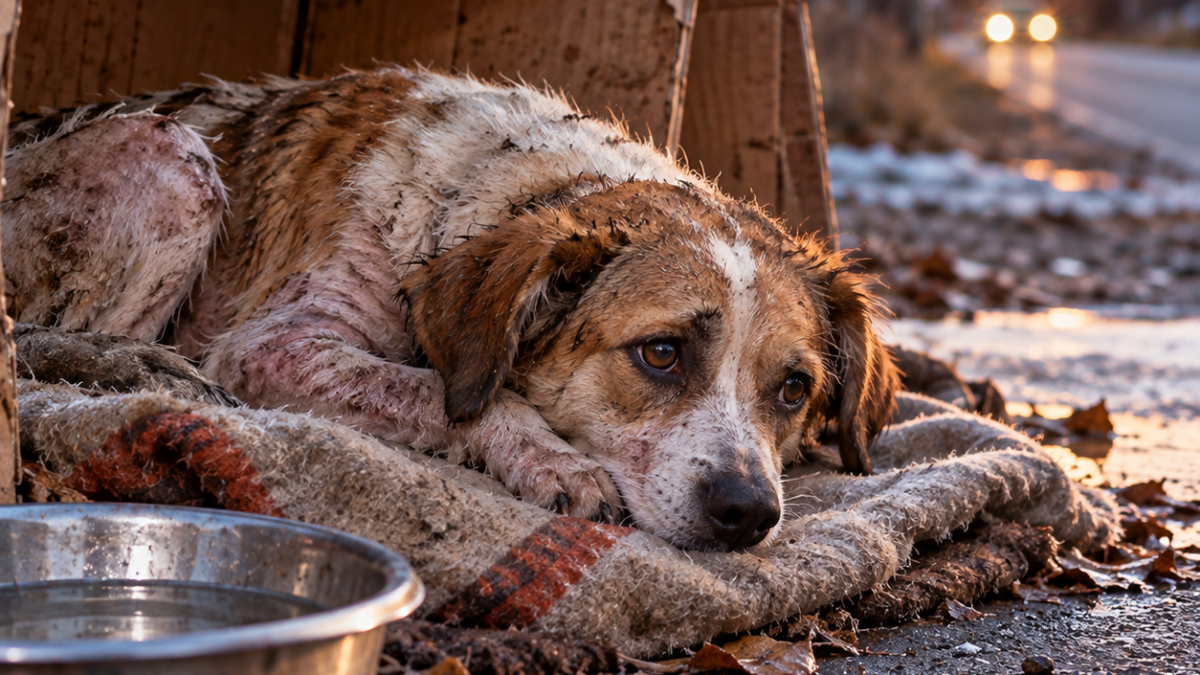
He Could Barely Walk, Yet He Kept Returning to the Same Place Waiting for His Mother—Then a Mysterious Illness Began Taking Over His Tiny Body.
The dog was too weak to run, too sick to stand straight, and still he kept looking down the empty road like the person who left him there might suddenly feel guilty enough to come back.
Everyone who saw the video thought he was just another abandoned stray, but the truth hidden inside his medical records was far crueler than hunger.
By the time I learned why he kept waiting for his “mother,” the woman who dumped him had already started telling the town that I was the villain who stole her dying dog.
It was 11:08 at night when the message came through.
I remember the exact time because I had already taken off my shoes, washed my face, and told myself I was done being useful to anyone until morning.
That was a lie rescue people tell themselves.
We say we are going to sleep.
We say the situation can wait until daylight.
We say we are only one person, one van, one tired body with sore knees and a phone battery at twelve percent.
Then a photo appears.
A dog beside a road.
A shape curled under a crooked mailbox.
A pair of eyes catching the flash.
And suddenly sleep becomes impossible.
The message came from a woman named Diane who lived outside Mill Creek, Tennessee, near the edge of a county road most people used only when they were lost, avoiding highway traffic, or trying to dump something they did not want connected to their name.
Found this dog two days ago, the message said. Thought maybe owner would come back. He hasn’t moved far. Looks hurt. Won’t let me near him. There’s a box by him. I’m scared he won’t make it through the night.
There were three blurry photos attached.
In the first, all I could make out was a cardboard box collapsed sideways in the weeds.
In the second, a stainless-steel bowl sat empty on the gravel shoulder.
In the third, the dog was looking directly at the camera.
Thin tan body. White chest. Big ears. One paw lifted awkwardly. Eyes so tired they seemed older than the rest of him.
I enlarged the photo with two fingers and felt that familiar drop in my stomach.
“Oh, baby boy,” I whispered to my empty kitchen. “What happened to you?”
My name is Grace Holloway, and at that time I had been running Hollow Creek Animal Rescue for seven years.
Running makes it sound more official than it was.
Mostly it was me, an old white cargo van with rust around the wheel wells, three foster families who answered texts at ungodly hours, one retired vet tech named Marlene who could scare a grown man into paying a bill with nothing but a look, and a row of kennels behind my house that I had sworn would only ever hold six dogs and currently held thirteen.
I had a bad habit of saying yes because no felt too much like a sentence.
That night, no was not an option.
I called Diane.
PART2:
She answered on the first ring, voice tight with fear.
“I’m sorry to bother you so late.”
“You did the right thing,” I said. “Tell me exactly where he is.”
“That’s the problem. It’s hard to explain. Old service road off Hollow Pike. No house numbers. I can send a pin, but service is spotty there.”
“Send what you can. Has he eaten?”
“I left food yesterday and this morning. It’s gone. I don’t know if he ate it or something else did. Tonight he was still there. I tried to walk closer and he got up, but something’s wrong with his back legs. He kind of… stumbled.”
“Did he growl?”
“No. He looked scared. Like he wanted to come to me but didn’t know if he should.”
That answer hurt worse than growling would have.
Dogs who growl at least believe their voice might protect them.
Dogs who look torn between hope and terror have usually been betrayed by the same kind of hands that once fed them.
“I’m leaving now,” I told her. “Stay home. Don’t go back out alone.”
“I can guide you over the phone once you get close.”
“Okay.”
I hung up, pulled my shoes back on, grabbed the rescue kit, and called my brother.
Ryder answered on the fourth ring, sounding like a man being dragged up from the bottom of sleep.
“Somebody better be bleeding.”
“Possibly.”
PART3:
He sighed. “Animal or human?”
“Dog.”
“Location?”
“Old service road off Hollow Pike.”
Another sigh, heavier. Then I heard him moving.
“I’ll meet you in ten.”
Ryder was two years younger than me, a mechanic by trade and the only person I knew who could complain through an entire rescue and still throw himself between a frightened animal and traffic without thinking twice.
He said he hated emergency calls.
He came to every one.
By 11:31, the van was rattling down Hollow Pike under a sky with no moon.
The headlights carved tunnels through the dark. Trees pressed close on both sides of the road, their branches bending over the pavement like they were trying to keep secrets. My phone sat in the cup holder with Diane’s pin glowing weakly on the map.
Ryder drove because my hands were already shaking.
“Talk to me,” he said.
“Dog. Possibly injured. Been there at least two days.”
“Dumped?”
“Looks like it.”
“People are trash.”
“Not all people.”
“Enough of them.”
I did not argue.
The service road was barely marked, just a break in the brush and a rusted sign that had once said county maintenance access. Ryder turned slowly, gravel popping under the tires. The van rocked over potholes. Tall weeds scraped both sides.
Diane stayed on speakerphone, guiding us.
“You’ll pass a little drainage ditch. Then there’s a line of cedar trees. After that, the road curves left. He was near the old mailbox post.”
“Any houses?” Ryder asked.
“No. There used to be a mobile home back there, but it burned down years ago.”
Of course, I thought.
People rarely abandoned animals in places where witnesses had porch lights.
We rounded the bend.
The headlights swept over the weeds, the ditch, the leaning mailbox post.
Then the box.
Ryder braked.
“There,” I breathed.
At first, the dog did not move.
He lay beside the cardboard box, almost the same color as the dead grass around him. The bowl was overturned nearby. Something had chewed through one corner of the box. The top flap sagged, damp with dew.
I opened my door slowly.
The interior light came on.
The dog lifted his head.
Even from twenty feet away, I could see how wrong his movement was.
His front end rose first. His back legs dragged half a second behind, as if his body had forgotten the order in which standing was supposed to happen. He swayed, caught himself, then stared at me.
“Hey, baby,” I said softly. “It’s okay.”
He did not run.
That worried me more than if he had.
Healthy frightened dogs run.
Sick frightened dogs calculate whether running is worth the pain.
I stepped out with a slip lead in one hand and a pouch of chicken in the other. Ryder stayed near the van, reading the dog’s body.
“Back legs are bad,” he said under his breath.
“I see it.”
“Neuro?”
“Maybe. Injury. Tick disease. Poison. I don’t know.”
The dog took one stumbling step backward.
Then another.
His eyes moved past me to the road behind us.
Waiting.
He was not looking for escape.
He was looking for someone.
That was the first moment I understood that his body was not the only thing breaking.
“Oh, honey,” I whispered. “She’s not coming back, is she?”
At the sound of my voice, his ears lifted weakly.
He wanted to believe me.
You could see it.
That tiny, dangerous hope.
I crouched low and tossed a small piece of chicken halfway between us. It landed in the gravel.
His nose twitched.
He looked at it.
Then at me.
Then down the road again.
Ryder stayed perfectly still.
“Come on, baby boy,” I said. “Just one bite.”
The dog lowered his head slowly, every motion careful, and took the chicken.
He swallowed fast.
Too fast.
Starving.
I tossed another piece, closer this time.
He came forward.
One step.
His rear paws scraped the gravel. His hips trembled. He nearly fell, caught himself with both front legs, and kept coming because hunger had finally become louder than fear.
When he was close enough, I could smell him.
Not just dirt.
Not just dog.
Sickness.
A sour, metallic odor under the smell of damp fur. His coat was patchy around the hips. His eyes had discharge at the corners. His nose was dry. His ribs showed sharply when he breathed.
He took a third piece of chicken from my open palm.
His lips barely touched my skin.
Gentle.
So gentle it made me angry.
People think neglected dogs are always wild.
Some are.
But some are polite in the saddest possible way, as if they learned that needing too much might get them left behind.
I slipped the lead over his head.
For one second, he froze.
Then panic hit.
He tried to bolt, but his legs betrayed him. He lurched sideways, stumbled, and slammed his hip into the fallen box. The cardboard collapsed beneath him with a soft, ugly crunch.
He yelped.
I moved toward him.
That was my mistake.
Fear took over.
He thrashed, twisted, and scrambled toward the ditch.
“Grace!” Ryder shouted.
I dropped to my knees, trying to keep the lead loose enough not to choke him and tight enough not to lose him.
“It’s okay! It’s okay!”
The dog fought like something much stronger than he was. Pain and terror can turn a dying body into a storm. Ryder came in from the side, not grabbing, just blocking the path to the road.
The dog snapped once.
Not at me.
At the air.
A warning.
Ryder reached to steady him before he fell into the ditch, and the dog’s teeth caught the back of his hand.
“Damn it,” Ryder hissed.
Blood ran over his knuckles.
“You okay?”
“He didn’t mean it.”
“I know.”
The dog collapsed then, panting, eyes wide, sides heaving as if the small fight had used up everything he had left.
I sat back on my heels.
No sudden movement.
No pressure.
The lead lay loose between us.
I held up both hands.
“Okay,” I whispered. “Okay. We’ll slow down.”
For ten minutes, we did nothing.
That is one of the hardest parts of rescue to explain to people who only see the video after it is edited with soft music.
Sometimes saving an animal looks like doing nothing.
Sitting in gravel.
Letting mosquitoes bite your neck.
Letting your knees ache.
Letting a frightened dog learn that the hand holding the rope is not in a hurry to hurt him.
Eventually, his breathing slowed.
I offered water in a shallow bowl.
He sniffed it but did not drink.
I dipped my fingers in and touched them to his lips.
He licked once.
Then again.
Then he drank like every cell in his body had been begging for permission.
“Not too much,” I murmured, pulling it back gently after a few seconds.
He followed the bowl with his eyes, hurt and confused.
“I know. I’m sorry.”
Ryder crouched nearby, wrapping his bleeding hand with gauze from the kit.
“He’s got no collar.”
“Check the box.”
Ryder stood and looked inside the collapsed cardboard.
“Nothing. Wait.”
He bent lower.
“What?”
“There’s writing.”
I turned my flashlight.
On one side of the box, in black marker, half smeared by dew, someone had written:
WAIT HERE.
My throat closed.
Ryder went very still.
“Well,” he said after a moment, his voice hard. “I hope whoever wrote that meets me in a dark parking lot.”
The dog looked at the box.
Then down the road again.
Wait here.
I had seen cruelty in many forms, but that one had a special kind of poison in it.
Not just abandonment.
Instruction.
A command given to a loyal animal by the person he trusted most.
Stay.
Wait.
I’ll come back.
And he had obeyed.
For two days, maybe longer, while hunger hollowed him out and sickness took control of his legs, he had stayed beside that box because the voice he loved told him to.
“We’re not leaving him here,” Ryder said.
“No.”
This time, I did not ask the dog to walk.
I wrapped a blanket around him, careful of his hips, and Ryder helped lift him. He whimpered once, then tucked his head into my chest so suddenly I almost lost my balance.
He was lighter than he should have been.
Bones and heat.
His body shook against me.
“I’ve got you,” I whispered. “I know she told you to wait. But you can stop now.”
He did not understand the words.
But he pressed his face harder into my shirt.
Inside the van, we made a nest of blankets. He lay stiff at first, head raised, still watching the rear window. As Ryder drove away, the headlights swept one last time over the cardboard box.
The dog whined.
One thin, broken sound.
Then he dropped his head and went silent.
I sat beside him the whole way to the emergency vet, one hand hovering near his shoulder without forcing contact.
“What are we calling him?” Ryder asked.
“We don’t name them until they make it through the night.”
“You always say that.”
“I mean it every time.”
“You never follow it.”
I looked down at the dog.
His eyes were half closed, but he was still awake. Still watching. Still waiting.
The marker on the box burned in my mind.
WAIT HERE.
“Santo,” I said.
Ryder glanced at me.
“Saint?”
“No. Santo. Like somebody who waited longer than any creature should have had to.”
Ryder drove for a while in silence.
Then he said, “Santo it is.”
At the emergency clinic, Santo froze the moment we carried him inside.
The lights were too bright. The floor too slick. The air filled with antiseptic, barking, ringing phones, strangers moving fast.
His body went rigid in my arms.
I felt his heart hammering.
“It’s okay,” I whispered. “No one’s leaving.”
The vet on call was Dr. Emily Vaughn, a woman in her forties with tired eyes and the calm hands of someone who had delivered bad news, good news, and everything in between too many times to waste movement.
She took one look at Santo and said, “Exam room three. Quiet side. Now.”
That is how you know a veterinary team is good.
They do not start with drama.
They start with reducing fear.
We laid Santo on a thick blanket in the corner of the room instead of forcing him onto the metal table. Dr. Vaughn sat on the floor several feet away and let him see her hands.
“Male. Young adult, maybe two or three. Severe underweight. Dehydrated. Hind-end weakness.” She looked at me. “How long outside?”
“At least two days. Maybe more.”
“Known toxin exposure?”
“No.”
“Trauma?”
“Unknown. Trouble walking. He was left with a box.”
Her face did not change, but her eyes did.
People who work in rescue and medicine learn to keep their faces steady because animals and humans both panic when we show the full force of what we feel.
“What did the box say?” she asked.
I swallowed.
“Wait here.”
Dr. Vaughn’s jaw tightened.
“Of course it did.”
She checked his gums.
Pale.
Temperature.
High.
Heart rate.
Fast.
She gently tested his reflexes, watched his paws, pressed along his spine, palpated his abdomen. Santo flinched at hip pressure but did not growl. He looked at her, then at me, then toward the door.
Always the door.
“Could be tick-borne disease,” she said. “Could be spinal injury. Could be distemper. Could be toxin. Could be severe nutritional deficiency making everything worse. We need bloodwork, tick panel, X-rays if he’s stable enough, and I want to test for infectious causes.”
“How bad?”
Dr. Vaughn looked at Santo before answering.
“Bad enough that he should not have been out there another night.”
I nodded.
That was already in my bones.
The estimate came printed on white paper.
Emergency care.
Fluids.
Bloodwork.
Radiographs.
Infectious disease testing.
Medication.
Overnight hospitalization.
The number at the bottom made my stomach twist.
I had seven hundred dollars in the rescue account.
Two thousand in unpaid invoices.
A roof leak over kennel three.
Thirteen dogs waiting for food tomorrow morning.
I signed anyway.
There are moments when money becomes a cliff and compassion becomes the step you take off it because leaving a suffering animal behind would cost something worse.
Ryder saw the estimate.
“We’ll figure it out,” he said.
“You always say that.”
“I mean it every time.”
“You never have a plan.”
“I said we’d figure it out, not that we’d do it intelligently.”
Santo stayed overnight.
I did not.
Dr. Vaughn made me go home at three in the morning because I had begun answering questions she had not asked.
“Grace,” she said gently, “you smell like fear and gas station coffee. Go sleep for two hours.”
“I can sit in the lobby.”
“You can fall over in the lobby. Go home. I’ll call if anything changes.”
I stood outside his kennel before leaving.
He lay on a fleece blanket with an IV catheter taped to one leg. His eyes opened when he heard me. He lifted his head, then struggled to stand.
“No, no,” I whispered. “Stay down.”
There it was again.
Stay.
Wait.
Words ruined by the wrong person.
I crouched.
“I’m coming back,” I said. “I promise I’m coming back.”
His eyes held mine with a level of trust he had no reason to give.
That trust felt like a weight placed directly on my chest.
At home, I did not sleep.
I sat at the kitchen table with my phone in front of me and looked at the first video I had taken.
Santo under the headlights.
Me whispering, “Okay, baby boy.”
His legs trembling.
The collapsed box.
The empty bowl.
His face turning toward the road.
I posted only fifteen seconds.
No music. No dramatic caption. Just the truth.
Found tonight off Hollow Pike. Weak, dehydrated, trouble walking. He had been left beside a cardboard box that said “WAIT HERE.” He is safe tonight at the emergency vet. We named him Santo. Please keep him in your thoughts.
By morning, the video had been shared 8,000 times.
By noon, 40,000.
By that evening, a local reporter messaged the rescue page.
That was how trouble began.
The first medical update came at 9:14 a.m.
Dr. Vaughn called while I was feeding the dogs.
“He made it through the night.”
I sank onto an overturned bucket.
“Okay.”
“He’s brighter. Still weak. He ate a small amount of gastrointestinal food. We’re going slow because of starvation risk.”
“Bloodwork?”
“Anemia. Elevated white count. Platelets low. Dehydration severe but improving. Tick panel preliminary is strongly suspicious for ehrlichiosis. We’re starting doxycycline.”
“And the legs?”
“Could be from inflammation, weakness, pain, possible neurologic involvement. X-rays don’t show a fracture. That’s good.”
“So he could walk again?”
“He is walking. Badly. But yes, I think there is a chance.”
A chance.
Rescue people live on those.
Sometimes a chance is small enough to fit in a spoon.
Sometimes it is enough.
I drove to the clinic an hour later with boiled chicken, a fresh blanket, and a fear I could not swallow.
Santo was in the corner of the kennel when I arrived. When he saw me, his ears lifted.
He tried to stand.
His back legs shook under him, but this time he managed three steps before sinking back down.
Dr. Vaughn watched from beside me.
“He knows you.”
“I told him I’d come back.”
“Then it matters that you did.”
I opened the kennel door and sat on the floor.
Santo came to me slowly, awkwardly, determined.
When he reached my lap, he lowered his head against my thigh.
I put one hand on his neck.
“You did so good,” I whispered.
His tail moved once.
A tiny, exhausted thump.
The kind of thing that can keep a rescuer alive for another week.
For three days, Santo remained at the clinic.
He ate small meals. Drank carefully. Took medication. Slept harder than any dog I had ever seen. When he dreamed, his paws twitched and his mouth made small desperate movements, like he was running toward someone who kept getting farther away.
Every time I visited, he checked the door before greeting me.
Every time I left, I told him the same thing.
“I’m coming back.”
And I did.
On the fourth day, we brought him home to the rescue.
The video of his arrival went viral before I understood how far it had spread. Ryder carried him from the van because the gravel hurt his paws and his back end still wobbled. I walked beside them with the IV discharge instructions tucked under my arm.
Marlene had prepared the recovery room.
Soft bed.
Water.
Raised bowls.
Non-slip mats.
A baby gate instead of a closed door so he could see us.
Santo took two steps inside, sniffed the bed, then turned around and looked toward the exit.
“No,” I said gently. “We’re not going back there.”
He did not believe me yet.
That first week was slow.
Recovery from neglect is not the montage people want.
It is not one bath, one meal, and a happy dog running through a field.
It is diarrhea at 2 a.m. because his stomach has forgotten how to trust food.
It is hiding pills inside chicken only to have him spit them out with surgical precision.
It is cleaning infected skin.
Counting breaths.
Checking gum color.
Supporting his hips with a towel under his belly while he takes six trembling steps across rubber mats.
It is celebrating water intake.
It is crying because he wagged his tail at Ryder.
It is trying not to cry because he flinched when someone dropped a metal bowl.
We fed him small meals six times a day.
Chicken, prescription food, soaked kibble, bone broth.
At first he inhaled every bite like the bowl might vanish.
So I began hand-feeding him.
One piece at a time.
Slow.
Open palm.
No grabbing.
No competition.
At first, he trembled through every meal. His eyes darted around the room, checking whether someone would take the food away. Then he began to breathe between bites. Then he began to look at me before taking the next piece, waiting for permission.
Eventually, he learned the bowl would come back.
That is another thing people do not understand.
Abandoned dogs do not only need food.
They need proof that food will happen again.
The first time he drank water without panicking, Marlene clapped so loudly he startled and she apologized for ten minutes.
“Sorry, baby. Auntie Marlene got excited.”
Santo blinked at her.
Ryder, standing in the doorway, said, “Auntie Marlene is a lot.”
“You hush. I’ve kept more dogs alive than you have kept cars running.”
“My cars don’t bite.”
“Only because they don’t have taste.”
Santo watched us bicker with faint concern.
Then his tail thumped.
Small.
But there.
By the end of the second week, the medications were working.
His fever was gone.
His appetite became less frantic.
The strength returned to his front legs first, then slowly to his hips. He still walked like his back half belonged to a different dog and was trying to catch up, but each day he made it farther.
The first time he crossed the recovery room without falling, I got it on video.
“Come on, Santo,” I whispered.
He stood at one end of the mat, ears forward, eyes fixed on the piece of chicken in my hand.
One step.
Pause.
Another.
His back left paw knuckled slightly.
He corrected it.
Another step.
Ryder stood behind him, ready but not touching.
“Good boy,” he said softly.
Santo made it all the way to me and took the chicken.
Then, as if shocked by his own success, he sat down hard and looked offended.
I laughed through tears.
“Oh my God. Are you serious? You’re perfectly capable when chicken is involved?”
His tail wagged.
The video reached a million views in two days.
That should have been a blessing.
In many ways, it was.
Donations came in. Enough to cover the emergency bill, then the follow-up care, then food for the whole rescue for a month. People mailed blankets, joint supplements, toys, handwritten cards, and one enormous orthopedic bed from a woman in Oregon who wrote, “My old boy passed last year. Let this baby have what he couldn’t take with him.”
I cried over that box in the driveway.
But attention has a shadow.
When a neglected dog goes viral, truth does not travel alone.
Lies chase it.
On the third Friday after Santo’s rescue, a woman named Marissa Vale posted a video claiming I had stolen her dog.
I watched it standing in the feed room with a scoop of kibble in my hand.
She appeared on camera in perfect makeup, blond hair curled, sitting in the front seat of a white SUV.
Her eyes were red, but there were no tears.
“I have stayed silent long enough,” she began, voice shaking in exactly the way people shake when they know they are being watched. “The dog everyone is calling Santo is actually my baby, Jasper. He went missing during a move, and this rescue refuses to return him. I have proof. I raised him. I loved him. I am devastated.”
The kibble scoop slipped from my hand and clattered into the bin.
Ryder, who had been carrying a bag of food past the doorway, stopped.
“What?”
I turned the phone toward him.
Marissa continued.
“I don’t know why someone would exploit a sick animal for donations, but I want my dog back. He has a medical condition. He needs his mother.”
His mother.
There it was.
The word from the title people would later give this whole mess.
His mother.
I watched the video twice.
Then a third time.
Ryder’s face went dark.
“That’s her?”
“I don’t know.”
“You think she’s lying?”
“I think a dog doesn’t end up beside a box that says WAIT HERE by accident.”
By noon, her video had been shared by half the town.
By three, people were calling the rescue.
Some kind.
Some curious.
Some vicious.
“If that’s her dog, you need to give him back.”
“You people steal pets and call it rescue.”
“Funny how donations started rolling in after you found a cute story.”
“Where’s the proof he was dumped?”
“Maybe he ran away.”
“Maybe you wrote that on the box yourself.”
That last one made me sit down.
For seven years, I had taken animals no one wanted after the emergency was over. Pregnant strays. Mange puppies. Senior dogs left after owners died. Cats pulled from hoarding houses. Pit bulls with cigarette burns. Hunting dogs with embedded collars.
I had been bitten, vomited on, lied to, stiffed by adopters, screamed at by owners, and lectured by strangers who thought sharing an inspirational quote online counted as service.
But being accused of staging cruelty for money hit somewhere I did not expect.
Marlene found me sitting on a feed bucket, staring at the phone.
“Put it down,” she said.
“I can’t.”
“You can. Your hand opens. Watch.”
She took the phone from me.
“Marlene.”
“No. I am old enough to remember when fools had to say things to your face. The internet has made cowards productive.”
“She’s saying we stole him.”
“She can say the moon owes her rent. Doesn’t make it true.”
“What if people believe her?”
“Some will.”
That answer was not comforting.
Marlene softened.
“Grace, look at me.”
I did.
“You know what we have?”
“What?”
“The dog.”
I blinked.
“And the vet records. And photos from the site. And that box. You kept the box, didn’t you?”
“In the storage shed.”
“Good. Because you are sentimental in useful ways.”
“I thought maybe the writing could matter.”
“It does. So now we stop reacting and start documenting.”
That was Marlene.
When the world caught fire, she made lists.
By evening, we had gathered everything.
The original message from Diane.
Screenshots with timestamps.
Photos of the site.
The box.
The empty bowl.
Santo’s intake records.
Bloodwork.
Weight.
The emergency vet’s statement.
Ryder’s urgent care record for the bite to his hand.
I called Deputy Lewis at the county sheriff’s office. He had helped us before with cruelty cases and understood that animal situations rarely stayed simple once pride entered the room.
“Grace,” he said when he answered. “Please tell me this is not about the viral dog.”
“It is absolutely about the viral dog.”
He sighed. “I was afraid of that.”
Marissa filed a police report the next morning claiming theft.
She also showed up at the rescue gate with her phone recording.
I saw her before she saw me.
White SUV.
Expensive sunglasses.
Pink nails wrapped around her phone.
She wore athleisure clothes that cost more than my monthly feed bill and carried herself with the sharp confidence of someone who had already decided being loud was the same as being wronged.
Ryder stepped out of the kennel building behind me.
“Want me to handle it?”
“No.”
“You sure?”
“No.”
I walked to the gate.
Marissa raised the phone higher.
“Are you Grace Holloway?”
“Yes.”
“I want my dog.”
“Santo is under veterinary hold while ownership and abandonment concerns are investigated.”
“His name is Jasper.”
“Do you have proof of ownership?”
Her eyes flashed.
“I have pictures.”
“Send them to Deputy Lewis.”
“I’m asking you as a woman who loves animals to do the right thing.”
“You left him beside a road.”
Her expression changed for half a second.
Fear.
Then outrage covered it.
“How dare you? He got loose during my move.”
“Then how did he end up beside a box with instructions written on it?”
“I don’t know what box you’re talking about.”
That was her first mistake.
I had not mentioned what the box said.
My security camera caught the pause.
So did her phone.
I kept my voice calm.
“The sheriff’s office will handle the report.”
She leaned closer to the gate.
“You’re enjoying this, aren’t you? Playing savior? Posting sad videos so strangers send you money?”
Ryder moved behind me.
I lifted one hand without looking at him.
No.
Marissa’s mouth curved.
“I know your type. Lonely women collecting broken animals because people don’t need you.”
There are insults that slide off.
That one found bone.
Not because it was original.
Because cruelty often knows where to press.
For half a second, I wanted to say something that would feel good and help nothing.
Instead, I looked directly into her camera.
“This conversation is over.”
I turned and walked back toward the kennels while she shouted my name.
That night, I sat beside Santo on the recovery room floor.
He was stronger by then, but still thin. He had started resting his chin on my knee when I sat close enough. He looked up at me with those careful eyes, the ones still learning whether people stayed after hard things.
“Your mother came today,” I said softly.
His ears moved.
I hated myself immediately for using the word.
Mother.
That was what people online called Marissa now.
His mother.
As if ownership and love were the same thing.
As if being the person a dog waited for meant you deserved the waiting.
Santo pressed his nose into my palm.
“You don’t have to go back,” I whispered. “I don’t know how yet, but you don’t.”
The investigation moved faster than I expected because Marissa had made one dangerous miscalculation.
She wanted attention.
Attention brings witnesses.
Diane saw the online drama and called me.
“There’s something I didn’t say before,” she admitted.
“What?”
“I didn’t want to get involved.”
My stomach tightened.
“Diane.”
“I know. I’m sorry. But I saw a white SUV on that service road the day before I messaged you. I thought maybe someone was turning around. Then later I saw the dog.”
“Did you get a plate?”
“No. But my neighbor might have camera footage. His driveway points toward the turnoff.”
By that evening, Deputy Lewis had the video.
White SUV.
Temporary moving stickers in the rear window.
A woman stepping out.
Opening the back.
A tan dog jumping down slowly, tail wagging despite the obvious weakness in his back legs.
The woman placing a cardboard box near the weeds.
Setting down a bowl.
Pointing at the ground.
The dog sitting.
Waiting.
The SUV driving away.
The dog trying to follow.
Falling.
Getting up.
Limping after the vehicle until he could not.
Then returning to the box.
I watched the footage once.
Only once.
Ryder watched it beside me, jaw clenched so hard I heard his teeth click.
“She told him to stay,” he said.
“Yes.”
“He tried to follow her.”
“Yes.”
“He went back to the box.”
I closed the laptop.
Ryder stood.
“Where are you going?”
“To do something illegal.”
“No.”
“Something emotionally illegal.”
“No.”
He paced the kitchen once, then gripped the back of a chair.
“I hate her.”
“I know.”
“No, Grace. I hate her in a way that feels like exercise.”
“I know.”
Deputy Lewis found the vet records the next day.
Marissa had taken Jasper, now Santo, to Green Valley Veterinary Hospital five weeks before abandoning him. He had been examined for fever, weight loss, and hind-end weakness. The recommended testing had been declined. So had treatment. The notes were careful but clear.
Owner advised condition may worsen without diagnostics and medication.
Owner declined due to cost.
Dog bright, bonded to owner, responsive to verbal cues.
Follow-up strongly recommended.
No follow-up occurred.
There it was.
The truth beneath the roadside.
She had known he was sick.
She had known he was getting weaker.
She had known he needed help.
And instead of surrendering him to a shelter, calling a rescue, asking for assistance, or doing any of the imperfect but human things available to her, she wrote WAIT HERE on a box and left him where nobody would connect him to her.
Until the internet did.
When Deputy Lewis interviewed her, Marissa denied everything.
Then he showed her the footage.
According to Lewis, she cried then.
Not the way guilty people cry when they understand what they have done.
The way cornered people cry when the story stops obeying them.
Her lawyer called it emotional distress.
Her supporters called it a misunderstanding.
Marissa posted one final video before her attorney likely told her to stop speaking.
“I was overwhelmed,” she sobbed. “I thought someone would find him. I left food. I loved him. I just couldn’t watch him suffer.”
I watched the video in silence.
Then I went to the storage shed and looked at the box.
WAIT HERE.
No.
That was not love.
Love does not give a dying animal an obedience command and drive away.
Love does not turn suffering into someone else’s problem and then reclaim the victim when the victim becomes beloved.
Love does not abandon and then demand sympathy for how heavy abandonment felt.
The hearing happened three weeks later in the county courthouse.
By then, Santo could walk half a block with a harness supporting his hips. His coat had begun to shine. His eyes were brighter. He had gained eight pounds. He had learned that Ryder always carried snacks in his left pocket and that Marlene pretended to be strict but dropped the most food.
He still startled at white SUVs.
He still watched the road when anxious.
But he no longer slept facing the door every night.
Progress is not forgetting.
Progress is fear losing authority.
Marissa arrived at court in a cream blazer and heels, looking fragile in a way that seemed carefully assembled.
I wore my only decent black dress and boots that still had kennel dust in the seams.
Ryder came with me.
Marlene too.
Diane sat two rows back, wringing her hands.
Deputy Lewis presented the evidence.
The vet records.
The footage.
The box.
Photos of Santo’s intake condition.
Dr. Vaughn testified calmly, medically, devastatingly.
“This dog was suffering from a treatable tick-borne illness that had progressed due to lack of care. He was dehydrated, severely underweight, febrile, anemic, and experiencing hind-end weakness. Had he remained outside another night or two, his prognosis would have worsened significantly.”
Marissa’s attorney tried to suggest she had panicked.
Dr. Vaughn said, “Panic explains a poor decision. It does not explain writing an instruction on a box and leaving an animal unable to walk properly beside an isolated road.”
The courtroom went silent.
Then Marissa spoke.
She should not have.
Her attorney touched her arm, but she shook him off.
“I loved him,” she said, crying. “I was his mom. I had him since he was a puppy. You don’t understand what it felt like watching him get sick and not being able to afford all these tests. I thought someone with more resources would find him.”
The judge leaned forward.
“You left him on a service road.”
“I left food.”
“You left instructions for him to stay.”
Her mouth opened.
Closed.
The judge looked at the photograph of the box.
“That suggests you expected him to obey you.”
Marissa began crying harder.
“He always listened to me.”
That was the moment she condemned herself, whether she knew it or not.
He always listened to me.
Yes.
He did.
That was exactly the cruelty.
The judge ordered that Santo would remain in the custody of Hollow Creek Animal Rescue, with no return to Marissa Vale. Restitution for emergency veterinary care. Community service. A ban on animal ownership pending review. Mandatory counseling. The cruelty charge moved forward under county statute.
Some people online thought the consequences were too light.
Some thought too harsh.
I was too tired to build a home inside either opinion.
Justice, in real life, rarely arrives like thunder.
Sometimes it arrives as paperwork, a payment plan, a prohibition, a public record, and one dog not being returned to the person who left him.
That was enough for that day.
Outside the courthouse, Marissa tried one last time.
She stood near the steps as reporters waited by the sidewalk.
Santo had not come to court, but his story had, and stories like his draw cameras when they become simple enough for the public to understand.
Abandoned sick dog.
Box.
Viral rescue.
Owner exposed.
Marissa turned toward me.
“You ruined my life.”
I stopped.
Ryder muttered, “Keep walking.”
But I turned back.
“No,” I said. “Santo told the truth. We just listened.”
Her face hardened.
“You think you’re better than me?”
I looked at her for a long moment.
There were many things I could have said.
Yes.
No.
I think you are cruel.
I think you wanted sympathy more than forgiveness.
I think you loved being loved by him but not enough to love him when it cost you something.
Instead, I said the only thing that mattered.
“He waited for you.”
Her expression flickered.
“He waited beside that box until his legs almost gave out. Whatever you tell yourself later, don’t forget that part.”
Then I walked away.
Santo was waiting at home.
Not by the door.
That was new.
He was asleep on his orthopedic bed in the recovery room, sprawled on his side, belly exposed, paws twitching in a dream.
Safe dogs sleep carelessly.
I stood in the doorway and watched him.
Marlene came up beside me.
“Look at that,” she whispered. “Dead to the world.”
“No. Alive to it.”
She looked at me sideways.
“That was almost poetic. You need food.”
“I need a nap.”
“You need both.”
Santo opened one eye.
His tail thumped.
I sat beside him on the floor and scratched his chest. He rolled slightly closer, pressing his back against my leg.
“No more waiting by roads,” I told him.
He sighed.
A deep, whole-body sigh.
As if he agreed.
Months passed.
Santo healed slowly, then suddenly.
That is often how it feels.
For weeks, progress came in tiny measurements.
One more pound.
One less stumble.
Three more steps.
A brighter eye.
A fuller wag.
Then one morning, he ran.
Not far.
Not gracefully.
But he ran across the yard because Ryder had dropped a piece of toast.
His legs kicked up under him, awkward and joyful, and every person at the rescue started screaming like we had won the Super Bowl.
Santo grabbed the toast, looked shocked by the celebration, and then ran behind the shed to eat it privately like a criminal.
Ryder pointed at him.
“That dog is perfectly capable when crime is involved.”
“He learned from you.”
“Rude.”
Santo became a different dog in public than he was in private.
At adoption events, he stayed close to me, polite but cautious. People recognized him and cried. Children wanted to pet him. Adults wanted selfies. Some called him “the box dog,” which I hated but understood.
He accepted attention with patience, but he never fully relaxed until we got back to the van.
Then he would climb onto his blanket, put his head on my backpack, and sleep.
Applications came in by the hundreds.
Some good.
Some awful.
One woman wrote, We have a big yard and want a dog with a sad story.
Rejected.
A man asked if Santo was “fully normal now.”
Rejected.
A family drove four hours to meet him and brought a soft blue collar with his name stitched on it. They seemed kind. Prepared. Patient. The mother knelt and let Santo approach on his own. The father asked smart questions. Their teenage son had researched ehrlichiosis and asked about long-term joint support.
I should have been happy.
Instead, I felt sick.
That night, I sat on the porch with Santo’s head in my lap.
Ryder came out with two mugs of coffee.
“You’re going to fail foster again,” he said.
“I am not fostering him.”
“What do you call this?”
“Medical hold.”
“He’s been medically cleared for three weeks.”
“Emotional hold.”
“That’s not a thing.”
“It is now.”
Ryder sat beside me.
Santo stretched his paws and groaned.
“You know,” Ryder said, “I used to think you kept the hard ones because nobody else could handle them.”
I said nothing.
“Now I think sometimes they stay because you’re the one who needs finishing.”
I looked at him.
“That is rude and emotionally accurate.”
“Growth hurts.”
“I preferred you when you just fixed brakes.”
He smiled into his coffee.
The truth was, I had spent years sending dogs into better lives and telling myself that was enough.
Most days, it was.
But Santo had entered my life through a sentence that haunted me.
WAIT HERE.
Some part of me, one I did not like examining, had been waiting too.
Not beside a road.
Not for a person who dumped me.
But waiting to feel like all this saving had a place to land.
Waiting to stop measuring my worth only in animals moved from danger to safety.
Waiting to admit that rescue had become both my purpose and my hiding place.
It is easy to look noble when you are too busy to be known.
Santo did not care about noble.
He cared about whether I came back.
Every day, he made me answer.
So I did.
I adopted him on a Tuesday afternoon in the county clerk’s office because the rescue paperwork required signatures, and Marlene insisted that “if you’re going to be sentimental, at least be legally tidy.”
Ryder took a photo of me holding the adoption certificate while Santo looked away at a fly.
“Perfect,” he said. “Emotionally moving. He’s indifferent.”
“He’s overwhelmed.”
“He’s hunting a bug.”
We posted the update that evening.
Santo is home. Officially.
The internet lost its mind in the way the internet sometimes does when the ending is simple enough to be loved.
But the ending was not simple.
It was medication reminders.
Follow-up bloodwork.
Physical therapy.
Slow walks.
Setbacks in cold weather.
Fear during thunderstorms.
White SUVs making him freeze.
It was Santo waking from nightmares and crawling into my room at 2 a.m., shaking until I put my hand on his chest and whispered, “I came back.”
It was me waking from my own kind of fear and finding him already beside the bed, watching me like he understood waiting could be done in love too.
A year after the rescue, we drove back to Hollow Pike.
Ryder thought it was a bad idea.
Marlene called it either healing or stupidity and said she would reserve judgment.
I brought Santo in the van on a clear fall morning when the leaves were just starting to turn. He sat in the passenger seat wearing his blue harness, stronger now, heavier, healthier, his coat glowing in the sun.
As we turned onto the service road, his body changed.
Ears up.
Mouth closed.
Breathing shallow.
I slowed down.
“We don’t have to,” I said.
He looked at me.
Then forward.
We drove to the old mailbox post.
The weeds were taller. The gravel had washed out in places. The ditch was dry. No box, of course. I had kept it stored away as evidence until the case ended, then burned it in a metal barrel behind the rescue while Santo slept inside and never knew.
I parked.
Opened the door.
Santo stepped down carefully.
He sniffed the ground.
The air.
The weeds.
Memory moved through him. I could see it.
Dogs do not remember the way humans do, but the body is a faithful historian.
He walked to the place where the box had been and stood there.
For a long moment, he stared down the road.
My chest hurt.
Then he turned around.
Walked back to me.
And sat at my feet.
Not facing the road.
Facing me.
I crouched and buried my face in his neck.
“Good boy,” I whispered. “You don’t have to wait here anymore.”
His tail moved slowly against the grass.
We stayed there maybe five minutes.
Then he tugged gently toward the van.
Ready to leave.
This time, he did not look back.
That night, after he fell asleep on the porch with his head on my boot, I wrote the final update.
I did not mention Marissa.
I did not mention the court.
I did not mention the viral fight, the accusations, the comments, the strangers who had turned a dog’s suffering into entertainment and argument.
I posted a photo of Santo in the sunlight, standing strong on all four legs.
Then I wrote:
A year ago, Santo was found beside a road with a cardboard box and a command he obeyed longer than anyone deserved. He was sick, hungry, weak, and still waiting for the person who left him. Today he went back to that place, stood where the box had been, and chose to come home. Healing is not forgetting. Healing is learning which direction safety lives.
I set the phone down after that.
No scrolling.
No comments.
No measuring whether the world approved of our ending.
Santo lifted his head when I stood.
“You coming?” I asked.
He rose, stretched, and followed me inside.
Not because he was afraid I would leave.
Because home was where we went together.
That is what I want people to understand when they hear his story.
The saddest part was not only that someone abandoned him.
It was that she used his loyalty to do it.
She knew he would wait.
She counted on it.
She turned his love into a leash and left him tied to an empty promise.
But love, real love, does not say wait here and disappear.
Real love comes back.
Real love moves slowly when fear needs time.
Real love feeds one bite at a time.
Real love pays the bill, makes the call, documents the truth, sits on the floor, cleans the mess, and stays after the story stops being beautiful.
Santo taught me that.
Not with words.
With the way he learned to sleep.
With the way he stopped watching the road.
With the way he chose, one ordinary day after another, to believe that hands could mean kindness and doors could open without ending in abandonment.
He had waited for the woman he thought was his mother while a hidden illness slowly stole his legs.
But in the end, she was not the one who came back.
We were.
And once Santo understood that, he stopped being the dog beside the box.
He became the dog running toward home.








