Gangsters Bullied a Quiet Man and His German Shepherd on a Bus—They Had No Idea He Was a Navy SEAL
PART2:
Disabled veteran, according to the paperwork.
Dangerous old man, according to anyone foolish enough to mistake restraint for weakness.
To the city, I was mostly invisible.
A gray-haired man in a faded canvas jacket two sizes too big, riding the bus home because my truck was in the shop and the disability check had already been divided between rent, medication, groceries, dog food, and the kind of bills that breed in the dark.
The coat hid most of me.
That was intentional.
It swallowed the hard muscle I still carried from a life spent dragging men out of fire and carrying equipment heavier than some civilians’ opinions.
It hid the scars on my forearms.
The faded tattoos.
The hands that looked like they belonged to someone who had broken rocks for a living.
It made me look smaller.
Or tried to.
Duke did not try to look smaller.
He sat in perfect heel position, shoulders square, eyes forward, breathing slow.
He did not sniff the candy wrappers on the floor.
He did not pant.
He did not whine.
He simply watched.
People always noticed Duke second.
They noticed me.
Then the dog.
Then they recalculated.
Some smiled because they liked dogs.
Some looked annoyed because they saw an animal where they thought one wasn’t supposed to be.
Some read the SERVICE DOG patch on his harness and softened, usually with pity I hadn’t requested.
Duke ignored all of them.
He had seen worse than city buses.
So had I.
There were only three other passengers when we left the stop near St. Agnes Hospital.
A nurse in pale green scrubs sat near the front, asleep with her cheek pressed to the window, her hair falling loose from a tired bun.
Her shoes were the expensive kind nurses buy after their feet stop forgiving them.
A teenager with oversized headphones slouched near the middle, hood up, phone glowing in his hands.
A man in a fast-food uniform sat across from him, staring at his shoes like he had left his soul behind the fryer.
The bus smelled of damp wool, stale diesel, wet rubber, and exhausted people.
A normal city smell.
A lonely smell.
A survivable smell.
I ran my thumb once over the nylon of Duke’s collar.
Two taps.
Hold.
His left ear flicked back.
Acknowledged.
His eyes stayed forward.
We breathed together.
Inhale.
Exhale.
Inhale.
Exhale.
That was how we survived most nights.
Rhythm.
Routine.
Control.
The rain thickened as we rolled through the downtown grid.
The bus driver kept one hand on the wheel and the other near a paper cup of coffee wedged into the cup holder.
He looked about sixty, with tired shoulders and the kind of face that said he had learned not to care too deeply about whatever happened behind him.
I did not blame him.
Caring gets expensive in a city.
At Fourth and Pike, the bus ground to a halt.
The pneumatic doors hissed open.
Freezing rain blew in.
And trouble stepped aboard wearing cheap cologne and borrowed courage.
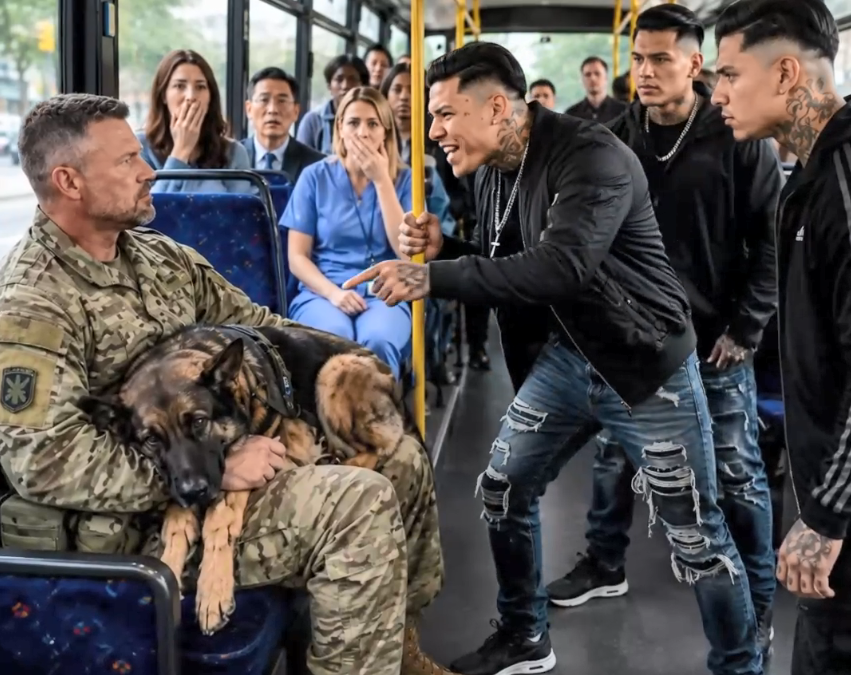
Three young men.
Loud before their shoes fully crossed the threshold.
Early twenties.
Maybe twenty-one.
Maybe twenty-four.
Old enough to know better.
Young enough to believe consequences were something that happened to other people.
The first wore a black bomber jacket with the collar up and a gold chain thick enough to announce insecurity from across the street.
The second had a shaved head, gray hoodie, and a tattoo climbing the side of his neck.
The third was smaller.
Red baseball cap backward.
Restless eyes.
He was the one I watched most.
The loudest guy is rarely the dangerous one.
The nervous one is.
They smelled like alcohol and rain.
The first man slapped a crumpled bill against the fare box.
“Three.”
The driver glanced at it.
“That’s not enough.”
The young man leaned closer.
“Looks like enough from here.”
The driver stared.
For half a second, I thought he might argue.
Then he looked at the other two.
“Go sit down.”
They laughed.
Not because anything was funny.
Because getting away with something always feels like victory to people who need an audience.
They moved down the aisle.
The nurse woke.
Looked.
Then immediately turned toward the window.
The teenager lowered his phone.
Fast-food worker made himself smaller.
I didn’t move.
Duke’s body changed beside me.
Not visibly to anyone else.
I felt it.
His shoulder pressed a fraction harder into my shin.
His breathing slowed.
His ears shifted independently.
The dog was building a map.
So was I.
Three men.
Wet floor.
Narrow aisle.
Driver twenty feet ahead.
Emergency rear door five feet behind me.
Teenager trapped mid-bus.
Nurse front.
Fast-food worker right side.
No visible weapons.
Yet.
I hated that my brain still did this.
I hated more that it had kept me alive.
The man with the gold chain noticed Duke.
“Damn.”
He stopped three rows ahead.
“Look at that thing.”
Duke stared forward.
The second man turned.
“Wolf?”
“German Shepherd,” the third said.
The first grinned at me.
“That yours, old man?”
I looked out the window.
Sometimes the easiest fight to win is the one you refuse to enter.
He stepped closer.
“I asked you something.”
I looked at him.
“Yes.”
One word.
No invitation.
He smiled wider.
“Does he bite?”
“No.”
Technically true.
Duke did not bite without reason.
The young man crouched slightly.
“Hey, puppy.”
“Don’t.”
He looked at me.
“What?”
“Don’t touch him.”
The bus became quieter.
Not silent.
Engine.
Wipers.
Rain.
But every passenger was listening now.
The man stood.
“You telling me what to do?”
“I’m telling you not to touch a service dog.”
His friends laughed.
Gold Chain looked toward Duke’s harness.
“Service dog?”
“Yes.”
“For what?”
“None of your business.”
That changed his face.
Men like him don’t hear boundaries as information.
They hear challenge.
He moved one step closer.
“What, you got anxiety?”
I didn’t answer.
He saw that as permission.
“PTSD?”
The second man laughed.
“Probably scared of fireworks.”
They both thought that was hilarious.
The kid with the headphones looked at me.
Then down.
I kept my breathing even.
Duke’s ears went back.
Two taps.
Hold.
My hand stayed on his collar.
Gold Chain leaned closer.
“You one of those fake veteran guys?”
I looked into his eyes.
“No.”
Something about my answer made him pause.
Then alcohol pushed him forward again.
He pointed at the scar visible above Duke’s collar.
“What happened to your mutt?”
I felt the valley.
Heat.
Dirt.
Duke screaming once.
Then silence.
I blinked.
Bus returned.
“Leave him alone.”
The man made a kissing sound toward Duke.
“Come on, killer.”
Duke did not move.
That bothered him.
People who perform domination need reaction.
Duke gave him none.
So he tried again.
He bent and snapped his fingers inches from Duke’s face.
I caught his wrist.
Not hard.
Not twisting.
Just stopped it.
His smile disappeared.
“Don’t.”
He looked at my hand.
Then at me.
I released him immediately.
His friends made noises.
“Ohhhh.”
“Old man got hands.”
Gold Chain straightened.
“You touch me again, we’re gonna have a problem.”
“You reached for my dog.”
“So?”
“He’s working.”
The second man stepped into aisle.
“What the hell’s he working on?”
Me.
That was the answer.
Keeping me present.
Keeping me from drowning in a war nobody else could see.
Keeping my pulse below explosion.
But I wasn’t giving them that.
I said:
“Move on.”
The first guy laughed.
“You think you own the bus?”
“No.”
“Then shut up.”
He turned like it was over.
I let myself exhale.
Then he pivoted suddenly and kicked the toe of his shoe toward Duke.
Not a full kick.
A fake.
A flinch test.
But Duke reacted.
He rose.
Instant.
Silent.
No bark.
No lunge.
Just standing between the man’s leg and mine.
Gold Chain stumbled backward.
“Yo!”
The second man moved forward.
The third reached under his jacket.
There.
That was the moment.
Everything changed.
I stood.
Slowly.
My jacket opened.
Duke stayed at my left.
The three men looked up.
I had been hunched before.
Sitting small.
Standing changed the geometry.
Six feet two.
Broad shoulders.
Old injuries.
Not young.
Not weak either.
Gold Chain’s grin disappeared.
“Sit down.”
I didn’t.
He looked at his friends.
Then back at me.
“You trying to scare somebody?”
“No.”
My voice was quiet.
That made it worse.
The nurse had turned fully around.
The teenager removed one headphone.
The driver looked in mirror.
The third man’s hand remained inside his jacket.
I stared at it.
“Take your hand out.”
He froze.
“What?”
“Your right hand.”
His face changed.
“How the hell—”
“Take it out.”
Gold Chain puffed up.
“You don’t give orders.”
I kept my eyes on the third man.
“Hand.”
The bus driver shouted:
“Everybody calm down!”
The third man slowly removed his hand.
Phone.
Maybe only phone.
Maybe something else was behind it.
Didn’t matter.
I watched both hands.
Gold Chain stepped closer.
“You think you’re some kind of tough guy?”
“No.”
“Then why you standing?”
“Because you’re too close to my dog.”
He shoved me.
There it was.
Palm to chest.
Not hard enough to hurt.
Hard enough to make a declaration.
I took one step back because I chose to.
Duke moved with me.
Heel.
Perfect.
Gold Chain smiled because he thought he had moved me.
The second man laughed.
The nurse whispered:
“Stop.”
Nobody listened.
Gold Chain shoved again.
This time harder.
My shoulder hit the window.
Flash.
Not bus.
Concrete wall.
Night vision.
Gunfire.
I smelled burned metal that wasn’t there.
Duke pressed into my leg.
Present.
Present.
Present.
Two taps.
Hold.
My hand found his harness.
I breathed.
The man said:
“What now?”
I looked at him.
“You should sit down.”
His face twisted.
Then he swung.
Wide right.
Angry.
Drunk.
Easy to see.
I moved six inches.
His fist passed my cheek.
I caught the wrist.
Turned.
Used his momentum.
He hit the floor on his knees.
Not violently.
Enough.
I released immediately.
The entire bus froze.
The second man rushed me.
He came straight.
No balance.
I stepped off-line.
One hand on his shoulder.
One behind elbow.
Redirect.
He crashed into empty seat.
The third man stopped moving entirely.
Gold Chain scrambled up.
His face wasn’t embarrassed anymore.
It was enraged.
That was more dangerous.
Humiliation makes fools reckless.
“You son of a bitch.”
He reached into waistband.
Duke growled.
First sound.
Low.
Controlled.
Every hair on my arms rose.
The man’s hand stopped.
I pointed.
“Don’t.”
For the first time, he heard me.
But not enough.
His fingers closed around something.
I moved before it cleared fabric.
Two steps.
Trap wrist.
Turn hips.
Drive him against seat back.
His hand opened.
A folding knife fell to floor.
The teenager screamed.
The nurse stood.
Driver slammed brakes.
Everyone lurched.
I held Gold Chain’s wrist pinned against seat.
Duke stood beside my thigh, teeth visible but not touching anyone.
“Knife stays down.”
The second guy had recovered.
He saw Duke.
Saw me.
Saw the knife.
Then made the first intelligent decision of the night.
He raised both hands.
“Yo, chill.”
I looked at him.
“I am chill.”
That frightened him more.
The third man backed toward rear door.
Gold Chain struggled.
I increased pressure just enough.
“Stop.”
He did.
I kicked the knife under seat.
The driver shouted:
“I’m calling cops!”
“Do that.”
Gold Chain spat:
“You broke my wrist.”
“No.”
I loosened fraction.
“You’d know if I did.”
The fast-food worker stared at me like I had become something else.
I hated that look.
It reminded me of younger men overseas after they saw what I could do.
Fear mixed with admiration.
Neither belonged on a bus.
The driver pulled to curb.
Doors stayed closed.
Dispatcher on speaker.
Police en route.
Gold Chain tried to twist.
I said:
“Don’t.”
He stopped.
Then:
“Who the hell are you?”
I almost said nobody.
That had become my preferred answer.
But the nurse saw the tattoo near my wrist where my sleeve had pulled back.
A trident.
Old.
Faded.
She looked from it to me.
Her eyes widened.
“You were Navy.”
I looked at her.
“Yes.”
The second man heard.
“What, like a sailor?”
The nurse kept staring at tattoo.
“No.”
Her voice changed.
“He was a SEAL.”
Silence.
Even the driver looked back.
Gold Chain stopped fighting completely.
The third man muttered:
“Oh, shit.”
I wanted to disappear.
That was the problem with identity.
People saw the word SEAL and rewrote everything around it.
Suddenly I wasn’t an old man they had bullied.
I was dangerous because of a résumé.
That bothered me.
I released Gold Chain and stepped back.
“Sit.”
He sat.
No argument.
His friends did too.
Duke remained between us.
The nurse said:
“Are you okay?”
“No injuries.”
“I meant…”
“I know.”
I looked at her.
“I’m fine.”
Lie.
But functional.
Police arrived in under six minutes.
Two patrol cars.
Four officers.
They boarded carefully.
Saw knife under seat.
Saw three men.
Saw Duke.
Saw me standing with hands visible.
One officer said:
“Who owns dog?”
“I do.”
“Is he controlled?”
“Yes.”
“Keep him seated.”
“Duke.”
He sat instantly.
Officer’s eyebrows lifted.
Statements began.
Driver had camera.
Bus security system had audio and video.
Good.
I hate cases dependent on memory.
Teenager had recorded part.
Also good.
Gold Chain claimed I attacked first.
Of course.
Officer asked:
“Did he?”
Driver said:
“No.”
Nurse:
“No.”
Fast-food worker:
“They were messing with him and dog.”
Teenager held up phone.
“I got it.”
Gold Chain looked smaller with police there.
That’s another thing about men who like intimidation.
Their courage often depends on isolation.
Take away the private audience and replace it with witnesses, suddenly everything becomes misunderstanding.
The knife complicated things for him.
Police cuffed all three initially while sorting statements.
One had outstanding warrant.
The third had pills not prescribed to him.
Gold Chain had knife despite probation condition.
They were not sophisticated gangsters.
Just three reckless men who had learned to make people afraid and mistaken fear for respect.
One officer recognized me.
Not by face.
Name.
“Hale?”
I looked.
Officer Ramirez.
Former Marine.
I’d met him at VA event maybe two years before.
“Yeah.”
He looked at Duke.
“Duke?”
“Yes.”
He smiled briefly.
Then professional again.
“You want medical?”
“No.”
“Dog okay?”
“Yes.”
“Need anything?”
“Ride home.”
The bus was going out of service for evidence review.
Ramirez nodded.
“We can arrange.”
Gold Chain watched.
His expression changed again.
“You know cops?”
I looked at him.
“No.”
Ramirez smirked.
“We met once.”
That mattered.
I didn’t want anyone thinking special treatment.
I gave statement.
Full.
Including wrist catches.
Redirects.
Pin.
Knife.
Every contact.
I signed.
Then sat on curb under bus shelter with Duke.
Rain had slowed.
Nurse came over.
Her name was Emily Tran.
Thirty-six.
Emergency department.
She held my dropped glove.
“You left this.”
“Thanks.”
She sat two seats away.
Respectful distance.
We watched police.
After a minute she said:
“You knew exactly what they were going to do.”
“No.”
“It looked like you did.”
“I knew what they might do.”
“Same thing?”
“No.”
She nodded.
Then:
“Duke knew too.”
“He usually knows before me.”
She looked at him.
“May I?”
I appreciated the question.
“Not tonight.”
“Of course.”
No offense.
Good.
Duke relaxed.
Emily looked at rain.
“You were shaking.”
I looked at my hands.
Damn.
Tiny tremor.
Adrenaline.
Flashback residue.
Age.
Everything.
“I’m fine.”
She gave me nurse look.
The one that says patients are idiots.
“You’re not.”
I almost laughed.
“You work emergency?”
“Yes.”
“That obvious?”
“You all have same face.”
“What face?”
“Disappointed in men who lie about pain.”
She smiled.
Then serious.
“Were you really a SEAL?”
“Yes.”
“How long?”
“Long enough.”
“And Duke?”
“Military working dog.”
“With you?”
“Yes.”
She looked at scar along his head.
“Same blast?”
I stared.
She immediately said:
“Sorry.”
“No.”
I touched Duke’s ear.
“Yes.”
We sat quiet.
Then she said something I didn’t expect.
“I’m glad they didn’t know.”
“What?”
“That you were a SEAL.”
I turned.
“Why?”
“Because what they did was wrong before they knew.”
That landed.
Hard.
I looked at her.
She continued.
“If they only backed off because you’re dangerous, they learned wrong lesson.”
Exactly.
I had been thinking same thing.
The truth is, I didn’t want story to become:
Gangsters picked wrong veteran.
Because what if I had been accountant?
Old teacher?
Disabled man with no combat training?
What if Duke had been ordinary rescue dog?
Would the bullying have been less wrong?
No.
The men were wrong when they walked toward somebody they assumed couldn’t fight back.
My background changed outcome.
Not morality.
Ramirez walked over.
“Tristan.”
“Yeah?”
“We’re taking all three.”
“Okay.”
“You’ll probably hear from city attorney.”
“Fine.”
He hesitated.
“Bus camera is clear.”
“Good.”
“Knife came out after shove and swing.”
“Good.”
“You did what you had to.”
I looked at him.
“That phrase causes problems.”
He nodded.
“You’re right.”
Then corrected.
“Evidence supports your account.”
Better.
I stood.
Knee complained.
Emily noticed.
Of course.
Nurses see everything.
Ramirez said patrol could drop me home.
I declined.
Emily said:
“My brother’s picking me up.”
I stared.
“No.”
“I wasn’t offering.”
“Good.”
She smiled.
“There’s another bus in forty minutes.”
I looked at Duke.
Duke looked at me.
Forty minutes in rain.
Fine.
Then fast-food worker approached.
His name tag said MALIK.
He looked maybe twenty-eight.
“Sir?”
“Yes?”
He rubbed back of neck.
“I should’ve said something.”
“What?”
“When they started.”
I shook head.
“You didn’t know what would happen.”
“Still.”
“You were alone.”
He looked down.
“I froze.”
I knew that word.
I knew it too well.
“Freezing is normal.”
He looked surprised.
“You?”
“Yes.”
“Seriously?”
“Anybody who says they never freeze hasn’t been scared enough.”
He nodded slowly.
“I thought you were just…”
He stopped.
“Just what?”
“Some old dude.”
I laughed.
“Accurate.”
He smiled.
Then his face tightened.
“I hate that I was relieved when you handled it.”
“Why?”
“Because it means I waited for somebody else.”
I thought.
Then:
“You stayed.”
He frowned.
“You gave police statement.”
“You didn’t run.”
“You told truth.”
“That counts too.”
Malik looked like that helped.
Maybe it did.
The teenager came next.
Sixteen.
Name was Jonah.
He had video.
“Can I send you clip?”
“No.”
He looked disappointed.
“Why?”
“I don’t need it.”
“It’s crazy.”
“That’s exactly why.”
He studied me.
“You really killed people?”
Emily sharply:
“Jonah.”
I held up hand.
Kid wasn’t trying to be cruel.
Just sixteen.
“That’s not a question you ask strangers.”
His face went red.
“Sorry.”
“It’s okay.”
Then he looked at Duke.
“Did he?”
“Also not a question.”
“Right.”
He put headphones around neck.
“Is he like a hero?”
I looked at Duke.
“He’s a dog.”
Jonah seemed confused.
I continued.
“He did his job.”
“He got hurt.”
“He came home.”
“He still works.”
“What does he do now?”
I put hand on Duke’s harness.
“Keeps me here.”
The kid nodded.
Maybe understood.
Maybe not.
Bus shelter lights buzzed.
Rain dripped.
Then the police cars left with three young men.
The whole street became ordinary again.
That’s how violence works.
Ten minutes of chaos.
Then wet pavement.
A convenience store sign.
Cars moving.
People checking phones.
The world does not stop because your nervous system thinks it should.
The next bus came at 12:38.
Different driver.
More passengers.
I almost didn’t get on.
My chest tightened at doors.
Duke looked at me.
Pressed against left leg.
Two taps.
Hold.
I stepped aboard.
That mattered more than anything I did in fight.
People think courage is winning.
Sometimes courage is getting back on bus.
We sat near front this time.
Back felt wrong.
I watched doors.
Duke watched me.
At home, I didn’t sleep.
No surprise.
Around two, I made coffee.
Duke lay under table.
I replayed fight.
The shove.
The swing.
Knife.
My body knew sequence.
My mind kept changing it.
What if knife opened sooner?
What if Duke bit?
What if teenager got hurt?
What if bus crashed when driver braked?
What if I had hit too hard?
This is how trauma works.
It turns survival into prosecution.
You become your own investigator.
Every alternate outcome a charge.
I hated it.
At three fourteen, Duke stood.
Walked over.
Put his head in my lap.
I buried one hand in his fur.
“You did good.”
His tail hit floor.
“You always do.”
I looked at scar.
Valley returned.
Not fully.
Just edge.
Duke had found an explosive before the blast that scarred us.
Different device.
Earlier.
Saved six men.
The second one was buried deeper.
Pressure plate linked to secondary charge.
He alerted.
Then everything happened too fast.
Duke took fragmentation along head and shoulder.
I lost hearing in left ear for weeks.
Two vertebrae damaged.
One teammate lost leg.
Another didn’t come home.
Duke spent three surgeries.
I stayed in rehabilitation nine months.
When command tried retiring him separately, I fought.
Not dramatically.
Paperwork.
Appeals.
Calls.
Eventually he came with me.
Since then, everybody praised me for rescuing Duke.
Wrong.
He had rescued me every night.
Flashbacks.
Crowds.
Panic.
Isolation.
The days I didn’t want to leave apartment.
The nights I thought disappearing might be easier.
Duke made needs.
Food.
Walk.
Medication.
Routine.
A creature depending on you can become an anchor before you notice.
The bus fight hit news next day.
I found out because my sister called at 7:05 a.m.
“Tristan.”
I groaned.
“What?”
“Turn on Channel Eight.”
“No.”
“You’re on television.”
“Absolutely not.”
“Somebody posted video.”
Of course.
Jonah.
Or passenger.
Or police scanner.
Headline online:
RETIRED NAVY SEAL SUBDUES THREE MEN ON CROSSTOWN BUS
I hated it immediately.
Not false.
Still hated it.
Video showed only thirty seconds.
One man swinging.
Me redirecting.
Second rushing.
Knife dropping.
Duke standing.
Perfect viral package.
Comments were worse.
OLD MAN DESTROYS THUGS.
FAFO.
THEY PICKED WRONG GUY.
SEAL JUSTICE.
People love violence if they can label it righteous.
They don’t see what comes after.
Hands shaking over cold coffee.
Dog monitoring your breathing.
The fear that part of you enjoyed being needed in that old way again.
That was the part I didn’t tell anyone.
For a few seconds on that bus, everything became simple.
Threat.
Protect.
Control.
No bills.
No insomnia.
No grief.
No future.
Just immediate problem.
I was good at immediate problems.
Too good.
That scared me more than knife.
My VA therapist, Dr. Aaron Wells, asked about it two days later.
“Did you enjoy it?”
I stared at him.
“That’s a hell of a question.”
“Yes.”
“No.”
He waited.
I hated therapists for waiting.
“Part of me did.”
“There.”
“I didn’t enjoy hurting them.”
“What did you enjoy?”
“Clarity.”
He nodded.
“Of course.”
“Don’t say of course.”
“Why?”
“Sounds like excuse.”
“It isn’t.”
He leaned back.
“You spent decades being rewarded for rapid threat assessment.”
“Now civilian life gives you ambiguity.”
“Money.”
“Pain.”
“Identity.”
“Loneliness.”
“No clear target.”
“So when a clear threat appears, your brain recognizes old competence.”
I looked down.
“That makes me dangerous.”
“No.”
“It makes you trained.”
“Danger comes from what you choose to do with it.”
I thought about Gold Chain on knees.
I could have broken arm.
Didn’t.
Second man into seat.
Could have struck throat.
Didn’t.
Knife hand.
Could have dislocated shoulder.
Didn’t.
Duke could have bitten.
Didn’t.
Control.
That was difference.
Aaron said:
“You restrained yourself.”
“Yes.”
“That is not absence of violence.”
“No.”
“It is regulation under threat.”
I didn’t like praise.
He knew.
So he didn’t give more.
The prosecutor called later that week.
Gold Chain’s name was Marcus Bell.
Twenty-three.
Prior assault.
Knife restriction from probation.
Second man, Devon Price.
Twenty-two.
No serious prior record.
Third, Kyle Jennings.
Twenty.
Outstanding warrant for shoplifting plus possession charges.
They offered plea arrangements eventually.
Marcus faced assault and weapons-related counts.
I attended no hearing except when subpoenaed.
I did not want revenge.
Marcus’s mother approached me once outside courthouse.
Small woman.
Hospital cafeteria uniform.
Eyes tired.
“Mr. Hale?”
“Yes.”
“My son…”
She swallowed.
“I’m sorry.”
I didn’t know what to say.
“He’s not bad.”
There it was.
Sentence every parent says when child does bad thing.
Maybe true.
“He made bad choices.”
“Yes.”
She cried.
“I didn’t raise him like this.”
I believed her.
People are not machines manufactured by parents.
She looked at Duke.
“Did he hurt your dog?”
“No.”
“Thank God.”
Then:
“Marcus said you could’ve killed him.”
My stomach tightened.
“I didn’t.”
“I know.”
She wiped face.
“He knows too.”
That surprised me.
“What?”
“He said you kept telling him to stop.”
I remembered.
Don’t.
Sit.
Hand out.
Stop.
Warnings.
Boundaries.
“I’m glad he remembers.”
She nodded.
Then did something unexpected.
“Thank you.”
“For what?”
“For not doing more.”
I stood there.
No answer.
Eventually:
“He stopped.”
She looked at me.
“So did you.”
That stayed.
Devon later entered diversion program.
Kyle took plea on warrant.
Marcus got probation revoked and served time.
I never saw them again.
Almost.
Two years later, I did.
By then Duke was twelve.
Slower.
Arthritis.
Still proud.
We were at St. Agnes VA outreach event.
I hated events but Aaron talked me into volunteering.
Service-dog education.
Duke lay under table while I answered questions.
A man approached.
Work boots.
Dark jacket.
Short hair.
Older than memory.
I recognized him when he stopped.
Marcus Bell.
Gold Chain.
No gold chain now.
He stood six feet away.
“Mr. Hale?”
My body reacted before mind.
Duke lifted head.
I touched harness.
“It’s okay.”
Marcus raised hands slightly.
“I’m not here for trouble.”
“What do you want?”
“To apologize.”
I waited.
He looked at Duke.
“Can I…”
“No.”
“Right.”
Good.
He kept distance.
“I was drunk.”
I said nothing.
“That isn’t excuse.”
Still nothing.
“I thought you were weak.”
There it was.
He looked ashamed.
“I don’t know why that made me want to mess with you.”
I did.
But wanted him to say it.
He continued.
“Because I was with them.”
“Because people were watching.”
“Because you weren’t doing anything.”
I said:
“You thought I was safe to hurt.”
He looked at floor.
“Yes.”
That was the truth.
Bullies choose targets by predicted cost.
Not strength.
Not justice.
Cost.
Old man.
Service dog.
Late bus.
Few witnesses.
Safe.
Marcus swallowed.
“Prison counselor said that.”
“What?”
“That I didn’t pick you because I was brave.”
“I picked you because I thought nothing would happen.”
I nodded.
“He’s right.”
Marcus looked at me.
“I found out who you were and felt stupid.”
“That isn’t lesson.”
“I know.”
“Do you?”
He breathed.
“Yeah.”
Then:
“If you’d been nobody, I would’ve still been wrong.”
Emily’s words.
Years earlier.
I almost smiled.
“Good.”
Marcus looked at Duke.
“Is he okay?”
“Old.”
“He was old then.”
“He’d disagree.”
Marcus actually laughed once.
Then stopped.
“I’m working construction.”
“Good.”
“Sixteen months sober.”
“Good.”
“My mom made me come here.”
“That sounds like a mother.”
He nodded.
Then held out nothing.
No hand.
Smart.
“I’m sorry.”
I looked at him.
Not teenager now.
Not monster either.
Just man trying to put something down.
“I believe you.”
His shoulders dropped.
I didn’t say I forgive you.
Maybe I did.
Maybe not.
Forgiveness is too large for parking-lot conversation.
But I believed apology.
That was enough.
He turned to leave.
I said:
“Marcus.”
He looked.
“Don’t waste your mother’s second chance.”
His face tightened.
“I won’t.”
He left.
Duke watched him go.
Then put head down.
Completely unimpressed by human redemption.
Duke lived another year.
Good year.
Slower walks.
More naps.
He stopped jumping into truck.
I built ramp.
He pretended not to need it.
Classic.
His final winter was cold.
Arthritis got worse.
Then cancer.
Spleen.
Fast.
I knew what vet was going to say before she finished ultrasound.
“We can operate.”
“How much time?”
She hesitated.
“Maybe months.”
“Quality?”
“Uncertain.”
I looked at Duke.
He was tired.
Not miserable.
But tired in deep way.
I had asked him to fight enough.
So I didn’t ask for one more war.
His last day, rain came.
Of course.
City windows streaked like that bus night.
I put his old harness beside him.
Scarred ear.
Gray muzzle.
My hand on his chest.
“Two taps.”
I tapped collar.
His ear flicked.
Barely.
“Hold.”
I started crying.
“You don’t have to.”
The vet gave medication.
Duke exhaled.
I felt his body release.
For first time in thirteen years, nothing pressed against my left leg.
The absence was physical.
Like missing limb.
Afterward, people told me he had good life.
True.
Doesn’t help first week.
I stopped riding bus.
Avoided Fourth and Pike.
Avoided crowds.
Therapist noticed.
“You’re shrinking world.”
“Yes.”
“Why?”
“No Duke.”
“So?”
“So I don’t have buffer.”
Aaron leaned forward.
“Was Duke your courage?”
I hated question.
“No.”
“Then what?”
“Anchor.”
“Good.”
“What anchors you now?”
“Nothing.”
“Not acceptable answer.”
I laughed bitterly.
“Therapy line?”
“Yes.”
We built replacements.
Not another dog immediately.
People suggested.
I refused.
Duke wasn’t a slot.
You don’t replace partner like battery.
I started riding bus again.
One stop.
Then three.
Then whole route.
First time 11:40 at night, I nearly got off early.
Stayed.
Same rain smell.
Different passengers.
No Duke.
I kept left foot pressed against empty space where he would have sat.
Breathing.
Inhale.
Exhale.
Inhale.
Exhale.
At Fourth and Pike, doors opened.
Three young men got on.
My pulse jumped.
They laughed.
Normal.
Just friends.
No threat.
My brain did not know difference immediately.
I let it learn.
They sat front.
One offered seat to older woman.
I almost laughed at myself.
Survival had taught me pattern.
Healing taught me not every pattern repeats.
Years after bus incident, people still send clip.
Friends think it’s funny.
“Tristan, you’re internet famous.”
No.
Duke is.
The clip ends before important part.
It shows men subdued.
Not what came before.
Not what came after.
It doesn’t show nurse Emily saying morality didn’t change when they learned I was SEAL.
It doesn’t show Malik admitting he froze.
Jonah asking bad questions.
Marcus apologizing years later.
It doesn’t show me shaking.
Or Duke grounding me.
Or getting back onto next bus.
Those are the parts I remember.
Violence is loud.
Restraint usually isn’t.
That’s why people miss it.
They see one wrist lock.
Don’t see ten opportunities not to escalate.
They see dog standing.
Don’t see every command obeyed.
They see knife.
Don’t see warnings before it.
They see veteran.
Don’t see man trying desperately not to return to person war trained.
If there’s lesson in that night, it isn’t:
Don’t bully quiet men because they might be Navy SEALs.
That’s too easy.
Too satisfying.
Wrong.
Don’t bully quiet men because they are human.
Don’t kick at service dogs because they are living animals.
Don’t choose people because you think nobody will defend them.
And don’t mistake restraint for permission.
I was lucky.
Duke was controlled.
Bus had cameras.
Witnesses spoke.
Police arrived.
Nobody got seriously hurt.
That could have gone differently.
Violence always charges interest.
Even when justified.
Especially when you’re good at it.
These days, I volunteer twice a week at a veterans center near St. Agnes.
Mostly dog-handler transition groups.
Some younger operators.
Some conventional forces.
Some cops.
Some people who never fired weapon but lived through enough trauma to recognize same symptoms.
I don’t tell bus story unless asked.
When I do, somebody always says:
“You showed them.”
I correct:
“No.”
“What?”
“I stopped it.”
Difference matters.
Winning implies opponent.
Stopping implies boundary.
Duke understood boundaries better than most humans.
Warn.
Hold.
Escalate only when necessary.
Disengage when threat ends.
Then go home.
Eat.
Sleep.
No ego.
Dogs don’t replay arguments in shower.
They are smarter than us.
I keep Duke’s collar on hook near door.
His harness in closet.
I tried boxing it once.
Couldn’t.
Some things stay visible because hiding them feels like second loss.
Emily and I stayed in touch.
Nothing romantic.
People always want that.
Life doesn’t owe cinematic coupling.
She became friend.
Sometimes coffee.
She switched hospitals.
Still nurse.
Still buys expensive shoes.
Jonah sent me graduation photo years later.
No idea how he got contact.
Probably public veteran center email.
Message:
Still don’t ask strangers dumb war questions.
Progress.
Malik became shift manager.
Then opened food truck.
I ate there.
He refused payment.
I paid anyway.
Marcus?
I heard through his mother he got married.
Still sober last I heard.
Good.
Everyone kept moving.
That’s another lesson.
The worst ten minutes of someone’s life don’t have to become entire biography.
Not mine.
Not Marcus’s.
Not Duke’s.
On anniversary of Duke’s death, I ride Crosstown sometimes.
Same route.
Not ritual exactly.
Maybe.
I sit near rear corner if I can.
Look at empty spot beside left leg.
One night a young woman got on with service dog.
Black Lab.
She looked tense.
Dog pressed against her leg.
I recognized it.
Two taps.
Not exactly mine.
Her version.
I looked away.
Privacy.
A man nearby started to reach toward dog.
I said:
“Ask first.”
He stopped.
“Oh.”
Then asked her.
She shook head.
“No, thank you.”
He nodded.
No fight.
No drama.
Boundary respected.
The simplest possible ending.
I smiled.
That’s what I want now.
Not revenge stories.
Not wrong guy chosen.
Not old warrior activated.
I want boring boundaries.
People hear no.
They stop.
Dogs work.
Buses move.
Everyone gets home.
That is peace.
Not silence before violence.
Actual peace.
It looks ordinary.
Which is why people underestimate it.
The night those three men boarded at Fourth and Pike, they thought silence meant weakness.
They thought my coat meant old.
My posture meant tired.
My service dog meant fragile.
They were partly right.
I was tired.
I was fragile in ways they couldn’t see.
Duke was holding parts of me together.
But fragility and helplessness aren’t same.
Trauma and cowardice aren’t same.
Age and weakness aren’t same.
And a man who refuses violence is not necessarily a man incapable of it.
Sometimes refusal means he knows exactly what violence costs.
That’s why I kept saying:
Don’t.
Sit down.
Move on.
Stop.
I wasn’t warning them because I wanted to sound tough.
I was begging them to choose another ending.
They didn’t.
Until they had to.
When people ask what moment scared me most, they expect knife.
No.
It was when my shoulder hit window and bus vanished.
Valley returned.
For one heartbeat, I wasn’t fifty-three.
I was back under dirt.
That was real danger.
Not three drunk kids.
Losing the present.
Duke brought me back.
Pressure against leg.
A body saying:
Here.
Now.
Bus.
Rain.
Not war.
He did that one final time before I moved.
That’s the heroism nobody filmed.
He kept me from fighting ghosts while real people stood in front of me.
So if you remember anything about that story, remember Duke.
Not as war dog with scars.
Not as internet “badass dog.”
As an old shepherd who knew his handler better than his handler knew himself.
He didn’t attack.
He didn’t need to.
He stood.
He waited.
He trusted me to choose.
And somehow, after everything we’d survived together, I did.
Three men came onto bus looking for someone weak enough to humiliate.
They found a retired Navy SEAL.
That’s the part that made headlines.
But the part that mattered happened before anyone knew who I was.
I told them to leave my dog alone.
They should have listened then.
Not because I had been a SEAL.
Because “leave us alone” should have been enough.