Forty Bikers Heard a Store Manager Humiliate a Foster Mom at Christmas—Then They Bought Every Toy Her Six Kids Could Carry
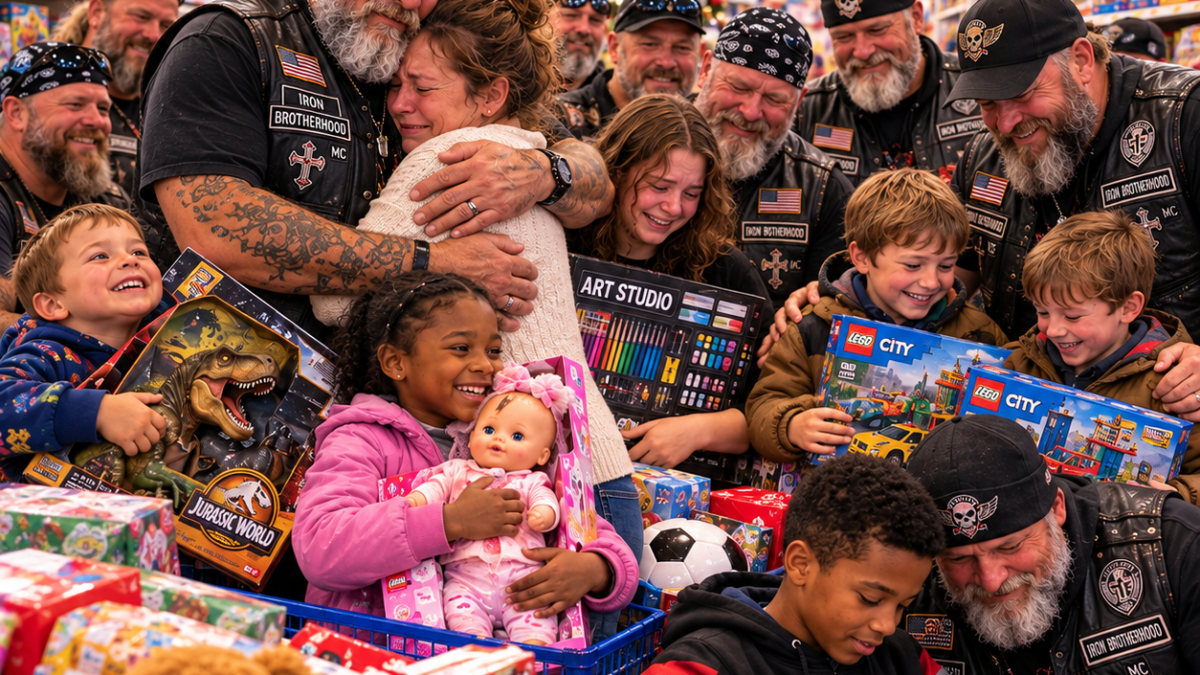
Forty Bikers Heard a Store Manager Humiliate a Foster Mom at Christmas—Then They Bought Every Toy Her Six Kids Could Carry.
The foster mother was crying at the customer-service counter while six children stood behind her pretending they did not care about Christmas, and the manager kept repeating that two days past the return deadline was two days too late.
Then a four-year-old boy looked up at her and asked why Santa never seemed to know where foster children lived, and forty bikers who had come to spend $8,000 on a charity toy run stopped walking at the exact same moment.
Before that afternoon was over, nearly $12,000 in toys would leave the store, strangers would empty their wallets into a shopping cart, and the manager who had humiliated that mother would learn that his return-policy problem was hiding something far uglier than anyone in the building knew.
My name is Robert Mercer.
I was sixty-three years old the Christmas I watched forty bikers turn a toy store upside down for six children who had spent most of their lives learning not to ask for anything.
I say forty bikers because that’s what everybody remembers.
Forty leather vests.
Forty motorcycles.
Forty men walking through automatic doors while shoppers stared.
But what I remember most clearly is one little boy in a coat two sizes too big, standing behind a foster mother named Linda Harris and asking a question no four-year-old should ever have to ask.
“Why doesn’t Santa know where I live?”
That question changed the whole day.
Maybe it changed more than that.
We had started the morning before sunrise.
The Iron Brotherhood Motorcycle Club had been doing a Christmas toy run for twenty-seven years.
Longer than some of our youngest members had been alive.
Every December we spent six weeks collecting cash at diners, garages, hardware stores, union halls, VFW posts, and anywhere else people were willing to drop five or ten dollars into one of our battered red donation cans.
We never kept a penny.
Not one.
The money bought toys for group homes, foster agencies, battered-women’s shelters, and a children’s hospital downtown.
That year we had raised $8,014.
Crusher insisted the fourteen dollars mattered.
Crusher’s real name was Daniel Whitaker.
Nobody had called him Daniel since 1989.
He was six-foot-four, weighed around two-seventy, and cried every year when we delivered stuffed animals to the pediatric cancer floor.
If you ever told anyone that, he would deny it.
He would be lying.
At eight that Saturday morning, our clubhouse parking lot looked like a refrigerator full of chrome.
Harleys lined both sides of the asphalt.
Breath steamed in the cold.
Coffee disappeared by the gallon.
Tommy Rourke was trying to get thirty-nine grown men to listen while holding a clipboard.
That was his first mistake.
“We are buying by age group,” he shouted.
Nobody listened.
PART2:
“Do not buy forty remote-control trucks.”
Crusher raised his hand.
“What if they’re different trucks?”
“No.”
“What if one is a fire truck?”
“No.”
“What if—”
“Crusher.”
“Fine.”
I laughed into my coffee.
Tommy glared at me.
“You think you’re funny, President?”
I had been president of the Iron Brotherhood for nine years by then, which mostly meant I handled charity requests, settled arguments about parking spaces, and reminded sixty-year-old men that fistfights were not an acceptable method of discussing bylaws.
“Extremely.”
“Then you organize them.”
“Nope.”
He muttered something I won’t repeat.
A few minutes later, engines started.
That sound will wake something primitive inside you.
Forty motorcycles in cold air.
Deep, rolling thunder.
PART3:
People came outside businesses to watch us pass.
Kids waved from minivans.
Some parents smiled.
Others pulled their children a little closer.
I noticed that sort of thing.
Every biker does.
You learn pretty quickly what people see when they look at you.
Leather.
Beards.
Tattoos.
Patches.
Noise.
Risk.
For some people, that means trouble before you’ve opened your mouth.
I understood.
I had spent half my life looking exactly like somebody I would not have trusted when I was ten.
That was part of why the toy run mattered to me.
I had been one of those children once.
Not exactly like Linda’s six.
But close enough.
My mother died when I was nine.
Ovarian cancer.
Back then adults whispered the word cancer as though saying it louder might spread it.
My father lasted eleven months after she died.
Not physically.
He stayed alive.
But whatever part of him had known how to be a father disappeared.
He drank.
Lost his job.
Lost our house.
One January night, after he left me alone for three days, the neighbors called police.
I entered foster care carrying everything I owned in a green garbage bag.
You remember something like that.
People think children forget.
We don’t.
I remember the smell of that bag.
Plastic and laundry detergent.
I remember the police officer tying the handles.
I remember being embarrassed because my underwear was inside.
I remember asking whether my father knew where I was going.
The social worker said yes.
I waited for him for nine years.
He never came.
Between nine and eighteen I lived in seven foster homes, two group homes, and for three months in a temporary residential center where twelve boys slept in a room that smelled like socks and bleach.
Some placements were good.
Some weren’t.
None were mine.
Christmas was the hardest.
Christmas in foster care can be wonderful when you’re lucky.
People donate.
Churches show up.
Social workers try.
Good foster parents work miracles.
But when you’re a kid who’s been moved enough times, you learn not to expect anything that won’t fit into a trash bag.
One Christmas I received a red plastic race car.
I was eleven.
It came from an anonymous donation.
No batteries.
No box.
One wheel was missing.
I loved that car.
That should tell you something.
So every year, when the club did the toy run, I remembered that eleven-year-old boy.
I never told most of the brothers why I cared so much.
They knew I’d been in care.
That was enough.
By eleven that morning we pulled into the parking lot of one of those giant toy stores that used to exist everywhere.
You know the kind.
Massive colored letters.
Automatic doors.
Shopping carts that never rolled straight.
Christmas music blasting before Thanksgiving.
Kids practically vibrating at the entrance.
We had called ahead.
The assistant manager knew we were coming.
The plan was simple.
Split into groups.
Fill carts.
Pay.
Load everything into Cutter’s box truck and two pickups.
Deliver half to the county foster agency.
Half to shelters.
We had done it dozens of times.
Nothing dramatic was supposed to happen.
Then we walked through the doors.
And heard a woman pleading.
“Please.”
Her voice carried from the customer-service desk.
“I understand there’s a policy. I do. But I’m asking you to please look at the receipt.”
Forty men slowed.
The manager behind the counter spoke loudly enough for everybody nearby to hear.
“Ma’am, I’ve already looked at your receipt.”
I saw him before I saw her.
Maybe forty-five.
Clean haircut.
Red store-manager vest.
Gold name badge.
His name was Martin Keller.
He had both hands planted on the counter and the expression of a man who had decided he was right and was enjoying the authority that came with it.
“The items are outside the return window.”
The woman held the receipt with both hands.
“By two days.”
“Outside is outside.”
“The receipt says thirty days.”
“And you’re at thirty-two.”
“Because one of my kids was in the hospital.”
He shrugged.
“I’m sorry about that.”
He didn’t sound sorry.
Behind her were six children.
That stopped me.
Not because there were six.
Because of the way they stood.
Children tell you more with posture than adults realize.
These kids weren’t whining.
They weren’t grabbing candy from the impulse rack.
They weren’t asking when they could leave.
They stood close together.
Almost military.
Like they understood that being noticeable was dangerous.
The oldest was a girl around fourteen.
Long brown hair tucked behind one ear.
Oversized denim jacket.
She had one hand resting lightly on the shoulder of a little girl beside her.
Two boys who looked like twins stood near the cart.
Another girl hugged a threadbare stuffed rabbit.
A quiet boy around ten stood slightly behind everyone.
And the smallest child, maybe four, held the foster mother’s sweater.
The cart contained no toys.
Bath towels.
Twin sheets.
Pillowcases.
Two pots.
Plastic storage containers.
A shower curtain.
The glamorous stuff.
The things nobody photographs on Christmas morning.
The woman spoke again.
“I bought these because three of the children came to me unexpectedly.”
“That’s not my responsibility.”
Martin Keller actually said that.
The oldest girl’s face changed.
She looked away.
The woman swallowed.
“No, sir. I know it’s not.”
Her voice trembled.
“They came with almost nothing. I needed bedding. Towels. Plates. But I used most of what I’d saved for Christmas. I thought the reimbursement would come sooner.”
“Again—”
“I just want store credit.”
“Can’t do it.”
“I don’t need cash.”
“Can’t do it.”
“I’ll spend every dollar here.”
“No.”
Her voice broke.
“The items haven’t even been opened.”
Keller pointed at the receipt.
“Thirty-two days.”
The girl in the denim jacket touched Linda’s arm.
“It’s okay.”
Linda turned.
“We can figure something out.”
“It’s okay, Mama Linda.”
The girl forced a smile that no fourteen-year-old should know how to make.
“We don’t need presents.”
Behind me, Tommy whispered, “Oh, hell.”
He had heard it too.
That sentence.
We don’t need presents.
Foster kids become experts in reducing their needs.
They learn adults leave.
Money runs out.
Placements fail.
Promises get forgotten.
So eventually some children learn to ask for less.
Not because they want less.
Because disappointment hurts less when you pretend you never wanted anything.
I knew that trick.
I had used it for years.
Linda wiped her eyes.
“I’m sorry, Destiny.”
There was her name.
Destiny.
The little boy tugged on Linda’s sleeve.
“Mama?”
She looked down.
“Yes, baby?”
“What’s Christmas?”
Nobody moved.
Even Keller stopped talking.
Linda crouched.
The little boy had large brown eyes and one bootlace untied.
“You know Christmas.”
He shook his head.
“Is it the tree day?”
Linda smiled despite the tears.
“Yes. The tree day.”
“People get boxes?”
“Presents.”
“Why?”
“Because people give presents to people they love.”
He considered this.
“And Santa?”
“Santa brings presents too.”
“For good kids?”
“Yes.”
“Am I good?”
Linda’s face collapsed.
She pulled him against her.
“You are very good, Marcus.”
He leaned back.
“Then why doesn’t Santa know where I live?”
There are moments when forty loud men can become completely silent.
That was one.
I looked at Tommy.
Tommy looked at Crusher.
Crusher’s jaw tightened.
Tiny, who despite his nickname stood six-foot-five, stared at the floor.
Nobody needed instructions.
I walked toward the counter.
Keller saw us.
His posture changed immediately.
Maybe forty bikers approaching customer service wasn’t covered in management training.
“Sir,” he said. “If there’s an issue—”
“No issue.”
I kept my voice calm.
“We’re waiting our turn.”
Linda stood quickly.
“Oh, I’m sorry.”
“You don’t have anything to apologize for.”
She looked at our vests.
Then at the motorcycles visible through the windows.
For a second I saw uncertainty in her face.
Couldn’t blame her.
I asked, “You’re a foster mother?”
She nodded.
“Six children?”
“For now.”
“For now?”
“Placements change.”
Destiny’s expression tightened at that.
Linda noticed.
She corrected herself.
“But hopefully they’ll stay.”
That one word, hopefully, carried a whole history.
I looked at the receipt.
“May I?”
Linda handed it to me.
Two hundred forty-seven dollars and eighteen cents.
Purchased November 16.
We were there December 18.
Thirty-two days.
I looked at Keller.
“Your policy is thirty?”
“Yes.”
“She’s two days late.”
“Correct.”
“Because one of the kids was hospitalized.”
“So she says.”
Linda stiffened.
I turned slowly.
“What does that mean?”
Keller backpedaled half an inch.
“I’m just saying I can’t verify that.”
Linda reached into her purse.
“I have the discharge papers.”
“No.”
I held up my hand.
“You don’t have to prove your kid was sick to me.”
Keller said, “Look, sir, we process returns according to corporate policy.”
“Store credit?”
“No.”
“Manager exception?”
“No.”
“Exchange?”
“No.”
“You’re the manager?”
“Yes.”
“Then who can make an exception?”
“There isn’t one.”
Tommy appeared beside me.
“There is always one.”
Keller looked at him.
Tommy smiled.
It was not comforting.
I asked Linda, “You said you bought this stuff because some children had just arrived?”
She nodded.
“Three came November 14. Emergency placement.”
“With nothing?”
“A few clothes.”
Her eyes dropped.
“Marcus came in pajamas.”
The little boy looked up when he heard his name.
Linda continued.
“Keisha had one shoe.”
The six-year-old girl hugged the rabbit tighter.
“The twins shared a backpack.”
Two identical boys looked down.
“And Jerome—”
She stopped.
The quiet ten-year-old stiffened.
Linda changed direction.
“Jerome didn’t have much.”
I respected that.
Whatever Jerome had experienced wasn’t ours to hear in a toy store.
“So you spent your own money?”
“The stipend hadn’t cleared.”
“How much?”
She hesitated.
“Most of my savings.”
“Why?”
Her expression changed as though the answer should have been obvious.
“They needed beds.”
That was the moment I understood Linda Harris.
Some people become foster parents because they have spare bedrooms.
Some because they feel called.
Some because they remember what it was like to need one.
And some, like Linda, seemed physically incapable of watching a child go without something they needed.
“What happened to the reimbursement?” I asked.
“Paperwork.”
She gave a tired laugh.
“There’s always paperwork.”
“And Christmas?”
“I thought I had another month to save.”
She looked at the children.
“Then I started asking what they wanted.”
Destiny stared at the floor.
“Nobody would tell me.”
I knew why.
Linda continued.
“So I asked their caseworkers.”
Her voice became quieter.
“That’s when I found out.”
“What?”
“Destiny has been in care since she was eight.”
Destiny shifted.
“Six Christmases.”
Linda swallowed.
“She’s never had presents waiting under a tree.”
I looked at Destiny.
She looked away.
“The twins don’t remember ever having one.”
Linda nodded toward Marcus.
“Marcus doesn’t really understand what Christmas is.”
My chest tightened.
“So I thought I’d return the household things. We have old towels. We can wash sheets more often. We can get by.”
Keller sighed.
Loudly.
“Ma’am, we’ve been through this.”
That sigh did it.
Not the policy.
Not the receipt.
That sigh.
The sound of inconvenience.
As though six children and one exhausted woman were wasting his afternoon.
I asked, “How much is everything?”
“I already told you.”
“I want the exact amount.”
Keller typed.
“Two hundred forty-seven eighteen.”
I pulled out my wallet.
Three hundred dollars.
I placed it on the counter.
Linda blinked.
“No.”
I pushed it toward her.
“No, sir.”
“Robert.”
“I can’t.”
“You can.”
“No.”
Her face flushed.
“You don’t understand. I wasn’t asking strangers for money.”
“I know.”
“I don’t want the children thinking we take—”
“Linda.”
I pointed at the cart.
“Keep the towels.”
She stared at me.
“Keep the sheets.”
Her mouth opened.
“Keep every single thing.”
Then I turned toward the brothers.
Forty faces watched.
“Tommy.”
“Yeah?”
“How much did we raise?”
He grinned.
“Eight thousand fourteen dollars.”
I looked at the children.
“Looks like we found our first delivery.”
Linda shook her head rapidly.
“No, no, no. Those donations are for children who need them.”
Crusher spoke from behind me.
“Ma’am.”
She looked at him.
He pointed gently at the six kids.
“Respectfully, what do you think these are?”
Nobody said anything for two seconds.
Then Destiny started crying.
Quietly.
She turned her face away.
Tommy clapped his hands once.
“Ladies and gentlemen, new plan.”
That was when chaos began.
Beautiful chaos.
Crusher grabbed four carts.
“Why four?” I asked.
He looked offended.
“There are six kids.”
“That’s not an answer.”
“It is today.”
Tiny approached Linda.
“Need ages.”
She wiped her face.
“What?”
“Ages.”
“Oh.”
She tried to collect herself.
“Destiny is fourteen.”
Tommy pointed down an aisle.
“What does she like?”
Linda looked at Destiny.
The girl immediately said, “Nothing.”
Tommy nodded solemnly.
“Excellent. Which aisle is nothing?”
Despite herself, Destiny smiled.
“Seriously.”
“So am I.”
She shrugged.
“I draw.”
“What?”
“Just draw.”
“Pencil?”
“Mostly.”
Tommy looked toward Linda.
“She any good?”
Linda’s face lit up.
“She’s incredible.”
Destiny’s eyes widened.
“Mama Linda.”
“It’s true.”
Tommy nodded.
“Got it.”
He disappeared.
Crusher bent down slightly toward the twins.
“Names?”
One said, “Isaiah.”
The other said, “Isaac.”
Crusher frowned.
“Your mama did that on purpose?”
They both laughed.
First real laugh I’d heard.
“How old?”
“Eight.”
“What do you like?”
Silence.
They looked at Linda.
She said, “It’s okay.”
Isaiah whispered, “LEGO.”
Crusher straightened.
“My brothers.”
He put one enormous hand over his heart.
“I was born for this.”
The twins giggled.
He marched them toward the LEGO aisle with two other bikers.
A brother named Leon crouched near Keisha.
“You like dolls?”
She hid partly behind Linda.
Leon backed up immediately.
“No problem.”
He held both palms out.
“My granddaughter likes dolls. I know too much about dolls now. It’s terrible.”
Keisha peeked around Linda.
“Barbie?”
Leon nodded gravely.
“Many Barbies.”
“Baby doll?”
“Also many babies.”
“I never had a baby.”
Something flickered across his face.
“Then maybe your first one should be really good.”
He waited.
Keisha slowly followed.
Marcus required no invitation.
Crusher’s cousin Pete mentioned dinosaurs.
That was all it took.
“Dinosaur?”
Marcus released Linda’s sweater.
“You like dinosaurs?” Pete asked.
“Big one.”
“Oh.”
Pete looked serious.
“We need experts.”
Three bikers immediately volunteered.
Marcus marched away between them.
I watched Linda begin panicking.
“Wait.”
“He’s okay,” I said.
“I know. I just—”
Her eyes searched the store.
“Six kids.”
“Understandable.”
“I need to see them.”
“We’ll keep everyone in sight.”
That left Jerome.
Ten years old.
Thin.
Hands buried in hoodie pockets.
He had not said a word.
Tiny stood near him.
Not too close.
“Cars?” Tiny asked.
Nothing.
“Trains?”
Nothing.
“Sports?”
Jerome looked away.
Tiny nodded.
“Me neither.”
He leaned against a display.
“Everybody thinks big guys like sports.”
Jerome glanced at him.
“I hate baseball.”
No response.
“Boring.”
Another glance.
“I probably shouldn’t say that out loud in December.”
Jerome’s mouth moved.
Barely.
Tiny pointed toward an aisle.
“I’m going to look at remote-control cars.”
He started walking.
Didn’t invite Jerome.
Didn’t ask him to follow.
Jerome waited three seconds.
Then followed.
That was Tiny.
People assumed a man called Tiny had spent his life breaking things.
He had.
Before sobriety.
Before his daughters.
Before becoming one of the gentlest men I knew.
Linda watched Jerome go.
“He’s been with me five weeks.”
“What happened?”
She shook her head.
“Not mine to tell.”
“Fair.”
“He barely speaks.”
“That’s okay.”
“He screams at night sometimes.”
Her eyes filled again.
“Then apologizes in the morning.”
I looked toward the RC-car aisle.
“Kids shouldn’t have to apologize for nightmares.”
“No.”
Her face crumpled.
“They all apologize.”
“What for?”
“Everything.”
She laughed through tears.
“Eating too much. Asking for seconds. Needing shampoo. Taking showers too long.”
She shook her head.
“Marcus apologizes every time he spills something.”
I looked at the little boy across the store.
He was holding a Tyrannosaurus rex almost as large as his torso.
“Who teaches a four-year-old to be sorry for spilling milk?”
Linda didn’t answer.
She didn’t have to.
We stood quietly.
Around us, the store transformed.
The brothers approached shopping like combat logistics.
They compared prices.
Found age recommendations.
Argued about batteries.
Discovered that half the toys required batteries.
Bought batteries.
Tommy returned with a cart so full of art supplies I couldn’t see over it.
Destiny stared.
“No.”
Tommy stopped.
“What?”
“No.”
She shook her head.
“You can’t buy all that.”
“Sure I can.”
“I don’t need it.”
“Need isn’t the question.”
He picked up a professional set of colored pencils.
“Would you use these?”
She looked at them.
“Yes.”
“Then they’re staying.”
“Those are expensive.”
“So?”
“Get cheaper ones.”
Tommy studied her.
“Why?”
“Because.”
“Not a reason.”
“They’re too nice.”
I watched her face.
There it was again.
A foster child’s arithmetic.
Other children deserve good things.
I should be grateful for whatever is left.
Tommy understood too.
He was quiet a moment.
Then he said, “Destiny, can I tell you a secret?”
She shrugged.
“I can’t draw.”
That startled her.
“At all.”
“Everybody can draw.”
“No.”
He shook his head.
“I once drew a dog and my wife thought it was a couch.”
Destiny laughed.
Tommy picked up the pencil set.
“You have a talent I don’t have.”
He placed it back into the cart.
“If somebody gave me good motorcycle tools, I’d use them.”
“That’s different.”
“Why?”
“They’re tools.”
“So are these.”
Destiny stared at him.
He tapped the pencils.
“Tools go to people who know how to use them.”
Her eyes filled.
“And I hear you know how.”
Linda covered her mouth.
Destiny whispered, “Thank you.”
Tommy cleared his throat.
“Don’t start that. You’ll get me going.”
Then he pulled an easel from behind the cart.
Destiny stared.
“You got an easel?”
“I panicked.”
She laughed again.
By then other shoppers had noticed.
You couldn’t miss forty bikers pushing carts piled with toys.
A woman approached me.
“Excuse me.”
“Yes, ma’am?”
“Is this for a charity?”
“Yes.”
She looked at Linda and the children.
“And them?”
“Some of it.”
She opened her purse.
“I want to help.”
“You don’t have to.”
“I know.”
She gave me fifty dollars.
Then another shopper gave twenty.
A man near the registers handed Tommy a hundred.
A teenage girl wearing a fast-food uniform stood watching for several minutes.
Finally she approached.
“I only have thirty-seven dollars.”
She held out crumpled bills.
I said, “Keep it.”
“No.”
“You worked for this.”
“Yeah.”
She glanced toward Destiny.
“I was in foster care.”
That changed everything.
She placed the money in my hand.
“My foster mom bought me my first Christmas present when I was fifteen.”
Her voice shook.
“Please.”
I accepted it.
“What’s your name?”
“Rachel.”
“Thank you, Rachel.”
She nodded and walked away quickly.
Destiny had heard.
She stared after her.
Something passed between those two girls without either speaking.
Proof.
You can survive it.
You can grow up.
You can wear a work uniform and carry your own money and decide where it goes.
At the front counter, Keller had become visibly uncomfortable.
I caught him speaking urgently into a phone.
Didn’t care.
We weren’t violating any rule.
We were buying merchandise.
A lot of merchandise.
About forty minutes into the spree, a young store employee approached me.
Her name tag said AMANDA.
“Sir?”
“Yes?”
She glanced toward Keller.
Then lowered her voice.
“I need to tell you something.”
I waited.
“Mrs. Harris should have been allowed to exchange those items.”
My stomach tightened.
“What?”
Amanda glanced behind her.
“Our policy is thirty days for a refund.”
“Right.”
“But managers can issue store credit for unopened merchandise after thirty days.”
I stared at her.
“How long?”
“Ninety.”
My voice dropped.
“Say that again.”
“Manager discretion. Up to ninety days.”
“Are you sure?”
She nodded.
“We do it all the time.”
“Then why didn’t he?”
Her eyes filled with fear.
“I don’t know.”
“That’s not true.”
She looked away.
“Amanda.”
“I need this job.”
“I won’t use your name.”
She swallowed.
“Keller doesn’t like overrides.”
“Why?”
“They affect reports.”
“That’s it?”
She hesitated.
“There’s more.”
Before she could finish, Keller shouted from behind the counter.
“Amanda.”
She jumped.
“Register four needs you.”
“Coming.”
She looked at me.
“Please don’t say I told you.”
“I won’t.”
She walked away.
I watched Keller.
Now his behavior felt different.
Not strict.
Suspicious.
Tommy returned.
“What?”
“Policy wasn’t the problem.”
He glanced toward Keller.
“Figured.”
“Manager can override up to ninety days.”
Tommy’s jaw tightened.
“Want me to talk to him?”
“No.”
“Why not?”
“Because your talking face looks like a felony.”
“Fair.”
We continued shopping.
I decided whatever Keller’s problem was, we could deal with it after the kids were taken care of.
That mattered more.
Marcus had chosen seven dinosaurs.
Pete convinced him to narrow it down.
Marcus chose six.
Pete looked at me.
“Progress.”
Keisha held a baby doll with dark curls.
She whispered something to Linda.
Linda nodded.
Keisha approached me.
“Mr.?”
“Robert.”
“Mr. Robert?”
“Close enough.”
She held up the doll.
“She has hair like mine.”
“I see that.”
“Can I really keep her?”
The question stopped me.
“Yes.”
“Even if I move?”
Linda’s face went pale.
I crouched.
“Why would you think you couldn’t?”
Keisha looked at Linda.
Then at the floor.
“Last house said toys stayed there.”
Linda closed her eyes.
I felt anger rise so fast I had to breathe before speaking.
“This one is yours.”
“Mine mine?”
“Mine mine.”
“If I go somewhere?”
“It goes with you.”
“If Mama Linda doesn’t keep me?”
Linda made a small sound.
I looked at Keisha.
“That doll belongs to Keisha.”
She hugged it.
“Forever?”
“As long as you want it.”
She smiled.
“Her name is Joy.”
“Good name.”
Linda turned away and cried.
The twins returned with LEGO sets, Nerf toys, board games, and matching footballs despite Crusher’s claim to hate organized sports.
Jerome came last.
Tiny pushed a cart.
There was one blue remote-control car inside.
One.
“That’s it?” I asked.
Tiny gave me a look.
“That’s what he picked.”
Jerome stood beside him.
“Good car?”
He nodded.
Tiny said, “Very fast.”
Jerome almost smiled.
I saw it.
So did Linda.
She gripped my arm.
“He doesn’t smile.”
“Almost did.”
“That’s the closest I’ve seen.”
Tiny pretended not to hear us.
We headed to checkout.
Twelve carts.
The cashier stared.
“All of this?”
Tommy said, “No, we just enjoy standing in line with it.”
I elbowed him.
“Yes, ma’am.”
She started scanning.
Beep.
Beep.
Beep.
One cart became two.
Total climbed.
Two thousand.
Three.
Four.
People gathered.
Someone began filming.
I didn’t love that.
I asked them not to film the kids’ faces.
Most respected it.
Six thousand.
Seven.
Tommy checked our charity envelope.
“Eight thousand fourteen.”
We crossed it.
Still scanning.
Eight thousand four hundred.
Crusher took out his wallet.
“Put two hundred on mine.”
Tiny said, “Three.”
Pete added a hundred.
Tommy five.
Brothers began walking forward.
Fifty.
One hundred.
Twenty.
Four hundred.
Whatever they had.
The total stopped at $11,847.63.
Silence.
Then the cashier whispered, “Oh my God.”
We had collected enough personal contributions and donations from shoppers to cover it.
Barely.
Linda stared at the receipt.
“I can’t accept this.”
“You already did.”
“No.”
She shook her head.
“This is too much.”
“Linda.”
“Robert, twelve thousand dollars.”
“Not exactly.”
“That doesn’t help.”
“I’m serious.”
Her face twisted.
“I can’t repay you.”
“I didn’t ask you to.”
“I don’t want them learning that strangers fix everything.”
“Good.”
She stared at me.
“Teach them strangers don’t fix everything.”
I looked around at the brothers.
“But sometimes people help.”
Her eyes filled.
“Teach them they can accept help without owing their dignity.”
That hit her.
She lowered her head.
I continued.
“Then someday, if they have something extra, maybe they help somebody else.”
Destiny stood beside her.
She whispered, “I will.”
I looked at her.
“What?”
“When I’m old.”
“Fourteen is practically old.”
She rolled her eyes.
Good.
Teenager behavior.
Normal.
“I’ll help somebody.”
“Deal.”
An elderly man stepped forward.
His wife held his arm.
“We’d like to contribute.”
He handed me a check.
Five hundred dollars.
“Sir—”
“For food.”
His wife said, “Toys are lovely. Children also eat.”
That became another collection.
Within twenty minutes, shoppers had contributed just over two thousand additional dollars.
Grocery money.
Winter coats.
Shoes.
Whatever Linda needed.
Keller stood behind customer service looking like he wanted the floor to open.
Then a woman entered through the front doors.
Black coat.
Store identification badge.
Two employees hurried toward her.
She scanned the crowd.
Then found me.
“Mr. Mercer?”
“Depends.”
“I’m Patricia Vaughn, district manager.”
Keller’s face went gray.
Interesting.
She held out her hand.
“I understand there’s been a problem.”
I looked at Linda.
“This is her call.”
Patricia turned.
“Ms. Harris?”
Linda immediately became nervous.
“I’m sorry about the crowd.”
“You don’t need to apologize.”
Patricia looked at the cart of household items.
“I’ve reviewed the transaction.”
Keller interrupted.
“Patricia, I followed procedure.”
She looked at him.
“Did you?”
Silence.
“Because our policy allows managers to issue merchandise credit for unopened items up to ninety days from purchase when circumstances warrant.”
Keller’s face tightened.
“Discretionary.”
“Correct.”
“So I used discretion.”
Patricia glanced at the six foster children.
“To refuse a two-day exception on unopened household goods?”
“They were already outside—”
“We’ll discuss this privately.”
Keller shut his mouth.
Linda looked at Patricia.
“I don’t want anyone fired over towels.”
Patricia’s expression softened.
“This isn’t only about your towels.”
Keller looked sharply at her.
That got my attention.
“What does that mean?” I asked.
Patricia didn’t answer me.
She asked Linda, “Did Mr. Keller offer store credit?”
“No.”
“Exchange?”
“No.”
“Did he tell you an exception existed?”
“No.”
Patricia nodded slowly.
“Thank you.”
Keller said, “This is ridiculous.”
Then Amanda appeared near register four.
Two other employees stood behind her.
Nobody spoke.
But their faces told me everything.
Something had been building long before Linda walked in.
Patricia looked toward them.
“Amanda?”
Amanda’s hands shook.
“You said you’d protect us.”
“I will.”
Keller stepped forward.
“Protect you from what?”
Patricia’s voice hardened.
“Martin, step into the office.”
“No.”
That surprised everyone.
“I am not going anywhere while I’m being accused by employees who don’t understand inventory management.”
Amanda flinched.
A male cashier spoke.
“We understand exactly what you’ve been doing.”
Keller turned.
“Watch yourself, Evan.”
There it was.
Not a strict manager.
A bully who had grown comfortable.
Patricia said, “Enough.”
Keller pointed toward Linda.
“This whole circus started because one customer missed a deadline and decided to cry until somebody paid for her.”
The store went silent for the second time that day.
Destiny’s face changed.
Linda recoiled like she’d been slapped.
I felt Tommy move beside me.
I put one hand against his chest.
“No.”
Keller looked at the children.
“People need to take responsibility instead of expecting exceptions.”
That was when Destiny spoke.
Not loudly.
“What did we do?”
Keller stopped.
The girl stepped forward.
“What?”
Destiny’s chin trembled.
“What did we do wrong?”
Linda reached for her.
“Destiny—”
“No.”
She looked directly at Keller.
“You said people need to take responsibility.”
Her voice cracked.
“What did Marcus do?”
Keller looked uncomfortable.
“What?”
“What did Keisha do?”
He said nothing.
“What did my brothers do?”
She swallowed.
“What did I do?”
Nobody breathed.
Destiny’s eyes filled.
“My mom chose drugs.”
A gasp moved through the crowd.
Linda whispered, “Sweetheart, you don’t have to—”
“My stepdad hit me.”
Destiny continued anyway.
“The judge put me in foster care.”
Her voice rose.
“I went to three houses.”
She wiped her face angrily.
“One sent me back because I yelled.”
My chest hurt.
“One said I scared their little kids.”
She pointed toward herself.
“I was ten.”
Keller’s face had lost all color.
“So what responsibility am I supposed to take?”
Nobody could answer.
She looked at him.
“I’m fourteen.”
Keller stared at the floor.
Destiny turned away.
Tommy moved toward her.
He didn’t touch her.
Just stood close.
She leaned against his arm.
That was enough.
Patricia looked at Keller.
“Office.”
This time he went.
We learned the rest later.
Not that day.
Not all at once.
Corporate investigators came.
Employees gave statements.
Records were pulled.
Returns were audited.
Keller had been denying legitimate manager-authorized returns for months.
But that wasn’t all.
According to what Patricia later told Linda, certain rejected merchandise had been left behind by customers who believed it had no resale value.
Some had been marked damaged.
Some inventory adjustments didn’t match.
Gift-card numbers had been issued under manager overrides that customers never received.
The company believed Keller had been exploiting the return system.
Exactly how much money was involved was never shared with us.
There were lawyers after that.
Investigators.
Corporate security.
Keller was suspended immediately.
Terminated less than two weeks later.
I heard there might have been criminal charges connected to the internal theft.
I never followed it closely.
By then, Keller wasn’t important.
The kids were.
We loaded the toys outside.
It took three trucks.
Marcus stood near Cutter’s pickup guarding his dinosaurs.
“You got enough?” I asked.
He counted.
“Six.”
“You sure?”
He thought.
“Maybe seven.”
I laughed.
Linda’s minivan looked like it had survived several wars.
One sliding door required a special lift-and-pull motion.
Tommy tried it wrong.
Destiny said, “No, you have to kick it.”
He stared at her.
“Kick?”
“Not hard.”
She demonstrated.
The door opened.
Tommy looked impressed.
“Good engineering.”
“We call it poor.”
The joke escaped her before she could stop it.
Linda’s face fell.
Destiny immediately said, “Sorry.”
I hated hearing that.
I crouched slightly.
“You don’t have to apologize for saying something true.”
She looked at me.
“Being poor isn’t funny.”
“Sometimes everything’s funny when you’ve survived enough.”
She considered that.
“Do bikers have money?”
I looked at our forty motorcycles.
“Some clearly make questionable financial decisions.”
She laughed.
Crusher shouted, “I heard that.”
We followed Linda home.
I hadn’t planned to.
None of us had.
But someone asked whether she had room for everything.
She laughed.
“No.”
Problem identified.
Bikers love logistics.
Twenty minutes later we were convoying behind her battered minivan.
Her house sat in a working-class neighborhood near the edge of town.
Small.
Two-story.
Blue siding.
One porch railing loose.
Christmas lights only on half the roof because, as Linda explained later, the ladder broke.
There was no Christmas tree.
Marcus ran inside.
“Where do toys go?”
Linda stood in the doorway.
Her face changed.
Because that was suddenly a real question.
Where do twelve carts of toys go in a house already holding seven people?
Crusher said, “Garage?”
“No garage.”
“Basement?”
“Leaks.”
“Attic?”
“Possibly.”
Tommy looked at me.
“We need shelving.”
“We are not building shelving.”
Forty-five minutes later, Tommy was building shelving.
This is why club presidents eventually stop giving orders.
Pete disappeared.
Returned with a Christmas tree tied to his truck roof.
“Where’d that come from?”
“Tree lot.”
“Pete.”
“What?”
“You bought a tree?”
“No.”
“Who bought it?”
He pointed at Crusher.
Crusher looked offended.
“Children require trees.”
“That’s not a law.”
“It should be.”
Then Tiny arrived with ornaments.
“Did you all coordinate this?”
“No.”
Which somehow made it worse.
By four that afternoon, Linda’s living room looked completely different.
Tree.
Lights.
Stockings.
Boxes.
Wrapping paper.
Kids running everywhere.
Except Jerome.
He sat on the floor near the couch with the blue RC car still inside its package.
Tiny sat several feet away assembling the remote.
No conversation.
Just presence.
I was carrying a box toward the hallway when I heard Jerome speak.
“Does it break?”
Tiny looked at him.
“Everything breaks eventually.”
Jerome’s expression closed.
Tiny realized his mistake.
“But this one’s pretty tough.”
Jerome touched the box.
“If I break it, you take it?”
“No.”
“If I’m bad?”
“No.”
“If I get moved?”
Tiny stopped working.
He placed the screwdriver down.
“It’s yours.”
Jerome stared.
“You keep saying that.”
“Because you keep asking.”
“What if Mama Linda doesn’t want me anymore?”
Linda froze across the room.
Every adult heard it.
Nobody moved.
Tiny didn’t look toward Linda.
He kept his attention on Jerome.
“Then the car still belongs to you.”
Jerome picked at the cardboard edge.
“They always don’t want me.”
Linda’s face crumpled.
She walked toward him slowly.
“Jerome.”
He stiffened.
She stopped a few feet away.
“Can I sit?”
He shrugged.
She sat on the carpet.
“I’m not sending you anywhere because you’re sad.”
He looked away.
“I’m not sending you away because you have nightmares.”
Silence.
“I’m not sending you away because sometimes you’re angry.”
His shoulders rose.
“I’m not sending you away because talking is hard.”
He whispered, “Everybody says that.”
Linda’s eyes filled.
“I know.”
That answer surprised him.
She didn’t promise forever.
Foster parents learn not to promise things courts can change.
She said something better.
“I can promise you tonight.”
Jerome looked at her.
“Tonight?”
“You’re staying tonight.”
“Tomorrow?”
“If it’s my decision, tomorrow too.”
He swallowed.
“And after?”
“We keep choosing tomorrow.”
Something in his face cracked.
Linda opened her arms.
Didn’t move closer.
Jerome stared.
Then crawled into them.
The sound Linda made when she held him was almost a sob.
Tiny looked away.
So did I.
Not every moment belongs to witnesses.
Later, Marcus found me near the porch.
“Mr. Robert?”
“Yeah, buddy?”
“Are you Santa?”
“No.”
He frowned.
“You got toys.”
“We bought toys.”
“Santa buys?”
“I assume somebody has to.”
He thought very hard.
“You have beard.”
“Fair point.”
“Motorcycle like reindeer.”
“That’s a stretch.”
He grinned.
“Are bikers superheroes?”
I looked toward the living room.
Forty leather-clad men were hanging ornaments, fixing a loose cabinet, wrapping gifts, and arguing over how to assemble a toy kitchen.
“We’re people.”
“Superhero people?”
“Sometimes people do superhero things.”
He hugged my leg.
“Thank you, Biker Superhero.”
I froze.
For a second I was eleven again.
Standing in a group home hallway holding a broken red race car.
Nobody had come for me.
Nobody had known my name.
I picked Marcus up.
He wrapped his arms around my neck.
And at sixty-three years old, after a lifetime of trying not to cry in front of anybody, I cried into a four-year-old’s winter hat.
When I put him down, Destiny was watching.
She held a sketchbook Tommy had bought.
“Can I show you something?”
“Sure.”
She handed it to me.
She’d been drawing while everyone worked.
Forty rough figures.
Motorcycles.
Six smaller figures.
One woman.
The bikers formed a ring around the family.
Above them she had drawn wings.
“That’s us?”
She nodded.
“Who’s got wings?”
“You.”
I laughed.
“Honey, you need your eyes checked.”
“I’m serious.”
She looked embarrassed.
“Marcus asked if you were angels.”
“We’re definitely not.”
“I told him that.”
“Smart girl.”
“I told him you’re bikers.”
“Correct.”
She looked at the drawing.
“But maybe people can be both sometimes.”
I couldn’t answer.
She handed it to me.
“For your clubhouse.”
That drawing still hangs there.
Framed.
Right inside the front door.
Every prospect sees it.
Every member knows why.
But the story didn’t end that Christmas.
Stories almost never end at the part that goes viral.
The hard part comes afterward.
The next morning, Linda called me.
I expected a thank-you.
Instead she was crying.
“What happened?”
“Destiny ran away.”
I was on my feet before she finished.
“When?”
“About six this morning.”
“Police?”
“Called.”
“Where would she go?”
“I don’t know.”
“Friends?”
“She doesn’t trust anyone enough.”
That sentence stayed with me.
I called Tommy.
Within twenty minutes, twelve of us were searching.
Not forty.
Too many motorcycles could make things worse.
We checked parks.
Bus stops.
Shopping centers.
The old foster agency office.
Tommy found her.
Behind the toy store.
Sitting near a loading dock with her knees pulled against her chest.
He didn’t approach immediately.
He called me.
I came with Linda.
Destiny saw her and stood.
“I’m sorry.”
Linda walked toward her.
“Why?”
“I messed everything up.”
“No.”
“You spent all that money.”
“The bikers did.”
“They did it because of us.”
“Yes.”
Destiny started crying.
“Now everybody’s going to expect me to be grateful.”
That surprised me.
Linda stopped.
Destiny’s voice rose.
“I am grateful.”
“I know.”
“But what if I get mad?”
“Then you get mad.”
“What if I yell?”
“We work through it.”
“What if I ruin Christmas?”
“You can’t.”
“What if I do?”
Linda’s eyes filled.
“Destiny.”
She stepped closer.
“Christmas is not a test you can fail.”
The girl’s face crumpled.
“You’ll send me back.”
“No.”
“You don’t know that.”
“You’re right.”
Linda’s honesty made Destiny look up.
“I don’t control the court.”
Linda took another step.
“But I control me.”
Silence.
“I will not request your removal because you get angry.”
Destiny’s breathing broke.
“I will not request your removal because you struggle.”
One more step.
“I will not request your removal because being loved scares you.”
Destiny sobbed.
Linda opened her arms.
The girl ran into them.
Tommy turned away and wiped his eyes.
I pretended not to see.
That was when I realized the toys were not the miracle.
The toys were easy.
Money is easy compared with staying.
The miracle was Linda.
A woman who had six traumatized children under one roof and kept choosing tomorrow.
Christmas morning, we stayed away.
That was deliberate.
The day belonged to the family.
At 7:12 a.m., my phone buzzed.
A photograph from Linda.
Marcus under the tree.
Mouth open.
Keisha holding Joy.
The twins surrounded by LEGO.
Jerome sitting cross-legged with the blue RC car.
Destiny holding the easel.
The caption said:
They waited until everyone was awake before opening anything because they didn’t want anyone to miss it.
Then another photograph.
Six stockings.
Another.
Jerome smiling.
Not almost.
Smiling.
Then a video.
Marcus was screaming.
Not from fear.
From happiness.
“Santa knew!”
He ran around the room.
“Santa knew our house!”
I watched that video eight times.
Then I sat alone at my kitchen table and cried.
My wife, Susan, found me.
She’d put up with the Iron Brotherhood for thirty-four years.
She kissed my head.
“Good toy run?”
“Yeah.”
“You look terrible.”
“Thanks.”
“You’re welcome.”
I showed her the video.
She cried too.
Two weeks later Patricia Vaughn called.
She asked for Linda’s number.
I got permission before sharing it.
Corporate had completed part of its investigation.
Keller was fired.
The company issued Linda a formal apology.
They refunded the original $247.18 even though she kept the items.
Then they gave her a $500 store card.
Linda tried to refuse.
Patricia told her it wasn’t charity.
“It is an apology.”
Linda accepted.
I asked Patricia why Keller had treated her that way.
She was careful.
Employment matters.
Legal issues.
She couldn’t share everything.
But she said something I remembered.
“People like Martin eventually reveal themselves because they stop seeing small cruelties as cruelty.”
Small cruelty.
That was exactly it.
No screaming.
No violence.
Just power used where kindness would have cost almost nothing.
Two days.
A manager override.
Thirty seconds.
That’s all it would have taken.
Instead, he humiliated a woman in front of six children already carrying enough humiliation for a lifetime.
Keller did contact me once.
About a month later.
I don’t know how he got my number.
“Robert Mercer?”
“Who’s this?”
“Martin Keller.”
I nearly hung up.
“What do you want?”
“I want you to understand something.”
“No.”
“Just listen.”
“I’ve done enough listening.”
“You made me look like a monster.”
That made me laugh.
“You think I did that?”
“You brought forty bikers into my store—”
“We were already coming.”
“You publicly embarrassed me.”
“You were speaking to Linda before we arrived.”
Silence.
He changed tactics.
“I lost my job.”
“I heard.”
“I have kids.”
“So does Linda.”
“My mortgage—”
“Linda had six children sleeping under sheets she bought out of her own savings.”
“That’s different.”
“Why?”
He didn’t answer.
I said, “Martin, if you’re calling because you want me to feel guilty, you’re wasting both our time.”
“I’m saying you don’t know the whole story.”
“Then tell me.”
He hesitated.
“I was under pressure.”
“From whom?”
“Corporate metrics.”
“To steal?”
Silence.
“I never stole.”
“Then tell your attorney.”
“I didn’t steal.”
“Fine.”
I waited.
Nothing.
Then he said something unexpected.
“I saw the video.”
“What video?”
“The little boy.”
Marcus.
My anger cooled slightly.
“What about him?”
“He said Santa knew his house.”
“Yeah.”
Martin became quiet.
“I have a son about that age.”
I said nothing.
“My wife took the kids to her mother’s after I got fired.”
There was pain in his voice.
Real pain.
That didn’t erase anything.
But it was real.
“I’ve been sitting here thinking about what that girl asked me.”
“Destiny?”
“What did we do wrong?”
He breathed shakily.
“I didn’t have an answer.”
“No.”
“I still don’t.”
“Because they didn’t do anything wrong.”
“I know.”
That was the first time Martin Keller sounded human to me.
He said, “I was cruel.”
I waited.
“I’m not asking you to forgive me.”
“Good.”
“I don’t know why I’m calling.”
“Maybe because saying it to yourself isn’t enough.”
Silence.
Then:
“I’m sorry.”
“Don’t tell me.”
“What?”
“Tell Linda.”
He called her.
I know because she told me later.
She didn’t forgive him.
Not immediately.
She listened.
Then she said:
“I hope losing your job makes you kinder, not meaner.”
That was all.
I thought that was more grace than I would have managed.
The club started visiting Linda’s family once a month.
Not because we wanted to become heroes.
Because Christmas exposes needs that still exist in January.
Food doesn’t stop costing money.
Roofs still leak.
Kids outgrow shoes.
Cars break.
Trauma doesn’t disappear because a tree had presents under it.
In February we fixed the porch railing.
In March Crusher replaced the brakes on Linda’s minivan.
In April the twins joined a youth baseball team.
Crusher pretended this betrayed him personally.
He attended every game.
In May Keisha had a school Mother’s Day event.
She asked Linda to come.
Linda cried in the parking lot for ten minutes beforehand because it was the first time any foster child had chosen to call her Mom in public.
Keisha still called her Mama Linda afterward.
That was enough.
Jerome took longer.
He didn’t trust us for months.
Tiny never pressured him.
Sometimes Tiny came over and sat in the garage while Jerome worked on the RC car.
Eventually Jerome started asking questions.
“How fast is your motorcycle?”
“Too fast.”
“Have you crashed?”
“Yes.”
“Did it hurt?”
“Very.”
“Why’d you ride again?”
Tiny thought.
“Because being afraid of something doesn’t always mean you have to lose it.”
Jerome remembered that.
A year later, after months of therapy, he told Linda he wanted to ride on the back of Tiny’s motorcycle.
They got permission.
Helmet.
Protective gear.
Slow trip around an empty parking lot.
Jerome screamed the entire time.
Then demanded to go again.
Destiny’s art changed the most.
Tommy paid the entry fee for her first local student competition.
She nearly refused to submit anything.
“What if I lose?”
Tommy said, “Then you’ve participated in art.”
“What if it’s embarrassing?”
“Then welcome to being creative.”
“That’s terrible advice.”
“I ride motorcycles wearing a vest with a nickname sewn on it. What did you expect?”
She submitted a charcoal drawing.
A child’s hands gripping a garbage bag.
The title was:
Everything I Owned.
I couldn’t look at it for long.
She won second place.
A local art teacher noticed her work and recommended a summer program.
Cost was almost nine hundred dollars.
Destiny refused to mention it to Linda.
We found the brochure in a trash can.
Tommy rescued it.
“Why’d you throw this away?”
“Too expensive.”
“Did anyone ask you that?”
“I know how much money costs.”
Tommy’s expression softened.
“Yeah.”
That was one thing he understood.
“But sometimes opportunities cost money too.”
The club paid half.
A local arts foundation covered the rest.
Destiny attended.
At sixteen, she won three regional competitions.
The drawing in our clubhouse wasn’t even close to her best work technically.
But I would not trade it for anything she made later.
Marcus became convinced motorcycles were a profession.
“What do bikers do?”
“Depends.”
“Do you get paid?”
“No.”
“So how buy motorcycles?”
“Jobs.”
“What job?”
“I own a plumbing company.”
He stared at me.
“You’re plumber?”
“Yep.”
“No.”
“Why not?”
“You biker superhero.”
“Biker superheroes need dental insurance.”
He thought that was hysterical.
By six he announced he would become a biker, a firefighter, and a dinosaur scientist.
We approved the plan.
The biggest change came when Linda applied to adopt.
Not all six.
That wasn’t legally possible.
Some had relatives involved.
Some cases were still moving through reunification plans.
Foster care is complicated.
Love doesn’t cancel biological families, courts, treatment plans, or parents trying to rebuild their lives.
The reality was messier than a Christmas story.
The twins eventually went to live with an aunt in another state.
Linda cried for weeks.
So did they.
But their aunt was safe.
She loved them.
Reunification with family was the right outcome.
Linda helped pack every LEGO brick.
Crusher drove eleven hours to help move them.
He pretended he had allergies when they hugged him goodbye.
Keisha remained with Linda.
So did Marcus.
Jerome’s parental rights were eventually terminated after a long case.
Linda adopted him when he was twelve.
At the adoption hearing, the judge asked whether he understood what adoption meant.
Jerome nodded.
“It means she can’t send me back.”
Linda started crying.
The judge smiled gently.
“It means you’re legally family.”
Jerome looked at Linda.
“We already were.”
There wasn’t a dry eye in the courtroom.
Destiny was different.
By sixteen she had been in care long enough to stop believing adoption was something adults actually meant.
Linda asked once.
Destiny said no.
Linda never asked again.
Two months later Destiny placed a folder on the kitchen table.
Inside were adoption forms she’d printed herself.
Linda stared.
“What’s this?”
Destiny crossed her arms.
“I changed my mind.”
Linda started crying.
“Don’t make it weird.”
Linda cried harder.
Destiny rolled her eyes and cried too.
I had the honor of attending that adoption hearing.
Tommy wore a suit.
Nobody had ever seen him in one.
Destiny laughed so hard she almost ruined her mascara.
Afterward she handed Linda a drawing.
Two hands.
One adult.
One teenager.
Holding the same house key.
Title:
Stayed.
Linda hung it beside the front door.
Years went faster after that.
They always do.
Children become teenagers while adults are arguing about whether six months has passed.
Marcus grew.
Keisha grew.
Jerome started talking more.
Not all at once.
Some days he barely spoke.
Other days he could talk for an hour if the subject was engines.
At fifteen he started helping Tiny rebuild an old Honda motorcycle.
“You know I’m not riding this until I’m eighteen,” he told Linda.
“Good.”
“Tiny said sixteen.”
Linda looked at Tiny.
Tiny immediately said, “I said nothing.”
Smart man.
Jerome laughed.
Then, one afternoon when he was seventeen, he told me something I still think about.
We were sitting outside the clubhouse.
He had grown taller than Linda.
His voice had deepened.
The quiet ten-year-old from the toy store was still inside him somewhere, but he didn’t control everything anymore.
“I want to foster someday.”
I looked at him.
“Kids?”
“Yeah.”
“That’s serious.”
“I know.”
“Why?”
He shrugged.
“Some kid’s going to think nobody wants him.”
He looked toward the framed drawing Destiny had made years earlier.
“I want to be the guy who says that’s not true.”
I had to turn my face away.
Jerome noticed.
“You crying?”
“No.”
“You’re terrible at lying.”
“I’ve been told.”
“What would I need to do?”
“For foster care?”
“Yeah.”
“Be stable.”
“I plan to.”
“Have patience.”
“I’m working on it.”
“Learn not to take everything personally.”
He smiled.
“That’s going to be harder.”
“Yep.”
He became serious again.
“I just remember Mama Linda sitting on the floor.”
“What floor?”
“Our first Christmas.”
I remembered.
The blue RC car.
The question.
What if you don’t want me anymore?
“She didn’t promise forever.”
Jerome nodded.
“Everybody else promised forever.”
He looked down.
“Then left.”
Linda had said:
I can promise tonight.
We keep choosing tomorrow.
Jerome said, “She was the first adult who didn’t lie to me.”
I thought about all the things people believe children need.
Toys.
Money.
Bedrooms.
Clothes.
Those matter.
But sometimes what a child remembers twenty years later is one adult telling the truth and staying until morning.
Linda never became wealthy.
The club never stopped helping.
Not rescuing.
Helping.
There’s a difference.
Linda hated being treated like a charity case.
So she gave back in ways she could.
She baked pies for our toy-run fundraiser.
She organized donated clothes by size.
She became a mentor to new foster parents.
She testified at county hearings about delayed reimbursements.
She fought for children to receive luggage instead of garbage bags when entering care.
That one was personal to me.
When she learned my story, she stared at me.
“They put your things in garbage bags too?”
“Everybody’s.”
“Not anymore.”
She started Bags With Dignity.
That’s what she called it.
Local businesses donated duffel bags and suitcases.
Within three years, every foster child entering care in our county received a proper bag.
The first time I saw a nine-year-old boy walk out of the agency carrying a blue duffel instead of a trash bag, I had to sit in my truck afterward.
One toy-store argument led there.
That’s the part people miss when they talk about kindness.
Kindness can multiply.
One person gives fifty dollars.
Another gives time.
One foster mom receives help.
Then she changes county policy.
One child receives pencils.
Then she becomes an artist.
One quiet boy receives an RC car.
Then he decides he wants to foster children.
People imagine generosity as money moving from one hand to another.
Sometimes it is a seed.
Several years after that Christmas, we held another toy run.
Same store chain.
Different building.
The original location had closed.
There were forty-three riders that year.
We had raised more than twenty thousand dollars.
Word about our club’s toy run had spread.
A young woman arrived while we were organizing carts.
She looked familiar.
Took me several seconds.
“Rachel?”
The teenager from the store.
Thirty-seven dollars.
She smiled.
“You remember.”
“Of course.”
She was twenty-something now.
Nursing scrubs.
She handed me an envelope.
Inside was a check.
One thousand dollars.
I stared.
“What is this?”
“My thirty-seven dollars grew up.”
I laughed.
She became emotional.
“I told you I was in foster care.”
“I remember.”
“The woman who bought me that first real Christmas present died last year.”
“I’m sorry.”
“She adopted me when I was seventeen.”
I didn’t know that.
Rachel looked around at the bikers.
“I make good money now.”
She shrugged.
“I figured she’d be mad if I didn’t do something useful with it.”
I hugged her.
She hugged me back.
Across the store, Marcus—now old enough to volunteer—was helping load toys into a cart.
Destiny stood beside the art supplies helping pick things for teenagers.
Jerome carried boxes.
Linda supervised everyone like a general.
I looked around and realized something.
That first Christmas hadn’t created one story.
It had created dozens.
People went home and carried pieces of it.
Some gave money.
Some changed jobs.
Some fostered.
Some adopted.
Some simply stopped making assumptions about who deserved kindness.
Even Martin Keller changed.
I know that sounds convenient.
Life rarely gives villains an epilogue.
But his came unexpectedly.
Eight years after the toy-store incident, I was fueling my motorcycle when a man approached.
Thinner.
Gray at the temples.
Took me a moment.
“Robert?”
“Martin.”
He nodded.
“I wasn’t sure you’d remember me.”
“I remember.”
He looked nervous.
“I won’t keep you.”
“Okay.”
“I’m working at a warehouse now.”
“Good.”
“Supervisor.”
I waited.
He smiled faintly.
“I’m probably the most annoying supervisor there.”
“That I believe.”
He laughed.
Then became serious.
“I volunteer too.”
“Where?”
“A family shelter.”
That surprised me.
“Started after counseling.”
I didn’t ask what kind.
He said, “Losing my job wrecked my marriage for a while.”
“I’m sorry.”
“We stayed together.”
“Good.”
“My son is twelve now.”
He looked down.
“I spent a long time angry at you.”
“I figured.”
“Then angry at Linda.”
“That was less fair.”
“I know.”
He rubbed the back of his neck.
“Eventually I had to get angry at the right person.”
“Yourself?”
“Yeah.”
Silence.
“I was stealing.”
He looked me directly in the eye.
“Not as much as corporate thought. Enough.”
I appreciated the honesty.
“I convinced myself I deserved it because they underpaid me.”
He laughed bitterly.
“I convinced myself customers were trying to cheat us, so cheating them didn’t feel bad.”
I said nothing.
“Then Linda showed up.”
He breathed out.
“I knew I could override it.”
There it was.
“You knew.”
“Yes.”
“Why didn’t you?”
He looked toward the highway.
“Because she’d challenged me.”
“What?”
“She kept asking.”
He seemed ashamed saying it aloud.
“I wanted to win.”
Four words.
I wanted to win.
So much unnecessary cruelty comes from that.
Not money.
Not policy.
Ego.
A man with authority deciding another human being needed to lose.
Martin said, “Then the little boy asked about Santa.”
“Marcus.”
“I know his name now.”
He smiled weakly.
“I remember every one of them.”
“Good.”
“I was already embarrassed. I knew I’d gone too far.”
“Then why keep going?”
His eyes filled.
“Because admitting I was wrong in front of everyone felt worse than being cruel.”
That may have been the most honest thing he’d ever said.
He reached into his jacket.
Handed me an envelope.
Cash.
Five hundred dollars.
“For the toy run.”
I looked at it.
“You don’t owe us.”
“I know.”
“You don’t owe Linda.”
“I know.”
“Then why?”
He smiled.
“Because some kid needs Christmas.”
I accepted it.
Not because it erased anything.
It didn’t.
Destiny was still humiliated that day.
Linda still cried.
Children heard adults discuss whether they deserved an exception.
Consequences matter.
But redemption, when genuine, isn’t pretending damage never happened.
It’s choosing not to remain the person who caused it.
Martin started to walk away.
I called after him.
“Hey.”
He turned.
“Linda was right.”
“About what?”
“I hope losing your job makes you kinder, not meaner.”
He laughed softly.
“Tell her I’m working on it.”
“I will.”
He walked away.
That night I called Linda.
She was quiet when I told her.
“Five hundred?”
“Yep.”
“For toys?”
“Yep.”
She exhaled.
“Good.”
“You forgive him?”
She thought.
“That’s not really the question anymore.”
“What is?”
“Whether he became better.”
I smiled.
“Looks like maybe.”
“Then good.”
That was Linda.
Always choosing tomorrow.
I’m seventy-one now.
Still ride.
Slower.
My knees complain.
Susan claims my hearing is terrible.
I tell her it’s selective.
She tells me that’s worse.
Tommy’s beard is almost completely white.
Crusher finally admitted baseball is watchable.
Tiny still hates crowds.
Cutter passed away two years ago.
Cancer.
We put a toy dinosaur on his casket because Marcus insisted.
Marcus is twelve now.
He stood beside me at the funeral in a small black vest Linda let him wear for the day.
Afterward he said, “Cutter was a superhero too.”
“Yeah.”
“Even without motorcycle now?”
“Especially now.”
He nodded as though that solved something.
Destiny is twenty-two.
Art school.
Scholarship.
She illustrates children’s books now.
Her first published book was about a little girl moving between foster homes with a suitcase that changed color every time she found someone kind.
She sent our clubhouse twenty copies.
Inside mine she wrote:
For Robert, Tommy, and forty loud angels who taught me accepting kindness wasn’t weakness.
I keep it beside the drawing.
Keisha is fourteen.
Joy, the baby doll, still sits on a shelf in her bedroom.
She’s missing one shoe.
Apparently dolls and children lose shoes at the same rate.
Jerome is eighteen.
Graduated high school.
Working at a mechanic’s shop.
Starting community college.
He still says he wants to foster someday.
Linda tells him to finish becoming an adult first.
He says she’s bossy.
She says correct.
And Marcus?
Marcus remembers almost nothing from that first Christmas.
Not the toy store.
Not Keller.
Not asking why Santa didn’t know his address.
I think that’s a mercy.
But he remembers growing up surrounded by bikers.
He remembers toy runs.
Sunday cookouts.
Motorcycle shows.
Forty men arguing over who gets the last piece of Linda’s pie.
Last month, he asked me:
“Mr. Biker Superhero?”
I sighed.
“You’re twelve. You can stop calling me that.”
“No.”
“Fine.”
“When I’m eighteen, are you really teaching me to ride?”
I looked at Linda.
She shouted from the kitchen:
“Don’t even think about answering.”
Marcus grinned.
I whispered, “Absolutely.”
Linda yelled:
“I heard that.”
Some traditions survive.
Every December our club still does the toy run.
Before the new members go shopping, I bring them into the clubhouse.
I point to Destiny’s old drawing.
The paper has yellowed slightly.
Forty bikers.
Six children.
Linda.
Wings.
I tell the whole story.
Not because we’re proud that we bought toys.
Money isn’t the point.
I tell them about the towels.
The two-day deadline.
The little boy who thought Santa had lost his address.
The teenager who believed expensive pencils were meant for somebody more deserving.
The little girl who needed to hear that her doll would still belong to her if she moved.
The boy who asked whether a toy could be taken away when adults got tired of him.
I tell them about Linda trying to trade sheets for Christmas presents because she had already spent her savings giving children a safe place to sleep.
I tell them about Keller.
Not to make him the villain forever.
To remind them how easy cruelty becomes when rules matter more than people.
Then I tell them about Keller years later.
Because consequences and redemption can exist in the same story.
I tell them about the thirty-seven-dollar donation from a teenage cashier who had once been in foster care.
About the five-hundred-dollar check from an elderly couple.
About people opening wallets because they saw someone else open a heart first.
Then I tell them the important part.
Christmas came.
The presents got opened.
The wrapping paper went into trash bags.
Batteries died.
Toys broke.
Kids grew.
The dramatic afternoon became an old photograph.
But the choices lasted.
Linda kept fostering.
Destiny became family.
Jerome found his voice.
Rachel came back with a thousand dollars.
A county stopped putting children’s lives into garbage bags.
Martin learned that admitting you’re wrong costs less than refusing to be kind.
And forty bikers who thought they were going shopping for anonymous children discovered six names they would never forget.
Destiny.
Jerome.
Keisha.
Marcus.
Isaiah.
Isaac.
People love big gestures because they’re easy to see.
Forty motorcycles.
Twelve shopping carts.
Almost twelve thousand dollars.
Those things make good photographs.
But when I think about that day, I don’t remember the money first.
I remember Linda kneeling beside Marcus.
I remember her trying to explain Christmas to a child who had never had one.
I remember Destiny saying they didn’t need toys because at fourteen she had already learned that wanting things was dangerous.
I remember Jerome choosing one blue car.
Just one.
Because asking for more felt impossible.
I remember Keisha asking whether her doll was “mine mine.”
I remember Linda standing inside her own house that afternoon, looking at a Christmas tree somebody else bought, surrounded by presents she never imagined she could give those children.
She came beside me while everyone was busy.
“Robert?”
“Yeah?”
“Thank you.”
“You’ve said that.”
“I know.”
She looked at the room.
“I was ready to take the towels back.”
“I remember.”
“I felt like the worst mother in the world.”
“Why?”
“Because I was choosing between towels and Christmas.”
Her eyes filled.
“What kind of mother can’t give children both?”
I looked at her.
“The kind raising six kids on a foster stipend.”
She laughed.
Then cried.
“I wanted them to have one morning.”
“One?”
“One morning where they woke up and didn’t feel different.”
Her voice shook.
“One morning where nobody else’s kids got more because nobody else’s kids were there.”
I understood.
One private morning.
No school comparisons.
No social workers.
No placement histories.
No case numbers.
Just children running downstairs.
I looked at her.
“You gave them more than that.”
She shook her head.
“No.”
“We helped with toys.”
I pointed around her house.
“You gave them the place to wake up.”
That silenced her.
Because that was the truth.
Toys need somewhere to go.
Children do too.
Linda gave them somewhere.
That was the gift.
Years later, Destiny told me something that proved it.
We were standing at her college art show.
One of her pieces showed the old blue house.
Christmas lights.
A crowded porch.
Motorcycles along the curb.
I asked:
“That first Christmas?”
She nodded.
“What do you remember most?”
I expected the easel.
The pencils.
Forty bikers.
She said:
“Waking up.”
“What?”
“I woke up before everyone.”
She smiled.
“I went downstairs.”
Her eyes became distant.
“The tree lights were still on.”
She swallowed.
“There were presents everywhere.”
“And?”
“I sat on the stairs for maybe twenty minutes.”
“Why?”
“I didn’t open anything.”
“Why not?”
She looked at me.
“Because I thought if I touched them, I’d wake up.”
My chest tightened.
“Then Mama Linda came downstairs.”
Destiny smiled through tears.
“She saw me sitting there.”
“What’d she say?”
“She said, ‘You don’t have to ask permission to come downstairs in your own house.'”
My eyes burned.
Destiny continued.
“That’s what I remember.”
Not the pencils.
Not the easel.
Not twelve thousand dollars.
Your own house.
Five words.
That’s what a child carried into adulthood.
I think about that whenever someone calls what we did heroic.
We weren’t heroes.
We had money already raised.
We had motorcycles.
We had each other.
Linda was the one opening her door when agencies called at midnight.
Linda was washing sheets at two in the morning.
Linda was sitting beside nightmares.
Linda was taking children to therapy appointments.
Linda was attending court hearings she couldn’t control.
Linda was loving kids she might have to say goodbye to.
We bought toys.
She stayed.
There’s a difference.
But maybe goodness doesn’t need everyone doing the hardest thing.
Maybe it needs people doing the thing in front of them.
Linda could open a home.
We could fill a cart.
Rachel could give thirty-seven dollars.
An old couple could write a check.
A district manager could apologize.
A store employee could tell the truth.
A former bully could decide not to remain one.
A teenager could draw.
A scared boy could someday become the adult he needed.
Different gifts.
Same direction.
I still have the original receipt.
$11,847.63.
Faded thermal paper.
Almost impossible to read now.
Susan says I should throw it away.
I won’t.
It sits behind Destiny’s drawing in the clubhouse frame.
Not because the number matters.
Because there was a moment before that receipt existed when six children believed Christmas belonged to other people.
Then people chose differently.
That’s all.
No magic.
No angels falling from the sky.
No miracle check from a billionaire.
Just ordinary people making decisions.
Keep the towels.
Buy the toys.
Give fifty dollars.
Tell the truth.
Stay tonight.
Choose tomorrow.
Do it again.
And again.
And again.
Sometimes that’s what changing a child’s life looks like.
Not one heroic act.
A hundred small decisions that say:
You matter.
Your needs aren’t embarrassing.
Your anger doesn’t make you disposable.
Your past doesn’t make you less deserving.
Your belongings are yours.
Your talent deserves good tools.
Your nightmares don’t make you difficult.
Your home doesn’t have to disappear every time something goes wrong.
And Christmas can know your address.
I saw Marcus recently.
We were hanging decorations at the clubhouse.
He found his old dinosaur ornament hanging near the top of the tree.
“Was that mine?”
“Yep.”
“I liked dinosaurs.”
“You were obsessed.”
“Still kind of am.”
He studied the ornament.
Then looked at me.
“Did I really ask if Santa didn’t know where I lived?”
My hands stopped.
“Who told you?”
“Destiny.”
I sighed.
“Yes.”
He looked embarrassed.
“I was dumb.”
“No.”
I turned toward him.
“You were four.”
“But Santa’s not—”
“I know.”
He waited.
I said, “You were asking a different question.”
“What?”
I looked at this twelve-year-old boy.
Safe now.
Loved.
Annoying in all the normal ways twelve-year-olds should be annoying.
“You were asking why good things kept missing you.”
He grew quiet.
“Oh.”
“That’s not dumb.”
He looked toward the clubhouse wall.
Destiny’s drawing.
“I don’t remember being unhappy.”
I smiled.
“Good.”
“Was I?”
“Sometimes.”
“Mama Linda fixed it?”
“She helped.”
“You guys too?”
“Sometimes.”
He thought.
Then smiled.
“I guess Santa figured it out.”
I laughed.
“Yeah, buddy.”
I put an arm around his shoulders.
“He found the house.”
That evening, forty-seven motorcycles sat outside our clubhouse.
New members.
Old members.
Gray beards.
Young fathers.
Veterans.
Mechanics.
Nurses.
Electricians.
Truckers.
A school custodian.
One accountant nobody believes is an accountant because he looks like he eats parking meters.
Boxes filled the room.
Toys for children whose names we mostly didn’t know yet.
I stood beneath Destiny’s drawing.
Tommy handed me the annual donation total.
Thirty-two thousand dollars.
“Not bad,” he said.
“No.”
“Think we can beat twelve carts?”
“God help us.”
Crusher, now sixty-eight, shouted from across the room:
“I found dinosaur sets on sale.”
I closed my eyes.
Some things never change.
Marcus laughed.
Linda stood near the doorway with Keisha.
Destiny had driven home from college.
Jerome arrived still wearing his mechanic uniform.
People moved everywhere.
Family.
Not the kind I was born into.
The kind built one decision at a time.
I looked at the drawing again.
Forty crude figures.
Six children.
One woman.
Wings.
Destiny had been wrong about one thing.
We weren’t angels.
We were flawed men.
Some sober.
Some divorced.
Some carrying grief.
Some with criminal records from stupid younger years.
Some trying to repair relationships with our own children.
Some just trying to be better than we had been yesterday.
Maybe that’s why those kids mattered so much to us.
Perfect people don’t understand second chances the way damaged people do.
I spent years angry because I believed nobody had shown up for me when I was a child.
Then at sixty-three, I realized something.
I couldn’t go backward and give eleven-year-old Robert a Christmas.
I couldn’t change the garbage bag.
Couldn’t make my father come.
Couldn’t put a wheel back on that broken red race car.
But I could stand in a toy store beside another child.
I could make sure his story went differently.
Maybe that’s as close as adults get to rescuing our younger selves.
We become the person we once needed.
Tommy came beside me.
“You doing the speech?”
“What speech?”
“The emotional old-man speech.”
“I hate you.”
“You cry every year.”
“So do you.”
“False.”
“Children’s hospital, 2019.”
“Allergies.”
“Destiny’s graduation.”
“Dust.”
“Cutter’s funeral.”
He became quiet.
“Okay. That one counts.”
We stood together a moment.
Then Marcus shouted:
“Mr. Biker Superhero!”
Half the clubhouse turned.
I yelled:
“Stop calling me that!”
Everyone laughed.
Marcus grinned.
“Are we going shopping or what?”
I looked at the brothers.
At Linda.
At the kids who were no longer little.
At the new toys waiting to become somebody else’s memory.
“Yeah.”
I pulled on my jacket.
“Let’s go.”
Engines started outside.
One after another.
The windows shook.
Marcus covered his ears and smiled.
And somewhere across town there was probably another child who had learned not to expect much.
Maybe a girl who thought nice art supplies belonged to someone else.
Maybe a boy who didn’t ask for toys because experience had taught him everything could be taken away.
Maybe a four-year-old who didn’t understand why other houses seemed easier for Santa to find.
We couldn’t fix every childhood.
Nobody can.
But we could show up for the children in front of us.
Forty bikers taught me that in a toy store years ago.
A foster mother taught me more.
She taught me that love is not measured by what you can afford to place beneath a tree.
It’s measured by who you keep making room for after the decorations come down.
Destiny taught me that a child can survive years of rejection and still create beautiful things.
Jerome taught me that silence is sometimes not emptiness but caution.
Keisha taught me that ownership can mean safety when you’ve lost enough belongings.
The twins taught me goodbye is not always abandonment.
Sometimes leaving means going somewhere else you are loved.
Marcus taught me that the saddest questions can come from the smallest mouths.
And Martin Keller taught me that sometimes the difference between cruelty and kindness is not a complicated policy.
It’s a choice.
Two days outside a return window.
Two hundred forty-seven dollars of towels and sheets.
Six children watching adults decide whether they mattered.
That was where it started.
Not with motorcycles.
Not with twelve thousand dollars.
With a choice.
One man chose policy over compassion.
Forty strangers chose differently.
Then other strangers chose too.
Then the children grew up and started choosing for themselves.
That’s how kindness survives longer than Christmas.
Not because one miracle happens.
Because somebody remembers what it felt like when the miracle reached them.
Then, years later, they become the person holding out a hand.
Destiny once called us angels.
She was giving us too much credit.
We were just bikers.
But maybe ordinary people are enough.
Maybe ordinary people have always been enough when they decide not to walk past someone else’s pain.
Every December, before we leave for the toy run, I touch the corner of Destiny’s framed drawing.
Forty motorcycles.
Six children.
One woman.
And I remember that first afternoon.
Linda crying.
Keller saying rules were rules.
Marcus asking why Santa didn’t know where he lived.
Forty bikers going silent.
Then moving.
That’s the part that matters.
We moved.
Toward them.
Not away.
And sometimes that is the beginning of everything.







