For Three Years, She Kept Returning to the Same Grave and Refused to Leave—Then Rescuers Learned Who She Was Still Waiting For, and Why No One Ever Came Back
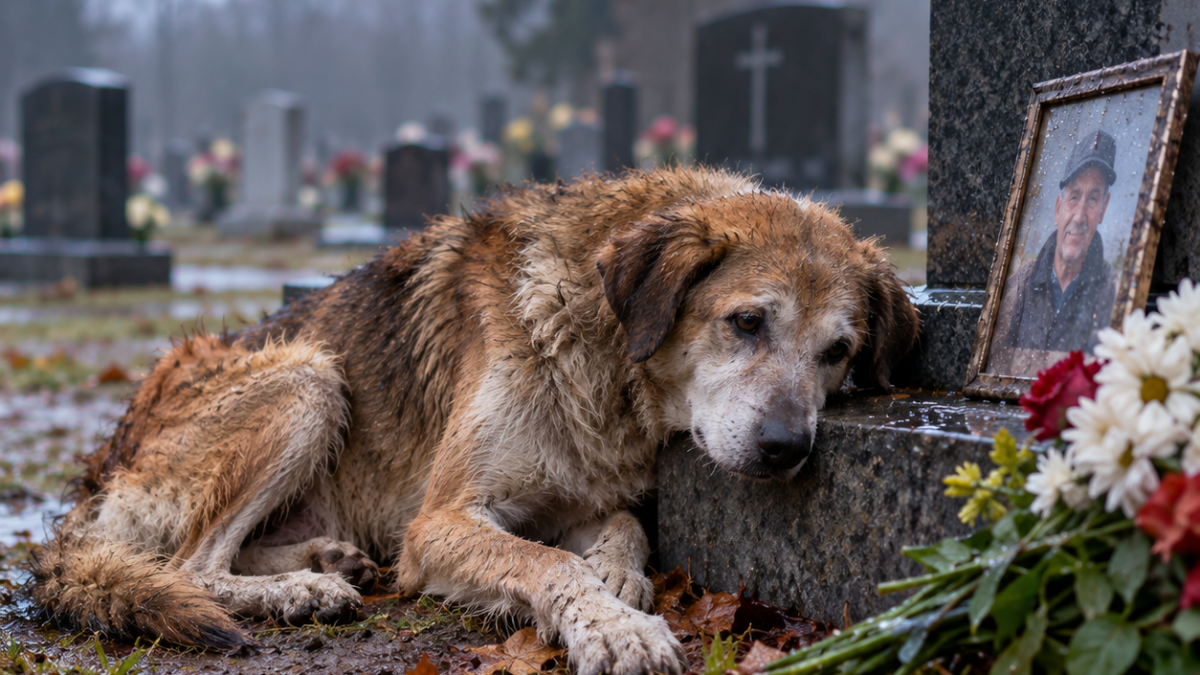
For Three Years, She Kept Returning to the Same Grave and Refused to Leave—Then Rescuers Learned Who She Was Still Waiting For, and Why No One Ever Came Back.
Nobody understood why the old dog kept returning to the cemetery.
People tried to chase her away, tried to feed her somewhere else, tried to lead her toward safer places, but every time, she came back to the same row of graves and lay down as if the dead were the only family she had left.
When I finally learned whose grave she had been guarding for nearly three years, I understood that I was not rescuing a stray dog — I was trying to rescue a broken heart that had refused to stop loving.
The first time I saw her, she was moving between the graves like a ghost.
It was early in the morning, the kind of gray, quiet morning when the world seems to be holding its breath. A thin layer of frost covered the grass. The cemetery gates creaked behind me as I stepped inside, and for a few seconds, all I could hear was the wind brushing through the bare branches above the headstones.
Someone had called us the night before.
“There’s a dog in the cemetery,” the man said. “She keeps coming back. She won’t leave.”
At first, I thought it was a simple case.
A stray dog looking for shelter.
Maybe an old animal abandoned near the cemetery because people thought no one would notice. It happens more often than people want to believe. Dogs are left outside shelters, markets, parks, gas stations, churches, schools, even cemeteries. Anywhere the person leaving them can convince themselves that someone else will eventually step in.
But the man on the phone sounded different.
He did not sound annoyed.
He sounded unsettled.
“She doesn’t wander like other strays,” he told me. “She comes for one place. The same place every time.”
I asked him how long she had been there.
There was a pause.
Then he said, “Years.”
That word stayed with me.
Years.
So I went.
The cemetery sat on the edge of town, behind an old stone wall stained dark by weather and moss. Rows of graves stretched across the hill, some cared for with flowers and candles, others leaning, faded, almost forgotten. It was the kind of place people visited with flowers in their hands and grief pressed quietly behind their ribs.
I walked slowly, scanning between the stones.
For a while, I saw nothing.
Only frost.
Only crows.
Only names carved into stone.
Then something moved near the far end of the cemetery.
At first, I thought it was a piece of torn cloth blowing low across the ground. But then the shape stopped, lifted its head, and looked directly at me.
A dog.
She stood several yards away, thin and worn, her fur dirty and patchy, her body lowered in caution. She was not barking. She was not growling. She was not running at me.
PART2:
She was deciding whether I was another person who would hurt her, ignore her, or try to force her away from the only place she still trusted.
I stopped immediately.
“Hey, sweetheart,” I said softly. “It’s okay.”
The dog stared at me.
She had the saddest eyes I had ever seen.
Not frightened eyes exactly.
Not even wild eyes.
Tired eyes.
Eyes that had waited too long.
Her ribs showed beneath her coat. Her legs looked weak. Her face was gray around the muzzle, and something about the way she held herself told me she was older than she looked from a distance. She had the kind of exhaustion that does not come from one bad night outside.
It comes from surviving too many.
I took one careful step forward.
She turned away.
Not fast.
Not in panic.
Just enough to show me she did not want to be touched.
“Okay,” I whispered. “I won’t chase you.”
She moved between two graves, stopped, looked back once, then continued down the row.
I followed at a distance.
Every few steps, she checked on me.
She knew I was there.
PART3:
She wanted to make sure I did not come too close.
Then she reached a grave near a pine tree.
She stopped beside it.
Lowered her head.
And lay down.
I stood still.
The grave was not new. The stone was weathered but not forgotten. Someone had once placed flowers there, though by then they were faded and brittle. A small framed photograph had been tucked near the base, protected under a cracked plastic cover.
I moved close enough to read the name.
I will not write it here.
Some grief belongs to the dead and the ones who loved them.
But I will say this:
The date told me he had died almost three years earlier.
The dog placed her head on the cold ground beside the stone and looked at me.
Not like she was guarding it from me.
Like she was asking whether I understood.
That was when the caretaker’s words made sense.
She was not living in the cemetery because she had nowhere else to go.
She was living there because someone she loved had never come back out.
And she had been waiting at his grave ever since.
I felt something tighten in my chest.
There are moments in rescue work when you have to stay practical because if you let yourself feel everything at once, you will break down before the animal is safe. You tell yourself: assess condition, secure the animal, get medical care, ask questions later.
But standing there in front of that grave, watching this old dog rest her tired body beside the only person she still trusted, I almost forgot how to move.
I crouched slowly and opened a pouch of food.
Her ears lifted.
Hunger still reached her, even through grief.
I placed the food on the ground and backed away.
She rose carefully, limping a little, and approached. She kept her eyes on me the whole time. When she reached the food, she sniffed once and began to eat.
No teeth.
That was the first detail that hit me.
She pushed the food around strangely, struggling to chew, swallowing awkwardly. Her mouth looked painful. Her gums were swollen. She ate with the desperate focus of a dog who had learned not to count on another meal.
I wanted to scoop her up right there.
But I knew better.
Fearful dogs do not understand urgency.
They understand pressure.
And pressure makes them run.
So I fed her slowly, piece by piece, letting her decide how close to come.
The cemetery caretaker approached quietly behind me.
“That’s her,” he said. “We call her Lucy.”
“Lucy,” I repeated.
The dog paused at the sound of the name but did not fully look up.
“She belonged to the man buried there,” he said.
“How long has she been doing this?”
He sighed.
“Almost three years.”
I looked at him.
“Three years?”
He nodded.
“At first, everyone thought the family would come get her. Then people thought she would leave on her own. Some tried to take her away, but she kept coming back. Once someone drove her several streets away. Next morning, she was right here again.”
Lucy finished the food and backed away.
Then, as if the conversation had become too much even without understanding the words, she turned and moved behind the grave again.
“She sleeps here?” I asked.
“Sometimes under that pine tree. Sometimes near the stone. In rain, too. Snow. Heat. Doesn’t matter. She leaves to look for food, then comes back.”
I looked at Lucy’s thin body, at the hollow look in her sides, at the way her legs trembled when she stood too long.
“She needs a hospital,” I said.
The caretaker looked relieved and guilty at the same time.
“I know.”
That is another difficult truth about animal suffering.
Many people know.
They just do not know what to do.
Or they are afraid to get involved.
Or they tell themselves someone else will handle it.
Or they have seen pain for so long it becomes part of the landscape.
A dog in a cemetery.
A cat behind a restaurant.
A horse in a field too thin.
A neighbor’s animal chained in the heat.
At first, everyone notices.
Then, slowly, the suffering becomes normal.
Until someone finally stops and says, no.
Not anymore.
Getting Lucy into the car was not easy.
She did not fight violently. She was too weak for that. But she resisted with the quiet stubbornness of a dog who had one last place in the world and did not want to be taken from it.
Every time I moved toward her with the leash, she retreated to the grave.
Every time I stepped back, she relaxed.
It took patience.
Food helped.
My voice helped a little.
The caretaker’s presence helped because she knew him and did not fear him as much as she feared me.
Finally, I looped the leash gently over her head.
The moment she felt it, she froze.
I expected panic.
Instead, she turned her head toward the grave.
That was worse.
“Lucy,” I whispered. “I know. I’m sorry.”
I do not usually apologize when rescuing an animal.
But that day, I did.
Because I understood that, in her mind, I was not saving her.
I was taking her away from the one place where love still lived.
We lifted her carefully into the back seat of my car.
She stood there for a moment, trembling, looking through the window toward the cemetery.
Then she let out a sound.
Not a bark.
Not a howl.
A low, broken whimper.
I sat beside her for a minute before driving.
“I promise,” I said softly. “I’m not taking him away from you. I’m just trying to keep you alive.”
She did not understand.
Not yet.
Maybe one day.
The nearest veterinary hospital was twenty minutes away.
During the drive, Lucy stayed pressed against the door, eyes fixed on the passing road. Every turn seemed to worry her. Every stop made her lift her head. She kept looking for the cemetery as if she could track the distance by smell, by memory, by the ache in her own body.
At the hospital, the staff took one look at her and moved quickly.
They were gentle, but their faces changed.
That is how you know it is serious.
A good veterinarian learns to keep a calm voice, but their eyes still tell the truth.
Lucy was underweight.
Dehydrated.
Weak.
Her skin showed signs of neglect.
Her mouth was in terrible condition. Most of her teeth were already gone. The remaining ones were damaged, loose, infected, or painful. A large tumor had formed near her chest. Her blood work showed a dangerous parasitic infection. Her heart was not strong. Age and hardship had worn her down from every direction.
The vet came into the consultation room with a file in his hand and that careful expression doctors use when they do not want to scare you too quickly.
“She is in critical condition,” he said.
I nodded, though my stomach had already dropped.
“How critical?”
He looked through the glass toward Lucy, who was lying on a towel in the exam area.
“She is very weak. She has a tumor that needs removal, but surgery will be high risk because of her age and heart condition. Her mouth is badly infected. She has a severe blood parasite infection. She needs stabilization before anything else.”
“Can you do the surgery here?”
He hesitated.
“We can support her short term. But for the tumor, and possibly the dental work, she needs a larger hospital with better equipment. I do not want to attempt that here unless there is no other choice.”
I looked at Lucy.
She was watching the door.
Always the door.
Always waiting for someone else.
“What happens if we don’t do it?”
The vet’s face softened.
“She does not have much time.”
I had known that.
Still, hearing it out loud hurt.
We decided to stabilize her first.
Fluids.
Medication for the parasite infection.
Pain management.
Soft food.
Rest.
Monitoring.
The vet warned me that the next forty-eight hours mattered. Her body had been surviving on almost nothing for too long. Sometimes rescue comes just in time. Sometimes the body has already spent too much.
I took her home that evening because the small clinic did not have overnight staff, and I wanted someone watching her. I made a warm space for her in a quiet room, with blankets, water, and a bed low enough that she would not need to climb.
She did not lie in the bed at first.
She chose the floor near the door.
Of course she did.
Dogs who have waited too long do not trust comfort immediately.
Comfort feels suspicious when life has trained you for loss.
So I sat on the floor across from her.
Not too close.
Just there.
She watched me.
Her eyes were dull with fatigue, but still alert enough to protect herself from disappointment.
“You don’t have to trust me tonight,” I told her. “Just rest.”
She lowered her head.
For the first hour, she kept lifting it every time I moved.
By midnight, exhaustion won.
She fell asleep with her nose pointed toward the door.
I did not sleep much.
I kept waking to check if she was breathing.
Each time, I found her there, thin body rising and falling under the blanket, paws twitching occasionally as if she were running through some old dream.
In the morning, I called larger hospitals.
One said they could not take her for a week.
Another said they did not have the right surgical availability.
The third asked me to send her test results.
I sent everything.
Then waited.
Waiting in rescue work is a strange kind of torture. You are doing everything you can, and yet so much depends on time, money, medical capacity, and whether a weakened animal can hold on long enough for help to arrive.
Lucy barely responded to affection.
If I reached toward her, she turned her head away.
If I spoke softly, she listened but did not soften.
If I sat beside her, she tolerated me but did not lean in.
She was not aggressive.
She was not ungrateful.
She was absent.
Part of her was still in that cemetery.
I could feed her body.
I could give medicine.
I could arrange surgery.
But I could not simply tell her heart to leave the grave.
That was going to take longer.
On the second day, a hospital in the city called back.
They could examine her.
Possibly operate.
But we had to bring her in as soon as possible.
The drive took hours.
I prepared her as carefully as I could. Soft blankets in the back seat. Medication. Water. Food. Her records. My own nerves packed tightly behind my ribs.
Lucy lay quietly during the trip.
Every now and then, she lifted her head to look out the window.
She seemed worried.
Maybe she sensed the tension in me.
Maybe she had learned that car rides meant change, and change had rarely been kind to her.
“We’re trying,” I told her. “All of us. We’re trying.”
At the hospital, the team moved with the practiced urgency of people used to difficult cases. They repeated tests, checked her heart, examined the tumor, evaluated her mouth, reviewed the blood infection, and discussed the risks.
The surgeon did not pretend the situation was simple.
“She is fragile,” he said. “The tumor removal may take several hours. Anesthesia is a concern. Recovery will also be difficult. We must limit movement afterward. But if we do nothing, the tumor and infection will continue to weaken her.”
I signed the consent forms with a hand that did not feel steady.
Before they took her back, I knelt beside Lucy.
For once, she did not turn away immediately.
Maybe because she was too tired.
Maybe because she was beginning to understand that I kept returning.
I placed my hand near her paw, not touching.
“You’ve waited long enough,” I whispered. “Now let us fight for you.”
The surgery took almost three hours.
Three hours is not long in some parts of life.
It is endless when you are sitting in a hospital hallway waiting to learn whether an old dog who spent three years guarding a grave will wake up again.
I walked.
Sat.
Stood.
Checked my phone.
Prayed in the clumsy way people pray when they are not sure who is listening.
Mostly, I thought about the man in the grave.
Did he love her?
I believed he did.
No dog waits like that for someone who gave them nothing.
Had he known what would happen after he died?
Had he trusted someone to care for her?
Had he asked?
Had someone promised?
Those questions stayed with me.
When the surgeon finally came out, his mask was lowered and his face looked tired.
“She made it,” he said.
For a second, I could not speak.
“She made it?”
He nodded.
“The tumor was removed. It was not easy, but she did well under the circumstances. We’ll need pathology, and she still has a long recovery ahead. Her mouth will need attention later. But she survived the first surgery.”
I sat down because my knees felt weak.
Lucy had survived one of the hardest moments of her life.
Again.
That was what struck me.
Not just the surgery.
Everything.
The cemetery.
The winters.
The hunger.
The infection.
The loneliness.
The waiting.
This old dog had survived so much that no living creature should have had to endure.
And somehow, she was still here.
When I saw her after surgery, she looked small.
Smaller than before.
Wrapped in blankets, connected to fluids, eyes half-open from anesthesia. Her body looked exhausted, but her breathing was steady.
I sat beside her cage and spoke quietly.
“You did it, Lucy.”
Her eyes moved toward me.
Just a little.
It was enough.
The first days after surgery were all about keeping her still.
That sounds simple until you are caring for an animal whose body hurts, whose mind is confused, and whose heart still wants to return to the only familiar place it knows.
Lucy did not try to run.
But she was restless.
She turned toward doors.
Lifted her head at sounds.
Watched every movement.
She was safe, but safety did not feel safe yet.
That is one of the hardest things people misunderstand about trauma. Removing danger is not the same as creating peace. A body can be indoors, warm, fed, and medically cared for, while the mind still believes it is abandoned in the cold.
So we moved slowly.
Medication on schedule.
Soft food.
Short steps.
Clean bedding.
Quiet voices.
Hand-feeding became our ritual.
At first, I did it because her mouth hurt and she had trouble eating.
Then I realized it was becoming something more.
I prepared every meal carefully — soft, warm, easy to swallow. I sat near her and offered small portions from my hand.
The first few times, she ate without looking at me.
Then she began glancing up.
Then, one evening, while taking food from my fingers, something changed in her eyes.
A tiny spark.
Not happiness exactly.
Interest.
A small sign that some part of her was still reachable.
“Good girl,” I whispered.
Her tail moved once.
It was barely anything.
It felt like everything.
A few days later, we learned more about her past.
We had begun asking around the cemetery, the neighborhood nearby, anyone who might remember the man buried there and the dog who stayed. Slowly, pieces of the story came together.
Lucy had belonged to the man in the grave.
He had two children.
Before he died, he had apparently asked them to take care of her.
That was what someone told us.
A request.
Maybe even a promise.
But after the funeral, Lucy was seen at the cemetery again.
And again.
And again.
No one came for her.
No one brought her home.
No one took responsibility for the old dog grieving beside the grave.
At first, people tried to remove her.
They chased her out.
They took her away from the cemetery.
They yelled.
They waved sticks.
They left food somewhere else, hoping she would settle in a safer place.
But Lucy always returned.
She found her way back as if the grave had a rope tied around her heart.
Eventually, people stopped trying.
They let her stay.
That broke me in a different way.
Because I understood the exhaustion of bystanders, but I also saw the cost of it.
Three years.
Lucy had spent almost three years circling that cemetery, sleeping near her owner’s grave, surviving on scraps, losing her teeth, developing infections, carrying a tumor, and waiting for someone who would never stand up from the ground and call her home.
When I looked at her after learning that, I no longer saw only a neglected dog.
I saw the weight of a promise broken by humans and carried by an animal who did not understand why love had suddenly stopped showing up.
Five days after the first surgery, sadness still filled her eyes.
She was healing physically, but emotionally she stayed far away.
If I sat beside her, she allowed it.
If I touched her gently, she tolerated it.
But she did not seek comfort.
Not from me.
Not from anyone.
She had learned how to live beside grief without asking it for anything.
That made me even more determined.
Her stitches came out when the surgeon was satisfied with the healing. To everyone’s surprise, her recovery was better than expected. Her body was weak, yes, but she had a quiet resilience that kept revealing itself.
Still, we were not finished.
Her mouth needed major treatment.
Fourteen damaged teeth had to be removed. Her upper gums needed repair. Infection had to be addressed before it caused more harm.
I was terrified before the second surgery.
She was older.
Still thin.
Still fighting the blood parasite.
Still recovering from the tumor removal.
But leaving her mouth that way would have been cruel. Every meal would hurt. Every infection would weaken her further. If we wanted her to live well, not merely survive, we had to do it.
The dental surgery was another long wait.
Not as long as the tumor operation, but heavy in its own way.
When it was over, the vet told me she had done well.
Fourteen teeth removed.
Gums repaired.
Infection cleaned.
Pain controlled.
“She may actually feel much better after this,” he said. “Once she heals, eating will be easier.”
I thought about all the meals she had struggled through in the cemetery.
All the scraps swallowed painfully because hunger left her no choice.
No animal should have to be that brave just to eat.
When I brought her home after the dental surgery, I prepared a soft meal and sat in the living room.
For the first time, Lucy slowly stepped into the room on her own.
Until then, she had preferred corners, doorways, edges — places where she could watch without belonging. But that day, she entered the living room as if something in her had grown curious enough to cross a line.
She came close.
Not all the way.
Just close enough to eat from my hand.
She was shy.
Uncertain.
But she stayed.
I did not move quickly.
I did not celebrate out loud.
Trust is easily frightened in the beginning.
I only fed her, piece by piece, and let the silence become gentle.
Then everything changed because of another dog.
A small brown dog who lived with us temporarily wandered into the room before I could stop him. He was friendly, curious, and completely unaware that he was about to do more for Lucy’s heart than weeks of human effort had managed.
Lucy saw him and froze.
I expected her to retreat.
Instead, her ears lifted.
Her eyes sharpened.
For the first time since I met her, her expression changed completely.
Not fear.
Curiosity.
The little dog stopped a few feet away and wagged.
Lucy leaned forward.
I held my breath.
Then she took one step toward him.
One step.
That was all.
But it felt like watching a door open inside her.
The little dog sniffed the air.
Lucy sniffed back.
Then, as if embarrassed by her own interest, she turned her head away.
But she did not leave.
From that day on, she began noticing the world around her.
At first, only the other dogs.
Then the cats.
Then sounds outside.
Then smells in the yard.
We started taking her outdoors for short periods.
The yard became her new classroom.
She explored cautiously at first, nose low, body tense, ready to retreat at any sudden movement. The first time a bird flew from a bush, she jumped back so fast I almost cried. Not because it was sad, but because it reminded me how long she had lived prepared for pain.
But little by little, the yard became familiar.
She sniffed the fence.
Investigated leaves.
Watched the cats watching her.
The cats were fascinated by Lucy. They sat along the wall like a tiny judgmental audience, tails curled, eyes bright, studying the old dog who had appeared in their world carrying sadness like a second shadow.
Lucy noticed them too.
Sometimes she stared back.
Sometimes she ignored them with great dignity.
Sometimes she walked past as if she had more important business.
Every day, she became a little more present.
Not healed.
Present.
There is a difference, and it matters.
Healing is not a sudden transformation.
It is noticing a sound without flinching.
Eating without fear.
Sleeping without waking in panic.
Taking three steps farther than yesterday.
Letting someone touch your head.
Choosing the soft bed instead of the corner.
Looking toward a person when they enter the room because you expect kindness instead of disappointment.
Lucy began doing those things.
Slowly.
Quietly.
Beautifully.
Her eyes changed first.
The heavy dullness began to lift. They became brighter, more alert. She watched things with interest instead of only caution.
Then her body changed.
She gained weight.
Her coat improved.
Her face softened.
Pain left her mouth, and with it, some of the tension around her eyes.
Then one afternoon, I saw it.
Lucy smiled.
A real dog smile.
Mouth soft, eyes warm, ears relaxed, tail moving gently behind her.
I stood there with a bowl in my hands and felt tears rise before I could stop them.
“There you are,” I whispered.
Because that was what it felt like.
Not that she had become someone new.
That the real Lucy had been buried under years of grief, hunger, illness, and waiting — and now, finally, she was beginning to come back.
Nights improved too.
At first, she barked in her sleep.
Sharp, distressed sounds that made me rush to her side.
Her legs twitched.
Her body stiffened.
Sometimes she woke suddenly and looked around as if expecting to find herself back among the graves.
I would sit nearby and speak softly until her breathing slowed.
“You’re home,” I would say. “You’re safe. Rest.”
I do not know when she began believing me.
But gradually, the nighttime barking faded.
Her sleep deepened.
She stretched out more.
Sometimes she even rolled slightly onto her side, exposing the vulnerability of a dog who no longer expected the world to strike while she rested.
That was one of the greatest victories.
Not the surgeries.
Not the weight gain.
Not even the first wag.
Sleep.
Peaceful sleep.
For a dog like Lucy, sleep meant her body had finally stopped standing guard over her broken heart.
Eventually, we were able to contact the children of her late owner.
I had imagined that conversation many times.
In some versions, they did not know she had been in the cemetery.
In others, they had looked for her and failed.
In others, there had been confusion, illness, poverty, distance — some painful reason that would make the story less cruel.
The truth was less clear and somehow more painful.
We learned that their father had asked them to care for Lucy.
He had not wanted her abandoned.
He had not forgotten her.
He had trusted the living to protect what he loved.
But for reasons no one fully explained, that promise was not kept.
When Lucy remained in the cemetery, no one came to take her home.
No one brought her bed.
No one brought her bowls.
No one brought her inside when winter came.
She was left there, near the place where her owner rested, as if grief itself could feed her.
When I learned that, I sat beside Lucy for a long time.
She was sleeping near the window, her head resting on a folded blanket, her face peaceful in the afternoon light.
“You were loved once,” I told her softly. “I know you were.”
Her ear moved at my voice.
“And then people failed you.”
That was the part I could not soften.
People failed her.
Not death.
Not fate.
People.
But I also knew this:
If people could fail her, people could also choose differently.
We could not erase the cemetery.
We could not give back the three years she spent waiting.
We could not bring her owner back or ask why his promise had been left behind with him.
But we could fill the rest of Lucy’s life with something better.
Warmth.
Care.
Companionship.
Food that did not hurt.
Beds instead of frozen ground.
Hands that reached gently.
Dogs who invited her to play.
Rooms where she belonged.
Love that returned every morning.
As Lucy grew stronger, the other dogs became more interested in her.
At first, they watched from a distance.
Dogs understand more than we give them credit for. They could sense she was fragile, not only in body but in spirit. They did not overwhelm her. They waited.
One small dog, however, had less patience than the others.
He decided Lucy should play.
One afternoon, he bounced toward her with a toy in his mouth, tail wagging wildly. He dropped the toy near her feet and stepped back, inviting her.
Lucy looked at him.
Then at the toy.
Then at him again.
Her expression was priceless.
A mixture of confusion, mild offense, and concern that this young creature might be mentally unwell.
He bounced again.
Lucy turned and trotted away.
Not in fear.
In avoidance.
Then she did something so unexpected that I laughed out loud.
She ran straight to my bed and climbed onto it, hiding there as if the invitation to play had been a dangerous social emergency.
The little dog followed her all the way.
He stood beside the bed, tail wagging, determined.
Lucy looked at me as if asking whether I planned to control this situation.
For the first time, she was not the unwanted dog in the cemetery.
She was the dog everyone wanted to include.
That mattered.
It mattered more than I can explain.
Because isolation changes an animal.
It changes people too.
When no one seeks you out, you begin to believe your absence would not matter.
But here, Lucy mattered.
The dogs noticed when she entered the room.
The cats watched her.
I looked for her first thing in the morning.
She had become part of the rhythm of the house.
Quietly.
Completely.
She was family before I even said the word out loud.
Her health continued improving.
Checkups showed stable progress.
The parasite infection responded to treatment.
Her surgical sites healed.
Her appetite returned.
Her body filled out.
The old sadness did not vanish entirely — I do not think love like hers ever disappears — but it no longer controlled every part of her.
The memory of her owner remained in her heart.
I believe that.
I do not think dogs forget the people they love.
But those memories stopped trapping her in the past.
They became part of her, not all of her.
Sometimes, on walks, Lucy would pause and look into the distance.
Not anxiously.
Not desperately.
Just quietly.
I wondered if she remembered the cemetery.
The grave.
The years.
The waiting.
Then she would turn back to me, tail soft, eyes calm, and continue walking.
That was when I knew she had begun choosing the present.
Not because the past meant nothing.
Because the present finally held something good too.
People often ask whether rescue is worth it when the animal is old, sick, traumatized, or has expensive medical needs.
They ask gently sometimes.
Other times, not so gently.
They ask why anyone would spend so much on an old dog.
Why fight so hard when the animal has already suffered so much?
Why not focus on younger dogs, healthier dogs, easier dogs?
I understand the question.
I do.
Resources are limited.
Money matters.
Time matters.
Emotional strength matters.
But when I look at Lucy sleeping peacefully, when I see her wag at meal time, when I watch another dog try to convince her to play, when I see her eyes bright instead of empty, I know the answer.
Because suffering should not get the final word just because it lasted a long time.
Because old dogs deserve comfort too.
Because love is not less valuable when it comes near the end.
Because a life can be wounded, shortened, complicated, expensive, and still absolutely worth saving.
Lucy taught me that.
She taught me that loyalty can survive almost anything.
But she also taught me something else.
Loyalty should not be exploited.
A dog’s faithfulness is beautiful, but it should never be the excuse humans use to abandon them.
Lucy stayed at that grave because she loved.
The least we could do was make sure love did not kill her.
Her new life did not become dramatic.
That is one of my favorite things about it.
There were no constant emergencies anymore.
No frozen mornings.
No frantic hospital drives.
No waiting outside operating rooms.
No searching for answers from people who had failed her.
There were ordinary days.
And ordinary days are sacred when an animal has survived the unthinkable.
Lucy woke up.
Ate breakfast.
Went outside.
Sniffed the yard.
Ignored the cats.
Accepted treats.
Slept in sun patches.
Walked slowly beside me.
Watched the younger dogs behave foolishly.
Rested at night without fear.
That was the miracle.
Not one grand moment.
A hundred ordinary ones.
The first time she fell asleep with her head on my foot, I did not move for nearly an hour.
My leg went numb.
I did not care.
For a dog like Lucy, choosing contact was not casual. It meant she had crossed a bridge inside herself.
She was not merely tolerating love anymore.
She was reaching for it.
Another day, while I prepared her food, she barked at me.
One short bark.
Impatient.
Demanding.
Alive.
I laughed so hard she wagged harder, clearly pleased with herself.
The dog who once silently wandered graves now had opinions about dinner service.
Good.
Let her have opinions.
Let her be a little spoiled.
Let her demand soft food and warm blankets and the good spot near the window.
Let her roll her eyes at playful dogs and pretend not to enjoy their attention.
Let her live long enough to become slightly ridiculous.
She had earned that.
Sometimes I think about her owner.
The man buried in the cemetery.
I never knew him.
But I know Lucy loved him.
And that tells me something.
A dog like Lucy does not wait three years for someone who never mattered.
I hope, wherever he is, he knows she is safe.
I hope he knows someone found her.
I hope he knows her last chapters are not being written in loneliness.
Maybe that sounds sentimental.
Maybe it is.
But rescue work leaves you with strange hopes.
You start hoping the dead can see.
You start hoping animals understand more than language allows.
You start hoping that love, once given, never fully disappears, even when life breaks the shape it came in.
Lucy still carries him.
I see it sometimes.
But now she carries us too.
That is what healing looks like sometimes.
Not forgetting.
Making room.
Room for the one who is gone.
Room for the ones who stayed.
Room for pain.
Room for new joy.
Room for memory without becoming a prisoner of it.
Today, Lucy’s life is simple.
Safe.
Loved.
Hers.
She no longer walks between graves looking for someone to come back.
She no longer sleeps under trees or waits for footsteps that never arrive.
She no longer eats scraps with a painful mouth or hides her weakness from a world too busy to notice.
She has a bed.
A family.
Friends.
A routine.
A name spoken with tenderness.
When I call “Lucy,” she looks up.
Not always quickly.
She is still an older dog, and she likes to decide whether my request is worth immediate attention.
But she looks.
And most days, she comes.
That still amazes me.
After all the waiting she did for someone else, she still found the courage to answer a new voice.
That is bravery.
Quiet bravery.
The kind nobody applauds because it happens in living rooms, yards, kitchens, and soft beds.
The kind that looks like eating from a hand after years of hunger.
Sleeping through the night after years of fear.
Letting another dog near you.
Walking away from a grave.
Choosing life again.
If you had seen Lucy in the cemetery that first morning, you might have thought she was almost gone.
In some ways, she was.
Her body was failing.
Her heart was locked in the past.
Her world had shrunk to one grave, one tree, one routine of waiting.
But there was still a small flame inside her.
Tiny.
Hidden.
Stubborn.
All we did was protect it long enough for it to grow.
That is what rescue is, at its best.
Not fixing everything.
Not erasing pain.
Not pretending the past never happened.
Just finding the small living flame and saying:
I see you.
Stay.
Let me help.
Lucy stayed.
And because she did, she got to learn that the world still had more to offer than loss.
She got to feel grass under her paws for reasons other than searching.
She got to hear other dogs invite her into the day.
She got to sleep without listening for footsteps in a cemetery.
She got to become more than the dog who waited.
She became Lucy.
Funny Lucy.
Gentle Lucy.
Stubborn Lucy.
Beautiful Lucy.
The dog who survived three years of grief and still found her way back to joy.
When I watch her now, I no longer see only sadness.
I see dignity.
I see loyalty.
I see the cost of broken promises.
I see the power of patience.
I see an old dog who should have been protected sooner, but who is finally protected now.
And I see a reminder I will carry for the rest of my life:
Some hearts do not stop loving just because they were abandoned.
Some souls keep waiting long after hope should have died.
And sometimes the most compassionate thing we can do is not ask them to forget.
It is to give them something new to trust.
Lucy still remembers her owner.
I am sure of that.
But she no longer lives at his grave.
She lives here.
In warmth.
In safety.
In the present.
And every time she closes her eyes and sleeps peacefully, I think of that cold cemetery morning and the old dog who turned away from me because she thought love only existed behind her.
I wish I could go back and tell her what I know now.
That love was not only in the ground beneath that stone.
It was coming toward her, slowly, with shaking hands and a leash and a promise.
It was waiting in hospital rooms, soft food, surgery scars, patient voices, cautious walks, curious dogs, and a bed near the window.
It was not the same love she lost.
It never could be.
But it was real.
And after everything Lucy endured, real love was enough to bring her home.








