For Seven Months the Scarred Pit Bull Hid His Face—Then a Burned Firefighter Sat Down and Showed the Dog His Own Scars First
PART3:
BURN INJURIES: HEALED.
EARS: TRAUMATIC AMPUTATION.
BEHAVIOR: EXTREME FEAR/AVOIDANCE.
The bite had happened during the raid.
One deputy.
One shallow puncture through a glove.
Ash had been lying across three puppies while smoke filled the building.
The deputy tried to pull him away.
Ash snapped.
For insurance purposes, context fit into a single box.
BITE HISTORY: YES.
That box would matter later.
For now, Denise stood at the far end of the adoption corridor while a family looked into Kennel 14.
Saturday morning.
October.
Outside, leaves scraped across the shelter parking lot in a cold breeze.
Inside, every kennel door had a laminated card.
Some had hearts drawn by volunteers.
Some said HOUSE TRAINED.
GOOD WITH KIDS.
LOVES TENNIS BALLS.
Ash’s card was almost empty.
NEEDS EXPERIENCED HOME.
ADULT HOUSEHOLD PREFERRED.
SLOW INTRODUCTIONS REQUIRED.
The family’s little boy stepped closer.
Maybe six.
Blue jacket.
Velcro shoes.
He peered through chain-link.
Ash saw him.
Closed his eyes.
Turned toward wall.
The boy immediately grabbed his mother’s jeans.
“He’s scary.”
The mother whispered:
“Come on.”
Nobody said anything cruel.
That was important.
People rarely insulted Ash.
Most simply left.
Denise sometimes wished for cruelty.
Cruelty could be corrected.
Indifference accumulated quietly.
The family moved to Kennel 15.
A yellow Lab named Sunny bounced against the gate.
The little boy laughed.
Five minutes later, Denise heard them asking for an application.
Good.
Sunny deserved a home.
Still, Denise glanced back at Ash.
He had not moved.
Kev Morales, one of the kennel technicians, approached carrying laundry.
“The board packet came.”
Denise knew what he meant.
“When?”
“Yesterday afternoon.”
She rubbed her forehead.
Kev lowered his voice.
“Friday?”
“Friday.”
He stared toward Kennel 14.
“Final?”
“Recommendation.”
“Same thing.”
“Not technically.”
“Denise.”
She looked at him.
Kev was twenty-four.
Still young enough to believe technical differences were sometimes lies adults used to make outcomes sound less final.
He was not entirely wrong.
The board met monthly.
The shelter operated at capacity.
Eighty-nine dogs that morning.
Twenty-seven on behavioral holds.
Twelve cruelty seizures.
Six medical cases.
Five dogs waiting transfer.
Resources were not infinite.
No-kill language sounded simple until an animal spent seven months terrified every waking hour.
Was keeping Ash alive in Kennel 14 kindness?
Denise asked herself that more often than she admitted.
He ate at night.
Drank.
Allowed sedation through food when veterinary care was unavoidable.
Would not permit touch while awake.
Would not walk on leash.
Could not tolerate evaluation.
Could not be adopted under current policy.
No rescue had accepted him.
Three specialized organizations had been contacted.
All full.
Friday’s board would consider placing him on the unadoptable list.
Everyone knew what came after.
Denise whispered:
“Not yet.”
Kev looked at her.
“What?”
“Nothing.”
At ten thirty, the reading program began.
Six children.
Six parents.
Paperbacks.
Blankets.
The program had started because frightened shelter animals often tolerated human voices better when those humans expected nothing from them.
Kids sat outside kennels and read.
No reaching.
No tapping fences.
No commands.
Just stories.
Mia Chen always chose Ash.
Nine years old.
Dark hair usually in two braids.
Purple backpack.
Serious expression.
She had started volunteering with her mother four months earlier.
First Saturday, Denise offered her a beagle.
Mia walked past.
Saw Ash.
Stopped.
“He doesn’t like people?”
“He’s scared.”
“Does he bite?”
“He has before.”
Mia studied him.
“Can I read to him?”
“From outside.”
“Okay.”
That was it.
Every Saturday she returned.
Charlotte’s Web.
The Velveteen Rabbit.
Dog Man, which Denise suspected Ash preferred because Mia laughed while reading.
Picture books.
Comics.
Once a science book about sharks.
She never reached through.
Never asked him to come closer.
She sat cross-legged six feet from the gate.
Ash remained in his corner.
But after the third Saturday, Denise noticed his eyes stayed open.
After the sixth, his head turned slightly toward Mia’s voice.
That was progress.
Tiny enough to be invisible to anyone who needed transformation.
Denise had learned that rescue often lived in measurements too small for photographs.
Mia carried her own habit.
The sleeve.
Her left sleeve always came down over the back of her hand.
Even when warm.
If it slid up, she tugged it down.
Denise once saw a pale pink scar beneath it.
Small.
She never asked.
Animals taught her not every scar required a question.
That Saturday, Mia was reading about a rabbit who wanted to become real when the front entrance opened.
The bell chimed.
Jasmine at reception looked up.
A man stepped inside.
Late thirties.
Maybe forty.
Solid build.
Navy hoodie.
Gray baseball cap pulled low.
Sunglasses.
Indoors.
Chin tucked toward chest.
His hands remained in the hoodie pocket.
He stood just inside the door like somebody deciding whether leaving immediately would count as failure.
Jasmine gave her practiced smile.
“Hi.”
The man’s head moved slightly.
“Hi.”
“Can I help you?”
“I’m…”
His voice was soft.
He cleared his throat.
“I’m here to look at dogs.”
“Absolutely.”
“Any kind in mind?”
“No.”
“Size?”
“No.”
“Age?”
He shook his head.
Jasmine glanced toward Denise.
That was their silent system.
Some visitors wanted privacy.
Some needed help.
Some looked overwhelmed.
Denise approached slowly.
“I’m Denise.”
The man did not offer a hand.
“Luis.”
“First time here?”
“Yes.”
“Want me to show you around?”
His shoulders rose.
Dropped.
“Okay.”
They entered the kennel corridor.
Noise hit immediately.
Thirty dogs barking because a new person meant possibility.
Luis flinched so hard Denise noticed.
She stopped.
“Too much?”
“No.”
“You can step back.”
“No.”
He pulled hoodie slightly farther forward.
“I’m okay.”
Denise did not believe him.
But she kept walking.
Kennel 2.
Puppy.
Luis glanced.
Kennel 4.
Two-year-old hound wagging wildly.
No reaction.
Kennel 7.
Black Lab carrying a rope toy.
Luis barely looked.
That was odd.
Most adopters became absorbed by one dog immediately.
Luis seemed to be enduring the hallway rather than exploring it.
His eyes stayed mostly on concrete.
Then he reached Kennel 14.
Stopped.
Complete.
Denise almost walked another step before realizing he was no longer beside her.
Ash was in his corner.
Face to wall.
Eyes shut.
Luis stared.
Not like others.
No flinch.
No pity expression.
Something more frightening.
Recognition.
His right hand emerged from hoodie pocket.
Trembling.
“What happened?”
His voice changed.
Denise looked at Ash.
Then Luis.
“Cruelty case.”
“What did they do to his ears?”
“We don’t know exactly.”
Luis stepped closer.
“Cut?”
“Yes.”
“Vet?”
“No.”
“How do you know?”
“Scar pattern.”
He swallowed.
“And the face?”
“Burns.”
“How?”
Denise hesitated.
“Fire during raid.”
Ash’s eyes opened.
Barely.
Luis noticed.
“How long has he been here?”
“Seven months.”
“And he does this?”
“Mostly.”
“Always faces wall?”
“When people stop.”
Luis removed sunglasses.
Denise’s attention went immediately to his eyes.
Brown.
Exhausted.
Red around edges.
Then she noticed his hand shaking harder.
“Friday.”
She said.
Luis frowned.
“What?”
“The board reviews his case Friday.”
“What happens?”
“He’s considered difficult to place.”
“What happens?”
He repeated.
Denise had learned not to soften language when people asked directly.
“They may classify him unadoptable.”
“And then?”
“We make humane decisions based on welfare and safety.”
Luis looked at her.
“That means kill him.”
Denise’s jaw tightened.
“It can.”
Luis turned toward Ash.
For almost a minute he said nothing.
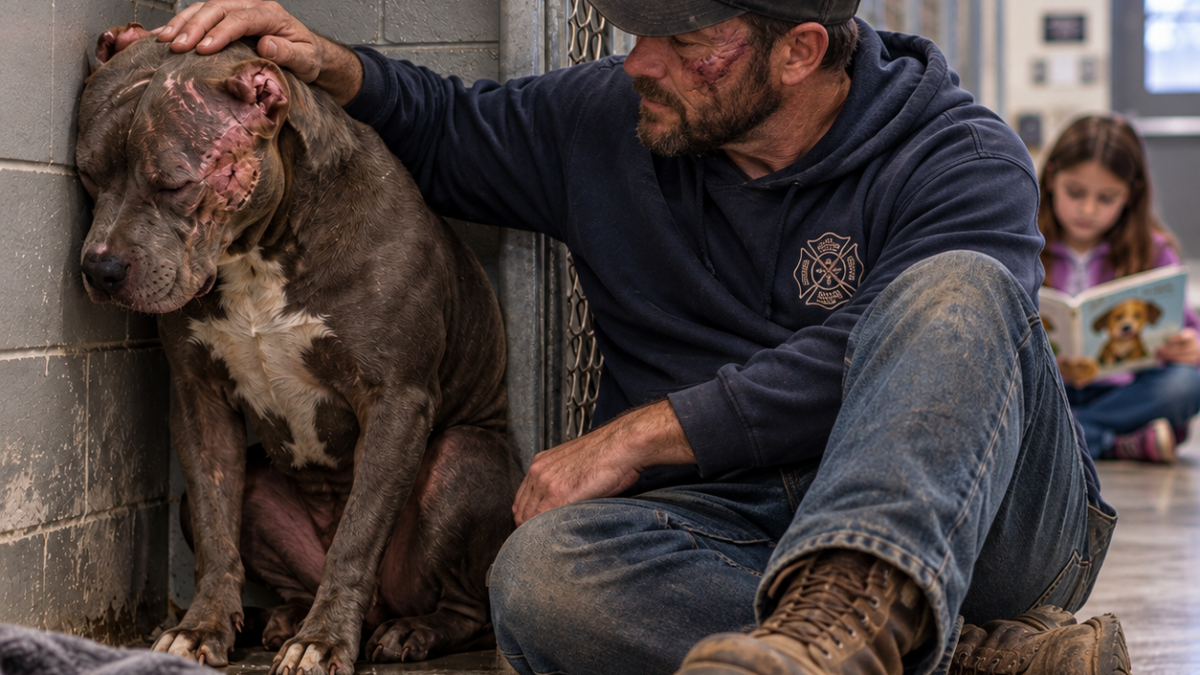
Then he lowered himself onto the floor.
Denise blinked.
Most visitors crouched facing kennels.
Luis sat with his back toward Ash.
Cross-legged.
Facing opposite wall.
Then he removed his hood.
Denise saw the back of his head.
She stopped breathing.
Luis slowly reached up.
Removed his baseball cap.
The left side of his scalp was scarred from the crown downward.
No hair.
Smooth grafted skin.
Pink.
White.
Tight.
Where his left ear should have been, only a folded remnant remained.
The scarring continued along his jaw.
Down neck.
Disappeared inside hoodie.
Denise put a hand over her mouth before she could stop herself.
Luis heard.
His shoulders tightened.
He did not put the hat back on.
He did not look around.
He remained sitting.
Back to Kennel 14.
Scarred side visible to the dog.
No words.
No reaching.
No “come here.”
Nothing.
Denise stepped backward.
Five minutes.
Ash remained in corner.
But his eyes opened.
Ten.
He watched.
Fifteen.
Luis’s hands rested loose over knees.
Twenty.
Staff began gathering.
Kev.
Jasmine.
One veterinary assistant.
Denise raised a hand.
Quiet.
Mia had stopped reading.
She stood beside her mother, book against chest.
Her eyes were fixed on Luis.
More specifically, the left side of his head.
Twenty-five minutes.
Ash shifted.
Not forward.
Just weight.
Denise saw.
Thirty minutes.
Luis still had not moved.
His back had to hurt.
Concrete was cold.
He remained.
And gradually Denise understood.
For seven months, every person who saw Ash had demanded something from his face.
Not intentionally.
They wanted to examine.
React.
Feel sorry.
Fear.
Whisper.
Ash could not control what happened after somebody saw him.
So he stopped allowing the moment.
He shut his eyes first.
Turned away first.
Luis had changed one thing.
He let Ash look without being looked at.
He showed the dog his own scars first and then surrendered the power of eye contact.
Thirty-five minutes.
Ash stood.
Jasmine inhaled sharply.
Denise held hand again.
Nobody speak.
Ash’s legs trembled.
He took one step.
Stopped.
Another.
His belly nearly brushed floor.
His eyes remained locked on the back of Luis’s head.
Third step.
Fourth.
He reached gate.
Luis’s shoulders began shaking.
He heard dog.
Or felt him.
But did not turn.
Forty minutes after sitting, Luis reached one hand behind without looking.
Slowly.
Touched gate latch.
Denise almost intervened.
Policy.
Visitors did not open kennels.
But something in her stopped her.
He lifted latch.
Gate opened three inches.
Ash stared at gap.
Then Luis.
He could stay.
No one pulled.
No one called.
Ash pushed nose through.
Gate moved wider.
The dog who had spent seven months refusing every human touch walked out.
One step into hallway.
Then another.
Staff held breath.
Ash approached Luis from behind.
Lowered his nose.
Sniffed scar tissue on the man’s neck.
Slowly.
Deeply.
Luis closed eyes.
Tears slipped down his right cheek.
Ash sniffed where the ear ended.
The smooth skin behind jaw.
The thickened graft line.
Then he licked him.
One small lick.
Right over the scar.
Luis covered his mouth.
Ash licked again.
Jasmine from reception sobbed.
Kev wiped his eyes with his sleeve.
Mia’s mother, Grace, pressed both hands over her face.
And then Denise saw Ash’s tail.
For seven months it had hung low.
Sometimes tucked.
Never moved with joy.
Now it lifted.
Once.
Then swayed.
Slow.
Left.
Right.
Again.
Faster.
Ash was wagging.
Denise slid down wall.
Nineteen years of shelter work.
Intakes.
Deaths.
Reunions.
Abuse cases.
She had cried at work maybe three times.
This made four.
Luis finally turned.
Ash startled slightly.
But did not run.
Their faces met.
Man’s scarred left side.
Dog’s scarred left side.
Only inches apart.
Ash stared.
No wall.
No closed eyes.
Luis whispered:
“Hey, buddy.”
His voice broke.
“I know.”
Ash leaned forward.
Pressed his face against Luis’s chest.
Luis wrapped his arms around the dog.
Very slowly.
Ash stayed.
They sat there.
Denise did not know how long.
Eventually she asked:
“Who are you?”
Luis looked up.
He seemed embarrassed by question.
“Luis Navarro.”
“How did you know?”
“Know what?”
“To sit like that.”
Luis looked at Ash.
For the first time, his mouth almost smiled.
“Because that’s what I’ve been doing.”
“What?”
“Turning my face to the wall.”
Later, Denise brought Luis into her office.
Ash followed.
That alone felt impossible.
The dog lay across Luis’s shoes beneath desk.
Not fully relaxed.
Still watching door.
But out.
Denise retrieved raid file.
She hesitated.
“I should tell you something.”
Luis stroked Ash’s shoulder.
“Okay.”
“The burns.”
His fingers paused.
“The man running the fighting operation saw deputies coming.”
Denise opened report.
“He poured gasoline on a back shed.”
Luis looked at her.
“Dogs were inside?”
“Yes.”
His face tightened.
“He lit it?”
“Yes.”
“Why?”
“Destroy evidence.”
“Kill dogs?”
“Apparently.”
Luis looked down.
Denise continued.
“Most were chained.”
“Deputies forced door.”
“Smoke was heavy.”
“The dogs were panicking.”
“Ash had pulled loose.”
“How?”
“Chain attachment failed.”
“Or he broke it.”
She glanced at report.
“They found him in far corner.”
“He wasn’t trying to escape.”
Luis’s hand stopped.
“He was lying over three puppies.”
Silence.
“They weren’t his.”
“Their mother had died days earlier.”
“The left side of Ash’s face…”
Denise swallowed.
“Was burning.”
“He stayed over them.”
“All three puppies survived without serious burns.”
Luis touched the scar on his own neck.
Slow.
“He walked into fire for kids that weren’t his.”
Denise nodded.
“He didn’t leave them.”
Luis looked down at Ash.
The dog’s eyes had closed.
Not from fear now.
Rest.
Luis whispered:
“And people looked at his face and saw a monster.”
Denise said nothing.
After a moment:
“Why did you come here today?”
His shoulders tightened.
“My therapist.”
“What’d she say?”
Luis laughed faintly.
“That I needed a friend who wouldn’t judge me.”
Denise almost smiled.
“She suggested dog?”
“Yes.”
“How long have you been looking?”
Luis stared at wall.
“This is the first place.”
“When did you last…”
She stopped.
He looked.
“When did I last what?”
“Go anywhere voluntarily.”
He understood.
“Two years.”
Denise sat straighter.
“Two years?”
“Doctor appointments.”
“Therapy.”
“That’s about it.”
“Groceries?”
“Delivery.”
“Family?”
“Not much.”
“Work?”
Luis shook head.
“Medical leave.”
“From?”
His hand moved unconsciously toward scars.
“Fire department.”
Denise glanced again.
He saw.
“I used to be firefighter.”
Used to.
Not retired.
Not am.
“Four years ago.”
He said.
“Building fire.”
Denise waited.
“I got burned.”
“I figured.”
“Yeah.”
Luis gave bitter smile.
“Subtle.”
“I didn’t mean—”
“It’s okay.”
He stroked Ash.
“People stare.”
Denise did not deny.
“First year I could handle hospitals because everybody there expected injuries.”
“Then surgeries ended.”
“Real world started.”
“First grocery store…”
He stopped.
“A kid screamed.”
Denise’s chest tightened.
“His mom dragged him away.”
“Didn’t say anything.”
“After that…”
He shrugged.
“Home got easier.”
“Then easier became permanent.”
Denise looked at Ash.
“Do you want to adopt him?”
Luis did not answer.
For several seconds Denise thought he might say yes.
Instead his face collapsed.
“No.”
Ash opened eyes.
Luis swallowed.
“I can’t.”
Denise said gently:
“You got farther with him in forty minutes than we did in seven months.”
“That doesn’t mean I can take care of dog.”
“You came here.”
“One day.”
“That’s still—”
“No.”
His voice sharpened.
Then softened.
“I’m sorry.”
He stood.
Ash stood too.
Luis looked down.
“I can’t even take care of myself right.”
“That isn’t true.”
“You don’t know me.”
“No.”
“You know forty minutes.”
He pulled cap over scars.
Hood.
Sunglasses.
Each layer closing.
“I’m sorry.”
He walked out.
Ash followed to front window.
Pressing his face against glass.
Luis crossed parking lot.
Did not turn.
Ash made a sound.
High.
Soft.
Then louder.
A cry.
Denise had never heard him vocalize like that.
Ash pawed glass once.
Luis reached his car.
Paused.
For half a second Denise thought he would look.
He didn’t.
He drove away.
That night Luis Navarro sat in darkness.
Blinds closed.
Television off.
Cap on coffee table.
He kept seeing gray face in shelter window.
Ash crying.
He had spent four years insisting he preferred silence.
Now silence sounded like abandonment.
At 11:17 p.m., he almost called shelter.
Did not.
At midnight he pulled up adoption page.
Closed it.
At 1:03 he searched fenced rentals.
Closed browser.
At 2:10 he stood at bathroom mirror.
Took off shirt.
Looked.
The burn started at scalp.
Left side.
Neck.
Shoulder.
Across upper back.
Grafting patchwork.
For years he showered without mirror light whenever possible.
Tonight he looked.
The accident had happened February 11, four years earlier.
Columbus Division of Fire.
Station 18.
Luis had served eleven years.
He loved job.
Not hero language.
Job.
Coffee at five thirty.
Gear checks.
Bad jokes.
Chili cook-offs.
School visits.
False alarms.
Car wrecks.
People burning dinner.
And sometimes fire.
Cleveland Avenue call came 2:19 a.m.
Three-story brick apartment.
Fire through second floor.
A woman in parking lot screaming.
“My daughter!”
Five-year-old.
Mia.
Back bedroom.
Luis and partner went inside.
Visibility near zero.
Heat heavy.
He heard coughing under bed.
Found child curled against wall.
Stuffed rabbit clutched.
He crawled.
“Mia?”
She did not answer.
He pulled mask slightly enough to show face.
“Fire department.”
She screamed.
Reached.
He wrapped her in turnout coat.
Lifted.
Hallway deteriorating.
Ceiling fire.
His partner shouted route.
They moved.
Then crack overhead.
Luis remembered turning.
Instinct.
Mia against chest.
He curled around her.
Burning ceiling material collapsed over left side of his head and back.
SCBA took part.
Helmet shifted.
Ear exposed.
Pain arrived like white light.
Then nothing.
He woke three weeks later.
Ohio State burn unit.
First question:
“Girl?”
Nurse understood.
“Mia?”
He nodded.
“She’s alive.”
He cried.
“Small burn on hand.”
“Smoke exposure.”
“Going home.”
He closed eyes.
Good.
Then doctors explained him.
Eleven surgeries eventually.
Grafts.
Most of left ear gone.
Scar contracture.
Neck mobility limited.
Permanent change.
City wanted medal.
News wanted interview.
Mia’s mother sent letters.
Luis rejected all.
Not because he regretted saving her.
Because everybody called him hero while he could barely look at himself.
His fiancée Cristina stayed.
A year.
She loved him.
He knew.
She changed dressings.
Drove therapy.
Slept in hospital chairs.
When he came home, she covered mirrors because he asked.
Then months later she suggested uncovering one.
He accused her of pressuring.
She cried.
He apologized.
Cycle.
She wanted restaurant.
He said no.
Family dinner.
No.
Walk at park.
No.
She stopped asking.
One morning she packed two bags.
“I love you.”
He stared at floor.
“I know.”
“I can’t live behind blinds forever.”
“Then go.”
He hated himself the moment he said it.
She went.
He never blamed her.
He blamed mirror.
Then world.
Then himself.
Fire department offered desk role.
Public education.
Training.
Investigations.
He ignored calls.
Therapist Dr. Moss spent nine months trying to get him to leave apartment for something not medically required.
On Tuesday before shelter:
“Find one place.”
“No.”
“One.”
“No.”
“Library.”
“No.”
“Coffee shop.”
“No.”
“Dog shelter.”
Luis looked up.
Dr. Moss shrugged.
“Dog won’t ask you what happened.”
“That’s your clinical recommendation?”
“Yes.”
“Get a dog?”
“No.”
“Enter building where beings care more about smell than appearance.”
He stared.
She smiled slightly.
“I’ll take that as assignment.”
He did not promise.
But Saturday morning he drove.
Three times around shelter.
Almost left.
Then walked in.
And Ash came out.
Luis sat on couch until sunrise.
At 9:12 Sunday morning someone knocked.
He ignored.
Knocked again.
He froze.
Nobody visited unannounced.
Third.
“Mr. Navarro?”
Small voice.
He stood.
“It’s Mia.”
His body locked.
From shelter?
“The girl with books.”
He exhaled.
“My mom’s here.”
Another knock.
“Please.”
Luis pulled hood.
Cap.
Opened door three inches.
Mia stood in hallway.
Purple coat.
Braids.
Grace Chen beside her.
The mother from Cleveland Avenue.
Older now.
Luis had seen her face in hospital photographs he refused.
Grace’s hand went to mouth.
Not from scars.
Recognition.
“Oh my God.”
Luis nearly shut door.
Mia spoke.
“You didn’t recognize me yesterday.”
“What?”
“I didn’t recognize you either.”
She pushed her sleeve upward.
Back of left hand.
Small pink scar.
His vision blurred.
Mia said:
“You carried me.”
Luis grabbed frame.
“From under my bed.”
Grace began crying.
Luis opened door wider.
Not consciously.
Mia continued.
“I had Bunny.”
Stuffed rabbit.
White.
One ear singed.
Memory hit.
He sat down.
Right there on apartment floor.
Grace knelt outside threshold.
“We tried finding you.”
“I’m sorry.”
Luis whispered.
“Why are you sorry?”
“I didn’t…”
His breath caught.
Mia stepped closer.
“Every year I make you a picture.”
He stared.
“Why?”
“Because you saved me.”
Luis shook head.
“No.”
Mia frowned.
“You did.”
“I just did job.”
“My mom says people who do brave things always say that.”
Grace gave a broken laugh.
“Not always.”
Mia lifted hand again.
“I used to hide this.”
“The scar?”
“At school.”
“Kids asked.”
“I wore Band-Aids even when healed.”
She tugged sleeve down.
Then deliberately pushed it up.
“I read to Ash because he hides his face.”
Luis’s eyes closed.
“I thought maybe if I didn’t stare, he’d stop.”
She swallowed.
“He didn’t.”
“Until you.”
Grace said softly:
“Denise told us you left.”
Luis looked away.
Mia’s chin trembled.
“They’re going to put him on bad list Friday.”
“Mia.”
Grace touched shoulder.
“That’s not exactly—”
“You said.”
Grace sighed.
Luis understood enough.
Mia said:
“Please.”
Then sentence that would follow Luis for rest of his life:
“You saved me.”
“Can you save him too?”
Luis covered face.
“I can’t.”
“Why?”
“I can’t take care of him.”
“You took care of me.”
“That was different.”
“You were on fire.”
Luis almost laughed.
Mia was crying now.
“He likes you.”
“You don’t know that.”
“He came out.”
Luis looked.
“He doesn’t come out for anybody.”
Long silence.
Then Mia said:
“If Ash can come out of his corner for you, maybe you can come out of yours for him.”
Grace closed her eyes like she wished her daughter had not said something so devastatingly simple.
Luis stared at small scar.
The child he had hidden from.
Not because she frightened him.
Because her gratitude did.
If she looked at him with horror, he could retreat.
She looked with love.
That required different story.
“Okay.”
He whispered.
Mia blinked.
“Okay?”
“I’ll try.”
Monday morning, Luis returned to shelter.
Ash was waiting at gate.
Not wall.
Gate.
Tail circling.
Denise saw and looked away for a second to compose herself.
Luis crouched.
Ash pressed muzzle against chain-link.
“Hey.”
Dog whined.
“I came back.”
Denise handed application.
Then grimace.
“I need to explain obstacles.”
“There are obstacles.”
“Several.”
She opened file.
“Bite record.”
Luis nodded.
“During fire rescue.”
“Yes.”
“Still record.”
“Okay.”
“Placement requires experienced handler.”
“I’m not.”
“Behavior evaluation.”
“Fine.”
“Home inspection.”
“Fine.”
“Secure six-foot fenced yard.”
Luis stared.
“I live in apartment.”
“I know.”
His face fell.
“And Friday board meeting.”
“What about it?”
“You have to attend.”
“Okay.”
“In person.”
His hand stopped.
“Public.”
Silence.
“There could be twenty people.”
His breathing changed.
“Luis.”
“Maybe media if word spreads.”
“No.”
“Listen—”
“No.”
Ash whined.
Luis turned.
Dog watched.
He whispered:
“I’ll figure it out.”
For four days Luis tried.
Landlord refused fence.
Rental houses.
Breed restrictions.
Deposits.
Credit checks.
One owner said:
“Pit bull? Absolutely not.”
Luis hung up.
Behaviorist evaluated Ash Wednesday.
With Luis:
soft.
Responsive.
Leaning against him.
With stranger:
Ash retreated.
Turned scar toward wall.
No aggression.
But fear profound.
Report honest.
Luis read:
Strong selective attachment to applicant.
Persistent avoidance of unfamiliar humans.
History of fear-related bite during extreme crisis event.
Requires controlled placement and ongoing behavioral support.
Not perfect.
Not hopeless.
Thursday night, Luis sat on apartment floor.
Friday meeting address displayed on phone.
Public room.
Strangers.
Staring.
He imagined entering.
All eyes.
Saw cereal aisle boy again.
Scream.
Mother pulling away.
He could hear:
What happened to him?
Don’t stare.
Oh my God.
His heart accelerated.
Hands tingled.
Air vanished.
He slid to floor.
Panic attack.
Forty minutes.
At end he lay exhausted.
He texted Denise.
I’M SORRY. I CAN’T COME. PLEASE TELL MIA I’M SORRY.
Turned phone off.
Friday at seven, Columbus Humane Rescue board sat at folding tables.
Harold Gaines, retired principal, chaired.
Denise stood near wall.
Mia sat front row with Grace.
Ash remained Kennel 14.
Gate.
Not wall.
Waiting.
Harold read agenda.
“Item four.”
“Kennel Fourteen.”
“Ash.”
“Staff recommendation for unadoptable status and transfer.”
He looked at Denise.
“I understood there was interested applicant.”
Denise swallowed.
“He withdrew this afternoon.”
Mia’s face crumpled.
Harold sighed.
“Then I’ll entertain motion.”
Board member lifted hand.
“Motion to approve.”
“Second.”
In kennel corridor Ash stood.
Hallway empty.
Tail still.
Community room:
“All in favor—”
Door slammed open.
Everyone turned.
Mia entered first.
Out of breath.
Holding someone’s hand.
Luis.
No hood.
No sunglasses.
No cap.
Every scar visible beneath fluorescent lights.
Twenty people stared.
His body trembled so visibly Denise could see from front.
He was gray.
Sweating.
Chest rising too fast.
But he stayed.
Harold lowered hand.
Luis swallowed.
“I’m sorry I’m late.”
His voice cracked.
“I’m here for Kennel Fourteen.”
Mia released hand.
Luis took one step.
Then another.
He looked like every step required lifting entire building.
Harold said gently:
“Mr. Navarro?”
“Yes.”
“Take your time.”
Luis nodded.
“Thank you.”
He stood before board.
Turned enough that everyone could see his face.
No hiding.
“My name is Luis Navarro.”
His hands shook.
“Four years ago I was firefighter at Station Eighteen.”
Murmur.
“I went into an apartment fire on Cleveland Avenue.”
He looked at Mia.
“There was five-year-old girl trapped under bed.”
Mia lifted scarred hand.
“I got her out.”
Grace was crying.
“Ceiling came down.”
Luis touched left side of head.
“This is what happened.”
Silence.
“I spent next two years in apartment with blinds closed.”
“Because people stared.”
He breathed.
“They weren’t all cruel.”
“That almost made it worse.”
“They felt sorry.”
“They looked away.”
“They whispered.”
“I started hiding before anybody could decide what to think.”
He looked toward hallway.
“Last Saturday, I saw Ash doing same thing.”
Denise’s tears came.
“He faces wall because he knows people look at scars.”
“He learned if they see him, they leave.”
“So I sat down.”
“Turned around.”
“I let him see mine first.”
Harold had put pen down.
Luis continued.
“I know your rules.”
“I don’t have fenced yard yet.”
“I’m not trained handler.”
“I have problems.”
“My therapist could give you a whole binder.”
A couple nervous smiles.
“But I know what it is to get labeled by one moment.”
“One face.”
“One injury.”
“One thing people think they understand.”
His voice broke.
“That dog walked through fire for three puppies.”
“He stayed while his face burned.”
“I went through fire for one little girl.”
“I stayed while mine burned too.”
Mia sobbed.
Luis looked at board.
“Then we both spent years hiding afterward.”
He wiped cheek.
“I’m not asking you to pretend I’m perfect.”
“I’m not asking you to pretend Ash is easy.”
“I’m asking you to let us stop hiding together.”
Nobody moved.
Then Mia stood.
“He’s the only person Ash came out for.”
Her voice wobbled.
“I was there.”
She raised hand.
“And he’s the only person who came in for me.”
Harold removed glasses.
Looked at Denise.
“Foster-to-adopt?”
Denise inhaled.
“There is an exception pathway.”
“Staff-supervised.”
“Temporary placement.”
“Applicant must satisfy housing within thirty days.”
“Behavior support weekly.”
“Home safety plan.”
Harold nodded.
“I withdraw my vote.”
Another member:
“I withdraw mine too.”
“Motion?”
“Approve supervised foster-to-adopt.”
“Second.”
“All in favor?”
Every hand.
Luis closed eyes.
Applause began.
He flinched.
Hard.
Mia noticed.
“Don’t.”
She turned.
“Don’t clap.”
The room stopped.
Luis looked at her.
She whispered:
“Too much?”
He nodded.
Harold said quietly:
“Then no applause.”
That may have mattered as much as vote.
Respect was not forcing celebration either.
Denise went for Ash.
The dog entered room.
Twenty strangers.
He froze.
Almost backed.
Then saw Luis.
Tail moved.
He crossed in three strides.
Pressed scarred face against Luis’s scarred neck.
Right there.
No hiding.
Luis hugged.
Whispered:
“Partner.”
Denise heard.
“What?”
Luis looked at Ash.
“If I get to keep him.”
“Yes?”
“Partner.”
“Why?”
“Firefighters call each other partner.”
“The one who goes in beside you.”
“The one you don’t leave.”
Ash licked his scar.
Saturday began foster arrangement.
Not magical.
First night at Luis’s apartment was a disaster.
Ash would not enter elevator.
Luis panicked because neighbor came.
Neighbor stared.
Luis pulled hood up.
Ash flattened.
They stood lobby twelve minutes.
Eventually stairs.
Third floor.
Ash refused doorway.
Luis sat inside apartment with back turned.
Like shelter.
Twenty minutes.
Ash entered.
Would not eat.
Would not sleep.
At 2 a.m., Luis woke on couch and found Ash standing over him.
Not threatening.
Checking.
Luis whispered:
“We’re both bad at this.”
Ash lay beside couch.
Next morning first walk.
Luis put cap.
Hood.
Sunglasses.
Opened door.
Ash sat.
Would not move.
Luis tugged gently.
Nothing.
He looked at dog.
Ash looked at his covered face.
Luis exhaled.
Removed sunglasses.
Ash stood.
Luis laughed.
“You’re kidding.”
He took hood down.
Ash stepped into hallway.
Cap remained.
Acceptable apparently.
Two days later, no hood.
A week later, no cap on early walks.
People stared sometimes.
One woman crossed street because pit bull.
Luis almost went home.
Ash kept walking.
So did he.
Housing became problem.
A retired contractor named Samuel Pierce read shelter post about foster exception.
He owned small rental house near Schiller Park.
Fenced partially.
He called Denise.
“I can finish fence.”
“Breed restrictions?”
“It’s my property.”
“Deposit?”
“He’s firefighter?”
“Former.”
Samuel said:
“Then tell him rent is what he pays now.”
Luis distrusted generosity.
He met Samuel.
No staring.
Samuel’s grandson had burn scars from accident.
He understood without saying.
Six-foot privacy fence installed by volunteers.
Home inspection passed.
December adoption finalized.
ASH NAVARRO.
Luis still called Partner.
Ash responded to both.
Fire department called in January.
Captain Reynolds.
“Public education opening still yours.”
Luis almost said no.
He looked at Partner.
Dog lying near window.
Not wall.
Window.
Watching snow.
“I’ll try.”
First school visit nearly failed.
Elementary gym.
Two hundred children.
Luis stood outside side door.
Uniform cap.
Dress uniform.
Partner in red vest.
Hands shaking.
Principal waited.
“You okay?”
“No.”
“Want cancel?”
Luis looked at Partner.
Dog looked back.
His scarred face fully visible.
“No.”
They entered.
Children went quiet.
Some stared.
Of course.
A boy whispered:
“He has no ear.”
Luis heard.
His chest tightened.
Then he remembered Ash.
He knelt beside dog.
Took cap off.
Turned scarred side toward children.
“This is Partner.”
He said.
“He has scars.”
He touched his own face.
“So do I.”
A little girl raised hand.
“Does it hurt?”
“Sometimes tight.”
“Does his?”
“Not anymore.”
Another:
“What happened?”
“Fire.”
“To both of you?”
“Yes.”
Gasps.
Luis said:
“Scars don’t make anybody ugly.”
Quiet.
“They tell you what somebody survived.”
A boy approached first.
Teacher asked permission.
Luis nodded.
Partner sat.
Boy touched dog’s white chest instead of face.
Then another child.
Another.
Eventually one touched scar.
Partner did not turn away.
Luis didn’t either.
Mia joined some visits.
She held up hand.
Three scars.
Three stories.
No hiding.
But healing was not straight.
Some days Luis cancelled.
Some mornings blinds remained closed.
Partner had setbacks too.
Man in baseball cap entered house once for repair.
Ash panicked.
Wedged behind couch.
Luis cancelled rest of day and sat floor.
Not training.
Just presence.
Behaviorist taught consent-based handling.
Predictability.
Visitors toss treats without approaching.
No reaching over head.
No forced greetings.
Six months later, Ash tolerated Denise visiting house.
One year later, stranger at park offered hand.
Ash sniffed.
Then walked away.
That counted.
He did not owe touching.
Luis learned same.
He did not owe strangers full story.
A child could ask.
He could answer or not.
An adult could stare.
He could keep walking.
Freedom was not making everyone comfortable with scars.
Freedom was no longer arranging life around avoiding their reaction.
Cristina saw local news segment.
Called.
Luis stared phone.
Did not answer.
Then called next day.
They met coffee.
First public café in four years.
Partner beneath table.
Cristina cried when she saw Luis without hood.
“You look…”
She stopped.
Luis smiled.
“Careful.”
She laughed through tears.
“Like you.”
They spoke.
No reunion.
No romantic ending required.
She had rebuilt life.
Luis was glad.
She apologized for leaving.
He said:
“You didn’t abandon me.”
“I made staying impossible.”
She shook head.
“Both can be true.”
He smiled.
Someone else had taught him that phrase in therapy.
They left friends.
Not close.
But without unfinished anger.
Mia grew.
At eleven she stopped covering hand entirely.
At twelve she spoke at shelter fundraiser.
Not about Luis saving her.
About Ash.
“When people stare at scars, sometimes they think the scar tells whole story.”
She said.
“It doesn’t.”
“Ash’s scar tells you he got burned.”
“It doesn’t tell you he protected puppies.”
“My scar tells you I was in fire.”
“It doesn’t tell you I was rescued.”
“Luis’s scar tells you he was hurt.”
“It doesn’t tell you he went in anyway.”
Grace cried.
Denise cried.
Luis pretended allergies.
Partner slept through speech.
At thirteen Mia decided she wanted be veterinarian.
At fourteen changed to firefighter.
At fifteen back to veterinarian.
Luis said:
“Pick at thirty.”
Ash aged.
White appeared around muzzle.
Missing ears looked softer with age.
At eight or nine, arthritis.
Luis built ramp.
Partner hated.
Then used.
At ten, tumor.
Spleen.
Surgery possible.
Risks.
They chose surgery.
Got eighteen good months.
Luis measured time differently by then.
Not years hiding.
Walks.
School visits.
Breakfasts.
Rain.
Mia birthdays.
At final decline, Partner stopped eating.
Luis knew.
Vet came home.
Denise came.
Mia, now teenager.
Grace.
Samuel.
No crowd.
Partner lay by window.
Luis sat.
Dog placed scarred face against Luis’s scarred neck.
Same place as first day.
Luis whispered:
“You came out first.”
Tears.
“I just followed.”
Partner’s tail tapped once.
Medication.
Breathing slowed.
Stopped.
Luis did not hide face.
He cried in front of everyone.
That was another kind of survival.
Shelter offered memorial plaque.
Luis resisted.
Eventually accepted small:
PARTNER
KENNEL 14
HE CAME OUT OF THE CORNER.
No “hero dog.”
No pity.
Mia added underneath in marker temporarily:
SO DID LUIS.
Denise left for a week before cleaning.
Luis returned to school visits months later without Partner.
Hard.
Children asked.
“Where’s dog?”
“He died.”
Simple.
“Are you sad?”
“Yes.”
“Then why are you here?”
Luis thought.
“Because being sad and being here can happen at same time.”
Teacher later wrote that down.
Fire department offered him expanded role training recruits on trauma recovery and public interaction.
Luis accepted part time.
He visited burn unit too.
Not immediately.
Years.
One patient twenty-two.
Facial burns.
Refused mirrors.
Luis sat with back toward bed.
Did not introduce scars as lesson.
Just waited.
Patient asked:
“Why are you sitting like that?”
Luis said:
“Thought you might want to look before being looked at.”
Silence.
Then:
“Turn around.”
Luis did.
Young man cried.
Luis stayed.
He finally understood what Ash had taught.
Not all healing begins with being brave enough to face others.
Sometimes it begins with being given control over how you are seen.
That became his message more than scars.
Consent.
Patience.
Presence.
No forcing.
Denise retired after twenty-six years.
At ceremony, she spoke about Ash.
“I spent nineteen years thinking experience meant I knew what frightened dogs needed.”
“Then man sat backward.”
Everybody laughed.
“She taught me not every closed eye is refusal.”
“Sometimes it’s protection.”
“And you don’t heal protection by ripping it away.”
Luis nodded.
The shelter changed protocols.
Fearful dogs could have visual barriers.
Consent-based handling.
Reading volunteers.
Long-term behavioral review.
More contextual language in bite histories.
Not:
BITER.
Instead:
Single bite during extraction from active structure fire while dog guarded puppies.
Words mattered.
Ash did not save every dog.
Some remained unsafe.
Some decisions painful.
But individualized context improved.
The board never again used “unadoptable” without detailed behavior explanation and review.
Harold Gaines said:
“One dog embarrassed us into writing better forms.”
Luis responded:
“Good.”
Years later, a reporter asked Luis:
“Did you rescue Ash?”
He shook head.
“Partner.”
“Sorry.”
“No, I mean his name was Partner.”
“Did you rescue Partner?”
Luis thought.
“Shelter pulled him from fire.”
“Denise kept him alive seven months.”
“Mia sat with him every Saturday.”
“The board gave chance.”
“People built fence.”
“I took him home.”
“So who rescued him?”
“All of us.”
“And he rescued you?”
Luis disliked that too.
“He didn’t fix me.”
“What did he do?”
“He looked.”
“At your scars?”
“Yes.”
“And wasn’t afraid?”
Luis smiled.
“He’d been through fire too.”
Reporter waited.
Luis continued:
“I was scared of people looking at me.”
“Turns out what I needed first was somebody who looked and didn’t react like I was ruined.”
That sentence became headline.
He hated headlines.
But this one he allowed.
Mia eventually became a firefighter.
Of course she did.
Station 18.
Luis pinned badge at academy graduation.
Her mother cried.
Mia held left hand visible.
The scar had faded so much you could barely see.
She said:
“Still there.”
Luis touched his own.
“Mine too.”
On first fire response involving child, Mia froze for half second.
Then training.
Moved.
Afterward called Luis.
“I thought about you.”
“Don’t.”
“Why?”
“Think about job.”
“I did.”
“Good.”
She laughed.
“You’re terrible mentor.”
“Retired.”
Not actually.
He never stopped.
At the shelter, Kennel 14 eventually housed another dog.
At first Denise’s replacement considered renumbering.
Luis said no.
“Why?”
“Because kennel isn’t haunted.”
“It’s a kennel.”
Important.
Do not turn trauma into sacred prohibition.
Life should occupy space again.
New dog was beagle named Pickles.
Loud.
Happy.
No respect for history.
Perfect.
Luis visited.
Pickles barked directly into scarred ear.
Luis laughed.
On wall outside community room hung photograph from adoption night.
Luis bare-headed.
Partner pressing face into neck.
Mia in foreground.
Harold behind.
No dramatic caption.
Only:
FOSTER-TO-ADOPT APPROVED, OCTOBER 18.
Ordinary administrative sentence under extraordinary image.
That was how Luis preferred memory.
Concrete.
Real.
No destiny required.
One morning, years after Partner died, Luis walked Schiller Park alone.
Seven a.m.
Habit remained.
No leash.
Hand felt strange without it for months.
He passed father and small boy.
Boy stared.
Luis felt old reflex.
Shoulders tighten.
Head lower.
Then boy said:
“Are you firefighter?”
Luis had station jacket.
“Yes.”
“Did you get burned?”
Father looked embarrassed.
“Evan.”
“It’s okay.”
Luis crouched.
“Yes.”
“Did it hurt?”
“Yes.”
“Were you scared?”
“Yes.”
The boy thought.
“Did you still do it?”
Luis smiled.
“I did what I could.”
Boy nodded.
Then ran after squirrel.
Father said:
“Sorry.”
“Don’t be.”
Luis continued walk.
Head up.
Not because staring stopped.
Because staring no longer controlled direction.
At home he kept Partner’s collar.
Mia’s four childhood drawings too.
Grace gave them.
Every February 11, they had drawn firefighter.
First:
huge red truck.
Second:
man with cape.
Third:
man with scars.
Fourth:
man smiling.
Luis framed fourth.
No cape.
He liked.
One day Dr. Moss came to fire department event.
Had not seen Luis two years.
She looked at classroom.
Children.
Luis.
Photograph of Partner projected.
She said:
“So.”
“So.”
“You found friend.”
Luis smiled.
“He found me.”
She raised eyebrow.
“Don’t become sentimental.”
“Too late.”
She asked:
“Blinds?”
“Open.”
“Groceries?”
“In person.”
“Crowds?”
“Still hate.”
“That’s allowed.”
“Good.”
“Mirrors?”
Luis thought.
“Just mirrors.”
That was perhaps biggest.
Not challenge.
Not enemy.
Object.
At seventy? No—Luis was only late thirties in original. Years later maybe fifties.
At fifty-two, Luis gave final public fire-safety lecture before retiring from city education.
He told story.
Not fire rescue first.
Dog.
He said:
“For seven months, whenever anybody passed Kennel 14, Partner shut his eyes.”
“He thought if he didn’t see people react, maybe it hurt less.”
“I spent two years doing same thing with blinds.”
“Not because I hated people.”
“Because I hated moment they saw me.”
Room quiet.
Then:
“The first thing I did right was not asking him to be brave.”
“I sat down and gave him the choice.”
“That dog walked across kennel on his own.”
“After that, I had to decide whether I would do same.”
He looked toward Mia, now Captain Chen.
“She reminded me.”
Mia grinned.
“Harassed you.”
“Correct.”
He ended with line he always used with children:
“Scars don’t make anybody ugly.”
Then paused.
Older now.
Wiser.
“Actually.”
“They don’t make anybody anything.”
“Scars are evidence.”
“That’s all.”
“Evidence something happened.”
“What you become afterward is still being written.”
That was better.
Because some survivors do not become heroes.
Should not need to.
Ash deserved home before puppies story was known.
Luis deserved life outside before anyone knew he saved Mia.
Mia’s scar did not have to become inspiration.
Worth cannot depend on making trauma beautiful.
Sometimes survival is enough.
Sometimes looking away is what gets you through.
And sometimes, when ready, you look back.
Luis’s entire life shifted because one dog did.
Thirty-five minutes.
Gray body trembling.
Step.
Another.
Another.
No music.
No miracle.
Choice.
Ash crossed floor because man did not demand.
Then licked scar because dogs investigate with mouths and noses.
People later made it symbolic.
It became symbolic because of what followed.
But in that moment:
two injured mammals.
One sitting.
One approaching.
That was enough.
Denise later said she realized Ash wasn’t ashamed exactly.
Dogs may not experience shame around appearance the way humans do.
She corrected herself.
“He had learned people’s reactions predicted discomfort.”
Better.
Luis appreciated.
“We put human word on it.”
“Yes.”
“Still felt familiar.”
“That’s what mattered.”
Accuracy and meaning can coexist.
One objector at board meeting years later asked whether story romanticized placing difficult dog with traumatized person.
Denise answered:
“We didn’t hand him dog because scars matched.”
“We used foster supervision.”
“Behaviorist.”
“Housing requirements.”
“Training.”
“Support.”
“Emotion opened door.”
“Procedure kept placement safe.”
That was right.
Love alone is not treatment.
Recognition alone is not readiness.
Luis almost withdrew because he knew limitations.
Board created pathway rather than ignoring them.
Fence.
Support.
Check-ins.
Both benefited.
That nuance disappeared in viral retellings.
They said:
Scarred firefighter adopts scarred dog.
Cute.
True.
Incomplete.
Real story included panic attacks.
Applications.
Breed restrictions.
Behavior plans.
Money.
Rental fence.
Setbacks.
Therapy.
Work.
That made it more powerful, not less.
Healing sturdy enough to survive paperwork.
Luis laughed when Mia once said that.
“You sound like Denise.”
“Occupational hazard.”
Years after, at shelter anniversary, a child asked:
“Why did Partner choose you?”
Luis answered honestly:
“I don’t know.”
“You both had scars.”
“Maybe.”
“He smelled fire?”
“No.”
“You were sad?”
“Probably.”
Then Luis said:
“I think I was quiet.”
Child considered.
“Dogs like quiet?”
“Some.”
Another child:
“Would he choose you now?”
Luis looked around crowded lobby.
No hood.
No cap.
Laughing.
He smiled.
“I hope so.”
Maybe Partner would.
Maybe not.
Dogs live in present more than humans.
That lesson too.
Luis spent years believing past face defined future.
Partner cared what he did now.
Sit.
Wait.
Open gate.
Walk.
Feed.
Return.
Again.
Trust is present-tense accumulation.
Humans could learn.
When Luis died many decades later—let’s avoid rushing too far. Better to end earlier.
The most important photograph of Luis was not medal ceremony he skipped.
Not Station 18 portrait before fire.
Not hospital.
It was shelter hallway.
Someone had taken it quietly from distance.
Luis sitting back to gate.
Scarred head bare.
Behind chain-link, Ash standing in corner.
Looking.
The image contained space between them.
About ten feet.
A gap.
That was what Luis framed.
Not later hug.
Not adoption.
The distance.
Why?
“Because that’s part everybody forgets.”
He told Mia.
“What?”
“The crossing.”
“People remember before and after.”
“Corner.”
“Then together.”
“They forget thirty-five minutes.”
“Nothing happened.”
Mia smiled.
“A lot happened.”
“Exactly.”
Thirty-five minutes of not forcing.
Thirty-five minutes in which Ash decided.
Thirty-five minutes Luis let himself be visible to one creature.
Healing often looks inactive from outside.
Waiting.
Sitting.
Breathing.
Not closing gate.
Then one step.
That was how Luis rebuilt life too.
Shelter.
Board meeting.
Rental.
Park.
Fire department.
School.
Coffee with Cristina.
Burn unit.
No single transformation.
Steps.
Sometimes belly close to floor.
Sometimes shaking.
Still movement.
Every Saturday before board, Mia had sat outside Kennel 14 reading.
She once asked Luis:
“Do you think my books helped?”
“Yes.”
“He never came out.”
Luis frowned.
“Who says helping means getting result?”
Mia considered.
“You made place safe before I got there.”
She smiled.
“Then I helped?”
“Yes.”
That mattered to her.
It should matter to all of us.
We often measure kindness by visible transformation.
But maybe Ash needed months of a girl who never touched him before he could understand a person sitting nearby might not demand anything.
Maybe Denise’s food bowls.
Kev’s quiet cleaning.
Jasmine’s soft voice.
Hundreds of uneventful moments built enough foundation.
Then Luis arrived.
No rescue is truly one person.
Even emotional one.
At Partner’s memorial, Mia read from same book she used first day.
The Velveteen Rabbit.
She did not quote much.
Copyright irrelevant inside story but we can paraphrase.
She talked about becoming real through being loved.
Luis stopped her afterward.
“He was real before us.”
Mia nodded.
“Yeah.”
“So were you.”
“So were you.”
They hugged.
Luis whispered:
“That’s better lesson.”
Partner did not become worthy because Luis loved him.
Luis did not become worthy because Mia thanked him.
They were already worthy.
Love made worth easier to see.
That distinction stayed with everyone.
One January school visit, a second grader with birthmark covering half face sat in back.
Would not approach dog.
Luis noticed.
He did not call.
At end, while children lined for class, the girl remained.
She looked at photo of Partner.
Then Luis.
“Did people stare?”
“Yes.”
“Do they still?”
“Yes.”
“What do you do?”
“Depends.”
“Sometimes look back.”
“Sometimes ignore.”
“Sometimes leave.”
“You can leave?”
“Sure.”
Girl touched birthmark.
Luis said:
“You don’t owe anybody brave.”
She looked up.
“What?”
“You don’t have to show people anything to teach lesson.”
“Okay.”
“You get to decide.”
She nodded.
Then asked:
“Can I pet him?”
Photo.
Partner gone by then.
Luis explained.
Girl looked sad.
He showed collar.
She touched tag.
PARTNER.
That was enough.
Luis knew what adults often forget:
Visibility should be choice.
He had been forced visible by injury.
Then hid.
Then chose again.
Ash had no concept social beauty, but had learned human reactions.
He too needed control.
Open gate.
His choice.
Board room.
Luis’s choice.
Scar up sleeve.
Mia’s choice.
Three people learned not hiding does not mean performing for others.
It means deciding for yourself when and how to be seen.
That is why the story never truly belonged to scars.
It belonged to looking.
How we look.
How quickly.
How greedily.
With pity.
Fear.
Curiosity.
And how different it feels when someone looks without taking.
Luis gave Ash first look without demand.
Ash returned one without fear.
Mia gave Luis one without horror.
Those glances did more than applause ever could.
If you walked through Columbus Humane Rescue years later, you might see the photograph.
Man on floor.
Dog behind.
Plaque beneath:
KENNEL 14 — OCTOBER.
No explanation.
Denise insisted.
“People can ask.”
And if they did, staff told story.
Not:
The ugly dog and ugly man healed each other.
Never.
Ash was not ugly.
Luis was not ugly.
That framing was problem.
They had visible evidence of survival.
People had reactions.
They learned reactions didn’t have to become home.
The first home Ash knew had been back corner of concrete kennel.
The first home Luis knew after injury was dark apartment.
Both were safe in narrow sense.
Nothing unexpected.
No stares.
No rejection.
Also no life.
Leaving safety can feel more dangerous than staying lonely.
That is why Luis said “I can’t” after first encounter.
People sometimes criticized that moment when retold.
“How could he walk away?”
Because he was afraid.
Because dog care is real.
Because attachment terrifies people who expect loss.
Because one meaningful hour doesn’t cure trauma.
Walking away did not make him bad.
Coming back did not make him hero.
It meant something interrupted avoidance.
Mia.
A nine-year-old knocked.
That was all.
She did not give speech about courage.
She reminded him Ash had moved first.
That detail got him to board meeting.
Not guilt.
Not heroic identity.
Reciprocity.
Partner took risk.
Your turn.
Sometimes that is how friendship works.
One steps out.
Waits.
Other eventually follows.
Luis named him Partner because firefighters use word.
But it fit bigger.
Partners do not drag each other.
They enter together.
Watch.
Wait.
Do not leave.
Years later, when Luis was asked to give keynote at burn survivor conference, he almost declined.
Large ballroom.
Hundreds.
Then he said yes.
He brought photograph of Ash.
He stood under bright lights.
No hat.
He began:
“I used to think hardest thing I ever did was walk into a burning building.”
Pause.
“It wasn’t.”
“Hardest was walking into a room after fire.”
Audience understood.
Many scarred.
Amputees.
Families.
He continued:
“Fire gives you orders.”
“Move.”
“Search.”
“Get out.”
“Recovery gives choices.”
“Answer phone.”
“Open blinds.”
“Go to grocery store.”
“Let someone see you.”
“Choices were harder for me.”
Then dog photo.
“A dog taught me one step counts.”
He looked at picture.
“He came out of corner.”
“I went to meeting.”
“Neither was whole journey.”
“But both were first step somebody else could see.”
He ended:
“If you’re still in corner, I’m not going to yell at you to come out.”
Silence.
“I’ll sit outside.”
That was Luis.
Not motivational demand.
Presence.
He had learned from Mia.
From Partner.
From Denise.
From therapy.
At conference, people lined to speak afterward.
He stayed until last.
Not because hero.
Because once you know what it costs someone to walk toward you with scars visible, you do not rush them.
That became his life.
Not rescued.
Expanded.
And somewhere beneath all of it remained Saturday morning in October.
Mia reading.
Denise walking family.
Little boy whispering “scary.”
A man in sunglasses entering because therapist told him to find a friend.
He did not know which dog.
He did not believe he could adopt.
Ash did not know anyone different had entered hallway.
He was doing what worked.
Eyes shut.
Face wall.
Then sound stopped near gate.
No hand came.
No pity voice.
No one tried to make him turn.
Minutes passed.
He opened eyes.
Saw back of man’s head.
Saw skin.
Missing ear.
Scars.
And for whatever reason animals choose trust, Ash stood.
One step.
Stopped.
Another.
Trembling.
Another.
He crossed.
That was beginning.
Not because their scars matched.
Because the man understood the mercy of not being stared at.
The dog understood the courage it took to show first.
Years later Luis still described sensation of Ash’s nose against his neck.
Warm.
Wet.
Careful.
Then tongue.
He would laugh.
“I thought it was profound.”
“Probably he thought I smelled weird.”
Both could be true.
Meaning does not require magic.
Ash did not know fireman.
Mia.
Board.
Trauma therapy.
He smelled human.
Saw stillness.
Made choice.
Luis gave meaning because he needed it.
Humans do that.
Not weakness.
Story helps us organize survival.
And this one helped more people because it was simple enough to remember.
Scars do not tell whole story.
Do not force frightened things out of corners.
Sit.
Wait.
Let them look.
When ready, open gate.
Luis Navarro entered Columbus Humane Rescue wearing sunglasses indoors because he could not bear strangers seeing the face he had sacrificed to save a little girl.
Ash had spent seven months pressing his own burned face against a wall because human reactions had taught him that being seen brought fear, pity, or rejection.
Mia hid one tiny scar beneath a sleeve even though it was proof she had survived the same fire that changed Luis.
Three people.
Three kinds of hiding.
None fixed overnight.
But one Saturday, a man sat on cold concrete and showed a dog his scars first.
The dog walked out.
The next day a little girl showed the man hers.
The man walked out too.
And when the shelter board finally opened the door and Ash crossed a crowded room to press his scarred face against Luis Navarro’s scarred neck, twenty strangers saw something neither of them had been able to believe alone.
Nothing about their faces needed to be hidden.
Nothing about survival needed to be apologized for.
And neither one of them had to walk into the next fire alone.








