For Days, a Starving Dog Refused to Leave the Collapsed Cardboard Box Where He’d Been Abandoned—As If He Still Believed the Clinging to the Hope His Owner Would Return
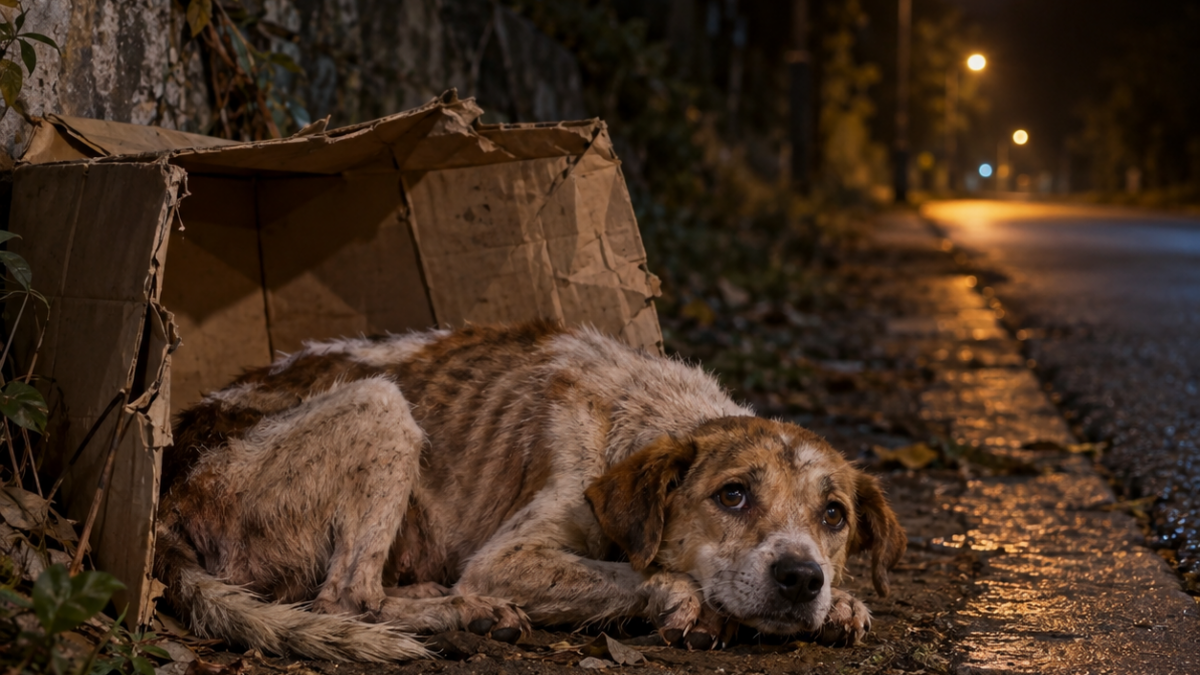
For Days, a Starving Dog Refused to Leave the Collapsed Cardboard Box Where He’d Been Abandoned—As If He Still Believed the Clinging to the Hope His Owner Would Return.
It was already eleven o’clock at night when we found the post about him, but waiting until morning felt dangerous.
A thin, terrified dog had been seen beside a lonely walkway with only a cardboard box near him, as if someone had left it there as the last thing he was allowed to call home.
The worst part was that the post was already two days old, and somehow, after all that time, he was still there waiting for a person who was never coming back.
I remember staring at my phone that night, reading the rescue notice over and over.
A weak dog.
Abandoned beside a quiet path.
Possibly injured.
No exact location.
Seen near a cardboard box.
That was all we had.
Not an address. Not a street number. Not even a clear landmark. Just a desperate post from someone who had passed through the area and noticed a dog who looked like he was slowly disappearing from the world.
Most people would have waited until morning.
It was dark. It was late. The place was unfamiliar. We did not know whether he would still be there. We did not know whether we would even find the right area.
But I kept thinking about the time stamp.
Two days.
That post had been sitting online for two days.
Two days of hunger.
Two days of fear.
Two days of cold ground, passing cars, strange footsteps, and the crushing hope that maybe the person who left him there might come back.
I could not sleep with that thought in my head.
So we went.
Rother came with me. He always came when the situation looked difficult, which meant he had seen too much and still had not learned to protect his own heart.
The person who posted the notice answered our messages and tried to guide us carefully through the dark. Turn here. Follow the narrow lane. There is a quiet path after the bend. The place is easy to miss. Hardly anyone uses it at night.
That made my stomach tighten.
PART2:
Quiet places are where abandoned animals vanish slowly.
Not because nobody cares.
Because nobody sees.
We drove with our eyes searching the edges of the road, the dirt shoulder, the weeds, the shadows near walls and bushes. Every plastic bag looked like a curled body for half a second. Every dark shape made my heart jump.
Then, under the weak beam of the headlights, we saw the cardboard box.
It had collapsed on one side.
The flaps were bent and dirty.
Beside it was an empty container where food had once been.
No water.
No shelter worth the name.
And a few feet away, pressed low to the ground, was the dog.
He was so thin it hurt to look at him.
Not just skinny.
Painfully thin.
PART3:
His ribs showed beneath his fur. His hips stood out sharply. His legs looked too fragile for the rest of him. His face had that hollow, exhausted expression animals get when they have been hungry for too long and scared for even longer.
He saw us immediately.
His body stiffened.
His eyes moved from me to Rother, then back to the road behind us.
That was when I understood.
He was not simply hiding there.
He was waiting.
He kept looking past us as if the person who had left him might still appear out of the dark. As if the box, the empty food container, and that lonely patch of ground were all part of some promise he did not understand had been broken.
I crouched down and spoke softly.
“Hey, baby. It’s okay.”
He did not believe me.
Of course he did not.
Why would he?
The last person he trusted had left him beside a box.
I took one careful step forward.
He backed away.
I stopped.
Rother moved slowly to the side, trying to block the direction of the road without making the dog feel trapped. We had done this before. Too much pressure, and a frightened dog bolts. Too little, and he disappears into the night.
I held out food.
The dog stared at it.
His nose twitched.
He was starving.
But fear was stronger than hunger.
For a few seconds, he leaned forward as if his body was about to betray him. Then he panicked and tried to run.
“Careful,” Rother said.
The dog darted toward the edge of the path, but he was too weak to move fast. His legs shook under him. Still, fear can lend strength to even the weakest body.
Rother reached to stop him from reaching the road.
The dog twisted, terrified, and in the confusion Rother got scratched and scraped hard enough to bleed.
He did not complain.
He only said, “Don’t let him get to the street.”
That was Rother.
Bleeding and still thinking about the animal first.
It took patience, food, soft voices, and more time than we wanted to lose. Every minute felt dangerous, but rushing would only make it worse.
Finally, we got a leash safely around him.
He froze.
Not surrendered.
Frozen.
There is a difference.
Surrender has some understanding in it.
Freezing is pure fear.
His body went stiff as if he had decided becoming a statue might keep him alive.
When we lifted him gently into the car, I felt how little there was of him.
Bones.
Fur.
Trembling.
A heartbeat too fast under my hands.
Once inside, something changed.
He did not relax exactly, but he became quieter. He lowered himself onto the seat and stopped fighting. He did not look at us. He only stared through the window into the darkness, back toward the place where the box had been.
As we drove away, I looked in the mirror and saw that collapsed cardboard shape disappear behind us.
I wondered how long he had stared at that same place.
How many footsteps he had heard.
How many headlights had made him lift his head.
How many times he had thought, Maybe now.
Maybe this is the person.
Maybe they came back.
But nobody came.
Not until strangers came instead.
At the veterinary clinic, he became stone again.
We carried him inside carefully, and the moment his paws touched the floor, he pressed himself into the corner of the exam room. His back touched the wall. His head lowered. His eyes stayed wide and watchful.
Every movement made him flinch.
A door closing.
A drawer sliding open.
A metal bowl touching the counter.
The veterinarian moved slowly around him. She did not crowd him. She did not force his face toward hers. She spoke in the calm voice good vets use when they understand that fear is already pain.
I sat on the floor a few feet away and held food in my hand.
For a while, he only looked at me.
Then he looked at the food.
Then back at me.
You could almost see the war inside him.
Fear said, Do not trust.
Hunger said, Please.
In the end, hunger won.
He crept forward an inch.
Then another.
His nose touched the food.
He took it so carefully, as if he expected my hand to punish him for needing it.
When nothing bad happened, he swallowed.
Then he took another bite.
Then another.
After that, the hunger took over.
He ate too fast, desperately fast, the way dogs eat when they have been forced to learn that food can disappear at any moment.
We had to slow him down.
Too much food too quickly could hurt him. A starving body needs kindness in small amounts. Recovery has to be slow, gentle, and patient, even when your heart wants to give everything at once.
The vet checked him as much as he would allow.
He was weak from hunger.
Dehydrated.
Exhausted.
His nails were overgrown. His coat was dirty. His body carried the signs of neglect, but the deeper wounds were not the kind you could see on an X-ray.
He looked like a dog who had once trusted someone completely.
That was what stayed with me.
He did not act like a street dog who had always belonged to no one.
He acted like a dog who had belonged to someone and could not understand why that belonging had ended.
Every human movement confused him.
He wanted to come closer, but his body said no.
He wanted food, but expected pain.
He wanted comfort, but did not believe comfort could last.
What kind of bond had he had with the person who left him?
Did he sleep beside their bed?
Did he wait by their door?
Did he know the sound of their keys?
Did he ride in their car believing every trip ended at home?
How does a person become the center of an animal’s world and then leave that animal beside a cardboard box?
I still do not know.
I only know that when he looked at people, there was hope and terror in the same eyes.
That combination is one of the most painful things I have ever seen.
We brought him home that night.
At first, he refused to leave his sleeping area.
We made a soft place for him with blankets. Food nearby. Water close enough that he did not have to cross the room. He curled into the smallest shape he could make and stayed there.
Days passed.
He ate.
He drank.
He slept.
But he would not explore.
He would not follow us.
He would not enter the living room.
He would not walk freely through the house.
The open space frightened him. New rooms frightened him. Doorways frightened him. Sometimes even kindness frightened him, because he did not yet know what it required from him.
So we asked for almost nothing.
That was the beginning of his healing.
Not affection.
Not training.
Not forcing trust.
Nothing.
We gave him food and let him decide how close we could be.
At first, I placed the bowl down and stepped away.
Then, after a while, I sat nearby while he ate.
Then I held a little food in my hand.
He hesitated the first time.
He stretched his neck forward as far as possible so the rest of his body could stay away from me.
When his lips touched my palm, I did not move.
He took the food.
Then retreated.
The next day, he came a little closer.
The day after that, closer still.
That became our routine.
Food by hand.
Soft voice.
No sudden reaching.
No grabbing.
No forcing him to accept love before he understood it was safe.
I wanted him to get used to my smell, my hands, my presence. I wanted him to learn that people could approach without hurting him. That a hand could bring food. That a voice could mean calm. That being near me did not mean being trapped.
Little by little, he let us into his heart.
Not all at once.
Dogs like him do not heal in dramatic movie scenes.
They heal in inches.
In one bite taken from a hand.
One nap with both eyes closed.
One moment when they hear footsteps and do not flinch.
One day when they look at you and do not immediately look for an exit.
We named him Zequinha.
A warm, affectionate little name.
A name that sounded like someone small and loved.
At first, he did not respond to it.
Then one day, when I said it softly while bringing his food, his ears moved.
Just a little.
I nearly cried.
“Zequinha,” I said again.
He looked at me.
Not long.
Not confidently.
But he looked.
That was enough.
We promised him, even if he did not understand the words, that we would do everything we could to help him forget the place where he had been left.
But forgetting is not simple.
The body remembers.
The heart remembers.
Sometimes, during quiet moments, Zequinha would stare toward the door or the window, and I could see something pass through him. A memory, maybe. A question. The old expectation that someone else might appear.
He would look outside as if searching.
That hurt every time.
Maybe some part of him still believed the person who abandoned him would come back.
Maybe loyalty does not die just because it is betrayed.
That is one of the cruelest things about dogs.
They do not stop loving the person who failed them as quickly as we wish they would.
Even after hunger.
Even after fear.
Even after a cardboard box on the side of a lonely path.
Some part of them still waits.
We bathed him after he had gained enough strength.
He stood completely still, stiff as a statue.
Not aggressive.
Not fighting.
Just terrified.
For a neglected dog, even simple care can feel strange.
Warm water.
Soap.
Hands moving over his body.
A towel.
A brush.
Nail clippers.
Things that should have been ordinary were not ordinary to him.
His nails had grown far too long. Trimming them took time and patience. He watched everything with wide eyes, trying to understand whether this was danger or care.
That is what neglect does.
It turns love into a foreign language.
You can offer tenderness, but the animal does not know how to translate it yet.
The lack of love leaves wounds that are hard to see.
But they are there.
In the way he tensed when someone moved too quickly.
In the way he ducked his head.
In the way he accepted food like he was not sure he was allowed to keep it.
In the way he seemed surprised every time kindness came twice.
Finally, one afternoon, we convinced him to step into the living room.
It took food, patience, and a ridiculous amount of encouragement.
He stood at the doorway for a long time, looking at the floor as if it might collapse beneath him.
Then he took one step.
Stopped.
Looked at me.
Took another.
His whole little body trembled.
When he reached the middle of the room, I sat on the floor and let him come to me if he wanted.
For a moment, he only stood there.
Then he walked forward and pressed his head against my knee.
Not fully.
Not with confidence.
Just enough.
I placed my hand gently on his shoulder.
He did not move away.
That was the first time I felt him choose us.
After that, he began changing faster.
He started following me from room to room, always staying close but never fully relaxed at first. If I went to the kitchen, he came to the doorway. If I sat down, he lay nearby. If I stood up suddenly, he rose too, nervous that I might leave without him.
He rarely wanted to be far from me.
At first, that made me sad.
It was not simple affection.
It was fear.
He had lost someone once and could not survive losing someone again.
So I made sure he learned the pattern of return.
I would step into another room and come back.
Go outside for a moment and come back.
Leave him with someone gentle and come back.
Every return was a lesson.
You are not being abandoned.
I am still here.
This is home.
Soon, he began to run toward me for affection.
The same dog who had tried to flee from us beside the road now came eagerly for hugs. His body, once curled inward, began to open. His tail started moving more freely. His eyes softened.
There had been a beautiful dog under all that pain.
We only had to wait long enough to meet him.
His body grew stronger.
His coat became cleaner, softer.
His hunger stopped looking like panic.
The fear in his eyes faded little by little, replaced by curiosity.
Then came the day we took him outside for a real walk.
He was still nervous.
The leash confused him. The open world overwhelmed him. A passing car made him freeze. A stranger’s footsteps made him press against my leg.
At one point, he trembled so much that I picked him up.
I carried him gently, feeling his small body shake in my arms.
And I knew what he was afraid of.
Somewhere deep inside, he still believed being carried somewhere might mean being left there.
So I held him close and whispered, “Not this time.”
I do not know whether he understood the words.
But I think he understood my arms.
I think he understood that I did not loosen my hold.
I think he understood that we went outside together and came back together.
That matters to a dog like Zequinha.
Coming back matters.
The first time he made a friend in the neighborhood, I almost could not believe it.
Another gentle dog approached slowly, tail low and friendly. Zequinha hid behind my legs at first, peeking out like a shy child. Then he sniffed the air. Then the other dog turned sideways, calm and patient.
Zequinha took one tiny step forward.
Then another.
By the end of the week, they were walking near each other.
By the end of the month, Zequinha was wagging his tail when he saw him.
That was how life returned to him.
Not in one miracle.
In pieces.
A meal.
A bath.
A trimmed nail.
A hand he could trust.
A room explored.
A walk survived.
A friend found.
A home learned.
He became part of my daily life so gradually that I almost did not notice when it happened.
At first, he was the rescued dog in the sleeping corner.
Then he was the shy dog in the living room.
Then he was the little shadow following me from room to room.
Then he was waiting near the door when I came home.
Then he was sleeping nearby while I worked.
Then he was leaning against me without trembling.
Then he was family.
That is the thing about rescue.
People often think we save animals in one big moment.
We find them.
We pick them up.
We take them away from danger.
But the real rescue happens afterward.
In the boring parts.
The repeated parts.
The patient parts.
The days when nothing dramatic happens except a frightened dog eats a little better.
The mornings when he does not flinch.
The afternoons when he walks three more steps than yesterday.
The nights when he falls asleep without watching the door.
Rescue is not only removing an animal from a bad place.
It is proving, over and over, that the bad place is not coming back.
Now Zequinha runs through the streets with confidence.
He lifts his head.
He explores.
He plays.
He meets the world like it belongs to him too.
Sometimes I still see flashes of the old fear. A loud noise can make him pause. A stranger moving too fast can make him step behind me. Certain quiet places still seem to remind him of something.
But he does not live inside that fear anymore.
That is the difference.
The dog we found beside the cardboard box was waiting for a person who had chosen not to return.
The dog beside me now knows someone always will.
He knows food will come again.
Hands can be gentle.
Rooms can be safe.
Walks can end at home.
Love can stay.
I think often about that night.
About the collapsed box.
The empty food container.
His thin body under the light.
The way he looked past us, still hoping.
I used to think the saddest part was that he waited.
Now I think the saddest part is that he had reason to.
At some point in his life, someone had taught him to trust.
Someone had been his person.
Someone had made themselves the center of his small world.
And then they left him with a box.
But they did not get the final word in his story.
That matters.
Cruelty may begin a chapter, but it does not have to end the book.
Zequinha’s life did not end on that quiet path.
It did not end beside cardboard, hunger, and the hope of someone who was not coming back.
It continued.
Slowly.
Softly.
One careful act of love at a time.
Now, when he runs toward me with bright eyes and a wagging tail, I see the life he was always meant to have.
Safe.
Loved.
Free.
Not waiting beside a box.
Not looking down an empty road.
Not wondering why he was left behind.
Just living.
Finally living.
And every time he chooses to stay close to me, I remember the night he did not want to come with us.
I remember how badly he wanted to believe his old life was coming back.
Then I look at him now, warm and strong and unafraid, and I think:
He was not refusing rescue.
He was grieving.
He was holding on to the only story he understood.
All we did was give him a new one.
A better one.
The one he deserved all along.








