Everyone Mocked Her for Trusting a Traumatized Retired K9—Until He Began Alerting to Something Beneath Their Quiet Neighborhood That No One Else Could See Coming
PART3:
Self-appointed guardian of property values, mailbox consistency, and other people’s business.
Ryan was a broad-shouldered man with a permanent squint and the habit of standing with his feet planted wide, as if every conversation were a crime scene he had already decided how to solve.
He watched Bruno limp out of my SUV and shook his head.
“What the hell is that?”
I kept my hand loose on Bruno’s leash.
“His name is Bruno.”
Ryan looked the dog up and down.
“That thing allowed here?”
“He’s a dog, Ryan.”
“He looks like a liability.”
Bruno stood beside my left leg, head low, eyes forward.
“Bruno is a retired K9,” I said.
Ryan snorted.
“A washout, you mean.”
Something hot rose in my chest.
I had been a 911 dispatcher for twelve years. I had heard men like Ryan on radio channels. Men who thought authority meant volume. Men who called every frightened person dramatic until blood made the call real.
“He served,” I said. “He earned peace.”
Ryan looked at Bruno’s scars.
“Peace is one thing. Bringing a dangerous dog into a family neighborhood is another.”
I should have walked away.
Instead, I said, “Good thing you’re not responsible for him.”
Ryan smiled without warmth.
“Not yet.”
That was our welcome to Maplewood.
The real humiliation happened two weeks later, at the Labor Day barbecue.
I should not have gone.
I know that now.
But at the time, I thought gentle socialization might help Bruno. The rescue trainer had told me controlled exposure could be useful if I kept distance, watched his signals, and left before he became overwhelmed.
So I brought him.
Heavy-duty leash.
Harness.
Plenty of space.
Exit plan.
I told myself we would stay twenty minutes.
No more.
Ryan hosted the barbecue on his sprawling driveway because he enjoyed giving orders near grilled meat. Neighbors stood around with paper plates and plastic cups, laughing too loudly, pretending not to stare at Bruno.
He stayed glued to my left side.
His head was low.
His breathing was steady but shallow.
Every burst of laughter made his ear twitch. Every child shriek made his shoulders tighten. Somewhere in the distance, fireworks popped early for the holiday weekend, and his whole body flinched.
I should have left then.
Ryan saw us and lit up.
Not with welcome.
With opportunity.
He stood with a beer in one hand and metal tongs in the other, surrounded by neighbors who always laughed a second too late at everything he said.
“Well, look at this,” he boomed. “April actually brought the dying wolf.”
A few people chuckled.
My cheeks burned.
“His name is Bruno.”
Ryan pointed the tongs at him.
“You paid money for that thing? What rescue conned you into taking their garbage?”
Bruno pressed closer to my leg.
I felt it through the leash.
His trust was fragile, and Ryan was stepping on it for sport.
“He’s a retired bomb-detection K9,” I said carefully. “He served his community.”
Ryan burst into a loud laugh.
Bruno flinched.
“A K9? Please. I know guys from the state unit. They dump the head cases when their brains get fried.”
The neighbors went quiet, but not in a way that defended us.
More like they were waiting to see how far Ryan would go.
He took another drink.
“That dog couldn’t sniff out a steak in a phone booth. He’s a broken liability.”
I tightened my grip.
“That’s enough.”
“No, people should know.” Ryan turned toward the crowd. “A dog with shell shock is a ticking time bomb. One loud noise and he’ll take a chunk out of a kid.”
Several parents pulled their children closer.
That hurt more than I expected.
Not for me.
For Bruno.
He had spent his life finding danger before it found people. Now all they saw was danger in him.
Then a car backfired on the street.
Sharp.
Sudden.
Bruno hit the pavement instantly.
Not aggressively.
Not toward anyone.
Down.
Shaking.
A high, broken whine escaped his throat as he tried to crawl under a folding table, his body flat to the concrete, eyes wide and unfocused.
My heart cracked.
I dropped to my knees beside him.
“Bruno. Hey. You’re here. You’re safe.”
Ryan laughed.
“Look at the fierce protector. A stiff breeze would give that mutt a heart attack.”
I wrapped my arms around Bruno’s trembling frame and buried my face in his coarse fur.
He smelled like rain, old scars, and fear.
Ryan’s voice came from above me.
“Keep him away from my property, April. If that dog causes trouble, I’ll have animal control haul him off as a public nuisance.”
I stood.
Slowly.
My knees were dirty. My hands shook. Bruno leaned into me, still trembling.
I looked at the neighbors.
Nobody said a word.
Not one person.
So I walked home with my damaged dog beside me and every whisper following us like thrown stones.
Franken-dog.
Crazy.
Dangerous.
Why would she bring that thing here?
Inside my house, Bruno went straight to the corner behind the couch and lay down facing the front door.
I sat on the floor several feet away.
“I don’t care what they think,” I told him.
His ear twitched.
“I know what it feels like when people decide your fear makes you useless.”
That was true.
After twelve years of emergency calls, I had left dispatch because one call would not leave me.
A child.
A fire.
A line that went dead too soon.
People praised dispatchers when everything ended well. When it did not, they forgot we heard the moment hope ran out.
After that, loud noises stayed in my body.
Sirens.
Screams on television.
Phones ringing at night.
I knew what it was to seem fine until something invisible pulled you backward.
So I understood Bruno better than Maplewood ever could.
“I won’t give up on you,” I whispered.
He did not move.
But his eyes softened.
Only a little.
Enough.
For weeks, our life became quiet routine.
Morning walks before the neighborhood fully woke.
Meals at the same time.
No sudden affection.
No forcing him onto furniture.
No guests.
At night, Bruno paced.
Sometimes he woke whining, nails clicking across the hardwood floor. Sometimes he stood in the hallway staring at nothing. Sometimes he pressed himself against the wall near the basement door and trembled until the memory passed.
I slept badly.
So did he.
But slowly, he began to choose me.
Not in obvious ways.
Bruno did not suddenly become playful. He did not fetch tennis balls or curl in my lap like a movie dog.
He followed me from room to room.
That was his love language.
If I washed dishes, he lay by the kitchen entrance.
If I folded laundry, he stood where he could watch the stairs.
If I worked at the dining table, he positioned himself between me and the front door.
He was not affectionate.
He was assigned.
And somehow, that meant more.
The shift began in late October.
The air turned sharp. Leaves collected along curbs. Halloween decorations appeared in yards, though Ryan sent a three-paragraph HOA email about acceptable pumpkin sizes and “non-garish lighting.”
Bruno’s behavior changed before I noticed the smell.
It started in the basement.
My house was a split-level with an unfinished cellar that held the washer, dryer, HVAC system, water heater, and an old shared utility access panel no one had touched since before I moved in.
One evening, I was doing laundry when I noticed Bruno standing at the top of the basement stairs.
His usual tired slump was gone.
His back was straight.
His ear pointed forward.
His nose lifted, pulling air in deep, rhythmic bursts.
“What is it, buddy?”
He did not look at me.
He came down the stairs.
No hesitation.
No limp.
He moved to the far concrete wall where the neighborhood’s old utility tunnel met the property line.
Then he sniffed along the foundation.
Back and forth.
Back and forth.
And sat.
Perfectly rigid.
Staring at the wall.
A cold prickle ran up my neck.
I knew enough about working dogs to recognize an alert.
But alert to what?
I checked the wall.
Nothing.
Dust.
Cobwebs.
Old pipes.
A faint metallic chemical smell, sharp but weak enough that I told myself it was the water heater or aging electrical insulation.
“False alarm?” I asked.
Bruno did not blink.
I guided him upstairs.
He resisted.
Not aggressively.
Insistently.
That bothered me more.
Two days later, my next-door neighbor Armando Coleman knocked on my door.
Armando was beloved in Maplewood.
Fifty-something.
Widower.
Electrical engineer.
Soft voice.
Hand-knit sweaters.
Always carrying cookies or offering to repair someone’s appliance for free. He was the kind of man people described as harmless because he knew how to perform harmlessness perfectly.
He stood on my porch holding a plate of snickerdoodles.
“April, dear,” he said warmly, “I noticed your outdoor security light flickering last night. These old houses can be a nightmare with wiring. I’d be happy to take a look at your breaker box.”
Before I could answer, Bruno pushed between my legs.
He did not bark.
He growled.
Low.
Deep.
Vibrating through the doorframe.
His hackles lifted in a jagged ridge along his spine. His lips pulled back from his teeth. His amber eyes locked on Armando’s face.
Armando stepped back.
Only one step.
His smile faltered.
Then returned.
Not all the way.
“Well,” he said lightly, “someone is certainly protective today.”
“He’s never done this before,” I said, pulling Bruno back by the collar.
Bruno resisted, paws planted, eyes fixed on Armando.
Armando looked at him, then at me.
“You really should be careful. Ryan was saying he’s unpredictable.”
The words were gentle.
The warning beneath them was not.
“I’ll call an electrician,” I said. “Thank you for the cookies.”
I closed the door.
My heart hammered.
The moment the door shut, Bruno stopped growling and ran to the floor vent in the living room. He shoved his nose against the metal grate and inhaled sharply, then whined.
Not fear.
Urgency.
By the end of the week, Bruno was waking at exactly 3:00 a.m. every night.
Scratching at the basement door.
If I let him down, he ran straight to the same foundation wall, sniffed frantically, then snapped into his rigid seated alert.
Every time.
The smell grew stronger.
Ammonia-sharp.
Burnt plastic.
Something chemical.
Something wrong.
Sleep deprivation does ugly things to the mind.
So does isolation.
By Friday morning, I made the mistake of mentioning it to Ryan at the mailboxes.
He cornered me before I could escape.
“You look rough, April.”
“Thanks, Ryan.”
“Dog keeping you up?”
I should have walked away.
Instead, I told him.
Not everything.
Just enough.
The smell.
The basement.
Bruno’s alerts.
Ryan stared at me for three seconds.
Then laughed.
“Are you seriously taking tactical advice from a brain-damaged mutt?”
My face went hot.
“I’m saying something is wrong.”
“It’s a dead rat,” he said. “Or sewage. Or your dog hallucinating because his brain is fried.”
“He’s trained to detect things we can’t.”
“He’s trained to be put down,” Ryan snapped, stepping closer. “Armando told me how aggressive that beast was when he tried to help you. Armando Coleman is the sweetest man in this zip code.”
“He growled for a reason.”
“Yeah. Because he’s unstable. If that dog shows his teeth to another resident, I’ll sign the mandate myself and have animal control remove him.”
The mailbox key bit into my palm.
Ryan leaned closer.
“Get him evaluated, April. Or I’ll do it for you.”
I walked home feeling smaller with every step.
By the time I reached my kitchen, doubt had opened inside me like a sinkhole.
What if Ryan was right?
What if Bruno was deteriorating?
What if trauma had turned his training into confusion?
What if I was clinging to the idea of saving him because I needed to believe broken things could still matter?
I sat on the kitchen floor and buried my hands in my hair.
Bruno walked in.
He did not ask for attention.
He did not whine.
He went straight to the central air return.
Pressed his nose to the grate.
Inhaled.
Then everything changed.
He began barking.
Not the fearful, broken sound from his nightmares.
Not panic.
Command.
A hard, concussive, relentless bark that shook the windows.
He pawed at the grate, scraping metal, every line of his body locked onto the target.
My doubt shattered.
I stood.
The smell hit me then.
Thick.
Acrid.
Wrong.
It was coming up from the basement.
And it was not a dead rat.
I grabbed my phone, a heavy flashlight, and a crowbar.
“Stay, Bruno,” I said.
He stopped barking, but he did not move from the vent.
His eyes tracked me.
I went down the stairs.
The smell was worse below.
It burned my throat and made my eyes water. The air felt dirty, charged, metallic.
At the far wall, the old utility access grate sat bolted into concrete. Maplewood’s houses on this side of the cul-de-sac were connected by a narrow service trench built decades earlier for shared lines and utility access.
No one used it.
No one talked about it.
I wedged the crowbar behind the rusted bolts and threw my weight into it.
The first bolt screamed loose.
Then the second.
The steel grate dropped forward and hit the concrete floor with a crash that made me freeze.
Silence.
I held my breath.
Nothing.
I clicked on the flashlight and aimed it into the tunnel.
Dark.
Low.
Barely three feet high.
Pipes ran along both sides. The chemical smell rolled out of the opening like breath from something alive.
I should have called 911 right then.
But dispatch had trained something terrible into me: the need to know exactly what emergency I was reporting.
I crawled in.
The concrete scraped my elbows through my sleeves. Pipes pressed close on either side. My flashlight beam shook as I pulled myself forward, inch by inch, following the smell.
Fifty feet down, the tunnel ended at another grate.
Armando’s basement.
Light flickered through the slats.
I shut off my flashlight before it could give me away and pressed my face close to the cold metal.
What I saw turned my blood to ice.
Armando’s basement was not a friendly neighbor’s workshop.
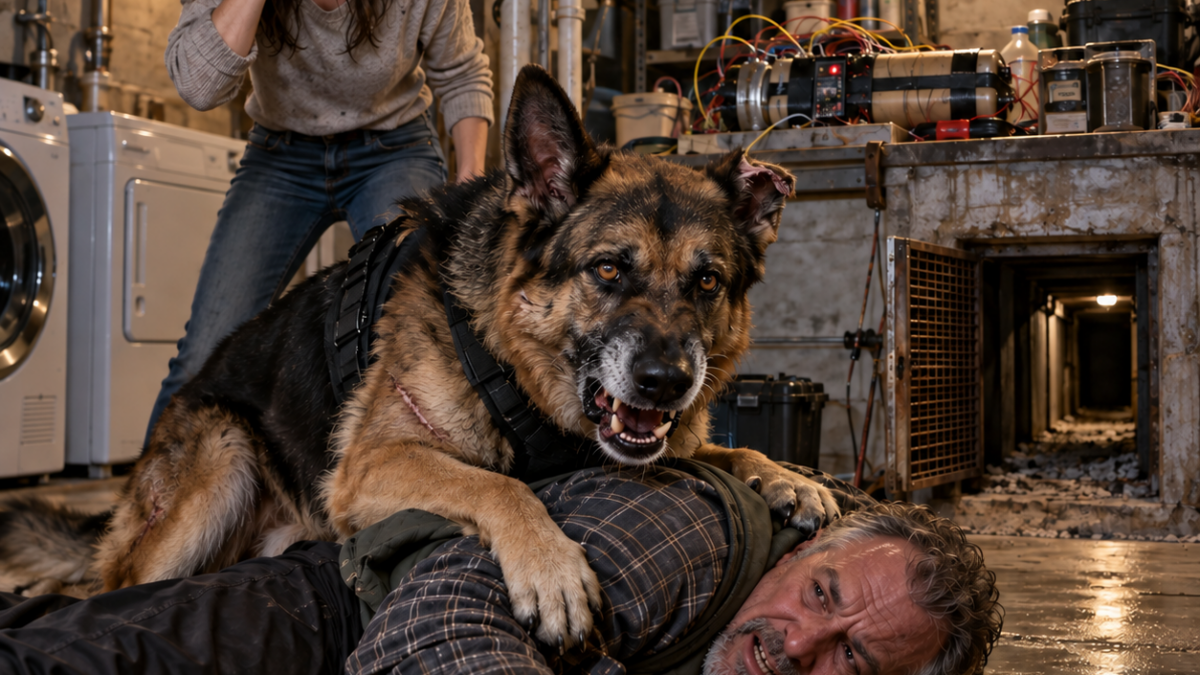
It was a hidden bomb-making lab.
Metal shelves lined the walls, stacked with containers marked by agricultural and industrial warning labels. Workbenches held wiring, tools, sealed chemical bottles, protective gear, and partially assembled components arranged with obsessive precision.
In the center of the room sat a large metal drum strapped to a hand truck.
Wired.
Prepared.
Connected to a timing mechanism.
Armando Coleman, the sweet cookie-baking engineer everyone trusted, sat at the bench calmly working on the final connection.
He was not fixing appliances.
He was building an improvised explosive device large enough to turn Maplewood Drive into a crater.
For one second, my brain refused to accept it.
Armando.
Warm sweaters.
Snickerdoodles.
Free repairs.
The man who waved at kids from his porch.
Then my flashlight slipped from my sweaty fingers.
It hit the concrete tunnel floor with a sharp clang.
Armando froze.
Slowly, he lowered the tool in his hand.
His head turned toward the utility grate.
The friendly expression drained from his face.
In its place was something cold.
Empty.
Real.
“April?” he called.
His voice echoed through the tunnel.
“You really shouldn’t be snooping, dear.”
Panic seized me.
I scrambled backward, elbows and knees scraping raw against concrete.
Behind me, metal screeched.
Armando was unbolting his side of the grate.
“I tried to warn you,” he called, voice calm and awful. “I tried to get inside your basement, but that wretched dog ruined my timeline.”
I moved faster.
Pain shot through my knees.
My shoulder hit a pipe.
I kept going.
“And now,” Armando said, “you’ve ruined yours.”
I tumbled out of the tunnel onto my basement floor, gasping.
I grabbed the heavy grate and tried to lift it back into place, but my hands shook too hard and the angle was wrong.
A flashlight beam cut through the tunnel.
Armando was coming.
When he pulled himself into my basement, he carried a heavy pipe wrench in one hand.
His face was calm.
That terrified me more than rage would have.
“There’s no point running,” he said.
I backed away, gripping the crowbar.
“What are you doing?”
He smiled.
The grandfather mask was gone.
“Correcting an imbalance.”
“You’re insane.”
“No. I am simply tired of small people and their small rules. Ryan and his little kingdom. These houses. These routines. These suffocating, perfectly manicured lives.”
“You were going to kill them.”
“I was going to make a statement.”
“There are children here.”
He tilted his head.
“Collateral has always been the cost of meaningful correction.”
My back hit the washing machine.
There was nowhere else to go.
Armando lifted the wrench.
I raised the crowbar with both hands, but I knew the truth.
I was outmatched.
Before he could swing, a roar ripped through the basement.
Not a bark.
A roar.
Bruno launched down the final stairs like the past ten years had fallen off his body.
No limp.
No hesitation.
No fear.
Eighty-five pounds of scarred German Shepherd hit Armando in the chest with the force of a freight train.
The wrench skittered across the floor.
Armando crashed backward, screaming as Bruno pinned him and locked his jaws onto the man’s right forearm.
Not wild.
Not random.
Controlled.
Tactical.
Dominant hand pinned.
Threat immobilized.
Armando thrashed, punching Bruno’s head with his free hand.
“Get this monster off me!”
Bruno took every blow.
His damaged ear flattened.
Blood appeared near his muzzle.
His grip did not break.
He was holding the line.
“Hold him, Bruno!” I shouted. “Hold!”
My dispatcher brain snapped back online.
I grabbed my phone and called 911.
The moment the operator answered, my voice changed.
“This is former dispatcher April Flores, badge number 409. Priority one emergency at 42 Maplewood Drive. Suspect detained by canine. Immediate SWAT and bomb squad required. Possible active improvised explosive device in adjacent structure, 44 Maplewood. Timer may be active. Evacuate the cul-de-sac. Send everyone.”
The operator did not question my tone.
Good dispatchers know when another dispatcher is speaking from the edge of catastrophe.
Armando realized the plot was unraveling.
With a surge of manic strength, he reached toward his pocket.
A folding knife flashed open.
“Bruno, out!” I screamed.
But Bruno refused to release.
Armando drove the blade toward Bruno’s side.
I swung the crowbar.
It connected with Armando’s wrist with a sickening crack.
The knife clattered across the floor.
Armando howled and collapsed back against the concrete.
Bruno stood over him, panting heavily, blood dripping from his snout, amber eyes locked on the defeated man.
Four minutes later, sirens tore through Maplewood Drive.
Red and blue lights flooded my living room.
Tactical officers stormed the house.
When they reached the basement, weapons drawn, they found Armando on the floor, Bruno holding position over him, and me standing nearby with a crowbar in shaking hands.
An older sergeant lowered his weapon slightly when he saw Bruno’s hold.
“Well, I’ll be damned,” he whispered. “Good boy.”
Bruno did not look away from Armando.
Not until I touched his shoulder.
“Bruno,” I said softly. “Stand down.”
He released and stepped back.
Only then did his limp return.
Only then did he look old again.
I dropped to my knees beside him and wrapped my arms around his neck.
“You did it,” I whispered into his fur. “You were right. You were right the whole time.”
The next several hours became a blur of evacuation orders, bomb squad trucks, FBI agents, floodlights, caution tape, and neighbors standing in the street in pajamas, clutching children and pets while armored vehicles filled our perfect little cul-de-sac.
Ryan stood across the street.
Pale.
Silent.
For once in his life, he had nothing to say.
Bomb technicians in heavy protective suits entered Armando’s house.
They came out later with evidence sealed, photographed, secured, and transported by specialists. I did not see everything, and I did not want to. I saw enough in the tunnel to know how close we had come.
An FBI agent found me sitting on the tailgate of an ambulance.
A paramedic was cleaning the cuts on Bruno’s head.
He tolerated it with the exhausted dignity of a veteran who had done his job and now found medical attention annoying.
“Ms. Flores,” the agent said, “your dog detected chemical precursors through a sealed utility tunnel.”
I looked down at Bruno.
His head rested against my knee.
The agent shook his head.
“The primary device was set for tomorrow morning.”
My stomach turned.
Tomorrow morning was the HOA meeting.
Ryan’s meeting.
Half the neighborhood would have been gathered at the clubhouse. Children would have been waiting for parents. Houses would have been occupied. People would have been drinking coffee, complaining about leaf pickup, and arguing about fence colors.
If Bruno had not alerted…
The agent’s face said the rest.
“If it had gone off,” he said quietly, “this entire block would have been gone.”
I closed my eyes.
Bruno pressed his head harder against my knee.
The sun began to rise over Maplewood Drive.
Golden light touched police tape, wet lawns, armored vehicles, and the stunned faces of people who had gone to sleep believing danger looked like my dog.
Ryan approached slowly.
No swagger.
No booming voice.
No tongs.
No audience.
He stopped several feet away and removed his baseball cap.
His eyes were wet.
He looked at Bruno first.
Then at me.
“I was a fool,” he said.
I did not answer.
“I am sorry, April.”
Bruno did not growl.
He barely lifted his head.
Ryan swallowed hard.
“He saved my family.”
His voice broke.
“He saved all of us.”
I looked at him for a long moment.
Part of me wanted to be cruel.
I had earned it.
I wanted to remind him of every word.
Broken liability.
Ticking time bomb.
Brain-damaged mutt.
Trained to be put down.
But Bruno leaned against me, warm and alive, and somehow his exhaustion made revenge feel too small.
“He isn’t broken, Ryan,” I said. “He just needed someone to listen.”
Ryan nodded.
Tears slipped down his face.
For the first time since I had known him, he looked less like a tyrant and more like a man who understood shame.
Armando Coleman was arrested that morning.
Later, federal investigators would uncover files, plans, writings, and timelines that made it clear the attack had been months in preparation. His cheerful neighbor routine had been cover. His offers to fix appliances had been reconnaissance. His visit to my house had not been kindness. He had wanted access to my basement because Bruno had disrupted his plan.
Bruno had seen through him before any of us.
Or smelled through him.
Maybe both.
The news called Bruno a hero.
Maplewood called him a miracle.
People who had crossed the street to avoid us suddenly brought treats, cards, blankets, and apologies. Parents asked if their children could meet him. Ryan proposed a neighborhood commendation, which I declined before he finished the sentence.
Bruno did not need a ceremony.
He needed peace.
The strangest change came after the attack.
The night terrors stopped.
Not immediately in the dramatic way people prefer stories to work.
But gradually.
The pacing faded.
The whining became rare.
He slept longer.
Deeper.
For the first time, he stretched out in the sun patch on my living room floor and slept with all four paws twitching as if running through a dream that no longer terrified him.
The trainer said completing a meaningful task may have helped him integrate something.
The vet said reduced stress and consistent safety probably mattered.
The FBI agent said Bruno had one final mission in him.
I do not know which answer is correct.
Maybe all of them.
What I know is this:
After saving Maplewood, Bruno finally stopped acting like the war was still waiting in every shadow.
Sometimes, in the evening, I would sit on the floor beside him.
He still did not cuddle.
Not exactly.
But he allowed his shoulder to rest against my leg.
For Bruno, that was a love letter.
One afternoon, several months later, Ryan came by.
He stood on the porch holding a small brass plaque.
I almost shut the door.
Then I looked at Bruno.
He seemed unconcerned, so I let Ryan speak.
“I know you said no ceremony,” he said quickly. “And I’m not here to make one happen.”
“Good.”
He winced.
“I deserved that.”
“Yes.”
He held out the plaque.
It read:
BRUNO
Guardian of Maplewood Drive
I stared at it.
Ryan cleared his throat.
“I thought maybe by the community mailbox. Or wherever you think appropriate. Only if you approve.”
Bruno came to the doorway then.
Ryan took one careful step back.
Not out of disgust this time.
Out of respect.
Bruno sniffed the air.
Then sat.
Calm.
Ryan’s eyes filled again.
“I was wrong about you, old man,” he whispered.
Bruno blinked slowly.
That was all the forgiveness Ryan got.
It was probably more than he deserved.
We placed the plaque near the entrance to the walking path, beneath a maple tree where morning light came through the leaves.
No ceremony.
Just me, Ryan, three neighbors, and Bruno standing beside me.
By then, the entire neighborhood had changed.
Not perfectly.
People do not become better just because disaster embarrasses them.
But something had shifted.
They watched their words more carefully.
They stopped treating appearances like truth.
They stopped assuming danger always looked scarred, limping, and visibly wounded.
They stopped assuming kindness always wore a sweater and carried cookies.
That may have been Bruno’s second rescue.
The first was saving their lives.
The second was forcing them to see.
Bruno lived three more years.
Good years.
Quiet years.
He grew slower.
Grayer.
His hearing faded almost completely.
His limp deepened.
But he slept in sun patches.
He took short walks at dawn.
He allowed three neighborhood children — only the calm ones — to toss treats gently onto the grass for him.
He never became a playful dog.
He never fetched.
Never chased squirrels.
Never learned to enjoy thunderstorms.
But he learned my house was safe.
He learned I came back when I left.
He learned the basement door no longer meant danger.
He learned that not every sound was a warning.
And I learned from him too.
I learned that broken is often a word people use when they do not want to understand repair.
I learned that trauma does not erase training, loyalty, intelligence, or worth.
I learned that fear can live beside courage inside the same body.
I learned that sometimes the one everyone calls damaged is the only one still paying attention.
On Bruno’s last morning, sunlight filled the living room.
He lay in his favorite patch, head on his paws, breathing slowly.
I sat beside him with one hand resting on his shoulder.
His amber eyes opened when I whispered his name.
“Bruno.”
His tail moved once.
Just once.
That was enough.
“You did good,” I said.
His eyes softened.
I do not know if dogs understand every word.
I know they understand tone.
And Bruno knew love when it finally learned to speak gently.
After he was gone, Maplewood Drive felt different.
Too quiet.
Too exposed.
For weeks, I still woke at 3:00 a.m., listening for nails against the floor.
There were none.
Ryan stopped by one morning and found me by the plaque.
He did not say much.
Good.
Some grief does not want language.
He just stood beside me for a while.
Then he said, “We never deserved him.”
I looked at the brass plaque beneath the maple tree.
“No,” I said. “But he saved you anyway.”
That was Bruno.
Scarred.
Mocked.
Partially deaf.
Afraid of backfires and fireworks.
Still a K9.
Still a guardian.
Still the one who knew danger was coming when everyone else laughed.
People ask me if Bruno had a sixth sense.
I tell them no.
Not the way they mean.
He had training.
He had memory.
He had instincts sharpened by years of work most of us cannot imagine.
And he had one person who believed him when the world called him broken.
Maybe that is the lesson.
Not that animals are magic.
That trust is.
Bruno did not need the neighborhood to understand him.
He needed one person to listen.
And because I finally did, he saved every person who had mocked him.
Including me.
Because before Bruno, I thought I had adopted a dog nobody wanted.
But the truth is, he found the part of me nobody had listened to either.
The part that still trusted warning signs.
The part that knew fear did not make me weak.
The part that needed proof that wounded things could still have purpose.
Bruno gave me that proof.
And every morning, when the sun hits the living room floor where he used to sleep, I still look there first.
Not because I expect to see him.
But because some guardians never really leave their post.








