Every Time a Family Stopped at His Kennel, This Shelter Pit Bull Turned to Face the Wall—Until One Volunteer Finally Understood the Heartbreaking Reason He Couldn’t Bear to Hope Again
PART3:
And people do not like being rejected by a dog they came to rescue.
By the time the twelfth family walked away from Winston’s kennel, his name had developed a weight in staff conversations.
“Another no on Winston.”
“They liked him until he turned around.”
“The dad said he wanted a dog that wanted them.”
“He’s not helping himself.”
That last phrase made something in me tighten every time.
He’s not helping himself.
As if survival had a customer-service requirement.
As if wounded creatures owed us recognizable hope.
As if a dog had to present pain correctly before people would believe it.
I started staying late to watch him.
At first, I told myself it was professional concern. Behavior notes. Adoption strategy. Enrichment planning. All the tidy phrases that make worry sound useful.
But the truth was simpler.
Winston bothered me.
Not because he frustrated me.
Because some part of me knew we were missing something, and every day we missed it, people judged him for the wrong wound.
One Tuesday night, after everyone left, I sat in the cramped staff office with a paper cup of stale coffee and the camera feeds open across two grainy monitors. Winston’s kennel was on the far row near the dog meet-and-greet room, not the best spot, not the worst. I scrubbed through the daytime footage first.
Family after family appeared in sped-up silence.
A girl in pink sneakers crouched near his gate.
Winston turned away.
A retired couple paused longer than most.
Winston turned away.
A father lifted his toddler to wave.
Winston turned away.
Nothing new.
I exhaled, rubbed my eyes, and clicked forward to the overnight recording.
10:42 p.m.
At first, I thought I had opened the wrong kennel.
Winston was moving.
Not pacing. Not circling with that tight, brittle repetition of a dog unraveling. He was moving with ordinary ease. Loose shoulders. Soft face. A wag low and casual behind him.
He picked up a rope toy and tossed it once, badly, then pounced on it with a clumsy sideways hop that looked almost young. He carried the toy to the front of the kennel and dropped it near the bars closest to the neighboring run, where an old hound mix named Mort lifted his head and thumped his tail twice.
Winston wagged back.
I leaned closer to the monitor.
At 11:03, he rolled onto one hip and chewed lazily on a rubber bone.
At 11:17, a volunteer doing final rounds passed with a mop bucket, and Winston stood, stretched, and trotted to the front of the kennel, tail swinging.
At 11:44, he pressed his shoulder companionably against the bars nearest Mort and stood there for almost a minute, just breathing beside another living thing.
No wall.
No withdrawal.
No coldness.
No sign of the dog visitors described during the day.
I replayed it.
Then again.
The details made it stranger.
Winston was normal when no one wanted anything from him.
More than normal.
There was a goofy dignity to him, a quiet pleasure in his own body, a softness that disappeared every morning as soon as the public arrived.
At 12:12 a.m., he wagged at his own reflection in the kennel glass.
I sat back slowly.
“Okay,” I whispered to the empty office. “So what are you doing?”
The next day, I changed nothing.
That mattered.
If you suspect a frightened animal is hiding a pattern, you do not rush toward it with a theory in your hands. You do not announce to the whole staff that you solved him. You watch. You become less interesting. You let the truth come toward you at its own speed.
So I watched.
At 9:04 a.m., before opening, Winston greeted me at the front of the kennel and accepted a biscuit from my hand. His tail moved once, twice, then settled. I crouched, spoke softly, and he held eye contact longer than usual.
Not affectionate exactly.
Open.
At 9:58, the first family entered the dog wing.
Winston heard their voices before he saw them. I could tell from the way his ears shifted. Then his posture changed. Not dramatically. That was the part people missed. It was a tightening through his shoulders. His tail went still. His eyes stopped resting anywhere.
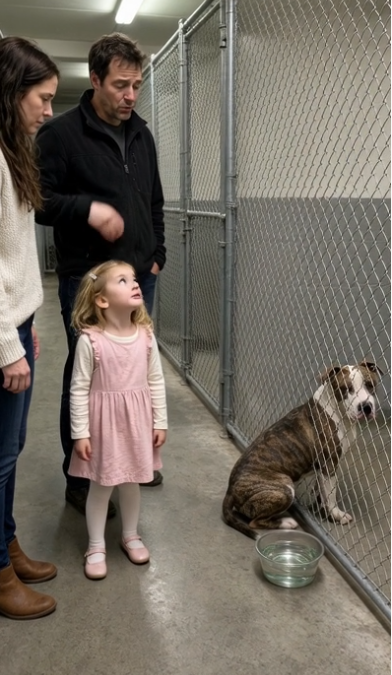
By the time the family reached his kennel and smiled, he had already turned and walked to the back wall.
The little boy asked if the dog was in timeout.
His mother laughed apologetically and led him away.
At 10:31, the same thing happened again.
And again.
Voices.
Attention.
Stillness.
Turn away.
It was not dislike.
It was anticipation.
That difference took me another day to admit.
On Thursday afternoon, I pulled Winston’s paper file from the intake cabinet. Shelters, like people, often reduce pain to forms because forms are easier to stack than grief.
Name, if known.
Approximate age.
Medical notes.
Vaccination status.
Surrender history.
I stopped there.
Surrender history.
Winston had not simply been found abandoned once, as his abbreviated public card suggested. He had been through the system before.
Not once.
Three times.
First adoption from a city shelter at around eight months old.
Returned after eleven days.
Reason: Too clingy. Whines when left alone.
Second adoption, six months later.
Returned after three weeks.
Reason: Not a good match for our lifestyle.
Third adoption through a breed rescue at age two.
Returned after four days.
Reason: Won’t settle. Doesn’t seem happy here.
Then the final note, handwritten in different ink, quick and irritated.
Owner dropped dog at boarding facility and never came back. Facility contacted animal control after nine days.
I stared at the page until the words blurred.
Too clingy.
Not a good match.
Won’t settle.
Doesn’t seem happy.
Ordinary phrases.
That made them worse.
Each one smoothed over a rupture. Each one turned rejection into logistics. But the timeline told its own story.
Winston had not failed one home.
He had survived being chosen, renamed, handled, hoped over, photographed, introduced, corrected, and then returned. Again and again. Until the act of being noticed probably stopped feeling like rescue.
It felt like the beginning of being left.
That evening, I carried his dinner down the aisle myself.
Winston came forward at once, tail low but wagging.
“Hey, buddy,” I murmured.
I set the bowl down. He nudged my wrist with his nose, briefly, then ate with the tidy seriousness of dogs who had learned not to trust abundance too quickly.
I stayed crouched outside the kennel longer than necessary.
“You don’t hate people,” I said quietly.
Winston glanced up.
“You hate what happens after they pick you.”
He went back to eating.
There was no movie-perfect revelation. No sudden soulful stare. No dramatic shift in the lights. But I felt that rare click shelter workers live for—the moment behavior stops looking inconvenient and starts looking like language.
The next week, I stopped introducing Winston as shy.
I stopped calling him stubborn.
I stopped apologizing for him.
Instead, I changed his kennel card.
Nothing dramatic.
No melodrama.
Just truth in a form the public could handle.
Winston takes time to trust. He may turn away at first. Please don’t mistake that for indifference.
It helped a little.
Not enough.
People still preferred easier dogs. The yellow Lab mix who leaned his whole body into the kennel gate. The beagle who spun in circles. The shepherd puppy whose paws looked too big for his body. The tiny terrier who screamed at everyone equally, which at least made people laugh.
Winston remained the dog who turned his back when hope arrived.
That is not a story most adopters know how to enter.
So I did the next thing modern shelters do when reality resists neat outcomes.
I posted him.
Not a sales pitch.
A confession.
I wrote about the wall.
About the night footage.
About a dog who seemed to protect himself by refusing to be chosen at all.
I did not use sad music or dramatic filters. I posted a split video instead.
Winston at night, tossing a toy, wagging softly at Mort, leaning against the bars like a dog who wanted connection.
Winston during the day, hearing footsteps, seeing smiling visitors, then slowly turning his whole body toward the cinder-block wall.
I wrote one line beneath it:
Some dogs don’t turn away because they don’t want love. Some turn away because they have learned what happens after they start wanting it.
By morning, the video had gone viral.
The internet did what the internet always does.
It turned pain into debate.
Some called him broken.
Some called him dramatic.
Some called him manipulative, which is what people often say when suffering behaves inconveniently.
A few insisted a dog like that should be grateful for any attention, which told me they understood neither dogs nor gratitude.
But threaded through the noise were quieter comments, mostly from women, mostly written late at night.
I used to do this as a kid.
I stopped unpacking my bag at new foster homes.
I would pretend I didn’t care first.
If you don’t reach for love, it hurts less when it leaves.
I read them all.
I should not have.
But I did.
One comment came from a woman named Mara Ellison.
She did not write much.
Just this:
I know exactly why he turns away. Please tell me if he’s still there.
Mara came to the shelter on a Tuesday afternoon in a denim jacket, scuffed brown boots, and no visible expectation that the world owed her a happy ending.
She was thirty-nine, fine-boned, with light brown hair pulled into a low knot that had started slipping loose by the time I met her in the lobby. She had the kind of face life teaches to check rooms before trusting them. Her eyes moved carefully over exits, doorways, other people’s moods.
Not nervous.
Practiced.
I had seen that before.
Not just in dogs.
In adults who apologize when furniture bumps into them.
“You’re Mara?” I asked.
She nodded and handed me a folded printout of Winston’s post, though there was no need.
“I saw the video at one in the morning,” she said. “Couldn’t stop thinking about him.”
I offered the polished shelter version first. Habit is hard to kill.
“I should tell you, he may not engage. He tends to—”
“Turn away,” Mara said.
Not impatiently.
Just like someone finishing a sentence she understood from the inside.
I led her down the kennel aisle anyway, talking softly as we walked. Winston lay near the front of his run when we approached. He lifted his head at my voice, then saw the unfamiliar woman beside me.
I felt it happen in real time.
That inward shift.
The tail stilling.
The slight lift of his chin.
Then Winston stood, turned, and faced the back wall.
Mara stopped two kennels short.
Most visitors reacted to that moment with embarrassment or determination. They cooed louder. Knelt lower. Said his name over and over, as if affection could be forced through repetition.
Mara did none of that.
She looked at Winston’s back for a long quiet second, and the expression on her face was so unguarded that I instinctively stepped away, as if I had accidentally opened a door into a private room.
“That’s exactly it,” she said.
I kept my voice gentle.
“Exactly what?”
Mara reached up and tucked a loose strand of hair behind her ear. Her fingers shook once, then steadied.
“When I was a kid,” she said, still looking at Winston, “my mother had a way of leaving that always sounded temporary until it wasn’t. A weekend with an aunt. A few days with a neighbor. A month with family friends.”
She swallowed.
“After a while, I stopped waving goodbye. Then I stopped unpacking. Then I stopped making eye contact when people said things like, ‘Let’s see if this works out.’”
I said nothing.
Mara gave a small breath of laughter with no humor in it.
“You learn weird tricks to survive being returnable.”
Winston did not move.
But one ear twitched.
That was all.
It was enough.
I unlocked the visitation room and asked if Mara wanted to try meeting him there. Most adopters said yes immediately. Neutral space. Less kennel stress. A chance for the dog to loosen up and show better.
Mara surprised me.
“No,” she said. “Not yet.”
She walked to the end of Winston’s kennel, lowered herself onto the concrete floor outside it, and sat with her back to him.
Not angled.
Not half-turned.
Fully turned away.
The whole aisle seemed to hold its breath.
I stood two runs down with a clipboard I was no longer pretending to read, feeling something careful and primitive move through me. The gesture was so exact it bordered on unbearable.
Mara rested her forearms on her knees and spoke toward the opposite wall.
“I’m not going to make you look at me,” she said. “I know that trick too.”
Winston stayed facing the cinder block.
Mara nodded once, as if she had expected that.
“I used to do it in foster homes. If I didn’t seem excited, maybe it wouldn’t hurt when they changed their minds. Or when I did.”
The shelter was not silent. Somewhere near intake, a terrier complained about existence in general. A staff member rolled a laundry cart past the clinic door. Phones rang up front.
But in that narrow slice of aisle, the air changed.
I watched Winston’s breathing.
It slowed.
Mara kept talking, not in a performance voice, not in the bright emotional register people use when they want healing to happen on cue. She sounded tired. Honest. Like someone sitting on a porch too late at night with no reason left to polish the truth.
“I’m not going to tell you I’m different,” she said. “You don’t know me. You shouldn’t have to trust me because I showed up once. But I can sit here. I can do that.”
Winston’s head lowered half an inch.
His back remained turned.
Minutes passed.
After twenty minutes, I approached with a folding chair.
Mara shook her head without turning.
“If I get comfortable, he’ll think I’m temporary.”
I went back to the desk and pretended to handle emails while keeping Winston’s kennel in view the entire time.
Thirty-seven minutes in, Winston looked over his shoulder.
Just once.
A quick glance.
Then he turned back again.
Mara did not react.
That mattered.
At fifty-two minutes, Winston stood and walked a small circle inside the kennel. He did not come forward. He did not return to the wall either. He simply stood sideways, uncertain, caught between habit and curiosity.
I texted the shelter manager from three rooms away.
He’s moving. Don’t come down here.
At one hour and eleven minutes, Mara shifted because her foot had gone numb.
Winston froze.
Mara immediately stilled again and murmured, “Sorry.”
No baby talk.
No pleading.
Just respect.
At one hour and forty-three minutes, Winston came to the front bars.
Not to Mara’s hand.
To her back.
He stood there breathing, close enough that the fabric of her denim jacket stirred with each exhale. Mara did not turn. Her shoulders tightened, then softened.
“I know,” she whispered.
Winston sniffed once at the seam near her shoulder blade.
Then again.
And then, with the gravity of something much larger than the motion itself, he touched his nose to the center of her back.
I had seen dogs survive surgery, neglect, storms, euthanasia lists, transport chaos, and returns that gutted whole staff meetings. I had watched reunions and breakdowns and every kind of desperate human promise.
But that tiny contact—one dog choosing to break his own ritual of refusal—was one of the purest acts of courage I had ever witnessed.
Mara closed her eyes.
Not crying yet.
Just receiving.
“I know,” she whispered again, but now her voice was gone at the edges.
It took another ten minutes before she turned slowly enough not to spook him.
Winston did not retreat.
He stood there, head slightly lowered, tail still, not offering joy exactly but offering access.
Mara rested the backs of her fingers near the kennel bars and let him decide the rest.
He sniffed her hand.
Pressed once into it.
Then leaned the whole hard, warm shape of his head against her knuckles like a door giving way.
I had to walk to the supply room for a full minute because suddenly the aisle was too bright and my face had become impossible.
When I came back, Mara was still on the floor.
Winston was still there.
By the end of the afternoon, adoption paperwork sat on my desk.
The shelter manager asked every practical question.
Rental?
Fenced yard?
Vet reference?
Work hours?
Experience with large dogs?
Support system?
Mara answered cleanly, almost absently, because something more important had already happened in the aisle. She was not careless. She had thought things through. She lived alone above a florist shop, worked mostly from home as a copy editor, walked daily, and had already spoken with her landlord before coming.
I asked one final question I did not ask most adopters.
“If he turns away again at home,” I said carefully, “what will you do?”
Mara signed the last page and looked up.
“I won’t take it personally,” she said. “And I won’t leave because he needed a wall that day.”
Winston went home before sunset.
There was no magical final shot of him bounding into the car like the shelter had finally become a bad dream. He hesitated at the front door. Stopped halfway to the parking lot. Looked once over his shoulder at the building that had held him and disappointed him less than homes had.
Mara did not tug the leash.
She stood beside him, facing the same direction he did, until he chose to move.
That was how they began.
Not with triumph.
With patience.
With two creatures who understood that love is often most truthful in the moment it refuses to rush.
For the first week, Winston slept facing Mara’s apartment door.
Not near it.
Facing it.
That detail told her more than anything else.
At night, he lay on the living room rug with his body angled toward the exit, eyes half-open, as if he expected the room itself might decide against him while he slept.
During the day, he learned the shape of her routines.
Coffee at 6:10.
Work calls at the kitchen table.
Laundry on Thursdays.
Soup on Sundays.
No shouting.
No sudden hands.
No one arriving to “see how it goes.”
Mara’s apartment was small but quiet, a second-floor unit above a florist shop at the edge of downtown. It had old hardwood floors, too many books, and windows that turned late afternoon light soft and forgiving. She did not overwhelm Winston with toys, commands, or dramatic promises about forever.
She gave him structure instead.
Meals at regular times.
Walks before traffic thickened.
A blanket in the corner by the radiator.
A crate with the door left open, never latched.
Choice everywhere choice could be offered.
He still turned away sometimes.
That was the part people online would not have liked.
They prefer the version where a wounded dog meets the right person and immediately understands safety. Real trust is slower. Less photogenic. Less useful for a caption.
There were mornings Winston refused eye contact if Mara moved too quickly toward the leash. Evenings when she came home from work and found him not destructive, not panicked, not loud—just sitting beside the entry table with his face toward the wall, as if something in the day had brushed against an old bruise.
When that happened, Mara did exactly what she had promised.
She did not take it personally.
Sometimes she sat on the floor six feet away and read aloud from whatever novel she was editing, not to soothe him exactly, but to fill the room with a human presence that did not demand anything.
Sometimes she cooked while he watched from his corner, body still, ears tipped forward.
Sometimes she turned her own chair in the same direction and worked on her laptop with her back partly to him, sharing space without pressure.
At first, Winston did not know what to do with a person who did not chase him emotionally.
He tested her in quiet ways.
He ignored his dinner until she walked away.
She walked away.
He slept by the door instead of the soft bed.
She left the bed available.
He froze when she picked up keys.
She picked them up, set them down, sat on the floor, and waited until the keys became only keys again.
Once, on the tenth day, Mara came out of the bedroom wearing a coat and scarf. Winston stood so fast his nails scratched the floor. His body went rigid. His eyes fixed on her bag.
Mara stopped.
Then she took off the scarf.
Set down the bag.
Removed the coat.
Sat on the couch.
Winston remained frozen.
“I’m not leaving right now,” she said softly. “But I will leave sometimes. And I’ll come back.”
He did not move.
She opened a book and read for twenty minutes.
Only then did Winston blink.
The next day, she practiced leaving.
Not long.
Thirty seconds.
She stepped into the hallway, closed the door, counted, came back.
Winston stood in the entry, trembling with silent dignity.
She did not make a celebration out of returning.
No squealing.
No apology.
Just, “I’m back.”
The next time, one minute.
Then five.
Then ten.
Each return became a brick in a bridge Winston did not yet trust enough to cross.
By the third week, he had learned a new habit.
He began following her from room to room, but only when he believed she would not notice. Mara would walk into the kitchen for water, then glance sideways and find him stationed in the doorway, pretending he had always intended to stand there.
If she met his eyes too directly, he looked away at once, embarrassed by attachment as if it were something caught in public.
Mara understood that too.
She did not laugh at him.
At six weeks, he brought her a toy for the first time.
Not during play.
At 2:14 in the morning, when a thunderstorm rolled over the city and Mara woke from an old dream.
In the dream, she was eight years old again, sitting on a stranger’s bed with her backpack still zipped because unpacking was for children who knew how long they were staying. Someone downstairs was saying, “Just for a while.” Someone else was saying, “We’ll see if this works out.” The walls smelled like detergent and unfamiliar food.
She woke on the couch with her chest tight, not fully in the room.
Winston climbed onto the rug in front of her and dropped a frayed rope toy against her bare foot.
An offering.
Or a question.
Mara stared at it.
Then she laughed softly through the last of the dream.
“All right,” she whispered. “Me too.”
They sat through the storm together that way, not facing each other directly, the rope toy between them, both pretending the other one had needed company more.
Six months after the adoption, I visited with a bag of donated treats and the mild anxiety shelter workers carry forever, even after a good placement.
You never fully stop fearing the answer to the door.
I stood outside Mara’s building, below hanging baskets from the florist shop, and pressed the buzzer. While I waited, I told myself not to expect too much. Winston might hide. He might turn away. He might regress because a shelter worker at the door meant old history had come knocking.
Mara opened in socks and a gray sweater, hair loose around her face.
She looked less sharpened by solitude than she had in the shelter aisle.
Winston stood beside her before the door cleared the frame.
Not behind her.
Beside her.
His coat shone now. The white patch on his chest looked brighter somehow. He had gained weight in the right places, the ridge of his spine softened under muscle.
Most striking of all, he did not turn away.
He looked at me.
Really looked.
Then he walked forward and pressed his head lightly into my thigh.
I blinked too many times before speaking.
“Show-off,” I managed.
Mara smiled.
“He does that now.”
The apartment held evidence of a life joined properly.
A leash by the door.
A dog bed under the window and an older blanket clearly preferred instead.
Photos on the refrigerator: Winston at the park standing uncertainly in grass higher than his ankles; Winston on the couch pretending not to enjoy being covered by one corner of a throw blanket; Winston asleep on his side, belly exposed, the posture of an animal whose body had finally accepted that unconsciousness would not be punished.
Over tea, Mara told me the small truths.
How Winston still disliked suitcases.
How he watched the front door closely when guests left, as if departures needed monitoring.
How he had once panicked when she moved a kitchen chair too suddenly, then spent the next hour ashamed of his own fear.
How he no longer faced walls when delivery people came.
“He still steps back,” she said. “But he doesn’t disappear anymore.”
I nodded because that was not small.
That was the thing.
Later, as I stood to leave, Winston walked with me to the door. Mara clipped on his leash for their afternoon walk, and for one suspended second the three of us stood in the tiny entryway where so many lives begin and end without ceremony.
I reached down to scratch Winston’s chest.
“You fooled us,” I said softly.
Mara corrected me without edge.
“No,” she said. “He warned us.”
That line stayed with me on the drive back to the shelter.
He warned us.
Not of aggression.
Not of indifference.
Of cost.
Of what it means to ask a living thing to hope after hope has already been used against him.
Months later, we still used Winston’s story in staff training, though never as a sentimental success piece. I refused to let him become a neat miracle. We used his story to teach observation. To remind new volunteers that shutdown can look like defiance, that withdrawal can be self-protection, that the dog refusing your hand may not be rejecting love at all.
He may be negotiating the risk of surviving it.
Winston kept changing in the quiet, unmarketable ways healing usually happens.
The first time Mara packed a suitcase for a weekend conference, he stood in the bedroom doorway with his body gone suddenly still. She saw it. She stopped packing, sat beside the suitcase, and let him sniff every folded shirt.
Then she unpacked it.
The next day, she packed it slowly again.
She left for one night.
Came back exactly when she said she would.
The second trip was easier.
The third, easier still.
One evening in early fall, Mara came home later than usual after a difficult day and found Winston asleep on the couch with his back not to the wall, not to the door, but open to the whole room.
Head tilted.
Paws twitching slightly with whatever soft dream had claimed him.
She stood in the doorway for a long time without turning on the light.
Some victories are too quiet to disturb.
He woke eventually, blinked at her, and thumped his tail once against the cushion.
No panic.
No retreat.
Just recognition.
Mara set down her keys, crossed the room, and sat beside him.
Winston shifted, sighed, and rested his head in her lap as if he had been doing it his whole life instead of learning, inch by inch, that a person could stay.
Outside, traffic moved past the florist shop. Downstairs, a delivery truck rattled the alley gate. Inside, the apartment held only lamplight, dog breath, and the sound of one woman absentmindedly tracing the edge of a torn ear that no longer had to explain itself.
For the first time in his life, Winston was not turning away before the leaving came.
Because the leaving had finally stopped.
And that was the lesson Winston left with all of us at Briar County.
Not every closed heart is closed because it does not want to open.
Some hearts have been opened too many times by people who only came to look around.
Some turn toward walls because walls do not make promises.
Walls do not call you family for eleven days, then return you.
Walls do not rename you, photograph you, decide you are too much, then hand your leash back across a counter.
Walls do not ask you to believe in forever before they have earned one ordinary day.
Winston did not need someone to prove love with one grand gesture.
He needed someone who could sit on a concrete floor for nearly two hours with her back turned, asking nothing.
He needed someone who understood that trust is not taken from a wounded creature.
It is waited for.
Mara never became Winston’s miracle because she forced him to become new.
She became his person because she honored who he had become in order to survive.
And slowly, patiently, without applause, Winston learned that being seen did not always mean being returned.
Sometimes it meant someone had finally recognized the warning for what it was.
Not rejection.
Not stubbornness.
Not a dog too cold to love.
Just one tired heart saying, “Please don’t ask me to hope unless you plan to stay.”
Mara stayed.
And Winston, brave in the quietest way, finally turned around.