Black Widow Shelters 20 Freezing Riders — The Hells Angels’ Thank-You Shocks the Town
PART3:
The storm arrived in mid-November.
At first, it looked harmless.
A light dusting on Tuesday afternoon.
Children stuck out their tongues on the way home from school. The diner filled with jokes about the first real snow of the season. Sheriff Higgins told everyone not to panic because, in his words, “We get weather every year, folks.”
By Wednesday evening, nobody was laughing.
The sky turned a violent purple-gray.
The pressure dropped so fast ears popped.
Wind began screaming through the valley, bending pines until their trunks groaned. Snow fell thick and sideways, not drifting down but attacking the earth. By midnight, the temperature had plunged to thirty-five below zero, and the wind chill dropped into numbers that stopped sounding real.
The power grid failed at 2:00 a.m.
Oak Haven vanished into darkness.
Down in town, furnaces died. Pipes froze. Families huddled beneath blankets. The diner lost heat. The church basement became an emergency shelter until its backup generator coughed and quit.
On Miller’s Ridge, Evelyn Croft was ready.
She had prepared for storms long before Oak Haven decided she deserved to weather them alone.
Her basement shelves were stocked with canned goods, rice, flour, beans, medical supplies, batteries, lamp oil, and enough bottled water to embarrass a doomsday preacher. The fireplace in her main living room burned with seasoned oak. A heavy diesel generator hummed in the detached garage, powering the kitchen, freezer, several lamps, and the old radio beside her chair.
Evelyn sat in a burgundy velvet armchair, wrapped in a gray wool sweater, sipping black coffee as the storm battered her windows.
She knew the town below was suffering.
She also knew Sheriff Higgins had ordered county plows to focus on Main Street, the school, the church, and the lower residential roads before Miller’s Ridge.
That was the polite version.
The truth was simpler.
They had abandoned her up there.
And in a way, that was the agreement Oak Haven had made with itself years ago.
The town took care of its own.
Evelyn Croft was not its own.
She stoked the fire and listened to the wind.
A mile down the mountain, twenty men were dying.
The Redwoods chapter of the Hells Angels had made one bad decision, and the storm had turned it into a death sentence.
They were headed from a rally in Wyoming back toward California. Their president, Big Dave Sullivan, was an enormous man with a scarred face, heavy hands, and a reputation that traveled faster than his motorcycle. His road captain, Jimmy “Clutch” Henderson, had ridden through desert heat, hail, dust storms, and more police roadblocks than he could count.
But no amount of toughness makes a motorcycle safe in a bomb cyclone.
They had trusted a faulty weather report.
By the time the storm swallowed them outside Oak Haven, the road had disappeared.
Twenty Harleys crawled through whiteout conditions, engines fighting cold so brutal the oil thickened like syrup. Carburetors iced. Spark plugs failed. Snow gathered on goggles, beards, gloves, and leather cuts until the riders looked less like men and more like ghosts riding through static.
Leather that had protected them from road rash turned stiff as stone.
Fingers went numb.
Then painful.
Then dead-feeling.
Young Toby, the newest prospect, hit a snowdrift first.
His bike slid sideways, dropped hard, and threw him onto the frozen asphalt.
He did not get up.
Dave stopped the pack.
Jimmy stumbled through the storm to Toby’s side and slapped his cheek.
“Toby! Stay with me!”
The boy’s lips were blue. His breathing was shallow. His fingers had gone waxy white at the tips.
“He’s fading!” Jimmy shouted.
Dave looked around.
There was no road anymore.
No sign.
No house.
No passing truck.
Just roaring wind and endless white.
“If we stay here another twenty minutes,” Jimmy yelled, “we’re all dead!”
For the first time that night, Dave felt true fear.
Not for himself.
For his men.
A president can be rough, feared, hated, respected—but in the end, the men behind him are his responsibility. He had led them into this storm. He had to lead them out.
Then, through a brief break in the snow, he saw it.
A yellow light high on the ridge.
Small.
Flickering.
Real.
“There!” Dave shouted, pointing. “Leave the dead bikes. Double up on whatever’s still running. We make for that light or we die right here!”
The climb up Miller’s Ridge was punishment.
They abandoned nearly half the bikes in the snow. Men pushed the remaining machines uphill through drifts that rose to their knees. Toby was carried between two riders, wrapped in frozen leather, his head lolling against Dave’s chest. Three others were barely conscious. One man vomited from cold shock. Another kept insisting he was warm, which terrified Jimmy more than shivering would have.
By the time they reached the iron gates of Evelyn’s farmhouse, three more bikes had died.
The men staggered across the yard.
Boots dragging.
Teeth chattering.
Hands useless.
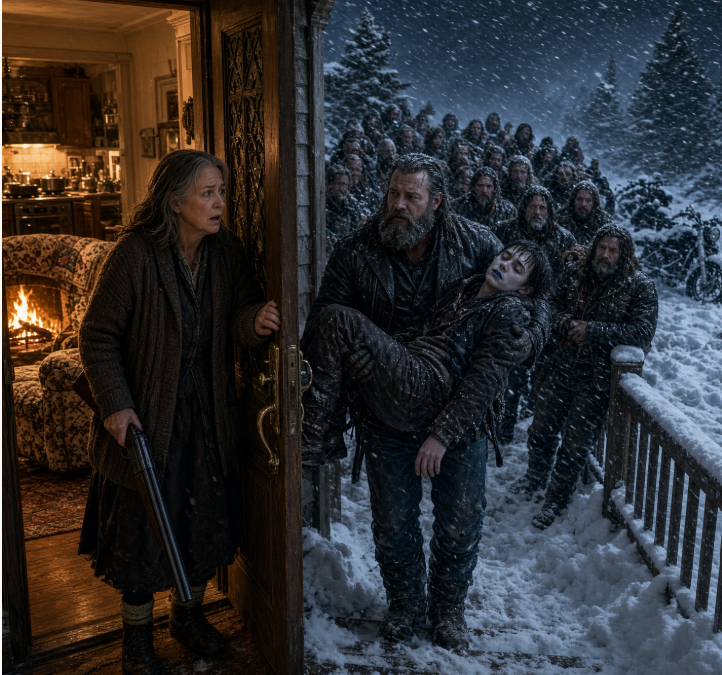
Dave reached the porch first, carrying Toby like a child.
He slammed one fist against the heavy oak door.
Inside, Evelyn froze.
Nobody came to her door in weather like that.
No neighbor.
No sheriff.
No friend.
The pounding came again.
Heavy.
Desperate.
She rose from the chair and walked to the hallway closet.
Richard’s old twelve-gauge shotgun rested behind winter coats. She took it down, broke the action, loaded two shells, and snapped it shut.
Then she approached the front door and looked through the frosted glass.
What she saw should have terrified her.
Twenty huge men crowded her porch, covered in snow and ice, wearing black leather cuts marked with the Hells Angels death’s head. Beards frozen. Faces gray. Some standing only because others held them upright.
In another story, in another kind of night, Evelyn might have stepped back and let the deadbolt remain locked.
After all, Oak Haven had taught her the rules.
People choose who deserves rescue.
People decide who belongs outside.
People watch from warm rooms and call it judgment.
Then she saw Dave.
The massive man at the front held a young rider against his chest.
The boy’s face was ashen.
His head hung loosely.
His lips were blue.
“Please!” Dave shouted through the door. His voice was rough, barely human through the cold. “We have men dying out here!”
Evelyn’s grip tightened around the shotgun.
She knew what people said about the Hells Angels.
She knew their reputation.
She knew opening that door might invite danger into the only place where she had any peace left.
But she also knew what it felt like to be left outside by people who had already decided what you were.
Evelyn Croft was many things.
Widow.
Outcast.
Rumor.
Survivor.
But she was not a monster.
She unlocked the door and pulled it open.
The storm burst into the foyer, hurling snow across the polished wood floor.
Dave stood face to face with a fifty-eight-year-old woman in a gray sweater holding a shotgun at her side.
He raised one trembling hand.
“Ma’am,” he croaked, voice breaking from cold. “We mean you no harm. I swear on my mother. My boy here is freezing to death. We just need the floor. We just need to survive the night.”
Evelyn looked at him.
Then at the men behind him.
All that leather, all those patches, all those frightening reputations—stripped meaningless by nature’s cruelty.
They were not outlaws in that moment.
They were dying men.
Evelyn lowered the shotgun and leaned it against the coat rack.
“Get him inside,” she said.
Dave blinked.
“Now,” Evelyn snapped. “Don’t stand there letting the heat out. Move.”
The bikers obeyed.
They surged into the foyer in a stampede of snow, boots, leather, and exhaustion. Dave carried Toby toward the fire, but Evelyn stopped him sharply.
“Not too close to the hearth. You’ll shock him.”
Dave froze.
This was a man who gave orders to men other people crossed the street to avoid.
Now he was being corrected by a gray-haired widow with a shotgun and a wool sweater.
“Yes, ma’am.”
“You two,” Evelyn said, pointing at Jimmy and another biker. “Linen closet upstairs. Every quilt, blanket, and towel you see. Bring them all.”
Jimmy did not hesitate.
“Yes, ma’am.”
“You,” she pointed at Dave. “Wet leather off the boy. Carefully. Don’t yank his arms.”
“Yes, ma’am.”
“You, kitchen. Fill every pot with water. Not boiling for drinking yet—warm first. Slowly.”
Within minutes, Evelyn’s immaculate house became a triage center.
Twenty men filled the living room and dining room.
They collapsed onto Persian rugs, antique chairs, and floral sofas. One biker apologized weakly for bleeding on a cushion. Evelyn told him if he could complain about upholstery, he could hold a towel against his own hand.
She moved like a general.
Sharp.
Calm.
Unshakable.
She warmed broth on the stove.
Heated water.
Wrapped hands.
Checked breathing.
Forced men to sip slowly.
She rubbed warmth back into frostbitten fingers while hardened riders wept quietly from the pain of thawing blood vessels.
She wrapped Toby in three layers of down comforters and sat beside him until color finally returned to his cheeks.
At one point, Jimmy tried to stand and help, took two steps, and nearly fell into a lamp.
Evelyn pointed at him.
“Sit.”
“I’m fine.”
“You are blue around the mouth and swaying like a drunk pine tree. Sit down before you break my furniture.”
He sat.
By four in the morning, the house had quieted.
The storm still screamed outside, burying the first floor windows in snow, but inside, the living room was warm. Bikers slept beneath hand-stitched quilts. One snored in an armchair. Another lay on the dining room floor with a lace table runner accidentally tucked under his chin like a scarf.
Toby was breathing steadily.
Dave sat at Evelyn’s kitchen island with both hands wrapped around a mug of black coffee.
For a long time, he said nothing.
Neither did Evelyn.
She wiped down the counter slowly, as if twenty Hells Angels sleeping in her house were no more unusual than spilled tea.
Finally Dave spoke.
“You saved our lives tonight.”
Evelyn rinsed the cloth.
“Yes.”
He gave a tired laugh.
Most people would have softened the answer.
Evelyn did not.
“I don’t know who you are,” Dave said, voice thick with exhaustion and something close to awe, “but you didn’t have to open that door for men like us.”
“My name is Evelyn Croft,” she said. “And in this house, Mr. Sullivan, we do not leave people outside to freeze.”
There was bitterness beneath the sentence.
Dave heard it.
“They give you trouble down there?”
Evelyn looked toward the dark kitchen window, beyond which the town lay somewhere under snow and judgment.
“They have opinions.”
“About what?”
“Me.”
Dave waited.
“They call me the Black Widow.”
His eyes narrowed.
Evelyn poured herself tea.
“Two husbands dead. Two inheritances. A town full of people who prefer scandal to facts.”
Dave looked back toward the living room, where his men slept beneath her blankets.
Then he looked at Evelyn.
A slow, dangerous warmth entered his expression.
“Well,” he said, “if that town thinks you’re a monster, wait until they see the friends you just made.”
The storm lasted three days.
During that time, the bikers did not act like houseguests.
They acted like men repaying a debt before anyone asked.
Once they could stand properly, they shoveled paths from the porch to the garage. They cleared vents. Hauled firewood. Fixed a drafty window in the back hall. Patched a small roof leak Evelyn had been meaning to repair since autumn. One of them got the generator running smoother. Another repaired the old snowblower that had sat dead in the barn for six years.
They ate everything she cooked and praised every bite like it was a banquet.
They called her “ma’am” at first.
By the second day, half of them were calling her “Mom.”
Evelyn pretended not to notice.
She noticed.
On Saturday morning, the sky finally cleared.
Oak Haven woke beneath four feet of packed snow and a bright blue sky cruelly beautiful enough to make people forget how dangerous the storm had been.
Power returned.
Plows began clearing Main Street.
At the diner, Martha Gable sat by the window, wrapped in a wool shawl, stirring coffee she had no intention of drinking quietly.
“No smoke from the Croft chimney for three days,” she announced.
Several people turned.
Martha lowered her voice just enough to make sure everyone listened harder.
“Power was out up there. No way a woman her age kept that house warm alone. The cold may have finally taken the Black Widow.”
Sheriff Higgins leaned against the counter over a plate of eggs.
He did not look sad.
“Well,” he said, wiping his mouth, “I suppose I’d better take the heavy plow up Miller’s Ridge. Welfare check.”
Martha’s eyes gleamed.
“Or recovery.”
A few people looked down at their plates.
Nobody defended Evelyn.
Nobody ever did.
The drive up was brutal.
The county snowplow groaned against deep drifts. Young Deputy Bobby drove while Higgins rode passenger, already rehearsing the radio call in his head.
Elderly woman found deceased.
Isolated residence.
Storm conditions.
The county would take control of the property. There would be paperwork. Maybe a sale. Higgins had a cousin in real estate who would love the commission on a Victorian farmhouse with ridge views.
But when the plow rounded the final switchback, Higgins stopped speaking.
Evelyn Croft’s driveway was not buried.
It was cleared clean down to the asphalt.
The walkways were shoveled.
Salted.
Firewood was stacked in a massive cord on the porch.
Smoke curled steadily from the chimney.
And parked in neat rows in front of the detached garage were twenty Harley-Davidsons.
Higgins stared.
Then the front door opened.
Evelyn stepped out wearing a tailored wool coat, gray hair pinned neatly back, looking perfectly alive and entirely unbothered.
Behind her came twenty men in black leather.
They filed out onto the porch and driveway like a royal guard from a very different kingdom.
Higgins’s stomach dropped.
He recognized the patches immediately.
Hells Angels.
In Oak Haven.
At the Black Widow’s house.
“What the hell is this?” he muttered.
He climbed down from the plow, one hand resting too close to his sidearm.
“Evelyn,” he called. “Step away from those men.”
Evelyn crossed her arms.
“Good morning, Sheriff. You’re about three days late with that plow.”
Several bikers smiled.
Higgins flushed.
Dave stepped forward.
He seemed even larger in daylight.
Scarred face.
Heavy boots.
Eyes steady.
“Problem, officer?”
Higgins tried to gather authority around himself like a coat.
“The problem is this is a private residence, and I see gang members trespassing. For all I know, this is a hostage situation.”
Dave looked around at the shoveled driveway, stacked wood, repaired gutter, and Evelyn standing calmly beside him.
“Hostage situation,” he repeated.
A low chuckle moved through the bikers.
“This lady saved our lives,” Dave said. “We’ve been doing chores to earn our keep.”
Higgins pointed at Evelyn.
“You boys don’t know who you’re dealing with. That woman is dangerous. Whole town calls her the Black Widow. Two dead husbands, both with insurance. You stay here, you may not wake up.”
The air changed.
Not loudly.
Not dramatically.
But twenty men who had been relaxed a moment earlier shifted into stillness.
Evelyn’s face did not change.
That hurt Dave more than if it had.
She had heard this so many times she no longer reacted.
Dave took two slow steps toward the sheriff.
Higgins backed into the plow blade.
“Let me explain something,” Dave said quietly. “We’re leaving because roads are clearing and we’ve got a long ride home.”
Higgins swallowed.
“But Mrs. Croft here is now a friend of the Redwoods chapter. That means if I hear she’s being harassed, threatened, isolated, or treated like prey by anyone wearing a badge or holding a coffee cup at that diner, I will take it personally.”
He leaned slightly closer.
“And Sheriff, I am not a man whose personal feelings you want to manage.”
Higgins’s face drained.
Evelyn gave him a small, polite smile.
“Do drive carefully on the way down, Sheriff.”
Dave turned back to her.
The hardness left his face.
He removed one glove, reached into his vest, and pulled out a small metal challenge coin stamped with the insignia of his chapter.
He placed it in her palm.
“If you ever need anything,” he said, “anything at all, you call.”
Evelyn closed her fingers around the coin.
“Safe travels, Dave.”
Twenty Harleys fired at once, shattering the bright mountain morning.
Higgins and Deputy Bobby stood in stunned silence as the riders rolled down Miller’s Ridge, leaving Evelyn alone on her porch with a faint smile and an army’s promise in her hand.
Spring arrived slowly.
Snow melted into mud.
Mud gave way to green shoots in Evelyn’s garden.
Oak Haven did what Oak Haven always did.
It twisted the story.
Martha Gable claimed Evelyn had invited the bikers deliberately to frighten the town.
Sheriff Higgins told everyone he had “escorted them out of county jurisdiction,” leaving out the part where he had backed into his own snowplow.
People still whispered, but now they whispered with caution.
Evelyn ignored them.
She had always been good at ignoring pain.
But Dave Sullivan had not forgotten.
And unlike Evelyn, Dave did not believe every insult should be met with dignified silence.
In late May, Oak Haven held its annual Founders Day festival.
Bunting hung across Main Street. Children ran between lemonade stands. Local businesses set up booths. A charity auction filled the town square with quilts, pies, handmade birdhouses, and the sort of forced cheer small towns produce when they want to pretend they are kinder than they are.
Sheriff Higgins stood on the bandstand with a microphone, preparing to auction a quilt from the ladies’ auxiliary.
Martha Gable sat in the front row, fanning herself.
At exactly one o’clock, the lemonade in the plastic cups began to ripple.
The first vibration came through the pavement.
Deep.
Rhythmic.
Then louder.
A rolling thunder moving down Main Street.
Higgins paused.
“What now?”
It was not an earthquake.
Over one hundred and fifty motorcycles rolled into the town square in perfect formation.
The festival descended into panic.
Parents grabbed children.
Vendors froze.
Martha nearly dropped her fan.
But the bikers did not shout.
They did not rev aggressively.
They parked in organized rows around the square and dismounted with terrifying calm.
At the front was Dave Sullivan.
Beside him were Jimmy, young Toby—fully recovered now—and a man the town had never seen before.
He wore a tailored charcoal three-piece suit and carried a leather briefcase.
The crowd parted as they walked to the bandstand.
Sheriff Higgins looked as if he might faint.
“I told you not to come back here,” he said into the microphone, voice cracking.
Dave ignored him.
The suited man stepped up, gently took the microphone from Higgins’s hand, and smiled at the town.
“Good afternoon, citizens of Oak Haven. My name is Robert Sterling. I am chief legal counsel for the Redwoods chapter of the Hells Angels Motorcycle Club, and I am also retained counsel for Mrs. Evelyn Croft.”
A gasp moved across the square.
Martha Gable’s mouth opened.
For once, nothing came out.
Sterling opened his briefcase.
“For twenty years,” he said, “this town has subjected my client to vicious and unfounded defamation. She has been publicly labeled the Black Widow and falsely accused of involvement in the deaths of her late husbands, Arthur Pendleton and Richard Croft.”
The square went silent.
Sterling lifted a stack of documents.
“My clients funded a private investigation. We now possess maintenance records proving that Arthur Pendleton’s logging company knowingly sent him onto Miller’s Pass in a truck with defective brakes.”
People turned to look at Martha.
Her face tightened.
Sterling continued.
“We also possess medical and genetic documentation confirming that Richard Croft died from a hereditary vascular condition consistent with the coroner’s original finding. His own brother died of the same condition last year in Seattle.”
Higgins looked at the ground.
Sterling’s voice sharpened.
“A wrongful death claim against the trucking company has already been filed on Mrs. Croft’s behalf, and settlement discussions are underway. Additionally, this office has prepared cease-and-desist notices regarding all defamatory statements made about Mrs. Croft by private citizens, businesses, and law enforcement officials.”
He looked directly at Higgins.
“If any person in Oak Haven continues spreading false accusations about my client, we will pursue every legal remedy available.”
He paused.
“And we are extremely well funded.”
Dave stepped to the microphone.
His voice filled the square.
“Evelyn Croft is not your monster. She is the reason twenty men are alive. When this town left her on that mountain, she opened her door to strangers and saved my brothers.”
He looked across the crowd.
“She’s family now.”
That was all he said.
He did not need to say more.
Because while the town stood frozen in shame, flatbed trucks were already climbing Miller’s Ridge.
The Hells Angels had not come empty-handed.
For three days, they worked on Evelyn’s farmhouse.
They repainted the exterior a bright, clean white.
Rebuilt the old barn.
Repaired the roof.
Installed a security system.
Put in a heavy-duty backup generator far better than the one she had kept alive herself.
Reinforced the porch.
Repaired the fence line.
Cleared dead trees from the property.
They did not treat her like a cursed woman.
They treated her like a queen.
On the final afternoon, Evelyn stood on her newly painted porch while Dave prepared to leave.
For the first time in years, the house looked less like a haunted story the town had invented and more like a home.
Evelyn’s eyes shone.
“I don’t know what to say,” she admitted.
Dave wrapped her in a careful bear hug.
“You don’t have to worry about them anymore, Mom.”
Evelyn patted his leather-covered back.
“I never did,” she said softly. “But I thank you.”
From that day forward, Oak Haven changed.
Not completely.
Small towns do not become kind overnight.
But they do learn fear faster than compassion.
When Evelyn walked into the grocery store, people stepped aside politely.
Martha Gable stopped speaking whenever Evelyn entered a room.
Sheriff Higgins found new roads to patrol far from Miller’s Ridge.
No one called her the Black Widow where she could hear it.
And if they said it where she could not, they said it softly enough to prove Dave Sullivan had made his point.
Every Christmas after that, a delivery truck arrived at the Oak Haven post office carrying crates for the farmhouse on the ridge.
Expensive coffee.
Fine wine.
Warm blankets.
Books.
Tools.
Handmade ornaments from riders’ families.
The return address was always the same.
Redwoods Chapter.
Evelyn kept the challenge coin on her mantel, next to photographs of Arthur and Richard.
Not because she needed protection.
Evelyn Croft had survived two decades of loneliness without anyone’s permission.
She kept it there because it reminded her of the night the world finally told the truth about her.
The town had called her a monster.
But monsters do not open doors in blizzards.
Monsters do not warm frozen hands, cook broth for strangers, and sit beside a dying boy until his breathing steadies.
Monsters do not lower the shotgun and choose mercy when the world has given them every excuse to become hard.
Oak Haven had tried to bury Evelyn beneath suspicion.
Instead, it introduced her to men who understood what it meant to be judged by reputation and saved by loyalty.
That was the part the town never truly understood.
Evelyn did not become powerful because the Hells Angels protected her.
She had been powerful all along.
They were simply the first people in twenty years dangerous enough, loyal enough, and grateful enough to make the town admit it.
And sometimes, when the winter wind hit the ridge just right, Evelyn would stand on her porch with a cup of black coffee, looking down over the valley that had once abandoned her.
Then she would smile.
Not bitterly.
Not cruelly.
Just knowingly.
Because Oak Haven had given her a name meant to make her small.
Black Widow.
But in the end, all the town had really done was teach a lonely woman how to survive alone.
And when the storm came, survival was exactly what made her strong enough to save everyone else.