At -35°C, She Refused to Leave the Snow-Covered Tree Where She Waited Alone—When Rescuers Finally Realized What She Was Still Hoping For, Their Hearts Shattered
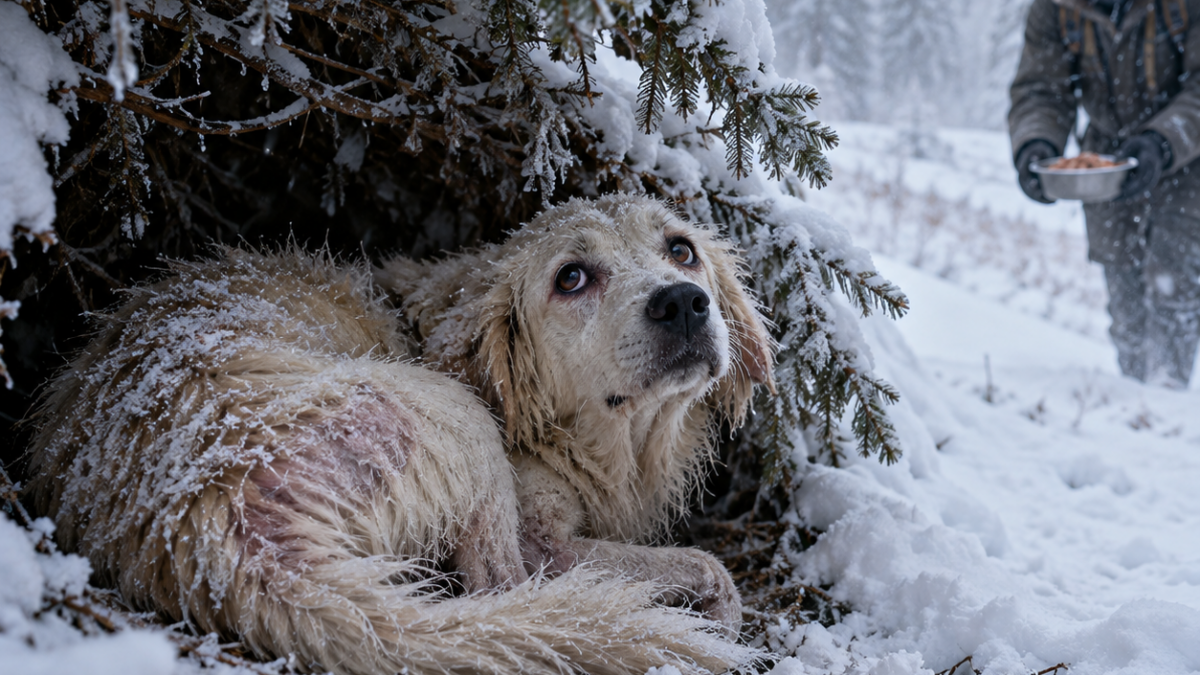
At -35°C, She Refused to Leave the Snow-Covered Tree Where She Waited Alone—When Rescuers Finally Realized What She Was Still Hoping For, Their Hearts Shattered.
I thought she was just a shadow moving across the snow, until the shadow lifted its head and looked straight at me.
It was minus thirty-five degrees Celsius, the kind of cold that burns your lungs and turns silence into something dangerous.
But the little dog refused to leave that frozen roadside, and when I finally understood what she was waiting for, it broke my heart.
The world was completely white that morning.
Not soft white.
Not beautiful white.
The kind of white that makes everything feel erased.
The road stretched ahead of me like a thin gray scar through the snow. Pine trees stood on both sides, heavy with ice, their branches bent under the weight of winter. The sky was pale and colorless. Even the wind seemed tired, moving in long, bitter gusts across the open land.
I was driving slowly because the road was slick, and because in weather like that, you do not trust anything.
Not the tires.
Not the ice.
Not the distance between where you are and where you think you are going.
Then I saw something on the horizon.
At first, I thought it was a branch.
A dark shape near the edge of the road.
Then it moved.
I eased my foot off the gas.
The shape lifted its head.
A dog.
She stood a short distance away from the road, thin and trembling, watching my car with the kind of caution that told me people had not been kind to her.
I pulled over.
The moment my tires stopped crunching against the frozen snow, the silence returned. It was so complete that I could hear the wind dragging loose ice across the road.
I opened the door and stepped out.
The cold hit my face so hard my eyes watered immediately.
“Hey,” I called gently. “It’s okay.”
The dog did not run.
But she did not come close either.
PART2:
She was medium-sized, with dirty white fur that blended almost too well into the landscape. Snow clung to her legs and belly. Her ribs were visible beneath her coat. Her ears were low. Her eyes were dark, exhausted, and still somehow full of questions.
She looked like she had not eaten properly in days.
Maybe longer.
I took one slow step forward.
She backed away.
Not far.
Just enough to tell me the boundary.
No closer.
I stopped.
“That’s okay,” I whispered. “I won’t touch you.”
Her tail moved once.
A tiny uncertain wag.
Hope and fear at the same time.
I did not have dog food in my hands, so I hurried back to the car. I had a small bag of food I kept for emergencies and some canned food I had bought earlier that week for another rescue stop. I grabbed what I could, my fingers already stiffening in the cold.
When I turned back, she was farther away.
My heart sank.
She thought I was leaving.
PART3:
The moment she saw me walking back with food, her whole expression changed.
Not trust.
Not yet.
But recognition.
The kind that says:
Maybe this person did not abandon me.
I crouched and placed the food on the snow between us, then backed away.
She stared at it.
Then at me.
Then back at the food.
Hunger won.
Slowly, carefully, she came forward. Every step looked like a negotiation with fear. She kept her body low, ready to spring away if I moved too fast.
When she reached the food, she ate like a dog who had forgotten meals could be safe.
Fast.
Desperate.
Her whole body shaking.
I wanted to tell her to slow down, but she was not ready to hear my voice that close. So I stayed quiet and let her eat.
When the food was gone, she looked at me again.
For one second, I thought she might come closer.
Instead, she turned and ran.
Not back toward the road.
Not toward the trees at random.
She ran with purpose.
Like she had somewhere she needed to be.
“Wait,” I called. “Where are you going?”
She did not stop.
I watched her disappear into the white distance, leaving only a broken trail of pawprints behind her.
I stood there, confused and cold, holding the empty food container in my hand.
Most starving dogs follow food.
Most frightened dogs hide.
This one had done both, and then left like something was more important than being saved.
I went back to the car, but I could not make myself drive away.
Something felt wrong.
So I waited.
Ten minutes.
Twenty.
Thirty.
Nothing.
No movement.
No bark.
No sign of her.
The wind kept blowing across the road, slowly filling in her tracks.
I told myself I had tried.
I told myself she was too scared.
I told myself maybe she lived nearby, maybe there was a house hidden beyond the trees, maybe she belonged to someone and only wandered too far.
But I did not believe any of it.
Just as I was about to give up, I saw her again.
A small white figure moving across the open snow.
The second she saw me, her face changed.
There is no other way to say it.
She brightened.
Her ears lifted slightly. Her body came alive. She ran toward me with a fragile, uneven joy that made my throat tighten.
She had come back because I had come back.
I grabbed more food.
This time, when I placed it down, she approached a little faster. Still careful. Still outside my reach. But closer than before.
I tried to extend one hand.
She jumped back immediately.
“Okay,” I said softly. “Not yet.”
The food was the only reason she stayed near me.
When it was gone, she started to leave again.
I called her.
She stopped, looked back, and then continued.
That was when I understood she was not wandering.
She was returning.
I decided to follow.
Not too close.
I did not want to frighten her into running farther. I just kept her in sight, walking through snow that reached over my boots while the cold worked its way into my gloves.
She moved through the trees with a strange determination.
Every now and then she looked back, checking whether I was still there. If I stopped, she stopped. If I moved too close, she moved ahead.
Finally, she reached a large pine tree standing alone near the edge of the forest.
Under its low branches, the snow had been pressed down into a hollow.
A small circle.
A body-shaped nest.
That was where she had been sleeping.
In minus thirty-five degrees.
Alone.
Under a tree.
Waiting.
I stood there staring at the hollow in the snow, and my chest hurt.
She curled herself into that little frozen space as if it was the only home she had left. She lowered her head, but her eyes stayed fixed on the road beyond the trees.
Not on me.
On the road.
That was when the truth became impossible to avoid.
She had been left there.
And she was waiting for the person who abandoned her to come back.
I have seen frightened dogs before.
Hungry dogs.
Injured dogs.
Dogs who ran from people because people had taught them to run.
But there is a special kind of heartbreak in a loyal dog who does not yet understand betrayal.
She was not staying there because she liked the cold.
She was not refusing rescue because she wanted to suffer.
She was staying because someone had brought her to that place and disappeared.
And in her heart, that place was still the last known path home.
I crouched several feet away.
“You poor girl,” I whispered.
Her ears moved at my voice, but she did not come.
I knew then I could not leave her.
Not for one more night.
The temperature would drop even lower after sunset. The wind was already sharpening. My hands were going numb inside my gloves. If she stayed under that tree, she might not survive until morning.
I went back to the car for more food and a blanket.
When I returned, she watched me carefully.
The plan was simple.
Keep her in sight.
Keep her interested.
Do not let her disappear.
Get close enough to secure her.
Simple plans are usually the hardest ones.
For the next hour, I fed her small amounts at a time.
A little closer.
Then a little closer.
She wanted the food badly, but fear kept pulling her back. Every time I shifted my weight, she retreated. Every time my hand moved too high, her body tensed.
The sun sank lower.
The forest darkened.
The cold became brutal.
My fingers lost feeling. My face burned. The wind howled through the pines, shaking snow from the branches in sudden bursts.
I kept thinking:
No mistakes.
This may be the only chance.
She stepped close enough to eat from the container in my hand.
My heart pounded.
I did not move.
She ate quickly, eyes flicking up to me every few seconds.
Then I lowered my other hand.
Slowly.
Carefully.
She saw it and started to pull away.
I waited.
She leaned forward again for the food.
That was my moment.
I caught her.
She exploded in panic.
Not aggression.
Terror.
She twisted, kicked, and thrashed so hard she tore my jacket sleeve with her claws. Snow flew around us. I held on as gently and firmly as I could, speaking low, trying to keep my own fear out of my voice.
“I’ve got you. I’ve got you. You’re safe. No more nights out here.”
She fought for a few seconds more.
Then, suddenly, all the strength went out of her.
She froze in my arms, trembling violently.
I wrapped the blanket around her and held her against my chest.
She was so cold.
So much colder than I expected.
Her body shook against me, and for the first time, she let me feel how little of her there was beneath the fur.
I carried her back through the snow.
She did not bark.
Did not growl.
Did not relax either.
She only stared over my shoulder toward the pine tree.
As if I were stealing her from the place where she still believed love might return.
That almost broke me.
At the car, she refused to get in.
Her body stiffened the moment I opened the door.
“No,” I whispered. “I know. I know you’re scared.”
I lifted her carefully inside and climbed in beside her for a moment before starting the engine. She sat on the blanket, silent, staring through the window at the dark line of trees.
Every now and then, she looked at me.
Not with trust.
With questions.
Where are you taking me?
Will you leave too?
Should I have stayed?
I turned the heat as high as it would go and drove slowly toward town.
My hands were still numb on the steering wheel. I could barely feel my fingertips. My jacket was torn. My face hurt from the cold. But none of that mattered.
She was out of the forest.
She would not spend another night under that pine tree.
On the way to the animal hospital, I stopped at a pet store.
I did not want to bring her inside without a collar or leash. She had already shown me that fear could make her bolt.
When I opened the car door, she suddenly tried to escape.
For one terrifying second, I thought I would lose her right there in the parking lot.
I caught the blanket just in time and held her close.
“It’s okay,” I said, though my own voice was shaking now. “Please. Just stay with me.”
I bought a collar, a bag of dry food, and several cans of soft food. In the car, I opened one of the cans and offered her a little.
That changed everything for a moment.
Her nose twitched.
Her eyes focused.
She ate carefully at first, then with more interest.
Good food has a way of reaching places words cannot.
At the animal hospital, she became a different dog.
Not calm.
But smaller somehow.
The bright lights, the clean floor, the smell of disinfectant, the strangers moving around her — all of it overwhelmed her. She pressed herself into the corner of the exam room and watched the door like she expected me to walk through it and vanish.
The veterinarian moved slowly.
So did the technicians.
They understood fear.
That helped.
“She’s been out there a while,” the vet said, running gentle hands along her body.
“I think she was abandoned,” I said.
The vet looked at her eyes, her ribs, the condition of her paws.
“I believe you.”
They gave her a mild sedative to help her relax during the exam. Even then, she fought sleep at first, as if closing her eyes meant losing control. Finally, exhaustion took over.
For the first time since I had seen her in the snow, she rested.
The exam took several hours.
No major injuries.
No broken bones.
No severe frostbite.
That felt like a miracle.
But she was underweight, dehydrated, and weakened by prolonged hunger. Her stomach was irritated from eating whatever she could find, or from not eating enough at all. Her paws were raw from ice and frozen ground.
“She’s lucky,” the vet said.
I looked at her sleeping on the blanket.
“No,” I said softly. “She waited too long to be called lucky.”
The vet did not argue.
That night, I sat beside her kennel at the clinic until they told me I had to go home.
She lifted her head when I stood.
Her eyes followed me.
That look nearly kept me there all night.
“I’ll come back,” I promised.
She did not know what promises meant anymore.
Not yet.
But I made one anyway.
The next morning, I returned as soon as they allowed visitors.
She was awake.
The moment she saw me, her body tensed.
Then her tail moved once.
Small.
Uncertain.
But real.
I sat on the floor outside her kennel and spoke quietly.
I told her about the weather.
About my cold hands.
About how badly she had ripped my jacket.
About how I had no idea what I was doing, but I was glad she was warm.
She watched me the whole time.
On the third day, she took food from my hand without retreating.
On the fourth day, she let me touch the top of her head for half a second before pulling away.
On the fifth day, something changed.
I walked into the room, and she stood.
Her ears lifted.
Her tail began to wag.
Not the tiny uncertain movement from before.
A real wag.
A bright, joyful little sweep of hope.
Then she smiled.
Dogs do smile.
Anyone who says they do not has never watched fear leave a dog’s face.
In that moment, I felt something pass between us.
Not ownership.
Not even trust exactly.
The beginning of trust.
A small door opening.
I named her Snowy.
It felt right.
Not because she belonged to the snow.
She did not.
But because that was where I found her, where she survived, and where her old life ended.
The name did not honor the cold.
It honored the fact that she made it out.
After she left the hospital, I arranged a safe place for her to stay while she recovered. It was warm, quiet, and simple. A soft bed. Clean water. Food she could digest. No sudden noises. No pressure.
At first, she watched everything.
She watched the door.
The windows.
My hands.
My feet.
She watched me leave and come back.
Especially that.
Every time I returned, I could see her trying to understand it.
People leave.
But this one returns.
People disappear.
But this one opens the door again.
People make promises with warm voices.
But this one brings food, walks, blankets, and patience.
Every day, I visited her.
Every day, we walked.
At first, she stayed tense on the leash, looking over her shoulder as if the old roadside might somehow appear behind us. She paused at every unfamiliar sound. She flinched when cars passed too fast. She kept scanning the distance, still searching for someone who was never going to come.
But little by little, the walks changed.
At first, they were only exercise.
Then they became routine.
Then comfort.
Then healing.
She began to sniff the snowbanks.
Then tree trunks.
Then footprints.
She began to look at me before choosing a direction, as if my opinion mattered.
She began to understand that the leash did not mean control.
It meant connection.
A path we walked together.
By the time the snow started melting, Snowy had changed.
Not completely.
Abandonment does not vanish because someone is kind for a week.
Fear leaves in layers.
But her eyes softened.
Her body filled out.
Her coat grew cleaner and brighter.
She wagged when she saw me.
She leaned into my leg when she was unsure.
She slept deeply now, the way only safe animals sleep.
No one ever found out who left her there.
Maybe we never will.
Maybe someone drove away and told themselves she would be fine.
Maybe they believed a dog could survive anything.
Maybe they knew exactly what they were doing and decided her loyalty was cheaper than responsibility.
I do not know.
There are questions that do not give you answers.
Only wounds.
What I do know is this:
Snowy waited.
She waited under that pine tree in a hollow she made with her own body.
She waited in a cold so sharp it could kill.
She waited even after hunger hollowed her out.
She waited because her heart had not yet accepted that the person she loved had chosen not to return.
That kind of loyalty deserves better than a frozen roadside.
So I made the decision before spring fully arrived.
I adopted her.
Not temporarily.
Not until someone better came along.
Not until it became inconvenient.
Forever.
The first night I brought her home for good, she stood in the doorway for a long time.
I had set up everything I thought she might need.
A bed near the wall.
Food and water bowls.
A blanket.
A few toys she did not yet understand.
She walked carefully from room to room, sniffing, pausing, looking back at me. When she reached the bed, she stepped onto it slowly and turned in a circle three times.
Then she lay down.
A few minutes later, she got up and came to find me.
I was sitting on the floor nearby, pretending not to watch too closely.
She stood in front of me.
Then she lowered her head and pressed it gently against my chest.
I put one hand on her shoulder.
She did not move away.
That was the moment I knew she understood.
Not everything.
Not the whole future.
But enough.
She was not waiting alone anymore.
The months that followed were not perfect.
Healing never is.
Some days, Snowy still startled at the sound of car doors.
Sometimes she stopped on walks and stared down empty roads.
Sometimes, when I left the room too quickly, she followed in a panic, afraid the old story was happening again.
So I moved slowly.
I spoke before leaving.
I came back when I said I would.
Again.
And again.
And again.
That is how you teach a betrayed heart.
Not with one grand gesture.
With repetition.
With patience.
With ordinary proof.
Food in the bowl.
Leash by the door.
Blanket washed and returned.
Hands that do not hit.
A voice that stays gentle.
A person who comes back.
As winter loosened its grip, Snowy discovered sunlight.
She loved it.
The first warm afternoon, she stretched out near the window and slept so deeply that her paws twitched. I wondered if she was dreaming of running through snow, not from fear this time, but simply because she could.
On our walks, she began to lift her head higher.
Her tail rose.
Her steps grew lighter.
She stopped looking like a dog searching for the past and started looking like a dog noticing the world.
Birds.
Melting ice.
Wet grass.
The smell of other dogs on fence posts.
The sound of children laughing somewhere down the street.
Little by little, life returned to her in pieces.
And strangely, life returned to me too.
I had gone into that snow thinking I was rescuing a dog.
But there is something about saving a wounded creature that forces you to examine your own promises.
Do I leave when things become difficult?
Do I stay when trust takes longer than I wanted?
Do I make room for fear without letting it run the whole house?
Do I understand that love is not only a feeling, but a pattern?
Snowy taught me that some hearts do not need to be rushed.
They need to be shown.
There is a difference.
Now, every morning, she waits for me by the door.
Not the way she waited under the pine tree.
Not stiff with fear.
Not staring at the horizon for someone who will never come.
This waiting is different.
Her tail moves when she hears my steps.
Her eyes brighten.
She knows I am coming.
She knows we are going together.
That may sound small.
It is not.
For a dog who once believed love meant being left behind, knowing someone will return is everything.
Sometimes I still think about that hollow in the snow.
The small circle beneath the pine tree.
The place where she curled herself against the cold and kept faith with someone who did not deserve it.
I think about how close I came to driving past.
How easy it would have been to tell myself I was too busy, too cold, too unprepared, too far from help.
And I think about how many living beings are out there waiting for someone to notice the difference between a stray and a soul that has been abandoned.
Snowy is sleeping beside me as I write this.
Her body is warm now.
Her belly full.
Her paws healed.
Sometimes, when she dreams, a soft little sound escapes her, and I reach down just to let my fingers rest near her shoulder.
She always settles.
She knows.
I am here.
And tomorrow, I will still be here.
That is what I want her to learn most.
Not all people leave.
Some people come back.
Some people stay.
Some people find you in the cold, carry you away from the place that broke your heart, and spend the rest of your life proving that waiting was not foolish.
It was just meant for the wrong person.
Snowy will never spend another night under that tree.
She will never have to press herself into a hollow of snow and hope headlights mean love returning.
From now on, when she waits, she waits in warmth.
She waits with a collar that fits.
A bed that belongs to her.
A bowl that is never empty for long.
A person who knows her story.
And a future that no longer ends at the edge of a frozen road.
She was freezing at minus thirty-five degrees, but still refused to leave.
Now I know why.
She was not waiting for rescue.
She was waiting for loyalty.
And somehow, by the grace of one bitter winter morning, I was lucky enough to become the person who finally gave it back.








