An Injured Old Dog Dragged Himself Up a Lonely Hill and Waited There in Fear—When We Finally Learned What He’d Been Through, Our Hearts Shattered
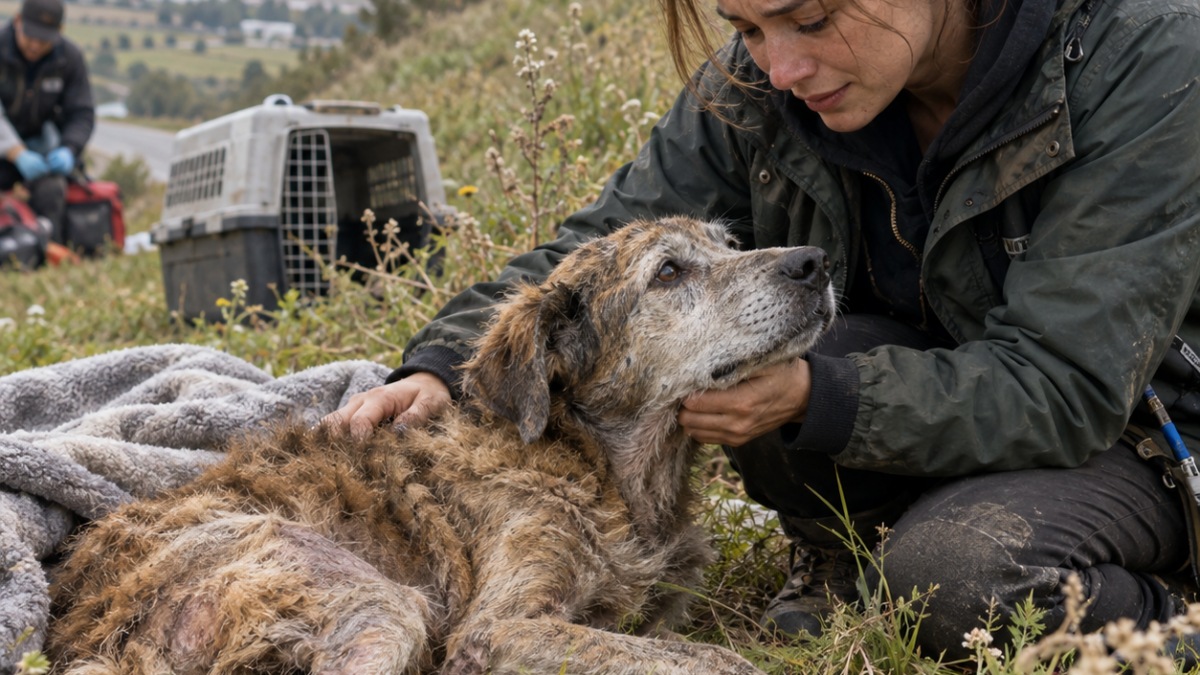
An Injured Old Dog Dragged Himself Up a Lonely Hill and Waited There in Fear—When We Finally Learned What He’d Been Through, Our Hearts Shattered.
They said he had been abandoned because he was old, useless, and too weak to matter anymore.
But when that injured dog dragged his broken body up a hill just to hide from the world, we realized fear had done more damage than age ever could.
What we found in his eyes was not only pain—it was the quiet question every discarded animal asks: “Am I still worth saving?”
The first time I heard about him, he did not even have a name.
People only called him “that old dog.”
That old dog near the road.
That old dog wandering alone.
That old dog lying in the dirt.
That old dog nobody claimed.
In rescue work, I have learned that the world can erase a soul with language before it ever erases a body. A dog becomes a stray. A patient becomes a case. A suffering animal becomes a problem. And once something is only a problem, people can step around it without feeling the full weight of what they are ignoring.
But a little boy did not step around him.
That was the only reason Risas lived long enough for us to find him.
It was late afternoon when my phone rang. The sun was already sliding behind the houses, and the road outside my window had turned the color of dust and tired light. I almost did not answer because I had just finished helping another rescued dog take his medication, and my hands still smelled faintly of antiseptic and canned food.
Then the phone rang again.
A child’s voice came through.
“Please,” he said breathlessly. “There’s a dog on the hill. He can’t walk.”
I stood still.
“How old are you?”
“Twelve.”
“Are you safe?”
“Yes, ma’am. I’m not too close. But he’s been there a long time. People said he’s abandoned. He used to walk around by himself, but today he’s dragging his back legs.”
My chest tightened.
“Dragging?”
“Yes. He tried to climb the hill. He kept pulling himself with his front legs. He looked scared.”
“Can you send me the location?”
“I already did. Please hurry.”
There are many kinds of urgency in rescue.
A bleeding wound is urgent.
A starving puppy is urgent.
A dog hit by a car is urgent.
But something in that boy’s voice told me this was another kind of emergency too—the kind where a creature has been suffering in public for so long that the first true act of rescue is simply believing he matters.
I grabbed towels, a soft muzzle, a stretcher blanket, water, gloves, and the emergency kit. On the drive, the boy sent one blurry photo.
An old dog lay halfway up a dry hillside, his body angled strangely, front legs tucked beneath him, back legs limp behind him. His head was lifted, but not proudly. More like he was listening for something dangerous. His ears hung low. His coat looked dull and thin. Dirt clung to his belly and legs.
Even through the poor photo, I could see the fear.
Not the wild panic of a dog who wants to bite.
The exhausted fear of a dog who has already learned nobody is coming.
When I arrived, the boy was waiting at the edge of the road with his backpack still on. He pointed up the hill before I even closed my car door.
“There,” he said. “He hasn’t moved.”
PART2:
The hill was not tall, but to an injured old dog, it might as well have been a mountain. Dry grass grew in patches between stones. The ground was uneven, with loose dirt that slid under my shoes as I climbed. Every few feet, I saw drag marks where his back legs had trailed behind him.
He had pulled himself all the way up there.
In fear.
In pain.
Alone.
That was the first thing that broke my heart.
Not the injury.
Not even his age.
The effort.
For a healthy dog, the climb would have been nothing. For him, every inch must have hurt. Every movement must have burned through his spine, hips, muscles, and nerves. But he had done it anyway because something inside him said the hill was safer than the road, safer than people, safer than wherever he had been before.
When I reached him, he did not growl.
He did not bark.
He only watched me.
His eyes were cloudy with age but alert with worry. His muzzle was gray. His body was thin beneath the dirty coat. When he opened his mouth to pant, I saw that most of his teeth were missing. The ones that remained were worn and stained, leaving his old mouth sunken and soft.
“Oh, sweetheart,” I whispered.
He flinched at my voice.
So I stopped moving.
PART3:
I lowered myself to the ground a few feet away and turned my body slightly sideways. With frightened dogs, facing them directly can feel like pressure. I kept my hands low and my voice softer than the wind.
“I’m not here to hurt you.”
He stared.
Behind me, the boy stood at the bottom of the hill, silent now.
I took a piece of soft food from my bag and placed it on the ground between us.
The dog sniffed but did not move.
His back legs lay useless behind him.
That was when I noticed the tremor running through his body. Not only fear. Pain. His muscles shivered as if holding still required strength he barely had left.
I moved a little closer.
He lowered his head.
I stopped again.
We stayed like that for several minutes.
Rescue is not always dramatic. Sometimes it is two beings on a hillside, one hurting and the other trying to prove that hands can mean help.
Finally, he let me touch the side of his neck.
His skin twitched beneath my fingers.
Then, slowly, the fear in his eyes changed.
Not gone.
Not healed.
Just softened.
Trust did not arrive all at once. It came like a tired animal too, one careful step at a time.
“You’re safe now,” I said.
I have said those words to many animals.
Sometimes I wonder whether they believe me.
That day, I needed him to.
My team arrived a few minutes later with a proper stretcher. Together, we examined what we could without causing more pain. His rear legs had some sensation, but he could not use them. There were old sores near his hips. A wound near his back looked inflamed. His coat was full of dust and ticks. His gums were pale, his breathing shallow.
When I slid my arms beneath his chest to help lift him, he looked at me again.
As if asking permission to hope.
“You can trust me,” I whispered. “Just this once. Let me carry you.”
And somehow, he did.
He did not fight when we placed him on the stretcher. He did not bite when pain shot through him as we lifted. He only made one low sound in his throat, then pressed his head against my arm.
The boy at the bottom of the hill wiped his eyes with his sleeve.
“Will he die?” he asked.
I did not lie.
“I don’t know yet.”
“But you’ll try?”
“Yes,” I said. “We’ll try.”
On the way to the clinic, the old dog lay across the back seat on thick towels. I kept one hand on him whenever traffic allowed. His body was warm but weak. His breathing carried the rough rhythm of exhaustion.
I did not know his name.
So I gave him one.
“Risas,” I said softly.
In Spanish, it means laughter.
Maybe it seemed like a strange name for a dog who looked as if joy had forgotten him. But that was exactly why I chose it.
I did not want his name to come from what had happened to him.
Not Broken.
Not Old Man.
Not Poor Thing.
Risas.
Laughter.
A promise spoken before there was proof.
At the veterinary clinic, the doctors moved quickly. Blood tests. Temperature. Tick-borne disease screening. Heartworm test. Neurological assessment. Spine imaging. Pain evaluation. Every new result made the room feel heavier.
He was worse than we expected.
Positive for ehrlichiosis.
Positive for anaplasmosis.
Positive for heartworms.
His immune system was badly weakened. Even a simple infection could become dangerous for a dog in that condition. His body had been fighting too many battles for too long, and he had been fighting them without food, without comfort, without treatment, without anyone kneeling beside him to say, You matter.
When the vet examined his spine, we held our breath.
A broken spine would change everything.
But the images surprised us.
His spine was not broken.
For a moment, hope lifted in the room.
Then came the explanation.
There was a wound and severe inflammation causing pressure around two vertebrae. The compression was affecting his rear legs, making movement painful and nearly impossible. The good news was that he still had some sensation. The difficult news was that recovery would be slow, uncertain, and exhausting.
“He may walk again,” the veterinarian said carefully. “But not quickly. And not without daily therapy.”
“What about surgery?”
“In his condition, surgery would be extremely risky. His age, the infections, the heartworm disease, the inflammation—everything makes it complicated. For now, we treat aggressively and support the nerves. We manage pain. We reduce swelling. We rehabilitate slowly.”
Risas looked up at me from the exam table.
His cloudy eyes were tired.
He did not understand blood tests, imaging, or medical plans.
He only understood that strangers were touching his painful body and that I was still there.
So I leaned close and placed my cheek near his head.
“I’m here,” I told him. “You don’t have to understand. Just stay.”
The first days were hard.
He received corticosteroids to reduce the swelling around his spine. He was given medication for the tick-borne diseases, pain relief, nerve support injections, and careful monitoring. The heartworm diagnosis meant another long road would come later, once his body was strong enough to face it.
At first, Risas did not want therapy.
He wanted only to lie still.
And I could not blame him.
For an old dog whose body had become a cage, movement meant pain. Hands meant uncertainty. Effort meant fear. Every gentle exercise we tried seemed to ask more from him than he believed he had left.
The first time we supported his hips with a towel sling and encouraged him to shift weight onto his back legs, he trembled so badly I nearly told the vet to stop.
“He’s hurting,” I said.
“He is,” she answered gently. “But he still has feeling. If we don’t help him use it, he may lose more.”
That is the cruelty of rehabilitation.
Healing often looks, at first, like asking the wounded to move through pain carefully enough not to become trapped inside it forever.
So we went slowly.
Very slowly.
One supported stand.
One tiny weight shift.
One assisted step that was more wish than movement.
Then rest.
Then praise.
Then food.
Then sleep.
Some days, he resisted. He turned his head away, closed his eyes, and made himself heavy in our hands. On those days, I sat beside him and simply held him.
He had been hurt not only in his body.
That became clearer with time.
Injured animals often fear pain.
Abandoned animals fear hope.
Risas had both.
When he first arrived, he watched every doorway. If someone stepped too quickly, he stiffened. If a metal bowl clanged, he flinched. If a man’s voice sounded sharp in the hall, his whole body shrank inward.
We asked around the neighborhood where he had been found.
Some people said they had seen him wandering for months.
An old dog alone.
Sometimes near the shops.
Sometimes by the road.
Sometimes sleeping near walls to avoid rain.
One person pointed us toward a house not far from the street.
“A dog like that lived there,” they said. “Or used to.”
We contacted local authorities.
The case was handled as neglect.
His injuries appeared consistent with some kind of accident, but there were no witnesses, no clear answers, no one willing to say exactly what had happened. Maybe he had been hit by a vehicle. Maybe he had fallen. Maybe he had been injured and left untreated until pain forced him to drag himself away and hide.
We wanted justice.
But justice did not arrive quickly.
Risas needed us faster than answers did.
So we went back to his therapy.
Day after day.
Morning stretches.
Supported standing.
Massage.
Medication.
Rest.
Cleaning wounds.
Checking temperature.
Helping him shift so pressure sores would not worsen.
Feeding him slowly because his old mouth and missing teeth made eating difficult.
At night, I often sat with him after everyone else left.
The clinic grew quiet then.
Only the hum of machines, the soft movement of recovering animals, the occasional bark from another room.
Risas liked the quiet.
He would rest his head on a folded towel and watch me with those sad, ancient eyes.
I began talking to him about ordinary things.
The weather.
The boy who found him.
The other dogs.
The ridiculous name I had given him.
“You know,” I told him one evening, “for a dog named Risas, you are very serious.”
His tail moved.
Not much.
Barely enough to stir the blanket.
But I saw it.
“Was that a laugh?” I asked.
The tail moved again.
Tiny.
Weak.
Perfect.
There are moments in rescue that do not look big from the outside. A tail tap. A dog eating a little more. A fearful animal sleeping while you sit near them. A patient leaning into touch instead of pulling away.
But those moments are doors.
And Risas was beginning to open them.
After several days, he stopped flinching when I touched his neck.
After a week, he allowed the vet to examine him if I held him.
After two weeks, he began licking soft food from my fingers.
Then came the morning everything changed.
We were doing his usual therapy. One person supported his chest, another held the sling beneath his hips, and I knelt in front of him with a small bit of food.
“Come on, Risas,” I said. “Just try.”
His front legs braced.
His back legs trembled.
Normally, they would fold beneath him almost immediately.
But that morning, something held.
For one second.
Then two.
His rear paws pressed weakly against the floor.
The room went silent.
No one breathed.
Risas stood.
Not well.
Not straight.
Not without help.
But he stood.
My eyes filled before I could stop them.
The vet whispered, “Good boy.”
Risas looked confused by our reaction.
Then he looked at me.
And I swear there was something different in his eyes.
Not joy yet.
Recognition.
As if some part of him had just remembered that his body had not entirely abandoned him.
That moment gave us strength for many hard days after.
Recovery was not a straight road.
Some mornings he improved. Some days he seemed tired and sore, as if the work had asked too much. There were setbacks, infections to monitor, fever risks, pain adjustments, and long conversations about how much progress was fair to expect from an old dog with so many illnesses.
But Risas kept trying.
One tiny movement at a time.
His back legs began to respond more during exercises. His muscles, weak from disuse, slowly started remembering their purpose. The pressure near his spine eased with treatment. His pain became more manageable. The dullness in his eyes began to lift.
He still could not walk on his own.
Not yet.
But he no longer looked like a dog waiting for the world to hurt him.
He began greeting me when I entered the room.
At first with his eyes.
Then with his tail.
Then, one beautiful morning, with a soft little sound in his throat that was not fear, not pain, but welcome.
I sat beside him and cried.
He licked my wrist once, as if embarrassed by my lack of composure.
The boy who had called us came to visit.
His mother brought him after school. He stood nervously in the clinic doorway, twisting the strap of his backpack.
“Can he see me?” he asked.
“He can.”
When Risas heard the boy’s voice, his head lifted.
The boy walked closer, slowly, exactly as I showed him.
“Hi,” he whispered. “Remember me?”
Risas sniffed his hand.
Then rested his chin against the boy’s palm.
The child’s face crumpled.
“I thought nobody would help him,” he said.
“You helped him,” I told him. “You were the first one.”
He shook his head.
“I just called.”
“Sometimes calling is the difference between being invisible and being saved.”
The boy sat on the floor beside Risas for almost an hour, telling him about school, a math test, and a neighbor’s chicken that kept escaping. Risas listened with the solemn patience of an old dog who had survived too much to be bothered by chicken gossip.
After that visit, he seemed brighter.
Maybe I imagined it.
Maybe I did not.
Animals know when kindness is sincere.
Weeks passed.
Risas grew stronger in the smallest ways first.
He held his head higher.
He ate better.
His coat began to look less dull after baths and proper nutrition.
His wounds improved.
His eyes softened.
His therapy sessions became less frightening. He still tired quickly, but he no longer resisted every movement. He began to understand that hands lifting his hips were not punishing him. They were helping him remember.
Sometimes, during therapy, I held him close against my chest while the vet examined him. Between my arms, he relaxed. His breathing slowed. His eyes half-closed.
That broke my heart in a different way.
Because safety should not feel like a miracle to a dog.
It should have been his normal.
One afternoon, while we sat outside in the sun, Risas looked across the yard at another rescued dog walking clumsily in a support harness.
His ears lifted.
His back legs twitched.
“You want that?” I asked.
He looked at me.
“You want to walk again?”
His tail tapped.
“All right,” I said. “Then we keep going.”
And we did.
We kept going through the boring days.
The painful days.
The days when progress was so small it could only be seen by people who had been watching from the beginning.
A paw placed better.
A muscle tremor less severe.
A longer stand.
A step.
Then another.
The first time Risas took three assisted steps in a row, the whole room cheered so loudly he startled and nearly sat down.
After that, we learned to celebrate more quietly.
“Good boy,” I whispered instead, tears running down my face. “Good, good boy.”
He began to look proud.
That may sound strange to people who do not know old rescue dogs.
But he did.
His face changed.
The deep sadness did not vanish completely. Some things leave shadows. But light entered beside it. His eyes became warmer, brighter. He watched us not with suspicion, but expectation.
He began expecting kindness.
That was healing too.
The authorities eventually confirmed what we had already suspected. Risas had belonged to someone nearby. He had been old, sick, and injured. At some point after the accident—or whatever event had damaged him—no one gave him the medical care he needed. He was left to wander.
The official words were neglect and abandonment.
They sounded too small.
How do you fit months of fear into one report?
How do you write down the effort it took an old dog to drag himself up a hill because hiding hurt less than hoping?
How do you record the way his eyes looked when he realized hands were not going to strike him?
Paper could not hold all of that.
So I stopped waiting for paper to feel like justice.
I put my energy into his body, his trust, his future.
Every evening, when therapy was done, I sat with him.
Sometimes we did nothing.
Those were my favorite moments.
No exercises.
No tests.
No needles.
No medicine.
Just Risas lying beside me in the quiet, his head near my knee, the sun lowering outside the window.
In those moments, he no longer looked afraid.
He looked tired, yes.
Old, yes.
But peaceful.
And peace, for him, was no small thing.
One day, he stood longer than ever before.
Another day, he took assisted steps across the room.
Later, he began moving with a harness, slow and uncertain, but forward.
His back legs still struggled. He still needed support. He still had a long road ahead. We did not pretend otherwise.
But when he moved, his face changed.
His mouth opened slightly.
His eyes brightened.
And there it was.
The smallest, softest expression.
Almost a smile.
Risas.
Laughter.
At last, his name began to fit.
He had not reached the end of recovery.
Not yet.
Maybe he would never run like a young dog. Maybe his walk would always be uneven. Maybe his old body would always carry the story of what had happened to him.
But healing is not always about returning to what was.
Sometimes healing is learning that what remains is still worthy of love.
Risas taught me that.
He taught all of us.
He taught the boy who found him that one call can matter.
He taught the vets that age is not a reason to stop trying.
He taught me that fear can hide on a hillside, but trust can climb there too.
Sometimes people ask how rescue workers continue when the stories hurt so much.
I think about Risas when they ask.
I think about his drag marks in the dirt.
His missing teeth.
His old eyes.
The way he let me touch him even though life had given him every reason not to trust hands.
I think about the morning he stood.
About the first time his tail moved.
About the quiet afternoons when he leaned against me and fell asleep without fear.
That is how we continue.
Not because every story is easy.
Not because every ending is perfect.
But because sometimes an abandoned old dog with a broken heart looks at you and decides to trust one more time.
And once he does, you owe him everything you can give.
Risas is still healing.
We are still with him.
Every day, he grows a little stronger.
Every day, his eyes become a little softer.
Every day, he moves farther from the lonely hill where the world almost left him behind.
One day, I believe he will walk again.
Maybe slowly.
Maybe unevenly.
Maybe with support.
But he will move forward.
And we will be there when he does.
Because that is what we promised him on the hill.
Not that the road would be easy.
Not that the pain would vanish overnight.
Only that he would never have to crawl through fear alone again.








