An Injured Kitten Refused to Lie Down at the Clinic—Then One Tiny Clue in Her Towel Revealed Why She Was Fighting So Hard to Stay Awake
PART3:
“She needs something optimistic.”
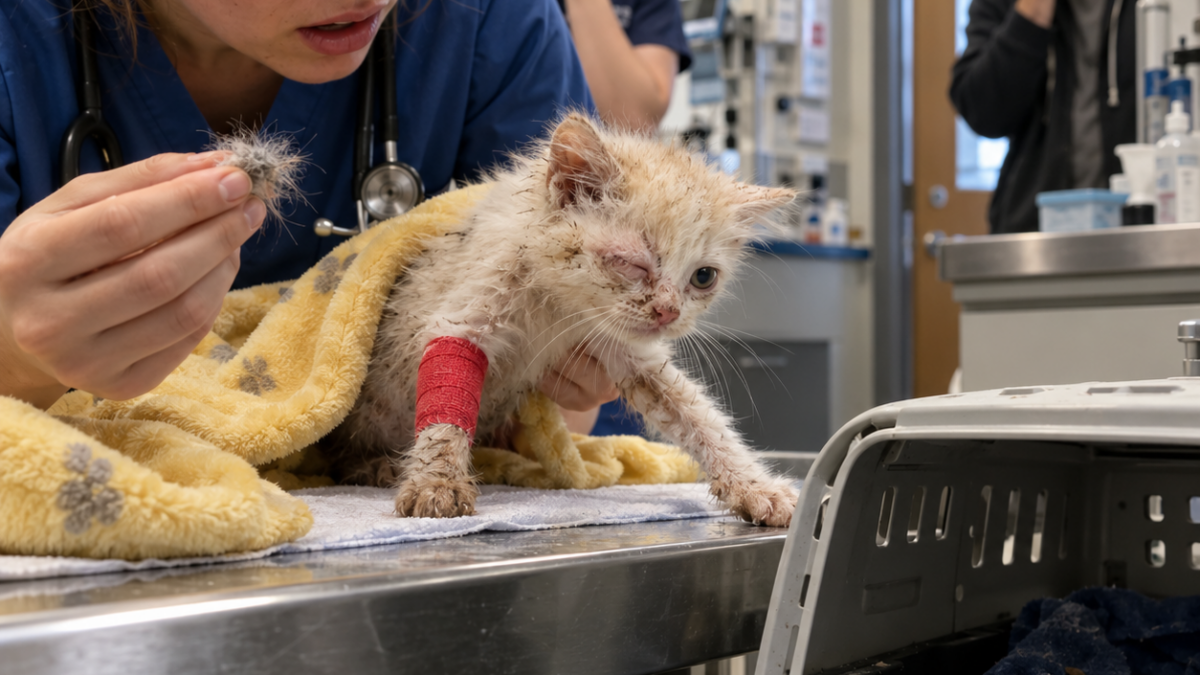
I looked down at the filthy little face, the swollen eye, the trembling whiskers, the tiny injured leg now protected in a bright red bandage.
“Sunny it is.”
I expected her to sink into the warmth.
Most kittens do after the first rush of handling stops. Especially the ones this weak. Their bodies realize heat has finally arrived, and they collapse into sleep with the full force of survival beginning.
Sunny did not.
She lifted her head.
At first, I thought it was a reflex.
Then she pushed her front paws beneath herself.
“Whoa,” I said, placing a hand beside her. “Easy.”
Her bandaged leg shook.
Her uninjured leg slipped.
Her back legs trembled so hard the yellow fleece moved under her.
Still, she stood.
One swollen-shut eye. One open eye.
Both pointed toward the clinic door.
I gently settled her down.
“Nope. You’re done. Sleep.”
Ten seconds later, she forced herself up again.
Jenna turned from the counter.
“She’s standing?”
“She thinks she is.”
Daniel was still filling out the intake form near the doorway. He looked up when he heard us.
“She did that in my truck,” he said.
“What?” I asked.
“Kept trying to sit up. Kept looking back.”
“Back where?”
He hesitated.
“Toward the storage buildings, I guess.”
Sunny wobbled.
I steadied her.
Her open eye shifted from the door to the carrier on the floor.
The same carrier Daniel had used to bring her from his truck into the clinic after removing the towel from his lap.
Jenna picked it up to move it away from the treatment table.
Sunny immediately tried to follow.
Her injured front leg touched the pad.
She flinched hard.
Still, she moved.
“Stop,” I said softly, placing both hands around her. “What are you doing?”
She twisted in my palms.
Not violently.
Not with strength.
With desperation.
Her eye locked on the carrier.
That was when I saw it.
A tiny tuft of gray fur stuck to the dirty towel inside.
Not cream.
Not Sunny’s.
Gray.
I reached down and pinched it carefully between my fingers.
The room changed.
Not dramatically.
No music. No slow-motion realization. Just a small cold shift inside my chest.
“Daniel.”
He looked up.
“Was there another cat?”
“No.”
“You’re sure?”
His face changed.
Not enough to be an answer.
Enough to be a warning.
“Well…”
I stood straighter.
“What does ‘well’ mean?”
“When I moved the boards, I thought I heard something else.”
Jenna stopped moving.
“What kind of something?” she asked.
Daniel rubbed both hands over his face.
“A little noise. Maybe a cry. Maybe wood shifting. I don’t know.”
“And you didn’t check?” Jenna’s voice sharpened before she could soften it.
“I did. I stood there listening, but it stopped. She was hurt, and I thought the scratching had been her.”
I looked at Sunny.
She was still staring at the carrier.
Then the door.
Then the carrier again.
I held the gray fur up in the light.
“How far away are those storage buildings?”
“Ten minutes.”
Jenna was already reaching for the phone.
“I’ll call Maya.”
Maya was one of the rescue volunteers we worked with when animals were trapped somewhere difficult. She was small, fearless, and physically incapable of ignoring a hole if something might be alive inside it.
Daniel’s face had gone pale.
“You think there’s another kitten?”
“I don’t know,” I said.
Sunny’s legs buckled.
I caught her before she hit the pad.
For the first time since she arrived, she made a sound.
One thin, desperate cry.
Daniel stared at her as if she had just accused him.
Then he whispered, “I’m going back.”
I wrapped Sunny more tightly in the yellow fleece.
“You’re not going alone.”
Less than twenty minutes later, Daniel and Maya were pulling into the storage lot.
I stayed at the clinic with Sunny because she needed monitoring, fluids, warmth, medication, and someone willing to keep telling her she was not allowed to climb off the table.
My phone sat beside my hand.
Five minutes passed.
Then ten.
Nothing.
Sunny remained upright.
Every time I tried to settle her down, she fought me.
Not like an animal trying to escape.
Like an animal trying to finish something.
“Absolutely not,” I told her. “You are the patient. Your job is to lie there and let medicine happen.”
She stared toward the door.
“You’ve done your part.”
She pushed against my hand.
“You got somebody’s attention. You came out. You brought us the clue. Now let us do ours.”
Her one open eye blinked slowly.
Then she tried to stand again.
“You are extremely stubborn.”
Jenna brought another warmed towel.
“She still won’t sleep?”
“No.”
“Pain?”
“Controlled as well as we can right now.”
“Fear?”
“Probably.”
We both knew probably was not a real answer.
At twelve minutes, my phone rang.
I almost dropped the thermometer.
“Maya?”
For several seconds, all I heard was breathing.
Then she said, very quietly, “We found where the sound is coming from.”
My hand tightened around the phone.
“Is it another kitten?”
“We think so.”
“Think?”
“It’s deep under the structure.”
I turned away from the examination table, although I had no idea why. Sunny could not understand the conversation.
At least, that was what I told myself.
“What can you see?”
“Almost nothing. Daniel moved the top boards, but there’s a narrow cavity behind the concrete footing. We heard one cry.”
“One?”
“Just once.”
My stomach tightened.
“How do you get in?”
“We don’t. Not directly.”
I heard scraping, then Maya speaking away from the phone.
“Careful with that. Don’t pull the bottom board.”
Then she came back.
“We’re removing debris piece by piece.”
“Don’t pull anything that could collapse.”
“I know.”
“Sorry.”
“You’re a nurse. Worrying is your hobby.”
I looked at Sunny.
“No argument there.”
Maya lowered her voice.
“I’ll call you as soon as we have something.”
The line went dead.
I set the phone beside the warming pad.
Sunny tried to stand again.
This time, I placed my hand lightly across her shoulders.
Her tiny body trembled beneath my palm.
“You are going to lie down,” I said. “Even if I have to make this a workplace policy.”
She did not care about workplace policy.
Hope is dangerous in rescue.
People imagine rescue as a series of beautiful moments. A frightened animal, gentle hands, a warm blanket, a happy ending.
Sometimes it is.
Other times you arrive six hours too late.
Sometimes you hear an animal but cannot reach it.
Sometimes the body is simply too damaged.
Sometimes the person who brings one kitten in believes there are no others, and by the time anyone realizes a mother had hidden a litter somewhere else, the outcome is already decided.
Hope is necessary.
So is discipline.
Until there was a kitten in someone’s hands, I would not let myself believe.
I checked Sunny’s gums again.
Still pale.
Temperature slightly improved.
That was something.
A few minutes later, the phone rang again.
“Maya?”
“We found him.”
Him.
One word.
Enough.
“Alive?”
“Yes.”
My knees weakened.
“Condition?”
“Cold. Very cold. Weak. I don’t see major bleeding. He’s smaller than your kitten.”
“Bring him straight here.”
“We are.”
“How long?”
“Ten minutes.”
“Call if he changes.”
“I know.”
I hung up.
Jenna had heard enough.
“Another kitten?”
I nodded.
“Alive.”
Her hand went to her mouth.
I turned to Sunny.
She was still standing.
“Your sibling is coming,” I told her.
That time, I did not care whether I was giving human meaning to an animal’s behavior.
I said it anyway.
“Someone found him.”
Sunny stared at me.
Then her legs finally folded.
Not dramatically.
Not like a scene written to break your heart.
She simply sank onto the warm pad. Her head remained lifted for another few seconds, as though she wanted proof. Then her chin lowered onto the yellow fleece.
Jenna looked at me.
“Did she understand?”
“No.”
The answer came too quickly.
Jenna raised one eyebrow.
I stroked the fur between Sunny’s ears.
“I don’t know.”
The clinic door opened eleven minutes later.
Daniel came in first, breathless and streaked with dust.
Maya followed carrying a second towel.
This one was gray.
Or at least the tiny shape inside it was.
“Room two,” I said.
We moved.
The gray kitten was smaller than Sunny.
Much smaller.
Thin body. Ears too large for his head. Eyes partly open. Paws cold enough to feel almost unreal against my fingers.
But he was alive.
His heart was beating.
Weakly.
Rapidly.
Alive.
Daniel stood against the wall, breathing hard.
“I almost left him there,” he said.
No one answered.
He rubbed both hands over his face.
“I almost drove away.”
Maya looked at him.
“But you went back.”
“Because she wouldn’t stop looking at the door.”
His voice broke.
“I thought she was scared.”
“So did we,” I said.
We worked on the gray kitten.
Warmth came first. Too much heat too quickly can be dangerous in a severely chilled animal, so we warmed him gradually. His blood sugar was low. His body was dehydrated. Unlike Sunny, he did not appear to have a significant leg injury, but his weakness was more profound.
We placed him in an incubator.
Daniel stood outside the glass.
“Is he going to make it?”
“I don’t know.”
I hated saying those words.
But they were true.
“He has a chance.”
Daniel swallowed.
“That’s enough.”
We called him Ash.
Sunny and Ash.
Jenna said the names sounded like the beginning and end of a fire.
I told her not to get poetic at work.
She ignored me.
That evening, we positioned their recovery spaces beside each other. They could not physically be together yet. Sunny’s eye needed treatment. Her injured leg needed protection. Ash needed controlled warmth.
But they could hear each other.
Smell each other.
The clinic quieted after closing.
Phones stopped ringing.
The waiting room lights went dark.
The fluorescent lights over the treatment area were dimmed.
I was entering notes into the computer when I heard it.
A sound so faint I first thought it came from one of the machines.
I stopped typing.
There it was again.
Purring.
I stood.
Sunny was curled against the yellow fleece, her good eye closed. Across from her, Ash had shifted toward the side of his incubator nearest her.
The purr could have been coming from either one.
Maybe both.
I called Jenna over.
She listened.
Her face softened.
“Well.”
I crossed my arms.
“Don’t.”
“What?”
“You’re about to say something sentimental.”
“I was going to say they know each other.”
“That is not sentimental.”
“You’re crying.”
“I have allergies.”
“At night?”
“Very aggressive allergies.”
The rescue was not over.
Not remotely.
Sunny’s eye could still worsen. Her leg might be more badly damaged than our first examination suggested. Ash remained dangerously weak. We did not know where they had come from. We did not know whether there were more.
And we certainly did not know how two tiny kittens had ended up beneath discarded lumber behind a storage facility with no mother in sight.
But for that night, both were alive.
And Sunny finally slept.
The next morning, she was the first thing I checked.
Her temperature was better. Her hydration had improved. She was still weak, but the desperate restlessness was gone.
When I entered, she lifted her head.
Then looked toward Ash.
Not the door.
Ash was sleeping inside his incubator.
“See?” I told her, adjusting her blanket. “He’s terrible company. He sleeps all day.”
She blinked.
I offered her a small amount of food.
She sniffed.
Turned away.
“Don’t start.”
We tried again a few minutes later.
This time, she took a little.
Then another lick.
Then one more.
Jenna walked by.
“Eating?”
“Barely.”
“Barely counts.”
That became our rule.
Barely counts.
Ash’s morning was harder.
His blood sugar had improved during the night, then dipped again. He did not want to eat. He barely responded when touched.
Dr. Patel examined him and frowned.
“He’s younger than Sunny.”
“How much younger?”
“Maybe the same litter, but significantly smaller. Could be the runt.”
I looked toward Sunny.
“Would he have survived another night out there?”
Dr. Patel did not answer immediately.
That was answer enough.
Daniel returned before lunch.
He had barely slept.
“I wanted to see them.”
I brought him into the treatment area.
Sunny opened her eye when she heard his voice.
Ash did not move.
Daniel stood between them.
“I should’ve checked better.”
“Stop.”
He looked at me.
“I heard him.”
“You heard something.”
“I could’ve—”
“You had an injured kitten in your hands. You got her here.”
“And almost left him.”
“But you didn’t.”
He stared at Ash.
“What if she hadn’t done that?”
I knew what he meant.
What if Sunny had simply slept?
What if she had not stared at the carrier?
What if the gray fur had stayed unnoticed in the towel?
What if Daniel had forgotten the second sound?
There are questions in rescue that do nothing except punish the person asking.
So I refused to answer.
“She did,” I said.
Daniel nodded slowly.
After a minute, he said, “There’s something else.”
“What?”
“Our storage facility has cameras.”
My attention sharpened.
“Cameras where?”
“Behind the main buildings. Not everywhere, but some cover the service lane.”
“You think you can see how the kittens got there?”
“Maybe.”
“Is there a mother cat around?”
“I asked the other workers. Nobody’s seen one recently.”
“That doesn’t mean there isn’t one.”
“I know.”
He hesitated.
“I’m going through the footage.”
“Why?”
His jaw tightened.
“Because those boards didn’t fall there naturally.”
A different feeling entered the room.
Until then, I had assumed Sunny and Ash belonged to a stray mother who had found a dangerous place to hide them. That was still possible. It is often possible. Animals find terrible shelters when humans leave terrible options.
But the way Daniel said somebody stacked it made me uncomfortable.
“Call me before you make conclusions,” I said.
“I will.”
“Seriously.”
“I know.”
“We do not accuse somebody because two kittens were found near lumber.”
“I said I’ll check.”
After he left, I returned to Sunny.
She had begun licking food from Jenna’s finger.
Good.
I told myself Daniel would find nothing.
Most mysteries around stray animals are not dramatic.
A mother moves kittens.
One gets trapped.
People disturb a hiding place unknowingly.
Weather changes.
A door closes.
Life becomes dangerous by accident.
There does not always have to be a villain.
I preferred that.
By afternoon, Sunny was strong enough for a more detailed examination of her leg and eye.
The leg injury was painful but not catastrophic. That was our first genuinely good medical surprise. There was tissue damage, swelling, and a wound that required protection, but we did not expect her to lose function.
Her eye was less certain.
The swelling had obscured what lay beneath. Dr. Patel cleaned the area carefully.
Sunny protested.
A tiny hiss.
I smiled.
Dr. Patel looked at me.
“Why are you happy?”
“She hissed.”
“You celebrate strange things.”
“A kitten who hisses has energy.”
Sunny hissed again.
“There,” I said. “Very energetic.”
The eye itself had suffered trauma and infection.
“We may be able to save it,” Dr. Patel said.
“Vision?”
“Too early to know.”
“Pain?”
“Manageable.”
“Long-term?”
“Ask me in forty-eight hours.”
I hated waiting.
Sunny hated eye medication.
That made two of us.
Ash finally ate a meaningful amount late that afternoon.
It was not much.
But he swallowed.
Then searched weakly for more.
Jenna looked at me.
“Barely counts.”
“Barely definitely counts.”
We put a note on his chart.
GOOD FEEDING.
Nobody except clinic staff would understand why two words could create celebration.
That evening, Daniel called.
I answered in the supply room.
“Tell me you found a mother cat.”
“No.”
My stomach tightened.
“What did you find?”
“I went back three days on the footage. Nothing until yesterday morning.”
“Okay.”
He went silent.
“Daniel?”
“There was a car.”
I leaned against the shelves.
“What car?”
“Dark SUV. Pulled into the service lane at 5:18 a.m.”
“So?”
“Someone got out.”
I closed my eyes.
“What did they do?”
“They carried a box.”
There are moments when your body reacts before your mind catches up.
My jaw tightened.
“A box?”
“Yes.”
“Could you see what was inside?”
“No. Camera angle is too far.”
“Then do not assume.”
“I don’t have to.”
“Why?”
“The person left the box behind the maintenance unit.”
“And?”
“Eight minutes later, the box was gone.”
“Gone how?”
“Two kittens crawled out.”
I said nothing.
Daniel’s voice had changed.
He was angry now.
“Someone dumped them.”
“Do you have the footage?”
“Yes.”
“Save copies.”
“I already did.”
“Do not post it.”
“I wasn’t—”
“Do not confront anyone.”
“Why would I—”
“Because you sound like you’re about to.”
He exhaled.
“What should I do?”
“Call animal control.”
“I can send them the video.”
“Do that.”
“I can get part of the license plate.”
“Let animal control handle it.”
He was silent.
Then he said, “Sunny didn’t get trapped there accidentally.”
“No.”
“And Ash—”
“I know.”
“Somebody left them in a box.”
I looked through the supply-room doorway.
Sunny was sleeping beside Ash’s incubator.
“I know.”
Anger is useful in rescue when it becomes action.
It becomes dangerous when it turns into fantasy.
People wanted villains. They wanted confrontation. They wanted someone dragged into a room and forced to look at what they had done.
Real accountability is usually slower.
Forms.
Evidence.
Statements.
Camera timestamps.
License plates.
Witnesses.
Veterinary records.
Animal-control reports.
Sometimes charges.
Sometimes nothing.
I had learned not to confuse satisfying stories with actual justice.
So when Daniel asked whether he should post the footage online, I said no.
“Why protect them?” he demanded.
“I’m not protecting anyone.”
“It feels like it.”
“If the footage identifies someone, I want the case preserved. If hundreds of people start calling, threatening, or guessing wrong, you can destroy the only path to consequences.”
He went quiet.
“Send the original video to the officer,” I said.
“I will.”
“And make copies.”
“Already done.”
“Good.”
The next morning, Animal Control Officer Reyes came to the clinic.
Reyes was broad-shouldered, gray beginning at his temples, with the weary expression of someone who had heard every excuse humans could make and still kept showing up.
He looked at Sunny first.
Then Ash.
“Both from the same location?”
“Yes.”
I gave him the timeline.
Daniel had already sent the footage.
Reyes had watched it.
“Vehicle is registered locally,” he said.
My attention sharpened.
“You got the plate?”
“Enough of it.”
“Who?”
He gave me a look.
“You know I’m not giving you a name during an active investigation.”
“I had to try.”
He nodded toward Sunny.
“Vet records?”
“I can provide the medical summary.”
“Good.”
He looked at the red bandage.
“Extent of injuries?”
I explained Sunny’s eye, leg wound, dehydration, hypothermia risk, and general condition. Then Ash. Severe chilling. Weakness. Low blood sugar. Dehydration. Smaller size.
Reyes wrote everything down.
“Can you prove the injuries happened because they were abandoned?”
“No,” I said.
His pen paused.
I hated the answer, but I knew better than to stretch medicine into certainty.
“Sunny’s eye and leg injuries could have happened before, during, or after confinement. We cannot prove exact timing. But both kittens were found without appropriate care, food, water, warmth, or shelter after being left there.”
“Good answer.”
“What answer did you expect?”
“A lot of people want certainty medicine can’t give.”
He was right.
Again.
Annoyingly.
“Evidence first,” he said.
Not revenge.
Not outrage.
Evidence first.
By the third day, Sunny stood without trembling for several seconds. She placed her front paws against Ash’s incubator and gave one small hoarse meow.
Ash’s ear moved.
“That is enough,” I told her.
She objected.
Of course she did.
By afternoon, Dr. Patel agreed we could allow limited supervised contact if both kittens remained stable.
We prepared a warm padded space.
I carried Ash first. Without the incubator walls around him, he looked unbelievably small.
Then Sunny.
The moment I placed her beside him, she crawled forward.
Not gracefully. Her bandaged leg made the movement awkward. But she went straight to him. She smelled his head. Ash lifted his nose.
For one second, neither moved.
Then he pressed himself under Sunny’s chin.
Sunny lay down.
Immediately.
No struggle.
No staring at the door.
No forcing herself upright.
Just down.
Her body curved around his.
I covered them both with the edge of the yellow fleece.
Jenna whispered, “There.”
I did not answer.
I had spent days trying not to assign human emotions to Sunny. Maybe she had been searching for familiar scent. Maybe her nervous system associated the carrier with her sibling. Maybe her agitation came from pain and stress rather than any conscious understanding that Ash was missing.
Those explanations could all be true.
None made the moment less moving.
She rested.
Ash rested.
And the purring returned.
For the next week, their improvement became linked.
Sunny ate better when Ash was nearby. Ash became more active when he could smell and hear her. We still separated them for medical care, but whenever possible, they rested together under supervision.
Sunny’s eye slowly opened.
The first time I saw a narrow sliver, I called Dr. Patel over so fast she thought something had gone wrong.
“She opened it,” I said.
“I see.”
“How does it look?”
“Give me a minute.”
“That phrase should be illegal in veterinary medicine.”
She examined the eye carefully.
Sunny protested.
A lot.
There was the kitten I wanted.
Dr. Patel finally stepped back.
“I’m more optimistic.”
“About vision?”
“About saving the eye.”
I exhaled.
“That’s good.”
“It is.”
“Vision?”
She looked at me.
“Still asking?”
“Yes.”
“Probably limited.”
“How limited?”
“We’ll know later.”
Later had become a place we lived.
Ash’s progress was steadier. Once he began eating, he seemed determined to make up for lost time. He crawled over Sunny to reach food. Sunny smacked him with her bandaged paw.
Not hard.
Enough.
“That’s sibling behavior,” Jenna said.
“No clinical terminology?”
“Very clinical.”
Ash also discovered that he had a voice.
A loud one.
I entered the recovery room one morning and heard screaming.
I ran.
“What happened?”
Jenna stood beside them.
“Breakfast is four minutes late.”
I stared.
Ash yelled again.
“That sound came from him?”
“Yes.”
“Where was that three days ago?”
“Hypothermic.”
I laughed.
“Good.”
Sunny meowed too.
“Now both?”
Jenna smiled. “You’re outnumbered.”
The clinic staff fell in love with them.
That happens.
We tell ourselves not to.
We maintain professional distance.
Then a kitten sleeps with its chin on another kitten’s back, and suddenly every employee has seventeen photos.
The next turn in the story came from a phone call I did not expect.
A woman called the clinic asking about “two kittens taken from a storage facility.”
The receptionist transferred her to me.
“This is Claire,” I said.
“I think you have my kittens.”
The words hit hard.
“Your kittens?”
“Yes.”
“Can I have your name?”
“Melissa Carter.”
“Can you describe them?”
“One light-colored. One gray.”
My hand tightened around the phone.
“Where did you last see them?”
“At my apartment.”
“When?”
“About a week ago.”
I stayed quiet.
She continued.
“My boyfriend said he took them to a rescue.”
The room seemed to narrow.
“What rescue?”
“He didn’t say.”
“How did you learn they were here?”
“Someone at his old storage place told me.”
“Are you asking to reclaim them?”
“Yes.”
I stared through the window.
Sunny was asleep.
Ash’s paw rested across her neck.
My first instinct was no.
Immediate.
Absolute.
No.
But rescue does not operate on instinct alone.
“Melissa, I need you to contact animal control.”
“Why?”
“Because there is an investigation related to how the kittens came into our care.”
“I didn’t do anything.”
“I’m not saying you did.”
“He was supposed to take them somewhere safe.”
“Then speak with Officer Reyes.”
“Can I at least see them?”
I hesitated.
“Not until we have clearance.”
Her voice broke.
“I’ve been looking for them.”
That did not sound like the voice I expected.
But voices prove little.
“Call Officer Reyes,” I said.
Then I gave her the office number.
After hanging up, I called Reyes immediately.
“Did you know there was a girlfriend?”
“We were going to interview her today.”
“She says the kittens were hers.”
“I know.”
“She says she thought he took them to a rescue.”
“I know.”
“How much do you know that I don’t?”
“A fair amount.”
“That’s annoying.”
“It’s an investigation.”
“Do you think she’s telling the truth?”
“Don’t know yet.”
A new question had entered the story.
Had the person who dumped them stolen them from someone who believed they were safe?
Or was this an attempt to avoid consequences?
Melissa arrived with Officer Reyes that afternoon.
She was younger than I expected. Mid-twenties. Hair pulled back. Eyes red from crying. She stood in the waiting room looking terrified.
Reyes nodded to me.
“She can see them. No release.”
I led them back.
The moment Melissa saw Sunny, she covered her mouth.
“Oh my God.”
Sunny lifted her head.
Melissa started crying.
“Pearl.”
I stopped.
“You called her Pearl?”
Melissa nodded.
“And the gray one?”
“Pip.”
Ash.
Pip.
She moved toward the enclosure.
I blocked her gently.
“Slowly.”
“Sorry.”
She crouched.
“Pearl?”
Sunny stared.
Melissa held one hand near the edge.
Sunny sniffed.
Then did something that confused me.
She moved closer.
Not dramatically.
Not proof of anything.
But she recognized something.
Maybe scent.
Maybe voice.
Maybe coincidence.
Ash woke.
Melissa whispered, “Pip.”
He meowed.
She cried harder.
Officer Reyes watched everything without expression.
“Tell Claire what you told me,” he said.
Melissa wiped her face.
“I found their mother behind my apartment building almost two months ago. She was stray, I think. She started coming when I left food.”
“Then?”
“She disappeared for a few days and came back skinny. I followed her and found four kittens.”
“Four?”
That word changed everything.
Sunny and Ash were not the whole litter.
“What happened to the other two?”
Melissa looked at Reyes.
“My boyfriend gave them away.”
“To whom?”
“I don’t know. He said two people from work wanted kittens.”
“And Sunny and Ash?”
“Pearl and Pip were smaller. Pearl’s eye started looking irritated. I wanted to take them to a vet.”
“What happened?”
“My boyfriend said we couldn’t afford it.”
“What’s his name?”
“Eric.”
I already knew from the investigation that Eric was the man in the video.
Melissa continued.
“We fought. I told him I’d borrow money. He said they weren’t our responsibility. Then he told me he knew a rescue that would take them.”
“When?”
“The night before they disappeared.”
“And you believed him?”
Her face crumpled.
“Yes.”
The angry part of me wanted to ask how.
How do you hand two sick kittens to someone who has already shown no concern?
How do you not demand the rescue’s name?
How do you not check?
But people in controlling relationships learn to believe whatever ends an argument.
I did not yet know whether that was what had happened here.
So I asked a different question.
“What about the mother?”
“She stopped coming.”
“When?”
“About a week before.”
“Could Eric have taken her somewhere?”
Melissa’s face changed.
“I don’t know.”
Officer Reyes wrote something down.
Four kittens.
A missing mother.
Two given away to unknown people.
Two dumped behind storage buildings.
The case had just become much bigger than Sunny refusing to lie down.
Over the next several days, medicine and investigation moved side by side.
Melissa sent Reyes photographs from her phone. Four kittens together. Sunny—Pearl—recognizable by her pale fur. Ash—Pip—smaller and gray. Two others: one orange, one black-and-white. Their mother, a slender gray tabby with a white chest.
Date stamps mattered.
Messages mattered.
Melissa had texted Eric repeatedly about veterinary care.
PEARL’S EYE IS WORSE. I AM TAKING HER TOMORROW.
Eric replied:
WE ARE NOT SPENDING $300 ON STRAY CATS.
Another message from him:
I FOUND A PLACE. STOP WORRYING.
Then:
THEY TOOK THEM.
But no rescue had taken them.
A camera had.
And behind a maintenance building, two tiny kittens had crawled out of a box into a day that almost ended both their lives.
The orange kitten was located first.
Alive.
Living indoors with one of Eric’s coworkers, who said Eric had claimed the kittens were his to give away.
The black-and-white kitten was found two days later with another coworker’s cousin.
Alive too.
Underweight.
Parasites.
Treatable.
For the first time, all four kittens were accounted for.
Their mother remained missing.
Melissa asked to help search.
I went with her once.
That surprised both of us.
We walked behind her apartment complex with food, a flashlight, and a humane trap. The area was larger than I expected. Garages, bushes, dumpsters, drainage ditch, parked cars, and countless places for a frightened cat to disappear.
“What was she like?” I asked.
“The mother?”
“Yes.”
“Quiet,” Melissa said. “She wouldn’t let me touch her at first. Then after the kittens were born, she started coming closer.”
“Did you name her?”
“Willow.”
Of course she had.
People name animals long before they admit how much they care.
We searched until dark.
Nothing.
Melissa sat on the curb.
“I should’ve left him.”
I stayed standing.
“This is not the part where I give relationship advice.”
She laughed bitterly.
“He got angry because I talked to Officer Reyes.”
“Are you safe?”
She looked at me.
That was enough.
“Melissa.”
“He hasn’t hit me.”
“That wasn’t my question.”
“He broke my phone once.”
The entire story shifted again.
This was no longer only about kittens.
“Do you have somewhere else to stay?”
“My sister.”
“Go.”
“He says I’m ruining his life over cats.”
I sat beside her.
“Sunny had an injured eye. Ash was hypothermic. Those facts exist whether Eric likes them or not.”
“He keeps saying he thought someone would find them.”
“Then why hide the box behind the building?”
She looked up.
Exactly.
There are excuses that collapse under one question.
That was one.
Sunny’s eye was saved.
Not perfectly.
It would always be a little cloudy near one edge. Her vision on that side would be limited. But the eye became comfortable, functional enough to respond to light and some movement.
Her leg healed faster.
The red bandage became smaller.
Then disappeared entirely.
The first day without it, Sunny lifted that paw and stared as if confused by its sudden freedom.
Ash immediately attacked it.
Sibling justice.
Sunny slapped him.
Jenna laughed.
“Rehabilitation complete.”
“Very scientific.”
“I have charts.”
When Sunny and Ash were strong enough, we transferred them into foster care together.
That was nonnegotiable.
I told the rescue coordinator, “They stay together.”
She looked at me.
“You know we normally evaluate bonding before making that promise.”
“I evaluated.”
“How?”
“Sunny refused to sleep until we found him.”
“That’s emotional evidence.”
“She eats better with him.”
“Better.”
“She sleeps beside him.”
“Normal for kittens.”
“She screams when we move him.”
“Also normal.”
I crossed my arms.
“They stay together.”
The coordinator smiled.
“You realize I already agreed before this conversation started.”
“I hate you.”
“No, you don’t.”
Their foster was a retired school librarian named Margaret, who had raised more kittens than some veterinarians. Her house had an entire room converted for fosters: washable flooring, climbing structures, low beds, heating pads, labeled cabinets, and the calm authority of a woman who had seen every kind of tiny disaster.
Sunny hid for the first hour.
Ash came out in seven minutes.
Of course he did.
Within three days, Ash had learned to climb onto a low shelf.
Sunny learned to pull him off.
Within five days, both discovered that Margaret’s slippers moved.
Within a week, Margaret called me.
“They are criminals.”
“What happened?”
“Curtain.”
“How bad?”
“Recoverable.”
“Which one?”
“Both.”
The clinic had spent so much time celebrating basic survival that misbehavior became its own kind of joy.
Sunny chased toys.
Ash climbed.
They wrestled.
They slept.
They ate with the intensity of animals trying to erase the memory of hunger.
Then, almost when I had stopped believing we would find her, Melissa called.
“I found Willow.”
I stood up so fast my chair rolled backward.
“Alive?”
“Yes. Thin. Scared. Her ear is torn, but alive. She’s in the trap.”
“Bring her in.”
Willow arrived forty minutes later.
Gray tabby.
White chest.
Green eyes.
Exhausted but fierce.
She hissed at everyone.
I loved her immediately.
“She hates me,” Melissa whispered.
“She’s terrified.”
“I used to feed her.”
“She’s been surviving outside.”
Willow had fleas, parasites, a healing ear wound, and the hard defensive posture of a cat who had learned not to expect good things. But she was healthier than I feared. No microchip. No owner. A body that had recently nursed kittens.
“That’s her,” Melissa whispered, covering her mouth.
Once Willow was medically stable and tested, Margaret brought Sunny and Ash in.
I warned everyone.
“They may not recognize each other. Willow may reject them. The kittens may be old enough that—”
“I know,” Melissa said.
We set up a quiet room.
Willow entered first and crouched low.
Sunny and Ash remained in a carrier.
When I opened it, Ash came out first.
Sunny followed.
Willow froze.
Her nose lifted.
Ash stopped.
The room became completely still.
Then Willow made a sound.
Not a meow.
A low chirping call.
Sunny’s head snapped toward her.
Ash moved first.
He ran.
Willow stepped forward.
They met in the middle.
She smelled him frantically.
Head.
Back.
Tail.
Then Sunny arrived.
Willow pushed her nose into Sunny’s neck.
Sunny leaned against her.
Melissa began crying.
Margaret cried.
Jenna cried.
I did not.
Allergies, obviously.
Willow groomed both kittens roughly, urgently, as if trying to erase the missing weeks. Sunny tolerated it for approximately twenty seconds before attempting to play with Willow’s tail. Ash crawled under her.
The reunion was not cinematic.
One kitten knocked over a water bowl.
Willow hissed at a technician.
Ash bit my shoelace.
Perfect.
Melissa whispered, “All four.”
I looked at her.
“What?”
“All four kittens are alive. And Willow.”
She wiped her face.
“I thought I lost everybody.”
In the end, Melissa did not ask for all the animals back.
That earned my respect.
“I can’t care for five cats,” she said.
“No.”
“I wanted to.”
“That doesn’t make it responsible.”
“I know.”
She looked at Willow.
“Can she stay with Pearl and Pip?”
“We have to evaluate.”
“I mean if she wants.”
That was the right question.
Willow spent time in foster care with Sunny and Ash. At first, we expected the kittens to become independent quickly. Instead, Willow seemed to relax around them. She ate better. She played. She stopped hissing at Margaret after four days.
Mostly.
By the end of the second week, Margaret called me.
“I have a problem.”
“What?”
“The mother is bonded to them too.”
“You sound upset.”
“I have three cats asleep on my lap. I haven’t moved in forty minutes.”
“Tragic.”
“My tea is across the room.”
“Thoughts and prayers.”
“I hate you.”
“No, you don’t.”
The adoption plan changed.
Sunny and Ash had to stay together.
Willow, if possible, would go with them.
That was a bigger request.
Three cats.
One adult.
Two kittens.
One kitten with reduced vision in one eye.
Many applicants loved the idea until they understood the responsibility.
One application said they wanted “the heroic sister kitten.”
Denied.
Animals are not characters you collect from viral stories.
Another wanted Sunny but not Ash.
Denied.
A family wanted the kittens but planned to “put the mother outside because adult cats prefer that.”
Absolutely not.
Then came the Whitakers.
A couple in their early fifties whose older cat had died the previous year. Quiet home. No small children. Large screened porch. Experience with cats. Financially stable enough for veterinary care. Patient enough to understand that trust is not owed on arrival.
They applied for all three.
Their first message said:
We don’t want to separate a family that has already been separated enough.
I read it twice.
Then called Margaret.
“Don’t get excited.”
“I’m already excited.”
“I said don’t.”
“Too late.”
The Whitakers visited.
Willow hid initially.
Ash introduced himself by climbing onto Mr. Whitaker’s knee.
Sunny sat near Mrs. Whitaker and watched.
No one forced anything.
Mrs. Whitaker placed her hand on the floor.
Sunny approached.
Sniffed.
Rubbed against her.
Then returned to Ash.
Willow emerged fifteen minutes later. She sat across the room. Mr. Whitaker ignored her completely.
That was exactly right.
He talked to us, answered questions, did not stare, did not coax.
Twenty minutes later, Willow moved closer.
Then closer.
At the end of the meeting, she sat three feet away.
For Willow, that was practically an embrace.
The application was approved.
Court happened three days before the adoption.
I almost did not go.
Part of me worried that seeing Eric would make me too angry. Reyes had warned me that court would not look like television. No dramatic confession. No jury gasping. No perfect speech.
He was right.
The room was plain. Fluorescent lights. Wood benches. People waiting for unrelated cases. Paper shuffling. Quiet conversations.
Then Eric walked in.
He looked ordinary.
That bothered me.
People who do cruel things rarely arrive dressed like villains.
The prosecutor laid out the evidence calmly.
Security footage.
Eric’s admission that he transported the kittens.
His statement that he left them at the storage facility.
Veterinary documentation showing dehydration, hypothermia, eye trauma, and untreated injury.
Messages proving he knew Sunny needed medical care before he removed the kittens.
The prosecutor did not exaggerate.
That mattered.
She did not claim he caused every injury.
She said he knowingly removed dependent kittens from a residence, represented that he would take them to a rescue, and instead abandoned them in a location where no care had been arranged.
Eric’s attorney argued that he believed employees would find them.
The prosecutor asked a series of questions.
Did he notify any employee?
No.
Did he leave them at the office entrance?
No.
Did he contact a shelter?
No.
Did he call animal control?
No.
Did he tell Melissa where he left them?
No.
Did he place the box in an open public area?
No.
The judge understood the difference between surrender and abandonment.
Eric eventually entered a plea agreement.
No dramatic collapse.
No shouting.
No begging.
He admitted abandoning the kittens.
He received probation, fines, restitution obligations related to part of their veterinary care, mandatory animal-welfare education, community service, and a prohibition on owning or possessing animals during probation.
Was it the punishment my angry mind had imagined?
No.
My angry mind wanted him forced to sit beside Sunny’s examination table while she tried to stand on three good legs. It wanted him to hear Ash’s weak cry beneath the boards. It wanted him to spend twelve cold hours in the dark wondering whether anyone would come.
That is not justice.
That is revenge.
Justice meant the record now said what he had done.
He could not rewrite it as “I found them a place.”
The video existed.
His admission existed.
The veterinary records existed.
The court order existed.
He had to pay part of the cost.
He could not legally take another animal home during probation and decide later that care was inconvenient.
The rescue did not need his suffering.
We needed prevention.
After the hearing, Eric turned and saw Melissa.
For one moment, I thought he would approach her.
Reyes stepped slightly between them.
Eric stopped.
“You did this,” he told her.
Her face changed.
The old reflex appeared.
Guilt.
Then disappeared.
“No,” Melissa said quietly. “You did.”
He stared at her.
“I asked you to take them somewhere safe,” she said.
“You brought stray cats into my apartment.”
“And you put two injured kittens in a box.”
“I thought someone—”
“Stop.”
The hallway went silent.
“You told me a rescue took them,” she said. “You lied because you knew I would go get them if you told me where they were. That’s why you hid them.”
He said nothing.
That was enough.
The Whitakers completed the adoption two days later.
All three.
Sunny.
Ash.
Willow.
Margaret cried before they even arrived.
“I hate adoption day,” she said.
“You foster animals.”
“I contain contradictions.”
Willow had become healthier. Her coat was fuller. She had been spayed. Her ear scar remained. Sunny’s eye would always look slightly different. Ash had become almost as large as his sister, no longer the tiny gray shape pulled from darkness.
The Whitakers brought three carriers.
Prepared.
Calm.
Responsible.
Mrs. Whitaker sat on the floor. Sunny approached first, of course. The kitten who once refused to lie down now walked confidently across the room. She jumped onto a low stool, then onto the couch. Her depth perception was not perfect, but she had learned her own body.
Ash followed.
Willow watched.
Mr. Whitaker opened one carrier.
“No rush,” he said.
Willow eventually entered on her own.
That told me everything.
Before they left, Mrs. Whitaker asked, “Do they have to keep these names?”
“No.”
She looked at Sunny.
“I like Sunny.”
“Her first name was Pearl,” I said.
“I know.”
“And Ash was Pip.”
“I know.”
“What are you thinking?”
She looked at her husband.
“We thought maybe keep both.”
“Both?”
“Sunny Pearl,” she said.
Then she pointed toward Ash.
“Ash Pip.”
“That is terrible.”
Mr. Whitaker laughed.
“We know.”
“And Willow?”
“Willow won’t answer to anything anyway.”
Fair.
The carriers were loaded.
Willow gave me one final suspicious stare.
Ash meowed.
Sunny sat quietly.
I placed my fingers against the carrier door.
“Sleep whenever you want now.”
Mrs. Whitaker looked at me.
“What?”
“Nothing.”
They drove away.
The updates started that night.
Willow under a bed.
Expected.
Ash exploring.
Expected.
Sunny sitting outside the bedroom door because Ash had wandered too far.
Very expected.
Day two: all three ate.
Day three: Willow came out while the Whitakers watched television.
Day four: Sunny and Ash discovered the screened porch.
Day five: Willow joined them.
A week later, Mrs. Whitaker sent a photograph that became my favorite.
Three cats sleeping in afternoon sunlight.
Willow in the middle.
Sunny pressed against her left side.
Ash on the right.
Nobody waiting.
Nobody missing.
Nobody trapped.
Months passed.
The kittens grew.
Sunny’s pale coat became soft and clean. Her once-swollen eye remained slightly cloudy but comfortable. She navigated the house effortlessly.
Ash became longer, heavier, and absurdly confident.
Willow turned into a cat who tolerated visitors but reserved affection for her family.
Melissa visited them with the Whitakers’ permission. The first time, she cried. Willow approached her. Sunny rubbed against her ankle. Ash stole a shoelace.
Melissa messaged me afterward.
I thought seeing them would hurt.
Did it? I wrote back.
Yes.
Then another message appeared.
But in a good way.
Melissa moved out of the apartment she had shared with Eric. She stayed with her sister for several months, then rented a small place of her own. She did not adopt another animal immediately.
That impressed me.
“I want to be ready,” she said.
Eventually, she adopted an adult cat from a shelter.
Not a fragile kitten with a dramatic rescue story.
A big brown tabby named Harold whose main problem was being repeatedly overlooked because he was nine years old.
I liked that ending for her.
Not redemption through a grand gesture.
Just a stable home for an older cat who needed one.
Daniel remained at the storage facility. He became obsessive about checking beneath anything that made noise.
For months, he sent me photographs.
Cat?
Raccoon.
Another.
Cat?
Plastic bag.
Another.
Cat?
Actual cat, already owned by the mechanic next door.
I finally told him, “You have trauma.”
He replied, “Correct.”
The storage company changed its procedures.
Employees were instructed to report any abandoned animal immediately. Cameras were upgraded. The service area where Sunny and Ash had been left was cleared. No more loose board piles. No hidden cavities. A sign with the local animal-control number went up near the office.
Not dramatic.
Useful.
That mattered more.
One year after Sunny first arrived, the Whitakers brought all three cats to the clinic for routine checkups.
Not emergencies.
Routine.
That word pleased me more than it should have.
Ash came out of the carrier acting as though he owned the building.
Willow refused.
We examined her mostly inside the lower half of the carrier.
She had standards.
Then Sunny.
Mrs. Whitaker placed her on the examination table.
The same kind of warm pad where she had once refused to lie down.
For a second, I saw both versions of her.
The tiny injured kitten with the red bandage.
And the healthy young cat standing in front of me.
Her cream fur was clean. Her body had filled out. Her once-injured leg bore weight normally. Her left eye was imperfect, cloudy near one edge, but still there.
Still comfortable.
Safe.
Dr. Patel examined her.
“Weight is good.”
I smiled.
“Very specific.”
“Heart good.”
“Strong diagnostic language.”
“Leg good.”
“You went to medical school for this?”
Dr. Patel ignored me.
“Eye stable.”
That one mattered.
After the exams, we let the three settle in a quiet room before the drive home. Sunny climbed onto a yellow fleece pad almost exactly the same color as the wrap we had used on her first day.
She turned twice.
Then lay down.
Immediately.
No hesitation.
No staring toward the clinic door.
No forcing herself back onto shaking legs.
Ash climbed beside her.
Willow settled nearby.
Sunny closed both eyes.
One fully clear.
One slightly cloudy.
Safe.
I sat on the floor.
Mrs. Whitaker watched me.
“You okay?”
“Yes.”
“You look emotional.”
“Allergies.”
She laughed.
Sunny began to purr.
Ash joined her.
Willow pretended not to.
I reached toward Sunny.
She opened one eye.
I rubbed beneath her chin.
“You know, you caused a lot of trouble.”
Purr.
“You made a man crawl under a building.”
Purr.
“You started an animal-control investigation.”
Purr.
“You made me attend court.”
Her paw came forward and rested on my wrist.
It was the same leg that had once been wrapped in red.
I stopped talking.
People later asked me whether Sunny saved Ash.
I never knew how to answer.
Daniel physically returned.
Maya crawled into the gap.
The clinic stabilized him.
Dr. Patel treated him.
Margaret fostered him.
The Whitakers gave him a home.
Many hands saved Ash.
But none of those hands would have been in the right place at the right time if Sunny had simply been treated as an isolated patient and nobody had questioned why she kept looking back.
So yes.
In the way that mattered, she saved him too.
Her refusal to rest was not magic.
It was information.
We just had to notice.
That lesson changed the way I worked.
Months later, a frightened dog came into the clinic after being found near a highway. He refused to eat and kept staring toward the parking lot. Old me might have written “anxious stray” on the chart and moved on.
Instead, I asked exactly where he had been found.
A volunteer went back.
There was another dog fifty yards away in a drainage ditch.
Alive.
Different story.
Same lesson.
Behavior is communication even when we do not understand the language yet.
Not every restless animal is protecting a secret.
Not every animal staring at a door has someone waiting outside.
Sometimes a frightened animal is only frightened.
Sometimes a restless animal is in pain.
Sometimes a cat staring at a carrier just wants to hide.
And sometimes there is a tiny piece of gray fur caught in a dirty towel.
Sometimes there is a second cry beneath the boards.
Sometimes the patient on the table is not asking you to save her.
She is simply showing you, in the only way she can, that your work is not finished yet.
Five years after the storage rescue, the Whitakers brought Sunny in for a minor dental issue.
Nothing serious.
Routine treatment.
She walked into the clinic on a harness.
A harness.
The kitten who once could not stand now marched into my clinic wearing purple and looking deeply offended by the entire institution.
I crouched.
“Sunny?”
She stopped.
Looked at me.
I held out my hand.
She sniffed.
Then rubbed her face against it.
“You remember.”
Mrs. Whitaker laughed.
“She remembers anyone associated with food.”
“I choose to interpret this emotionally.”
Ash was home.
Willow was home.
Sunny was alone at the clinic for the first time since those early days.
I wondered whether she would become anxious.
She did.
But for an entirely different reason.
She hated being separated from her family.
During recovery from the dental procedure, she stood and turned toward the door.
For one strange second, I was back five years earlier.
Injured kitten.
Red bandage.
Door.
Waiting.
Then Sunny meowed angrily.
I laughed.
“You’re not doing this again.”
She meowed.
“Ash is home.”
Another meow.
“Willow too.”
She paced once.
Then sat.
I picked up my phone and called Mrs. Whitaker.
“Can you come twenty minutes early?”
“Is something wrong?”
“No.”
I looked at Sunny.
“She’s impatient.”
When Mrs. Whitaker arrived, Sunny heard her voice from the hallway. Her head lifted. She walked directly toward the carrier.
No trembling.
No collapse.
No injury.
Just certainty.
Mrs. Whitaker opened the door.
“Ready to go home?”
Sunny climbed inside.
Before they left, I touched the top of the carrier.
“Everyone accounted for?”
Sunny meowed.
“Good.”
That evening, Mrs. Whitaker sent a photograph.
Sunny asleep beside Ash.
Willow at their feet.
I looked at it for a long time.
The strangest thing about Sunny had never been that she survived an injury. Animals survive terrible things every day. It was not even that she led us back to Ash, because she did not lead us in any deliberate human sense.
The strange thing was how one unexplained behavior changed the decisions of every person around her.
Daniel remembered the second sound.
I noticed the fur.
Maya returned.
Ash was found.
The camera footage was checked.
Four kittens were located.
Willow was searched for.
A dumping case became an abandonment case.
A woman left a man who had taught her to doubt her own judgment.
A storage facility changed its procedures.
Three animals ended up together in a house where nobody would ever decide their care was inconvenient.
All because somebody asked one extra question.
Why won’t this kitten lie down?
That is what I think about now when an animal does something I cannot explain.
I do not romanticize it.
I watch.
I listen.
I ask.
Because sometimes the thing that looks like stubbornness is pain.
Sometimes what looks like fear is memory.
Sometimes what looks like restlessness is a message.
And sometimes the smallest patient in the room is not fighting you.
She is telling you, with every bit of strength she has left, that someone is still missing.
Sunny eventually became sleepy during that five-year visit.
Once she knew Mrs. Whitaker had arrived, the tension left her. She curled inside the carrier. Her head lowered. Her eyes closed.
No struggle.
No waiting.
Nothing left behind.
I thought about the first night.
That injured little kitten had fought sleep until Ash returned.
Five years later, she could close her eyes before she even reached home because she already knew exactly where everyone she loved would be when she woke up.
And that, more than the court case, more than the recovered eye, more than the healed leg, more than every photograph and update that followed, was the ending I had wanted for her from the beginning.
Not revenge.
Not a miracle.
Just this:
Everyone safe.
Everyone found.
And finally, nothing left for Sunny to wait for.