An Eight-Month-Pregnant Ranch Wife Watched a Dust-Covered Stranger Ride Up Carrying Her Husband’s Leather Bag—Then He Took Off His Hat and Said, “Your Husband Saved My Life.”
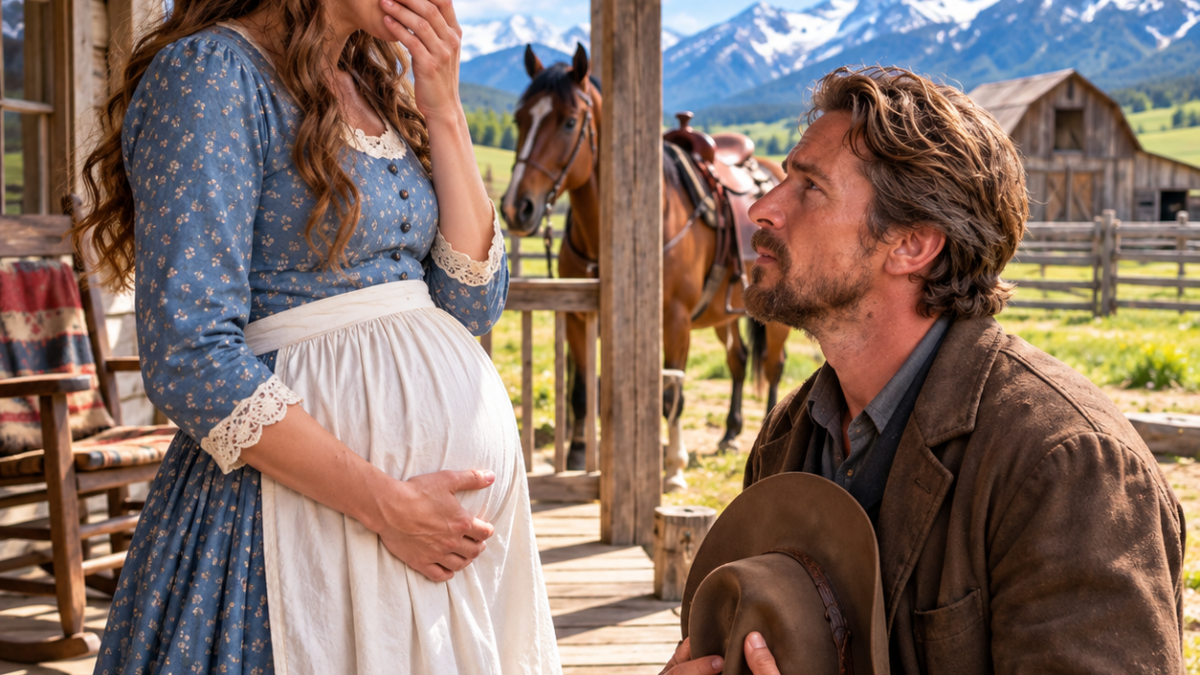
An Eight-Month-Pregnant Ranch Wife Watched a Dust-Covered Stranger Ride Up Carrying Her Husband’s Leather Bag—Then He Took Off His Hat and Said, “Your Husband Saved My Life.”
Rose Caldwell was nearly eight months pregnant with her first child when the stranger rode up to her porch carrying her husband’s leather bag.
She saw the bag before she saw his face.
That was how she knew.
It was late afternoon, and the Dakota Territory sky had turned the color of old brass. Wind moved through the dry grass beyond the corral. The chickens were already gathering near the coop, complaining softly to themselves. A half-finished cradle sat inside the front room near the window, one curved rail still rough, waiting for Hollis’s hands.
Rose had spent most of the day pretending not to worry.
That had become the work of the week.
Sweep the floor.
Pretend not to worry.
Knead bread.
Pretend not to worry.
Fold the tiny shirts she had sewn from flour sacks.
Pretend not to worry.
Stand in the doorway and stare down the road until the child inside her shifted beneath her ribs, as if reminding her that worry had never brought a man home faster.
Hollis had left the ranch a week earlier with a small herd of cattle.
The sale money was supposed to settle part of the ranch’s debts, finish the new barn, and buy what they still needed before the baby arrived.
Before he rode out, he had pressed one broad hand flat against her belly and smiled the way he smiled when he was trying not to show fear.
“I’ll be back before he decides to arrive.”
Rose had raised an eyebrow.
“He?”
Hollis grinned.
“How do you know it’s a boy?”
“I just know.”
“You know, do you?”
“Some things a man simply knows.”
“You also knew that south pasture gate would hold another season.”
“That gate betrayed me.”
She had laughed then.
It was the last sound Hollis Caldwell ever heard from his wife.
Now an unfamiliar rider approached in a cloud of pale dust, moving slowly as though every hoofbeat made the road harder. His hat was low. His shoulders sagged with exhaustion. His horse looked spent.
And in his hands, when he dismounted, he carried Hollis’s leather bag.
PART2;
Rose stood on the porch with one hand braced against the doorframe and the other curved over the child.
The stranger stopped at the bottom step.
He removed his hat.
For several seconds, he said nothing.
Rose looked at the bag.
Then at him.
He looked like a man who had rehearsed a sentence for miles and found that distance had not made it easier to speak.
“Mrs. Caldwell?”
Rose’s throat tightened.
“Yes.”
“My name is Emory Cole Ransom.”
The baby moved once beneath her palm.
Emory’s eyes dropped to the movement, then away again, as if the sight made what he had come to say almost unbearable.
“Your husband saved my life,” he said finally.
Rose went very still.
The world seemed to narrow to the porch step, the bag, the man’s dust-covered boots, the sound of wind against the eaves.
“But?” she whispered.
Emory closed his eyes.
That was when Rose knew the rest.
PART3:
Hollis had left at dawn seven days earlier, driving twelve head of cattle east toward a meeting point near the river crossing.
The buyer was a man named Emory Cole Ransom, an experienced cattle trader who traveled between ranches and small settlements, purchasing stock for resale in the larger markets farther east. Emory knew cattle the way some men knew scripture. He could judge weight, health, age, and temperament with a glance. He knew which ranchers spoke honestly and which hid sick animals behind dust and distance.
He had never met Hollis Caldwell before that day.
By noon, he had decided he liked him.
That did not happen often.
Emory made his living by not trusting men too quickly.
But Hollis was the kind of man whose decency seemed to arrive before he did. He negotiated firmly but fairly. He did not inflate the value of the weaker animals, and he did not pretend the best ones were ordinary. He knew the herd and respected the work behind it.
More than that, he talked.
Not boastfully.
Not foolishly.
But because happiness, in him, seemed to need someplace to go.
Over the midday meal, sitting on two overturned crates near the cattle pen, Hollis spoke constantly of Rose.
“My wife would say I talk too much when I’m nervous,” he said, cutting a piece of bread with his pocketknife.
“Are you nervous?” Emory asked.
“About cattle? No.”
“About the sale?”
“No.”
“Then what?”
Hollis hesitated, then smiled down at his hands.
“First child coming.”
Emory nodded.
“That’ll do it.”
“Near eight months now.”
There was pride in Hollis’s voice.
Pride and fear twisted so tightly together that Emory recognized both.
“Cattle at least give a man signs he can read,” Hollis said. “A child’s different territory.”
He reached into his pocket and took out a small piece of carved wood.
At first Emory thought it was scrap.
Then he saw the care in it.
A curved piece, sanded smooth along one edge.
Part of something larger.
“Started a cradle back in the fall,” Hollis admitted. “Figured I had months to spare. Turns out a man underestimates how much barn work eats into cradle-building time.”
Emory took it when Hollis offered.
The wood was walnut.
Good grain.
A careful hand.
“You made this?”
“Making it. Slowly.”
“How much left?”
“Enough that my wife keeps looking at me like she’s wondering whether I expect the baby to sleep in a feed trough.”
Emory laughed.
Hollis grinned.
“She doesn’t say it. Rose has a way of being quiet that speaks plenty.”
“You afraid of her?”
“Terrified,” Hollis said cheerfully. “A man should be a little afraid of any woman who knows exactly what needs doing before he’s finished thinking about breakfast.”
He took the piece of cradlewood back and turned it over in his hands.
“How do you know it’s a son?” Emory asked.
Hollis smiled.
“Told Rose the same thing. I just know.”
“Some things a man simply knows?”
“That’s right.”
“And if you’re wrong?”
“Then my daughter will spend her life hearing the story of how her father was wrong once, and her mother will take great pleasure in telling it.”
Emory liked him more after that.
By late afternoon, the sale was settled.
Emory paid the agreed price, and Hollis counted the money carefully before placing it with the paperwork inside the leather bag. He buckled the bag beneath his saddle with the kind of care a man gives something that carries more than dollars.
It carried winter.
It carried lumber.
It carried a cleared debt.
It carried blankets, flour, nails, and whatever small things Rose had written on the list pinned inside the pantry.
It carried a cradle not yet finished and a child not yet born.
Since both men were headed the same direction for part of the road, they rode together.
The sky darkened as they approached the river.
Several days of heavy rain in the mountains had swollen the current. Even from a distance, Emory heard the roar before he saw the water. It was not the mild crossing marked on his map. It was brown, fast, and angry, churning with torn branches and debris from higher ground.
He reined in beside Hollis.
“Doesn’t look friendly.”
Hollis studied the water for a long moment.
“Crossed worse.”
“That supposed to comfort me?”
“No. Just saying I made poorer decisions and lived.”
The humor did not reach his eyes.
He watched the current, tracing the surface with a rancher’s attention.
“Follow my line exactly,” Hollis said. “Current’s meanest where it looks calmest.”
He nudged his horse forward.
The animal resisted at first, then entered the water.
For several tense moments, horse and rider fought the pull together. Hollis leaned low, guiding with calm hands, reading the water as if it were a living thing trying to lie to him.
He reached the far bank.
Mud splashed beneath the horse’s hooves.
Emory exhaled.
Then followed.
Halfway across, his horse lost footing on a hidden rock.
It happened fast.
One moment the animal was struggling but steady.
The next, its front legs buckled, and the river took them both.
Cold water closed over Emory’s head.
He came up choking.
His horse screamed once and vanished downstream.
The current spun Emory sideways.
He struck something beneath the surface hard enough to knock the breath from him. His boots dragged. His coat filled. He fought to keep his face above water, but every stroke seemed to pull him nowhere.
“Hollis!”
He did not know whether he shouted or only thought the name.
On the far bank, Hollis had already made it.
He could have stayed there.
No one watching would have blamed him.
A man with a pregnant wife waiting.
A man carrying sale money.
A man with every reason in the world to value the ground beneath his horse.
He turned back into the river.
Emory saw him only in flashes.
Horse chest-deep in current.
Hollis leaning forward.
One arm out.
Face set with terrifying determination.
The horse fought bravely, hooves striking rock, slipping, finding footing again.
Hollis reached Emory just as his strength began to fail.
“Grab the mane!”
Emory missed.
“Again!”
This time Hollis caught his coat and shoved him toward a jagged rock formation jutting from the water. Emory struck hard, skin tearing from his palm, but his fingers found purchase.
He clung.
Coughing.
Gasping.
Half drowned.
“Hold there!” Hollis shouted over the roar. “I’ll get a rope!”
He turned his horse toward the bank.
That was when the river brought the log.
It came fast, half-submerged, black with water, spinning in the current.
Emory saw it.
He shouted.
Hollis turned too late.
The log struck him across the back with a sound Emory felt more than heard. Hollis folded forward, air driven from his lungs, then pitched sideways from the saddle.
For one second, his hand caught in the reins.
Then the leather slipped.
The river took him.
Emory tried to move.
His body would not obey.
His hands were numb. His lungs burned. The current pinned him to the rocks like a cruel hand.
“Hollis!”
Hollis surfaced once.
Farther downstream.
He fought for air.
For footing.
For anything.
Then, before the bend took him from sight, he shouted one last thing.
Not help.
Not curse.
Not prayer.
“My wife’s expecting our child!”
Then he disappeared around the bend.
Hollis’s horse reached the bank without him.
The reins dragged through mud.
The leather bag was still tied beneath the saddle.
Soaked outside.
Securely buckled.
Emory did not remember clearly how he got out of the river.
He remembered crawling.
Vomiting water.
Shaking so violently he could not stand.
The horse stood nearby, sides heaving, eyes wild.
And there beneath the saddle was the bag.
Hollis had saved the money.
Hollis had saved Emory.
Hollis had not saved himself.
For two days, Emory searched the riverbanks with men from a nearby settlement.
They found branches.
A torn glove.
Part of a broken fence rail carried down from somewhere upstream.
They did not find Hollis Caldwell.
On the third morning, Emory understood what remained for him to do.
He rode to the Caldwell ranch.
He had planned his words a hundred ways.
None survived the porch.
Rose looked at him and the bag and knew too much already.
Emory told her everything.
He told her Hollis had completed the sale fairly.
He told her the money was all there.
He told her Hollis had already reached the far bank.
He told her he had turned back only because Emory had been swept away.
He told her about the rock, the rope, the log.
He told her about Hollis’s final shout.
My wife’s expecting our child.
When he finished, Rose had not moved except for one hand tightening around the curve of her belly.
The room behind her was dim.
The half-finished cradle sat near the window.
Emory took the leather bag in both hands and held it out.
“Every dollar is inside,” he said. “Not one missing.”
Rose looked at the bag.
For a moment, Emory thought she would not take it.
Then she did.
Her fingers brushed the leather as though touching Hollis’s hand through it.
She asked only one question.
“Did he know he was going to have a son?”
Emory lowered his eyes.
“He talked about it the whole day.”
Rose’s mouth trembled once.
“He did?”
“Yes, ma’am.”
Emory told her about the cradle.
About the carved piece of walnut Hollis had carried in his pocket.
About the way he spoke her name.
About how he kept saying he needed to get home before the baby came.
About how he grinned when he said some things a man simply knows.
That was when Rose finally understood fully that Hollis was not coming back.
Not late.
Not injured somewhere.
Not delayed by weather.
Gone.
The room was quiet for a long time.
Emory stood because grief that was not his had filled the house so completely he felt like an intruder inside it.
“I’ll leave you now, Mrs. Caldwell.”
Rose lifted her head.
“You’ll stay for supper.”
It was not a question.
Emory did not know what to do with that.
“I don’t want to impose.”
“You came to my porch carrying my husband’s death,” she said, voice steady in a way that hurt to hear. “You can sit at my table long enough to eat.”
So he stayed.
They ate at opposite ends of the table and said almost nothing.
The silence was not empty.
It was the specific silence of two people who had been handed a grief neither knew how to carry.
Rose set a plate in front of him.
Beans.
Bread.
Cold beef.
He thanked her.
He ate because refusing seemed cruel.
Afterward, he washed his own dishes without being asked.
Rose watched from the doorway and said nothing.
When he moved to saddle his horse, she stood on the porch.
“The barn loft is dry.”
“I can sleep outside.”
“The barn loft is dry,” she repeated.
So he slept in the barn.
Emory believed his obligation ended there.
He had delivered the money.
He had told the truth.
He had not stolen so much as a dollar from a dead man’s family, though no one would have known if he had.
He intended to leave the following morning.
But at dawn, while saddling his horse, he noticed a broken section of fence near the corral.
Then the low firewood stack.
Then the uneven hinge on the barn door.
Then the cattle needing sorting in the lower pasture.
There were too many tasks for a woman nearly eight months pregnant and alone.
So when Rose woke, she heard hammering.
She stepped onto the porch wrapped in a shawl.
Emory was by the corral, sleeves rolled, repairing the broken fence as if he had every right to be there.
Anger came to her with relief beneath it, which made it sharper.
“Mr. Ransom.”
He did not stop hammering.
“Yes, ma’am?”
“I don’t need charity.”
“It isn’t charity.”
“That what you call fixing another woman’s fence before breakfast?”
He set the nail, struck it once, then looked at her.
“Your husband gave me a life I still don’t know how to repay.”
Rose’s face hardened.
She did not like that answer.
She did not want Hollis turned into an eternal debt she was expected to accept along with the stranger carrying it.
“You already repaid it,” she said. “You brought back every dollar.”
“The money was his.”
“And the rest?”
“What he did at that river was something else.”
He set the hammer down.
“I’m not here because I feel obligated to you, Mrs. Caldwell. I’m here because if I ride away knowing a good man’s pregnant wife has a broken fence, no firewood, and cattle needing sorting, then whatever life he gave me isn’t worth much.”
Rose held his gaze.
She had the expression of a woman measuring whether something was true or merely well said.
Finally, she said, “Fine. But when you finish the fence, you come in and eat something.”
“Yes, ma’am.”
She went inside.
The fence was fixed before noon.
He came in and ate.
He was still there the following morning.
Little by little, Emory became a steady presence in the ranch’s daily life.
He knew cattle better than almost any man in the region. He reorganized part of the herd. He helped negotiate the sale of animals Hollis had already planned to sell. When buyers offered far less than the cattle were worth, thinking a widow would accept anything, Emory ended the conversation cold.
“The cattle didn’t get cheaper because she lost her husband,” he told one man.
Rose heard it from the porch.
She said nothing.
But that evening, his coffee was stronger than usual, and there was an extra slice of bread on his plate.
He never entered the house uninvited.
Never slept anywhere but the barn.
Never used Hollis’s personal tools without asking first.
Never made decisions on Rose’s behalf.
That mattered more than she wanted it to.
Once, while repairing a damaged gate, he stood in the shed doorway for too long.
Rose noticed.
“What?”
“I need a brace.”
“You know where the lumber is.”
“Yes, ma’am.”
“Then get it.”
He looked at the tools hanging on the wall.
Rose understood.
“You could simply take what needs using.”
“Could.”
“But?”
“Rather ask and let you decide. It’s yours to say.”
She handed him the right tool.
He took it.
Neither said anything else.
But something shifted between them that was small and not small at the same time.
One evening, weeks later, she found him on the porch mending the small wooden horse he had carved for the baby. It had broken during a fall from the table, and he was putting it back together by lamplight.
“You don’t have to mend everything that breaks around here,” Rose said.
Emory kept his eyes on the wooden horse.
“I know.”
“Then why do you?”
He turned the toy carefully in his hands.
“Because this is the first place in a long while where anyone notices when I’m gone.”
Rose had no answer.
What unsettled her was that she had noticed long before he said it.
Three weeks after Emory arrived, Rose went into labor in the middle of the night.
It began with a pain that stole her breath.
Then another.
She gripped the edge of the kitchen table until her knuckles whitened.
Emory had been outside checking the horses when he heard something break inside the house.
He found her bent over the table, one hand pressed low on her belly, jaw clenched against fear.
“Mrs. Caldwell?”
“Midwife,” she said.
That was all.
He ran.
Not walked.
Ran to the barn, saddled his horse in half the time it should have taken, and rode into the dark.
The midwife lived miles away.
The road was uneven.
The moon was thin.
Emory rode like a man trying to outrun the memory of a river.
When he returned with the midwife, Rose was pale, furious, and very much alive.
“I told you not to break your neck,” she said between contractions.
“You said midwife.”
“I assumed you’d interpret that with sense.”
“I’ll try next time.”
“If there is a next time, I’ll shoot you before you saddle a horse like that again.”
The midwife looked between them and said, “Good. She’s got strength left.”
Emory stayed outside through the entire birth.
He paced the porch, unwilling to intrude on something that was not his to witness and unable to go farther away.
Hours passed.
Rose cried out.
The midwife spoke sharply.
Rain began.
Stopped.
The wind shifted.
Emory gripped his hat in both hands and prayed for a woman he barely knew, a baby he had never seen, and a dead man whose name had become the weight under every board of that porch.
Near dawn, a baby cried.
Emory sat down hard on the steps.
A boy was born.
Rose named him Wade Hollis Caldwell.
In the morning, she found Emory asleep on the porch steps, still wearing his boots, still caked with dust from the ride.
For the first time since Hollis’s death, Rose smiled.
Not fully.
Not without pain.
But enough that something in her face remembered light.
By the time the first snow came, Emory had been at the ranch two months.
He told himself he would leave when the fences were properly done.
Then when the cattle were sorted.
Then when the firewood was stacked high enough.
Then after winter.
There was always another reason.
He began to suspect the reasons were no longer entirely about the ranch.
Rose would have said the same about her reasons for not asking him to go.
Wade was three months old when fever came.
It arrived in the night, sudden and high, turning his tiny body hot beneath Rose’s palm.
She knew the difference between ordinary fussing and danger.
So did Emory when he saw her face.
“Doctor,” she said.
He was already reaching for his coat.
The snowstorm outside had covered the road.
The dark was deep and bitter.
Emory rode anyway.
He brought the doctor back before dawn, his beard white with ice, his horse trembling, his own hands nearly too numb to unbuckle the saddle.
He sat on the hallway floor while the doctor worked.
Hat in his hands.
Listening to Wade cry.
Then go quiet.
Then cry again.
When the doctor came out and said the fever was breaking, Emory bent forward, elbows on his knees, and stayed like that for a long time.
Rose came out an hour later.
“He’s sleeping,” she said. “Breathing easy.”
Emory nodded.
He did not trust his voice.
Rose lowered herself to the floor beside him.
That was not the sort of thing Rose Caldwell did under ordinary circumstances.
They sat there shoulder to shoulder, listening to the soft sounds of the house.
“Thank you,” she said finally. “For the doctor.”
“Any man would have gone.”
“You went,” she said. “In a snowstorm. In the dark.”
He had nothing to say to that.
Neither did she.
When she stood to return to Wade, Emory rose and helped her up.
Their hands held for a moment after they were both standing.
Then they let go.
She went back into the bedroom.
He went back to the barn.
As Wade grew, Emory told him about Hollis.
Not because Rose asked.
Because the boy deserved a father made of more than a photograph.
He told him how Hollis negotiated cattle.
How he talked about Rose.
How he carried a piece of cradlewood in his pocket and turned it over when he was thinking.
How he claimed to know he was having a son.
How he turned back into a rising river for a man he had known only one day.
Wade grew up knowing his father through his mother’s stories and through Emory’s memory.
The photograph above the fireplace showed Hollis standing beside a horse, hat tipped back, smiling as if he knew the joke before anyone told it.
On the mantle beside it sat the carved piece of cradlewood found in Hollis’s pocket after the sale. Emory had carried it back with the bag, wrapped in cloth. Rose had not been able to look at it for months.
Eventually, she placed it near the photograph.
Wade touched it often.
“Tell it again,” he would say.
And Emory would.
When Wade began to talk, one of his first names for Emory was Cole.
Not Emory.
Not Mr. Ransom.
Cole.
A child’s attempt at Emory’s middle name, which Rose occasionally used when she was being particularly direct.
“Cole, that hinge is crooked.”
“Cole, if you bring mud in this house, you’ll clean it.”
“Cole, you forgot your coffee.”
The name lodged in Wade before anyone noticed.
Then it became Uncle Cole.
Nobody corrected him.
By five, Wade followed Emory everywhere.
He learned to feed calves and spilled half the milk in the process.
He learned to brush horses and approach them from the side.
He learned to set his feet in the stirrups.
He learned to respect an animal before trying to control it.
“Why gentle first?” Wade asked once, watching Emory approach a skittish colt with slow hands.
“Same reason you’d want someone gentle with you meeting for the first time.”
“I wouldn’t kick.”
“You might if you were scared enough.”
Wade considered that seriously.
“Animal doesn’t know whether you mean harm yet,” Emory said. “A man who rushes that answer usually gets the wrong one.”
Wade absorbed lessons like scripture.
He mimicked Emory’s stance, his hat tilt, the way he leaned on fences when thinking.
Once, while working beside the corral, Emory caught Wade squinting at a post with one thumb hooked into his belt exactly like him.
“You’re doing the hat thing.”
Wade looked up.
“Mama says I do lots of things like you now.”
“Does she mind?”
“She smiles when she says it. So I don’t think she minds at all.”
A beat.
“Mama says you lean on fences whenever you don’t know what to say.”
Emory looked down.
He was currently leaning on a fence.
“Your mama notices too much.”
“She says the same thing about me,” Wade said, and returned to the post with the satisfaction of a boy who considered the matter settled.
Wade waited eagerly every time Emory returned from a buying trip.
He would run the length of the drive, shouting “Uncle Cole!” before Emory was properly through the gate.
At first, Emory told himself he loved the boy because of Hollis.
Because he owed it.
Because Wade deserved any scrap of fatherly attention the world would give him.
Then one day Wade fell asleep against his shoulder on the ride back from town, small hand curled in Emory’s coat, and Emory understood the truth with a force that frightened him.
He loved Wade as if the boy were entirely his own.
That was dangerous.
More dangerous than rivers.
Because his feelings for Rose had changed too.
At first, she had been Hollis’s wife.
Then a widow he respected.
Then the woman whose ranch he helped keep standing.
Then his friend.
Then the person he talked to after everyone else was asleep, sitting on opposite ends of the porch in the dark.
They talked about cattle.
Weather.
Wade.
Repairs.
Prices.
Sometimes Hollis.
Sometimes nothing of consequence at all.
Those small conversations became the place Emory’s mind returned whenever he rode away.
Rose had moved through her own change just as quietly.
At first, Emory was the stranger who brought the worst news of her life.
Then the man fixing things she had not asked him to fix.
Then the friend who asked before assuming.
Then the presence whose absence she felt with an irritation that was not irritation at all.
Neither spoke of it.
Both carried guilt.
Emory believed loving Rose meant taking for himself the life that should have belonged to Hollis.
Rose feared loving again would mean abandoning her dead husband entirely.
So they stayed carefully unnamed.
Until the day Rose came back from town with hands chapped raw from the cold.
She had lost a glove on the ride and said nothing.
Emory noticed.
He noticed most things.
Without comment, he brought the tin of salve he kept for cracked winter hands and set it on the table beside her.
Rose looked at it.
Then at him.
“I know how to use salve.”
“I know you do.”
He sat across from her.
Waited.
She applied it herself, methodically.
He watched.
She let him.
Afterward, they both looked at the fire for a while.
“Emory.”
“Yes.”
“You’ve been here two years.”
“I have.”
“Are you going to keep leaving and coming back,” she asked, “or are you going to stop pretending you’re not staying?”
The room went still.
He looked at the fire.
“I don’t know how to stay.”
It was the most honest thing he had said about himself since he arrived.
“My whole life, I’ve moved from one place to the next before anyone expected me to be there permanently. Hard habit to name when you’re in the middle of it.”
“You are in the middle of it,” Rose said. “I’m naming it for you.”
He almost smiled.
Could not quite manage it.
A week later, an offer arrived from a large cattle company.
They wanted Emory to manage purchases in another territory.
Better wages.
Real authority.
A position he had spent years working toward.
It was also an escape.
He accepted.
He told Rose over supper.
He kept his eyes on his plate.
“When do you leave?” she asked.
“End of the week.”
She nodded.
Passed the biscuits.
Said nothing else.
Emory recognized the silence.
It was the specific silence of a woman with more to say who had decided not to say it.
In some ways, that was worse.
On the morning of his departure, Wade ran to Emory’s horse carrying the small wooden horse Emory had carved years earlier.
“When’s Uncle Cole coming back?”
Emory could not answer.
Rose watched from the porch.
When Wade finally went inside, she walked down to where Emory stood beside his horse.
“Why do you have to go?”
He tried talking about the job.
The opportunity.
The money.
The territory.
Rose listened without believing any of it.
So he told the truth.
“Hollis died so I could live. Sometimes it feels wrong wanting the life that should have been his.”
Rose went quiet.
“And sometimes,” he continued, “I think leaving is what I do when something starts to matter too much. Easier to go before it costs me something to stay.”
He said it like a confession he had not known was true until the words left him.
Rose held his gaze.
“Do you believe Hollis saved you so you could spend the rest of your life punishing yourself for it?”
Emory had no answer.
So Rose gave him her truth.
“I spent years believing that loving anyone again would mean leaving Hollis behind.”
Her voice shook once, then steadied.
“But you never once tried to take his place. You taught Wade his father’s name. You kept his saddle in the barn. You talk about him like a man you respected, not like a man you’re trying to become.”
Emory could not breathe.
Rose stepped closer.
“Maybe that’s exactly why I started loving you.”
It was the first time either of them had said aloud what had lived between them for years.
At the porch window, Wade watched with his face pressed against the glass.
Emory looked at Rose.
Then at the boy.
Then at the horse.
He left anyway.
Not because he did not love her.
Because he needed to know whether he could come back by choice.
Not guilt.
Not debt.
Not obligation.
Choice.
He rode to the company’s regional office and met the man who had hired him.
The man talked about territory, cattle volumes, wages, profit margins, authority.
Emory sat with his hat in his hands and thought about a porch in Dakota Territory.
Coffee on the rail.
A boy running down the drive.
A woman who had named the truth before he could.
He thanked the man for the opportunity.
Then declined the position.
He rode back.
The weeks without Emory were hard at the ranch.
Wade asked about him every single day with the relentless devotion of a child who had decided something mattered and intended to keep saying so until the world corrected itself.
Rose kept the ranch running.
She mended harness.
Counted cattle.
Settled accounts.
Tended Wade.
Stacked wood.
Spoke Hollis’s name aloud.
And slowly understood that she had said something to Emory that could not be unsaid.
She did not regret it.
One afternoon, Wade was playing near the fence when he started shouting.
“Mama! Mama! Uncle Cole!”
Rose stepped onto the porch.
A rider was coming down the road.
Emory.
This time, he carried no contracts.
No buyer’s ledger.
No tools borrowed from someone else’s work.
He had not come to buy cattle.
Or repay a debt.
Or fulfill obligation.
He dismounted near the porch.
Rose came down the steps.
“Why did you come back?”
Emory looked at her.
Then at Wade, already running hard enough to stumble.
“Because I finally understood that a debt is something you pay off and leave behind.”
He took one step closer.
“I rode near two hundred miles trying to convince myself the new territory was where I belonged. Woke every morning thinking about this porch instead.”
His voice roughened.
“I’ve been leaving places my whole life before they could cost me anything. This is the first time I turned around.”
Wade collided into his legs before Rose could answer.
Emory dropped to one knee and caught him properly, lifting him with the easy strength Wade had grown up trusting.
“You came back,” Wade said, delighted, as if no further explanation were required.
“Seems I did.”
Emory looked at Rose over the boy’s shoulder.
Something settled lived in his expression now, something certain that had not been there the morning he left.
Rose looked at him for a long moment.
Then said, “Supper’s in an hour.”
“Yes, ma’am.”
She turned and walked back up the steps.
He watched her go.
From that evening forward, the relationship changed.
There was no sudden declaration.
No rushing.
No forgetting.
Their love grew the way things grow between two people who have spent years being careful with each other.
In small acts.
Rose leaving coffee on the porch rail when she heard him start early.
Emory asking about her day and actually waiting for the answer.
His hand at the small of her back when she stepped down from the wagon.
Her fingers brushing his when she passed him a cup.
A quiet walk to the barn after supper.
A smile held too long.
Small things that were not small.
He courted her the way he had once fixed her fence.
Patiently.
Deliberately.
Asking rather than assuming.
Offering rather than deciding.
And he honored Hollis.
Always.
When he taught Wade to ride properly, he used Hollis’s old saddle.
When Wade asked about his father, Emory never avoided the subject.
Hollis’s photograph remained above the fireplace.
Dusted.
Visible.
Loved.
The saddle stayed in the barn.
The piece of cradlewood sat on the mantle.
Rose came to understand that loving Emory did not erase what she had shared with Hollis.
It made room for a new part of her life.
The heart, she decided, was not a fixed size.
It expanded to hold what needed holding.
In the spring of 1889, when Wade was six years old, Rose Caldwell married Emory Cole Ransom in a small ceremony at the ranch.
Dakota Territory was just beginning to green.
The grass near the fence had returned in soft patches.
A few neighbors came.
The midwife came.
Bear Creek’s preacher came and forgot Rose’s middle name, which made Wade giggle until Rose gave him a look.
Wade carried the rings with grave seriousness, holding them flat on his palm as though carrying something breakable.
To him, Emory was still Uncle Cole.
That night, when Emory tucked him into bed, Wade asked a question that stopped him cold.
“If I ever call you Papa,” the boy said, “would my real father be angry?”
Emory went still.
The weight of that question settled in his chest more heavily than anything a child that young should have been able to place there.
Rose answered from the doorway.
“Your father saved Emory so he could keep on living,” she said.
Wade turned toward her.
“I think he’d be glad we managed to as well.”
Wade considered this with the serious expression Emory had seen a hundred times when the boy was weighing something that mattered.
Then he hugged Emory and said nothing more about it that night.
The next morning at breakfast, without ceremony, he tested the word as if checking whether it fit.
“Pass the biscuits, Papa.”
Emory passed the biscuits.
His hand was not steady.
He said nothing about the word.
Some moments are better received in silence than remarked upon.
In that house, Hollis was never forgotten.
His photograph stayed above the fireplace.
His name was spoken often, with warmth instead of only grief.
His saddle remained in the barn.
His piece of cradlewood stayed on the mantle, worn smooth from handling.
Wade knew the story by heart.
He asked for it anyway.
“How did he save you?” he would say.
And Emory would tell him.
Again.
And again.
Hollis Caldwell turned back into a rising river to save a stranger’s life.
He had already reached safety.
He could have ridden home to Rose.
He could have held his son.
He could have finished the cradle.
But he saw a man being taken by the current and turned back.
That choice cost him everything.
And gave Emory the life that eventually led him back to the porch, to Rose, to Wade, to the family none of them expected and all of them chose.
Years later, when Wade was old enough to understand more of the story, he asked Emory a question while they repaired fence along the south pasture.
“Did you love him?”
Emory looked toward the horizon.
“I knew him one day.”
“That’s not what I asked.”
Emory smiled faintly.
“No. I suppose it isn’t.”
He set the hammer down.
“I respected him before noon. Trusted him before supper. Owed him my life before dark. Loved him after I spent years raising his son.”
Wade absorbed that.
Then nodded.
“Good.”
“That all?”
“Mama says love isn’t always in order.”
“Your mama notices too much.”
“She says the same thing about us.”
Emory laughed.
Rose, standing near the barn with a basket in hand, heard both of them and smiled.
Some families do not begin the way anyone expects.
Sometimes they begin on the worst day of someone’s life, with a stranger standing on a porch carrying nothing but truth and a leather bag that once belonged to someone loved.
Sometimes the man who brings the worst news becomes, years later, the man passing biscuits at breakfast while a child tries the word Papa for the first time.
Sometimes a boy never meets his father and still grows up knowing him through a photograph, a saddle, a carved piece of wood, and the stories told by the man whose life his father saved.
Emory Ransom spent years believing the debt he owed Hollis Caldwell could only be repaid through duty.
Rose and Wade taught him that some debts are not meant to be carried forever.
Some are meant to become a life lived well.
A fence mended.
A child raised.
A name spoken.
A porch returned to.
A family made larger, not by forgetting the dead, but by letting love keep moving among the living.
Hollis never came home from the river.
But his love did.
It came back in the leather bag.
In the piece of cradlewood.
In the stories told at bedtime.
In the boy who grew up knowing his father was brave.
In the stranger who turned around instead of riding away.
And in the woman who learned, slowly and painfully, that loving again did not mean loving Hollis less.
It meant the life he saved had finally become something worthy of the saving.







