An 11-Year-Old Boy Walked Into Our Vet Clinic Alone With a Limp Orange Cat—Then He Emptied His Pockets and Offered Us His Backpack to Save Her
PART3:
“Six-year-old female cat. Acute collapse. Vomiting this morning. Kid brought her in.”
“Owner?”
“Eleven-year-old boy in the lobby. Alone.”
Claire looked toward the door.
Then at Marmalade.
“Okay. Table two.”
Within seconds, the quiet clinic changed.
That’s what people who have never worked in medicine don’t always understand.
Panic doesn’t make professionals run around screaming.
Panic makes everything faster and quieter.
A tech named Jasmine clipped fur.
Claire listened to the cat’s chest.
I pulled blankets from the warmer.
“Temperature 104.7.”
“Heart rate two-ten.”
“Dehydrated.”
“Get a glucose.”
“Blood pressure.”
“IV catheter.”
Marmalade barely reacted when the needle went in.
That frightened me more than if she had fought.
“She’s shocky,” Claire said.
The glucose meter beeped.
“Low.”
“Let’s start dextrose support. Fluids, carefully. CBC, chem panel, packed cell volume.”
I looked toward the lobby door again.
“I’m going to check on the kid.”
Claire nodded.
“And Maggie?”
I turned.
“Find out if there’s an adult we can contact.”
My name is Margaret Lawson, though almost everybody calls me Maggie.
I’m fifty-three years old, divorced, mother of one grown daughter, grandmother to nobody yet despite my daughter’s repeated warnings that asking will not speed up the process.
I have spent most of my adult life taking care of frightened animals and frightened people.
Sometimes I’m better with the animals.
That morning, I had a feeling the person in the lobby was going to need more than reassurance.
When I returned, the boy had not sat down.
He was standing beside the front desk, staring at the swinging door.
“Hey.”
He looked at me instantly.
“They’re working on her.”
“Is she alive?”
“Yes.”
His whole body loosened a fraction.
“She’s very sick, Eli.”
I had learned his name only because he had scribbled it shakily on the scrap of intake paper I’d handed him earlier.
Eli Turner.
Age eleven.
Under owner, he had written:
ME.
Under phone number, he had left the line blank.
“But alive?”
“Yes.”
He nodded rapidly.
“Okay.”
“Is there somebody we can call?”
His expression changed.
Only slightly.
But I noticed.
“My mom’s at work.”
“Do you know her number?”
He looked down.
“She doesn’t have her phone right now.”
“Could we call her job?”
“She can’t take calls.”
“Where does she work?”
He rubbed one sneaker against the other.
“Different places.”
Different places.
That wasn’t an answer.
It was also exactly the kind of answer a child gives when he’s protecting an adult.
“Dad?”
His shoulders went stiff.
“No.”
“Another relative? Grandparent? Aunt? Uncle?”
He shook his head.
“Anybody at home?”
“No.”
“Eli, how did you get here?”
“I walked.”
I stared at him.
“From where?”
He named an apartment complex across town.
My stomach tightened.
“That’s nearly two miles.”
He shrugged.
It wasn’t defiance.
It was as if two miles did not rank very high among the things he was worried about.
“Did you carry Marmalade the whole way?”
“Mostly.”
“Mostly?”
“She tried to walk at first.”
He swallowed.
“Then she couldn’t.”
I looked at his hands.
His fingers were red from the cold.
There was a shallow scratch across one knuckle.
“You don’t have a coat?”
“I have one.”
“Where is it?”
He looked toward the treatment room.
“I wrapped her in it at first, but she threw up on it.”
Something inside my chest hurt.
Before I could answer, he suddenly seemed to remember something.
“Oh.”
He yanked his backpack off his shoulder.
“I have money.”
“You don’t need to worry about that right this second.”
“Yes, I do.”
“No, honey—”
He shoved one hand into the front pocket.
Then another.
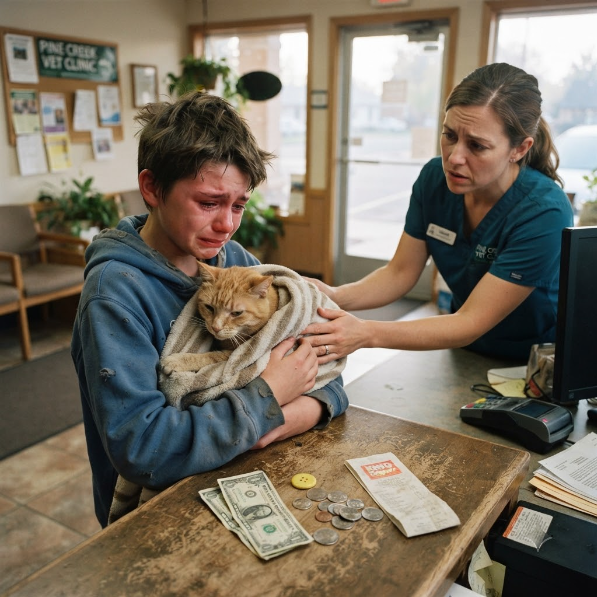
Coins hit the counter.
Three one-dollar bills.
Four quarters.
Six dimes.
A nickel.
Two pennies.
A button.
A grocery receipt.
A blue plastic game token from an arcade that had closed three years earlier.
“This is everything.”
His voice was shaking again.
I stared at the money.
“Eli—”
“You can take my backpack too.”
He pushed it toward me.
“It’s still good. The zipper sticks, but if you pull this part—”
He demonstrated.
“See?”
My throat tightened.
“We’re not taking your backpack.”
“I have a bike.”
“You walked.”
“The tire’s flat, but you could sell it after you fix it.”
“Eli.”
“And I can work.”
He started talking faster.
“I can clean cages. I can sweep. I know how to mop. I do the laundry at home. I can come after school every day until I pay you.”
I placed both hands flat on the counter.
“Eli.”
He stopped.
The clinic went very still around us.
His lower lip trembled.
Then he whispered the sentence I still hear sometimes when I’m lying awake at night.
“Please don’t let her die just because I’m poor.”
I had thought my heart was already breaking.
I had been wrong.
There are sentences children should not know how to say.
There are fears they should not have learned.
There are calculations an eleven-year-old should never have made.
I came around the counter again.
He looked embarrassed the moment I got close, as if crying had become some failure he needed to apologize for.
I crouched so we were almost eye level.
“Listen to me.”
His eyes stayed fixed on the floor.
“Eli.”
He looked up.
“Marmalade is being treated because she needs help.”
“But—”
“Not because of those three dollars.”
His eyes flicked toward the coins.
“Not because of your backpack. Not because of your bike. And you are absolutely not working off her care.”
“Then how—”
“That part is for grown-ups to figure out.”
His face tightened.
“But there’s just me.”
I didn’t understand then how literal he meant that.
I touched his shoulder.
“Right now there’s you, and there’s me, and there’s Dr. Reynolds, and there are three veterinary technicians back there trying to help your cat. So for this moment, it isn’t just you.”
He stared at me.
Children usually decide very quickly whether they believe you.
Eli seemed to take longer.
Like trust was expensive.
Finally, he nodded.
I pulled out the chair closest to the treatment-room door.
“Sit.”
He did.
“Do you want water?”
“No.”
“Hot chocolate?”
That got his attention.
“We have packets in the break room.”
His eyes narrowed suspiciously.
“Does it cost money?”
“No.”
“Then okay.”
I made it with more powder than I was supposed to and gave it to him in a paper cup with a plastic lid.
He held it between both hands.
For warmth, I think, more than anything.
For the next forty minutes, our clinic slowly filled around him.
Mrs. Hart brought in a senior beagle for a nail trim.
Mr. DeSoto arrived with a cockatoo that swore at everybody.
A young couple carried in a bulldog puppy who had eaten half a sock.
Normal life moved around Eli like he was sitting in the eye of a storm.
He barely noticed.
Every time the treatment-room door opened, he straightened.
Every time it closed without anyone speaking to him, he sank a little.
At 8:02, Claire came out.
She crouched beside him.
“Eli?”
He stood.
“I’m Dr. Reynolds.”
“Is Marmalade dead?”
“No.”
The answer came fast.
Eli inhaled so sharply it sounded painful.
Claire continued.
“She’s still very sick. Her blood sugar was low, she’s dehydrated, and she has a fever.”
“Can you fix it?”
“We’re trying to figure out exactly what caused it.”
“Is it poison?”
“Maybe. Maybe an infection. Maybe something else. We need more tests.”
His first response wasn’t about money.
It was worse.
“Did I do something?”
Claire frowned.
“What do you mean?”
“Did I make her sick?”
“No.”
“But I gave her tuna yesterday.”
“That wouldn’t cause this.”
“And I forgot to fill her water before school, but I did it when I got back.”
“This is not because you forgot her water for a few hours.”
He nodded.
Then looked away.
“Okay.”
Claire glanced at me.
It was the look professionals give each other when an animal’s medical condition stops being the only concern in the room.
“We’d like to keep Marmalade here,” Claire said. “Probably through the day. Maybe overnight.”
Eli’s face drained.
“Can I stay?”
“You have school.”
“I can miss.”
“You probably shouldn’t.”
“I already did.”
It was a Thursday.
I looked at the clock.
8:07.
“Does your school know where you are?”
He shook his head.
“Eli.”
“I couldn’t leave her.”
“I understand.”
“No, you don’t.”
He said it quietly.
Not rudely.
Just factually.
“If I went to school, nobody would bring her here.”
Claire sat in the chair across from him.
“Is your mom coming home today?”
“Later.”
“What time?”
“Depends.”
“Does she know you’re here?”
He went silent.
Claire looked at me.
That was when I knew we were no longer talking about a kid who had simply slipped out while his mother worked an early shift.
Something was wrong.
Not necessarily criminal.
Not necessarily dangerous.
But wrong.
“Can we call your school?” I asked.
His head snapped up.
“No.”
“Why?”
“Please.”
“Eli—”
“Please don’t.”
The panic in his voice returned instantly.
“Why not?”
“They’ll call people.”
“What people?”
He didn’t answer.
“Eli.”
His eyes filled again.
“They’ll say Mom left me.”
The clinic seemed to shrink around us.
I sat beside him.
“How long has your mom been gone?”
“She’s working.”
“I understand. How long?”
He twisted the paper sleeve around his hot chocolate.
“Since Tuesday.”
It was Thursday morning.
Claire’s eyes met mine.
“Where is she working?”
“I don’t know.”
“Does she usually stay away for two nights?”
“Sometimes.”
“How do you eat?”
His jaw set.
“There’s food.”
“Do you cook?”
“Yes.”
“What do you cook?”
“Stuff.”
“Eli.”
“Mac and cheese. Eggs. Cereal. Sandwiches.”
“Do you have electricity?”
He looked offended.
“Yes.”
“Heat?”
He hesitated.
That hesitation was answer enough.
I tried to keep my face neutral.
“Does your mom know the heat isn’t working?”
“She told the landlord.”
“When?”
“A while ago.”
“And Marmalade?”
“She sleeps with me.”
That explained why the cat mattered in a way I had not yet understood.
When the apartment was cold, Marmalade was warmth.
When the apartment was empty, Marmalade was company.
When his mother disappeared into the exhausting machinery of whatever kept them barely afloat, Marmalade was the one living thing that stayed.
Claire asked the next question carefully.
“Do you feel safe at home?”
“Yes.”
Too fast.
“Is anybody hurting you?”
“No.”
“Does anybody come into the apartment who scares you?”
“No.”
I believed him.
Mostly.
But I also knew scared children can tell the truth and still leave important pieces out.
Claire stood.
“I’m going to check on Marmalade.”
Eli grabbed her sleeve.
It wasn’t aggressive.
Just desperate.
“Please don’t call anybody yet.”
Claire looked down at his hand.
Then at his face.
“We need an adult responsible for you.”
“My mom is responsible.”
“I’m not saying she isn’t.”
“Yes, you are.”
His cheeks flushed.
“Everybody says that.”
I wondered who everybody was.
He let go of Claire’s sleeve.
“She’s not bad.”
His voice dropped.
“She’s just tired.”
That sentence told me almost as much as the first one had.
She’s not bad.
She’s just tired.
Children defend the people they love long after adults decide those people have failed.
Sometimes because they are afraid.
Sometimes because they are loyal.
Sometimes because they are the only ones who know the whole story.
“What’s your mom’s name?” I asked.
“Rachel.”
“Rachel Turner?”
He nodded.
“Where does she usually work?”
“She cleans the Hampton Inn three days. Sometimes she works at Bell’s Diner. And she does houses.”
“Which Hampton Inn?”
“The one by the interstate.”
I picked up the phone.
Eli shot to his feet.
“No.”
“I’m not calling the police.”
“What if they call them?”
“I’m calling the hotel.”
He stood frozen.
“If she’s there, we need to tell her you’re safe.”
“She’ll be mad.”
“Probably.”
That almost made him smile.
Almost.
The hotel transferred me twice.
Then a woman named Denise answered.
“Housekeeping.”
“Hi, my name is Maggie Lawson. I’m calling from Willow Creek Veterinary Clinic. I’m trying to reach Rachel Turner.”
Silence.
“Rachel?”
“Yes.”
“She hasn’t worked here for almost two weeks.”
My eyes went to Eli.
He was watching my face.
“Do you know where I could reach her?”
“No. She got let go.”
“Can I ask why?”
Another pause.
“I shouldn’t—”
“I understand.”
“She missed shifts.”
“Thank you.”
I hung up.
Eli had heard enough.
He looked down.
“She didn’t tell me.”
I moved around the desk.
“That doesn’t mean she isn’t working somewhere else.”
“She said she was there Tuesday.”
His voice was flat now.
Not crying.
Some truths hurt too deeply for tears at first.
“She said she got extra rooms.”
I hated the look on his face.
Not anger.
Not yet.
Embarrassment.
As though his mother losing a job was somehow shame he needed to wear.
“People sometimes hide bad news because they’re scared.”
“From kids?”
“Especially from kids.”
He stared through the glass front door.
“She said things were gonna get better.”
I didn’t know how to answer.
At 8:40, the lab results came back.
Marmalade had severe anemia.
Her kidneys were under stress.
Her liver values were abnormal.
The cause wasn’t obvious.
Claire asked if there were medications in the apartment.
Eli said only his mother’s headache pills and some cold medicine.
Cleaning chemicals?
“Under the sink.”
Rat poison?
“No.”
Plants?
“One little plant by the window. It’s mostly dead.”
Lilies?
He didn’t know what lilies were.
We pulled up photos.
“No.”
Could she have gotten outside?
“No. She hates outside.”
Any chance she had eaten human medication?
“I keep everything closed.”
“Could someone else have dropped something?”
“There isn’t anyone else.”
Again.
There isn’t anyone else.
Jasmine came from the treatment room carrying a small zippered plastic bag.
“Maggie?”
“What?”
She showed me something.
A piece of bright blue material.
“What is that?”
“Found stuck to the fur near Marmalade’s mouth.”
Eli stepped closer.
His face changed.
“I know that.”
“What is it?”
He reached toward the bag but stopped before touching it.
“That’s from the basement.”
“The basement where?”
“Our building.”
“How do you know?”
“There are little blue blocks down there.”
Claire came out behind Jasmine.
“Rodenticide.”
My stomach sank.
“Could Marmalade get into the basement?”
Eli shook his head wildly.
“No. She stays inside.”
“Are you sure?”
“Yes.”
“Could she have slipped out?”
“No.”
His expression changed again.
Wait.
He remembered something.
“Tuesday night.”
“What?”
“The door was open.”
“Which door?”
“Our apartment.”
“Why?”
He looked frightened now.
“Mr. Crane came in.”
“Who’s Mr. Crane?”
“The landlord.”
The words started coming faster.
“He said he had to check the pipes because the downstairs ceiling was wet. I was doing homework. Marmalade was under my bed. He went out, but then I had to go downstairs because Mrs. Alvarez asked me to carry groceries, and when I came back, the door wasn’t shut all the way.”
“How long?”
“I don’t know. Maybe ten minutes.”
“And Marmalade?”
“I couldn’t find her.”
Claire leaned forward.
“For how long?”
“Like an hour.”
“Where did you find her?”
“She was sitting by the basement stairs.”
There it was.
The possible answer.
Claire stood immediately.
“We need to treat this as anticoagulant rodenticide exposure until proven otherwise.”
“Can you fix it?” Eli asked.
“If that’s what happened and we caught it early enough, there’s treatment.”
“Early enough?”
“She may need plasma or a blood transfusion.”
I saw the word transfusion hit him before he understood anything else.
“Like people?”
“Yes.”
He swallowed.
“Will it hurt?”
“We’ll keep her comfortable.”
“How much?”
There it was again.
Claire glanced at me.
I answered before she could.
“We’re handling that.”
“How much?”
“Eli.”
“How much does blood cost?”
He sounded almost angry now.
Because fear is exhausting, and children run out of ways to carry it.
“I told you. We’re handling it.”
“You can’t just say that.”
I blinked.
“What?”
“My mom says when people say don’t worry about money, it means it’s really bad.”
For the first time that morning, I had no response.
He looked toward the treatment room.
“I want to see her.”
Claire considered it.
“Two minutes.”
Marmalade lay inside an oxygen kennel with an IV taped to one front leg.
She looked smaller than before.
Eli stood in front of the glass.
At first, he didn’t touch it.
Then Marmalade opened her eyes.
Barely.
Her pupils moved.
Found him.
Her tail made the tiniest twitch.
Eli pressed both hands to the kennel.
“Hey, Marm.”
His voice collapsed into a whisper.
“It’s me.”
Marmalade lifted her head less than an inch.
Then let it fall.
Eli bit his lip.
“I’m sorry.”
I stood behind him.
“For what?”
He ignored me.
“I should’ve shut the door.”
His forehead touched the glass.
“I’m sorry.”
That was when I understood something that would become important later.
Eli was not only afraid of losing Marmalade.
He believed he deserved to.
Children living under too much responsibility become experts at assigning themselves blame.
If dinner burns, they should have watched it.
If the electric bill is late, maybe they used too much light.
If Mom cries, maybe they asked for too much.
If the cat gets sick, they should have shut the door.
I put my hand between his shoulder blades.
“The landlord opened that door.”
“I went downstairs.”
“You are eleven.”
“I knew she could get out.”
“You are eleven.”
He turned.
“You keep saying that.”
“Because you keep forgetting.”
His face crumpled.
And suddenly he was crying again.
Not quietly this time.
I pulled him toward me.
For half a second, he resisted.
Then his forehead hit my shoulder.
He sobbed the way children cry when they have spent too long trying not to.
“I can’t lose her.”
“I know.”
“She’s all I got.”
“You’ve got your mom.”
“She’s never there!”
The words burst out.
Then he froze.
Like he had betrayed someone.
He pulled away from me.
“I didn’t mean that.”
“It’s okay.”
“She works.”
“I know.”
“She has to.”
“I know.”
“She loves me.”
“I believe you.”
He wiped his face hard.
“You don’t know.”
“No. I don’t.”
That seemed to matter.
I wasn’t pretending.
I wasn’t telling him his life from across a desk.
“I don’t know your mom,” I said. “But I know you’re scared. And I know being scared doesn’t mean you don’t love somebody.”
His shoulders sagged.
“She says after things get fixed, she’s gonna be home more.”
“What things?”
“The car. Rent. Electric. Other stuff.”
“What happened to the car?”
“Got taken.”
“Repossessed?”
“I think.”
“When?”
“Last month.”
“How does she get to work?”
“Bus. People pick her up.”
Something about the picture was changing.
This wasn’t a neglectful mother disappearing for fun.
This was a family sliding down a cliff one bill at a time.
Still, Eli had been alone for two nights.
Whatever the reason, that could not continue.
At 9:15, we got the number for Rachel’s emergency contact from an old vaccination record.
We had seen Marmalade three years earlier.
The account listed Rachel Turner.
Phone disconnected.
Emergency contact: Linda Harper.
I dialed.
A woman answered on the fourth ring.
“Hello?”
“Linda Harper?”
“Yes?”
“My name is Maggie Lawson. I’m calling from Willow Creek Veterinary Clinic. Do you know Rachel Turner?”
Silence.
“Who is this?”
I repeated myself.
“Yes. She’s my sister.”
I looked at Eli.
His head came up.
“Are you Eli’s aunt?”
Another pause.
“Yes.”
“Eli is here.”
“What?”
“He came in this morning with his cat. He’s safe, but he’s here alone.”
The woman swore softly.
“Rachel left him alone?”
“I think we should talk in person.”
“I’m in Dayton.”
“That’s over an hour.”
“An hour and fifteen.”
“Can you come?”
“Yes.”
No hesitation.
“I’m leaving now.”
After I hung up, Eli stared at me.
“You called Aunt Linda?”
“Yes.”
“Mom’s gonna be mad.”
“Maybe.”
“Aunt Linda hates her.”
“Do you hate your aunt?”
“No.”
“Then let’s let the grown-ups be mad at each other later.”
He looked uncertain.
“She has a dog.”
“Your aunt?”
“Yeah. A fat beagle.”
“Sounds terrible.”
That did it.
A tiny laugh escaped him.
It surprised both of us.
Then he covered his mouth like laughing while Marmalade was sick was disrespectful.
“It’s okay to laugh,” I told him.
He looked toward the treatment room.
“She likes when I laugh.”
“Then you better keep practicing.”
At 10:03, a gray Honda pulled crookedly into the parking lot.
A woman in navy hospital scrubs jumped out before fully shutting the door.
She was maybe thirty-eight.
Same hazel eyes as Eli.
Her hair was twisted into a messy bun, and she moved with the frantic purpose of somebody who had spent the whole drive imagining disaster.
She burst through the entrance.
“Eli?”
He stood.
“Aunt Linda.”
She crossed the room in six fast strides.
Then stopped.
For one second, neither of them moved.
“You’re okay?”
He nodded.
She grabbed him.
Not gently.
The kind of hug where a person has to prove with their arms that somebody still exists.
“Oh my God.”
Eli looked embarrassed.
“Aunt Linda.”
“You walked here?”
“Yes.”
“Two miles?”
“I had Marmalade.”
“That doesn’t answer my question.”
He pulled back.
“She was sick.”
Linda closed her eyes.
“Of course she was.”
Something in her voice wasn’t about the cat.
She turned to me.
“Where is my sister?”
“We haven’t reached her.”
“She left him?”
“We don’t know everything yet.”
“I do.”
Eli’s whole body changed.
“Aunt Linda.”
She stopped.
Looked at him.
Whatever she had been about to say, she swallowed it.
“Not here.”
He watched her suspiciously.
“You said you wouldn’t call people.”
“I didn’t call her,” I said. “I called family.”
“That counts.”
“You needed somebody.”
“I had Marmalade.”
The room went silent.
Linda’s expression broke.
“Oh, Eli.”
He turned away.
Linda looked at me.
“What happened to the cat?”
I explained.
Possible rodenticide poisoning.
Severe anemia.
Possible transfusion.
Hospitalization.
Her eyes moved toward the treatment room.
“Do it.”
“We are.”
“What do you need?”
“Right now, we need to know if you can legally consent.”
“I’m his aunt, not the owner.”
“Rachel owns the cat.”
“Eli owns that cat.”
On that, I agreed.
But legally, paperwork is less sentimental.
“I can pay,” Linda said.
Eli spun around.
“No.”
She frowned.
“What?”
“You don’t have to.”
“Eli—”
“I have money.”
He pointed toward the counter.
His little pile was still sitting there.
Linda looked.
Three dollars.
Coins.
A button.
The grocery receipt.
Her face changed.
She covered her mouth.
“Oh, sweetheart.”
“I can pay more later.”
She turned away.
I saw her shoulders shake once.
Then again.
She got herself under control before facing him.
“We’ll figure it out.”
“That’s what everybody says.”
Linda stared at him.
Then she knelt.
“Okay.”
She took his hands.
“No promises about figuring everything out.”
He watched her.
“But today, you do not have to buy Marmalade’s life.”
His face twisted.
“I wasn’t buying her life.”
“I know.”
“I was paying.”
“I know.”
“She’s not free.”
“No.”
“Nothing is.”
That sentence did something to every adult who heard it.
Linda looked at me helplessly.
I went behind the desk and picked up the coins.
Then I found an empty plastic medication bottle.
I poured everything inside.
The three dollars.
The quarters.
Dimes.
Nickel.
Pennies.
Even the button and the arcade token.
I screwed on the cap.
Then I wrote on a label:
ELI’S MARMALADE FUND.
I handed it to him.
He frowned.
“What’s this?”
“Your money.”
“But you need it.”
“No.”
“What’s the fund for?”
I thought for a second.
“For the next animal who comes through that door with somebody who loves them more than they can afford.”
He stared at the bottle.
“You’re gonna use my money for that?”
“If you want.”
He looked at Linda.
Then at me.
Then back at the bottle.
Slowly, he nodded.
“Keep the button too.”
“I was planning to.”
“It might be lucky.”
“Then we definitely need it.”
At 10:46, Marmalade’s clotting test came back severely prolonged.
Rodenticide poisoning became the leading diagnosis.
Claire called a specialty hospital to arrange plasma.
The nearest compatible blood product was forty minutes away.
One of our techs volunteered to drive.
Then our clinic cat donor program turned out to have another possibility.
A seventeen-pound black cat named Winston belonged to our receptionist Sarah.
Winston had donated before.
He was healthy.
He was enormous.
And according to Sarah, “He’s mostly blood and attitude.”
Blood typing matched.
We started the process.
Eli sat on the floor outside the treatment room.
I told him he could use the chair.
He said the floor was closer.
At 11:20, he asked if he could call his mother again.
We tried the disconnected phone.
Then Bell’s Diner.
“No Rachel here today.”
A cleaning company he remembered.
“She quit three weeks ago.”
Another number went to voicemail.
Each call made him smaller.
Linda sat beside him.
“What is she doing?”
He snapped.
“Working.”
“Eli—”
“She is.”
“I’m not blaming you.”
“You’re blaming her.”
Linda looked away.
“That’s between me and Rachel.”
“You always think she’s messing up.”
“Sometimes she is.”
“You don’t know everything.”
“I know more than you think.”
“You moved away.”
Linda flinched.
The argument had arrived.
I pretended to reorganize invoices.
“I moved because I got married.”
“You could’ve stayed.”
“My husband’s job is in Dayton.”
“You could visit.”
“I do.”
“On Christmas.”
“I came in June.”
“For one day.”
“Eli.”
He folded his arms.
“You hate Mom.”
“I don’t hate her.”
“Yes, you do.”
Linda looked exhausted suddenly.
“I hate what keeps happening to her.”
“That’s the same.”
“No.”
“Yes.”
“No, it isn’t.”
“Then why don’t you help her?”
The question landed.
Linda looked down.
“I tried.”
“When?”
“Before you were old enough to remember.”
“That doesn’t count.”
“It counts to me.”
Eli’s eyes flashed.
“You have a house.”
“Eli.”
“You have two cars.”
“Stop.”
“You have a guest room.”
“Stop.”
“Mom said you told her no.”
Linda went completely still.
I watched her face.
There was a story there.
“Your mom asked me for money,” she said carefully.
“She asked to stay.”
“She asked for both.”
“So?”
“So I told her she could stay with me if she went into treatment.”
Eli’s expression changed.
“What treatment?”
Linda regretted the sentence instantly.
“Nothing.”
“What treatment?”
She closed her eyes.
“Eli.”
“What treatment?”
The clinic was too public for what was happening.
I came around the desk.
“Why don’t we use the consultation room?”
Neither objected.
We went inside.
The small room suddenly felt smaller with all three of us.
Eli stood by the exam table.
Linda sat.
I stayed near the door.
“What treatment?” Eli asked again.
Linda rubbed her face.
“Your mom had a problem with pills after her back injury.”
His eyes narrowed.
“She takes medicine.”
“She did.”
“She doesn’t anymore.”
“I hope not.”
“She said she stopped.”
“She may have.”
“Why are you saying may?”
“Because I don’t know.”
“You think she’s lying.”
“I think your mother has been through more than any person should.”
“That’s not an answer.”
“No.”
Linda looked at him.
“You’re right.”
Her voice softened.
“Your mom hurt her back at a warehouse when you were five.”
“I know.”
“She was prescribed pain medication.”
“I know.”
“She got dependent on it.”
Eli stared.
“That doesn’t mean—”
“She went to rehab once.”
“No.”
“Yes.”
“She went to stay with a friend.”
“That’s what she told you.”
He took one step backward.
“No.”
“I’m sorry.”
“No.”
“Eli.”
“No.”
His breathing quickened.
I moved toward him.
“Hey.”
He shook his head.
“Mom doesn’t do drugs.”
Linda’s eyes filled.
“She had a prescription problem.”
“That’s drugs!”
“She got help.”
“You’re lying.”
“I wish I was.”
“You always make her sound bad!”
“I am trying not to.”
“You’re lying!”
He shoved the door open and ran.
I followed him into the hall.
“Eli!”
He made it to the front door.
Then stopped.
Because leaving meant leaving Marmalade.
That cat anchored him more effectively than any adult could have.
He stood there trembling.
I approached slowly.
“You don’t have to understand everything today.”
He wiped his face angrily.
“She promised.”
“I know.”
“She said when Dad left she’d never lie to me.”
That was the first mention of his father beyond no.
“People make promises they want to keep.”
“That’s stupid.”
“Sometimes.”
“She lies so I don’t worry.”
“Maybe.”
“That makes me worry more.”
“Yes.”
He stared at me.
“You’re supposed to say adults have reasons.”
“They do.”
“You’re supposed to say she’s doing her best.”
“She might be.”
“That’s not enough.”
“No.”
He looked surprised.
I crouched again.
“Someone can love you more than anything and still fail you.”
His face crumpled.
“Then what am I supposed to do with that?”
It was the smartest, saddest question anybody asked me that year.
“I don’t know.”
He looked furious.
“You’re a grown-up.”
“Unfortunately, that doesn’t mean I know everything.”
He laughed once through his tears.
Then his face collapsed again.
“I just want her to come home.”
“I know.”
At noon, the police came.
Not because I had called them.
Linda had.
She did it quietly from the parking lot.
I was angry at first.
Eli had begged us not to.
But Linda explained.
Rachel’s car was gone.
Her known workplaces hadn’t seen her.
Her phone was disconnected.
She had been missing for at least two days.
And an eleven-year-old had been left alone.
At that point, this was no longer only a family argument.
Officer Dean Parker arrived without lights.
He was young enough to have a baby face under the uniform and old enough to know better than to walk in sounding official.
Eli saw the badge and went white.
“You said—”
I stepped between them instinctively.
“I didn’t call.”
He turned on Linda.
“You did.”
She stood.
“Yes.”
“I hate you.”
“I know.”
“I hate you!”
“I know.”
“You ruin everything!”
Linda’s face tightened, but she didn’t defend herself.
Officer Parker removed his hat.
“Eli?”
“Go away.”
“I can do that in a minute.”
“Now.”
“I just need to ask a couple questions first.”
“No.”
“Okay.”
Officer Parker sat in the farthest chair from him.
“I’ll sit here.”
Eli glared.
The officer looked toward the treatment room.
“Cat sick?”
Eli said nothing.
“I have a cat.”
Still nothing.
“Actually, she has me. I just pay the mortgage.”
Eli’s mouth twitched.
He fought it.
“What’s her name?” the officer asked.
Eli finally answered.
“Marmalade.”
“Mine’s Kevin.”
Eli blinked.
“Your cat’s name is Kevin?”
“Yeah.”
“That’s dumb.”
“I told my wife that.”
“Why’d you name a girl cat Kevin?”
“My daughter was four.”
That broke the tension by one degree.
Enough.
The officer asked questions slowly.
When had he last seen Rachel?
Tuesday morning.
Had she said where she was going?
Work.
Had she returned Tuesday night?
No.
Called?
She had used a borrowed phone around 8 p.m.
Wednesday?
One call at 6:30 a.m.
What did she say?
“Eat the soup in the freezer. Do homework. Lock the door.”
Did she say where she was?
“No.”
Did she sound okay?
Eli hesitated.
“I guess.”
“Did she sound sick?”
“No.”
“Scared?”
“I don’t know.”
“Did anyone come by?”
Mr. Crane, the landlord.
Mrs. Alvarez downstairs.
Nobody else.
Officer Parker took notes.
Then asked the question we had avoided.
“Has your mom ever disappeared like this before?”
Eli looked at Linda.
Then down.
“Once.”
“How long?”
“One night.”
“When?”
“Summer.”
“Did she explain?”
“She got stuck.”
“Where?”
“She didn’t say.”
The officer nodded.
“Thank you.”
“Are you taking me away?”
The question was so direct that Parker stopped writing.
“No.”
“Are you putting me in foster care?”
“Not today.”
Eli looked terrified by the phrase not today.
Linda reached for him.
He moved away.
Parker caught it.
“You have family here who can take care of you.”
“She lives in Dayton.”
“That’s okay.”
“I have school.”
“We can work that out.”
“I can stay home.”
“Not alone.”
“I’ve been fine.”
I looked at him.
“You carried a dying cat two miles in freezing weather because there was nobody to help you.”
He spun toward me.
“That doesn’t mean I wasn’t fine.”
It was exactly what a child forced into self-sufficiency would believe.
Officer Parker did not argue.
He stood.
“I’m going to look for your mom.”
Eli’s anger disappeared.
Just like that.
“Is she in trouble?”
“I don’t know.”
“Will you arrest her?”
“I don’t know.”
“Don’t.”
“I’m not looking to punish your mom.”
“Then why?”
“To make sure she’s alive.”
The room went silent.
That possibility had not been spoken aloud.
Eli looked at me.
I wished I could erase it from his face.
At 1:18 p.m., Marmalade started bleeding internally.
Claire called it calmly.
“Her hematocrit is dropping.”
The transfusion began.
Eli sat beside the kennel while Winston’s donated blood moved slowly through the line.
“You’re getting someone else’s blood,” he whispered.
Marmalade’s ear twitched.
“Don’t be weird about it.”
I stood behind him.
“She’s not being weird.”
“She hates other cats.”
“Maybe don’t tell her.”
He looked at me.
“Who’s Winston?”
“A very brave cat.”
“Can I meet him?”
“After.”
“Does he get his blood back?”
I smiled.
“No.”
“That seems unfair.”
“He gets treats.”
“What kind?”
“Chicken.”
Eli considered this.
“He needs more than chicken.”
“I’ll negotiate.”
He looked back at Marmalade.
“Maybe tuna.”
At 2:06, Officer Parker called Linda.
They found Rachel.
She was at St. Anne’s Medical Center.
Emergency room.
Alive.
That was the good news.
The bad news took longer.
She had been brought in early Wednesday morning after collapsing at a bus terminal.
Severe pneumonia.
Dehydration.
Complications from an untreated infection.
She had given staff an old address and had no working emergency contact in her wallet.
She had been semi-conscious most of the day.
No drugs in her system except medication administered at the hospital.
No overdose.
No relapse.
Just sick.
Very sick.
And broke enough that she had been trying to work through it.
Linda covered her mouth.
“Oh my God.”
Eli heard enough.
“Mom?”
Linda turned.
“She’s alive.”
He sprinted across the room.
“Where?”
“At St. Anne’s.”
“Why?”
“She got sick.”
“I knew it.”
His relief came out almost angrily.
“I knew she wasn’t just gone.”
Linda nodded through tears.
“You were right.”
“Can I see her?”
“We’ll go.”
“Now.”
“Marmalade—”
He froze.
There it was.
An impossible choice in a child’s face.
His mother or his cat.
The two beings he loved most.
Both in hospitals.
Both might die.
He looked from Linda to the treatment-room door.
“I can’t leave.”
I stepped forward.
“Yes, you can.”
He shook his head.
“She’ll think I left her.”
“Marmalade?”
“Yes.”
“I’ll stay with her.”
“No.”
“I promise.”
“You have work.”
“I’m already here.”
“What if she dies?”
The question hit hard.
“If something changes, I call immediately.”
“What if she dies before I get back?”
I couldn’t promise she wouldn’t.
That was the cruel part.
Children deserve honesty delivered gently.
Not lies delivered kindly.
“I don’t know.”
He started crying again.
“I can’t pick.”
Linda crouched beside him.
“You don’t have to pick forever.”
“What if one of them—”
She hugged him.
“Your mom is asking for you.”
That decided it.
“Really?”
“Yes.”
“When?”
“The nurse said she woke up and asked where you were.”
Eli grabbed his backpack.
Then came back.
He went to the oxygen kennel.
Pressed his hand against the glass.
“I’m going to Mom.”
Marmalade didn’t move.
“You keep fighting.”
Nothing.
“I’ll come back.”
Her whiskers twitched.
Maybe coincidence.
Maybe not.
Eli smiled through tears.
“That means okay.”
I nodded.
“That means okay.”
Before he left, he took the medication bottle containing his three dollars and coins from the desk.
I thought he had changed his mind.
Instead, he unscrewed the cap.
He removed one quarter.
Then poured the rest back in.
“What’s the quarter for?”
He pocketed it.
“Vending machine.”
“Good plan.”
Then he handed the bottle back.
“Don’t lose the button.”
“I won’t.”
At 4:37 p.m., he returned.
He looked ten years older.
His mother had oxygen tubing in her nose.
She was exhausted.
Ashamed.
And apparently had cried harder than Eli when she saw him.
Linda filled me in privately.
Rachel had lost the hotel job.
Then the diner cut her hours.
The landlord had served a late-rent notice.
She had been cleaning office buildings at night under the table.
She got sick the previous week.
Instead of staying home, she picked up more shifts.
On Tuesday, she took two buses to a commercial cleaning job outside town.
She planned to come home that night.
The supervisor offered an overnight shift.
She took it because the rent was due.
By Wednesday morning, feverish and short of breath, she collapsed while waiting for the bus.
Her borrowed phone had died.
Her sister’s number was not memorized.
Eli’s school number was in her phone.
The hospital had no idea an eleven-year-old was home alone.
Rachel had failed him.
But not in the simple way people prefer.
There was no easy villain.
No mother who didn’t care.
No dramatic abandonment.
Just poverty, pride, fear, illness, bad decisions, and a woman who had convinced herself that keeping a roof over her son mattered more than telling anybody she could no longer hold that roof up alone.
Sometimes tragedy doesn’t arrive wearing evil.
Sometimes it arrives wearing work shoes.
Eli came back to the clinic holding a folded hospital blanket.
“Mom said Marmalade might like this.”
I took it.
“How is she?”
“Mom?”
“Yes.”
“She looks bad.”
“But?”
“She yelled at Aunt Linda.”
I smiled.
“Good sign.”
“She said not really yelled because she can’t breathe good.”
“Still counts.”
He went to Marmalade.
The transfusion had helped.
Not dramatically.
Not magically.
But her gums were pinker.
Her temperature had come down.
When Eli opened the kennel door, she lifted her head.
Actually lifted it.
“Marm?”
She made a rough little sound.
His face lit.
“Oh my God.”
He put both hands over his mouth.
“Maggie.”
“I see.”
“She knows me.”
“Of course she does.”
“She knows me!”
Marmalade tried to move.
Claire stopped him from lifting her.
“Not yet.”
“But she wants me.”
“I know.”
“She’s trying.”
“She is.”
He knelt in front of the kennel.
“I went to Mom.”
Marmalade blinked.
“She’s sick too.”
Another blink.
“Everybody’s sick.”
Claire laughed softly.
Eli smiled.
“Except me.”
“Let’s keep it that way.”
Marmalade survived the night.
That should have been the end of the story.
At least the kind people like to tell online.
Boy brings cat.
Clinic saves cat.
Mother is found.
Everyone cries.
Fade to black.
Life rarely respects good endings that quickly.
The next morning, Marmalade was stable but weak.
Rachel remained hospitalized.
Child Protective Services became involved.
Eli heard that phrase and shut down completely.
He wouldn’t speak to the caseworker.
Wouldn’t look at Linda.
Wouldn’t eat.
When I arrived for my afternoon shift, he was sitting outside the clinic on the curb.
Linda was beside him.
Neither spoke.
I sat on his other side.
“Nice curb.”
He shrugged.
“Five stars.”
Nothing.
“Very premium concrete.”
Nothing.
“Excellent parking-lot view.”
His mouth twitched.
Then disappeared again.
“They’re taking me.”
“Your aunt?”
“Dayton.”
“For now.”
“I don’t want to go.”
“I know.”
“My school’s here.”
“I know.”
“Marmalade’s here.”
“She can go with you when she’s discharged.”
“My mom’s here.”
That was the real wound.
“They said Mom has to do classes.”
“Parenting support.”
“And visits.”
“Probably.”
“And some lady gets to decide if she’s good enough.”
I didn’t correct him.
“They think she’s bad.”
“I don’t.”
“They said neglect.”
“Leaving you alone for two days is serious.”
“She was in the hospital!”
“She didn’t plan to be.”
“So it’s not her fault.”
“She planned to leave you alone overnight.”
He glared.
I held his gaze.
“Loving your mom doesn’t mean pretending every decision she made was safe.”
He looked away.
“That’s what Aunt Linda said.”
“Your aunt is very annoying.”
That got a breath of laughter.
Then he wiped his nose.
“If Mom loses me, she’ll get worse.”
That was too much responsibility again.
“You are not medicine.”
He looked at me.
“What?”
“You are her son.”
“So?”
“So your job is not keeping your mother healthy.”
“She needs me.”
“She loves you.”
“That’s what I said.”
“No. Different thing.”
He frowned.
“People can need love without making the person they love responsible for fixing them.”
He picked at a crack in the curb.
“I make sure she eats sometimes.”
“I figured.”
“I put alarms on her phone for medicine.”
“I figured.”
“I hide the bills when she cries.”
My heart hurt.
“I figured.”
He turned to me.
“Then who’s gonna do that?”
“A grown-up.”
“She doesn’t have one.”
“She has Linda.”
“They fight.”
“Grown-ups can fight and still show up.”
He was quiet.
Then:
“You showed up.”
“I work here.”
“That’s not why.”
I didn’t answer.
He studied my face.
“You really like Marmalade.”
“I do.”
“But you like me too.”
There are moments when children strip every layer of adulthood off you with one sentence.
I smiled.
“Yeah, kid.”
He leaned his shoulder against mine.
“I like you too.”
The following week became a strange mixture of recovery and disruption.
Marmalade improved.
Rachel got stronger.
Eli temporarily moved to Dayton with Linda, her husband Mark, their teenage daughter Sophie, and the aforementioned overweight beagle, Chester.
He hated it.
For three days.
Then he discovered Linda’s basement had an Xbox.
For one afternoon, he hated it less.
He called the clinic every evening.
“Did Marmalade eat?”
“Yes.”
“How much?”
“Half a can.”
“What flavor?”
“Chicken pâté.”
“She doesn’t like chicken pâté.”
“She ate it.”
“She was desperate.”
“How’s her poop?”
“That is a medical question, but I resent how comfortable you are asking me.”
“Is it normal?”
“Getting there.”
“Did Winston get tuna?”
I sighed.
“Sarah bought him salmon.”
“That’s acceptable.”
By the fifth day, Marmalade was well enough to leave.
Linda drove ninety minutes to get her.
Eli came with her.
The second he entered, Marmalade began yowling from the kennel.
Not weak little sounds.
Not tiny recovery noises.
Full offended orange-cat outrage.
Eli ran.
“Marm!”
Claire opened the kennel.
Marmalade launched herself into his chest.
Not gracefully.
Not safely enough for Claire’s blood pressure.
But she climbed him.
Front paws over his shoulder.
Face buried against his neck.
And Eli folded around her.
He made one sound.
A sob.
Then he began laughing.
“There you are.”
Marmalade purred so loudly we could hear it.
“You’re heavy now.”
She head-butted his jaw.
“You smell weird.”
She purred harder.
“You’re rude.”
Linda stood beside me crying openly.
Sarah cried.
Jasmine cried.
I cried.
Claire claimed allergies.
Nobody believed her.
Eli carried Marmalade to the front desk.
Then stopped.
He looked at the medication bottle.
ELI’S MARMALADE FUND.
It was no longer sitting alone.
People had heard.
Not through social media.
We hadn’t posted anything.
We had privacy rules.
But clinics have communities.
Mrs. Hart had asked why the crying boy was there.
Mr. DeSoto heard part of the story.
Sarah told her husband only that “a kid needs help.”
Money began appearing.
Twenty dollars.
Fifty.
Five.
A hundred-dollar bill folded into an envelope labeled FOR THE ORANGE CAT KID.
By discharge day, there was $2,846.
Eli stared.
“What’s all that?”
“Your fund.”
His mouth opened.
“No.”
“Yes.”
“That’s not mine.”
“No.”
“It belongs to other animals.”
“That was the idea.”
He stared at the jar we had replaced the medication bottle with.
His original button was taped inside the lid.
“People gave that?”
“Yes.”
“Why?”
“Because sometimes people remember they can help.”
He looked suspiciously emotional.
“Can we use it for Marmalade?”
I glanced at Linda.
“The clinic already handled Marmalade.”
“How?”
“We have an emergency care fund.”
That wasn’t entirely true.
We had one after the fact.
Claire and I had convinced Dr. Halpern, the practice owner, to start one.
He contributed the first thousand.
Then everybody else filled the gap.
“What happens to this money?”
“We’ll use it for animals whose families are in a crisis.”
“Kids?”
“Maybe.”
“Old people?”
“Maybe.”
“People who are poor?”
“Yes.”
He looked at the jar a long time.
“Then keep my three dollars in front.”
“Why?”
“So they know who started it.”
I smiled.
“You got it.”
Rachel came home from the hospital eleven days after collapsing.
Home did not mean her apartment.
The apartment was declared unsafe after investigators found a failed furnace, mold, leaking pipes, unsecured rodent poison in the basement, and two code violations involving electrical wiring.
Mr. Crane blamed tenants.
The city blamed Mr. Crane.
Eventually, the building was ordered to complete repairs.
That investigation would later become its own ugly story.
But for Eli, it meant one thing.
There was no home to return to.
Rachel stayed temporarily with a supervised transitional housing program near Dayton.
Eli remained with Linda.
For the first month, he was furious at everyone.
At CPS.
At the landlord.
At his aunt.
At his mother.
At himself.
Sometimes at Marmalade.
Mostly because Marmalade had adjusted too well.
“She likes Aunt Linda’s couch.”
He told me this like betrayal.
“Cats are opportunists.”
“She sleeps with Sophie.”
“Terrible.”
“She used to only sleep with me.”
“She knows you’re there.”
“She likes the heated blanket.”
“Again. Opportunist.”
He sighed.
I had become somebody he called.
At first about Marmalade.
Then about other things.
“Do you think it’s bad if I like my new school?”
“No.”
“Mom said she’s proud of me.”
“Good.”
“Then she cried.”
“Also normal.”
“Do adults cry when they’re happy?”
“All the time.”
“That’s stupid.”
“You’ll understand someday.”
“I hope not.”
Rachel began treatment.
Not addiction treatment this time.
Though she agreed to regular monitoring because of her history.
She began counseling.
Financial coaching.
A job placement program.
Parenting support.
And something she hated more than almost anything:
asking for help.
Linda drove her to appointments.
They fought.
Then drank coffee.
Then fought again.
Then cried.
Then didn’t speak for two days.
Then Linda picked her up again.
One evening, about two months after that first morning, Rachel came to the clinic.
I knew who she was immediately.
Eli had her eyes.
She was thinner than she should have been.
Still pale.
But stronger.
She stood at the counter holding a paper grocery bag.
“Are you Maggie?”
“Yes.”
She started crying.
No introduction.
No preparation.
Just tears.
“I’m sorry.”
I came around the counter.
“For what?”
“My son.”
“You don’t have to apologize for your son.”
“He came here alone.”
“Yes.”
“He walked.”
“Yes.”
“With her.”
“Yes.”
She covered her face.
“I keep seeing it.”
I waited.
“He told me everything.”
Her voice was muffled behind her hands.
“The money. The backpack. The bike.”
She lowered her hands.
“I made my baby think if he didn’t have money, the thing he loved was going to die.”
“You didn’t teach him that in one morning.”
“No.”
She nodded.
“I taught him a little bit every day.”
There was no self-pity in her voice.
That mattered.
“I kept saying we couldn’t afford things.”
She stared at the floor.
“Can’t afford the field trip. Can’t afford pizza. Can’t afford new shoes yet. Can’t afford the vet unless it’s serious. Can’t afford, can’t afford, can’t afford.”
She swallowed.
“Then the one time it was serious, I wasn’t there.”
I didn’t tell her it wasn’t her fault.
Some parts were.
Compassion isn’t the same as erasing accountability.
“I was trying so hard to keep him from knowing how bad it was,” she continued. “And somehow I made him think everything was his job.”
“He loves you.”
“That’s what scares me.”
She met my eyes.
“He loves me enough to excuse me.”
That was one of the bravest things I had heard an adult admit.
“I don’t want him to do that anymore.”
I nodded.
“What’s in the bag?”
She almost smiled.
“Oh.”
She placed it on the counter.
Inside were cans of cat food.
Blankets.
A small unopened bag of treats.
And an envelope.
“For the fund.”
I shook my head.
“You don’t need to—”
“Yes.”
She interrupted gently.
“I do.”
I opened the envelope.
Twenty-seven dollars.
“I clean two houses on Saturdays now.”
“Rachel.”
“It’s not charity.”
“I know.”
“I want him to see me put something back.”
Her eyes filled again.
“Even if it’s twenty-seven dollars.”
I added it to the jar.
Then I turned the jar so she could see the faded button taped beneath the lid.
Rachel laughed.
“He gave you the button?”
“He said it might be lucky.”
“That button came off his school coat.”
“Then we owe him a button.”
“No.”
She touched the glass.
“Keep it.”
For the next six months, life did what life does.
It kept moving.
Not smoothly.
Not toward some perfect movie ending.
Rachel got a full-time job at a hospital laundry facility.
Then lost it during probation because she missed three days when Eli got the flu.
She wanted to hide it from him.
Her counselor told her not to.
So she sat him down.
“I lost my job.”
Eli panicked.
Then Rachel said, “This is not yours to fix.”
He told me later that hearing those words felt weird.
Then good.
Linda and Rachel began rebuilding their relationship.
Slowly.
Painfully.
Linda apologized for helping with money in ways that had sometimes felt like control.
Rachel apologized for lying, borrowing, disappearing, and making Linda the enemy whenever she set boundaries.
Neither woman became a saint.
They became sisters again.
Which is harder.
Eli started therapy.
He hated the word.
Called it “talking homework.”
His therapist helped him understand something children in unstable homes often struggle to learn:
Being useful is not the price of being loved.
He did not have to cook dinner to deserve dinner.
He did not have to protect adults from bad news.
He did not have to earn safety.
He did not have to save everybody.
Marmalade, meanwhile, became fat.
Not dangerously fat.
Just enough that Eli began calling her “the orange bowling ball.”
She fully recovered.
Her liver values normalized.
Her clotting times returned to normal.
She developed a strong hatred of carriers and an unreasonable affection for Linda’s heated blanket.
Every few months, Eli brought her in.
Sometimes for an actual appointment.
Sometimes suspiciously because he “wanted Maggie to check something,” and the something turned out to be that Marmalade sneezed once.
He grew.
Kids do that when you aren’t paying attention.
The skinny little boy with duct tape on his shoe became a taller twelve-year-old.
Then thirteen.
His hair got longer.
His voice began doing strange things.
He joined the science club.
Then quit because, according to him, “everybody there thinks building baking soda rockets is science.”
He started volunteering at Willow Creek on Saturdays when he was old enough.
At first, he cleaned kennels.
By choice.
I reminded him of the first morning.
“You told me you’d work to pay off Marmalade.”
He groaned.
“Don’t.”
“You said you knew how to mop.”
“I was traumatized.”
“You bragged about laundry.”
“I was eleven.”
“So mature.”
“Maggie.”
I laughed.
He flipped me off with a rubber glove.
I threatened to tell his mother.
He behaved.
Mostly.
The Marmalade Fund grew.
We never advertised it heavily.
We didn’t need to.
People talked.
A widow paid ten dollars after we helped her Chihuahua.
A construction worker left a hundred.
A little girl donated birthday money after her rabbit recovered from surgery.
One Christmas, somebody mailed a cashier’s check for five thousand dollars with no return address.
Over three years, the fund helped sixty-two animals.
A pit bull with a broken leg.
A senior cat whose owner had lost her husband.
A puppy with parvovirus.
A homeless man’s terrier with pneumonia.
A diabetic cat belonging to a seventeen-year-old girl whose mother had been hospitalized.
Every time we used the fund, Eli wanted to know.
Not names.
Just outcomes.
“Did they make it?”
Usually.
Sometimes not.
That was something else he had to learn.
Money cannot buy every ending.
Love cannot force every body to survive.
Trying does not guarantee saving.
But trying still matters.
When Eli was fourteen, the fund paid for emergency surgery on a dog belonging to a single father with two little girls.
After the surgery, the man stood in the lobby crying.
“I don’t know how to thank you.”
Eli happened to be sweeping nearby.
I pointed at him.
“Thank that kid.”
The man frowned.
Eli froze.
“What did he do?”
I told him the short version.
Not the painful details.
Just that years earlier, a boy had come in with three dollars and a sick cat.
Those three dollars became the beginning of the fund.
The man looked at Eli.
Then shook his hand.
“You saved our dog.”
Eli turned bright red.
“I didn’t.”
“You started something.”
“That’s not the same.”
The man smiled.
“Maybe not.”
His younger daughter hugged Eli around the waist.
He stood completely frozen, broom in hand.
After they left, he disappeared into the supply room.
I found him wiping his eyes with a roll of paper towels.
“Dust?”
“Shut up.”
“Very dusty room.”
“I said shut up.”
I hugged him.
He tolerated it for three seconds.
Which, for a fourteen-year-old boy, is practically a love letter.
By then, Rachel had stable employment with a property-management company.
Ironically, she handled tenant complaints.
She became vicious about heating violations.
Eli joked that karma had given her a clipboard.
She saved money.
Slowly.
Not movie money.
Not dramatic money.
Real money.
Twenty dollars here.
Forty there.
Tax refund untouched.
No new car.
Used furniture.
Generic cereal.
At fifteen, Eli and Rachel moved into a small two-bedroom duplex.
The first place they had rented together since everything fell apart.
I helped them move.
Linda came.
Mark brought his truck.
Sophie, now in college, carried boxes and complained about the stairs.
Marmalade sat in an empty laundry basket supervising everybody.
When we finished, Rachel stood in the living room.
There was almost no furniture.
A used couch.
A lamp.
A coffee table with scratches.
Two folding chairs.
Nothing impressive.
She cried anyway.
Eli came out of the hallway.
“Why are you crying?”
Rachel laughed.
“Because it’s ours.”
He looked around.
“It’s kinda ugly.”
“It is.”
“The carpet’s bad.”
“Terrible.”
“The kitchen’s tiny.”
“I hate it.”
He smiled.
“I like it.”
Rachel pulled him into a hug.
He pretended not to like that.
Then hugged her back harder.
I turned away.
Some moments don’t need witnesses staring directly at them.
The emotional ending people imagine is usually dramatic.
A courtroom verdict.
An arrest.
A surprise inheritance.
Some villain exposed in front of a crowd.
We had some justice.
Mr. Crane, the landlord, was fined.
His company had to relocate several tenants while repairing the building.
The city cited him for improper storage of rodenticide in a common-access area.
Rachel and three other tenants joined a legal-aid complaint.
They received a modest settlement.
Not enough to transform anyone’s life.
Enough to pay debts.
Enough for a security deposit.
Enough to breathe.
But that wasn’t the ending that mattered most.
The real ending came almost six years after the morning Eli first walked through our clinic doors.
I was fifty-nine.
Thinking more seriously about retirement.
My knees hurt after long shifts.
My daughter had finally given me a granddaughter, then complained when I spoiled her exactly as I had promised I would.
It was a cold November morning.
7:11 a.m.
Almost exactly the same time of day.
I had just poured coffee.
The front door opened.
For one split second, memory hit me so hard that I looked up expecting a skinny eleven-year-old with a dying orange cat.
Instead, a tall seventeen-year-old boy walked in.
Eli.
He wore a winter coat that actually fit him.
Good boots.
A backpack without a broken zipper.
And Marmalade was in his arms.
She was twelve now.
Older.
Slower.
Her face had gone pale around the muzzle.
But still unmistakably Marmalade.
“Morning,” he said.
I smiled.
“You know we open at seven, not whenever you feel emotional.”
He rolled his eyes.
“Can you just come here?”
Something in his voice changed me.
I came around the desk.
“What’s wrong?”
He looked down at Marmalade.
She wasn’t limp.
She wasn’t in crisis.
Just old.
Tired.
“What happened?”
“Nothing happened.”
He swallowed.
“She’s okay.”
“Eli.”
“She’s just…”
He stroked her head.
“Dr. Reynolds said last week the kidney disease is getting worse.”
I knew.
I had read the chart.
“I know.”
“She still eats.”
“Yes.”
“She still sleeps with me.”
“Yes.”
“But she gets confused sometimes.”
I nodded.
“And last night she couldn’t jump on the bed.”
His voice broke.
He was eleven again for half a second.
“I picked her up.”
I touched his arm.
“I’m sorry.”
He nodded.
“She’s not dying today.”
“No.”
“I know.”
“Okay.”
“I just wanted to…”
He looked embarrassed.
“What?”
“Sit here.”
So we sat.
Same lobby.
Different chairs.
Different boy.
Same cat.
Marmalade curled in his lap.
Outside, morning traffic passed.
Inside, we listened to the humming heater.
After a while, Eli said, “I remember everything.”
“From the first day?”
“Pretty much.”
“You were terrified.”
“I thought you were gonna throw me out.”
“What?”
“Because I didn’t have money.”
“Eli.”
“I know.”
He smiled.
“It sounds stupid now.”
“It wasn’t stupid then.”
“I remember putting the coins down.”
“I still have the button.”
He laughed.
“No way.”
I got up.
The Marmalade Fund jar had changed over the years.
The original jar was locked in my office.
We used a formal nonprofit account now.
But the button remained.
I brought the jar out.
His three original one-dollar bills were preserved inside a clear plastic sleeve.
The old arcade token.
A dime.
A quarter.
The button taped under the lid.
Eli stared.
“You kept them?”
“Some things shouldn’t be spent.”
He ran one thumb over the glass.
“How much is in the fund now?”
“Between what’s currently available and what it’s helped pay out?”
“Yeah.”
“About eighty-four thousand dollars over the years.”
He looked at me.
“No.”
“Yes.”
“From three dollars?”
“From three dollars and a button.”
He laughed.
Then cried.
Again.
Just like he had when he was eleven.
“You know what I used to think?”
“What?”
“I thought that morning was the worst day of my life.”
“It was pretty bad.”
“I hated everything that happened after too.”
“I remember.”
“Aunt Linda. Social workers. Dayton. Therapy.”
He made a face.
“Still hate therapy?”
“No.”
He smiled.
“Don’t tell my therapist.”
“My lips are sealed.”
He looked at Marmalade.
“But if she never got sick…”
He paused.
“Mom might’ve died at that hospital and nobody would’ve known where I was.”
The thought sat heavily between us.
“And the building wouldn’t have gotten inspected.”
“Maybe not.”
“And Mom and Aunt Linda would probably still hate each other.”
“Possible.”
“And Mom might’ve kept trying to do everything alone.”
“Also possible.”
He looked at me.
“I’m not saying it was good.”
“No.”
“But sometimes the worst day cracks something open.”
I smiled.
“When did you get so smart?”
“TikTok.”
“Of course.”
He laughed.
Then his expression softened.
“I want to be a vet.”
I stared at him.
He looked nervous.
“You do?”
“Yeah.”
“Since when?”
“A while.”
“You never told me.”
“I wanted to make sure.”
“What changed?”
He looked at Marmalade.
Then at the jar.
Then at me.
“You did.”
That one got me.
I turned away immediately.
“Oh, absolutely not.”
“What?”
“You don’t get to make me cry before coffee.”
He laughed.
“I’m serious.”
“Terrible decision.”
“Maggie.”
“Veterinary school is expensive.”
“I know.”
“Long hours.”
“I know.”
“People yell.”
“I know.”
“Animals bite.”
“Marmalade prepared me.”
She opened one eye as if offended.
He smiled.
“I don’t want to just treat animals.”
His voice changed.
“I want to be the person who doesn’t look at the money first.”
I looked at him.
And suddenly I saw every version at once.
The freezing child.
The frightened boy.
The angry twelve-year-old.
The embarrassed teenager sweeping kennels.
The young man sitting beside me with his aging cat.
I reached over and squeezed the back of his neck.
“You’ll be good at it.”
“You think?”
“I know.”
Marmalade lived another eight months.
Her decline was slow.
Gentle, mostly.
Rachel cooked chicken for her.
Linda bought an expensive orthopedic cat bed Marmalade refused to use.
Eli carried her upstairs at night.
She still slept beside his head.
Just like when he was eleven.
On a warm July evening, Rachel called me.
Eli had graduated high school three weeks earlier.
He had been accepted to a state university with plans to study biology.
I answered on the second ring.
“Maggie?”
Rachel’s voice told me before the words did.
“It’s time.”
I closed my eyes.
“I’ll meet you at the clinic.”
When I arrived, they were already there.
Rachel.
Linda.
Eli.
Marmalade lay wrapped in the same faded hospital blanket Rachel had sent to the clinic six years earlier.
I recognized it instantly.
“You kept that?”
Eli nodded.
“She likes it.”
Dr. Reynolds was there too.
Older.
Grayer.
Still claiming she never cried.
We dimmed the lights.
Marmalade rested in Eli’s lap.
Her breathing was slow.
Her body fragile.
But she was peaceful.
Rachel sat on one side.
I sat on the other.
Eli stroked the orange fur between her ears.
“You remember when you almost died the first time?”
Marmalade purred faintly.
“I walked really far.”
Rachel covered her mouth.
Eli continued.
“I offered them my backpack.”
I laughed through tears.
“You did.”
“It was a bad backpack.”
“Terrible.”
Marmalade’s eyes opened slightly.
Eli bent closer.
“You stayed.”
His voice broke.
“For six more years.”
He breathed in.
“Thank you.”
That destroyed all of us.
Rachel leaned against Linda.
Claire looked at the ceiling.
I stopped pretending.
Eli pressed his forehead gently to Marmalade’s.
“You stayed when Mom was gone.”
His tears fell into her fur.
“You stayed when we moved.”
Marmalade purred.
“You stayed when I was mad at everybody.”
He laughed softly.
“You stayed when I hated Dayton.”
Linda whispered, “Everybody hates Dayton.”
Eli laughed through his tears.
Then looked back down.
“You stayed long enough.”
His voice cracked completely.
“So you don’t have to stay because I’m scared anymore.”
There are sentences that divide your life into before and after hearing them.
That was one.
The eleven-year-old boy who once believed love meant holding on at any cost had become a young man capable of letting go because love demanded mercy.
“You can go, Marm.”
He kissed her head.
“I’m okay.”
Rachel sobbed.
Eli looked toward her.
“We’re okay.”
She nodded.
“Yes.”
“We’re okay.”
Dr. Reynolds administered the medication.
Marmalade relaxed.
Her breathing slowed.
Eli never looked away.
He whispered the whole time.
“You’re a good girl.”
One breath.
“The best girl.”
Another.
“I’ve got you.”
One more.
“You’re not alone.”
Then none.
The room became unbelievably quiet.
Eli kept one hand on her.
For a long time.
Nobody hurried him.
Finally, he looked at me.
“She died.”
I nodded.
“Yes.”
He cried.
Not like the terrified boy at the front desk.
Not like somebody bargaining.
Not like someone trying to fix the impossible.
He simply grieved.
Which may be the hardest kind of strength.
Three months later, a new sign appeared near the front desk.
THE MARMALADE FUND
No Pet Should Lose a Chance at Care Because Love Has an Empty Wallet.
Below it was a small framed photograph.
Eleven-year-old Eli.
Skinny.
Oversized hoodie.
Marmalade in his arms.
He hated the photo.
Said his hair looked terrible.
We used it anyway.
On the shelf beneath the frame sat a sealed glass jar.
Inside:
Three one-dollar bills.
Four quarters.
Six dimes.
A nickel.
Two pennies.
A faded arcade token.
And one small button.
The original button.
Eli started college that fall.
Before leaving, he stopped at the clinic.
He had a brand-new backpack.
Rachel came with him.
So did Linda.
They stood by the door while he hugged me.
“You better come back.”
“I will.”
“No becoming some fancy veterinarian and pretending you don’t know us.”
“I’m not a veterinarian yet.”
“Exactly. Humility.”
He laughed.
Then reached into his pocket.
“I have something.”
He handed me a quarter.
I stared.
“What’s this?”
“Vending machine money.”
It took me a second.
Then I remembered.
The quarter he kept the day his mother was found.
The only coin he had taken back.
“You kept it?”
“All these years.”
“Why?”
He shrugged.
“Guess it was lucky.”
I closed my fingers around it.
“No.”
He frowned.
“No?”
“You keep it.”
“Maggie—”
“You carried enough that day.”
I put the quarter back in his hand.
“Carry something good now.”
His eyes filled.
He nodded.
Then he hugged me again.
As he walked toward the parking lot, Rachel called his name.
He turned.
She took a picture.
He groaned.
“Mooom.”
I laughed.
He climbed into Linda’s car.
Before closing the door, he looked back at the clinic.
At the place he had once entered believing his love was worth exactly three dollars, some loose change, a broken backpack, and a bicycle with a flat tire.
Then he smiled.
Years earlier, I had watched that same child walk out carrying a recovering orange cat against his heart.
That morning, I thought the miracle was that Marmalade survived.
I understand now that I was wrong.
The miracle was what happened afterward.
A frightened boy learned that needing help did not make him weak.
A struggling mother learned that love without honesty could still wound the person she was trying to protect.
Two sisters learned how to forgive without pretending the past had never happened.
A dying little orange cat lived long enough to become the thread that held a broken family together while they learned how to hold one another again.
And three crumpled dollar bills became thousands of dollars in care for animals belonging to strangers Eli would never meet.
Every now and then, a scared person still walks through our clinic doors carrying an animal they love and wearing that familiar look.
The look that says they already know they cannot afford whatever comes next.
Sometimes it is an elderly man.
Sometimes a young mother.
Sometimes a teenager.
Sometimes someone who has been homeless for years.
They look at the floor.
They apologize.
They ask the cost before they ask if their animal will live.
And whenever possible, I point to the picture on the wall.
I tell them about a little boy who arrived one freezing morning with an orange cat wrapped inside his hoodie.
I tell them he had three dollars.
I tell them he offered us his backpack.
Sometimes people laugh.
Usually they cry.
Then I tell them the part I want them to remember.
His money was never what saved Marmalade.
His love brought her through the door.
Other people carried the rest.
That is something I wish more of us understood.
There will be days when love is not enough to fix what is broken.
There will be days when you have the heart but not the money.
The courage but not the strength.
The willingness but not the answer.
There will be days when the thing you love is heavier than you can carry alone.
Those days do not mean you have failed.
They mean it is time for someone else to take a corner of the weight.
Eli taught me that.
Marmalade taught all of us.
And after nearly twenty years behind that front desk, I have come to believe this more deeply than anything else:
Sometimes the most important words a frightened person can hear are not “Be stronger.”
Not “Try harder.”
Not even “Everything will be okay.”
Sometimes the words that save us are much simpler.
You do not have to carry this alone.
Years after Marmalade died, I received a photograph in the mail.
No letter.
Just a picture.
Eli stood outside a university veterinary teaching hospital wearing blue scrubs, a stethoscope around his neck.
He was older.
Broader shoulders.
Same hazel eyes.
Same smile.
In his arms was a battered orange kitten with one bandaged paw.
On the back, he had written five words.
“Found another one worth carrying.”
I sat behind the same front desk where I had first met him.
I held that photograph in both hands.
And I cried.
Then I placed it beside Marmalade’s picture.
Right above the jar.
Right above the button.
And before opening the clinic doors that morning, I touched the frame and whispered the same thing I had once told an eleven-year-old boy who thought he had nothing left to offer.
“You were never alone, kid.”
Outside, the sun was coming up.
Inside, the phones began ringing.
A dog barked from an exam room.
Someone laughed in the hallway.
Another ordinary day was beginning.
And somewhere far away, a young man who once carried his dying cat through the cold was learning how to carry other frightened creatures toward hope.
Marmalade was gone.
But the love that brought her through our doors never disappeared.
It simply kept finding new lives to save.