After Her Sister Died, I Spent Five Years Raising Her Son and Giving Him Everything I Had—Then One Cold Morning, a Rancher Looked at Me and Asked, “Who Takes Care of You?”
After Her Sister Died, I Spent Five Years Raising Her Son and Giving Him Everything I Had—Then One Cold Morning, a Rancher Looked at Me and Asked, “Who Takes Care of You?”
For five years, Varity Hail kept the promise she made beside her dying sister’s bed: little Milo would never feel alone in the world, no matter what it cost her.
She rose before dawn to bake bread, skipped meals so he could eat, wore a shawl thin as paper so he could have a warm coat, and smiled through exhaustion so the boy would never know how close they lived to the edge.
Then one freezing morning in Nevada, a quiet rancher named Duncan Reyes watched her hands shake with fever and asked the one question no one had ever asked her before: “Who takes care of you?”
Nevada, 1887.
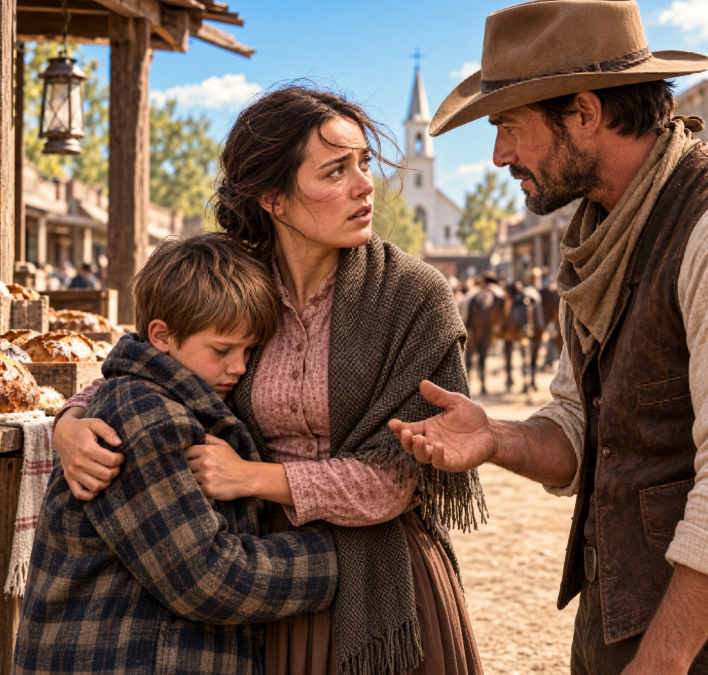
The morning Duncan Reyes finally asked the question, Varity Hail was kneeling in the cold dirt beside her bread stall, buttoning her nephew’s coat with fingers that would not stop trembling.
She tried to hide the shaking by moving faster.
That had become her way with most things.
If her hands shook, she worked faster.
If her knees ached, she stood straighter.
If hunger gnawed at her stomach, she drank water and told Milo she had eaten earlier.
If grief came for her in the dark, she rose before dawn and buried it beneath flour, yeast, salt, and firewood.
Hardship had never frightened Varity as much as idleness. Idleness gave sorrow too much room.
So she kept moving.
Always.
That morning, frost silvered the edges of the street boards and turned the horse troughs cloudy at the top. The sun had barely cleared the far ridge, and the town still smelled of chimney smoke, damp leather, and coal ash. Merchants were opening shutters. A wagon rattled past with milk cans clanging. Somewhere down the street, a blacksmith’s hammer rang once, then again, like the town’s heart beginning to beat.
Varity’s stall stood near the main road, between the mercantile and the livery stable. It was no grand thing. A wooden counter on folding legs. A patched canvas awning. Two crates beneath for storage. A small hand-painted sign that read:
V. HAIL
BREAD & ROLLS
FRESH DAILY
By most standards, it was a modest business.
To Varity, it was survival.
Every loaf on that counter had begun in the dark hours before sunrise, in the old brick oven behind the boarding house where she and Milo rented one small room. She had mixed and kneaded while the town slept, warming her hands near the oven door when the cold became too sharp. She had shaped rolls by lamplight, counted coins in her head, measured flour carefully, stretched yeast longer than she should, and prayed every batch would rise.
Now the bread sat stacked in neat rows beneath clean cloths, fragrant and golden, steam still trapped inside the crusts.
Milo stood beside her, nine years old, serious-eyed, and far too aware for a child.
His brown coat was too short in the sleeves, but she had lined it with flannel from one of her old skirts. His boots were scuffed but polished. His hair stuck up in one stubborn place near the crown, and no amount of water or persuasion had ever convinced it to lie flat.
“Hold still,” Varity said softly.
“I am holding still.”
“You are leaning.”
“I’m cold.”
“I know.”
She fastened the last button at his throat.
He looked down at her hands.
“You’re shaking.”
“It’s the cold.”
“You’re colder than me.”
“Nonsense.”
He frowned.
Milo had his mother’s frown.
That still hurt sometimes.
PART2:
Not the sharp way it had in the beginning, when every turn of his face had felt like Anne calling from the grave. Now it hurt softly. Like touching a bruise you already knew was there.
“You should keep the wool shirt,” Milo said.
“I’m not the one going to lessons.”
“You’re the one standing outside all day.”
“I’ll be near the oven soon enough.”
That was not true.
The oven fire was back at the room, already banked low. The day would be spent outside, behind the stall, smiling at customers and pretending the wind did not cut through her shawl.
Milo looked at the shawl.
It had once been blue.
Now it was the color of old smoke, mended at both corners, thin enough in places that morning light passed through it. Varity had meant to buy a heavier one before winter deepened. Then Milo needed new slate pencils. Then flour cost more. Then Mrs. Abernathy’s rent came due. Then a loose board in the stall had to be replaced before it gave way beneath the bread.
A woman could always postpone being warm.
A child could not postpone growing.
Milo reached toward one button.
“I don’t need—”
“You do,” Varity said, more sharply than she intended.
He stopped.
Her face softened at once.
“I’m sorry.”
He shook his head.
PART3:
“You only sound like that when you’re tired.”
The words slipped under her ribs.
Before she could answer, a cough rose in her chest.
She turned away, pressing one hand to her mouth, trying to smother the sound.
She failed.
The cough rattled through her, deep and ugly, leaving her breathless and dizzy. The street blurred for half a second.
When she looked up, Duncan Reyes was standing in front of the stall.
He held his hat in one hand and coins in the other.
He was a tall man, broad through the shoulders, with dark hair sun-browned at the edges and a face that seemed built for silence. His ranch lay a few miles outside town, close enough that he rode in most mornings for supplies, mail, and, for the past year, bread from Varity’s stall.
At first, he had bought one loaf.
Then two.
Then three.
Some weeks, more.
Varity had assumed he had a large crew and a taste for her baking. She had never let herself think past that. A woman working from dawn until dark did not have time to wonder why a man with a ranch kitchen bought more bread than he needed.
Duncan looked at Milo’s coat.
Then at Varity’s shawl.
Then at her face.
She knew what he saw.
The flush high on her cheeks.
The faint blue at her lips.
The sweat at her temple despite the cold.
The way her hands would not settle.
“You’re ill,” he said.
“I’m perfectly fine.”
Milo gave her a look.
Duncan did too.
Theirs were different looks. Milo’s was frightened. Duncan’s was calm, but it had the troubling quality of a man who had already decided not to be fooled.
“You spend the whole day looking after him,” Duncan said.
Varity reached for a loaf, eager to shift the moment back into business.
“Will it be the usual, Mr. Reyes?”
He did not take the bread.
His eyes remained on her.
“But who takes care of you?”
The question stopped her cold.
Not because it was cruel.
Because it was kind in a place no one had touched in years.
Varity had answers for nearly everything life threw at her.
Rent due?
Bake more.
Flour short?
Stretch with cornmeal.
Milo sick?
Sit up all night.
Boots worn?
Patch them.
Winter coming?
Work harder.
Anne gone?
Keep the promise.
But who takes care of you?
No one had ever asked her that.
Not Mrs. Abernathy, who cared in her own bustling way but assumed Varity could endure anything because Varity always had.
Not the townswomen who bought rolls and praised her strength as if strength were a meal.
Not the men who tipped their hats but did not see past the counter.
Not even Milo, who loved her with his whole young heart but should never have been asked to carry an adult’s loneliness.
Varity opened her mouth.
No answer came.
Duncan put his coins on the counter.
Then he stepped around the stall and began untying the awning ropes.
“What are you doing?”
“Closing your stall.”
“No.”
“Yes.”
“I cannot lose a day’s sales.”
“You’ll lose more than a day if that cough settles into your chest.”
She reached for the pole he was folding.
“Mr. Reyes, this is not your concern.”
He looked at her hand on the pole.
It shook so badly the wood tapped against his palm.
His voice softened.
“It became my concern the moment I saw you trying to stand through fever.”
“I have responsibilities.”
“I know.”
“You do not.”
His face changed slightly.
Not anger.
Something deeper.
“I know about responsibility.”
That quiet sentence made her release the pole.
Duncan folded the awning with efficient hands. He stacked the loaves into the crates, covered them, and lifted both as if they weighed nothing.
“I’ll take what bread you have to the ranch and into town myself,” he said. “Every loaf sold. Same as if you stood here all day.”
“That is impossible.”
“Bread is not impossible.”
“I mean I cannot allow—”
“You can allow it or you can fall over in the street and make Milo watch. Those are the choices I see.”
Milo’s eyes widened.
Varity stiffened.
Duncan looked immediately regretful, but he did not take it back.
Because it was true.
That was the trouble with Duncan Reyes. He did not say much, but what he said tended to stand there refusing to move.
Varity coughed again.
This time, she had to grip the counter.
Milo grabbed her sleeve.
“Aunt Varity?”
The fear in his voice decided it.
Not Duncan’s insistence.
Not the fever.
Not even her own weakness.
Milo’s fear.
“All right,” she whispered.
Duncan nodded once.
Not triumphant.
Only relieved.
He loaded the bread crates onto his wagon and walked with Varity and Milo back to the small room behind Mrs. Abernathy’s boarding house.
The room had once been the old kitchen and laundry before Mrs. Abernathy built a newer kitchen closer to the main building. It was cramped, but it had one blessing no other cheap room in town could offer: a working brick oven and chimney. That oven was the reason Varity could bake before dawn without paying rent on a separate shop.
Their bed stood along one wall, narrow and neatly made. Milo’s cot sat near the window. Shelves held flour tins, salt jars, folded cloths, and three chipped plates. A small table served for meals, accounts, lessons, and rolling dough. It was not much.
But it was theirs.
Mrs. Abernathy opened her door before Duncan finished knocking.
She was a stout widow with silver hair and eyes sharp enough to cut thread.
“What’s happened?”
“She’s running a fever,” Duncan said before Varity could speak. “Needs broth, a proper fire, and someone checking on her through the day. I’ll cover whatever it costs.”
Mrs. Abernathy looked at Varity.
Varity tried to stand straighter.
Failed.
“Inside,” the older woman said.
“I only need—”
“Inside.”
Varity went inside.
Milo hovered near the bed while Mrs. Abernathy removed Varity’s shawl and clucked her tongue at how thin it was. Duncan built the fire without being asked, then brought in water, then split kindling from the stack behind the shed.
Varity watched him move through the room with the careful discomfort of a person who did not know what to do with help.
Help, in her experience, came with a hook.
A debt.
A pitying look.
A reminder later.
Duncan offered none of those. He simply did the next useful thing.
Then he took the bread and left.
He returned near sundown.
Every loaf sold.
Every coin counted twice.
He placed the money on the table beside her bed, along with a jar of broth from Mrs. Abernathy’s kitchen and a small paper packet of horehound drops for her cough.
Varity stared at the coins.
“You sold all of it?”
“Yes.”
“At my prices?”
“Yes.”
“No discount?”
His mouth twitched.
“Your prices are fair.”
She did not have strength to argue, which was fortunate, because she very much wanted to.
Milo sat beside her bed that night and refused to leave.
“Milo,” Varity said, her voice rough, “you need sleep.”
“So do you.”
“I will sleep better if you are in your cot.”
He shook his head.
His small hand clutched the blanket.
“Mama got sick like this.”
Varity closed her eyes.
Anne.
It had been five years, but some wounds did not understand calendars.
Anne had died in one terrible week.
A fever that began as a cough, became weakness, then delirium, then silence. Varity had been twenty-four then, still thinking grief was something other people survived in stories. Milo had been four, too young to understand death but old enough to understand absence.
On the last night, Anne had gripped Varity’s hand with fingers already losing strength.
“Don’t let him think he’s alone in the world,” she whispered. “Whatever it costs you.”
Varity had promised.
At the bedside.
Again at the grave.
Again every morning since.
Now Milo looked at her with Anne’s eyes and said, “She didn’t get better.”
Varity reached for his hand.
“I am not your mother.”
His chin trembled.
“I don’t intend to leave you the way she had to.”
“You can’t promise.”
Nine years old.
Too young for such truth.
“No,” Varity admitted. “I can’t promise that.”
A tear slid down his cheek.
“But I can promise I am not simply going to lie here and let this fever win without a fight. That much I can manage.”
It was not the certainty he wanted.
But it was honest.
Milo held her hand a while longer. Only when Duncan returned after checking the horses and sat in the chair near the fire did Milo allow Mrs. Abernathy to guide him to his cot.
“Mr. Reyes will stay?” Milo asked.
Duncan removed his hat.
“As long as needed.”
Milo studied him.
“You won’t sleep?”
“I’ve missed sleep before.”
That seemed to satisfy him.
Varity drifted in and out through the night. Each time she woke, Duncan was there. Sometimes adding wood. Sometimes reading by low lamplight. Sometimes looking into the fire with a loneliness on his face that disappeared whenever he noticed her watching.
The fever held for three days.
Three hard, humiliating days in which Varity learned exactly how difficult it was to be cared for.
Mrs. Abernathy brought broth.
Milo read aloud from his school primer in a voice that shook less each day.
Duncan sold the remaining bread, then arranged with two ranch hands to purchase loaves from another baker for his crew so no one would wonder why he had stopped coming to Varity’s stall. He chopped wood. Hauled water. Paid the doctor. Refused to discuss the cost until Varity was well enough to argue properly.
On the third night, the fever broke.
Varity woke soaked with sweat, weak as thread, but clear-headed.
Duncan sat asleep in the chair, his chin against his chest, hat in his lap.
The fire had burned low.
Milo slept curled on his cot, one hand hanging over the edge.
For the first time in years, Varity woke and did not feel alone with the whole world.
She closed her eyes again.
That frightened her more than the fever.
Because a person can become used to hardship.
Kindness is more dangerous.
It asks you to imagine living differently.
When she was strong enough to sit up, she found Duncan outside splitting wood.
“You didn’t have to do all that,” she said from the doorway, wrapped in Mrs. Abernathy’s spare shawl.
Duncan set another log upright.
“Didn’t have to,” he agreed.
The axe came down clean.
“Wanted to.”
Varity watched the log split in two.
“Most men would have considered the question enough.”
“What question?”
“Who takes care of me.”
He lifted another log.
“A man asks a question like that, seems only right he do something about the answer instead of simply asking it and riding off.”
She looked down.
“I do not know how to be beholden.”
“Then don’t be.”
“That is not how help works.”
“It can.”
“Not in my experience.”
He leaned on the axe handle.
“Maybe your experience needs broadening.”
She should have been offended.
Instead, to her great irritation, she nearly smiled.
During her recovery, Varity learned pieces of Duncan Reyes the way one learns a landscape by traveling through it slowly.
He had inherited his ranch ten years earlier after losing both parents within two years. His people had been hardworking, quiet, and stubborn. They believed affection belonged in labor, not language.
“My father could mend a fence beside me for six hours,” Duncan said one afternoon, “and never say he was proud. But he’d leave the better pair of gloves on my saddle the next morning.”
“That was how you knew?”
“That was how I knew.”
“And your mother?”
“Cooked enough for twelve even when there were three of us. Sent food with every hand who rode out. If she worried about me, she packed biscuits.”
Varity sat propped against pillows, mending one of Milo’s shirts despite being ordered not to work.
“Sounds like love in a practical dress.”
“That’s about right.”
“Is that why you find plain speech difficult?”
He looked at her sharply.
She kept her eyes on the needle.
“You do.”
“I say what needs saying.”
“That is not the same as saying what you feel.”
For a long moment, he did not answer.
Then he said, “No. It isn’t.”
She glanced up.
His honesty surprised her.
Most men she had known defended their silences as virtues.
Duncan seemed to know his silence was both shelter and prison.
A week after her fever broke, Varity returned to the stall.
Not for a full day.
Duncan and Mrs. Abernathy conspired against that.
She opened only for the afternoon, sitting on a stool behind the counter like an invalid and resenting how good it felt. Customers welcomed her back. Mrs. Callahan bought rolls and said the town had been dull without her. Mr. Bell from the livery said Duncan’s bread-wrapping skills were “functional but joyless.” Milo stood beside her counting change with solemn importance.
Duncan arrived at his usual time.
“One loaf?” Varity asked.
“Three.”
“Your ranch must eat more bread than any place in Nevada.”
“Hardworking men.”
“Men made of bread, apparently.”
His mouth twitched.
She wrapped three loaves and noticed something she had not let herself notice before.
He was not in a hurry.
He never had been.
He lingered at the stall even when he had no reason. Asked after Milo’s lessons. Asked whether Mrs. Abernathy’s roof leak had been repaired. Noticed when the awning rope frayed and brought new rope the next morning. Noticed when her hands were cracked from lye soap and left a tin of salve on the counter without a word.
Love in a practical dress, she thought.
Then scolded herself for using the word love about a man buying bread.
Weeks passed.
Winter loosened its grip.
The ground softened. Mud replaced frost. Spring green touched the edges of the fields. Varity regained her strength slowly and, under the combined tyranny of Milo, Mrs. Abernathy, and Duncan Reyes, learned to sit down once in a while.
She hated it at first.
Rest felt like theft.
Then one afternoon, Milo came home from lessons and found her on the step with a cup of tea, doing absolutely nothing.
He stopped dead.
“You’re sitting.”
“I am.”
“Are you sick again?”
“No.”
“Then why?”
She looked at the tea.
“Apparently, I’m allowed to on occasion.”
He considered this as though it were a new law.
Then nodded.
“Good.”
After that, he watched her more carefully. Children who have lost one mother can become guards around anyone left. Varity hated that she had given him reason to worry, but she also saw something gentler growing in him. He began saving the largest biscuit for her. He brought her shawl without being asked. He once scolded Mrs. Abernathy for letting Varity carry too much firewood, which made the older woman laugh until she wheezed.
Duncan became a regular presence at their small table.
It began with repairs.
A loose wheel on the stall.
A warped board on the counter.
A hinge on the room door.
A crack near the oven that needed mortar before it worsened.
Each time, Duncan appeared with tools and the plain expression of a man who claimed to have “noticed” something.
“You notice a great deal,” Varity said one evening as he tightened a screw on the stall leg.
“Occupational hazard.”
“Of ranching?”
“Of having eyes.”
Milo laughed.
That laughter changed the room.
Varity had not realized how careful Milo’s happiness had become until Duncan gave it space to grow noisier.
Soon the boy started setting a third place at supper.
“You don’t have to keep a chair ready,” Varity told him.
“He might come.”
“He does not come every night.”
“Most nights.”
“That is not the point.”
“Better to have it ready.”
More often than not, Duncan came.
He folded himself into the small chair at their crowded table with surprising ease, ate whatever simple meal Varity had managed, praised the bread without sounding false, and let Milo tell him long stories about school, horses, arithmetic, and why Mrs. Abernathy’s rooster was “mean in his soul.”
Duncan listened.
Not the way adults often listened to children, half-present and waiting for the end.
He listened as if Milo’s thoughts were worth time.
That, more than anything, unsettled Varity.
A person could admire kindness from a distance.
It became far more dangerous when kindness sat at your table teaching your nephew how to sharpen a pencil with a pocketknife.
One afternoon in May, Varity delivered bread to Duncan’s ranch herself.
She had done so before, but this time she arrived early and found him in the yard tending to a horse that had gone lame. He waved her toward the kitchen, calling that he would be in shortly.
Inside the ranch house, Varity placed the loaves on the table and looked around.
The house was sturdy, clean, and lonely.
A large kitchen. A long table. Shelves lined with plain dishes. A fireplace dark for the season. Everything in its place. Everything functional. Nothing unnecessary. No flowers. No scrap of ribbon. No extra cup left out for someone who might come through the door.
On a back pantry shelf, she noticed bread.
A great deal of bread.
More than the ranch hands could possibly have eaten that week.
Duncan’s foreman, a red-haired man named Eli, came in for coffee and caught her looking.
He cleared his throat.
“Boss buys more than we use.”
“So I see.”
“Wasn’t sure if you knew.”
“I did not.”
Eli looked as if he regretted speaking.
“What does he do with it?”
“Widow Callahan gets some most weeks. Trent family got plenty after their barn burned. Couple miners out past Willow Creek when work was thin. He doesn’t much talk about it.”
Varity stood very still.
All those loaves.
All those mornings.
She had believed Duncan bought more because he liked her bread, perhaps because he liked her company. Both were true, perhaps. But he had also quietly turned her work into help for others, paying full price so she would not feel pitied, then sending bread where hunger had hidden behind pride.
When Duncan came in, washing his hands at the basin, she waited until Eli left before speaking.
“You buy bread you don’t need.”
He paused.
“Some of it gets used.”
“By people who are not your ranch hands.”
He dried his hands slowly.
“Eli talks too much.”
“Duncan.”
He looked at her then.
“At first, I came for the bread,” he said. “Then I started coming because I wanted to know you were all right.”
Her breath caught.
“The extra loaves seemed a decent use for money I didn’t strictly need once I understood how much your stall meant to families same as yours.”
“You could have told me.”
“Could have.”
“Why didn’t you?”
“Didn’t want you thinking the arrangement was charity dressed up as commerce.”
“And what is it?”
“Commerce,” he said. “And care kept separate enough that you’d accept both.”
She should have been angry.
Part of her wanted to be.
But beneath that was something far more difficult.
Being seen.
Not pitied.
Not rescued.
Seen.
“You are a very frustrating man,” she said.
His mouth curved.
“I’ve been told.”
“By whom?”
“People with eyes.”
She laughed before she could stop herself.
The sound startled them both.
After that, something between them changed.
Not quickly.
Not dramatically.
Varity had no patience for dramatic romance. She had rent, flour, firewood, a growing boy, and a heart that had learned caution honestly.
But Duncan became part of their days in the way dawn becomes morning. Gradually, then completely.
He taught Milo to saddle a horse.
Milo taught him that butter should be spread all the way to the edges of bread “or else corners are sad.”
Duncan helped Varity build a better awning for the stall.
Varity discovered Duncan’s birthday from one of his ranch hands and arrived that evening with Milo, a basket supper, and a small cake made with precious sugar she had saved for two weeks.
Duncan opened the ranch house door and looked so astonished that Milo whispered, “Did he forget people have birthdays?”
“I heard that,” Duncan said.
“It’s a fair question,” Varity replied.
They ate at his kitchen table.
For the first time since entering that house, Varity saw it become warm. Milo talked with his mouth full until corrected. Duncan lit a lamp though the sun had not fully gone down, as if brightness itself was welcome. The cake was plain, slightly dense, and worth every bit of sugar.
“Nobody’s done this for me since my mother,” Duncan admitted quietly.
Varity cut him a second piece.
“Then I expect it’s overdue.”
He looked at her across the table with something open on his face, something he did not yet know how to say.
She saw it.
She did not force him.
Some feelings, like bread, needed time to rise.
Summer came.
Then trouble.
It arrived in the form of a letter from the landlord who owned Mrs. Abernathy’s property.
Not Mrs. Abernathy herself. The boarding house was hers, but the old kitchen rooms and storage buildings behind it stood on land owned by a man in Carson City who had inherited half the block and none of its conscience.
The rent was increasing.
Nearly double.
Varity read the letter three times after Milo slept.
Then she sat at the small table with her account book open and understood the truth before dawn.
They had six weeks.
Perhaps less.
The business had grown, but not enough for that. Flour cost too much. Firewood would rise again before winter. Milo’s boots would not last another season. Mrs. Abernathy was furious but powerless; her own agreement with the landlord had changed too.
“You can move into the main house,” Mrs. Abernathy said.
“With the oven?”
The older woman’s face fell.
No oven.
No business.
No business meant wages elsewhere. Laundry, sewing, domestic service. Work she could do, yes, but not with Milo’s hours, not without giving up the fragile independence she had built loaf by loaf.
Duncan found her sitting behind the stall that afternoon, staring at nothing.
He did not ask if she was all right.
He had learned better.
Instead, he said, “Tell me.”
She handed him the letter.
He read it once.
Then again.
His jaw tightened.
“I could speak to him.”
“I doubt a rancher’s disapproval will move a man in Carson City.”
“You haven’t seen my disapproval at full strength.”
Despite everything, she almost smiled.
Then he folded the letter.
“I have a building.”
She blinked.
“What?”
“On my ranch. Near the road. Used to store tools before I built the equipment shed. It’s mine free and clear.”
“Duncan—”
“Needs work,” he continued before she could object. “Roof patched. Windows replaced. A proper oven built in. Counter facing the road. Enough space for baking and selling both.”
“I cannot accept a building.”
“I didn’t offer it as a gift.”
Her mouth closed.
He knew her too well.
“I’ll cover repairs,” he said. “You pay it back through bread. Formal arrangement. Two loaves a week toward the building’s upkeep until we agree the debt is settled.”
“And living?”
“You keep your room in town unless you decide otherwise. Milo still walks to lessons. Mrs. Abernathy still keeps an eye when needed. Nothing changes except where you bake and sell.”
“You have thought this through.”
“Yes.”
“For how long?”
He looked away.
“Since the fever.”
Her heart stumbled.
“Since winter?”
“You needed a safer place to work. I lacked the courage to say so plainly.”
She studied him.
“Because you thought I would refuse.”
“Yes.”
“I might have.”
“I know.”
“What changed?”
He looked at the letter in his hand.
“You may refuse me. You may not refuse survival out of pride.”
She should have bristled.
Instead, she heard the care beneath the clumsy words.
The next day, he took her to see the building.
It was weathered but sound, set near the ranch road where wagons could stop easily. Sun fell across the front in the morning. There was space for shelves, a counter, a proper oven, a small table for customers waiting out weather.
Milo ran around it twice and declared it “almost a castle.”
Varity stood in the empty doorway and imagined flour on the table, fire in the oven, bread cooling by the window.
Room.
Not plenty.
But enough.
More than enough.
“I’ll take it,” she said finally. “On the terms stated. Two loaves a week until the debt is properly settled. Not a day longer.”
Duncan nodded.
“Wouldn’t offer it any other way.”
The bakery opened in late summer.
Not a stall.
A bakery.
Small, yes.
Plain, yes.
But with a sign painted by Milo himself:
HAIL BREAD
FRESH DAILY
PLEASE CLOSE DOOR GENTLY
The last line was his contribution.
Customers came.
More than before.
Families from surrounding farms. Ranch hands. Miners. Townspeople willing to make the short ride for bread that smelled like comfort and tasted like someone had risen early on purpose.
Varity hired a girl named Elsie to help some mornings. Fourteen, quick-handed, shy, and badly in need of wages. For the first time in five years, Varity had help she could pay rather than guilt she had to swallow.
She rested some afternoons.
At first with great suspicion.
Then with slightly less.
Duncan found increasing reasons to stop by the bakery. Most were transparent.
“Checking on my investment,” he said one afternoon.
“You checked it yesterday.”
“Investments can change overnight.”
“You are standing in my kitchen doing nothing useful.”
“I am very useful.”
“Name one useful thing you have done since entering.”
“I complimented the smell.”
“That is not labor.”
“It encourages labor.”
“Go stack firewood.”
“Yes, ma’am.”
He went.
Smiling.
Milo saved him a seat at supper permanently now.
No one commented on it anymore.
The chair simply belonged.
One evening in early autumn, after the day’s work was done and Milo had gone to Mrs. Abernathy’s to help carry apples, Varity found Duncan on the bakery porch. The sky was turning rose and gold over the low hills. Flour dust marked one sleeve of her dress. Duncan had sawdust on his shirt from repairing a shelf.
They sat without speaking for a while.
Comfortably.
That still amazed her.
“You asked me once,” Varity said, “who takes care of me.”
Duncan turned his hat in his hands.
“I did.”
“I gave you no answer.”
“Wasn’t really asking for one right then.”
“No?”
“More a thing I wanted you to start considering.”
“I have considered it.”
He went still.
“For months now,” she said.
The evening air seemed to hold its breath.
“I believe the answer has been standing in my kitchen inventing excuses to visit.”
Duncan looked down.
“I simply needed time,” she continued, “to trust it properly.”
He swallowed.
For once, the man who knew how to fix wheels, mend roofs, calm horses, split wood, and provide without announcing it looked entirely helpless.
“I’ve never had much practice saying things plainly,” he said.
“I know.”
“My family didn’t.”
“I know that too.”
He looked at her.
“But I love you, Varity.”
The words came rough.
Plain.
Unadorned.
Perfect.
“I have for longer than I properly admitted. Even to myself.”
Varity’s eyes stung.
“I know,” she said gently.
His brow furrowed.
“You know?”
“You’ve been saying it for months.”
“I have not.”
“You have. Same way your father taught you. Fixed wheels. Standing orders. Extra bread sent to families short on money. A building made into a bakery. A chair never left empty too long.”
She smiled through tears.
“I simply needed to learn how to hear it. Same as you are learning to say it.”
He looked at her as though she had just translated his whole life into a language he could understand.
Before he asked Varity anything further, Duncan rode into town to speak with Milo alone.
He found the boy at the bakery counter after lessons, carefully counting change into stacks of ten.
“Milo,” Duncan said, “I’d like to ask you something important.”
Milo immediately looked worried.
“Is Aunt Varity sick?”
“No. Nothing like that.”
“All right.”
Duncan crouched so they were eye to eye.
“I’d like to marry your aunt.”
Milo blinked.
“I wanted you to hear it from me directly,” Duncan said. “And I wanted to ask whether you would be all right with it. This concerns you too.”
Milo considered the question with great seriousness.
“Would you still teach me things?”
“A good deal more than before.”
“Like ranch things?”
“Ranch things. Tool things. Horse things. Bread things, if I ever improve enough not to shame us all.”
Milo nodded slowly.
“And would you live with us?”
“If your aunt says yes.”
“Would Aunt Varity still be Aunt Varity?”
Duncan’s face softened.
“Yes. Always.”
“Would I have to forget Mama?”
“No.”
The answer came immediately.
Milo’s lower lip trembled.
Duncan continued carefully.
“I would never ask that. Your mother has her place. Nothing changes that. I’m only asking whether there might be room for one more person looking after you properly.”
Milo whispered, “Like a father?”
Duncan’s eyes shone.
“If you’d have me in that capacity.”
Milo threw his arms around Duncan’s neck.
Duncan held him for a long time.
When he came to Varity that evening, she already knew.
Milo had tried to keep the secret and failed within nine minutes.
Still, Duncan asked her on the bakery’s front step as the spring crickets began their evening song and warm light glowed through the windows behind them.
“I’ve already asked Milo’s permission,” Duncan admitted.
“Did you?”
“Seemed only fair, given how much of this decision belongs to him too.”
“And what did he say?”
“Asked if I would still teach him things.”
“That sounds like Milo.”
“I told him more than before. If I was to be his father properly.”
Varity’s eyes filled despite all effort.
Duncan took her hand.
It was still work-worn.
Still strong.
Still marked by flour and fire and years of keeping promises.
“Marry me, Varity,” he said. “Not because you need rescuing. You have proven plainly enough that you do not. Marry me because I would like the chance to keep learning how to say what I feel, with you patient enough to keep teaching me.”
She thought of Anne.
The bedside.
The promise.
Don’t let him think he’s alone in the world.
She thought of five years of hunger hidden behind smiles, cold hidden beneath a thin shawl, fear hidden inside account books.
She thought of Duncan’s question.
Who takes care of you?
And she realized the answer no longer frightened her.
“Yes,” she said.
The word cost her nothing.
That, more than anything, told her it was right.
They married the following spring in the bakery itself.
Mrs. Abernathy sat proudly in the front row and informed anyone within whispering distance that she had known the whole thing would end this way since Duncan started buying three loaves instead of one.
Elsie scattered wildflowers across the counter.
Milo stood between Varity and Duncan, more excited about the cake than the vows, though he held Duncan’s hand throughout the ceremony with a seriousness that told another story entirely.
When Duncan promised to honor, cherish, and stand beside Varity, his voice shook once.
Just once.
Varity squeezed his hand.
When she promised the same, Milo cried.
Then insisted he had not.
Nobody argued.
The morning after the wedding, Varity woke before dawn out of pure habit.
For five years, her body had known the hour before her mind did.
She reached for her work dress, then paused.
The bed beside her was empty.
So was the room.
She smelled smoke.
Then flour.
Then something burning.
She hurried to the bakery kitchen and stopped in the doorway.
Duncan stood at the table covered head to boot in flour. Flour dusted the floor, the counter, his shirt, his beard, one eyebrow, and, inexplicably, the windowsill. A misshapen lump of dough sat before him like a defeated animal. Smoke leaked faintly from the oven.
He looked up.
Entirely unbothered by disaster.
“Morning.”
Varity stared.
“What have you done?”
“Bread.”
“No.”
“Attempted bread.”
“That is more accurate.”
“I thought it was time someone took care of you too.”
The sentence landed softly.
Not like a grand declaration.
Like a log placed on a fire.
Like a chair pulled out.
Like bread bought at full price.
Like a coat buttoned against the cold.
Varity walked to the table, dipped two fingers into the flour, and brushed a white streak across his cheek.
“You used too much flour.”
“I suspected.”
“And not enough water.”
“I feared that.”
“And the oven is too hot.”
“That explains the smoke.”
She laughed.
Not carefully.
Not quietly.
Fully.
From somewhere deep and long unused.
Duncan watched her like that laugh was worth every ruined batch he would ever make.
Milo appeared in the doorway, hair wild, rubbing his eyes.
He looked at Duncan.
Then at the flour.
Then at Varity laughing.
“Are we eating that?”
“No,” Varity said.
“Thank goodness.”
Duncan looked offended.
Milo came to the table, stood beside him, and inspected the dough.
“I can teach you,” he said.
Duncan nodded solemnly.
“I’d appreciate that, son.”
Milo froze.
The word hung in the warm kitchen.
Son.
Not replacing.
Not erasing.
Adding.
Milo smiled slowly.
Then rolled up his sleeves.
“All right. First thing, you have to listen to Aunt Varity. She knows bread better than anybody.”
“I know,” Duncan said.
He looked at Varity.
“I’m learning.”
Years later, people in that part of Nevada would talk about Hail Bakery as if it had always been there.
They would remember the smell of bread cooling by the window, the rancher who fixed shelves and carried flour sacks, the boy who grew tall and learned both horses and accounts, the woman whose hands shaped dough before sunrise and whose laughter became easier with time.
They would say Duncan Reyes was a good man.
They would say Varity Hail was strong.
Both were true.
But neither was the whole truth.
Strength had kept Varity standing.
Love taught her she could lean.
Duncan had learned as a boy that care was something done with hands, not spoken with words.
Varity learned to hear that language.
Then she taught him another.
Milo grew up knowing his mother had loved him, his aunt had kept him, and the man who became his father had asked permission before claiming a place in his heart.
And on cold mornings, when Varity sometimes woke before dawn and reached instinctively for work, Duncan would catch her hand before she rose.
“The bread can wait a minute,” he would murmur.
She would look toward the kitchen.
Think of the oven.
The flour.
The customers.
The world and all its needs.
Then she would remember the question that changed everything.
Who takes care of you?
And she would rest her hand in his.
Just for a minute.
Then two.
Long enough to remember that receiving love did not make her weaker.
It only meant the promise she made to Anne had grown bigger than survival.
Milo was not alone in the world.
And at last, neither was she.







