After 19 Years of Marriage, I Realized I Couldn’t Remember the Last Time My Husband Had Simply Held Me—Then I Opened an Old Trunk in the Attic and Found the Letters He Wrote Before We Married.
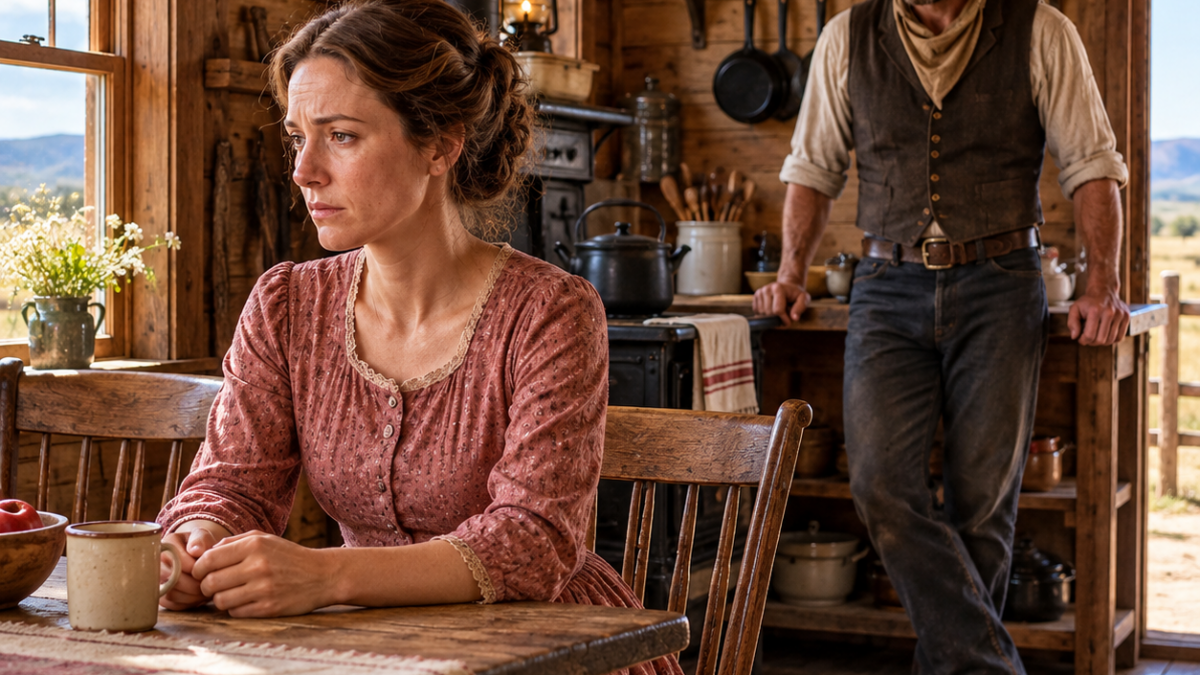
After 19 Years of Marriage, I Realized I Couldn’t Remember the Last Time My Husband Had Simply Held Me—Then I Opened an Old Trunk in the Attic and Found the Letters He Wrote Before We Married.
For nineteen years, Grace Whitaker slept beside the same man, cooked his meals, raised his children, worked his land, and believed theirs was the kind of marriage that endured anything.
Then one ordinary Tuesday morning in Colorado, she stood at the stove watching her husband cross the yard and realized she could not remember the last time Daniel had held her simply because he wanted to.
What she found days later in an old cedar trunk would bring them both back to the people they had once been—before chores, harvests, children, and survival taught love to grow quiet.
Colorado, 1887.
Grace Whitaker was standing at the kitchen stove on an ordinary Tuesday morning when the thought came to her so suddenly that her hand stopped in midair above the skillet.
She could not remember the last time her husband had held her.
Not touched her in passing.
Not steadied her elbow on the icy porch steps.
Not placed one hand at the small of her back while moving behind her in the kitchen.
Not brushed flour from her sleeve, or taken a basket from her arms, or tucked a shawl around her shoulders because the wind had turned sharp.
Held her.
Arms around her.
Nothing required. Nothing practical. No chore waiting on the other side of it. No child crying. No cow loose. No supper burning. No storm coming. No fence down. No wagon wheel cracked. No reason at all except that Daniel Whitaker wanted his wife close to him.
Grace stood there so long that the eggs began to catch in the pan.
A brown edge curled at the bottom.
Still she could not land on one memory.
A morning.
An evening.
A Sunday after church.
A winter night.
Any small ordinary moment from recent years when Daniel had reached for her the way he used to, as if the day itself had asked too much and she was where he returned to set it down.
Nothing came.
The absence frightened her more than she expected.
She was forty-one now. Daniel was forty-four. They had been married nineteen years, since the autumn of 1868, when he was twenty-five and she was twenty-two and the claim they moved onto held little more than a half-finished cabin and more sky than shelter.
Grace could still see that first day clearly.
Daniel carrying her over the threshold of the single finished room because he insisted it was proper, even though the second room had only three walls and a roof that leaked at the corners. She remembered laughing against his shoulder, telling him he would regret marrying a woman foolish enough to call that a house.
PART2:
He had looked down at her then, young and sun-browned and shy in the way he always became when feeling too much.
“Not if you’re in it,” he had said.
Back then, those words had seemed enough to warm any winter.
And there had been winters.
The first one nearly undid them. Wind came through every gap in the boards. Snow collected inside the unfinished room. They slept in all their clothes, boots near the bed so they would not freeze solid by morning. Daniel spent his days cutting timber and checking traps and coaxing stubborn livestock through weather neither of them yet understood. Grace spent hers cooking what little they had, patching seams, melting snow, and writing letters home that made the place sound prettier than it was.
They were cold.
Hungry at times.
Tired nearly always.
But young.
That had mattered more than either of them understood then.
Hardship, when you are young and newly married, can sometimes feel like proof that love is strong. You laugh at the smoke in the cabin because the chimney doesn’t draw right. You eat burnt beans and call them supper. You sit beside each other on an overturned crate because there is no proper chair yet and speak of the rooms you will build, the garden you will plant, the children who might one day sleep beneath the roof still being nailed into place.
Grace remembered Daniel whistling while he worked in those early years.
Off-key.
Cheerful.
Entirely unashamed.
He whistled while splitting rails. Whistled while bringing in water. Whistled while mending the roof. Once, during their second spring, he whistled while helping her chase three escaped chickens through the mud, and Grace had laughed so hard she slipped and sat straight down in it.
Daniel had stood over her, trying not to smile.
“You all right?”
“No.”
“You hurt?”
PART3:
“Only my pride.”
“That’ll mend.”
Then he had offered his hand, pulled her up too quickly, and somehow she had fallen against him. He held her there in the muddy yard, both of them laughing, chickens scattering in every direction, supper not started, chores waiting, the whole frontier pressing in on them.
And still, there had been time.
That was the part that hurt now.
There had been time.
Or maybe there had not been more time then.
Maybe they had simply been better at stealing it.
The eggs hissed sharply in the skillet.
Grace blinked and came back to the kitchen.
The room around her was no longer the unfinished cabin of memory. It was a proper farmhouse kitchen now, built board by board across nineteen years. Whitewashed walls. A sturdy table Daniel had made by hand. A pantry with shelves he had fitted himself. A good cast-iron stove. Pegs near the door for coats. A braided rug beneath the sink that Ellie had made two winters ago.
From the outside, anyone passing along the road on a Sunday would have called the Whitaker place a success.
A strong marriage.
A good farm.
Proof that steady work and steady love could outlast anything the Colorado frontier cared to throw at a family.
Grace had believed that too.
Most days.
She still believed it, in a way.
Daniel fixed everything before she had to ask. The loose porch step. The sticking pantry door. The gate that sagged every spring after thaw. The wagon wheel that developed the same wobble year after year as if determined to be part of the family.
Grace still had his coffee ready before he left for the fields, strong and black exactly as he had taken it since the first week they married. She knew how he folded his shirts. Which socks he wore for church. How much salt he liked in beans. Which horse he trusted with a nervous rider. How he rubbed his left thumb when a storm threatened because that old break ached before weather changed.
They slept in the same bed.
Worked the same land.
Raised the same children.
Prayed over the same graves.
They had done all of it faithfully for nineteen years.
And yet, standing there at the stove, Grace realized their conversations had narrowed somewhere along the way into a small, practical circle.
Children.
Animals.
Money.
Seed.
Weather.
Repairs.
The endless list of what needed doing before winter.
She could tell you exactly how many bushels the west field had yielded last September.
She could not tell you the last thing Daniel had said to her that had nothing to do with the farm.
The kitchen door opened.
Daniel stepped in from the yard, his hat missing from his head.
“Coffee’s getting cold,” he said.
His voice was the same as always.
Steady.
Low.
A little rough from morning air.
Grace looked down at the stove.
“I know. Eggs caught a little too.”
“Won’t mind them.”
He crossed to the peg by the door and took his hat from where he had left it. His boots left dry dust across the floor she had swept not twenty minutes earlier. He did not notice. Or perhaps he did and knew she would sweep again. Marriage was full of such small assumptions, some tender, some dangerous.
He took a swallow of coffee from the cup she had poured.
“Wyatt says the north fence needs looking at.”
“I thought you mended that last week.”
“Did. Storm loosened it again.”
“Of course it did.”
“Ellie up?”
“Not yet.”
“Tell her I’ll need help sorting eggs after dinner if she’s not going to the Millers’.”
“I’ll tell her.”
He set down the cup.
Then he turned to go.
Grace nearly spoke.
Daniel.
The word rose in her throat.
Not for any practical reason. Not to remind him of seed or supper or a torn shirt. Simply to make him turn back.
But when he looked over his shoulder, waiting, she could not find the rest.
“What is it?”
She looked at his face.
The face she had loved longer than she had not.
Lines at the eyes now. Gray in his beard. Sun-browned skin. A small scar near his chin from the year the ax slipped. He was not unkind. Not distant in any dramatic way. Not cruel, cold, faithless, or careless.
He was simply already halfway gone into the day’s work.
“Nothing,” Grace said. “Mind the fence wire. It cut you last time.”
“I will.”
Then he was gone, crossing the yard toward the barn with the same steady, unhurried gait he had carried across that yard ten thousand mornings before this one.
Grace stood at the stove and watched him until he disappeared inside.
The eggs were ruined.
She scraped them from the pan anyway.
On a homestead like theirs, labor did not divide itself by affection.
It divided itself by survival.
Daniel’s work took him outward: fields, livestock, fencing, markets, hauling, building, repairing, bargaining. Grace’s work folded inward and never ended: cooking, preserving, mending, washing, cleaning, tending the garden, nursing illness, stretching food, raising children, keeping track of every object a household required to keep functioning through weather and want.
Their days ran side by side but rarely together.
That had not seemed strange while it was happening.
Everyone lived that way.
Every farm wife Grace knew had hands roughened by work and a mind full of lists. Every husband came in tired, ate quickly, spoke of what needed doing, then slept because morning came early and did not care whether anyone felt romantic.
Love was there.
Of course it was.
It was in coffee poured before dawn.
In boots dried near the stove.
In Daniel carrying in extra wood when he knew Grace’s wrists ached.
In Grace darning his socks so carefully he did not notice the mend.
In the two of them counting coins late at night after the children slept, neither blaming the other for how little there was.
Love had not vanished.
That was not the trouble.
The trouble was that love had become almost entirely useful.
Grace carried that thought through the morning like a stone in her apron pocket.
By noon, she had churned butter, fed chickens, mended a torn shirt, washed breakfast dishes, mixed dough for supper rolls, and snapped at Ellie for tracking mud through the kitchen.
Ellie, seventeen and bright-eyed despite the work that shaped every girl on a farm, froze near the door.
“I’m sorry, Mama.”
Grace closed her eyes.
“No. I’m sorry. I didn’t mean to sound sharp.”
Ellie looked at her more carefully.
“Are you unwell?”
“No.”
“You look sad.”
“I’m thinking.”
“About what?”
Grace almost said, Nothing.
That word had become too easy.
Instead, she wiped her hands on her apron and said, “About your father.”
Ellie’s expression shifted at once into curiosity.
“What about Pa?”
Grace hesitated.
Ellie was seventeen. Nearly a woman. Full of hope, impatience, romantic notions, and questions she pretended were casual. Lately she had taken to talking about weddings with a seriousness that made Grace both smile and ache. Dresses. Dances. The boy two farms over who had begun finding reasons to ride past on Sundays, as though the road itself had developed an interest in their fence line.
“Do you think your father and I speak much?” Grace asked.
Ellie blinked.
“You speak every day.”
“I know that. I mean… do we talk?”
Ellie’s brow furrowed.
“What’s the difference?”
Grace looked toward the window.
Daniel was crossing the yard with a coil of rope over one shoulder.
“That is what I am trying to remember.”
Ellie said nothing, but Grace saw the question settle in her daughter.
That evening, Wyatt gave it shape.
Wyatt was eighteen, their eldest, long-limbed and restless in the way boys become when the horizon starts to look less like distance and more like invitation. He had been speaking for months about finding work in Denver or perhaps farther east, somewhere wages came in cash and a young man’s future did not depend on rain, wheat prices, and the health of cattle.
Grace had tried not to take it personally.
She failed.
Not openly. A mother learns to fold her disappointment away where it will not burden her children. But she felt each mention of leaving like a thread pulling loose from the life she had stitched together.
After supper, while Daniel went out to finish chores and Ellie helped wash dishes, Wyatt stayed behind to dry plates.
He was quiet for several minutes.
Then he said, “Mama?”
“Yes?”
“I didn’t mean to upset you the other night.”
Grace handed him a plate.
“Which night?”
“When I said I didn’t want to spend my whole life the way you and Pa have.”
Ellie looked quickly between them and then became very interested in the dishwater.
Grace kept her voice calm.
“And how is that, exactly?”
Wyatt stared at the plate in his hands.
“Working.”
The word landed hard.
“Just working side by side,” he continued. “Same as the mules pull the same plow. You and Pa talk about the farm. About cattle and money and fences. Last week at supper, you discussed that heifer sale the whole meal and never once asked each other how the day actually went.”
He looked ashamed now, but he kept going.
“I want something more than that. I don’t know what exactly. But more.”
Grace wanted to defend herself.
To say he did not understand.
To say marriage was not a fiddle tune and a dance. That farms did not run on soft talk. That children had to be fed and winters survived. That romance was easier in a young man’s imagination than in a house where bread must be baked and fences must stand.
All of it would have been true.
None of it would have answered him.
Because some part of her had feared for longer than she wanted to admit that Wyatt was not entirely wrong.
Ellie spoke softly.
“Was it romantic when you and Pa married?”
Grace let out a small breath.
“At the time, it felt like the whole world.”
Ellie dried her hands on a towel and turned fully toward her mother.
“Did he court you properly?”
“Your father wrote letters.”
Wyatt looked up, surprised.
“Pa?”
Grace smiled despite herself.
“Yes. Pa.”
“But you lived three miles apart,” Ellie said.
“We did.”
“Why write?”
“Because your father said more easily in ink than aloud.”
Grace could see him as he had been then: younger, leaner, hat in his hands, unable to look at her directly for more than a few seconds when feeling too much.
“He wrote me once that he thought of me the whole ride home after a church social.”
Ellie pressed both hands to her chest.
“Did he?”
“He did.”
“What happened to that?” Wyatt asked.
The question had no malice in it.
That made it harder.
Grace folded the dish towel slowly.
“I don’t rightly know. I expect it simply became harder to find once there was a farm and children and every season’s trouble standing between us and the leisure to write letters.”
She looked toward the door Daniel had gone through.
“And I expect I stopped asking for it somewhere along the way, same as he stopped offering it.”
Ellie looked troubled.
“I don’t want that to happen to me.”
Grace touched her daughter’s cheek.
“I hope it doesn’t.”
But that night, lying beside Daniel in the dark, Grace heard Ellie’s words and Wyatt’s words moving through her like wind through dry grass.
Daniel was on his back, one arm over his eyes.
He smelled of hay, soap, and the cold air that clung to his shirt.
Grace turned toward him.
“Daniel?”
“Hm?”
“Do you ever feel like we’ve stopped talking?”
His arm lowered.
“We talked plenty. Talked about the Hendricks boy wanting to buy that heifer just this morning.”
“That’s not what I mean.”
“What do you mean, then?”
Grace stared at the ceiling.
The room was dark except for a stripe of moonlight across the floorboards. Somewhere outside, a horse shifted in the barn. The house had gone quiet in the way farmhouses do only after everyone has surrendered to exhaustion.
What did she mean?
How did one explain loneliness while lying beside the man who had shared her bed for nineteen years?
How did she say, I miss you, when he had never left?
How did she accuse neither of them and still name what had happened?
Daniel waited.
That should have helped.
Instead, the waiting made her feel foolish.
“Nothing,” she said finally. “Never mind. Long day.”
For a moment, he said nothing.
Then, because Daniel was tired and because tired people trust easy exits too quickly, he said, “All right.”
Within minutes, he slept.
Grace lay awake much longer.
She was angry with him for falling asleep.
Then angry with herself for giving him permission to.
She had opened a door no wider than a crack and then shut it herself the moment the draft felt uncomfortable. How many times had Daniel done the same? How many small openings had passed between them across nineteen years, each too awkward to step through, until the habit of silence became easier than the work of reaching?
The next week, Grace went to the attic for winter linens.
That was all.
A practical task.
A simple one.
The attic was low and warm, smelling of dust, cedar, and old wool. Grace climbed the narrow stairs after dinner while Daniel and Wyatt worked in the barn and Ellie stitched by lamplight downstairs. She meant only to shift her mother’s old trunk to reach the linen shelf behind it.
The trunk had come west with Grace when she married.
Dark cedar.
Iron latch.
A little warped now from years beneath the eaves.
She dragged it aside, and the latch gave way with age. The lid fell open before she could catch it.
The scent rose at once.
Old paper.
Dried lavender.
Cedar.
Time.
Inside, beneath a quilt she had forgotten she still owned, lay a small bundle of letters tied with a ribbon gone soft and faded.
Daniel’s handwriting.
Grace sat back on her heels.
For a long moment, she did not touch them.
Then she lifted the bundle as if it might crumble.
The ribbon was pale blue.
She recognized it with a start.
She had worn that ribbon in her hair the night of their first dance.
Her hands trembled as she untied it.
The top letter was dated May 1868.
Grace,
I think of you the whole ride home and find the miles pass faster for the thinking. I do not know that I will ever manage to say this plain to your face, so I will trust the paper with it instead. I believe I have loved you since the church social, and I do not much care to spend the rest of my life pretending otherwise.
Grace pressed the letter to her mouth.
She could see him writing it.
Young Daniel bent over a small table by lamplight, choosing words the way he chose boards for building, carefully, with the hope they would hold.
She opened another.
Grace,
I passed your father’s south field today and saw you hanging wash. I was meant to be looking at the road, but I looked at you instead and nearly rode straight into the ditch. If we marry, you may need to keep me alive by not standing in sunshine where a man can see you from horseback.
She laughed.
A sound so sudden and bright it startled her in the attic.
Then she cried.
The next letter was written only days before their wedding.
Tomorrow I get to call you my wife, and I mean to spend every day after making certain you never once regret saying yes.
Grace stopped reading.
The words blurred.
Beneath the letters sat a photograph, edges soft, colors faded. Daniel and Grace, young and stiff in the way photographs demanded back then. His hand rested near hers but not quite touching because the photographer had arranged them properly. Grace remembered laughing the moment after the picture was taken because Daniel had whispered that the camera made him look like a condemned man.
Beneath the photograph was the blue ribbon.
A dried flower.
A hand-drawn map of the claim Daniel had once made before they built the house.
He had marked everything in hopeful ink.
Garden here.
Porch facing mountains.
Chicken yard if Grace agrees.
Room for children someday.
She sat on the attic floor surrounded by the evidence of a love that had once known how to imagine itself.
She did not know how long she had been there when Daniel found her.
“Grace?”
She looked up.
He stood in the attic doorway, shoulders nearly brushing both sides, supper forgotten below. His eyes moved from the open trunk to the letters spread across her lap.
“I called,” he said softly. “You didn’t answer.”
She held up the first letter.
He crossed the attic slowly and lowered himself beside her.
The floor creaked under his weight.
He took the letter.
Read.
His face changed.
Not all at once.
A tightening around the mouth first. Then a softening near the eyes. Then something like grief.
“I wrote that,” he said, almost to himself.
“You did.”
He read the line again.
I do not much care to spend the rest of my life pretending otherwise.
His thumb rested against the paper.
“Don’t recall the last time I said anything half that plain to you.”
“Neither do I.”
He looked at her then.
Grace’s throat tightened.
“That is rather the trouble I’ve been sitting with all week, Daniel.”
He set the letter down carefully.
“What trouble?”
She looked at the photograph.
Then at the young man in the letters.
Then at the older man beside her, who had spent nineteen years building what that young man promised.
“I couldn’t tell you the last time you held me.”
Daniel went still.
“Grace—”
“Not fixed something for me. Not steadied me. Not walked beside me to the barn. Held me. The way this letter talks about wanting to.”
His eyes dropped.
She pressed on before courage failed her.
“I am not laying it only at your feet. I stopped asking. I know that. I became tired and practical and sharp in ways I did not mean to be. I trained you in small ways not to expect softness from me, and you learned the lesson too well.”
Daniel’s jaw worked.
“I thought you didn’t have room for such things.”
Grace nodded.
“Perhaps I didn’t. Then. When the children were small. When winters were cruel. When every day felt like something had to be survived. But somewhere along the way, survival stopped being a season and became our whole marriage.”
He looked at the map in the trunk.
“When did we stop?”
“I don’t think we stopped all at once.”
Grace wiped her cheek.
“I think we simply got busy one ordinary day at a time until enough ordinary days added up to nineteen years.”
The attic seemed very quiet.
Daniel picked up the blue ribbon.
“I remember this.”
“I wondered if you would.”
“First dance.”
“Yes.”
“You wore it in your hair.”
“I did.”
“I stepped on your shoe.”
“Twice.”
“Once.”
“Twice.”
He almost smiled.
Then he looked at the ribbon for a long time.
“I used to bring you wildflowers.”
Grace’s heart ached.
“You did.”
“Whatever was growing along the fence line. I’d bring in a handful.”
“I kept them in a jar on the windowsill until they wilted.”
“When did I stop?”
She considered answering kindly.
Then decided truth was kinder.
“Around the year Wyatt was born, I think. There wasn’t time for wildflowers once there was a baby needing feeding every few hours. I remember being too tired most evenings to properly thank you for the ones you did bring near the end.”
Daniel nodded slowly.
“So I stopped.”
“I think so.”
“And then because I stopped, you had less to thank me for.”
“Perhaps.”
“And because there was less to thank me for, I did even less.”
She looked at him.
“That is how neglect works, I think. Not one choice big enough to notice. A thousand small ones, each reasonable enough on its own.”
Daniel ran one hand over his face.
“I never meant to make you lonely.”
“I know.”
“That almost makes it worse.”
“Yes,” she whispered. “It does.”
He reached for her hand then.
An ordinary gesture.
Simple.
His hand over hers on the dusty attic floor.
Yet Grace felt it as if a door inside the house had opened after being stuck for years.
“What do we do about it now?” he asked.
Grace looked down at their joined hands.
“I don’t rightly know. I expect it isn’t something that mends in a single evening, however much I would like it to.”
“No.”
“But I would like to try.”
“So would I.”
“I would like us to talk about something besides the farm at least some evenings.”
Daniel nodded.
“I would like to remember what your hands feel like around me for reasons besides work.”
His fingers tightened.
“I can do that.”
“Can you?”
He met her eyes.
“I want to.”
They sat in the attic until the light changed.
They went through the trunk together. More letters. A pressed flower from some forgotten summer. The old photograph. The map. A church program from their wedding, edges yellowed. A scrap of fabric from the dress Grace had worn their first Christmas on the claim.
Daniel traced the faded ink on the map.
“I sat up half the night drawing this.”
“Did you?”
“Kept trying to picture the whole life before we had built a board of it.”
Grace leaned closer.
“Did it turn out the way you pictured?”
He smiled faintly.
“Better in most ways.”
“Harder too?”
“Harder in ways I had no sense to imagine.”
He looked at her.
“I don’t think I pictured us talking mostly about heifers and harvest by year nineteen.”
“Neither did I.”
“Though the heifers have been demanding.”
She laughed softly.
“They have.”
Below them, Ellie called up the stairs.
“Mama? Pa? Supper’s gone cold.”
Daniel looked at Grace.
Grace looked at the letters.
Then both of them began laughing.
Not loudly.
Not the laughter of young people in a muddy yard chasing chickens.
But something close enough that Grace recognized it.
In the following days, nothing changed.
And everything did.
The farm still required work.
Cows still needed milking. Fences still needed checking. Bread still needed baking. Buttons still came loose. Chickens still escaped. Bills still waited. Weather still threatened, unconcerned with whether two people had rediscovered an old ribbon in an attic.
But Daniel began coming into the kitchen for reasons that had no immediate use.
At first, it was awkward.
He would appear in the doorway, hat in hand, looking as uncertain as he had in the old stories Grace had told Ellie.
“Need something?” she asked the first time.
“No.”
She waited.
He looked around the kitchen as if searching for a chore to justify himself.
Then, with visible effort, he said, “Just wanted to see you.”
Grace’s hands stilled in the dishwater.
“Oh.”
“If that’s foolish—”
“No.”
He nodded once.
Then stood there a moment too long.
Then left.
Grace smiled into the sink.
It was not graceful.
But it was a beginning.
She began walking out to meet him at the fence some evenings, before supper pulled them fully inside. The first time, he looked startled to see her coming across the yard without a basket, bucket, or message.
“Something wrong?”
“No.”
“Children?”
“Fine.”
“House?”
“Still standing.”
He frowned.
“Then what—”
She took his hand.
He stopped.
“Ten minutes,” she said. “Before the day takes the rest.”
Daniel looked down at her hand in his.
Then he closed his fingers around it.
“Ten minutes.”
They stood at the fence and watched the field darken.
At first, they spoke of nothing because neither knew how to begin.
Then Grace said, “I used to think that hill looked like a sleeping horse.”
Daniel turned.
“The one beyond the creek?”
“Yes.”
“I always thought it looked like a woman lying on her side.”
Grace looked.
Tilted her head.
“No.”
“No?”
“Absolutely not.”
“You have poor imagination.”
“You have strange hills.”
He laughed.
She had not realized how long it had been since she heard him laugh without one of the children causing it.
From the porch, Ellie noticed first.
Something’s different, she told Wyatt while they shelled corn.
Wyatt glanced toward the fence where their parents stood side by side.
“Reckon so.”
“What do you think happened?”
Ellie lowered her voice.
“I think they found something in that old trunk. Mama’s had it out twice this week. She gets a look after, like she’s remembering something she’d rather not have forgotten.”
Wyatt watched Daniel take Grace’s shawl and settle it more closely around her shoulders.
“Good,” he said.
“Good?”
“I like it better this way.”
The children did not speak of it directly. But they felt it.
The house began to change in small ways.
Their parents lingered at the table after supper instead of scattering immediately into separate tasks. Daniel asked Ellie about the boy two farms over and endured her blushing answer with admirable seriousness. Grace asked Wyatt about Denver without letting fear sharpen her tone.
Sometimes laughter came from the kitchen after the lamps were lit.
Quiet laughter.
Private laughter.
The sort children hear and understand, dimly, that their parents are not only parents but two people who once chose each other.
That knowledge made the house feel less like a well-run farm and more like a home.
One morning, Grace found a note under her coffee cup.
One line.
Thinking of you on the ride out, same as I used to.
She read it three times before the words settled.
When Daniel came in for dinner, she said nothing in front of the children. But as he passed behind her near the stove, she caught his sleeve and pressed the folded note into his palm.
On the back, she had written:
Then come home to me when the ride is done.
He read it standing beside the pantry.
His ears turned red.
Grace loved him fiercely for that.
The notes continued.
Not every day.
That would have been too easy to turn into a duty.
But often enough to become a thread between them.
Saw wildflowers near the south fence. Thought of the first year.
You looked tired last night. I should have noticed before you had to say it.
I like hearing you sing when you think no one is close enough to hear.
Grace began writing back.
The porch step needs mending, but I am not telling you that as a wife. I am telling you as a woman who wants you on the porch with her after supper.
You still whistle off-key.
I missed you today, which seems foolish since you were only in the north field.
Not foolish, he wrote back the next morning.
Never foolish.
Then came the Saturday evening when Daniel moved the kitchen table.
Supper was finished. Wyatt had gone to check on a neighbor’s horse. Ellie was at the Millers’ helping with a quilt and, Grace suspected, being admired by the boy two farms over. The house was quiet except for dishwater and the settling creak of floorboards cooling after a warm day.
Daniel stood from his chair and took hold of the table.
Grace looked over her shoulder.
“What are you doing?”
He did not answer.
He pushed the table toward the wall. The legs scraped softly across the floorboards.
“Daniel?”
He crossed to the old cabinet near the sitting room, opened the lower door, and searched among odds and ends neither of them had used in years. When he came back, he held a small battered music box.
Grace stared at it.
“My mother gave us that.”
“Wedding gift,” Daniel said.
“I thought it was broken.”
“Stiff.”
“That is often the first step toward broken.”
He looked nervous enough that she took pity and dried her hands.
He wound the little key carefully.
For a moment, nothing happened.
Then the music began.
Thin at first.
Halting.
A little warped by years of disuse.
But then the mechanism caught, and the melody steadied.
Grace knew it before she could place it.
The church social.
Their first dance.
Daniel had stood at the edge of the gathering with his hat in his hands, watching her as if crossing the room required more courage than crossing a flooded river. When he finally asked, his voice cracked on the first word. Grace had said yes before he could finish.
Now he stood in their kitchen nineteen years later, holding out his hand with nearly the same expression.
“You remembered,” she said.
He did not answer with words.
He simply held his hand there.
Grace looked at it.
The same hand that built their house. Dug postholes. Mended fences. Held babies. Closed coffins. Carried burdens without complaint. The same hand that had somehow forgotten, somewhere along the way, how to reach for her without a reason attached.
She placed her hand in his.
Daniel drew her gently toward him.
Not hurried.
Not practical.
The music box played its thin old tune while they stood in the space where the table usually sat.
He put one arm around her waist.
The other held her hand.
Grace rested her palm against his shoulder, then moved closer.
Closer still.
His body felt familiar and strange.
Like coming home to a house where the furniture had been covered for years.
For a few steps, they were awkward.
Daniel’s boot caught the table leg because he had not moved it quite far enough. Grace laughed into his shirt.
“You planned this poorly.”
“I planned it privately. There’s a difference.”
“You always stepped too far left.”
“Only because you drift right.”
“I do not.”
“You do.”
The music wound down slowly.
Neither stopped.
When the melody finally clicked into silence, they kept swaying.
Grace rested her head against his chest the way she had that first night long ago. His heartbeat was slower now than it had been at twenty-five. Stronger somehow. Familiar. Dear.
“I nearly forgot how well you dance,” she whispered.
“Only ever practiced with one partner,” Daniel said. “Reckon that’s why I still remember the steps.”
Her eyes filled.
This time she did not hide it.
Daniel’s arms tightened around her.
There it was.
No chore.
No duty.
No practical need.
Just Daniel holding her in the kitchen because both of them wanted to remember before they forgot again.
One dance did not undo nineteen years.
They knew that.
The next morning still came early.
The cows still needed milking. Wyatt still announced he intended to leave for Denver in the spring. Ellie still floated between childhood and womanhood with all the intensity of seventeen. The farm still demanded more than seemed fair, which had always been true and would remain true long after Grace and Daniel were gone.
But something had shifted.
Not back.
Forward.
That distinction mattered.
They were not the same young couple from the letters. They could not become them again. Too much had happened. Children, loss, debt, harvest, sickness, worry, weather, all of it had written itself into their bodies and habits.
But perhaps love did not need to become young again.
Perhaps it only needed to become awake.
They began taking ten minutes on the porch some mornings before chores.
At first, Grace felt guilty.
Then Daniel said, “The farm has had us nineteen years. It can spare ten minutes.”
So they drank coffee slowly while the sky brightened.
Sometimes they spoke.
Sometimes not.
But silence changed when chosen. It no longer sat between them like distance. It sat around them like rest.
Daniel brought wildflowers again.
Not often enough to make it a performance.
Just when he saw them.
The first handful was awkward, clutched in his fist like contraband.
“They were by the south fence,” he said.
Grace took them.
“Were they?”
“Yes.”
“Did they ask to come home with you?”
“Practically begged.”
She put them in a jar on the windowsill.
When they wilted, she did not feel the old ache of endings. She carried them outside herself and scattered them near the garden, trusting more would come.
Wyatt left for Denver the following spring.
Grace cried after he rode away, though not in front of him.
Daniel found her in the barn afterward, one hand pressed to the stall door.
“He’ll write,” he said.
“He’d better.”
“He will.”
“I am glad he’s going.”
“I know.”
“I hate that I’m glad.”
“I know that too.”
She turned into him then, and he held her without needing to ask what else was wrong.
That, Grace thought, was its own kind of letter.
Wyatt did write.
More often than expected.
That first Christmas, when he came home taller somehow and full of city stories, he watched his parents move around the kitchen together. Daniel touched Grace’s shoulder when passing. Grace laughed when Daniel burned his fingers on a pan he should have known was hot. Later Wyatt told Ellie by the porch steps, “Don’t know what changed, but I like it better this way.”
Ellie smiled.
“They found something in that old trunk.”
“Letters?”
“Maybe.”
“What did the letters say?”
Ellie looked through the kitchen window where their parents stood together by the stove.
“Enough.”
Two years later, Ellie married the boy from the farm two over.
His name was Samuel Miller, and he had taken nearly a year to build a house before asking properly because Ellie had informed him she would not move into “a romantic idea with no roof.”
The night before the wedding, Ellie sat with Grace in the bedroom while the white dress hung from the wardrobe door.
“Mama?”
“Yes?”
“What advice would you give for a marriage meant to last as long as yours?”
Grace looked at the dress.
Then at her daughter’s hopeful face.
She could have said many things.
Be patient.
Do not let anger sleep beside you.
Learn how he takes his coffee.
Keep accounts carefully.
Choose kindness when tired.
All true.
All useful.
But not the heart of it.
“Don’t wait nineteen years to notice you’ve stopped holding each other,” Grace said.
Ellie grew still.
“The farm will still be there in the morning. The work will always find you. But the holding will not wait quite so patiently if you teach it for too long that it has no place.”
Ellie’s eyes filled.
“Did you nearly lose it?”
Grace thought about the kitchen stove. The eggs burning. The letters. The attic floor. The music box. Daniel’s hand outstretched after nearly two decades of forgetting how to ask.
“No,” she said slowly. “But we nearly forgot where we put it.”
Ellie nodded as if committing this to memory.
Then she asked if Daniel had really written love letters.
Grace smiled.
“He did.”
“Does he still?”
“Sometimes.”
“What do they say?”
Grace touched her daughter’s cheek.
“Enough.”
Years passed.
The trunk stayed in the attic, but not buried behind linens anymore. Grace took the letters out now and then, not in sorrow, but in remembrance. Sometimes she read them alone. Sometimes Daniel sat beside her, embarrassed by his younger self and yet strangely proud of him.
“He was bold,” Grace said once.
“He was terrified.”
“Both can be true.”
Daniel smiled.
“Yes. I’ve learned that.”
The music box remained in the kitchen cabinet, no longer forgotten. It did not work perfectly. The tune sometimes dragged. Sometimes it stopped halfway and required a little tap on the side.
Daniel said that made it more honest.
Grace said he only said that because he did not know how to repair music boxes.
He said some things should be allowed to remain imperfect if they still played.
She could not argue.
They danced in the kitchen on anniversaries.
Then on birthdays.
Then occasionally for no reason at all.
The first time Milo—Ellie’s first child—saw them dancing, he asked why Grandpa was stepping funny. Grace told him Grandpa had only ever practiced with one partner and still hadn’t learned not to step on her shoe.
Daniel said she drifted right.
Grace said he stepped left.
Milo declared them both guilty.
Life did not become easy.
It never had been.
There were more hard winters. Illnesses. Debts. A drought that left the fields brittle and everyone short-tempered. Daniel’s hair went fully gray. Grace’s hands stiffened in cold weather. The children built lives that pulled them away and brought them back in seasons.
But love stayed awake.
Not perfectly.
There were still days when work swallowed tenderness. Still evenings when both were too tired to speak beyond necessity. Still times when Grace felt the old silence waiting nearby, patient as dust.
The difference was that now they recognized it.
Daniel would reach across the table.
Grace would write a note.
One of them would say, “Ten minutes.”
And they would take them.
From the farm.
From worry.
From the endless work of staying alive.
Ten minutes to remember they were not only partners in survival.
They were husband and wife.
Once, many years after the morning at the stove, Grace found Daniel standing alone in the attic with the old map in his hands.
He did not hear her come up.
His finger traced the faded ink.
Garden here.
Porch facing mountains.
Room for children someday.
“Did we build it?” Grace asked softly.
He turned.
For a moment, in the dusty attic light, she could see both versions of him at once: the young man who drew the map and the older man who had spent his life making it real.
“Yes,” he said.
Then he looked at her.
“Not exactly the way I pictured.”
“No?”
“Better in most ways.”
“Harder too?”
He smiled.
“Still.”
She crossed the attic and took his hand.
He folded the map carefully and set it back inside the trunk.
Then he held her.
No music.
No letters.
No children watching.
No reason except love, old and imperfect and found again in the same house where it had grown quiet.
Grace closed her eyes against his chest and thought of that Tuesday morning long ago when she had stood at the stove unable to remember.
Now she could.
The attic.
The kitchen.
The porch.
The fence.
The doorway.
The morning Wyatt left.
The evening Ellie married.
The winter Daniel thought he might lose her to pneumonia and held her so tightly afterward she had to remind him she still needed to breathe.
So many memories now.
Not because they had been spared work.
But because they had stopped giving all their tenderness to tomorrow.
Grace and Daniel Whitaker never stopped loving each other.
Not for a single day of their nineteen quiet years.
They had simply let the daily work of surviving crowd out the daily work of loving, the way so many marriages do. Not through one great failure. Not through cruelty. Not through betrayal. Through a thousand reasonable choices made by tired people who believed the farm could not wait.
What they learned sitting in an attic with an old trunk open between them was that marriage is not only built once at the beginning.
Sometimes it has to be found again.
In the same house.
After the same nineteen years.
By the same two people who never truly stopped wanting to be found.
And when Grace was old, older than she ever imagined becoming when Daniel first carried her over the threshold of that unfinished cabin, she would sometimes sit by the kitchen window and watch him cross the yard.
Slower now.
A little bent.
Still steady.
Still hers.
And every so often, he would look back before reaching the barn.
Not because he needed anything.
Not because he had forgotten his hat.
Not because there was a chore to mention.
Only to see her.
Grace would lift her hand.
Daniel would lift his.
Then, more often than not, he would turn around and come back.
The animals could wait.
The fence could wait.
The farm, demanding as ever, could wait.
He would step into the kitchen, smelling of cold air and hay and all the years they had survived together, and he would hold her.
No reason.
Every reason.
And Grace would rest her head against his chest, listening to the heartbeat she had slept beside for nearly a lifetime, thankful beyond words that love had not left them.
It had only grown quiet.
And they had found it again before the silence became permanent.







