A Trucker Heard Scratching Behind His Cab and Found a Terrified Cat Wearing a Heart-Shaped Tag—Then One Phone Call Changed a 1,200-Mile Journey Into Something He Never Expected
PART3:
I could tell June I was sorry but I had a route, a schedule, a dispatcher, a delivery window, fuel costs, and a life that did not have room for a cat who had somehow traveled more than a thousand miles from home.
All of that would have made sense.
But sometimes what makes sense and what lets you sleep at night are not the same thing.
I told June I would call her back in a little while.
Then I sat under that yellow parking lot light, holding Maggie against my jacket while she began to purr like a rusty motor turning over.
My mother lived alone the last four years of her life.
I was always on the road back then.
Always busy.
Always telling myself I would stop by next week, call tomorrow, stay longer next time.
When she died, it was not the funeral that stayed with me most.
It was all the ordinary evenings I had missed because I thought there would be more of them.
More Tuesdays.
More phone calls.
More chances to ask about the garden, the television shows she liked, the neighbor who parked too close to her mailbox, the way she cooked soup even when she was only feeding herself.
When I pictured June in that quiet house, walking from room to room calling a cat that might never come home, something in me gave way.
I looked at my route.
Then I looked at Maggie.
Then I called my dispatcher and told him I had a family emergency.
That was not exactly true.
But it was not exactly false either.
The next morning, I turned the truck around.
The drive took two days.
Maggie rode in a blanket I folded on the passenger seat. At first, she hid beneath the edge of it, watching me with suspicious yellow eyes. By the second day, she had stopped ducking every time I reached toward the radio.
Every few hours, I called June.
She answered on the first ring every time.
Once, she told me she kept the porch light on all night in case Maggie somehow found her way home.
Once, she told me she still set out two cups in the morning sometimes—one for her, and one for Harold, though she knew that made no sense.
Once, she said softly, “I know this is foolish, but it feels like you’re bringing part of my home back to me.”
That one stayed with me for miles.
By the time I turned onto her street, the sun was low and the whole neighborhood looked still.
Small houses.
Bare trees.
Winter grass.
Porch lights not yet needed but already glowing on a few steps.
The kind of place where people used to sit outside more than they do now.
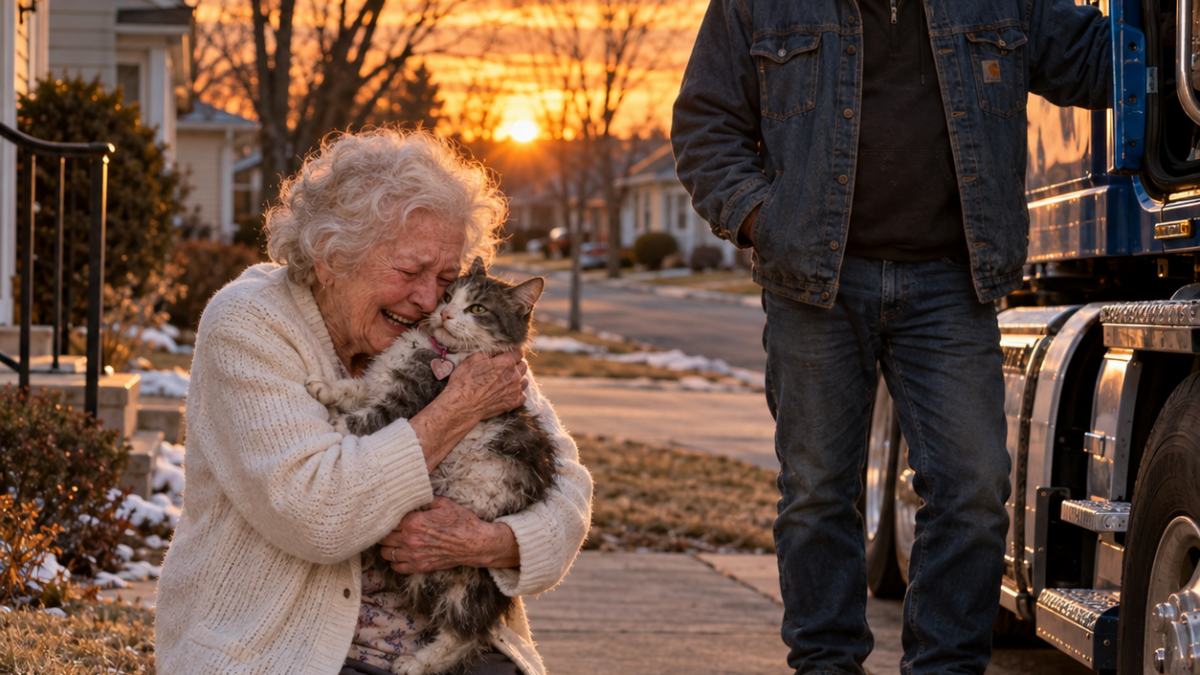
June was already waiting in the yard.
She was smaller than I expected.
White cardigan.
House shoes.
One hand pressed against her chest as if she was holding herself together.
I had barely put the truck in park when Maggie stood up on the passenger seat and let out a sharp little cry.
June heard it.
Her face changed so fast it almost undid me.
I opened the passenger door.
Maggie jumped down before I could help her.
That cat ran across the walkway like every mile between them had been an insult she intended to correct.
June dropped to her knees and caught her.
I will remember that sound as long as I live.
An old woman laughing and crying at the same time, holding a trembling cat beneath her chin like she had just been handed back oxygen.
Maggie climbed her sweater, pressed against her neck, and purred so loudly I heard it from the driveway.
June looked up at me over Maggie’s back.
“You didn’t just bring back my cat,” she said. “You brought sound back into my house.”
I had to turn my face for a second.
She invited me in for coffee.
Nothing fancy.
Just a warm kitchen, two mismatched mugs, and Maggie curled in June’s lap like she had never left.
I did not stay long.
Truckers learn not to overstay the moments they are lucky enough to be invited into.
But when I walked back to my truck, something inside me felt quieter than it had in years.
People think big kindness has to be expensive or dramatic.
Most of the time, it does not.
Sometimes it is just deciding that somebody else’s loneliness matters as much as your schedule.
I thought that was the end of it.
I was wrong.
Three nights later, June called me again.
This time, she was not crying about a cat.
She was whispering.
The kind of whisper people use when they are standing in their own kitchen but do not feel alone enough to speak freely.
“Are you driving?” she asked.
I was parked outside a rest stop with a paper cup of coffee gone cold between my hands.
“No, ma’am,” I said. “What happened?”
There was a pause.
Then she said, “They came.”
I sat up.
“Who came?”
“My family.”
She did not say family the way most people do.
She said it the way someone says weather when dark clouds roll in after the laundry is already on the line.
“My daughter,” she said. “My son-in-law. My grandson too. They drove in this afternoon.”
Part of me thought maybe that was good.
Maybe the story had reached them, and they had rushed over because they loved her and were frightened by what they had almost lost.
Maybe the world was kinder than I had learned to expect.
But June was not whispering like a woman comforted.
She was whispering like a woman trying not to be overheard.
“They saw me on the internet,” she said.
I frowned.
“I didn’t post anything.”
“I know,” she said quickly. “Mrs. Alvarez from across the street recorded when you brought Maggie home. Not all of it. Just when Maggie ran to me on the walkway.”
I closed my eyes.
I could picture it.
The shaky porch video.
The winter light.
The old woman on her knees.
The cat flying across the walkway like love had claws.
That kind of video does not stay small anymore.
Someone had posted it with a caption.
Then someone else shared it.
Then someone else.
Then a stranger added music.
Then strangers began adding judgment.
June told me her daughter had called, angry, wanting to know why half the county thought she had abandoned her mother.
“I’m sorry,” I said.
And I meant it.
Because I knew how these things worked.
One person saw a moment of tenderness.
Another saw loneliness.
Another saw neglect.
Another saw a sermon.
Then suddenly a private ache became public property, and everyone with a phone became judge, jury, and moral expert.
June sighed.
“I don’t think you did anything wrong,” she said. “I don’t want you thinking that.”
Then her voice lowered.
“But my daughter is angry.”
“At you?”
“At everybody,” June said. “At the video. At the neighbors. At me. At the people online. At the fact that they all have opinions.”
She paused.
Then added something I never forgot.
“But mostly at being seen.”
Mostly at being seen.
Not accused.
Not exposed.
Seen.
There is a difference.
I asked if she was all right.
She said yes too quickly.
Then no, not exactly.
Then she laughed once, brittle and small.
“She says I made her look like a terrible daughter.”
“And did you?” I asked.
It was too dangerous a question.
I knew that the moment it left my mouth.
June was quiet for a long time.
When she answered, there was no anger in her voice.
Only age.
“No,” she said. “Life did that on its own.”
I had no answer.
Sometimes a person tells the truth so plainly there is nowhere for words to go after it.
June continued.
“She did call after Harold died. Every Sunday at first. Then every other Sunday. Then when she could. Then holidays. Then when Maggie got sick last spring. Then when the roof leaked. Then…”
She stopped.
“Well. You know how then goes.”
Yes.
I knew exactly how then goes.
It goes one missed call at a time.
One postponed visit.
One “next week” laid carefully on top of another until a whole relationship disappears under the pile.
I had lived there myself.
Just on the other side of it.
“What does she want now?” I asked.
June’s voice got smaller.
“She says I shouldn’t be here alone anymore.”
I waited.
“And she says Maggie isn’t helping.”
My grip tightened around the phone.
June hurried on.
“She says the cat got out once and next time maybe I’ll get out too. She says the house is too much. She says I forget things. She says strangers online are messaging me and I don’t understand what’s safe. She says if I had just agreed to move months ago, none of this would have happened.”
There it was.
Not one argument.
A hundred little ones tied together.
The kind that sound practical on paper and cruel in the room.
“Do you want to move?” I asked.
“No.”
That answer came fast.
Clear.
Steady.
Then, after a second, “At least not because people got embarrassed.”
I closed my eyes.
I could see her standing in that warm kitchen in house shoes, one hand wrapped around the phone, Maggie probably underfoot, her own life suddenly crowded by people who had found urgency only after strangers noticed the silence.
“Did you call because you want me to talk to them?” I asked.
“Oh no,” she said quickly. “No, I wouldn’t ask that of you.”
Her voice cracked.
“I just needed one person who already knew what the house sounded like before they came.”
That one got me worse than anything else.
Because I understood.
There are people who show up when the room is already full.
And then there are the rare ones who know how quiet it was before the doors opened.
I told her to keep her phone nearby.
I told her if anything felt wrong, she could call me again.
After we hung up, I sat in the dark cab for a long time.
No radio.
No coffee.
Just my own reflection faint in the windshield and the uncomfortable knowledge that sometimes a stranger gets invited into a truth a family has been stepping around for years.
The next morning, curiosity got the better of me.
That was my mistake.
It took less than five minutes to find the video.
Somebody had clipped it.
Somebody had reposted it.
Somebody had added soft piano music.
The original caption was simple enough:
TRUCKER DRIVES LOST CAT 1,200 MILES HOME TO ELDERLY WIDOW.
That part I could live with.
Then came the rest.
Where was her family?
If a stranger can do this, what excuse do her kids have?
We fail our elders every day.
Call your mother.
Shame on anyone who leaves an old woman alone except for a cat.
The comments were worse.
Thousands of them.
Some beautiful.
Some ugly.
Some painfully honest.
Some so eager to judge that they tripped over themselves reaching for the gavel.
One woman wrote that her father had died waiting for visits that never came.
A man replied that nobody knew the family story and strangers needed to stop acting like thirty seconds made them God.
Someone else wrote that people would type paragraphs defending why they could not drive ten minutes to see their parents.
That one had thousands of likes.
Another person pointed out how daughters get blamed for caregiving while sons disappear without anyone noticing.
That started another war entirely.
Then came the arguments about pets.
Older adults should not live alone with animals.
Pets are the only reason some older people keep going.
No cat is worth a twelve-hundred-mile trip.
It was not about the cat.
That last one made me put the phone down.
Because it was not.
And it was.
It was about Maggie.
It was about June.
It was about the silence in that house.
It was about the way small living things sometimes hold people together better than big human promises.
I should have stayed out of it.
But wisdom and regret are cousins.
They look enough alike to fool a tired man.
Two days later, I ended up rerouted because of bad weather and passed within ninety miles of June’s town.
Ninety miles is not nothing in a truck.
But it is not twelve hundred either.
I called her.
She did not ask me to come.
Not directly.
She just said, “Maggie keeps sleeping by the door after lunch.”
So I went.
It was colder than the first time.
When I pulled up, two cars sat in the driveway.
Not June’s little sedan.
Newer cars.
Bigger.
The sort that say stability in the parking lot and impatience in the kitchen.
June opened the door before I knocked.
Her face changed when she saw me.
Not surprise.
Relief.
That told me I had not imagined any of this.
Maggie wound around her ankles, already looking healthier, her collar shining beneath the porch light.
“You came,” June said.
I took off my cap.
“Yes, ma’am.”
From inside, a woman’s voice called, “Mom? Who is it?”
Then the woman appeared.
Mid-fifties.
Neat coat.
Good boots.
The polished, tired face of someone used to keeping it together in public and falling apart in private.
She saw me.
She understood at once.
“You,” she said.
June flinched like she had hoped for softer.
I nodded.
“Ma’am.”
“You’re the driver.”
“Yes.”
“The one from the video.”
“The one with the cat,” I said. “I didn’t take the video.”
“I know you didn’t,” she snapped. “But ever since it showed up, people I have not spoken to in ten years have been sending it to me like I’m public enemy number one.”
There it was.
Not grief.
Not concern.
Shame with witnesses.
“I’m sorry for that,” I said.
She laughed without humor.
“Are you? Because you drove across half the country and now strangers act like you’re some kind of saint and I’m some kind of monster.”
Before I could answer, June spoke.
“Karen.”
Just the name.
Soft.
But it carried.
Something in the room shifted.
Karen looked at her mother, and for one second I saw the child still living somewhere beneath the grown woman’s anger.
Then it vanished.
“I’m not saying he is a bad person,” Karen said. “I’m saying nobody online knows anything. They don’t know who was here when Dad was sick. They don’t know who did the paperwork. They don’t know who called doctors, pharmacies, insurance offices, hospice. They don’t know how many weekends I gave up. They don’t know how many times I begged you to come stay with us.”
Her voice had started aimed at me.
By the end, it was pointed at June.
And suddenly the room became more complicated.
That is the thing people online hate.
Sometimes the person they have cast as the villain has receipts.
June stood there with one hand resting on the doorframe.
Tiny.
Cardigan buttoned wrong.
Maggie pressed against her leg.
Still, somehow, steadier than all of us.
“I know what you did for your father,” she said quietly. “I thanked you then, and I thank you now.”
Karen opened her mouth.
June kept going.
“What I am talking about is after.”
There it was.
Not no love.
Not no history.
Just the slow decay that comes when duty ends and tenderness does not know how to survive without an emergency.
A man appeared from the kitchen.
Tall.
Gray at the temples.
Watchful.
This was Rick, the son-in-law. He held himself like a man who had spent his marriage trying to de-escalate pain that belonged to other people.
“You should all come inside,” he said.
Not warm.
Not cold.
Practical.
So we did.
The kitchen smelled like reheated soup and stress.
There were unopened envelopes on the counter, flowers on the table, printed emails from strangers, and a teenage boy sitting on a stool in the corner looking like he wished he could disappear into the tile.
Owen.
The grandson.
He gave me a small nod without lifting his head.
Nobody asked if I wanted coffee.
June made it anyway.
That told me whose kitchen it still was.
Karen started again.
Not shouting.
That would have been easier.
She sounded wounded, and wounded people can do a lot of damage while sounding reasonable.
“My mother is not safe here alone,” Karen said. “That is the part nobody wants to hear because it ruins the nice viral story. This house is too much. The steps are icy. The gutters are bad. She forgets things. People online are messaging her. Someone mailed cash. Someone else showed up wanting a picture. This is not normal.”
“No,” I said. “It isn’t.”
Karen blinked as if she had not expected agreement.
I continued.
“But neither is a woman having to become internet-famous for people to notice she is lonely.”
Her jaw tightened.
“That’s not fair.”
I looked at June.
Then at Karen.
“Most true things aren’t.”
Rick rubbed the back of his neck.
Owen stared harder at the floor.
June carried mugs to the table one at a time because her hands were too full to manage two.
Nobody moved to help her.
That told its own story.
Karen saw me notice.
Red climbed up her neck.
“I am trying to help her,” she said.
June sat down slowly, and Maggie climbed into her lap.
“I know,” June said.
That was the problem.
It would have been easier if Karen were cruel.
Cruelty is clean.
This was not clean.
This was love thinned out by time, inconvenience, fear, and embarrassment until it started cutting the wrong person.
Karen leaned forward.
“Mom, I asked you months ago to come stay with us.”
“For a week,” June said.
“To see if it worked.”
“In the room over your garage.”
“It’s a finished room.”
“It’s over your garage.”
Rick closed his eyes.
Owen swallowed.
Karen threw up her hands.
“See? This is what I mean. Nothing is good enough.”
June ran one hand down Maggie’s back.
“No,” she said. “Being stored is not good enough.”
The whole room went still.
Karen stared at her mother.
“I would never store you.”
June looked up.
Really looked.
Not scared.
Not apologizing.
Just old enough to be done decorating the truth.
“You don’t mean to,” she said. “But people don’t always have to mean a thing for it to happen.”
Karen’s face changed.
Anger first.
Then hurt.
Then recognition.
Because somewhere deep down, she knew what her mother meant.
Rick spoke quietly.
“We have been trying to figure this out. There is too much attention now. That part is real. We are worried.”
June nodded.
“I know.”
Rick glanced at Maggie.
“And the cat situation…”
June smiled a little.
Not because it was funny.
Because old women have a way of smiling when younger people say foolish things with straight faces.
“Maggie is not a situation,” June said. “She is my cat.”
Karen pressed her fingertips against her temples.
“Mom, you say that like we’re asking you to surrender a child.”
June did not miss a beat.
“When you live alone long enough, love does not stop counting just because it has fur.”
Nobody spoke.
That sentence moved through the room and sat down with us.
She was not comparing a cat to a child.
She was comparing silence to companionship.
Only people who have lived with too much of the first understand the value of the second.
Owen finally looked up.
His voice came out rough.
“Grandma didn’t used to be this alone.”
Everyone turned toward him.
Teenagers hate that.
But he kept going.
“After Grandpa died, we came every week for a while. Then baseball started. Then Mom got busier. Then I got older. Then…” He shrugged helplessly. “I guess we got used to her always being there.”
June’s face softened.
That broke my heart more than if she had cried.
Older people forgive so often before anyone has earned it.
Karen looked at her son like he had slapped her.
“Owen.”
“What?” he said, heat entering his voice. “That’s what happened.”
“You don’t understand adult life.”
“No,” he said. “But I understand phones. Everyone has one. That’s kind of the problem.”
Karen looked from him to June to me, and humiliation rose in her like steam.
“Of course,” she said. “Now the trucker gets front-row seats to my son telling me I’m a bad daughter.”
“Nobody said bad,” I said.
She snapped toward me.
“They didn’t have to. I read the comments.”
There they were again.
The comments.
That giant anonymous jury sitting in the room without being in it.
I hated them suddenly.
I hated that Karen was hearing her failure through strangers before she could hear it in her mother’s quiet voice.
I hated that June had to defend herself from concern that had only found urgency after shame lit it on fire.
And maybe most of all, I hated how familiar it felt.
This was not just their kitchen.
It was every kitchen where love gets crowded out by errands, distance, resentment, pride, exhaustion, and the lie that there will be time later.
I set my mug down.
“I should say something.”
Nobody looked thrilled.
Nobody stopped me either.
“I don’t know your family,” I said to Karen. “And I won’t pretend I do. I know what I saw. I saw your mother alone in a quiet house loving a cat like that cat was keeping her stitched together. I heard what her voice sounded like before the internet showed up.”
Karen folded her arms tighter.
“And?”
“I also believe you when you say you showed up for your father.”
Her eyes flickered.
“But showing up in the hardest season of somebody’s life does not buy you the right to disappear in the quieter one.”
The words sat there.
Rick looked down.
Owen stared at me.
Karen’s face went white, then red.
June did not move.
Maggie purred in her lap like none of this had anything to do with her and everything did.
Karen let out a breath that sounded half angry and half broken.
“You think I wanted this?” she said. “You think I wanted my mother turned into a lesson for strangers? You think I don’t know how it looks?”
“No,” I said. “I think you know exactly how it looks. That’s why you’re here now.”
It was the wrong thing.
And the true thing.
Those are often the same.
Karen stood so fast her chair scraped the floor.
Rick said her name.
June did not.
Karen looked at her mother, tears in her eyes and fury trying to outrun them.
“I called you,” she said. “Maybe not enough. But I called.”
June nodded.
“Yes.”
“I invited you.”
“Yes.”
“I worried about you.”
“Yes.”
Karen’s face crumpled.
“Then why does it feel like I’m on trial for not being perfect?”
June answered so gently I almost missed how sharp it was.
“Because lonely people do not need perfect. They need present.”
Nobody breathed for a moment.
I have heard a lot of things on the road.
Men threatening each other over parking spots.
Women sobbing outside gas stations.
A preacher in Arkansas once told me hell was paved with postponed intentions.
But I do not know if I have ever heard a cleaner truth than that.
Lonely people do not need perfect.
They need present.
Karen sat down slowly.
All the fight left her at once.
Rick reached for her hand.
This time, she let him.
The next hour was not dramatic.
That was the strangest part.
No one slammed a door.
No one delivered a speech and changed forever.
Real families almost never do.
Instead, we sat in June’s kitchen and said ugly, useful things.
Karen admitted the video made her feel exposed, but what really gutted her was realizing she could not honestly say the criticism was completely unfair.
Rick admitted they had talked more about what to do with June than with June.
Owen admitted he had seen the video before his mother and had not known whether to send it because part of him did not want to know if it was true.
June admitted she had hidden how lonely she was because she did not want pity, and because people stop calling altogether when every conversation feels like guilt.
I admitted my mother died with too many “next weeks” still owed her.
The room held all of it.
Not neatly.
Honestly.
When I stood to leave, the winter light outside had gone blue.
Karen followed me to the door.
For a moment, neither of us spoke.
Then she wrapped her coat tighter.
“I hate that it took this.”
“So do I.”
She glanced back toward the kitchen, where June’s voice drifted softly over Owen’s.
“I’m not a bad person,” Karen said.
I believed her.
That was the uncomfortable part.
Bad people are easy.
Ordinary people failing the ones they love because they got busy, overwhelmed, proud, embarrassed, avoidant, and used to tomorrow being available—that is the part nobody likes discussing.
It hits too close to home.
“I don’t think you are,” I said.
She nodded once.
Then surprised me.
“I do think I’ve been a lazy daughter in the ways that don’t leave paperwork.”
I looked at her.
She gave a bitter little half-smile.
“Everyone praises the hard emergencies. Nobody notices the soft neglect.”
That one was worth carrying.
I drove away with June’s porch light glowing behind me.
For the first time since the video spread, I felt something other than anger.
Not peace exactly.
Room.
Room for the ugly truth that love can be real and still insufficient.
Room for the fact that the internet had been wrong and not wrong.
Wrong about the whole story.
Not wrong about the loneliness.
That night, parked outside a shipping yard, I opened the page again.
The comments had gotten worse.
People were drawing battle lines as if this were politics instead of grief with Wi-Fi.
Some said children owe parents everything.
Some said nobody owes anyone anything.
Some talked about trauma.
Some about duty.
Some about nursing homes.
Some about pets.
Some about daughters being judged harder than sons.
Some about the death of basic decency in America.
A lot of them were probably typing with one hand while ignoring a phone call from somebody who loved them.
That thought made me so mad I laughed.
Then I did something I almost never do.
I wrote a comment.
Not much.
Just this:
I’m the driver from the video.
You don’t know that family, and neither do I.
But I know this much: no older person should have to become a public story before people remember to be present.
Before you judge a stranger for stepping in, ask yourself why a stranger had to.
I stared at it a long time.
Then I posted it and set my phone face down.
By morning, it had spread farther than the first video.
Maybe people were not actually hungry for outrage.
Maybe they were hungry for a mirror and angry about what they saw in it.
Messages poured in.
From nurses.
Truckers.
Widows.
Overwhelmed daughters.
Adult sons.
People caring for parents with dementia.
People estranged for reasons they said nobody in the comments could understand.
One message came from a woman who wrote:
I did everything for my mom when she was dying, and somehow still forgot she needed me before she was.
That one stayed with me.
A week later, June called on a Sunday afternoon.
Not whispering this time.
Just talking.
Karen had gone home.
Owen had come back twice on his own.
Rick had installed better lights on the back steps.
Mrs. Alvarez had started knocking every evening around six “for no reason at all.”
And Karen, who lived only forty minutes away but had somehow let life stretch that into an emotional distance, had started coming on Thursdays for lunch.
“Not every Thursday,” June said.
“But enough Thursdays to count?” I asked.
“Yes,” she said. “Enough Thursdays to count.”
“And Maggie?”
June snorted.
“As if anyone was taking Maggie anywhere.”
I smiled so hard my face hurt.
Then June said something else.
“Karin called me last night just to tell me what she was cooking.”
“Karin?”
“My daughter,” June said. “I suppose I should call her Karen less when I’m proud of her.”
That made me laugh.
“She didn’t need anything,” June continued. “She didn’t have a list. She wasn’t checking on a form or a bill or medicine. She just called because she was making pot roast and remembered Harold liked his carrots too soft.”
Her voice softened.
“I had almost forgotten how ordinary love sounds.”
I had to look away from the road even though I was parked.
Ordinary love.
That was the whole thing.
Not dramatic love.
Not funeral love.
Not crisis love.
Not viral love.
Ordinary love.
The kind that calls to say what is for dinner.
The kind that knocks at six.
The kind that remembers the soft carrots.
A month later, I passed through again.
This time, I planned it.
When I pulled up, Owen’s beat-up car was at the curb. A folding chair sat on June’s porch with a blanket over the back. June was sitting in it with Maggie in her lap like she had been doing it forever.
Not waiting.
Just there.
Visible.
That mattered.
A lot of older people disappear while still alive.
Not because they vanish physically.
Because everyone gets used to not seeing them.
June was not doing that anymore.
Inside, the house sounded different.
Not louder exactly.
Inhabited.
There was a grocery list on the counter in two different handwritings. A bag of cat food near the pantry. A framed photo of June and Maggie on the walkway that night, though Owen had cropped me out of it.
I appreciated that.
Some moments belong where they happened.
Owen said he had started coming by on Saturdays to help with yard work.
“Mostly I listen to stories about Grandpa and fix things that aren’t really broken,” he said.
June smiled into her mug.
“That is fixing things.”
Karen came in halfway through my visit carrying a pie that looked homemade enough to count.
She looked at me, then at her mother, then at Maggie sprawled across the table like management.
And she smiled.
Not grateful.
Not guilty.
Just human.
That felt like progress.
Before I left, June walked me to the truck again.
The air had softened some.
Winter losing its grip.
She stood on the bottom step and looked up at me.
“You know the strangest part?” she asked.
“What’s that?”
“Everyone keeps saying you brought my cat home.”
I waited.
She smiled.
“But what you really brought home was my daughter’s attention. My grandson’s conscience. My own voice.”
She looked down at Maggie’s tag glinting in the sun.
“That cat did more than get lost. She embarrassed the truth out into the open.”
I laughed.
Then, because June had earned plain honesty from me, I said, “That might be the most American thing I’ve ever heard.”
She laughed too.
Then she grew serious.
“People are still arguing under that post, you know.”
“I know.”
“Good,” she said.
I blinked.
“Good?”
“Yes,” June said. “Maybe people should. Maybe we would all be less lonely if folks were half as brave in real life as they are in comment sections.”
That was June.
Tiny.
Seventy-seven.
House shoes.
Cardigan.
Dropping lines heavier than most men I knew.
I thought about that for miles after I left.
Maybe that was the message.
Not that families are evil.
Not that strangers are better.
Not even that pets save lives, though sometimes they do.
Maybe the message is simpler and harder.
If someone else has to prove your love exists, it probably is not showing up where it counts.
And maybe the reason stories like June’s spread so fast is not because people enjoy kindness.
Maybe it is because they recognize the guilt hiding behind it.
Every person who shared that video knew someone they should probably call.
Every person who got defensive in the comments had a name sitting somewhere in the back of their throat.
Every person who said, “You don’t know the whole story,” might have been right.
But a whole lot of them were also using complexity the way people use curtains.
To cover a window they do not want to look through.
I still drive.
I still hear every strange sound in the truck.
I still drink bad coffee and tell myself I will switch to water, then never do.
But some things changed.
On Sundays now, unless I am stuck somewhere impossible, I make two calls.
One to June.
One to whoever else comes to mind that week.
An old neighbor.
A retired mechanic in Missouri.
A widow who runs a bait shop in Kentucky and always says she is fine too quickly.
Nothing heroic.
Nothing viral.
Just present.
That is all.
And I guess that is what I keep thinking about.
The biggest arguments online are usually built around very small daily failures.
A missed visit.
A delayed call.
A parent told not to fuss.
A grandparent moved to the edge of everyone’s schedule.
A cat becoming the last witness to a person’s life.
People love to debate grand values.
Family.
Duty.
Boundaries.
Freedom.
Independence.
They will type essays about all of it.
But real love rarely looks like an essay.
Usually it looks like showing up before a stranger has to.
So let people argue if they want.
Let them fight in the comments about whether Karen was wrong, whether June was stubborn, whether Maggie was a risk, whether I overstepped, whether loneliness is a family failure or a social one, whether pets should matter that much, whether daughters get judged harder, whether the internet helps or poisons everything it touches.
Let them.
Maybe they should.
Because under all that noise, there is a question no one gets to dodge forever.
Who in your life is still waiting in a quiet house, pretending not to need more from you than you have been giving?
And if a frightened cat had not climbed behind my cab that night, how much longer would June have kept pretending too?
That is the part I cannot shake.
Not the drive.
Not the video.
Not the comments.
The pretending.
The way decent people let loneliness grow in the people they love because no one is screaming.
No smoke.
No sirens.
No blood.
Just silence getting thicker around someone everyone calls strong.
Until a stranger hears scratching in the dark and discovers an entire life hanging from a little heart-shaped tag.
If there is anything worth saying after all of this, maybe it is this:
Do not wait for the reunion video.
Do not wait for the hospital bed.
Do not wait for funeral flowers and casseroles and guilt dressed up as praise.
Do not wait until your kindness can be witnessed.
Call while their voice is still ordinary.
Visit while the chair is still warm.
Knock while they can still answer the door themselves.
Because lonely people do not need perfect.
They need present.
And if that sentence makes somebody defensive, maybe that is exactly why it needs saying.