A Tiny Puppy Kept Digging Snow From His Mother’s Face in the Middle of a Blizzard—Until a Police Officer Heard His Desperate Cries and Followed Them Into the Storm
PART3:
Calder turned and pushed through the snow toward the old line of bushes near the rear of the property. The drifts deepened there where wind had packed powder against the fence. His boots sank. Snow climbed over the tops and melted cold against his socks. He cursed under his breath and kept moving.
The flashlight passed over branches, a leaning fence post, a mound of snow near the base of a bush.
Then the mound moved.
Calder froze.
He swept the beam back.
Two small pointed ears stuck above the snow.
At first, that was all he saw.
Then the eyes.
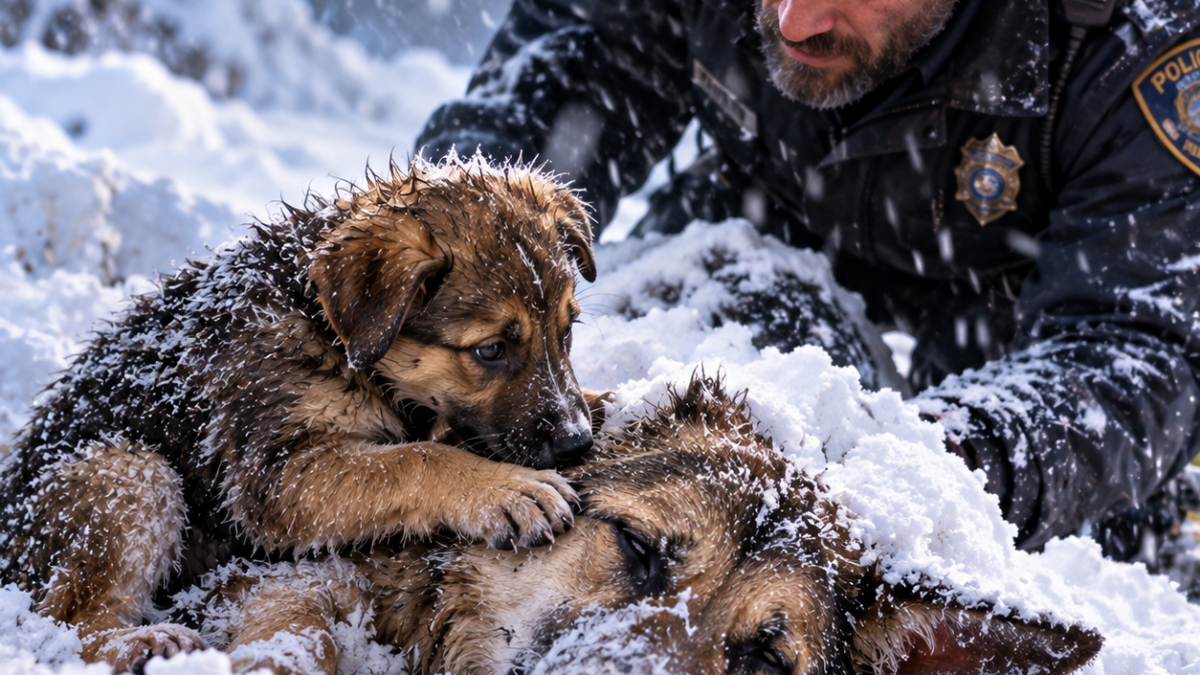
A German Shepherd puppy lay pressed low against a snow-covered shape beneath him. He could not have been more than nine weeks old. His paws were oversized for his body, his ears not quite grown into themselves, his thick puppy fur crusted with ice. He trembled violently, but he did not run toward Calder. He did not run at all.
Instead, he lowered himself harder against the mound beneath him and barked again.
“Easy, little guy,” Calder said, crouching. “I’m not going to hurt you.”
The puppy’s eyes were tired and frightened, but fiercely alert.
A gust swept across them.
Fresh powder blew over the mound, covering a small dark shape near the puppy’s chest.
The puppy reacted instantly.
He lifted himself, scraped frantically with both front paws, clawing away snow, then bent and licked something beneath him.
Calder stepped closer.
His breath stopped.
The mound was not just snow.
It was another dog.
An adult female German Shepherd lay beneath the drift, almost completely buried. Only her head, part of one shoulder, and a narrow section of her back remained visible. The puppy had been lying across her neck and shoulder, using his small body as a shield against the storm.
Calder dropped to his knees.
The snow around the mother dog’s muzzle was scratched and broken by dozens of tiny grooves.
He understood then.
Every time the wind covered her nose, the puppy cleared it.
He had not been barking because he was lost.
He had been barking because she was dying.
Calder pulled off one glove and touched the mother dog near the shoulder.
Her body was dangerously cold.
For a second, nothing happened.
Then her eyes opened halfway.
Clouded.
Unfocused.
Still alive.
“Stay with me,” Calder murmured. “Stay with me, girl.”
The puppy barked once, as if agreeing.
Calder began digging.
The snow had packed hard around the mother dog’s lower body, and he forced himself to work carefully instead of pulling too fast and making an injury worse. His fingers burned. Snow filled his sleeves. The wind tried to cover everything he uncovered.
The puppy refused to move far.
Whenever Calder’s hands cleared one area, the little dog went back to the mother’s muzzle, licking her face and pushing snow away with desperate, clumsy paws.
“I see you,” Calder said. “I know. I’m getting her.”
The words sounded absurd, but he said them anyway.
The puppy’s eyes flicked up to him.
For a moment, in the middle of that storm, Calder had the strange sense that the puppy understood only one thing: help had finally arrived, and it had better not fail.
It took several minutes to free enough of the mother’s body to lift her. She could not stand. When Calder slid one arm beneath her chest and the other beneath her hips, she made a faint sound but did not fight.
She was heavier than he expected.
Too heavy for the puppy to have protected.
Too cold to have lasted much longer.
Calder staggered upright with her in his arms and turned toward the house.
The puppy followed immediately.
He struggled through the deep trail Calder had made, falling once, then scrambling up again, refusing to be left behind.
“Come on,” Calder called over his shoulder. “Come on, little guy.”
Inside the house, the sudden warmth felt almost violent.
Calder laid the mother dog on blankets near the heater and grabbed more from the hallway closet. The puppy climbed over the folds before Calder could stop him and curled against his mother’s chest, pressing his small body into her as if warmth could be transferred by loyalty alone.
Calder called the nearest veterinary clinic equipped for emergency storm work.
“Teresa,” he said when Dr. Teresa Foster answered. “I found two German Shepherds outside. Adult female hypothermic, barely conscious. Puppy exposed but alert. I need help.”
Dr. Foster did not waste time.
“Bring them in. I’ll meet you there.”
Fifteen minutes later, Calder was driving through Munising with the mother dog stretched across the back seat, wrapped in blankets, the puppy on the passenger-side floor in a towel. The roads were nearly empty, buried under fresh snow and wind-whipped drifts. Several times, gusts erased the world beyond his headlights, and Calder had to slow until he could see the edge of the road again.
The puppy paid little attention to him.
He kept turning toward the back seat.
Every time the mother dog released a faint breath, his ears lifted.
When Calder pulled up behind the clinic, Teresa was already waiting with her assistant. She was forty-five, practical, steady, the kind of rural veterinarian who could deliver calves, treat farm dogs, calm panicked owners, and work through storms because animals did not schedule emergencies during office hours.
They moved the mother dog inside.
The puppy tried to follow.
“Not yet,” Calder said, gently holding him back.
The puppy strained toward the exam room door.
His whole body seemed to lean in the direction his mother had gone.
Calder crouched beside him in the hallway. Snow melted off both of them and puddled on the tile.
“You did your part,” he said quietly. “Let them do theirs.”
The puppy stared at the closed door.
After the initial examination, Teresa stepped back into the hall. Her expression was controlled, but Calder knew enough to read what sat behind it.
“She’s hypothermic and dehydrated. There’s an injury around the hip. I’ll know more when she’s warm enough for imaging.”
“Does she have a chance?”
“Yes,” Teresa said. “She does.”
The puppy whimpered.
Calder told Teresa what he had seen outside—the scratches in the snow, the way the puppy cleared her muzzle every time the wind buried it again.
Teresa looked down at him.
The puppy’s paws were still damp from melting snow. He looked too small to have done anything heroic. Too young to understand death. Too fragile to have held back a blizzard for even one minute.
“Whatever he was doing out there,” Teresa said softly, “it bought her time.”
The mother dog needed more intensive monitoring than Teresa’s small clinic could safely provide through the storm, so arrangements were made to transfer her to a larger veterinary hospital farther inland, where she could receive round-the-clock care, advanced imaging, and warming support.
Calder assumed the puppy would go with her.
Then Teresa explained that the hospital could take the injured mother as a patient, but not a healthy puppy simply because he belonged beside her.
The explanation made sense.
Medically.
Logistically.
Practically.
It meant nothing to the puppy.
When the mother dog was brought out on a stretcher, he stood instantly. His body leaned toward her. His eyes locked onto the blankets around her.
The rear doors of the transport vehicle opened.
The stretcher slid inside.
The puppy strained against the leash in Calder’s hand.
The doors closed.
He whimpered once.
The vehicle began moving away.
For one second, the puppy stood completely still.
Then he slipped free.
“Hey!”
Calder lunged after him.
The puppy ran straight toward the departing vehicle, his short legs fighting through fresh snow, ears pinned, towel slipping from his body. Calder caught him before he reached the road and lifted him against his chest.
The little dog struggled, stretching toward the fading taillights.
Then they disappeared into the storm.
The puppy stopped fighting.
He simply stared.
Calder held him while snow settled across both their coats.
He had gone outside expecting to check on a barking animal.
Instead, he had found a puppy who had stayed in a blizzard beside his dying mother, clearing snow from her face every time the wind tried to bury her.
Teresa stepped out beside him.
“He needs somewhere warm tonight.”
Calder looked down at the puppy.
Taking home a dog had not been part of his night.
Not even close.
“One night,” he said. “I’ll keep him for one night.”
Before he left, Teresa scanned the mother dog for identification.
“She has a microchip,” she said. “I haven’t traced it yet, but someone owns her.”
Calder glanced toward the road where the transport vehicle had vanished.
Someone owned her.
Someone owned the puppy too, likely.
Someone might be worried sick.
Or someone might have failed them so badly that they ended up outside in a lethal storm.
For now, Calder knew none of it.
He carried the nameless puppy back to his truck and placed him gently on the blanket inside. The little dog turned once toward the empty road before curling down, still facing the direction his mother had gone.
Somewhere beyond Munising, she was fighting to survive.
And beside Calder sat a puppy whose name he did not yet know, waiting for the only thing that mattered to him.
His mother coming back.
By morning, the storm had weakened, but the town remained buried. Snowbanks rose high along driveways and storefronts. Plows moved slowly through the streets, their yellow lights turning ghostly behind blowing powder. Inside Calder’s house, everything felt unnaturally still.
The puppy stood in the entryway listening toward the closed door.
Calder had lived alone long enough that silence usually felt normal. He had arranged his life around it without admitting what he was doing. Work filled the days. Small routines held the evenings together. Coffee. News. Paperwork. Laundry. Bed. Repeat.
But with the puppy standing there, the silence no longer felt like peace.
It felt like waiting.
Calder placed a bowl of water in the kitchen and found a clean blanket. He folded it near the heater, where the floor stayed warm.
The puppy drank a little, sniffed the blanket, then walked back toward the front door.
Calder watched him.
“You’re missing the warm part,” he said.
The puppy took one corner of the blanket in his mouth and dragged it across the floor.
It took several attempts. He stumbled twice. The blanket bunched beneath him and caught on the edge of a rug. Calder almost helped, then stopped.
The little dog kept pulling until most of the blanket sat beside the door.
Then he curled on it, facing the narrow space beneath the frame.
“All right,” Calder said. “Have it your way.”
The puppy lowered his head, but he did not sleep deeply. Any sound from outside lifted his ears. A passing plow. Wind. A branch dropping snow from its limbs.
He was waiting for the vehicle that had taken his mother to come back.
Calder left the blanket by the door.
Teresa called the next morning.
“She survived the night.”
Calder closed his eyes.
The relief surprised him with its force.
“Temperature is improving,” Teresa continued. “She’s still weak, but they’re encouraged. The first hours were the most dangerous.”
Calder looked toward the doorway.
The puppy was awake, watching him.
“Your mother made it through the night,” Calder told him.
The puppy stared.
Calder almost laughed at himself. He had spoken to working dogs for years, but those had been commands. Useful words. Heel. Search. Stay. Release.
This was not a command.
There was no reason to think the puppy understood.
Still, saying it aloud mattered.
The one night Calder promised became a second.
On the second morning, Teresa called again. The mother dog had lifted her head without assistance.
Calder repeated the news before leaving for work.
When he returned that afternoon, the puppy hurried toward him, tail moving for the first time since the rescue.
For one brief second, Calder thought he was beginning to settle.
Then the puppy moved past him and looked into the driveway.
He waited several seconds.
When no second vehicle appeared, he quietly turned around.
That became their routine.
Every afternoon, Calder opened the door and the puppy came running. He would look up at Calder, then peer past his legs toward the road, searching for the mother who never followed him inside.
Calder stopped trying to distract him.
Some forms of waiting could not be talked away.
On the fourth morning, Teresa called with another improvement.
“She ate a little on her own.”
The puppy appeared beside Calder’s chair the moment the phone rang. He had begun recognizing Teresa’s early calls, or maybe he recognized the change in Calder’s voice when he answered them.
“That’s good, isn’t it?” Calder asked.
“It’s very good,” Teresa said. “She still has a long way to go, but she’s moving forward.”
After the call, Calder crouched near the puppy.
“Your mother ate today.”
The little German Shepherd placed one oversized paw on Calder’s boot.
The gesture lasted only a second.
Calder carried it with him through the entire day.
Life in the house began changing in small ways he did not notice until they had already happened.
He bought puppy food before he ran out.
He moved cleaning supplies from under the sink after catching the puppy sniffing too close.
He started putting his gloves higher because the puppy showed interest in chewing leather.
He came home directly after work.
One afternoon, halfway through a shift, Calder caught himself wondering whether the puppy had finished breakfast.
That thought brought Ranger back so suddenly he had to sit in his patrol vehicle for a full minute before answering the next radio call.
Ranger had been Calder’s K9 partner for eight years and his retired shadow for four more. A black-and-tan German Shepherd with sharp eyes, steady nerves, and a stubborn habit of resting his chin on Calder’s knee whenever Calder pretended not to be tired.
Ranger had died peacefully at fourteen, old and ready, if any creature can be called ready.
Calder had known it was coming.
That did not make the house less empty afterward.
The bowl disappeared first.
Then the leash.
Then the dog bed.
Eventually, the house returned to the quiet it had known before Ranger came.
Calder never declared he would never own another dog.
He simply never brought one home.
Until now.
The puppy did not replace Ranger.
That thought made Calder uncomfortable enough that he said it aloud one night while washing a food bowl.
“You’re not him.”
The puppy, sitting by the door, looked up.
“And I’m not doing this permanently,” Calder added.
The puppy yawned.
Calder pointed at him.
“That is not agreement.”
On the sixth morning, Teresa’s call came earlier than usual.
“They got her standing today.”
Calder straightened.
“Standing?”
“With support. Not long. But she put weight through her front legs and stayed upright.”
Calder looked toward the front door.
The puppy sat beside his blanket, watching him.
“Your mother stood up today,” Calder said after ending the call. “She’s getting stronger.”
The puppy stayed still for a moment.
Then he followed Calder into the living room.
That evening, something changed.
For the first time since arriving, he did not return to the front door after dinner. He walked to Calder’s chair, circled once, and lay beside his feet.
Within minutes, he was asleep.
Calder looked down.
He could have moved him back to the blanket.
Instead, he left his feet exactly where they were until the little dog woke on his own.
Later that week, Teresa called again, but this time her voice carried a different kind of news.
“I traced the microchip.”
Calder set down his coffee.
“The registered owner is Beverly Butler. Sixty-eight. Currently staying at a rehabilitation center after an accident at home.”
“Did you reach her?”
“I did.”
“And?”
“She had no idea where either dog was.”
Calder’s eyes moved to the puppy, who had stopped chewing a toy and was watching him.
Teresa gave him Beverly’s contact information.
He called her himself.
Beverly Butler answered on the third ring. Her voice was tired but clear, the voice of a woman whose body might be recovering slowly but whose mind was fully awake and already worried.
Calder introduced himself and explained why he was calling.
The moment he mentioned the German Shepherds, Beverly’s breath caught.
“You found Alice?”
That was the first time Calder heard the mother dog’s name.
“Yes,” he said. “We found her.”
“And Leo?”
Calder looked across the room.
The puppy had abandoned the toy entirely.
“The puppy?”
“Yes. Leo. Is he alive?”
“He’s here with me,” Calder said. “He’s safe.”
Beverly released a breath so slowly he could hear the relief inside it.
Leo.
For the first time, the puppy beside him had a name.
Beverly asked about Alice first, then Leo. Calder told her everything Teresa had reported. Alice was improving. She had eaten. She had stood with support. Leo had survived exposure and exhaustion but seemed physically stable.
“I’ve known Leo since the day he was born,” Beverly said. “Alice has never wandered from me. Not once.”
“How long have you been away from home?”
“A little over a month.” Her voice shook slightly. “I fell. Badly. My hip and back. They said rehab would only be a few weeks, then longer, then longer again. I arranged for someone I trusted to care for them.”
Calder said nothing.
Police work had taught him that silence often invited more truth than questions did.
Beverly continued.
“I called for updates. I was told they were fine. I thought they were safe.”
Calder looked at Leo again.
The puppy walked over and rested his chin on Calder’s knee.
Beverly loved the dogs.
He could hear that.
Which made the question worse.
If Beverly had never abandoned them, and Alice had never wandered, what had sent a mother and her nine-week-old puppy into a blizzard miles from the place they were supposed to be safe?
A few days after Calder learned their names, the roads cleared enough for easier travel. Snowbanks still stood high along the streets, and the air remained sharp with cold, but the storm that nearly buried Alice was gone.
Calder drove Leo to the rehabilitation center where Beverly was recovering.
The puppy had become more relaxed in the vehicle by then, though he still turned toward every passing car as if one might hold his mother. When they entered the rehabilitation center, Leo slowed, unsure of the slick floors and unfamiliar smells.
Beverly waited in a small sitting area near the end of a quiet hallway. She had a gentle face, silver-brown hair cut just above her shoulders, and the careful movements of someone rebuilding strength one painful day at a time. A walking aid rested nearby. Her hands were folded tightly in her lap until she saw Leo.
The puppy stopped.
For several seconds, he simply stared.
Then Beverly leaned forward.
“Leo.”
His ears lifted.
He approached slowly, as if moving through a memory he had not expected to find there.
When he reached her chair, he sniffed her hand once.
Then again.
A moment later, he pressed his head against her knee.
Beverly closed her eyes.
“There you are,” she whispered.
Calder remained a few steps away and let the moment belong to them.
Seeing Leo recognize her changed something. Beverly was not merely a name attached to a microchip. Leo remembered her voice, her scent, the hands that had touched him when he was smaller.
After a while, Beverly explained more.
She had fallen at home on a patch of ice near her back steps. The injury had required surgery and rehabilitation. She expected to be away for weeks, not forever. A neighbor’s nephew, Daryl Whitcomb, had offered to care for Alice and Leo in the meantime.
“I trusted him,” Beverly said. “He had helped with repairs before. He knew where everything was. I paid him.”
“Did he notify you they were missing?”
Her mouth tightened.
“No. By the time anyone told me something was wrong, Teresa had already called. Daryl said part of the fence came down in the storm and they must have escaped.”
“Did he look for them?”
Beverly’s eyes filled.
“I don’t know.”
Leo leaned harder against her leg.
She lowered one trembling hand to his head.
“I keep wondering if Alice thinks I left her.”
Calder thought about Leo at the front door every afternoon, looking behind him for the mother who never came.
“I don’t think either of them has forgotten who they’re waiting for,” he said.
Beverly nodded, but the fear did not leave her face.
A few days later, Teresa arranged for Leo to visit Alice at the veterinary hospital.
Calder drove him there in the afternoon. The moment they entered the building, Leo changed. His body became alert. He pulled toward every doorway they passed, nose working, ears shifting.
When Alice finally appeared, she was walking with a support sling beneath her body. Her movements were slow and careful. She was still weak, still thin, still not fully herself.
But she was upright.
Leo froze.
Calder had expected him to rush forward.
Instead, the puppy trembled where he stood.
Alice paused several feet away.
Her ears lifted.
She looked directly at him.
Leo lowered his head.
For a moment, neither dog moved.
Then Alice took several slow steps closer.
Only when she reached him did Leo move.
He tucked his head beneath her neck and pressed himself against her chest.
Alice lowered her muzzle over the back of his head.
Calder turned away for a second.
Some reunions deserved privacy, even between animals.
No one needed to explain what had changed.
Leo had seen his mother standing.
He had touched her.
He knew she was still there.
On the drive home, Leo slept almost the entire way.
The change continued over the following days. He ate with more interest. He explored rooms he had ignored. His blanket remained near the front door, but he no longer treated it like a permanent post.
One evening, Calder returned from work and set his gloves on a chair near the kitchen. He was halfway through taking off his coat when Leo appeared beside him with one glove hanging from his mouth.
“Give me that.”
Leo backed away.
Calder reached.
Leo turned and ran around the table.
For the next minute, Calder found himself following a nine-week-old German Shepherd in slow circles through the kitchen while Leo kept just beyond reach, his tail moving faster with every turn.
“Leo.”
The puppy changed direction.
Calder lunged, missed, and laughed.
The sound surprised him so much that he stopped.
Leo stopped too, glove still in his mouth.
Calder stood there hearing the last trace of his own laughter fade into the room.
It had been a long time since the house carried that sound without effort.
Leo eventually dropped the glove.
Calder picked it up, looked at the damp teeth marks, and shook his head.
“You’re expensive already.”
Leo sat as if he had won something.
Several days later, winter tested the town again.
A power outage affected parts of Munising after ice weighted down lines near the lake road. Temperatures fell well below freezing, and the community opened a warming shelter for residents whose homes had lost heat.
Calder stopped by to help during the evening. He brought Leo because he did not expect to stay long, and leaving him alone while power flickered unpredictably did not sit right.
The shelter was busy but calm. Volunteers arranged chairs, handed out coffee, helped elderly residents settle near portable heaters, and checked on people arriving from neighborhoods still waiting for repairs.
Leo handled the unfamiliar setting better than Calder expected.
He stayed near Calder’s leg as they moved through the main room.
Near the back of the building, Calder walked down a narrow hallway beside the mechanical room.
Leo stopped.
Calder took another step before noticing the leash had gone tight.
He turned.
The puppy stood near the base of the wall, nose lowered close to the floor.
“What is it?”
Leo sniffed along the edge where the wall met the floor. Then he backed away. His ears shifted forward. He approached again, sniffed the same place, and backed away a second time.
Calder gave the leash a gentle pull.
“Come on.”
Leo followed three steps.
Then he turned around and went straight back to the wall.
This time, he barked.
Not the weak, exhausted bark Calder had heard through the blizzard.
This one was sharp.
Intentional.
Calder walked back and crouched beside him.
He could see nothing unusual.
The wall looked ordinary. No smoke. No visible damage. No sound from inside the mechanical room that seemed out of place.
Leo sniffed again.
Then he looked at Calder and barked once more.
Calder stared at him.
The last time this puppy refused to stop barking, there had been a life buried under snow.
A volunteer stepped into the hallway, a man in his fifties named Mark who had spent the evening coordinating supplies.
“He probably hears something behind there,” Mark said. “Pipes maybe.”
“Maybe.”
Leo sniffed again, backed away, and stared at Calder.
Calder could have dismissed it.
A curious puppy.
A strange sound.
A new building.
Nothing more.
But he remembered standing in his kitchen, hearing a weak bark between gusts of wind, almost ignoring it. He remembered the mound moving beneath the snow. He remembered tiny scratches around Alice’s muzzle.
Calder rested one hand lightly on Leo’s back.
Whatever the puppy noticed, he did not want to leave it behind.
“Let’s move people away from this hallway,” Calder said.
Mark blinked.
“You think something’s wrong?”
“I don’t know. That’s the problem.”
There was no panic. No shouting. No dramatic evacuation. The main seating area was far enough away that volunteers simply redirected people to the opposite side of the shelter while Calder called the fire department for an inspection.
A small crew arrived soon afterward.
They did not treat Leo’s behavior as proof of anything. They checked the mechanical room, inspected heating equipment, and used detection tools along the wall where Leo reacted.
For several minutes, nothing changed.
Leo sat beside Calder in the main room.
Calder began wondering whether he had overreacted.
Then one firefighter returned.
“There’s a propane leak.”
Mark went pale.
“How bad?” Calder asked.
“Small right now. Behind the wall near the heating line. Not immediate explosive concentration, but if this building stayed sealed overnight with people sleeping here, it could have accumulated.”
Calder looked down at Leo.
The puppy sat quietly, as if the matter no longer concerned him.
The shelter coordinator arranged for residents to be moved temporarily to another warming location while repairs were made. Vans came to the front entrance. Volunteers helped people gather coats, blankets, walkers, and medication bags.
No one panicked.
No one was hurt.
That mattered more to Calder than turning Leo into a story.
As the last group prepared to leave, Mark stopped beside him and looked at the puppy.
“I guess he wasn’t interested in the pipes.”
Calder gave a small smile.
“Maybe he smelled something we didn’t.”
Leo looked up at both men, then sat on Calder’s boot.
On the drive home, Calder thought about the difference between the two times he had listened.
During the blizzard, Leo had barked until Calder found Alice, and then the danger was obvious. Calder could see it. Feel it. Touch the cold in her body.
At the shelter, there had been no proof at first.
Just a puppy returning to a wall.
A smell Calder could not detect.
A bark.
This time, Calder had acted before knowing what the answer would be.
That was what had changed.
He had not blindly trusted Leo as if the puppy could never be wrong. He had simply decided listening was worth more than dismissing something because he did not understand it yet.
Leo had spent the first night of their life together trying to make someone notice his mother.
Calder was beginning to understand that some warnings came before the proof.
Back home, Leo drank from his bowl and wandered the kitchen with the relaxed confidence he had slowly developed since seeing Alice. Calder had just removed his coat when his phone rang.
Teresa.
“How is she?” he answered immediately.
“Good enough that I have news.”
Calder leaned against the counter.
Teresa explained that Alice had continued to improve. Her temperature remained normal. She ate reliably. The injury around her hip was healing with rest and support. She still needed care, but she was no longer critical.
Then Teresa said the words Calder had been waiting to hear.
“She’s strong enough to come back to Munising.”
Calder looked at Leo.
The puppy had heard Teresa’s voice through the phone and was already watching.
“When?”
“Soon. But Beverly asked for something first.”
Calder waited.
“She wants to see Alice before anything else happens.”
That made sense.
But Teresa’s tone suggested the meeting might not be simple.
Alice was returning.
But returning to whom?
Beverly was still in rehabilitation. Alice still needed care. Leo was growing quickly. Neither dog could stay caught between temporary arrangements forever.
The next day, Calder began looking into the question he had not been able to shake: how had Alice and Leo ended up so far from the place where they were supposed to be safe?
The answer came in pieces.
First, Daryl Whitcomb called him back after ignoring two earlier messages.
He sounded irritated before Calder finished introducing himself.
“Look, I already told Mrs. Butler it was the storm. Tree branch took down part of the fence. Dogs got loose. I couldn’t help the weather.”
“When did you discover they were missing?”
“Morning after.”
“Did you search?”
“Roads were closed.”
“That wasn’t the question.”
A pause.
“I looked around the property.”
“Did you call animal control?”
“I figured they’d come back.”
Calder closed his eyes.
“They were out during a blizzard.”
“I didn’t know they left right away.”
“You were being paid to care for them.”
Daryl exhaled sharply.
“I had my own place to worry about too. Power went out. Pipes froze. Everybody had problems.”
Everybody had problems.
Calder had heard that phrase before. Usually from people explaining why someone else’s suffering did not rank high enough to interrupt their own inconvenience.
The second piece came from a security recording at Beverly’s house. Daryl eventually provided it after Beverly requested it herself.
The video had been captured during the worst hours of the storm.
Wind bent trees almost sideways. Snow crossed the yard in heavy sheets. For several seconds at a time, the image disappeared entirely behind white static.
Then a large branch came down against the rear fence.
Part of the fence collapsed.
Several minutes passed.
Alice appeared near the opening.
She stood there, looking into the storm.
Then she stepped through.
Leo followed immediately.
There was no panic.
No wild escape.
Alice moved forward with purpose, and the puppy stayed close behind her.
A second video from a small store several streets away showed them hours later. Alice was moving slowly by then, snow clinging to her legs and belly. Leo stayed near her side, occasionally falling behind, then hurrying to catch up.
Calder studied the direction.
Not exact, but close enough.
They were moving toward Beverly’s neighborhood.
Alice could not have known Beverly was not home. Dogs did not understand rehabilitation centers, hospital stays, or temporary arrangements. They understood scent, memory, routine, and longing.
When the fence failed, Alice had done the simplest thing she knew.
She started toward home.
She never reached it.
Her strength gave out near Calder’s property.
Leo stayed.
The scratches around Alice’s muzzle mattered even more now.
The puppy had followed his mother into the storm, stayed when she collapsed, and kept clearing snow from her face until someone heard him.
Calder closed the video.
He did not need every detail.
The important part was clear.
Neither dog had abandoned the other.
Daryl had not caused the tree branch to fall.
But he had failed them after it did.
Calder sent his report to the proper agency. Beverly chose not to pursue anything dramatic beyond making sure Daryl would never again be trusted with the animals of anyone in her circle. Sometimes justice came as jail bars. Sometimes it came as truth spoken plainly enough that a careless man could no longer hide inside excuses.
When Beverly learned the details, she cried quietly.
“I should have chosen someone better,” she said.
Calder disliked hearing guilt in her voice.
“You were injured. You arranged care. The failure wasn’t yours.”
“Maybe.”
“It wasn’t.”
She nodded, but guilt does not leave simply because facts tell it to.
The reunion with Alice took place two days later.
Beverly waited in the same sitting area where she had met Leo. This time, she looked more nervous. Leo entered first and immediately moved to her chair. Beverly touched his head, but her eyes stayed fixed on the doorway.
Then Alice appeared.
She no longer needed the support sling, though she still moved carefully. Her hip limited her pace, and she remained thinner than she should have been. But she walked on her own.
Beverly’s hand stopped.
Alice stood just inside the room.
For several seconds, neither moved.
Beverly could not rise quickly enough to cross the space. Her balance was uncertain, her body still recovering.
So she stayed where she was.
“Alice.”
The German Shepherd’s ears lifted.
Beverly said her name again, softer this time.
Alice took one step.
Then another.
Something in her posture changed as she moved closer.
When she reached Beverly, she lowered her head directly into the woman’s lap.
Beverly closed both hands around Alice’s face.
For a long moment, no one spoke.
Leo settled beside his mother and leaned against one of her front legs.
Beverly bent over Alice as far as her body allowed.
“You remembered me,” she whispered.
Alice did not lift her head.
Calder stood near the doorway, watching Beverly receive the answer to the question she had asked days earlier.
Does Alice still look for me?
She had her answer now.
Alice had not forgotten her.
If anything, she had nearly walked herself into the ground trying to return to the place where Beverly had always been.
The reunion should have made everything simple.
It did not.
Calder saw it in Beverly’s face before she said the words. Relief was there, deep and real. But so was acceptance.
Beverly looked at Alice’s size, at the careful way she shifted weight around her injured hip, and then at Leo, whose paws seemed larger every week. He would not remain small for long.
“I thought about this every night after you called,” Beverly said.
Calder stayed quiet.
“I kept telling myself that once I was stronger, I’d take them home and everything would go back.”
Her hands stilled on Alice’s shoulders.
“But it won’t.”
Calder understood.
Beverly was improving, but recovery would take time. Caring for one large German Shepherd would be demanding. Caring for Alice while she healed, along with a growing puppy needing exercise, training, and structure, would be harder still.
“I can still love them,” Beverly said. “I just can’t give them the life they need anymore.”
The words were calm.
That made them heavier.
She was not giving them up because they meant less.
She was considering it because they meant enough.
Leo shifted closer to Alice.
Beverly watched him, then looked at Calder.
“Have you thought about keeping them?”
He did not answer immediately.
The question had crossed his mind before, though he had not let it stay long.
Leo had already changed the rhythm of his house. Bringing Alice home would change it again. Two dogs meant two sets of needs. Alice needed recovery time. Leo needed training. Calder worked shifts. Some predictable. Others not.
And beneath the practical concerns sat the truth he did not want to say aloud.
Once before, he had loved a German Shepherd for years.
Then he lived through the quiet that followed.
Beverly seemed to read enough in his silence.
“Don’t say yes because you feel sorry for me.”
Calder looked at her.
“I won’t.”
“I mean it. They need someone who wants the whole life that comes with them. Not someone trying to rescue me from guilt.”
“I understand.”
He did not give an answer that afternoon.
On the drive home with Leo, the puppy slept most of the way, exhausted from the visit. Calder kept thinking about Beverly’s question, but every answer seemed either too emotional or too practical.
At home, he fed Leo and hung his coat.
Then he walked into the kitchen.
Two bowls sat beside the cabinet.
One belonged to Leo.
The second was new.
Calder had bought it several days earlier, telling himself it was for when Alice was well enough to spend time at the house during recovery.
He had not asked himself why he bought it before anyone decided where Alice would go.
Leo entered the kitchen and sat beside him.
Calder looked down at the two bowls.
One was already part of the house.
The other sat empty.
For the first time, he understood the choice in front of him was not about taking in two dogs for a few days.
It was about opening the door and knowing they might never leave.
He stood there a long time.
Leo waited beside him.
The second bowl remained where Calder had placed it.
That night, Calder opened a storage cabinet he had not touched in nearly two years.
Inside was a small box.
He carried it to the kitchen table and opened it.
Ranger’s old collar lay inside.
The leather was worn smooth in familiar places. The metal tags were dulled. The buckle still carried scratches from years of work, walks, bad weather, and ordinary life.
Calder picked it up.
For years, Ranger had ridden beside him through long shifts, dangerous calls, winter roads, routine patrols, and quiet mornings. After the dog died, Calder put the collar away because seeing it every day felt harder than storing it out of sight.
He held it now, and grief rose—not sharp, but present.
The kind that had settled into the bones rather than vanished.
Leo padded into the kitchen, sleepy-eyed, and rested his chin on Calder’s knee.
Calder placed one hand on the puppy’s head.
“I’m not replacing him,” he said.
Leo blinked.
“I know you don’t understand that. Maybe I’m the one who needs to hear it.”
The next morning, Calder returned to the rehabilitation center before his shift.
Beverly sat near the window where she had met Leo and Alice.
When Calder entered, she looked up immediately.
He did not sit.
“They’ll stay together,” he said.
Beverly watched him as if making sure he understood the weight of the sentence.
“You mean both of them?”
Calder nodded.
Her eyes softened, but she did not smile yet.
“Promise me they wake up in the same house.”
“Every morning.”
Only then did Beverly let out a long breath.
“That’s all I needed to hear.”
The arrangements took time, paperwork, signatures, phone calls, confirmations with Teresa, but the decision itself had already happened in Calder’s kitchen beside two bowls and an old collar.
Beverly signed what needed signing. She gave Calder notes about Alice’s routines, favorite sleeping spots, food preferences, and the way Leo liked to carry socks if nobody watched him closely. She asked for updates while she continued rehabilitation.
Calder promised.
A few days later, Alice came home.
The word home felt strange at first.
Calder had spent years thinking of the house as simply the place where he slept between shifts. Leo had begun changing that. Alice changed it completely.
Teresa gave Calder a recovery schedule: medication, short walks, rest, gradual movement, no stairs without assistance, and careful monitoring of the hip injury.
Calder placed the schedule on the refrigerator where he could not miss it.
The second bowl was no longer empty.
It sat beside Leo’s.
That small detail seemed to settle something in the house.
Leo noticed immediately.
The moment Alice entered, he stayed close without becoming frantic. He followed her from kitchen to living room, waited when she moved slowly, and lay down whenever she rested.
The puppy who once spent night after night at the front door no longer returned there to wait.
Now he slept beside his mother.
Calder adjusted to life with two German Shepherds.
There was more food to buy. More water on the floor near the bowls. More hair on his uniform than seemed physically possible. Alice moved through the house quietly, choosing warm places near the heater or the window. Leo moved through it as though every room had been designed for him.
A glove disappeared one morning.
Calder found it under the kitchen table.
Two days later, one sock vanished.
He discovered Leo asleep with it tucked under one paw.
“Really?”
Leo looked up without moving.
Alice watched from across the room with the dignified expression of a mother who had seen worse behavior and expected him to handle it.
Calder shook his head and retrieved the sock.
The house no longer stayed perfectly quiet.
He found he did not miss the silence.
Teresa came by one afternoon to check Alice’s recovery. She watched the dog walk slowly across the living room, examined her hip, checked her temperature, and reviewed the medications.
“She’s doing well,” Teresa said. “Keep the walks short. Let her set the pace.”
Calder nodded.
Teresa glanced toward the kitchen, where two bowls sat side by side.
“Still temporary?”
Calder looked toward the living room.
Alice had settled on her bed. Leo walked over, turned in a small circle, then dropped beside her and rested his head against her shoulder.
Calder said nothing.
Teresa smiled slightly.
She had her answer.
That evening, Calder took Ranger’s collar from the kitchen table and stood in the hallway near the framed photo Teresa had taken during her visit. In the picture, Alice rested on the floor while Leo sat beside her, leaning slightly against her shoulder.
Calder hung Ranger’s collar on the wall beside it.
Not hidden.
Not replacing anything.
Beside.
He stepped back.
The old collar remained part of the house.
So did the new photograph.
For the first time, Calder understood that making room for something new did not erase what had been loved before.
Winter slowly loosened its hold on Munising.
The deep snowbanks shrank. Water ran along the edges of roads during warmer afternoons. Icicles dripped from eaves. The sky brightened earlier. Lake Superior remained cold and dark, but the light changed over it, softer now, promising spring even before spring fully arrived.
One morning before sunrise, Calder walked into the living room and stopped in the doorway.
Alice slept near the heater.
Leo was curled against her, his head resting across her shoulder.
For a moment, the image pulled Calder back to the night of the storm.
The small body pressed against the larger one.
The puppy refusing to move away.
But everything else was different now.
No snow covered Alice’s face.
No freezing wind.
No desperate bark between gusts.
Leo was not trying to keep his mother alive.
He was simply sleeping.
And when he woke, Alice would still be there.
Later that morning, Calder took both dogs for a slow walk near Lake Superior.
The air was cold but clear. The water stretched dark and calm beneath the morning sky. Alice moved carefully, improving but still cautious. Teresa’s advice stayed in Calder’s mind.
Let her decide the pace.
Leo had discovered that growing stronger meant moving faster. He trotted several steps ahead, nose low, curious about every scent thawing from beneath the snow.
Then he realized the others were behind him.
He stopped.
Turned.
Waited.
Alice continued forward at her slower pace. Calder slowed with her. When they reached Leo, the puppy turned again and continued down the path.
A few minutes later, he did the same thing.
Run ahead.
Stop.
Look back.
Wait.
Calder smiled.
There had been a time when Leo could not leave his mother because he was afraid of losing her.
Now he could move ahead because he trusted she was still coming.
As spring arrived, Beverly improved enough to visit them at Calder’s house.
He worried the first time.
He did not know whether seeing Alice and Leo in their new home would comfort her or reopen the grief of giving them up.
Beverly arrived with Teresa driving her.
Alice recognized the car before Calder did. She moved to the front window, ears high, tail beginning to sway slowly.
When Beverly entered, Leo ran to her first, all legs and excitement. Alice followed more carefully, pressing her head against Beverly’s hands.
Beverly cried.
Not because the dogs seemed lost.
Because they did not.
“They look happy,” she whispered.
Calder stood by the door.
“They are.”
Beverly sat in the living room with Alice’s head in her lap and Leo sprawled across her feet. She looked around at the two bowls, the beds, the schedule on the refrigerator, the toys already scattered in corners, the old collar on the wall, the new photograph beside it.
“You kept them together,” she said.
“Yes.”
“You kept your promise.”
Calder looked at Leo, who had rolled onto his back in an shameless attempt to request belly rubs from everyone in the room.
“I had help.”
Beverly smiled through tears.
“I think they helped you too.”
He did not deny it.
By summer, Alice moved almost normally again, though Calder never pushed her too hard. Leo grew into his paws faster than expected, turning from a compact puppy into a lanky, energetic young German Shepherd with a talent for locating unattended gloves and a stubborn belief that every closed door needed investigation.
Calder’s life changed around them.
He came home on time when he could.
He arranged help for long shifts.
He learned which parts of the yard needed reinforcement because Leo believed fences existed to test problem-solving ability.
He laughed more.
That might have been the largest change.
Sometimes, standing in the kitchen with Alice sleeping near the window and Leo dragging some stolen object under the table, Calder would hear himself laugh and think of the blizzard.
A weak bark through the storm.
A puppy refusing to give up.
If he had ignored it, his house would still be quiet.
Alice might have died beneath the snow.
Leo might have been found too late, curled against a mother he could not save.
Beverly might have spent the rest of her life wondering.
The shelter might have remained open through a propane leak no one smelled in time.
A dozen things might have gone differently because one sound was dismissed as nothing.
That thought stayed with him.
Not in fear.
In gratitude.
It changed the way Calder listened.
To dogs.
To people.
To quiet needs that did not announce themselves loudly.
On the first anniversary of the storm, Calder drove Alice and Leo to see Beverly. She was living now in a smaller apartment closer to medical care and community support. She moved better, though still carefully. On her wall hung photos Calder had sent throughout the year: Leo asleep against Alice, Alice walking by the lake, both dogs sitting near the front door waiting for Calder after shift.
Beverly had kept one photo on her small kitchen table.
The first one Teresa took after Alice arrived home.
“She saved him too, you know,” Beverly said, touching the frame.
Calder looked at her.
“Who?”
“Alice. Leo saved her in the snow. But she saved him by giving him something to stay for.” Beverly looked toward the dogs, who had settled together near her chair. “And then they both saved you.”
Calder looked down.
He could have argued.
A year earlier, he might have.
Instead, he said, “Yes.”
On the drive home, snow began falling lightly.
Nothing like the blizzard.
Soft flakes, slow and gentle, drifting across the windshield.
At home, Calder opened the front door.
Leo bounded inside first, then stopped and turned back as always. Alice walked in at her own pace. Calder followed, hanging his coat near the door.
The house was warm.
Two bowls sat in the kitchen.
Ranger’s collar hung on the wall.
Alice’s bed lay near the heater.
Leo’s toys were scattered in places Calder had given up pretending to control.
Outside, snow gathered quietly on the porch where, one winter night, Calder had carried in a puppy who did not yet know how much his life was about to change.
Or how much he would change everyone else.
Calder stood for a moment in the doorway between the hall and living room.
Leo looked back at him, tail wagging.
Alice lifted her head from the bed.
Both waiting.
Both home.
And Calder understood, finally, that rescue had never been only about pulling someone out of danger.
Sometimes rescue was what happened afterward.
The staying.
The healing.
The daily choice to make room.
A puppy once barked into a blizzard because his mother could not call for help.
A police officer listened.
That was where the story began.
But it did not end in the snow.
It ended in a house that was no longer empty, with a mother dog sleeping safely, a young dog brave enough to run ahead and look back, and a man who had learned that love, once lost, does not close the heart forever.
Sometimes it only waits for the right sound to open it again.








