A Stray Dog Took a Rattlesnake Bite for a Lost 4-Year-Old—Then the Boy Woke Up and Revealed What the Dog Had Done All Night.
PART3:
Prescott National Forest looked forgiving during daylight.
Ponderosa pine.
Granite.
Oak.
Open sky.
Campers with propane stoves and folding chairs.
At night, it became something else.
Thirty-eight degrees.
Dark enough that even experienced searchers could not see the next ravine until it opened under their feet.
Coyotes called from the ridges.
A mountain lion had been photographed six miles away earlier that month.
Black bears existed.
Rattlesnakes too.
No one said those words around Megan.
But everybody thought them.
By 3:00 a.m., hope had changed shape.
Nobody was talking about finding Leo and bringing him home laughing.
They were talking about body temperature.
Shelter.
Water.
How quickly a small child loses heat.
He wore a red fleece hoodie.
Jeans.
One sneaker.
No coat.
No flashlight.
No water.
By 5:30, Kurt had begun preparing himself for something he had learned never to say aloud.
Then he pushed through scrub oak.
And saw red.
His heart slammed.
Not fabric caught on branch.
Not trash.
A child.
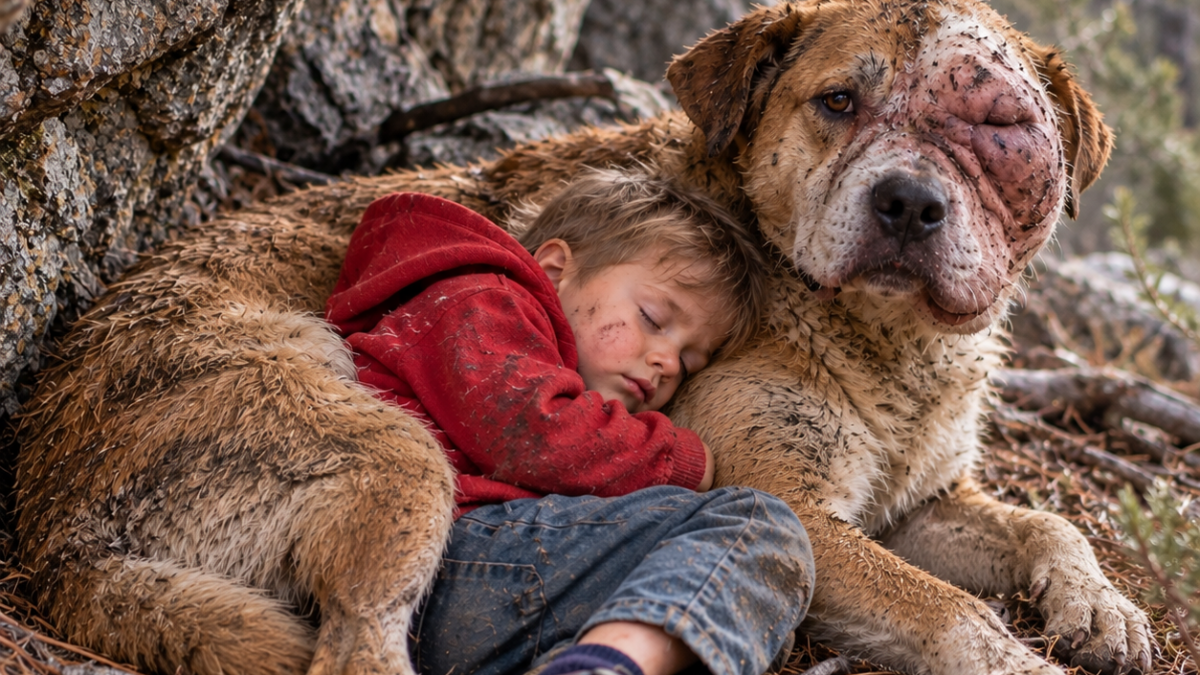
Beneath a granite overhang where the wash narrowed, on a bed of dry pine needles, lay a small blond boy curled on his side.
Red hoodie.
Jeans.
One bare sock.
Face pink.
Breathing.
Alive.
Kurt stopped so fast the deputy behind nearly hit him.
“Jesus.”
Then Kurt saw what was around the boy.
A dog.
Medium-sized.
Shaggy in places, though coat underneath looked short and sandy tan.
White chest.
Stubby tail.
A small notch missing from left ear.
The animal had curled its entire body around Leo.
Back pressed against the cold air.
Belly toward child.
Like a living wall.
But the dog’s face—
Kurt had seen animal injuries before.
Road strikes.
Porcupine quills.
Barbed wire.
Coyote bites.
Nothing like this.
The dog’s muzzle was swollen grotesquely.
Twice normal size.
Maybe more.
Skin stretched tight.
Lips distorted.
Eyes compressed into narrow slits.
One side worse.
Breathing shallow.
Wet.
Rattling.
Yet its head was raised.
Watching him.
Not resting.
Watching.
Guarding.
Kurt reached for radio.
“Command, Hensen.”
Static.
“Hensen, go.”
His voice broke.
“I’ve got him.”
Pause.
“Repeat?”
“I’ve got Leo.”
The world behind him stopped.
“He’s alive.”
Kurt shouted now.
“I’ve got the boy! He’s alive!”
Radios exploded.
“Copy!”
“Location?”
“Marking!”
“Medical moving!”
Someone farther uphill yelled.
“THEY FOUND HIM!”
The dog growled.
Faint.
Almost not a growl.
A rough vibration beneath ruined muzzle.
Kurt froze.
He had been moving toward Leo.
The dog tried to stand.
Front legs pushed.
Body lifted maybe six inches.
Then collapsed.
He tried again.
Placed one paw forward.
Shoulders shook.
Fell.
Even half-dead, he was attempting to get between the child and approaching strangers.
“Easy.”
Kurt stopped.
“Easy, buddy.”
The word came automatically.
Behind him, volunteers came down.
One deputy whispered:
“Is that a coyote?”
“No.”
Another:
“Dog.”
“Did it attack him?”
Kurt looked at swollen face.
At dog wrapped around Leo.
“I don’t know.”
That mattered.
He did not know.
A missing child beside injured stray could mean many things.
He had learned to let facts arrive before conclusions.
Dr. Amy Lindqvist slid down final rocks.
Amy was a veterinarian in Prescott who volunteered with county K9 teams and wilderness search groups.
Thirty-seven.
Long blond braid.
Medical pack strapped tight.
Her knees hit dirt six feet from dog.
She stared.
Color drained from her face.
“Oh no.”
Kurt looked.
“What?”
“Snake.”
“What?”
“That’s envenomation.”
Amy’s eyes tracked muzzle.
“Facial strike.”
“Likely rattlesnake.”
“How long?”
“With this swelling?”
She swallowed.
“Hours.”
A volunteer whispered:
“How is it alive?”
Amy did not answer.
She looked at child.
Leo stirred.
Everyone froze.
He yawned.
A normal little-boy yawn.
As if waking at home after nap.
He rubbed one eye with dirty fist.
Several crumbs fell from hoodie pocket.
Tiny animal crackers.
Leo blinked at orange search vests.
At Kurt.
At Amy.
At all strangers.
Then turned toward dog.
His face brightened.
“Doggy.”
The dog’s stubby tail thumped once.
Leo touched swollen muzzle with two fingers.
Gentle.
“Doggy’s face got big.”
No fear.
No drama.
Matter-of-fact.
Kurt dropped to knees.
“Leo.”
His hands were shaking.
“Buddy, I’m Sergeant Kurt.”
Leo looked.
“Hi.”
Kurt almost laughed.
“Are you hurt?”
Leo shook head.
“Does anything hurt?”
“No.”
Amy approached slowly.
“Can I look at you?”
Leo considered.
Then nodded.
She checked hands.
Wrists.
Arms.
Neck.
Head.
Abdomen.
Legs.
Ankles.
One sock damp but intact.
Nothing.
No punctures.
No scratches.
No bite marks.
No bruising beyond ordinary child stuff.
Kurt looked at dog.
“Leo.”
“Yeah?”
“What happened to doggy’s face?”
Leo thought hard.
Children often do before telling something obvious.
“There was a snake.”
Every adult in wash went still.
“Where?”
Kurt asked.
Leo pointed toward flat granite rock three feet away.
“It went shhhhhhhh.”
He made rattling noise.
“Like this.”
His tongue clicked.
“And I was scared.”
Amy’s eyes widened.
“And doggy jumped.”
Leo pointed.
“He bit snake.”
“Then snake bit doggy.”
He patted swollen head.
“And doggy’s face got big.”
No one spoke.
A deputy moved to granite.
Crouched.
Then jerked backward.
“Sarge.”
His voice changed.
“Snake.”
Dead rattlesnake lay partly between two rocks.
Arizona black rattlesnake.
Nearly four feet long.
Head crushed.
Body torn.
Amy stared.
Whole night reconstructed itself.
Leo wandered into wash.
Probably sometime afternoon.
The stray followed.
At dusk rocks remained warm.
Rattlesnake nearby.
Child sits too close.
Snake coils.
Dog intercepts.
Strike lands in face.
Dog attacks.
Kills snake.
Then temperature falls.
Dog already envenomated.
Swelling.
Pain.
Weakness.
Yet Leo remains uninjured.
Kurt looked at little boy.
Cheeks pink.
Hands warm.
Thirty-eight degrees all night.
One fleece.
One shoe.
No shivering.
Then at dog curled around him.
“He kept him warm.”
Amy whispered:
“Yes.”
“All night.”
“Yes.”
“With venom?”
Her voice cracked.
“Yes.”
One volunteer turned away.
Another swore softly.
Kurt had spent career around brave people.
Bravery looked dramatic in stories.
In real life, it often looked exhausted.
A deputy working through fear.
A volunteer checking one more ravine.
A dog whose airway was narrowing still trying to stand between a child and strangers.
Amy opened medical pack.
IV catheter.
Fluids.
Pain medication.
She approached dog.
Growl returned.
Leo placed hand on head.
“It’s okay, doggy.”
He looked at Amy.
“She’s nice.”
The dog stopped.
Amy inserted IV.
No resistance.
Kurt looked at Leo.
“Where did you meet him?”
“At camping.”
“Is he your dog?”
“No.”
“Whose?”
Leo shrugged.
“My friend.”
Rotor blades approached.
DPS helicopter landed in meadow above wash.
Flight medic ran down.
Foil blanket.
Pediatric stretcher.
Leo was wrapped.
Then he grabbed edge.
“Doggy too.”
Medic hesitated.
“We can’t usually take—”
“Doggy too.”
Leo’s lower lip trembled.
“He’s my friend.”
The medic looked at animal.
At swelling.
At Amy.
“We’re configured for human rescue.”
Kurt stood.
“That dog took a rattlesnake strike for this kid.”
The medic said nothing.
“Then kept him from freezing.”
Kurt looked straight at him.
“He comes.”
The medic studied him.
Then keyed radio.
They flew both.
Leo strapped safely.
Dog on wool blanket on helicopter floor.
Amy kneeling beside.
IV bag raised.
The whole flight Leo’s small hand rested on dog’s back.
At Prescott hospital, Leo went inside.
Dog transported in sheriff SUV to Thumb Butte Emergency Animal Hospital.
Megan and Chris Hartman waited at human ER.
Megan had been awake over twenty-four hours.
Hair tangled.
Face gray.
She heard helicopter before seeing stretcher.
When Leo came through doors, she screamed his name.
Then grabbed him.
Held so hard he squeaked.
“My baby.”
She kissed face.
Hair.
Hands.
“You’re okay.”
Chris wrapped both.
He did not cry at first.
He just pressed forehead into son’s hair.
Shoulders shaking.
Kurt waited.
Let family have moment.
Then Megan asked:
“Where were you?”
“In woods.”
“With doggy.”
Chris lifted head.
“What dog?”
Kurt explained.
Stray.
Rattlesnake.
Wrapped around child.
Chris’s face changed.
He knew.
Kurt asked:
“Where’s your dog’s vet information?”
Chris stared.
“Not ours.”
“What?”
“We don’t have dog.”
Megan looked confused.
“We’re from Mesa.”
“Just weekend camping.”
Kurt glanced toward hallway.
“Then whose dog is he?”
Nobody knew.
He called Lynx Lake campground host.
Darlene Pruett answered.
“Sandy dog?”
“Yes.”
“Stubby tail?”
“Yes.”
“Little bite-looking notch in ear?”
“Yes.”
“That’s Ghost.”
“Ghost?”
“My husband calls him that.”
“He’s been hanging around since summer.”
“Belong to anyone?”
“Not that we know.”
“People think dumped.”
“He avoids everybody.”
“Steals buns sometimes.”
“The Forest Service was gonna have animal control collect him next week.”
“History of aggression?”
Darlene laughed.
“That dog?”
“He runs if somebody looks cross at him.”
Pause.
“Why?”
Kurt told.
Silence.
“That scruffy little thing?”
“Yes.”
Darlene began crying.
At hospital, Leo ate pudding.
Unbothered.
Children can experience terror and return to snacks faster than adults can understand.
Megan asked:
“Did you know doggy?”
Leo nodded.
“He was my friend.”
“What friend?”
“I gave cookies.”
“What cookies?”
“Animals.”
Megan froze.
She had packed animal crackers.
Box was empty second morning.
She blamed Leo.
“Where did you give them?”
“Window.”
“What window?”
“Tent.”
“When?”
“When you sleeping.”
Piece by piece.
Leo had pushed crackers through mesh.
One at a time.
Morning.
Night.
Three days.
The stray had remained near perimeter.
Not coming close to adults.
Close enough for child.
Chris stood in corner.
Quiet.
His face had changed.
Kurt’s phone rang.
Amy.
“Kurt.”
Her voice tight.
“I need owner.”
“No owner.”
“What?”
“Stray.”
Silence.
Then:
“That’s problem.”
“How bad?”
“Very.”
Amy explained venom.
Coagulopathy.
Bleeding internally.
Swelling.
One vial antivenom at hospital.
Need four or five more.
Where?
Phoenix.
One hundred miles.
Cost?
About $1,100 per vial.
Dog did not have hours for fundraising, shelter authorization, ownership questions.
Chris stood.
“I’ll pay.”
Kurt looked.
“Sir—”
“Whatever.”
“Chris.”
Megan touched arm.
“No.”
His voice broke.
“You don’t understand.”
He looked at Leo.
“I have to.”
Then truth came.
First afternoon, dog approached campsite.
Skinny.
Dirty.
Chris saw unknown stray near child.
Protective instinct.
He yelled.
Clapped.
Threw pinecone.
Dog ran.
Came back that evening.
Chris chased again.
Next morning he caught Leo feeding crackers through mesh.
He became angry.
Zipped tent window.
Told son dog was dirty.
Dangerous.
Not to touch.
Threatened animal control.
Leo listened.
Then four-year-old logic solved problem.
If dog could not come to him, he would go to dog.
“Doggy was sad.”
Leo said.
“So I took cookies.”
“In woods.”
Chris stared.
“You left because of that?”
“You said he can’t come here.”
“So I went his house.”
Leo pulled from hoodie pocket three broken animal crackers.
Lion.
Camel.
Half elephant.
“I saved these.”
Chris sank to floor.
Put face in hands.
“I chased him off.”
Megan began crying.
“My son went because I chased dog away.”
He looked at Leo.
“And dog followed you.”
Leo nodded.
“Doggy knows where I go.”
Chris whispered:
“I did this.”
Kurt said:
“You didn’t make snake—”
“I did this.”
Chris stood.
“Where in Phoenix?”
He drove.
One hundred miles down I-17.
Too fast.
Hazard lights.
Bought five vials.
Didn’t ask total.
Put credit card down.
Returned.
4:10 p.m.
Emergency animal hospital.
Cold-pack cooler in arms.
Dog lay on padded table.
Face hideous.
Purple bruising spreading belly.
IVs.
Warming blanket.
Breathing shallow.
Chris stopped.
This was animal he had thrown pinecone at.
He stepped closer.
Put hand on side.
The dog’s slitted eyes moved toward him.
Tail moved once.
Chris began crying.
“I’m sorry.”
His hand remained.
“I didn’t know who you were.”
The dog slowly turned swollen face.
Pressed against Chris’s palm.
No dog understands apology linguistically the way humans do.
But he understood touch.
Tone.
Presence.
Maybe enough.
Antivenom started.
One vial.
Two.
Three.
Four.
Blood clotting markers improved.
At 9:30 Amy came to waiting room.
“It’s working.”
Chris exhaled.
Then saw her face.
“But?”
“Swelling.”
“Going down?”
“No.”
“Moving into throat.”
“What does that mean?”
“If airway closes, emergency tracheotomy.”
Chris sat.
“What chance?”
Amy did not say yet.
At 1:15 a.m., dog could no longer breathe through nose.
By 2:30 mouth breaths whistled.
Dr. Hector Ruiz worked.
Oxygen.
Steroids.
Sixth vial total.
Swelling continued.
“If it worsens, tracheotomy.”
“And if not?”
Ruiz’s silence answered.
Chris called Megan.
Leo would not sleep.
“Is doggy okay?”
“Is doggy’s face better?”
“Can doggy sleep with me?”
Every five minutes.
Megan whispered:
“What do I tell him?”
Chris stared through glass.
“I don’t know.”
At human hospital, Leo finally slept holding three crackers.
“For later.”
At animal hospital, 3:40 a.m., Amy sat beside Chris.
“We used everything.”
“All six.”
“His throat still closing.”
“Ruiz is prepping trach.”
“What chance?”
“Maybe one in four.”
Chris closed eyes.
Animal no one owned.
No pedigree.
No training.
No reason to sacrifice himself.
Had spent summer being chased from camps.
Eating scraps.
Scheduled for animal control.
Then a child gave cookies.
Maybe that was all it took.
Not obligation.
Not ownership.
Connection.
Chris thought about yelling.
Pinecone.
Dangerous.
Dirty.
How confident he had been.
How completely wrong.
“He can’t die.”
Amy put hand shoulder.
“Not because of me.”
She said nothing.
Inside, monitor changed.
Beeping slowed.
Then flat tone.
Chris stood.
Could not move forward.
Could not go in.
Ruiz yelled.
“Amy!”
She ran.
Doors shut.
Flat tone continued.
Chris slid to floor.
Voices inside.
“Come on.”
“Epi.”
“Compressions.”
“Come on, buddy.”
Ninety seconds.
Then—
beep.
Pause.
Beep.
Beep.
Rhythm.
Fifteen minutes later Amy came out.
Face white.
Eyes wet.
“He arrested.”
Chris stared.
“Heart stopped.”
“No.”
“We got him back.”
Chris covered face.
“Ruiz got airway.”
“He’s intubated.”
“He’s breathing.”
Chris sobbed.
Not relief exactly.
Too early.
But possibility.
Dog remained ventilated two days.
Third morning swelling reduced.
Tube removed.
One breath.
Then another.
Blood clotted normally.
Bruises fading.
Alive.
That afternoon Leo arrived in brand-new sneakers.
Megan holding hand.
The moment dog heard voice, tail wagged.
Leo ran.
“Doggy!”
He hugged carefully.
“Your face is still big!”
Dog licked him.
One long swipe.
Leo laughed.
Then reached pocket.
Three animal crackers.
Crushed.
Dusty.
Lion.
Camel.
Half elephant.
“I saved these.”
Dog sniffed.
Then carefully licked every crumb from palm.
Everyone cried.
Kurt had driven from sheriff’s office.
Amy stood by Ruiz.
Megan doorway.
Chris knelt.
“Leo.”
“Yeah?”
“Do you know why you went into woods?”
“To doggy.”
“Why?”
“You said he couldn’t come.”
Chris swallowed.
“I was wrong.”
Leo looked.
“I thought he was dangerous.”
He looked at dog.
“But he kept you safe.”
“Yep.”
Chris’s voice broke.
“I thought I was keeping you safe.”
“But he did.”
Leo nodded again.
Children rarely cushion truth.
Chris put hand on dog.
“He saved you from snake.”
“And cold.”
Kurt added quietly.
Chris stared.
Then said:
“If I hadn’t chased him off, Leo wouldn’t have walked out.”
Megan came closer.
“Chris—”
“No.”
“I need to say it.”
He looked around room.
“That part is mine.”
No excuses.
“I was afraid.”
“I judged him.”
“I chased him.”
“My son went looking because of me.”
“And this dog went after him anyway.”
He rubbed sandy fur.
“Took bite meant for my boy.”
“Stayed all night.”
“He didn’t just save Leo.”
Chris’s eyes filled.
“He saved me from living with something I don’t know if I could have survived.”
The dog pressed face into hand.
Leo looked at parents.
“Can doggy come home?”
Megan was nodding already.
Chris laughed through tears.
“Yeah.”
“Really?”
“Really.”
Kurt smiled.
“What are you naming him?”
Leo answered immediately.
“Cookie.”
Of course.
It took two weeks for Cookie’s face to return to normal.
Under swelling:
warm brown eyes.
Crooked white blaze.
Pinkish patch on nose.
Notch in ear.
Stubby tail.
He went home to Mesa.
Small house.
Fenced yard.
Lemon tree.
His first night, Chris bought three different dog beds.
Cookie ignored all.
Slept at Leo’s bedroom doorway.
Next night, foot of bed.
By week two, on bed.
Chris did not object.
Megan watched from door.
“Remember when you said dirty?”
“Please never let me forget.”
“I won’t.”
Good marriage.
Leo developed nightmares.
Not every night.
Sometimes.
Snake sounds.
Dark.
Calling Mom.
Cookie would lift head before adults heard.
Press body against child.
Leo settled.
Therapist later explained trauma in young children can emerge through play, sleep, separation anxiety.
They got help.
No pretending rescue erased fear.
Chris got help too.
His guilt was becoming unhealthy.
Everything became:
My fault.
Therapist challenged.
“You made mistake.”
“Yes.”
“You did not command snake.”
“No.”
“You did not intend son leave.”
“No.”
“You repaired.”
“Yes.”
“Then responsibility should produce change, not self-destruction.”
Chris carried that.
He volunteered with Yavapai Search and Rescue.
Training.
Navigation.
Missing-person operations.
Why?
“Debt.”
Kurt said:
“Don’t call it debt.”
“What then?”
“Usefulness.”
Better.
Chris learned how quickly children travel.
How search grids work.
How families blame themselves.
He became the person who sat beside fathers saying:
“I turned away for one minute.”
He never said:
It’s not your fault.
Too simple.
He said:
“We find your kid first.”
Then later deal with guilt.
Cookie became campground legend.
Old timers at Lynx Lake passed hat.
RV clubs donated.
Camp associations.
Money accumulated.
They started Cookie Fund.
Goal:
Rattlesnake antivenom access for working dogs and emergency animal cases near forest.
The source story says ranger stations stocked vials; operationally storage and administration would need veterinary/medical protocols, but in the story the fund ensured vials were available locally so no one faced another hundred-mile dash.
Campground host Bob built wooden sign.
PLEASE BE KIND TO THE CAMP DOGS.
ONE OF THEM WAS A HERO.
Chris saw.
Cried.
Then asked to add:
AND KEEP YOUR FOOD SECURE.
Darlene laughed.
“Still campground.”
One year later, Hartmans returned.
Same site.
Chris almost canceled.
Megan insisted only if Leo wanted.
Leo wanted.
Cookie exploded with excitement at scent.
Campground.
Pines.
Lake.
Darlene met them.
“Oh my God.”
She knelt.
Ghost no longer ran.
He accepted scratches.
“Look at you.”
Leo corrected:
“Cookie.”
“Cookie.”
That weekend Chris watched son constantly.
Too constantly.
Megan touched arm.
“He needs room.”
“I know.”
“You’re following him to bathroom.”
“I know.”
“Chris.”
He exhaled.
“I know.”
Trauma makes parents cage what they love.
He had once tried keeping stray away.
Now risk was keeping Leo too close.
Different fear.
Same control.
He backed off.
Set boundaries.
Bright vest.
Whistle.
Never out of sight.
Age-appropriate.
On final morning, Megan unzipped tent.
Gray dawn.
Stopped.
Leo awake in sleeping bag.
Cookie asleep curled against him.
Face normal.
White blaze.
Ear notch.
Soft snore.
Leo had one arm around dog.
He was keeping perfectly still.
His head raised.
Watching over Cookie.
Beside pillow:
animal cracker box.
Open.
Lion set aside.
“For later.”
Megan took no photo first minute.
Just watched.
A year earlier, rescuers found dog awake and poisoned, wrapped around sleeping child.
Now child awake, holding sleeping dog.
Nothing threatening.
No snake.
No search teams.
No helicopter.
Just reversal.
Safety.
She finally took picture.
Framed it.
Caption underneath:
NOW IT’S MY TURN.
Leo couldn’t spell all words yet.
He chose sentence.
Years passed.
Cookie grew older.
Leo taller.
The story followed family.
News clips resurfaced every October.
Chris disliked hero framing.
Especially “miracle stray.”
At school presentations he said:
“Cookie was brave.”
Then:
“But biggest lesson is I was certain and wrong.”
Adults were surprised.
“I thought dirty dog meant dangerous.”
“I acted without understanding.”
“My fear contributed to situation.”
“And then dog I judged saved my child.”
He didn’t romanticize letting children approach strays.
“Please don’t.”
He would say.
“Leo was four.”
“We teach him now to get adult.”
“But being cautious and being cruel are not same.”
That distinction mattered.
You can protect children without throwing pinecones at hungry animal.
You can call animal control responsibly.
You can ask campground host.
You can create distance without hatred.
Chris learned.
Leo remembered pieces.
Cookies.
Snake noise.
Cold.
Dog warm.
Helicopter mostly as loud.
He did not remember family terror.
Good.
Children should not carry full weight of adults’ worst nineteen hours.
At six, he drew picture.
Snake.
Cookie.
Leo.
Snake absurdly huge.
Cookie superhero cape.
Chris asked:
“Where am I?”
Leo drew tiny stick man far away.
“Camping.”
Fair.
At seven, school “My Hero” assignment.
Everyone expected Cookie.
Leo chose Amy.
“Because she made Cookie not die.”
Amy cried reading copy.
Cookie got honorable mention.
At eight, Leo understood snake strike more.
Asked:
“Could Cookie have died?”
Chris did not lie.
“Yes.”
“Because of me?”
There it was.
Chris felt history reaching son.
He crouched.
“Snake bit Cookie when he jumped between you.”
“So yes?”
“You were four.”
“But—”
“No.”
Chris chose words carefully.
“You did something unsafe because you wanted to help a hungry dog.”
“That doesn’t make you responsible for snake existing.”
“But you always said you were responsible.”
Chris froze.
Children hear everything.
He had to repair lesson.
“I was responsible for how I treated Cookie.”
“Not for everything that happened.”
“You were responsible for leaving camp?”
Leo nodded uncertain.
“But you were four.”
“Four-year-olds need adults to set safe rules and help understand.”
“I made rule badly.”
“That’s on me.”
“Snake is snake.”
“Cookie chose to jump.”
“Everybody has different piece.”
Leo thought.
“So nobody made Cookie get bit?”
“Right.”
“He did it.”
“Yes.”
“Why?”
Chris smiled sadly.
“Because you were his friend.”
Animal crackers.
Three days.
Enough.
Cookie aged into calm dog.
The wildness faded.
At dog park he remained cautious with strangers.
Loved children.
Hated pinecones.
Chris deserved that joke.
Whenever someone tossed pinecone, Cookie barked.
Megan said:
“He remembers you.”
Chris groaned.
“I know.”
At ten? Leo maybe child; Cookie age unknown maybe 5-7. Let’s avoid exact.
Cookie’s history before campground remained mystery.
No chip.
No collar at rescue discovery? In source, no mention collar. Maybe stray. Vet estimated adult.
Amy guessed five or six during hospitalization.
He might have had family once.
Dumped maybe.
Lost maybe.
Nobody knew.
Hartmans posted notices anyway.
No claimant.
After legal stray hold, adoption official.
Chris signed.
His hand shook.
“Breed?”
Clerk asked.
“Dog.”
She laughed.
“Color?”
“Sandy.”
“Name?”
“Cookie.”
Leo grinned.
Official.
Cookie Hartman.
Not that dog cared.
Home was routine.
Leo school.
Chris hardware store.
Megan elementary librarian.
Evenings.
Walks.
Lemon tree.
On thunderstorms Cookie slept in bathtub.
No one knew why.
Everybody has history not fully visible.
Chris stopped pretending he could identify character from surface.
One day hardware store employee complained stray dog behind dumpster.
“Mean-looking.”
Chris paused.
“Growling?”
“No.”
“Chasing?”
“No.”
“Just… rough.”
Chris grabbed water and food.
Went outside.
Dog ran.
He placed bowls.
Called rescue.
Employee asked:
“Why so much?”
Chris looked.
“Long story.”
That story changed behavior far beyond one dog.
At Lynx Lake, campers became less casual about rattlesnake risk.
Leash rules emphasized.
Food storage.
Child supervision.
Snake education.
Not because fear.
Because respect.
Cookie Fund supported veterinary emergency transportation too.
The source version described local antivenom availability across ranger stations; either way the intent was the same: no family should spend precious hours racing medicine from Phoenix when an animal’s life depends on minutes.
Kurt remained in search and rescue.
He kept photograph of first morning.
Not graphic.
Cookie after swelling reduced, sitting beside Leo at clinic.
He used in volunteer training.
“Why?”
New searcher asked.
Kurt said:
“Because assumptions almost made us hesitate.”
“What assumptions?”
“Unknown dog beside child.”
Pause.
“We approached carefully, which was right.”
“But if we had treated growl as aggression instead of weakness and protection, we might’ve separated too fast.”
He emphasized:
“Safety first.”
“But observe.”
“Context.”
Same lesson across so many rescue stories.
Growl can mean threat.
Pain.
Guarding.
Fear.
Warning.
You don’t romanticize.
You assess.
Amy used case in veterinary continuing education.
Snakebite.
Facial swelling.
Airway.
Coagulopathy.
Antivenom timing.
Emergency airway.
Cardiopulmonary arrest and recovery.
She always ended with:
“The fact he survived eleven-plus hours untreated was extraordinary.”
Then:
“Do not use this story to delay care.”
Important.
Cookie survived despite delay.
Not because delay harmless.
Immediate veterinary treatment still best.
She also discussed how facial bites can be especially dangerous due to swelling compromising airway. In Cookie’s case, the team used antivenom and eventually secured his airway after deterioration, with his heart stopping briefly before being restarted.
Chris attended one lecture.
Sat back.
When Amy showed early swollen-face photo, he looked down.
Still painful.
Later:
“You okay?”
“No.”
“Good?”
“Getting there.”
She nodded.
Healing does not mean image stops hurting.
It means you can stay in room with it.
Leo grew old enough to hear full story.
At twelve, he watched news footage.
Search volunteers.
Mom crying.
Dad dirt-covered.
Helicopter.
Cookie swollen.
He shut laptop.
“I did that to you?”
Megan sat.
“You scared us.”
He cried.
“I’m sorry.”
She pulled him close.
“You were four.”
“I know, but—”
“You were four.”
She repeated until he heard.
“Parents’ job is not to make children repay fear.”
Chris joined.
He said:
“We changed because of that day.”
Not:
We suffered because of you.
Difference.
Leo asked:
“Did Dad really throw pinecone?”
Megan smiled despite tears.
“Yes.”
Leo looked at Chris.
“Dude.”
“I know.”
“You’re terrible.”
“I know.”
Cookie asleep nearby.
Leo scratched ear.
“Good thing he forgave you.”
Chris said:
“I’m not sure dogs think like that.”
Leo shrugged.
“He sleeps in your chair.”
Fair evidence.
Cookie loved Chris deeply.
That became part father could barely bear.
The dog had no grudge.
Again, not necessarily forgiveness in human moral sense.
Dogs form new associations.
Safety.
Food.
Affection.
Routine.
But emotionally, Chris experienced it as undeserved grace.
He tried to live worthy.
One winter Cookie developed arthritis.
Leo noticed first.
Slower stairs.
Hesitation jumping bed.
Vet prescribed anti-inflammatory medication.
Ramp.
Chris built one.
Overengineered.
Megan laughed.
“It’s dog ramp, not bridge.”
Chris added carpet.
Rails.
Leo painted:
COOKIE EXPRESS.
Cookie refused first.
Used chair.
Eventually accepted.
At night, he still slept at foot of Leo’s bed.
Leo was teenager by then.
Too cool for many childhood things.
Not Cookie.
He would come home from school, drop backpack, lie on floor with dog.
Tell him things before parents.
First crush.
Fight.
Bad grade.
College fears later.
Dogs become archives.
They keep secrets without interpretation.
Chris watched and thought about animal crackers.
Tiny bridge.
Every relationship had beginning.
Theirs began through tent mesh.
One cookie at a time.
Cookie’s health eventually declined.
Old injury? Snakebite didn’t necessarily cause. Age.
Heart murmur.
Kidneys.
Arthritis.
White muzzle.
The family knew.
One October—anniversary season—Cookie stopped eating breakfast.
Leo now sixteen.
He sat kitchen floor.
“Okay, buddy.”
Dog looked.
No interest.
Vet said time near.
Not necessarily today.
Days or weeks.
Quality of life.
Leo asked:
“Can we take him to Lynx Lake?”
Megan hesitated.
Chris looked at Cookie.
“Can he handle?”
Vet said short trip, comfortable, maybe.
They went.
Same campground.
Off-season quiet.
Cold mornings.
Cookie moved slowly.
Leo carried him partway to wash? Maybe not same dangerous location. They stayed near campsite.
At sunrise Cookie lay outside tent.
Head on Leo’s leg.
Chris made coffee.
Megan watched.
Darlene and Bob long retired.
New host knew story.
Left them privacy.
Leo took animal cracker from box.
Lion.
Placed by dog.
Cookie sniffed.
Licked once.
Couldn’t chew.
Leo broke tiny piece.
Dog took gently.
“Saved lion.”
Chris sat.
“Full circle.”
Leo gave look.
“Corny.”
“Your mother says same.”
Megan:
“Because true.”
Cookie slept.
That night temperature dropped.
Family brought him into tent.
He curled against Leo.
Exactly first night, reversed and then reversed again.
No danger.
Just warmth.
Cookie died several weeks later at home.
Not forest.
Not clinic emergency.
At foot of Leo’s bed.
Family with him.
Chris had hand on side.
Megan stroked head.
Leo held ear.
Before vet arrived for home euthanasia, Leo placed animal cracker beside blanket.
Half elephant.
“Couldn’t find lion.”
His voice broke.
Cookie’s tail moved once.
Everyone cried.
After, Leo asked:
“Do dogs know they saved you?”
Chris thought.
“I don’t know.”
“Do you think he knew?”
“That you loved him?”
“Yes.”
“Yes.”
No hesitation.
Leo nodded.
“That’s enough.”
They cremated Cookie.
Scatter some at Lynx Lake with permission? Let’s do a memorial plaque? Source had sign. Keep grounded.
They did not scatter in protected area without checking.
Search-and-rescue group helped arrange small memorial at campground entrance near wooden sign.
No ashes needed.
A brass plate added:
COOKIE
FORMERLY “GHOST”
GOOD FRIEND
Leo hated word hero.
“Why?”
Chris asked.
“Because he was my friend before he was hero.”
That was better.
Darlene heard by phone.
Cried.
Cookie Fund continued after death.
Expanded.
Helped working dogs and family pets with emergency snakebite care.
Chris served board.
Amy medical advisor.
Kurt honorary.
Leo later volunteered.
First fundraiser speech at seventeen:
“I was four when Cookie saved me.”
Pause.
“I don’t remember being heroic.”
People smiled.
“Neither was he trying to be famous.”
“He was hungry stray who liked cookies.”
More smiles.
“That matters.”
He looked at dad.
“My dad thought he was dangerous.”
Chris nodded.
“Dad admits it too much.”
Laughter.
“Cookie didn’t become valuable because he saved me.”
Room quiet.
“He was valuable before.”
That line hit.
The dog had been unwanted.
Shooed.
Scheduled animal control.
Campers saw nuisance.
Leo saw hungry friend.
Then snake incident changed everyone’s story.
But it should not require dramatic sacrifice for stray to deserve kindness.
Chris had learned.
He spoke afterward.
“My son’s right.”
“I don’t tell this because every stray dog is safe.”
“They aren’t.”
“Unknown dogs require caution.”
“But caution doesn’t require contempt.”
“Fear doesn’t require cruelty.”
“I could have protected Leo differently.”
“I didn’t.”
“And Cookie saved him anyway.”
No applause for moment.
Then applause.
Useful.
At Prescott National Forest training, rangers incorporated:
Do not feed strays casually—can create dependency.
Report roaming dogs.
Keep children supervised.
Snake awareness.
Call animal control/rescue.
Compassion and safety together.
Stories work best when they produce practical wisdom, not mythology.
Cookie’s story had dramatic elements.
Snake.
Cold.
Search.
Helicopter.
Heart stopping.
But the hinge was smaller.
A four-year-old pushed crackers through mesh.
Without that, maybe dog does not follow.
Maybe does.
Unknown.
But friendship existed before danger.
That matters.
The source story records Leo saying the stray was his friend because he had secretly fed him animal crackers through the tent window, and that he entered the woods specifically because his father had forbidden the dog from returning to the campsite.
Chris never forgot exact moment:
“Doggy was sad, so I took him cookies.”
Parenting humiliation.
A child’s compassion exposing adult fear.
Yet Chris also learned not to swing opposite.
At first after incident, he wanted Leo pet every animal.
Megan stopped him.
“Don’t overcorrect.”
Right.
The lesson was not strangers harmless.
The lesson:
Assess.
Use kindness.
Set safe boundaries.
He taught Leo:
Ask adult.
Offer food from distance if appropriate.
Call rescue.
Do not approach unknown injured animal.
Especially wildlife.
And if snake:
Back away.
Never touch.
Cookie had instinctive response, but humans should not emulate.
Leo rolled eyes through safety lectures.
Good.
Ordinary child.
The family kept original three-cracker photograph.
Actually no one had photographed the three before eating? Could have after. Let’s not invent as factual if source? They could remember. Instead one remaining? All eaten. So a drawing.
Megan framed Leo’s drawing of lion, camel, half elephant.
Kitchen.
Below:
FOR LATER.
Visitors ask.
Family tells.
Sometimes long.
Sometimes:
“Those cookies are why we got Cookie.”
Not technically full truth.
Close enough.
Kurt retired.
At dinner, Hartmans attended.
He told story in speech.
“I’ve found people dead.”
He said quietly.
Room still.
“I’ve found people alive who shouldn’t have been.”
“Leo was one.”
He looked at family.
“The thing I remember most isn’t boy.”
“Not snake.”
“It’s dog trying to stand.”
“Couldn’t.”
“Still tried.”
Kurt’s voice broke.
“That is what duty looks like when nobody gave you duty.”
He raised glass.
“To Cookie.”
Chris cried.
Leo older, eyes wet.
Amy eventually adopted working-line shepherd.
Named Needle because veterinary humor terrible.
She kept Cookie case in lectures.
One photo after recovery.
Face almost normal.
Leo arms around.
Under slide:
SURVIVAL IS NOT A TREATMENT PLAN.
Then:
EARLY ANTIVENOM SAVES LIVES.
She refused miracle framing.
But privately called him stubborn bastard with affection.
Years later, one of Cookie Fund’s first beneficiaries was a ranch dog bitten near Mayer.
Antivenom administered locally fast.
Dog survived without airway crisis.
Owner sent photo.
Chris printed.
Pinned garage.
Caption:
THIS IS WHY.
That gave meaning to terrifying drive Phoenix.
Not erase.
Transform.
The campground sign weathered.
PLEASE BE KIND TO THE CAMP DOGS. ONE OF THEM WAS A HERO.
Eventually forest management replaced with more general responsible-animal notice because unofficial signs rot.
Local campers saved old sign.
Mounted in community center.
Maybe legend grows.
People embellish.
Cookie fought three snakes.
No.
Cookie carried Leo.
No.
Cookie ran searchers home.
No.
Truth enough.
One snake.
One bite.
One freezing night.
One dog curled around child.
Do not improve.
The facts already extraordinary.
At high school, Leo did senior essay about memory.
He wrote he did not remember snake as clearly as adults thought.
He remembered sound.
Dog.
Cold not really.
He remembered animal crackers.
He remembered hospital dog licking face.
He did not remember search teams.
Trauma memory fragments.
He wrote:
“My parents remember almost losing me. I remember finding a friend.”
That became family’s favorite sentence.
Chris read ten times.
Then said:
“That’s unfairly good.”
Leo:
“AP English.”
Megan cried.
Cookie gone by then.
Essay won local contest.
Leo donated prize to Cookie Fund.
Of course.
He did not become veterinarian.
Everyone expected.
He chose environmental engineering? Maybe keep plausible but no need. Could become search and rescue? Maybe later.
He studied forestry.
Not because story had to dictate.
He genuinely loved outdoors.
Chris terrified.
Let him go.
That was growth.
First college field course overnight in forest, Chris nearly asked for GPS tracker.
Megan:
“No.”
“Maybe—”
“No.”
“Satellite messenger?”
“Reasonable if course requires.”
They checked.
It did.
Chris bought one normal.
Not military.
Progress.
Leo called after trip:
“No snakes.”
Chris:
“Excellent.”
“Fed no strays.”
“Even better.”
“Made friend.”
“Human?”
“Probably.”
Megan laughed.
Life continued.
That is what rescue gives when successful.
Not permanent climax.
Ordinary years.
Birthdays.
School.
Dog hair.
Vet bills.
Arguments.
Camping.
Loss.
Cookie’s greatest gift was not one survival night.
It was all ordinary days after.
For Leo.
For Chris.
For dog himself.
A stray scheduled for removal got a home.
A father got chance to change.
A community got emergency fund.
Search organization gained volunteer.
Hundreds learned.
Ripples.
But none outweigh first:
Boy breathing under granite.
Kurt often described pink cheeks.
Warm hands.
At 38 degrees.
One shoe.
No shiver.
Without dog heat, outcome might differ.
Children have high surface-area-to-mass ratio and can cool quickly.
Dog body contact and wind shelter likely mattered.
Again, not magic.
Physics.
Warm mammal around smaller mammal.
Even poisoned.
Cookie’s body was losing battle internally while serving as insulation externally.
That fact haunted Amy.
“How did he do it?”
People asked.
She answered:
“I don’t know.”
“Pain doesn’t always stop behavior.”
“Dogs can function in severe distress.”
“Adrenaline.”
“Bond.”
“Drive.”
“But he was very sick.”
“He should have been treated hours earlier.”
She never said love neutralized venom.
It didn’t.
Love kept him beside Leo.
Antivenom saved him afterward.
Both can be true.
The source recounts that rescuers found Leo warm and uninjured despite the 38°F night and realized the poisoned dog had lain around him for warmth after taking the rattlesnake strike.
The helicopter decision became another legend.
Paramedic initially said animals not flown.
Kurt insisted.
Protocols later clarified when a service animal or animal directly involved in rescue could accompany if space/safety permit.
Cookie not service dog.
But exceptional.
Nobody got disciplined.
Pilot said later:
“Would’ve taken elephant if that kid asked after hearing story.”
Maybe joke.
Good.
At animal hospital, Ruiz remembered moment Cookie coded.
He had seen many arrests.
Most do not come back.
“Ninety seconds.”
He would say.
“Then electrical activity.”
They worked.
No guarantees.
One reporter asked:
“Did Cookie come back because he needed to see Leo?”
Ruiz said:
“No.”
“His heart restarted because CPR, drugs, oxygenation, correction of venom effects, chance.”
Then softened.
“But I’m glad he saw Leo.”
Important distinction.
Science does not diminish meaning.
It protects truth.
Chris appreciated.
He had enough guilt and sentiment.
Facts grounded.
At home, Cookie was not perfect.
He stole bread.
Dug near lemon tree.
Barked at mail carrier.
Chewed one expensive boot.
Chris held boot.
“Hero?”
Cookie wagged.
Leo defended:
“He saved me.”
Chris:
“That was years ago. Statute expired.”
Megan laughed.
Ordinary bad dog behavior became luxury.
They loved it.
First time Cookie stole hot dog bun, Chris remembered Darlene:
Steals hot dog buns.
He almost cried.
Then realized dog ate bun.
“Seriously?”
Cookie licked lips.
Alive.
That was enough.
Years after death, family found old brown fur under couch during renovation.
Megan held.
“Do we save?”
Chris thought.
“No.”
They vacuumed.
Grief mature enough not to preserve everything.
Photographs enough.
Stories enough.
Cookie Fund enough.
Leo enough.
One October, Chris joined search for six-year-old girl near Flagstaff.
Night.
Cold.
He walked orange vest.
At 2 a.m., father sitting command trailer.
Destroying himself.
“I yelled at her before she ran off.”
Chris sat.
Did not say:
I know exactly.
No situation same.
He said:
“Kids leave for reasons that make sense to kids.”
Father cried.
“If something happens—”
Chris interrupted gently.
“We’re still searching.”
“Stay here for her.”
Girl found at dawn under tree, cold but alive.
Chris cried alone afterward.
Called Leo.
“Everything okay?”
“Yeah.”
“Found kid.”
“Alive?”
“Alive.”
“Good.”
Pause.
“Dad?”
“Yeah?”
“Cookie?”
Chris knew question.
Thinking of him.
“Always.”
They did not need more.
That is how certain animals remain after gone.
Not ghosts.
Habits.
Values.
Decisions.
A father who once threw pinecone now spends cold nights searching strangers’ kids.
That is a dog’s legacy without needing mysticism.
Megan’s change quieter.
She became more attentive to parents’ shame.
As librarian, when families returned books late after crisis, she stopped assuming irresponsibility.
People have things happening.
Again, not excuse everything.
Context.
Cookie had rearranged family’s worldview.
Leo grew into adult who cared about animals but did not romanticize them.
When friends approached wildlife for selfies, he said:
“Back up.”
Rattlesnake respect.
He volunteered educational events.
Showed children Cookie’s normal-face photo.
Then swollen photo only if age appropriate.
“Snakes aren’t bad.”
He always said.
“They’re animals.”
“Cookie wasn’t fighting evil.”
“He protected me from danger.”
This prevented story from becoming kill-snakes narrative.
Arizona black rattlesnakes part ecosystem.
Most strikes defensive.
Leo had sat too close.
Cookie reacted.
The dead snake was consequence, not villain.
That nuance came with adulthood.
At four:
Bad snake.
Good dog.
At twenty:
Animals acting as animals.
One intervention.
That maturity honored truth.
The first line everybody remembered remained:
“Doggy’s face got big.”
He said at discovery, matter-of-fact, patting swollen muzzle while adults pieced miracle together.
For Kurt, sentence was almost unbearable.
Because Leo had no idea how close both had been to death.
Good.
Children should not.
On Cookie Fund’s tenth anniversary, they held gathering at Lynx Lake.
No viral event.
Campers.
Search volunteers.
Veterinarians.
Families helped by fund.
Leo gave short speech.
Chris expected grand.
Instead:
“When I was four, I thought Cookie needed cookies.”
Laughter.
“I was right.”
More laughter.
“He also needed medicine.”
“You all made sure dogs after him could get it faster.”
“Thank you.”
Done.
Chris whispered:
“That’s it?”
Leo:
“People want lunch.”
Tony? Different story, no.
They had barbecue.
At dusk Leo walked to edge of wash overlook with Kurt.
Not down to exact site.
Forest changed.
Fire.
Growth.
Trails shifted.
Kurt said:
“I’m not sure I could find exact overhang now.”
Leo nodded.
“Good.”
“Why?”
“Means forest kept moving.”
Kurt smiled.
They stood.
Leo asked:
“Were you scared when you saw Cookie?”
“Yes.”
“You thought he hurt me?”
“I considered.”
“Would you have shot him?”
Kurt’s face tightened.
“If he attacked us, maybe.”
“But he didn’t.”
“No.”
“He tried stand.”
“Yes.”
Leo looked out.
“That part gets me.”
“Me too.”
“Why?”
Kurt thought.
“Because he didn’t know we were help.”
“He just knew strangers were coming near you.”
Leo swallowed.
“He must’ve been hurting.”
“Yes.”
“And still tried.”
“Yes.”
They stood.
Not every question needs lesson.
At home, Chris kept pinecone on desk.
Not original.
Impossible.
Just one from Lynx Lake first return.
Leo teased.
“Penitence cone.”
Chris:
“Shut up.”
But he kept.
Reminder:
Fear without curiosity can become cruelty.
He once wrote on bottom:
LOOK TWICE.
That was his lesson.
Cookie’s:
Stay.
Leo’s:
Be kind.
Amy’s:
Treat fast.
Kurt’s:
Observe before assuming.
Megan’s:
Love without smothering.
Everyone got different story from same night.
Good stories do that.
The final photograph—Megan’s dawn shot one year later—became most shared.
Not swollen dog.
Not snake.
Not helicopter.
Healthy Cookie asleep against Leo.
Leo awake.
Arm around dog.
Watching.
Open animal crackers.
Lion beside pillow.
People loved symmetry.
Once dog kept boy warm.
Now boy keeps dog close.
But Megan said photo’s beauty not symmetry.
“It’s boring.”
“What?”
Reporter asked.
“It’s just them sleeping.”
Exactly.
After trauma, boring is holy.
Nobody missing.
Nobody poisoned.
Nobody searching.
No sirens.
No flatline.
Just morning.
The family never stopped camping.
That was intentional.
They did not want fear own forest.
They changed habits.
Better supervision.
Snake awareness.
Emergency gear.
Dog leash.
Satellite communication on remote trips.
But returned.
Chris’s first time sleeping at Lynx Lake after incident was awful.
Every sound woke.
He checked Leo every thirty minutes.
Cookie eventually climbed onto Chris.
Laid across legs.
Prevented getting up.
Megan whispered:
“He’s treating you.”
Chris laughed silently.
Maybe.
By third year, he slept.
That was healing too.
When Cookie died, first camping trip without him felt empty.
Leo brought animal crackers.
Set lion near sleeping bag.
Chris said nothing.
In morning crumbs gone.
Probably mouse.
Leo said:
“Cookie.”
Chris:
“Absolutely a mouse.”
“Let me have this.”
“Fine.”
Not every sentimental interpretation needs correcting.
Some are harmless.
The Arizona sun rose.
Pines warmed.
A rattlesnake somewhere continued being a rattlesnake.
Life.
At old campground sign, a camper once asked Chris:
“You the dad?”
Chris sighed.
“Depends what version you heard.”
“The one who chased hero dog.”
“Yep.”
Camper looked embarrassed.
“Sorry.”
“Why?”
“I mean…”
“You’re right.”
Chris smiled.
“I did.”
“I’m not proud.”
Then:
“What matters is what you do after you find out you were wrong.”
The camper nodded.
That sentence became Chris’s personal creed.
Being wrong is inevitable.
Defending wrongness after evidence is choice.
He paid antivenom.
Adopted dog.
Changed behavior.
Volunteered.
Told story accurately including ugly part.
He did not erase past by hiding it.
That is accountability.
Leo respected him more for admitting than if dad had edited hero version.
“My dad messed up.”
He would say.
“Then fixed what he could.”
That became another gift from Cookie.
A child learning adults can be wrong and still worthy if they own it.
Powerful.
One day as adult, Leo called Chris after his own mistake at work.
“I screwed up.”
Chris listened.
“What now?”
“I don’t know.”
“First, stop making it about whether you’re bad person.”
Leo laughed.
“Cookie lecture?”
“Always.”
“What can you fix?”
They talked.
Ripple again.
Dogs cannot teach abstract ethics intentionally.
Humans build meaning from relationship.
Still counts.
Cookie never knew fund.
Sign.
Volunteer hours.
Essays.
He knew Leo.
Food.
Home.
Warm bed.
Chris’s hand.
Megan’s voice.
Lemon-tree shade.
That was his life.
Enough.
If he could have described first night, maybe simple.
Boy wandered.
Dog followed.
Snake.
Fight.
Cold.
Curl close.
Stay.
No hero narrative.
Animals do not need narrative to act.
Humans need narrative to remember.
So we tell.
And every time story begins with swollen face wrapped around sleeping child, people gasp.
But perhaps better beginning is earlier.
A skinny camp stray watched tent from darkness.
A four-year-old pressed animal cracker through mesh.
Dog took it.
Then another.
No adults noticed.
A tiny friendship.
That is where rescue began.
Three days before snake.
Before loss.
Before panic.
Kindness established direction.
Later when Leo walked away, Cookie followed.
Maybe for food.
Maybe companionship.
Maybe because relationship formed.
No need choose.
He followed.
When danger came, stayed.
That is enough.
At 6:12 a.m., Sergeant Kurt Hensen did not find a boy and a hero.
He found two living creatures who had gotten each other through night.
One by friendship.
One by body heat and intervention.
And then humans took over.
Amy’s IV.
Helicopter.
Parents.
Chris’s drive.
Antivenom.
Ruiz’s airway.
CPR.
Medicine.
Home.
Survival is chain.
No single link owns result.
Cookie’s link unforgettable.
Leo’s animal crackers were still crumbled in hoodie pocket three days later when they reunited.
He held them on flat palm.
Cookie, swollen and bandaged, licked every crumb carefully.
That is image worth keeping.
Not because cute.
Because promise completed.
“For later.”
Later arrived.
So much nearly didn’t.
Leo nearly did not see morning.
Cookie nearly did not breathe through second night.
Chris nearly lived forever believing his last act toward that dog was throwing pinecone.
Instead—
boy came home.
Dog came home.
Father changed.
Fund formed.
Forest learned.
And one year later, in same gray dawn, Megan opened tent and saw Leo awake beside sleeping Cookie.
The dog’s face perfectly normal.
Relaxed.
Snoring.
Leo’s arm around him.
His head raised.
Watching.
Once, Cookie had stayed awake all night with venom burning through his body so Leo would not freeze.
Now Leo kept still so Cookie could sleep.
Beside his pillow sat an open box of animal crackers.
One lion saved.
For later.
And this time, there was no snake.
No search party.
No helicopter.
No one was lost.
The boy was safe.
The dog was safe.
And for once, neither one had to save the other.








