A Retired K9 Rejected Every Handler and Was Hours From Being Put Down—Then a Fallen SEAL’s Silent Daughter Whispered One Forgotten Command, and Everything Changed
PART3:
Three months later, they locked me in kennel four at Oak Ridge Tactical Canine Rescue in Chesapeake, Virginia.
Oak Ridge was not a shelter.
There were no children smiling through glass. No families walking between kennels deciding which dog looked soft enough to bring home. No bright banners. No squeaky toys near the front desk.
It was concrete, steel, bleach, and men who smelled like old war.
The other dogs barked.
I did not.
Barking wastes breath.
I paced.
Three steps forward.
Turn.
Three steps back.
Turn.
I listened to every footfall. Every metal latch. Every radio click. Every shift of weight outside my gate.
They thought I was pacing because I was broken.
They were wrong.
I was counting.
I was measuring.
I was waiting for someone to try again.
David Harper ran the place.
Former Marine dog handler.
He knew dogs like me better than most men, which meant he was wise enough to fear me.
He stood outside kennel four with a clipboard sometimes. His eyes were tired. His shoulders carried the weight of a man who had seen too many good animals come back from human wars wearing wounds nobody could bandage.
“He’s not a dog anymore,” I heard him murmur once.
His voice was low.
“He’s an unpinned grenade.”
Maybe he believed that.
Maybe part of him hated himself for believing it.
I did not care.
His belief was not the mission.
The collar was.
The first buyer came with confidence so loud it smelled sour before he reached the yard.
Sergeant Greg Miller.
Maryland State Police Canine Unit.
Big man. Heavy steps. Booming voice. A chest full of metal and pride.
He looked at David’s warnings and dismissed them before they entered his body.
“I’ve handled biters,” he said. “You establish dominance early. Let him know who the alpha is.”
Alpha.
Humans love that word when they do not understand trust.
Miller stepped into the training yard wearing a padded bite suit. Kevlar. Reinforced forearm. Thick shoulder. Protection where he expected me to strike.
He cracked a training whip against his leg.
“Heel.”
I lowered my body.
Not in submission.
In calculation.
His protected arm came forward.
Obvious.
Insulting.
I saw the suit. I smelled the padding. I smelled the gap between his confidence and his readiness.
When I moved, he was still expecting a dog.
He got a soldier.
I slid beneath the offered arm and took the unprotected inside of his upper thigh, just short of the place where blood leaves fast and men stop shouting.
He screamed.
Three men pried my jaws open with break sticks.
I let them.
I had made my point.
Do not reach for me.
Do not reach for the collar.
Miller left pale, shaking, and quieter than he arrived.
He called me a demon.
He did not know demons guard what they love too.
The second buyer came a week later.
John Rossi.
Private security contractor out of D.C.
He smelled like expensive leather, stale coffee, and violence polished until it could pass through lobbies.
He did not wear a bite suit.
He believed in psychological dominance.
He carried a choke chain and a stun baton.
“It’s all about energy projection,” he said.
Humans who say things like that usually have never been truly quiet in the presence of death.
Rossi entered the yard aggressively, swinging the metal collar so it flashed in the pale winter light.
The sight of it made something hot move under my skin.
A collar.
Hands near my neck.
No.
He stepped closer.
“Sit.”
I stood still.
He mistook stillness for hesitation.
I let him.
When he raised the chain, I struck.
Not with teeth.
With mass.
My chest hit his sternum and knocked the air from his body before his brain could name what was happening. He hit the dirt flat on his back, eyes wide, mouth opening and closing without sound.
I planted both front paws on his chest.
Pinned him there.
Lowered my face until my nose brushed his cheek.
Then I peeled back my lips and let him look at what waited if he moved wrong.
He did not move.
Four minutes.
That is a long time for a man to understand he is not in control.
David’s team tranquilized me.
Rossi resigned his contract the next morning.
After him, the phone calls stopped.
The buyers disappeared.
Word spread through the tactical community that the JSOC dog at Oak Ridge was beyond repair.
Broken.
Unmanageable.
A liability.
Those were human words again.
They did not know I still slept with my body curled around the side where Caleb’s note rested inside my collar.
They did not know that every hand reaching toward my neck became the hand that might steal the last thing he gave me.
They did not know that I was not waiting to attack.
I was waiting to deliver.
On Thursday morning, David sat in his office holding a document stamped with a red military seal.
I could not read.
I could smell finality on paper.
Humans think ink has no scent.
They are wrong.
Stress has scent.
Decision has scent.
Regret has scent.
David came to my kennel later than usual that day. He stood outside the fence and did not speak at first.
I paced.
Three steps.
Turn.
Three steps.
Turn.
“I’m sorry, buddy,” he whispered.
Buddy.
He had never called me that before.
“I just don’t know how to reach you.”
I looked at him through the steel.
He looked away first.
The vet was scheduled for Friday at three.
I did not know the time, but I knew the staff had changed around me. Their footsteps softened. Their glances slid away. They smelled of pity, fear, and something I had smelled before on battlefields when men knew a body would not be carried out alive.
So I prepared.
If they came for the collar, I would stop them.
If they came for me, I would fight.
If Friday was the final perimeter, I would hold it.
Two hundred miles away, though I did not know it yet, Caleb’s wife was packing a small duffel bag.
Her name was Sarah Montgomery.
She smelled like lavender laundry soap, grief, and the kind of exhaustion that lives beneath the skin after too many nights without real sleep.
Her daughter was Lily.
Seven years old.
Small.
Pale blond hair.
Eyes like cold morning sky.
Lily had not spoken in 241 days.
Not since two men in Navy dress uniforms walked up the driveway and told Sarah that Caleb was gone.
Before he deployed, Caleb had knelt in that same driveway, pressed his forehead to Lily’s, and made a promise.
“You hold down the fort, squirt. When I get back, you, me, and Titan are going camping in the Blue Ridge. Deal?”
Lily had nodded.
He gave her a subdued American flag patch from his deployment gear.
Frayed edges.
Desert dust.
Gun oil.
His hands.
She kept it in the pocket of her denim jacket every day after that.
The military returned Caleb’s personal effects in a plastic bin.
Medals.
Letters.
Uniform pieces.
Small objects made enormous by absence.
But one piece of his life did not come home.
Me.
Sarah spent months calling offices, chasing forms, hitting walls made of classification and indifference. The Navy called me property. A file number. An asset. A complicated case.
Then a sympathetic lieutenant leaked enough information to send her to Oak Ridge Tactical Canine Rescue in Chesapeake.
On Thursday afternoon, Sarah’s Subaru pulled into the gravel driveway beneath a heavy gray sky.
Rain threatened from the clouds.
The air coming off the Atlantic was cold.
David met them in the reception area.
His heart changed when he saw them.
I was not there, but later I learned how he looked at Sarah and Lily. He had known Caleb, not well, but enough. Enough to remember the laugh. The confidence. The rare kind of man who could be fearless without being cruel.
“Mrs. Montgomery,” he said. “I’m David. I’m so deeply sorry for your loss.”
Sarah shook his hand.
She asked for my original deployment collar and Caleb’s challenge coin.
Items sent with me.
Items the Navy had not returned to the family.
“I wish I could let you see the dog,” David told her. “Caleb loved him more than anything. But I have to be honest. Titan is not in a good place. He’s extremely aggressive.”
Sarah’s eyes filled.
“The war took a toll on him,” David said.
She nodded like a person nods when another weight is added to a load already too heavy.
“I figured as much. The Navy wouldn’t have given him up if he was okay. I just need the collar for Lily’s memory box.”
David told her the items were in his office safe.
The adults stepped into the administrative office.
The door clicked behind them.
And Lily was left in the waiting room.
She stood still among the distant barking, clutching the faded boonie hat that had been Caleb’s.
A steel door at the back of the room stood propped open with a cinder block to let heat circulate.
A red sign read:
ISOLATION WING. AUTHORIZED PERSONNEL ONLY.
Lily did not care about signs.
Children and dogs understand certain things adults explain themselves out of.
She walked into the corridor.
The air changed there.
Bleach.
Damp concrete.
Fear.
The lighting was dim. Fluorescent tubes buzzed above her. Ten kennels lined the block, but nine were empty.
At the very end was kennel four.
Mine.
I was pacing when I heard her.
Tap.
Tap.
Tap.
Light footsteps on concrete.
Not boot steps.
Not handler steps.
Not David.
Not vet.
Not threat I understood.
I stopped.
The fur along my spine rose into a ridge. My head lowered. My muscles coiled. A growl began deep in my chest, vibrating through the chain at my neck.
Someone was entering my perimeter.
I prepared to hit the fence.
Then the child stepped out of the shadow.
Small.
Still.
Seven years old.
Three feet from the reinforced mesh.
I had seen children before.
Villages.
Bases.
Airfields.
Children smelled like milk, dirt, sugar, sun, fear, sleep.
This child smelled like silence.
My growl caught.
She looked straight at me.
Not at my missing ear.
Not at the scar running from brow to muzzle.
Not at my teeth.
At me.
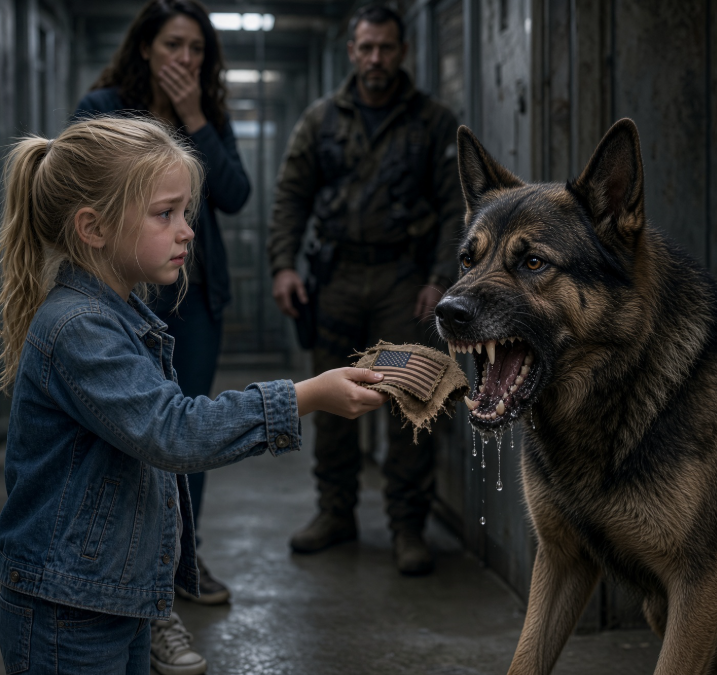
Then she reached into her pocket.
Slowly.
No sudden movement.
No threat.
Her small hand opened.
In her palm lay the frayed subdued American flag patch.
The scent struck before thought.
Gun oil.
Sweat.
Peppermint gum.
Desert dust.
Caleb.
The corridor vanished.
The kennel vanished.
For one impossible second, the dead came back through a child’s hand.
My mangled ear twitched forward.
I stepped closer.
Every instinct fought every other instinct.
Guard.
Threat.
Caleb.
Child.
Collar.
Mission.
Home.
Lily did not flinch.
She slipped her fingers through the diamond-shaped gaps in the fence.
Behind her, far away, David dropped an envelope.
“Where is she?” Sarah asked.
Then running.
Panic.
Boots.
A mother screaming Lily’s name.
David rounded the corner with Sarah behind him.
He expected blood.
I could smell that expectation on him before he saw us.
He reached for the tranquilizer pistol at his thigh.
Sarah lunged forward.
David slammed his arm across her chest and pinned her against the cinder block wall.
“Don’t,” he hissed. “If you scream, if you make a sudden movement, you’ll trigger him. He’ll tear her arm off before I can unholster.”
They froze.
Everyone froze.
Only Lily’s hand remained steady.
I lowered my nose to her fingers.
One millimeter away.
I inhaled.
Strawberry shampoo.
Dried tears on denim.
The boonie hat.
The patch.
Caleb.
Caleb.
Caleb.
My growl broke into silence.
Something inside me, clenched for eight months, cracked.
Lily slowly curled her fingers and touched the bridge of my nose.
I should have pulled away.
I did not.
Then, for the first time in 241 days, Lily spoke.
Her voice was raspy.
Fragile.
Barely louder than breath.
But to me it was louder than rotor blades.
“Stand down, soldier.”
My body locked.
No one moved.
She swallowed.
“Relief is here.”
The old world opened.
Then she whispered the words that belonged to Caleb.
“Safe harbor.”
A sound left me that did not feel like mine.
A long, broken whine.
My front legs buckled.
I collapsed onto the concrete.
Not from fear.
Not from obedience.
From release.
Safe harbor.
The command did not make me weak.
It told me the mission had reached the place it was meant to reach.
I dragged myself forward until my scarred side pressed against the chain-link fence. I pushed my head toward Lily, desperate to get closer.
Sarah fell to her knees beside her daughter, sobbing.
David’s hands shook so badly the keys rattled against one another. He unlocked kennel four, breaking every safety protocol written in that facility.
The door swung open.
I did not lunge.
I did not run.
I crawled forward on my belly until my head rested in Lily’s lap.
She wrapped her arms around my neck and buried her face in my fur.
“I’ve got you,” she whispered. “I’ve got you now.”
I closed my eyes.
For the first time since Afghanistan, I let my body believe someone else was guarding the perimeter.
David stood in the open door holding the clipboard with my euthanasia order attached.
Friday.
Three o’clock.
He looked at the paper.
Then at me.
Then at Lily.
Quietly, he tore the order into pieces.
The drive from Chesapeake, Virginia, back to Raleigh, North Carolina, felt stranger than any transport I had ever known.
No crate.
No chains.
No sedation.
No men with rifles.
I sat in the back seat of Sarah’s Subaru with my head resting on Lily’s lap.
Her fingers remained buried in the fur behind my ear.
Sarah kept looking in the rearview mirror, eyes red, face pale with exhaustion and something almost too fragile to call hope.
I watched cars pass.
Watched tree lines.
Watched bridges.
Watched reflections in windows.
Calm did not mean careless.
I was still alert.
But the frantic edge was gone.
I was not a prisoner.
I had a protectee.
At the house, I learned the new perimeter.
Front door.
Back door.
Kitchen window.
Garage entry.
Staircase.
Lily’s room.
Every evening before sunset, I patrolled the backyard fence line with precision. Loose board near the east corner. Squirrel track by the oak. Neighbor dog three houses down. Mail carrier route at 1100. Trash pickup loud on Tuesdays.
Inside, I cleared the first floor before lying across the threshold of Lily’s bedroom.
No one entered without stepping over me.
No one.
David Harper called after a week.
Sarah told him I was calm.
He did not believe her at first.
I could hear disbelief through the little rectangle she held to her ear.
The canine behavioral world had decided I was lost.
Broken.
Combat-damaged beyond use.
But I had not been useless.
I had been unemployed from the wrong mission.
Now I had a new one.
Guard Lily.
Guard Sarah.
Guard the house Caleb no longer could.
But one thing remained unfinished.
The collar.
Sarah had placed Caleb’s memorial on the living room mantle.
Folded American flag.
Medals.
A framed photograph of him smiling in dress whites.
And my deployment collar.
The heavy tactical collar I had worn in Afghanistan.
The collar the Navy told Sarah not to tamper with because it was part of a closed combat investigation.
Humans are strange.
They call things closed when nothing inside them has healed.
Every evening at 2100 hours, the exact time Caleb used to read Lily a bedtime story, I paced in front of the fireplace.
I stared at the mantle.
Whined.
Scratched my paw lightly against the brick.
Sarah thought at first I missed the collar.
She took it down once and placed it near my bowl.
I did not put my head through it.
I stood over it.
Guarding.
Waiting.
When she put it back, I paced again the next night.
And the next.
And the next.
For a month, she did not understand.
I grew more insistent.
I refused my evening meal unless the collar was placed on the floor. Even then, I did not eat until Lily touched it.
Because Caleb had been clear.
Sarah.
Lily.
Only them.
One rainy Tuesday evening, Sarah was washing dishes when she heard the tearing sound.
She came into the living room and found Lily cross-legged on the rug.
I sat directly in front of her.
The collar lay between my paws.
Lily’s small fingers moved along the inner seam of the thick Kevlar lining.
“What are you doing, sweetie?” Sarah asked.
Lily did not look up.
“There’s something inside.”
Sarah stilled.
“Titan wants me to take it out.”
Sarah knelt beside her.
She picked up the collar.
It was stiff with old mud, sweat, and the dark stains of Caleb’s final mission.
Her thumb moved along the seam.
Then she felt it.
A rigid rectangle buried beneath reinforced stitching.
Her heartbeat changed.
“The Navy told us not to open it,” she whispered.
I nudged her hand with my nose.
Not command.
Request.
Please.
Sarah went to the kitchen and returned with heavy utility scissors.
Her hands shook as she carefully cut through the thick nylon thread. The seam split open.
A small plastic packet slipped onto the carpet.
Inside was a folded piece of tactical notebook paper.
Blood-stained.
Waterproofed.
Protected.
Sarah stopped breathing.
She opened the plastic.
Unfolded the paper.
The scent rose into the room.
Old blood.
Dust.
Ink.
Caleb.
Her hands trembled so violently Lily had to steady the bottom of the page.
Then Sarah read.
His handwriting was jagged and rushed, but it was his.
Sarah. Lily. If you are reading this, things went sideways.
Sarah’s breath broke.
She kept reading anyway.
He wrote that he had taken shrapnel during the extraction. That the medic said the helicopter was twenty minutes out. That he knew he was bleeding too fast.
He wrote that his last thoughts were of them.
That Lily was his brave girl.
That he was sorry he broke his promise to come home.
Sarah pressed one hand to her mouth, but the words continued through her tears.
I am sending my best man to watch over you.
Titan is carrying this note in his collar.
I ordered him to guard it with his life.
He won’t let anyone touch it but you.
The room changed.
I felt Sarah understand.
Felt Lily understand.
Felt the air finally clear around the thing I had been carrying all along.
I had not attacked Miller because I was a demon.
I had not pinned Rossi because I was feral.
I had not refused buyers because I wanted no home.
Every hand near my collar had been a threat to Caleb’s final order.
I had been executing my last mission.
Deliver the commander’s final words to his family.
Sarah sobbed so hard she bent over the letter.
Lily touched my head.
Sarah read the last part.
Tell him safe harbor, Lily.
Relieve him of duty.
Let him be a dog again.
He loves you both as much as I do.
I am always with you.
Look at the stars in the Blue Ridge for me.
All my love, forever.
Dad.
Sarah dropped the letter and pulled Lily into her arms.
They wept on the living room floor while rain tapped against the windows and thunder rolled softly beyond the glass.
This grief was different from the grief I had smelled at Oak Ridge.
That grief had no door.
This grief opened one.
They had been denied goodbye for eight months.
War had taken Caleb’s body.
Bureaucracy had taken his dog.
Silence had taken Lily’s voice.
But the collar had held one last bridge between the dead and the living.
I had guarded it.
I had delivered it.
Mission complete.
A sigh moved through me so deeply it felt like my bones exhaled.
I leaned forward and licked Lily’s tears.
She laughed while crying.
A small sound.
A living sound.
I rested my head against her lap.
For the first time in longer than my body knew how to count, I was not waiting for an attack.
Not listening for extraction.
Not guarding hidden cargo.
Not calculating the distance between my teeth and a threat.
I was just a dog lying with my family on the rug.
After that night, something in me changed.
I still patrolled the yard.
I still slept by Lily’s door.
I still watched strangers with the seriousness they deserved.
But I stopped pacing at 2100.
I stopped guarding the collar.
Sarah placed Caleb’s letter in a frame beside his photograph.
The collar stayed on the mantle, but it no longer pulled at me like an unfinished order.
Sometimes Lily took the patch from her pocket and held it while sitting beside me.
Sometimes Sarah stood at the mantle and touched the frame, lips moving silently.
Sometimes the three of us went outside at night and looked toward the dark Blue Ridge sky.
Lily spoke more after the letter.
At first, only small things.
“Titan, come.”
“Mom.”
“I’m hungry.”
Then more.
Stories.
Questions.
Memories of Caleb.
She told me secrets while brushing my coat.
She read books aloud with one hand resting on my neck.
Sometimes she cried into my fur and told me she missed him.
I did not tell her not to.
Dogs do not make that mistake.
Humans often rush to stop tears because they think comfort means ending the sound of pain.
Dogs know better.
Sometimes comfort means staying close while the pain speaks.
Months later, David Harper came to see us.
He stood in Sarah’s living room and looked at me lying beside Lily on the carpet.
I lifted my head.
He froze.
Old fear has a scent too.
Then Lily said, “It’s okay. He’s home.”
Home.
That word was not a military command.
Not official.
Not classified.
But I understood it better than most.
David looked at the framed letter on the mantle. Then at my collar. Then back at me.
“I was wrong about you,” he said softly.
I watched him.
He smelled of regret, but not danger.
So I lowered my head again.
That was enough forgiveness for one afternoon.
Eventually, Oak Ridge changed its procedures.
No retired military working dog would be reassigned without a full inventory of personal equipment, hidden compartments, handler-specific commands, and final mission context. No dog would be labeled beyond repair because it refused to submit to someone who did not understand what it was protecting.
David began teaching new handlers a phrase:
Behavior has a history.
Aggression has a reason.
A dog that refuses to let go may still be holding on to a promise.
I do not know how many dogs that saved.
I hope many.
I hope enough.
Because there are dogs like me in places like kennel four all over the world.
Dogs who came home from human wars with orders no one can read.
Dogs who flinch at harmless sounds because harmless sounds once came before explosions.
Dogs who growl not because they hate people but because their whole bodies still believe the mission is active.
Dogs called broken when they are grieving.
Dogs called dangerous when they are loyal beyond human patience.
And there are people like Lily too.
Children holding silence because the person who understood their voice did not come home.
Widows carrying boxes of returned belongings that feel too small to contain a life.
Families told to accept closure from paperwork when love has not received its final sentence.
I was almost ended by paperwork.
A red stamp.
A scheduled injection.
A conclusion written by people who had seen my teeth but not my mission.
Then a seven-year-old girl walked into the dark with her father’s patch in her hand and the only words that could reach me.
Stand down, soldier.
Relief is here.
Safe harbor.
Humans said she saved me.
Maybe she did.
But Caleb had saved us both long before that.
He trusted a child with the command.
Trusted me with the letter.
Trusted love to find its way through steel, silence, grief, and fear.
He was right.
Every night now, after I check the doors and the windows, I stop by Lily’s room.
She is older than seven now.
Her voice is stronger.
Her laughter fills spaces that once held only her mother’s careful quiet.
Sometimes she sleeps with one hand hanging over the edge of the bed, and I place my head beneath it the way I once placed my head under Caleb’s hand before a mission.
Not because I am waiting for orders.
Because I know where I belong.
I am not a grenade.
I am not a monster.
I am not the beast of Oak Ridge.
I am Titan.
I was Caleb Montgomery’s partner.
I carried his final words home.
And when his daughter whispered the command no one else remembered, I finally learned that my war was over.
Safe harbor.
Quiet follows.
Home.








