A Mother Dog Begged Us to Save Her Nine Puppies Before the Flood Arrived—But After They Escaped the Rising Water, One Tiny Life Began a Fight We Never Saw Coming
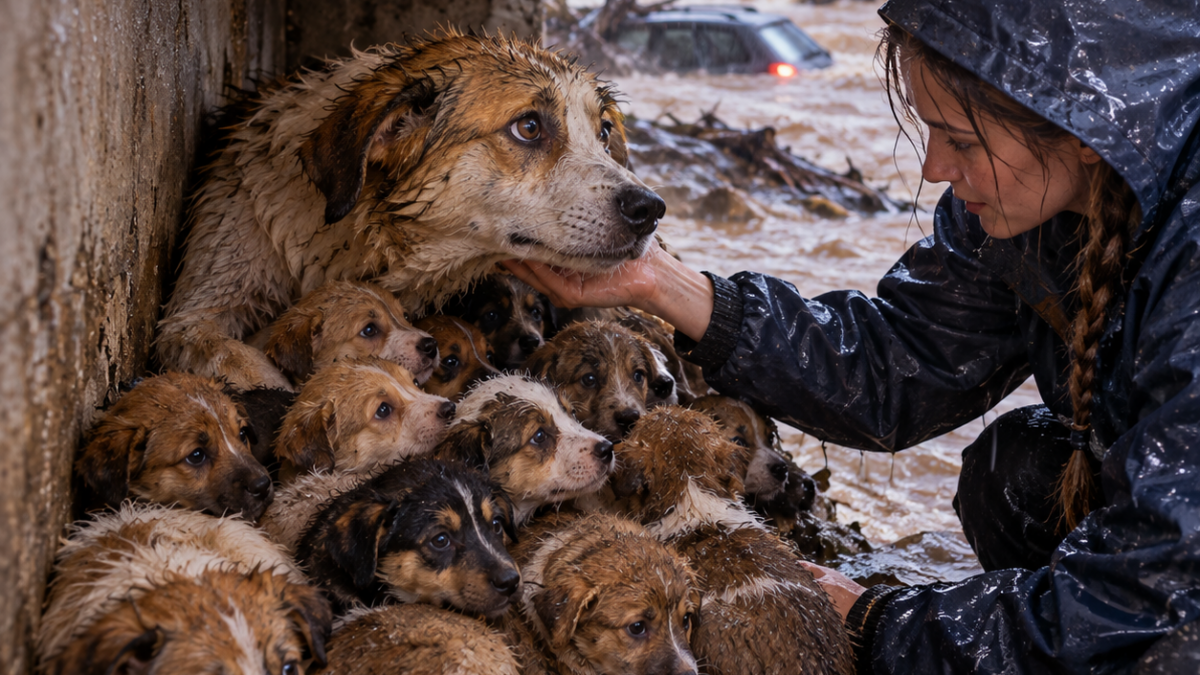
PART3:
The puppies had intestinal infections. Several had fungal skin infections that caused itching, irritation, and discomfort. They needed cleaning, medication, proper food, rest, and careful monitoring.
The mother dog, too, was thin and worn down. How she had managed to keep nine puppies alive as a stray, we could not understand.
Nine puppies take everything from a mother.
Milk.
Warmth.
Energy.
Protection.
Sleep.
Somehow, even hungry and scared, she had kept them together.
We named the puppies one by one as their personalities began to appear.
Some were shy, hiding behind their siblings whenever we entered the room. Some were bold, toddling forward on unsteady legs to sniff our shoes. One had a habit of sleeping on top of everyone else. Another cried if separated from his mother for even a minute. Each had a different face, a different little voice, a different way of looking at the world.
One of them was Archie.
Archie was small, gentle, and quiet.
At first, we thought he was simply timid. He did not rush to eat like the others. He trembled often. He seemed easily confused by movement around him. When his siblings began playing, clumsily biting ears and paws, Archie sometimes sat apart as if the noise overwhelmed him.
I noticed him more each day.
Something was wrong.
I could feel it before I could explain it.
Rescue teaches you to listen to small changes. A puppy who refuses food. A puppy who trembles. A puppy whose eyes do not focus quite right. A puppy who grows weaker while the others begin growing stronger.
One morning, Archie would not eat at all.
His small body shook continuously.
By afternoon, his condition had worsened.
We rushed him to emergency care.
The veterinarians moved quickly. Tests were done. Fluids were started. They checked for infections, viruses, trauma, anything that might explain why such a tiny puppy seemed to be slipping away in front of us.
I stood there helplessly while doctors worked over his little body.
There is a special kind of fear that comes when an animal is too small to fight the size of the battle inside them.
I kept asking questions.
“Is he in pain?”
“Can he hear me?”
“Will he survive?”
The veterinarian did not want to give false hope. He only said they were doing everything they could.
They did not let me stay all night. I begged, but the clinic had protocols, and Archie needed constant medical attention. Finally, late that night, they told me to go home and rest.
Rest.
As if that were possible.
At home, the other puppies still needed feeding, cleaning, medicine, and comfort. The mother dog still watched the doorway whenever I entered, as if asking where her missing baby had gone.
I did not know how to tell her.
So I sat beside her and stroked her head.
“He’s fighting,” I whispered. “Your baby is fighting.”
The next day, I returned to the hospital as soon as they allowed me.
The test results came slowly.
All the usual tests were negative.
No clear infection explained what was happening. No simple answer appeared. Then imaging showed what none of us were prepared to hear.
Archie had severe brain damage.
Many of his brain cells had been badly damaged or had already died. He had lost much of his awareness. He became disoriented, unable to understand what was happening around him. He lost his vision and hearing. He could not balance properly. He barked in confusion, not like a playful puppy, not like an angry puppy, but like a baby trapped inside darkness and noise that only he could feel.
No one could tell us exactly why.
Maybe it had happened before we found him.
Maybe something during those early, desperate days had already begun inside his body.
Maybe he had been fighting silently from the start.
The veterinarians tried everything they could.
Medication.
Supportive care.
Monitoring.
Treatment after treatment.
But his condition worsened quickly. The damage became irreversible. His little body remained alive, but the world he knew had begun disappearing.
I held him in my arms and cried into his fur.
He was so small.
Too small for such suffering.
Too small for words like irreversible.
Too small for decisions that break the people who must make them.
For several days, I brought Archie home whenever the doctors allowed it, even if only briefly.
I wanted him to feel his mother again.
I wanted him to smell his siblings.
I wanted him to be surrounded by the family he had fought beside through the flood.
The mother dog recognized him immediately each time.
She sniffed him, licked his face, and lay close as if her body could somehow call him back. His siblings crawled around him, unaware of the grief surrounding the room. Archie rested among them, confused and fragile, but not alone.
Those moments were gifts.
Painful gifts.
Then we had to take him back to the hospital.
I could not give up while even a tiny chance remained.
Archie did not stop trying.
That is what I remember most.
He endured every treatment, every exam, every strange sound and touch. His headaches became more frequent. His confusion deepened. His small body fought beyond what seemed possible.
But love cannot always save a life.
Sometimes love only makes sure a life does not end alone.
The day we said goodbye, it was raining heavily.
Just like the day we found him.
I remember standing outside the clinic, hearing the rain strike the roof, watching water run down the glass, and feeling as though time had folded back on itself. The same storm sound. The same helplessness. The same desperate wish to arrive in time.
But this time, there was no rescue left to perform.
Only mercy.
I held Archie close.
His body was warm against my chest. I whispered his name again and again, hoping that somewhere inside the darkness, he could still feel love.
“You were brave,” I told him. “You were so brave.”
When he was gone, something inside me broke quietly.
There are losses rescue workers carry forever.
Archie became one of mine.
Afterward, I returned home to the others.
That was the hardest part.
Grief does not pause the needs of the living.
The remaining puppies still needed meals. Medicine. Skin treatments. Vaccines. Cleaning. Socialization. Families. A future.
So I poured all the love I could no longer give Archie into the eight who were still with us.
One by one, they grew stronger.
Their coats improved.
Their eyes brightened.
They began to play like puppies should—tumbling over one another, stealing toys, biting blankets, falling asleep in piles after five minutes of chaos.
The mother dog finally began to rest.
She had spent so long surviving that sleep looked unfamiliar on her at first. But slowly, she learned that food would come again. That her babies were safe. That rain outside did not mean danger inside. That human hands could bring bowls, blankets, medicine, and kindness.
Applications for adoption came in.
We were careful.
These puppies had survived too much to be placed carelessly. We wanted families who understood that they needed patience, training, medical follow-up, and love that would not vanish when puppyhood became work.
Three families were approved first.
Then another.
Then another.
One by one, the puppies left for homes of their own.
Each goodbye hurt.
Each one healed something too.
I watched them carried away in warm arms, wrapped in clean blankets, heading toward futures their mother had begged us to protect.
Some went to homes with children.
Some to quiet couples.
One to a woman who had lost her old dog months before and cried the moment the puppy licked her chin.
The updates began soon after.
Photos of puppies sleeping on soft beds.
Puppies playing in yards.
Puppies wearing tiny collars.
Puppies looking healthy, loved, and completely unaware that they had once been minutes away from a flood.
Every update made me think of Archie.
I believe he would have been happy to know his siblings survived.
Maybe that is something we tell ourselves because grief needs somewhere gentle to rest. But I still believe it.
I imagine him somewhere free from pain, no longer confused, no longer trapped inside a body that betrayed him. I imagine him watching the others grow, seeing them find the lives he deserved too.
From floodwater to families.
From a narrow alley to warm homes.
From fear to safety.
That was the journey his mother had fought for.
People often ask how animals know when to ask for help.
I do not know.
I only know that this mother dog did.
She came to us in the storm.
She led us to her babies.
She trusted strangers because love made her braver than fear.
And because she did, eight puppies grew up in homes full of warmth, and one tiny puppy named Archie knew love before he left this world.
The ending was not perfect.
Rescue rarely is.
Perfect would have been all nine puppies running in new yards, their mother healthy and peaceful, no hospital rooms, no impossible diagnosis, no goodbye in the rain.
But there was beauty inside the heartbreak.
The mother dog and her puppies were not swallowed by the flood.
Archie was not alone.
The others found families.
And every one of them was loved.
Sometimes rescue means saving a life.
Sometimes it means fighting beside a life until the very end.
And sometimes it means honoring the one you could not save by giving everything you have to the ones still waiting.
That is what we did for Archie.
That is what his mother asked of us before the flood came.
And that is what we will keep doing, every time a frightened animal leads us into the storm and asks us not to look away.








