A Mechanic Fixed a Bike Without Charge — Then the Hells Angels Came Back With a Surprise
PART3:
I had fixed bikes for all kinds of riders over the years. Weekend warriors. Veterans. Cross-country dreamers. Rich guys pretending to be outlaws until Monday morning.
This man was not pretending.
He dropped the kickstand with a heavy clank and took off his helmet.
His eyes were pale blue, sharp, and tired.
“Shop open?”
My mouth had gone dry.
“Yes, sir,” I said. “Bring her inside before you melt out here.”
He pushed the Harley into the bay.
I did not ask questions.
You do not make small talk with a man like that unless he invites it.
He leaned against my toolbox and wiped sweat from his brow.
“Name’s Jim,” he said. “Jim Callahan. Bike lost power outside Needles. Started blowing white smoke, then died. Had to push her the last three miles.”
Three miles.
In that heat.
Pushing that bike.
I glanced at him again.
He looked angry, but beneath that, something else was happening. His color was off. His jaw was clenched too tight. His eyes were focused, then unfocused, then focused again.
Still, the bike came first.
That is what mechanics do.
I opened the side panel, got my light, and leaned in.
The smell hit me immediately.
Burnt oil.
Scorched metal.
A motor cooking itself from the inside.
“You’ve got a blown head gasket,” I said. “And your primary chain case took a hit. Looks like a rock or debris on the highway. It’s leaking fluid everywhere. You ran dry.”
Jim cursed under his breath.
“How long?”
“To do it right? Six, maybe seven hours. I’ve got to pull the top end apart, clean it, seat a new gasket, weld the case, refill everything, and pray you didn’t cook more than I can see.”
He crossed his arms.
For a long moment, neither of us spoke.
Then he looked straight at me.
“I’m going to be honest with you, mechanic. I don’t have money.”
I waited.
“Got separated from my pack two nights ago in Nevada. Stopped at a roadside motel. Woke up and some tweaker had slashed my saddlebags. Took my wallet, cash, cards, everything except my clothes and my colors.”
I looked at him.
Then at the bike.
Then through the office window at the foreclosure notices on my desk.
I needed money so badly my hands had been shaking before he came in.
The gasket alone was worth more than I could spare.
The oil, welding supplies, labor, hours of heat—it all mattered.
I could not afford generosity.
Not anymore.
But if I turned him away, he would be stranded on Route 66 in lethal heat with a dead motorcycle and no money.
Maybe he would get picked up.
Maybe he would not.
Maybe he would survive.
Maybe he would not.
And yes, another thought crossed my mind too, one I am not proud of but will not lie about.
You do not anger a high-ranking Hells Angel unless you are ready for consequences.
But that was not why I made the choice.
At least, not the whole reason.
I looked at Jim Callahan and saw a man cornered by life.
I knew that look.
I saw it in my own mirror every morning.
“I’ve got the gasket in stock,” I said, reaching for a wrench. “I can weld the case.”
Jim stared at me.
“Did you hear me, old man? I said I can’t pay.”
“I heard you.”
I slid the creeper under the bike.
“There’s cold water in the mini fridge in the office. Don’t drink the last Dr Pepper. That one’s mine.”
His eyes narrowed.
“You fixing it anyway?”
“It’s too hot to argue.”
For the next seven hours, I worked like a man possessed.
The shop turned into an oven.
Sweat poured off me. My knees screamed. My back tightened. My hands slipped twice because the tools were slick with oil and heat.
I pulled the top end apart, scraped old gasket material, cleaned the surface until it shone, seated the new gasket, checked the cylinder heads, repaired the primary case, welded the crack, refilled the fluid, checked the lines, checked them again, and said three quiet prayers my father would have pretended not to hear.
Jim sat in the office for part of it.
Then paced.
Then sat again.
Every once in a while, I caught him watching me through the glass.
Not impatient.
Not angry.
Almost confused.
Like kindness had become so rare on the road that he did not trust it when it appeared wearing a grease-stained shirt.
By sunset, the sky outside had turned bruised purple and orange.
The desert cooled by maybe two degrees, which felt like mercy.
I lowered the Harley off the lift and wiped my hands.
“Moment of truth.”
I hit the ignition.
The bike roared alive.
Not coughed.
Not stumbled.
Roared.
A deep, clean thunder that filled the whole shop and rolled out across Route 66 like the old road had woken up.
Jim stepped forward slowly.
He listened.
Walked around the bike.
Looked at the weld.
Checked the sound.
Then he nodded once.
For a man like him, that felt like applause.
“I won’t forget this, Tyler.”
The way he said my name made me realize he had seen it on the shop sign and remembered.
“The Angels pay their debts,” he said. “Always.”
I forced a tired smile.
“Just get home safe, Jim. Route 66 is unforgiving after dark.”
He threw one leg over the saddle, kicked into gear, and rode out into the cooling desert night.
I stood in the garage bay and watched his taillight disappear.
Then I locked the shop, went into the office, and looked again at the foreclosure notices.
I had just given away parts I could not replace.
Hours I could not charge.
Work I desperately needed to sell.
I had done the right thing.
And the right thing had moved me one day closer to losing everything.
Three weeks passed.
I thought about Jim sometimes, but only in brief flashes.
Mostly, I thought about the bank.
The deadline came on a Thursday morning with wind rattling the loose tin roof above the garage.
Richard Miller from Mojave Regional Bank arrived at 9:00 a.m. in a gray suit too expensive for a man whose job was crushing people politely.
He sat across from me in the office, looked around like the smell of oil offended him, and slid a thick manila envelope across my desk.
“I’m sorry, Mr. Harding,” he said.
He was not sorry.
“But the grace period expired at midnight. The bank has officially initiated foreclosure proceedings. You have forty-eight hours to vacate the premises and remove personal belongings.”
I heard the words, but they seemed to come from far away.
“Mr. Miller,” I said, “I just need thirty more days. Tourist season is starting. I can bring you five thousand by the end of the month.”
“We’ve had this conversation.”
“Please.”
He stood and smoothed his jacket.
“The property is already listed. A commercial developer is interested in the land. A gas station complex would perform well here.”
“This is my father’s shop.”
His face did not change.
“I suggest you start packing.”
After he left, I sat at the desk for hours.
I looked at Sarah’s photograph.
Then at the old Harding and Son sign hanging crooked near the office door.
Then at the pegboards full of tools my father had collected one paycheck at a time.
I had failed him.
I had failed Sarah.
I was about to fail Chloe.
By mid-afternoon, I started packing.
There is a special cruelty in boxing up a life while the building still smells alive.
My father’s socket set went first.
Then the custom torque wrench Sarah bought me for our tenth anniversary.
Old manuals.
Vintage carburetor gauges.
Photographs.
Receipts.
A coffee mug Chloe made for me when she was eight that said WORLD’S OKAYEST MECHANIC.
Every item I dropped into a cardboard box sounded like dirt hitting a coffin lid.
I was taping the third box when the floor began to vibrate.
At first, I thought a semi was passing.
Then a loose wrench on the workbench rattled.
The vibration grew.
Deep.
Unified.
Mechanical.
I walked to the open bay and looked down Route 66.
My blood went cold.
A wall of motorcycles crested the hill.
Not five.
Not ten.
Fifty, maybe sixty Harley-Davidsons riding two-by-two, black leather and chrome flashing under the desert sun.
At the front was the Road Glide I had fixed.
Jim Callahan’s bike.
My first thought was terrible.
The repair failed.
The weld cracked.
The engine seized.
Jim crashed.
And now they had come back for me.
The convoy rolled into my lot with frightening precision. Bikes split left and right, filling the gravel, blocking the shoulder, surrounding the shop. Engines cut off in near unison.
The silence afterward was worse than the roar.
Fifty men dismounted.
Big men.
Hard men.
The kind of men whose faces made you understand how many ways life can sharpen a person.
I stood in the garage bay with tape still stuck to my fingers.
A crowbar leaned against a barrel behind me.
I did not reach for it.
There would have been no point.
If the Hells Angels had come to hurt me, I was already finished.
Jim walked forward.
He was not smiling.
Two men flanked him—one broad and scarred with bones tattooed across his knuckles, the other younger and lean with a chain hanging over his shoulder.
They stopped ten feet away.
“Jim,” I said, my voice dry. “I hope the bike held up.”
He did not answer.
His eyes moved around the garage.
The boxes.
The empty pegboard spaces.
The half-packed office.
“You’re packing up.”
It was not a question.
I swallowed.
“Bank’s taking the property.”
Jim looked at the boxes again.
“If there was an issue with the primary case, I—”
He raised one gloved hand.
I stopped talking.
He nodded to the scarred man beside him.
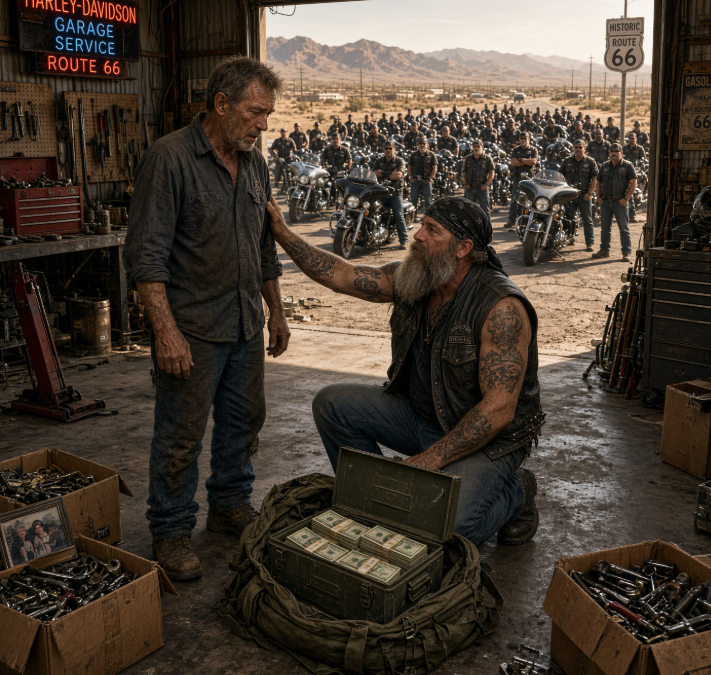
The man walked back to his bike, opened a saddlebag, and lifted out a heavy olive-green duffel. The fabric strained around whatever was inside.
He carried it to me and dropped it at my feet.
It hit the concrete with a metallic thud.
My heart hammered.
Jim’s voice broke the silence.
“I told you, Tyler. The Angels pay their debts.”
I stared at the bag.
“Open it.”
My hands trembled as I knelt and unzipped the duffel.
Inside was an old military ammunition crate.
The scarred man tossed a small brass key. It skidded across the concrete and stopped near my knee.
I unlocked the crate and lifted the lid.
For a moment, I forgot how to breathe.
Money.
Stacks of bills.
Twenties.
Fifties.
Hundreds.
Bundled with rubber bands.
Not clean bank money.
Road money.
Cash that smelled like gasoline, tobacco, leather, and a thousand pockets.
“There’s seventy-five thousand dollars in that box,” Jim said. “Raised by California charters. Passing the hat for the man who saved my life.”
I looked up.
“Saved your life? Jim, I fixed a gasket.”
He shook his head.
“I didn’t tell you everything that day.”
He stepped closer.
“When my saddlebags were slashed in Nevada, they didn’t just take my wallet. They took my emergency insulin.”
I stared at him.
“I’m type 1 diabetic,” he said. “By the time I pushed that bike to your shop, I was slipping bad. Vision tunneling. Mouth dry. Heat making it worse. If you had turned me away, if you had sent me walking or left me out there, I would have been dead in a ditch within two hours.”
The garage seemed to tilt.
I thought back to his pale face.
The strange focus in his eyes.
The way he sat, then paced, then sat again.
I had thought he was only exhausted from pushing the bike.
I had not known.
“You didn’t see a patch and decide I wasn’t worth helping,” Jim said. “You knew I couldn’t pay. You knew what we were. And you fixed that bike anyway.”
He reached down, gripped my shoulder, and pulled me to my feet.
“You bought our loyalty, Tyler Harding. And we do not let our friends lose their livelihood to bank vultures.”
Before I could speak, another engine pulled into the lot.
Not a motorcycle.
A sleek black BMW sedan.
Behind it came a Kingman County Sheriff’s cruiser.
Richard Miller stepped out of the BMW holding a clipboard.
He had come to inspect my failure.
To make sure I was packing.
To enjoy being the man who stood on the winning side of a signature.
Then he saw the bikes.
He froze.
The clipboard slipped from his hand, papers scattering in the wind.
Sheriff Brody Caldwell stepped out of the cruiser and immediately rested one hand near his holster. He was a practical man with a gray mustache and the expression of someone doing math he did not like.
He knew Jim Callahan by reputation.
He knew what fifty Hells Angels in one lot could mean.
Jim lifted one hand.
“Sheriff. No quarrel with the badge today. We’re just helping a local businessman pay his debts.”
Caldwell’s eyes moved across the bikes.
“That’s a lot of moral support.”
“That’s all it is.”
Miller tried to recover his voice.
“Harding,” he snapped, though it came out thinner than he wanted, “what is this?”
I looked at Jim.
Jim looked at me.
For the first time all day, my spine straightened.
“I’m clearing the debt.”
Miller blinked.
“What?”
Jim stepped toward him.
The bikers parted behind him, creating a path that felt less like courtesy and more like a warning.
“Mr. Harding is ready to cure the default,” Jim said quietly. “In cash. Right now.”
Miller’s face twisted.
“We don’t accept large cash deposits without scheduled verification procedures.”
The younger biker with the chain laughed once.
A dry, ugly sound.
“Legal tender is legal tender, Richard.”
Sheriff Caldwell looked at Miller.
“He’s right. If Harding has the money to cure the default, the bank has to accept it. I’m not arresting a man for paying his mortgage.”
Miller’s mouth tightened.
I carried the ammo crate out and set it on the hood of his BMW.
The metal scratched the paint.
He flinched.
I did not apologize.
“Forty-five thousand for the arrears and penalties,” I said. “Count it. Write the receipt. Release the lien.”
Miller’s hand shook as he counted enough to know it was real. Then he scribbled a receipt on the back of one of the forms he had dropped.
He shoved it at me.
“You haven’t won anything,” he spat. “The developer will build across the road. You’ll be starved out in six months.”
Jim chuckled.
It was not a pleasant sound.
“Funny you mention the developer.”
He pulled a folder from inside his vest and tossed it onto the hood of the BMW.
“My boys looked into that anonymous LLC buying up land around here. Turns out it’s registered to Beatrice Miller.”
Richard Miller went pale.
Sheriff Caldwell looked sharply at him.
“Your sister?”
Jim continued.
“You were denying Tyler extensions to force foreclosure. Then your family buys the land at auction for pennies on the dollar.”
The sheriff’s voice dropped.
“Richard. Is that true?”
Miller did not answer.
That answered enough.
Caldwell tapped the BMW window.
“I’d stay available. I’ll be visiting the regional manager this afternoon, and I’ll bring a warrant if I need one.”
Miller got into his car and tore out of the lot in a cloud of dust.
The sheriff tipped his hat to me.
Then looked at Jim.
“I don’t like surprises, Callahan.”
Jim smiled faintly.
“Neither do we.”
Caldwell drove away.
For a long moment, nobody spoke.
I looked at the receipt in my hand.
Then at the remaining thirty thousand dollars sitting in the duffel.
Then at Jim.
“I don’t know how to repay this.”
Jim’s answer came immediately.
“You already did.”
Then he turned to the men behind him and raised one fist.
They moved at once.
Not toward Miller.
Not toward violence.
Toward my boxes.
For the next three hours, fifty Hells Angels helped me unpack my life.
That is a sentence I still cannot say without laughing.
The scarred man with the dead eyes carefully rehung my father’s socket set on the pegboard in perfect size order.
The skinny biker with the chain swept the floor like he had been personally offended by dust.
Two men carried my toolbox back from the corner.
Another plugged in the vintage neon sign Sarah loved, and when the blue glow flickered to life, I had to turn away because my eyes filled too fast.
Jim stood in the doorway watching it all.
Before they left, he pulled a small cast-iron plaque from his saddlebag.
He nailed it above the entrance.
It showed a winged death’s head and words that made my knees feel weak.
Protected by Hells Angels Motorcycle Club.
Arizona Support.
Jim stepped back and nodded.
“You’re our official maintenance hub now. Any biker flying our colors breaks down within two hundred miles of Kingman, they come to you.”
“I can’t do free repairs for—”
He looked offended.
“Full price, Tyler. No discounts. You try giving discounts, I’ll take it personally.”
For the first time in months, I laughed.
The engines fired up together, shaking the building.
Jim put on his helmet, then looked back at me.
“Call your daughter,” he said. “Tell her the shop’s still open.”
Then they rode out.
One by one, fifty red taillights disappeared down old Route 66.
I stood under the sign my father had hung decades earlier and cried like a man who had been holding his breath for years.
After that day, everything changed.
Word spread fast through biker routes, club networks, desert bars, repair forums, and roadside conversations.
Harding and Son became known.
Not fancy.
Not modern.
Not fast.
Known.
Bikers came from California, Nevada, Arizona, and New Mexico. Some came needing repairs. Some came needing oil changes they probably could have done themselves. Some came just to shake my hand and buy a Harding and Son patch I had never intended to make until Chloe told me I needed merchandise.
Within six months, I hired my first employee in years.
Within a year, I replaced the roof.
Within two years, the office had air-conditioning that worked, the lifts were upgraded, and the bank never called me again except to apologize through new management after Richard Miller was indicted for bank fraud.
The mega gas station never got built.
Beatrice Miller’s LLC collapsed under investigation.
Funny how fast developers disappear when paperwork starts glowing under federal lights.
As for Chloe, I finally told her the truth.
Not all at once.
I drove to Phoenix one weekend, took her to dinner, and admitted how close I had come to losing the shop.
She cried before I finished.
Then she got mad.
Then she cried again.
“You should have told me,” she said.
“I know.”
“I would have helped.”
“That’s why I didn’t.”
She reached across the table and took my hand.
“Dad, you don’t get to protect me by disappearing inside your own problems.”
That sounded exactly like Sarah.
It hurt in exactly the right way.
The remaining money from Jim’s duffel paid Chloe’s tuition through graduation.
I tried to save some for taxes, equipment, emergencies.
But that tuition check mattered most.
Sarah would have wanted it that way.
On the day Chloe graduated nursing school, I sat in the front row in Phoenix wearing my best shirt and a tie she had picked because apparently my taste was “mechanic formal,” which she said was not a compliment.
When her name was called, I stood so fast my chair nearly tipped.
I clapped until my palms hurt.
Three rows behind me, another man stood too.
Massive.
Gray-bearded.
Wearing a tailored black suit over a shirt that could not completely hide the outline of a leather cut folded beneath his arm.
Jim Callahan cheered louder than half the families there.
Chloe saw him and laughed through tears.
Afterward, she hugged me first.
Then she hugged Jim.
“Thank you,” she told him.
Jim looked genuinely uncomfortable.
“I didn’t do anything.”
“You helped save my dad’s shop.”
Jim glanced at me.
“Your dad saved me first.”
That was the truth of it.
Some debts are not measured correctly by banks.
A bank saw forty-five thousand dollars and decided that was the value of my life’s work.
Jim Callahan saw seven hours of labor, a gasket, a weld, a cold bottle of water, and a man willing to help when help made no financial sense.
To him, that was worth more.
I still run Harding and Son.
The sign is repainted now, but I kept the old one inside above the office door. The cast-iron plaque is still outside. Some customers ask about it. Some leave when they see it.
That is fine.
The customers who stay tend to pay on time and speak politely.
Every now and then, a young mechanic working for me asks if the story is true.
“If you mean the part where fifty Hells Angels saved this place from foreclosure,” I say, “yes.”
They always ask the same thing after that.
“Were you scared?”
I tell them the truth.
“I was terrified.”
Then I tell them something else.
“Fear isn’t always a warning to run. Sometimes it’s just standing next to a moment that’s about to change your life.”
The day Jim pushed that dead Harley into my shop, I thought I was choosing between survival and kindness.
I thought helping him might cost me everything.
In a way, it did cost me something.
It cost me the belief that I was alone.
For months, I had looked at those foreclosure notices and thought nobody was coming.
My wife was gone.
My father was gone.
My daughter was too far away to know the truth.
The bank had already written the ending.
Then a man in a Hells Angels cut walked through my door with a broken motorcycle, no money, and death riding quietly under his skin.
I helped him because leaving him stranded felt wrong.
That was all.
No strategy.
No heroism.
No expectation.
Just a choice made in a hot garage by a tired mechanic who still remembered what his father taught him.
If a man comes to your shop broken, you fix what you can.
Sometimes that means an engine.
Sometimes it means something more.
And sometimes, three weeks later, the road sends thunder back to your door with fifty riders, a bag full of cash, and a reminder that good deeds do not always vanish into the heat.
Sometimes they ride home.
Sometimes they remember your name.
And sometimes they save everything you thought you had already lost.