A Lonely Man Fed a Stray Cat Every Evening but Never Touched Him—Then One Stormy Night, the Cat Walked Inside and Chose the One Place Neither of Them Expected
PART3:
My back hurt from unloading lumber I was no longer paid enough to carry.
My schedule for the next week had fewer hours than the week before.
By the time I got home, the silence inside my own house felt personal.
Then the storm rolled in.
Not a pretty rain.
A real one.
Wind shoved at the windows. Water hit the siding so hard it sounded like handfuls of gravel. The power flickered twice, then held.
I stood at the kitchen sink and looked out at the porch light cutting through the rain, feeling a stupid ache in my chest over a cat that had never once let me touch him.
I told myself he had found a shed.
A carport.
A better porch.
He did not owe me anything.
Still, I left an old towel by the door.
Around ten, I heard something.
Not loud.
Just a faint scrape under the storm.
I opened the front door.
There he was.
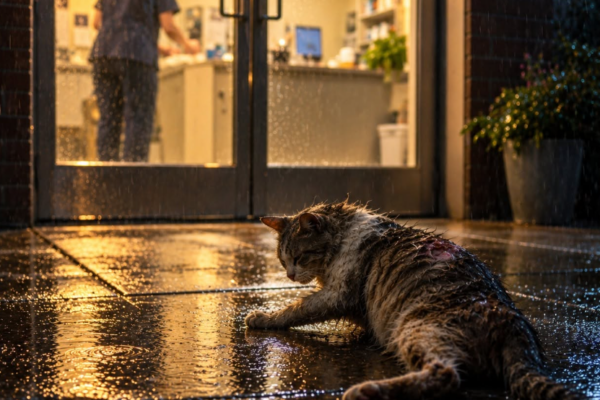
Pressed into the far corner of the porch, soaked clean through, sides heaving, eyes wide but fixed on me.
He did not run.
That is the part I remember most.
Not the thunder.
Not the rain.
Not the way my porch light made every drop shine silver for half a second before it fell.
Just that cat staying there, looking at me like he was out of options and trying to decide whether I was one of them.
I stepped back from the door.
“Okay,” I said. “You can come in.”
That was all.
No reaching.
No sudden moves.
No grabbing for him like kindness had to hurry.
He stood there another second.
Then he walked past me into the house like he had been thinking about it for weeks.
I shut the door behind him, and the whole place changed.
I dried him with the towel as best I could, though he acted offended by the service. I made him a bed from a cardboard box and an old sweatshirt near the heater.
He sniffed it.
Circled once.
Then ignored it completely.
I figured that was that.
Sometime in the middle of the night, I woke because my feet were warm.
He was there.
Curled against my ankle like he had always belonged there.
Breathing slow.
Completely asleep.
Trusting me in the most ordinary, devastating way.
I lay there in the dark and cried so quietly I barely made a sound.
Not because it was sad.
Because it had been so long since anything living chose to stay.
The storm passed before morning.
Sun came through the blinds in thin yellow lines. For one second, I thought maybe I had imagined the whole thing.
Then I looked down.
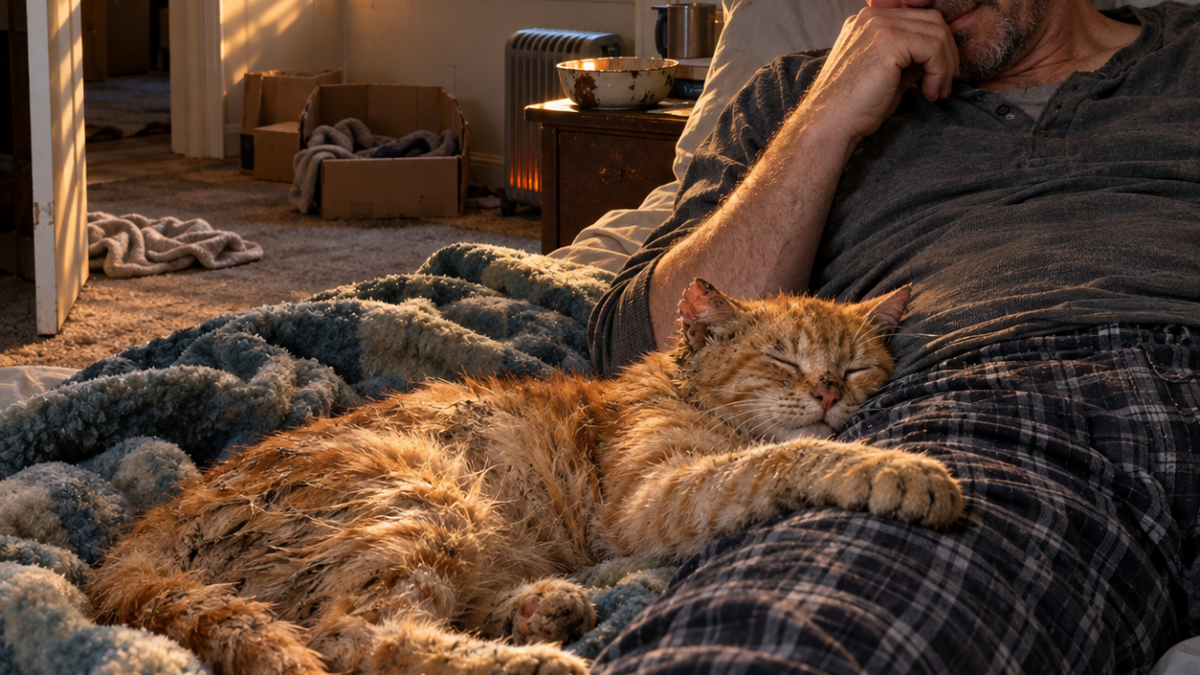
He was still there, stretched out now, one paw resting on my leg like he was making sure I did not disappear first.
That morning, I named him Frank.
It felt like the kind of name you give somebody who has seen hard years and made it anyway.
Frank lifted his head, looked at me, and gave one slow blink.
Then he stood up, stepped across my stomach with all the gentleness of a brick, and jumped off the bed to inspect the kitchen.
It made me laugh.
A rusty, unfamiliar sound.
The kind that catches you off guard because you have not heard it come out of your own mouth in a while.
I fed him the last of the canned tuna and watched him eat under the weak kitchen light.
He still looked rough.
Torn ear.
Skinny body.
Mud on his paws that seemed to belong to another life entirely.
But he was not wild in the room.
He was cautious.
There is a difference.
Wild means nothing reaches you.
Cautious means something hurt you enough times that now love has to stand at the door and wait.
I knew that feeling better than I wanted to admit.
By noon, I did something I had not done since moving in.
I unpacked a box.
Not an important one.
Just a kitchen box full of mismatched spoons, old dish towels, and a chipped mug that somehow kept following me from place to place.
Frank sat in the middle of the floor and supervised.
Every time I set something down, he sniffed it.
Every time I threw something away, he looked offended, as if I should have consulted him first.
It took me three minutes to understand what was happening.
I was cleaning because another living thing was there to witness the mess.
That did something to me.
Shame works one way when you are alone.
It works another way when an old orange cat sits by the baseboard watching you live like you have given up.
So I made my bed.
Rinsed the dishes.
Bought eggs and bread.
Turned an old baking pan into a temporary litter tray.
Frank inspected the arrangement, looked at me with exhausted patience, and used it anyway.
By the end of that first week, I was no longer eating straight from the pot.
That might not sound like much.
But houses are made from little things.
So are recoveries.
At work, nothing improved.
I worked at a small hardware supply place on the edge of town, the kind with concrete floors, humming lights, and customers who always remembered one more thing five minutes before closing.
A year earlier, I had been full-time.
Then management changed. Shipments got restructured. Hours got trimmed. Suddenly, everybody was being told to be grateful for twenty-six hours like gratitude paid utility bills.
Nobody said the word panic.
But it sat with us in the break room every Friday.
It watched us punch numbers into our phones.
It stood beside us when we pretended not to compare schedules.
The second week Frank lived with me, my hours got cut again.
Four short shifts.
One on Saturday.
Marty, the assistant manager, saw me staring at the paper and said, “We’re all taking a hit right now.”
He said it the way people talk when the thing hurting you is not happening to them quite the same way.
I folded the schedule and put it in my pocket.
Then I spent the rest of my shift helping a man argue with a faucet part while thinking about cat food, rent, and whether weak heat counts as a luxury if you are already indoors.
That night, Frank met me at the door.
Not in an eager dog way.
Nothing about Frank was eager.
He just appeared from wherever he had been pretending not to care and stood there like my arrival had been noted.
I bent to scratch under his chin.
He allowed it for three seconds.
Then he walked toward the kitchen as if to say, enough sentiment, feed me.
I did.
Then I sat at the table with unopened mail and a calculator that had begun to feel hostile.
Frank jumped onto the second chair and curled up facing me.
I remember thinking how strange it was that I could no longer lie to myself as easily with him in the room.
When you are alone, you can call your life temporary.
You can tell yourself you will clean up later.
Eat better later.
Sleep better later.
Care later.
But later gets real quiet after a while.
Eventually, later starts sounding like never.
Frank had no interest in later.
He wanted food now.
Warmth now.
A place to sleep now.
It was inconvenient.
It was also the best thing that had happened to me in months.
Then June warned me about the lease.
She stopped me near the mailbox one afternoon and nodded toward my window.
Frank sat there, orange and obvious.
“Well,” she said. “So that’s that.”
I tried to look confused.
She gave me a look.
“Don’t insult me. I’ve lived here eight years. I know the difference between a curtain and a cat.”
I laughed, but it came out thin.
“He just came in during the storm.”
“You check your lease lately?”
That sentence landed hard because I knew exactly what my lease said.
No pets without approval.
Approval meant paperwork.
Deposit.
Monthly pet rent.
Vaccination records.
Management permission.
Rules meant for lives more organized than mine.
“He’s not exactly official,” I said.
June snorted.
“Management doesn’t care what you call him. If he’s got fur and a heartbeat, he costs extra.”
She must have seen something on my face, because her expression softened.
“I’m not trying to scare you. I’m telling you before inspection season starts.”
“Inspection season?”
She nodded toward the office near the front gate.
“They do unit walks every spring. Smoke detectors. Filters. Sink leaks. Whatever excuse they need to remind folks this isn’t theirs.”
Not yours.
A funny thing to hear about the place where you sleep.
That night, I reread the lease at the table while Frank washed one paw like he had legal counsel.
Pet deposit.
Monthly fee.
Records.
Approval.
The numbers looked small in the way bad numbers always do when somebody richer than you typed them.
Frank sat in the middle of the rug, tail wrapped around his feet, blinking like none of this was his department.
“Real helpful,” I told him.
He yawned.
That was Frank’s specialty.
Offering no practical assistance while somehow making everything harder to give up.
The next week, I tried not to think about it.
I told myself I would figure something out.
That phrase has broken a lot of people in this country.
We say it when there is not enough money, enough time, enough room, enough grace.
We say it because the alternative is admitting we are one flat tire, one fever, one envelope from disaster.
Then Frank stopped eating.
Not all at once.
Just enough to scare me.
He sniffed his food, backed away, and sat down with that strange stillness animals get when they are trying not to show weakness.
By afternoon, he had not touched the second bowl either.
I crouched beside him and put my hand against his side.
He felt too light.
And too warm.
A person who has been broke long enough develops a terrible skill.
You learn to rank emergencies.
You ask ugly questions in a calm voice.
Can this wait?
Can I wait?
What happens if I do nothing?
I hated myself for having those thoughts with him.
But I had them.
Of course I did.
Rent was due in ten days. My next shift was not until Thursday. The little bit I had managed to keep in savings already had three jobs.
I still took him to the vet.
There are moments when decency feels less like virtue and more like surrender.
I borrowed a carrier from June, put Frank inside, and drove him to a clinic in a strip mall between a tax office and a discount mattress store.
He complained the whole ride.
Not loudly.
Frank did not do much loudly.
He just made offended little sounds like I was personally ruining his afternoon.
The vet was younger than I expected.
Tired eyes.
Soft voice.
Hands that moved slowly enough not to scare him.
She examined Frank and told me he was older than I thought.
Maybe ten.
Maybe more.
Bad tooth infection.
Mild dehydration.
Old scars under the fur that had healed crooked.
“He’s had a rough road,” she said.
I looked at Frank on the table.
He looked back at me like this was private.
The vet gave him medicine to get through the weekend and wrote up an estimate for bloodwork and a dental procedure he would need soon.
Not optional.
Soon.
The paper slid across the counter like a verdict.
I paid for the visit with my debit card and felt the familiar cold wash through my stomach when I saw what remained.
Outside, I sat in the car with Frank in the passenger seat and held the steering wheel with both hands.
He meowed once.
Short.
Hoarse.
And for one terrible second, I had the thought a lot of struggling people are ashamed to say out loud.
Maybe I had no business taking him in.
Maybe people like me were the reason animals suffered.
Maybe love without money was just selfishness dressed up as tenderness.
It is an easy argument.
People make it all the time.
Usually from safer rooms.
I took Frank home anyway.
Gave him his medicine.
Sat on the floor beside him until dark.
By morning, he ate a little.
That felt like grace.
Small grace.
But enough to keep breathing inside.
Two days later, a notice appeared taped to every apartment door.
Unit inspection next Tuesday between 9 a.m. and 4 p.m.
I stood there reading it while my coffee went cold.
Frank sat inside on the sill behind the blinds, visible to anyone with working eyes.
June saw the notice in my hand.
“You going to hide him?”
“I don’t know.”
“That cat is orange,” she said. “He looks like a traffic cone with opinions. He doesn’t hide.”
Despite everything, I laughed.
Then June’s face changed.
“For what it’s worth,” she said, lowering her voice, “I warned you because I lost a dog here once.”
I looked at her.
She stared toward the parking lot.
“After my husband died, they raised the pet fee. Just enough to sound reasonable. Just enough to make me feel stupid for not being able to manage it.”
I did not say anything.
“I told myself rehoming her was responsible. Maybe it was. But I’ve never forgiven the sentence.”
“What sentence?”
“Responsible.”
She swallowed.
“People use that word like it means painless.”
Then she went inside.
I stood there a long time after she left.
Frank remained in the window.
Watching me.
That night, I opened the boxes I had been ignoring since the move.
Not the kitchen boxes.
The harder ones.
The boxes from the marriage.
Wedding gifts we never used.
Picture frames still wrapped in newspaper.
A heavy blanket my ex-wife had loved because she said it made the couch look finished.
A set of bowls too nice for the life I had now.
I sat on the floor among all of it and realized something embarrassing.
Half those boxes were not memories.
They were evidence.
Proof that I had once belonged to a version of life people respected more.
Two incomes.
Plans.
Matching dishes.
A future spoken about in normal voices.
Frank climbed into one of the boxes and sat on our old bath towels like he had found treasure.
I looked at him.
Then at the room.
Then back at the box.
And something in me got tired of honoring a life that was over by paying storage rent in my own bedroom.
The next morning, I loaded what I could into the car.
A lamp.
The nice bowls.
An extra chair.
A blender still sealed in the box.
I took them to a secondhand place across town and got less money than they were worth and more relief than I expected.
That became my weekend.
Sorting.
Selling.
Letting go.
By Sunday night, I had enough for Frank’s follow-up bloodwork and almost half the pet deposit.
Almost.
Almost is another ugly country to live in.
Inspection day came like a sentence.
I was scheduled off, which somehow made it worse.
I fed Frank early and tried to keep him in the bedroom with the door shut.
He objected with quiet dignity for about four minutes.
Then he launched himself at the knob, knocked over folded laundry, and stared at me like I was the one behaving irrationally.
By noon, no one had come.
By one, I had checked the blinds twelve times.
By two, my shirt stuck to my back.
At a little after three, there was a knock.
Not aggressive.
Not polite either.
Official.
I opened the door to a woman from the office holding a clipboard and a maintenance guy carrying an air filter.
They moved through the place in less than five minutes.
Smoke detector.
Sink.
Window latch.
Air vent.
The maintenance guy crouched by the return vent while the woman marked boxes on her sheet.
For one hopeful second, I thought we were going to make it.
Then Frank walked out of the bedroom.
Not sneaking.
Not apologizing.
He strolled into the center of the living room and sat down.
The office woman looked at him.
Then at me.
Then back at him.
“Is this your cat?”
I had thought about lying.
A lot.
Saying he belonged to a friend.
Saying I was watching him for the day.
Saying anything a desperate person says when one more problem feels fatal.
But Frank sat there looking between us like he expected me to answer honestly.
So I did.
“Yes.”
The woman wrote something on her sheet.
“No approved pet on file for this unit.”
“I know.”
“You’ll receive a lease notice by tomorrow. If you want to keep him, there’s a deposit and monthly pet rent. If not, the animal needs to be removed.”
Removed.
Funny word.
As if he were a stain.
After they left, I sat on the couch and stared at the door.
Frank jumped up beside me and pressed his side against my thigh.
Not affectionate exactly.
More like anchoring.
The notice came the next morning.
Seven days.
Deposit.
Monthly fee.
Vaccination record.
Failure to comply could affect lease status.
It was written in the calm, bloodless language institutions use when they want consequences to feel like weather instead of choice.
I called the clinic for his records.
Then two local rescues.
Full.
Then the shelter.
Over capacity.
The woman on the phone was kind and tired and honest.
“If you’re just worried about money,” she said, “and the cat is safe with you, he’s probably better off staying where he feels secure.”
That sentence almost undid me.
Because the problem was never whether I wanted Frank.
The problem was whether the world would let me keep one small source of peace without charging admission.
That night, I barely slept.
Frank did.
He sprawled across my feet like he paid half the utilities.
By morning, I had made a decision I hated.
I put his medicine, paperwork, and one of my old sweatshirts into a tote bag.
I borrowed June’s carrier again.
I told myself I was doing the decent thing.
Giving him a chance at a home that did not come with overdue notices and legal warnings.
When I brought out the carrier, Frank backed away.
He knew.
Maybe not the details.
But animals know the shape of abandonment before we do.
I had to lift him gently and place him inside.
He did not fight.
That was worse.
He just looked at me through the wire door with a face I still do not have words for.
Not accusation.
Not fear.
Recognition.
Like he had seen this kind of decision in humans before.
I carried him to the car.
Set the carrier on the passenger seat.
Then stood in the parking lot with one hand on the roof and felt something inside me break clean in half.
June’s screen door opened across the lot.
“You doing what I think you’re doing?”
I could not answer.
She came down in those same house slippers and looked at the carrier.
Frank made one small sound.
June closed her eyes.
“I know everybody says don’t let feelings make decisions when money’s tight,” she said.
I swallowed.
“But I think a lot of people say that because they’ve never had to choose between being stable and being human.”
I wish I could say that settled it.
It did not.
I still drove.
Halfway to the shelter, Frank started making those rough little sounds again.
The kind he only made when he was scared enough to forget pride.
I pulled into a grocery store parking lot and sat there.
Carts rattled.
Cars moved.
People lived ordinary lives around me while I stared at a cat carrier and tried to decide what kind of man I was.
Then my phone rang.
June.
I answered, and all she said was, “Come back. I think something’s wrong.”
I was home in seven minutes.
June was standing outside her place, waving hard enough to make me run.
Her front door was open.
A lamp lay broken near the wall.
And on the kitchen floor, half-hidden behind the table, was Mrs. Keller from the next building.
Eighty if she was a day.
Sharp tongue.
Cardigan always buttoned one hole wrong.
She was pale, breathing through pain, one arm twisted beneath her.
June said she had heard Frank crying under Keller’s window.
Not normal crying.
Different.
She went to check, saw through the glass, and called me because she knew I was close. Then we called an ambulance.
I do not know how Frank got out of the carrier in the confusion.
I only know that by the time the paramedics loaded Mrs. Keller onto the stretcher, Frank was sitting by the baseboard, tail wrapped around himself, watching everything like he had arranged the entire operation.
Later, we learned Mrs. Keller had fallen carrying groceries through the back door.
Her phone had slid under the cabinet.
She had been there longer than anyone liked to think about.
If June had not gone over when she did, it could have been much worse.
Frank was the reason she looked.
That night, June told me something I had not known.
Before Frank came to my porch, he used to visit Keller’s place too.
Before that, June’s late husband had left scraps for him behind the shed for nearly a year.
“He wasn’t nobody’s cat,” June said.
I looked down at Frank, who sat between us like a rough orange secret.
“He was everybody’s reminder.”
“Reminder of what?”
June looked at me over her tea.
“That some creatures hang around sad people on purpose.”
I smiled at that.
Then, unexpectedly, I cried.
Not big dramatic sobs.
Just the quiet kind that arrive when you have been trying too hard to act reasonable.
June pretended not to notice.
Word got around after that.
Apartment complexes are funny that way.
People can ignore each other for months, but let an ambulance show up and suddenly everybody has a narrative.
In one version, Frank saved Mrs. Keller’s life.
In another, he simply made noise and got lucky.
That is how people are.
Some folks can stand in the middle of grace and still argue over measurements.
I did not care.
I knew what I knew.
Frank had stayed.
Frank had noticed.
Frank had pulled somebody toward another human being when it mattered.
The lease notice still sat on my table.
Heroics do not impress rent very much.
But something had shifted.
The next morning, the office woman knocked on my door.
No clipboard this time.
Just a folder in her hand.
She said Keller’s daughter had come by the office.
So had June.
Apparently, both had stories to tell.
I waited.
The woman glanced over my shoulder.
Frank was sitting on the couch like the meeting concerned him at an executive level.
She almost smiled.
Almost.
“The policy still stands,” she said. “But management approved splitting the deposit over three months if records are provided.”
I stared at her.
“Monthly pet rent still applies,” she added.
Of course it did.
Nothing in this country ever misses a chance to monetize tenderness.
But three months.
Three months was not easy.
Three months was possible.
I thanked her twice, which made me feel smaller than I wanted to feel.
After she left, I sat down and put my face in my hands because sometimes relief looks a lot like grief after it finally gets through the door.
I picked up extra hours where I could.
Stayed late when shipments came in.
Helped Marty redo inventory in the back for cash under the approved overtime cap, which is as ridiculous as it sounds.
I sold the last of the unopened wedding gifts.
I kept one blanket.
Thick gray.
Nothing special.
Frank loved it immediately.
June brought coupons and pretended it was not charity.
Mrs. Keller came home ten days later with a wrist brace, a lecture from her daughter, and enough indignation to survive another decade.
That first evening she was back, she stood at my porch with a plastic container of store-bought cookies.
“I don’t bake anymore,” she said. “So lower your expectations.”
“That feels fair.”
She looked past me and saw Frank on the bed through the open door.
“He settle in?”
“He acts like I’m renting from him.”
She nodded once.
“That means he likes you.”
Then she surprised me.
“My husband used to say a home isn’t the place that keeps the weather out. It’s the place something living waits for you.”
After she left, I sat with that for a long time.
I had spent months thinking I had lost a marriage, a paycheck, and a better apartment.
Maybe I had.
But what hollowed me out was not only loss.
It was coming home every night to proof that nobody noticed whether I made it back.
Frank noticed.
He noticed everything.
If I slept too late, he sat on my chest.
If I stayed up too long at the table with bills, he climbed into my lap and pretended it was an accident.
If I stood too quietly at the sink, he threaded around my ankles until I moved.
Some people will read that and say I am making too much of an animal.
Maybe I am.
But I have noticed that the same people who say a cat is just a cat rarely understand what it means to sit in a quiet room without being swallowed by it.
Frank never gave speeches.
He never told me to get over anything.
He never asked whether I had healed enough to deserve company.
He just kept coming back to the bed.
Every night.
That kind of consistency can pull a person a surprising distance.
A month after the inspection, I unpacked the last box.
Books.
A cheap desk lamp.
An old photo album I almost threw away without opening.
I sat on the floor with Frank beside me and looked through pictures of a version of myself I barely recognized.
Me smiling beside a grill in a backyard I no longer had.
Me standing next to a woman who once knew how I took my coffee and then, somewhere along the way, stopped wanting to know anything else.
I did not feel anger looking at those pictures.
Not anymore.
Just distance.
A clean kind.
The kind that means a wound has finally decided to become a scar.
I closed the album and put it away.
Not because I was still living there.
Because I was not.
That night, I moved the small table closer to the window.
Bought a secondhand plant for five dollars.
Replaced the buzzing kitchen bulb with one that did not flicker like a bad thought.
Little things.
But houses are made out of little things.
So are recoveries.
By then, Frank had put on weight.
His fur had gone from rough orange to something softer, deeper, almost gold in late light.
His torn ear was still there.
His old-cat face was still there.
Thank God for that.
I did not want him shiny.
I wanted him true.
One evening, I came home and found June and Keller arguing on the walkway about whether cats belong indoors.
June said indoor cats live longer.
Keller said a cat with Frank’s history would die of insult if confined.
They looked at me like I was the judge.
Frank was sprawled across my porch chair, asleep in the center of the controversy, which felt appropriate.
“He goes out when he wants,” I said. “And he comes back at night.”
Keller lifted her chin like she had won something.
June rolled her eyes.
Then all three of us ended up talking for nearly an hour.
About pets.
About rent.
About what things cost now.
About how lonely the place had gotten after the old tenants moved out and everybody started minding their own business so hard they forgot how to be neighbors.
That may be the real sickness now.
Not just in little rental lots like ours.
Everywhere.
People acting like needing one another is failure.
People calling isolation independence because it sounds stronger.
People treating tenderness like bad math.
I do not buy it anymore.
I think a lot of us are hanging on by smaller threads than we admit.
A dog at the foot of the bed.
A cat at the door.
A neighbor who notices your blinds have not opened.
A text.
A casserole.
A ride to the clinic.
A hand on your shoulder in a parking lot when you are one hard decision away from becoming someone colder.
Those things are not little.
They are the bridge.
And maybe that is the part people fight about because it makes them uncomfortable.
Who deserves comfort.
Who deserves companionship.
Who deserves to keep something gentle when they do not have much money.
I have heard all the arguments.
That poor people should not take in animals.
That struggling people should get stable first.
That love is irresponsible if it comes with bills.
Maybe some of those people mean well.
Maybe some are even right in certain situations.
But I know this much.
There is cruelty in a world that says only the already-secure deserve something soft waiting for them at night.
There is brutality in telling struggling people to become machines until they can afford to be human again.
Frank is asleep by my ankle as I write this.
One paw on my leg.
Same as that first morning after the storm.
The house is still small.
The carpet is still old.
The heat still loses its argument with winter some nights.
My job is still my job.
My bank account is nothing to brag about.
But the place is not empty anymore.
And neither, if I am being honest, am I.
That is not because I got rescued in some shiny, movie kind of way.
Nobody knocked on my door with a better life.
There was no dramatic breakthrough.
No speech.
No perfect apology.
No clean cinematic turning point where the music swelled and I became easier to root for.
It happened in a drafty rental with cheap cat litter and weak heat.
One unpacked box at a time.
One meal eaten at the table instead of over the sink.
One bill paid.
One neighbor noticed.
One night at a time with something living curled against me, refusing to let my life get so quiet I disappeared inside it.
So no, I do not think Frank is just a cat.
I think he is proof.
Proof that home can start in the smallest possible place.
Proof that broken things still recognize each other.
Proof that what saves us is not always efficient, logical, approved, affordable, or easy to explain.
Sometimes it is just another bruised creature making room for you in the dark.
And deciding, against all better judgment, that you are not too late to come back to.