A Hungry Boy Knelt Outside a Lonely Rancher’s Door and Prayed for His Widowed Mother—Then She Whispered, “I Only Asked God for Food,” and an Open Gate Changed Everything
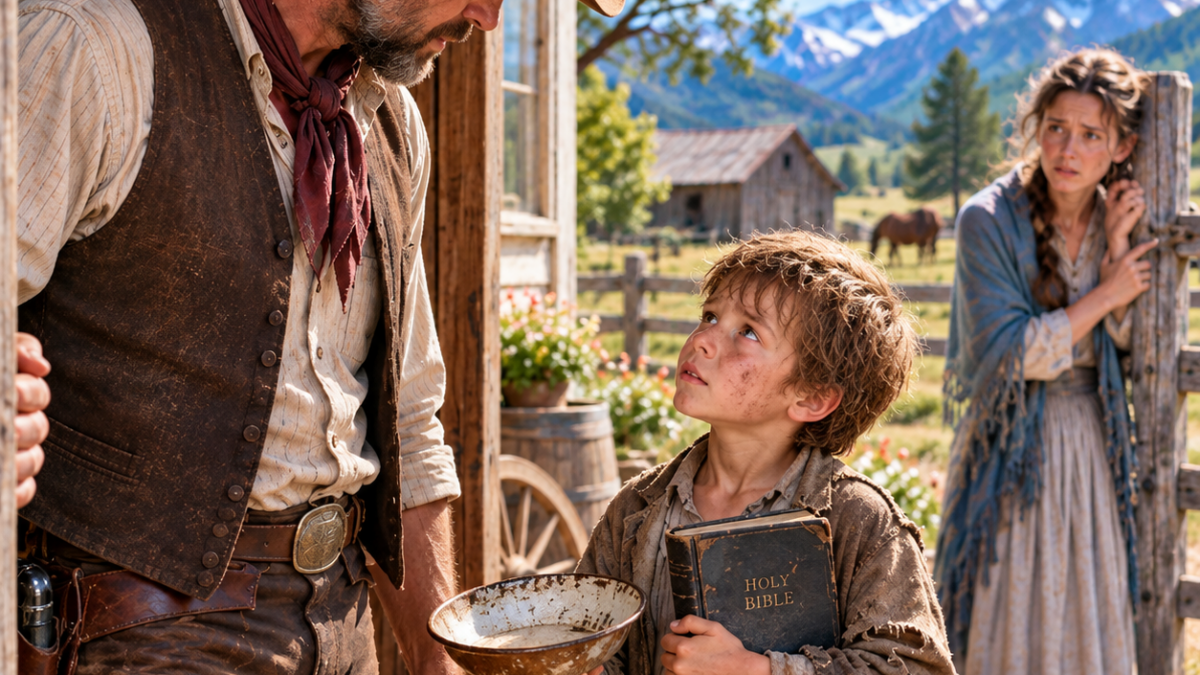
A Hungry Boy Knelt Outside a Lonely Rancher’s Door and Prayed for His Widowed Mother—Then She Whispered, “I Only Asked God for Food,” and an Open Gate Changed Everything.
Ethan Caldwell had locked his gate every night for nineteen years, but on the morning a hungry boy knelt on his porch praying for help, that gate stood wide open.
The boy’s widowed mother said she had only asked God for food, not a house, not a future, and certainly not the heart of a rancher who had stopped praying long ago.
Before summer ended, one dead man’s letter, one burning porch lamp, and one child’s stubborn faith would turn Ethan’s empty house into the home he had stopped believing God could give him.
Wyoming Territory, spring of 1887.
Ethan Caldwell heard the voice before he understood what it was.
It came through the front door just after sunrise, thin and steady, the voice of a child trying very hard not to sound afraid.
Nobody knocked.
Nobody called his name.
Nobody stepped onto the porch boards with the loud, careless boots of a ranch hand looking for coffee before work.
The child was praying.
“Jesus,” the boy said, “Papa said You don’t leave orphans alone. Mama says she isn’t hungry, but I know she is. I’m not asking for money. Just show me what I’m supposed to do now.”
Ethan stood motionless in the kitchen, one hand on the coffeepot.
The words slipped beneath the door and settled in the room like cold air.
He had not heard a child pray in his house in nineteen years.
For one moment, irritation came easier than compassion. Irritation had been Ethan’s armor for so long that it rose before anything else could.
He set the coffeepot down harder than necessary, crossed the front room, and opened the door.
A boy of about eight knelt on the porch boards.
He held a worn black Bible against his chest with both arms, as if it might be the only solid thing left in the world. His coat sleeves stopped well above his wrists. His pants were patched at both knees. His cheeks had the hollow look Ethan had seen on calves after a hard winter when hay ran low and spring grass came late.
But his eyes were not afraid.
That unsettled Ethan more than hunger would have.
The boy looked up with eyes too old for eight and too honest for comfort.
“Who taught you to talk to yourself on a man’s porch?” Ethan asked.
The boy stood slowly, still clutching the Bible.
“I wasn’t talking to myself, sir.”
Before Ethan could answer, a woman’s voice came from the road.
“Sam.”
Ethan looked past the boy.
A woman stood by the gatepost at the bottom of the lane, one hand gripping the wood as if it were the only thing holding her upright. She was young, maybe thirty, though grief had done what weather does to unpainted boards. Her gray dress had been mended so many times it was more patch than cloth. Her bonnet sagged at one side, and the canvas bag at her feet looked nearly empty.
She started up the lane with the careful steps of someone measuring how much strength each footfall would cost.
The boy turned toward her immediately.
“I’m sorry, Mama,” he said.
PART2:
She reached the porch and placed one hand on his shoulder.
Then she looked at Ethan.
“Forgive us,” she said, polite, almost formal, though her voice was faint. “We didn’t mean to trouble you. We only need directions to the next town.”
The boy looked up at her.
“Mama,” he said quietly, “Papa said we don’t lie when we’re afraid.”
No one spoke.
Somewhere in the grass, a meadowlark sang like nothing holy or terrible was happening on Ethan Caldwell’s porch.
The woman closed her eyes.
When she opened them, something in her face had stopped fighting.
“We need a home,” she said. “Just until I can work for one.”
Ethan looked at the Bible in the boy’s arms.
“Your God send you here?”
There was an edge in his voice, and he made no effort to hide it.
The boy turned and looked back down the lane.
“I don’t know,” he said. “But Mama asked Him for help. And this was the first gate that was open.”
Ethan felt something cold settle in his stomach.
The gate.
He knew that gate.
He had latched it himself the night before, the way he had latched it every night for nineteen years. Same iron latch. Same habit. Same final walk down the lane before bed, making sure stock stayed out, strangers stayed away, and his property remained orderly.
He was certain of it.
And yet there it stood.
Wide open.
PART3:
Ethan Caldwell was forty-five years old, and by every measure Wyoming Territory cared about, he was a successful man.
He ran twelve hundred head of cattle along the Sweetwater. He kept four hired hands and paid them on time. His fences were sound, his horses well kept, his accounts clean, and his name respected from Rawlins to the Wind River. His house was the largest for thirty miles, two full stories of milled lumber hauled in by wagon at a cost men still liked to discuss when they ran out of weather.
He had built it with six bedrooms.
He slept in one.
Neighbors said Ethan Caldwell was hard but fair. A man who would lend you a team without prying into your trouble. A man who paid debts before they came due. A man who would ride through snow to help pull a neighbor’s calf and then leave before breakfast so no one had to thank him too warmly.
They also said he would not come to church.
Not Christmas.
Not Easter.
Not funerals unless cattle business made absence impossible.
The preacher had written him three times.
Ethan had answered none.
People thought they knew why.
They did not.
They knew he had a house.
They did not know he had no home.
He brought Clara Bennett and her son into the kitchen because leaving them on the porch felt worse than letting them in.
That was the only reason he gave himself.
The kitchen smelled of coffee, ash, and the bacon he had nearly burned while listening at the door. Morning light came through the windows in pale strips. The table was rough but clean, large enough for men who ate hard and talked little. Sam sat carefully at the edge of a chair and placed the Bible on his lap beneath the table, where one hand could remain on it.
The woman gave her name as Clara Bennett.
The boy was Samuel, though she said everyone called him Sam unless he was in trouble.
Ethan set out what he had.
Cold biscuits.
Bacon.
Coffee.
Plum preserves in a jar.
A few eggs he fried without asking.
Sam watched the food with the discipline of a starving child trying not to look like one.
He ate with one hand and held the Bible with the other.
Clara took a biscuit, broke it in half, and put one half on Sam’s plate. The other half she slipped into the pocket of her dress when she thought Ethan wasn’t looking.
Then she folded her hands.
“I’m not hungry, thank you,” she said. “The coffee is plenty.”
Sam stopped chewing.
He picked up the half biscuit from his plate and pushed it back toward her.
“Papa said I’m supposed to take care of you when he can’t.”
Clara’s face nearly broke.
She pushed the biscuit back to him.
“Your father also said children weren’t made to carry the whole world on their backs.”
Sam looked at her with the terrible honesty of eight years old.
“Then why are you carrying it by yourself?”
Clara had no answer.
Ethan stood abruptly, went to the stove, and returned with a full plate of eggs and bacon. He set it in front of her.
“Eat.”
She looked up.
“Mr. Caldwell—”
“Eat,” he repeated, “or I’ll feed it to the dog, and he’s fat enough already.”
There was no dog in the kitchen.
He had never owned one.
Sam looked around for it anyway.
Clara seemed to understand that arguing would cost more strength than eating. She picked up the fork.
The first bite nearly undid her.
Not because it was fine food.
Because hunger, once answered, sometimes becomes grief.
She ate slowly at first, then with the cautious shame of someone who had denied her body too long.
Ethan looked away.
A person deserved privacy even when starving.
When she tried to stand and clear the dishes afterward, the room tilted.
Ethan caught her by the elbow before she hit the floor.
She was lighter than she should have been.
Far lighter.
“When did you last eat a full meal, Mrs. Bennett?”
She gently pulled free.
“I don’t recall. And I’d thank you not to ask in front of my son.”
Her voice had dignity in it.
Not pride.
Dignity.
Ethan respected that despite himself.
The hunger was solved in one morning.
The larger problem appeared by afternoon.
Clara had eleven cents, a canvas bag, and the Bible Sam would not put down. She was bound for Lander, two days’ walk north, where a widow named Mrs. Pruitt had written back in winter that she needed a housekeeper who could also teach her grandchildren their letters.
It was the only promise of work Clara had left.
She had walked nearly a hundred miles on the strength of it.
“There’s a room upstairs,” Ethan said that evening, after watching her sway twice while helping with supper.
She stiffened.
“I won’t take a bed I haven’t paid for, Mr. Caldwell.”
“It isn’t for sale.”
“Then I can’t take it.”
She said it plainly, as if explaining a rule of arithmetic.
“I’ve been taking charity for four months. It is a kind of hunger too. I’d rather work.”
Ethan stared at her.
“You can hardly stand.”
“I can cook.”
“My men eat in the bunkhouse.”
“I smelled their beans from the road.”
For the first time that day, something almost like humor touched Ethan’s mouth.
His cook had quit a month earlier to chase silver in Colorado. Since then, supper in the bunkhouse had become an act of war. The men had eaten burned beans, half-raw potatoes, bacon tough enough to patch boots, and biscuits that could have been used as ammunition if the Sioux ever attacked.
“You can cook?” he asked.
Clara lifted her chin.
“I’ve cooked church suppers for sixty. I expect I can manage four cow hands who don’t know any better.”
That settled it.
One night’s bed for one night’s supper.
No charity.
Wages in kind.
That evening, the hired hands ate like men restored from the dead.
Joe Whitlow, the youngest, consumed seven biscuits and asked Clara with his mouth full whether she was married.
Sam immediately set down his fork.
“My mother is a widow,” he said. “My father’s name was Thomas Bennett. Also, Papa said a man should close his mouth when he chews.”
Joe closed it.
The other hands laughed so hard that Clara turned away, but not before Ethan saw her smile.
It vanished quickly.
Still, he saw it.
The next morning, Clara was awake before sunrise. The canvas bag was packed. Sam’s hair had been combed flat with water, though one stubborn piece at the back stood up in defeat of all authority. Clara thanked Ethan for the bed as formally as if he had been a hotel clerk, then took Sam’s hand and headed for the door.
They had almost reached the porch when the mail rider came up the lane to water his horse.
He was a talkative man named Weller, carrying letters and news between ranches from Rawlins to the Wind River. He recognized Ethan, nodded, and accepted coffee before his horse finished drinking.
Clara, hearing he knew the roads, asked how far it was to Lander.
“Depends which way you go,” Weller said. “Who are you bound to see?”
“Mrs. Pruitt,” Clara said. “She’s expecting me.”
The mail rider’s face changed.
That was the first sign.
Ethan watched Clara notice it.
“Ma’am,” Weller said slowly, “the Pruitt place sold at the end of March. Old Mrs. Pruitt went to her daughters in Denver. Took the grandchildren with her.”
Clara’s hand tightened on the canvas bag.
“There must be another Mrs. Pruitt.”
“I’m sorry.”
He looked down at his boots.
“There’s nobody out there now but the new owner’s foreman.”
Clara did not cry.
She thanked him.
Even smiled.
Then she set the canvas bag on the porch very carefully, as if it had suddenly become too heavy to hold, and sat down on the step beside it.
She stared at the road.
Ethan had seen men take bad news that way. Cattlemen who had lost a herd to blizzard. Men who had watched hail flatten a year’s crop in ten minutes. They did not weep. They simply went still because there was nowhere left to go.
Sam sat beside his mother and took her hand.
He did not pray out loud this time.
But Ethan saw his lips moving.
Ethan stood in the doorway a long moment.
Then he said, in the flattest voice he had, “My hands ate better last night than they have in a month.”
Clara looked up.
“I’ll pay you a week’s wages to keep cooking. Five dollars and board. That gives you time to write for other work. After that, you go wherever you please.”
She stared at him.
“A week?”
“Yes.”
“Wages?”
“Yes.”
“Not charity?”
Ethan frowned.
“I’d pay a man the same. I’d just get worse biscuits.”
Clara looked back at the road one more time.
Then she stood, picked up the canvas bag, and carried it back inside.
By noon, she had written three letters to three towns.
By supper, the bunkhouse was fed.
By dusk, Sam had pulled on his boots and followed Ethan to the barn as if he had been assigned there by Providence.
The boy followed him everywhere after that.
To the corral.
To the tack room.
Out to the low pasture.
Behind the saddle with his arms wrapped tightly around Ethan’s middle and the Bible buttoned inside his coat.
He asked questions the way other children threw stones: without aim, without warning, and without end.
“What’s that horse’s name?”
“Doesn’t have one.”
“Why not?”
“Horse doesn’t need one.”
“Papa named our mule Deuteronomy.”
“That’s a terrible name for a mule.”
“He was a terrible mule.”
Ethan almost smiled.
Almost.
Along the fence line, Sam asked the question Ethan had been waiting for and dreading.
“Mr. Caldwell, why do you have such a big house if nobody lives in it with you?”
Ethan kept his eyes on a loose rail.
“Fence needs mending.”
“Yes, sir, but after that can you answer?”
“No.”
Sam considered that.
“All right.”
He stayed quiet for nearly five minutes, which Ethan began to understand was the boy’s version of mercy.
That afternoon, forking hay in the loft, Sam began singing “Rock of Ages.”
Off-key.
Loud in the way children are loud when they believe they are being private.
Ethan stopped working.
“Quit that.”
Sam stopped immediately.
“Don’t you like hymns?”
“I don’t have much use for them.”
The boy leaned on a pitchfork taller than he was.
“Papa said sometimes the person who doesn’t want to hear about God is the one who’s most angry with Him.”
“Your papa said a lot of things.”
“He did,” Sam agreed cheerfully. “Mama says he never stopped talking, not even in his sleep.”
A pause.
“Are you angry at God, Mr. Caldwell?”
“I’m angry at boys who stop working to ask questions.”
Sam returned to forking hay.
For about a minute.
“If you don’t believe in God,” he asked, “who do you thank when something good happens?”
Ethan had no answer.
Sam seemed to take pity on him.
“You can borrow mine. Papa said He doesn’t mind.”
That night, passing the upstairs room, Ethan heard Sam’s voice through the door.
“And thank You for the biscuits and for the job for Mama, even though it’s only a week. And please help Mr. Caldwell not be so mad at You. I think he’s just sad. Amen.”
Ethan stood in the dark hallway long after the boy’s voice stopped.
Sad.
He almost laughed.
There had been a time when he might have called it that.
Before it hardened.
Before it became silence, then habit, then something others mistook for strength.
On the fourth night, Ethan found Clara sitting on the porch after supper with a shawl around her shoulders, looking at the lamp hanging beside the door.
Not glancing.
Looking.
As if the flame were a face she almost recognized.
“You’ve been staring at that lamp since you got here,” he said.
She folded her hands in her lap.
“It’s foolish.”
“That doesn’t answer.”
Clara looked toward the darkening yard.
“Since Thomas died, I’ve had the same dream. I am walking at night, and I see a lamp burning on a porch. A house I’ve never seen. I walk toward it and walk toward it, but I never get there.”
She shook her head.
“Every porch has a lamp.”
Ethan sat on the far end of the step.
The distance between them was proper.
Careful.
“How did he die?”
Her face changed.
For a long time, he thought she would not answer.
Then she did.
“A neighbor owed money in town. He was sick and could not make the trip. Thomas offered to carry the payment for him.”
Her voice remained steady, but her hands tightened.
“There were men on that road hired to collect from someone else. A man who looked like Thomas.”
Ethan stared out into the yard.
“They didn’t ask his name,” she said.
A calf bawled somewhere in the dark pasture.
“They found the neighbor’s receipt in his pocket. His Bible. A letter for Sam.”
She swallowed.
“I have never been able to open it.”
Ethan turned slightly.
“You carry it?”
“In the Bible.”
“Why not open it?”
“Because then it will be the last new thing I ever hear from him.”
The answer struck him harder than expected.
Clara continued, quieter now.
“I went to live with his mother after. She loved him so much, and she needed someone to blame. She used to say he would still be alive if he hadn’t worked himself to death feeding us. I stayed as long as I could stand it. Longer for Sam.”
Her voice did not break.
That made it worse.
“I don’t understand why God let a man die on the road while he was trying to help someone.”
Ethan looked at her patched dress, her straight back, her empty hands.
“And you still believe?”
“Yes.”
“How?”
Clara thought about it honestly.
Not with church words.
Not quickly.
“I don’t believe because I understand it, Mr. Caldwell. Some nights I believe because I have nowhere else to set the pain down.”
It was the most honest thing anyone had said to Ethan Caldwell in nineteen years.
The next morning, Ethan found the Bible on a kitchen chair.
It was the first time he had seen it out of Sam’s arms. He picked it up only to move it.
That was what he told himself.
The book fell open in his hands.
Tucked against the back cover was a folded envelope stained dark at one corner. Across the front, in a careful square hand, was written:
For Samuel, when he needs it.
The seal remained unbroken.
On the page where the Bible had opened, one verse was underlined in pencil so hard the lead had torn the paper.
For I was an hungered, and ye gave me meat: I was thirsty, and ye gave me drink: I was a stranger, and ye took me in.
Ethan read it twice.
Then he set the Bible back exactly where he found it and walked out to the barn without breakfast.
He had fed the boy before he believed a word of it.
He did not know what to do with that.
The week ended.
None of Clara’s letters had been answered.
On the seventh evening, she came to Ethan with the canvas bag in her hand and the five dollars folded carefully in her apron pocket.
“I appreciate what you’ve done,” she said.
Ethan did not look up from the tally book.
“Ranch still needs a cook.”
She went still.
“Twenty dollars a month and board,” he said. “Same as the last man drew. You keep writing letters. When one comes back with a better offer, you take it.”
Clara watched his face.
“Wages.”
“Wages.”
“Not charity wages.”
“My last cook was worse than you and I paid him more.”
Sam, listening from the hallway, whispered, “A lot worse.”
Ethan pointed at the kitchen without looking up.
“Boy, if you’re going to eavesdrop, make yourself useful and bring in more wood.”
Sam grinned and ran outside.
Clara should have objected.
She did not.
She only carried the canvas bag back upstairs.
They stayed just until an answer came.
That was what everyone said.
The hired hands said it.
Clara said it.
Ethan said nothing, which was close enough.
But one week became three, and nobody at supper talked about leaving anymore.
Least of all the house.
The house changed first.
Ethan noticed that before he admitted people had anything to do with it.
A pair of boy-sized boots appeared near the kitchen door, one always tipped on its side no matter how many times Sam righted it. The black Bible began turning up in places Ethan had once placed his hat. Clara’s mending basket sat beside the stove. Her neat lists appeared pinned near the pantry. The smell of bread returned to rooms that had lived too long on coffee and beef.
Hymns drifted from the barn.
Still off-key.
At first, Ethan told Sam to quit.
Then he told him less often.
Then one afternoon, halfway across the yard, Ethan realized the boy had been singing for twenty minutes and he had not minded.
That irritated him more than the hymn had.
Clara worked with the quiet competence of someone who believed order could hold sorrow at bay if one kept enough dishes washed and floors swept. She cooked for the bunkhouse, kept simple accounts, mended shirts, tended the kitchen garden, and somehow made the men behave better at the table without scolding them.
One night Ethan found her writing in a clean, careful hand by lamplight.
“You taught school,” he said.
She did not look up.
“Four years before I married.”
“You were good at it.”
“Yes,” she said simply. “I was.”
He liked that answer.
No false modesty.
No apology for knowing her worth.
He began coming in from pasture earlier.
Not much.
Just enough to wash before supper rather than grab a plate and eat standing by the counter.
One evening, while helping dry dishes because Joe had burned his hand and the other men had made themselves conveniently absent, Ethan caught himself humming “Rock of Ages.”
He stopped so suddenly he nearly dropped a plate.
Clara, drying beside him, said nothing.
But she smiled.
It was the first full smile he had seen from her.
He thought about it for three days.
Sam finally pulled the story of the house from him.
They were riding back from the north pasture when the boy said, “There are five bedrooms nobody sleeps in.”
Ethan sighed.
“Joe counted,” Sam added helpfully.
“Joe should learn to count fence posts.”
“Who were the rooms for?”
Ethan rode a long way before answering.
“Children.”
Sam grew quiet.
“I was married once,” Ethan said. “Her name was Ruth.”
The reins moved loosely in his hands.
“We built this house for the family we were going to have. Years went by. No children came. Folks at church said to pray and trust. So I prayed every night for eleven years.”
“What did God say?”
“Nothing.”
The wind moved through the grass.
“One day Ruth packed a trunk and went back to her sisters in Omaha. She said this house had become a place where hope went to die. She did not come back.”
Sam’s arms tightened around Ethan’s waist.
“And I figured praying was just lonely people talking to the ceiling,” Ethan said. “So I quit.”
They rode on.
After a while, Sam spoke carefully, like a boy handling something breakable.
“Papa said sometimes ‘not yet’ sounds just like nothing.”
Ethan did not answer.
But he did not argue either.
A few days later, Sam found him at the kitchen table with the Bible open to the underlined verse.
The boy climbed onto the bench beside him.
“That’s Papa’s favorite.”
“I fed you before I believed any of it,” Ethan said, mostly to himself.
Sam considered this with grave seriousness.
“Maybe God knew you’d do it before you did.”
Ethan closed the Bible.
“You are a troubling child.”
“Yes, sir,” Sam said, as though receiving praise.
The hardest day came in early summer.
Hard days often arrive disguised as ordinary work.
Ethan and Sam were rehanging the front gate. The bottom hinge had rusted through, and Ethan decided to fix it properly. Sam held the post steady while Ethan drove in the new pins and explained, with more patience than he had shown anyone in years, why a gate ought to swing slightly uphill.
“So it closes on its own weight,” Ethan said.
Sam nodded seriously.
The gate creaked.
Ethan adjusted the hinge.
Out of the quiet, Sam said, “Sometimes you sound like Papa.”
Ethan’s hammer stopped.
Sam’s face went red, then white.
“I shouldn’t have said that.”
“Why not?”
“Because he’s my father.”
The boy’s voice cracked on the last word.
Ethan set down the hammer and got down on one knee in the dirt so they were eye to eye.
“He still is,” Ethan said. “Nothing that happens on this ranch changes that. Not ever.”
Sam’s chin trembled.
He was trying to be eight years old and a man at the same time.
It was not working.
“I promised him,” Sam whispered.
“What?”
“Before he left that day, he said to take care of Mama. And I’ve been trying. I gave her my food, and I prayed every night, and I found your gate, but I can’t make her the way she was.”
The tears came all at once.
“I don’t want a new papa, Mr. Caldwell. I just want Mama to smile like she used to.”
Ethan had never learned how to hold a crying child.
He did it anyway.
It turned out his arms knew more than he did.
When the worst of it passed, Sam wiped his nose on his sleeve.
“Can God give somebody a family without rubbing out the first one?”
“I don’t know, son,” Ethan said.
The word slipped out before he heard it.
Son.
Sam looked at him.
Ethan looked away.
“I’m the last man you ought to ask about God.”
Sam turned toward the house where the Bible waited.
“Then maybe we ought to ask Papa.”
Clara could not do it.
That night, she sat at the kitchen table with the envelope before her under the lamp. Her hands would not move.
She had carried the letter for five months.
She knew Thomas’s handwriting better than her own.
“You do it,” she said at last, sliding it toward Ethan.
His hand hovered above it.
“Clara—”
“Please.”
Ethan broke the seal.
The room seemed to lean closer.
Sam sat beside his mother, one hand in hers, the other resting on the Bible.
Ethan unfolded the pages and read aloud.
“Sam,
If you are reading this, then there has come a day when I cannot walk beside you, and I am sorry for that more than these words can say.
I know you, son. I know you will try to be brave. You will try to stand where I used to stand. You will think it is your job to keep your mama from hurting, to make sure she eats, to carry things that are too heavy for your small shoulders.
Don’t.
You are my boy. God made you a child on purpose. So be one.
Run until your boots are muddy. Ask too many questions. Laugh loud. Climb things your mama tells you not to climb. And when you are afraid, pray. When you do not understand, pray then too.
Take care of your mama, but do not believe that means carrying her alone. Let good people help you. Let them help her too. There is no shame in needing someone. Even strong people need a hand sometimes.
And listen carefully to this part, Sam. If one day God places someone kind in your path, someone who makes you feel safe, someone who makes your mama smile again, do not be afraid to care for him because you think it means you are leaving me behind.
You cannot leave me behind.
I am your father. Nothing can change that.
Love does not erase love. A heart can remember what it has lost and still make room for what God gives next.
So do not spend your life trying to keep everything the way it was for me. Live it. Grow. Laugh. Love your mama. And if happiness ever finds the two of you again, do not close the door because you think grief is the only way to prove you remember me.
I will know you remembered me.
Every time you tell the truth when it is hard, every time you help someone who has less than you, every time you kneel down and pray when you do not know what to do next, that will be enough.
I am proud of you, Sam. More than you will ever know.
And wherever life takes you, never forget this:
You were never asked to become me.
You were only asked to become the boy God made you to be.
Your father,
Thomas Bennett.”
Ethan’s voice had gone rough by the end.
But there was one more line, written smaller beneath the signature, pressed hard into the paper.
He read it quietly.
“Clara, if the light ever finds you again, do not be afraid to step toward it.”
Nobody spoke.
The clock ticked.
The lamp flame breathed softly behind the glass.
Sam did not cry.
He only let out a breath he seemed to have been holding since the day his father rode away. Then something in his small shoulders loosened.
He climbed into Clara’s lap, though he was far too big for it, and she wrapped both arms around him as if he were still a baby.
Clara cried without sound.
Ethan sat holding a dead man’s letter and understood something that shook him.
He was not taking anything from Thomas Bennett.
He was being invited by the man himself into a story that had started long before him.
A story with room for what came before and whatever God might still place there.
Two weeks later, a letter came for Clara from the preacher’s wife in Cheyenne.
The new church school needed a teacher.
Thirty-five dollars a month.
A small house beside the schoolyard.
A place for Sam in the school.
The position would be held until the first of August.
Clara read the letter to Ethan in the kitchen doorway.
Every word.
Then she folded it and waited.
It was everything she had walked those roads praying for.
Respectable work.
A roof of her own.
A school for Sam.
A life where she would never again have to stand at a stranger’s gate and admit she had nowhere to go.
For the first time since Thomas died, Clara Bennett did not need anybody.
Ethan wanted to ask her to stay so badly it frightened him.
He wanted to say the house would die again without them.
He wanted to remind her of the lamp.
He wanted to say Sam belonged in the barn asking impossible questions, and Clara belonged at the kitchen table with lamplight on her hands, and that he had become less himself before they came and more himself after.
Instead, he said, “It’s good work.”
She watched him.
“Yes.”
“You would be good at it.”
“I would.”
“Sam would have other children.”
“He would.”
Say it, something in him pleaded.
Ask.
But a woman who had been pushed from every door in the territory deserved to walk through one on her own feet.
So Ethan said nothing else.
Clara’s eyes lowered.
“The stage leaves Rawlins on Friday.”
He nodded.
“We’ll be on it.”
Thursday night, Ethan could not sleep.
He came down to the kitchen after midnight.
Clara’s trunk waited by the door. The mending basket was gone. A list of instructions for the next cook had been pinned neatly on the wall.
Not everything was gone yet.
Sam’s small boot stood by the door, one tipped on its side.
The lamp hung on its hook.
The Bible lay on the table where Sam had left it before bed.
“You can keep it out tonight,” the boy had said. “You look like you need it more than me.”
Ethan lit the lamp and sat down.
He did not open the Bible.
He only laid one hand flat on the cover.
He had not prayed in nineteen years.
He had forgotten how a man was supposed to begin.
So he did not begin properly.
He just said what was true.
“If You’re there,” he said, voice strange in the empty kitchen, “I don’t want this house empty again.”
That was the whole prayer.
No answer came.
No voice.
No miracle shaking the rafters.
The lamp flame did not flicker.
The clock ticked.
The wind moved over the roof.
The night remained as dark as it had been.
Ethan sat there anyway until gray light touched the east.
And somewhere in those quiet hours, he noticed something he never tried to explain.
For the first time in nineteen years, the silence in that house did not feel empty.
It felt like Someone was sitting in it with him.
He left the lamp burning when he went out to hitch the wagon.
Friday morning, Ethan loaded Clara’s trunk and checked the harness three times because his hands needed something to do.
Sam stood on the porch gripping the rail, trying very hard not to cry and failing.
Clara wore her gray dress, freshly brushed and mended. Her face was pale but steady.
“Give me a minute first,” she said. “Alone.”
Ethan nodded.
She walked down the lane toward the gate.
It stood wide open.
The way Ethan had left it at dawn.
He had stood there with one hand on the rail for a long time, thinking about closing it.
Then he had walked away and left it open.
It was her road.
Not his.
Clara stopped at the same gatepost she had gripped that first morning, too weak to stand without it.
Now she stood on her own.
She looked out at the road running east, dry and straight toward a schoolhouse, a paycheck, a little house with her name on the door.
Everything she had prayed for waited just beyond the horizon.
Then she turned and looked back.
Sam was on the porch, crying openly now.
The house stood behind him, every window catching morning light.
Beside the door, still burning in broad daylight because a stubborn man had forgotten to put it out, was the lamp.
A lamp burning on the porch of a house she had never seen before spring.
This time, she was close enough to reach it.
Then she looked at Ethan.
He stood by the wagon with his hat in his hands.
Not moving toward her.
Not calling out.
Letting her choose.
Clara Bennett stood at the open gate for a long time.
Then she turned her back on the road and walked up the lane.
She did not hurry.
She walked like a woman who knew exactly where she was going.
She stopped in front of Ethan and looked him in the eye.
“For five months,” she said, “every door I walked through, I walked through because I had no choice. Now I have one. A good one.”
She took a breath.
“And I am choosing here. Not because I need a roof. Because this is where I want to be.”
On the porch, Sam let out a whoop that startled every horse in the corral.
Ethan closed his eyes for one second.
When he opened them, Clara was still there.
That evening, they sat on the porch step while the sun went down gold over the Sweetwater.
Sam had worn himself out from joy and fallen asleep inside with one boot still on.
The lamp was lit.
“You didn’t ask me to stay,” Clara said.
“No.”
“Why not?”
Ethan turned his hat in his hands.
“Because I wanted it more than I’ve wanted anything since I quit praying. And a thing you want that much, you’ve got no business taking. It has to be given.”
Clara’s eyes softened.
“Thomas would have liked you.”
“I would have liked to meet him.”
Ethan looked toward the upstairs room where the boy slept.
“I want to say something plain, so there’s no mistaking it. I am not asking to take anyone’s place. If Sam ever calls me anything more than Ethan, it will be because he chooses it. I will never ask him to forget the man who taught him how to pray.”
He swallowed.
“I read that man’s letter. I intend to honor it.”
Clara’s eyes were bright.
“You came here needing a roof,” Ethan said. “I had one. More roof than any man needs.”
He finally looked at her.
“What I did not know all these years was that I was the one without a home.”
The last light slipped behind the ridge.
“I am asking if you will make one with me, Clara. Not because you need it. Because you want it.”
Clara had learned not to say anything she did not mean.
So she took her time.
“Yes,” she said at last. “I want it.”
They were married that September in the front room, with the circuit rider officiating and Joe Whitlow weeping openly into his handkerchief.
At supper afterward, Joe finally confessed the mystery of the gate.
Back in spring, he had gone out before dawn chasing a loose heifer and left the front gate standing wide open behind him. He had been too ashamed to admit it after everyone began speaking of providence and open doors.
“There,” Ethan said to Clara later. “Coincidence.”
Clara smiled.
“Maybe. Or maybe the Lord is not above using a careless cow hand.”
Ethan had no argument for that.
By December, snow lay soft over the Sweetwater.
Down at the bottom of the lane, the front gate stood strong on its new hinges, the ones Ethan and Sam had hung together one summer afternoon. Ethan still latched it every night, but nobody in that house passed it without remembering the morning it stood open.
On the porch, the lamp burned on its hook by the door.
It burned every night now.
Clara said it was so anyone coming up the road in the dark would know somebody was home.
The first time Sam came to that house, he had knelt outside in the cold with his father’s Bible clutched against his chest, holding on to it as if it were the last thing he had.
Now he sat inside by the warm stove, and the Bible lay open in the lamplight, Thomas Bennett’s pencil lines on the pages where anyone in the house could read them.
The first time Clara came up that lane, she could hardly walk without holding the gatepost.
Now she sat near the fire with flour on her cheek, smiling the way Sam remembered and prayed to see again.
And the man who once asked a child why he was talking to himself on the porch placed his hand on the open Bible and looked at the boy.
“Would you pray for us tonight, son?”
Sam looked up, surprised.
“I thought you didn’t believe in prayer.”
Ethan was quiet a moment.
“I’m learning.”
Sam bowed his head.
He did not make it long.
He never did.
“Thank You for Papa. Thank You for Mama smiling. Thank You for Ethan. And thank You for leaving the gate open. Amen.”
“Amen,” Clara whispered.
After a moment, in a voice that had not said the word in nineteen years, Ethan said it too.
Years later, when people asked how the Caldwell house became so full, Ethan never told the story the same way twice.
Sometimes he blamed Joe and the gate.
Sometimes he blamed a hungry boy with more questions than sense.
Sometimes he said a widow came looking for food and found a lamp.
But Clara knew the truth.
So did Sam.
And, eventually, so did Ethan.
The Lord had not answered Ethan’s prayers the way he expected nineteen years before.
He had not filled the six bedrooms on Ethan’s timetable.
He had not explained Ruth’s leaving or made loneliness less sharp simply because Ethan demanded answers.
But all those years, the house had stood.
The rooms had waited.
The porch lamp had hung ready.
And when the morning came, help arrived wearing patched sleeves, carrying a canvas bag, and holding a Bible with an unopened letter inside.
Sometimes God opens a door.
Sometimes He opens a gate.
And sometimes He sends a hungry child to pray on the porch of a man who thinks he no longer believes, because the child is not the only one who needs saving.
Ethan Caldwell opened his door to feed a boy.
But in the end, God used that boy, his brave widowed mother, and a dead father’s letter to bring Ethan home.








