A Grieving Widow Arrived at a Lonely Ranch With Her Late Husband’s Bible Still Closed—Then the Rancher Confessed, “I Believe in God… I Just Don’t Know How to Pray Anymore”
A Grieving Widow Arrived at a Lonely Ranch With Her Late Husband’s Bible Still Closed—Then the Rancher Confessed, “I Believe in God… I Just Don’t Know How to Pray Anymore”
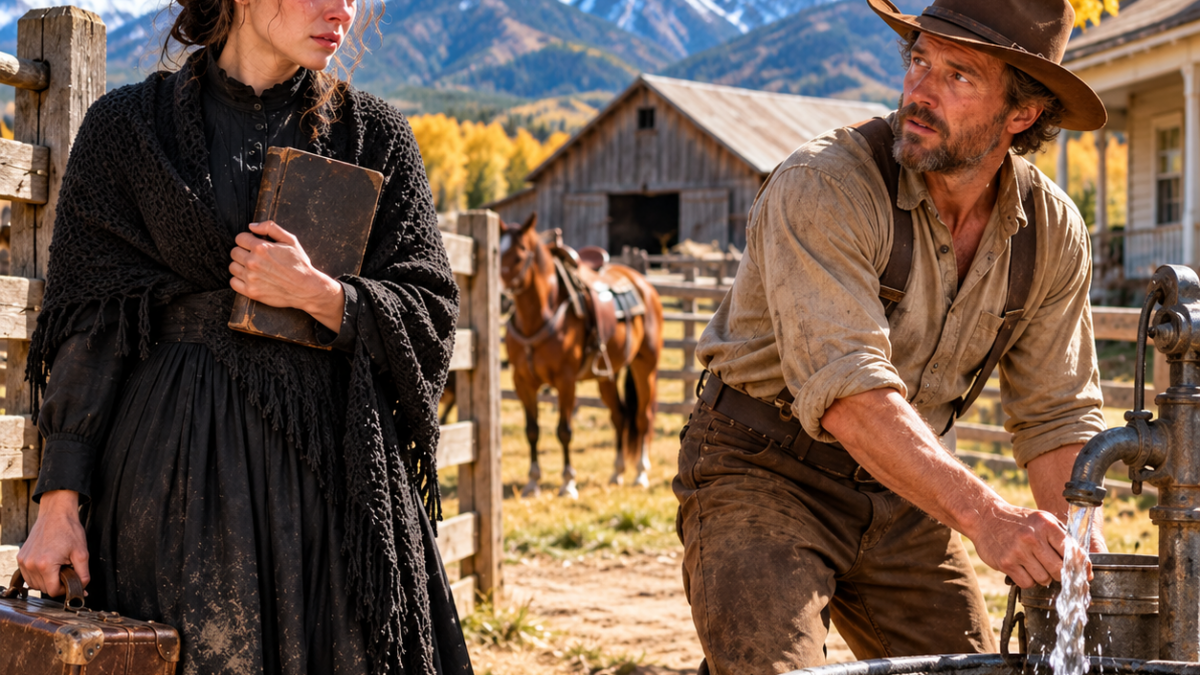
I came to his ranch with one suitcase, four silver dollars, and my dead husband’s Bible pressed to my chest like it was the last warm thing left in the world.
I thought I was the broken one until the silent rancher looked at that unopened Bible and confessed he still believed God was real, but he no longer knew how to speak to Him.
By winter, a child’s innocent question at his dinner table would force him to pray for the first time in sixteen years, and before dawn, I would open the book I had been afraid to touch since my husband died.
Gallatin Valley, Montana Territory, autumn of 1888.
The morning my last door closed behind me, I did not cry.
That surprised me.
I had cried so much in the eight months since Henry died that I thought sorrow had become as natural to me as breathing. I had cried into pillow ticking, into dishwater, into my apron, into the sleeves of dresses I could no longer afford to mend properly. I had cried silently in church while the people around me sang about a peace I could no longer find. I had cried in the cemetery with my gloved hands clenched so tight around my husband’s Bible that the leather left marks on my palms.
But that October morning, when Mrs. Braddock stood at the bottom of the boarding house stairs and told every renter on Mendenhall Street that the place had been sold and we had to be gone by noon, I did not cry.
I packed.
That took less time than it should have.
One suitcase.
Two black dresses.
One spare pair of stockings.
A comb missing three teeth.
A needle book.
A folded photograph of Henry taken when he still had weight in his face and mischief in his eyes.
Four silver dollars wrapped in a handkerchief.
And the Bible.
Henry’s Bible.
Black leather, worn soft at the corners, his name written in the front in a hand I could still see moving across the page if I closed my eyes. Henry Winslow. June 14, 1869. The day his father gave it to him. Later, beneath that, our wedding date. September 3, 1872.
I had carried that Bible every day since the funeral.
I dusted it.
Wrapped it in a flour sack so the cover would not wear.
Laid my thumb along the edge of it some nights the way a mother lays her hand on a sleeping child’s back.
But I had not opened it once.
Not once since February.
Henry had been sick eleven weeks.
Eleven weeks of broth he could barely swallow, fever cloths, whispered prayers, and doctors who looked at me with eyes that had already given up before their mouths found gentler words. I prayed over him every night. Sometimes out loud. Sometimes with my forehead pressed to the mattress. Once, near the end, with both hands wrapped around that Bible while Henry slept in fragments beside me.
I had prayed until the words lost shape.
I begged.
I bargained.
I promised God I would go anywhere, give up anything, forgive anybody, if only Henry would open his eyes clear again and say my name the way he used to say it from the garden gate.
Henry died on a Thursday morning a little after four.
I was still praying when he went.
That was the part I could not forgive.
Not his death.
PART2:
Death comes to every house sooner or later.
It was the silence.
The room had been so quiet afterward that I heard a coal shift in the stove.
I had looked at the Bible in my hands and felt something inside me close.
Not faith exactly.
Something more frightened than faith.
Something that whispered, Do not open it. If you open it and find nothing there, then you will know you were speaking into an empty room the whole time.
So I kept it closed.
A closed Bible could still hold hope.
An opened one might prove I had none left.
By noon that October day, I stepped out of the boarding house into a hard blue morning with my suitcase in my right hand and Henry’s Bible pressed against my chest with my left.
No one stopped me.
That is one of the cruelties of becoming poor after being respectable. People are kinder when they do not have to look at you too long.
Mrs. Braddock said, “I’m sorry, Clara.”
I believed she was.
I also believed she was relieved not to be me.
PART3:
I walked south out of Bozeman because I had nowhere inside it left to go. The wind came off the Bridger Range with teeth in it, sharp enough to cut through my black wool coat and the thin dress underneath. By the second mile, the handle of my suitcase began biting into my palm. By the fifth, my knees ached. By the eighth, my hem was dark with mud to the knee.
By the tenth mile, I had stopped thinking in words.
Step.
Breath.
Bible.
Suitcase.
Wind.
Step.
Breath.
Do not fall.
I did not know what I expected to find down that road. Work, perhaps. A barn corner. A kitchen that needed hands. A woman who needed washing done. A family that would pay little but let me sleep near the stove.
I had been a wife.
Then a widow.
That morning, I became simply a woman on a road with four dollars and no place to lay her head.
Near four in the afternoon, when the light had begun to flatten and the valley looked the way cold places look before evening takes them, I came to a gate.
The fence on either side was good.
Not fancy.
Good.
Straight posts. Tight wire. Repairs made before failure. Beyond it stood a barn kept up better than the house, which told me something about the man who lived there before I met him.
He was in the yard working the handle of a water pump.
Tall, broad-shouldered, forty or more, shirt sleeves rolled despite the cold. His hair was dark with gray at the temples. His face was not hard, exactly, but unused. Like a door kept shut through many winters.
He heard the gate and looked up.
I saw him see me.
A woman in black.
A suitcase with its handle mended in twine.
Mud on my hem.
Then his eyes went to the Bible against my chest.
He looked at it longer than he looked at my face.
“I’m not asking for charity,” I said before my courage failed.
My voice came out steadier than I felt.
“I’m asking for work. Any honest work. Cooking, washing, mending, garden. I only need a place where I can start again.”
The man let go of the pump handle.
The water ran a moment longer into the trough, then quit.
“Do you read?” he asked.
It was such a strange first question that I almost laughed.
“I used to.”
His eyes narrowed, not unkindly.
“Why’d you stop?”
The wind pulled at my sleeves.
I stood in that stranger’s yard and heard myself say the thing I had not said aloud to one living soul in eight months.
“Because it belonged to my husband. I prayed over this book while he was dying. I buried him in February. I haven’t been able to open it since.”
The man looked at the wet ground a long while.
Then he said something I was not prepared for.
“Then maybe you’ll understand.”
I waited.
He wiped his palm on his trousers.
“I still believe God is up there,” he said. “I have never once doubted He is real.”
His voice remained even, but something moved beneath it.
“I just don’t know how to talk to Him anymore.”
That was the beginning of Thomas Avery and me.
Not romance.
Not healing.
Not anything pretty enough to embroider on a sampler.
Just two people standing beside a water pump in the Montana wind, each holding a closed door inside the chest.
He offered real wages.
Twelve dollars a month, board included, and the hands’ cabin beyond the corral. It was a small tight house with its own stove, its own bed, its own lock, and its own door.
“You’ll have your own key,” he said. “You can leave any day you want, and I won’t ask why.”
I started to thank him.
He was already walking toward the barn.
That first evening, I carried my suitcase into the cabin, set it on the narrow bed, and opened it. I took out Henry’s Bible and held it in both hands.
The room smelled of cold ashes and old pine.
The stove was small but clean. Someone had set a box of kindling beside it. There was a quilt folded on the bed, plain but warm. On the table sat a tin cup, a lamp, a plate, and a note in Thomas Avery’s blunt hand.
Flour in the crock. Coffee on shelf. Bacon in cellar. Pump freezes if you leave water standing.
That was all.
I looked at the Bible.
I thought of opening it.
My hands would not move.
So I wrapped it back in the flour sack, placed it in the suitcase, and shut the lid.
“Well,” I said aloud to nobody, “here I am.”
I did not mean it as a prayer.
Not yet.
The Avery house was the quietest house I had ever worked in.
It was not poor. It was clean in the way a man keeps a place clean when he has no reason to make it pretty. The floors were swept. The stove was blacked. The dishes were washed. But there was one plate in the cupboard, one cup, one chair pulled close to the stove, and three more lined against the wall with dust in the seats.
No curtains.
No clock.
No flowers dried on a shelf.
No woman’s shawl on a peg.
No child’s slate.
No music except the wind.
Above the kitchen door, on a high shelf, sat a hymnal and an old Bible with a cracked spine. A gray line of dust lay across the top of both.
I looked at them and thought, Two of us in this valley, and neither one can open the book.
I did not say that to him.
Thomas Avery was not unkind.
He was the opposite, though at first I had no good word for it. Courteous in a plain, old-fashioned way. He took his hat off if he stepped into the kitchen. He called me “ma’am” for three weeks until I told him if he kept it up, I would start charging him for it. He never came near the cabin after dark. If he needed something, he left a note on the porch weighed down with a stone.
He simply did not talk much.
So I learned him by what he did when he thought nobody was watching.
My suitcase handle had been mended with twine since Fort Benton. One morning, I found it repaired properly. Harness leather. Waxed thread. Neat stitches. The way a man does a thing in a barn at night under a lamp and leaves no claim on it.
He never mentioned it.
Neither did I.
The first hard frost came early. I woke to find split wood stacked by my cabin door and boot tracks in the frost leading back toward the main house.
He did not mention that either.
One afternoon, I rode with him to haul hay. On the way back, he pulled the team aside at a place with a sagging porch and a thin cow tied near the shed. A woman in a faded dress came out with four children behind her, all of them narrow-faced and watching.
Thomas carried in flour, bacon, beans, and a stack of wool blankets.
He said about nine words.
The widow cried anyway.
Back on the road, I said, “That was kind.”
“It was surplus.”
“The blankets were new.”
He looked straight ahead at the horses.
“Were they?”
I sat there in the cold and thought a thought that stayed with me for weeks.
This man says he walked away from God, but he is still living most of what God taught him.
Which raised the question I could not shake.
What happened to a man like that?
Some evenings, after supper, I heard him whistling near the barn.
He did not whistle cheerful tunes.
That would have been too simple.
He whistled hymns.
Not loudly. Not the way a man whistles because he wants company to hear. Quietly. Almost without knowing.
One night, standing at my cabin window in stocking feet, I caught the tune.
Abide with me; fast falls the eventide.
My knees gave slightly, and I had to sit down on the bed.
Henry used to sing that one in a voice too low for church but perfect for a kitchen.
The whistling stopped midline.
I looked up and realized my lamp had moved near the window. Thomas had seen the light shift.
He did not whistle again for a week.
I was no better than he was, and I knew it.
Every night, I took Henry’s Bible from the suitcase and laid it on the quilt across my knees.
I wiped the cover with my apron though it was never dusty.
I ran my thumb along the gilt edges.
I looked at the place where the ribbon marker disappeared between the pages.
I could not open it.
Grief is not simple, though people keep trying to make it so.
Part of it was Henry’s handwriting. In the front. In the margins. Beside verses he loved. In one place near the middle where he had underlined something in pencil three weeks before he died and never told me what it was.
Part of it was worse.
I had prayed for eleven weeks.
Not casually.
Not politely.
I prayed like a woman with both hands on the edge of the world.
And Henry died anyway.
What I feared, the thing I would not have said aloud for one hundred dollars, was this:
If I opened that Bible and read those promises again and felt nothing, then I would know for certain I had been talking to an empty room.
Better to hold a closed book and still have a little hope left in it.
So I wiped it, held it, and put it back into the suitcase.
Every single night.
Behind the barn stood an apple tree that was mostly dead.
Lightning had taken the top years before. A hard freeze had finished most of the rest. The trunk was split, one side blackened, the branches twisted like arthritic fingers. If the tree had been mine, I might have taken an axe to it the first week and called it mercy.
Thomas did not.
Every few days, I saw him carrying water to it. Cutting back dead wood. Packing manure around the roots as though tending a prize animal.
One afternoon, he caught me watching.
“Everybody who comes through tells me to cut it down,” he said.
“Is it dead?”
“Mostly.”
“That does not sound promising.”
He wiped his hands on a rag.
“Every spring it puts out a few green shoots down low, right at the root.”
He looked at the tree a long time.
“Something under there still doesn’t know it’s supposed to be finished.”
That night, I did something I had not done in eight months.
I did not open Henry’s Bible from the front.
I could not face the front.
I opened it from the back, with my eyes half closed, the way you step into cold water and let it find your skin before you are ready.
The pages fell open in Job.
My eyes landed on a verse before fear could stop me.
For there is hope of a tree, if it be cut down, that it will sprout again, and that the tender branch thereof will not cease.
I stopped breathing.
Though the root thereof wax old in the earth, and the stock thereof die in the ground; yet through the scent of water it will bud, and bring forth boughs like a plant.
I shut the Bible so fast the lamp flame jumped.
But the words stayed.
There is hope of a tree, if it be cut down.
They stayed all week.
And under them, the question I was too frightened to say aloud:
Is there hope for a life that has been cut down?
The first snow came the last day of October and melted by noon.
That was the day I found the grave.
It sat on the rise above the house inside a square fence Thomas kept painted white. One stone stood in the center.
Luke Avery
1855–1872
He shall gather the lambs with His arm.
Seventeen years old.
I heard Thomas come up behind me.
“Your brother?” I asked.
“Yes.”
“Sixteen years?”
“Sixteen years and five months.”
The valley below us lay brown and quiet under melting snow. The barn roof shone wet. The dead apple tree reached its black arms toward a flat sky.
“You keep the fence painted,” I said.
“He is not in it.”
I turned.
Thomas’s face was calm in a way that hurt to look at.
“The river had him three days before we found him. I keep the fence up for my mother, and my mother has been gone nine years.”
Then, standing in melting snow above a silent house, Thomas Avery told me what had happened.
Spring of 1872.
High water.
He was nineteen. Luke was seventeen.
They took a wagon across the ford because the ford had always been good.
That day, it was not.
The wagon went over.
The team drowned in the traces.
Thomas got his hand on Luke’s hand.
He held it.
“I want you to understand something,” he said, his voice flat and even, which was somehow worse than if it had broken. “I had him. I had a good hold on him. I was not careless with my brother.”
“I know.”
“No,” he said. “You don’t. Folks say things. They say the current was too strong. They say it happened fast. They say I did all I could. But I want you to know I had him.”
His jaw worked once.
“He held on for what felt like a long time. It was probably ninety seconds. Then his fingers came out of my hand. Not all at once. One at a time.”
My throat hurt.
“Thomas.”
“I hollered for God,” he said. “Not a church prayer. I hollered like a man on fire. I said, You can do this. You have done it before. I have heard about it my whole life. You did it for other people. Do it for him.”
He looked out over the valley.
“I walked that riverbank till dark. Prayed the whole way.”
“I’m so sorry.”
“Here’s the part folks can’t get hold of,” he said. “Every one of them wants to help me back to believing. They think my trouble is that I quit.”
He shook his head slowly.
“My trouble is that I never quit.”
I looked at him then and saw the whole of it.
“I believe God was on that riverbank with me,” Thomas said. “I believe He heard every word. I have never doubted one hour that He is real and that He is able.”
His eyes found mine.
“I believe He was there. And I believe He decided not to.”
No wind moved.
No bird called.
Even the horses below seemed quiet.
“So you tell me,” Thomas said. “If He was listening, why did He leave my hand empty?”
This is where most people reach for something to say.
I had heard all of them.
At Henry’s funeral, a woman I barely knew squeezed my arm and said, “God needed another angel.” A man from church said, “Everything happens for a reason, sister,” and smiled as if waiting for me to feel better. Someone else said it was simply God’s plan.
I had gone home from my husband’s funeral so angry I could not see straight.
So I did not reach for anything.
“I don’t know,” I said.
Thomas looked at me.
“I don’t know why,” I said. “And I’ll tell you the truth. After Henry died, I spent four months hating every person who acted like they did know.”
Something in his shoulders came down about an inch.
“Well,” he said quietly. “That is the first honest answer I have had in sixteen years.”
That was the day Thomas Avery and I became something more than employer and hired woman.
Not because I fixed him.
I did not.
Because I did not pretend to.
It was a Tuesday in November when I found him at the pump working the handle.
Six pulls.
Eight.
Ten.
Nothing but the dry groan of the rod.
“Some mornings it’s slow,” he said, and kept going.
Twelve.
Fifteen.
“How do you know there is still water down there?” I asked. “You cannot see it. You have no way to be sure.”
Thomas kept pulling.
“Because it was there before.”
I looked at the ground beneath my boots and said something I had not planned to say.
“Maybe faith is a little like that.”
He glanced at me.
“Keeping on pulling,” I said, “when you cannot see anything yet.”
The pump gasped, coughed, and water came running clear and hard into the trough.
Thomas watched it a while.
“Or maybe,” he said, “it is admitting you are too tired to keep pulling by yourself.”
Neither of us said anything more.
But the next morning, when he came out at five in the dark, there was a tin cup of coffee sitting on the flat board beside the pump handle.
That was the whole conversation.
The blizzard came the second week of November.
Too early.
Too fast.
Thomas and I were driving home with an empty wagon when we found the Dunars stopped dead on the road with a cracked axle and snow already blowing sideways.
Ruel Dunar. His wife Sarah. Two children, Josiah eleven and Netty seven. Sarah’s father, Amos Pile, eighty-one years old, small and dried up like an apple left too long in a cellar, wrapped in three blankets and refusing to admit he was cold.
We got them all to the ranch in the last of the light.
That night, for the first time in sixteen years, the Avery house was full.
Boots by the door, six pairs steaming.
A rope strung across the corner with children’s coats hanging from it.
Bread in the oven.
A lamp on the table instead of the shelf.
Netty found the cat.
Josiah asked forty questions about the barn.
Sarah found the dust on the high shelf and cleaned it without a word, the way women do.
Amos Pile fell asleep by the stove with his mouth open before supper was ready.
I watched Thomas stand in the middle of his own kitchen and look around as if he had walked into the wrong house.
Then we sat down.
Nine plates on a table that owned one.
Netty Dunar, seven years old, looked around at all those grown faces and asked the question that split that man open.
“Who’s going to say grace?”
Nobody moved.
Ruel looked at Thomas because Thomas was the man of the house.
Sarah looked at Thomas because her daughter had asked.
The children looked at Thomas because children believe grown men know what to do.
Thomas looked at me.
Understand this.
That was the moment I could have saved him.
One sentence.
“I’ll say it.”
Two seconds, and he would have been led off the edge of that terrible silence. I would have been the good Christian woman who carried the prayer for the man who could not.
I looked down at my plate.
I did not rescue him.
Later, I would say it was the hardest kindness I ever did anybody.
The silence ran long.
Long enough to hurt.
Long enough that Sarah started to smooth it over.
Ruel touched her hand.
She did not.
Then Thomas Avery placed his rough hands on either side of him, took Netty’s small hand in one and old Amos’s crooked hand in the other, and bowed his head.
“Lord,” he said.
Then stopped.
The room held its breath.
He started again.
“Lord, I don’t know how to come back. I don’t even know if I remember how to pray.”
His voice was low.
Rough.
“It has been a long time, and I have said things to You I would not say to a man.”
He took a breath.
“But these people need Your help. They have no wagon. There is a child at this table with a cough. And if You are still willing to hear a man who has been angry with You for sixteen years…”
His voice went out from under him.
He swallowed.
“Here I am.”
He did not know how to finish.
So he said, “Amen.”
Here is what happened next.
Nothing.
No wind died down.
No warmth flooded the room.
No voice from heaven.
No light through the window.
No weeping around the table.
Netty’s cough did not go away. She coughed twice more before the potatoes came around.
Nothing happened at all except that a little girl of seven, who did not know she was doing anything important, squeezed Thomas’s hand before she let go.
And Thomas Avery sat at the head of his own table with his eyes shut and water running down into his beard.
Not because he had been given an answer about Luke.
Not because it had stopped hurting.
Because for the first time since he was nineteen years old, he had spoken to God, and God had let him.
He wiped his face on his sleeve and said, “Eat while it’s hot.”
So we did.
Late that night, with the children bedded on quilts near the stove and the wind throwing itself against the north wall, I found Amos Pile still awake by the fire with a Bible in his lap.
It was so worn it looked soft as cloth.
“Sit down, daughter,” he said.
I sat.
He looked at my black dress.
“How long?”
“February.”
“Ah.”
He nodded slowly.
“Mine’s eleven years in April. Martha.”
He said the name easily, the way you say the name of someone in the next room.
“First two years, I figured I’d been buried with her and just had not laid down yet.”
I sat still.
“I’ll tell you what near finished me,” he said. “Not the missing her. The uselessness. I was seventy. My hands shook. My son ran the place better than I ever did. I got it in my head that God was through with me. Used me up and set me on a shelf like an empty jar. I could sit there till He remembered to come get me.”
I said nothing.
It was too close to my own thoughts to answer.
Amos opened the old Bible without hunting for the place.
“Isaiah forty-six,” he said. “Listen.”
His voice, though old, carried the words steady.
“And even to your old age I am He; and even to hoar hairs will I carry you. I have made, and I will bear; even I will carry, and will deliver you.”
He put one crooked finger on the page.
“Now look at what He did not say. He did not say, I will carry you while you are young and useful and then you are on your own. He said even to gray hairs, I will carry you. The carrying does not stop when the strength does.”
The fire snapped.
“I am eighty-one,” Amos said. “I cannot lift a saddle. But last spring, I sat three nights with a boy of nineteen who had lost his mother. I was the only man in this county who knew what to say to him. And I only knew because I had been through it.”
He looked at the fire.
“God is not finished with old people, daughter. He has only changed the work.”
I did not sleep that night.
Sometime after three, I came out to the dark kitchen with a shawl over my nightdress, stirred the coals, and sat at the table with the lamp turned low.
Henry’s Bible was in my lap.
I had brought it without deciding to.
I thought about Thomas at the table.
A man who did not know how to pray and prayed anyway.
I thought about how nothing had happened.
And how something had.
I put both hands flat on the cover.
“Lord,” I whispered, “if I open this and there is nothing in it, I do not know what I will do.”
Then I opened it.
Not at random this time.
At the ribbon.
Because there was a ribbon, and Henry’s own hand had placed it there, and I had not moved it in eight months and eleven days.
Lamentations, chapter three.
In the middle of the page was a line underlined in soft pencil.
A wobbling line.
The line of a man too weak to hold the pencil steady.
Which meant Henry had done it near the end, in that bed, while I was in the next room boiling water and believing he would get well.
Verse fifty-seven.
Thou drewest near in the day that I called upon thee: thou saidst, Fear not.
I put my hand over my mouth and cried without making a sound.
The way you learn to cry in a boarding house with thin walls.
I read it again.
Then again.
Look at what it does not say.
It does not say, I explained it to you.
It does not say, I gave you what you asked for.
It does not say, I told you why.
It says, Thou drewest near.
You came close.
I had spent eight months believing the silence in that bedroom meant absence. I had believed Henry’s death meant I had prayed into emptiness.
I still did not know why he died.
I would not know for the rest of my life on this earth.
But my husband, dying and knowing it, had reached for a pencil to underline a promise that God draws near to people He does not explain Himself to.
Then I turned to the front of the book, the part I had never been able to face.
On the flyleaf, under his name and our wedding date, was one more line in that same shaking pencil.
Clara, if you are reading this, keep reading.
H.
I sat in that kitchen with the wind howling outside and prayed my first honest prayer since February.
It was not pretty.
“Lord, I am still angry with You,” I whispered. “I still miss him every hour. I still do not understand one thing about why.”
My tears fell onto the table.
“But if I am allowed to come back like this, if this is all I have to bring…”
I wiped my face with the heel of my hand.
“Here I am.”
Now catch what happened in that house.
In the evening at that table, a man who had not prayed in sixteen years said, Here I am.
Before dawn, in the same room, a woman who had not opened a Bible in eight months said the same prayer almost word for word.
Separately.
Neither one knowing about the other.
That is very often how God works.
Quietly, in the same house, on the same night, in two hearts that each think they are the only one still awake.
The blizzard blew itself out in three days, and the Dunars went on toward Belgrade with a sack of Avery flour they had not asked for.
Winter settled in, and in small ways, the house came back to life.
The Bible stopped going back into my suitcase.
I left it on the kitchen table.
It simply stayed there open.
Some evenings, I found it moved slightly, a page turned that I had not turned.
Neither Thomas nor I mentioned it.
He started whistling again.
The second time he caught me listening, he did not stop.
The one chair by the stove quietly acquired a companion.
In January, we sat in the back row at Crossroads Church and left before the visiting was over. We said nothing about it on the ride home except that the sermon had been long.
We went back the next Sunday.
In February, the anniversary came.
I stood by Luke’s stone, which was the only grave-shaped thing in that valley, and told Henry about the winter.
Thomas waited a little way off with his hat in his hands until I was done.
In March, something happened that I was not prepared for.
I laughed.
Really laughed.
Thomas had named the milk cow Deacon on account of the animal’s expression, and he explained this with a perfectly straight face while the cow stared at us as if judging the theology of hay.
The laughter came out of me before I could stop it.
Not a polite laugh.
Not a widow’s careful half-smile.
A full laugh, bright and shocking in the barn.
I laughed until I had to sit on the milk stool.
Then it drained out of me like water from a cracked jar.
I went to the cabin and shut the door.
Then I cried harder than I had in months.
Because how dare I.
Henry was in the ground, and I was in a warm barn laughing with another man.
How dare life offer anything after him.
How dare my body accept it.
How dare a joke slip through a door grief had locked.
I kept to myself two days.
On the third evening, Thomas knocked at the cabin door.
The only time he ever did.
He stood well back from it with his hat off.
“I do not know what I said wrong,” he told me, “but I would take it back if I knew.”
“You did not say anything wrong.”
I stood in the doorway with my arms folded.
“I laughed.”
Thomas waited.
“He has been gone thirteen months, and I laughed out loud in your barn like a girl. It felt like stepping over him. Like walking on him to get somewhere.”
Thomas Avery stood in the cold and thought about it a long while because he was not a quick man.
That was one of the things I trusted about him.
He did not throw words just to fill air.
At last, he said, “Ma’am, I am not looking to take any dead man’s place. That is not a place that comes open.”
He turned his hat once in his hands.
“If there ever came a day when there was room in that house for his name, you could say it out loud at that table any time you wanted. I would want to hear about him.”
My throat tightened.
“A man that good,” Thomas said, “ought to get talked about.”
Then he put on his hat and went back to the barn.
I stood in that doorway long after he was gone.
In April, the letter came.
Sarah Dunar’s brother sat on the school board in Bozeman, and Sarah had not forgotten the woman who put nine plates on a table in a blizzard.
The town needed a teacher for the fall term.
Forty dollars a month.
A room at Mrs. Hollis’s boarding house, meals included.
My own room.
My own money.
My own name on a contract.
Eight months earlier, I had been put out on the street with four dollars and a Bible I could not open.
I read the letter twice at the kitchen table.
Then I read it out loud and watched Thomas’s face while I did.
He listened all the way to the end.
Then he looked at the fire and said, “You should take it.”
I went very still.
“It is good money,” he said. “Good work. You would be good at it.”
“Yes,” I said. “I suppose I would.”
Then I got up and cleared the plates.
For three days, that house was polite.
Only polite.
He said good morning.
I said good morning.
He asked if I needed the wagon to town.
I said no, thank you.
I asked if he wanted biscuits with supper.
He said either way.
It was worse than the silence had ever been because I had let myself think something foolish, and now I knew.
He did not want me.
Or that was what I told myself.
The night before I was to leave, I came out at dusk to fetch water I did not need.
Thomas stood at the pump.
Same pump.
Same yard.
Same place I had first seen him in October with a suitcase in my hand and a book I could not open.
He was working the handle for nothing.
The bucket was already full.
“Thomas.”
He let go.
The pump dripped in the dark.
“When you first came up that road,” he said, “I had a thought.”
I waited.
“I thought, Well, maybe God has finally sent somebody out here to lead me back to Him.”
“I could barely find the road myself.”
“I know it.”
He almost smiled.
“That is the thing. I believe that is exactly why it worked.”
He turned and faced me.
“Every soul that ever tried to help me stood out in front of me hollering back that they knew the way. You never once did that. You just walked alongside.”
He reached into his coat and took out an envelope.
He held it out.
I did not take it.
“That is the winter’s money,” he said. “Mine. Not yours. Yours is already paid. Take it to town with you.”
“Thomas, listen to me.”
His voice was not steady, and he did not try to make it be.
“If you stayed here because you needed a roof, then ten years on you would lie awake some night and wonder whether you loved me or only needed me.”
My eyes burned.
“I could not stand that. I would rather lose you knowing you had a choice than keep you knowing you did not.”
I took the envelope.
It weighed almost nothing.
Then Thomas Avery said the thing I would still be repeating to my grandchildren fifty years later.
“Clara, I do not need a wife to lead me back to God.”
He swallowed.
“I need the woman who taught me I was allowed to come back broken.”
The pump dripped.
Somewhere in the barn, a horse shifted.
I put the envelope in my pocket and kept it there.
“Then I will take the school,” I said.
Thomas nodded once and looked at the ground.
“And in the spring,” I continued, “when the term is out, I am going to come back down this road with my own wages in my own pocket and nowhere on this earth I am obliged to be.”
He looked up.
“And if you will have me then,” I said, “you will never have to wonder which it was.”
I taught the whole term in Bozeman.
Twenty-nine children in one room.
I was good at it.
I loved it.
I banked my money in my own name.
Thomas came into town the first Saturday of every month with his hat brushed and his boots cleaned better than they needed to be. We walked. Drank coffee. Argued over books. Sat sometimes in the churchyard without feeling the need to talk.
He never once asked me to come back early.
That is how I knew I could.
We were married in May at Crossroads Church on a windy Tuesday.
The Dunars sat in the second row.
Old Amos Pile sat in the front, grinning like a prophet who had won a bet with heaven.
The widow Pruitt’s four children threw more dirt than flowers.
I did not choose between the schoolhouse and the man.
I chose both.
There is no verse anywhere that says a woman has to trade one calling for another.
Now, let me take you forward because a wedding is never the end of a story.
Weddings are beginnings with witnesses.
Twenty-two years later, there was a schoolhouse at the crossroads built partly with Avery money, and I taught in it until I was sixty-three. Amos Pile rode out every Friday until he was eighty-nine to tell those children what the territory was like before the railroad. There are men buried in that valley now who learned to be decent from an old man who once believed God was through with him.
The apple tree came back.
Not the top.
The top was gone forever.
But from the root, new branches grew. It bore small, hard, sour apples every other year, and I made pies out of them. Every time, I thought of the page in Job I had once been too frightened to read.
The house was never perfect.
No house is.
There were water stains by the north window that Thomas never did fix properly. The stove smoked when the wind came from the west. The pump handle froze twice a winter no matter what we did. But there were coats on the pegs, boots by the door, children’s slates on the table, and by the end, grandchildren asleep in the loft.
Henry Winslow’s name was spoken at that table for fifty years.
Easy and often.
The way you say the name of someone in the next room.
Henry’s Bible stayed open on that table until I died.
But here is the scene I most want you to have.
We were old.
Thomas was sixty-eight with a bad hip from a horse, and my hair had gone white early like my mother’s. It was an evening in the fall, and the house was quiet again.
A different quiet now.
Not empty.
Rested.
I was mending near the lamp when I said out of nowhere, the way you do when grief has become an old visitor who no longer knocks, “I still miss him.”
Thomas did not ask who.
He said, “I know it.”
Then after a moment, “I still miss Luke.”
Fifty years.
A good marriage.
Grandchildren in the loft.
And we still missed them.
Hear me.
Healing does not mean forgetting.
A second love does not betray the first.
And faith that comes back does not come back with all the answers in its hands.
Thomas Avery never learned why his hand came up empty in that river.
I never learned why eleven weeks of prayer ended at four in the morning on a Thursday.
We went to our graves not knowing.
So what did we have?
That night, Thomas pulled the lamp closer, opened the Bible on the table, and read aloud slowly, the way a man reads who came to it late and values every word.
“He will swallow up death in victory; and the Lord God will wipe away tears from off all faces.”
His voice trembled on the last word.
Then he kept reading.
“And it shall be said in that day, Lo, this is our God; we have waited for Him, and He will save us.”
Isaiah did not write, Death will be explained.
He wrote, Death will be swallowed up.
There is a difference.
Explanations are smaller than resurrection.
I had wanted God to answer me in Henry’s sickroom.
I had wanted why.
I had wanted if You love me.
I had wanted not this.
For a long time, I thought the silence meant absence.
But the line Henry underlined told me the truth I could live on.
Thou drewest near in the day that I called upon thee: thou saidst, Fear not.
Not I explained.
Not I spared you.
Not I made it stop hurting.
I drew near.
That was what Thomas and I found together on that ranch.
Not all the answers.
Nearness.
God near a riverbank where a nineteen-year-old lost his brother.
God near a sickroom where a wife prayed until her husband went quiet.
God near a table where a man said, “I don’t know how to pray,” and prayed anyway.
God near a woman at three in the morning opening a Bible with shaking hands.
God near the old, the angry, the widowed, the useful no longer, the useful still, the ones who think their best chapters are gone, the ones who believe they have to come back polished or not at all.
You do not.
Come angry if anger is what you have.
Come tired.
Come with a closed Bible.
Come with a prayer no prettier than Here I am.
He has never once turned that away.
I came up that road with one suitcase, four silver dollars, and a book I could not open.
I left this world fifty-one years later with that same book lying open on the kitchen table, right where I had set it down.
Some things you do not get back in this life.
But the Bible never promised this life was the last page.
And on the day when death is finally swallowed whole, when every river gives back what it took, when every grave becomes a doorway, when the Lord God wipes away tears from all faces, I believe Henry will know I kept reading.
I believe Luke Avery will place his hand in Thomas’s again.
I believe no prayer spoken in agony is lost just because the answer is hidden from us here.
And I believe the God who drew near in the day I called upon Him is nearer still than grief can feel.
Even now.
Especially now.
Fear not.








