A Desperate Mother Dog Kept Begging Us to Follow Her Into a Dangerous Scrap Yard—Then We Crawled Beneath the Metal and Discovered Who She’d Been Trying to Save
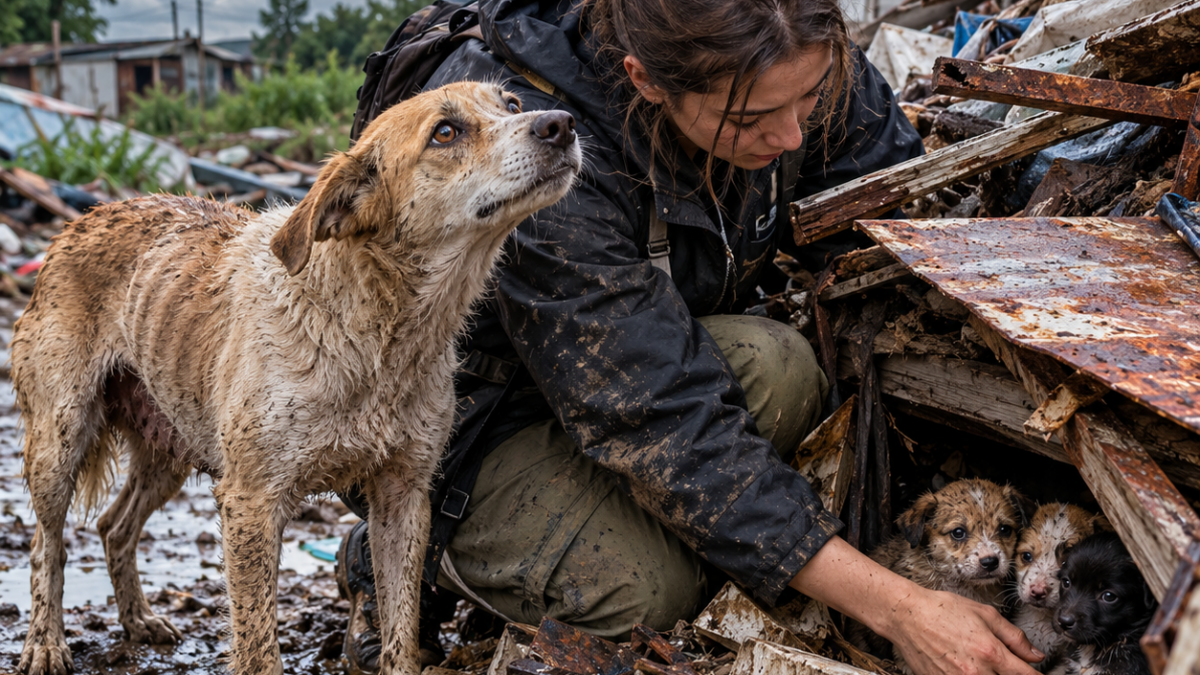
A Desperate Mother Dog Kept Begging Us to Follow Her Into a Dangerous Scrap Yard—Then We Crawled Beneath the Metal and Discovered Who She’d Been Trying to Save.
The mother dog came running toward our car with mud on her legs, milk still heavy in her body, and panic in her eyes like she had been praying for a human to stop.
At first, we thought she was begging for food, but every time we moved toward her, she turned back toward the junkyard and looked over her shoulder as if saying, Please, not me—follow me.
When we finally crawled under the rusted scrap metal, we heard the tiny cries, and I realized this starving stray had risked everything to lead strangers to the three hidden puppies she could no longer protect alone.
The first thing I noticed was that she was not afraid of the car.
Most stray dogs are.
They hear an engine slow down, see a door open, and their bodies remember every bad human at once. They keep distance. They lower their heads. They watch hands. They decide, in the space of a heartbeat, whether hunger is worth danger.
But she came straight toward us.
Not running wild.
Not barking.
Not even wagging her tail.
She moved with urgency, like a mother who had spent the whole night making one terrible calculation after another and had finally decided strangers were safer than waiting.
We had pulled off the narrow village road because we thought we had seen a thin dog near the drainage ditch. It was late afternoon, the sky heavy with the kind of gray clouds that make the whole world smell like rain before a drop has fallen. On one side of the road were small houses with tin roofs and vegetable gardens. On the other side was a stretch of abandoned land where people had dumped old sheet metal, broken crates, rusted fencing, bent pipes, and the forgotten bones of things no one wanted to repair.
The place always made me uneasy.
In dry weather, it looked ugly.
In wet weather, it turned dangerous.
Water pooled under the metal and plastic. Sharp edges disappeared beneath mud. Snakes came in. Rats came in. And if one hard rain washed down from the hill, the low ground near the ditch could flood within minutes.
That was where she came from.
A medium-sized brown dog, thin but not skeletal, with a white blaze on her chest and eyes that seemed older than her body. Her coat was dirty, clumped with mud along her belly. Her ears were uneven, one lifted higher than the other. Her teats hung heavy beneath her, swollen with milk.
That was when my heart tightened.
“Oh,” I whispered. “You have babies somewhere.”
My friend Mara, who had been driving, killed the engine.
The dog stopped near the front bumper and looked directly at me through the windshield.
Not at my hands.
Not at the food bag on the floor.
At my face.
I have rescued dogs for years, and people sometimes think that gives you a special gift, as if rescuers hear animals speak in complete sentences.
We do not.
We guess.
We watch.
We make mistakes.
PART2:
We learn to read weight distribution, ears, pupils, breath, tail position, distance, direction, food response, avoidance, surrender, bluff, fear.
But every now and then, an animal looks at you with such fierce purpose that all the training falls away and you understand one thing clearly.
This dog was asking for help.
I stepped out slowly.
“Hey, mama,” I said softly. “What is it?”
She backed up two steps.
Then turned toward the junkyard.
Then looked back.
Mara opened her door.
The dog took another few steps toward the rusted metal, then stopped again.
Mara and I looked at each other.
“She wants us to follow,” Mara said.
“I know.”
“That land floods.”
“I know.”
The dog gave one short, breathy whine.
Then she trotted forward, stopped, looked back again, and waited.
I grabbed my rescue kit, a flashlight, two towels, and a small pouch of food. Mara took the carrier from the back seat. We followed the mother dog off the road and into the weeds.
The ground was soft, sucking at our shoes. A sour smell rose from the mud—old water, oil, rust, trash, and something else I recognized too well.
Sickness.
The mother dog moved carefully, weaving through gaps in the scrap as if she had memorized every safe place to step. She did not look like a dog wandering randomly. She looked like a dog taking the fastest known path to a place she had been guarding with her life.
Twice, she stopped when we fell behind.
Twice, she waited.
PART3:
The third time, she disappeared behind a leaning sheet of corrugated metal, then reappeared at the edge, frantic now, lifting one paw and whining under her breath.
“Mara,” I said.
“I hear it.”
At first, it sounded like a bird.
Tiny.
High.
Weak.
Then another sound answered it.
A puppy cry.
I dropped to my knees so fast mud soaked through my jeans.
The mother dog pressed close, her nose almost touching my shoulder. I expected her to be defensive. Mothers often are, especially when starving and exhausted. But she did not growl. She did not warn me away.
She nudged my arm.
Then pushed her nose toward the dark hollow beneath the metal.
“Okay,” I whispered. “I see. I see.”
The puppies were hidden under a low tangle of sheet metal, plastic boards, and rusted frames. Someone had dumped a broken metal cabinet there, and its side had formed a shallow covered pocket against the dirt. It must have looked like shelter to a desperate dog looking for any place dry enough to keep newborns alive.
But now the ground beneath it was damp.
If rain came hard, the whole hollow would fill like a basin.
I lay flat on my stomach and shone the flashlight inside.
Three tiny faces blinked back at me.
My throat closed.
They were small, much too small to be in a place like that, their little bodies pressed together for warmth. Mud clung to their bellies. Fleas moved across their thin fur. One puppy, black and smaller than the others, trembled so hard its whole body seemed to pulse. Another had light brown fur and a rounder face, eyes wide and confused. The third, a little cream-and-brown pup with markings like the mother’s, tried to crawl backward into the shadows when the light touched her.
“Oh, babies,” I breathed.
The mother dog whined again, urgent but controlled.
She knew exactly where they were.
She knew exactly what she had brought us to.
And I realized then how much courage it had taken.
A stray mother dog does not lead humans to her puppies unless she has run out of choices.
She must have known they were weakening.
She must have known the place was unsafe.
She must have known she could no longer feed them enough by herself.
So she came to the road.
She stopped a car.
She begged.
Not for herself.
For them.
“Mama, you did so good,” I said, my voice breaking. “You did so good.”
The first puppy came out easily.
The brown one.
He was cold, muddy, and limp with fear, but when I cupped him in both hands, he made a tiny indignant sound as if offended by rescue. I wrapped him in a towel and handed him to Mara.
“One,” she said.
The second was harder.
The cream-and-brown puppy had crawled deeper behind a twisted strip of metal. I could not reach without risking cutting my arm. Mara held the sheet up while I slid one hand under it, ignoring the scrape along my wrist.
“Come on, sweetheart,” I murmured. “Don’t go farther in.”
The puppy stared at me with enormous frightened eyes.
Behind me, the mother dog began licking my boot.
A strange little gesture.
Encouragement, maybe.
Or desperation.
I reached slowly, caught the puppy around the chest, and eased her out inch by inch.
She did not cry.
That scared me more than crying would have.
I tucked her into my jacket and felt her tiny heartbeat fluttering against my shirt.
“Two.”
The black puppy had disappeared completely.
For one terrible moment, I thought there had only been two after all. Then I heard the faintest sound from farther back under the cabinet.
A weak squeak.
Mara lowered herself beside me.
“I’m smaller,” she said. “Let me try.”
The mother dog moved between us, sniffing, whining, circling, stepping back, stepping in again. She was trying so hard to help that she nearly blocked the opening.
“Mama,” I said gently. “We need room.”
She backed up.
Immediately.
As if she understood.
Mara stretched her arm under the metal, face pressed to the mud, fingertips searching in the dark.
“I feel fur,” she said.
“Can you get him?”
“He’s wedged behind something.”
“Is he moving?”
“A little.”
The sky rumbled.
All three of us froze.
Thunder rolled low beyond the hill.
The mother dog barked once.
Sharp.
Terrified.
She knew.
She knew what rain meant.
“Come on,” Mara whispered through clenched teeth. “Come on, little one.”
Her fingers closed.
The black puppy screamed.
The mother dog lunged forward instinctively, then stopped herself, trembling all over.
“I’ve got him,” Mara said. “I’ve got him.”
She pulled slowly, carefully, freeing one tiny leg, then the other. The puppy came out covered in mud and old leaves, eyes half-shut, body weaker than the first two.
For one second, he lay in Mara’s hands too still.
“No,” she whispered.
I took him, rubbed him hard with the towel, cleared mud from his nose, and touched his chest with two fingers.
There.
A heartbeat.
Faint but there.
“He’s alive,” I said.
The mother dog pushed her face into my hands and began licking the puppy with such frantic tenderness that I had to hold him tighter so she did not roll him from the towel.
“Three,” Mara said, and her voice cracked.
We checked again.
No more puppies.
Only the dark hollow, damp earth, insects, sharp metal, and the ugly truth of what might have happened if that mother had not found us before the rain.
We carried the puppies back to the car in towels, one each against our bodies and the smallest tucked inside my jacket. The mother dog followed so closely she nearly tripped me twice.
At the road, she stopped.
The open car door frightened her.
That was the first sign that she had not always known kindness.
She wanted the puppies.
She wanted safety.
But the vehicle was another question.
She stood in the rain-heavy air, looking from the car to me, from me to the towels, torn between terror and motherhood.
I knelt beside the open door and placed the brown puppy just inside the crate.
He squeaked.
The mother dog took one step forward.
Then another.
I placed the cream-and-brown puppy beside him.
Another squeak.
The mother’s body leaned toward them.
“Come on,” I whispered. “You brought us to them. Come with them.”
The first raindrops began to fall.
Big ones.
Cold ones.
They struck the metal around us with hollow ticks.
The mother dog looked back toward the junkyard.
Then at the puppies.
Then she climbed into the car.
Not for us.
For them.
Mara closed the door gently, and the rain opened over the road as if the sky had been waiting for permission.
By the time we reached the shelter, the storm was pounding so hard the windshield wipers could barely keep up.
I kept looking at the rearview mirror.
The mother dog lay curled around the crate, nose pushed through the bars, trying to touch every puppy at once. The puppies rooted blindly toward her scent. The smallest black one had begun to whimper with more strength.
“She saved them,” Mara said quietly.
“No,” I said. “She made us save them.”
There is a difference.
At the shelter, we turned the laundry room into an emergency nursery.
Warm towels from the dryer.
Heat pad on low under half the bedding so they could move away if too warm.
Fresh water for mama.
Small amounts of food because a starving nursing dog cannot safely gorge no matter how badly she wants to.
The moment I set the crate down and opened it, the mother dog stepped out, checked each puppy, then looked at me.
That look undid me.
It was not trust yet.
Not fully.
It was gratitude mixed with exhaustion.
As if she was saying, I did my part. Please do yours.
“We will,” I promised her. “We will.”
The puppies were worse than they had first looked.
Fleas covered them, too many for bodies so small. Their bellies were round in the wrong way. Their coats were dull. One puppy’s eye was red and swollen, sticky at the corner. Their gums were pale. Their cries were weak.
The mother was thin under the mud, her ribs not sharp but visible, her hips too narrow for a dog who had been feeding three puppies. Later, the vet would tell us she was probably not older than four.
Four.
She looked older because hardship ages animals the way grief ages people.
Her teeth were still white, still healthy, still the teeth of a young dog. But her eyes carried the tired knowledge of someone who had survived too many litters and too many nights outside.
We did not know whether she had been abandoned or born stray.
But nothing about her manners felt wild.
She accepted food gently.
She understood doorways.
She watched our hands.
She knew how to ask without demanding.
Somebody, somewhere, had either loved her once or taught her to hope for love and then left her with the memory of it.
The first bath was for the puppies.
They were too little for harsh treatments, and the fleas were too many, so we had to do it slowly by hand. Warm water. Mild soap. Flea comb. Tweezers. Towels. Patience.
The brown puppy complained through the entire process with surprising volume.
“That one has opinions,” Mara said.
“Good,” I replied. “Opinions mean energy.”
The cream-and-brown puppy sat quietly in my palm with the resigned dignity of a tiny grandmother.
The black puppy trembled but did not fight. He looked at us with round worried eyes as if the whole world had become too large too quickly.
“You’re the shy one,” I whispered to him. “That’s okay. You survived too.”
We cleaned them one by one, wrapping each in warm towels and returning them to their mother between steps so she could smell them, lick them, know we were not taking them away.
Then came the mother’s bath.
I expected resistance.
Instead, she stood in the tub with her head lowered and let us pour warm water over her back.
At first, the water running off her was brown.
Then reddish with rust-colored mud.
Then gray.
Then finally clear.
She closed her eyes when Mara rubbed soap gently into the fur along her neck.
“She likes it,” Mara said, surprised.
The dog leaned slightly into her hand.
Something in my chest loosened.
For once, she was the one being cared for.
Not guarding.
Not nursing.
Not searching for food.
Not listening for danger.
Just standing in warm water while kind hands cleaned the life she had survived from her coat.
Afterward, wrapped in a towel, she looked like a new dog.
Still thin.
Still tired.
But beautiful.
Soft brown fur. White chest. Intelligent eyes. A face made gentle by nature and sharpened by hardship.
I sat on the floor while she returned to the puppies. She circled once, lay down carefully, and let them crawl toward her.
The black puppy found her first.
Then the brown.
Then the cream-and-brown.
She lowered her head onto her paws and looked at me.
Her eyes shone.
That was when I first thought, You are not just a stray.
You are a miracle with teeth.
We named the puppies before we meant to.
That always happens.
The brown boy became Bear because he had the round face, the courage, and the tiny dramatic growl of something much larger than himself.
The cream-and-brown girl became Mini Winnie because she looked so much like her mother in miniature that calling her anything else felt dishonest.
The black puppy, the shy one, took longer.
For three days, we called him “little one,” “baby,” “sweet boy,” and “please stop hiding under the towel.”
Finally, after he crawled out from behind the laundry basket at midnight and silently stole a piece of softened food twice the size of his mouth, Mara said, “That is not shyness. That is strategy.”
So we named him Scout.
As for their mother, she earned her name.
The first morning after rescue, I opened the laundry room door expecting her to be curled with the puppies.
She was gone.
The puppies were safe in their nest.
The window was closed.
The door had been latched.
The baby gate was still in place.
Mara and I searched the room like detectives.
Then we heard scratching near the kitchen.
Somehow, the mother dog had squeezed herself through the tiny cat door that led from the laundry room into the back hall. A cat door I would not have believed could fit a loaf of bread, let alone a nursing dog.
She was standing by the food bin, tail low but hopeful.
Mara stared.
“How did she do that?”
The dog looked at us, then at the food.
I laughed for the first time since the rescue.
“You little Houdini.”
Her ears lifted.
And that was it.
Houdini.
Hope, survival, escape, and the stubborn refusal to stay trapped where the world puts you.
Day by day, Houdini became herself.
At first, she ate with the intensity of a dog who had learned that food could vanish. We had to feed her carefully, several small meals a day, rich enough to help her produce milk, gentle enough not to upset her stomach. She needed strength for herself and for the three puppies who depended on her.
Sometimes she ate near the other rescue dogs.
That was when something happened that I still remember with a full heart.
Our dogs are not saints.
They are dogs.
Some came from hunger. Some came from chains. Some came from streets, hoarding houses, abandonment, neglect, and fear. Food can bring out hard memories.
But when Houdini approached the bowls, the others moved aside.
Not all at once.
Not dramatically.
Just quietly.
Pedro took one step back.
Pip sniffed her shoulder and turned away.
Old Nala, who had once guarded kibble like gold, sat down and watched Houdini eat first.
It looked almost deliberate.
As if they understood she was not eating only for herself.
As if every rescued dog in that room remembered, in its own way, what it meant to need someone to make space.
I stood in the doorway and cried into a dish towel.
Mara found me there.
“You crying again?”
“No.”
“You’re holding the towel like a grieving widow.”
“Shut up.”
She put an arm around me.
“They know,” she said.
“I think they do.”
Houdini ate, then looked up at us with food on her nose and no shame at all.
That became one of her defining traits.
The dog knew where food lived.
All food.
Hidden food.
Forgotten food.
Food in pockets.
Food behind doors.
Food in bowls belonging to dogs who had stepped away for half a second too long.
Before breakfast, she waited outside the gate with the patience of a monk and the stomach of a thief. She did not bark. Did not scratch. Did not cause trouble. She simply sat there, certain that meals came to those who believed in them.
Once she grew stronger, she began taking morning walks around the village.
At first, this terrified us.
We had just rescued her from the outside world. The last thing we wanted was for her to disappear into it again.
But Houdini had her own ideas about freedom.
She would slip out through that absurdly small cat door, trot along the fence, visit the neighbors who sometimes left rice, scraps, or water for stray dogs, inspect the garden, greet Pip and Pedro near the trees, and return before evening as if clocking out from work.
“Absolutely not,” I told her the first week she did it.
She wagged her tail.
“We are not encouraging this.”
She licked her lips.
“You are a nursing mother.”
She looked toward the road.
“You have responsibilities.”
She slipped through the cat door thirty seconds later.
We fixed the flap.
She opened it.
We blocked it.
She squeezed around it.
We watched her route.
She never went far.
Always returned.
Always checked the puppies first.
Eventually, we understood that Houdini did not want to leave.
She wanted to know she could return.
For a dog who may have been abandoned, there is power in choosing the door and finding it open again.
The puppies grew fast.
Too fast, as puppies do.
At first, they were blind hunger and sleep, soft bellies and tiny paws. Then their eyes brightened. Their legs steadied. Their personalities began rising through them like sunlight through curtains.
Bear was bold.
Recklessly bold.
He was the first to climb out of the bed, the first to growl at a broom, the first to taste softened food, the first to march into the garden like he had purchased it.
If the others hesitated, Bear went first.
Sometimes because he was brave.
Sometimes because he had not thought things through.
Mini Winnie followed with her mother’s warmth. She had Houdini’s face, Houdini’s sweetness, and Houdini’s strange ability to make everyone feel chosen. She would toddle after me during garden walks, ears flopping, eyes full of trust, as if the world had never once been dangerous.
Scout was different.
The black puppy remained careful. He watched everything before joining. He waited for Bear to prove the grass was not haunted and Mini Winnie to prove my shoes were safe. His worry sat openly on his little face.
One afternoon, I sat in the garden with a bowl of softened food and called him.
“Come on, Scout. It’s okay.”
He stood several feet away, looking from me to the trees.
Anxious.
Thinking.
I kept my voice gentle.
“Don’t worry. Everything is okay.”
He took one step.
Then another.
Then ran the last few feet and crashed into my knee like he had meant to be brave all along.
From that day on, he walked beside me.
Not always ahead.
Not always confidently.
But beside me.
That is courage too.
People think courage looks like Bear charging into bushes.
Sometimes courage looks like Scout deciding to take the next step even though his whole tiny body says not yet.
We filmed their baths because they were absurd.
No matter what we did, they tried to drink the bathwater.
Fresh water in bowls? Ignored.
Warm, soapy bathwater? Apparently a delicacy.
Bear plunged his entire nose in.
Mini Winnie licked the stream coming from the cup.
Scout, dignified as ever, waited until we looked away and then drank from the corner like a gentleman committing a crime.
“Horrible little gremlins,” Mara said.
“They are angels.”
“They are drinking their own shampoo.”
“Angels can be flawed.”
Bath time became chaos, comedy, and tenderness all in one. Outdoor tubs in the sun. Puppies slipping. Houdini supervising from a few feet away. Bear trying to climb into my lap while wet. Mini Winnie shaking water directly into my face. Scout looking betrayed by moisture.
Those were the moments that made their beginning hard to believe.
No one seeing them in the garden, clean and round-bellied, would have guessed they had been born under scrap metal in a place that could flood.
No one would have guessed their mother had stood in the road and begged strangers to follow.
But I remembered.
Houdini remembered too.
Even as she became playful, even as she grew healthier, even as her ribs disappeared under good weight and her coat shone, there were signs of the life behind her.
She never ignored food.
Never.
Hardship had taught her that food was not casual. It was opportunity. Insurance. Memory.
She could smell snacks from impossible distances.
One minute she would be asleep under the table, and the next she would vanish because somewhere, three houses away, a child had dropped bread.
Mara joked that Houdini had a second nose dedicated only to carbohydrates.
She also became our unofficial guard.
Not aggressive.
Not loud.
Simply aware.
A strange sound outside? Houdini noticed first.
A new dog near the fence? Houdini positioned herself between it and the puppies.
A delivery man at the gate? Houdini watched, silent and stern, until one of us confirmed he belonged there.
At times, she followed me so closely that I nearly tripped over her.
If another dog came near me, Houdini would circle fast, shoulder brushing my legs, as if saying, politely but firmly, This human is mine.
“You know I rescued you,” I told her.
Her eyes said, Debatable.
Slowly, the puppies no longer needed her milk.
We soaked dry food in warm water until it softened into mush. Bear attacked every meal like it owed him money. Mini Winnie ate neatly. Scout took his time, then checked everyone else’s bowl in case opportunity had been left unattended.
Watching them grow stronger brought a satisfaction I cannot explain to anyone who has not held a dying-small animal and then seen it become loud, demanding, inconveniently alive.
It is one of the best feelings in the world.
It is also the beginning of goodbye.
Applications came first for Bear.
Of course they did.
Bold puppies photograph well.
A family with two older children came to meet him. They had a fenced yard, patient voices, and a father who sat on the ground without caring about mud on his jeans. Bear climbed into the daughter’s lap, bit her shoelace, and fell asleep five minutes later like he had signed a contract.
Mini Winnie went next.
A woman who had lost her senior dog the year before came quietly, not expecting to be chosen. Mini Winnie walked straight to her, placed both paws on her shoe, and looked up.
The woman began crying.
“That’s not fair,” she said.
No.
It was not.
Love rarely is.
Scout took longer.
He met three families and hid behind my legs each time. Not ready. Not them. Not yet.
Then a retired schoolteacher named Mrs. Bell came with no expectations and a bag of soft treats. She did not reach for him. Did not call him repeatedly. Did not insist he like her on her schedule. She simply sat on the bench in the garden and began reading aloud from a paperback novel.
Scout listened.
Then crept closer.
Then lay down under the bench beside her foot.
Mrs. Bell kept reading.
After twenty minutes, he put his chin on her shoe.
“That one,” I said.
Mara nodded. “That one.”
The day Scout left, Houdini watched from the porch.
Not frantic.
Not confused.
Just still.
Too still.
She had watched Bear leave. Mini Winnie leave. Now Scout.
One by one, the little bodies she had risked everything to save disappeared into other arms.
Good arms.
Safe arms.
But still gone.
People like to say dogs live in the moment.
Sometimes they do.
Sometimes they grieve in ways that are quieter than ours and no less real.
That night, Houdini slipped outside and did not come in.
We found her sleeping alone near the garden, curled under the old bench where the puppies had played.
The air was cold.
Her body was warm when I touched her, but her eyes opened slowly, heavy with a sadness I had no words for.
“Oh, mama,” I whispered.
She did not get up.
So I sat beside her in the dark.
Mara brought a blanket.
Pip and Pedro came out and lay a few feet away, worried, respectful. Even Bear’s old squeaky toy, the one he had somehow forgotten behind the shed, lay near Houdini’s paw.
I do not know if she understood that her puppies were safe.
I believe she did, eventually.
But safe does not mean near.
And mothers know the difference.
For several days, Houdini was quieter.
She ate, because she was still Houdini and grief had not defeated appetite. But she did not race through the yard. Did not sneak out as often. Did not patrol with the same pride.
Then winter came.
The first snow changed everything.
At dawn, I opened the back door expecting caution.
Houdini shot through the cat door like a rocket.
A full-grown dog squeezing through a cat flap and launching herself into snow is not graceful. It is not dignified. It is one of the funniest things God allows on earth.
She landed, froze, then began leaping at snowflakes.
Leaping.
Houdini, the tired mother from the junkyard, the dog who had carried fear and hunger in her bones, ran through the yard like a puppy seeing magic for the first time.
Pip and Pedro chased her.
She rolled.
Sneezed.
Jumped up.
Dove again.
The snow clung to her ears and nose. Her tail whipped circles. She barked once, surprised by her own joy, then raced around the garden while Mara and I stood in the doorway laughing so hard we cried.
“She’s happy,” Mara said.
“Yes.”
Not fixed.
Not forgetting.
Happy.
There is a difference, and it matters.
Over the next months, Houdini became round.
Not unhealthy at first.
Just comfortable.
Then slightly too comfortable.
Then, as Mara put it, “luxuriously padded.”
“She was starving when we found her,” I said defensively.
“She is not starving now.”
“She deserves snacks.”
“She has become a snack with legs.”
Houdini wagged at this, because tone mattered more than content.
We adjusted her food, increased her walks, encouraged more play. She slimmed down slowly, grew stronger, shinier, more beautiful.
People started asking to adopt her.
A lot of people.
At first, I answered politely.
She is not ready yet.
She is still recovering.
We are evaluating her long-term needs.
Then one day, after the eighth message in a week, Mara looked at me across the table and said, “You know you’re lying.”
“I am not lying.”
“You are absolutely lying.”
“She has needs.”
“Yes. Breakfast, lunch, dinner, second dinner, unauthorized village snacks, and you.”
I opened my mouth.
Closed it.
Houdini lay under the table with her head on my foot.
Mara softened.
“She belongs here.”
I looked down at the dog who had once begged us to follow her.
The dog who had trusted us with her babies.
The dog who had squeezed through impossible doors, guarded the yard, stolen bread, chased snow, mourned her puppies, and somehow wrapped herself around the daily shape of my life until the shelter felt incomplete without her.
“Yes,” I said. “She does.”
So Houdini stayed.
Not as a foster.
Not as a case.
Not as the brave mother dog from the video.
As family.
She still made her morning rounds through the village, though she never went far. We learned her route: the neighbor with rice water by the gate, the old man who pretended not to feed her but always had scraps, the garden wall where Pip liked to sun himself, the shade beneath the fig tree, then home before evening.
Always home.
That was the miracle.
No matter where Houdini wandered, she came back.
Some dogs return because they are trained.
Houdini returned because she had finally found a place worth choosing.
Years from now, people may only remember the first part of her story.
The mother dog who begged us to follow.
The hidden puppies under scrap metal.
The rescue before the rain.
That is the part made for videos.
But I will remember the rest.
The way she closed her eyes during her first bath.
The way the other dogs stepped aside so she could eat.
The way Bear made Scout brave.
The way Mini Winnie looked like a tiny echo of her mother.
The way Houdini slept outside when the puppies left because grief needed room under the sky.
The way she ran through snow like joy had finally caught up with her.
The way she still circles me when another dog comes too close, proud and ridiculous, as if announcing, This human is mine.
The way she learned that doors could open and still lead back home.
Her life before us may remain a mystery.
Maybe someone abandoned her.
Maybe she was born outside.
Maybe she had many litters before the three we found.
Maybe she had known kindness once and lost it.
Maybe she had survived by becoming clever enough to trust only at the exact moment trust became necessary.
I do not know.
Some parts of a rescued animal’s story stay hidden forever in the eyes.
But this much I know:
Houdini will never face the world alone again.
She came to us not asking for herself, but for her babies.
She gave us the chance to help them live.
And in return, we gave her something she may have never had before.
Not just food.
Not just shelter.
Not just safety.
A place where she could stop begging strangers to follow her.
A place where she could run out the door and know she was allowed to come back.
A place where her puppies could leave because they were loved, not because they were lost.
A place where the frightened mother from the junkyard became the heart of a home.
That is what rescue is at its best.
Not ownership.
Not pity.
Not saving something broken and calling ourselves good.
It is listening when a muddy mother dog stands in the road and tells you, without words, that someone smaller is waiting in the dark.
It is following.
It is getting on your knees in the mud.
It is reaching under the sharp metal before the rain comes.
It is understanding that sometimes the one who needs help most is still brave enough to lead you to someone who needs it more.
Houdini did that.
She found us.
She led us.
She trusted us.
And somehow, after everything she had survived, she still had enough hope left to believe humans might stop.
I am grateful every day that we did.








