A Decorated Combat K9 Was Minutes From Being Put Down After Turning “Dangerous”—Then a Pregnant Nurse Spoke Two Quiet Words, and Everyone Finally Realized What He Had Been Trying to Tell Them
PART2:
Before Pauline could continue her lecture, a nervous voice called from maternity assessment.
“Nurse?”
I set down the chart and walked carefully across the corridor.
Inside the room, a young expectant mother named Tessa lay propped against the pillows, both hands resting protectively over her belly. Her husband stood beside the bed staring at the fetal monitor like he might understand it through sheer concentration.
The monitor emitted two quick tones.
High.
Low.
Tessa flinched.
“What was that?”
I looked at the tracing.
“Signal adjustment.”
“Is the baby all right?”
“The heart rate is steady.”
The machine sounded again.
High.
Low.
Tessa’s breathing quickened.
“It keeps doing that.”
“I know.”
I checked the sensor belt, repositioned it slightly, and watched the screen. The tracing steadied. The tone stopped.
Then returned.
High.
Low.
It was sharper than a normal signal-loss alert. Almost distorted. The sound did not belong to the situation. It felt too dramatic, too sudden, too threatening for what the monitor was actually telling us.
Tessa whispered, “It sounds terrible.”
“It sounds more frightening than the situation is.”
I placed my hand near her wrist without touching her until she gave a tiny nod of permission.
“Look at me instead of the machine.”
She did.
“Your baby’s heart rate is good. Your blood pressure is good. The monitor is having a bad evening.”
Her husband finally exhaled.
“Can you switch it off?”
“Not while we need the tracing. But I can replace it.”
I called equipment services and asked for another unit. The technician promised to bring one when he could, which in hospital language meant maybe soon, maybe after three other people called, maybe when the sun had emotional closure.
Until then, I lowered the alarm volume as far as safely permitted.
Tessa’s shoulders relaxed.
I looked once more at the monitor.
High.
Low.
That sound bothered me.
Not because it meant danger.
Because of how it changed the room.
The first tone made people turn.
The second made them brace.
Repeated often enough, it trained the body to expect something bad.
I knew that feeling.
Years earlier, during nursing school, I had volunteered at a civilian reintegration center outside Olympia. The program helped veterans returning to family life, including handlers bringing retired or recovering military working dogs into homes with newborns.
Those dogs were remarkable.
Brave beyond language.
Disciplined beyond anything most people ever see.
But that did not mean they understood ordinary life.
Some tolerated gunfire better than doorbells. They could walk through controlled explosions and then panic when a blender started. They knew the sounds of battlefield command, but not crying babies, smoke alarms, dropped bottles, or kitchen timers.
The rehabilitation specialist taught families something I never forgot:
Manage the sound before reacting to the behavior.
If a dog went rigid at a noise, you did not immediately decide the dog was aggressive. You identified what its body had heard before its mind could understand it.
During desensitization exercises, one instructor used the same phrase each time she turned off a distressing recording.
Home signal.
Quiet follows.
Not a command.
A promise.
The sound ends now.
I remembered those words because they worked on more than dogs.
People calm down faster when they know what happens next.
Pain becomes less frightening when it gets a name.
Panic decreases when the world becomes predictable for even one breath.
I returned to the emergency station just as another alarm erupted from Bay 9.
A teenage boy with a badly cut palm sat on the bed while his father argued with one of the residents.
“He needs a surgeon.”
“The tendon appears intact,” the resident said.
“You barely looked.”
I stepped in.
“What happened?”
The teenager lifted his bandaged hand.
“Glass door.”
“Can you move every finger?”
He demonstrated. I checked circulation, sensation, and range of motion before helping irrigate the wound. The father continued pacing.
“You’re pregnant,” he said.
I glanced down at my stomach.
“So I’ve been told.”
“Should you be doing this?”
“I’m cleaning a hand, not lifting an ambulance.”
He looked embarrassed.
“I just meant—”
“I know.”
And I did know.
People saw the pregnancy first, then the nurse. Most meant well. Some were simply afraid of being near any woman who looked like she might create a baby in the middle of their emergency.
The laceration was deep but uncomplicated. The resident repaired it. The father apologized twice. The teenager asked if he would still be able to play guitar.
I told him yes, if he did not use the stitches as an excuse to become mysterious and unbearable.
He laughed.
I finally returned to the nurses station and lowered myself into a chair.
The relief was immediate.
My daughter shifted under my ribs.
I put one hand against my abdomen.
“You have excellent timing.”
Pauline slid a packet of crackers toward me.
“Eat.”
Before I could answer, the trauma radio cracked alive.
“Kingswell emergency, prepare for incoming military casualty.”
The whole department quieted by instinct.
Dr. Noelani Pierce reached for the receiver.
“Report.”
A voice came through, strained and clipped.
“Male, thirty-nine. Unconscious after training vehicle collision. Possible head injury. Irregular respirations.”
Noelani’s face changed.
“Any other injuries?”
“Unknown. Military working dog accompanying.”
Someone at the desk muttered, “A dog?”
Then the second voice came through.
“K9 has shown defensive aggression. One security injury during transfer.”
Every person near the station looked up.
Hospital security supervisor Warren Drake was already reaching for his radio.
“Animal control being contacted.”
I looked toward the maternity bay.
High.
Low.
The broken fetal monitor sounded again.
I did not know yet that within minutes, that same little distorted sound would turn a decorated working dog into something everyone in the hospital would call a weapon.
The military vehicle arrived under flashing amber lights.
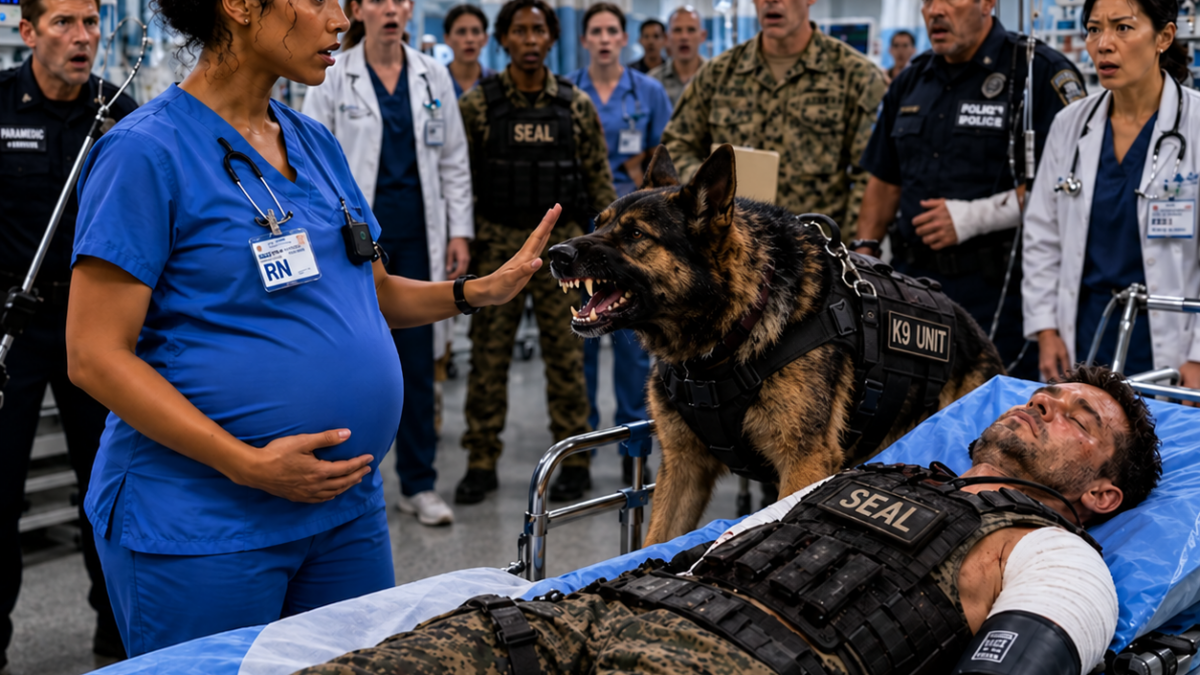
Rain hammered the ambulance bay doors. The rear doors opened, and for one second, the whole trauma team stopped moving.
An unconscious man lay strapped to the stretcher.
Blood matted his hairline. One side of his face was bruised. His breathing came in uneven pulls, like his body was forgetting the rhythm and remembering too late.
A large dark sable German Shepherd stood over him.
Not beside him.
Over him.
His front paws were planted on either side of the man’s chest. His body formed a barrier from shoulder to thigh. A black operational harness covered his torso. The name HAVOC was stitched in white across one side.
His ears were forward.
His lips were drawn back just enough to reveal teeth.
He was not snapping.
Not barking.
Warning.
The military medic beside the stretcher held the lead with both hands.
“He won’t let anyone touch the commander.”
Noelani approached slowly.
“Is he trained to respond to another handler?”
“Usually.”
“Usually?”
“He hasn’t responded since the crash.”
Commander Tate Walcott stepped in from the rain, uniform soaked, expression controlled.
“Creed needs immediate treatment.”
“So move the dog,” Warren said.
Walcott looked at him.
“If it were that simple, we would have done it outside.”
The stretcher crossed into Trauma Bay 6.
Havoc stayed over Jonah Creed.
Doctors and nurses spread around the perimeter, hands ready, voices low.
I stood in the doorway.
Everyone was watching the dog’s mouth.
I watched his ears.
They twitched rapidly.
One side more than the other.
Then he shook his head once and pressed his right ear against his shoulder.
Pain.
That was the first word that moved through me.
Not aggression.
Pain.
Noelani tried to approach with an airway kit.
Havoc’s head snapped toward her.
A low growl filled the room.
She stopped.
“Easy,” she said.
The growl continued.
Jonah’s oxygen saturation dropped on the monitor.
“We need access now,” Noelani said.
Warren entered with a catch pole.
Behind the military escort, a woman rushed into view, face pale and soaked from the rain.
Leah Creed.
Jonah’s sister.
She saw the pole and cried, “No.”
Warren did not turn.
“Ma’am, stay outside.”
“That dog has protected my brother for six years.”
“And right now he is preventing treatment.”
“He doesn’t do that for no reason.”
“An officer is already injured.”
“What happened before he was injured?”
Warren looked back.
“What?”
“What happened first?”
Nobody answered.
That silence bothered me.
People often remember the bite.
The lunge.
The blood.
They forget the thing that came right before.
I looked at Havoc again.
His breathing was rapid. His eyes moved from doorway to monitor to radio.
Not random.
Scanning.
A portable cardiac monitor rolled closer. Its wheels squeaked.
Havoc glanced at it but did not react.
A nurse entered with medication.
Nothing.
A respiratory therapist adjusted an oxygen cylinder.
Still nothing.
Warren raised his radio.
“Security to control. Keep the hall clear.”
The device emitted a short confirmation tone.
High.
Low.
Havoc exploded.
He launched from the stretcher.
Not toward Warren’s throat.
Not toward the nearest body.
Toward the radio.
Warren lifted his arm. Havoc struck him hard enough to send him crashing into a supply cart. Metal trays clattered across the floor. Someone screamed. Havoc caught the sleeve near Warren’s forearm, clamped down, released almost immediately, then spun back to Jonah.
He positioned himself over the stretcher again.
Teeth bared toward the entire room.
Blood appeared along Warren’s arm.
“Get animal control here now!” he shouted.
The trauma bay erupted.
Security officers drew stun devices.
Leah cried, “Don’t hurt him!”
Noelani stepped between the officers and the stretcher.
“Everybody stop moving.”
Nobody breathed.
In my mind, I heard it again.
High.
Low.
The same interval as the fetal monitor.
The same distorted shape.
Havoc shook his head violently, then pawed at his right ear.
I looked at Warren’s radio.
“Turn that off.”
He stared at me.
“What?”
“The radio. He attacked after the tone.”
Warren’s face hardened.
“He attacked because he’s unstable.”
I looked back at Havoc.
The dog had already stopped lunging.
The radio was silent.
His breathing was still fast, but he was no longer trying to cross the room.
“He calmed when it stopped.”
Walcott turned toward me.
“Who are you?”
“Mara Ellison. Emergency nurse.”
Warren pressed gauze against his arm.
“You’re standing outside the room. You didn’t see what happened.”
“I saw his ear twitch before he moved.”
Leah looked toward Havoc.
“He’s been shaking his head for days.”
Walcott turned sharply.
“What?”
“I told Jonah. Jonah said it was probably the harness.”
I focused on the black tactical equipment fitted around Havoc’s shoulders. A narrow cable disappeared beneath the fabric toward the dog’s right ear.
“What is that?”
The military medic followed my gaze.
“Directional communication system. Audio transmission.”
Warren gave a bitter laugh.
“So now the radio made the dog attack?”
“I’m saying the sound may be part of the pattern.”
Noelani looked toward Jonah’s monitor.
His oxygen had fallen again.
“We do not have time to debate.”
Walcott’s expression became grim.
“If the dog cannot be controlled, authorization may be required.”
Leah stared at him.
“Authorization for what?”
Nobody answered quickly enough.
Her face changed.
“No.”
Walcott kept his voice low.
“If Havoc prevents life-saving care and no alternate handler can take control—”
“You will kill him?”
“Emergency euthanasia is the final option.”
“He is protecting Jonah.”
“He may also cause Jonah’s death.”
The words struck the room into silence.
Havoc stood over his unconscious partner, ears trembling, one paw lifting toward the side of his head.
I watched him.
He looked dangerous.
There was no denying that.
But a dangerous reaction was not the same thing as an unexplained one.
Animal Control arrived twelve minutes later.
By then, Warren’s injury had been cleaned and bandaged. The bite had not penetrated deeply, but the bruising looked severe, and his anger had grown with every minute.
Two Animal Control officers waited outside Trauma 6 with a sedation pole and injection equipment. A veterinary consultant spoke quietly with Commander Walcott.
“If sedation fails or the dog escalates during approach,” she said, “we may not have a safe second attempt.”
Leah stood near the wall with both arms crossed tightly over her chest.
“You’re discussing him like he’s already gone.”
Walcott looked at her.
“I’m trying to keep your brother alive.”
“And Havoc isn’t?”
There was no answer that could satisfy either of them.
I sat briefly at the desk outside the room and wrote everything I had seen.
Radio tone.
Ear twitch.
Head shake.
Lunge toward device.
Immediate return to Jonah.
No aggression toward medication cart.
No aggression toward oxygen tank.
No aggression toward staff voices.
No aggression toward physical movement before tone.
I added Leah’s report:
Right ear pawing for several days.
Noelani read over my shoulder.
“You think this is auditory pain.”
“I think the sound precedes the behavior.”
“That may not be enough to stop an emergency order.”
“It should be enough to test.”
“How?”
“Remove the sound.”
“We can’t silence every device in an emergency department.”
“No. But we can identify which one matters.”
As if the hospital itself had heard us, the fetal monitor in the adjacent maternity assessment room emitted its distorted double tone.
High.
Low.
Havoc’s ears snapped toward the corridor.
His pupils widened.
He shook his head, then slammed his body harder against the side of the stretcher, placing more of himself over Jonah.
A growl rolled from his chest.
I stood.
“There.”
Walcott looked toward me.
“What?”
“The same tone.”
The fetal monitor sounded again.
Havoc barked violently and snapped toward the doorway.
One Animal Control officer raised the sedation pole.
“Now,” Warren said.
“Wait,” I said.
The officer advanced.
Havoc lunged forward, stopped at the end of his lead, and nearly pulled the military medic off his feet.
The room became a wall of shouting.
I moved away from the doorway, well beyond Havoc’s reach, and crossed to the maternity monitor.
Tessa stared at me in fear.
“What’s happening?”
“The machine is producing a bad alert.”
“Is my baby okay?”
“Yes.”
I checked the tracing once.
“Your baby is fine.”
I pressed the alarm silence control.
The tone stopped.
In Trauma 6, Havoc froze.
His body remained tense, but the frantic head shaking ended.
The hallway went quiet in a way hospitals almost never do.
I stepped into the corridor, still keeping a safe distance.
I remembered the reintegration center.
Dogs learning the sounds of home.
Handlers turning off recordings.
The instructor repeating the phrase until the pattern became predictable.
I spoke calmly.
Not loudly.
Not like a command.
“Home signal.”
Havoc’s ears turned toward me.
Every security officer went still.
I continued.
“Quiet follows.”
The dog looked toward the silent monitor.
Then toward me.
Then back to Jonah.
His breathing slowed.
One breath.
Then another.
His rigid shoulders lowered.
Finally, Havoc stepped down from Jonah’s chest.
He did not run.
He did not surrender.
He lay beside Jonah instead.
No one moved.
No one seemed to breathe.
I looked toward Noelani.
“Approach from the opposite side.”
The physician moved slowly.
Havoc lifted his head but did not rise.
Noelani reached Jonah.
Then the respiratory therapist.
Then a nurse with the airway equipment.
Within seconds, treatment began.
The Animal Control officer lowered the sedation pole.
Commander Walcott stared at me.
“What did you say?”
“A rehabilitation phrase.”
“You know this dog?”
“No.”
“You gave him a command.”
“No,” I said. “I told him the sound had ended.”
Warren looked unconvinced.
“He attacked me.”
“Yes.”
My answer was direct.
“He is still dangerous while triggered.”
I pointed toward the harness cable.
“But he is not reacting to people without cause.”
Havoc pawed his right ear again.
This time, everyone saw it.
“He’s not trying to fight us,” I said. “He’s trying to escape something only he can hear.”
Jonah’s airway was secured.
His oxygen level began climbing.
Havoc remained beside the bed, watching the team work but no longer blocking them.
Commander Walcott slowly folded the unsigned euthanasia authorization and placed it back inside his folder.
Not cancelled.
Not yet.
But no longer inevitable.
The dog had been given minutes.
I intended to use every one of them.
For nearly three seconds, Trauma Bay 6 existed in suspended air.
Havoc lay beside Jonah’s stretcher, his chest rising and falling heavily. His ears were still alert, but the frantic shaking had stopped.
Noelani took one cautious step closer.
The dog watched her.
He did not growl.
“Airway first,” she said quietly.
The team slipped into motion.
Respiratory from Jonah’s left side.
Fresh monitoring leads.
IV access.
Medication.
Trauma evaluation.
Havoc never took his eyes off the team, but he no longer tried to block them.
Walcott looked at me.
“What exactly did you say?”
“It wasn’t a command.”
“It looked like one.”
“It was a phrase used during sound desensitization. Dogs learned it meant the painful noise had ended.”
Animal Control officer Ben Castillo lowered the tranquilizer pole.
“So he wasn’t obeying you.”
“He was responding to a pattern.”
Before anyone could reply, another portable monitor rolled into the room. As its power cycled, the same distorted double tone echoed through the bay.
High.
Low.
Havoc shot upright.
His ears flattened.
He shook his head violently and took two quick defensive steps toward Jonah.
“There,” I called. “Turn it off.”
The technician silenced the monitor.
Almost immediately, Havoc stopped pacing.
The entire room watched the transformation.
Noelani folded her arms.
“The trigger is repeatable.”
Walcott’s face tightened.
“We’ve been calling this aggression.”
“I think it’s pain.”
I watched Havoc’s right ear.
Each time the tone sounded, that ear twitched before the rest of his body reacted.
That tiny delay changed everything.
“If this were simple aggression,” I said, “he’d react first to movement. But he reacts first to sound.”
Noelani turned toward security.
“No more radios inside this bay unless absolutely necessary.”
The room grew quieter.
Noticeably quieter.
Without the constant electronic chatter, Havoc lowered himself beside Jonah again.
The euthanasia authorization remained in Walcott’s folder.
Unsigned.
For now.
Veterinary neurologist Dr. Imani Vale arrived less than twenty minutes later.
She moved with the calm confidence of someone used to frightened animals and frightened humans, which are not as different as people like to pretend.
She stayed outside Havoc’s comfort zone and studied the room first.
“I’m not examining him first,” she said.
That surprised everyone.
“I’m examining the equipment.”
I pointed toward the black tactical harness.
“The cable runs toward his right ear.”
“I noticed.”
Walcott carefully unclipped the rear equipment module while Havoc remained focused on Jonah.
The device looked ordinary from the outside.
Rugged.
Military.
Black.
Functional.
Dr. Vale removed the protective cover.
Her eyebrows drew together.
“Interesting.”
Noelani asked, “What?”
“This isn’t standard.”
Inside were miniature speakers, vibration transmitters, and a sophisticated directional audio processor.
Walcott frowned.
“Experimental model.”
“You knew?”
“I knew Jonah volunteered to field-test upgraded communications.”
Dr. Vale looked at him.
“Did anyone mention the dog was testing it too?”
Silence answered.
She examined the earpiece. The rubber seal showed fresh wear marks. Then she used a small veterinary light and looked carefully inside Havoc’s right ear without touching the most painful area.
“There it is.”
“What?” I asked.
“Inflammation. Small abrasions. Pressure irritation. The ear canal is extremely sensitive.”
She turned toward the room.
“This dog has been receiving repeated acoustic trauma.”
Warren crossed his arms.
“From a headset?”
“Potentially.”
Dr. Vale connected the module to a diagnostic reader.
The screen displayed transmission logs. Most looked normal. Then one section flashed red.
Signal distortion detected.
Another warning followed.
Frequency output exceeds calibration limit.
I looked at Havoc.
“So every time that tone sounded—”
“The damaged receiver may have amplified it,” Dr. Vale finished. “Directly into his ear.”
Walcott stared at the screen.
“No one reported this.”
I answered quietly.
“Maybe someone did.”
The room fell silent.
By evening, military behavioral records arrived.
Walcott spread four files across a conference table.
Each file belonged to a decorated military working dog.
Different units.
Different handlers.
Different deployments.
But the conclusions sounded almost identical.
Unpredictable aggression.
Behavioral deterioration.
Unsuitable for continued operational service.
I read each report carefully, one hand on the edge of the table, the other resting over my daughter as she shifted beneath my ribs.
“They all changed suddenly,” I said.
“Exactly,” Walcott replied. “No gradual decline.”
Dr. Vale pointed at the equipment inventory attached to each file.
“Look here.”
Every dog had worn the same experimental auditory communication system.
Manufactured by Stratos Defense Acoustics.
One file caught my attention.
K9 Orion.
Decorated explosive detection dog.
Nearly flawless service record.
Then, within six weeks:
Ear scratching.
Head shaking.
Defensive lunges.
Failure during routine handling.
Recommendation: immediate euthanasia due to irreversible behavioral instability.
Leah Creed looked away.
“They destroyed him.”
Walcott closed his eyes briefly.
“I signed the authorization.”
“You believed the reports?” Leah asked.
“I did.”
Dr. Vale slid Orion’s veterinary notes beside Havoc’s examination.
“The symptoms match almost perfectly.”
I compared them.
Inflamed right ear.
Sensitivity to alarms.
Defensive behavior around handler.
“This isn’t coincidence,” I whispered.
“No,” Dr. Vale said. “It’s a pattern.”
Walcott looked physically older than he had that morning.
“We thought combat had broken these dogs.”
I looked through the ICU window.
Havoc rested beside Jonah’s bed now.
For the first time all day, his ears were still.
“No,” I said. “Pain was breaking them.”
Noelani entered the conference room with encouraging news.
“Jonah’s intracranial pressure is improving. He’s beginning to respond to verbal stimulation.”
Leah covered her mouth with both hands.
Walcott turned toward the glass.
Havoc lay beside Jonah, eyes half-open, one paw touching the bottom of the hospital bed as if he needed physical proof that his partner was still there.
The distorted tones had been removed.
The painful feedback had stopped.
Walcott looked through the glass for a long moment.
“If Orion’s file was wrong,” he said, then stopped.
Nobody rushed him.
Finally, he finished.
“How many others never had a chance?”
No one answered.
The silence itself was answer enough.
And beyond the hospital walls, the company that built the defective communication system still insisted its equipment had never failed.
Forty-eight hours later, Jonah Creed opened his eyes.
His speech was weak. His body was bruised. One side of his face had swollen badly enough that he could barely see through that eye.
But when Commander Walcott asked what had happened before the crash, Jonah ignored every question except one.
He lifted a trembling hand and pointed toward Havoc’s harness.
“Logs.”
Walcott immediately searched Jonah’s secured military tablet.
Buried inside an unsent draft report was a file documenting repeated failures of the experimental auditory communication system.
Jonah had recorded dogs clawing at their ears after training exercises.
Handlers complaining of strange bursts of feedback.
Unexplained behavioral incidents that always followed specific signal tones.
The report ended with one unfinished sentence.
If this isn’t fixed, they’re going to blame the dogs instead of the equipment.
I looked at Havoc sleeping beside the bed.
“He was trying to warn someone long before today.”
The damaged communication module was sent to a military canine auditory laboratory.
Engineers recreated the transmission sequence using identical equipment. At first, everything looked normal.
Then the unit warmed under continuous operation.
A violent frequency spike flashed across the monitor.
One engineer whispered, “It shouldn’t be producing anything there.”
His name was Ellis Quade.
He looked like a man who had been carrying a truth so long it had become part of his posture.
“It wasn’t supposed to,” he admitted.
He had reported insulation failures months earlier.
Heat and moisture caused the circuitry to distort, sending painful ultrasonic bursts directly into the working dogs’ earpieces.
Management rejected the report.
Replacement costs would delay a major defense contract.
That was the sentence that made everyone in the room understand exactly what had happened.
Not a mystery.
Not a tragedy without a culprit.
A calculation.
Money against pain.
Deadlines against living animals.
A contract against creatures that could not testify in a boardroom.
For the first time, Havoc’s behavior had a measurable scientific explanation.
He had never become unpredictable.
He had been responding to pain.
At the federal contract hearing, Dr. Imani Vale presented Havoc’s neurological examination beside the laboratory frequency analysis.
Ellis Quade produced internal emails proving executives had instructed staff to classify canine reactions as behavioral problems instead of equipment failures.
Leah submitted Jonah’s suppressed complaint.
Finally, Commander Walcott stood before the review panel.
“I signed a recommendation believing the equipment was safe,” he said.
He paused.
“I was wrong.”
That sentence mattered.
Not because it fixed everything.
It did not.
Orion was still dead.
Other dogs had still suffered.
Handlers had still been told their partners were broken when their partners had been trying to communicate the only way they could.
But accountability has to start somewhere.
The emergency euthanasia authorization for Havoc was formally withdrawn.
The panel ordered a complete review of every military working dog removed from service after unexplained aggression involving the same communication system.
Orion’s case was officially reopened.
Months later, Havoc returned to Kingswell Memorial.
Not as a patient.
As a guest.
By then, I was no longer pregnant.
My daughter, Elise, was six weeks old and had strong opinions about sleep, timing, and whether human beings should ever sit down with hot food.
Jonah Creed walked slowly through the hospital corridor with a cane, still recovering but upright. Havoc moved beside him, calm and steady, wearing a simple service harness with no experimental audio equipment anywhere near his ears.
The hospital had opened a new veteran family and working dog transition program.
That still amazes me sometimes.
How close we came to killing a dog in one room, and how that same dog helped us build something better in another.
The program trained hospital staff, handlers, and families to recognize the difference between fear, pain, and true aggression in service animals adapting to civilian life.
It taught people to ask better questions.
What happened first?
What changed?
What sound came before the reaction?
What does the animal do when the trigger stops?
Where is the pain hiding?
During the opening session, a nursing student raised her hand and asked the question everyone seemed to wonder.
“Did those words save Havoc?”
I looked toward him.
Havoc rested peacefully at Jonah’s feet while two children sat nearby reading quietly from picture books. His eyes were half-closed. His body was relaxed. No trembling. No head shaking. No frantic scanning.
I gently rocked Elise in my arms.
“The words didn’t have magic,” I said.
Jonah looked up.
“They simply told him the frightening sound was over.”
I thought about Tessa in the maternity room.
About the distorted monitor.
About Warren’s radio.
About Havoc’s right ear twitching before the lunge.
About Leah’s face when someone first said euthanasia.
About Orion, whose file had been wrong too late.
“Sometimes healing begins,” I said, “the moment someone realizes the danger has stopped.”
Across the room, Jonah nodded silently.
Havoc lifted his head once.
Then relaxed completely and closed his eyes.
The growls were gone.
The fear was gone.
Not because someone had controlled him.
Not because someone had dominated him.
Not because someone finally proved he was obedient enough to deserve mercy.
But because someone listened closely enough to understand what he had been trying to say all along.
That lesson has stayed with me.
In nursing.
In motherhood.
In every hospital room where machines are loud, fear is louder, and people make permanent decisions too quickly because panic has filled the room before understanding can get there.
Danger does not always look like danger.
Sometimes it looks like a dog showing his teeth.
Sometimes it looks like a patient refusing care.
Sometimes it looks like a mother crying over a monitor that only needs replacing.
Sometimes it looks like a veteran’s partner standing over his body because every sound in the room has become a weapon.
And sometimes the most important thing you can do is not shout louder.
Not force obedience.
Not assume the worst because fear makes the worst sound reasonable.
Sometimes the most important thing you can do is stop.
Listen.
Find the sound beneath the behavior.
And say, as calmly as you can:
Home signal.
Quiet follows.
The danger is over now.








