A Burned Kitten Stumbled Into My Garage on Christmas Night and Took One Tiny Step Toward Me—But Saving Her Life Uncovered a Question Far Darker Than Her Wounds
PART3:
We wrapped her as gently as we could. I was terrified the towel would stick to her skin. Terrified of touching the wrong place. Terrified that the pain would become too much before we could get her help.
Mark grabbed his keys while I called the nearest emergency veterinary clinic.
The woman who answered did not hesitate after I described what I was seeing.
“Bring her now.”
The drive felt endless.
I sat in the passenger seat with the kitten bundled in my lap while Mark drove through nearly empty Christmas streets. Decorations glowed in windows. Plastic reindeer stood in yards. A giant inflatable Santa waved cheerfully in front of a house where everyone inside was probably opening gifts or cleaning plates or arguing over dessert.
Every few seconds, I looked down to make sure the kitten’s chest was still moving.
“Stay with me,” I kept whispering. “Just stay with me.”
At one red light, her eyes opened.
For a moment, she looked at me with the same strange trust she had shown in the garage.
I touched one finger to the edge of the towel, nowhere near her wounds.
“You found us,” I said. “Whatever happened before tonight, you found us.”
At the clinic, two technicians were already waiting with a carrier and warm blankets.
One of them took a single look at her and called for the veterinarian.
“How bad?” I asked.
The veterinarian examined her without answering right away.
That silence frightened me more than anything.
Finally, she looked up.
“A significant portion of her body is burned. We need to control her pain, clean the wounds, start fluids, and watch very closely for infection. The next few days are going to matter.”
“Is she going to live?”
The veterinarian looked back at the kitten.
“She made it here,” she said carefully. “That tells me she has fight left.”
I signed every form they put in front of me.
Before they carried her into treatment, one of the technicians asked if she had a name.
I looked through the glass at the tiny gray kitten who had somehow crossed the cold night and chosen my garage.
“Cloe,” I said.
I do not know why that name came to me.
But when the technician softly repeated it, one of Cloe’s injured ears twitched.
And as the treatment-room doors swung closed, I had no idea that saving her life would soon force us to ask a much darker question about what had happened before she found me.
The doors closed behind Cloe, and for several seconds I stood in the hallway staring at them.
Christmas music played quietly through a speaker near the reception desk.
I remember that because the normality of it felt almost offensive.
Someone was singing about peace and home and snow while a kitten who could barely stand was somewhere on the other side of those doors fighting for her life.
Mark put his hand against my back.
“You did everything you could.”
“No,” I said.
He looked at me.
“We got her here. They’re treating her.”
“I mean before tonight.”
“What?”
“I should have heard her sooner.”
“Emily.”
“What if she was outside for hours?”
“You didn’t know she was there.”
“What if she’d been under that workbench all afternoon?”
He turned me gently toward him.
“You didn’t put her there.”
I knew that.
Logically, I knew it.
But guilt does not always care about logic.
I kept imagining her outside our house while we ate Christmas dinner. Mark and I had complained because the potatoes were cold. My brother had dropped gravy on his shirt, and we had laughed so hard my mother told us we were acting like children.
Ten yards away, maybe twenty, a burned kitten could have been trying to stay alive.
The thought made me sick.
A veterinary technician named Rachel came out almost forty minutes later. There was something about her face that made me stand immediately.
“She’s stable for the moment,” Rachel said.
“For the moment?”
Rachel nodded.
“They’ve started fluids and pain medication. Dr. Patel is cleaning the wounds now. She’s severely dehydrated.”
“Can I see her?”
“Not yet.”
I swallowed.
“What caused the burns?”
“We don’t know.”
“Could somebody have done this to her?”
Rachel hesitated.
That hesitation stayed with me.
“It’s too early to say how the burns happened,” she said. “There are several possibilities. What matters tonight is getting her through the immediate danger.”
“But someone owned her.”
“Maybe.”
“She didn’t get burned and then magically appear in my garage.”
“No.”
“Then somebody knows who she is.”
Rachel’s expression softened.
“I think those are questions worth asking. But tonight, let us keep her alive first.”
It was nearly three in the morning when we finally left.
I hated leaving her.
Dr. Patel promised someone would be with Cloe throughout the night. She also warned us that burns could be deceptive. Tissue that initially appeared viable could worsen. Infection was a serious concern. Dehydration, shock, and the stress on such a young animal made her condition especially fragile.
Before leaving, I stood outside the treatment-room window.
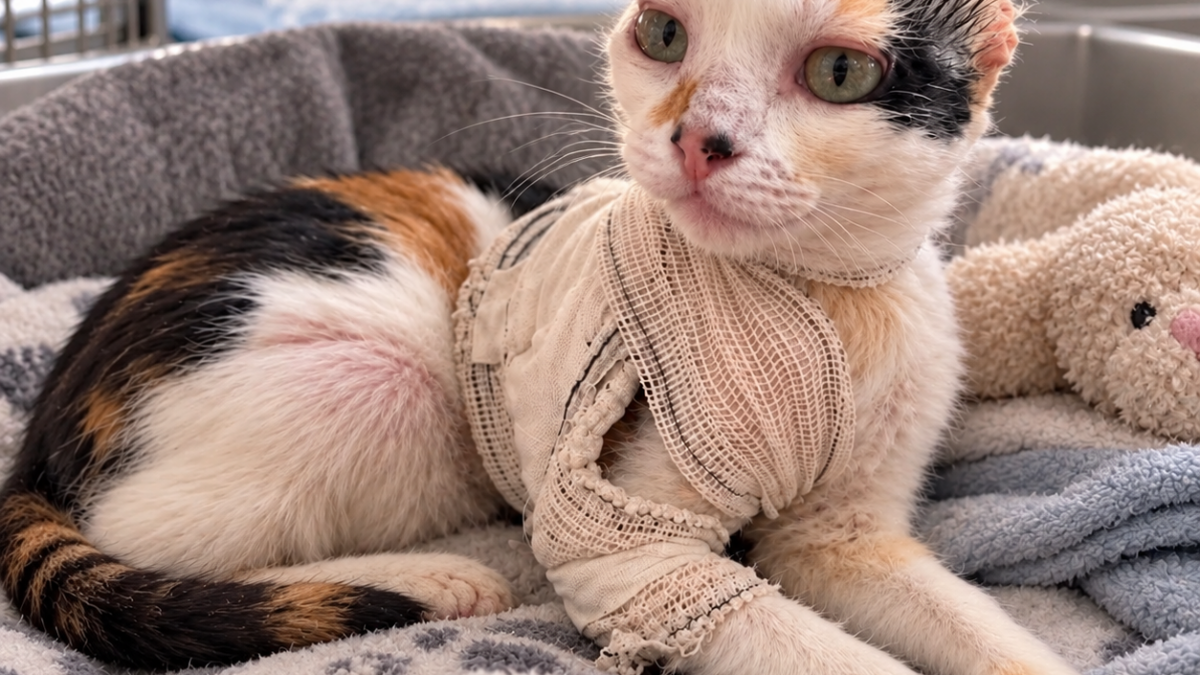
Cloe lay beneath blankets with bandages covering much of her little body. Only part of her face was visible.
She looked impossibly small.
“You made it this far,” I whispered through the glass. “You don’t get to quit now.”
One of her paws moved beneath the blanket.
I chose to believe she heard me.
At home, the garage felt different.
The towel I had first used was gone, taken to the clinic with her. But a few drops of blood and fluid remained on the concrete near the workbench.
Mark found me kneeling there at four in the morning.
“You need sleep.”
“I’m cleaning this.”
“It can wait.”
“No.”
He brought me a bucket.
Neither of us said much.
Afterward, I stood in the exact place where I had found her and looked toward the garage door.
How had she gotten inside?
The side door had been cracked open because Mark had taken recycling out earlier that evening. It was possible she had slipped through then.
But from where?
Our neighborhood consisted mostly of modest single-family homes built in the late 1980s. Behind us was an older row of rental houses and several detached garages.
There had been no large fires that night.
No sirens.
No smell of smoke.
Nothing.
I stepped outside.
The temperature had fallen below freezing.
I stared down the driveway.
For Cloe to arrive in the condition she had been in, she had either traveled farther than seemed possible, or whatever happened to her had happened close by.
At 6:17 that morning, my phone rang.
I answered before the second ring.
“Emily?”
“Yes.”
“This is Dr. Patel from the emergency clinic.”
My legs went weak.
Mark sat up immediately.
“She’s still with us,” Dr. Patel said.
I shut my eyes.
“Okay.”
“The night was difficult. Her temperature dropped once, but we were able to stabilize her. She’s resting.”
“Can I come?”
“Yes.”
I was dressed in less than three minutes.
When we arrived, Cloe looked worse than I remembered.
The bandages made the injuries seem larger somehow.
Dr. Patel met us beside her enclosure.
“We estimate burns affect close to forty percent of her body.”
I stared at her.
“Forty?”
“Yes.”
“How does something this little survive that?”
Dr. Patel looked at Cloe.
“Sometimes they surprise us.”
She explained the treatment plan. Wound management. Fluids. Pain control. Antibiotics if indicated. Careful nutrition. Frequent examinations. Later, if Cloe stabilized enough, additional therapies could support healing.
“How long?” I asked.
“Weeks at minimum.”
“And if something goes wrong?”
“We deal with it when it happens.”
I appreciated that answer.
Not because it comforted me.
Because it did not pretend.
I reached one finger through the enclosure.
Cloe smelled it.
Then, very carefully, she touched her nose against me.
Rachel laughed softly behind us.
“She likes you.”
“I think she’s confused.”
“No,” Rachel said. “Cats are many things. Confused about who makes them feel safe usually isn’t one of them.”
That sentence stayed with me.
We visited every day.
Sometimes twice.
There were days when improvement could be measured in something as tiny as eating one more spoonful of food.
Other days, nothing seemed to improve.
On the third night, Cloe developed a fever.
I got the call shortly before midnight.
“We’re adjusting treatment,” Dr. Patel said. “I wanted you to know.”
“Is it infection?”
“It may be.”
“Is she dying?”
A pause.
“She is still fighting.”
I drove to the clinic alone because Mark had an early shift and I refused to wake him.
Rachel let me sit beside Cloe’s enclosure after asking me not to touch the dressings.
I sat on the floor.
Cloe did not lift her head.
I talked anyway.
I told her ridiculous things.
I told her about the squirrel that stole birdseed from our porch. I told her Mark snored but denied it. I told her there was a sunny window in our living room that I suspected she would approve of. I told her I had bought her a little stuffed mouse even though I had no idea whether she would ever be strong enough to play with it.
Then my voice broke.
“Please don’t make me take that stupid mouse back.”
Cloe’s eye opened.
Only for a second.
But it opened.
I laughed and cried at the same time.
“All right,” I whispered. “That’s a deal, then.”
Rachel brought me coffee.
“You should go home.”
“I know.”
I stayed another hour.
The fever came down by morning.
On the fifth day, an animal control officer called me.
His name was Daniel Ramirez.
The veterinary clinic had made a report because of the severity of Cloe’s injuries and because her owner was unknown.
“I’m not saying a crime occurred,” he told me on the phone. “I want to make that clear.”
“I understand.”
“But when an animal arrives with injuries like these and there’s no explanation, we document.”
“Good.”
“Can I look at where you found her?”
“Absolutely.”
He came that afternoon.
Daniel was quiet, observant, and far less dramatic than the animal investigators shown on television. He photographed the garage floor. He measured the distance from the side door to the workbench. He walked the driveway.
“Did you smell smoke?”
“No.”
“Hear fireworks?”
“A few earlier in the evening, but nothing near the house.”
“Anyone burning trash?”
“Not that I saw.”
“Do you have security cameras?”
“One over the front door.”
“Garage?”
“No.”
He looked disappointed.
“What about neighbors?”
“I don’t know.”
“We’ll ask.”
Before leaving, he turned back toward me.
“One thing.”
“Yes?”
“If someone contacts you claiming she belongs to them, don’t hand her over.”
My stomach tightened.
“You think that could happen?”
“It happens.”
“What do I do?”
“Call me.”
I nodded.
He handed me a card.
Then he added, “And don’t accuse anyone publicly. We don’t know what happened.”
“I won’t.”
I meant it.
At least then I did.
For the next week, my life divided itself into two categories: things involving Cloe and things that felt like distractions from Cloe.
Work was something I did between clinic visits.
Dinner was something Mark reminded me to eat.
Sleep happened occasionally.
New Year’s Eve passed with us sitting beside Cloe instead of going to my sister’s party. By then, she could lift her head more easily.
“You know,” Mark told her through the enclosure, “you owe me a New Year’s kiss.”
Cloe stared at him.
“She said no,” I said.
“She’s considering it.”
“She definitely said no.”
He leaned closer.
Cloe sneezed.
I laughed harder than I had in days.
The sound startled me.
I had forgotten laughter could exist in the same world as all that fear.
Two days later, Dr. Patel let me watch one of Cloe’s dressing changes from a distance.
I almost wished I had not.
Even with pain medication, Cloe trembled.
Rachel spoke to her constantly.
“There you go, sweetheart. You’re okay.”
Cloe’s paws tightened against the towel.
I stood near the wall with both hands over my mouth.
Then Cloe turned her head.
She saw me.
And something happened that I will remember for the rest of my life.
She stopped struggling.
Not entirely.
But enough.
“Talk to her,” Rachel said.
“What?”
“She knows your voice.”
I moved closer.
“Hey, Cloe.”
Her eye stayed fixed on me.
“I’m right here.”
Rachel continued working.
“You’re doing so good,” I whispered. “I know it hurts.”
Tears ran down my face.
“But you’re not alone anymore.”
Cloe slowly lowered her head onto the towel.
Rachel glanced at me.
“She believes you.”
That nearly destroyed me.
Because what had I done to deserve that belief?
Nothing.
I had opened a garage door.
That was all.
Yet somehow this animal, after whatever had happened to her, had decided to trust me with what little she had left.
By mid-January, Cloe had survived the most immediate danger.
Survived.
Not recovered.
There was an enormous difference.
Some wounds were beginning to close. Others required continued treatment. Her right eye still worried the veterinary team, although the swelling had begun to improve. Her ears had been badly damaged. Dr. Patel warned me they might never look the way they once had.
“I don’t care what they look like.”
“I know.”
“Will they hurt forever?”
“That’s what we’re trying to prevent.”
That was all I cared about.
I had stopped thinking of her as beautiful or damaged.
She was simply Cloe.
And Cloe deserved a body that did not hurt every time she moved.
The investigation, meanwhile, seemed to be going nowhere.
Daniel had spoken with neighbors.
No one knew the kitten.
No one reported a house fire.
No missing-kitten notices matched her.
She had no microchip.
Then, eighteen days after Christmas, Daniel called.
“Can you meet me?”
My heart jumped.
“Did you find something?”
“Maybe.”
He came to our house carrying a tablet. Mark was at work. We sat at the kitchen table.
“A neighbor two streets over has a doorbell camera angled partly toward the road,” Daniel said.
He opened a video.
The timestamp read December 25.
8:43 p.m.
The quality was poor.
A dark pickup drove slowly through the frame.
It stopped.
For several seconds, nothing happened.
Then the passenger door opened.
Someone leaned down.
The camera could not capture the person’s face clearly.
Something small was placed on the edge of the road.
The door closed.
The truck drove away.
My skin went cold.
Daniel froze the video.
The small shape moved.
Barely.
“What is that?” I asked.
“We don’t know.”
I stared.
“Is that Cloe?”
“We can’t prove it from this footage.”
The shape limped toward the sidewalk.
I covered my mouth.
“Where is this?”
“About three blocks from your house.”
Three blocks.
Cloe had walked three blocks.
In December.
With burns covering nearly half her body.
“Play it again.”
“Emily—”
“Please.”
He did.
Truck.
Stop.
Door.
Tiny shape.
Drive away.
I watched it four times.
By the fifth, I could no longer breathe normally.
“Someone dumped her.”
“It appears someone left an animal.”
“Daniel.”
“I understand what it looks like.”
“They dumped her.”
“We need evidence before I can tell you that animal was Cloe.”
“What else could it be?”
“That’s why we’re working on it.”
“Can you read the license plate?”
“Not from this camera.”
“Then find another one.”
His expression remained calm.
“We are.”
I stood.
Three weeks of exhaustion, fear, and helplessness suddenly turned into something hot.
Anger.
“What kind of person sees an animal burned like that and puts her on the side of a road?”
“We don’t know what happened before that video.”
“She could barely walk.”
“I know.”
“They drove away.”
“I know.”
“She could have frozen to death.”
“I know.”
I slammed my palm against the table.
Daniel waited.
Then he said quietly, “That anger is exactly why I need you to let me do my job.”
I looked away.
“If we identify the vehicle, evidence matters. What you post online matters. What you say to neighbors matters. If this becomes a case, I don’t want anyone claiming they were harassed or that evidence was contaminated.”
“I’m not going to harass anybody.”
“Good.”
“But if that was Cloe—”
“I know.”
No, I thought.
You don’t.
Later, I realized he did.
He had simply learned to carry anger differently.
That afternoon, I went directly to the clinic.
Cloe was awake. The technicians had placed the soft toy beside her, the stuffed mouse I had bought and then been afraid to hope she would ever touch.
For nearly three weeks, it had sat untouched.
I put my fingers near the enclosure.
“Hey, troublemaker.”
Cloe shifted.
Then she lifted one front paw.
Slowly.
Awkwardly.
She reached toward the mouse.
Her paw landed short.
She tried again.
The second time, she touched it.
Rachel gasped.
“Oh my God.”
Cloe tapped the mouse.
Barely enough to move it.
Rachel started crying.
I did too.
“You did it,” I whispered.
Cloe tapped it again.
That tiny movement became one of the greatest victories I had ever witnessed.
There were no cheering crowds.
No dramatic music.
Just a burned kitten touching a stuffed mouse.
But three weeks earlier, we had wondered whether she would live through the night.
Now she wanted to play.
Hope does not always arrive like lightning.
Sometimes it moves a toy half an inch across a veterinary blanket.
From that day forward, Cloe seemed determined to collect small victories.
She stood longer.
She ate more.
She began grooming the areas of fur she could safely reach.
She discovered that Rachel kept treats in the right pocket of her scrub top and would stare shamelessly at that pocket whenever Rachel entered.
“She’s manipulating you,” I said.
Rachel handed her a treat.
“I’m aware.”
“You’re encouraging it.”
“I’m also aware.”
Cloe chewed happily.
Dr. Patel started laser therapy as part of her treatment plan. The first session worried me because almost everything still worried me.
Cloe surprised us by relaxing.
Eventually, she became so comfortable during some treatments that she slept.
The first time I saw her do it, I stood in the doorway for several seconds without speaking.
Her little body was stretched on a padded surface.
Her breathing was slow.
Her eye was closed.
Rachel worked beside her.
“She’s asleep?”
“Completely.”
“How?”
“She trusts us.”
There was that word again.
Trust.
People talk about animals forgiving humans as though forgiveness is something simple.
I do not think that is what Cloe was doing.
She did not know humanity as an abstract idea.
She knew hands.
Some hands had failed her.
Now other hands brought food.
Other hands changed bandages.
Other hands lifted her gently.
Other hands stopped when she was scared.
Maybe trust was not forgetting the hands that hurt.
Maybe trust was learning that not every hand would.
Three days later, Daniel called again.
This time, his voice was different.
“We identified the pickup.”
I sat down.
“Who?”
“I can’t give you everything yet.”
“Is it somebody near us?”
“Yes.”
“Do they own Cloe?”
“We’re looking into that.”
“Daniel.”
“Emily.”
I hated when he used the same tone on me that I used on frightened patients at the dental office where I worked.
“What can you tell me?”
“The truck belongs to a man named Derek Lawson.”
I knew the name.
Not well.
He rented a small house behind the row of properties west of our neighborhood. I had seen him maybe twice. Ordinary man. Ordinary truck. The kind of person who could stand in line behind you at the grocery store and never make you wonder what he might be capable of leaving behind.
“Does he have cats?” I asked.
“We have information suggesting kittens were present on the property.”
My throat tightened.
“Was there a fire?”
A pause.
“We found evidence of a small fire in an outbuilding.”
I stood so fast my chair scraped the floor.
“When?”
“December twenty-fourth.”
Christmas Eve.
Cloe had entered my garage Christmas night.
“What happened?”
“That’s what we’re determining.”
“Did he burn her?”
“We do not have evidence that anyone intentionally burned her.”
The distinction mattered.
Even to me.
“So it could have been an accident.”
“Yes.”
I sat again.
For one brief moment, some of my anger loosened.
Accidents happen.
Space heaters malfunction.
Wires short.
Candles fall.
People make terrible mistakes.
If Cloe had been injured accidentally, that was horrible.
But an accident was not cruelty.
Then I remembered the video.
“But after the fire?”
Daniel did not answer immediately.
“After the fire, somebody put an injured animal beside a road.”
My anger returned.
“What did Derek say?”
“I haven’t interviewed him formally yet.”
“Why are you telling me?”
“Because you are caring for the animal, and there may be an ownership issue.”
“What ownership issue?”
“If he claims her.”
“No.”
“Emily—”
“No.”
My voice shook.
“He left her.”
“If evidence establishes that, it will be addressed.”
“He does not get to walk into that clinic and take her.”
“No one is handing her over today.”
“Promise me.”
“I can promise the case is being handled.”
“That isn’t what I asked.”
“It’s what I can promise.”
For the first time since meeting him, I wanted to hang up on Daniel.
Instead, I asked, “What should I do?”
“Exactly what you’ve been doing.”
“Take care of her?”
“Yes.”
I looked toward the little cat bed sitting beside our fireplace.
I had bought it even though Cloe had never been inside our house.
I had begun buying things for a future I was afraid to admit I wanted.
“Okay,” I said.
“Emily.”
“Yes?”
“If the facts are what they appear to be, you’re not the only person who will be angry.”
The interview happened two days later.
I was not there.
Daniel told me afterward that Derek admitted a fire had occurred in his detached workshop. Several stray cats had been sheltering around his rental property. He claimed he had occasionally fed them. Cloe may have been one of them.
The workshop fire had started accidentally, possibly from an old portable heater.
Derek said he found Cloe afterward.
Alive.
Burned.
Afraid.
He claimed he did not have money for veterinary care.
So he put her in his truck.
For one moment when Daniel told me that, I thought perhaps Derek had tried. Perhaps he had been driving to a shelter. Perhaps something complicated had happened.
Then Daniel finished the sentence.
Derek admitted he had driven Cloe away from his property because he “couldn’t deal with it.”
He left her near our neighborhood.
No call to animal control.
No emergency clinic.
No shelter.
No knock on a door.
He drove away.
I could not speak.
Daniel was silent on the phone.
Finally, I said, “He knew.”
“Yes.”
“He knew she was burned.”
“Yes.”
“He saw her.”
“Yes.”
“And he left her.”
“That is what he admitted.”
I pressed my hand against my forehead.
In my imagination, Cloe had always emerged from darkness. I had wondered if she crawled from beneath a burned shed, if she had been wandering for days, if she had been born wild.
The truth was somehow worse because another person had held the answer in his hands.
He had seen her suffering.
He had possessed a truck.
A phone.
Roads leading to emergency clinics.
He had options.
He simply decided Cloe was a problem he did not want.
“Why near my house?”
“He said he chose a residential area because he assumed someone would find her.”
I laughed once.
There was no humor in it.
“At night?”
“Yes.”
“In freezing weather?”
“Yes.”
“He didn’t even knock?”
“No.”
My eyes filled.
“What if my garage door had been shut?”
Daniel did not answer.
“What if Mark hadn’t left the side door open?”
Silence.
“What if she went the other direction?”
“I know.”
“No, I need him to answer that.”
“He may have to answer questions in court.”
That was the first moment I understood this was no longer just an investigation.
“You’re charging him?”
“I’m submitting the case.”
“With what?”
“Animal abandonment and neglect are being reviewed. The prosecutor decides what moves forward.”
It was not the dramatic justice I had imagined during sleepless nights.
There were no handcuffs at the door.
No courtroom thunder.
There was paperwork.
Statements.
Photographs.
Veterinary records.
Video.
Receipts.
A timeline.
But perhaps that was what justice looked like before television edited it.
Slow.
Methodical.
Unexciting.
And absolutely necessary.
When I went to see Cloe that evening, I did not tell her any of it.
I sat beside her.
She reached toward me through the enclosure.
“You know something?” I whispered.
Her paw touched my finger.
“You were never the problem.”
She blinked.
“You hear me? You were never too expensive. You were never too damaged. You were never too much trouble.”
My voice cracked.
“Someone was too cowardly to help you. That was never the same thing.”
Cloe began purring.
It was still a faint purr then.
More vibration than sound.
I leaned my forehead against the enclosure.
“I’m sorry he left you.”
The purring continued.
“But I’m glad you walked toward my house.”
By February, Cloe had gained weight.
Soft fur began growing around portions of her neck and back. The new growth was uneven. Some areas remained scarred. Her ears would always carry visible damage.
But when I looked at her, I no longer saw the kitten from Christmas night.
I saw personality.
A lot of personality.
She hated one particular flavor of cat food and demonstrated this by carefully pushing the bowl away with one paw. She loved chicken. She adored fleece blankets. She considered pens stolen from the veterinary desk to be legitimate prey.
She had learned that acting weak around Mark caused him to immediately produce treats.
“You realize she can walk perfectly well now,” I told him one afternoon.
Cloe was sitting beside him at the clinic.
“She limped,” he said.
“She did not.”
“She absolutely did.”
“Mark, I watched her sprint toward Rachel five minutes ago.”
Cloe looked up at him.
He gave her chicken.
I stared.
“You’re hopeless.”
“She has been through a lot.”
“She has you trained.”
Cloe ate the chicken.
Mark smiled smugly.
“I’m comfortable with our arrangement.”
For the first time, healing began to feel real.
Then came a setback.
One area along Cloe’s side stopped improving the way Dr. Patel expected. The tissue looked irritated. The possibility of another infection returned.
I had become too comfortable.
That was my mistake.
The moment Dr. Patel said, “I want to watch this closely,” every nightmare from December returned.
I sat in my car afterward and cried.
Mark found me there.
“What happened?”
I told him.
“Does Patel think it’s serious?”
“She doesn’t know.”
“So we don’t know.”
“I can’t do this again.”
He leaned against the open door.
“Yes, you can.”
“I thought we were past this.”
“Past what?”
“Losing her.”
His expression changed.
“Emily.”
“I know. Nobody said she was dying.”
“Exactly.”
“But I finally let myself believe she was going to come home.”
There.
I had said it.
Come home.
Not go to a foster home.
Not be adopted.
Home.
Our home.
Mark looked at me for several seconds.
“Was there ever actually another plan?”
I wiped my face.
“What?”
“You’ve already bought three beds.”
“She needs options.”
“You bought a climbing tower.”
“It was on sale.”
“You put her name on the emergency contact sheet on our refrigerator.”
“That’s practical.”
“You’ve watched forty-seven videos about introducing a cat to a house.”
“I like being prepared.”
“And yesterday you told my mother she had a granddaughter.”
I stared at him.
“Did I?”
“You did.”
I started laughing through my tears.
Mark crouched beside me.
“She’s coming home when Patel says she’s ready.”
“You’re okay with that?”
He looked offended.
“I’ve been sneaking her chicken for six weeks.”
“Exactly. You’re a terrible influence.”
“I’m her father.”
That settled it.
Cloe was ours.
The setback lasted nine frightening days.
Treatment was adjusted. Her skin responded. The threatened infection did not become the catastrophe I feared. Cloe continued healing. Her right eye slowly returned closer to its normal shape. She could walk without the trembling weakness I remembered from Christmas.
Then one Thursday morning, Dr. Patel called.
“I have something I think you’ll want to hear in person.”
My chest tightened.
“Good or bad?”
She laughed.
“Good.”
I was at the clinic twenty minutes later.
Cloe was sitting on an examination table.
No heavy body wrapping.
Only smaller protected areas remained.
I stopped in the doorway.
For a second, I could see both versions of her.
The kitten under my workbench.
And the cat sitting before me.
“Look at you.”
Cloe stood.
Then she walked toward me.
Not limped.
Not stumbled.
Walked.
She rubbed her face against my hand.
I completely lost composure.
Rachel laughed.
“I knew you were going to cry.”
“You’re crying.”
“I’m crying because you’re crying.”
Dr. Patel smiled.
“We’re comfortable transitioning her out of continuous hospitalization.”
I stared.
“You mean—”
“She can go into home care.”
“Today?”
“If you’re ready.”
I looked at Cloe.
“Ready?”
Mark appeared behind me carrying the cat carrier we had bought two weeks earlier.
Apparently Dr. Patel had called him too.
“You traitors,” I said.
Rachel grinned.
“We planned it.”
Cloe meowed.
It was louder than the broken sound I had heard Christmas night.
A real voice.
“Well,” Mark said, “apparently she’s ready.”
The veterinary team spent nearly an hour teaching us what to do.
Medication schedules.
Areas to monitor.
Follow-up appointments.
Restrictions.
Signs of infection.
How to keep her from damaging delicate healing skin.
I wrote everything down even though they provided printed instructions.
When it was finally time to leave, Rachel picked Cloe up.
Cloe immediately tucked her face against Rachel’s chest.
Rachel’s eyes filled.
“I’m going to miss you, little monster.”
Cloe purred.
“You scared ten years off my life.”
Another purr.
Rachel kissed the top of her head where the fur had returned.
Then she handed her to me.
The weight of Cloe in my arms stunned me.
The first time I held her, she had felt almost weightless.
Fragile.
Cold.
Now she was warm.
Solid.
Alive.
“You ready to go home?”
Cloe looked at me.
Mark opened the carrier.
She refused to enter it.
After ten minutes of negotiation, two treats, and one failed attempt involving a towel, Rachel laughed.
“She survived forty-percent burns and now her greatest enemy is apparently a plastic box.”
Eventually, we succeeded.
On the drive home, I sat beside the carrier.
At the same intersection where Cloe had opened her eyes on Christmas night, the light turned red.
I looked at her through the carrier door.
“Remember this?”
She meowed.
“I’m choosing to interpret that as yes.”
When we pulled into our driveway, I became emotional again.
The garage door stood closed.
Behind it was the workbench.
The concrete floor.
The place where one life had nearly ended and another had begun.
Mark carried the supplies.
I carried Cloe.
I did not take her through the garage.
I carried her through the front door.
“You came in as family,” I told her. “You’re leaving through that garage never.”
We had prepared the spare bedroom for her.
A low bed.
Food.
Water.
Litter box.
Blankets.
Toys.
No dangerous surfaces.
No unnecessary climbing until the veterinary team cleared her.
Cloe stepped from the carrier.
She stood still.
I sat on the floor.
Mark sat several feet away.
We let her decide.
She smelled the carpet. The blanket. A toy. The leg of the nightstand.
Then she walked directly to me.
She climbed carefully into my lap, turned in a circle, and lay down.
Mark wiped his eyes.
“Don’t.”
“I’m not doing anything.”
“You’re crying.”
“There’s dust.”
“In the spare bedroom?”
“A lot of dust.”
I laughed quietly.
Cloe closed her eye.
Within minutes, she was asleep.
Her first sleep in our home lasted almost four hours.
I barely moved.
My leg went numb.
My back hurt.
I did not care.
Every few minutes I looked down and watched her breathe.
At one point Mark whispered, “You can put her in the bed.”
“No.”
“You can’t feel your foot.”
“I don’t need it.”
Cloe slept.
No trembling.
No clinic sounds.
No treatment table.
No strange people passing.
Just warmth.
That afternoon, sunlight moved slowly across the carpet until it touched her body.
She stretched toward it.
For the first time, I saw Cloe sleeping in a patch of sunlight.
I remembered promising her there was a sunny window waiting.
“I told you,” I whispered. “I told you there was one.”
Home care was not effortless.
Cloe still required regular veterinary visits. There were medications she disliked. There were moments when healing skin bothered her. There were nights when I woke because I thought I heard her crying, only to discover her asleep beside the bed.
I suspect those nights were more about my trauma than hers.
Cloe adapted faster than I did.
She learned the house.
She learned the sound of the refrigerator opening.
She learned Mark came home at 5:40 most evenings.
By 5:35, she waited near the door.
“She likes me more,” he announced.
“You have chicken.”
“Love is love.”
She learned sunbeams moved.
At first, she seemed offended by this fact.
Every afternoon, she would settle in one patch of light only to discover twenty minutes later that it had shifted. Eventually, she learned to follow it. I would watch her move from place to place across the living-room rug.
A little farther each time.
A completely ordinary cat doing a completely ordinary thing.
There was nothing ordinary about what it meant to me.
Meanwhile, the legal case moved forward.
Derek tried to minimize what he had done. According to Daniel, he argued that he believed someone in the neighborhood would help Cloe.
That defense made me angrier than if he had simply admitted he had not cared.
Helping Cloe himself had been possible.
He had chosen to transfer responsibility to a stranger who did not even know she existed.
He had gambled her life on the chance that somebody might notice.
Daniel asked me to write a statement describing the night Cloe arrived.
I sat at the kitchen table for two hours and could not finish the first paragraph.
How do you translate something like that into legal language?
Animal located at approximately 9:30 p.m.
That sentence did not explain her eyes.
Animal appeared severely injured.
That did not explain the sound she made beneath the workbench.
Animal transported to emergency veterinary facility.
That did not explain me counting breaths at red lights.
Mark sat across from me.
“Write what happened.”
“I am.”
“No. You’re writing what you think court sounds like.”
I looked at him.
“What should I write?”
“What you remember.”
So I started again.
I wrote about the cold.
The cracked garage door.
The broken sound.
The towel.
The way Cloe walked toward me when every reasonable instinct should have told her to run.
I wrote about asking whether she would live.
I wrote about the fever.
The dressings.
The first toy.
The sunlight.
Then I wrote the sentence that mattered most.
Whoever left her beside that road could not have known my garage door would be open.
I read it twice.
That was the truth.
No matter what Derek told himself afterward, he could not have known.
Cloe lived because of a chain of accidents.
Mark forgot to latch the side door.
I remembered ornaments in the garage.
I heard a sound.
I looked beneath the workbench instead of assuming it was a mouse.
The clinic was open.
The veterinary team was ready.
Her body endured.
Change one thing and the story could have ended on Christmas night.
I sent the statement to Daniel.
The hearing was scheduled for spring.
I expected to feel triumphant.
Instead, I felt sick.
By then, Cloe had become energetic enough that the veterinary team allowed her more freedom.
The first time she ran from one side of our living room to the other, Mark and I cheered like parents at a graduation.
Cloe stopped.
Looked at us.
Then ran again.
“She knows,” Mark said.
“She likes applause.”
We clapped.
She sprinted back.
That became a game.
Her fur continued returning, although scars remained visible. Her ears looked different. They always would.
Sometimes strangers saw her and immediately asked, “What happened?”
I learned to choose my answers depending on the person.
“She survived burns.”
That was usually enough.
If they looked at her with pity, I wanted to correct them.
Do not pity her.
Admire her.
Cloe did not live like a victim.
She attacked shoelaces.
Stole socks.
Knocked a Christmas ornament from a box in March and then looked insulted when it broke.
She once dragged an entire roll of paper towels down the hallway while Mark was on a conference call.
He came into the room holding the shredded roll.
“Your daughter.”
“Our daughter when she’s sleeping. My daughter when she’s behaving. Your daughter when she does this?”
“Yes.”
Cloe pounced on a strip of paper towel.
Mark sighed.
“I can’t even be mad.”
The hearing took place in April.
I almost did not attend.
Daniel told me I was not required to sit through everything, but I needed to see the end of the part of Cloe’s story she could not speak about herself.
The courthouse was smaller than I expected.
No dramatic columns.
No television cameras.
Just fluorescent lights, hard benches, and people waiting for their names to be called.
Derek sat across the room.
I recognized him immediately from around the neighborhood.
He looked ordinary.
That bothered me.
Some irrational part of me had wanted a monster. Someone whose appearance would explain how a person could look at an injured kitten and leave her beside a road.
Instead, he looked like somebody you might stand behind at a grocery store.
He glanced at me once.
Then away.
My hands shook.
Daniel noticed.
“You okay?”
“No.”
“That’s allowed.”
“I want to ask him something.”
“Don’t.”
“I know.”
But I did.
I wanted to walk across that room and ask whether Cloe cried in his truck. I wanted to ask whether she looked at him the way she had looked at me. I wanted to know whether he saw her trembling when he put her down. I wanted to ask how far he drove before he convinced himself she was no longer his responsibility.
Most of all, I wanted to ask whether he had looked in his rearview mirror.
But I stayed seated.
The case did not become a dramatic trial.
The evidence was strong enough that Derek eventually accepted responsibility rather than contest every allegation. The court considered the video, his admissions, the animal-control investigation, and Cloe’s veterinary documentation.
He faced penalties for abandoning an injured animal and failing to obtain necessary care.
There was restitution.
Probation.
Required animal-welfare conditions.
And restrictions that prevented him from simply bringing another animal into the same situation as though nothing had happened.
It was not enough for the angry part of me.
Nothing would have been.
You cannot sentence somebody to experience another creature’s pain.
You cannot make him feel every dressing change.
You cannot order him to lie awake wondering whether a fever will kill a three-pound kitten.
But when the judge addressed Derek, the room became completely still.
“You say you believed someone else would help.”
Derek looked down.
“Yes.”
The judge folded his hands.
“Someone else did help.”
My throat tightened.
“That does not excuse the fact that you chose not to.”
Derek said nothing.
The judge continued.
“An injured animal is not trash to be placed somewhere convenient in the hope that another person accepts the burden.”
I looked down because tears had filled my eyes.
For months, I had wanted somebody in authority to say exactly that.
Not because it would heal Cloe.
She was already healing.
Because responsibility needed a name.
Afterward, Derek walked out without looking at me.
I thought I would feel victorious.
I did not.
Daniel found me on the courthouse steps.
“You look disappointed.”
“I thought I’d feel better.”
“Most people do.”
“What?”
“Think they’ll feel better.”
I looked back at the courthouse.
“Does that mean it didn’t matter?”
“No.”
“Then why does it feel so small?”
“Because court can address what he did. It can’t undo what happened to her.”
I knew that.
“I wanted him to understand.”
“Maybe he does.”
“And if he doesn’t?”
Daniel shrugged.
“Cloe is still alive.”
I looked at him.
“That’s not revenge, Emily. It’s better.”
I did not understand what he meant until I got home.
Cloe was sitting in the front window.
The second she saw my car, she jumped down.
When I opened the door, she ran toward me.
Actually ran.
Her paws crossed the hardwood floor so fast she nearly slid into the wall.
I dropped my bag.
She climbed into my arms.
And suddenly I understood.
The man who had left her had become a paragraph in a court file.
Cloe had become an entire life.
He no longer mattered to her mornings.
He did not matter to the sunlight she chased across the floor.
He did not matter to her favorite blanket.
He did not matter to the chicken Mark pretended not to sneak beneath the table.
He did not matter when she climbed onto my chest at night and purred.
Justice mattered.
Accountability mattered.
But Cloe’s greatest victory was not watching somebody else lose.
It was discovering how much she still had left to gain.
By summer, the transformation was astonishing.
The kitten who once could barely place her paw against concrete now climbed onto the back of our couch to supervise the neighborhood. Her damaged right eye had improved dramatically. Her scars remained. Her ears remained visibly changed.
Nothing erased what happened.
But that was the strange thing about scars.
At first, I thought healing meant making Cloe look the way she might have looked if the fire had never happened.
Eventually, I understood that was impossible.
Healing was not returning to an untouched version of yourself.
Healing was building a life in the body that survived.
Cloe did that beautifully.
She became obsessed with a red feather toy. Every evening after dinner, she carried it into the living room.
If we ignored her, she dropped it on Mark’s foot.
If he continued ignoring her, she bit the feather and dragged it across his shoe.
“She’s subtle,” I said.
“She’s a terrorist.”
Cloe chirped.
“Don’t call our daughter a terrorist.”
“She has demands.”
“Then meet them.”
Mark picked up the toy.
Cloe crouched.
Her backside wiggled.
He flicked the feather across the rug.
She launched herself after it.
Watching her run remained something I never took for granted.
Maybe I never would.
One afternoon, Rachel came to visit.
Cloe heard her voice from the kitchen.
Her head snapped up.
Rachel barely made it through the doorway before Cloe ran to her.
“Oh!”
Rachel dropped to her knees.
Cloe climbed straight into her lap.
Rachel buried her face against Cloe’s neck.
“Do you remember me?”
Cloe purred loudly.
Rachel looked up at me with tears in her eyes.
“She remembers.”
“Of course she does.”
“I thought maybe she’d associate me with all the painful stuff.”
Instead, Cloe rubbed her face against Rachel’s chin.
Rachel laughed.
“She used to sleep during laser treatments.”
“I know.”
“I’ve treated hundreds of animals,” Rachel said, voice cracking. “This one got me.”
Cloe reached toward her scrub pocket.
Rachel stared.
“She still remembers where I kept treats?”
“Yes.”
“Unbelievable.”
She pulled one from her purse.
“I came prepared.”
That evening, we looked through photographs.
I had taken far more than I realized.
The early ones were difficult.
Cloe wrapped in bandages.
Cloe barely lifting her head.
Cloe asleep after treatment.
Then came the first toy.
The first time standing.
The first patch of new fur.
The first day without the heavy body wrapping.
The carrier.
The front door.
The sunbeam.
The red feather.
In one photograph, Cloe was stretched across Mark’s chest while he slept on the couch. Her paws were in the air.
Rachel laughed.
“Look at her.”
Mark glanced over.
“She owns the house now.”
“She earned it,” Rachel said.
Later, after everyone left, I found myself looking at the oldest photograph again.
Christmas night.
Someone at the clinic had taken it for the medical record.
Cloe’s face was visible above the towel.
Exhausted.
Frightened.
Alive.
I sat on the floor beside the couch.
Cloe wandered over.
She looked at the phone.
Then at me.
“That’s you.”
She sniffed the screen.
“You were very dramatic.”
Cloe climbed onto my leg.
“I was dramatic too.”
She settled.
I stroked the fur between her ears. There were places where hair would never grow normally. My fingers knew every one of them.
For a long time, I had been afraid touching those scars would remind her.
Maybe they reminded me more.
“I used to wish I could go back,” I whispered.
Cloe’s purr began.
“Not to change finding you.”
I smiled.
“I’d go back five minutes earlier. Or an hour. Or a day. I’d find you before you had to walk those three blocks.”
That was the part that still hurt.
No court order changed it.
Cloe had walked.
Somehow.
After being burned.
After being placed beside a road.
Through winter darkness.
Three blocks.
People often called it a miracle.
Maybe it was.
But I did not like giving all the credit to fate.
Cloe had done something too.
She had kept moving.
One paw.
Then another.
Past unfamiliar houses.
Past driveways.
Past Christmas lights.
Until she found a garage door that was not completely closed.
Sometimes survival is not one heroic decision.
Sometimes it is refusing to stop during a series of terrible minutes.
That was Cloe.
Refusing to stop.
Months after her adoption became official, Dr. Patel scheduled what she jokingly called Cloe’s “graduation appointment.”
No emergency treatment.
No major wound care.
Just a final assessment of the areas we had been monitoring.
I still felt anxious driving there.
Medical buildings had acquired emotional weight for me.
Cloe, on the other hand, was furious about the carrier.
She complained for the entire drive.
“I know.”
Meow.
“You’re being oppressed.”
Meow.
“I’m reporting myself to the authorities.”
MEOW.
When we entered the clinic, three technicians appeared from different rooms.
“Cloe!”
She stopped complaining immediately.
“Traitor,” I whispered.
Rachel took her.
Dr. Patel examined her carefully.
Weight.
Skin.
Eye.
Mobility.
Scarring.
General health.
Finally, she leaned back.
I held my breath.
“She looks wonderful.”
“Wonderful as in—”
“Wonderful.”
“Nothing alarming?”
“Nothing alarming.”
“What about this area?”
“Healthy scar tissue.”
“And her eye?”
“Stable.”
“Her ears?”
“Emily.”
I looked up.
Dr. Patel smiled.
“You can stop waiting for Christmas night to happen again.”
That sentence hit somewhere deep.
I looked at Cloe.
She was trying to steal a pen.
“I don’t know how.”
“You learn.”
“How?”
“The same way she did.”
I laughed softly.
“One day at a time?”
“One ordinary day at a time.”
Rachel returned with a small box.
“What’s that?”
“Graduation present.”
Inside was a new stuffed mouse.
The original one had become so battered that it barely resembled a mouse anymore.
They placed the new toy on the examination table.
For a moment, Cloe stared at it.
Then she lifted her paw.
Tap.
Every person in the room went silent.
I remembered the first time.
The weak paw.
The tiny movement.
Everyone crying because a kitten had touched a toy.
Cloe hit this one again.
Harder.
The mouse flew off the table.
Rachel burst out laughing.
“Well, that’s an upgrade.”
I picked Cloe up.
She purred against me.
“Yes,” I whispered. “It definitely is.”
We took a photograph outside the clinic.
Me holding Cloe.
Mark beside us.
Dr. Patel and Rachel behind.
Cloe looking slightly annoyed because she wanted to investigate a shrub.
It remains one of my favorite photographs.
Not because everyone looked perfect.
We did not.
I had been crying.
Mark’s shirt was wrinkled.
Rachel was laughing.
Cloe was trying to escape my arms.
It was perfect because everyone in that photograph had once stood in a room wondering whether she would survive.
Now we were struggling to make her hold still.
That was the kind of problem I had prayed for.
Autumn arrived.
Then December.
As Christmas approached again, I began thinking about the anniversary.
I did not want to.
But my body remembered before my mind did.
The temperature dropped and I felt anxious. Christmas songs played in stores and I remembered the emergency clinic. I pulled ornament boxes from the closet and remembered blood on concrete.
One evening Mark found me standing in the garage.
The workbench had not moved.
“Hey.”
“I’m okay.”
He stood beside me.
“I know.”
I looked underneath.
Empty.
“I hate this garage.”
“No, you don’t.”
“I did for a while.”
“So did I.”
“I keep seeing her there.”
Mark put his arm around me.
“Then maybe we change what you see.”
“How?”
He looked around.
Two days later, he brought home lumber.
“What are you doing?”
“Building something.”
“That narrows it down.”
He refused to explain.
Over the next weekend, he built a small insulated shelter near the safer side of our property for neighborhood strays, positioned away from traffic and equipped so food and water could be provided responsibly.
He added a camera.
I stared at it.
“You built a cat shelter?”
“No.”
“What is it?”
He screwed down the roof.
“Cloe’s Christmas annex.”
I laughed.
He added, “And this time the camera works.”
That first night, no cat visited.
The second night, a large orange tom investigated the entrance for eleven minutes and refused to go inside.
By the end of the week, he was sleeping there.
We named him Walter.
We worked with a local rescue to have him checked, vaccinated, neutered, and eventually placed with an older couple who adored him.
Then another cat appeared.
Then another.
We did not rescue dozens.
We did not become a shelter.
We simply stopped assuming suffering would announce itself loudly.
Sometimes it whispered beneath a workbench.
Christmas Eve came.
I barely slept.
At 8:43 p.m.—the timestamp from the video of Cloe being left beside the road—I found myself looking at the clock.
Mark noticed.
“You thinking about it?”
“Yes.”
Cloe was lying between us on the couch.
He reached down and stroked her.
“Look where she is now.”
“I know.”
“Really look.”
So I did.
Cloe had gained enough confidence that she slept in absurd positions. That night, she was on her back, paws curled toward her chest, completely vulnerable.
Completely safe.
Her scars were visible beneath the thinner fur along one side. One ear bent differently. Her right eye would never look exactly like the left.
And she was beautiful.
Not despite those things.
Not because suffering made her beautiful.
She was beautiful because she was Cloe.
A living animal who deserved love before she ever proved how strong she was.
The next evening—Christmas night, exactly one year after she had walked into our garage—I carried the old stuffed mouse into the living room.
Cloe saw it immediately.
Despite owning newer toys, she still loved that ugly thing.
I placed it on the floor.
She pounced.
Mark laughed.
“One year.”
“One year.”
We watched her wrestle the toy.
I remembered my first Christmas promise.
Stay with me.
That was all I had asked.
Cloe had done much more than stay.
She had healed.
She had trusted.
She had played.
She had turned a veterinary clinic into an extended family.
She had turned Mark into a man who carried emergency chicken in his jacket pocket.
She had turned my spare bedroom into her kingdom.
She had made an animal-control officer save her photograph on his phone.
Daniel had sent me a message earlier that day.
One year. How’s the survivor?
I answered with a photograph of Cloe attacking wrapping paper.
His response came almost immediately.
Looks dangerous.
I wrote:
Extremely.
Later that night, after our family left, I cleaned the kitchen.
The house became quiet.
Mark went upstairs.
I realized Cloe was missing.
“Cloe?”
Nothing.
I checked the living room.
Hallway.
Spare bedroom.
Then I knew.
The garage.
My heart jumped even though there was no reason to panic.
I opened the door.
Cloe was sitting near the workbench.
For one second, I could not move.
Same concrete.
Same shadows.
Same Christmas night.
But everything else was different.
She was healthy.
Her fur shone.
Her tail curled around her feet.
She looked up at me.
“Seriously?”
She meowed.
I sat on the floor.
Cloe walked toward me.
One confident step after another.
No stumbling.
No collapse.
She climbed into my lap.
I looked beneath the workbench.
A year earlier, I had knelt there and found suffering.
Now I was sitting in the same place holding the life that suffering had failed to destroy.
“You remember this place?”
Cloe rubbed her face against me.
“Probably not.”
Part of me hoped she did not.
I did not need her to remember.
I could remember for both of us.
I carried her toward the door.
Then stopped.
“Wait.”
I turned back toward the workbench.
There was one thing I had never said aloud.
Not there.
“Thank you.”
The words sounded strange in the empty garage.
Cloe looked at me.
I swallowed.
“Thank you for walking in.”
She purred.
Maybe that was ridiculous.
Maybe she had not chosen our house.
Maybe she simply saw shelter.
Warmth.
An open door.
But love often begins because somebody happens to find an open door at the exact moment they need one.
I took her inside.
Cloe jumped from my arms near the living room. She ran toward the stairs. Halfway there, she changed her mind and came back.
She looked at me.
“Chicken?”
Her head tilted.
I laughed.
“You really are shameless.”
She followed me into the kitchen.
I gave her a tiny piece.
She carried it away like a prize.
Then she returned for another.
Of course she did.
Years from now, Cloe’s scars may fade further.
Her fur may turn gray.
She may stop chasing toys as fast.
She may become the old cat sleeping in the same patch of afternoon sunlight where she first learned she was safe.
I know there will eventually come a day when looking at those photographs hurts for another reason.
That is the price hidden inside loving an animal.
Their lives are never long enough for us.
But I refuse to borrow grief from that future.
Cloe taught me better than that.
She does not live in Christmas night.
She does not wake every morning and ask why someone abandoned her.
She does not inspect her reflection and mourn the shape of her ears.
She wakes up hungry.
She wants sunlight.
She wants the red feather.
She wants Mark’s chicken.
She wants my lap when I am trying to work.
She lives inside the day she has been given.
Perhaps that is the final thing she taught me.
For months, I thought her story was about cruelty.
Then I thought it was about survival.
Then justice.
Then healing.
I was wrong every time.
Cloe’s story is about what happened after all those things.
Life.
Ordinary, annoying, funny, peaceful life.
That is the part people forget when they hear rescue stories.
They remember the terrible photograph.
The wound.
The cage.
The cold road.
But rescue is not supposed to end at the moment an animal stops dying.
The real goal is everything afterward.
A food bowl emptied at breakfast.
A veterinarian becoming someone the animal trusts enough to sleep beside.
A toy pushed across a floor.
A scar nobody needs to apologize for.
A front window.
A warm blanket.
A human saying, “Move, I need my pillow,” and then sleeping without the pillow because the cat refuses.
That is victory.
Not dramatic.
Not perfect.
But complete.
I once wanted revenge on the person who left Cloe beside that road.
I wanted him to understand precisely what he had almost destroyed.
I wanted some punishment large enough to balance her suffering.
There was no such punishment.
There never could be.
The law held him responsible for what it could prove.
That mattered.
He lost the privilege of pretending his decision had been harmless.
That mattered too.
But the most satisfying ending was something no courtroom could order.
Cloe stopped needing him to matter.
His decision became smaller every time she experienced something good.
He left her in darkness.
She found warmth.
He decided her pain was somebody else’s problem.
Dozens of people decided her life was worth their effort.
He drove away.
We stayed.
That was the only revenge I eventually needed.
One winter morning, long after her final major treatment, I woke to find sunlight pouring through the bedroom window.
Cloe was lying across my legs.
Her scars were warm beneath my hand.
I remembered Dr. Patel telling me I had to stop waiting for Christmas night to happen again.
Maybe I finally had.
Cloe opened her eye.
“Morning.”
She stretched.
Her front paws extended toward me.
Then she stood and walked across my chest because personal boundaries had never become part of her recovery plan.
“Ow.”
She meowed.
“Yes, breakfast. I know.”
She jumped down.
I followed her downstairs.
Halfway to the kitchen, she stopped beside the front window.
Snow had fallen overnight.
Cloe stared at it. She had seen snow before, but something about it fascinated her that morning. She placed one paw against the glass.
Outside, the neighborhood was quiet. The road where she had once been abandoned was hidden beneath white. Christmas decorations from several houses still hung along the street.
For a moment, I stood behind her and saw two worlds at once.
The one where a tiny burned kitten had been left outside and expected somehow to become someone else’s responsibility.
And this one.
Warm house.
Morning light.
Breakfast waiting.
A family behind her.
Cloe turned from the window.
She walked toward me.
Not because she was desperate.
Not because she hurt.
Not because she needed saving.
She simply wanted me.
I crouched.
She pushed her head against my hand.
And that was when I finally stopped seeing the kitten beneath the workbench.
I saw Cloe.
Only Cloe.
Healthy enough to be demanding.
Loved enough to be spoiled.
Safe enough to sleep through the night.
Confident enough to expect every door in this house to open for her.
The scars were still there.
They always would be.
Her ears would always carry the shape of what she survived.
But scars are evidence of injury.
They are not instructions for how the rest of a life must be lived.
Cloe proved that every day.
On Christmas night, she entered my garage with nearly forty percent of her tiny body burned.
She could barely walk.
No one knew whether she would survive.
She had every reason to fear human hands.
And still, when I reached toward her with a towel, she stepped toward me.
One step.
That was all.
One step toward a stranger.
One step toward warmth.
One step toward the possibility that the next pair of hands might be different from the last.
Everything came from that.
The emergency clinic.
Dr. Patel.
Rachel.
The treatments.
The nights beside her enclosure.
The stuffed mouse.
The first new fur.
The investigation.
The truth about the truck.
The courtroom.
The front door.
The sunbeam.
Home.
Sometimes I wonder what would have happened if I had gone to bed five minutes earlier that night.
I do not let myself wonder for long.
Instead, when Cloe falls asleep beside me, I put my hand lightly against her back and feel it rise.
Fall.
Rise.
Fall.
That is enough.
That is the answer.
She is here.
The kitten somebody left beside a freezing road is here.
The kitten doctors were afraid might not survive the week is here.
The kitten who once trembled through dressing changes now sleeps so deeply during afternoon naps that Mark has to check whether she is breathing.
The paw that once barely supported her now knocks pens from my desk.
The body that once seemed consumed by pain now races through our hallway at two in the morning for absolutely no reason.
And the frightened little animal who walked into my garage searching for shelter no longer has to search.
She found it.
She found us.
And somewhere along the way, we realized something else.
We had found her too.
So when people ask me what Cloe’s scars mean, I no longer tell them only about the fire.
I tell them about the Christmas night she refused to stop walking.
I tell them about veterinarians who would not give up.
I tell them about a technician who whispered to her through painful treatments until she learned that hands could be gentle.
I tell them about the first time she reached for a toy and made an entire room cry.
I tell them about the day she walked through our front door.
And I tell them about a little cat sleeping in sunlight as though safety had always belonged to her.
Because now it does.
Cloe will never know how many people once worried about whether she would see another morning.
She does not need to.
Her job is not to carry our memories.
Her job is to live.
To play.
To cuddle.
To steal chicken.
To chase sunlight.
To grow old in a house where no one will ever decide that helping her is too much trouble.
And if there is one promise I intend to keep for the rest of her life, it is the one I whispered during that first desperate drive through the empty Christmas streets.
“You found us.”
I thought I was comforting her then.
I understand those words differently now.
Cloe had spent that night searching for an open door.
What I did not know was that, once she walked through it, none of us would ever be the same.
That garage was not where Cloe’s story ended.
It was where pain finally stopped writing it.
And everything that came afterward belonged to her.
Every meal.
Every toy.
Every ridiculous sprint down the hallway.
Every warm lap.
Every quiet veterinary visit.
Every Christmas.
Every sunrise.
Every afternoon asleep beneath the window.
Every ordinary day.
Especially the ordinary days.
Because after everything Cloe survived, ordinary was the miracle she deserved most.
And this time, no one is leaving her behind.
Not ever.