A Biker Played Cars With My 4-Year-Old Leukemia Son Every Day for a Year—Then a Nurse Told Me Who the Toys Really Belonged To
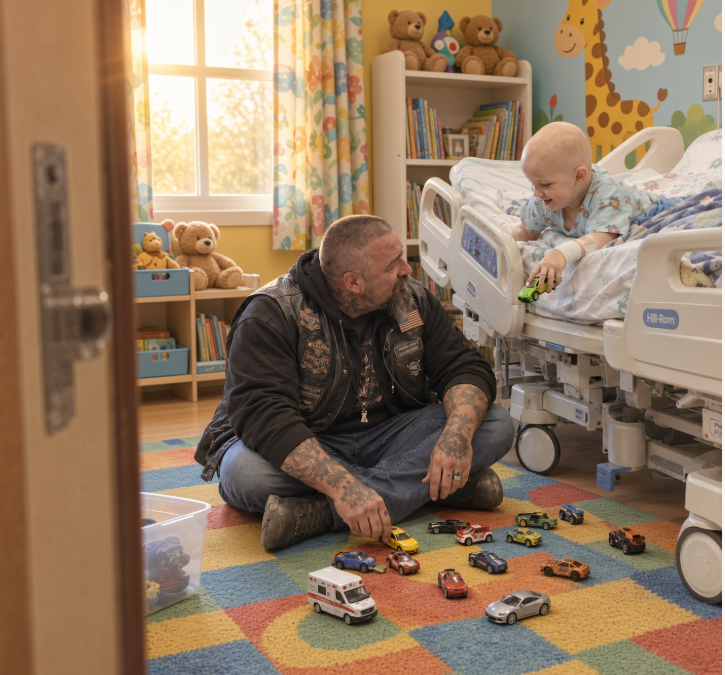
A Biker Played Cars With My 4-Year-Old Leukemia Son Every Day for a Year—Then a Nurse Told Me Who the Toys Really Belonged To.
For nearly a year, a huge tattooed biker came to my four-year-old son’s cancer room every single day, sat cross-legged on the cold hospital floor, and made him laugh when chemotherapy had stolen almost everything else from him.
I thought Wade was simply a kind volunteer until I learned that the toy cars he brought weren’t donations at all—they had belonged to his five-year-old daughter, who had died from the same leukemia in the exact room where my son was sleeping.
Then I discovered why Wade had chosen my little boy out of every child on the oncology floor, and the secret he had carried back into that room for three years nearly broke both of us.
The first thing leukemia stole from Eli was his laugh.
Not his hair.
That came later.
Not his appetite.
That disappeared gradually.
Not even his energy, though I can still remember the first morning he didn’t sprint from his bedroom pretending to be a race car.
It was his laugh.
My son had always laughed with his entire body.
Eli was the kind of four-year-old who could fall off a kitchen chair, scare ten years off my life, then lie on the floor laughing because the spoon landed on his head.
He laughed when our dog sneezed.
He laughed at his father’s terrible impressions.
He laughed every time I tried to sing.
He laughed hardest at his own jokes, most of which made absolutely no sense.
Then, two weeks after his fourth birthday, a pediatrician stared too long at a blood test.
And suddenly everything changed.
The bruises had been the first sign.
Tiny purple marks on Eli’s legs.
Then bigger ones.
I thought he had gotten them playing outside.
My husband, Mark, joked that four-year-old boys were ninety percent bruises.
Then came the fevers.
Nothing frightening at first.
99.8.
100.4.
They came and went.
Eli got pale.
He stopped eating peanut butter sandwiches, which should have been my first proof that something was terribly wrong because that child would have traded me for peanut butter if given the opportunity.
Then one Saturday morning, while he was sitting on the living room carpet pushing toy cars around, his nose started bleeding.
It wouldn’t stop.
Not for five minutes.
Not for ten.
By the time we reached urgent care, there was blood down the front of his dinosaur pajamas.
The doctor ran bloodwork.
Then ran it again.
PART2:
Then came into the little exam room and closed the door.
That door closing is one of those sounds you never forget.
“We need you to take Eli to Children’s.”
Mark frowned.
“Tonight?”
“Now.”
Something in the doctor’s face emptied my lungs.
“What’s wrong?”
He sat down.
“There are abnormalities in his blood counts.”
“What abnormalities?”
“His white blood cell count is extremely elevated, and his platelets are very low.”
I looked at Eli.
He was sitting on the examination table making the paper covering crinkle beneath his hands.
He held up a sticker the nurse had given him.
“Mommy, look.”
I smiled at him.
Then turned back.
“What does that mean?”
The doctor paused.
PART3:
“We need specialists to determine that.”
That sentence meant cancer.
Nobody had said the word.
But somehow I knew.
Maybe mothers know before language catches up.
We drove to Children’s in silence.
Eli sat in the back seat asking questions.
“Are we getting French fries?”
“No, baby.”
“Can we get French fries after?”
“Maybe.”
“Is Daddy coming?”
“He’s right behind us.”
Mark was driving his truck because one of us might need to leave later.
I remember thinking how ridiculous that was.
Planning logistics.
Cars.
Parking.
Work schedules.
We had no idea our old life had ended thirty minutes earlier.
At the hospital they drew more blood.
Then they took us upstairs.
Oncology.
I saw the word and nearly stopped walking.
“No.”
The nurse turned.
“Mrs. Bennett?”
“There’s a mistake.”
She didn’t say anything.
“My son doesn’t have cancer.”
I said it loudly enough that another family looked over.
“Mrs. Bennett, the physician will explain everything.”
“No.”
Mark put his hand on my back.
“Claire.”
“No.”
I turned on him.
“He had a nosebleed.”
“I know.”
“He has bruises.”
“I know.”
“Kids get bruises.”
“I know.”
Eli tugged my coat.
“Mommy?”
I dropped instantly to my knees.
“Yeah, sweetheart?”
“Are you mad?”
That question shattered me.
“No.”
I pulled him into my arms.
“No, baby. Mommy’s not mad.”
The diagnosis came at 1:17 in the morning.
Acute lymphoblastic leukemia.
ALL.
The oncologist told us it was the most common childhood leukemia.
He told us survival rates were good.
He told us treatment would be long.
He told us children often responded well.
Good.
Often.
Usually.
Words parents grab like ropes.
I held onto all of them.
The next morning they put a port in Eli’s chest.
Two days later chemotherapy began.
And our son learned that adults who said, “This will just pinch,” were liars.
The first month was terror.
Needles.
Medication.
Vomiting.
Steroids.
Night sweats.
Fevers.
Eli screamed whenever someone wearing gloves entered the room.
I started sleeping folded into a hospital recliner.
Mark worked.
That sounds cruel when I say it quickly.
My husband worked.
While our son had cancer.
But somebody had to.
Insurance did not care that our child was sick.
The mortgage company did not care.
The electric bill still arrived.
Groceries still cost money.
So Mark took every overtime shift his warehouse supervisor offered.
Twelve hours.
Sometimes sixteen.
He would finish work, shower in the employee locker room, drive to the hospital, sit with Eli for two hours, kiss both of us, then drive back and sleep three hours before starting again.
I watched him age in weeks.
At night I could hear him crying sometimes in the hospital bathroom.
He thought the water covered it.
It didn’t.
But neither of us talked about it.
We were both afraid that if one of us collapsed, the other would not be strong enough to lift us both.
Eli’s hair came out in his hands on a Thursday.
He stared at the little brown strands on his pillow.
“Mommy?”
I froze.
“What?”
“My hair broke.”
I smiled because crying would scare him.
“Kind of.”
He touched his head.
“Can Daddy fix it?”
That night Mark shaved his own head in the hospital bathroom.
Eli laughed.
Not a big laugh.
But a real one.
Then treatment got harder.
His counts dropped.
His mouth filled with sores.
Food hurt.
His skin looked gray.
Some days he slept eighteen hours.
Other days steroids turned him into a tiny furious dictator who once threw a pudding cup at me because I opened it “wrong.”
I cried in the hallway afterward.
Not because of pudding.
Because mothers are allowed to be irrational too.
That was where Wade first saw me.
Tuesday afternoon.
I had stepped outside room 4B because Eli had screamed during a blood draw.
I had held his arms down while the nurse worked.
When it was over, he looked at me like I had betrayed him.
“I hate you!”
I knew he didn’t mean it.
That didn’t stop the words from cutting.
So I walked into the hall.
Pressed my back against the wall.
Closed my eyes.
And cried silently.
Then I heard laughter.
Eli’s laughter.
I stopped.
At first I thought maybe I was imagining it.
Then it came again.
A full, delighted belly laugh.
I turned and looked through the doorway.
There was a stranger on the floor.
A huge man.
Black leather jacket.
Gray-streaked beard.
Tattooed hands.
Ink crawling up his neck.
Heavy boots.
He was sitting cross-legged beside Eli’s bed as if he belonged in a preschool classroom rather than a pediatric cancer ward.
Between them sat six toy cars.
Eli pushed a tiny red sports car across the tile.
“Vroom!”
The biker widened his eyes.
“That thing’s illegal.”
“No!”
“Absolutely. Too fast.”
“It’s a race car!”
“That makes it worse.”
Eli giggled.
The man picked up a green car.
“Now this one here?”
He squinted at it.
“This is a responsible vehicle.”
“No!”
“Yes.”
“Noooo!”
“Seat belts. Proper tire pressure. Files taxes early.”
Eli laughed so hard his IV line bounced.
Then the biker launched the green car directly into the red one.
“CRASH!”
Eli screamed with joy.
I stepped inside.
“And who are you?”
The biker turned.
He immediately stopped smiling.
Not because he looked guilty.
Because he suddenly realized a mother was standing behind him.
He raised both hands slightly.
“Name’s Wade.”
“That doesn’t answer my question.”
“I volunteer here.”
His voice was much gentler than his appearance.
“The nurses said it was okay.”
I looked toward the station.
Nurse Kelly saw me.
She nodded emphatically.
Then mouthed:
He’s fine.
I looked back at Wade.
He pointed at Eli.
“He challenged me to a race.”
“I won!” Eli shouted.
“Cheated.”
“I did not!”
“You used nitrous.”
Eli looked at me.
“What’s nitrous?”
“Nothing,” I said.
Wade grinned.
That was the first day.
I assumed it would also be the last.
Hospital volunteers came and went.
People had good intentions.
Church groups visited around Christmas.
College students appeared for service hours.
Retirees delivered coloring books.
People wanted to help.
But pediatric oncology was difficult.
There were bald children.
Feeding tubes.
Wheelchairs.
Vomiting.
Parents crying in elevators.
Empty rooms that sometimes stayed empty after a child left them.
Most volunteers eventually moved to easier floors.
Wade came back Wednesday.
Same time.
Different cars.
Thursday too.
Then Friday.
Saturday.
Sunday.
Monday.
After two weeks, I finally asked one of the nurses:
“Does he have a job?”
She laughed.
“Motorcycle mechanic.”
“When does he work?”
“Early mornings.”
“He comes here every afternoon.”
“Yep.”
“Every day?”
The nurse looked at me.
“Every day.”
At first, Wade and Eli mostly raced cars.
The games became elaborate.
There were championships.
Pit stops.
Fake sponsorship deals.
Eli named every hospital blanket “the garage.”
His IV pole became “the gas station.”
His bed was “Victory Lane.”
Wade let Eli win approximately seventy percent of the races.
The other thirty percent caused arguments that sounded very serious.
“You blocked me!”
“It’s called defense.”
“You cheated.”
“I’m forty-eight years old. I don’t cheat against preschoolers.”
“You did yesterday.”
“Prove it.”
Sometimes Mark arrived during their races.
The first time he saw Wade, he stopped in the doorway.
“Who’s Motorcycle Santa?”
Wade looked offended.
“I’m not that old.”
Mark pointed at his beard.
“Debatable.”
That was the beginning of their friendship.
Mark liked Wade immediately.
Maybe because men often trust one another differently.
They talked engines.
Motorcycles.
Football.
Bad bosses.
The things men discuss when discussing feelings directly would be unbearable.
One evening, after Eli fell asleep, Mark asked Wade:
“You got kids?”
Wade went very still.
I noticed.
Mark didn’t.
Then Wade said:
“Yeah.”
“How many?”
“One.”
“Boy or girl?”
Wade looked down at the blue car he was holding.
“Girl.”
Something in his voice made me change the subject.
I should have understood then.
But cancer narrows your world.
You stop noticing clues that do not belong to your own emergency.
Weeks became months.
Eli grew attached to Wade in a way that surprised all of us.
He started asking:
“When’s my friend coming?”
Not Mr. Wade.
Not the motorcycle man.
My friend Wade.
Every time Eli said it, something passed across Wade’s face.
A tiny flinch.
So quick you could miss it.
I didn’t understand.
Sometimes Wade would look at Eli laughing and turn his face toward the window.
Sometimes he touched one particular little red car as though it were made of glass.
Once I caught him putting it back inside his jacket instead of leaving it overnight.
“Special one?” I asked.
He looked at the car.
“Yeah.”
“Old?”
“Little bit.”
“Worth something?”
He smiled sadly.
“To me.”
I never pushed.
By month four, chemotherapy had transformed our family.
Mark and I communicated in laboratory numbers.
“How are his neutrophils?”
“Up.”
“Platelets?”
“Still low.”
“Temperature?”
“99.1.”
We knew which anti-nausea medication worked.
Which nurse could access Eli’s port without making him cry.
Which cafeteria soup he would tolerate.
Which hallway vending machine stole money.
We learned words parents should not know.
Neutropenia.
Methotrexate.
Vincristine.
Lumbar puncture.
Minimal residual disease.
We also learned how quickly hope could become terror.
A fever of 100.5 meant panic.
A cough meant tests.
A bruise meant numbers might be dropping.
The world outside the hospital felt increasingly unreal.
Friends texted:
Thinking of you!
Praying!
Anything we can do?
I learned not to answer honestly.
Yes.
You can come sit here.
You can bring dinner.
You can let me shower.
You can ask Mark about something besides cancer.
You can remember that we existed before this.
Most people meant well.
But as months passed, messages became less frequent.
Other people’s lives continued.
Our life stayed in room 4B.
Wade never missed.
Christmas Eve.
He came dressed normally.
No Santa costume.
No ridiculous hat.
Just his leather jacket and a bag of cars.
“You’re here?” I asked.
“Looks like.”
“Don’t you have family?”
He looked at Eli.
“Yep.”
At the time, I thought he meant us.
Thanksgiving.
He came after dinner carrying three tiny motorcycles.
His birthday.
We didn’t know it was his birthday until a nurse walked in with a cupcake.
“Forty-nine!”
Wade groaned.
“Traitor.”
Eli demanded to sing.
His voice was weak that week.
His blood counts were terrible.
But he sang Happy Birthday anyway.
Wade looked down throughout the entire song.
When Eli finished, he said:
“Make a wish.”
Wade stared at him.
“You’re supposed to make the wish.”
“It’s your birthday!”
“I already got mine.”
“What?”
Wade smiled.
“You sang.”
Eli accepted that.
I did not understand why Wade went into the hallway afterward and stayed there almost ten minutes.
By month seven, Eli stopped asking when he could go home.
That scared me more than anything.
Children adapt frighteningly well to captivity.
Hospital walls became normal.
Nurses became friends.
Needles became expected.
His old bedroom at home began feeling like somewhere we visited.
He forgot where we kept cups in our own kitchen.
One afternoon I carried him inside during a two-day break between treatments.
He looked around his bedroom and said:
“My hospital room has more stuff.”
I went into the bathroom and cried.
Wade understood something about that that nobody else did.
When Eli returned, he brought a toy garage.
A real one.
Plastic ramps.
Elevator.
Parking spaces.
It was much too large for the room.
“Wade.”
“What?”
“You can’t keep buying him things.”
“Didn’t.”
“Where did this come from?”
“Garage sale.”
“How much?”
“None of your business.”
“Wade.”
“Eight bucks.”
Later Nurse Donna told me she had heard him telling someone it cost sixty dollars.
When I confronted him, he shrugged.
“Inflation.”
I started noticing other things.
Wade knew where extra blankets were kept.
He knew which doctors had changed shifts.
He knew which rooms had been renovated.
He knew that room 4B’s window used to open two inches before hospital safety codes changed.
He knew one ceiling tile had been replaced.
He knew Nurse Donna’s maiden name.
He knew the hospital far too well for somebody who had volunteered only a few years.
I asked Donna one night.
“How long has Wade been coming?”
“Three years.”
“Exactly?”
She hesitated.
“Pretty much.”
“Why?”
“He likes kids.”
“That’s not the whole answer.”
“No.”
I waited.
Donna continued writing in a chart.
“Ask him.”
“He won’t tell me.”
“Then maybe there’s a reason.”
“Does he have a daughter?”
Donna’s pen stopped.
“Yes.”
“Where is she?”
Donna looked at me.
Then away.
“That’s Wade’s story.”
I should have known.
I didn’t.
Eleven months after diagnosis, Eli had one of his worst weeks.
A spinal procedure left him miserable.
His mouth hurt.
His stomach hurt.
He refused food.
He stopped speaking except to say no.
Wade came every afternoon and sat beside him anyway.
No racing.
No jokes.
Some days Eli didn’t open his eyes.
Wade would take one toy car and hold it near the bed.
“I’m keeping this one ready.”
No response.
“It’s fast.”
Nothing.
“Illegal fast.”
Eli’s eyelid sometimes twitched.
“I’m not racing until you’re ready.”
Then Wade would simply sit.
Hours.
No phone.
No television.
No demand that Eli perform gratitude.
He understood that companionship did not require conversation.
That week I asked:
“Why do you keep coming when he can’t play?”
Wade looked confused.
“Because he’s still here.”
I didn’t understand how profound that answer was until later.
The secret came out by accident.
It was almost midnight.
Mark had gone home to sleep before an early shift.
Eli was sleeping.
I walked toward the nurses’ station to ask for fresh water.
Two nurses were talking quietly.
Donna and Kelly.
I heard my name nowhere, so I didn’t think I was eavesdropping.
Then Donna said:
“Next Tuesday.”
Kelly sighed.
“Three years already?”
“Yeah.”
“Has Wade said anything?”
“No.”
“He’ll still come?”
Donna gave a sad little laugh.
“He comes every year.”
“Same floor?”
“Every day.”
Kelly shook her head.
“I don’t know how he does it.”
Donna looked toward room 4B.
“After what happened to Lily, I couldn’t.”
I stopped walking.
Lily.
A child.
Something inside me already knew.
Kelly said:
“He was holding her when she died.”
The water cup slipped from my hand.
It hit the floor.
Both nurses turned.
Donna’s face changed.
“Oh, Claire.”
“Who is Lily?”
Nobody answered.
“Who is Lily?”
Donna stood.
“Come sit down.”
“No.”
“Claire—”
“Please.”
My voice broke.
“Who is Lily?”
Donna looked at Kelly.
Then back at me.
“Wade’s daughter.”
The corridor went silent.
“How old?”
“Five.”
I felt cold.
“What happened?”
Donna’s eyes filled.
“She had leukemia.”
I gripped the counter.
“What kind?”
She hesitated.
That hesitation terrified me.
“Acute lymphoblastic leukemia.”
Same as Eli.
I whispered:
“No.”
Donna came around the station.
“Claire.”
“Where was she treated?”
Nobody needed to answer.
I looked toward 4B.
My knees weakened.
“No.”
Donna touched my arm.
“She was in that room?”
“Yes.”
I pulled away.
“How long?”
“Fourteen months.”
“And she died?”
“Yes.”
“In there?”
Donna closed her eyes.
“Yes.”
The hallway shifted around me.
I sat down because my legs no longer worked.
Donna crouched in front of me.
“Her name was Lily Holloway.”
“How long ago?”
“Three years next Tuesday.”
My chest hurt.
The red car.
His expression when Eli called him friend.
His knowledge of the room.
The way he never missed a day.
“What happened?”
Donna sat beside me.
She had worked pediatric oncology twenty years.
I had seen her stand beside screaming parents with absolute steadiness.
Her voice trembled now.
“Lily was something else.”
She smiled through tears.
“Tiny thing. Blonde curls. Loud opinions.”
I started crying.
“She hated dolls.”
“What?”
“People kept bringing her dolls.”
Donna laughed softly.
“She’d thank them. Then shove them under the bed.”
“What did she like?”
“Cars.”
I closed my eyes.
“No.”
“Matchbox. Hot Wheels. Little motorcycles.”
Donna looked toward Eli’s room.
“Wade brought her a new one almost every day.”
Every day.
“They played on the floor?”
“Yes.”
“The same way…”
“Yes.”
“The same spot?”
Donna nodded.
I covered my mouth.
“What happened to Lily?”
Donna took a long breath.
“She didn’t respond the way we hoped.”
I knew hospital language.
“That means treatment failed.”
“Yes.”
“They tried everything?”
“Everything available then.”
Donna looked at her hands.
“Her disease kept coming back.”
“Did she know?”
“Kids usually know.”
My stomach twisted.
“Was Wade here?”
“At the end?”
I nodded.
“Yes.”
Donna’s eyes moved toward 4B.
“He held her hand.”
I cried harder.
“Her mother?”
“Also here.”
“What happened after?”
Donna looked toward Kelly.
Then back.
“Wade disappeared.”
“For how long?”
“About six months.”
“Where?”
“We didn’t know.”
“Did you call?”
“Several of us tried.”
“What happened to his wife?”
“Their marriage fell apart.”
My chest tightened.
Donna continued.
“Wade started drinking.”
“He drinks?”
“Not anymore.”
“What happened?”
“He sold their house.”
“Why?”
“He couldn’t stay there.”
I understood that instantly.
Some rooms become graves even when nobody is buried there.
“One afternoon,” Donna said, “about six months after Lily died, Wade walked onto the floor carrying a grocery bag full of toy cars.”
I wiped my eyes.
“What did he say?”
“That he wanted to volunteer.”
“And you let him?”
“Not immediately.”
Donna smiled faintly.
“Administration nearly had a heart attack when they saw him.”
I almost laughed.
“He did background checks, orientation, child-safety training, everything.”
“And then?”
“He came back.”
“Every day?”
“Yes.”
“For three years?”
“Yes.”
“Christmas?”
“Yes.”
“Thanksgiving?”
“Yes.”
“His birthday?”
Donna nodded.
“He never misses voluntarily.”
I stared at room 4B.
My son was asleep inside.
The same bed.
Maybe not literally the same mattress.
But the same room.
The same walls.
The same window.
The same patch of floor.
“Why didn’t anyone tell me?”
Donna’s expression tightened.
“Because he asked us not to.”
“Why?”
“He doesn’t want pity.”
“Pity?”
“He thinks if parents know about Lily, they’ll treat him differently.”
“He’s playing with children who have the same disease that killed his daughter.”
“I know.”
“How does he stand it?”
Donna shook her head.
“I don’t think he knows how not to anymore.”
Then she said:
“There’s one more thing.”
I looked at her.
“The cars Wade brings…”
My heart stopped.
“What?”
“They’re Lily’s.”
I stared.
“All of them?”
“Most.”
“No.”
“She had dozens.”
Donna smiled through tears.
“Named every one.”
I stood and walked toward Eli’s room.
My legs felt numb.
Through the glass, I could see Wade.
I had not realized he was still there.
He sat in the chair beside Eli’s sleeping body.
A small blue car rested in his palm.
He rotated it slowly.
Once.
Twice.
Three times.
Not playing.
Remembering.
I walked inside after he left.
The room was dark.
Eli slept.
I sat on the floor where Wade usually sat.
Cars were arranged beside the toy garage.
Green.
Yellow.
Blue.
Red.
I picked up Eli’s favorite.
The red one.
Paint chipped along the hood.
One wheel slightly crooked.
I turned it over.
There, beneath the chassis, written in faded purple marker:
LILY.
I pressed the car to my chest and cried so hard I had to bite my sleeve to keep from waking Eli.
Everything changed after that.
Every memory reorganized itself.
Wade holding that car carefully.
Wade looking away when Eli laughed.
Wade sitting through chemotherapy silence.
Wade knowing exactly where room 4B’s light switch was without looking.
Wade saying:
Because he’s still here.
At some point Eli woke.
“Mommy?”
I quickly wiped my face.
“What are you doing down there?”
“Nothing.”
He looked at the car.
“Red Rocket.”
“What?”
“That’s his name.”
“You named him?”
“No.”
“Who did?”
“Wade said somebody did a long time ago.”
My throat closed.
“Do you know Lily?”
Eli frowned.
“No.”
I nodded.
“Go back to sleep.”
“Are you sad?”
“Yes.”
“Why?”
Because a little girl died in your room.
Because her father has been reliving it every day.
Because every time you laugh, he probably hears her.
Instead I said:
“Sometimes grown-ups get sad because they love people.”
Eli accepted that.
Children often understand things adults make complicated.
The next morning Wade arrived at exactly ten.
Leather jacket.
Coffee.
Canvas bag.
“Morning.”
His eyes immediately went to Eli.
“How’s our man?”
“Numbers came up,” I said.
“Now that’s what I like.”
He dumped several cars onto the floor.
“Hey, buddy.”
Eli sat up.
“Race.”
“You’re getting demanding.”
“I’m sick.”
Wade pointed at him.
“Emotional manipulation.”
“What’s that?”
“Ask your mother.”
For thirty minutes they raced.
I watched differently now.
Wade’s fingers trembled slightly when he touched the red car.
When Eli laughed, Wade’s jaw tightened.
Not every time.
Just sometimes.
And the cars.
I had always assumed they were cheap toys.
Now they looked sacred.
Not because they were valuable.
Because a five-year-old had touched them.
Named them.
Probably slept with some of them.
Maybe thrown one across the room.
Maybe begged for one in a hospital gift shop.
Relics.
That was the word.
When Eli fell asleep halfway through a race, I said:
“Wade?”
“Yeah?”
“Can we talk outside?”
His eyes changed.
He knew.
Maybe he had always known this day would come.
We stepped into the hallway.
I held the red car.
Wade stared at it.
“I know about Lily.”
He went completely still.
Not surprised.
Not angry.
Just frozen.
“One of the nurses told me.”
His eyes lowered.
“I told them not to.”
“She didn’t mean to.”
“Which one?”
“Does it matter?”
A tiny smile.
“Donna.”
“How’d you know?”
“She talks when she’s emotional.”
I nearly laughed.
Then tears filled my eyes.
“I’m sorry.”
Wade looked away.
“Don’t.”
“Wade…”
“Please don’t do that.”
“Do what?”
“Look at me like that.”
“Like what?”
“Like I’m something sad.”
“You lost your daughter.”
His jaw clenched.
“I know.”
“In this room.”
“I know.”
“With the same leukemia.”
“I know.”
“And you come back every day.”
His voice sharpened.
“What do you want me to say, Claire?”
I flinched.
Wade saw it.
Immediately softened.
“Sorry.”
“No.”
He rubbed both hands over his face.
“I knew eventually you’d find out.”
“Why didn’t you tell us?”
“Because then this happens.”
“What happens?”
“You stop seeing Wade.”
His eyes met mine.
“You start seeing the guy whose kid died.”
I didn’t know what to say.
He leaned against the wall.
“Parents get careful around me.”
“They think talking about their kid getting better will hurt me.”
He gave a small shrug.
“Sometimes it does.”
That honesty surprised me.
“But that doesn’t mean they should stop hoping.”
I sat on the floor.
Wade looked at me.
Then slid down the opposite wall until he sat too.
Two adults sitting on a pediatric oncology hallway floor.
It didn’t feel strange anymore.
I asked:
“Why do you come back?”
His eyes stayed on the wall.
“For the kids.”
“That’s the answer you give everyone.”
“Because it’s true.”
“It’s not all of it.”
Silence.
Then Wade said:
“When Lily got sick, people disappeared.”
I listened.
“At first everybody came.”
He smiled bitterly.
“Balloons. Stuffed animals. Church people.”
“Then treatment got long.”
I knew exactly where he was going.
“People stopped knowing what to say.”
“Yes.”
“So they stopped coming.”
He nodded.
“My brothers from the club came some.”
“Motorcycle club?”
“Riding club.”
“Difference?”
“Long story.”
For the first time, his mouth twitched.
Then the smile disappeared.
“My wife’s family couldn’t handle seeing Lily sick.”
He looked down.
“My own brother came twice.”
“What about Lily’s friends?”
“She was five.”
He swallowed.
“Parents didn’t want their kids scared.”
I whispered:
“That’s awful.”
“They thought they were protecting them.”
“From what?”
“Death.”
He looked at me.
“People think kids don’t know when they’re being avoided.”
My stomach tightened.
“Lily knew.”
He nodded.
“She’d ask why nobody visited.”
His voice cracked.
“She thought maybe they didn’t like her anymore because she was bald.”
I covered my mouth.
“One day she asked if cancer made people ugly.”
“Oh, Wade.”
“I told her no.”
He looked down at his tattooed hands.
“Then I went into a bathroom and punched a paper towel dispenser until I broke two knuckles.”
I laughed through tears.
“That sounds like you.”
“Yeah.”
His eyes filled.
“She loved those cars.”
He nodded toward the one in my hand.
“Every one had a name.”
“What was this one?”
“Ruby Rocket.”
“Eli calls it Red Rocket.”
Wade smiled.
“Close.”
“She wrote her name underneath?”
“Her mom did at first.”
His expression softened.
“Then Lily started doing it.”
“Why?”
“Hospital kids lose stuff.”
Of course.
“Lily said if her name was on them, they’d know how to get home.”
My tears started again.
Wade stared at the floor.
“After she died, I packed everything.”
“Toys?”
“Clothes. Cars. Drawings.”
He took a breath.
“I put it all in boxes.”
“What happened then?”
“My marriage went to hell.”
He said it without bitterness.
“Was it because of Lily?”
“Everything was because of Lily.”
His voice softened.
“Her mom and I grieved differently.”
“How?”
“She needed to talk.”
“And you?”
“Needed everyone to shut up.”
I understood that too.
“She wanted therapy.”
“You didn’t?”
“I wanted whiskey.”
He rubbed his jaw.
“Turns out hers was the better idea.”
“Did you drink a lot?”
“Enough.”
He looked toward the floor.
“I’d been sober nine years.”
“You were an alcoholic?”
“Still am.”
I blinked.
“You’ve never had a drink around us.”
“Four years sober again.”
“After Lily?”
“Six months after.”
His eyes darkened.
“There were nights I got on my bike drunk.”
“Wade.”
“I know.”
“Why?”
He looked directly at me.
“Because I didn’t care whether I came home.”
That sentence chilled me.
“I sold the house.”
“Why?”
“Her room.”
No explanation needed.
“Moved into an apartment.”
“One night I opened her boxes.”
His voice became quieter.
“There were fifty-three cars.”
“You remember the number?”
“Every one.”
He pulled a green car from his jacket pocket.
The paint was chipped.
“This is Speedy.”
I smiled through tears.
“Speedy?”
“Lily wasn’t subtle.”
“What made him special?”
“She said he was brave.”
“Why?”
“Because he crashed all the time.”
I laughed.
Wade smiled.
“She said being brave didn’t mean you didn’t crash.”
He turned the car over.
LILY.
“She said it meant you kept racing.”
I closed my eyes.
“I sat on my apartment floor that night.”
Wade continued.
“Started pushing these stupid cars around.”
“Making noises?”
“Unfortunately.”
“Vroom vroom?”
“Never repeat that.”
I smiled.
“For a couple minutes…”
His voice broke.
“It felt like she was there.”
I stopped smiling.
“So you came back.”
“Next morning.”
“To this hospital?”
“Yep.”
“Room 4B?”
He shook his head.
“Couldn’t.”
“Why?”
“I stood outside for twenty minutes.”
His breathing changed.
“Thought I was gonna throw up.”
“What happened?”
“There was a little girl inside.”
“How old?”
“Six.”
“What was wrong?”
“Bone cancer.”
“Alone?”
“Her dad had gone downstairs.”
“And?”
“She was coloring.”
Wade smiled faintly.
“I asked if she liked cars.”
“Did she?”
“No.”
I laughed.
“She said cars were dumb.”
“What did you do?”
“Asked if she liked motorcycles.”
“And?”
“Also dumb.”
“What did she like?”
“Horses.”
“So?”
“I spent two hours pretending Speedy was a horse.”
I laughed until tears ran down my face.
“That poor car.”
“He survived.”
Wade looked toward Eli’s room.
“The next day I came back.”
“And again.”
“Yeah.”
“For three years.”
“Yeah.”
“How many kids?”
He shrugged.
“Fifteen. Twenty. Maybe more.”
“Some died?”
His face changed.
“Yes.”
“You stay?”
“When families let me.”
“All the way?”
“Yes.”
“Why?”
He took a long breath.
“Because Lily taught me something.”
“What?”
“Dying isn’t the worst thing that can happen to a kid.”
I stared.
“What could be worse?”
“Thinking nobody cares.”
Silence.
He continued.
“A child shouldn’t have to look around a hospital room and wonder why everybody disappeared.”
My tears fell.
“So I show up.”
He looked at me.
“That’s it.”
“No speeches.”
“No.”
“No miracle.”
“No.”
“No saving them.”
His jaw tightened.
“I learned my limits.”
“You help.”
“That’s different.”
I looked down at Ruby Rocket.
“Eli reminds you of her.”
Wade closed his eyes briefly.
“Sometimes.”
“Because of the leukemia?”
“Partly.”
“What else?”
“He laughs like her.”
There it was.
The pain I had seen for months.
“He likes red cars.”
“Yeah.”
“He argues.”
“Constantly.”
I smiled.
“Lily did too?”
“She could negotiate a hostage release at five.”
We both laughed.
Then Wade looked at me.
“But Eli’s Eli.”
“I know.”
“I need you to understand that.”
“Why?”
“Because I’m not trying to replace her.”
“I never thought—”
“Some people do.”
His voice hardened.
“They think I picked some kid who looks like Lily and started pretending.”
“I don’t think that.”
“Good.”
He nodded toward room 4B.
“I love your kid because he’s your kid.”
I had never heard a grown man say something so simple and so devastating.
When I thanked him, he shook his head.
“Don’t.”
“Why?”
“Because coming here helps me too.”
“You’ve given us a year.”
“And you gave me a reason to wake up.”
“No.”
“Yes.”
He looked toward Eli.
“This is the only thing I do that makes Lily’s room feel like somewhere more happened than her dying.”
That sentence stayed with me.
When Eli woke later, nothing outwardly changed.
Wade still cheated.
Eli still accused him.
Ruby Rocket still won most races.
But I watched differently.
Sometimes love becomes heavier once you know its cost.
The anniversary of Lily’s death came the following Tuesday.
I expected Wade not to come.
At 9:58 A.M., I watched the elevator.
Nothing.
10:02.
Nothing.
10:05.
Eli asked:
“Where’s Wade?”
“I don’t know.”
10:10.
10:17.
I thought:
Of course.
He deserves one day.
Then at 10:21, the elevator doors opened.
Wade stepped out.
He looked terrible.
Red eyes.
Same leather jacket.
Canvas bag of cars.
He entered room 4B.
“Sorry.”
Eli crossed his arms.
“You’re late.”
“Traffic.”
“You have a motorcycle.”
“Motorcycles encounter traffic.”
“You said they don’t.”
“I lie.”
Eli grinned.
“Race?”
Wade sat on the floor.
“Race.”
I watched for half an hour.
Then slipped into the hallway and called Mark.
“He came.”
Mark knew what day it was.
We had told him.
“You surprised?”
“Yes.”
“I’m not.”
“Why?”
“Because that man doesn’t know how to stay home.”
After work, Mark arrived carrying a small bunch of white lilies.
I looked at him.
“You remembered her name.”
He shrugged.
“Hard one to forget.”
He handed them to Wade.
Wade stared.
Nobody spoke.
Then Mark said:
“For your girl.”
Wade took the flowers.
“Thanks.”
His voice broke.
That was all.
Men.
Sometimes one sentence is enough.
The next month brought the first truly good news we had received in almost a year.
Eli’s bone marrow showed no detectable leukemia.
The oncologist said the word remission carefully.
I heard only one word.
Remission.
“Say it again.”
She smiled.
“Eli is in remission.”
I stared.
“For real?”
“Yes.”
“You’re sure?”
“Yes.”
“Completely?”
“We’ll continue maintenance therapy and monitoring.”
“But right now?”
“Right now, his tests show remission.”
I made a sound that must have frightened half the ward.
Then my knees gave out.
I sat on the hallway floor and sobbed.
Mark dropped beside me.
We held each other.
Eli was confused.
“Why are you crying?”
I crawled toward his bed.
“Because your medicine worked.”
“Cancer gone?”
“The doctors can’t find it.”
He thought.
“So can I have McDonald’s?”
I laughed so hard I could barely breathe.
Wade arrived twenty minutes later.
He saw our faces.
Stopped in the doorway.
“What?”
I couldn’t speak.
Mark did.
“Remission.”
Wade looked at Eli.
Then at us.
Then back.
He closed his eyes.
One second.
Two.
When they opened, they were wet.
“That’s one tough kid.”
He bent down beside Eli.
“Told you.”
“No you didn’t,” Eli said.
Wade laughed.
Then he stood and pulled me into a hug.
A year earlier I might have been frightened to see him coming toward me.
Now his arms felt like family.
Going home took several weeks.
There were still treatments.
Education.
Medication schedules.
Follow-ups.
A list of symptoms that should send us immediately back to the ER.
The day we finally told Eli he was leaving, he became excited for approximately eleven seconds.
Then his face fell.
“Is Wade coming?”
Mark smiled.
“No, buddy.”
“Why?”
“He has other kids here.”
Eli looked toward Wade.
“Are you staying?”
Wade crouched beside him.
“Hospital kind of needs me.”
“Can you come to my house?”
“If your mom lets me.”
Eli looked at me.
“Mom?”
“Yes.”
“When?”
“Let him breathe.”
Eli considered this unfair.
Then he picked up Ruby Rocket.
“Can I take this?”
The room went quiet.
I looked at Wade.
Wade stared at the car.
For the first time since learning about Lily, I wished Eli had chosen any other toy.
“Sweetheart,” I said gently, “that one belongs to—”
Wade raised one hand.
He took the car.
Turned it over.
LILY.
His thumb rubbed across the faded letters.
Nobody hurried him.
Finally he looked at Eli.
“You like this one best?”
“Yes.”
“Why?”
“Fast.”
“Anything else?”
Eli thought.
“He always comes back after crashes.”
Wade’s face broke.
He quickly looked down.
Then pressed the car into Eli’s palm.
“You keep it.”
I inhaled.
“Wade—”
He shook his head.
I stopped.
Eli smiled.
“Forever?”
“Forever.”
“Who’s Lily?”
Wade went still.
Mark looked at me.
I looked at Wade.
Wade crouched lower.
“She was my little girl.”
“Your daughter?”
“Yep.”
“Where is she?”
No adult in the room breathed.
Wade answered honestly.
“She died.”
Eli’s face changed.
“Oh.”
“She was sick?”
“Like me?”
“Yeah.”
“Did she have this car?”
“She did.”
“Was it her favorite?”
“One of them.”
Eli looked down at Ruby Rocket.
Then held it toward Wade.
“You can keep it.”
Wade’s eyes filled completely.
“You wanted it.”
“But it’s hers.”
Wade closed Eli’s fingers around the car.
“She’d want you to have it.”
“How do you know?”
“Because Lily liked brave kids.”
Eli smiled.
“I’m brave.”
“You are.”
“I cried when I got needles.”
“Brave people cry.”
“I screamed.”
“Brave people scream too.”
“I kicked Nurse Kelly.”
From the doorway Nurse Kelly said:
“Yes, you did.”
Everyone laughed.
Wade put a hand on Eli’s shoulder.
“Being brave isn’t being scared of nothing.”
“What is it?”
“Crashing and racing again.”
Eli looked at Ruby Rocket.
Then nodded as if that made perfect sense.
We took our son home on a Thursday.
Wade was not there when we left.
At first I felt disappointed.
Then Donna told me:
“Marcus.”
“Who?”
“Six-year-old.”
“New diagnosis.”
“His parents are talking to the oncologist.”
She looked down the hall.
“Wade’s sitting with him.”
Of course.
That was the lesson.
Wade loved Eli.
But the mission was bigger than Eli.
There would always be another room.
Another terrified child.
Another parent trying not to cry.
Another car waiting on the floor.
We drove home.
Eli pressed his forehead against the window.
When our street appeared, he shouted:
“My house!”
I cried.
Our neighbors had tied balloons to the mailbox.
WELCOME HOME, ELI.
Inside, his bedroom looked smaller than I remembered.
He stood in the doorway.
“Everything’s here.”
Mark laughed.
“Where would it go?”
Eli ran toward his bed.
Actually ran.
I nearly shouted at him to slow down.
Then stopped.
Let him run.
That evening, after pizza, somebody knocked.
Mark opened the door.
A motorcycle sat in the driveway.
Wade stood on the porch holding a wooden box.
Eli screamed.
“WADE!”
He launched himself.
Wade caught him.
“Easy!”
“You came!”
“Promised.”
Inside the box were five toy cars.
They rested on dark blue velvet.
Each had a word written underneath in silver marker.
ELI.
LILY.
BRAVE.
STRONG.
HOME.
I touched the last one.
“Home.”
Wade nodded.
“First two are so he remembers.”
“And the other three?”
“So he believes.”
Mark turned away and pretended to inspect the kitchen.
I saw him wipe his eyes.
I whispered:
“You saved us.”
Wade shook his head.
“No.”
“You did.”
“No.”
“You gave my son something medicine couldn’t.”
He looked at Eli playing on the floor.
“Kid did the hard part.”
“All I did was play cars.”
That became his favorite lie.
All I did was play cars.
Two years passed.
Eli started first grade.
His hair grew back darker.
He was six.
Healthy.
Still monitored carefully.
Still had bloodwork that made my stomach knot every time.
But alive.
Really alive.
His teacher asked each child to bring something important for show-and-tell.
Most kids brought stuffed animals.
Rocks.
Sports trophies.
Eli brought Ruby Rocket.
He stood in front of his class and said:
“This was Lily’s.”
His teacher later told me what happened.
“Who’s Lily?” another child asked.
“My friend Wade’s daughter.”
“Where is she?”
“She died.”
The teacher held her breath.
Kids are not frightened of truth until adults teach them to be.
A little girl asked:
“Why do you have her car?”
Eli said:
“Because she was brave and I was brave, so Wade said we share.”
That evening I told Wade.
He went silent.
“Share?”
“That’s what Eli said.”
Wade turned away.
“What?”
“Nothing.”
“You’re crying.”
“Dust.”
“You’re inside my kitchen.”
“Indoor dust.”
Every Sunday, Wade ate dinner at our house.
Mark built a shelf for the wooden box.
Wade pretended not to notice.
We did not become magically healed people.
Cancer leaves fingerprints.
I still panicked when Eli bruised his knee.
Mark still woke from nightmares about hospital monitors.
Eli hated doctors.
Wade still had days when Lily’s anniversary flattened him.
Grief did not disappear because something good grew beside it.
It simply learned to share space.
One Sunday, I found Wade watching Eli race cars alone on the living room rug.
There was that expression again.
The one I had once misunderstood.
Love.
Pain.
Pride.
Loss.
All of it at once.
I sat beside him.
“You okay?”
He nodded.
“You don’t look okay.”
“Didn’t say I was okay.”
We watched Eli.
After a while Wade said:
“She’d be eight.”
“Lily?”
“Yeah.”
I did the math.
“Third grade.”
“Probably bossing everybody around.”
I smiled.
“What do you think she’d be like?”
He stared at Eli.
“No idea.”
That answer surprised me.
“I used to imagine.”
“What happened?”
“I realized I was inventing somebody.”
His eyes filled.
“I knew Lily at five.”
He swallowed.
“I don’t get to know her at eight.”
I reached for his hand.
“That hurts.”
“Yeah.”
“Does watching Eli grow make it worse?”
He thought for a long time.
“Sometimes.”
I almost pulled my hand away.
Then he squeezed it.
“Mostly it makes me glad somebody gets to.”
That was Wade.
He never made Eli responsible for carrying Lily’s lost future.
He loved him without turning him into a substitute.
By his sixth year volunteering, Wade had sat with more than forty children.
Some recovered.
Some did not.
I knew names.
Marcus.
Ava.
Jeremiah.
Sophie.
Daniel.
A little boy called Ben who died at seven with Wade holding one hand and his mother holding the other.
I asked him afterward:
“How do you keep doing this?”
We were sitting outside the hospital on a bench.
He stared at traffic.
“I don’t know.”
“You could stop.”
“Yeah.”
“Would anyone blame you?”
“No.”
“Then why don’t you?”
He looked toward the fourth-floor windows.
“Because tomorrow somebody’s gonna get diagnosed.”
That was the entire answer.
Wade eventually convinced Mark to buy a motorcycle.
I nearly divorced both men.
“You have a child!”
I shouted.
Mark said:
“I’m forty-one.”
“That is not a defense.”
Wade helpfully added:
“He bought a safe one.”
“There is no safe motorcycle.”
“Safer.”
“Leave my house.”
Eli thought this was hilarious.
They rode together on Sunday mornings.
Helmets.
Protective gear.
No foolishness.
That was my rule.
Wade obeyed because he claimed I was scarier than his club president.
One year, the hospital asked Wade to accept a volunteer award.
He refused.
They asked again.
He refused again.
Then they cheated.
They invited him to what they claimed was a fundraiser.
When he entered the auditorium, almost sixty former patients were waiting.
Some toddlers.
Some teenagers.
Some adults now.
Families filled the seats.
Toy cars covered the stage.
Wade stopped in the doorway.
“No.”
I stood beside him.
“Yes.”
“I’m leaving.”
“No.”
“Claire.”
“Sit.”
“I hate you.”
“You love me.”
“Debatable.”
They played a video.
Parents spoke.
Kids spoke.
Nurses spoke.
Marcus, now ten, said:
“When I was sick, Mr. Wade made motorcycles jump over my IV pole.”
His mother added:
“He was not supposed to.”
The audience laughed.
A teenage girl said:
“He sat outside my bathroom door for forty minutes because I wouldn’t let anyone see me after my hair fell out.”
Another boy said:
“He taught me card games.”
Donna said:
“Wade claims he just plays with children.”
Her voice broke.
“What he actually does is stay.”
Then Eli appeared on the screen.
Seven years old by then.
Holding Ruby Rocket.
“When I was four, I had cancer.”
The room became silent.
“I was scared all the time.”
Wade lowered his head.
“But Wade never acted scared of me.”
That sentence destroyed him.
“He played cars even when I was sick.”
Eli held up Ruby Rocket.
“This was his daughter Lily’s.”
Wade covered his face.
Eli continued.
“She died.”
A pause.
“But Wade says being brave means you keep racing.”
Then Eli smiled.
“So this award should be shaped like a car.”
The curtain opened.
Eli walked onto the stage holding a handmade trophy.
A golden Matchbox car mounted on a wooden base.
Wade began crying before Eli reached him.
The plaque read:
FOR WADE HOLLOWAY
FOR SHOWING UP.
Nothing else.
No hero.
No angel.
No saint.
Showing up.
Wade hugged Eli.
Then every child on the stage came forward.
I watched this huge leather-covered man disappear beneath a pile of little arms.
Afterward, a reporter asked him:
“Would Lily be proud of you?”
Wade’s face changed.
For years people had said things like that.
Lily is watching.
Lily would be proud.
Lily sent Eli to you.
Comforting ideas.
Maybe true.
Maybe not.
Wade answered carefully.
“I hope she’d recognize me.”
The reporter seemed confused.
“What do you mean?”
“I wasn’t much good to anybody for a while after she died.”
He looked toward the children.
“I hope if she could see me now, she’d know I finally figured out what to do with all the love I had left over.”
That became the quote newspapers used.
Love left over.
I hated the phrase at first.
Then I understood.
Grief is love with nowhere obvious to go.
Sometimes people drown in it.
Sometimes they pour it into bottles.
Sometimes they become angry.
Sometimes they disappear.
And sometimes a grieving father opens a box of toy cars, walks back into the hospital room where his daughter died, and asks another lonely child:
“Want to race?”
Years later, Eli asked Wade a question none of us had ever asked.
We were sitting around our dining room table.
Eli was nine.
Wade was fifty-four.
Ruby Rocket sat on a shelf upstairs.
“Did Lily know she was dying?”
The room went silent.
I started to intervene.
“Eli—”
Wade shook his head.
“It’s okay.”
He looked at Eli.
“Yes.”
“How?”
“Doctors talked to her.”
“She wasn’t scared?”
Wade laughed softly.
“She was terrified.”
“What did she say?”
Wade stared at his hands.
“The night before she died, she asked me what would happen to her cars.”
Eli’s face changed.
“What did you tell her?”
“That they’d stay in her room.”
“Did she like that?”
“No.”
“What did she want?”
Wade’s eyes filled.
“She said toys are supposed to be played with.”
Nobody moved.
“She told me not to put them in a box.”
His voice broke.
“I put them in a box anyway.”
“For six months.”
Eli understood.
“Then you brought them here.”
“Yeah.”
“Because she told you?”
“Eventually I listened.”
Eli thought for a moment.
Then said:
“You were late.”
Wade stared.
Mark nearly choked.
I closed my eyes.
But Wade laughed.
A huge laugh.
“Yeah, kid.”
He wiped his face.
“I was late.”
Eli smiled.
“But you did it.”
“I did.”
That conversation freed something in Wade.
At least I believe it did.
For years he had framed volunteering as his idea.
His penance.
His reason to survive.
But Lily had already told him what to do.
Toys are supposed to be played with.
Children understand legacy better than adults sometimes.
Not monuments.
Not speeches.
Use the thing.
Share the thing.
Let someone else love it.
Ruby Rocket stayed with Eli.
By twelve, he no longer slept with it.
I thought he might outgrow it.
Instead he built a small glass case.
Inside:
One chipped red toy car.
Underneath, he placed a handwritten label.
RUBY ROCKET
BELONGED TO LILY HOLLOWAY.
LOANED TO ELI BENNETT.
Wade saw it.
“Loaned?”
Eli nodded.
“So when I’m old, I give it to another kid.”
Wade looked at me.
I shrugged.
His idea.
Wade touched the glass.
“Good plan.”
At thirteen, Eli’s cancer scare returned.
Not relapse.
Thank God.
A routine blood test came back abnormal.
We had to wait twenty-four hours for repeat labs.
It was the longest day of our lives since treatment.
I fell apart.
Years of therapy.
Years of healthy scans.
Years of telling myself I was no longer the terrified mother in 4B.
Gone.
I sat on the kitchen floor shaking.
Mark held me.
Eli tried to act calm.
Then a motorcycle roared into the driveway.
Wade walked inside without knocking.
He found Eli upstairs.
“You scared?”
Eli nodded.
“Me too.”
That surprised him.
“You?”
“Yeah.”
“I thought you don’t get scared anymore.”
Wade smiled sadly.
“Who told you that?”
“You.”
“No, I didn’t.”
“You said brave people keep racing.”
“Exactly.”
“That means they’re scared?”
“Usually.”
They sat together.
No toy cars.
Eli was too old for games.
But Wade stayed.
The repeat test was normal.
A lab error.
I cried from relief.
Wade did too.
That night I asked:
“Was it like Lily?”
He knew what I meant.
“The fear?”
“Yes.”
He nodded.
“Every time.”
“And you still come?”
He looked at me almost impatiently.
“Claire.”
“What?”
“You keep asking the same question.”
“Because I still don’t understand.”
“Maybe you’re not supposed to.”
He thought.
“Pain doesn’t always need solving.”
“Sometimes you just carry it somewhere useful.”
That answer was enough.
The years kept moving.
Eli grew.
Wade aged.
His beard turned almost completely white.
His knees began bothering him from years of sitting on floors.
I bought him a folding cushion.
He refused to use it.
“Old man cushion.”
“You are an old man.”
“Disrespectful.”
Then one afternoon I visited the oncology floor without Eli.
Wade was sitting with a new little girl.
Her name was Tessa.
Five years old.
No hair.
Pink pajamas.
She held a tiny blue truck.
Wade pushed a yellow car toward her.
She smashed them together.
“Crash!”
Wade fell backward dramatically.
“Oh no!”
Tessa laughed.
Her mother stood in the doorway.
Crying.
She saw me.
“I’m sorry.”
“For what?”
“I just…”
She pointed at Wade.
“My daughter hasn’t laughed since diagnosis.”
I knew exactly what that felt like.
“What’s his story?”
She asked.
I looked at Wade.
He had made me promise long ago not to introduce him by his tragedy.
So I said:
“His name’s Wade.”
“He volunteers here.”
“That’s all?”
I smiled.
“That’s enough for today.”
Months later, Wade eventually told her himself.
That mattered.
His grief belonged to him.
Not to the hospital.
Not to us.
Not to some inspirational story people could use without permission.
He was not valuable because Lily died.
He was valuable because Lily lived.
Five years.
Loud.
Bossy.
Funny.
Car-loving.
Wade made sure people knew that distinction.
“Don’t talk about her like she existed to teach me a lesson,” he once told a pastor.
The pastor had meant well.
He had said God used Lily’s death to create Wade’s ministry.
Wade stood up and walked out.
Later I found him outside.
“You okay?”
“No.”
“What did he say wrong?”
“My daughter wasn’t a tool.”
I sat beside him.
“She didn’t die so I’d become a better person.”
I nodded.
“She died because leukemia killed her.”
He wiped his face.
“If something good happened afterward, fine.”
“But don’t turn her death into a plan.”
I never did.
That was another thing Wade taught me.
People love neat meaning.
Meaning makes pain seem controllable.
But not every tragedy has an explanation.
Sometimes the only meaning is what we choose afterward.
Eli graduated eighth grade cancer-free.
Wade sat between us.
When Eli’s name was called, Wade whistled so loudly the principal glared.
At dinner afterward, Eli handed him an envelope.
“What’s this?”
“Open it.”
Inside was a printed photograph.
Wade stared.
It showed Eli at four.
Bald.
Skinny.
Hospital pajamas.
Sitting on the floor beside Wade.
Toy cars everywhere.
They were both laughing.
I had taken it during month five.
On the back, Eli had written:
THANK YOU FOR STAYING UNTIL I COULD GO HOME.
Wade read it.
Then again.
His hands shook.
“I gotta go outside.”
Nobody stopped him.
Ten minutes later, Eli followed.
I watched through the restaurant window.
Wade stood beside his motorcycle.
Eli hugged him.
The big man folded around him.
Neither knew I could see them.
That picture now sits in Wade’s repair shop.
Beside Lily.
Not instead of Lily.
Beside her.
That matters.
Today Eli is sixteen.
Twelve years cancer-free.
He is learning to drive.
Which is terrifying in an entirely new way.
He has a girlfriend.
Wade pretends to interrogate her.
She is not intimidated.
I like her.
Mark finally stopped taking double shifts years ago.
We paid off most of the medical debt.
Not all.
Hospital bills reproduce when nobody is looking.
But we are okay.
And Wade?
Wade is in his fifteenth year volunteering.
He no longer comes every single day.
His knees finally forced a compromise.
Five days a week.
Sometimes six.
He complains that doctors ruined his perfect attendance.
More than one hundred children have known him now.
Some for one afternoon.
Some for years.
He remembers all of them.
Birthdays.
Favorite colors.
Which ones cheated at cards.
Which ones hated clowns.
Which ones liked motorcycles.
And which ones didn’t make it home.
He keeps a notebook.
I discovered it accidentally.
Names.
Dates.
Tiny details.
JENNA — PURPLE. HATED APPLE JUICE.
MARCUS — BATMAN. COULDN’T STAND BANANAS.
CALEB — WANTED TO BE A FIREFIGHTER.
AVA — SANG DISNEY SONGS OFF-KEY.
No death dates.
Only lives.
I asked why.
“I already remember the endings.”
He tapped the notebook.
“This is for the middle.”
Lily is on the first page.
LILY HOLLOWAY.
AGE 5.
RED CARS.
PANCAKES.
THOUGHT MOTORCYCLES SHOULD BE PINK.
BOSSED ME AROUND.
BEST KID I EVER KNEW.
No leukemia.
No room 4B.
No death.
Just Lily.
That is how he remembers her now.
Last year, the hospital renovated the oncology ward.
Room 4B disappeared.
New numbering.
New walls.
New flooring.
Wade struggled with it.
I found him standing where the room used to be.
“You okay?”
“They moved it.”
“The room?”
“Yeah.”
“They didn’t move what happened.”
“Exactly.”
He looked unsettled.
For fourteen years he had walked into the physical place where Lily died.
Now it was gone.
A playroom occupied part of the space.
Bright colors.
Shelves.
Games.
And one long track for toy cars.
The hospital had built it quietly.
A small plaque sat on the wall.
Not with Wade’s name.
He refused.
It said:
LILY’S ROAD
TOYS ARE SUPPOSED TO BE PLAYED WITH.
Wade touched the plaque.
“Who told them that?”
I pretended ignorance.
“Claire.”
“What?”
“You did this?”
“Donna.”
“Donna’s retired.”
“She has email.”
“Traitors.”
A little boy ran into the room.
Picked up a car.
Started racing it down the track.
Wade watched.
His eyes filled.
Then he laughed.
“Track’s too short.”
Of course.
Within three weeks he had modified it.
Today, Ruby Rocket remains in Eli’s glass case.
But not forever.
Eli already knows where it goes someday.
Back to Lily’s Road.
He says when he turns eighteen he’ll return it.
Wade says he doesn’t have to.
Eli says:
“Toys are supposed to be played with.”
Wade never wins that argument.
Sometimes strangers see Wade with our family and assume he is Eli’s grandfather.
We stopped correcting them immediately.
Not because he replaces anyone.
Because family is not always a precise word.
Some people are blood.
Some people marry into your life.
Some are born into it.
And some walk into a hospital room wearing black leather, sit on the floor, and crash a green toy car into a red one until your dying child remembers how to laugh.
Years ago, I thought Wade kept coming because he was strong.
I know better now.
He came because he was broken.
At first.
Then he discovered broken people can still carry things.
Toy cars.
Coffee.
Fear.
A child’s hand.
Another parent’s hope for five minutes while they shower.
Their own grief.
Wade never defeated grief.
He simply stopped letting grief decide where he could go.
He walked directly back into the room that hurt most.
Again.
Again.
Again.
Until room 4B was no longer only the place his daughter died.
It became the place Eli laughed.
The place Marcus learned to play cards.
The place a frightened six-year-old stopped crying long enough to race Speedy.
The place parents slept while somebody trustworthy watched their children.
The place Lily’s cars kept moving.
And maybe that is what healing actually is.
Not replacing the terrible memory.
Adding others beside it.
Love does not erase grief.
Joy does not betray the dead.
Surviving does not mean forgetting.
Sometimes two opposite things can live inside one heart without destroying each other.
Wade can miss Lily and love Eli.
He can hate that hospital room and keep walking into it.
He can wish his daughter had lived while celebrating every child who gets to go home.
He can cry when Eli reaches milestones Lily never reached and still be genuinely glad Eli reached them.
Love and grief sharing the same heartbeat.
I used to think that expression on Wade’s face meant pain.
I was only half right.
It meant both.
One Sunday not long ago, Wade sat on our living room floor.
Yes.
At sixty-three, despite the knees.
Eli was beside him.
Sixteen years old.
Six-foot-one.
Ruby Rocket between them.
I walked in carrying coffee.
“What are you doing?”
Eli pushed the car toward Wade.
“Race.”
I laughed.
“You’re sixteen.”
“Your point?”
Wade picked up another car.
“He’s scared.”
“I’m not scared.”
“You should be.”
They raced.
Two grown-looking men making engine noises on my rug.
Mark came in.
Saw them.
Turned around.
“Nope.”
I sat on the couch and watched.
Ruby Rocket won.
Naturally.
Eli held it up.
“Still fast.”
Wade looked at it for a long time.
“Yeah.”
Then Eli asked quietly:
“Do you think Lily would think this is stupid?”
Wade smiled.
“She’d be mad you kept it this clean.”
Eli laughed.
“What else?”
“She’d tell you your driving technique is garbage.”
“What else?”
Wade looked at him.
“She’d like you.”
Eli nodded.
“I think I’d like her too.”
Wade’s eyes filled.
No dramatic music.
No speech.
No miracle.
He simply reached over and messed up Eli’s hair.
Eli complained.
And life continued.
That is the part of stories people often forget.
After cancer.
After funerals.
After remission.
After grief.
Tuesday still comes.
Dinner still needs cooking.
Cars need oil changes.
Teenagers need rides.
Hospital rooms fill again.
And people choose whether they will show up.
Wade still insists he did nothing special.
Ask him about Eli and he says:
“We played cars.”
Ask about the hundred children he has visited and he says:
“I had free afternoons.”
Ask about sitting beside dying children and he shrugs.
“Somebody oughta be there.”
Ask about Lily and he finally stops joking.
He’ll tell you:
“She was my daughter.”
Not:
She inspired me.
Not:
God needed an angel.
Not:
Everything happens for a reason.
Just:
She was my daughter.
Five years old.
Loved red cars.
Hated dolls.
Had leukemia.
Died too young.
And was loved beyond language.
That is enough.
Wade did not turn Lily’s death into something beautiful.
He turned the love that survived her into something useful.
There is a difference.
My son knows that.
So do I.
Once, when Eli was four years old and too sick to lift his head, Wade held Ruby Rocket where he could see it.
“I’m saving this one till you feel like racing.”
Years later, I finally understood what he was really saying.
Not just to Eli.
To himself.
To Lily.
To every parent on that floor.
We can wait.
We can sit here.
You don’t have to perform.
You don’t have to be brave today.
The car will still be here tomorrow.
And if tomorrow comes, we’ll race.
If it doesn’t, you will not be alone tonight.
That is Wade’s entire philosophy.
Stay.
Play when they can play.
Sit when they cannot.
Laugh when there is something funny.
Cry when there isn’t.
Never make a sick child comfort you.
Never tell frightened parents you understand unless you actually do.
Never promise outcomes.
Promise presence.
And keep the promise.
A few months ago, Eli and I visited Lily’s Road.
A little boy was racing a yellow car down the track.
Wade sat nearby.
The boy’s mother looked exhausted.
The kind of exhausted I recognized instantly.
Hair unwashed.
Coffee untouched.
Phone full of unanswered messages.
The boy crashed the car.
Wade made an explosion noise.
The boy laughed.
His mother covered her mouth.
I knew what she was feeling.
Because once, twelve years earlier, I had stood in almost the same place and heard my sick child laugh after weeks of silence.
The mother noticed me.
“Do you know him?”
She pointed at Wade.
I smiled.
“Yeah.”
“Who is he?”
I looked across the room.
Huge man.
Leather vest.
Tattooed hands.
White beard now.
Sitting on a tiny chair built for children.
Making ridiculous engine noises.
I thought of a five-year-old girl named Lily.
A box of fifty-three cars.
A grieving father drinking alone.
A hospital doorway he almost couldn’t enter.
A little girl who hated cars and forced him to pretend Speedy was a horse.
An eleven-month battle for Eli.
A red car passed from one child to another.
And all the days Wade could have stayed home but didn’t.
“He’s a dad,” I said.
The woman looked confused.
“His child is here?”
I looked at the plaque.
LILY’S ROAD.
“In a way.”
Then the little boy called:
“Wade!”
Wade turned immediately.
The child held up two cars.
“Pick!”
Wade pointed at the red one.
“Always red.”
The boy gave him yellow anyway.
“Cheater.”
“You picked wrong.”
“That’s not how picking works.”
They argued.
The mother laughed.
I felt tears filling my eyes.
Eli put his arm around my shoulders.
“You okay?”
“Yeah.”
“You’re crying.”
“Moms cry.”
“You always say that.”
“It keeps being true.”
We watched Wade push the yellow car down the track.
The boy screamed with laughter.
Somewhere on Eli’s nightstand at home, Ruby Rocket was waiting.
Someday it would return here too.
Another hand would hold it.
Another child would turn it over.
Maybe see the faded name.
LILY.
Maybe ask who she was.
And someone would tell them.
Not that she died.
Not first.
They would say:
She loved cars.
She was funny.
She was stubborn.
She named every toy.
She thought brave cars crashed and kept racing.
She was five.
She mattered.
Then maybe they would say that her father loved her so much he ran out of places to put that love after she was gone.
So he brought it here.
One toy car at a time.
One child at a time.
One ordinary afternoon at a time.
That is how Wade kept Lily close without trapping her memory in a box.
He let her toys move.
He let them get scratched.
He let children drop them.
He let Eli take one home.
He let life touch what grief wanted to preserve.
And in doing that, he taught me something I hope I never forget.
The things we love are not honored by hiding them away from life.
Sometimes honoring love means letting it be used.
Risked.
Shared.
Passed forward.
Wade once thought Lily’s cars belonged in a sealed box because they were all he had left.
Then he discovered memory does not become smaller when shared.
It becomes larger.
Lily never met Eli.
But Eli knows her name.
My husband knows her name.
My family knows her stories.
Dozens of children know those cars.
Hospital nurses who never met Lily know why there is a toy-car track on the oncology floor.
And one day, when Wade and I are gone too, some grown man named Eli Bennett may walk into that hospital with a chipped red car in his hand.
He may sit beside a frightened child.
He may place Ruby Rocket on the floor.
And if that child asks:
“Whose car is this?”
Eli will know exactly what to say.
“It belonged to a brave little girl named Lily.”
Then he’ll push it forward.
And the race will continue.
That is not Lily being replaced.
That is Lily being remembered.
Wade still says he is nothing more than a father who misses his daughter.
Maybe he is right.
Maybe that is already enough to explain everything.
Because a father who misses his daughter can still make another child laugh.
A broken man can still become safe.
A terrible loss can coexist with an enormous kindness without one justifying the other.
A toy can become an inheritance.
A hospital room can hold both death and life.
And sometimes the person who saves your family does not arrive wearing a white coat.
Sometimes he walks in wearing black leather.
He sits on the floor.
He pushes a tiny green car across the tile.
He makes an engine sound.
And for the first time in weeks, your four-year-old son laughs.
You think that is the miracle.
Years later, you realize the bigger miracle was that the man could still make the sound at all.
Wade lost Lily in room 4B.
He could have spent the rest of his life avoiding that hallway.
Nobody would have blamed him.
Instead he came back.
Not once.
Not for an anniversary.
Not for a photograph.
Every day.
Through birthdays.
Christmas mornings.
Bad scans.
Good scans.
Remissions.
Relapses.
Homecomings.
Funerals.
He kept carrying Lily’s cars through those doors until the worst place in his life became somewhere children waited for his footsteps.
That is what courage looked like in our story.
Not somebody who wasn’t afraid.
Not somebody who never broke.
Not somebody who found a magical reason for tragedy.
Just somebody who crashed.
And eventually decided to race again.
Every now and then, when Wade watches Eli laughing, I still see that old expression cross his face.
Now I understand it completely.
It is grief for the little girl who should be sitting beside him.
It is love for the boy who is.
It is pain for every year Lily never got.
It is gratitude for every year Eli has received.
Two truths.
Same heart.
And when those feelings become too much, Wade usually looks down, reaches for the nearest toy car, and says the same thing he said all those years ago.
“You ready?”
Eli always knows what he means.
And somewhere in my mind, I can still see a five-year-old girl with a marker in her hand carefully writing her name beneath each car so everyone would know how to send it home.
LILY.
She could never have known how far those little cars would travel.
Or how many children they would carry with them.
But one of them carried my son home.
And the man pushing it was her daddy.







