A Biker Cut the Patches Off His Own Vest to Save a Freezing Newborn—Then Police Revealed the Mother Who Dumped Her Was Connected to His Club
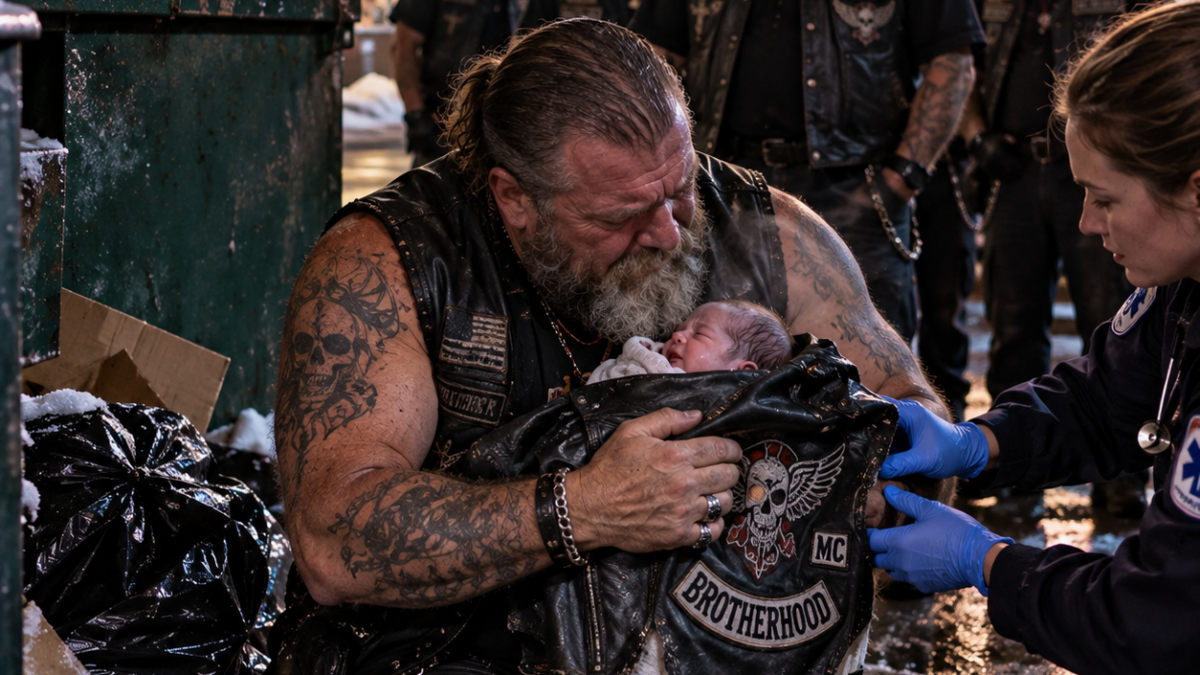
A Biker Cut the Patches Off His Own Vest to Save a Freezing Newborn—Then Police Revealed the Mother Who Dumped Her Was Connected to His Club.
Ray had spent twenty-two years earning the patches on his back, and according to our rules, cutting them off with a knife should have ended his life in the club that same night.
Then a detective arrived with a photograph of the seventeen-year-old mother who had abandoned the newborn Ray wrapped in those ruined colors, and the toughest man in our clubhouse collapsed when he realized the baby was his own granddaughter.
By sunrise, we were no longer deciding whether Ray had disgraced our colors—we were deciding what those colors were ever worth if saving a dying child could make a man unworthy to wear them.
I’ve been president of the Iron Saints Motorcycle Club for fourteen years.
My road name is Dutch.
Only my sister still calls me Michael, and only when she’s angry.
In fourteen years at the head of that table, I’ve handled enough ugly business to know the difference between a loud problem and a serious one.
I’ve stood beside hospital beds while brothers took their last breaths.
I’ve driven six hours through freezing rain to tell a member’s mother her son wasn’t coming home.
I’ve made prison visits.
I’ve broken up fights between men who’d once taken bullets for each other.
I’ve watched two patched members trade loyalty for deals with prosecutors and disappear into witness-protection rumor.
I’ve buried men.
I’ve expelled men.
I’ve forgiven things I swore I never would.
And I’ve refused forgiveness when forgiving would have made the patch meaningless.
But until the night Ray Maddox walked into church carrying what remained of his vest in both hands, I had never seen a room full of bikers go quiet enough that I could hear the refrigerator compressor behind the bar.
Ray didn’t say anything at first.
He walked to the center table.
Set the leather down.
Stepped back.
That was all.
Bull was the first one to realize what we were looking at.
“Jesus Christ.”
Nobody else spoke.
The back of Ray’s vest was gone.
Not torn.
Cut.
Deliberately.
The leather had been sliced in a rough rectangle from shoulder blade to waist.
The center patch was missing.
The upper rocker was gone.
The bottom rocker too.
Twenty-two years of club history had been carved off the back of that vest like somebody had skinned it.
The remaining leather looked obscene.
Empty.
Ruined.
Ray stood across from us wearing a black thermal shirt.
No vest.
No colors.
Nothing.
Bull pushed his chair back.
Bull’s real name was Darnell Hayes, but nobody had called him Darnell since before most of us had gray in our beards.
Six-foot-four.
Two hundred and seventy pounds.
Hands like cinder blocks.
Sergeant-at-arms for nine years.
PART2:
He had the kind of voice that could stop an argument without being raised.
That night, he raised it.
“What the hell did you do?”
Ray didn’t flinch.
“I cut them.”
Everybody already knew that.
Hearing him say it anyway changed the air.
Bull stared at him.
“You cut your colors.”
“Yeah.”
“With what?”
“My knife.”
“Why?”
Ray looked at me.
I nodded.
“Tell it from the start.”
He took a breath.
Then he told us.
At 3:51 that morning, Ray had been leaving the all-night Waffle House on Route 9 after hauling a transmission two counties over for a friend.
December cold.
PART3:
Twenty-one degrees.
Wind blowing hard enough to push wrappers across the parking lot.
He was halfway to his bike when he heard something behind the building.
At first he thought it was a cat.
Thin noise.
Barely there.
He almost kept walking.
He’d been awake seventeen hours.
His hands were numb.
He wanted his bed.
Then he heard it again.
Not a cat.
A baby.
Ray went behind the restaurant.
The dumpster lid was partly open.
A black garbage bag moved inside.
He climbed onto the concrete curb and looked in.
The bag wasn’t tied.
It was folded over.
Inside was a shirt.
Inside the shirt was a newborn girl.
Four pounds, twelve ounces according to the hospital later.
Umbilical cord still attached.
Blood on her skin.
Her lips were turning blue.
Ray looked around.
Nobody.
No blanket.
No box.
No mother screaming for help.
Nothing.
He said he didn’t think.
That’s the part he kept repeating.
“I didn’t think.”
He called 911.
Dispatcher told him to get the baby warm.
Ray had gloves.
A sweatshirt.
Leather vest.
Nothing else.
The baby was barely moving.
He tucked her inside his shirt against his chest.
Still not enough.
The wind kept cutting through.
So Ray pulled his vest off.
Looked at the back panel.
Pulled his knife.
And cut.
The patches came off with the leather still behind them.
Club name.
Chapter.
Center skull-and-wing emblem.
Everything.
Then he wrapped that chunk of leather around the newborn’s back and head, held her bare skin against his chest, sat on the pavement behind the Waffle House, and stayed there for eleven minutes until paramedics arrived.
“You could have used the whole vest,” Bull said.
Ray looked at him.
“What?”
“You could’ve wrapped her in the whole damn vest instead of cutting it.”
“I needed the front open so I could keep skin contact.”
Bull’s jaw tightened.
Ray continued.
“Paramedic said I did it right.”
“Not the point.”
“It was at the time.”
A few men shifted.
Bull looked around the table.
“You all know the rule.”
Nobody answered.
He pointed toward the ruined vest.
“You deliberately destroy your colors, they’re surrendered.”
Ray nodded.
“I know.”
“No reinstatement.”
“I know.”
“No exceptions.”
“I know.”
Bull stepped closer.
“Then why are we sitting here?”
That was Bull.
Black and white.
Rules existed because gray areas got people hurt.
He’d spent nine years enforcing the laws we voted on.
No stealing from brothers.
No club business around children.
No narcotics at the clubhouse.
No touching another man’s old lady.
No talking to cops about club matters.
No disrespecting the colors.
Those rules had kept us alive through years when loyalty was sometimes the only thing between a man and the grave.
Ray wasn’t arguing.
That bothered me more than if he had.
“I know what I did,” he said.
Bull stared at him.
“Then hand over what’s left.”
A younger member named Mack stood.
“Hold up.”
Bull turned.
Mack was twenty-nine.
Barely patched two years.
His eyes were wet.
“That baby would be dead.”
Bull’s face didn’t change.
“I’m aware.”
“He saved her.”
“I’m aware.”
“With the colors.”
“I know what he used.”
“So what are we even talking about?”
Bull’s eyes hardened.
“We’re talking about whether your oath means something only when it’s convenient.”
Mack looked toward me.
I held up my hand.
“No yelling.”
Bull sat.
Ray remained standing.
I asked, “Where are the patches now?”
“Hospital.”
“What?”
“They went with her.”
“You didn’t get them back?”
Ray almost laughed.
“I had a half-dead newborn in my hands, Dutch. Wasn’t exactly inventorying leather.”
A couple men smiled grimly.
Bull didn’t.
“What happened after the ambulance?”
“Police kept me four hours.”
“Why?”
“Because I’m the idiot standing behind a restaurant at four in the morning holding an abandoned baby.”
“Fair.”
“They took my clothes. Swabbed my hands. Asked questions.”
“And?”
“They cleared me after security video showed me coming out of the restaurant after the baby was already there.”
I leaned back.
“Baby alive?”
Ray’s face softened.
“Stable when I left.”
That changed the room.
A man behind me muttered, “Thank God.”
Another crossed himself.
Ray continued.
“Body temp was eighty-nine point something when EMS got there.”
Somebody cursed under his breath.
“They said another ten minutes…” Ray stopped.
He didn’t finish.
Didn’t need to.
Bull rubbed both hands over his face.
For a second I thought the emotion would change his position.
It didn’t.
He stood again.
“We are not deciding whether Ray’s a good man.”
Nobody argued.
“We know what kind of man he is.”
Bull pointed at the vest.
“We’re deciding whether rules disappear when breaking them feels noble.”
Ray said quietly, “He’s right.”
Bull turned.
Ray repeated it.
“He’s right.”
Mack stared at him.
“What are you doing?”
Ray shrugged.
“I knew the price.”
“You saved a baby.”
“And I cut the colors.”
“You would’ve let her die?”
“No.”
“Then—”
“I’d do it again.”
That silenced everybody.
Ray looked around the table.
“I’d do the exact same thing.”
His eyes came back to mine.
“If that means I’m done, then I’m done.”
I’ve known Ray for twenty-six years.
He’d been patched twenty-two.
Never president.
Never wanted office.
Worked diesel repair.
Lived alone after his wife died from pancreatic cancer.
Had one brother named Tommy who died in a motorcycle wreck fifteen years earlier.
Ray was the kind of man who’d show up at your house with tools before you finished explaining what broke.
He never talked about loyalty.
He just practiced it.
And now he stood in front of us prepared to lose the only family he had left because he’d used its most sacred symbol to warm a child he’d never met.
I called for a vote.
Secret ballot.
Fourteen voting members besides me.
Seven said remove him.
Seven said keep him.
Tie.
That made it mine.
Bull stared at me.
Ray didn’t.
He sat down finally and folded his hands.
I looked at the shredded vest.
Twenty-two years.
Every patch had a ceremony behind it.
Every inch carried history.
Then I pictured a blue-lipped infant inside a garbage bag.
“I need an hour.”
Bull frowned.
“Dutch—”
“One hour.”
Nobody challenged me.
I grabbed my coat and walked outside.
The parking lot was empty except for our bikes.
Cold enough to sting your nose.
I stood beneath the security light.
Couldn’t smoke anymore.
Doctor’s orders.
Still reached for a cigarette that wasn’t there.
Old habits.
My father used to say rules were fences.
Good fences keep cattle alive.
Bad fences keep them from water.
At fifty-eight, I still didn’t know how to tell the difference until something was already dying on one side.
I had been outside maybe six minutes when headlights rolled through the gate.
Dark sedan.
Unmarked.
A man got out.
Mid-forties.
Badge clipped to his belt.
Folder in one hand.
“Dutch?”
“Who wants to know?”
“Detective Aaron Pike.”
He showed identification.
“I’m with county major crimes.”
“If this is about Ray, he’s already answered questions.”
“It isn’t exactly about Ray.”
I looked at the folder.
“Baby?”
“Alive.”
My shoulders dropped a little.
“Stable?”
“For now. NICU.”
“Good.”
“We identified the mother.”
That got my attention.
“How?”
“Restaurant cameras. Traffic camera two blocks over. Pharmacy across the street.”
He opened the folder.
“She’s in custody.”
“How old?”
“Seventeen.”
Jesus.
“Baby’s mother is seventeen?”
“Yes.”
I shook my head.
Pike studied me.
“You know why I’m here?”
“No.”
“Your club’s name came up when we ran her background.”
Every instinct I had sharpened.
“How?”
He removed a photograph.
Placed it on the hood of his car.
I looked down.
For a second my brain rejected what my eyes already knew.
Teenage girl.
Dark hair.
Sharp cheekbones.
Eyes I’d seen a thousand times when she was little.
Kayla Hayes.
Bull’s daughter.
I stared.
“No.”
Pike said nothing.
I picked the photo up.
Kayla at ten eating Cheetos on our pool table.
Kayla at twelve trying to polish her father’s Harley and dropping the rag every thirty seconds.
Kayla at thirteen making all of us buy cookie dough for a school fundraiser.
Kayla at fifteen screaming at Bull in the clubhouse parking lot because he wouldn’t let her go somewhere with an eighteen-year-old boy.
Seventeen now.
Missing from our lives for more than a year.
Bull always said she was fine.
“That’s Bull’s kid.”
“I know.”
I looked toward the clubhouse door.
“He doesn’t know.”
“Not yet.”
“Does Kayla know the baby lived?”
“Yes.”
“What’d she say?”
Pike’s expression changed.
“She asked three times.”
“Asked what?”
“If the baby was breathing.”
I closed my eyes.
“What happened?”
“We’re still piecing it together.”
“Does Bull know she was pregnant?”
“Apparently not.”
“Nobody?”
“Her aunt says no.”
A gust of wind moved between us.
Pike said, “I came because I’m required to notify next of kin, and given the circumstances, I wanted to know whether walking into a biker clubhouse with three officers was going to become an issue.”
I looked at him.
“No.”
“You’re sure?”
“Yes.”
“He has a temper?”
“Everybody has a temper.”
“That’s not an answer.”
I stepped closer.
“My sergeant-at-arms will not hurt your officers.”
Pike studied me.
Then nodded.
“I need to tell him.”
“I tell him.”
“We normally—”
“Detective.”
He waited.
“That man watched his wife walk out when Kayla was four.”
I pointed toward the building.
“He raised her alone. He has no idea she was pregnant. Twenty minutes ago he tried to throw out the man who saved his granddaughter.”
Pike’s expression softened.
“Give me ten minutes.”
Then he nodded.
“Ten.”
I carried the photograph inside.
Every head turned.
Bull was near the bar.
Arms crossed.
He looked at the picture in my hand.
Something moved across his face.
Not recognition.
Fear.
Maybe fathers recognize bad news before it has words.
“Bull.”
“What?”
“Come outside.”
“We’re in the middle of Ray.”
“Ray can wait.”
Bull didn’t move.
“What happened?”
I walked toward him.
Quiet enough nobody else could hear.
“They found the mother.”
His eyes narrowed.
“It’s Kayla.”
For three seconds Bull became a statue.
Then his knees failed.
He grabbed the pool table.
One hand slipped.
Ray moved first.
Caught his elbow.
Bull jerked away on instinct, then recognized who had touched him.
The man he’d tried to expel.
The man who had cut his colors apart to warm Bull’s granddaughter.
Ray placed one hand against Bull’s back.
Nothing dramatic.
Didn’t hug him.
Didn’t say I told you.
Didn’t even look around.
Just held his hand there.
Bull breathed like somebody had punched him.
“My Kayla?”
“Yeah.”
“The baby?”
“Yours.”
His mouth opened.
Nothing came out.
I said, “She’s alive.”
Bull looked at Ray.
Ray nodded.
“She’s alive, brother.”
Bull made a sound that I had never heard from a grown man.
Maybe grief.
Maybe relief.
Maybe both tearing through the same chest at once.
Pike entered a minute later with two uniformed officers.
Bull sat.
Pike took a chair across from him.
“Mr. Hayes, your daughter is safe medically at the moment.”
Bull stared at the table.
“What’d she do?”
“We believe she delivered the infant alone in the restroom of the Waffle House around 3:40 this morning.”
Bull’s face went white.
“Alone?”
“Yes.”
“Where was her aunt?”
“Working overnight.”
Bull whispered, “Why didn’t she call me?”
Pike didn’t answer immediately.
Then:
“She told investigators she believed you didn’t want anything to do with her.”
Bull’s head snapped up.
“That’s bullshit.”
Pike’s expression remained neutral.
“She said the last time you two spoke, you told her if she got herself into serious trouble, she was on her own.”
Bull flinched.
I remembered that fight.
Eight months earlier.
Kayla had stolen two hundred dollars from Bull.
Bought pills.
Bull found them.
She screamed that he treated her like a criminal.
He shouted that she was becoming one.
Then:
If you keep choosing this crap, someday you’re going to get yourself into real trouble, and don’t come expecting me to fix it.
I’d been there.
I’d forgotten.
Bull hadn’t.
He covered his face.
“I didn’t mean…”
Pike said softly, “She believed you.”
Nobody in that room moved.
Pike explained what the cameras showed.
Kayla arrived walking at 3:11 a.m.
Oversized hoodie.
Backpack.
Entered alone.
At 3:39 a woman in a booth heard a noise in the restroom but assumed someone was sick.
At 3:56 Kayla exited through a side door carrying the backpack in front of her.
She disappeared behind the building for forty-three seconds.
Then ran.
Eight minutes later Ray walked outside.
He heard the baby.
Bull stared at him.
Eight minutes.
That number never left any of us.
Eight minutes between life and whatever comes after it.
Pike said they found Kayla at her aunt’s apartment around noon.
She was in the shower.
Still bleeding.
A towel on the floor looked like somebody had slaughtered an animal.
When officers told her she needed an ambulance, she asked:
“Is my baby alive?”
When they said yes, she sat on the bathroom floor and started sobbing.
Bull whispered, “Why the dumpster?”
Pike took a breath.
“She told detectives she believed the baby was dead.”
The room shifted.
“Dead?” I asked.
“The baby apparently didn’t cry immediately after delivery.”
Bull closed his eyes.
Pike continued.
“Kayla says she sat in the bathroom holding her for several minutes. She panicked. Thought she’d killed her by having her there instead of a hospital.”
“Then why throw her away?” Bull said.
Pike didn’t soften the answer.
“Because she was frightened.”
Bull slammed his fist against the table.
“That’s not an answer!”
Everyone jumped.
Pike didn’t.
“No. It isn’t an excuse either.”
Bull stood.
His chair fell backward.
“She put my granddaughter in garbage!”
Ray said quietly, “Bull.”
“Don’t.”
“She’s seventeen.”
“So?”
“So maybe wait until you see her.”
Bull spun toward him.
“She left a baby to freeze.”
Ray didn’t move.
“I know.”
“You don’t know anything!”
Ray’s face changed.
“I know exactly how cold she was.”
That stopped him.
Ray stepped forward.
“I know how blue her mouth was.”
Bull’s anger disappeared as quickly as it came.
Ray’s voice became rough.
“I know how light four pounds feels when you’re scared you’re holding a dead child.”
Bull looked away.
“So yeah. I know what Kayla did.”
Ray swallowed.
“But I also know the first thing that girl asked police was whether the baby lived.”
Silence.
“Doesn’t make it okay.”
Ray looked toward Pike.
“But it tells me maybe we’re not talking about a monster.”
Bull sat back down.
Detective Pike continued.
“She’ll be charged.”
“With what?”
“Likely child abandonment, endangerment, possibly attempted homicide depending on the prosecutor and evidence.”
Bull’s eyes widened.
“Attempted murder?”
“I said possibly.”
“She’s a kid.”
Pike’s tone stayed level.
“The baby nearly died.”
That truth hung between them.
Nobody knew which person they were allowed to feel sorry for.
The newborn?
Kayla?
Bull?
Ray?
Turns out grief doesn’t care about fairness.
There was enough to go around.
We never finished the vote that night.
Nobody had the stomach.
Bull rode with detectives to the hospital first.
They allowed him to see the baby through NICU glass.
Kayla went from medical evaluation to juvenile detention under guard.
Ray went home wearing no colors.
I stayed behind.
By midnight the clubhouse was empty.
I sat alone with Ray’s vest.
Picked it up.
Turned it over.
Inside the collar, written in faded black marker, was one name.
TOMMY.
Ray’s dead brother.
He’d written it there fifteen years earlier.
Nobody saw that name when Ray wore the vest.
That was the point.
Some patches were for the world.
Some were for the man carrying them.
I ran my fingers around the raw edge where the back panel used to be.
What are colors?
Ask twenty bikers, you’ll get twenty answers.
Family.
Respect.
History.
Loyalty.
Territory.
Brotherhood.
Sacrifice.
Some men think it’s leather.
Some think it’s the image stitched on that leather.
Some think it’s the people who died wearing it.
For me, it had always meant:
If you’re mine, I don’t walk away when things get bad.
That was the whole promise.
Then I looked at the hole Ray cut.
He hadn’t destroyed that promise.
He’d used it.
Literally.
Wrapped it around somebody who needed it.
I laughed once.
Alone.
“Son of a bitch.”
At 5:58 a.m., my phone rang.
Bull.
“You awake?”
“Never went to sleep.”
“She’s tiny.”
I leaned back.
“The baby?”
“Yeah.”
He sniffed.
Bull never sniffed.
“She’s in one of those plastic incubators.”
“How’s she doing?”
“Doctors say guarded but improving.”
“Good.”
“They let me put my hand through a hole.”
His voice broke.
“Dutch, her whole body fits from my wrist to my elbow.”
I closed my eyes.
He continued.
“She grabbed my finger.”
Long silence.
“She’s got Kayla’s nose.”
“Yeah?”
“My mother’s nose too.”
I smiled.
“Strong nose.”
“Ugly nose.”
“Your mother would punch you.”
“I know.”
He laughed once.
Then cried.
Neither of us pretended he wasn’t.
“Kayla asked me to name her.”
I sat up.
“What?”
“Through her lawyer.”
Bull inhaled.
“First thing she’s asked me for in two years.”
“You got a name?”
“Not yet.”
“Take your time.”
“I don’t know how to look at Ray.”
“You start with your eyes.”
“Don’t be funny.”
“I’m serious.”
“I tried to throw him out.”
“You didn’t know.”
“Doesn’t matter.”
“Matters some.”
Bull went quiet.
Then:
“She would’ve died.”
“Yeah.”
“My granddaughter would’ve died while I was sitting at home pissed off at my daughter.”
I didn’t answer.
“I told Kayla she was on her own.”
“You were angry.”
“She believed me.”
“Yeah.”
“I made my child believe she couldn’t call me while giving birth alone in a bathroom.”
There are some kinds of guilt nobody can remove for you.
They have to wear down slowly.
Like stones.
I said, “Come to church tonight.”
“What about the vote?”
“Unfinished business.”
By noon, the story hit local news.
BIKER SAVES NEWBORN FOUND IN DUMPSTER.
They didn’t have Ray’s name.
They had ours.
IRON SAINTS MOTORCYCLE CLUB MEMBER CREDITED WITH RESCUE.
Phone exploded.
Reporters.
Radio.
Strangers wanting to donate blankets.
Women asking whether they could send formula.
A church offered diapers.
An attorney offered free representation for the child’s custody proceedings.
One idiot offered Ray a reality-show interview.
I turned my phone off.
At four, I drove to the hospital.
Bull sat in the NICU waiting area looking twenty years older.
No vest.
He’d left it home.
That told me how broken he felt.
“You see Kayla?”
“No.”
“Why?”
“Lawyer says not yet.”
“Her choice?”
Bull stared at the floor.
“Mine.”
I sat beside him.
“I don’t know what I’d say.”
“Could start with hello.”
His jaw tightened.
“She threw her baby in a dumpster.”
“Yeah.”
“Stop saying it like I don’t know.”
“Then stop saying it like that’s the only thing she ever did.”
He looked at me.
I continued.
“She’s also the little girl who sat on our pool table eating Cheetos.”
“Don’t.”
“Why?”
“Because that girl is gone.”
“You sure?”
Bull looked through the NICU window.
“No.”
We sat.
After several minutes he said, “I went back through my texts.”
I waited.
“She texted me in August.”
“What’d she say?”
“Nothing.”
“Bull.”
“She wrote, ‘Dad, are you awake?'”
“What’d you answer?”
“I didn’t.”
His eyes filled.
“It was one in the morning. I saw it when I woke up.”
“You respond then?”
“Sent ‘what.'”
“And?”
“Nothing.”
He rubbed his face.
“October she texted, ‘Do you ever wish Mom stayed?'”
I didn’t like where this was going.
“What’d you say?”
“Told her not to drag her mother into our arguments.”
He stared at his hands.
“She wasn’t arguing.”
“No.”
“I thought everything she said was manipulation.”
“Why?”
“Because she lied.”
“She did.”
“Stole.”
“Yeah.”
“Used pills.”
“Yeah.”
“Skipped school.”
“Yeah.”
“Every conversation became a fight.”
His voice cracked.
“So eventually I stopped hearing a kid.”
That sentence hurt.
“I only heard trouble.”
We sat with it.
I said, “Go see her.”
Bull shook his head.
“Not yet.”
“If you wait until you know what to say, she could be forty.”
He glared.
“You’re a pain in my ass.”
“Presidential privilege.”
That evening every patched member showed for church.
Two brothers drove from another state.
One had been on a construction job.
Another turned his truck around halfway to Kansas.
Ray came last.
Plain black hoodie.
No leather.
No patch.
He took his normal seat.
Bull arrived after him.
He walked straight to the front.
“Before Dutch talks, I need the floor.”
I nodded.
Bull faced the room.
“Two nights ago, I stood right there.”
He pointed.
“And I said Ray should be done.”
Nobody moved.
“I said rules are rules.”
Ray looked at him.
“I meant it.”
Bull swallowed.
“I believed it.”
His voice began shaking.
“While I was calling for his colors, my granddaughter was lying in intensive care because he cut those same colors off his back and wrapped her in them.”
Mack looked down.
Bull continued.
“I didn’t know she was my granddaughter.”
He turned fully toward Ray.
“Doesn’t matter.”
Ray started to speak.
Bull held up a hand.
“Let me finish.”
His eyes were wet now.
“I spent my life telling everybody this patch means family.”
He tapped his chest.
“I raised my daughter around it.”
His face twisted.
“Somewhere along the way I got better at protecting a patch than protecting my own kid.”
Nobody breathed.
“I was wrong.”
He looked directly at Ray.
“In front of everybody, brother, I was wrong.”
Ray stood.
Bull’s voice broke.
“I don’t know what my granddaughter would be if you ordered another cup of coffee.”
Ray’s eyes filled.
“I don’t know what Kayla would be.”
Bull inhaled.
“I don’t know what I’d be.”
He lowered his head.
“I’m asking you to forgive a stupid old man who didn’t know what he was voting on.”
Ray walked across the room.
He’s not big.
Five-nine.
Maybe a hundred seventy-five pounds.
Standing in front of Bull, he looked almost small.
“There ain’t anything to forgive.”
Bull laughed bitterly.
“Yeah, there is.”
“No.”
Ray shook his head.
“If I hadn’t known the baby, I’d have voted with you.”
Bull blinked.
“What?”
“Rule’s the rule.”
“Then why—”
“Because that’s not the question anymore.”
Ray stepped closer.
“I’d cut them again.”
His voice thickened.
“I’d cut every patch off every vest in this room if that’s what was between a baby and freezing to death.”
Bull stared.
Ray added:
“And so would you.”
That broke him.
Bull hugged Ray.
Not one of those quick shoulder pats men use when they don’t want to admit emotion.
He folded around him.
Sobbed into Ray’s shoulder.
Ray held him.
Nobody looked away.
Men like us spend half our lives pretending tenderness makes us weak.
Then life gives you something too heavy for toughness, and tenderness is all that’s left.
When Bull sat down, I stood.
“We’re not voting on Ray again.”
A few heads lifted.
“I’m making an executive ruling.”
No one spoke.
“Anybody wants to challenge it, do it now.”
Silence.
I looked toward Ray.
“Ray cut the colors.”
Bull closed his eyes.
“But I’m ruling he didn’t desecrate them.”
Mack smiled.
“He used them exactly according to what they’re supposed to mean.”
I placed a brand-new black vest on the table.
Bare.
No patches.
“Leather can be replaced.”
Ray stared.
“Twenty-two years can’t.”
I pushed the vest toward him.
“The man matters more than the stitching.”
Someone behind me whispered, “Damn right.”
I continued.
“Every patch you earned goes back on.”
Ray looked down.
“Fresh set.”
He shook his head.
“Dutch, I—”
“I’m not done.”
He shut up.
“Those old patches don’t belong on your back anymore.”
His face changed.
I nodded toward Bull.
Bull reached under the table.
Pulled out a clear hospital evidence bag.
Inside were Ray’s original patches.
Cleaned.
Stained faintly along the back.
Ray stopped breathing.
Bull held them.
“The hospital released them.”
Ray stared.
Bull looked at the bag.
“There’s blood on the center patch.”
Nobody spoke.
“Kayla named the baby this morning.”
He swallowed.
“Raylene.”
Ray looked as if somebody had taken a hammer to his chest.
“What?”
“Raylene Marie Hayes.”
Bull smiled through tears.
“After the idiot who found her.”
Ray sat down.
Hard.
Mack laughed and cried at the same time.
Bull said, “I want permission from the club to keep these.”
He lifted the bag.
“I want to have them sewn into a blanket.”
My throat tightened.
“Not a riding blanket.”
Bull’s hands shook.
“A baby blanket.”
He looked around.
“I want that girl to grow up knowing what she was wrapped in when somebody finally held on to her.”
No need for secret ballots.
“All in favor?”
Fourteen hands rose.
Mine made fifteen.
Unanimous.
The next day Bull finally visited Kayla.
He didn’t tell me what happened until weeks later.
By then I’d heard pieces from lawyers and detectives, but Bull’s version was the only one that mattered.
She was in a juvenile medical unit.
Gray sweatpants.
Hospital socks.
No makeup.
She looked younger than seventeen.
Bull said he walked in and forgot every angry speech he’d rehearsed.
Kayla looked at him and immediately said:
“I’m sorry.”
Not hello.
Not Dad.
I’m sorry.
Bull sat.
For nearly a minute, neither moved.
Then Kayla asked:
“Did you see her?”
“Yeah.”
“Is she okay?”
“Getting there.”
“Did you touch her?”
“Her hand.”
Kayla started crying.
“Is she beautiful?”
Bull said, “Ugliest baby I’ve ever seen.”
Kayla laughed.
One tiny sound.
Then sobbed harder.
Bull moved toward her.
Stopped.
Didn’t know whether she wanted touch.
Kayla noticed.
She stood.
Crossed the room.
Collapsed against him.
He held his daughter for the first time in almost two years.
She kept saying:
“I thought she was dead.”
Over.
And over.
“I thought she was dead.”
Bull eventually asked the question that had been eating him alive.
“Why didn’t you call me?”
Kayla froze.
Then stepped back.
“You said not to.”
Bull’s face crumpled.
“I was mad.”
“I know.”
“I didn’t mean—”
“I know now.”
“No.”
Bull shook his head.
“You shouldn’t have had to know.”
She wiped her face.
“I stole from you.”
“I know.”
“I lied.”
“I know.”
“I got high.”
“I know.”
“I called you names.”
“I remember.”
“You hated me.”
Bull’s voice broke.
“No.”
“You looked like you did.”
“I hated what was happening.”
“Same thing when you’re fifteen.”
That sentence followed Bull for years.
Same thing when you’re fifteen.
Adults separate behavior from identity.
Children often can’t.
You say:
I hate what you’re doing.
They hear:
I hate you.
Bull told her:
“I failed you.”
Kayla shook her head.
“I put my baby in garbage.”
“Both things can be true.”
She stared.
Bull said, “What you did was wrong.”
Her face closed.
“I know.”
“I’m not going to lie to you because you’re hurting.”
He moved closer.
“You could’ve killed her.”
Kayla covered her mouth.
“But I’m your father.”
His eyes filled.
“And I should have made damn sure there was no kind of trouble big enough to make you think you couldn’t call me.”
Kayla cried again.
Bull took her hand.
“I’m angry.”
She nodded.
“I’m scared.”
Another nod.
“I don’t know how any of this works.”
She whispered, “Me neither.”
“But you’re not on your own.”
Kayla looked at him.
He repeated it.
“You’re not on your own.”
That became the beginning.
Not forgiveness.
Not redemption.
Beginning.
The prosecutors charged Kayla with felony child abandonment and reckless endangerment.
There was discussion of attempted murder.
It didn’t stick.
Not because what she did wasn’t terrible.
Because intent matters.
Evidence showed panic.
No planning.
No concealment before birth.
No attempt to kill the baby directly.
Immediate medical crisis after unattended delivery.
Postpartum trauma.
A seventeen-year-old with untreated addiction history, unstable housing, and no prenatal care.
The prosecutor didn’t excuse her.
Neither did the judge.
Neither did Bull.
Neither did I.
There’s a dangerous habit people have when a tragic story reaches the news.
They pick one person who must be evil.
Then everybody else becomes innocent.
Life isn’t usually that clean.
Kayla endangered Raylene.
That was true.
Kayla also spent months terrified, addicted, pregnant, estranged, and convinced she had nobody safe to call.
That was true too.
You can hold both truths without dropping either one.
She eventually accepted a juvenile plea.
Eighteen months with review after twelve.
Mandatory counseling.
Addiction treatment.
Parenting classes.
Psychiatric evaluation.
Supervised contact with Raylene if doctors approved.
The judge was an older woman named Miriam Caldwell.
At sentencing she looked at Kayla for a long time.
“What you did could have ended your daughter’s life.”
Kayla cried quietly.
“There must be consequences.”
Then Judge Caldwell looked at Bull.
“And every adult in this child’s life should understand something else.”
The courtroom became very still.
“Children rarely arrive at catastrophe in one step.”
She looked back at Kayla.
“You failed your baby.”
Kayla lowered her head.
“But the evidence suggests many people failed you before that moment.”
Bull closed his eyes.
The judge continued.
“That does not erase responsibility.”
Pause.
“It creates responsibility for the rest of us.”
I remembered that.
Responsibility for the rest of us.
Bull received temporary kinship custody of Raylene after three weeks.
Watching a fifty-two-year-old sergeant-at-arms prepare for an infant was one of the funniest and saddest things I’ve ever seen.
The man could rebuild a transmission blindfolded.
He could not install a car seat.
Four instructional videos.
Three brothers.
One firefighter.
Still wrong.
Finally a twenty-three-year-old nurse showed him.
“That’s it?”
She stared at him.
“Yes.”
“You sure?”
“Mr. Hayes, I install these every day.”
“Could check again.”
“It’s secure.”
“One more tug.”
“Please stop pulling it.”
Six of us childproofed his house.
Cabinet locks.
Outlet covers.
Baby gate.
Crib.
Changing table.
Bull bought a temperature monitor that connected to his phone and checked it every nine minutes.
He slept in a recliner beside Raylene’s crib the first month.
Wouldn’t admit it.
We all knew.
Raylene gained weight.
Four pounds became six.
Six became nine.
Her cheeks filled out.
The purple-blue newborn from the dumpster became a furious little baby who hated socks and demanded bottles like a union negotiator.
Ray visited often.
First time he held her after the rescue, Bull called me.
“You need to see this.”
Ray sat on Bull’s porch.
Raylene against his chest.
Exactly where she’d been that night.
She was six weeks old.
He looked terrified to move.
“She’s tougher now,” I said.
“Still small.”
“You’re holding her like nitroglycerin.”
“Shut up.”
Raylene opened one eye.
Ray whispered, “Hey, trouble.”
Her tiny hand grabbed his beard.
He yelped.
Bull laughed for the first time in weeks.
Ray didn’t complain.
The blanket took a month.
A woman named Margaret, whose husband had been an Iron Saint before dying from cancer, volunteered.
She stitched Ray’s old leather patches onto thick gray flannel.
Not directly against Raylene’s skin.
Leather was too rough.
They formed the center.
Club rocker above.
Center emblem.
Lower rocker.
Around them Margaret embroidered one line:
HE STOPPED.
Bull cried when he saw it.
Ray refused to look for almost five minutes.
Then he touched the edge.
“Too much.”
Margaret slapped his hand.
“Nobody asked you.”
That settled it.
The press wanted pictures.
We said no.
This wasn’t marketing.
Not a recruitment campaign.
Not biker propaganda.
A baby nearly died.
A teenager nearly bled to death alone.
We weren’t turning it into merchandise.
One reporter kept calling.
Young woman named Elise Warner.
She finally approached me outside court.
“I’m not trying to exploit the child.”
“Everybody says that.”
“I want to know why Ray cut his vest.”
“Baby was cold.”
“I know.”
“Then you know.”
She tried again.
“People don’t understand what those patches mean.”
“They don’t need to.”
“But he gave them up.”
“Yeah.”
“Was he afraid he’d be expelled?”
“Probably.”
“Did he hesitate?”
“No.”
“How do you know?”
“Because baby lived.”
She went quiet.
Then asked:
“What does that say about the club?”
I thought.
“Nothing.”
She looked confused.
“It says something about Ray.”
“Which is?”
I looked toward him.
He was smoking by his truck, irritated that anyone had noticed him.
“It says when somebody was dying, Ray knew what mattered.”
That quote ended up in the article.
Not the exact words.
Close enough.
The story spread nationally for about forty-eight hours.
Then the internet found something else to be angry about.
Good.
We wanted quiet.
Kayla needed quiet most.
Treatment wasn’t pretty.
People like neat redemption.
Person does terrible thing.
Feels remorse.
Gets help.
Becomes good.
Real recovery is uglier.
Kayla relapsed once inside the program.
Contraband pills.
Lost visitation privileges for six weeks.
Bull was furious.
He drove to the clubhouse.
Threw a chair.
“You know what she said?”
I waited.
“She said she screwed up.”
“Sounds accurate.”
“Don’t be cute.”
“What do you want me to say?”
“I want her to stop!”
“Then tell addiction to cooperate.”
Bull glared.
“I’m done.”
“No, you’re not.”
“You don’t know that.”
“Yeah, I do.”
“How?”
“Because you’re here yelling instead of disappearing.”
He paced.
“She almost had supervised visits with Raylene.”
“She’ll earn them back.”
“What if she doesn’t?”
“Then Raylene stays safe.”
His face tightened.
“And Kayla?”
“Stays your daughter.”
Bull stopped.
That was the lesson he was learning.
Boundaries aren’t abandonment.
Consequences aren’t rejection.
Love doesn’t require pretending dangerous behavior is safe.
You can say:
No.
Not yet.
You can’t hold the baby today.
You can’t come home high.
You have to finish treatment.
And still say:
I’m here tomorrow.
Bull had spent years thinking love had only two settings.
Rescue everything.
Or cut her off.
Kayla needed something harder.
Steady.
She finished the next ninety days clean.
Earned visitation again.
First time she held Raylene legally after the abandonment, there were two social workers in the room.
Bull watched through glass.
Ray was there.
So was I.
Kayla sat in a rocking chair.
They placed Raylene in her arms.
Kayla didn’t move.
She stared.
Raylene stared back.
Then sneezed.
Kayla laughed.
Immediately cried.
She whispered something we couldn’t hear.
Bull pressed his hand against the glass.
Ray stood beside him.
“She’s good with her.”
Bull said, “Don’t know yet.”
Ray nodded.
“Fair.”
A few minutes later Kayla kissed Raylene’s forehead.
Bull whispered:
“That’s my kid.”
I didn’t know which one he meant.
Probably both.
Months passed.
Ray’s new vest gained its fresh patches.
We held a ceremony.
Nothing flashy.
No press.
No outsiders.
Bull personally sewed on the center patch.
His hands shook so badly he stabbed his thumb twice.
Ray said:
“You sure you know what you’re doing?”
Bull told him where to go.
When the last stitch was tied, Bull turned the vest around.
There was one difference.
Tiny.
Hidden beneath the lower rocker.
A small embroidered date.
The night Ray found Raylene.
Ray saw it.
Looked at me.
I shrugged.
“History.”
He put the vest on.
Everyone stood.
No applause at first.
Then Mack started pounding the table.
One by one others joined.
Ray shook his head.
“You idiots.”
Bull hugged him anyway.
The old vest remained on the clubhouse wall.
What’s left of it.
Front panels.
Shoulders.
A giant rectangular hole in back.
No plaque.
No explanation.
New prospects always ask.
“Why’s that vest cut up?”
Nobody answers immediately.
Usually we say:
“Earn enough trust and somebody’ll tell you.”
Because the story isn’t about rule breaking.
It’s about understanding why rules exist.
We don’t respect colors because cloth has magic.
We respect them because they represent men being accountable to something bigger than themselves.
If that symbol ever becomes more important than the life it’s supposed to serve, we’ve turned loyalty into vanity.
Ray taught us that.
He never tried to.
That’s why it mattered.
Bull changed after Raylene.
Not softer exactly.
Still Bull.
Still terrifying when somebody messed up.
But he listened longer.
One night a prospect admitted he’d relapsed on alcohol after six years sober.
Old Bull might have tossed him immediately for lying about it.
New Bull said:
“You riding?”
“No.”
“You drive here?”
“No. Wife brought me.”
“You got booze on you?”
“No.”
“Then sit your ass down. Tomorrow we deal with the rules. Tonight we get you home alive.”
I watched from across the room.
He caught me smiling.
“Don’t start.”
Didn’t need to.
Kayla came home after fourteen months.
Early review.
Not because anyone forgot what happened.
Because she had completed treatment, maintained sobriety, continued therapy, finished high-school equivalency courses, and shown consistent progress.
She didn’t move in with Bull.
That surprised him.
Her counselor recommended transitional housing.
Bull hated it.
Then accepted it.
Another lesson.
Love does not mean control.
Visits with Raylene increased slowly.
One hour supervised.
Then three.
Then afternoons at Bull’s house.
Then outings with caseworkers.
Kayla was nineteen before she had her first overnight visit.
By then Raylene was walking.
Calling Bull “Buh.”
Calling Ray “Ray-Ray.”
Kayla was “Mama.”
First time Raylene said it, Kayla called Bull sobbing.
“She called me Mama.”
Bull put her on speaker.
The entire clubhouse heard.
Kayla realized.
“Dad!”
“What?”
“Why am I on speaker?”
Bull panicked and hung up.
We mocked him for a month.
The custody situation took years.
Kayla never immediately regained full custody.
She didn’t demand it.
That impressed everybody.
At one hearing, her lawyer asked what she wanted.
Kayla looked at the judge.
“I want what’s safest for Raylene.”
“Do you believe that’s with you?”
“Someday.”
The courtroom went still.
“Not yet.”
Bull cried in the hallway afterward.
Kayla found him.
“You okay?”
“No.”
“Why?”
“You sounded like a mother.”
She smiled.
“I am one.”
Bull nodded.
“Yeah.”
Then:
“You’re getting there.”
Kayla didn’t get offended.
She understood.
Eventually shared guardianship arrangements developed under court supervision.
Boring paperwork.
Evaluations.
Drug screens.
Home checks.
Therapy reports.
No dramatic moment where a judge slammed a gavel and declared everyone healed.
Healing rarely gets a gavel.
It shows up in calendars.
Appointments kept.
Promises kept.
Calls returned.
Drug tests passed.
One ordinary day after another.
Raylene grew.
At two, she loved motorcycles from behind Bull’s porch railing.
Every time Ray’s bike came down the street she squealed.
At three, she could identify his engine before seeing him.
“Ray-Ray!”
He would pull in.
Take off his helmet.
Walk straight toward her.
She’d run with both arms up.
Same man.
Same chest.
Completely different circumstances.
When she turned four, Kayla asked Ray if he would come to her preschool’s Grandparents and Special People Day.
Ray stared.
“Why me?”
Raylene answered:
“Because you’re Ray-Ray.”
That was apparently sufficient.
He went.
Wore clean jeans.
No vest because Kayla worried other parents might complain.
When Raylene saw him without it, she frowned.
“Where’s your jacket?”
Ray looked at Kayla.
Kayla laughed.
“Put it on.”
He did.
Parents stared.
One father whispered something.
Ray ignored him.
Raylene dragged Ray into the classroom.
Told everyone:
“He found me.”
Teacher already knew the story.
Other parents didn’t.
Raylene announced:
“I was in trash when I was baby.”
Kayla nearly died from embarrassment.
Ray added:
“Kids love context.”
Teacher asked Raylene what he did.
“He got me warm.”
“What did he use?”
“My special blanket.”
Ray looked away.
Afterward, a father approached him.
The same one who had whispered.
“Sorry if I stared.”
Ray shrugged.
“My brother rides.”
“Good for him.”
The man smiled.
“My wife was adopted.”
Ray waited.
“He saved her life?”
“Baby?”
“Yeah.”
Ray nodded.
The father held out his hand.
“Then I’m glad you wore the vest.”
Ray shook it.
By five, Raylene knew more.
Not everything.
Children shouldn’t carry adult shame before they have to.
Kayla told her:
“When you were born, Mommy was very sick and very scared. I made a dangerous choice. Ray found you and kept you safe. Grandpa helped take care of you while Mommy got healthy.”
No lies.
No graphic detail.
Just truth scaled to size.
Raylene asked:
“Were you bad?”
Kayla’s face broke.
“No.”
She thought.
“I did something very bad.”
“Why?”
“I was scared.”
Raylene said:
“I’m scared of thunder.”
Kayla smiled through tears.
“Yeah.”
“Did dumpster have thunder?”
“No.”
“Then why?”
Kids will find the hole in any explanation.
Kayla eventually said:
“I thought nobody would help me.”
Raylene frowned.
“Grandpa helps.”
“I know.”
“Ray-Ray helps.”
“I know.”
“I help.”
Kayla laughed and hugged her.
“Yes, baby. You help.”
Later Kayla told Bull what happened.
He sat on the porch after Raylene went inside.
“She said Grandpa helps.”
“Because you do.”
“I didn’t then.”
Kayla looked at him.
“Dad.”
“No.”
“I need you to hear me.”
He did.
“I was terrified of you.”
Bull flinched.
“But I was also lying to you all the time.”
“You were a kid.”
“I was a kid making dangerous choices.”
She sat beside him.
“You weren’t the only reason I didn’t call.”
“Still one.”
“Yes.”
She didn’t let him escape.
Then:
“But if you spend the rest of your life punishing yourself, you’re making my worst night about you.”
Bull stared at her.
She smiled faintly.
“Therapy.”
“I hate your therapist.”
“No, you don’t.”
“No. She’s annoyingly smart.”
They laughed.
Then Bull asked:
“Forgive me?”
Kayla thought.
“I did.”
“When?”
“When you showed up.”
Bull looked away.
“That’s it?”
“No.”
She bumped his shoulder.
“You kept showing up.”
That became our club’s unofficial phrase.
Keep showing up.
Raylene turned seven.
Then eight.
She started asking bigger questions.
Why did Kayla hide the pregnancy?
Why did Bull and Kayla stop talking?
Why was she born in a bathroom?
Why didn’t somebody call an ambulance?
Why would a person put a baby in a dumpster?
Each answer got more complete.
Never easier.
Kayla never blamed anyone else.
“I did it.”
Bull never let her carry everything.
“I gave you reasons to believe I wasn’t safe.”
Ray never made himself a hero.
“I heard you cry.”
Raylene once asked:
“Did you know I’d live?”
Ray answered:
“No.”
“Were you scared?”
“Terrified.”
“Do bikers get scared?”
“Constantly.”
She laughed.
“No.”
“Absolutely.”
“What scares you?”
“Your grandpa trying to sew.”
Bull threw a rag at him.
At eight, Raylene asked to see the old vest.
We had always kept it high on the clubhouse wall.
Bull looked at me.
I took it down.
Placed it on the table.
She stared at the hole.
“This was Ray-Ray’s?”
“Yeah.”
“Where’s the back?”
Bull brought the blanket.
Raylene had used it for years without fully understanding.
He laid it beside the vest.
She looked back and forth.
Then touched the old patch.
“This?”
“Yep.”
“You cut this?”
She asked Ray.
He nodded.
“Why not use another blanket?”
“Didn’t have one.”
“You could buy one.”
“Store wasn’t open.”
“You could use your shirt.”
“Used that too.”
She stared.
“So you ruined it.”
Ray smiled.
“Pretty much.”
“Did you get in trouble?”
The whole room laughed.
Ray looked at me.
“Almost.”
Raylene frowned.
“Why?”
I sat across from her.
“Because those patches mean a lot to us.”
“More than babies?”
There are questions adults take years to answer that children solve immediately.
“No.”
I shook my head.
“That night we remembered that.”
Raylene thought.
Then said:
“That’s dumb.”
Bull burst out laughing.
“She’s not wrong.”
Ray said:
“You’re raising a disrespectful child.”
Kayla answered:
“Runs in the family.”
Raylene touched the blanket again.
“Can I keep it?”
Bull stared.
“It’s yours.”
“Forever?”
“As long as you want it.”
She hugged it.
“Then Ray-Ray didn’t ruin it.”
Nobody spoke.
“What?”
Ray asked.
She looked confused that we needed explanation.
“You made it mine.”
Ray turned away.
He walked outside.
Pretended he needed a cigarette though he had quit months earlier.
I found him behind the clubhouse.
“You okay?”
“Kid’s annoying.”
“Yeah.”
He wiped his eyes.
“Damn wind.”
“No wind.”
“Shut up.”
The old vest went back on the wall.
The blanket went home with Raylene.
By the time she was ten, she brought it to school for a family-history project.
Teacher called Kayla beforehand.
“Are you comfortable with her telling this?”
Kayla asked Raylene.
Raylene said:
“It’s my story.”
That sentence was hard for Kayla.
But she respected it.
Raylene stood before her class.
Displayed the blanket.
Told them:
“When I was born my mom was very young and sick and scared. She made a dangerous mistake and put me somewhere unsafe. My Ray-Ray heard me crying. He was in a motorcycle club. Their jacket patches were special, but he cut them off because I was freezing.”
A boy asked:
“Did your mom go to jail?”
Teacher stiffened.
Raylene said:
“Juvenile detention.”
The boy:
“What’s that?”
“Jail for kids.”
“Whoa.”
Raylene continued.
“My mom got better.”
Then:
“My grandpa took care of me.”
Then:
“My Ray-Ray got another jacket.”
She lifted the blanket.
“And I got this.”
A girl in front asked:
“Are you mad at your mom?”
Raylene stopped.
Kayla later told us that was the question she feared.
Raylene said:
“Sometimes.”
Then:
“But I love her all the time.”
Kayla cried in her car for an hour after hearing that.
Love and anger.
At the same time.
People spend lifetimes learning they can coexist.
Raylene understood at ten.
Bull got older.
So did Ray.
So did I.
Motorcycles got heavier.
Stairs got steeper.
Doctors got more annoying.
Our funerals became more frequent than weddings.
Mack became sergeant-at-arms after Bull stepped down.
First night in the role, Bull gave him one piece of advice.
“Know the rules.”
Mack nodded.
“Then know why they’re there.”
That was new.
Years earlier Bull would’ve stopped after the first sentence.
Raylene turned twelve.
Then thirteen.
Teenage attitude arrived right on schedule.
Bull hated it.
“What happened to the sweet kid?”
Kayla laughed.
“You don’t remember seventeen?”
“Not helping.”
At thirteen Raylene got caught lying about where she went after school.
Bull exploded.
Kayla stopped him.
“Dad.”
“She lied.”
“Yes.”
“Do you know what lies become?”
Kayla stared.
“Don’t.”
Bull froze.
She took a breath.
“Don’t look at her and see me.”
That hit him.
“She’s not me.”
“I know.”
“Do you?”
Silence.
“She gets to screw up without inheriting my whole story.”
Bull sat down.
That night he apologized to Raylene.
“I reacted to something that wasn’t yours.”
Raylene crossed her arms.
“You yelled.”
“Yeah.”
“I hate yelling.”
“I know.”
“You scared me.”
Bull closed his eyes.
“I’m sorry.”
She waited.
“Can I still ground you?”
Raylene almost smiled.
“For what?”
“For lying.”
“That’s fair.”
Bull nodded.
Progress doesn’t mean nobody makes the old mistakes.
It means somebody notices faster.
At fourteen, Raylene joined us for the annual charity ride—not on a motorcycle, not yet, despite Bull’s objections to even the concept of someday.
She rode in the support truck with Kayla.
We raised money for emergency baby boxes, crisis pregnancy hotlines, youth addiction treatment, and safe-surrender education.
That was Kayla’s idea.
She had become a peer counselor at a youth recovery center.
Not a saint.
Not magically healed.
She still attended meetings.
Still had hard days.
Still carried shame.
But she could sit across from a terrified sixteen-year-old and say:
“I’ve done something I thought would make me unforgivable.”
And mean it.
One night she called me.
“Dutch?”
“Yeah?”
“Can I ask you something?”
“Sure.”
“Do you think I deserved a second chance?”
I hated the question.
“That’s not mine to decide.”
“Come on.”
“You want easy?”
“I want honest.”
“Fine.”
I sat on my porch.
“You deserved consequences.”
She was silent.
“You deserved people telling you what you did was dangerous.”
Still silent.
“You deserved treatment.”
She sniffed.
“You deserved truth.”
Then:
“And you deserved a chance to become more than the worst thing you did at seventeen.”
Kayla cried.
“Raylene asked me whether I’d do it again.”
My chest tightened.
“What’d you say?”
“I said no.”
“Good.”
“Then she asked how I know.”
“What’d you tell her?”
“Because I’m not the same person.”
“Also good.”
Kayla paused.
“Then she said maybe that’s what second chances are.”
I smiled.
“Smart kid.”
“Too smart.”
“Runs in the family.”
“Don’t tell Bull.”
“I tell him everything.”
She laughed.
When Raylene turned fifteen, we held a club picnic.
Ray had slowed down by then.
Seventy-two.
Bad hip.
Still riding.
Bull was sixty-seven and claimed nothing hurt while consuming ibuprofen like candy.
I was old enough that everybody had stopped asking my age out of politeness.
Raylene sat beside Ray on the clubhouse steps.
She wore a denim jacket.
No club colors.
Bull would’ve had a coronary.
She looked at Ray’s vest.
New patches aged now.
Faded from sun.
“Ray-Ray?”
“Yeah?”
“Would you still cut it?”
Ray didn’t even think.
“Yep.”
“Right now?”
“Yep.”
“After all these years?”
“Yep.”
She smiled.
“What if they kicked you out?”
Ray glanced at me.
“They tried once.”
“They did not.”
“Oh, they absolutely did.”
Bull shouted from the grill:
“I said I was sorry!”
Everyone laughed.
Raylene looked at me.
“Did you almost kick him out?”
“Vote tied.”
“So you decided?”
“Eventually.”
“What were you going to do before you found out I was Bull’s granddaughter?”
That question stopped me.
I’d asked myself for years.
Would I have saved Ray if the baby belonged to a stranger?
I like to think yes.
But certainty is cheap after the fact.
“I don’t know.”
Raylene watched me.
“Really?”
“Really.”
I leaned forward.
“I was still thinking like the vest was the important thing.”
She looked at Ray.
“What changed?”
I thought about the detective’s photograph.
Bull collapsing.
The old vest.
Baby in leather.
“Maybe I finally understood what a symbol is.”
“What’s that mean?”
“A symbol is supposed to point at something bigger.”
I tapped Ray’s patch.
“Brotherhood.”
“Okay.”
“Protection.”
She nodded.
“Loyalty.”
“Yeah.”
“If keeping the symbol means betraying the thing it stands for…”
I shrugged.
“Then the symbol’s worthless.”
Raylene stared at the patch.
“So Ray didn’t break the rule.”
“Technically he did.”
“Then rule was wrong.”
Bull said from behind us:
“Careful. She’s going to become president.”
Raylene yelled:
“Can’t. I’m not a man.”
The room got awkward.
Our bylaws had always been male-only.
She looked around.
“See?”
Ray began laughing.
Bull groaned.
“Great. Now we have another problem.”
Raylene grinned.
The girl had inherited Kayla’s talent for throwing matches into dry grass.
A year later our bylaws changed.
Not because Raylene demanded membership.
She didn’t even want it.
She wanted us to explain why loyalty, courage, and service somehow required a Y chromosome.
We couldn’t.
So we changed.
Bull voted yes.
That’s how I knew he’d grown.
People think institutions survive by refusing to change.
Sometimes they survive because they remember the difference between tradition and purpose.
I’m seventy-three now.
Still president.
Against my better judgment.
Ray doesn’t ride much.
Bull complains about everything.
Mack does most of the work.
Raylene is sixteen.
Learning to drive a car before anybody lets her near a motorcycle.
Bull says twenty-five.
Ray says eighteen.
Kayla says:
“Nobody ask the men who once couldn’t install a car seat.”
Fair.
The old vest is still hanging in the clubhouse.
Back panel missing.
No plaque.
No explanation.
The rule remains:
If you have to ask on your first day, nobody tells you.
Earn trust.
Learn the people.
Then somebody brings you a chair.
Takes the vest down.
Tells you about a freezing December morning.
A dumpster.
A garbage bag.
A baby who almost stopped breathing.
A biker who heard one cry and turned around.
A knife.
A patch.
Eleven minutes on frozen pavement.
A teenage mother who believed she had nowhere left to go.
A father who learned that anger can sound like abandonment when the person hearing it is your child.
A club that almost protected leather more fiercely than life.
And a little girl named Raylene who grew up wrapped in the pieces.
Last Christmas we had every surviving member at the clubhouse.
Ray sat near the fireplace.
Bull beside him.
Kayla came with Raylene.
The blanket came too.
Old now.
Leather scratched.
Flannel washed soft from sixteen years.
Raylene carried it folded over one arm.
“Why’d you bring that?” Ray asked.
“School project.”
“Again?”
“No.”
She sat beside him.
“I’m giving a speech at the youth center.”
Kayla works there full-time now.
“What kind of speech?”
“About people thinking one bad moment decides your whole life.”
Ray glanced at Kayla.
“Good subject.”
Raylene nodded.
“I want to show them this.”
Ray touched the blanket.
“Why?”
“Because you ruined something important and it became more important.”
Ray looked at me.
I laughed.
“She’s got you.”
Raylene continued.
“And Mom did something terrible.”
Kayla took a breath.
Raylene looked at her.
“But that wasn’t all she became.”
Kayla smiled.
Bull stared into the fire.
Raylene noticed.
“And Grandpa said something terrible.”
Bull looked over.
“Everybody getting roasted tonight?”
“Yes.”
She grinned.
“But he spent sixteen years proving he didn’t mean it.”
Bull’s eyes watered.
Then Raylene looked at me.
“And the club had a rule.”
I sighed.
“Here we go.”
“A dumb rule.”
Bull laughed.
“It wasn’t dumb.”
“It would’ve kicked out the guy who saved me.”
“Okay, dumb application.”
Raylene looked around the room.
“What I’m saying is everybody in this story messed something up.”
Nobody argued.
“Ray cut his vest.”
Ray raised one hand.
“Guilty.”
“Mom panicked.”
Kayla nodded.
“Grandpa pushed Mom away.”
Bull looked down.
“The club cared too much about rules.”
I raised my beer.
“Also guilty.”
“Detectives thought Ray might’ve done something at first.”
“Fair assumption.”
She smiled.
“But then everybody had to choose what happened next.”
The room went quiet.
That’s the part nobody tells you when you’re young.
You inherit consequences.
You inherit pain.
Sometimes you inherit other people’s mistakes.
But eventually a moment comes where the next choice becomes yours.
Raylene lifted the blanket.
“This is what happened next.”
Ray started crying.
Didn’t even hide it anymore.
Bull reached over and squeezed his shoulder.
Raylene rested her head against Ray.
Same shoulder.
Same chest.
Sixteen years apart.
He whispered:
“You’re too big now.”
“No, I’m not.”
“Definitely are.”
“Deal with it.”
He smiled.
She stayed there.
I looked at them and remembered Ray in the clubhouse the first night.
Plain black shirt.
Ruined vest.
No excuses.
Prepared to lose everything.
He never once asked for his patches back.
That mattered to me.
He didn’t save Raylene because somebody would praise him.
Didn’t know she was Bull’s granddaughter.
Didn’t know cameras caught it.
Didn’t know reporters would call.
Didn’t know a baby would someday carry his name.
He believed cutting his colors might cost him his club.
He cut them anyway.
That’s why the old vest stays on the wall.
Not because Ray broke our rule.
Because when the choice came, he understood the rule beneath the rule.
A biker’s colors are supposed to tell the world what kind of man is inside them.
If the man becomes less important than the colors, you’ve got it backward.
I’ve been riding forty-six years now.
I’ve worn club colors for thirty-five.
I once believed respect was something stitched across your back.
I once believed loyalty meant never violating the rules men before you wrote down.
I once believed strength was refusing to bend.
Then I watched a man cut twenty-two years of history apart with a pocketknife because a newborn needed warmth more than he needed status.
I watched the toughest sergeant-at-arms I ever knew admit publicly that he had been wrong.
I watched a seventeen-year-old girl walk into juvenile detention carrying the knowledge that she’d nearly killed her own baby and come out determined not to let that night become the only sentence anybody could write about her.
I watched a grandfather learn that being present after failure matters more than pretending you never failed.
And I watched a four-pound baby become a young woman strong enough to hold every ugly piece of her own story without letting any one piece define her.
The blanket still belongs to Raylene.
Someday the leather will crack beyond repair.
The thread will loosen.
The fabric will fade.
That’s what material things do.
The meaning won’t.
Because the patch was never really leather.
It was never thread.
It was never a rocker or an emblem or a name stitched across a man’s shoulders.
It was the promise underneath.
When somebody is freezing, you give them warmth.
When somebody is lost, you help them find the road.
When your child thinks they can’t call you, you spend the rest of your life making sure they know they can.
When somebody has done something terrible, you hold them accountable without deciding they are forever incapable of becoming better.
And when saving a life costs you something sacred, you find out whether the sacred thing was the object you lost or the reason you were carrying it in the first place.
Ray figured that out behind a Waffle House at four in the morning.
The rest of us needed a little longer.
There’s one last thing.
Last month Ray went into the hospital.
Heart trouble.
Nothing dramatic, according to him.
Everything is “nothing dramatic” when you’re seventy-two and stubborn.
Raylene visited wearing the old patch blanket over her shoulders.
A nurse told her she couldn’t bring outside bedding into the cardiac unit.
Raylene explained.
The nurse looked at Ray.
Then at the blanket.
Then said:
“I didn’t see anything.”
Ray laughed so hard the heart monitor complained.
Raylene sat beside him.
At some point he fell asleep.
She stayed.
Bull and I stood in the hallway.
Through the glass I could see her pull the blanket from her shoulders.
She spread it carefully over Ray.
Old leather patches across his chest.
The same patches he had once wrapped around her.
Bull saw it too.
Neither of us said anything.
Didn’t need to.
Sixteen years earlier, Ray had sat on frozen pavement holding a newborn against his bare chest, using everything he had to keep warmth inside a body that barely contained any.
Now that girl was nearly grown.
And she was covering him.
Bull wiped his face.
“Damn allergies.”
“In a hospital?”
“Shut up.”
I smiled.
Raylene adjusted the blanket.
Ray slept.
The faded center patch rose and fell with each breath.
I thought about the first night.
Bull saying rules are rules.
Seven votes against.
Seven for.
My one vote waiting.
How close we’d come to getting everything wrong.
Then I thought about Raylene.
Alive.
Kayla alive.
Bull still her father.
Ray still our brother.
The old colors turned into a blanket instead of hanging untouched on somebody’s back.
Maybe that’s the real test of anything we call sacred.
Not whether we’re willing to protect it from being damaged.
Whether we’re willing to use it for what it was meant to do.
I used to think I understood what wearing colors meant.
I didn’t learn it from our bylaws.
I didn’t learn it in initiation.
I didn’t learn it from thirty-five years of rides, funerals, fights, weddings, prison visits, or meetings around that table.
I learned it from a man who heard a baby crying in the dark, climbed into a dumpster, pulled out his knife, and cut the most important thing he owned off his own back without wasting one second asking what it would cost him.
Because a child was cold.
And that was the only rule that mattered.







