A 72-Year-Old Diner Owner Found Four Bikers Beaten and Chained to His Back Fence—Two Weeks Later, Just Before Their Attackers Were Due to Return, Route 12 Began to Thunder.
PART2:
Cinnamon rolls whenever she felt guilty that business had been slow.
She kept a glass jar of peppermints near the register. Children got two if they asked politely. Truck drivers received free coffee refills. Nobody argued because Ruth Mercer could make generosity sound like store policy.
Earl worked the pumps.
Ran the register.
Fixed whatever broke.
Talked too long with regulars.
Asked about children and grandchildren.
Kept the coffee hot.
They were not wealthy.
Some winters, they worried about propane.
One summer, the ice machine died, and Earl spent three weeks pretending customers preferred warm soda.
But they owned the place.
They lived in the little house attached to the rear of the diner.
They had each other.
And beneath the porch slept Biscuit.
Biscuit was fourteen years old, a bloodhound with long ears, cloudy eyes, and knees that complained almost as loudly as Earl’s. He no longer chased rabbits. Rarely barked. When strangers arrived, Biscuit usually opened one eye, considered whether civilization required his involvement, and decided against it.
Ruth said Biscuit had reached the age where every problem was somebody else’s responsibility.
Earl respected that philosophy.
For years, their life was small.
Predictable.
Good.
Then Deak Rollins made it smaller.
Everyone in Iron County knew Deak.
Most pretended they did not.
He owned Rollins Salvage on the western edge of Culver Bend.
Also a towing company.
Two storage yards.
Several rental properties.
And, according to rumor, enough influence inside county government that permits appeared when he wanted them and disappeared when he did not.
Deak’s business model depended less on contracts than fear.
If a rancher refused to sell land Deak wanted, gates mysteriously opened during the night.
Cattle wandered.
Equipment disappeared.
A shed caught fire once.
Nobody proved anything.
If a business owner complained about towing fees, windows got broken.
If somebody challenged Deak publicly, deputies sometimes discovered unresolved citations or code violations that suddenly became urgent.
People called the men around Deak the Iron County Boys.
They were not technically a motorcycle gang.
Not a formal organization at all.
Just local men with trucks, money, family connections, and a willingness to make other people afraid.
That made them harder to define.
Fear did not need bylaws.
Two years before the night Earl’s life changed, two of Deak’s men entered the gas stop.
They drank coffee.
Waited until the last rancher left.
Then told Earl every business in the area contributed toward “security.”
“How much?” Earl asked.
The younger man smiled.
“Three hundred a month.”
“For what?”
“So things don’t happen.”
Earl looked around.
“What things?”
The second man laughed.
“You’ve lived here long enough.”
Earl did not pay.
That night, someone smashed two pump displays, cut the phone line, and poured sugar into the generator’s fuel tank.
Earl knew who had done it.
So did Ruth.
He called the sheriff anyway.
Sheriff Daniel Pike arrived the next morning.
Walked around.
Took notes.
Sighed.
“No witnesses.”
Earl stared at him.
“You know who did this.”
Pike adjusted his belt.
“I know who you think did it.”
“You fish with Deak every Sunday.”
The sheriff’s face cooled.
“Careful, Earl.”
That conversation taught Earl the rules.
He repaired the pumps himself.
Never paid the protection money.
Deak did not push again immediately.
Maybe because Earl was old.
Maybe because there was not enough profit in destroying a struggling gas stop.
But Ruth began locking the doors before dark.
Earl stopped staying alone at the pumps after midnight.
They learned what the rest of Culver Bend had already learned.
You could stand up to Deak once.
Doing it repeatedly cost more.
So when Earl heard metal striking metal behind the diner just before midnight on an August Thursday, his first instinct was not courage.
It was fear.
The day had been brutally hot.
Heat still clung to the gravel.
Ruth had gone to bed.
Earl sat behind the counter counting receipts.
Biscuit slept beneath the porch outside.
Then came the sound.
Clink.
Earl stopped.
Another sound.
A low groan.
Human.
He waited.
Maybe a drunk.
Maybe a trucker hurt himself.
Maybe nothing.
Clink.
Then a weak voice.
Earl stood.
Biscuit was already awake.
That bothered him.
The old hound stood at the corner of the building, facing the darkness.
Ears raised.
Earl grabbed a flashlight.
For thirty seconds, he argued with himself.
Lock the door.
Wake Ruth.
Stay inside.
Call someone.
But who?
The sheriff?
If Deak was involved, calling the sheriff might be the same as calling Deak.
The groan came again.
Earl remembered a classroom.
Students.
A boy named Trevor asking why civilians had risked hiding strangers during dangerous times in history.
Earl’s own answer came back to him.
Because sometimes knowing something is dangerous does not make ignoring it right.
He had said that confidently at forty-three.
At seventy-two, standing behind a diner with his heart hammering, he discovered principles were far easier to explain to teenagers than to live by.
He stepped outside.
“Stay,” he told Biscuit.
Biscuit ignored him.
They walked around the building together.
The flashlight beam crossed dumpsters.
Fence.
Gravel.
Then stopped.
Earl forgot how to breathe.
Four men were chained to the back fence.
Not tied.
Chained.
Steel links ran behind their backs.
Wrists secured.
Heavy padlocks fastened the chain to fence posts.
Their jackets were torn.
Faces swollen.
One man’s eye had closed completely.
Another had dried blood along his temple.
A younger man slumped badly enough that Earl thought at first he might be dead.
The largest lifted his head.
He had a thick beard, shaved scalp, and shoulders broad enough that even beaten and chained, he looked difficult to move.
His voice barely worked.
“Go.”
Earl stepped closer.
The man’s good eye focused.
“Old man. Go inside.”
Earl aimed the flashlight toward the highway.
“Who did this?”
The man shook his head.
“Doesn’t matter.”
“It matters to me.”
“They’re coming back.”
The words changed everything.
“Who?”
The man’s eyes closed.
“Deak.”
Earl felt the name like cold water.
“Rollins?”
The man managed a nod.
“You know him.”
“Yes.”
“Then get your wife. Get in your car. Leave.”
Earl looked at him.
Here was a man who could barely sit upright.
Chained.
Beaten.
Yet warning Earl.
Protecting a stranger while helpless himself.
Earl lowered himself into the gravel.
His knees cracked loudly.
The stranger blinked.
Earl reached toward the chain.
“Don’t be scared.”
The man almost laughed.
“What?”
“I’ll help you.”
The stranger stared at him.
“You don’t understand.”
“I understand enough.”
“You help us, he’ll come for you.”
Earl nodded.
“Probably.”
“Then leave us.”
“No.”
“Why?”
Earl looked him directly in the eye.
“Because you need help.”
The man stared.
Earl continued.
“That’s the whole reason.”
A porch light came on.
Ruth stood in the doorway wearing a pale housecoat and slippers.
“Earl?”
Then she saw the fence.
She stopped.
Most people who knew Ruth thought of cinnamon rolls, warm smiles, and peppermints.
They forgot she had raised three children on a teacher’s salary.
Cared for Earl’s mother through dementia.
Buried two younger brothers.
Stayed beside one child during a thirty-hour hospital vigil after a ranch accident.
Ruth Mercer did not panic easily.
Her eyes moved across the men.
Then to Earl.
“Bolt cutters?”
Earl nodded.
“In the shed.”
“I’ll get towels.”
No discussion.
That was marriage after fifty years.
Earl fetched the red bolt cutters.
Ruth filled a basin, brought clean towels, water, and the first-aid kit.
The padlocks were cheaper than the chain.
That was fortunate.
Earl positioned the cutters.
Leaned.
Nothing.
He repositioned.
Pressed until his back screamed.
The first lock snapped.
The big man’s arms came loose.
He groaned so deeply Earl nearly dropped the cutters.
Ruth supported one elbow.
“Slow. Blood’s coming back into your hands.”
The second lock broke.
Then the third.
Then the fourth.
One man collapsed.
Ruth knelt beside him.
“Can you hear me?”
He blinked.
“What’s your name?”
“Miguel.”
“Stay with me, Miguel.”
Biscuit stood at the edge of the lot, facing the highway.
A low rumble came from his throat.
Earl had not heard that dog growl in years.
“Good boy.”
Biscuit did not look back.
They moved the men inside.
Ruth lowered the blinds.
Turned off the exterior sign.
Left only the small grill light on.
The four strangers sat in a booth and along the counter.
Earl brought water.
Ruth cleaned wounds.
Nothing looked immediately life-threatening, but Miguel worried her.
He was young.
Maybe twenty-seven.
Concussion possible.
She insisted they needed a hospital.
The biggest man shook his head.
“Not here.”
“Why?”
“Deak knows who’s on duty.”
Earl looked at him.
“Sheriff?”
The man smiled bitterly.
“You tell me.”
Earl said nothing.
Ruth made eggs.
It seemed absurd.
Four men attacked and chained behind her diner.
One barely conscious.
And Ruth cooked eggs.
But food was something she understood.
Control one thing.
Then another.
Toast.
Coffee.
Water.
Clean towels.
The world became manageable in pieces.
The men ate slowly.
That was when Earl noticed the vests.
Leather.
Same patches.
Same colors.
Not symbols Earl recognized.
The large man introduced himself.
“People call me Tank.”
Earl raised an eyebrow.
“Your mother name you that?”
Tank almost smiled.
“No, sir.”
“Then I’m assuming you’ve got a real name.”
“Thomas.”
“Better.”
The second man was Cole.
The third was Rooster.
Earl looked at him.
“Not asking.”
Rooster smiled through a split lip.
The youngest was Miguel Alvarez.
They belonged to the same motorcycle organization.
Earl did not know the hierarchy.
Did not care.
“Why did Deak do this?” he asked.
Tank hesitated.
Then told him.
Their group was traveling through the county ahead of a regional charity ride. One rider’s motorcycle broke down. Deak’s towing company collected it. When they came to retrieve the bike, the bill had tripled. Tank challenged the charge. Argument followed.
Deak’s men followed them later.
More men arrived.
Ambush.
They were separated from the rest of their riders.
Phones taken.
Bikes damaged and hauled away.
Four men beaten.
Chained behind Earl’s business.
“Why here?” Earl asked.
Tank looked toward him.
“Message.”
“To who?”
“Us. Maybe you too.”
Earl understood.
Deak wanted the bikers found.
Wanted word carried.
This was territory.
His county.
His rules.
Earl felt sick.
At 3:40 a.m., headlights appeared.
Everyone tensed.
Biscuit rose.
Tank struggled to his feet.
Then relaxed.
“Our people.”
A pickup entered.
Two riders jumped out.
They stopped when they saw Earl and Ruth.
One whispered something Earl could not hear.
The injured men were helped outside.
Tank paused at the door.
He looked at the elderly couple.
“You two got names?”
“Earl and Ruth Mercer.”
Tank repeated them.
“Earl and Ruth Mercer.”
As if memorizing.
“You’re not going to remember tonight the way I do.”
Earl smiled faintly.
“Probably because you got hit in the head.”
Tank laughed once.
Then winced.
“I mean it.”
He looked toward the fence.
“You could’ve left us there.”
“Could have.”
“You should’ve.”
Ruth answered this time.
“No.”
Tank looked at her.
“No?”
“No.”
She folded a towel.
“You needed help. It’s not complicated.”
Something broke in Tank’s expression.
He nodded.
Then left.
The truck disappeared into darkness.
Earl locked the door.
Ruth cleaned blood from the sink.
They went to bed just before sunrise.
Neither slept much.
Nothing happened the next day.
Or the next.
A week passed.
Then another began.
Culver Bend returned to normal.
Ranchers.
Truckers.
Pie.
Gasoline.
Biscuit sleeping.
Earl began to believe Deak might never learn what happened.
That was foolish.
Tuesday morning, Deak arrived.
One black pickup.
Three more men inside.
He parked directly in front of the diner.
No fuel.
No food.
Earl watched through the window.
Ruth stopped chopping onions.
“Stay back,” Earl said.
She looked at her husband.
“Earl.”
“Please.”
Ruth dried her hands.
Stayed near the kitchen doorway.
Deak entered.
Large.
Gray beard.
Expensive boots.
Friendly smile.
His men spread near the entrance.
Two tourist families stopped eating.
Deak sat at the counter.
“Coffee?” Earl asked.
The smile widened.
“Still got manners.”
“I’m charging you.”
One of Deak’s men laughed.
Deak did not.
“Funny story reached me.”
Earl poured coffee.
“Most stories get less accurate while traveling.”
“This one sounds specific.”
Deak wrapped his fingers around the mug.
“Four boys we had a disagreement with ended up tied somewhere. Then suddenly they weren’t.”
Silence.
Deak looked toward the rear of the diner.
“Funny thing. Place they disappeared from sounds a lot like your back fence.”
Ruth came into view.
Deak noticed.
His smile softened falsely.
“Morning, Mrs. Mercer.”
Ruth said nothing.
Deak returned to Earl.
“I’m going to ask one question.”
Earl knew the moment.
The classroom lesson.
The thing he had told children about character.
Except now his wife stood ten feet away.
His house was behind him.
His savings were inside this building.
His old dog slept beneath the register.
Truth suddenly felt expensive.
“Did you cut those men loose?”
Earl’s mouth was dry.
“Yes.”
Ruth closed her eyes.
Deak sat back.
His smile remained.
His eyes changed.
“Honest.”
“You asked.”
“I respect that.”
“No, you don’t.”
The diner went utterly still.
Deak tapped the counter.
“You interfered in something that didn’t concern you.”
“Four injured men chained to my fence concern me.”
“You’re not understanding.”
Earl leaned closer.
“I understand fine.”
Deak’s men shifted.
Ruth whispered, “Earl.”
He heard fear.
That stopped him from pushing further.
Deak smiled.
“Friday.”
Earl frowned.
“Friday night.”
“What happens Friday?”
“Me and some boys come back.”
Deak glanced around.
“Maybe we talk about respect.”
His eyes moved toward Ruth.
“Maybe we talk about what happens when people insert themselves into private business.”
Earl felt his hands tighten.
Deak noticed.
“Nothing personal, Mrs. Mercer.”
Ruth finally spoke.
“Threatening my husband in my diner feels personal.”
For the first time, Deak’s smile weakened.
He stood.
“Friday.”
Then left.
The trucks disappeared west.
One tourist family immediately paid and left.
The other man remained, looking embarrassed.
“Should we call the sheriff?”
Earl almost laughed.
Ruth gripped his arm.
“We need to go.”
Earl looked at her.
“My sister,” Ruth said. “Billings. We go today.”
Earl stared through the window.
“No.”
“Earl.”
“He’ll follow.”
“Then we call state police.”
“With what evidence?”
“A threat.”
“From a man half the county is scared to testify against?”
Ruth’s eyes filled.
“I don’t care about this place enough to die for it.”
“Neither do I.”
“Then leave.”
Earl turned.
“I care about us not spending whatever years we have left running because a bully decided we should.”
Ruth stared.
Earl softened.
“I am scared.”
That surprised her.
He almost never admitted it.
“Terrified.”
He reached for her hand.
“But this is our home.”
Ruth cried quietly.
“So what do we do?”
Earl looked toward the road.
“I don’t know.”
That night he took an old shotgun from the closet.
Had not fired it in twenty years.
Cleaned it.
Set it beside the chair.
Ruth hated seeing it.
“So now we’re going to shoot people?”
“No.”
“Then why is that here?”
Earl looked at the weapon.
“Because being afraid makes people do things that feel useful.”
Ruth sat beside him.
“Is it useful?”
“No.”
They both knew it.
The shotgun would not stop Deak.
It might make everything worse.
Earl locked it away again before sunrise.
Wednesday passed.
No visitors.
Thursday afternoon, a motorcycle turned into the lot.
Earl’s heart jumped.
One rider.
He came onto the porch.
Removed his helmet.
Cole.
One of the four.
Bruises yellow now.
Stitches near the eyebrow.
“Mister Mercer.”
Earl stepped outside.
“You feeling better?”
“Compared to being chained to your fence?”
Cole smiled.
“Yes.”
Ruth emerged.
“Where are the others?”
“Recovering.”
“Miguel?”
“Concussion. He’s okay.”
Ruth visibly relaxed.
Cole looked between them.
“I came because word’s moving.”
“What word?”
“What you did.”
Earl shook his head.
“We cut four locks.”
“No,” Cole said. “You helped four men everybody else drove past.”
Earl looked uncomfortable.
Cole continued.
“Tank is regional leadership. He’s spent the last week telling people what happened.”
“I don’t understand what that means.”
“It means a lot of riders know your names.”
Ruth smiled faintly.
“That seems unnecessary.”
“Maybe.”
Cole leaned on the porch railing.
“But in our world, helping one brother like that…”
He shook his head.
“You didn’t create a debt. You created a relationship.”
Earl did not like the language.
“We don’t need anything.”
“I know.”
“Then tell everybody thanks.”
Cole smiled.
“That’s not how this is going to work.”
Earl frowned.
Then told him about Deak.
Friday night.
Threat.
Cole’s entire expression changed.
“Tomorrow?”
“Yes.”
“How many?”
“Didn’t say.”
Cole pulled out his phone.
Earl immediately said, “No.”
Cole looked at him.
“I don’t want a war in my parking lot.”
“You’re not getting one.”
“Two motorcycle groups fighting Deak’s men sure sounds like one.”
Cole stepped closer.
“Mister Mercer, you helped us because you thought it was right.”
“Correct.”
“We’re going to help you the same way.”
“No violence.”
“Agreed.”
Earl searched his face.
“I mean it.”
“So do I.”
“What are you going to do?”
Cole typed something.
“Make sure Deak understands the county is watching.”
Earl did not like that answer.
Cole added, “And state authorities are being contacted. We have riders who are attorneys. Retired cops. Current public employees. Veterans. Business owners. People with cameras. People Deak doesn’t own.”
Cole put away the phone.
“You just keep the diner open.”
Earl looked confused.
“That’s your plan?”
“Keep coffee hot.”
“That’s not a plan.”
“It’s your part.”
Cole put on his helmet.
“Friday evening, you’re going to have company.”
He left.
Earl watched until the motorcycle vanished east.
Ruth stepped beside him.
“How much company?”
Earl shook his head.
“He didn’t say.”
Friday arrived with heat shimmering above Route 12.
Earl barely ate.
Ruth cooked because cooking kept her hands busy.
At noon she dropped a plate.
At four, Earl said, “Go to Billings.”
“No.”
“Ruth.”
“I married you fifty-one years ago. You think I’m suddenly letting you face something alone because you turned stupid at seventy-two?”
Despite everything, Earl smiled.
“Romantic.”
“I’m serious.”
“So am I.”
They held each other in the kitchen.
Biscuit slept nearby.
At five thirty, the sun began lowering.
Still no motorcycles.
Earl wondered whether Cole had changed his mind.
Maybe that was better.
State police?
He had not seen them.
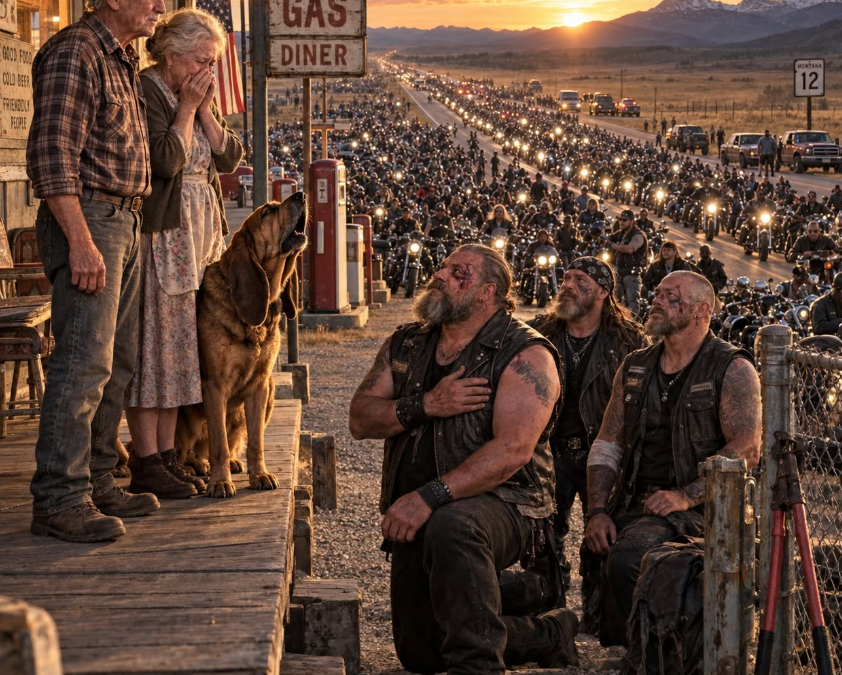
At six eleven, Earl heard thunder.
He stepped onto the porch.
Clear sky.
The sound continued.
Low.
Steady.
Growing.
Ruth came out wiping her hands.
“What is that?”
Biscuit stood.
Ears forward.
The rumble deepened.
Earl felt vibration through the porch boards.
Then headlights appeared over the eastern rise.
One.
Five.
Twenty.
Fifty.
More.
Motorcycles flowed over the horizon in a line so long Earl’s mind could not count them.
They filled the eastbound lane.
Then another group appeared behind.
And another.
Ruth grabbed Earl’s hand.
“My God.”
The first motorcycles turned into the lot.
Riders parked with practiced precision.
The lot filled.
Then the roadside.
Then a field owned by a rancher who had apparently already opened his gate.
Bikes stretched east as far as Earl could see.
Hundreds.
Then hundreds more.
Earl looked at Ruth.
“How many?”
She whispered, “Too many for breakfast.”
Later he learned the estimate.
Around two thousand riders.
Not all from one club.
Different organizations.
Independent riders.
Veterans groups.
Charity riders.
People from Montana.
Wyoming.
Idaho.
Washington.
Oregon.
North Dakota.
Some had ridden four hundred miles.
Why?
Because Tank told four people.
Those four told twenty.
Twenty told hundreds.
And the story changed as it traveled, but one detail remained intact.
Two elderly strangers found four injured riders chained behind a diner.
They knew helping them could bring danger.
They helped anyway.
Engines began shutting down.
The roar became rolling silence.
Tank dismounted from the lead motorcycle.
He looked healthier.
Still bruised.
Cole beside him.
Rooster.
Miguel, moving carefully.
All four.
Alive.
Ruth began crying.
Tank crossed the gravel.
Stopped at the porch.
Earl did not know what to say.
Tank did.
“I told you that you’d remember that night differently than I would.”
Earl nodded.
Tank turned toward the highway.
“This is me remembering.”
The crowd stretched behind him.
Earl looked overwhelmed.
“Son, this is too much.”
“No.”
Tank stepped closer.
“Four men were chained to your fence. You had every reason to stay inside. You didn’t.”
Ruth wiped tears.
Tank’s voice roughened.
“People talk a lot about brotherhood. Most of it’s cheap. You showed us what it means before you knew anything about us.”
He looked at Earl.
“You’re not alone tonight.”
A woman in a leather jacket approached carrying a clipboard.
“Mr. Mercer?”
“Yes?”
“Laura Keene. Attorney.”
She handed him a card.
“We’ve been collecting written statements from business owners around Iron County for three days.”
Earl stared.
“What?”
“Cole told us Deak threatened you. We started asking questions.”
She nodded toward several riders near pickup trucks.
“Two former state investigators are helping organize evidence. State police were contacted yesterday. They’re nearby.”
Earl looked at Cole.
“You said no war.”
Cole nodded.
“This isn’t war.”
Laura said, “It’s documentation.”
A second man introduced himself as retired detective Raymond Shaw.
“We’ve got fourteen people willing to speak on record already. Ranchers. Business owners. Former Deak employees. One towing customer with receipts that don’t match county filings.”
Earl felt something shift.
This was bigger than riders showing muscle.
They had arrived with witnesses.
Evidence.
Cameras.
Attorneys.
People willing to stand publicly beside frightened locals.
At seven twenty, three trucks appeared from the west.
Deak.
Right on time.
They slowed.
The lead truck stopped one hundred yards from the diner.
The others stopped behind it.
Nobody spoke.
Tank looked toward Earl.
“Stay on the porch.”
“No.”
Earl stepped down.
Tank turned.
“This is between—”
“No.”
Earl’s voice remained calm.
“This started at my diner. I stand here.”
Ruth came too.
Tank almost argued.
Then nodded.
The trucks idled.
Deak exited.
Three men remained inside the other vehicles.
He looked around.
Two thousand motorcycles.
Rows of riders.
Phones recording.
No weapons displayed.
No one yelling.
That quiet disturbed him more than shouting would have.
Deak walked forward.
Tank met him halfway.
Ten feet separated them.
“You brought a circus,” Deak said, trying to smile.
Tank answered, “You brought yourself.”
Deak glanced toward Earl.
“We had business.”
Tank shook his head.
“No. You had fear.”
Deak’s eyes hardened.
“Careful.”
Tank smiled faintly.
“That word used to work better for you.”
Earl could hear them.
Everyone could.
Tank continued.
“You chained four of us to that fence. You left us injured. Then you threatened the people who helped us.”
Deak raised his voice.
“You boys were trespassing.”
Cole laughed from somewhere behind Tank.
Tank said, “State police have our statements.”
The smile vanished.
Deak glanced around.
“You think these people scare me?”
Tank shook his head.
“No. This isn’t about us scaring you.”
He pointed toward the diner.
“This is about everybody else seeing they don’t have to be scared anymore.”
That sentence traveled.
Earl saw people gathered behind the riders.
Locals.
Ranchers.
Howard Jensen, whose cattle had escaped after fences were cut.
Martha Alvarez from the hardware store.
Paul Keyes, mechanic.
Two towing customers.
A woman whose husband had lost equipment after disputing a salvage bill.
People who had spent years looking down when Deak entered rooms.
They were standing up now.
Deak saw them too.
Tank continued.
“You built your whole business on people thinking they were alone. One rancher. One shop owner. One old couple. One at a time.”
He gestured around.
“That’s over.”
Laura Keene stepped forward.
“I represent several individuals preparing civil complaints.”
Raymond Shaw held a folder.
“State investigators are waiting at the county office.”
Deak looked at Earl.
“You called them?”
Earl shook his head.
“No.”
“Then what the hell is this?”
Earl answered, “Consequences.”
Deak stared.
The word sat between them.
Not revenge.
Consequences.
One of Deak’s drivers got out of the truck.
Everyone stiffened.
The man raised both hands.
Not aggressive.
He walked toward the shoulder.
“Deak.”
“What?”
“I’m done.”
Deak looked at him.
“What did you say?”
“I’m done.”
The driver removed his work jacket and dropped it into the truck bed.
“I’m not going down with you.”
Deak’s face reddened.
“Get back in that truck.”
“No.”
The man turned toward Raymond Shaw.
“I’ve got records.”
The crowd reacted.
Deak looked genuinely frightened for the first time.
“What records?”
The driver said nothing.
Another man exited the second truck.
Then another.
They did not join Deak.
Fear began unraveling.
Exactly as Tank predicted.
The state patrol arrived ten minutes later.
No sirens.
Just vehicles.
Professional.
Controlled.
Two investigators spoke privately with witnesses.
Nobody arrested Deak that evening.
That disappointed some people who expected drama.
Real investigations rarely obey audience expectations.
But Deak did not enter Earl’s diner.
He did not threaten Ruth again.
He got back into his pickup.
Before leaving, he looked toward Earl.
Old instincts made Earl brace.
Deak said nothing.
The trucks turned.
Rolled west.
This time, fewer men were inside them.
For several seconds there was silence.
Then somebody cheered.
Another voice joined.
The entire roadside erupted.
Not threats.
Relief.
Ruth laughed and cried.
Biscuit began howling.
Two thousand riders answered with laughter.
Earl put both hands over his face.
Tank approached.
“You okay?”
“No.”
Tank smiled.
“Good.”
Earl dropped his hands.
“Why good?”
“Means you’re paying attention.”
Then Ruth said the most Ruth thing imaginable.
“All right.”
Everybody looked at her.
“You people hungry?”
Tank stared at the diner.
“Ma’am, there are two thousand of us.”
“I didn’t ask how many.”
She turned.
“Earl, open the side storage.”
Earl laughed.
And that was how the strangest night in Culver Bend history became a cookout.
Ruth made eggs.
Then pancakes.
Then emptied the freezer.
Local ranchers brought beef.
Someone arrived with potatoes.
The feed store owner brought folding tables.
The church opened its kitchen.
People who had spent years keeping doors closed after dark suddenly brought food to strangers wearing leather.
Riders paid for coffee.
Earl tried to refuse.
They ignored him.
One man left a twenty for a two-dollar cup.
Another paid fifty.
Someone tipped Ruth three hundred dollars.
She chased him into the parking lot.
He escaped on a motorcycle.
By midnight, tents covered the pasture.
People sat beneath stars.
Stories moved between strangers.
No fights.
No revenge.
No Deak.
Miguel sat at the counter.
Ruth inspected his forehead.
“You need to stop touching those stitches.”
“Yes, ma’am.”
“You said that last time.”
“Yes, ma’am.”
Tank laughed.
Miguel pointed at him.
“You’re the one who told me to listen to her.”
“Correct.”
Around two in the morning, Earl found Tank behind the diner.
Near the fence.
The broken padlocks still sat where Earl had dropped them two weeks earlier.
Tank stared.
Earl stood beside him.
“Couldn’t sleep?”
Tank shook his head.
“For years I thought I knew who’d show up for me. Club brothers. Family. People like us.”
He touched the fence.
“Then four old men drove past us that night. Two pickups. A sedan. Everybody saw. Nobody stopped.”
His voice changed.
“Then you did.”
Earl said, “You would’ve done the same.”
Tank looked at him.
“You don’t know that.”
Earl considered.
“No.”
Tank nodded.
“That’s why it matters.”
They stood quietly.
Then Earl said, “You know what bothered me?”
“What?”
“You warned me. You were chained to my fence, could barely lift your head, and your first words were telling me to leave.”
Tank shrugged.
“I didn’t want Deak hurting anybody else.”
“That told me what I needed to know.”
“About what?”
Earl smiled.
“That you weren’t the kind of man Deak said you were.”
Tank looked toward the diner.
“And what kind did he say?”
“Trouble.”
Tank laughed softly.
“He wasn’t completely wrong.”
Earl laughed too.
The investigation into Deak Rollins took almost a year.
Once one witness spoke, others followed.
The driver who abandoned Deak on Route 12 turned over accounting records.
Illegal towing fees.
Cash payments.
Property intimidation.
Insurance manipulation.
False invoices.
Payments tied indirectly to people within the sheriff’s department.
Sheriff Pike resigned.
Then became part of the investigation.
Several deputies were cleared.
One was charged.
Deak faced a combination of state charges, civil suits, tax problems, and business investigations.
His salvage yard eventually sold.
The towing company lost county contracts.
More important, Iron County stopped treating him like weather.
Something unavoidable.
People challenged bills.
Filed reports.
Testified.
Installed cameras.
Called state authorities instead of assuming local corruption made reporting useless.
A rancher named Howard Jensen told Earl one afternoon, “Funny.”
“What?”
“I thought Deak had a hundred men.”
“How many did he really have?”
“Maybe eight.”
Earl smiled.
“Fear multiplies.”
Howard nodded.
“So does courage, apparently.”
Earl looked toward the motorcycles arriving for Sunday lunch.
“Apparently.”
The Route 12 gas stop changed after that.
Not completely.
Still three reliable pumps.
Still eight stools.
Still Ruth’s pies.
But riders began appearing regularly.
One motorcycle.
Five.
Twelve.
People traveling through Montana who had heard about Earl and Ruth.
They stopped to shake hands.
Earl found it embarrassing.
Ruth found it useful for pie sales.
Tank returned in October.
He carried something.
A small leather patch.
One word stitched across it.
FAMILY.
He placed it on the counter.
Earl stared.
“What’s this?”
“We don’t hand these out.”
“Then don’t start.”
Tank smiled.
“I’m serious.”
“So am I.”
Ruth came closer.
Tank explained, “Not a club patch. Doesn’t claim membership. It means if either of you ever needs help and one of ours sees it…”
He paused.
“You’re family.”
Earl pushed it back.
“We didn’t help you for this.”
“I know. That’s why you’re getting it.”
Earl looked at Ruth.
She was already crying.
“Don’t.”
“I’m not doing anything.”
“You’re crying.”
“I’m seventy. I can cry whenever I want.”
Tank placed the patch into Earl’s hand.
“You knelt in the gravel beside four strangers. Everybody else drove past. You didn’t.”
His voice roughened.
“I will remember that until I die.”
Earl closed his fingers around the patch.
Biscuit wandered over and leaned against Tank’s leg.
Tank crouched, scratching the old hound behind the ears.
Biscuit immediately sat on his boot.
“He likes you,” Earl said.
Tank smiled.
“He’s got good judgment.”
Ruth said, “He eats garbage.”
The annual Mercer Run began the following August.
Earl protested the name.
Nobody cared.
The first year, three hundred riders arrived.
Not two thousand.
Still too many for Ruth’s kitchen.
The town prepared.
Church volunteers cooked.
The fire department directed parking.
The new sheriff closed one lane temporarily.
Local businesses set up booths.
Money raised during the ride went to families facing medical emergencies and to a regional school lunch program.
Earl insisted.
“If people are coming because of us, somebody else better benefit.”
That became another tradition.
The Mercer Run raised twelve thousand dollars the first year.
Twenty-one thousand the second.
Eventually more.
Earl stood on the porch each year telling everyone not to make a fuss.
Everyone made a fuss.
Biscuit became the unofficial mascot.
By sixteen, he barely moved.
Yet on Mercer Run mornings, he somehow found strength to walk among motorcycles.
Riders fed him inappropriate amounts of bacon.
Ruth complained.
Did nothing to stop it.
Biscuit died one November morning.
Sixteen years old.
Under the same porch where he had slept most of his life.
Earl found him curled peacefully.
For days, the porch looked wrong.
Tank drove up from Wyoming when he heard.
He sat beside Earl.
No speech.
Two men.
Empty porch.
After an hour, Tank said, “Good dog.”
Earl nodded.
“The best.”
The following Mercer Run, somebody placed a small bronze plaque near Biscuit’s spot.
HE STOOD WATCH.
Ruth cried.
Earl pretended dust had gotten into his eye.
Time continued.
Miguel married.
Brought his wife.
Later, a daughter.
Cole retired from long-distance riding after back surgery.
Rooster never retired from anything because, according to Tank, Rooster had never formally begun adulthood.
Earl aged.
Ruth too.
The gas stop stayed open partly because they loved it.
Partly because nobody allowed it to fail.
When the compressor broke, three riders who owned an HVAC company replaced it at cost.
When the roof needed work, a construction crew appeared.
Earl protested every favor.
Nobody listened.
But the relationship was not one-way.
Ruth mailed food when riders were sick.
Earl attended funerals.
He wrote notes to widows.
Tutored a rider’s grandson in American history over video calls.
When Miguel’s daughter struggled with school, Earl spent an entire summer helping her read.
The girl eventually became a teacher.
“Your fault,” Miguel told him.
Earl smiled.
“Best accusation I’ve had.”
Ruth died first.
Eighty-four.
Cancer.
Fast.
Unfair.
She spent her last weeks at home.
The porch remained busy but quiet.
Riders came in twos, not hundreds.
Brought soup she could barely eat.
Flowers.
Stories.
Tank visited three days before she died.
He sat beside her bed.
Ruth looked small.
Tank seemed enormous.
“You remember the eggs?” he asked.
She smiled.
“You boys ate too slowly.”
“We were half dead.”
“No excuse.”
Tank laughed.
Then cried.
Ruth reached toward him.
He took her hand carefully.
“You take care of Earl.”
Tank nodded.
“He won’t let us.”
“Do it anyway.”
“Yes, ma’am.”
Ruth smiled.
“That’s better.”
At her funeral, motorcycles lined Route 12.
Not revving.
No spectacle.
Engines off.
Hundreds of riders stood in silence.
Earl held the FAMILY patch inside his coat.
Afterward, he almost sold the gas stop.
Could not imagine running it without Ruth.
Tank told him, “Then don’t run it.”
Earl looked confused.
“Keep living there. Let somebody else operate the place.”
That became the solution.
A young couple named Daniel and Melissa Tran leased the diner.
They kept Ruth’s recipes.
The peppermints.
Coffee refills.
Earl retained his chair by the register.
He told customers he was management.
Daniel said, “You’re unpaid furniture.”
Earl liked Daniel.
Earl lived eleven years after the August night.
When he died at eighty-three, his funeral drew more riders than Culver Bend had residents.
Tank was older too.
Gray.
Slower.
He stood beside Earl’s grave holding the leather FAMILY patch.
Earl had left instructions.
Put it with me.
Tank did.
Before the casket was lowered, he placed it over Earl’s heart.
Nobody spoke.
They did not need to.
Afterward, Tank walked alone behind the old diner.
The chain-link fence remained.
Rustier.
One post bent.
He touched it.
Thirty years earlier, he might have thought loyalty was something proven by riding together.
Fighting together.
Wearing the same colors.
He understood differently now.
Loyalty could look like a seventy-two-year-old teacher kneeling in gravel.
A woman in a housecoat bringing towels.
A fourteen-year-old bloodhound guarding a dark highway.
A frightened town finally deciding to testify.
Two thousand riders showing up and choosing not to throw a punch.
Kindness was not weakness.
Neither was restraint.
Sometimes the bravest person in a story was not the strongest.
Sometimes it was the person with the least power who decided power would not determine what was right.
Years after Earl and Ruth were gone, the Mercer Run continued.
The old gas stop changed hands.
Route 12 widened.
New pumps replaced Earl’s.
The diner expanded from four booths to eight.
But one thing remained.
Behind the counter, beneath a photograph of Earl and Ruth standing beside Biscuit, hung a framed copy of the words that had started everything.
DON’T BE SCARED. I’LL HELP YOU.
People asked whether Earl really said that.
Tank, whenever he heard the question, answered, “Close enough.”
Then he told them what mattered.
Earl had not known Tank’s title.
Did not know the club.
Did not know two thousand riders might care.
Did not expect protection.
Money.
Recognition.
A charity ride.
A patch.
He knew only that four people were hurting.
Everybody else had driven past.
He decided not to.
That was all.
And that was everything.
Because fear had ruled Culver Bend for years using one simple idea:
You are alone.
Earl broke that idea without knowing it.
First for four chained strangers.
Then for his wife.
Then for ranchers.
Store owners.
Drivers.
Witnesses.
An entire county.
And eventually for riders hundreds of miles away who realized two elderly people they had never met had demonstrated the exact loyalty they spent their lives claiming mattered.
The motorcycles were dramatic.
Two thousand riders made a story people remembered.
But the motorcycles were not the miracle.
The miracle happened before anyone was watching.
Behind a small diner near midnight.
One old man holding a flashlight.
One frightened wife bringing towels.
One ancient dog standing guard.
Four injured strangers.
And a choice.
Earl Mercer could have closed the door.
Instead, he walked into the dark.
He knelt.
He reached for the chain.
And he told a stranger:
“Don’t be scared.”
“I’ll help you.”
Earl never knew how far those words would travel.
He only knew somebody needed to say them.
And sometimes that is how courage begins.
Quietly.
Before the engines.
Before the crowd.
Before anybody knows your name.








