When My Flashlight Reached the Back Wall of the Flooded Barn, I Couldn’t Understand What the Exhausted Dog Was Carrying
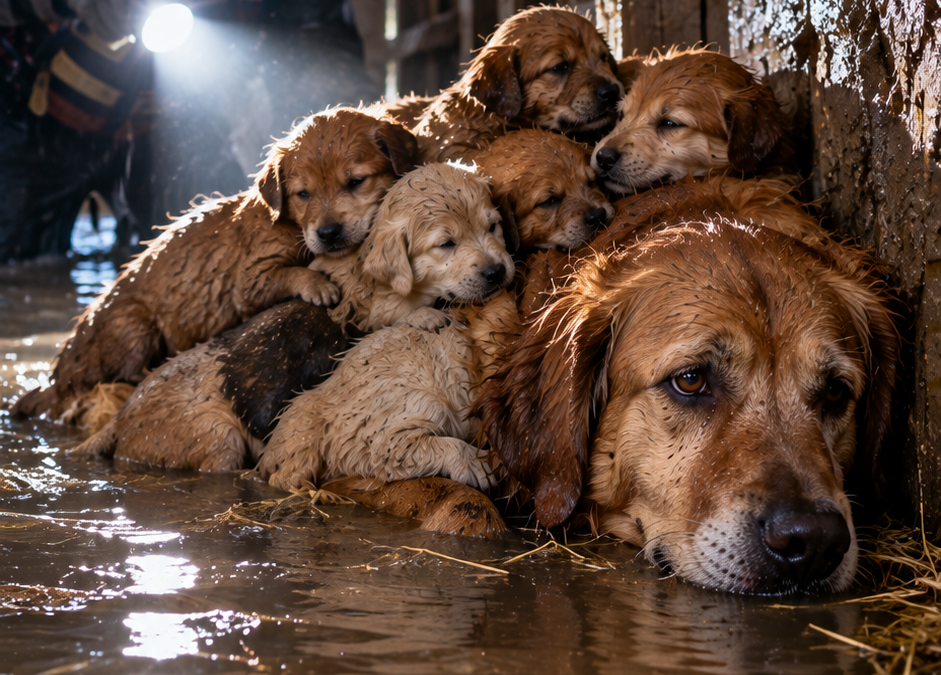
When My Flashlight Reached the Back Wall of the Flooded Barn, I Couldn’t Understand What the Exhausted Dog Was Carrying
For twenty-two hours, the floodwater had been rising inside that barn.
By the time I reached the back wall, Copper could barely keep his legs beneath him.
Then my flashlight moved across his body, and I realized he had turned himself into the only dry ground seven tiny lives had left.
My name is Emily Collins.
I was thirty-five years old when I walked into that flooded barn, and by then I had already seen enough disasters to know that nature rarely leaves things exactly as it found them.
Floods are especially deceptive.
Fire announces itself.
Smoke rises.
Flames roar.
You can see destruction coming.
Water is different.
It moves quietly.
It fills ditches.
Crosses roads.
Creeps under doors.
Climbs steps.
Turns fields into lakes and familiar houses into isolated shapes surrounded by brown water.
By the time people understand how serious it has become, the world they know may already be inaccessible.
That was what had happened in Oak Ridge.
Rain had fallen hard for hours.
Then the river rose.
Then every small stream feeding it rose too.
Roads disappeared.
Fences vanished beneath muddy water.
Cars stalled.
Families left homes carrying whatever they could lift.
By the time our rescue team arrived, entire sections of farmland had become impossible to reach by truck.
We used boats.
That morning, Mark and Daniel were with me.
Both were experienced enough that very little surprised them anymore.
At least, that was what I believed before we reached James Bennett’s property.
Someone at the evacuation center told us about the dog.
“Copper.”
James was standing near a window at the old school that had been turned into a temporary shelter.
He had not slept.
I could tell before he spoke.
His eyes were red.
His clothes were still damp from the evacuation.
His hands would not stay still.
“My dog is still there.”
“Where?”
“The barn.”
He pointed as though we could see it through walls and miles of floodwater.
“What kind of dog?”
“Copper.”
“I mean size.”
“Large.”
He swallowed.
“There are puppies too.”
That changed everything.
“How many?”
“Seven.”
“How old?”
“Young.”
He shook his head.
“I don’t know exactly. Still little.”
“Why didn’t they come with you?”
The moment the question left my mouth, I regretted it.
James’s face collapsed.
“The water came too fast.”
There was no defensiveness in his voice.
Only guilt.
“We thought we’d have more time.”
He rubbed both hands over his face.
“Copper wouldn’t leave them.”
“You tried?”
“Yes.”
“The barn already had water in it. We had to get out.”
He looked directly at me.
“I thought I’d be able to go back.”
He stopped.
That sentence lives inside almost every disaster.
I thought I’d be able to go back.
For the medicine.
For the photographs.
For the cat.
For the dog.
For one more box.
For the thing left on the kitchen table.
People don’t leave believing they are saying goodbye.
They leave believing they are escaping temporarily.
Then roads close.
Water rises.
Time stretches.
And temporary becomes something else.
“How long ago?” I asked.
James stared at the clock on the wall.
“Twenty-two hours.”
Mark and I exchanged a look.
I did not let James see it.
Twenty-two hours in a flooded barn.
With seven puppies.
“How high was the water when you left?”
“Maybe a few inches.”
“And the barn?”
“Concrete floor.”
“Any loft?”
“No.”
“Raised platform?”
“Some feed storage shelves.”
“But could Copper reach them?”
“I don’t know.”
His voice broke.
“I don’t know.”
Daniel stepped closer.
“We’ll go.”
James grabbed my sleeve.
“Please.”
“We’re going.”
“No.”
His fingers tightened.
“Please don’t tell me you’re just going because I’m standing here.”
I looked at him.
“We’re going because there may still be animals alive.”
“Do you think…”
He couldn’t finish.
I didn’t give him false reassurance.
“I don’t know what we’ll find.”
His eyes closed.
“Okay.”
I put one hand over his.
“But we’ll look.”
That was the promise I could make.
The boat ride to the farm took longer than expected.
Floodwater changed every landmark.
Fence posts stuck out at strange angles.
Tree branches floated past.
A mailbox drifted beside us with its door open.
The air was cold.
Not freezing, but cold enough that standing in water for any length of time would become dangerous.
The farmhouse appeared first.
Water reached partway up the exterior wall.
Then the barn.
Only the upper doors and roofline looked normal.
Everything below them belonged to the flood.
Daniel slowed the boat.
“That’s it?”
I checked the directions.
“That’s it.”
No barking.
That bothered me.
A dog trapped for twenty-two hours should have reacted to the engine.
Unless the dog was too exhausted.
Or no longer alive.
I did not say that.
Mark tied us off near the entrance.
I stepped down first.
Cold water climbed almost to my knees.
Instantly, it seeped through everything.
Boots.
Fabric.
The temperature shocked my legs.
I imagined an animal standing in it for twenty-two hours.
No.
Don’t imagine yet.
Work first.
The barn door resisted.
Mud and water pressed against it.
The three of us forced it open enough to enter sideways.
Inside, darkness swallowed the daylight.
The smell hit immediately.
Wet hay.
Mud.
Oil.
Animal.
Cold concrete.
Rotting grain.
The quiet was worse.
Flooded buildings have their own sound.
Water tapping against metal.
Dripping roofs.
Small things shifting somewhere you cannot see.
Your own breathing.
I raised my flashlight.
“Animal rescue!”
Ridiculous words for a dog.
Habit.
“Hey, Copper!”
Nothing.
Mark called.
“Come on, boy!”
No response.
We moved slowly.
Water distorted the floor.
A bucket floated past my leg.
Something brushed Daniel’s knee and he jerked before realizing it was a piece of wood.
“Copper!”
Then I heard something.
Not a bark.
A faint movement.
Water.
From the back.
I turned the flashlight.
Tools hung along one wall.
Feed sacks had collapsed.
A shelf leaned dangerously.
The beam reached farther.
Then stopped.
At first, I thought the shape against the wall was a pile of soaked blankets.
Large.
Dark.
Irregular.
Then it moved.
A head lifted.
“Oh my God.”
Mark came beside me.
My flashlight steadied.
Copper.
The dog was standing with his back braced against the barn wall.
I say standing, but that word does not explain what I saw.
He was surviving upright.
His legs were spread slightly for balance.
His paws were planted against slick concrete beneath the water.
His entire body trembled.
Not small shivers.
Deep muscular shaking.
The kind that comes when the body has been demanding something impossible from itself for too long.
His coat was soaked from his belly downward.
Water clung to his ribs.
His head drooped forward.
His eyes were half closed.
But the moment we disturbed the water, he raised his head.
Alert.
Watching.
Protecting.
I took one step.
Then my light moved upward.
Something was on his head.
I stopped.
“Mark.”
“I see it.”
A puppy.
A tiny blond puppy lay curled between Copper’s ears and the top of his broad head.
At first, that alone seemed impossible.
Then the beam moved along Copper’s back.
One.
Two.
Three.
More.
Six puppies were pressed along his spine, packed against one another so tightly that their bodies almost looked like one mass of fur.
Seven total.
One on his head.
Six along his back.
None in the water.
For several seconds, nobody spoke.
Daniel finally whispered, “How?”
Mark stepped closer.
“He put them there?”
I didn’t answer.
There was no other explanation.
Somehow, as the water rose, Copper had gotten seven small puppies onto his own body.
And stayed standing.
Twenty-two hours.
My flashlight shook.
I forced my hand steady.
The puppies weren’t crying.
That frightened me at first.
Then one shifted.
Another moved its paw.
The blond puppy on Copper’s head gave a tiny sound.
Alive.
I moved closer.
Copper’s body immediately tensed.
His head lifted.
Not threatening.
But clear.
These are mine.
I stopped.
“Easy.”
His eyes followed me.
There was no aggression in them.
There was almost no energy left for aggression.
But there was determination.
The smallest movement from us made him straighten as much as his exhausted body allowed.
I lowered the flashlight.
“Look at the water.”
Mark followed my gaze.
Near Copper’s feet, the floodwater was faintly pink.
My chest tightened.
I moved the beam lower.
His paws.
What I could see of them beneath the murky water was raw.
Concrete had abraded the skin.
His legs had been fighting for traction for hours.
His belly and lower chest were bright red from cold exposure.
Yet the puppies above the water were dry.
Not just less wet.
Dry.
I reached toward the nearest one but stopped before touching.
“Wait.”
Mark looked at me.
“If we take them too quickly, he may think we’re hurting them.”
Daniel nodded.
“He’s running on instinct.”
“Exactly.”
I moved one step closer.
The water rippled.
Copper tried to raise his head again.
His legs trembled harder.
“Hey.”
I kept my voice low.
“You did good.”
His ears moved.
“Copper.”
James had told us the name.
I hoped hearing it would mean something familiar in a completely unfamiliar moment.
“Copper.”
His cloudy exhaustion fixed on me.
“You did everything right.”
The blond puppy moved.
A tiny whimper.
Copper’s ears flattened backward immediately.
His head shifted the smallest amount, as though trying to reassure the animal without dislodging it.
My throat tightened.
“You’re okay.”
I extended one hand.
Palm upward.
“I’m not taking them away from you.”
Of course, that was exactly what I needed to do.
But not away.
To safety.
“You’re tired.”
Copper stared.
“I know.”
One more step.
“You can stop now.”
That sentence affected me even as I said it.
Because I realized he probably had not allowed himself to stop for twenty-two hours.
If he sat, the puppies went into the water.
If he lay down, they went into the water.
If his legs failed, they went into the water.
So he remained upright.
There had been no rest available to him.
No choice between comfort and discomfort.
Only stand or let them drown.
“You can stop.”
His head lowered slightly.
Not surrender.
Permission.
That was how it felt.
I moved within reach.
Copper sniffed my hand.
Weakly.
His nose was cold.
I touched the side of his face.
He did not pull away.
“Good.”
Mark had returned to the boat and prepared blankets.
Daniel positioned himself beside me.
“One at a time.”
I nodded.
The blond puppy on Copper’s head came first.
I moved both hands slowly.
Copper watched.
I slid one beneath the tiny chest and another beneath its rear legs.
The puppy weighed almost nothing.
I lifted.
Copper’s eyes followed it.
“It’s okay.”
I held the puppy against my chest.
Warm.
Actually warm.
After twenty-two hours in that barn.
Warm.
“Mark.”
He took the puppy and wrapped it immediately.
I returned.
Copper remained upright.
Barely.
“Next.”
The puppies along his back were pressed into his soaked upper fur.
The second was dark brown with a lighter muzzle.
I lifted carefully.
Copper turned his head enough to follow.
Third.
White markings.
Fourth.
Almost black.
Fifth.
Golden.
Sixth.
Gray and round.
Each one warm.
Each one dry.
Each one alive.
With every puppy removed, Copper’s body seemed to sink slightly.
Not into the water yet.
Into exhaustion.
The weight was leaving his back.
So was the reason he had forced himself to stay rigid.
I kept talking.
“Almost done.”
His eyes closed for half a second.
Opened again.
“You’re still with me.”
The seventh puppy was tucked closest to his neck.
The smallest.
Pressed into the warmest part of him.
I slid my fingers beneath it.
The puppy made a tiny sound.
Copper’s head immediately moved toward my hands.
I stopped.
“Easy.”
His nose touched the puppy.
One brief touch.
Then he looked at me.
I will remember that look until I die.
Not because it was dramatic.
Because it wasn’t.
There was no wild panic.
No desperation.
Only exhaustion and a question.
Will you keep this one safe too?
“I’ve got him.”
I lifted the puppy.
Copper watched until Mark took it.
Then the last small body disappeared into a blanket.
All seven safe.
For one second, Copper remained standing exactly as before.
Back against the wall.
Head lowered.
Body trembling.
Then something changed.
His rear legs folded.
“Daniel!”
Copper began sinking.
Not fighting anymore.
He had no reason left to.
I grabbed beneath his front legs.
“Not yet.”
His weight came down hard.
Mark rushed back from the boat.
Together, we supported him.
“Come on.”
Copper’s head dropped against my shoulder.
“You’re coming too.”
For twenty-two hours, he had made himself into a platform.
Now he finally allowed himself to become a dog who needed carrying.
We got him into the boat.
He collapsed immediately onto a blanket.
His legs stretched awkwardly.
His whole body shook.
The puppies were bundled nearby.
The first one began moving more actively in the warmth.
Then another.
Copper heard them.
His eyes opened.
He tried lifting his head.
“Stay down.”
He ignored me.
Of course.
He dragged his head toward the puppies.
Mark moved them closer.
Copper reached the first.
Licked its head.
Slow.
One stroke of the tongue.
Then the second.
Third.
He checked each puppy.
Every one.
Only after touching all seven did he lower his head again.
Daniel started the boat.
As we pulled away from the barn, I looked back.
Water covered almost everything around it.
If we had arrived later, I don’t know what would have happened.
I don’t like thinking about that.
Instead, I looked at Copper.
He had done the one thing available to him.
He had used his own body.
There had been no shelf he could safely climb with seven puppies.
No human coming through the door.
No dry bedding.
No raft.
He had four legs, a back, and the instinct not to let those puppies disappear beneath the water.
So that became the rescue plan.
The temporary shelter was an old school on higher ground.
Dozens of evacuated families were crowded inside.
Children slept on gym mats.
People carried cups of coffee they forgot to drink.
Wet coats hung over chairs.
Someone had turned classrooms into sleeping spaces.
A volunteer veterinarian was working out of one room.
As we approached, word spread that we’d found the dog.
James was outside before the boat was fully secured.
“Where is he?”
“Slow down.”
“Where’s Copper?”
Then he saw the blankets.
Mark carried two puppies.
Daniel carried more.
I stayed with Copper as we lifted him.
James stopped moving.
Seven puppies.
Alive.
Copper.
Alive.
The man’s face broke.
“Copper.”
The dog lifted his head.
Barely.
But he knew the voice.
His tail moved once against the blanket.
James dropped to his knees.
“Oh, God.”
We lowered Copper carefully.
James leaned over him.
He didn’t care that the dog was soaked.
Didn’t care about mud.
He buried his face against Copper’s neck.
“I’m sorry.”
His voice shook.
“I’m sorry.”
Copper licked near his wrist.
James cried harder.
“I left you.”
“No.”
I said it before I could stop myself.
James looked up.
“I left him there.”
“You evacuated during a flood.”
“I should have—”
“You would have become another person we needed to rescue.”
He shook his head.
“The puppies—”
“Are alive.”
He looked toward the seven bundles.
“Because of him.”
I nodded.
“Yes.”
James pressed his forehead against Copper’s.
“I’m sorry, buddy.”
Copper simply breathed.
That was enough.
Dr. Susan Miller examined the puppies first.
She had been practicing veterinary medicine for thirty years and volunteering since the evacuation center opened.
I watched her work.
Temperature.
Heart rate.
Hydration.
Gums.
Breathing.
One puppy after another.
Her expression grew stranger each time.
Finally, she looked at me.
“These puppies were in that barn twenty-two hours?”
“Yes.”
“In the flood?”
“On Copper.”
“All of them?”
“All seven.”
She checked the smallest again.
Then sat back.
“They’re dry.”
“I know.”
“They’re warm.”
“I know.”
“Their temperatures are normal.”
James stared.
Susan moved to Copper.
His condition was different.
Cold exposure.
Exhaustion.
Abrasions.
His paws were badly irritated.
His underside was reddened.
Muscles in his legs were so fatigued that when Susan tried helping him stand briefly, he couldn’t.
She stopped immediately.
“Don’t make him.”
We wrapped him in dry blankets.
Slow warming.
Fluids.
Treatment for the abrasions.
Constant monitoring.
Susan looked from Copper to the puppies.
Then back at me.
“I’ve been doing this for thirty years.”
She shook her head.
“I’ve never seen anything like this.”
James sat close enough that his knee touched Copper’s blanket.
Susan continued.
“These puppies should be cold.”
Her voice grew softer.
“They should be dehydrated.”
She looked toward them.
“They’re not.”
“How?”
James asked.
Susan touched Copper’s wet back.
“His body.”
“He kept them above the water.”
“And warm.”
She examined the placement of the abrasions.
“He must have braced himself against the wall.”
I remembered the way we’d found him.
Back locked against concrete.
Legs wide.
“Twenty-two hours.”
Susan looked at Copper.
“Standing?”
“As far as we know.”
She exhaled.
“That’s…”
She stopped.
There wasn’t a clinical word for it.
James supplied one.
“A miracle.”
Susan didn’t argue.
I understood what he meant.
But I had seen Copper’s paws in the pink water.
Miracles sometimes have very physical costs.
Over the next several days, Copper slept.
A lot.
He would wake.
Check the puppies.
Then sleep again.
His legs gradually stopped trembling.
The abrasions began healing.
Warmth returned to his skin.
His appetite came back slowly.
At first, James hand-fed him.
Small amounts.
Copper ate, then immediately turned his head toward the puppies.
“They’re fine.”
James said it constantly.
“They’re right there.”
The puppies stayed together in a warm enclosed area near Copper.
Whenever possible, he remained beside them.
The first night after the rescue, I came by the temporary shelter late.
I told myself I was checking on animals.
Truthfully, I wanted to see him.
Copper was asleep.
Seven puppies were pressed near him.
One paw rested over two of them.
I smiled.
Then Copper jerked awake.
Suddenly.
His head snapped upward.
Body tense.
For one second, he looked lost.
The room wasn’t the barn.
There was no floodwater.
No wall against his back.
No rain hammering the roof.
Still, he looked around urgently.
Then he saw the puppies.
One.
Two.
Three.
His gaze moved across them.
His body relaxed.
He lay down again.
James was sitting nearby.
“He does that every few hours.”
“Wake up?”
“Like he thinks they’re gone.”
I crouched beside Copper.
“Then he checks.”
James nodded.
“And goes back to sleep.”
He rubbed his eyes.
“I don’t know how I’m going to forgive myself.”
I knew what he meant.
“You may not need to.”
He looked at me.
“What?”
“Forgiveness assumes you deliberately did something wrong.”
“I left him.”
“We talked about this.”
“I hear you.”
His voice hardened.
“But I was the one in a dry building while he stood in freezing water.”
That was a fact no reassurance could erase.
So I didn’t try.
Instead I said, “Then remember it.”
James stared.
“Don’t turn it into punishment.”
I looked at Copper.
“Turn it into care.”
He looked down.
That was all I had.
Floodwater eventually receded.
Roads reappeared.
Mud remained everywhere.
Oak Ridge began the exhausting work that comes after disaster.
Cleaning.
Drying.
Throwing away.
Repairing.
Counting losses.
The Bennett property was damaged badly, but the barn still stood.
James went back before Copper was ready.
When he returned to the shelter, he had mud on his boots and a strange expression.
“The water line is shoulder high on me.”
I knew what he meant.
Inside the barn, staining along the wall showed exactly how far the flood had risen.
He had seen where Copper stood.
“There’s scratches on the concrete.”
“From his paws?”
“I think so.”
He sat.
“I keep picturing him.”
I didn’t answer.
Sometimes images have to exist for a while before words become useful.
Copper improved steadily.
Within days, he could stand.
At first, his legs shook.
James stayed beside him.
“Easy.”
Copper took one step.
Then another.
The moment he reached the puppies, he lay down.
That was his destination.
Always.
The seven puppies grew quickly.
Their personalities began emerging.
The blond one was bold.
The dark brown puppy slept constantly.
The almost-black one seemed determined to climb anything nearby.
The smallest pup remained closest to Copper.
Maybe coincidence.
Maybe not.
By the time they were running around the temporary shelter, it became difficult to imagine them balanced on Copper’s exhausted back.
But I had seen them there.
I knew.
Stories spread through Oak Ridge.
At first, through the evacuation center.
Then across the community.
Everyone knew about Copper.
The dog who had stood in floodwater.
The seven dry puppies.
Twenty-two hours.
People brought him treats.
Blankets.
Toys.
James accepted some and rejected ridiculous amounts of food because Copper would have become dangerously fat within a week.
Children wanted to meet him.
Copper tolerated attention but seemed mostly interested in his puppies and James.
Months later, after the floodwater was gone and repairs had begun, people decided to hold a small ceremony at the farm.
James resisted at first.
“Copper doesn’t know what a ceremony is.”
“No.”
I smiled.
“But the community does.”
He thought about that.
The gathering was simple.
Dozens of people came.
Nothing grand.
Neighbors.
Families from the evacuation center.
Volunteers.
Rescuers.
Children.
Susan.
Mark.
Daniel.
Me.
James brought Copper out clean and brushed.
His coat looked healthy again.
Only a few marks remained on his paws.
Around his neck hung a blue ribbon.
HERO.
James looked embarrassed by the word.
Copper looked indifferent.
The seven puppies ran between people’s legs.
They were bigger now.
Clumsy.
Loud.
Alive.
That was the only award Copper needed.
The local pastor spoke.
“We often imagine heroes far away from us.”
He looked at the crowd.
“In uniforms.”
“In cities.”
“In great events.”
Then at Copper.
“But sometimes heroism is standing exactly where you are.”
The crowd became quiet.
“Sometimes it is remaining on four exhausted legs in freezing water because the lives you love have nowhere else to stand.”
James looked down.
Copper leaned against him.
The pastor continued.
“Love is easy to describe when nothing is being asked of us.”
He paused.
“Harder to measure when it costs something.”
His eyes moved toward the puppies.
“Copper measured it for us in twenty-two hours.”
James knelt.
Wrapped both arms around Copper.
The dog leaned into him.
The puppies continued playing.
They had no idea why people were emotional.
No memory of the flood.
No concept of rescue.
That struck me as the best possible ending for them.
Trauma forgotten.
Safety ordinary.
A few months later, the puppies were ready for permanent homes.
That decision was difficult for James.
He wanted to keep all seven.
Susan reminded him that seven growing dogs plus Copper was not a practical plan.
Eventually, James kept two.
The other five went to families he had chosen carefully.
I was there for one of the conversations.
A couple sat across from him.
One puppy asleep between them.
James said, “There is something you need to know before you take her.”
They nodded.
Then he told them.
The flood.
The barn.
Copper.
Twenty-two hours.
By the end, the woman was crying.
James looked at the sleeping puppy.
“She spent the worst night of her life on his back.”
The man reached down and touched her.
“She’ll never spend another night cold.”
James nodded.
That was what he needed to hear.
Each family made some version of the same promise.
Warm house.
Food.
Care.
Safety.
Never abandoned.
The five puppies left one by one.
Copper noticed.
The first time a family drove away, he stood near James watching the vehicle disappear.
I wondered whether he would search for the puppy later.
He did.
Briefly.
Then returned to the two still at home.
Perhaps dogs understand departure better than we do.
Or perhaps he could smell enough calm around the new families to accept what was happening.
I don’t know.
What I know is that the puppies had lives.
That was what Copper had fought for.
Not ownership.
Life.
The years after the flood were gentle to him.
He lived four more.
Four.
I have always loved that number.
Because after twenty-two hours when it seemed possible he might not last another day, he was given four years.
Four spring mornings.
Four summers.
Four winters.
Four autumns.
Hundreds of breakfasts.
Hundreds of naps.
Walks.
Sunrises.
Rainstorms.
Quiet evenings with James.
He aged peacefully.
His favorite place became the front porch.
From there, he could see the fields and the road.
Or perhaps smell them more than see them as age changed his eyes.
James said Copper loved sunrise.
Every morning, weather permitting, he went outside and settled near the steps.
When clouds gathered, something in him changed.
Not panic.
Attention.
His head lifted.
He looked toward the yard.
Toward the house.
Toward whichever dogs happened to be nearby.
Checking.
Always checking.
The first rain after the flood worried James.
He called me.
“He’s pacing.”
I went out.
Copper wasn’t frantic.
But every few minutes he walked from the porch into the house.
Counted, in whatever way dogs count, who was there.
Back outside.
Check.
Back.
Eventually, after everyone was inside, Copper lay down.
Rain fell.
He watched it.
Then closed his eyes.
James sat beside him.
“He remembers.”
“Probably.”
“Do you think he’s afraid?”
I watched Copper.
“No.”
“What is it then?”
I thought about the barn.
“Responsibility.”
James looked at me.
I wasn’t sure that was the right word.
But it was the closest one I had.
The flood had taught Copper something his body did not forget.
When water comes, make sure everybody is safe.
Once he had confirmed that, he could rest.
Over time, even that ritual softened.
Rain became rain again.
Not every storm was a disaster.
Not every dark cloud carried danger.
Copper would lift his head.
Look around.
Find James.
Find the dogs.
Then settle.
The memory never completely disappeared.
It just stopped controlling the moment.
That is what healing looks like more often than people realize.
Not forgetting.
Knowing the difference between then and now.
I visited James periodically.
Sometimes for rescue-related follow-up.
Eventually just because we had become friends through something neither of us could forget.
Copper always greeted me calmly.
I liked to believe he remembered me from the barn.
James said he did.
I never claimed certainty.
Dogs remember scents remarkably well.
Maybe he knew.
Maybe I was simply another person associated with safety.
Either was enough.
Once, years after the rescue, I sat on the porch beside him.
Copper’s muzzle had gone gray.
His movements slower.
Two of the puppies James kept were now large adult dogs.
Calling them puppies had become ridiculous, though James still did.
They wrestled in the yard.
Copper watched.
I touched the fur behind his ear.
“You know they don’t need you to carry them anymore.”
His eyes remained on them.
One of the younger dogs ran toward the porch.
Copper lifted his head.
The dog stopped beside him.
Licked his muzzle.
Then ran off.
James laughed.
“He still thinks they’re babies.”
“Maybe they still are to him.”
James looked toward the fields.
For a while, neither of us spoke.
Then he said, “I used to think the worst thing that happened in my life was leaving him in that barn.”
I waited.
“Now?”
“I still hate that I did.”
He rubbed his hands together.
“But I’ve finally stopped pretending I could have controlled the river.”
That was progress.
“He never blamed you.”
“I know.”
“He probably didn’t think of it that way.”
“I know.”
James looked at Copper.
“That’s the problem with dogs.”
“What?”
“They forgive things before we forgive ourselves.”
I smiled.
“Maybe because they’re smarter.”
“Probably.”
We sat until sunset.
Copper’s breathing was slower in those later years.
But peaceful.
He had earned peaceful.
When Copper finally died four years after the flood, it was not in water.
Not in cold.
Not standing.
Not fighting to keep anyone alive.
He was old.
Safe.
At home.
James was with him.
The two dogs he’d kept were nearby.
When James called me, his voice was quiet.
“He’s gone.”
I closed my eyes.
“Was he comfortable?”
“Yes.”
“Was he alone?”
“No.”
“Then you gave him what mattered.”
James cried.
So did I.
The community remembered Copper long after.
Not just because of the ceremony.
Not because of the ribbon.
Because stories like his become part of a place.
When heavy rain came, somebody inevitably mentioned him.
When people talked about the flood, they remembered the barn.
Seven puppies.
One dog.
Twenty-two hours.
But I always felt uncomfortable when the story became too clean.
People love to turn survival into legend.
They say things like:
Copper wasn’t afraid.
Copper knew exactly what to do.
Copper never considered giving up.
We don’t know that.
I saw his body.
He was exhausted.
He was cold.
His paws were injured.
His muscles were failing.
Fear would not make what he did less remarkable.
If Copper was afraid and stayed anyway, that matters even more.
If he didn’t know whether we would come, but stood anyway, that matters.
If every hour his legs hurt more and he continued because lying down would put the puppies in water, that matters.
Courage is not the absence of suffering.
Sometimes it is simply refusing to transfer your suffering to someone more vulnerable.
Copper took the cold.
The water.
The pressure.
The exhaustion.
The puppies got his dry back.
I cannot think about that without emotion even now.
Of all the details people remember, one stays with me most clearly.
Not the water.
Not the pink around his injured paws.
Not James crying.
Not the blue ribbon.
The warmth of the first puppy when I lifted it from Copper’s head.
Warm.
That should have been impossible after twenty-two hours inside a flooded barn.
But Copper had kept enough heat in his upper body to protect that tiny animal.
When I held that puppy, I was holding evidence of everything he had endured.
His body had become the shelter.
Nothing abstract.
No metaphor.
Literally.
His back was the dry floor.
His fur was the blanket.
His muscles were the walls.
His legs were the foundation.
And he held the entire structure upright until someone came.
I have participated in many rescues since.
Some dramatic.
Some quiet.
Animals trapped in ditches.
Homes.
Vehicles.
Ice.
Storm debris.
I have seen mothers refuse to leave offspring.
Dogs stay beside injured owners.
Animals do things that seem beyond what we expect from instinct.
People always ask why.
I stopped trying to answer everything.
Sometimes attachment is enough explanation.
Copper had seven vulnerable lives on his back.
He kept them there.
That is what happened.
One day, someone asked me which one of us rescued the puppies.
I thought they meant the team.
Mark.
Daniel.
Me.
I said, “Copper did.”
They laughed.
“No, I mean who actually removed them.”
“I did.”
“Then you rescued them.”
I shook my head.
“No.”
I arrived at hour twenty-two.
Copper had been rescuing them since hour one.
We transported them.
He saved them.
There’s a difference.
The same is true for Copper himself.
Did I save him?
Maybe physically, in the final moments.
I caught him when his legs collapsed.
Mark helped lift him.
Susan treated him.
James cared for him afterward.
But Copper stayed alive for twenty-two hours before any of us arrived.
Survival is often cooperative that way.
One creature carries the impossible part until another arrives to carry the next part.
Copper carried the puppies.
Then we carried Copper.
James carried the guilt.
Eventually, time helped carry some of that too.
No one survives entirely alone.
Not even a dog who looks like a hero in every photograph.
Years later, I returned to the Bennett farm during another spring rain.
The barn had been repaired.
The flood line was still faintly visible on one interior wall.
James had never painted over it.
“Why leave that?”
He looked at the mark.
“Because forgetting isn’t the goal.”
I understood immediately.
Near the back wall were scratches low on the concrete.
Some might have existed before the flood.
Some probably came from debris.
But James believed several had been made by Copper’s claws.
I crouched.
Ran my fingers lightly over them.
For a second, I could see him again.
Back against the wall.
Head down.
Puppies on top.
“Do you ever come in here just to look?”
James smiled sadly.
“Less than I used to.”
“Good.”
“I think so.”
Outside, rain tapped on the roof.
Nothing dangerous.
Just rain.
Two adult dogs lay near the barn door.
Copper’s puppies.
They didn’t care about the sound.
James glanced at them.
“They don’t remember.”
“No.”
“Sometimes I wish they did.”
“Why?”
“So they’d know what he did.”
I looked at them.
“They don’t need to.”
He waited.
“The whole point was that they got to live past it.”
James nodded.
That thought had stayed with me since the ceremony.
The puppies had no memory of terror.
No story about the barn.
No understanding of Copper’s sacrifice.
They had warmth.
Homes.
Food.
People.
Ordinary lives.
That was the victory.
The goal of rescue isn’t gratitude.
It’s freedom from needing rescue again.
Those seven dogs received that.
Five in new homes.
Two with James.
Copper had not stood for twenty-two hours so they would remember him.
He stood because they needed somewhere dry.
That simplicity makes the story stronger, not weaker.
I have often wondered what Copper experienced during those hours.
The source of the floodwater.
The sounds.
Darkness.
Cold.
Did the puppies keep slipping?
Did he reposition them?
Did he use his mouth to lift them one at a time?
Did he understand the water would continue rising?
We will never know.
I refuse to invent what happened inside those missing hours.
What we know is enough.
When we found him, the puppies were there.
Dry.
Warm.
Alive.
Copper was standing.
Exhausted.
Injured.
Still guarding them.
That is the truth.
And the truth does not require decoration.
After Copper died, James kept the blue ribbon from the ceremony.
He did not hang it somewhere dramatic.
It stayed in a drawer with photographs.
One picture showed Copper on the porch years after the flood.
Gray muzzle.
Eyes half closed in morning sun.
No mud.
No water.
No puppies stacked along his back.
Just peace.
That became my favorite picture.
People preferred the rescue images.
I preferred the porch.
Because rescue is only valuable if it leads somewhere.
Copper’s heroism did not end when we pulled him from the barn.
The reason the rescue mattered was that afterward he got four years in the sun.
Four years of sleeping without needing to stay upright.
Four years of rain that did not reach his chest.
Four years of puppies becoming adults around him.
Four years of knowing everybody was safe.
That is the part I wish people celebrated more.
Not only survival.
The life after survival.
The morning after.
The soft bed.
The healed paws.
The quiet porch.
The ability to close your eyes during rain.
Those things are not dramatic.
They are everything.
I sometimes think back to the moment Copper’s legs gave way.
The last puppy had just left his back.
For twenty-two hours, his body had refused collapse.
Then the responsibility was gone.
Safe hands.
Warm blankets.
Boat.
Only then did he let himself fall.
I caught him.
At the time, I thought I was saving him.
Now I understand I was receiving something from him.
The weight.
He had carried it long enough.
Literally and otherwise.
For twenty-two hours, he had been the wall.
The platform.
The heat.
The protector.
Then humans finally arrived.
He handed the responsibility over.
That is why the look he gave me before I touched the first puppy remains so important.
Trust.
Not affection.
Not gratitude.
Trust.
Are you going to do this correctly?
Can I stop?
Will they remain safe if I let go?
I hope my hands answered.
Yes.
You can stop now.
We’ve got them.
We’ve got you too.
Every rescuer should understand that second promise.
We focus naturally on the most vulnerable.
The puppies.
The child.
The injured animal.
But sometimes the protector is collapsing in front of us.
The mother who has not slept.
The dog who stayed.
The person who carried everyone else out.
They need someone to say:
Your turn.
You can be carried now.
Copper deserved that.
He had done enough.
More than enough.
When I train new rescue volunteers now, I sometimes tell his story.
I keep it simple.
No dramatic music.
No exaggerated language.
I tell them about the barn.
The flood level.
The water temperature.
Seven puppies.
Twenty-two hours.
Copper standing against a wall.
Then I tell them the most important part.
“Do not rush toward a protector just because you are there to help.”
They usually look confused.
I explain.
“Copper had spent twenty-two hours believing every movement around those puppies mattered.”
“We knew we were rescuers.”
“He didn’t.”
“So we slowed down.”
“We let him see our hands.”
“We spoke.”
“We gave him a choice to trust us.”
“That matters.”
Rescue is not something you do to an animal.
It is something you do with whatever trust the animal can give you.
Copper gave me just enough.
I still remember moving my hands toward that first blond puppy.
The way his eyes followed.
The way his head lowered only after he understood I wasn’t hurting it.
That wasn’t a small thing.
He allowed me to take over the most important job in his world.
Some trust has to be earned in years.
Some is decided in one second because there is no time left.
I have never taken either kind lightly since.
Today, when people ask me about the most extraordinary animal I’ve ever rescued, Copper’s name usually comes first.
But I correct the question.
“I didn’t rescue the extraordinary part.”
“What do you mean?”
“We got there at the end.”
The extraordinary part happened when nobody was watching.
That matters to me.
Heroism is easy to recognize once people arrive.
The difficult choices usually happen earlier.
In the dark.
Without witnesses.
Without applause.
Without any certainty that help is coming.
Copper did not know a boat was twenty-two hours away.
He did not know his owner was awake in a school building grieving for him.
He did not know a veterinarian would later call what he did miraculous.
He did not know there would be a ribbon.
A ceremony.
Good homes for five puppies.
Four more peaceful years.
He knew water was rising.
He knew the puppies could not stand in it.
He had a back.
So he gave them his back.
Sometimes love is no more complicated than that.
Use what you have.
Hold on as long as you can.
And when help arrives, trust someone else enough to let them carry the rest.
The last time I saw Copper alive, he was old and lying on the porch in sunlight.
Clouds were gathering over the hills.
I watched him lift his head.
Look toward the two dogs in the yard.
Look toward James.
Everything accounted for.
He lowered his head again.
Eyes closed.
No fear.
Just the habit of checking.
I sat beside him.
“You can retire, you know.”
One ear moved.
“You’ve done enough.”
He sighed.
James laughed from the doorway.
“He doesn’t believe you.”
“Clearly.”
Copper’s eyes remained closed.
The first drops of rain began tapping against the porch roof.
He did not move.
The two younger dogs came closer.
One lay beside him.
The other near James.
Everybody inside the circle.
Everybody safe.
Copper slept.
That is how I remember him now.
Not standing in black water.
Not shaking.
Not bleeding from his paws.
Sleeping.
Because that was what all twenty-two hours had been for.
Safety.
Not heroism.
Not a story.
Safety.
He gave it to seven puppies.
And afterward, for four years, the people who loved him gave it back.
If there is any lesson in Copper’s life, I don’t think it is that love can magically defeat everything.
Floodwater still rose.
Homes were damaged.
Copper suffered.
Nothing romantic about that.
I think the truth is quieter.
Love sometimes cannot stop the water.
It can only decide what remains above it.
Copper could not end the storm.
Could not lower the river.
Could not call a rescue boat.
Could not rebuild Oak Ridge.
He could keep seven puppies out of the water.
So he did.
For twenty-two hours.
That was enough.
More than enough.
And whenever rain falls now, I sometimes think of a dark barn in Oak Ridge.
A dog with exhausted legs.
Seven small bodies pressed along his back.
A flashlight crossing the darkness.
And one pair of tired eyes asking me the only question that mattered.
Are they safe now?
Yes, Copper.
They were.
Every one of them.
And in the end, so were you.
𝗧𝗛𝗘 𝗘𝗡𝗗
When My Flashlight Reached the Back Wall of the Flooded Barn, I Couldn’t Understand What the Exhausted Dog Was Carrying
For twenty-two hours, the floodwater had been rising inside that barn.
By the time I reached the back wall, Copper could barely keep his legs beneath him.
Then my flashlight moved across his body, and I realized he had turned himself into the only dry ground seven tiny lives had left.
My name is Emily Collins.
I was thirty-five years old when I walked into that flooded barn, and by then I had already seen enough disasters to know that nature rarely leaves things exactly as it found them.
Floods are especially deceptive.
Fire announces itself.
Smoke rises.
Flames roar.
You can see destruction coming.
Water is different.
It moves quietly.
It fills ditches.
Crosses roads.
Creeps under doors.
Climbs steps.
Turns fields into lakes and familiar houses into isolated shapes surrounded by brown water.
By the time people understand how serious it has become, the world they know may already be inaccessible.
That was what had happened in Oak Ridge.
Rain had fallen hard for hours.
Then the river rose.
Then every small stream feeding it rose too.
Roads disappeared.
Fences vanished beneath muddy water.
Cars stalled.
Families left homes carrying whatever they could lift.
By the time our rescue team arrived, entire sections of farmland had become impossible to reach by truck.
We used boats.
That morning, Mark and Daniel were with me.
Both were experienced enough that very little surprised them anymore.
At least, that was what I believed before we reached James Bennett’s property.
Someone at the evacuation center told us about the dog.
“Copper.”
James was standing near a window at the old school that had been turned into a temporary shelter.
He had not slept.
I could tell before he spoke.
His eyes were red.
His clothes were still damp from the evacuation.
His hands would not stay still.
“My dog is still there.”
“Where?”
“The barn.”
He pointed as though we could see it through walls and miles of floodwater.
“What kind of dog?”
“Copper.”
“I mean size.”
“Large.”
He swallowed.
“There are puppies too.”
That changed everything.
“How many?”
“Seven.”
“How old?”
“Young.”
He shook his head.
“I don’t know exactly. Still little.”
“Why didn’t they come with you?”
The moment the question left my mouth, I regretted it.
James’s face collapsed.
“The water came too fast.”
There was no defensiveness in his voice.
Only guilt.
“We thought we’d have more time.”
He rubbed both hands over his face.
“Copper wouldn’t leave them.”
“You tried?”
“Yes.”
“The barn already had water in it. We had to get out.”
He looked directly at me.
“I thought I’d be able to go back.”
He stopped.
That sentence lives inside almost every disaster.
I thought I’d be able to go back.
For the medicine.
For the photographs.
For the cat.
For the dog.
For one more box.
For the thing left on the kitchen table.
People don’t leave believing they are saying goodbye.
They leave believing they are escaping temporarily.
Then roads close.
Water rises.
Time stretches.
And temporary becomes something else.
“How long ago?” I asked.
James stared at the clock on the wall.
“Twenty-two hours.”
Mark and I exchanged a look.
I did not let James see it.
Twenty-two hours in a flooded barn.
With seven puppies.
“How high was the water when you left?”
“Maybe a few inches.”
“And the barn?”
“Concrete floor.”
“Any loft?”
“No.”
“Raised platform?”
“Some feed storage shelves.”
“But could Copper reach them?”
“I don’t know.”
His voice broke.
“I don’t know.”
Daniel stepped closer.
“We’ll go.”
James grabbed my sleeve.
“Please.”
“We’re going.”
“No.”
His fingers tightened.
“Please don’t tell me you’re just going because I’m standing here.”
I looked at him.
“We’re going because there may still be animals alive.”
“Do you think…”
He couldn’t finish.
I didn’t give him false reassurance.
“I don’t know what we’ll find.”
His eyes closed.
“Okay.”
I put one hand over his.
“But we’ll look.”
That was the promise I could make.
The boat ride to the farm took longer than expected.
Floodwater changed every landmark.
Fence posts stuck out at strange angles.
Tree branches floated past.
A mailbox drifted beside us with its door open.
The air was cold.
Not freezing, but cold enough that standing in water for any length of time would become dangerous.
The farmhouse appeared first.
Water reached partway up the exterior wall.
Then the barn.
Only the upper doors and roofline looked normal.
Everything below them belonged to the flood.
Daniel slowed the boat.
“That’s it?”
I checked the directions.
“That’s it.”
No barking.
That bothered me.
A dog trapped for twenty-two hours should have reacted to the engine.
Unless the dog was too exhausted.
Or no longer alive.
I did not say that.
Mark tied us off near the entrance.
I stepped down first.
Cold water climbed almost to my knees.
Instantly, it seeped through everything.
Boots.
Fabric.
The temperature shocked my legs.
I imagined an animal standing in it for twenty-two hours.
No.
Don’t imagine yet.
Work first.
The barn door resisted.
Mud and water pressed against it.
The three of us forced it open enough to enter sideways.
Inside, darkness swallowed the daylight.
The smell hit immediately.
Wet hay.
Mud.
Oil.
Animal.
Cold concrete.
Rotting grain.
The quiet was worse.
Flooded buildings have their own sound.
Water tapping against metal.
Dripping roofs.
Small things shifting somewhere you cannot see.
Your own breathing.
I raised my flashlight.
“Animal rescue!”
Ridiculous words for a dog.
Habit.
“Hey, Copper!”
Nothing.
Mark called.
“Come on, boy!”
No response.
We moved slowly.
Water distorted the floor.
A bucket floated past my leg.
Something brushed Daniel’s knee and he jerked before realizing it was a piece of wood.
“Copper!”
Then I heard something.
Not a bark.
A faint movement.
Water.
From the back.
I turned the flashlight.
Tools hung along one wall.
Feed sacks had collapsed.
A shelf leaned dangerously.
The beam reached farther.
Then stopped.
At first, I thought the shape against the wall was a pile of soaked blankets.
Large.
Dark.
Irregular.
Then it moved.
A head lifted.
“Oh my God.”
Mark came beside me.
My flashlight steadied.
Copper.
The dog was standing with his back braced against the barn wall.
I say standing, but that word does not explain what I saw.
He was surviving upright.
His legs were spread slightly for balance.
His paws were planted against slick concrete beneath the water.
His entire body trembled.
Not small shivers.
Deep muscular shaking.
The kind that comes when the body has been demanding something impossible from itself for too long.
His coat was soaked from his belly downward.
Water clung to his ribs.
His head drooped forward.
His eyes were half closed.
But the moment we disturbed the water, he raised his head.
Alert.
Watching.
Protecting.
I took one step.
Then my light moved upward.
Something was on his head.
I stopped.
“Mark.”
“I see it.”
A puppy.
A tiny blond puppy lay curled between Copper’s ears and the top of his broad head.
At first, that alone seemed impossible.
Then the beam moved along Copper’s back.
One.
Two.
Three.
More.
Six puppies were pressed along his spine, packed against one another so tightly that their bodies almost looked like one mass of fur.
Seven total.
One on his head.
Six along his back.
None in the water.
For several seconds, nobody spoke.
Daniel finally whispered, “How?”
Mark stepped closer.
“He put them there?”
I didn’t answer.
There was no other explanation.
Somehow, as the water rose, Copper had gotten seven small puppies onto his own body.
And stayed standing.
Twenty-two hours.
My flashlight shook.
I forced my hand steady.
The puppies weren’t crying.
That frightened me at first.
Then one shifted.
Another moved its paw.
The blond puppy on Copper’s head gave a tiny sound.
Alive.
I moved closer.
Copper’s body immediately tensed.
His head lifted.
Not threatening.
But clear.
These are mine.
I stopped.
“Easy.”
His eyes followed me.
There was no aggression in them.
There was almost no energy left for aggression.
But there was determination.
The smallest movement from us made him straighten as much as his exhausted body allowed.
I lowered the flashlight.
“Look at the water.”
Mark followed my gaze.
Near Copper’s feet, the floodwater was faintly pink.
My chest tightened.
I moved the beam lower.
His paws.
What I could see of them beneath the murky water was raw.
Concrete had abraded the skin.
His legs had been fighting for traction for hours.
His belly and lower chest were bright red from cold exposure.
Yet the puppies above the water were dry.
Not just less wet.
Dry.
I reached toward the nearest one but stopped before touching.
“Wait.”
Mark looked at me.
“If we take them too quickly, he may think we’re hurting them.”
Daniel nodded.
“He’s running on instinct.”
“Exactly.”
I moved one step closer.
The water rippled.
Copper tried to raise his head again.
His legs trembled harder.
“Hey.”
I kept my voice low.
“You did good.”
His ears moved.
“Copper.”
James had told us the name.
I hoped hearing it would mean something familiar in a completely unfamiliar moment.
“Copper.”
His cloudy exhaustion fixed on me.
“You did everything right.”
The blond puppy moved.
A tiny whimper.
Copper’s ears flattened backward immediately.
His head shifted the smallest amount, as though trying to reassure the animal without dislodging it.
My throat tightened.
“You’re okay.”
I extended one hand.
Palm upward.
“I’m not taking them away from you.”
Of course, that was exactly what I needed to do.
But not away.
To safety.
“You’re tired.”
Copper stared.
“I know.”
One more step.
“You can stop now.”
That sentence affected me even as I said it.
Because I realized he probably had not allowed himself to stop for twenty-two hours.
If he sat, the puppies went into the water.
If he lay down, they went into the water.
If his legs failed, they went into the water.
So he remained upright.
There had been no rest available to him.
No choice between comfort and discomfort.
Only stand or let them drown.
“You can stop.”
His head lowered slightly.
Not surrender.
Permission.
That was how it felt.
I moved within reach.
Copper sniffed my hand.
Weakly.
His nose was cold.
I touched the side of his face.
He did not pull away.
“Good.”
Mark had returned to the boat and prepared blankets.
Daniel positioned himself beside me.
“One at a time.”
I nodded.
The blond puppy on Copper’s head came first.
I moved both hands slowly.
Copper watched.
I slid one beneath the tiny chest and another beneath its rear legs.
The puppy weighed almost nothing.
I lifted.
Copper’s eyes followed it.
“It’s okay.”
I held the puppy against my chest.
Warm.
Actually warm.
After twenty-two hours in that barn.
Warm.
“Mark.”
He took the puppy and wrapped it immediately.
I returned.
Copper remained upright.
Barely.
“Next.”
The puppies along his back were pressed into his soaked upper fur.
The second was dark brown with a lighter muzzle.
I lifted carefully.
Copper turned his head enough to follow.
Third.
White markings.
Fourth.
Almost black.
Fifth.
Golden.
Sixth.
Gray and round.
Each one warm.
Each one dry.
Each one alive.
With every puppy removed, Copper’s body seemed to sink slightly.
Not into the water yet.
Into exhaustion.
The weight was leaving his back.
So was the reason he had forced himself to stay rigid.
I kept talking.
“Almost done.”
His eyes closed for half a second.
Opened again.
“You’re still with me.”
The seventh puppy was tucked closest to his neck.
The smallest.
Pressed into the warmest part of him.
I slid my fingers beneath it.
The puppy made a tiny sound.
Copper’s head immediately moved toward my hands.
I stopped.
“Easy.”
His nose touched the puppy.
One brief touch.
Then he looked at me.
I will remember that look until I die.
Not because it was dramatic.
Because it wasn’t.
There was no wild panic.
No desperation.
Only exhaustion and a question.
Will you keep this one safe too?
“I’ve got him.”
I lifted the puppy.
Copper watched until Mark took it.
Then the last small body disappeared into a blanket.
All seven safe.
For one second, Copper remained standing exactly as before.
Back against the wall.
Head lowered.
Body trembling.
Then something changed.
His rear legs folded.
“Daniel!”
Copper began sinking.
Not fighting anymore.
He had no reason left to.
I grabbed beneath his front legs.
“Not yet.”
His weight came down hard.
Mark rushed back from the boat.
Together, we supported him.
“Come on.”
Copper’s head dropped against my shoulder.
“You’re coming too.”
For twenty-two hours, he had made himself into a platform.
Now he finally allowed himself to become a dog who needed carrying.
We got him into the boat.
He collapsed immediately onto a blanket.
His legs stretched awkwardly.
His whole body shook.
The puppies were bundled nearby.
The first one began moving more actively in the warmth.
Then another.
Copper heard them.
His eyes opened.
He tried lifting his head.
“Stay down.”
He ignored me.
Of course.
He dragged his head toward the puppies.
Mark moved them closer.
Copper reached the first.
Licked its head.
Slow.
One stroke of the tongue.
Then the second.
Third.
He checked each puppy.
Every one.
Only after touching all seven did he lower his head again.
Daniel started the boat.
As we pulled away from the barn, I looked back.
Water covered almost everything around it.
If we had arrived later, I don’t know what would have happened.
I don’t like thinking about that.
Instead, I looked at Copper.
He had done the one thing available to him.
He had used his own body.
There had been no shelf he could safely climb with seven puppies.
No human coming through the door.
No dry bedding.
No raft.
He had four legs, a back, and the instinct not to let those puppies disappear beneath the water.
So that became the rescue plan.
The temporary shelter was an old school on higher ground.
Dozens of evacuated families were crowded inside.
Children slept on gym mats.
People carried cups of coffee they forgot to drink.
Wet coats hung over chairs.
Someone had turned classrooms into sleeping spaces.
A volunteer veterinarian was working out of one room.
As we approached, word spread that we’d found the dog.
James was outside before the boat was fully secured.
“Where is he?”
“Slow down.”
“Where’s Copper?”
Then he saw the blankets.
Mark carried two puppies.
Daniel carried more.
I stayed with Copper as we lifted him.
James stopped moving.
Seven puppies.
Alive.
Copper.
Alive.
The man’s face broke.
“Copper.”
The dog lifted his head.
Barely.
But he knew the voice.
His tail moved once against the blanket.
James dropped to his knees.
“Oh, God.”
We lowered Copper carefully.
James leaned over him.
He didn’t care that the dog was soaked.
Didn’t care about mud.
He buried his face against Copper’s neck.
“I’m sorry.”
His voice shook.
“I’m sorry.”
Copper licked near his wrist.
James cried harder.
“I left you.”
“No.”
I said it before I could stop myself.
James looked up.
“I left him there.”
“You evacuated during a flood.”
“I should have—”
“You would have become another person we needed to rescue.”
He shook his head.
“The puppies—”
“Are alive.”
He looked toward the seven bundles.
“Because of him.”
I nodded.
“Yes.”
James pressed his forehead against Copper’s.
“I’m sorry, buddy.”
Copper simply breathed.
That was enough.
Dr. Susan Miller examined the puppies first.
She had been practicing veterinary medicine for thirty years and volunteering since the evacuation center opened.
I watched her work.
Temperature.
Heart rate.
Hydration.
Gums.
Breathing.
One puppy after another.
Her expression grew stranger each time.
Finally, she looked at me.
“These puppies were in that barn twenty-two hours?”
“Yes.”
“In the flood?”
“On Copper.”
“All of them?”
“All seven.”
She checked the smallest again.
Then sat back.
“They’re dry.”
“I know.”
“They’re warm.”
“I know.”
“Their temperatures are normal.”
James stared.
Susan moved to Copper.
His condition was different.
Cold exposure.
Exhaustion.
Abrasions.
His paws were badly irritated.
His underside was reddened.
Muscles in his legs were so fatigued that when Susan tried helping him stand briefly, he couldn’t.
She stopped immediately.
“Don’t make him.”
We wrapped him in dry blankets.
Slow warming.
Fluids.
Treatment for the abrasions.
Constant monitoring.
Susan looked from Copper to the puppies.
Then back at me.
“I’ve been doing this for thirty years.”
She shook her head.
“I’ve never seen anything like this.”
James sat close enough that his knee touched Copper’s blanket.
Susan continued.
“These puppies should be cold.”
Her voice grew softer.
“They should be dehydrated.”
She looked toward them.
“They’re not.”
“How?”
James asked.
Susan touched Copper’s wet back.
“His body.”
“He kept them above the water.”
“And warm.”
She examined the placement of the abrasions.
“He must have braced himself against the wall.”
I remembered the way we’d found him.
Back locked against concrete.
Legs wide.
“Twenty-two hours.”
Susan looked at Copper.
“Standing?”
“As far as we know.”
She exhaled.
“That’s…”
She stopped.
There wasn’t a clinical word for it.
James supplied one.
“A miracle.”
Susan didn’t argue.
I understood what he meant.
But I had seen Copper’s paws in the pink water.
Miracles sometimes have very physical costs.
Over the next several days, Copper slept.
A lot.
He would wake.
Check the puppies.
Then sleep again.
His legs gradually stopped trembling.
The abrasions began healing.
Warmth returned to his skin.
His appetite came back slowly.
At first, James hand-fed him.
Small amounts.
Copper ate, then immediately turned his head toward the puppies.
“They’re fine.”
James said it constantly.
“They’re right there.”
The puppies stayed together in a warm enclosed area near Copper.
Whenever possible, he remained beside them.
The first night after the rescue, I came by the temporary shelter late.
I told myself I was checking on animals.
Truthfully, I wanted to see him.
Copper was asleep.
Seven puppies were pressed near him.
One paw rested over two of them.
I smiled.
Then Copper jerked awake.
Suddenly.
His head snapped upward.
Body tense.
For one second, he looked lost.
The room wasn’t the barn.
There was no floodwater.
No wall against his back.
No rain hammering the roof.
Still, he looked around urgently.
Then he saw the puppies.
One.
Two.
Three.
His gaze moved across them.
His body relaxed.
He lay down again.
James was sitting nearby.
“He does that every few hours.”
“Wake up?”
“Like he thinks they’re gone.”
I crouched beside Copper.
“Then he checks.”
James nodded.
“And goes back to sleep.”
He rubbed his eyes.
“I don’t know how I’m going to forgive myself.”
I knew what he meant.
“You may not need to.”
He looked at me.
“What?”
“Forgiveness assumes you deliberately did something wrong.”
“I left him.”
“We talked about this.”
“I hear you.”
His voice hardened.
“But I was the one in a dry building while he stood in freezing water.”
That was a fact no reassurance could erase.
So I didn’t try.
Instead I said, “Then remember it.”
James stared.
“Don’t turn it into punishment.”
I looked at Copper.
“Turn it into care.”
He looked down.
That was all I had.
Floodwater eventually receded.
Roads reappeared.
Mud remained everywhere.
Oak Ridge began the exhausting work that comes after disaster.
Cleaning.
Drying.
Throwing away.
Repairing.
Counting losses.
The Bennett property was damaged badly, but the barn still stood.
James went back before Copper was ready.
When he returned to the shelter, he had mud on his boots and a strange expression.
“The water line is shoulder high on me.”
I knew what he meant.
Inside the barn, staining along the wall showed exactly how far the flood had risen.
He had seen where Copper stood.
“There’s scratches on the concrete.”
“From his paws?”
“I think so.”
He sat.
“I keep picturing him.”
I didn’t answer.
Sometimes images have to exist for a while before words become useful.
Copper improved steadily.
Within days, he could stand.
At first, his legs shook.
James stayed beside him.
“Easy.”
Copper took one step.
Then another.
The moment he reached the puppies, he lay down.
That was his destination.
Always.
The seven puppies grew quickly.
Their personalities began emerging.
The blond one was bold.
The dark brown puppy slept constantly.
The almost-black one seemed determined to climb anything nearby.
The smallest pup remained closest to Copper.
Maybe coincidence.
Maybe not.
By the time they were running around the temporary shelter, it became difficult to imagine them balanced on Copper’s exhausted back.
But I had seen them there.
I knew.
Stories spread through Oak Ridge.
At first, through the evacuation center.
Then across the community.
Everyone knew about Copper.
The dog who had stood in floodwater.
The seven dry puppies.
Twenty-two hours.
People brought him treats.
Blankets.
Toys.
James accepted some and rejected ridiculous amounts of food because Copper would have become dangerously fat within a week.
Children wanted to meet him.
Copper tolerated attention but seemed mostly interested in his puppies and James.
Months later, after the floodwater was gone and repairs had begun, people decided to hold a small ceremony at the farm.
James resisted at first.
“Copper doesn’t know what a ceremony is.”
“No.”
I smiled.
“But the community does.”
He thought about that.
The gathering was simple.
Dozens of people came.
Nothing grand.
Neighbors.
Families from the evacuation center.
Volunteers.
Rescuers.
Children.
Susan.
Mark.
Daniel.
Me.
James brought Copper out clean and brushed.
His coat looked healthy again.
Only a few marks remained on his paws.
Around his neck hung a blue ribbon.
HERO.
James looked embarrassed by the word.
Copper looked indifferent.
The seven puppies ran between people’s legs.
They were bigger now.
Clumsy.
Loud.
Alive.
That was the only award Copper needed.
The local pastor spoke.
“We often imagine heroes far away from us.”
He looked at the crowd.
“In uniforms.”
“In cities.”
“In great events.”
Then at Copper.
“But sometimes heroism is standing exactly where you are.”
The crowd became quiet.
“Sometimes it is remaining on four exhausted legs in freezing water because the lives you love have nowhere else to stand.”
James looked down.
Copper leaned against him.
The pastor continued.
“Love is easy to describe when nothing is being asked of us.”
He paused.
“Harder to measure when it costs something.”
His eyes moved toward the puppies.
“Copper measured it for us in twenty-two hours.”
James knelt.
Wrapped both arms around Copper.
The dog leaned into him.
The puppies continued playing.
They had no idea why people were emotional.
No memory of the flood.
No concept of rescue.
That struck me as the best possible ending for them.
Trauma forgotten.
Safety ordinary.
A few months later, the puppies were ready for permanent homes.
That decision was difficult for James.
He wanted to keep all seven.
Susan reminded him that seven growing dogs plus Copper was not a practical plan.
Eventually, James kept two.
The other five went to families he had chosen carefully.
I was there for one of the conversations.
A couple sat across from him.
One puppy asleep between them.
James said, “There is something you need to know before you take her.”
They nodded.
Then he told them.
The flood.
The barn.
Copper.
Twenty-two hours.
By the end, the woman was crying.
James looked at the sleeping puppy.
“She spent the worst night of her life on his back.”
The man reached down and touched her.
“She’ll never spend another night cold.”
James nodded.
That was what he needed to hear.
Each family made some version of the same promise.
Warm house.
Food.
Care.
Safety.
Never abandoned.
The five puppies left one by one.
Copper noticed.
The first time a family drove away, he stood near James watching the vehicle disappear.
I wondered whether he would search for the puppy later.
He did.
Briefly.
Then returned to the two still at home.
Perhaps dogs understand departure better than we do.
Or perhaps he could smell enough calm around the new families to accept what was happening.
I don’t know.
What I know is that the puppies had lives.
That was what Copper had fought for.
Not ownership.
Life.
The years after the flood were gentle to him.
He lived four more.
Four.
I have always loved that number.
Because after twenty-two hours when it seemed possible he might not last another day, he was given four years.
Four spring mornings.
Four summers.
Four winters.
Four autumns.
Hundreds of breakfasts.
Hundreds of naps.
Walks.
Sunrises.
Rainstorms.
Quiet evenings with James.
He aged peacefully.
His favorite place became the front porch.
From there, he could see the fields and the road.
Or perhaps smell them more than see them as age changed his eyes.
James said Copper loved sunrise.
Every morning, weather permitting, he went outside and settled near the steps.
When clouds gathered, something in him changed.
Not panic.
Attention.
His head lifted.
He looked toward the yard.
Toward the house.
Toward whichever dogs happened to be nearby.
Checking.
Always checking.
The first rain after the flood worried James.
He called me.
“He’s pacing.”
I went out.
Copper wasn’t frantic.
But every few minutes he walked from the porch into the house.
Counted, in whatever way dogs count, who was there.
Back outside.
Check.
Back.
Eventually, after everyone was inside, Copper lay down.
Rain fell.
He watched it.
Then closed his eyes.
James sat beside him.
“He remembers.”
“Probably.”
“Do you think he’s afraid?”
I watched Copper.
“No.”
“What is it then?”
I thought about the barn.
“Responsibility.”
James looked at me.
I wasn’t sure that was the right word.
But it was the closest one I had.
The flood had taught Copper something his body did not forget.
When water comes, make sure everybody is safe.
Once he had confirmed that, he could rest.
Over time, even that ritual softened.
Rain became rain again.
Not every storm was a disaster.
Not every dark cloud carried danger.
Copper would lift his head.
Look around.
Find James.
Find the dogs.
Then settle.
The memory never completely disappeared.
It just stopped controlling the moment.
That is what healing looks like more often than people realize.
Not forgetting.
Knowing the difference between then and now.
I visited James periodically.
Sometimes for rescue-related follow-up.
Eventually just because we had become friends through something neither of us could forget.
Copper always greeted me calmly.
I liked to believe he remembered me from the barn.
James said he did.
I never claimed certainty.
Dogs remember scents remarkably well.
Maybe he knew.
Maybe I was simply another person associated with safety.
Either was enough.
Once, years after the rescue, I sat on the porch beside him.
Copper’s muzzle had gone gray.
His movements slower.
Two of the puppies James kept were now large adult dogs.
Calling them puppies had become ridiculous, though James still did.
They wrestled in the yard.
Copper watched.
I touched the fur behind his ear.
“You know they don’t need you to carry them anymore.”
His eyes remained on them.
One of the younger dogs ran toward the porch.
Copper lifted his head.
The dog stopped beside him.
Licked his muzzle.
Then ran off.
James laughed.
“He still thinks they’re babies.”
“Maybe they still are to him.”
James looked toward the fields.
For a while, neither of us spoke.
Then he said, “I used to think the worst thing that happened in my life was leaving him in that barn.”
I waited.
“Now?”
“I still hate that I did.”
He rubbed his hands together.
“But I’ve finally stopped pretending I could have controlled the river.”
That was progress.
“He never blamed you.”
“I know.”
“He probably didn’t think of it that way.”
“I know.”
James looked at Copper.
“That’s the problem with dogs.”
“What?”
“They forgive things before we forgive ourselves.”
I smiled.
“Maybe because they’re smarter.”
“Probably.”
We sat until sunset.
Copper’s breathing was slower in those later years.
But peaceful.
He had earned peaceful.
When Copper finally died four years after the flood, it was not in water.
Not in cold.
Not standing.
Not fighting to keep anyone alive.
He was old.
Safe.
At home.
James was with him.
The two dogs he’d kept were nearby.
When James called me, his voice was quiet.
“He’s gone.”
I closed my eyes.
“Was he comfortable?”
“Yes.”
“Was he alone?”
“No.”
“Then you gave him what mattered.”
James cried.
So did I.
The community remembered Copper long after.
Not just because of the ceremony.
Not because of the ribbon.
Because stories like his become part of a place.
When heavy rain came, somebody inevitably mentioned him.
When people talked about the flood, they remembered the barn.
Seven puppies.
One dog.
Twenty-two hours.
But I always felt uncomfortable when the story became too clean.
People love to turn survival into legend.
They say things like:
Copper wasn’t afraid.
Copper knew exactly what to do.
Copper never considered giving up.
We don’t know that.
I saw his body.
He was exhausted.
He was cold.
His paws were injured.
His muscles were failing.
Fear would not make what he did less remarkable.
If Copper was afraid and stayed anyway, that matters even more.
If he didn’t know whether we would come, but stood anyway, that matters.
If every hour his legs hurt more and he continued because lying down would put the puppies in water, that matters.
Courage is not the absence of suffering.
Sometimes it is simply refusing to transfer your suffering to someone more vulnerable.
Copper took the cold.
The water.
The pressure.
The exhaustion.
The puppies got his dry back.
I cannot think about that without emotion even now.
Of all the details people remember, one stays with me most clearly.
Not the water.
Not the pink around his injured paws.
Not James crying.
Not the blue ribbon.
The warmth of the first puppy when I lifted it from Copper’s head.
Warm.
That should have been impossible after twenty-two hours inside a flooded barn.
But Copper had kept enough heat in his upper body to protect that tiny animal.
When I held that puppy, I was holding evidence of everything he had endured.
His body had become the shelter.
Nothing abstract.
No metaphor.
Literally.
His back was the dry floor.
His fur was the blanket.
His muscles were the walls.
His legs were the foundation.
And he held the entire structure upright until someone came.
I have participated in many rescues since.
Some dramatic.
Some quiet.
Animals trapped in ditches.
Homes.
Vehicles.
Ice.
Storm debris.
I have seen mothers refuse to leave offspring.
Dogs stay beside injured owners.
Animals do things that seem beyond what we expect from instinct.
People always ask why.
I stopped trying to answer everything.
Sometimes attachment is enough explanation.
Copper had seven vulnerable lives on his back.
He kept them there.
That is what happened.
One day, someone asked me which one of us rescued the puppies.
I thought they meant the team.
Mark.
Daniel.
Me.
I said, “Copper did.”
They laughed.
“No, I mean who actually removed them.”
“I did.”
“Then you rescued them.”
I shook my head.
“No.”
I arrived at hour twenty-two.
Copper had been rescuing them since hour one.
We transported them.
He saved them.
There’s a difference.
The same is true for Copper himself.
Did I save him?
Maybe physically, in the final moments.
I caught him when his legs collapsed.
Mark helped lift him.
Susan treated him.
James cared for him afterward.
But Copper stayed alive for twenty-two hours before any of us arrived.
Survival is often cooperative that way.
One creature carries the impossible part until another arrives to carry the next part.
Copper carried the puppies.
Then we carried Copper.
James carried the guilt.
Eventually, time helped carry some of that too.
No one survives entirely alone.
Not even a dog who looks like a hero in every photograph.
Years later, I returned to the Bennett farm during another spring rain.
The barn had been repaired.
The flood line was still faintly visible on one interior wall.
James had never painted over it.
“Why leave that?”
He looked at the mark.
“Because forgetting isn’t the goal.”
I understood immediately.
Near the back wall were scratches low on the concrete.
Some might have existed before the flood.
Some probably came from debris.
But James believed several had been made by Copper’s claws.
I crouched.
Ran my fingers lightly over them.
For a second, I could see him again.
Back against the wall.
Head down.
Puppies on top.
“Do you ever come in here just to look?”
James smiled sadly.
“Less than I used to.”
“Good.”
“I think so.”
Outside, rain tapped on the roof.
Nothing dangerous.
Just rain.
Two adult dogs lay near the barn door.
Copper’s puppies.
They didn’t care about the sound.
James glanced at them.
“They don’t remember.”
“No.”
“Sometimes I wish they did.”
“Why?”
“So they’d know what he did.”
I looked at them.
“They don’t need to.”
He waited.
“The whole point was that they got to live past it.”
James nodded.
That thought had stayed with me since the ceremony.
The puppies had no memory of terror.
No story about the barn.
No understanding of Copper’s sacrifice.
They had warmth.
Homes.
Food.
People.
Ordinary lives.
That was the victory.
The goal of rescue isn’t gratitude.
It’s freedom from needing rescue again.
Those seven dogs received that.
Five in new homes.
Two with James.
Copper had not stood for twenty-two hours so they would remember him.
He stood because they needed somewhere dry.
That simplicity makes the story stronger, not weaker.
I have often wondered what Copper experienced during those hours.
The source of the floodwater.
The sounds.
Darkness.
Cold.
Did the puppies keep slipping?
Did he reposition them?
Did he use his mouth to lift them one at a time?
Did he understand the water would continue rising?
We will never know.
I refuse to invent what happened inside those missing hours.
What we know is enough.
When we found him, the puppies were there.
Dry.
Warm.
Alive.
Copper was standing.
Exhausted.
Injured.
Still guarding them.
That is the truth.
And the truth does not require decoration.
After Copper died, James kept the blue ribbon from the ceremony.
He did not hang it somewhere dramatic.
It stayed in a drawer with photographs.
One picture showed Copper on the porch years after the flood.
Gray muzzle.
Eyes half closed in morning sun.
No mud.
No water.
No puppies stacked along his back.
Just peace.
That became my favorite picture.
People preferred the rescue images.
I preferred the porch.
Because rescue is only valuable if it leads somewhere.
Copper’s heroism did not end when we pulled him from the barn.
The reason the rescue mattered was that afterward he got four years in the sun.
Four years of sleeping without needing to stay upright.
Four years of rain that did not reach his chest.
Four years of puppies becoming adults around him.
Four years of knowing everybody was safe.
That is the part I wish people celebrated more.
Not only survival.
The life after survival.
The morning after.
The soft bed.
The healed paws.
The quiet porch.
The ability to close your eyes during rain.
Those things are not dramatic.
They are everything.
I sometimes think back to the moment Copper’s legs gave way.
The last puppy had just left his back.
For twenty-two hours, his body had refused collapse.
Then the responsibility was gone.
Safe hands.
Warm blankets.
Boat.
Only then did he let himself fall.
I caught him.
At the time, I thought I was saving him.
Now I understand I was receiving something from him.
The weight.
He had carried it long enough.
Literally and otherwise.
For twenty-two hours, he had been the wall.
The platform.
The heat.
The protector.
Then humans finally arrived.
He handed the responsibility over.
That is why the look he gave me before I touched the first puppy remains so important.
Trust.
Not affection.
Not gratitude.
Trust.
Are you going to do this correctly?
Can I stop?
Will they remain safe if I let go?
I hope my hands answered.
Yes.
You can stop now.
We’ve got them.
We’ve got you too.
Every rescuer should understand that second promise.
We focus naturally on the most vulnerable.
The puppies.
The child.
The injured animal.
But sometimes the protector is collapsing in front of us.
The mother who has not slept.
The dog who stayed.
The person who carried everyone else out.
They need someone to say:
Your turn.
You can be carried now.
Copper deserved that.
He had done enough.
More than enough.
When I train new rescue volunteers now, I sometimes tell his story.
I keep it simple.
No dramatic music.
No exaggerated language.
I tell them about the barn.
The flood level.
The water temperature.
Seven puppies.
Twenty-two hours.
Copper standing against a wall.
Then I tell them the most important part.
“Do not rush toward a protector just because you are there to help.”
They usually look confused.
I explain.
“Copper had spent twenty-two hours believing every movement around those puppies mattered.”
“We knew we were rescuers.”
“He didn’t.”
“So we slowed down.”
“We let him see our hands.”
“We spoke.”
“We gave him a choice to trust us.”
“That matters.”
Rescue is not something you do to an animal.
It is something you do with whatever trust the animal can give you.
Copper gave me just enough.
I still remember moving my hands toward that first blond puppy.
The way his eyes followed.
The way his head lowered only after he understood I wasn’t hurting it.
That wasn’t a small thing.
He allowed me to take over the most important job in his world.
Some trust has to be earned in years.
Some is decided in one second because there is no time left.
I have never taken either kind lightly since.
Today, when people ask me about the most extraordinary animal I’ve ever rescued, Copper’s name usually comes first.
But I correct the question.
“I didn’t rescue the extraordinary part.”
“What do you mean?”
“We got there at the end.”
The extraordinary part happened when nobody was watching.
That matters to me.
Heroism is easy to recognize once people arrive.
The difficult choices usually happen earlier.
In the dark.
Without witnesses.
Without applause.
Without any certainty that help is coming.
Copper did not know a boat was twenty-two hours away.
He did not know his owner was awake in a school building grieving for him.
He did not know a veterinarian would later call what he did miraculous.
He did not know there would be a ribbon.
A ceremony.
Good homes for five puppies.
Four more peaceful years.
He knew water was rising.
He knew the puppies could not stand in it.
He had a back.
So he gave them his back.
Sometimes love is no more complicated than that.
Use what you have.
Hold on as long as you can.
And when help arrives, trust someone else enough to let them carry the rest.
The last time I saw Copper alive, he was old and lying on the porch in sunlight.
Clouds were gathering over the hills.
I watched him lift his head.
Look toward the two dogs in the yard.
Look toward James.
Everything accounted for.
He lowered his head again.
Eyes closed.
No fear.
Just the habit of checking.
I sat beside him.
“You can retire, you know.”
One ear moved.
“You’ve done enough.”
He sighed.
James laughed from the doorway.
“He doesn’t believe you.”
“Clearly.”
Copper’s eyes remained closed.
The first drops of rain began tapping against the porch roof.
He did not move.
The two younger dogs came closer.
One lay beside him.
The other near James.
Everybody inside the circle.
Everybody safe.
Copper slept.
That is how I remember him now.
Not standing in black water.
Not shaking.
Not bleeding from his paws.
Sleeping.
Because that was what all twenty-two hours had been for.
Safety.
Not heroism.
Not a story.
Safety.
He gave it to seven puppies.
And afterward, for four years, the people who loved him gave it back.
If there is any lesson in Copper’s life, I don’t think it is that love can magically defeat everything.
Floodwater still rose.
Homes were damaged.
Copper suffered.
Nothing romantic about that.
I think the truth is quieter.
Love sometimes cannot stop the water.
It can only decide what remains above it.
Copper could not end the storm.
Could not lower the river.
Could not call a rescue boat.
Could not rebuild Oak Ridge.
He could keep seven puppies out of the water.
So he did.
For twenty-two hours.
That was enough.
More than enough.
And whenever rain falls now, I sometimes think of a dark barn in Oak Ridge.
A dog with exhausted legs.
Seven small bodies pressed along his back.
A flashlight crossing the darkness.
And one pair of tired eyes asking me the only question that mattered.
Are they safe now?
Yes, Copper.
They were.
Every one of them.
And in the end, so were you.




