PART 2: HOA Karen Claimed 200 Acres of My Family Ranch—Then Started Building Like I Didn’t Exist
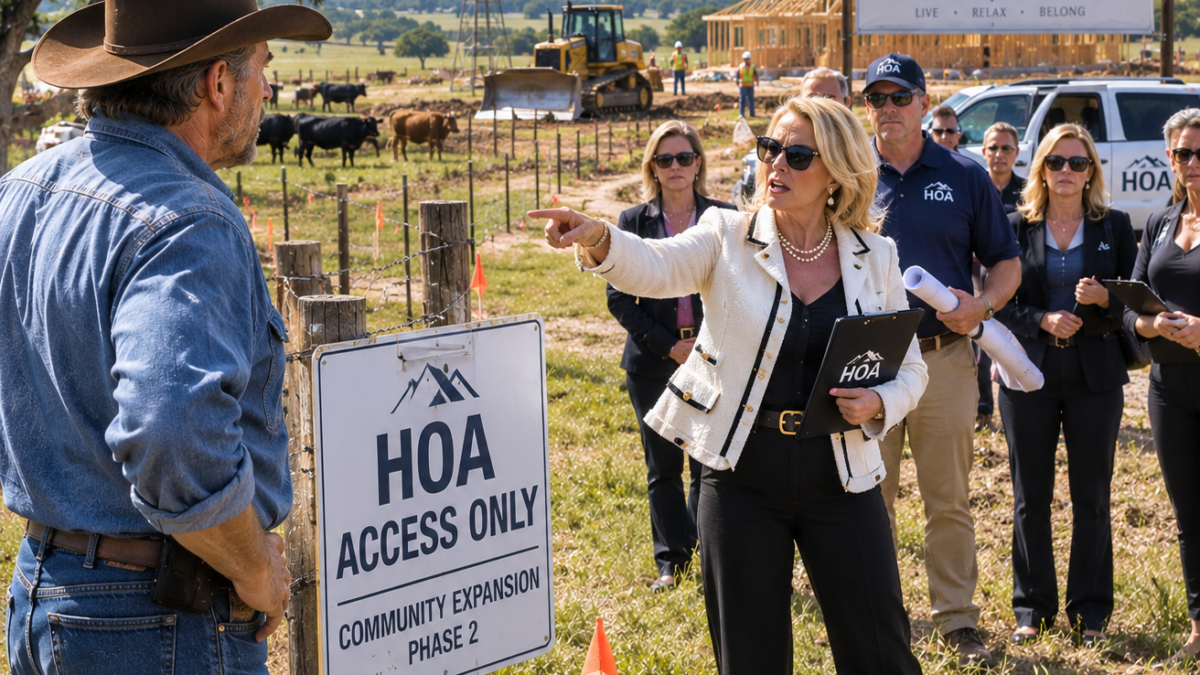
I walked out to feed my cattle one cool Texas morning and found strangers hammering stakes across my pasture while brand-new signs declared nearly two hundred acres of my family ranch “HOA ACCESS ONLY.”
When I told the crew they were half a mile beyond Redstone Meadows and standing on land my father had fought forty years to keep, the HOA president stepped from behind a white SUV, smiled at me, and said the board had already voted to make my property part of her community.
I thought I was looking at an arrogant boundary mistake—until one county employee saw the map Cheryl Langford was using and suddenly stopped talking above a whisper.
My name is Jack Whitaker, and the ranch had been in my family longer than Redstone Meadows had existed.
Two hundred forty acres of Texas grass, mesquite, creek bottom, cattle trails, and stubborn memories.
My father, John Whitaker, built the place almost from nothing. He borrowed money when interest rates hurt, repaired fence by moonlight after working all day, and drove steel survey stakes so deep into the earth that he used to joke future archaeologists would find them before they found us.
When the deed eventually came to me, I didn’t treat those acres like an investment.
They were the map of my family.
The old windmill was where Dad taught me how to repair a pump.
The creek was where I learned to swim.
The southern pasture was where he stood beside me after my first calf was born and said, “Land doesn’t care what you say you own, Jack. It cares what you can prove.”
At the time, I thought that was just another rancher’s saying.
I would remember it later.
Redstone Meadows appeared along my northern boundary about five years before this started.
Luxury homes.
Stone entrance.
Perfect landscaping.
A clubhouse with columns large enough to make you wonder whether the residents were expecting Roman senators.
I didn’t care.
They could measure one another’s lawns with microscopes if they wanted.
My fence ended at the creek.
Their subdivision began on the other side.
Simple.
Then Cheryl Langford became HOA president.
I knew who she was before I ever spoke to her.
Everybody nearby did.
White Lexus.
Expensive sunglasses.
Clipboard.
A voice that always sounded like she was correcting someone.
A few months before the morning with the contractors, I noticed HOA volunteers photographing my fence.
“What are you doing?”
“Documenting community boundaries.”
“This isn’t your community.”
They smiled awkwardly and left.
The following week, bright orange survey flags appeared beyond my fence.
Then came the morning I heard chainsaws.
Two contractors were cutting mesquite inside my pasture.
I drove straight across the field.
“Shut those saws off!”
The foreman raised both hands.
“We’ve got authorization.”
“From who?”
“Redstone Meadows HOA.”
“For my ranch?”
“They’re extending the scenic trail.”
He handed me a laminated map.
Redstone Meadows was shaded pale green.
So was most of my property.
Nearly two hundred acres.
My stomach tightened.
“Who drew this?”
“The HOA gave it to us.”
“Stop work.”
“Sir—”
“Now.”
That afternoon I went to the county clerk with my deed, my 1983 plat, and old aerial photographs.
Darlene, the clerk, checked everything twice.
“Mr. Whitaker, your line hasn’t moved.”
She pointed at the map.
“Redstone Meadows ends at the creek.”
I exhaled.
“So their map is wrong.”
“Very.”
I called Cheryl.
She sounded cheerful.
“Good afternoon, Mr. Whitaker.”
“You have contractors on my land.”
“Our board approved an expansion of the scenic easement.”
“You voted yourselves two hundred acres?”
“Our updated survey indicates the property was historically included in the Redstone district.”
“My deed says otherwise.”
“Old deeds can be superseded.”
“By what?”
“A community vote.”
I actually laughed.
“I’m not in your HOA.”
Her voice became softer.
More condescending.
“Oh, Mr. Whitaker. That’s where you’re mistaken. The board’s decision applies to adjacent owners within the designated district.”
“Designated by who?”
“The community.”
I hung up.
Two days later, the HOA mailed me a violation notice.
My cattle were allegedly damaging “community aesthetics.”
My fence was “nonconforming.”
Daily penalties would begin at $250.
I took the letter to the county assessor’s office.
A thin man named Howard pulled up the parcel records while I unfolded Cheryl’s map beside him.
At first he looked irritated.
Then confused.
Then genuinely worried.
“Where did you get this?”
“The HOA gave it to its contractors.”
He leaned closer.
His finger moved across the parcel numbers.
Then stopped over the signature at the bottom.
“Mr. Whitaker…”
His voice dropped.
I felt the room suddenly become much smaller.
“What?”
Howard looked toward the office door before turning the map back toward me.
“This document should not exist.”
PART 2
I stared at him.
“What do you mean it shouldn’t exist?”
Howard pushed his glasses higher and looked at the map again.
He traced one parcel number with his finger.
Then another.
“These numbers don’t correspond to recorded tracts.”
“So they’re wrong.”
“Not just wrong.”
He clicked through the county system.
“These parcel identifiers were never issued.”
My stomach tightened.
“What about the signature?”
Howard leaned closer to the bottom corner.
A county surveyor’s name appeared beneath what looked like an official electronic mark.
He shook his head.
“I work with this office every day.”
“And?”
“That isn’t his normal signature block.”
“Could it be an older version?”
“Maybe.”
He didn’t sound convinced.
Then he opened another record.
Same surveyor.
Real county document.
Different signature format.
Different certification code.
Different seal.
Howard looked at me.
“This appears to be a reproduction.”
I sat down slowly.
“You mean copied?”
“I’m saying I would not rely on this document.”
“That’s not the same thing.”
“No.”
He lowered his voice.
“If I were you, I would get a certified copy of your current parcel record, then talk to the county surveyor and an attorney.”
“Is my land still mine?”
“Yes.”
“All two hundred forty acres?”
He checked again.
“Yes.”
“No transfer?”
“No.”
“No recorded easement giving Redstone two hundred acres?”
“Nothing like that.”
I looked at Cheryl’s map.
“And yet they’re building on it.”
Howard nodded.
“That is why you need counsel.”
I folded the paper carefully.
Not because I respected it.
Because it had just become evidence.
—
I drove to the sheriff’s office next.
Deputy Mark Reynolds had known my family for years.
He was younger than me by maybe fifteen years, steady, practical, and allergic to drama.
He listened while I explained.
Contractors.
Survey flags.
HOA signs.
The map.
The fines.
He examined the certified deed.
Then Cheryl’s document.
“Jack.”
“Yeah?”
“This looks ugly.”
“Then stop them.”
He leaned back.
“I wish it were that simple.”
“They’re trespassing.”
“And you’ve got competing paperwork.”
“Fake paperwork.”
“Probably.”
“Probably?”
“I’m not a judge.”
I pushed my hat back.
“So what am I supposed to do while they carve a walking trail through my pasture?”
“Document everything.”
I groaned.
“That’s what Darlene said.”
“She sounds smart.”
“Mark.”
“Photos.”
“Video.”
“Names.”
“Vehicles.”
“Dates.”
“Get the county surveyor involved.”
He tapped the HOA map.
“And get a lawyer before Cheryl turns this into a paperwork contest.”
I stood.
“It already is.”
—
That evening I bought a drone.
I had never wanted one.
Always thought grown men flying cameras over fields looked like boys who’d found expensive toys.
By sunset I had changed my mind.
I launched it from behind the barn.
The screen showed what I couldn’t see from ground level.
The new gravel path sliced through my north pasture.
Past the water trough.
Under the windmill.
Across ground where my cattle grazed.
HOA contractors had already installed three posts.
One carried a polished sign.
**REDSTONE MEADOWS SCENIC GREENWAY**
Underneath:
**RESIDENT ACCESS ONLY**
I nearly dropped the controller.
Resident access.
On my ranch.
I flew the drone farther.
Workers had cut mesquite.
Moved rock.
Dug drainage channels.
One utility vehicle was parked beside my creek.
GPS coordinates recorded automatically.
Time stamps.
Video.
The kind of evidence Deputy Reynolds wanted.
I landed the drone and immediately backed up the footage.
Dad would have hated the technology.
Then asked how high it could fly.
—
The next morning, I found a chain across my water gate.
Brand-new padlock.
Metal tag.
**PROPERTY OF REDSTONE MEADOWS MAINTENANCE DIVISION**
I stood there with one hand around the cold steel.
My cattle were on the other side.
That gate gave me access to the creek and one of the watering points we relied on during hotter weather.
My irritation became something else.
Until then, this had been a property fight.
Now they were interfering with the operation of the ranch.
Animals depended on those gates.
Water wasn’t decorative.
It wasn’t a community feature.
It was life.
I photographed everything.
Then called Reynolds.
“You still think this is paperwork?”
He arrived twenty minutes later.
Walked the fence.
Photographed the lock.
“Did you give anyone permission?”
“No.”
“Any recorded easement?”
“No.”
He sighed.
“Cut it.”
“You sure?”
“It’s on your gate, according to every valid record we have.”
I used bolt cutters.
The lock dropped into the dirt.
Reynolds bagged it.
“Don’t throw anything away anymore.”
“Wasn’t planning to.”
He pointed toward the Redstone tag.
“Especially stupid evidence.”
—
Michael Boone’s office was in Lubbock.
Property lawyer.
Sharp eyes.
White shirt sleeves rolled to his elbows.
His waiting room had no fancy artwork, just aerial maps and framed court decisions.
He read silently for nearly twenty minutes.
Deed.
1983 plat.
Tax records.
Darlene’s certified parcel record.
Howard’s notes.
Photos.
Drone footage.
The HOA violation letters.
Then he leaned back.
“Let me guess.”
“What?”
“They redrew the boundary first.”
I nodded.
“Then started acting as though repetition would make the new line real.”
“Yes.”
“Now they’re creating documents that make it look like you’ve always been inside their district.”
“Yes.”
He tapped Cheryl’s map.
“Classic paper-annexation strategy.”
“You’ve seen this before?”
“Not usually this stupid.”
“Comforting.”
He smiled.
“Most people don’t try taking two hundred acres at once.”
“Cheryl has ambition.”
“That she does.”
“What now?”
“Cease and desist.”
“Then?”
“Injunction.”
“Then?”
“Discovery.”
“And if they ignore us?”
Michael looked at me.
“Then they get expensive.”
I liked him.
—
The cease-and-desist letters went to Cheryl and every board member.
Trespass.
Boundary interference.
Unauthorized construction.
Property damage.
Fraudulent representations.
Stop all activity immediately.
Preserve all records.
Forty-eight hours later, Cheryl responded.
Not through a lawyer.
Through the HOA.
Certified envelope.
Thick enough to bruise someone.
Inside:
Fence violation.
Livestock aesthetic violation.
Unauthorized signage.
Improper land use.
Nonconforming agricultural activity.
Failure to maintain community-standard landscaping.
Then an invoice.
**$9,250.**
I called Michael.
“You’re not going to believe this.”
“I will.”
“Nine thousand two hundred fifty dollars.”
“Don’t pay.”
“I wasn’t planning to.”
“Keep it.”
“I was thinking fireplace.”
“No.”
“Shredder?”
“No.”
“Target practice?”
“Jack.”
“Fine.”
“It’s evidence.”
I looked at the stack.
“You lawyers have a depressing definition of treasure.”
—
That began what Michael called the paper war.
Every time Redstone sent a violation, we asked for the covenant giving them authority over Whitaker Ranch.
They sent a map.
We asked for the deed.
They sent board minutes.
We asked for annexation consent.
They sent a charter.
We asked for my signature.
They sent threats.
We sent certified records.
Again.
And again.
Then came the letter that changed everything.
County assessor.
**NOTICE OF PARCEL ADJUSTMENT**
My western acreage had supposedly been annexed into the Redstone Meadows Community District.
Same map.
Same fake-looking boundary.
But this time it carried a county seal.
Electronic signature.
I read it three times.
Then drove straight to the courthouse.
Darlene saw my face.
“What happened?”
I put the notice in front of her.
She stopped breathing for about two seconds.
“Where did you get this?”
“Mail.”
She took it into a back office.
Returned five minutes later.
Pale.
“Jack.”
“What?”
“The HOA submitted an expedited adjustment packet.”
“Who approved it?”
“They claimed it was pre-approved through planning.”
“By who?”
She lowered her voice.
“Commissioner Harlan is listed.”
“Did he sign?”
“I don’t know.”
“You work here.”
“I know.”
She looked around.
“But this signature doesn’t look right.”
I felt something cold move through my chest.
“Copied?”
“I can’t say that.”
“Then say what you can.”
She slid the paper back.
“I would have Michael challenge this immediately.”
I called him from the parking lot.
He answered.
“Boone.”
“They got a county seal.”
Silence.
“What?”
I explained.
When I finished, Michael said:
“Come straight here.”
—
By three that afternoon, he had filed for an emergency injunction.
The judge temporarily halted new HOA work on the disputed land while title and annexation records were reviewed.
Michael looked satisfied.
“They cannot build.”
I wanted to believe him.
Two days later, my drone showed a gravel truck entering the pasture.
Then another.
Then a skid steer.
I called Michael.
“They’re back.”
“You’re sure?”
“I’m looking at them.”
“Don’t confront alone.”
“I’m already in my truck.”
“Jack.”
I hung up.
Not my finest decision.
I reached the site ten minutes later.
Cheryl stood near the windmill.
White blouse.
Big sunglasses.
Clipboard.
As if she were inspecting a municipal park.
She smiled.
“Morning, Jack.”
“Get your people off my ranch.”
“We’re completing environmental improvements.”
“You’re under injunction.”
“Not for maintenance.”
“You’re dumping gravel.”
“Trail stabilization.”
“On land you don’t own.”
She tilted her head.
“Our records disagree.”
“Those records are under investigation.”
Her smile remained.
“You can’t fight progress forever.”
“Progress?”
I pointed toward the cattle pasture.
“You mean theft.”
“Such an ugly word.”
“So is trespass.”
She lowered her voice.
“You should read the updated charter.”
“I’ve read enough of your fiction.”
Her smile finally slipped.
“You’re part of something bigger now.”
There it was.
Something bigger.
At first I thought she meant Redstone.
Later I would understand she meant much more.
—
Deputy Reynolds arrived with two other deputies.
“Stop the equipment.”
The foreman killed the skid steer.
Cheryl walked toward Reynolds.
“I believe you’re exceeding your authority.”
“Ma’am, the property is under a court-ordered dispute and active work is prohibited.”
“This is routine maintenance.”
He looked at the fresh gravel.
“Maintenance of what?”
“Our trail.”
“Which didn’t exist before this dispute.”
She stiffened.
“Our records—”
“Are being investigated.”
He pointed toward the road.
“Leave.”
Cheryl stared at him.
“This is harassment.”
“No, ma’am.”
He nodded toward his body camera.
“This is documentation.”
For the first time, I saw uncertainty in her face.
Not fear yet.
Just the realization that other people had started recording too.
—
The next morning, my water troughs were empty.
The upstream valve had been closed.
Fresh boot prints surrounded the gate.
Another HOA lock.
I photographed it.
Cut it.
Then found the southern fence.
Gone.
Not broken.
Removed.
Posts stacked neatly beside the road.
Wire coiled.
A laminated notice nailed to one remaining post.
**HOA RESOLUTION 14B**
**UNAUTHORIZED FENCING WITHIN COMMUNITY GREENWAY REMOVED AT OWNER EXPENSE**
I stood there until my hands stopped shaking.
Then called Michael.
“She tore down the fence.”
Long silence.
“How much?”
“Hundreds of feet.”
“Photos?”
“Yes.”
“Video?”
Trail camera caught part of it.”
“Good.”
“Good?”
“Jack, I don’t mean good for you.”
“Then what?”
“This moves beyond an abstract boundary fight.”
I looked at the stacked posts.
“Property destruction.”
“Yes.”
“Criminal trespass.”
“Potentially.”
“Contempt.”
“Very possibly.”
I called Reynolds.
When he arrived, he whistled.
“She really doesn’t know when to stop.”
“No.”
He turned on his body camera.
“That’s going to become expensive.”
“I’m starting to hope so.”
—
Redstone residents began showing up at my gate.
Not officials.
Homeowners.
First was Mr. Douglas.
Seventy-something.
Retired machinist.
His wife stood beside him.
“Mr. Whitaker.”
“Jack.”
He looked toward the trail construction.
“We didn’t vote for that.”
“What?”
“Cheryl told everybody the scenic trail was already funded and approved.”
“Did anyone see the budget?”
“No.”
Mrs. Douglas said:
“We’ve been paying trail maintenance fees for two years.”
I stared.
“For a trail that didn’t exist?”
She nodded.
“How much?”
“Hundreds per household.”
Mr. Douglas lowered his voice.
“We asked for financial statements.”
“And?”
“Confidential.”
HOA financials being treated like state secrets.
Interesting.
“Would you be willing to tell Michael?”
They exchanged a look.
Mrs. Douglas nodded.
“Yes.”
That was the first crack.
—
Two nights later, an email arrived.
Anonymous.
Subject:
**YOU’RE RIGHT ABOUT CHERYL**
Attachments.
Board messages.
Budget spreadsheets.
Vendor invoices.
One email from Cheryl:
**Do not circulate annexation documents until county submission is complete. Redirect homeowner questions to environmental improvement funding.**
Another:
**Western boundary must be included before grant disbursement.**
Then:
**The rancher will object. Once trail infrastructure is installed, he’ll have less leverage.**
My hand froze on the mouse.
I opened the spreadsheet.
**TRAIL BUDGET — $1.2 MILLION**
Vendor names.
Consulting fees.
Land improvement costs.
Some companies I could find online.
Others?
Nothing.
No address.
No website.
No meaningful registration.
Then:
**LANGFORD CONSULTING LLC**
Repeated payments.
I printed everything.
Called Michael at seven the next morning.
“Please tell me you’ve had coffee.”
“Why?”
“I’m about to ruin it.”
—
Michael read the documents without speaking.
Then:
“Where did these come from?”
“Anonymous.”
“Original files?”
“Some metadata preserved.”
“Could be fabricated.”
“I know.”
“But if authentic…”
He leaned back.
“This becomes much larger.”
“Fraud?”
“Potentially.”
“Self-dealing?”
“Potentially.”
“Grant misuse?”
“Potentially.”
“You lawyers really love that word.”
“We love not getting sued.”
He pointed toward one line.
“Environmental grant.”
“Yes.”
“If public money is involved, different agencies become interested.”
“Good.”
“Don’t celebrate.”
“I’m not.”
“You look like you are.”
“Maybe a little.”
“Don’t.”
—
Cheryl arrived at my gate the next morning.
Two men in suits.
No clipboard.
That told me the meeting mattered.
She smiled.
“Mr. Whitaker.”
“Cheryl.”
“We’d like to discuss resolution.”
“Michael handles legal matters.”
“This can be informal.”
“No.”
One of the men stepped forward.
“We represent development interests associated with Redstone.”
“Then call Michael.”
Cheryl said:
“The HOA is prepared to purchase the disputed acreage.”
I stared.
“Disputed?”
“Two hundred acres.”
“The land you said already belongs to you?”
Her eyes flickered.
“For purposes of avoiding litigation.”
“Fair market value?”
“Yes.”
“How generous.”
“Jack.”
Her voice softened.
“We both know prolonged litigation will damage everyone.”
“You forged a map.”
“We did no such thing.”
“You built after an injunction.”
“Our attorneys disagree.”
“You cut my fence.”
“Contractor error.”
“You locked my water gate.”
“Maintenance confusion.”
I almost admired the consistency.
Nothing was ever Cheryl.
Always error.
Confusion.
Contractor.
Process.
I leaned on the gate.
“Here’s my answer.”
She smiled slightly.
“No.”
Smile gone.
“Think carefully.”
“I did.”
“You could walk away with a significant payment.”
“I already own the land.”
Her voice hardened.
“Then we’ll see you in court.”
“Good.”
She turned.
Her heels crunched against the gravel.
I watched her white Lexus disappear.
Then called Michael.
“She offered to buy it.”
“The land she claims she owns?”
“Yes.”
He laughed.
“That’s useful.”
—
After that, things became uglier.
Utility trucks blocked my ranch entrance.
Feed deliveries couldn’t get through.
Workers claimed they were inspecting community drainage.
I photographed every plate.
Logged every time.
Michael sent notices.
The blocking stopped.
Then construction started near the creek again.
Nearly three hundred yards of gravel went down before deputies shut it down.
Three benches appeared.
Brass plaques:
**REDSTONE MEADOWS HOA**
**PRESERVING NATURE FOR ALL**
I stared at one.
“For all?”
Reynolds stood beside me.
“Except the owner.”
“Apparently.”
—
Then came the walkathon.
That one nearly broke me.
Flyers appeared around town.
**GRAND OPENING**
**REDSTONE SCENIC TRAIL**
**200 BEAUTIFUL ACRES**
My acres.
Saturday morning, hundreds of people arrived.
Families.
Joggers.
Children.
Strollers.
HOA volunteers handed out water bottles.
Redstone shirts.
Cheryl’s smiling face appeared on promotional signs.
I stood behind my legal boundary marker with the drone controller in my hands.
A father walked past holding a little girl’s hand.
He smiled.
“Beautiful property.”
I looked at him.
“Thank you.”
He didn’t understand.
Why would he?
He thought Redstone had opened a park.
I launched the drone.
Recorded everything.
Crowd.
Signs.
Trail.
Benches.
Construction.
Coordinates.
Vehicles.
Cheryl saw it.
She waved.
“Smile for the camera, Jack!”
I shouted back:
“I’m collecting evidence.”
Some people laughed.
Cheryl didn’t care.
She had a ribbon.
A microphone.
A crowd.
She stood at the new trail entrance.
“This represents Redstone’s commitment to conservation, wellness, and shared community space.”
Shared.
That word hurt.
I looked at the old windmill behind her.
Dad repaired it with his own hands.
I had stood on a ladder below him passing tools.
Now Cheryl was using it as scenery for a public-relations event built on a lie.
For one moment, I wanted to drive my truck across the trail and shut everything down myself.
Then Michael’s voice came back.
Facts.
Evidence.
Don’t give her a new story where you’re the aggressor.
I stayed behind the fence.
Recorded.
Waited.
That patience would matter later.
—
That night, I reviewed the drone footage.
One white SUV sat behind the construction zone.
License plate clear.
Cheryl’s.
She had been present during restricted work.
Another exhibit.
Another timestamp.
Michael reviewed the packet.
“We have enough to hurt them.”
“Hurt?”
“Legally.”
“Good clarification.”
“But we still need someone inside the mapping process.”
I thought of a young surveyor I’d encountered at the county office.
Lydia.
She had seemed nervous when I asked about the Redstone maps.
I called.
“Lydia, it’s Jack Whitaker.”
Silence.
“About Redstone.”
Longer silence.
“Can we talk?”
Finally:
“Not here.”
“Where?”
“Coffee shop in Bell Crossing.”
“When?”
“Six.”
“Okay.”
“And Jack?”
“Yeah?”
“Don’t tell anyone I’m coming.”
—
Lydia arrived twenty minutes late.
Baseball cap.
No makeup.
Kept looking toward the windows.
She slid into the booth.
“You came alone?”
“Yes.”
“Lawyer know?”
“He knows I’m meeting a potential witness.”
She reached into her bag.
USB drive.
Placed it between us.
“What is this?”
“Original survey data.”
I didn’t touch it.
She whispered:
“I worked for the engineering firm Redstone used.”
“Okay.”
“Cheryl asked my boss to change the western boundary coordinates.”
My chest tightened.
“He refused.”
“She found another route.”
“What route?”
“Someone exported the project file.”
“Edited it.”
“Submitted it under our company’s name.”
“You know who?”
“I know where the requests came from.”
“Can you prove it?”
She pushed the USB closer.
“Emails.”
“File hashes.”
“Time stamps.”
“Screen recordings.”
“IP logs.”
I stared at it.
“Why didn’t you report this?”
Her eyes filled.
“I tried.”
“To who?”
“My supervisor.”
“And?”
“He told me not to get involved.”
“County?”
“I called.”
“Who?”
She looked down.
“I don’t want to say yet.”
“Why?”
“Because Cheryl has friends.”
“Who?”
“Jack.”
Her voice shook.
“This is not just an HOA map.”
I felt the same cold sensation I’d had in Howard’s office.
“What is it?”
“Money.”
She stood.
“I’ll testify.”
“Lydia.”
She looked at me.
“But I need protection.”
“You’ll have it.”
I had no authority to promise that.
So I corrected myself.
“Michael will help make sure this goes through proper channels.”
She nodded.
Then left.
I sat with the USB on the table.
Didn’t touch my coffee.
—
Michael opened the files with a forensic consultant present.
Good lawyers don’t just double-click mystery drives.
The records were authentic enough to justify escalation.
One email:
**Move western boundary to include Section 3 pasture. We’ll handle paperwork later. Funding clears once district map is accepted.**
Signed from an account associated with Cheryl.
Another referenced:
**EPA Rural Greenway Restoration Fund**
Michael stared.
“Public money.”
“How much?”
He traced a line.
“Over a million allocated to project activity.”
My stomach turned.
“She used my ranch to qualify for a grant?”
“Potentially.”
“Stop saying potentially.”
“Then stop asking legal questions before investigation.”
Fair.
He contacted the appropriate state oversight office.
Auditors began asking questions.
Residents brought more.
Mrs. Douglas.
Then another couple.
Then ten families.
Trail fees.
Unapproved dues increases.
Invoices nobody understood.
A retired accountant named Ben Crandall volunteered to review documents residents had lawfully obtained.
We sat at my kitchen table one night.
Boxes everywhere.
Ben wore reading glasses low on his nose.
“Here’s one.”
“What?”
“Land enhancement.”
“How much?”
“Twenty-seven thousand.”
“Vendor?”
“Langford Consulting.”
“Again?”
“Again.”
He turned pages.
“Again.”
I leaned back.
“Her company?”
Public records showed Cheryl associated with it.
Ben whistled.
“She has been very busy.”
—
The biggest surprise came from inside the HOA itself.
Treasurer Megan Boyd contacted Michael.
Not me.
Probably smart.
She wanted counsel.
Wanted to cooperate.
Vice President Thomas Grady did too.
Not heroes.
They had signed documents.
Approved payments.
Ignored warning signs.
But now they were scared.
That mattered.
Michael told me only what he could.
“They are talking.”
“Against Cheryl?”
“They are preserving themselves.”
“Difference?”
“Motivation.”
“Same result?”
“Maybe.”
There it was again.
Maybe.
—
State auditors arrived at Redstone.
Requested financial records.
Cheryl delayed.
Software maintenance.
Missing archives.
Accounting transition.
Cyber issue.
Every excuse sounded more desperate.
Then the accounts were frozen pending review.
Residents panicked.
Emergency HOA meeting.
I was not invited.
I went anyway.
The community hall held maybe sixty people.
Cheryl stood at the front.
Microphone.
Smile.
“This is a misunderstanding.”
Someone groaned.
“A few disgruntled individuals have made reckless allegations regarding financial management.”
Ben stood.
“Then open the books.”
Cheryl’s smile tightened.
“Financial records are subject to board confidentiality.”
“No.”
Ben held up a public notice.
“State auditors froze the accounts.”
The room changed.
“What?”
“Why?”
“Where’s our money?”
Cheryl said:
“Please sit down.”
Ben didn’t.
“How much did Langford Consulting receive?”
Silence.
A woman shouted:
“That’s her company!”
Cheryl saw me near the back.
Her face turned red.
“You.”
I folded my arms.
“You caused this.”
“No.”
I kept my voice low.
“You did.”
State investigators were present.
Not theatrical.
No handcuffs.
No dramatic raid.
One approached the front.
“Ms. Langford, we’d like to review some records with you.”
She pointed at me.
“This man has been harassing the HOA for months.”
The investigator said:
“Mr. Whitaker is not the subject of our review.”
The room went quiet.
Cheryl finally looked afraid.
—
Local media found the story.
**HOA LAND EXPANSION UNDER INVESTIGATION**
**RANCHER CLAIMS 200 ACRES SEIZED THROUGH FALSE RECORDS**
I hated seeing my photograph on television.
Dad would have hated it more.
Michael said:
“Public scrutiny helps preserve records.”
“I prefer fences.”
“Fences didn’t stop Cheryl.”
Fair.
Then federal grant questions surfaced.
Now the investigation widened.
I kept working.
Fed cattle.
Fixed pumps.
Checked fences.
Every ordinary ranch chore felt like resistance.
Cheryl had tried to transform the ranch into a political story.
Cattle didn’t care.
They wanted water at six.
That kept me sane.
—
Court came months later.
The civil property case first.
News vans outside.
Judge McCallister sat behind the bench.
Gray hair.
Dry sense of humor.
He looked at the maps.
Then at both sides.
“All right.”
He adjusted his glasses.
“Let’s determine who owns Texas today.”
A few people laughed.
Cheryl did not.
Michael opened simply.
“This case is about a boundary that existed for decades until one party decided to move it on paper.”
He showed my deed.
1983.
Tax records.
Historic plats.
County records.
Then Redstone’s revised map.
Then the drone footage.
On the courtroom screen:
Workers cutting fence.
Dumping gravel.
Installing trail signs.
The windmill.
The water gate.
Timestamp.
GPS coordinates.
No rhetoric needed.
Then came the emails.
**Move western boundary to include Section 3 pasture.**
Cheryl’s attorney stood.
“Authentication objection.”
Michael was ready.
Server logs.
Metadata.
IT-vendor records.
The objection failed.
Lydia testified.
She looked terrified when she entered.
Then she saw me.
I nodded once.
She sat straighter.
Michael asked:
“Did the original Redstone survey include Whitaker Ranch?”
“No.”
“Were you asked to alter the boundary?”
“Yes.”
“By whom?”
“Requests came from Ms. Langford’s office.”
Cheryl stared.
Lydia continued.
“My supervisor refused.”
“What happened afterward?”
“An altered version was submitted under our company’s name.”
“Did it change Mr. Whitaker’s boundary?”
“Yes.”
“How?”
“It shifted the mapped district line across approximately two hundred acres of his ranch.”
The courtroom became still.
Michael displayed a screen recording.
Cursor.
Coordinates.
Boundary line moving.
Across the creek.
Across my pasture.
Judge McCallister leaned forward.
“Ms. Langford.”
Her attorney whispered.
The judge continued.
“Why is an HOA editing lines through privately deeded ranch land?”
Cheryl finally answered.
“We believed the land was unincorporated.”
The judge looked at my deed.
“Recorded since 1983?”
“We believed there was historical ambiguity.”
“Did you obtain Mr. Whitaker’s consent?”
“No.”
“Purchase agreement?”
“No.”
“Recorded easement covering two hundred acres?”
“No.”
“Then what precisely did you believe gave your HOA the right to build?”
Cheryl said:
“The environmental program.”
The judge stared.
“A grant is not a deed.”
Silence.
That sentence mattered.
—
Then Michael moved to money.
He did not accuse Cheryl of every crime investigators were considering.
He showed only what was relevant and admissible.
HOA funds.
Vendor payments.
Langford Consulting.
Trail project invoices.
Grant-linked expenditures.
Cheryl’s attorney argued legitimate consulting work.
Then Ben testified about internal records.
Mrs. Douglas testified about trail fees collected before the trail existed.
Megan Boyd testified about board approvals.
Her voice shook.
“Cheryl told us county approval was complete.”
“Did you verify that?”
“No.”
“Why?”
“She said she had handled it.”
“Did you receive full financial records?”
“No.”
“Why sign?”
Megan looked toward the residents.
“I trusted her.”
That was one of the saddest moments.
Not because it excused her.
Because it explained how systems fail.
Someone says:
Handled.
Someone else signs.
Then another.
Soon a lie has letterhead.
—
Cheryl’s defense changed in the afternoon.
Good-faith mistake.
Bad consultants.
Administrative confusion.
County errors.
Misunderstanding.
The same woman who once told me:
**You do now**
now claimed she had never intended to seize anything.
Then Michael played an audio recording lawfully obtained from an HOA meeting.
Cheryl’s voice.
Clear.
**The rancher’s too stubborn to sell. Once the trail is built, he won’t have a choice. He’ll fall in line eventually.**
Nobody moved.
One juror looked directly at Cheryl.
Her face went pale.
Michael turned off the audio.
No speech.
He didn’t need one.
—
The civil verdict confirmed what my father had known forty years earlier.
The creek was the boundary.
Whitaker Ranch belonged to me.
All of it.
Redstone Meadows had no lawful title to the two hundred acres it claimed.
No valid annexation.
No valid authority to impose HOA rules on my ranch.
The court found the HOA responsible for trespass, property damage, and fraudulent boundary representations, with damages and legal costs to be resolved under the judgment.
Separate investigations continued regarding document falsification and misuse of funds.
I did not cheer.
I just closed my eyes.
For months, people had treated ownership like a debate.
Now it wasn’t.
Michael leaned over.
“You okay?”
I nodded.
“Dad would’ve liked that.”
“What?”
“The judge saying the creek.”
Michael smiled.
“Go home, Jack.”
—
Outside, reporters crowded the steps.
“What are you going to do now?”
“Repair my fence.”
Another:
“Will you sue individual homeowners?”
“No.”
“Do you blame Redstone residents?”
“No.”
“Why?”
“Most of them didn’t steal my ranch.”
A reporter asked:
“What does this victory mean?”
I looked toward the cameras.
Then at the dirt on my boots.
“It means a board vote can’t move a property line.”
That quote made the evening news.
Better than anything clever.
—
The board collapsed within a week.
Resignations.
Grady.
Boyd.
Others.
An interim committee formed.
Laura Jenkins, a soft-spoken schoolteacher, became acting president.
She called me.
“Mr. Whitaker.”
“Jack.”
“We’d like to meet.”
“Why?”
“To apologize.”
“That’s new.”
She didn’t laugh.
“Please.”
I went.
Not to Redstone’s clubhouse.
The local library.
Folding chairs.
No projector.
No banners.
About thirty homeowners.
Laura stood.
“Jack, what happened to your ranch should never have happened.”
Silence.
“We trusted leadership instead of verifying authority.”
Mrs. Douglas sat in the front row.
Laura continued.
“We’ve canceled every expansion initiative.”
“Good.”
“We’re opening financial records.”
“Good.”
“We’re adopting term limits and independent audits.”
“Very good.”
She looked embarrassed.
“We owe you more than an apology.”
I thought about saying:
Yes, you do.
Instead:
“Keep your trails off my pasture.”
The room laughed.
Tension broke.
That was enough for the moment.
—
County-authorized crews removed the illegal trail.
Not all in one day.
Gravel trucks came back.
This time to haul material away.
Benches lifted.
Solar lamps removed.
Trash cans.
Signs.
The giant **REDSTONE MEADOWS SCENIC TRAIL** entrance came down last.
I watched from the truck.
The worker unbolted it.
Metal sign tilted.
Dropped.
For months, I’d imagined that moment.
I expected triumph.
Instead, I felt sad.
The grass underneath was dead.
Soil compacted.
Mesquite gone.
A scar remained.
Winning doesn’t reverse damage.
It gives you the right to repair it.
That distinction matters.
—
The restitution process eventually provided substantial compensation for property damage, lost ranch productivity, and legal costs.
Enough to rebuild correctly.
I didn’t spend it on anything glamorous.
Fence.
Water access.
Soil restoration.
Replanting.
Security.
I rebuilt the southern line taller.
Steel posts.
Deep-set corners.
Lighting at key gates.
Not because I wanted a fortress.
Because after months of strangers telling me where my ranch ended, I wanted the boundary physically unmistakable.
At the main gate, I hung a carved oak sign.
**WHITAKER RANCH**
**PRIVATE PROPERTY**
**NOT HOA LAND**
Underneath, smaller:
**BOUNDARIES MATTER**
Reynolds drove past.
Slowed.
Whistled.
“Subtle.”
“I’ve changed.”
“Clearly.”
He tipped his hat.
“Looks good.”
“Shame I had to teach the county how to read a map.”
He laughed.
“You didn’t teach us.”
“Who did I teach?”
He pointed toward Redstone.
“Them.”
—
The criminal and financial cases moved slower.
That’s how real consequences work.
Search warrants.
Audits.
Statements.
Digital records.
Bank accounts.
Cheryl’s company.
Public funding.
County involvement.
Headlines became worse.
Reports described large amounts of HOA money unaccounted for or routed through questionable vendors.
Investigators found ledgers.
Unfiled invoices.
Handwritten notes.
Some referenced my property.
**Whitaker section pending compliance.**
**Push surveyor faster.**
**County contact cooperative.**
When Michael told me, I laughed once.
“She wrote that down?”
“People who believe they’re untouchable make terrible archivists.”
—
Cheryl eventually faced charges tied to records and money.
Other officials came under scrutiny too.
Commissioner Harlan resigned while investigators reviewed the grant and development approvals.
County staff were questioned.
The engineering firm connected to the altered survey suffered its own consequences.
The investigation spread well beyond one HOA president.
Michael called late one summer afternoon.
“Jack.”
“What’s wrong?”
“Nothing.”
“That tone means something.”
“Federal investigators are expanding the grant case.”
I sat down.
“What grant case?”
“The environmental funding.”
“I thought the state had it.”
“They do.”
“Then?”
“Federal money.”
I looked toward the pasture.
“So Cheryl wasn’t acting alone.”
“That’s what they’re investigating.”
He sent documents.
Greenway funding.
County development administration.
Boundary-based eligibility.
Reimbursement structures.
What Cheryl had called a scenic trail wasn’t merely an HOA vanity project.
It was part of a funding mechanism.
My ranch had increased the scale of the project.
More land.
More infrastructure.
More reimbursable spending.
My stomach turned.
“She didn’t want the ranch.”
Michael said:
“She wanted what claiming the ranch unlocked.”
That was worse.
—
Federal investigators interviewed me.
Then Lydia.
Then county staff.
They subpoenaed records.
Bank transfers.
Grant files.
Emails.
Planning documents.
What began with a fence stake became a wider public-corruption inquiry.
I stayed out of the speculation.
Reporters called.
I stopped answering.
I had cattle.
That was enough.
One afternoon, a black government SUV arrived.
A federal agent stepped out.
Professional.
Polite.
“Mr. Whitaker?”
“Yes.”
He handed me a letter recognizing my cooperation and documentation.
I read it twice.
He said:
“Your records helped establish the original timeline.”
I laughed.
“Dad would enjoy that.”
“Your father?”
“He taught me to keep deeds.”
The agent smiled.
“Good advice.”
I looked toward the new fence.
“So what’s happening?”
“I can’t discuss active details.”
“Worth trying.”
He nodded.
“Just know your documentation mattered.”
Then left.
Dust behind the SUV.
I stood there holding the letter.
Months earlier, Cheryl had called me an obstacle to community progress.
Now investigators were thanking me for keeping records.
Interesting world.
—
Cheryl’s personal reckoning was quieter than people expected.
No dramatic prison van.
No movie ending.
She eventually resolved parts of her criminal case through pleas on reduced charges involving record alteration and misappropriation.
Probation.
Restitution.
Loss of office.
Frozen assets.
Public disgrace.
Her house went up for sale.
Her marriage fell apart.
I heard those things from other people.
I did not celebrate them.
Some consequences belonged to the crime.
Others belonged to a private life I had no business cheering over.
That surprised people.
Mrs. Douglas asked:
“You don’t hate her?”
I thought.
“I hated what she did.”
“Difference?”
“Yeah.”
“What?”
“Hate’s expensive.”
She smiled sadly.
“Fair.”
—
Then a letter came.
Handwritten.
No return address.
**Congratulations, cowboy. You got what you wanted. Enjoy your dusty pasture. You made enemies in high places. This isn’t over.**
I stared at it.
Then placed it in the evidence folder.
No response.
Michael said:
“Good.”
“I’m learning.”
“Slowly.”
“Don’t ruin it.”
Nothing came of the threat.
Sometimes the most powerful reply is creating no new material.
—
Redstone changed.
Actual elections.
Public financial reports.
Open meetings.
Term limits.
Independent audits.
Residents who once whispered began speaking normally.
That was one of the strangest things I noticed.
Under Cheryl, people lowered their voices when criticizing the HOA.
After she left, they stopped.
Fear teaches quiet habits.
Freedom sounds surprisingly ordinary.
Laura occasionally left newsletters at my gate.
Gardening tips.
Bake sale.
Road repair.
Pool schedule.
No annexations.
Perfect.
—
Lydia got a new job.
A state surveying office offered her a position after the investigation.
She visited the ranch before starting.
We stood beside the creek.
“I almost didn’t give you that USB.”
“Why?”
“Scared.”
“Reasonable.”
“I thought I’d lose my career.”
“You nearly did.”
She laughed.
“Comforting.”
Then became serious.
“My old supervisor said keeping quiet protects the company.”
“And?”
“He was wrong.”
I looked at the water.
“Keeping quiet protects whatever’s already happening.”
She nodded.
“Do you ever wish you’d just sold them the land?”
“No.”
“Even after all this?”
“No.”
“Why?”
I looked toward the windmill.
“Because then Cheryl would’ve learned the method worked.”
Lydia smiled.
“That’s a very rancher answer.”
“Engineer?”
“Stubborn old man.”
“Also fair.”
—
Ben Crandall became treasurer for the restructured HOA.
Terrible decision for anyone trying to hide money.
He called me once.
“You’ll like this.”
“What?”
“We rejected a vendor.”
“Why?”
“President’s cousin.”
“Good.”
“Price was actually lowest.”
“Then why reject?”
“We didn’t.”
I frowned.
“You said—”
“We disclosed relationship, got independent bids, voted publicly, then approved them because they were lowest.”
I smiled.
“You tricked me.”
“Point is, transparency doesn’t mean nobody knows anybody.”
“It means everybody knows what everybody needs to know.”
“Exactly.”
That was something Cheryl never understood.
Conflict of interest isn’t magically cured by good intentions.
You disclose it.
You let other people decide.
—
Dad’s windmill needed repair the following spring.
I climbed the tower slower than I used to.
Daisy—my old cattle dog—sat below and watched like a supervisor.
Halfway up, I stopped.
From that height, I could see the old trail scar.
Grass returning.
Not completely.
But enough.
The earth was swallowing it.
That gave me more satisfaction than the court ruling.
Paper can restore ownership.
Time restores land.
Slowly.
—
I replanted mesquite along the southern boundary.
People thought that was odd.
Most ranchers spend their lives fighting mesquite.
But Dad had kept certain stands for shade and windbreak.
The HOA contractors had cut them.
So I replaced them.
Tiny seedlings.
Not impressive.
Would take years.
Maybe decades.
I might not see them full grown.
That was okay.
Dad planted things he never sat beneath either.
That’s part of land stewardship.
You don’t own only for yourself.
You carry.
Then pass.
—
The first anniversary of the verdict came quietly.
No party.
No newspaper.
I walked the fence with Daisy.
At the creek, I found one piece of old trail gravel the removal crew had missed.
White stone.
Wrong for the soil.
I picked it up.
For a second, anger returned.
Then I threw it into the truck bed.
Later I used it beneath a gatepost.
That amused me.
Something Cheryl brought onto my ranch now helping hold my fence in place.
Poetic enough.
—
Calls started coming from other landowners.
Different counties.
Different HOAs.
Similar problems.
Boundary disputes.
Easement claims.
Fake notices.
I always said the same thing.
“Don’t start with anger.”
They usually hated that.
“Start with records.”
Deed.
Survey.
Tax history.
Photographs.
Certified copies.
Then lawyer.
Then authorities.
One man said:
“I want to drag their signs out with my tractor.”
“I understand.”
“Would you?”
“I wanted to.”
“What stopped you?”
“Being right is useful.”
I paused.
“Looking reckless while you’re right is less useful.”
He laughed.
“That’s disappointing advice.”
“Good advice usually is.”
—
Michael eventually told me the broader investigation had uncovered a pattern of grant-related land and development irregularities involving county-level approvals.
I didn’t pretend I had personally taken down some giant criminal empire.
I hadn’t.
Investigators did their jobs.
Auditors.
Whistleblowers.
Records staff.
Prosecutors.
Lydia.
Residents.
Michael.
I was one rancher who refused to let a fake map become reality.
That was enough.
People in town started calling me “President Whitaker.”
President of what?
“The No-HOA Association.”
I hated it.
Which made them use it more.
Someone printed a shirt.
**NO HOA. NO NONSENSE.**
Doug—different Doug from some of my earlier stories, because Texas has no shortage of Dougs—bought one.
I refused.
Then secretly ordered two.
—
Years later, Laura Jenkins invited me back to a Redstone meeting.
I sat in the last row.
No banners.
No Cheryl.
Treasurer gave financial report.
Residents asked questions.
One man challenged a landscaping contract.
No one called him disloyal.
They discussed it.
Voted.
Moved on.
Laura looked at me afterward.
“Boring enough?”
“Beautifully.”
“We’re trying.”
“That’s all you can do.”
She hesitated.
“Cheryl called.”
I raised an eyebrow.
“From probation?”
“Yes.”
“What now?”
“She asked me to tell you something.”
I waited.
“She underestimated you.”
I laughed.
“That may be the smartest thing she ever said.”
Laura smiled.
“Anything you want me to tell her?”
I thought.
“No.”
“Nothing?”
“No.”
The fight was over.
I did not need the final word.
That felt like victory too.
—
At home, I carved another small plaque beneath the ranch sign.
**TRUTH IS THE BEST FENCE**
Michael hated it.
“Too sentimental.”
“You’re a lawyer.”
“Exactly.”
“Your profession uses Latin to say obvious things.”
“Fair.”
Reynolds liked it.
Darlene from the county clerk’s office drove out once just to take a picture.
Howard came too.
He stood beside the fence.
“Remember when I told you that document shouldn’t exist?”
“I remember.”
“I almost didn’t say anything.”
I looked at him.
“Why?”
“Didn’t want trouble.”
“And?”
He stared toward Redstone.
“Trouble already existed.”
That was the whole story in three words.
—
My father had died years before any of this happened.
Sometimes during the fight I wished he had been there.
Then I would remember what he was like.
He would’ve climbed onto Cheryl’s bulldozer and become evidence himself.
Maybe it was better I handled the legal part.
But his voice stayed with me.
**Land doesn’t care what you say you own. It cares what you can prove.**
At first I thought the lesson was about deeds.
Later I understood it was about responsibility.
If something matters, preserve the truth about it.
Don’t rely on memory.
Don’t rely on reputation.
Don’t rely on people “knowing.”
Proof survives confident liars.
—
One evening, long after the investigations ended, I stood on the hill above the southern pasture.
Redstone Meadows glowed in the distance.
Porch lights.
Street lamps.
A few children riding bikes.
It looked harmless.
Ordinary.
And maybe now it was.
Daisy lay beside my boots.
Old.
Gray around the muzzle.
I scratched behind her ears.
“We did all right, girl.”
Her tail hit the dirt once.
Below us, the creek followed the same line it had followed when Dad bought the place.
The legal boundary.
The physical boundary.
The line Cheryl tried to erase.
I no longer needed to feel angry when I looked toward Redstone.
That surprised me.
For months, anger kept me moving.
But anger is terrible retirement fuel.
Eventually you have to put it down.
—
A new family from Redstone stopped at my gate one Saturday.
Young father.
Two kids.
He held a newsletter.
“Mr. Whitaker?”
“Jack.”
“We just moved in.”
“Welcome.”
“My wife says you’re the rancher from the HOA case.”
“Unfortunately.”
He laughed.
“Can I ask something?”
“Sure.”
“Is it true the old HOA tried taking two hundred acres?”
“Yes.”
“How?”
“Paper.”
He frowned.
“That simple?”
“No.”
I looked toward the office where the old evidence boxes were stored.
“That’s what made it dangerous.”
He nodded.
Then pointed toward the creek.
“Kids want to know if they can look at the cattle.”
I smiled.
“From this side of the fence?”
“Yes.”
“Anytime.”
“Can they come onto the ranch?”
“With me.”
His son asked:
“Why?”
“Because boundaries matter.”
The boy looked at the sign.
Then at me.
“That’s what it says.”
“Good reading.”
—
I showed them the windmill.
The creek.
The mesquite.
Told them about Dad.
Not Cheryl.
That felt important.
I didn’t want the ranch’s story to become the story of the woman who tried to steal it.
She got one chapter.
Dad had decades.
So did I.
The kids fed cattle.
Asked a thousand questions.
Before leaving, the boy said:
“Your ranch is better than the HOA trail.”
I laughed.
“Don’t tell Laura.”
—
My restitution money repaired property.
The investigations repaired records.
But the emotional damage took longer.
For months after everything ended, engine noise near the northern fence made me tense.
White SUV?
Survey crew?
Contractor?
Then one day, I heard a truck.
Looked up.
Didn’t react.
Just continued repairing a gate.
That’s how I knew it was over inside me too.
Peace rarely announces itself.
You notice you’re no longer checking.
—
The final county case made headlines two years after the first stakes appeared.
Several officials faced consequences.
The exact outcomes varied.
Some resigned.
Some were charged.
Some were cleared of more serious allegations but still lost jobs over procedural failures.
I was careful not to lump them together.
That’s another thing fighting Cheryl taught me.
Evidence doesn’t exist to confirm the story you want.
It exists to tell you what happened.
Sometimes that means your enemy is worse than expected.
Sometimes it means someone you suspected wasn’t guilty.
Both matter.
Justice without precision becomes another kind of bullying.
—
On the fifth anniversary of the original dispute, Michael drove out to the ranch.
He had aged.
So had I.
We sat on the porch.
Whiskey.
Sunset.
He pointed toward the boundary.
“You ever think about selling?”
“No.”
“Never?”
“I didn’t say never.”
“You said no.”
“Today.”
He smiled.
“You learned lawyer language.”
“Unfortunately.”
He looked at the sign.
“Two hundred acres almost gone because somebody changed numbers on a map.”
“Yeah.”
“People think property disputes are about dirt.”
“They aren’t.”
“What are they about?”
I thought.
“Memory.”
“Control.”
“Security.”
“Choice.”
Michael nodded.
“And money.”
“Lawyer.”
“Always.”
—
The ranch had become more valuable over the years.
Developers still called.
Some politely.
Some aggressively.
Redstone’s new board once asked about purchasing a narrow legitimate easement for emergency drainage access.
Laura came herself.
Survey.
Proposal.
Compensation.
Defined width.
Maintenance terms.
Everything proper.
I read it.
Called Michael.
Negotiated.
Then signed.
That surprised people.
“You gave the HOA an easement?”
A legal one.
Voluntarily.
Paid.
Limited.
Recorded.
Because the problem had never been cooperation.
It was theft disguised as cooperation.
Consent changes everything.
Cheryl never understood that.
Laura did.
—
When the easement work began, I stood beside the contractor.
He showed me the survey stake.
“We stay inside this corridor.”
“Yes.”
“If something changes, we call.”
“Yes.”
“No extra grading.”
“Correct.”
He smiled.
“We’ve heard the story.”
“Then you’re motivated.”
“Very.”
They finished in two days.
No drama.
No lawsuits.
No fake maps.
I told Laura:
“This is how it should have happened.”
She nodded.
“I know.”
“Ask.”
“Yes.”
“Agree.”
“Yes.”
“Write it down.”
She laughed.
“Yes, Jack.”
Progress.
—
Daisy died the following winter.
That hurt more than I expected.
Old cattle dog.
Seventeen years.
She had walked every mile of the ranch with me.
During the HOA fight, she slept beside my desk while I sorted papers.
She barked at contractors.
Ignored Cheryl.
Smart dog.
I buried her near the windmill.
Not too close to the creek.
Placed one flat stone.
**DAISY**
No other words.
I sat there until dark.
The ranch felt quieter afterward.
A few days later, Laura left flowers at the gate.
Mrs. Douglas brought food.
Reynolds stopped by.
Even people from Redstone had become neighbors.
Real neighbors.
Not because a board declared it.
Because people behaved like it.
That’s the difference.
—
I eventually adopted another dog.
Not to replace Daisy.
Nothing does.
Young blue heeler.
Too much energy.
Named him Dusty.
First week, he chased a Redstone golf cart along the fence.
I considered that inherited memory.
—
One summer night, I pulled out the old evidence binder.
Cheryl’s first map.
The fake green shape swallowing the ranch.
I laid it beside Dad’s 1983 plat.
One false.
One true.
The fake map looked more modern.
Color.
Digital labels.
Professional fonts.
Dad’s plat was faded.
Black lines.
Old stamp.
Coffee stain near one corner.
Yet the ugly old document had survived every lie.
Appearance has nothing to do with truth.
That thought stayed with me.
Cheryl had always looked official.
Clipboard.
Blazer.
HOA seal.
County-looking paperwork.
The ranch looked like grass.
Cattle.
Dust.
But when the court asked:
What is real?
The answer was not the best-designed document.
It was the one supported by lawful records.
—
I framed Dad’s original survey.
Not Cheryl’s.
That went into storage.
The framed plat hangs in my office now.
Visitors ask why.
I point to the creek line.
“That’s the most expensive line I’ve ever owned.”
They laugh.
I don’t.
Not immediately.
—
Years after the case, I received one final message related to Cheryl.
No threat.
No accusation.
Laura forwarded it.
A short email.
**Tell Mr. Whitaker I understand now that the ranch was never ours to take.**
That was all.
No apology.
Maybe not even enough.
But I read it twice.
Then closed the laptop.
I did not respond.
Some people spend years needing the other side to admit they were right.
I didn’t anymore.
The creek had already answered.
—
That evening I walked to the southern fence.
Dusty followed.
Sunset turned the pasture gold.
New mesquite had grown taller.
Grass had covered nearly every remaining sign of the illegal trail.
You had to know where to look.
One shallow depression.
A patch where the soil color differed.
A few stones beneath the grass.
Evidence fading into land.
I stopped at the old windmill.
Placed my hand on the metal.
Dad had taught me to repair that machine.
Taught me the fence line.
Taught me to keep records.
What he never taught me—because maybe he didn’t know either—was how much patience it takes to defend something without letting the fight consume you.
I learned that part myself.
—
When people hear the story now, they focus on the scale.
Two hundred acres.
Big number.
They ask:
“How could an HOA possibly think it could steal that?”
My answer is always the same.
“It didn’t start with two hundred acres.”
It started with photos near the fence.
Orange flags.
A draft map.
A contractor.
A sign.
A confident explanation.
Then another document.
Then another.
Every step assumed I would be too tired, too confused, too intimidated, or too late.
That is how overreach works.
Rarely all at once.
It moves the line.
Then waits to see if you notice.
I noticed.
Dad made sure I would.
—
The revenge people expected was never what satisfied me.
Cheryl losing office?
Necessary.
Court ruling?
Essential.
Restitution?
Helpful.
Her fraud investigation?
Deserved.
But the best moment came years later.
A calf stood drinking near the creek.
Dusty slept in the shade.
Windmill turning.
No trail.
No HOA signs.
No strangers.
No camera crews.
I realized I had gone an entire week without thinking about Cheryl Langford.
That was victory.
Not beating her.
Outliving the fight.
—
On the ranch gate, the oak sign has weathered.
Letters darker now.
**WHITAKER RANCH**
**PRIVATE PROPERTY**
**NOT HOA LAND**
And underneath:
**BOUNDARIES MATTER**
I considered taking the smaller line down once.
Seemed obvious.
Then remembered how expensive obvious things can become when arrogant people decide they no longer apply.
So it stays.
Not as a threat.
A reminder.
For them.
For me.
—
One autumn evening, I sat on the porch with a glass of whiskey.
Dusty at my feet.
Redstone lights in the distance.
I could hear cattle moving somewhere beyond the creek.
Everything ordinary.
Everything mine.
I thought about the morning this started.
Workers hammering stakes.
Cheryl smiling.
“You do now.”
She believed an HOA vote could make me one of them.
Could make private land community property.
Could turn a ranch my father built into a funding line.
She was wrong.
Not because I shouted louder.
Not because I threatened more.
Not because I had better friends.
Because I kept the deed.
I kept the survey.
I filmed the trucks.
I saved the notices.
Lydia saved the files.
Residents saved the financial records.
Michael put the pieces together.
Reynolds documented the damage.
Auditors followed the money.
A judge looked at the line.
Truth survived long enough to be seen.
That was all.
I raised my glass toward the dark pasture.
“To Dad.”
Dusty’s ear twitched.
The wind moved through the mesquite.
And somewhere beneath that grass, the old scars of Cheryl’s scenic trail continued disappearing.
She tried to take two hundred acres.
In the end, she didn’t keep one inch.
[END OF STORY]

