PART 2: HOA Karen Tried to Auction My 47-Acre Ranch While I Buried My Father—She Never Expected Me Home Early
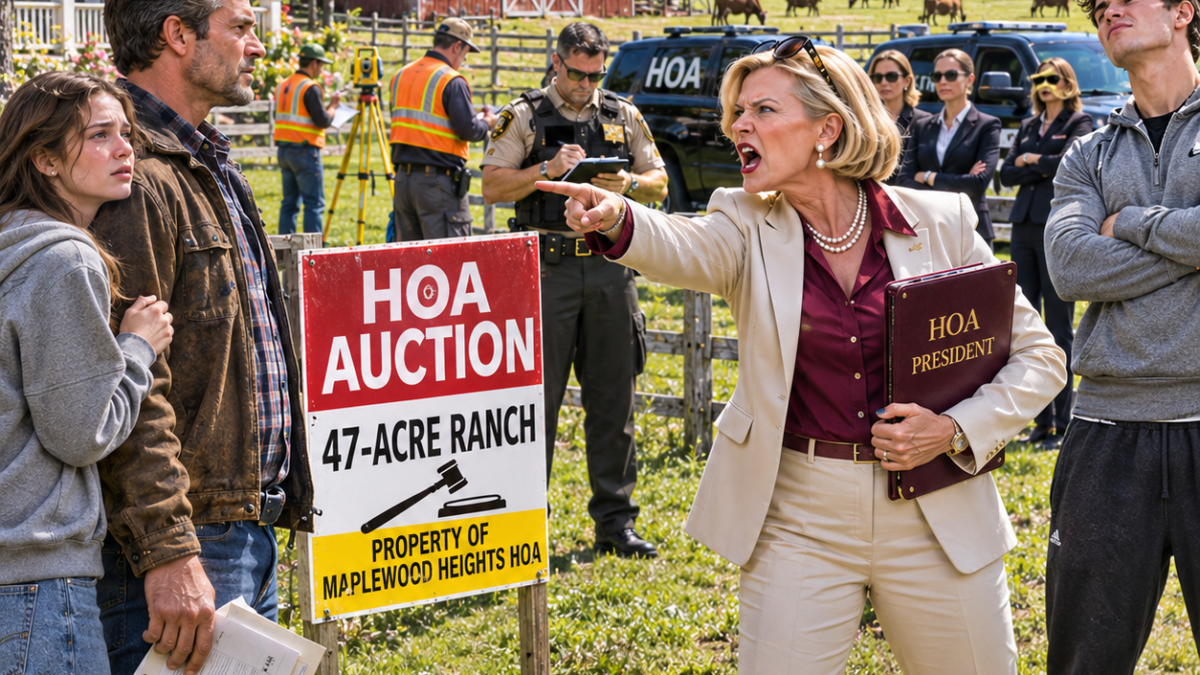
The morning I came home three days earlier than anyone expected and found a six-foot HOA AUCTION sign hammered into my front pasture, two strangers in reflective vests were photographing my barn and cattle while Karen Whitfield stood beside my father’s old windmill telling them which parts of my forty-seven-acre ranch would “show best to buyers.”
I had just driven nearly eight hundred miles after burying my father in Montana, my sixteen-year-old daughter had spent two frightening nights watching HOA workers measure our property from behind locked doors, and now the woman who had spent years fining me for manure smells and tractor noise was calmly insisting that Maplewood Heights had legally taken possession of land my family had owned since 1967.
Then Karen called 911 and reported me as an armed trespasser on “HOA property,” but when the deputy opened the thick folder Karen claimed proved the ranch belonged to her association, I saw my own name written across one page in elegant cursive—even though I have signed every important document of my adult life in block letters—and the date beneath it told me this had started long before my father died.
My name is Jake Morrison, and until that morning I thought I understood exactly how far Karen Whitfield was willing to go.
I was wrong.
Morrison Ranch sits on forty-seven acres of working Colorado land—pasture, cattle, an old red barn, a windmill my father refused to replace, and a line of fencing my grandfather first stretched across the property in 1967.
Maplewood Heights came decades later.
It was the kind of development built to look perfect from every angle: matching roofs, landscaped entrances, decorative ponds, identical mailboxes, and an HOA that seemed to have an opinion about anything visible from the street.
Karen had been its president for years.
She also ran a real-estate consultancy on the side.
That should have bothered me sooner.
Our problems began with letters.
My tractor was “visually disruptive.”
My gravel driveway conflicted with Maplewood’s “aesthetic continuity.”
The cattle created an “odor concern.”
Once, she mailed me a two-hundred-fifty-dollar fine because a piece of ranch equipment could be seen from one of Maplewood’s walking paths.
I called her office.
“I don’t live in your HOA.”
“You border it,” she replied.
“That isn’t the same thing.”
“We all affect community values.”
“My cows don’t know your bylaws.”
She hung up on me.
I ignored the fine.
Nothing happened.
At least, I thought nothing happened.
Then my father died.
I left for Montana on a cold Thursday morning to handle the funeral and bury him near the old cottonwood tree he loved. Emma stayed at the ranch to feed the cattle and keep an eye on the house.
Before I left, she hugged me beside my truck.
“Stop worrying.”
“I’m your father. It’s contractual.”
“I can handle cows.”
“I know.”
“And Karen.”
“That concerns me more.”
Emma smiled.
I told her, “This land knows who it belongs to.”
Two days later, she called me crying.
“Dad, there are people in the pasture.”
I stood beside my father’s fresh grave with the phone pressed so hard to my ear it hurt.
“What people?”
“Two men. They’re measuring the barn.”
“Stay inside.”
“There’s a sign.”
“What sign?”
Her voice cracked.
“For sale. HOA auction. Saturday at nine.”
For several seconds, I couldn’t speak.
Then I heard a man outside her window say something about photographing the livestock area.
“Lock every door,” I said. “Do not confront them. Film everything.”
“What are you going to do?”
“I’m coming home.”
I drove through the night.
No hotel.
No music.
Just highway, coffee, and a kind of anger that kept trying to outrun grief.
At 5:47 a.m., Emma texted me:
DAD. SHE’S BACK. TWO MEN WITH HER.
At 6:10, I turned onto our gravel road.
Karen’s blue-and-white HOA van sat beside my mailbox.
The auction sign stood in front of the barn.
One of the men raised a clipboard.
“Sorry, sir. Restricted area until after the sale.”
I stepped out.
“This is my ranch.”
Karen came around the fence.
Pearls.
Phone.
Perfect blazer.
And the smallest smile.
“Mr. Morrison,” she said. “You’re back earlier than expected.”
That sentence stopped me colder than the dawn air.
“Expected?”
Her smile tightened.
Then she raised the phone and said, “You need to leave before I have you arrested.”
Fifteen minutes later, Deputy Maria Santos arrived, and Karen handed her the folder that supposedly proved Maplewood Heights owned everything around us.
Maria opened it.
I looked over her shoulder.
And there, beneath an HOA seal I had never seen before, was a signature claiming I had agreed to the transfer.
My name.
Not my handwriting.
I looked at the date.
Then at Karen.
And for the first time that morning, she stopped smiling.
PART 2
The date was eleven months old.
That mattered.
My father had still been alive eleven months earlier.
Healthy enough to complain about feed prices, argue with me about replacing the barn roof, and drive his truck into town every Thursday morning for coffee with the same three men he had known since high school.
If I had signed away any part of Morrison Ranch, he would have known.
More importantly, I would have known.
Deputy Maria Santos held the page closer.
“This is your signature?”
“No.”
Karen gave a short laugh.
“Of course he’s going to deny it now.”
I looked at her.
“I’ve signed my name in block letters since the Army taught me that nobody can read my cursive.”
Karen folded her arms.
“People change signatures.”
“Not in the middle of a property transfer they never agreed to.”
Maria’s eyes moved down the page.
There was a notary stamp.
Then another attachment.
A survey.
I recognized the surveyor’s name immediately.
Robert Kumar.
I knew of him because he had handled several rural boundary jobs in our county.
Good reputation.
Careful.
Professional.
Not the kind of man who would casually move a property line because an HOA president wanted a prettier map.
I pointed.
“Robert Kumar surveyed this?”
Karen answered before Maria could.
“Yes.”
“When?”
“Last year.”
“He came here?”
“Our land consultant coordinated it.”
I looked toward my fence.
“Interesting.”
“What?”
“I was here almost every day last year.”
Karen’s expression hardened.
“Your inability to remember a survey crew is not our problem.”
Maria closed the folder.
“Ms. Whitfield, where is the county-recorded transfer?”
Karen pointed at the documents.
“You’re holding it.”
“No.”
Maria spoke calmly.
“I’m holding HOA paperwork.”
“The association approved annexation.”
“An association vote does not transfer private title.”
“We have jurisdiction.”
“Over your members.”
Karen’s voice sharpened.
“Mr. Morrison’s parcel was incorporated into Maplewood Heights under the revised covenant.”
“Then show me the recorded covenant.”
Karen hesitated.
“It’s under administrative review.”
Maria looked at me.
Then at Karen.
“That means it isn’t recorded.”
“It means the county hasn’t updated its system.”
Maria exhaled slowly.
“Do you have a court order?”
“We don’t need—”
“Do you have one?”
“No.”
“Sheriff’s sale?”
“No.”
“Foreclosure judgment?”
“The HOA has its own enforcement process.”
“Which does not make you the county.”
Karen’s cheeks turned red.
One of the men in reflective vests quietly lowered his camera.
Maria noticed.
“Who are you two?”
The first man cleared his throat.
“We’re with Mountain Vista Property Services.”
“Real estate?”
“Property photography and listing support.”
I turned toward Karen.
“You’ve already hired people to list my ranch?”
She lifted her chin.
“The auction is Saturday.”
Maria looked at the two men.
“Did you enter any buildings?”
“No.”
“Touch livestock?”
“No.”
“Remove anything?”
“No.”
“Good. Keep it that way.”
Karen stepped forward.
“They’re authorized.”
“By you.”
“By the HOA.”
“Neither owns this ranch according to the county records I can see.”
Karen pointed at me.
“He owes forty-seven thousand dollars.”
I laughed.
“For what?”
“Accumulated violations.”
“On property outside your HOA?”
“You were repeatedly notified.”
“I was repeatedly entertained.”
“This isn’t funny.”
“No, Karen.”
I looked at the auction sign.
“My father died six days ago. My sixteen-year-old daughter spent two nights watching strangers photograph her home because you decided grief looked like an opportunity.”
For the first time, one of the photographers looked uncomfortable enough to stare at the ground.
Karen didn’t.
“This is not personal.”
“That makes it worse.”
She raised her phone.
“I want him formally trespassed.”
Maria stared at her.
“From his own ranch?”
“From HOA-administered property.”
Maria’s tone changed.
“Ms. Whitfield, stop.”
Silence.
“You called 911 and reported an armed trespasser.”
“Yes.”
“Where is the weapon?”
Karen looked at me.
“He owns firearms.”
“I own a ranch.”
Maria turned to me.
“Are you carrying?”
“No.”
“Did you threaten anyone?”
“No.”
Emma called from the porch.
“I filmed the whole thing.”
Karen spun.
“Young lady, this does not involve you.”
I stepped between them.
“Do not speak to my daughter.”
Maria held up a hand.
“Everyone lower the temperature.”
Karen pointed toward the road.
“This is not over.”
Maria handed the folder back.
“Maybe not. But there is no legal basis for me to remove Mr. Morrison today.”
Karen looked stunned.
“You’re refusing to enforce the law?”
“I’m refusing to enforce HOA paperwork as a property transfer.”
“I’ll report you.”
“You can.”
For a second, I thought Karen might actually argue with a deputy until sunrise.
Then she snapped at the photographers.
“Pack up.”
The men didn’t need convincing.
Karen marched toward her van.
Before getting in, she looked at me.
“You should have stayed in Montana.”
The sentence hit harder than she probably intended.
Or maybe exactly as hard.
I watched her drive away.
Maria waited until the van disappeared.
Then she turned to me.
“Jake.”
“Yeah?”
“You need a lawyer.”
“I know.”
“Today.”
She pointed at the folder Karen had left copies from.
“If somebody forged your signature on property documents, this is beyond HOA nonsense.”
Emma came down the steps.
“What about the auction?”
Maria looked toward the sign.
“I’d get an injunction before Saturday if possible.”
Emma’s face changed.
“They can still try?”
“People can try stupid things.”
I pulled the auction sign out of the ground.
It took both hands.
The posts had been driven deep.
For one ugly second, I wanted to smash it against Karen’s van tracks.
Instead, I leaned it against the barn.
Maria nodded.
“Evidence.”
“Exactly.”
She smiled faintly.
“You’re learning.”
“No.”
I looked at the sign.
“I’m getting angry slower.”
***
That afternoon, Bill Foster showed up.
Bill lived three parcels west and had retired from survey work years ago.
He wore the same sweat-stained hat in summer, winter, weddings, and once, according to my father, a funeral.
He got out of his Ford holding coffee.
“Heard Maplewood bought your ranch.”
“Apparently.”
“Congratulations.”
“Thanks.”
“What’d they pay?”
“Forty-seven thousand dollars in fines I don’t owe.”
Bill whistled.
“Good deal for them.”
Emma brought the fake survey copy outside.
Bill put on reading glasses.
His humor disappeared.
“Robert Kumar?”
“You know him?”
“Yeah.”
“Would he do something like this?”
Bill looked up.
“No.”
“You sure?”
“Robert is irritatingly careful.”
He traced the survey bearings.
Then frowned.
“What?”
“This datum reference.”
“What about it?”
“It doesn’t make sense.”
Emma leaned closer.
“Fake?”
Bill ignored her and read another line.
“Your south boundary hasn’t moved since your grandfather filed the original plat.”
“I know.”
“I helped your dad restake part of it in seventy-eight.”
That surprised me.
“You did?”
“He paid me in beer and steaks.”
“That sounds like Dad.”
Bill looked toward the southern fence.
“The subdivision wasn’t even there.”
“Karen says they expanded.”
“She can expand a covenant over property they own or members lawfully agree to include. She cannot draw a line across your pasture and call that title.”
“Can you prove it?”
He looked offended.
“Jake.”
“What?”
“I’m retired, not dead.”
By sunset, Bill had his old records spread across my kitchen table.
Emma sat beside him with a laptop.
I stood at the counter making coffee nobody needed.
The original county plat showed Morrison Ranch clearly.
The later Maplewood development ended short of us.
An eighty-seven-foot separation appeared at the closest point on the old map.
No overlap.
No ambiguity.
Then Bill pointed at the fake survey.
“Look here.”
The coordinate references were slightly wrong.
Not wildly.
Just enough to reveal whoever created it knew how a survey looked without knowing how this particular boundary had been established.
“It’s like somebody copied the structure of a real survey,” Bill said, “then bent the numbers to reach the result they wanted.”
Emma stared.
“So fraud.”
“Potentially.”
She looked at him.
“You sound like a lawyer.”
“No. Lawyers charge more.”
My phone rang.
Unknown number.
I answered.
“Jake Morrison?”
“Yes.”
“Robert Kumar.”
I glanced at Bill.
He sat straighter.
“I heard my name is on a document involving your ranch.”
“It is.”
“I didn’t survey it.”
Straight to the point.
“You’re sure?”
“I have never performed a boundary survey on Morrison Ranch.”
“Your certification number is on the page.”
“I saw a photograph someone sent me.”
“Signature?”
“Not mine.”
Bill mouthed, Told you.
Robert continued.
“I’m preparing a written statement.”
“Why?”
“Because my professional seal is being used without permission.”
“Has this happened before?”
A pause.
“I’ve seen other questionable documents recently.”
That made my skin tighten.
“Connected to Maplewood?”
“I’m not prepared to say.”
“Understood.”
“Get counsel, Mr. Morrison.”
“You’re the third person today.”
“Then maybe listen to one of us.”
He emailed the statement twenty minutes later.
I printed it.
Signed acknowledgment.
Dated.
Then placed it beside the fake survey.
My father’s old metal lockbox sat beneath the kitchen counter.
I hadn’t opened it since before Montana.
Inside were decades of tax records, deeds, grazing permits, insurance papers, and handwritten notes from a man who trusted paper because paper didn’t forget what people preferred to remember.
I put Robert’s statement inside.
Then the fake survey.
Then the auction notice.
Emma watched.
“You think this is going to court?”
“Yes.”
“How bad?”
“I don’t know.”
She looked toward the dark pasture.
“What if we lose?”
I wanted to say we wouldn’t.
Instead, I told her the truth.
“Then we appeal.”
She looked back.
“That wasn’t very comforting.”
“Your grandfather would have said something dramatic about dying on the hill.”
“That’s worse.”
“Exactly why I’m the parent now.”
She smiled.
For about three seconds, the house felt normal again.
***
Karen returned the following morning.
Black Lexus.
Two HOA board members.
A man in khakis carrying a leather folder.
Emma looked out the window.
“She brought the Avengers.”
“Stay inside.”
“Why do you keep saying that?”
“Because someday it might work.”
I stepped onto the porch with coffee.
Karen walked toward me.
“Mr. Morrison.”
“Karen.”
“You’ve created unnecessary confusion.”
“Your auction sign did most of the work.”
The man in khakis introduced himself.
“David Mercer. Maplewood Heights Legal Advisory Committee.”
“Attorney?”
“No.”
“County official?”
“No.”
“State?”
“No.”
Karen snapped:
“He represents the association.”
“Then he can represent it from the road.”
Mercer opened his folder.
“Mr. Morrison, the HOA has determined your parcel falls within Maplewood Heights under the 2021 covenant revision.”
“No.”
“You have accumulated forty-seven thousand dollars in penalties.”
“No.”
“For sanitation, fencing, livestock nuisance, exterior structures, gravel surfacing—”
“No.”
His voice tightened.
“You can’t simply reject association authority.”
“I just did it three times.”
Karen stepped closer.
“You signed the revised covenant.”
“No.”
Mercer turned the paper around.
There it was again.
Jake Morrison.
Perfect cursive.
The forged signature almost looked elegant.
Mine never did.
“That’s cute,” I said.
Karen’s mouth tightened.
“Excuse me?”
“Whoever practiced it did a nice job.”
“You’re accusing the board of forgery?”
“Yes.”
Mercer looked uncomfortable.
Karen didn’t.
“You’d better be careful.”
“Why?”
“Defamation has consequences.”
“So does forging a signature.”
She lowered her voice.
“You have until noon to vacate the residence.”
I stared.
Then laughed.
Karen’s face reddened.
“You think this is funny?”
“I’m trying to imagine you explaining to a judge how you evicted a rancher based on a covenant he never signed.”
“You’ll have a chance to contest it at tonight’s hearing.”
“Hearing?”
“Emergency board review.”
“Your board?”
“Yes.”
“Reviewing its own decision?”
“That’s how procedure works.”
“No, Karen. That’s how theater works.”
Tires crunched behind the Lexus.
Deputy Maria Santos arrived again.
She stepped out slowly.
“I’m starting to know this driveway too well.”
Karen rushed toward her.
“Deputy, we need assistance removing an unlawful occupant.”
Maria closed her eyes briefly.
“Show me the court order.”
Mercer offered the folder.
Maria flipped through it.
Her eyebrows rose.
“No judge.”
Karen folded her arms.
“We have internal jurisdiction.”
“No court stamp.”
“The association—”
“No assessor verification.”
“It’s pending.”
“No recorded transfer.”
“You’re being obstructive.”
Maria closed the folder.
“This is an HOA memorandum.”
Karen’s voice rose.
“We are a recognized community authority.”
“Over your members.”
“The ranch was incorporated.”
“Show me the county record.”
“Under review.”
Maria handed the folder back.
“Then it isn’t enforceable.”
Karen’s nostrils flared.
Behind her, Patricia Vance—the younger board member—looked toward me.
Then at the documents.
Something in her expression had changed.
Doubt.
Maria pointed toward the vehicles.
“I’m asking you to leave Mr. Morrison’s property.”
Karen stared.
“His property?”
“Yes.”
“You’re taking his side.”
“I’m looking at recorded title.”
“It’s outdated.”
“Then update it legally.”
Karen turned on her heel.
“This is exactly why private communities cannot depend on county bureaucracy.”
Maria said:
“You called county law enforcement.”
One of the board members coughed to hide a laugh.
Karen heard it.
Her face went red.
She got into the Lexus.
Before leaving, she lowered her window.
“Seven o’clock, Mr. Morrison.”
“I’ll bring the deed.”
“Bring whatever makes you comfortable.”
I smiled.
“Oh, I will.”
***
The Maplewood community hall looked less like a courtroom than Karen clearly wanted it to.
Fluorescent lights.
Folding chairs.
Bad coffee.
A crooked HOA banner.
But Karen sat at the center of a long table with a gavel.
Robert Stanton, vice president, sat to her right.
Jennifer Walsh, secretary, had a laptop open.
The treasurer looked nervous.
Patricia Vance sat at the end.
Residents filled the back rows because Emma’s video had spread through the neighborhood by then.
Karen tapped the gavel.
“This hearing will determine whether parcel 12B remains subject to Maplewood Heights authority pending sale.”
I sat down.
“Still calling it parcel 12B?”
“That is its administrative designation.”
“My county parcel has a different number.”
Karen ignored me.
Robert Stanton read the alleged violations.
Livestock nuisance.
Odor.
Improper fencing.
Nonconforming driveway.
Exterior visual deterioration.
Unauthorized agricultural use.
That last one made me laugh.
Karen glared.
“Something amusing?”
“You’re fining a ranch for agriculture.”
A few residents laughed.
Karen struck the gavel.
“Order.”
I opened my father’s weathered leather folder.
“Since we’re pretending this is court, can I present evidence?”
“This is an administrative review.”
“Even better.”
I placed the deed on the table.
“Forty-seven acres. Morrison family.”
Tax records.
“Paid.”
Original survey.
“Recorded.”
Robert Kumar’s written declaration.
“And the surveyor whose name appears on your new map says he never surveyed my ranch.”
The room changed.
Jennifer stopped typing.
Patricia leaned forward.
Karen didn’t move.
“He may not remember.”
I looked at her.
“He signed a sworn statement.”
Robert Stanton cleared his throat.
“We relied on third-party consultants.”
“Which ones?”
“Land planning.”
“Name.”
Karen stepped in.
“This is not a deposition.”
“No. In a deposition you’d have to answer.”
Several people murmured.
Patricia spoke.
“Karen, did we independently verify Kumar’s certification?”
Karen’s eyes moved toward her.
“Yes.”
“With him?”
Silence.
Patricia waited.
“Was it verified with Robert Kumar?”
Karen struck the gavel.
“This meeting concerns Mr. Morrison’s noncompliance.”
Patricia leaned back.
“That’s not an answer.”
Karen’s jaw tightened.
“Noted.”
I slid the fake covenant across the table.
“And this is supposedly my signature.”
“Yes.”
“I print my name.”
“You’re denying it after the fact.”
“Who notarized it?”
Karen looked toward Stanton.
He answered.
“The file contains a notarial seal.”
“That wasn’t my question.”
Jennifer stopped typing again.
I continued.
“Who watched me sign?”
No answer.
“Who met with me?”
No answer.
“Where did I sign?”
Karen’s voice became sharp.
“You had numerous opportunities to challenge the revision.”
“How could I challenge something nobody showed me?”
“We mailed notice.”
“To where?”
“Your address.”
“I never received it.”
“That isn’t our responsibility.”
Then the back doors opened.
Bill Foster walked in carrying a large survey tube.
“Sorry.”
He walked down the aisle.
“Had trouble finding a legal parking spot.”
The room laughed.
Karen didn’t.
“You are not a member.”
Bill smiled.
“Best news I’ve heard all week.”
He unrolled the original county plat across the table.
“Maplewood ends here.”
His finger moved.
“Morrison Ranch starts here.”
He pointed to the gap.
“Eighty-seven feet at the closest historical boundary point.”
Karen stood.
“The association revised its boundary.”
Bill looked at her.
“You can revise a neighborhood map. You can’t vote a ranch into your ownership.”
Robert Stanton shifted in his chair.
Karen snapped:
“Mr. Foster is not qualified to interpret current association documents.”
Bill nodded.
“Good thing I’m interpreting a county plat.”
Laughter again.
Karen slammed the gavel harder.
I stood.
“One last thing.”
She glared.
“What?”
I pointed at the small camera clipped to my shirt pocket.
“This entire meeting is recorded.”
Jennifer went pale.
Stanton leaned forward.
“You did not receive permission.”
“Neither did your auction.”
Karen’s face froze.
I looked around the table.
“You just voted, on camera, to continue selling land you have no recorded title to.”
Nobody answered.
Patricia looked down.
Jennifer’s hands hovered above the keyboard.
The treasurer avoided my eyes.
Karen whispered:
“You’re finished, Mr. Morrison.”
I closed the folder.
“No.”
For the first time all evening, I felt calm.
“You are.”
***
The next morning, two HOA maintenance trucks appeared at my gate.
Orange cones.
Barrier tape.
**HOA RESTRICTED ZONE**
I walked outside.
A young worker immediately looked miserable.
“Mr. Morrison?”
“Yes.”
“Ms. Whitfield instructed us to secure the perimeter for the auction.”
I pointed at my fence.
“That perimeter?”
“Yes.”
“You understand this is private property?”
He looked at his coworker.
“We were told the HOA owns it.”
“You were told wrong.”
The older worker folded his arms.
“We’re just doing a job.”
“So am I.”
“What job?”
“Keeping strangers off my ranch.”
I pulled out Maria’s card.
“If you cross that fence, I’ll call the sheriff and let her explain the paperwork.”
The younger man began loading the cones back into the truck.
The older worker glared.
“This isn’t over.”
“Apparently nothing is.”
They left.
That was the morning I stopped playing defense.
I called Bill.
“You busy?”
“Depends.”
“Want to survey a ranch?”
“You sound like your father.”
“That a yes?”
“One hour.”
Bill arrived with old equipment, GPS gear, maps, and more enthusiasm than a retired man should have before breakfast.
Tommy Reed, a twenty-year-old neighbor who loved cameras and drones, came too.
Emma recruited him.
I told them both:
“No crossing into Maplewood property.”
Tommy nodded.
“No problem.”
“No harassing anybody.”
“I know.”
“No filming through windows.”
“Jake,” Bill said, “he’s twenty, not stupid.”
Tommy looked at him.
“Thanks.”
Bill shrugged.
“I said not stupid. Didn’t say smart.”
We spent the day walking the ranch boundary.
Every post.
Every marker.
Every bearing.
Bill found the same monuments he remembered from decades earlier.
One had nearly disappeared beneath grass.
Another sat beside an old cottonwood root.
Tommy sent his drone over our property and filmed the fence line from above.
By afternoon, we had enough visual evidence to make Karen’s map look like what it was.
A drawing designed to reach a result.
Tommy streamed part of Bill’s explanation online.
Hundreds watched.
Then thousands.
By evening, local reporters had clipped the footage.
Maria called.
“You stirring trouble?”
“I’m measuring my fence.”
“You’re trending while doing it.”
“That sounds like society’s problem.”
She laughed.
Then her voice turned serious.
“Be careful.”
“Why?”
“Karen called twice today.”
“About?”
“Harassment. Defamation. Interference with HOA operations.”
“Did she mention the fake survey?”
“No.”
“Shocking.”
“Jake.”
“I know.”
“Cornered people get unpredictable.”
She was right.
***
The next morning, my mailbox was gone.
Completely.
Post still there.
Box removed.
In its place was a white placard:
**REMOVED FOR NONCOMPLIANCE — MAPLEWOOD HEIGHTS CODE 3A**
I stood beside it.
Emma came outside.
“Where’s the mailbox?”
I pointed.
She read the sign.
Then looked at me.
“They stole federal mail property?”
“Technically the box is mine.”
“Still.”
I started laughing.
Not because it was funny.
Because after fake annexation, fake signatures, fake surveys, and an illegal auction, the stolen mailbox somehow felt like Karen had decided subtlety was no longer useful.
Tommy filmed me holding the placard.
“Say something.”
“No.”
“Come on.”
I looked at the camera.
“They’ve upgraded from stealing forty-seven acres to stealing one mailbox.”
Emma laughed so hard she had to sit on the porch.
The clip spread.
That afternoon, Channel 9 arrived.
The reporter asked:
“Is the HOA still planning Saturday’s auction?”
“Yes.”
“Can they legally sell the ranch?”
“No.”
“How can you be sure?”
“Because I still own it.”
“Then what are they auctioning?”
I looked toward the barn.
“Their credibility.”
The reporter smiled.
“That’s going on television.”
“I figured.”
***
The news brought something useful.
Attorney Sarah Chen contacted me.
She specialized in title disputes and property litigation.
She drove out two days later.
Navy blazer.
Wire-frame glasses.
No ranch boots.
She stepped in mud before reaching the porch.
“Great start.”
“You’ll survive.”
She spent an hour reviewing documents.
Then another.
No dramatic reactions.
No promises.
I liked that.
Finally, she placed the fake covenant beside the county land index.
“Maplewood’s recorded covenant boundary stops short of your ranch.”
“We know.”
“No valid amendment brings you in.”
“Karen says one does.”
“It doesn’t.”
“The fake one?”
“Not recorded properly.”
Emma leaned forward.
“So it’s worthless?”
Sarah considered the word.
“As a lawful transfer of your property? Yes.”
She pointed to the seal.
“Also, this notary information is inconsistent.”
Then Robert Kumar’s certification.
“He denies this.”
“In writing.”
“Good.”
Sarah looked at me.
“What does Karen gain?”
“Control.”
“That’s personality.”
She tapped the documents.
“I’m asking about money.”
I glanced at Emma.
Then:
“She owns a real-estate consultancy.”
Sarah stopped.
“Name?”
Emma had already opened her laptop.
“Whitfield & Stanton Property Group.”
Sarah looked up.
“Stanton?”
“HOA vice president.”
Sarah leaned back.
“That’s where we look next.”
***
The corporate records were public.
Karen Whitfield and Robert Stanton were partners.
Their company had relationships with Maplewood-connected property listings.
Properties affected by foreclosure.
Delinquency.
Association sales.
Then Sarah obtained an internal listing agreement through formal discovery requests connected to our emergency filing.
Six percent commission.
She set the paper on my table.
“This is not proof of a crime by itself.”
“But?”
“But it explains why selling property might personally benefit them.”
Emma read the projected ranch valuation.
Her mouth opened.
Then she calculated six percent.
“That’s…”
“Yeah.”
She looked sick.
I felt worse.
My father had spent fifty years on that land.
Karen had reduced it to a commission.
Sarah found another document.
**Western Expansion Opportunity — Morrison Parcel**
I stared at it.
“Opportunity.”
Sarah nodded.
“They wanted the land for expansion.”
“How long?”
“The earliest document we’ve seen predates your father’s death.”
That answered the question from the forged signature date.
The scheme had started before Montana.
Before the funeral.
His death had not created the idea.
It created the opening.
I sat quietly.
Emma understood before I said anything.
“She waited until you left.”
“Yes.”
Her eyes filled with anger.
“She used Grandpa’s funeral.”
I looked at Sarah.
“Can we prove that?”
“Not yet.”
Emma slammed her laptop shut.
“I hate her.”
I didn’t correct her.
I hated Karen in that moment too.
Not HOA-president Karen.
Not clipboard Karen.
The woman who had seen death in my family and converted it into timing.
Sarah let the silence settle.
Then:
“Anger later.”
I looked at her.
“Now we preserve evidence.”
I almost smiled.
“You and Maria would get along.”
***
Sarah filed for emergency injunctive relief.
She also sent preservation demands.
No records destroyed.
No emails deleted.
No listing activity.
No attempt to transfer the ranch.
Karen responded publicly.
**Mr. Morrison is conducting a coordinated campaign of misinformation against a legitimate community association.**
I didn’t respond.
Sarah wouldn’t let me.
“Let her talk.”
“She’s lying.”
“Excellent.”
“Excellent?”
“Every public statement becomes something we can compare with records later.”
That was the first time legal patience felt like revenge.
Not loud.
Precise.
***
Then Emma found the auction registry.
She was at the kitchen table before school.
Coffee mug beside her.
“Is that mine?”
“No.”
“You’re sixteen.”
“Allegedly.”
She turned the laptop.
“Look.”
County public-auction submissions.
Property sales required advance filing and proof of ownership.
Maplewood had attempted a submission.
Rejected.
Reason:
**INSUFFICIENT PROOF OF TITLE / PARCEL DATA INCONSISTENT**
My heart kicked.
“They tried.”
“Yep.”
“They knew it failed?”
“The rejection date is three weeks ago.”
Three weeks.
Karen had stood in my pasture after knowing the county rejected the sale paperwork.
That changed everything.
Sarah confirmed it.
Maria called the clerk on speaker.
“Jim, tell Jake what you told me.”
The clerk laughed.
“They tried to file an auction notice.”
“Rejected?”
“Immediately.”
“Why?”
“No title. Wrong parcel reference on one form. Supporting documents didn’t match recorded ownership.”
I looked at Emma.
She smiled without humor.
The clerk continued.
“Whatever they’re holding Saturday, it isn’t a lawful county property auction.”
Sarah took over.
“Could they collect deposits from private bidders?”
“People can hand money to anybody dumb enough to take it.”
That was the danger.
Karen might not be capable of legally transferring my land.
But she could still convince someone to pay.
Fraud didn’t require her plan to succeed.
It required her to try.
***
Friday afternoon, the first buyer arrived.
Gray SUV.
Suit.
Clipboard.
He stopped at the gate.
“Jake Morrison?”
“Yes.”
“I’m here for the ranch preview.”
“No, you’re not.”
He blinked.
“Ms. Whitfield said the property was seized over unpaid HOA assessments.”
“She lied.”
“She showed me documents.”
“Did she show you a recorded deed?”
He looked down.
“No.”
“Court foreclosure?”
“No.”
“County auction permit?”
“No.”
His face changed.
“Are you saying this property isn’t for sale?”
“That is exactly what I’m saying.”
He stared past me at the barn.
“I drove two hours.”
“I’m sorry.”
He looked embarrassed.
“I put down a registration deposit.”
My stomach dropped.
“How much?”
“Five thousand.”
“To who?”
“Whitfield & Stanton Property Group.”
That was it.
Not rumor.
Not theory.
Money.
Sarah came to the ranch within an hour.
She took the buyer’s statement.
Copied his receipt.
Bank transfer information.
The listing email.
Then looked at me.
“This just got much more serious.”
“How serious?”
“Serious enough that I’m forwarding it.”
“To the district attorney?”
“And potentially federal investigators depending on where the money and communications went.”
Emma whispered:
“Karen actually took money.”
Sarah nodded.
“From at least one buyer.”
***
That night, floodlights appeared at my gate.
HOA trucks.
Banners.
Tents.
Folding chairs.
They were setting up for Saturday.
I walked outside recording.
Karen stood beneath a light wearing a red blazer and pearls.
“You cannot be serious.”
She smiled.
“The auction proceeds at nine.”
“The county rejected it.”
“You’re mistaken.”
“I saw the rejection.”
“Your attorney is misrepresenting administrative paperwork.”
“A buyer paid your company five thousand dollars.”
Her smile vanished.
Only for a second.
“You’re interfering with a lawful transaction.”
“No.”
I stepped closer.
“You’re collecting money for property you don’t own.”
“You should be careful with accusations.”
“You should be careful with deposits.”
Her hand tightened around her clipboard.
“The board voted.”
“The county said no.”
“The HOA has independent authority.”
“Not ownership.”
“You do not understand covenant law.”
“I understand my deed.”
She raised her voice.
“You have spent weeks humiliating this community.”
“You put my ranch up for auction.”
“You refused every opportunity to integrate.”
“I was never required to integrate.”
“You live beside us.”
“That doesn’t make you my landlord.”
Workers nearby had stopped moving.
Karen noticed.
“Keep setting up.”
One young worker hesitated.
“Ms. Whitfield…”
“Continue.”
Headlights appeared behind us.
Two sheriff’s cruisers.
Then a dark sedan.
Karen looked toward the road.
Deputy Maria stepped out.
Beside her was a tall man in a dark suit.
He approached.
“Karen Whitfield?”
“Yes.”
He displayed credentials.
“Special Agent Daniel Rodriguez. White-collar investigations.”
Karen blinked.
“Federal?”
“I need you to cease activity associated with tomorrow’s auction.”
“This is a civil HOA dispute.”
“Not anymore.”
Her face went pale.
“We have received information concerning suspected document falsification, financial transactions related to the attempted sale, and representations of ownership inconsistent with recorded title.”
Karen looked at Maria.
“This is absurd.”
Maria said nothing.
Karen turned back.
“Maplewood is an independent association.”
Rodriguez nodded.
“An association under investigation.”
One of the workers immediately folded a table.
Karen pointed.
“Stop.”
He shook his head.
“Ma’am, I’m done.”
Within twenty minutes, the tents came down.
Records were preserved.
Auction material was collected.
Karen kept arguing.
Every sentence sounded smaller than the one before.
Emma stood beside me.
“We did it.”
I looked at Rodriguez.
Then Karen.
Then the ranch.
“No.”
“What?”
“The law just started looking.”
***
By morning, everyone was looking.
Local television.
Newspapers.
Residents.
Attorneys.
Maplewood members who had ignored years of strange fines suddenly wanted accounting records.
Karen posted a statement blaming “outside misinformation.”
Then deleted it.
Then posted another.
Then stopped posting.
Sarah called me.
“They froze some HOA-related transactions pending review.”
“Karen?”
“Not arrested.”
“Yet?”
“Jake.”
“Sorry.”
“Try not to enjoy this.”
“I’m failing.”
“I know.”
Then her voice changed.
“There’s more.”
She came to the ranch with a spreadsheet.
Vendor payments.
Consulting fees.
Unusual transfers.
Several invoices went to entities that didn’t appear to perform real services.
One routing trail connected to an account associated with Robert Stanton.
I stared.
“They were taking HOA money too?”
“Potentially.”
“Lawyer word.”
“Yes.”
Sarah pointed.
“This requires forensic accounting. Don’t leap ahead.”
But the pattern was ugly.
Residents had spent years paying fines.
Eight hundred dollars for paint colors.
Three hundred for mailboxes.
Late penalties.
Landscaping violations.
Some of that money moved into ordinary HOA operations.
Some went somewhere else.
The ranch wasn’t the entire scheme.
It was simply the mistake large enough to expose it.
***
The Maplewood clubhouse filled beyond capacity for the emergency meeting.
I didn’t attend.
Sarah advised against it.
Tommy streamed from inside with permission from several residents.
Karen sat at the front clutching her clipboard.
“This meeting is to correct misinformation—”
A woman stood.
“Where did my eight hundred dollars go?”
Karen stopped.
The woman held up receipts.
“You fined me because my porch was beige instead of Maplewood Taupe.”
Laughter.
Not friendly laughter.
Karen struck the gavel.
“Order.”
Another resident shouted:
“Why is the FBI asking about our accounts?”
Karen raised her voice.
“All Maplewood funds are properly administered.”
A man called:
“Then publish the statements.”
“We have procedures.”
Someone else:
“Did your private company take deposits on Morrison Ranch?”
Silence.
Karen’s face changed.
Then Patricia Vance stood.
“I move to suspend Karen Whitfield from the presidency pending the outcome of financial and legal investigations.”
Karen stared.
“You cannot.”
Patricia didn’t sit.
“The bylaws allow board suspension for alleged misconduct.”
Robert Stanton jumped in.
“This is a mob.”
Jennifer Walsh, the secretary, whispered something.
Karen looked at her.
“What?”
Jennifer raised her head.
“I second.”
The room went silent.
Karen’s face went white.
“Jennifer.”
Jennifer’s hands shook.
“You told me to delete emails.”
The crowd erupted.
Karen stood.
“That is a lie.”
Jennifer opened a folder.
“I saved them.”
Even watching through a screen, I felt the room change.
Karen leaned across the table.
“You violated confidentiality.”
Jennifer began crying.
“You told me to erase records related to the Morrison annexation.”
“I said archive.”
“No.”
Jennifer shook her head.
“You said delete before discovery.”
Karen froze.
Patricia stared at her.
Stanton got up.
“I need counsel.”
He left.
The gavel sat untouched.
For the first time since I had known Karen, nobody waited for her permission to speak.
***
The emails broke the case open.
One from Karen to Stanton:
**Do not notify Morrison until preparations are substantially complete. He will create delays.**
Another:
**His absence gives us a workable window.**
Then one that made me sit down.
**Funeral schedule confirmed. Daughter remains on property but has no legal authority. Proceed with signage and photography.**
Emma read it over my shoulder.
Her face turned white.
“She knew.”
“Yes.”
“She knew why you were gone.”
“Yes.”
I had imagined that.
Suspected it.
But suspicion still leaves room for mercy.
Maybe she didn’t know.
Maybe timing was coincidence.
Maybe somebody else handled it.
The email killed every maybe.
Emma pushed away from the table.
“I hate her.”
I looked at the screen.
“So do I.”
She turned.
I rarely admitted things that plainly.
“You do?”
“Yes.”
“What now?”
I thought about it.
“We make sure that feeling doesn’t make decisions for us.”
She sat again.
“That sounds like Grandpa.”
“He would’ve said it louder.”
“He would’ve driven the tractor through her office.”
“Also possible.”
We laughed.
Barely.
Then Sarah showed us another email.
**Once the parcel is under association control, Whitfield & Stanton will handle disposition. Six percent per existing agreement.**
There it was.
Greed, typed into a sentence.
My father’s death.
My daughter’s fear.
My ranch.
Six percent.
***
Agent Rodriguez called three days later.
“Jake.”
“Yeah?”
“We have cooperation from one board member.”
“Jennifer?”
“I can’t discuss details.”
“Stanton?”
Silence.
I took that as enough.
“We have evidence indicating the false boundary documents originated with Whitfield and Stanton.”
My stomach tightened.
“My signature?”
“Part of the same scheme.”
“Karen knew?”
“Yes.”
The word landed quietly.
“How far back?”
“Several months before your father passed.”
I closed my eyes.
“So the funeral was opportunity.”
“That appears consistent with the records.”
“What happens?”
“Charging decisions are being reviewed.”
“And the HOA?”
“Separate issues.”
“Karen?”
“Do not contact her.”
“I wasn’t planning to.”
“Good.”
He paused.
“Your daughter did well documenting those first visits.”
I smiled.
“She’ll enjoy that.”
“Don’t let it go to her head.”
“Too late.”
***
The civil case came first.
Judge Evelyn Marks presided.
Thirty years on the bench.
Gray hair.
Sharp voice.
No patience for performance.
The courtroom was packed with residents, reporters, county officials, and people who had apparently taken the day off work to watch an HOA case.
I hated that.
Sarah leaned toward me.
“Breathe.”
“I’m breathing.”
“Not convincingly.”
Across the aisle, Karen and Stanton sat with separate attorneys.
That told me plenty.
Judge Marks opened.
“This case concerns forty-seven acres known as Morrison Ranch, disputed HOA covenant authority, allegations of forged signatures, unauthorized auction activity, and damages.”
She looked over the file.
“Let us try to keep the theatrics outside.”
Karen looked toward me.
I looked straight ahead.
Sarah’s opening was short.
“My client left Colorado to bury his father. During his absence, Maplewood Heights began preparing his ranch for sale using documents he did not sign, a survey the named professional did not perform, and an HOA vote that could not transfer title.”
She put a photograph on the screen.
The auction sign.
My barn behind it.
Emma sitting behind me made a small sound.
Sarah continued.
“The case looks complicated because the defendants produced many pages.”
She held up my deed.
“But ownership is not measured in pages.”
***
The county clerk testified first.
Recorded owner:
Jake Morrison.
No transfer to Maplewood.
No foreclosure judgment.
No lawful annexation.
No approved auction.
Rejected filing.
No ambiguity.
Then Robert Kumar.
He appeared remotely.
Sarah displayed the survey.
“Did you create this?”
“No.”
“Did you inspect Morrison Ranch?”
“No.”
“Is this your professional seal?”
“A copy of it.”
“Did you authorize its use?”
“No.”
“Your signature?”
“No.”
“What is this document?”
Robert took a breath.
“A false survey using my credentials.”
The courtroom went silent.
Karen looked down.
***
Bill Foster took the stand wearing a tie that looked like punishment.
Sarah asked him about the original boundary.
He described the 1967 plat.
The 1978 restaking.
Permanent markers.
Historical county records.
“Has the southern boundary moved?”
“Not lawfully.”
“Could Maplewood vote to move it?”
Bill glanced toward Karen.
“They can vote to move the moon if they want.”
The courtroom laughed.
Judge Marks looked over her glasses.
Bill added:
“Doesn’t mean it moves.”
Even the judge almost smiled.
***
Then Emma testified.
That was the part I dreaded.
She took the oath.
Sat.
Sixteen years old.
Hands folded.
Sarah’s voice softened.
“Emma, where was your father when people first entered the ranch?”
“In Montana.”
“Why?”
“My grandfather died.”
“Who stayed at the ranch?”
“I did.”
“Did you see workers?”
“Yes.”
“What were they doing?”
“Measuring the barn. Photographing the cattle. Walking near the fence.”
“Did you speak with Karen Whitfield?”
Emma looked at Karen.
“Yes.”
“What did she tell you?”
“That the property had been forfeited.”
“Did you tell her your father was returning?”
“Yes.”
“What did she say?”
Emma swallowed.
“She said that might not matter.”
My hands closed under the table.
Sarah played the video.
There was Karen in my field.
“There is nothing for your father to discuss. The association has taken stewardship.”
Emma’s recorded voice:
“He owns this ranch.”
Karen:
“Not anymore.”
The courtroom watched.
I looked at Karen.
She looked at the screen.
Then away.
Sarah stopped the video.
“Emma, were you afraid?”
Karen’s attorney objected.
Judge Marks allowed limited testimony.
Emma nodded.
“Yes.”
“Of what?”
“That strangers could come into our home and nobody would believe it was ours.”
I looked down.
That was the part she hadn’t told me.
Not exactly.
She had been tough because she thought I needed her tough.
Sarah ended quickly after that.
When Emma stepped down, I whispered:
“I’m sorry.”
She frowned.
“For what?”
“For leaving you alone with it.”
“You were burying Grandpa.”
“I know.”
She squeezed my shoulder.
“Then stop.”
Kids sometimes know exactly which guilt isn’t useful.
***
Jennifer Walsh testified next.
She authenticated emails.
Meeting records.
Internal communications.
The instruction to delay notifying me.
The instruction to delete certain messages.
Then Sarah displayed the email:
**FUNERAL SCHEDULE CONFIRMED. DAUGHTER REMAINS ON PROPERTY BUT HAS NO LEGAL AUTHORITY. PROCEED WITH SIGNAGE AND PHOTOGRAPHY.**
I had seen it before.
It hurt more in court.
Sarah asked:
“Who sent this?”
Jennifer’s voice shook.
“Karen Whitfield.”
“Did the board discuss Mr. Morrison’s funeral?”
“Yes.”
My jaw tightened.
“Why?”
“Because Karen said his absence gave the association time to establish control before he returned.”
Silence.
“Establish control how?”
“By posting notices, beginning sale preparation, and creating a record showing Maplewood was administering the parcel.”
Sarah paused.
“So when Mr. Morrison returned, the HOA would be able to argue possession had already shifted?”
“Yes.”
Karen whispered something to her lawyer.
The lawyer didn’t answer.
Then came the financial records.
Whitfield & Stanton Property Group.
Six-percent commission agreement.
Buyer registration deposits.
Projected development value.
Internal marketing material.
The puzzle stopped being a puzzle.
***
When Karen testified, her lawyer tried to rescue the story.
She believed the documents were valid.
She relied on consultants.
She believed Maplewood had expansion authority.
She had been trying to protect property values.
She had never intended to steal anything.
Sarah stood.
“Ms. Whitfield, did Jake Morrison sign the covenant amendment?”
Karen hesitated.
“I believed—”
“Yes or no.”
Her lawyer objected.
Judge Marks said:
“She may answer.”
Karen looked down.
“No.”
The room shifted.
Sarah continued.
“Did you know he had not signed it when you used the document?”
Karen’s lips tightened.
“I knew he had not signed in my presence.”
“Did anyone tell you he signed?”
“I relied on internal processing.”
“Who processed it?”
“I don’t remember.”
Sarah placed metadata records on the screen.
The file originated from an HOA computer assigned to Karen’s office.
“Do you recognize that computer?”
“Yes.”
“Did you use it?”
“Yes.”
“Did you approve this document?”
“Yes.”
“Knowing Mr. Morrison had not signed it?”
Karen looked toward me.
“Yes.”
Emma’s fingers closed around mine.
Sarah didn’t raise her voice.
“Why?”
Karen’s composure finally cracked.
“Because he never cooperated.”
The words hung there.
Sarah waited.
“Cooperated with what?”
“Maplewood.”
“He was not a member.”
“He benefited from proximity.”
“He owned the land first.”
Karen’s face reddened.
“That doesn’t mean one person should block responsible development.”
“Responsible development required his ranch?”
“It was the natural western expansion corridor.”
“Which he refused to sell.”
“Yes.”
“So you created paperwork making it appear he had agreed.”
“We were trying to solve a community problem.”
Sarah pointed to the commission agreement.
“And your private company would earn six percent.”
Karen said nothing.
“Correct?”
“Yes.”
“How much?”
Her attorney objected.
Judge Marks allowed the document.
Sarah stated the projected figure.
The room murmured.
Then she displayed the email about my funeral.
“Why did you call my client’s father’s funeral a ‘workable window’?”
Karen’s face went white.
“I didn’t mean it like that.”
“How did you mean it?”
Silence.
“His absence reduced resistance?”
Karen stared at the table.
“Yes.”
That was the moment she lost.
Not legally.
That came later.
But you could feel it.
The board president who had once spoken as if every rule in Maplewood came directly from her mouth now sat beneath courtroom lights admitting that my father’s death had made her plan easier.
Sarah sat down.
“Nothing further.”
***
Judge Marks issued the ruling the next morning.
Morrison Ranch remained mine.
The HOA had no lawful title.
The covenant revision was invalid.
The claimed fines were unenforceable.
The auction had no legal foundation.
Maplewood was permanently barred from asserting control over the ranch based on those documents.
Then came damages.
Trespass.
Property interference.
Legal costs where recoverable.
Damage to my mailbox and fencing.
Additional civil consequences tied to knowingly false documents.
Judge Marks looked directly at Karen.
“An HOA is a private association.”
Karen sat rigid.
“It is not a county government.”
Silence.
“It is not a court.”
Silence.
“And it does not obtain neighboring land by writing a different boundary on paper.”
Nobody moved.
The judge continued.
“The defendants’ actions went well beyond overzealous enforcement. They attempted to create the appearance of legal authority where none existed.”
Then she looked at me.
“Mr. Morrison, the recorded boundary remains what the evidence establishes it has been.”
I exhaled.
Behind me, Emma whispered:
“We kept it.”
I turned.
She had tears running down her face.
“Yeah.”
“We kept Grandpa’s ranch.”
I pulled her close.
For months, I had imagined revenge as Karen being publicly destroyed.
That moment changed it.
My daughter crying because she knew her home was safe felt better than anything that could happen to Karen.
***
The federal investigation continued.
Robert Stanton began cooperating.
Jennifer had already surrendered emails.
Financial investigators followed vendor accounts.
Several supposed consulting companies were questioned.
Some payments tied back to Stanton-controlled accounts.
Other transactions were linked to Karen’s real-estate business.
The attempted ranch sale was part of a broader pattern investigators believed involved fraudulent documents, misused HOA authority, and financial self-dealing.
One afternoon, Agent Rodriguez called.
“Jake, charging decisions are moving forward.”
“Karen?”
“Yes.”
“Stanton?”
“Yes, though his cooperation matters.”
“What charges?”
He explained carefully.
Conspiracy.
Document falsification.
Fraud-related offenses.
Attempted property theft by deception under applicable state theories.
Financial charges tied to the broader investigation.
The details would be sorted in court.
But the important part was simple.
This was no longer Karen saying I misunderstood HOA bylaws.
She had to answer to people who did not care about her gavel.
***
That night, red-and-blue lights appeared beyond the southern fence.
Maplewood.
Emma came onto the porch.
“Is that—”
“Yes.”
News traveled fast.
Karen was taken into custody as part of the case.
Stanton appeared separately.
Tommy messaged Emma a video.
I told her not to play it.
She looked surprised.
“Seriously?”
“Seriously.”
“You don’t want to see her arrested?”
“No.”
“Why?”
I looked toward my barn.
“Because I already saw Judge Marks say the ranch is ours.”
Emma sat beside me.
“That’s enough?”
“Tonight.”
She thought about that.
Then turned her phone face down.
We sat together in silence.
Cattle moved in the dark pasture.
For the first time since Montana, quiet didn’t feel like something waiting to go wrong.
***
The criminal cases took time.
Months.
Karen eventually pleaded guilty to key charges arising from the fraud scheme.
Stanton cooperated and received far more favorable treatment than she did.
Residents were angry about that.
Some wanted everyone punished equally.
But cooperation had opened records investigators might never have found.
Justice was messier than the neighborhood wanted.
It usually is.
HOA funds were audited.
Assets tied to improper transactions became part of restitution proceedings.
Residents who had been financially harmed submitted claims.
Karen’s real-estate business collapsed.
Her position was gone.
The board removed her permanently.
Patricia Vance became interim president.
Her first major decision was almost boring.
She opened the books.
Budget records became accessible.
Vendor contracts required independent review.
Large payments needed multiple approvals.
Anonymous enforcement complaints were eliminated.
Boundary disputes required outside survey verification.
Half the petty appearance rules disappeared.
Maplewood became quieter.
Which, ironically, was what Karen always claimed she wanted.
***
Patricia came to the ranch one afternoon carrying coffee and a sealed envelope.
I stepped onto the porch.
“You’re not here to annex anything?”
She smiled.
“No.”
“No clipboard?”
“Left it home.”
“Good start.”
She handed me the envelope.
Inside was the county’s formal confirmation.
The false covenant modification had been nullified.
Morrison Ranch remained separate from Maplewood jurisdiction.
Boundary confirmed.
I stared at those words.
Months of chaos reduced to two ordinary words.
Boundary confirmed.
Patricia watched me.
“Jake?”
“Yeah.”
“I’m sorry.”
I looked up.
She continued.
“I knew things were wrong before I spoke.”
“You voted no.”
“I should have done more.”
I didn’t rescue her from that.
She was right.
Fear explained silence.
It didn’t erase it.
“I’m glad you eventually did.”
She nodded.
“So am I.”
Emma came outside.
Patricia smiled.
“Your daughter scares the board.”
Emma looked pleased.
“Good.”
“They call you the Maplewood hacker.”
Her smile vanished.
“No.”
I laughed.
“Absolutely yes.”
“Dad.”
“Too late.”
***
Then something strange happened.
People started sending money.
Not to me.
At first, some tried.
I refused.
But there were families contacting Sarah because they had their own boundary problems.
Questionable liens.
HOA foreclosure threats.
Disputed easements.
Most weren’t dramatic.
They just needed a surveyor or a lawyer before a small problem became a catastrophe.
Tommy’s videos had generated advertising revenue.
A local fundraiser added more.
When Emma saw the total, she called me into the kitchen.
“Dad.”
“What?”
She pointed at the number.
Forty-seven thousand dollars.
Almost exactly the amount Karen had claimed I owed in fake HOA fines.
I stared.
Emma smiled.
“That’s weird.”
“Very.”
“What do we do with it?”
I thought about the auction sign.
The people who emailed saying they didn’t have Sarah Chen money.
The widow who wrote that an association was trying to place a lien on property her husband had owned before the subdivision existed.
“Give it away.”
Emma blinked.
“All?”
“Set up a legal-assistance fund.”
Her eyes lit up.
“Morrison Property Rights Fund.”
“No.”
“Yes.”
“That sounds self-important.”
“Grandpa would hate it.”
“Exactly.”
Sarah helped us set it up properly.
Independent administration.
Clear limits.
Survey assistance.
Title research.
Early legal consultations.
Nothing flashy.
No crusade.
No promise to destroy every HOA in America.
Just help for people who might otherwise be frightened into surrendering something they actually owned.
That became the part of the story I was proudest of.
***
A month later, we held a gathering on the ranch.
Emma called it Ownership Day.
I told her that sounded like a government holiday invented by lawyers.
She printed a banner anyway.
Neighbors came.
Maplewood residents too.
Bill brought steaks.
Maria came after her shift.
Sarah arrived late.
Tommy brought cameras but actually asked permission before recording.
Progress.
Patricia stood near the barn talking to people she once would have met only in HOA hearings.
I watched children running beside the pasture fence.
Nobody measured anything.
Nobody posted signs.
Nobody announced jurisdiction.
I started to understand that a neighborhood wasn’t Karen.
Maplewood had hundreds of people.
Some had supported her.
Some had been afraid.
Some had ignored everything.
Some had eventually spoken.
Calling all of them the enemy would have been easier.
It also would have been wrong.
Near sunset, I walked away from the music.
Toward the old cottonwood.
Dad had loved that tree.
I carried his original deed.
Grandfather’s faded signature sat at the bottom.
Oil stains marked one corner.
Dad had probably handled it with dirty hands sometime in the seventies.
I touched the paper.
“Looks like we kept it.”
Wind moved through the leaves.
I swallowed.
“Took longer than I thought.”
Footsteps came behind me.
Emma.
She stood beside me.
“You talking to Grandpa?”
“No.”
“You’re bad at lying.”
“Little.”
She put her hand on my shoulder.
We watched the fields.
After a while, she said:
“I think I want to study law.”
I turned.
“No.”
She laughed.
“I’m serious.”
“After watching this?”
“Because of watching this.”
“Emma.”
“Property law.”
“Absolutely not.”
“Dad.”
“Lawyers send emails that cost two hundred dollars.”
“Sarah says that’s not how billing works.”
“Never trust a lawyer explaining billing.”
Emma laughed.
Then looked toward the grave.
“Grandpa would think it’s funny.”
“He’d call you Counselor until you regretted telling him.”
“I miss him.”
The words went straight through me.
“Me too.”
We stayed there until the sun disappeared.
For once, I didn’t think about Karen at all.
***
Two months later, a university law program invited me to speak at a symposium on private property and HOA authority.
I refused.
Emma accepted for me.
“You cannot do that.”
“I gave them your email.”
“That’s different.”
“Barely.”
Sarah also insisted.
“They don’t need another lawyer.”
“What do they need?”
“A rancher who watched official-looking nonsense almost become reality.”
So I went.
Borrowed blazer.
Old boots.
No tie until Emma forced one on me.
The auditorium was full.
Law students.
Surveyors.
Attorneys.
County officials.
I had a prepared speech.
I abandoned it after two paragraphs.
Instead, I told them about the first morning.
The sign.
The men photographing my barn.
Karen calling me a trespasser.
The forged signature.
Emma locked in the house while strangers measured her home.
Then I told them the part that frightened me most.
Not Karen.
The paperwork.
Because paperwork can make a lie look respectable.
A seal.
A signature.
A letterhead.
A vote.
A meeting.
Words like forfeiture, annexation, authority.
If you don’t know what any of those actually require, confidence can sound like law.
“I almost lost sleep over documents that were legally worthless,” I said. “But they looked official enough to scare my daughter.”
The room was quiet.
“That’s why people need access to professionals before panic makes their decisions.”
I thought about Bill.
Maria.
Sarah.
Robert Kumar.
Jennifer.
Patricia.
Emma.
“The ranch didn’t survive because I was tougher than Karen.”
I paused.
“It survived because enough people checked the records.”
That was all I wanted to say.
The applause embarrassed me.
Emma loved every second.
***
The following spring, a young couple from Maplewood came to my gate.
The husband held fence plans.
“Mr. Morrison?”
“Jake.”
“Patricia told us to ask you before our contractor starts.”
That alone made me smile.
“What’s the issue?”
“Our survey shows the corner might be close to your property.”
“How close?”
“Maybe a foot.”
I called Bill.
He came over.
We found the proposed fence would cross onto my land by fourteen inches.
The husband looked horrified.
“I’m sorry.”
“You haven’t built it.”
“No.”
“Then we’re fine.”
“We’ll move it.”
“Good.”
That was the whole dispute.
Forty minutes.
No threats.
No gavel.
No auction.
No federal agents.
As they drove away, Bill looked at me.
“Almost disappointing.”
“Shut up.”
He laughed.
That little interaction taught me more about community than Karen ever had.
Permission wasn’t weakness.
A boundary wasn’t hostility.
Asking did not diminish anybody.
It prevented war.
***
Karen’s sentencing hearing came later.
The prosecutor asked whether I wanted to speak.
For days I wrote angry versions.
Then deleted them.
I wrote a forgiving version.
Deleted that too.
Finally, I stood in court with no paper.
“I don’t want revenge.”
Karen looked up.
“I wanted my ranch left alone.”
My voice tightened.
“I wanted my daughter not to be afraid in her own house.”
The courtroom stayed silent.
“When Ms. Whitfield chose my father’s funeral as the time to move forward, she made the damage personal in a way no property appraisal can measure.”
Karen looked down.
“But I don’t want punishment simply because I’m angry.”
I paused.
“I want the court to remember this wasn’t one mistake. People warned her. Records contradicted her. She kept going.”
That was enough.
Karen spoke later.
She looked nothing like the woman who had stood in my pasture.
“I believed Maplewood needed control.”
Her voice was small.
“I convinced myself people who resisted me were hurting the community.”
She glanced at me.
“Mr. Morrison became the biggest obstacle.”
She swallowed.
“And I stopped seeing him as a person.”
I didn’t forgive her in that moment.
Real forgiveness doesn’t happen because somebody says the right sentence under courtroom lights.
But I heard her.
That was different.
The judge imposed the sentence based on the actual charges, her role in the scheme, restitution, and other factors.
Years of consequences.
Loss of the business.
Financial restitution.
The end of her position.
A criminal record she could not gavel away.
Stanton’s cooperation led to a much lighter outcome.
Nobody walked away untouched.
***
I saw Karen once more outside the courthouse.
She stopped several feet away.
“Jake.”
“Karen.”
“I’m sorry about your father.”
That sentence hurt more than I expected.
Because she knew.
Because his death had once been a window in an email.
I almost walked past.
Then I stopped.
“His name was Daniel.”
She looked confused.
“My father.”
“Oh.”
“Daniel Morrison.”
She nodded.
“I’m sorry.”
I looked at her.
“Remember that.”
“What?”
“He had a name.”
Her eyes filled.
“I will.”
I walked away.
That was the last conversation we ever had.
***
Life became normal again.
Not immediately.
Normal takes longer to rebuild than fences.
But eventually the ranch returned to ordinary problems.
Feed costs.
Snow.
Broken gates.
Vet bills.
A tractor hydraulic leak that cost more than any machine that old should be worth.
Maplewood stayed south of us.
Patricia occasionally called.
Always before doing anything near the line.
“Jake, county crews want to trim brush beside the shared road.”
“County property?”
“Mostly.”
“Mostly?”
“That’s why I’m calling.”
We checked.
Solved it.
Nobody sued anybody.
I started to enjoy the boring competence of decent people.
***
Emma left for college the next fall.
Property law.
She actually did it.
The morning we loaded her car, I checked the tires three times.
“Dad.”
“What?”
“You checked those.”
“Pressure changes.”
“In nine minutes?”
“Colorado.”
She laughed.
Then looked toward the ranch.
“You going to be okay?”
“No.”
Her smile faded.
I added:
“But that’s my problem.”
She hugged me.
Hard.
“You could sell someday.”
I stepped back.
“That isn’t funny.”
She grinned.
“Little funny.”
“Get out.”
She got into the car.
Started the engine.
Then lowered the window.
“Boundary confirmed!”
“Drive.”
She laughed all the way to the county road.
I watched until she disappeared.
Then I stood alone beside the house.
The ranch felt enormous.
But it didn’t feel threatened.
There’s a difference.
One kind of emptiness scares you.
The other reminds you somebody you love has somewhere to go.
***
That evening, I walked to the southern fence.
The place where Karen’s auction sign had stood was covered in ordinary grass.
No scar.
No post hole I could find.
If I hadn’t lived it, I might not know where to look.
I stood there anyway.
I remembered pulling in at 6:10.
The reflective vests.
The clipboard.
Karen saying:
“You’re back earlier than expected.”
That sentence had once sounded terrifying.
Now it sounded like evidence.
Everything Karen did eventually became evidence.
The false notice.
The fake survey.
The forged signature.
The rejected auction permit.
The buyer deposit.
The emails.
The deletion request.
Her confidence had produced the paper trail that defeated her.
I used to think revenge meant doing something back.
Now I knew better.
The most satisfying payback I ever experienced was standing still long enough for someone else’s lies to collapse under their own weight.
***
I replaced the front ranch sign the following spring.
The temporary one from the legal fight was too aggressive.
Warnings.
Cameras.
Legal language.
Emma hated it.
“You sound like Karen.”
That insult worked.
I built a cedar sign instead.
Three lines.
**MORRISON RANCH**
**EST. 1967**
**FAMILY OWNED**
Bill came over while I installed it.
“No threats?”
“No.”
“No federal warnings?”
“No.”
“No dramatic statement?”
“No.”
He looked disappointed.
“You’re getting soft.”
“I have lawyers now.”
“Worse.”
We stepped back.
The morning light hit the cedar.
My grandfather’s year.
Our name.
Nothing about Maplewood.
Nothing about Karen.
Nothing about court.
That felt right.
For months, I had defined the ranch by what somebody tried to take.
The new sign defined it by what had always been there.
Family.
***
Later that day, I opened my father’s steel document box.
The original deed lay inside.
The 1967 plat.
Old tax receipts.
My father’s handwritten notes.
Then one certified copy of the fake covenant.
I placed it beside a page bearing my real signature.
The difference made me laugh.
Karen’s forged version was smoother.
Elegant cursive.
Mine looked like block letters stamped by a tired mechanic.
Hers looked better.
Mine was true.
That was the whole fight.
An attractive lie versus an ugly fact.
For months, the lie had possessed letterhead, seals, meetings, votes, signs, and confidence.
The truth had an old deed and a fence.
In the end, the truth needed fewer decorations.
I put everything back.
Closed the box.
Locked it.
***
Before sunrise the next morning, I carried coffee down to the fence.
Mist sat low over the pasture.
The cattle moved slowly through the gray light.
Maplewood’s roofs were barely visible beyond the southern boundary.
No HOA vans.
No strangers with clipboards.
No auction signs.
Just wind.
I stopped near an old fence post Dad and I had repaired years earlier.
When I was a kid, he always tested posts after setting them.
He’d lean his weight against each one.
I once asked why.
He said:
“A fence doesn’t need to look strong, Jake. It needs to hold when something leans on it.”
I hadn’t thought about that sentence in decades.
Karen leaned on us.
Hard.
She leaned with paperwork.
Money.
Fear.
Authority she didn’t actually possess.
For a while, I thought fighting back meant becoming harder than she was.
It didn’t.
It meant knowing what held.
The deed held.
The survey held.
The truth held.
Emma held.
So did I.
I tightened one loose strand of wire.
Then another.
The sun finally cleared the hills.
Light rolled across all forty-seven acres.
The barn turned red.
The windmill creaked.
A calf bawled near the north pasture.
Ordinary morning.
I picked up my coffee and started toward the house.
Halfway there, I turned.
The cedar sign stood beside the road.
**MORRISON RANCH.**
**EST. 1967.**
**FAMILY OWNED.**
Karen once hammered a sign into that same ground telling strangers my ranch was for sale.
Years later, hers was gone.
Mine was still standing.
And that was all the revenge I needed.
[END OF STORY]

